



Education Content Expert
Law of Sines is an important law in Trigonometry that defines the relationship between an angle and the sides of an oblique triangle. It is used to find the unknown side or angle of an oblique triangle (which is not a right-angled triangle) if at least its two angles and respective side measurements are given.
- Sine Function is a ratio of the side opposite to an angle and the hypotenuse.
- Law of Sines is also referred to as Sine Law, Sine Rule, and Sine Formula.
- Sine Rule states that the ratios of the side lengths of a triangle to the sine of their respective opposite angles are equal.
- The ratio is equal for all three sides and opposite angles.
Law of Sines is expressed as follows:
| \(\begin{array}{l}\frac{a}{Sin A}=\frac{b}{Sin B}=\frac{c}{Sin C}\end{array}\) |
Where a, b, and c are the lengths of the sides of the triangle and A, B, and C are the angles of the triangle.
Key Terms: Law of Sines, Sine, Sine Formula, Sine Function, Oblique Triangle, Ratio, Triangle, Angles, Trigonometry, Sine Law
What is Law of Sines?
[Click Here for Sample Questions]
Law of Sines is an equation in Trigonometry that describes the relationship between the lengths of the sides of a triangle to the sines of its angles.
- It is the ratio of side length to the sine of the opposite angle.
- It establishes the relationship between the sides and angles of an oblique triangle.
- An oblique triangle is any other triangle other than a right-angled triangle.
Law of Sines Definition
Law of Sines is defined as the ratio of the side to the sine of the opposite angle. Law of Sines is applicable for all three sides of a triangle respective of their sides and angles.
Thus, the Law of Sines is given as:
| \(\begin{array}{l}\frac{a}{Sin A}=\frac{b}{Sin B}=\frac{c}{Sin C}\end{array}\) |
According to the Law of Sines, the ratio of the sides and the corresponding angles of a triangle is equal to the diameter of the circumcircle of the triangle. Thus,
| a/sinA = b/sinB = c/sinC = 2R |
While finding the unknown angles of a triangle, the law of sines formula can also be written as follows:
| Sin A/a = sin B/b = sin C/c |
In this case, the fraction is interchanged that is SinA/a instead of a/SinA.
Where
- a, b, and c: Length of Sides of Triangle
- A, B, and C: Angles of Triangle
- R: Radius of Circumcircle of Triangle
Trigonometric Functions Detailed Video Explanation
Law of Sines Proof
[Click Here for Previous Years’ Questions]
Law of Sines is used to calculate the remaining sides of a triangle if its two angles and a side are given. The technique is referred to as Triangulation. It is also applicable when two sides and one of the non-enclosed angles are given. However, in some cases, the triangle cannot be determined uniquely using the given data which is called the ambiguous case. In this case, two possible values for the enclosed angle are obtained.
Given below is a detailed derivation of the Law of Sines:
Theorem: In any triangle, sides are proportional to the sines of the opposite angles. That is, in a triangle ABC
| a/SinA = b/SinB = c/SinC |
Proof: Consider the two oblique triangles given below.
In the first triangle,
- h/b = sinA
- Thus, h = b sinA
In the second triangle,
- h/a = sinB
- Thus, h = a sinB
Now, sin(180º - B) = sinB
On equating the value of h from the above expressions, we get
a sinB = b sinA
Thus, a/sinA = b/sinB
A relation for sin A and sin C can also be derived in the same manner.
- asinC = csinA
- a/sinA = c/sinC
Add up the above expression to obtain the Law of Sines which is
a/sinA = b/sinB = c/sinC
Read More:
Law of Sines Formula
[Click Here for Sample Questions]
Law of Sines Formula is used to describe the relationship between the lengths of the sides of a triangle to the sines of its consecutive angles.
- It is defined as the ratio of the length of the side of the triangle to the sine of the angle between the two remaining sides.
- Law of Sines Formula is applicable for all the triangles apart from the SAS triangle and SSS triangle.
Law of Sines Formula is given as:
| a/SinA = b/SinB = c/SinC |
Where
- a, b, and c denote the lengths of the sides of the triangle.
- A, B, and C denote the angles of the triangle.
Law of Sines Formula can also be expressed in three different forms as follows:
- a/sinA = b/sinB = c/sinC
- sinA/a = sinB/b = sinC/c
- a/b = sinA/sinB; a/c = sinA/sinC and b/c = sinB/sinC
Solved ExampleExample: Two angles and an included side of a triangle are given as ∠A = 47º and ∠B = 78º and c = 12.6 units. What is the value of a? Solution: According to the question,
Using the Angle Sum Property of a Triangle, we get 47º + 78º + ∠C = 180º Now, using the Law of Sines, we get a/sin A = c/sin C a/sin 47º = 12.6/sin 55º a = 5.62 Thus, the value of a is 5.62 units. |
Applications of Law of Sines
[Click Here for Previous Years’ Questions]
Sine, Cosine, and Tangent are the primary trigonometric ratios that are used to find the unknown angles or sides of a right triangle. The applications of Law of Sines are as follows:
- It is used to calculate the length of the side of a triangle using ASA or AAS criteria.
- It is used to find the unknown angle of a triangle.
- Law of Sines can also be used to find the area of a triangle.
Ambiguous Case of Law of Sines
When Law of Sines is applied to a triangle, an ambiguous case arises in certain situations. If two sides and the angle opposite to them are known in a triangle, then, there are three possibilities that can happen:
- There is exactly one such triangle.
- There are two different triangles.
- There is no such triangle.
Law of Sines Uses
[Click Here for Sample Questions]
Law of Sines is used to find the other unknown sides of a triangle by following the congruence rules. It is used when some specific combinations of measurement of a triangle are given.
- ASA Criteria: The unknown side can be calculated by knowing two angles and the included side of the triangle.
- AAS Criteria: The unknown side can be calculated by knowing two angles and the non-included side of the triangle.
Since ASA and AAS methods are used to prove the congruence of triangles, these two criteria will provide a unique solution.
Law of Sines in Real Life
- In real life, the Law of Sines is used in engineering for measuring the angle of tilt.
- It can be used in astronomy to measure the distance between planets and stars.
- It is also used for measurements in the process of navigation.
Law of Sines Solved Example
[Click Here for Previous Years’ Questions]
Given below are a few solved examples on Law of Sines:
Example 1: If a = 20 units c = 25 units and Angle C = 42º, what is the measurement of Angle A?
Solution: Given that,
- a = 20 units
- c = 25 units
- Angle C = 42º
Using the Law of Sines, we get
a/sinA = b/sinB = c/sinC
20/sin A = 25/sin 42º
sin A/20 = sin 42º/25
sin A = (sin 42º/25) × 20
sin A = (sin 42º/25) × 20
sin A = (0.6691/5) × 4
sin A = 0.5353
A = sin-1(0.5363) = 32.36º
Thus, the value of Angle A is 32.36º.
Example 2: If a = 7 cm, ∠A = 60°, and ∠B = 45°, what is the value of b?
Solution: Given that,
- a = 7 cm
- ∠A = 60°
- ∠B = 45°
Using the Law of Sines, we get
a/sin A = b/sin B
Substituting the values,
7/sin 60° = b/sin 45°
7/(√3/2) = b/(1/√2)
14/√3 = √2 b
b = 14/(√3√2) = 14/√6
Thus, the value of b is 14/√6.
Check More:
Differences between Laws of Sines and Cosines
[Click Here for Sample Questions]
Law of Sines and Law of Cosines are two important laws in Trigonometry.
- Sine Law describes a relationship between the ratios of side lengths of triangles to their respective opposite angles.
- Cosine Law describes a relationship between the sides and one angle of a triangle.
| Law of Sines | Law of Cosines |
|---|---|
| Law of Sines is used when two angles and one side are given or two sides and a non-included angle are given. | Law of Cosines is used when three sides are given or two sides and the included angle is given. |
| If a, b, and c are the sides and A, B, and C are the angles of a triangle respectively, then the Law of Sines is given as a/Sin A = b/Sin B = c/Sin C. | If a, b, and c and A, B, and C are the sides and the angles of a triangle respectively, then the Law of Cosines is given as a² = b² + c² − 2bc cos A; b² = a² + c² − 2ac cos B, and c² = a² + b² − 2ab cos C. |
Things to Remember
- Law of Sines is a trigonometric equation that describes the relationship between the sides of a triangle to the sines of its angles.
- It is the ratio of side length to the sine of the opposite angle.
- Law of Sines is expressed as a/sinA = b/sinB = c/sinC.
- When the unknown angles of a triangle are to be found, Law of Sines is given as Sin A/a = sin B/b = sin C/c.
- It can be used to find the other unknown sides of a triangle when two of the angles and one of the sides are given.
- It can also be used when two sides and one non-included angle are given.
- Law of Sines is applicable when the triangle meets the ASA Criteria and AAS Criteria.
For Latest Updates on Upcoming Board Exams, Click Here: https://t.me/class_10_12_board_updates
Previous Years’ Questions
- If tan A + cot A = 2, then the value of tan… (KCET - 2020)
- If 0≤x<π/2, then the number of values of x...(JEE Main – 2019)
- Let a vertical tower AB have its end A on the level ground. Let… (JEE Main - 2017)
- The value of sin251∘ + sin239∘ is… (KCET - 2020)
- Consider a triangular plot ABC with sides AB = 7m… (JEE Main - 2019)
- If the angles of elevation of the top of a tower from three collinear… (JEE Main - 2015)
- √3cosec20∘ − sec20∘… (KCET - 2019)
- If [x] denotes the greatest integer ≤x, then the system of linear equations… (JEE Main - 2019)
- Let f(?) = (1+sin2?)(2−sin2?). Then for all values of ?… (WBJEE – 2013)
- If cosecθ − cotθ = 2017, then the quadrant in which θ lies... (TS EAMCET – 2017)
Sample Questions
Ques. In a triangle, a = 8 cm, ∠A = 60°, and ∠B = 45°. What is the value of b? (3 Marks)
Ans. Given that,
- a = 8 cm
- ∠A = 60°
- ∠B = 45°
Using the Law of Sines,
a/sin A = b/sin B
Substituting the values, we get
8/sin 60° = b/sin 45°
8/(√3/2) = b/(1/√2)
16/√3 = √2 b
b = 16/(√3√2) = 16/√6
Thus, the value of b is 16/√6.
Ques. What is Law of Sines? (3 Marks)
Ans. Law of Sines is an important equation in Trigonometry that describes the relationship between the lengths of the sides of a triangle to the sines of its angles.
- It is generally defined as the ratio of side length to the sine of the opposite angle.
- It is also known as Sine Law, Sine Rule, and Sine Formula.
Law of Sines is expressed as:
a/sin A = b/sin B = c/sin C
Ques. What is the use of Law of Sines? (2 Marks)
Ans. Law of Sines is commonly used to find the unknown angle or side of an oblique triangle, i.e. any triangle other than a right-angled triangle. It is used for the following purposes:
- It is used to find the other unknown sides of a triangle when two of the angles and one of the sides are given.
- When two sides and one non-included angle are given.
Ques. Can Law of Sines be expressed in other ways? (2 Marks)
Ans. Law of Sines is expressed in three different forms which are listed as follows:
- a/sinA = b/sinB = c/sinC
- sinA/a = sinB/b = sinC/c
- a/b = sinA/sinB; a/c = sinA/sinC and b/c = sinB/sinC
Ques. Prove the Law of Sines. (5 Marks)
Ans. Law of Sines can be derived as follows:
- Given: △ABC, AB = c, BC = a, and AC = b.
- Construction: Draw a perpendicular to the triangle, CD ⊥ AB. Now, CD = h (Height of the Triangle). it divides the △ ABC in two right-angled triangles, △CDA and △CDB.
- To Prove: a / b = Sin A / Sin B
Proof: In △CDA, Sin A= h/b
In △CDB, Sin B = h/a
Thus, Sin A / Sin B = (h / b) / (h / a) = a/b
Hence Proved.
In the same manner, Sin B/ Sin C= b / c and so on can be calculated for any pair of angles and their opposite sides.
Ques. Explain the ambiguous case in the Law of Sines. (3 Marks)
Ans. If in a triangle two sides and the angle opposite to them are given or known, it is an ambiguous case and there could be three possibilities which are as follows:
- First, there is no such triangle.
- Second, there could be two different triangles.
- Third, there is exactly one triangle.
Ques. In the given figure, find tan P – cot R. (3 Marks)

Ans. In right angled triangle PQR,
PR² = PQ² + QR²
13² = 12² + QR²
169-144 = QR²
25 = QR²
Tan P = QR/PQ = 5/12
Cot R = QR/PQ = 5/12
So,
Tan P - Cot R = 5/12 - 5/12 = 0
Ques. Solve for a triangle PQR in which ∠ P = 65° and ∠Q = 50° and r = 6 cm. (3 Marks)
Ans. Given that,
- ∠ P = 65°
- ∠Q = 50°
- r = 6 cm
First, using the angle sum property, the third angle needs to be calculated.
∠R = 180° – 65°- 50°= 65°
Now, calculate the sides.
6/Sin 65 = p/Sin 65
p = (6 × Sin 65)/Sin 65
p = 6 cm (Approx)
Similarly, 6/Sin 65 = q/Sin 50
q = (6× Sin 50) / Sin 65.3
q= 5.40 cm
Thus,
- ∠R= 65.3°
- p = 6 cm
- q = 5.40 cm
Ques. What are the uses of the Law of Sines in real life? (3 Marks)
Ans. Some of the real-life uses of the Law of Sines are mentioned below:
- Law of Sines is used in engineering to find the measure of the angle of tilt.
- It is also used in the field of astronomy to calculate the distance between planets and stars.
- It is used in the measurement of navigation.
Ques. If ∠A and ∠B are acute angles such that cos A = cos B, then show that ∠A = ∠B. (2 Marks)
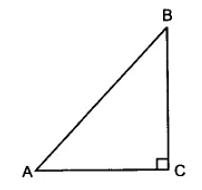
Ans. Since A and B are acute angles.
Then, \(\angle\)C = 90°
Cos A = Cos B
AC/AB = BC/AB
AC = BC
\(\angle\)A = \(\angle\)B (Angles opposite to equal sides are equal)
Hence Proved.
Check-Out:



Comments