



Education Journalist | Study Abroad Lead
Lead acetate is a chemical compound, which is white crystalline in color. Lead acetate is sweet in taste and poisonous in nature. It is also known as Sugar of Lead, Lead Diacetate, Plumbous Acetate, Salt of Saturn and Goulard’s Powder. Lead belongs to Group IV A elements where the majority of the compounds have +2 state. The IUPAC name of lead acetate is Lead (II) Ethanoate. Lead acetate is formed when lead is boiled in hydrogen peroxide and acetic acid. The lead acetate formula is Pb(C2H3O2)2.
| Table of Contents |
Keywords: Lead Acetate, Lead, Hydrochloric Acid, Sulphuric Acid, Ionic, Sugar of Lead.
Lead Acetate Formula
[Click Here for Sample Questions]
The chemical formula of Lead Acetate is Pb(CH3COO)2. It is a combination of lead which is Pb+2 and acetate which is (CH3COO–) ions. In this combination, an electrovalent or ionic bond exists between lead and acetate ions.
It must also be noted that +2 which is the oxidation state of lead makes up the name lead (II) acetate.
- Chemical Structure of Lead Acetate
The chemical structure of lead acetate is as shown below –
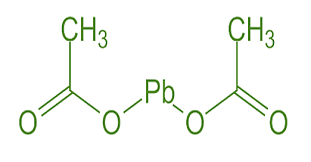
Lead Acetate Structure
Chemical Properties of Lead Acetate
[Click Here for Sample Questions]
Some of the chemical properties of lead acetate are as follows.
- On heating, lead acetate initiates the process of decomposition and it decomposes toxic lead fumes and acetic acid.
- On reacting with hydrochloric acid, lead acetate produces lead chloride with acetic acid. The reaction can be written as:
Pb(CH3COO)2 + 2HCl → PbCl2 + 2CH3COOH
- In reaction with sulphuric acid, lead acetate produces lead sulfate with acetic acid. The chemical formula is as follows.
Pb(CH3COO)2 + H2SO4 → PbSO4 + 2C2H4O2
Physical Properties of Lead Acetate
[Click Here for Sample Questions]
Some of the physical properties of lead acetate are as follows.
- Lead acetate is white in color and crystalline in structure.
- Lead acetate is sweet and known as the sugar of lead.
- Lead acetate is soluble in water and glycerin.
- The melting point of lead acetate is 75 degrees C.
- On boiling, lead acetate decomposes.
- Lead acetate upholds a density of 3.25g/cm3
- The molar mass of lead acetate is 325.29 g/mol.
Uses of Lead Acetate
[Click Here for Sample Questions]
As per the properties of lead, lead acetate is poisonous in nature, even though it has many uses. Some of the uses of lead acetate are as follows:
- Due to the sweetening tendency of lead acetate, it has been used as a sugar substitute in many food items and wine. But by the time the toxicity of lead acetate had been detected, it led to its prohibition in usage as a sweetening agent.
- Lead acetate has been used in cosmetics but it has been identified that it contains carcinogenic properties. Therefore the usage of lead acetate has been banned in cosmetics.
- Many a time, it is used in textile printing and dyeing.
- Lead acetate is used for the detection of hydrogen sulfide gas.
- Lead acetate is used in making anti-foaming agent dispersion agents, emulsifiers, and floatation agents.
Also Read: Lead Iodide
Things to Remember
- Lead acetate is a chemical compound, which is white crystalline in texture and poisonous.
- The chemical formula of Lead Acetate is Pb(CH3COO)2. It is made up of a combination of acetic acid and lead.
- Lead acetate is also known as Lead Diacetate, Sugar of Lead, Plumbous Acetate, Salt of Saturn, whereas its IUPAC name is Lead (II) Ethanoate.
- Lead acetate is formed by boiling lead in acetic acid and hydrogen peroxide.
- Lead acetate is toxic and so it has been prohibited for usage as a sweetening agent and as a cosmetic product.
Sample Questions
Ques. What is Lead Acetate? (2 Marks)
Ans. Lead acetate is an electrovalent or ionic compound. It is made up of lead and acetic acid. Lead acetate is white in color and toxic in nature. Thua, there are many limitations in the usage of lead acetate due to its toxicity.
Ques. What is the level of toxicity of lead acetate? (2 Marks)
Ans. Lead acetate is a component of lead, and by the same virtue, it is toxic. Lead acetate is sweet by taste but due to its toxicity, it is not used for the preparation of any food materials. Moreover, lead acetate has also been used as a cosmetic but it has been observed that it is carcinogenic and so its usage in cosmetics has also been prohibited. So, considering these aspects lead acetate is highly toxic and harmful for human usage.
Ques. In lead acetate what elements are present. (2 Marks)
Ans. Lead acetate is a chemical compound. It is white crystalline in structure and toxic in nature. Lead acetate is made when a lead is boiled in hot hydrogen peroxide and acetic acid. So, in lead acetate specifically, lead and hydrogen are present.
Ques. What is the reaction of lead acetate with sulphuric acid? (2 Marks)
Ans. When lead acetate reacts with sulphuric acid, it produces lead sulfate with the release of acetic acid. The chemical formula of this reaction is as follows
Pb(CH3COO)2 + H2SO4 → PbSO4 + 2C2H4O2
Ques. State some properties of lead acetate. (5 Marks)
Ans. Some of the properties of lead acetate are as follows .
- Lead acetate is white crystalline in colour.
- Lead acetate has the character of lead and is toxic.
- Lead acetate on heating results in the emission of lead fumes with the release of acetic acid.
- Lead acetate is soluble in water and glycerin.
- Lead acetate upholds a melting point of 75-degree C.
Ques. Lead acetate is sweet. Can we use it as a sweetening agent? (2 Marks)
Ans. Lead acetate is sweet in its characteristics. It has been used for a long time as a sweetening agent in food and wine. But due to its poisonous nature, it has been banned from usage and it causes food poisoning.
Ques. Mention some uses of lead acetate. (3 Marks)
Ans. Some of the usages of lead acetate are as follows -
- It is used as an anti-foaming agent and effervescence.
- Lead acetate is used in making the coating of lead in articles.
- It is used in textile printing and dyeing.
Ques. On boiling what happens to lead acetate? (2 Marks)
Ans. Lead acetate is a chemical compound that is formed when lead is added to boiling hydrogen peroxide and acetic acid. On boiling, lead acetate reacts and releases hot fumes of lead and acetic acid.
Ques. Describe the reaction of lead acetate with sodium sulfide. (2 Marks)
Ans. When lead acetate reacts with sodium sulfide (Na2S) the resultant is black-colored lead sulfide and sodium acetate. Chemically this reaction can be elucidated as -
Pb(CH3COO)2 + Na2S → PbS + 2CH3COONa
Ques. Lead acetate is known as the sugar of lead. Can it be used as sugar in food? (2 Marks)
Ans. Lead acetate is a chemical compound that is made up of lead and acetic acid. It is also known as the sugar of lead. Lead is toxic and so is lead acetate. Therefore, lead acetate though being sweet in taste cannot be used as sugar in food.
Check-Out:



Comments