



Exams Prep Master
Marginal product plays an essential role in Commerce, for it helps determine the characteristics of the law of the supply chain. It helps take important business decisions relating to revenue and consumer satisfaction. It also makes sure that the resources of any organization are utilized to their maximum extent. Marginal product is generally calculated by taking the ratio of the overall change in output to the overall change in the input. Let us look in-depth at what a marginal product is, what is its formula, and how it is helpful.
| Table of Content |
Key Takeaways: Marginal product, total product, average product, marginal product formula, the law of diminishing return, resources
Read More: GDP
What is a Marginal Product?
[Click Here for Sample Questions]
In Economics, Marginal Product can be defined as extra product which is produced due to the addition of extra units of input. In simple terms, a change in the production of output in production input is known as marginal product. It is important to remember that all other factors of production like land and capital remain constant. Only the input changes. It is no surprise that a marginal product has a crucial role to play when it comes to short-run production. It helps to understand the laws and determinants of supply. A business only makes progress when the supply of products matches consumer satisfaction. The marginal product helps any business entity to keep their resources under check and helps to maintain a high rate of production and less costs.
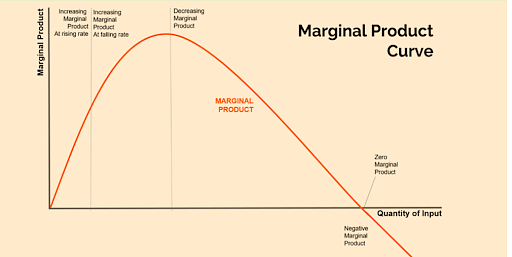
There may be many factors of production involved in the scenario like land, labor, capital, machinery, etc. all these have the capability to affect the production of the product. When any of the factors of production show a rise in the graph, it is sure for the production to rise as well. Marginal product is such a tool that helps monitor this change and its advantages to the market. For example, Dairy Farm Ltd. had 50 healthy cows which satisfied their customers by producing 200 bottles of pure milk. After some time they brought in 10 extra cows and as a result, their production went high by 50 bottles. In this case, the marginal output happens to be 250 - 200 = 50/ 60 - 50. This gives us 50/10, that is 5.
Also Read: Effects Of Climate Changes
Law of Diminishing Return
[Click Here for Sample Questions]
Popularly known as the law of diminishing marginal productivity, diminishing returns states that it occurs when the marginal output of the production is less because of the quantity of single factor production is more. It is said by considering that the other factors of production remain constant. The law of diminishing returns is readily applied to agriculture, forests, mining and building infrastructure.
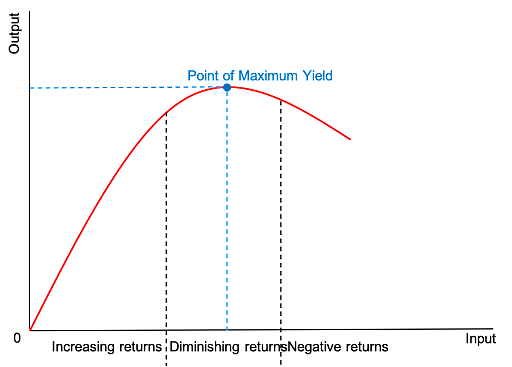
In this case of diminishing returns, the output remains positive throughout, however the productivity and the efficiency decrease. Taking into account an additional factor gives rise to outcomes of considerable growth. When these extra factors become significant in volume, higher factors of production are added. This results in reduced per-unit incremental returns.
Formula of Marginal Product
[Click Here for Sample Questions]
The formula for calculating marginal product is given as,
Marginal product = Change in output change in input
Marginal product = ΔTPΔL
Marginal product = [Qn-(Qn-1)]/[Ln-(Ln-1)]
Where,
Qn = Total production at time n, where n can be defined as the current total production time
Qn - 1 = Total production at time n - 1, where n- 1 refers to the previous total production time
Ln = Total units at time n
Ln - 1 = Total units at time n - 1

The basic motive behind devising marginal products is to analyse the gradual increase in production which happens because of additional units of labour. It thereby gives a chance to admit plenty of workforces which would result in maximum revenue generation, as a result, maximum productivity.
Also Read: Our Environment
Factors Affecting Marginal Product Output
[Click Here for Sample Questions]
There are many factors present that affect the nature of the marginal product output.
Change in various quantities of inputs ultimately brings about a change in the output of marginal products. This may be a change in technology, labour and leads to a shift in the graph.
Consumer demand also affects marginal product output to a certain extent. Organisations end up hiring more work power or employees in order to produce desired products to satisfy the demand in the market. The marginal productivity of any factor of production can never be identified or calculated accurately because we live in a dynamic world. If we are increasing labour to meet our goal, other tools have to be increased in order to fulfil it.

Things to Remember
- Marginal product of a factor of production is the change in output obtained as a result of employing one additional unit of a specific quantity making sure that other units are kept constant. It goes by the term MPP and is especially used in short-run productions.
- Factors of production may be anything like capital, labour, entrepreneurship, land, machinery, etc. they help establish a strong base of the company.
- The relationship between marginal product and the total product includes three main stages and must be carefully observed.
- The law of diminishing return lays down that the extra unit or factor of production will cause a fall in the marginal output.
- The law observes three stages, increasing returns, falling or decreasing return, and negative return.
- Marginal product is calculated with the help of the formula which states that Marginal product =[Qn-(Qn-1)]/[Ln-(Ln-1)].
- It should be kept in check that factors like change in quantities, demands of the consumer, and marginal productivity of factors of production don't end up hampering the nature of the marginal product.
Also Read:
Sample Questions
Ques. What is called the marginal productivity of a product? (3 marks)
Ans. It explains that, if an increasing amount of variable inputs are used, in addition to some fixed units, the resultant output increases more rapidly, then it increases at a uniform rate, and later starts to fall. It is calculated by taking the ratio of the change in total product divided by the change in labour. For example, when one waiter is hired, 5 people are served, whereas when 4 are hired, 20 people are served. As a result, marginal product output is 20 - 5 = 15.
Ques. How are marginal product and total product related? (3 marks)
Ans. The relationship between MPP and TPP takes place in 3 significant steps. These are,
In the first step, both marginal product and total product increase at an increasing rate.
In the second step, TPP starts to increase at a diminishing rate after the employment of many units which are variable. MPP gradually starts to decline.
In the third step, when TPP has reached the peak and is maximum, the value of MPP is 0. After this, TPP also declines and becomes negative.
Ques. How to improve the output of marginal products? (3 marks)
Ans. In order to increase the marginal product output, it has been advised that making minute changes to each element at a time increases the chances of getting better revenue. For example, in order to get a job done, if you employ extra workers, you end up investing more money and other requirements. It gets difficult to find out exactly which factor was responsible for increasing the revenue. Also, you end up spending more on the employees which is much more than the profit made. Thus, increasing the extent of a single element of production can result in a loss of liquidity for the company.
Ques. What does the law of diminishing returns assume? (3 marks)
Ans. The law of diminishing return assumes that,
No change in technology - It makes sure that the techniques of production do not undergo any change. In case there is any change in the former, efficiency would decrease and the desired output won't be produced.
Homogenous units - All factors of production must be homogenous.
Less time period - The law of diminishing returns states that it can only be used for a shorter time period as one or more factors cannot be supplied in excess in that duration of time.
Measurement - The resultant product or the output is calculated in terms like kilograms, tones, etc.
Ques. If a company has an association of employees who are 20 in number. They previously worked for specific projects to get a profit of 20000 rupees. In the current times, the organisation gets the job results in a profit of 40000. What is the marginal output? (2 marks)
Ans. Here, as the employees stay fixed, we can say that, 40000-20000 = 20000
The marginal product is given as 20000 rupees.
Ques. Define marginal product of labour. (2 marks)
Ans. The marginal product of labour is the change in revenue that happens due to adding one extra unit of labour. Labour is the work done by the people which leads to revenue or the production of goods and services. The money received by doing labour is known as wages and serves as a very crucial factor of production.
Ques. Why does the marginal product of labour decrease? (2 marks)
Ans. Diminishing marginal productivity increases the value of inputs during the production time, while other factors remain constant. This results in a fall in productivity and consumer demand is not met.
Ques. Why does the law of diminishing return take place? (2 marks)
Ans. The most and foremost reason is the constant or fixed factors of production. The law is applicable solely because of this reason. The factors cannot be changed all the time. But we know that in order to increase production, factors will have to be increased. So when it is fixed and production doesn’t show a rise, the law applies. The lack of perfect substitutes is also a good reason. It basically means that one factor of production cannot replace another factor of production. As a result, substitutes can't always be made available. In this situation of need, the law of diminishing return comes into effect.
For Latest Updates on Upcoming Board Exams, Click Here: https://t.me/class_10_12_board_updates
Check-Out:



Comments