



Education Journalist | Study Abroad Lead
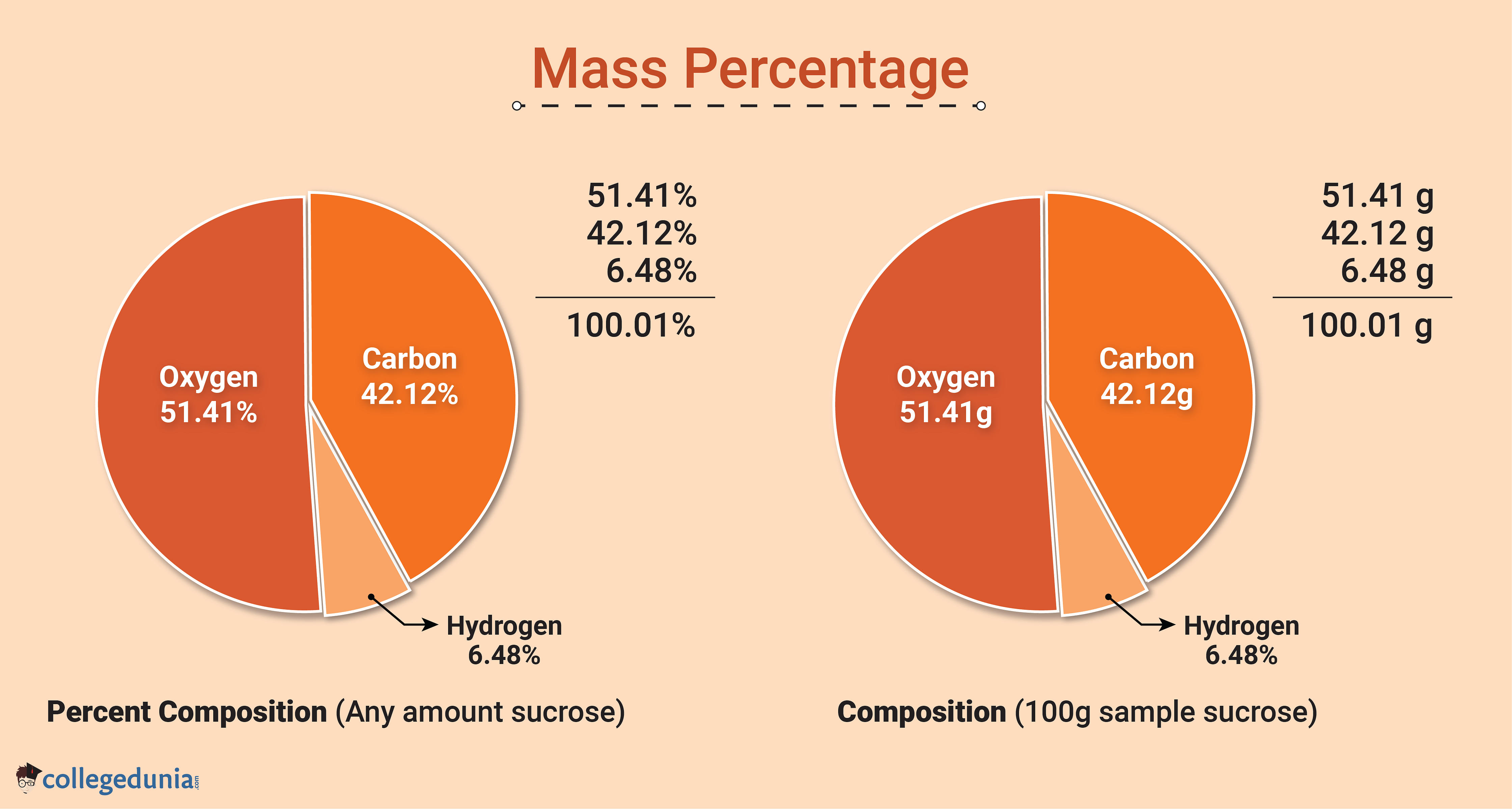
Mass percentage can be defined as the percentage of the mass of a solute to the total mass of a Solution. It is a very common way of expressing the concentration of a Solution. It is typically used in chemistry, biology, and other sciences.
- Mass percentage can also be defined as the percent by mass or weight percent.
- The resulting value is the mass percentage of the solute in the Solution.
- It is also sometimes also known by the name of “percent composition by mass.”
- Mass percentage is a way of expressing the concentration or component of a particular mixture.
- The composition of a Solution can be expressed in mass percentage, which indicates the mass of the solute in the mass of a given Solution.
- The amount of solute is expressed in mass or mol. For Solutions, multiply the number of grams of solute with the gram of Solution by 100 to determine the mass percentage.
| Table of Content |
Key Terms: Mass Percent Formula, Supersaturated Solution, Solution, Solvent, Mass Percentage, Volume Percentage, Colligative Properties, Ideal Solutions, Non-ideal Solutions, Solute, Solubility Product, Azeotropic Distillation, Aqua regia
What is Mass Percentage?
[Click Here for Sample Questions]
In a mixture, the mass percentage of a substance can be calculated by dividing the mass of the substance by the total mass of the mixture and then multiplying by 100 to express it as a percentage. The formula for mass percentage is:
| mass percentage = (mass of substance / total mass of mixture) x 100 |
Mass percent is typically used in chemistry, especially in analytical chemistry, in order to express the amount of a particular solute in a Solution.
Example of Mass Percentage
For instance, suppose we have a mixture of 20 g of salt and 80 g of water. The mass of the salt is:
mass of salt = 20 g
And, the total mass of the mixture is:
total mass of mixture = 20 g + 80 g = 100 g
In the mixture, the mass percentage of the salt is going to be:
mass percentage of salt = (20 g / 100 g) x 100% = 20%
Hence, it means that 20% of the mixture is salt by mass.
The mass percentage is considered to be a very useful way of describing the composition of mixtures, and it is typically used in chemistry and other fields to quantify the amount of one substance in relation to the total mixture.
Also Read:
| Related Topics | ||
|---|---|---|
| Ideal and Non-Ideal Solutions | Fehling’s Test | Ideal Soltuions |
| Azeotropic Distillation | Types of Solutions | Saturated Solutions |
Mass Percentage Formula
[Click Here for Previous Year Questions]
Mass Percentage is a way of expressing degree. It also describes the ingredients in a particular mix. The composition of a Solution is often described by mass. Specific mass Displays the mass of solutes present in a Solution. The number of solutes is expressed in mass or mol.
The formulae for calculating Mass Percentage is as follows:
- Mass percent = (component mass ÷ total mass) x 100%
- Percent mass = (mass solute ÷ mass Solution) x 100%
Mass Percentage formula can also be expressed by dissolving the molar mass of mass of each element in one molar compound. The mass percentage of each element can be determined with these masses. For solving these numerical, a gram of solute is divided by the gram of Solution and then multiplied by 100 to get the mass percentage.
Mass is usually expressed in grams, but any unit of measurement is sufficient as long as equivalent units are used for both the solute component and the mass, and thus the total mass of the Solution mass. The mass percentage is also referred to as weight percentage or weight percentage.
Mass Percentage
Calculating Mass Percentage
[Click Here for Sample Questions]
Mass percentage Calculation of a compound can be followed by the following steps:
Define the equation for the mass percentage of the compound
The basic formula for the mass percentage of a compound is mass percentage = (mass chemicals ÷ total mass compound) x 100. To specify the value as a percentage, multiply the top by 100.
| Mass% = \(\frac {\text {Mass of solute}}{\text {Mass of solution}} \) x 100% |
Calculate the total mass of the compound
Once you know the masses of all the elements or compounds, add them up to calculate the total mass of the final compound or Solution. And this can be the denominator when calculating mass percentages.
Identify the mass of the chemical
If you are asked to find a "mass percentage", you will be asked to find the mass of a particular chemical (the chemical in question) as a percentage of the total mass of all the elements. Then write down the mass of the chemical in question. This mass is the numerator in the calculation of mass percentage.
Variables of the mass percentage equation
Therefore, once you have determined the value of each variable, link it to the equation.
Calculate the mass percentage
Now that the equation is complete, solve the mass percentage. Divide the chemical's mass by the compound's total mass and multiply by 100. This allows you to determine the mass as a percentage of chemicals.
Solutions Video Lecture
Things to Remember
- Mass percentage is a way of expressing degree and describes the ingredients in a particular mix. The composition of a solution is often described by mass.
- Specific mass displays the mass of solutes present in a Solution. The number of solutes is expressed in mass or mol.
- The mass percentage formula by dissolving the molar mass of the mass of each element in one molar compound.
- Mass is usually expressed in grams, but any unit of measurement is sufficient as long as equivalent units are used for both the solute component and the mass, and thus the total mass of the Solution mass.
- The mass percentage is also referred to as weight percentage or weight percentage.
Read Also:
Previous Year Questions
- The vapour pressure of due to….(KCET 2012)
- Number of moles of ions which 1 mole of ionic compound produces...(NEET 2009)
- Which element has the highest first ionization potential...?
- The electronegativities of N, C, Si and P are in the order...
- A graph of vapour pressure and temperature for three different… (JEE Main 2020)
- Two open beakers one containing a solvent and the other… (JEE Main 2020)
- A solution of sodium sulfate contains 92g of… (JEE Main 2019)
Sample Questions
Ques: Calculate grams of NaOCl (6.15% by weight) in 285 grams of billboard bleach Solution. (3 marks)
Ans: During this problem, the equations need to be rearranged to unravel the gram of solute. Given as follows:
Mass Percent = (Mass Solute / Mass Solution) x 100%
1 gram of solute = (mass percent X gram of Solution) / 100
Then, Grams of solute (6.15 x 285) / 100 = 17.52 grams.
Therefore, the gram of solute is 17.52 grams.
Ques: What is the mass percentage of 5g caustic soda dissolved in 100g water? (3 marks)
Ans: The total mass of the compound is the amount of caustic soda plus the amount of water. If the complete mass is 105g, it is 100g + 5g. Currently, the mass of the chemical in question is 5 g of caustic soda. Mass percent = (mass of chemical substance / total mass of compound) x 100 = (5 g / 105 g) x 100. (5/105) x 100 = 0.04761 x 100 = 4.761%. Therefore, the mass percentage of 5g baking soda dissolved in 100g of water is 4.761%.
Ques: Prepare an aqueous Solution of sodium chloride (CaCl2). Determine the mass of a 5% (m / m) Solution of calcium chloride that can be prepared with 100 g of calcium chloride. (4 marks)
Ans: The interpretation of mass/percentage of mass indicates that 5 g of CaCl2 is used to prepare 100 g of Solution. therefore,
G Solution= (100 g CaCl2 x 100 g Solution) / 5 g CaCl2
G Solution= 2 x 10³ g Solution
Therefore, a 2 x 10³ g 5% (m / m) Solution can be prepared with 100 g CaCl2.
Ques: Determine the number of grams of sugar contained in 1500 g of 1.50% aqueous sugar Solution. (4 marks)
Ans: As the mass percentage gives the mass of sugar in 100g of Solution. The two conversion coefficients can be solved as follows.
1.50g sugar / 100g Solution is invested in 100g Solution/ 1.50g sugar
The Solution is given by the first transformation
G sugar = (1500 g Solution x 1.5 g Solution) / 100 g Solution
G sugar = 22.5g sugar
Therefore, 1500g of 1.50% Solution contains 22.5g of sugar.
Ques: What is the mass percentage of hydrogen in water? (4 marks)
Ans: First, we need the formula for water, which is H2O. Next, use the periodic table to find the mass (atomic weight) of 1 mol of hydrogen and oxygen.
Mass of hydrogen = 1008 grams / mol
Mass of oxygen = 16.00 grams per mole
Then use the mass percentage formula. The key to making the calculation correct is to remember that each water molecule has two hydrogen atoms. Therefore, 1 mole of water contains 2 x 1008 grams of hydrogen. The total mass of a compound is the sum of the masses of two hydrogen atoms and one oxygen atom.
Mass percent = (mass of 1 mol compound element / mass of 1 mol compound) x 100
Mass Percentage of Hydrogen = [(2 x 1,008) / (2 x 1,008 16.00)] x 100
Mass percentage of hydrogen = (2,016 / 18,016) x 100
Mass percentage of hydrogen = 11.19%
Ques: Determine the mass percentage of 6 g sodium hydroxide dissolved in 50 g of water. (Note: Since the density of water is almost 1, this type of question often indicates the amount of water in millilitres.) (3 marks)
Ans: First, find the total mass of the Solution.
Total mass = 6 g Sodium hydroxide 50 g Total water mass = 56 g
Now you can find the mass percent of sodium hydroxide using the following formula:
Mass per mass = (grams of solute / gram of Solution) x 100% per mass = (6 g NaOH / 56 g Solution) x mass per 100 mass = (0.1074) x 100 = 10.74% NaOH.
Ques: Find the mass of sodium chloride and water needed to get a 15% Solution of 175 g. (4 marks)
A)NaCl = 26.25 g; Water = 147.75 g
B)NaCl = 36.25 g; Water = 147.75 g
C)NaCl = 26.25 g; Water = 167.75 g
D)NaCl = 40.25 g; Water = 147.75 g
Ans: The correct option is (A).
Enter the given information, starting with the usual equations.
Mass Percentage = (grams of solute / gram of Solution) x 100 15% = (x grams of sodium chloride / total 175 g) x 100
By solving x, you can find the amount of NaCl.
x = 15 x 175/100 x = 26.25 grams of NaCl
Now you know how much salt you need. The Solution consists of the sum of the amount of salt and water. Subtract the mass of salt from the Solution to determine the required mass of water.
Mass of water = total mass-mass of salt mass of water = 175 g-26.25 g mass of water = 147.75
Ques: Show mass percent with the help of an example. (3 marks)
Ans: Mass percent helps to express the concentration of a solute in a solution, given as a percentage by mass.
For instance, consider having a solution of sugar water. By adding 20 grams of sugar to 80 grams of water, we can find the mass percent of the solution by using the formula:
mass percent = (mass of solute ÷ mass of solution) x 100%
The mass of the solute (sugar) is 20 grams, and the mass of the solution (sugar and water combined) is 100 grams (20 g + 80 g) in this case. Hence, we can calculate the mass per cent of the sugar solution as:
mass percent = (20 g ÷ 100 g) x 100% = 20%
Thus, the sugar solution has a mass percentage of 20%, signifying that 20% of the solution's mass is made of sugar.
Ques: What is a Mixture? (2 marks)
Ans: In chemistry, a mixture is a combination of two or more substances in which each substance retains its own chemical identity. The components of a mixture can be separated from each other using physical methods such as filtration, distillation, and chromatography.
Mixtures can be either homogeneous or heterogeneous. In a homogeneous mixture, the components are uniformly distributed throughout the mixture and cannot be visually distinguished from one another, while in a heterogeneous mixture, the components are not uniformly distributed and can be visually distinguished. Examples of mixtures include air, saltwater, and soil.
Ques: What is Solute? (1 mark)
Ans: A solute is a substance that is dissolved in a solvent to create a solution. In a solution, the solute is the substance present in the smaller amount that is dissolved in the solvent, which is the substance present in the larger amount. For example, when salt is dissolved in water, salt is the solute and water is the solvent. T
For Latest Updates on Upcoming Board Exams, Click Here: https://t.me/class_10_12_board_updates
Read More:



Comments