



Education Journalist | Study Abroad Lead
The mean value theorem (MVT), sometimes known as Lagrange's mean value theorem (LMVT), establishes a formal foundation for a rather simple assertion linking a function's change to its derivative's behaviour. According to the theorem, a continuous and differentiable function's derivative must equal the function's average rate of change in a given interval.
| Table of Content |
Key Takeaways: Mean value theorem formula, Function, Value, Slope, Continuous, Differentiable, Derivative, Mean value, Calculus, Real Number
Also Read: L’hospital Rule
What is the Mean Value Theorem?
[Click Here for Sample Questions]
The mean value theorem asserts, approximately, that for each planar arc between two endpoints, the tangent to the arc is parallel to the secant across its endpoints at least one point. Starting with local hypotheses about derivatives at locations on the interval, this theorem is used to prove assertions about a function on an interval. The mean value theorem, as simple as it seems, is at the basis of the proof of the basic theorem of calculus and is ultimately dependent on real-number qualities.
The video below explains this:
Mean Value Theorem Detailed Video Explanation:
Also Read: Trigonometry Values
Formula of Mean Value Theorem
[Click Here for Sample Questions]
If f(x) is continuous on [a, b] and differentiable on (a, b), the Mean Value Theorem asserts that there exists an integer c between a and b and the secant line connecting the points (a, f(a)) and (b, f(b)) will be parallel to the tangent to the curve of the function at point c.

The mean value theorem is an extension of Rolle's theorem, which implies f(a)=f(b) such that the right hand has a zero above it. This indicates that for at least one point on the curve between the two ends, the slope of the tangent line will be equal to the slope of the secant line between (a, f(a)) and (b, f(b)).

Also Read: Maxima and Minima
Proof of Mean Value Theorem
[Click Here for Sample Questions]
According to the mean value theorem, if a function f is continuous over the closed interval [a,b] and differentiable over the open interval (a,b), there must be at least one point c in the interval (a,b) where f(c) is the average rate of change of the function over [a,b] and parallel to the secant line over [a,b].
The formula \(\frac{f(b)-f(a)}{b-a}\) yields the slope of the line connecting the points (a,f(a)) and (b,f(b)), which is a chord of the graph of f , while f(x) calculates the slope of the tangent to the curve at the given location.
g(x)=f(x)-rx where r is constant fis continuous on a,b and differentiable on (a,b), while g is the same. We now wish to pick r such that g meets Rolle's theorem's criteria. So

Because g is differentiable and g(a)=g(b), there is some c in (a,b) for which g'(c)=0, according to Rolle's theorem, and it follows from the equivalence g(x)=f(x)-rx that

hence proved.
Also Read: Onto Function
Mean Value Theorem for Derivatives
[Click Here for Sample Questions]
We can approximate the derivative of any function using the mean value theorem. The slope of a tangent line and the secant line on a curve may be linked using the theorem. There exists a point c if f is differentiable over (a,b) and continuous over [a,b]. Such that c is a<c<b and that
f’(c) = \(\frac{f(b)-f(a)}{b-a}\)Now, if we draw a secant line linking A and B, we may deduce that the secant line's slope is \(\frac{f(b)-f(a)}{b-a}\). Similarly, if we draw a tangent line to f (x) at x = c. Its slope is known to us f′(c).

Discover about the Chapter video:
Continuity and Differentiability Detailed Video Explanation:
Also Read:
Things to Remember
Following are some important points:
- The slope of the tangent of the point is the same as the slope of the straight line connecting the two-interval endpoints at a certain point in the interval.
- According to the Theorem, there is a point in the interval when the function's instant change equals its average rate of change throughout the interval.
- The Mean Value Theorem implies that the function is continuous and differentiable at point 'c' in the interval.
- It's termed the "mean value theorem" because the words "mean" and "average" are synonymous.
Also Read: Secant Function
Sample Questions
Ques: How can I calculate the numbers c that satisfies the Mean Value Theorem f(x) =3x2+2x+5 on the interval [-1,1] ? (3 marks)
Ans: Given function is f(x)=3x2+2x+5
Interval is [-1,1]
To find c
f(x)=6x+2
f(-1)(a)=3×-1+2×-1+5=3-2+5
f(1)(b)=3×1+2×1+5=3+2+5
f(c)= \(\frac{f1-f(-1)}{1-(-1)}\)
6c+2=\(\frac{3+2+5-3-2+5}{2}\)
6c+2=\(\frac{4}{2}\)
6c+2=2
6c=2-2=0
c=0
Ques: Find the value of c for the function f(x)=x2 on 2,4? (3 marks)
Ans: If f(x) is defined and continuous on the interval [a, b] and differentiable on (a, b), the mean value theorem asserts that there is at least one number in c in the interval [a, b].
To find c
f(x)=2x
f(2)(a)=2×2=4
f(4)(b)=4×4=16
By using the formula
f(c)=\(\frac{f(b)-f(a)}{b-a}\)
f(c)=\(\frac{16-4}{2}\)=\(\frac{12}{2}\)=6
2x=6
x=\(\frac{6}{2}\)
x=3
c=3
Ques: Assume that f(x) is a continuous and differentiable function on the interval.[-7,0] that f(-7)=-3 and that f'(x)≤2. What is the largest possible value for f(0)? (3 marks)
Ans: We were told in the problem description that the function (whatever it is) fits the requirements of the Mean Value Theorem so let’s start out this and enter in the known values.
f(0) – f(-7) = f' (c) (0-(-7)) → f(0) +3=7f'(c)
Solve for f(0)
f(0) = 7f'(c) -3
Finally, we'll look at what we know about derivatives. We're told that the derivative's maximum value is 2. As a result, entering in the greatest possible value of the derivative into f'(c above will give us the maximum value of in this situation. This results in:
f(0) =7f'(c) – 3 ≤7(2) – 3 = 11
So, the largest possible value is:
f(0) ≤ 11
Ques: If f: [-5,5] → R is a differentiable function and if f'(x) does not vanish anywhere, then prove that f(-5) ≠ f(5). (4 marks)
Ans: f: [-5,5] →R is a differentiable
We also know that every differentiable function is continuous.
Therefore, f is differentiable and continuous both on (-5,5)
By mean value theorem, there exists some c in (-5,5)
Such that f'(c)) = \(\frac{f(b)-f(a)}{b-a}\)
Given that
f'(x) does not vanish anywhere
f'(x)≠0 for any value of x
Thus,
f'(c)≠0
\(\frac{f(5)-f(-5)}{5-(-5)}\) ≠ 0
\(\frac{f(5)-f(-5)}{5+5}\) ≠ 0
f(5) – f(-5) ≠ 0×10
f(5) – f(-5) ≠ 0
f(5) ≠ f(-5)
Hence proved
Ques: Assume we already know that f(x) Everywhere, it is continuous and differentiable. Assume, too, that we already know f(x) has 2 roots. Show that f(x) have at least one root in it. (3 marks)
Ans: We already know that f(x) has 2 roots. Let’s suppose they are a and b Assumingly, we now know that f(x) is continuous and differentiable everywhere, and this is especially true on [a,b] and distinguishable on (a,b).
f'(c)) = \(\frac{f(b)-f(a)}{b-a}\)
But we now need to recall that a and b are the roots of f(x)
f' (c) = \(\frac {0 - 0} {b - a} = 0\)
f(x) has a root at x=c
It's worth repeating that we don't know a value for c. We've merely demonstrated that it exists. We've also left out the fact that c is the sole root. More than one root is entirely possible.
Ques: Given y = x3- 4x find a value in the interval (-2,2) which satisfies Rolle’s theorem (3 Marks)
Ans: Firstly we need to verify that Rolle’s theorem can be applied f(-2) = 0 and f(2) = 0 and f(x) is continuous and differentiable.
Then f(x) = 3x2 - 4x
There must be one value of x between -2 and 2 for which f(x) = 0
3x2 - 4=0
x2 = \(\frac{4}{3}\)
x= + \(\frac{2\sqrt {3}}{3}\)
Hence there are two values which satisfy Rolle’s Theorem
Ques:. Determine if the Mean Value Theorem can be used to solve the following function on a closed interval. If that's the case, look up all of the potential value? (4 Marks)
f(x) = \(\frac{x}{1+x}\) on [1,3]
Ans: We are given the functionfx=x1+x and the interval 1,3. This function is continuous on the closed interval 1,3 since it is the quotient of continuous functions y=x and y=1+x.
\(f'(x) = \frac{(1+x)(1)-x(1)}{(1+x)^2} = \frac{1}{(1+x)^2}\)
We can clearly see that f is differentiable on the open interval 1,3 .The Mean Value Theorem's assumptions have now been satisfied. Let's use the Mean Value Theorem to determine all potential c values in the open interval using the Mean Value Theorem (1,3). Then

Ques: What is the most important distinction between the mean value theorem and Rolle's theorem? (4 Marks)
Ans: The mean value theorem states that:
f has to satisfy the conditions given below
- On [a,b] f is continuous
- On [a,b] f is differentiable
Then for c ∈ (a,b)
\(f' (c) = \frac{f(b)-f(a)}{b-a}\)
The Rolle’s theorem states that:
- On [a,b] f is continuous
- On [a,b] f is differentiable
- f(a) = f(b)
Then for c ∈ (a,b)
f'(c) =0
Rolle's Theorem is a special case of the Mean Value Theorem, as may be seen. Rolle's Theorem, on the other hand, is fairly simple to establish.
Ques: Give proof for Cauchy mean value theorem? (5 Marks)
Ans: First and foremost, the denominator in the Cauchy formula's left side is not zero:


Then by Rolle’s theorem
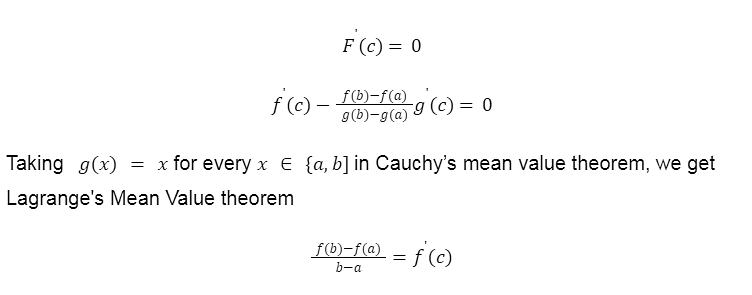
There is a point (f(c),g(c)) on the curve where the tangent is parallel to the chord joining the ends and of the curve.

Ques: For the functions, f(x)=x4 and g(x)=x2 test the validity of Cauchy's mean value theorem on the interval 1,2 (4 Marks)
Ans: These functions' derivatives are: f'(x)=(x4)=4x3,g'(x)=(x2)=2x.

This number clearly falls inside the range of 1,2 and so fulfils the Cauchy theorem.
For Latest Updates on Upcoming Board Exams, Click Here: https://t.me/class_10_12_board_updates
Check-Out:



Comments