



Education Journalist | Study Abroad Lead
Michelson Morley experiment was named after the two scientists Michelson and Morley who experimented based on the fact that sound and light travel at different speeds. The Michelson-Morley experiment was a scientific experiment conducted in 1887 by American physicist Albert A. Michelson and his colleague Edward W. Morley. The experiment was designed to detect the existence of the luminiferous ether, a hypothetical medium that was thought to be necessary for the propagation of light through space.
Key Terms: Velocity, Speed of light, Interferometer, Electromagnetic Waves, Relative Motion
What is Michelson Morley’s Experiment?
[Click Here for Sample Questions]
Michelson Morley's experiment is one of the most famous and successful theories. Michelson and Morley measured the speed of light by looking for interference fringes between the light which passed through two perpendicular arms of the apparatus. The speed of light depends on the relative motion through space.
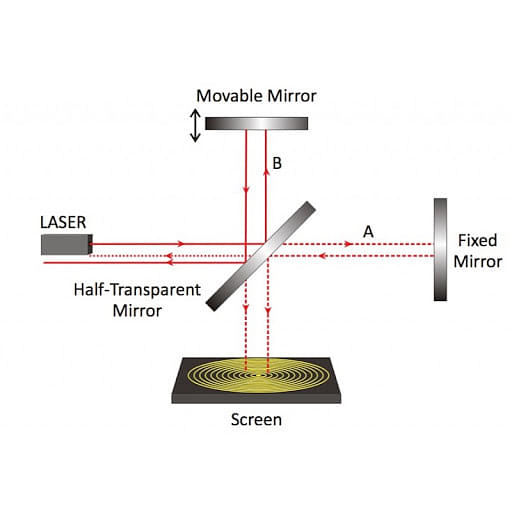
Diagrammatic representation of Michelson Morley Experiment
Also read:
Luminiferous Ether Concept
[Click Here for Sample Questions]
Luminiferous ether is a theoretical substance that is being used as a medium for the passage of electromagnetic waves. It was stated as a theoretical medium that was said to be frictionless, and weightless but after the special theory of relativity, the concept of luminiferous ether lost significance.
Through the experiment, they compared the speed of light in perpendicular directions so that the relative motion of matter can be detected through the stationary luminiferous aether.
The existence of the ether and the velocity of the earth could not be proved through this experiment even though it was performed with full sophistication.
The Procedure of Michelson Morley Experiment
[Click Here for Sample Questions]
To perform the Michelson Morley experiment, here is the procedure which needs to be followed:
- An interferometer is set up and then a beam of light is passed through the silver glass plate. The plate acts as a beam splitter which splits the light into two coherent beams.
- Then the beam strikes the first mirror and reflects and then the reflected beam strikes the second mirror.
- Then the beam reaches the telescope and then interference patterns are made by the two rays.
- The distance between the two mirrors and the silver mirror is kept the same. So, the light reflected from the two mirrors interferes with the mirror.
- The apparatus and the light both move in the same direction.
Interferometer
[Click Here for Sample Questions]
Michelson and Morley designed an interferometer that consists of a light source, glass plate, mirror, and telescope. The two mirrors are placed at right angles to each other. The distance between the mirror and the glass is equal.
The different components of the interferometer are:
- Beam splitter
- Screen
- Mirror
- Silver glass plate
Things to Remember
- Michelson and Morley measured the speed of light by looking for interference fringes between the light which passed through two perpendicular arms of the apparatus.
- Luminiferous ether is a theoretical substance that is being used as a medium for the passage of electromagnetic waves.
- Michelson and Morley designed an interferometer that consists of a light source, glass plate, mirror, and telescope.
- The distance between the two mirrors and glass is at an equal distance in the interferometer.
Sample Questions
Ques. What is the Michelson-Morey experiment? (1 Mark)
Ans: Michelson Morey is an experiment that compares the speed of light to notice the relative motion of the earth through ether but it couldn't prove it.
Ques. What is luminiferous ether? (1 Mark)
Ans: Luminiferous ether is defined as a theoretical substance that acts as a medium for the passage of electromagnetic waves like the x-rays, light rays, etc. they are assumed to be frictionless, transparent, and weightless.
Ques. What is the Michelson interferometer? (2 Marks)
Ans: Interferometer is a device invented by Michelson which consists of a silver glass plate that is oriented at 45 degrees to the light and it splits the light into two equal beams which reflect the mirror and then again reflect the other mirror and enter the telescope. Hence, the interference patterns of the reflected light rays are approved.
Ques. What are the different components of an interferometer? (1 Mark)
Ans: The different components of an interferometer are a beam splitter, screen, two mirrors, coherent light source, and silver glass plate.
Ques. Is the ether theory of Morley Michelson's experiment proved? (1 Mark)
Ans: The ether theory of Morley Michelson's experiment was not able to prove the existence of ether or the velocity of the earth. Various other scientists also tried to prove the theory but were unsuccessful.
Ques. Who were the scientists who experimented with ether theory? (1 Mark)
Ans: Morley and Michelson were the scientists who performed the Morley-Michelson experiment to prove the ether theory.
Ques. Which theory proved the non-existence of the ether theory? (1 Mark)
Ans: After the special theory of relativity was developed, the theory of luminiferous ether lost its existence.
For Latest Updates on Upcoming Board Exams, Click Here: https://t.me/class_10_12_board_updates
Check Out:



Comments