



Education Content Expert
Muscular Dystrophy is a group of genetic disorders that cause progressive muscle weakness and loss of muscle mass.
- Muscular dystrophy is caused by genetic mutations that affect the production of proteins needed for muscle health.
- There are many different types of MD each with its own specific symptoms, progression, and genetic cause.
- Muscular dystrophy affects muscles throughout the body and can cause muscle weakness, wasting, and difficulty performing daily activities.
- It can also affect the heart and respiratory system, and in some cases, lead to intellectual disability or hearing loss.
There is currently no cure for MD, but treatments such as physical therapy, occupational therapy, and medications can help slow the progression of the disease.
Read More: NCERT Solutions For Class 11 Biology Locomotion and Movement
| Table of Content |
Key Terms: Muscular Dystrophy, Duchenne Muscular Dystrophy, Muscles, Genetic Disorder, Genes, Becker Muscular Dystrophy
Muscular Dystrophy Meaning
[Click Here for Sample Questions]
Muscular Dystrophy is a condition in which there is a progressive degeneration of skeletal muscle most probably due to a genetic disorder. There are multiple types of muscular dystrophy, each affecting specific muscle groups, with signs and symptoms appearing at different ages, and varying in severity.
- The severity and progression of muscular dystrophy can vary widely, with some forms causing only mild weakness, while others can lead to severe disability and premature death.
- Different types of muscular dystrophy are caused by mutations in different genes.
- The most common form is Duchenne muscular dystrophy, which primarily affects boys.
- It is caused by a mutation in the gene that codes for dystrophin, a protein important for muscle function.
- Treatment for muscular dystrophy include physical therapy, assistive devices, and medications to slow the progression of the disease.
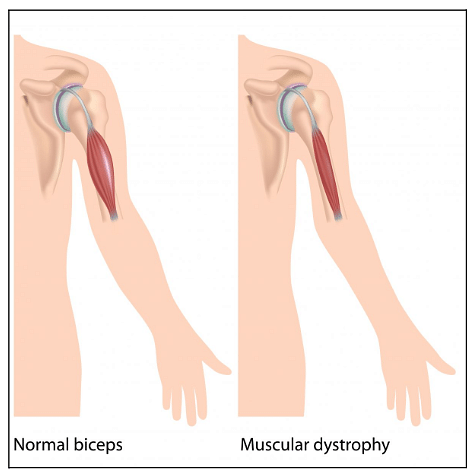
Muscular Dystrophy
Types of Muscular Dystrophy
[Click Here for Previous Year Questions]
There are different genetic mutation within each type of Muscular Dystrophy. People who suffer from the same kind of muscular dystrophy can experience distinct symptoms.
Muscular Dystrophy can be classified into various types as follows:
Duchenne/Becker Muscular Dystrophy
- It is the most common and severe form of muscular dystrophy, primarily affecting boys.
- It is caused by a mutation in the gene that codes for dystrophin, a protein important for muscle function.
- Symptoms usually appear in early childhood, with progressive muscle weakness and loss of function.
- It leads to difficulty walking, climbing stairs, and getting up from a seated position.
Myotonic Muscular Dystrophy
- It is also known as Steinert's disease.
- It is characterized by muscle weakness, stiffness, and prolonged muscle contractions (myotonia) in the face, hands, and feet.
- It is caused by a genetic mutation that affects the myotonin protein kinase gene.
Read More:
| Relevant Concepts | ||
|---|---|---|
| Atrophy | Disorders Muscular and Skeletal System | Locomotion and Movement |
| Paralysis Symptoms | Difference between Upper and Lower Motor Neurons | Deltoid Muscle |
Limb-Girdle Muscular Dystrophy
- There are multiple subtypes of LGMD each caused by different gene mutations.
- Symptoms of LGMD typically appear in the shoulders and hips.
- It involves muscle weakness, wasting, and trouble with balance and coordination.
Facioscapulohumeral Muscular Dystrophy
- This type of muscular dystrophy affects the muscles of the face, shoulders, and upper arms.
- It is characterized by gradual muscle weakness and wasting.
- It leads to difficulty with facial expressions, raising the arms, and climbing stairs.
Congenital Muscular Dystrophy
- This type of muscular dystrophy is present at birth.
- It is caused by mutations in various genes that are responsible for muscle development.
- Symptoms include muscle weakness and wasting, as well as joint and limb contractures, which are restrictions in the range of motion of a joint.
Distal Muscular Dystrophy
- The symptoms primarily affect the distal muscles of the body, such as the hands, feet and lower legs.
- It can lead to difficulty with fine motor skills and difficulty in walking.
Oculopharyngeal Muscular Dystrophy
- This type of muscular dystrophy affects the muscles of the eyes and throat.
- It typically starts in adulthood and causes drooping eyelids and difficulty swallowing.
Emery-Dreifuss Muscular Dystrophy
- This type of muscular dystrophy affects the muscles of the upper arms, lower legs and heart.
- It is characterized by progressive muscle weakness and heart problems, such as heart block.
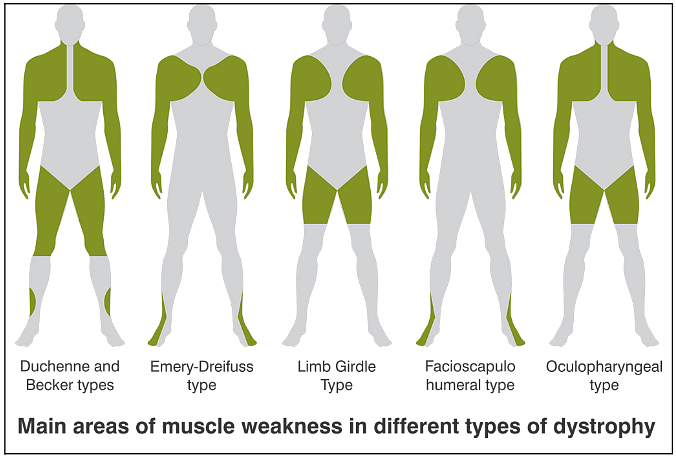
Muscle Weakness in Types of Dystrophy
Here is a summary of all the types of muscular dystrophy:
| Types of Muscular Dystrophy | Affected Gender | Affected Body Parts |
|---|---|---|
| Duchene/ Becker Muscular Dystrophy | Males | Heart, Lungs, Throat, Spine, Intestine, Stomach |
| Myotonic Muscular Dystrophy | Males and Females equally | Brain, Eyes, Hormone-Producing Organs |
| Limb- Girdle Muscular Dystrophy | Males and Females equally | Hips, Calves, and Trunk |
| Facioscapulohumeral Muscular Dystrophy | Males and Females equally | Eyes, Ears, Lower Legs |
| Congenital Muscular Dystrophy | Males and Females equally | Brain, Heart, Spine |
| Distal Muscular Dystrophy | Males and Females equally | Heart, Arms, Legs |
| Oculopharyngeal Muscular Dystrophy | Males and Females equally | Shoulder, Upper Legs, Hip |
| Emery- Dreifuss Muscular Dystrophy | Males | Throat, Shoulders, Hip |
Read More: Locomotion and Movement Important Questions
Symptoms of Muscular Dystrophy
[Click Here for Sample Questions]
The symptoms of muscular dystrophy generally exhibit themselves in children, and yet some symptoms are not visible till adulthood.
The typical symptoms of Muscular Dystrophy include:
- Poor Balance
- Inability to Jump or Run
- Waddling Gait
- Deformation of The Calf
- Trouble in Getting Up from Lying or Sitting Positions
- Inability to Learn from Others
- Delayed Growth
- Muscle Pain and Stiffness
- Frequent Falls
- Walking on the Toes
Causes of Muscular Dystrophy
[Click Here for Previous Year Questions]
The causes of muscular dystrophy are as follows:
- There are certain genes responsible for making proteins that shield muscle fibers.
- Muscular dystrophy mainly occurs when one of these genes is defective.
- The main cause as per research for muscular dystrophy is caused by genetic mutation specifically to that type of the disease.
- Most of the mutations are inherited.
Risk Factors of Muscular Dystrophy
- Muscular dystrophy occurs in both genders and can be seen in all ages and races.
- The most common is Duchene/ Becker (DMD/BMD) which occurs in young boys usually.
- People with a family history of muscular dystrophy are prone to the risk of developing the disease or passing it on to their children.
Read More: Difference between Locomotion and Movement
Diagnosis of Muscular Dystrophy
[Click Here for Sample Questions]
There are multiple ways for tests that can help doctors to diagnose Muscular dystrophy:
- Testing blood sample for the enzymes released by damaged muscles.
- Examining blood for the genetic markers of muscular dystrophy.
- Performing electromyography test on muscle’s electrical activity using an electrode needle that enters muscle.
- Performing a muscle biopsy to examine a sample of muscle for muscular dystrophy.
Treatment of Muscular Dystrophy
[Click Here for Previous Year Questions]
Muscular Dystrophy is rare, with little data on how many people are affected. The Centers for Disease Control and Prevention (CDC) is working to estimate the number of people with each major kind of muscular dystrophy in the United States. There is no cure as for now but frequent treatments can help manage the symptoms and slow the progression of the disease.
Treatment for muscular dystrophy depend on the patient's symptoms and include the following:
- Corticosteroid drug helps in muscle strengthening and slow muscle deterioration.
- Assisted ventilation if respiratory muscles are affected.
- Medication for heart issues.
- Surgery to rectify the shortening of your muscles.
- Surgery to repair cataract.
- Surgery to treat scoliosis.
- Surgery for cardiac issues.
Check More:
| Related Topics | ||
|---|---|---|
| Skeletal System | Brain Tumors & Neurodegenerative Diseases | Muscular Tissue |
| Leg Muscles | Difference between Cardiac Muscle and Skeletal Muscle | Abdominal Muscles |
Things to Remember
- Muscular dystrophy is a group of inherited diseases that cause muscle weakness and degeneration.
- Muscular dystrophy is mostly of eight different types with Duchene Muscular Dystrophy being the most common.
- Duchene Muscular Dystrophy (DMD) mostly affects males of younger age.
- Initial symptoms of Muscular dystrophy include deformities, crooked spine, decreased muscle tone, intellectual retardation, etc.
- People diagnosed with muscular dystrophy are referred to neurologists, geneticists, and physiotherapists for treatment.
Previous Years’ Questions
- Which of the following muscular disorders is inherited… (NEET - 2019)
- Which of the following is an autoimmune disease… (JIPMER - 2015)
- Energy for muscle contraction is provided by reserve…
- Number of cervical vertebrae in camel is… (NEET - 1990)
- In human body which one of the following is an atomically… (NEET - 2007)
- During muscle contraction in humans, the… (NEET - 2013)
- Which cartilage is present on the end of long bones… (NEET - 1989)
- Lack of relaxation between successive stimuli in sustained muscle… (NEET - 2016)
- What will happen if ligaments are cut or broken… (NEET - 2002)
- Which of the following pairs is correctly matched… (NEET - 2005)
Sample Questions
Ques. What is Muscular Dystrophy? (1 Mark)
Ans. Muscular dystrophy is defined as a progressive degeneration of skeletal muscle mostly due to a genetic disorder. It occurs in both sexes and can be seen in the early stages of childhood and at the age of 70 yrs.
Ques. When was Duchene Muscular Dystrophy discovered? (1 Mark)
Ans. Duchene Muscular Dystrophy (DMD) was first described by the French neurologist Guillaume Benjamin Amand Duchenne in the 1860s. In 1986, MDA-supported researchers identified a particular gene on the X chromosome that, when mutated, leads to DMD.
Ques. State the types of Muscular dystrophy. (2 Marks)
Ans. The types of Muscular dystrophy are as follows:
- Duchene/ Becker Muscular Dystrophy
- Myotonic Muscular Dystrophy
- Limb-Girdle Muscular Dystrophy
- Facioscapulohumeral Muscular Dystrophy
- Congenital Muscular Dystrophy
- Distal Muscular Dystrophy
- Oculopharyngeal Muscular Dystrophy
- Emery-Dreifuss Muscular Dystrophy
Ques. State a few symptoms of Muscular Dystrophy. (2 Marks)
Ans. The typical symptoms of Muscular Dystrophy include
- Poor Balance
- Inability to Jump or Run
- Waddling Gait
- Deformation of the Calf
- Trouble In Getting Up from Lying or Sitting Positions
- Inability to Learn from Others
- Delayed Growth
- Frequent Falls
Ques. What are the causes of Muscular Dystrophy? (5 Marks)
Ans. Muscular Dystrophy (MD) is a group of genetic disorders that cause progressive muscle weakness and loss of muscle mass. There are many different types of Muscular dystrophy, each with its specific causes. Some of the most common causes of Muscular dystrophy include:
- Genetic Mutations: The most common cause of MD is a genetic mutation that affects the production of proteins needed for muscle health.
- Inheritance Patterns: Many forms of Muscular dystrophy are inherited in a specific pattern, such as X-linked recessive or autosomal dominant.
- Deletion or Duplication of Genetic Material: Some forms of MD are caused by the deletion or duplication of small segments of genetic material.
- Environmental Factors: Some studies have suggested that exposure to certain environmental toxins, such as pesticides, may increase the risk of developing MD. However, more research is needed to confirm these findings.
- Other Genetic Disorders: Some forms of Muscular dystrophy are caused by mutations in other genes that are not directly involved in muscle health but affect other genes that do.
Ques. How is the Muscular Dystrophy Diagnosis done? (5 Marks)
Ans. There are many different types of Muscular Dystrophy, each with its specific diagnostic methods. Some of the most common ways to diagnose Muscular Dystrophy include
- Medical History and Physical Examination: A doctor will ask about a patient's symptoms and medical history, and will perform a physical examination to look for signs of muscle weakness or wasting.
- Blood Tests: Blood tests can be used to measure levels of certain enzymes and proteins that are related to muscle health.
- Genetic Testing: Genetic testing can be used to identify specific genetic mutations that cause Muscular Dystrophy. This can be done by analyzing a sample of blood or saliva, and can confirm a diagnosis of a specific type of Muscular Dystrophy.
- Biopsy: In some cases, a small sample of muscle tissue may be taken for examination under a microscope. This can help to determine the type of Muscular Dystrophy and can also help to rule out other muscle disorders.
- Imaging Studies: Imaging studies such as MRI and CT scans can be used to evaluate the muscles and can show specific patterns of muscle wasting, inflammation, or fatty infiltration in Muscular Dystrophy cases.
Ques. What are the various treatments for Muscular Dystrophy? (3 Marks)
Ans. There is no cure for Muscular Dystrophy, but there are a variety of treatments that can help to slow the progression of the disease, improve muscle strength and function, and increase a patient's quality of life. Some of the most common treatments for Muscular Dystrophy include
- Physical Therapy: Physical therapy can help to maintain muscle strength and function, and can also help to prevent contractures (stiffening of joints) and scoliosis (curvature of the spine). Physical therapy exercises may include range-of-motion exercises, stretching, and resistance training.
- Occupational Therapy: Occupational therapy can help people with Muscular Dystrophy to maintain their independence and improve their ability to perform daily activities. An occupational therapist can teach patients how to use adaptive equipment, such as walkers or wheelchairs, and can also make recommendations for modifying the patient's home or work environment.
- Orthopedic Surgery: Some people with Muscular Dystrophy may require orthopedic surgery to correct deformities or to relieve pain. For example, surgery may be used to correct scoliosis or to release tendons that have become tight.
Ques. What are the various symptoms of Muscular Dystrophy? (5 Marks)
Ans. Symptoms of Muscular Dystrophy can vary depending on the type of Muscular Dystrophy, but some common symptoms include
- Muscle Weakness: One of the most common symptoms of Muscular Dystrophy is muscle weakness, which typically begins in the muscles of the hips and shoulders and progresses to the muscles of the limbs and trunk.
- Wasting (atrophy) of Muscles: As Muscular Dystrophy progresses, the muscles can become smaller, or atrophic, due to the loss of muscle fibers.
- Delayed Motor Milestones: Some forms of Muscular Dystrophy are congenital, meaning that symptoms present at birth or in early childhood, in such cases delayed motor milestones such as difficulty in standing or walking may be seen.
- Difficulty in Climbing Stairs, or Lifting Objects: As the muscle weakness progresses, it may become more difficult to perform everyday activities.
- Cardiac and Respiratory Problems: Some forms of Muscular Dystrophy can affect the heart and lungs, causing heart or respiratory muscle weakness which can lead to symptoms such as shortness of breath and fatigue.
Ques. Explain Duchenne and Becker Muscular Dystrophy. (2 Marks)
Ans. Duchenne Muscular Dystrophy is caused by a mutation in the dystrophin gene, which leads to the absence of the protein dystrophin.
Becker Muscular Dystrophy is caused by a mutation in the dystrophin gene, similar to Duchenne Muscular Dystrophy, but the mutation results in a partially functional form of the dystrophin protein.
Ques. What is Distal Muscular Dystrophy? (1 Mark)
Ans. Distal Muscular Dystrophy is a group of disorders that affect muscles farther away from the center of the body, including the hands and feet. There are several types of distal Muscular Dystrophy, each caused by a different genetic mutation.
Check-Out:



Comments