



Education Journalist | Study Abroad Lead
Plumule is a component of the seed embryo, which upon germination of seeds, develops into the shoot. Plumule is also referred to as a baby plant or a new plant arising from the seed embryo. It is the shoot tip that gives rise to a new plant. Once the seed starts germinating, small new tender leaves start arising from the seed embryo. Plumules are present above the cotyledons and develop into a plant giving rise to several leaves, branches, flowers and seeds. Plumule is primarily composed of the epicotyl, young leaves and the shoot apical meristem.
| Table of Content |
Key Terms: Plumule, Radicle, Embryonic Root, Embryonic Shoot, Seed Embryo, Cotyledons, Apical Meristem, Germination, Flower, Seed, Plant
Definition of a Seed
[Click Here for Sample Questions]
A seed is a small, embryonic plant that is enclosed in a protective shell called the seed coat, which generally contains some stored nutrition. The seed coat, endosperm, and embryo are the three primary components of a seed. A seed is a critical component of any flowering plant that plays a crucial role in the plant's life cycle.
Because the seed has an embryo that later grows into a plant after germination, in this phase, the seed requires fundamental ingredients such as sunlight, optimal temperature, sufficient moisture, and nutrition-rich soil to develop into a plant. During this phase, the seed grows into a younger plant with primary parts such as embryonic leaves, shoots, and roots.
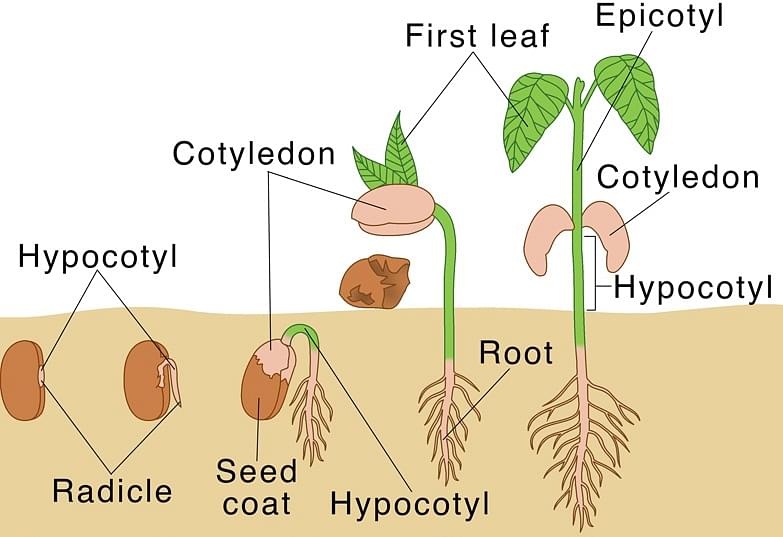
Germination
Learn More About:
What is Radicle?
[Click Here for Previous Year Questions]
After the process of germination, the embryo of the seed grows into a radicle, which is nothing but the embryonic root of the seedling. The seedling laterally develops and becomes the root of the plant, which grows from the micropyle of the seed. It further develops into the soil by absorbing water and minerals from the soil. After the growth of the radicle, the plumule emerges from the seed, which later supports the cotyledons for the photosynthetic process. Here, the cotyledons produce the necessary foods required for the development of the plant.
There are two types of radicle, which are synchronous and antitropous. They differ from each other in their direction of growth. The synchronous is nothing but the typical radial, which grows towards the hilum. Similarly, the antitropous is termed the radicle's growth away from the hilum.
Definition of Plumule
[Click Here for Sample Questions]
The embryonic shoot which comes out of the seed is called plumule. It later develops into the primary leaves above the cotyledons. After the germination process, the developing tip of this embryonic shoot is called epicotyl, which can also be called plumule. The epicotyl further develops into stems, leaves, and flowers of the plant.
Besides, seed germination can be categorized into two parts: hypogeal germination and epigeal germination. Epigeal germination is nothing but the growth of plumules above the ground with cotyledons. The hypogeal germination occurs when the plumule grows above the soil, and the cotyledons grow beneath the soil.
Further, the plumules are conical in shape. The cotyledons begin to store food, and the plumule begins to shrink and become small. Sometimes, the seed stores a very small amount of food. In such a case, the plumule becomes large and grows exponentially to form leaves. These leaves are responsible for the photosynthetic process.
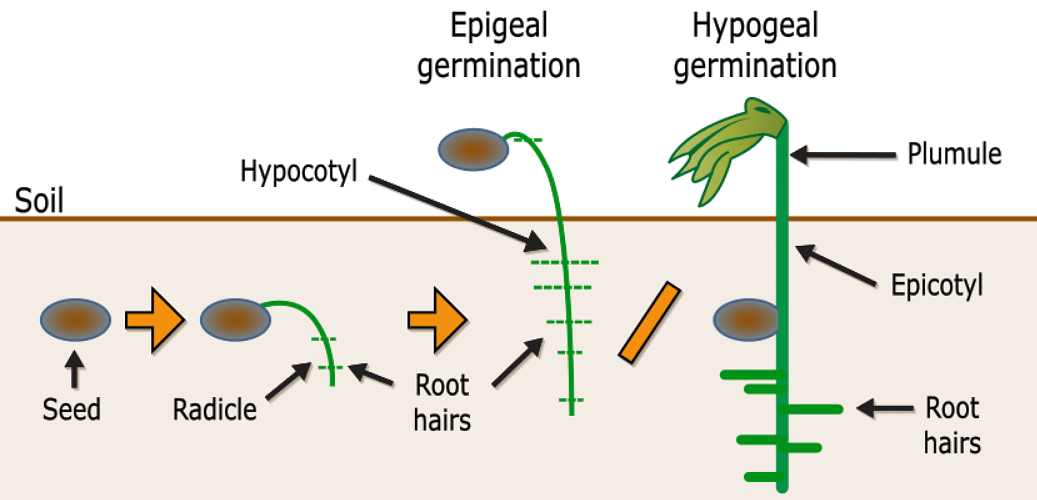
Plumule and Radicle
Features of Plumules
[Click Here for Sample Questions]
- Plumule is a part of the embryonic axis that grows after the radicle and is made up of the epicotyl, young leaves and the shoot apical meristem.
- It is an embryonic shoot which is present above the cotyledons.
- Plumule is positively phototropic as it grows towards the sunlight.
- It moves away from the soil, thus, it is referred to as negative geotropism.
- Plumule grows in an upward direction from the soil and thus performs photosynthesis.
- There are different shapes and sizes of plumules which usually vary within the different plant species.
- Lastly, plumules develop into a proper shoot, that comprises the stem, leaves, flowers, fruits and seeds.
Read More: Tropism in Plants
Difference Between Plumule and Radicle
[Click Here for Sample Questions]
The primary difference between plumule and radicle is that the radicle is an embryonic root, whereas the plumule is an embryonic shoot. The embryonic leaves developed from the seed are called cotyledons. Here, both the radicle and plumule are present inside the seed and are attached to the cotyledons.
| Characteristics | Plumule | Radicle |
|---|---|---|
| Plant’s Part | Embryonic Shoot | Embryonic Root |
| Time of Emergence | Plumule emerges out after the radicle | Radicle appears first followed by the plumule, Both emerge from the seed |
| Growth | Plumule grows and develops into the shoot, and further develops into the stem and leaves | The radicle grows and develops into the roots of the plant |
| Direction of Growth | Plumule grows away from the soil. | Radicles grow towards the soil. |
| Function | Plumule helps the plants in the photosynthetic process. It helps in the rapid growth of the plant. | Radicles absorb the water from the soil and help in the growth of embryonic plants. |
| Phototropic | Positive Phototropic - Because it grows towards the sunlight. | Negative Phototropic - Because it grows away from the sunlight |
| Shape | Plumule is conical in shape and sometimes appears like a bud. | Radicle is elongated in shape. |
| Hydrotropic | Negative Hydrotropic | Positive Hydrotropic |
Things to Remember
- Plumule is an embryonic shoot which comes out of the seed and grows towards the sunlight. It is positively phototropic and grows in the direction of sunlight.
- A radicle is an embryonic root which develops into the root system of the plant. It is negatively phototropic as it grows away from the sunlight.
- Plumule helps the plant to attain a complete morphological growth and photosynthetic process for further evolution.
- Radicle helps the plant to form the entire root system for absorbing water and minerals from the soil.
- Plumule is conical in shape and sometimes it appears like a bud, whereas the radicle appears like an elongated structure.
Learn More About:
Previous Year Questions
- Vexillary aestivation is characteristic of the family….[NEET 2012]
- Vascular cambium produces...[NEET 2010]
- Where do the casparian bands occur?...[NEET 1990]
- A bicollateral vascular bundle is characterised by...[NEET 1992]
- Madhunashini is the popular name for…..[COMEDK UGET 2006]
- The roots that originate from the base of the stem are… [NEET 2020]
- Death of protoplasm is a pre-requisite for a vital function like...[NEET 1989]
- Out of diffuse porous and ring porous woods, which is correct?...[NEET 1989]
- In which of the following plant sunken stomata are found...[NEET 2001]
- What is the eye of potato?…[ NEET 2001]
- Edible part of banana...[ NEET 2001]
- Which is correct pair for edible part?….[NEET 2001]
- Tracheids differ from other tracheary elements in...[ NEET 2014]
- Commercial cork is obtained from… [NEET 1991]
- Botanical name of cauliflower is…. [NEET 1991]
- The cork cambium, cork and secondary cortex are collectively called...[NEET 2011]
- Tricarpellary syncarpous superior ovary is….[JKCET 2007]
- The edible part in hesperidium fruit is...[JKCET 2007]
- The bladders of Utricularia and pitchers of….[JKCET 2004]
- Phylloclades are...[JKCET 2004]
- A major characteristic of monocot root is the presence of... [NEET 2015]
Sample Questions
Ques. What are plumules? (3 Marks)
Ans. Plumules are typically found in seed embryos. It's a bud-like or small section of the plant embryo that produces the first actual leaves, typically above the cotyledons, and grows into a plant with several leaves, branches, flowers, and seeds.
Ques. What is the function of a plumule? (3 Marks)
Ans. After seed germination, the plumule is the portion of the seed embryo that develops into the shoot. It's a shoot tip with a small bud-like structure with a plant embryo attached. It is also called a baby plant, and it gives rise to a new plant.
Ques. Explain the phototropic nature of both Plumule and Radicle. (3 Marks)
Ans. Plumule is positively phototropic and grows towards the direction of sunlight, whereas the radicle is negatively phototropic as it grows away from the sunlight.
Ques. Explain the hydrotropic nature of both Plumule and Radicle. (3 Marks)
Ans. Plumule is negatively hydrotropic and does not involve the absorption of water from the soil, whereas the radicle is positively hydrotropic and involves the absorption of water from the soil.
Ques. What are Radicles? (3 Marks)
Ans. Radicle refers to the plant's embryonic root, which develops into the root of the plant. The root system of plants develops from the first part of the embryo. These embryonic roots penetrate deep into the earth, absorbing all the essential minerals, water, and nutrients for the growth and development of plants.
Ques. What is the function of a Radicle? (3 Marks)
Ans. The radicle is the initial part of the embryo that develops into the root system of plants. These embryonic roots extend deep into the earth to perform the function of absorbing all of the necessary minerals, water, and nutrients for plant growth and development.
Ques. What is epigeal and hypogeal germination? (3 Marks)
Ans. The growth of plumules above the earth with cotyledons is known as epigeal germination, whereas the cotyledons grow beneath the soil with plumule above it, this is known as hypogeal germination.
For Latest Updates on Upcoming Board Exams, Click Here:https://t.me/class_10_12_board_updates
Also Read:



Comments