



Content Curator
Polymerization is a chemical reaction in which a large number of monomer molecules combine to produce a polymer. A polymerization can yield macromolecules with a linear or branching structure. They can also take the form of a three-dimensional complicated network.
Read Also: Zone Refining
| Table of Content |
Keyterms: Polymerization, Chemical reaction, monomer, molecules, polymer, macromolecules, polystyrene, ethylene, alkenes
Polymerization Definition
[Click Here for Sample Questions]
A polymer is a substance made up of very big molecules that are made up of many monomers, or repeating units. The process through which these monomers combine to generate the macromolecules that makeup polymers is known as polymerization. The polymerization of the monomer styrene into the polymer known as polystyrene is depicted in the diagram below:
The intricacy of the polymerization reaction mechanism varies depending on the functional groups present in the reacting monomers. Polymers are formed from alkenes via a free-radical reaction in the simplest polymerization reactions. A polymerization process like this produces polyethylene, which is one of the most commercially important polymers (the reactant monomer used here is ethylene).

Polymerizations using only one type of monomer are known as homopolymerizations, whereas those involving many types of monomers are known as copolymerization processes. Polymerization is a chemical process that results in the creation of polymers in their most basic form. Polymerization can be defined as the process of producing polymers in simple terms. Polymerization is a chemical event in which smaller molecules known as monomers are united to generate larger molecules. A polymer consists of a cluster of these big molecules. In general, the term polymer refers to "big molecules" with a larger molecular mass. Macromolecules are another name for them.
As previously stated, polymers are produced by the addition of a network of structural units or monomers. The intriguing thing about these molecules is that they are reactive and are usually connected by covalent bonds. These monomers combine to form a lengthy chain, which results in a product with certain characteristics. Polymerization is the term for the entire process of polymerization. Polymers include materials such as polythene and Nylon 66.
Read Also: Botanical Name of Coffee and Tea
Polymerization Mechanism
[Click Here for Sample Questions]
In general, polymerization is divided into three stages: initiation, propagation, and termination. In terms of reaction mechanisms, polymerization is mostly accomplished through two approaches. Two of them are the step-growth and chain-growth mechanisms.
Step Growth Polymerization
Polymers are generated by an independent reaction between the functional groups of simple monomer units in step-growth polymerization. To generate a longer-length molecule, each step-in step-growth may consist of a mixture of two polymers of differing or equal lengths.
The reaction takes a long time to complete, and the molecule mass increases at a glacial pace. Step-growth polymerization, such as condensation polymerization, involves the evolution of a water molecule as the chain lengthens.
Condensation Polymerization
When molecules are joined together in condensation polymerization, some small molecules are lost as byproducts of the reaction, resulting in the formation of the polymer. Water or hydrogen chloride is a possible byproduct. Condensation polymers include polyamides and proteins.
The following are some of the several types of condensation polymerization.
- Polyamides
They are nylons, which are synthetic fibers. Between these polymers is an amide bond. Condensation polymerization of di-amines with di-carboxylic acid, as well as amino acids and their lactams, results in polyamide.
- Nylon 66 is produced by condensation polymerization hexamethylenediamine and adipic acid at high pressure and temperature.
- Nylon 6 is made by combining caprolactam and water at a high temperature. Tyre cords, textiles, and ropes are all made of it.
- Polyesters
Polyesters are generated when dicarboxylic acids and diols polycondensate. Using zinc acetate antimony trioxide as a catalyst, heat a combination of terephthalic acid and ethylene glycol at 460 k. Dacron and Terylene are two common names for polyesters. They're also employed in safety helmets as glass reinforcing elements.
- Phenol-Formaldehyde Polymer
These are referred to as the old synthetic polymers, in which condensation polymerization phenol with formaldehyde is used in the presence of an acid or a base where it acts as a catalyst.
When Novolac is heated with formaldehyde, it crosslinks and generates Bakelite, an invisible solid mass. Combs, electric switches, and phonograph records are all made of them.
- Melamine-Formaldehyde Polymer
Melamine and formaldehyde condensate polymerize under particular conditions, resulting in this substance. They're employed in the production of non-breakable tableware.
Chain Growth Polymerization
The monomer molecules are combined to form a long chain in chain-growth polymerization. The monomers may be of the same type or a different type. Alkenes, alkadienes, and their derivatives are commonly used. Chain lengthening happens in this phase as a result of the production of free radicals or ionic species.
Free Radical Mechanism
In the presence of free radicals, many monomers, such as alkenes or dienes, and their derivatives, polymerize. A modest amount of benzoyl peroxide initiator is used in the polymerization of ethene to polythene by heating or exposing it to light. The peroxide-generated phenyl free radical is added to the ethene double bond, resulting in the formation of a new bigger free radical.
A chain initiation step is what it's called. This newly produced radical will react with another ethene molecule to produce yet another free radical, and so on. Chain propagation is the production of a new free radical again and over again. Finally, the polymerized product will be created at some point, which is referred to as the chain termination step. The procedures are outlined below.
A free radical mechanism follows the three steps explained below:

Also Read:
| Related Articles | ||
|---|---|---|
| Cadmium Sulphate Formula | Cadmium Nitrate Formula | Ammonium Hydroxide Formula |
| Antimony V Chloride Formula | Bromic Acid Formula | Barium Phosphate Formula |
Chemical Reaction of Polymerization
[Click Here for Sample Questions]
We're talking about a polymerization reaction of organic monomers when we say polymerization chemical reaction. These monomers are in a solution with particles that will be coated with the polymer that has been produced and placed on the particle surface. A coating layer is formed as a result of this process. Either monomer adsorption polymerization or emulsion polymerization are used in this procedure.
Also Check: Ammonium Nitrite Formula
Preparation of Polymers
[Click Here for Sample Questions]
Polyethene
There are two varieties of polyethylenes available, which are listed below:
- Polyethene with a Low Density
This type of polymer is made by polymerizing ethylene at high pressures of 1000 to 2000 atmospheres at 350 to 520 degrees Celsius in the presence of a small amount of dioxygen or peroxide initiator as a catalyst.
It has a highly branching structure and is produced via free radical addition and H-atom abstraction. It's chemically inert and robust, yet it's also flexible. It is a poor electrical conductor. Toys, squeeze bottles, and flexible pipes are all made out of LDP.
- Polyethene with a High Density
Prepared by polymerizing ethene with a catalyst such as triethyl aluminum and titanium tetrachloride in the presence of a catalyst. The procedure is carried out in a hydrocarbon solvent at a low pressure of 3 to 4 atmospheres at a temperature of 343 k.
It's chemically inert like LDP, but it's a lot tougher. Buckets, dustbins, pipelines, and other items are made from it.
Check Important Notes for Metabolites
Polytetrafluoroethylene
It is made by heating tetrafluoroethylene with a free radical at high pressure and is also known as Teflon. Because of its resistance to corrosive chemicals, Teflon is chemically inert and less corrosive. It's for gaskets, not for utensils with a non-stick surface.

Polyacrylonitrile
The additional polymerization of acrylonitrile in the presence of a peroxide catalyst produces this polymer. It is utilized as a wool substitute in the production of commercial fibers such as Acrilan.

Anionic Polymerization
[Click Here for Sample Questions]
Anionic polymerization can be referred to as an additional polymerization which includes the polymerization of monomers that primarily starts with the anions. These polymerizations will begin when there is a transfer of electrons from ions to the monomers.

In case the monomer is highly electrophilic then the initiators can be said to be weakly nucleophilic. This process will lead to the total consumption of monomers taking place. This process will be fast even at low temperatures. Vinyl monomers are generally polymerized through this method. It is very delicate to the solvent used during this reaction procedure and is used for the generation of synthetic polydiene rubbers, SBR and thermoplastic styrene elastomers.
Also Read:
Classification of Polymerization
[Click Here for Sample Questions]
Polymers are divided into distinct types depending on a variety of variables including their source, structure, polymerization mode, molecular forces, and polymer development.
Source of Polymerization
- Natural Polymers: Polymers that occur spontaneously in plants and animals are known as natural polymers. Examples include resins, starch, and rubber.
- Semi-Synthetic: Semi-synthetic polymers are a type of natural rubber that has been changed. This means that natural rubbers are chemically processed to make them semi-synthetic. This subcategory includes cellulose acetate and cellulose nitrate, for example.
- Synthetic Polymers: Synthetic polymers are polymers that have been totally created by humans. Synthetic polymers such as polythene, nylon 66, and synthetic rubber are commonly employed.
Polymerization based on Polymer Structure
- Linear Polymers: Linear polymers are made up of monomers in a long, straight chain. PVC is a polymer with a linear structure.
- Branched Polymers: Branched polymers are linear polymers with some branches in them. One example is low-density polythene.
- Cross-linked or network polymer: Polymers with cross-linked links between them are referred to as cross-linked or network polymers. They're usually made up of bi-functional or tri-functional monomers. This type of polymer includes bakelite and melamine.
Based on Polymerization Mode
They are separated into two groups:
- Addition Polymers: Polymers generated by the repetitive addition of monomers with double or triple bonds are known as addition polymers. Homopolymers are made up of monomers from the same species, while copolymers are made up of monomers from different species. Polythene and Buna-s are two examples of these materials.
- Condensation Polymers: Condensation polymers are made up of tri or bifunctional monomeric units that are repeatedly condensed. Some tiny molecules, such as water and hydrogen chloride, will be eliminated during this process. Terylene and Nylon 6,6 are two examples of these materials.
Polymerization based on Forces Between Molecules
They are divided into four subgroups once more.
- Elastomers: Polymers with rubber-like solids and elastic properties are known as elastomers. Weak intermolecular interactions hold the polymer links together here, allowing the polymers to stretch. The cross-links in the polymer between the aid of the chain in the retracement of the initial location after the applied force are removed. Buna-s and Buna-s are two examples.
- Fibres: Fibres are polymers with strong intermolecular interactions, such as hydrogen bonds. Strong force molecules are maintained closer together as a result of this, i.e. they are tightly packed. They are crystalline because of this feature. Polyesters and polyamides are two examples.
- Thermoplastic polymers: These are the liner or slightly modified branching polymers that soften when heated and harden when cooled. Between the fibres and the elastomers, they have an intermolecular force. Thermoplastic polymers include polyvinyl, polystyrene, and others.
- Thermosetting Polymers: Thermosetting polymers are extensively branched or cross-linked polymers that can be moulded and do not revert to their original structure when heated. As a result, these can't be utilized again. Bakelite is a good example of this.
Read More: Metal Excess Defect
Things to Remember
[Click Here for Sample Questions]
- Polymerization is a part of CBSE class 12 chemistry syllabus, unit 15, Polymers.
- It carries a total of 8 periods and 4 to 6 marks.
- Polymerization is a chemical reaction in which a large number of monomer molecules combine to produce a polymer. A polymer is a substance made up of very big molecules that are made up of many monomers, or repeating units. The process through which these monomers combine to generate the macromolecules that makeup polymers is known as polymerization.
- A polymerization is a chemical event in which smaller molecules known as monomers are united to generate larger molecules. A polymer consists of a cluster of these large molecules. In general, the term polymer refers to "big molecules" with a larger molecular mass. Macromolecules are another name for them.
- Polymers are divided into distinct types depending on a variety of variables including their source, structure, polymerization mode, molecular forces, and polymer development.
Read More: Ammonium Sulfide Formula
Sample Questions
Ques 1. Write the structures of monomers used for getting the following polymers: (2019) [3 Marks]
(i) Nylon-6,6
(ii) Glyptal
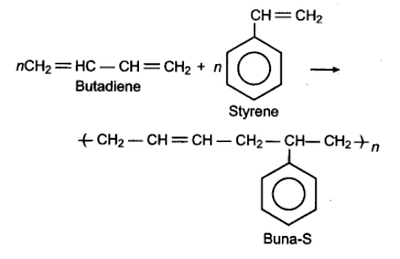
(iii) Buna-S
Ans. (i) Monomers of Nylon-6,6 are adipic acid and hexamethylenediamine.

(ii) Monomers of glyptal are ethylene glycol and phthalic acid.

(iii) Monomers of Buna-S are Butadiene and Styrene.
Ques 2. (i) Write the monomers of the following polymer(2019)[3 Marks]

(ii) What is the role of Sulphur in the vulcanization of rubber?
Ans.
- The polymer given in the question is melamine and monomers are Melamine and Formaldehyde.


- Natural rubber is generally soft at higher temperatures. Sulphur in the vulcanization process forms cross-links of double bonds at the reactive sites in the rubber monomers, hence rubber steffins.
Ques 3. Name the polymer which is used for making non-stick cooking utensils. (2013) [1 Marks]
Ans. Polytetrafluoroethylene known as Teflon is used for making non-stick cooking utensils.
Ques 4. (i) What is the role of t-butyl peroxide in the polymerisation of ethene? (2016) [2 Marks]
(ii) Identify the monomers in the following polymer

Ans.
- It is either used as a catalyst during the polymerization of ethane or as a free radical producing initiator.
- Hexamethylenediamine and adipic acid.
Ques 5. Write the names and structures of the monomers of the following polymers:
(i) Nylon 6, 6
(ii) Neoprene (2015) [2 Marks]
Ans.
- Nylon-6,6 Monomer Hexamethylenediamine NH2(CH2)6NH2 and adipic acid COOH(CH2)4COOH
- Neoprene Monomer - Chloroprene CH2 = CH - C(CL) = CH2
Ques 6. Give names of the monomers of the following polymers : (2014) [3 Marks]
(i) Neoprene
(ii) Polystyrene
(iii) Polypropene
Ans. Names are:
- Chloroprene

- Styrene

- Propene
CH2 = CH-CH3
Ques 7. Write the mechanism of free radical polymerisation. (2016) [3 Marks]
Ans. In the presence of free radicals, many monomers, such as alkenes or dienes, and their derivatives, polymerize. A modest amount of benzoyl peroxide initiator is used in the polymerization of ethene to polythene by heating or exposing it to light. The peroxide-generated phenyl free radical is added to the ethene double bond, resulting in the formation of a new bigger free radical.
A chain initiation step is what it's called. This newly produced radical will react with another ethene molecule to produce yet another free radical, and so on. Chain propagation is the production of a new free radical again and over again. Finally, the polymerized product will be created at some point, which is referred to as the chain termination step.
Ques 8. Write the names and structures of the monomers of the following polymers: (2015) [3 Marks]
(i) Buna-S
(ii) Glyptal
(iii) Polyvinyl chloride
Ans.
- Buna-S = Buta-1, 3-diene

- Glyptal = Ethylene glycol and phthalic acid

- Polyvinyl chloride = Vinyl chloride
CH2 = CH - Cl
Ques 9. Write the name of the monomers of the following polymers: (2014) [3 Marks]
(i)Polythene
(ii)Polyvinyl chloride
(iii)Bakelite
Ans.
- Polythene = Ethylene

- Polyvinyl chloride = Vinyl chloride
CH2 = CH - Cl
- Bakelite = HCHO formaldehyde and C6H5OH phenol.
Ques 10. Give one example each of (2010) [3 Marks]
(i) addition polymers,
(ii) condensation polymers,
(iii) copolymers.
Ans.
- Polythene
- Nylon 6, Nylon 6,6
- Buna-S, Buna-N
For Latest Updates on Upcoming Board Exams, Click Here: https://t.me/class_10_12_board_updates
Check-Out:



Comments