



Exams Prep Master
The study of physics on a microscopic level which is related to atoms and its parts is called Quantum Physics. Physics has mainly two branches, first is for the things related to a macroscopic level which is termed Classical Physics. This portion of physics emphasizes Newton's law of motion. Another branch is Quantum Physics that deals with microscopic elements. Quantum physics talks about how atoms work. For example, a computer chip works due to the moving electron, electricity produced by the photons of light, and more. There are several parts of Quantum Physics like Quantum Mechanics. Moreover, the theory of relativity is applicable to things that move fast just in the case of atomic elements. Here, we will study quantum physics and discuss some important questions.
| Table of Content |
Keyterms: Quantum Physics, Atoms, Motion, electron, electricity, photon, atomic elements, light
What is Quantum Physics?
[Click Here for Sample Questions]
The definition of Quantum Physics corresponds to the study of physics on a microscopic level like the way atoms or electrons move. It is a part of modern physics that tells us how modern civilization is going on and how all the scientific research has been performed. Quantum physics tells us about the nature of the particles that build matter, and also, the forces with which they hold on to each other or get affected.

Quantum Physics
It tells us about how atoms perform or work, and it also explains the reasons behind the theories and phenomena of chemistry and biology. There exist several quantum physics theories, and not just one. Quantum Mechanics corresponds to the basic mathematical framework, and it explains it all. It was brought to us by Niels Bohr, Erwin Schrödinger, Werner Heisenberg, and other scientists. Quantum Mechanics tells us about the simple things like the way a change in position and momentum of a single particle or a group of particles takes place.
When we talk about quantum physics theories and fundamental forces, we may come across three quantum physics theories. They are electromagnetism, strong nuclear force, and weak nuclear force. They tell us about the way quantum physics theories and fundamental theories are related and also their influences on matter and its particles.
- Electromagnetism shows us how atoms hold on to each other.
- The strong nuclear force explains to us how the nucleus is stable at the center of an atom.
- The weak nuclear force explains why there exist atoms that undergo radioactive decay.
These three theories collectively come under the ramshackle coalitions termed as Standard models in the field of Particle Physics.
Need for Quantum Physics
[Click Here for Sample Questions]
There are some theories, equations, and rules in Classical physics that don't seem to be very useful when it comes to explaining the existence and behavior of atoms and their elements like electrons and nuclei. Classical physics is mainly for heavier objects related to objects around us like chairs, tables, a ball, etc., and not for small-sized particles like atoms.
So, we need other laws of physics like Quantum physics to provide us with to explanation of all the phenomena that Classical Physics failed to explain. The reason behind the fact that the theories of Quantum Physics differ from Classical Physics is because Quantum Physics is based on the idea that a particle exists in the probability that it might be at point A, another chance to be at point B, and so on. On the other hand, in Classical Physics, an object exists in one place at a given point in time.
Also Read:
| Related Articles | ||
|---|---|---|
| LASER LIGHT | Avogadro's Number | Laser |
| Alpha Particle Mass | Magnetic Quantum Number | Modern Physics |
Dual Behavior of Matter
[Click Here for Sample Questions]
The dual nature of matter corresponds to when a particle shows both particle and wave nature. Bigger objects on a macroscopic level tend to show only the particle nature of matter. It is so because the wave nature of these macroscopic objects is neglected as they have very small wavelengths due to their large size. De Broglie states that the wavelength of an object is inversely proportional to the weight of that object.

Dual Behavior of Matter
On the other hand, atoms and their elements are very small in size, consequently having a comparatively larger wavelength to possess the wave nature as well as particle nature. Hence, it can be drawn that atoms possess dual nature of matter. The particle nature is defined by the mass of the atom whereas the wave nature of the atom comes from its matter-wave which is explained by the De Broglie relationship. It is given by-
λ = h/mv
Where,
λ is the wavelength of the matter
h is Planck's constant
m is the mass of the matter
v is the velocity of matter
Laws of Quantum Physics
[Click Here for Sample Questions]
There are some laws that Quantum Physics works with, and we need to learn what they are. So, let’s hop into it one by one-
De Broglie Equation
De Broglie equation corresponds to the fact that matter also acts like waves as it relates the wavelength of a moving particle with its momentum. We can say that this equation links the wavelength of a huge particle with its momentum through Planck’s constant.
The De Broglie equation states that all the moving particles are related to the wavelength regardless of the fact that it is microscopic or macroscopic. We can observe the wave nature of microscopic particles, but as for larger objects or macroscopic objects, it cannot be noticed because the wavelength becomes small and negligible due to their heavyweight.

De Broglie Equation
Heisenberg’s Uncertainty Principle
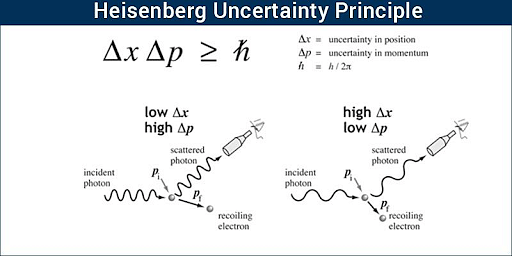
Heisenberg’s Uncertainty Principle states that we cannot determine the position and momentum of a microscopic particle simultaneously at a given time. It means that if we want to calculate the momentum then we won't be able to find the position of that particle, and if we want to know the position then we won't be able to measure the momentum. Both of them cannot be measured with arbitrarily high precision.
Heisenberg’s Uncertainty Principle
This principle applies only to microscopic particles because the energy of photons is insufficient to alter the position and velocity of larger bodies when it collides with them.
Δx Δp ≥ h /4π
Δx = Uncertainty of state
Δp = Uncertainty of momentum
Arthur Compton’s Experiment on X-rays
An American physicist named Arthur Compton showed us more details on the dual nature of X-rays. He performed an X-ray scattering experiment in which he explained the wave and particle nature of the X-ray. The experiment was done as follows-
- Arthur sent a beam of X-ray which was passed through a target material and he observed that a small part of the beam was deflected at some different angles. He also discovered that the scattered X-rays were having a longer wavelength when compared to the original beam.
- The change in wavelength in the X-rays after scattering can be explained by imagining that the X-rays scattered from the electrons in the target as if the X-rays were particles with discrete amounts of momentum and energy.
- After the scattering of X-rays, the momentum of the cloud partially passes to the electrons and recoil electrons get energy from an X-ray, and consequently, the frequency of X-ray gets altered.

Arthur Compton’s Experiment on X-rays
The classical electromagnetic theory does not explain the discrete amount of momentum and the frequency shift of the light scattering, but Einstein's quantum formula seems to explain it clearly. The X-rays were then supposed to be made up of discrete bundles or particles. Now, we call them photons. These photons lose energy while colliding with electrons in the material, and after that, it scatters with low energy.
Schrodinger’s Wave Equation
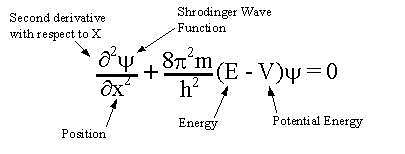
In the year 1926, Schrodinger's wave equation provided a very wide and huge application to Quantum Mechanics. Schrodinger postulated that the electrons in an atom need to be managed like the waves on a drumhead. The different energy levels of atoms were identified with the simple vibrational modes of the wave equation. After this, the wave equation gets solved to find these modes, then the electron gets the energy by the frequency of the model and by Einstein’s Quantum Equation, that is, E = hv.
Schrodinger’s Wave Equation
So, as a conclusion, the trajectory, the positioning, and the energy of these systems can be recovered by solving Schrodinger’s Wave Equation. This is a more precise version of Bohr's original formula which describes the electron in an atom.
Things To Remember
- The definition of Quantum Physics corresponds to the study of physics on a microscopic level like the way atoms or electrons move. It is a part of modern physics that tells us how modern civilization is going on and how all the scientific research has been performed.
- There are some theories, equations, and rules in Classical physics that don't seem to be very useful when it comes to explaining the existence and behavior of atoms and their elements like electrons and nuclei. So, we need other laws of physics like Quantum physics to provide us with the explanation of all the phenomena that Classical Physics failed to explain.
- Bigger objects on a macroscopic level tend to show only the particle nature of matter. It is so because the wave nature of these macroscopic objects is neglected as they have very small wavelengths due to their large size. On the other hand, atoms and their elements are very small in size, consequently having a comparatively larger wavelength to possess the wave nature as well as particle nature.
- The De Broglie equation states that all the moving particles are related to the wavelength regardless of the fact that it is microscopic or macroscopic. We can observe the wave nature of microscopic particles, but as for larger objects or macroscopic objects, it cannot be noticed.
- Heisenberg’s Uncertainty Principle states that we cannot determine the position and momentum of a microscopic particle simultaneously at a given time.
Also Read:
Sample Questions
Ques: Who was the father of Quantum Physics? (2 marks)
Ans: The fathers of Quantum Physics are Niels Bohr and Max Planck.
Ques: Write the Heisenberg’s Uncertainty Equation. (2 marks)
Ans: Heisenberg’s Uncertainty Principle applies only to microscopic particles because the energy of photons is insufficient to alter the position and velocity of larger bodies when it collides with them.
Δx Δp ≥ h /4π
Δx = Uncertainty of state
Δp = Uncertainty of momentum
Ques: What does Dual Nature Correspond to? (2 marks)
Ans: A particle is said to be showing dual nature when it shows both particle and wave nature which means it acts as both of them and shows properties related to both particle and wave nature.
Ques: What does De Broglie Equation state? (2 marks)
Ans: The De Broglie equation states that all the moving particles are related to the wavelength regardless of the fact that it is microscopic or macroscopic. We can observe the wave nature of microscopic particles, but as for larger objects or macroscopic objects, it cannot be noticed because the wavelength becomes small and negligible due to their heavyweight.
Ques: What is Quantum Physics? (3 marks)
Ans: The definition of Quantum Physics corresponds to the study of physics on a microscopic level like the way atoms or electrons move. Quantum physics tells us about the nature of the particles that build matter, and also, the forces with which they hold on to each other or get affected.
Quantum Mechanics corresponds to the basic mathematical framework, and it explains it all. It was brought to us by Niels Bohr, Erwin Schrödinger , Werner Heisenberg, and other scientists. Quantum Mechanics tells us about the simple things like the way a change in position and momentum of a single particle or a group of particles takes place.
Ques: What are the three forces that Quantum Physics rely on? (3 marks)
Ans: When we talk about quantum physics theories and fundamental forces, we may come across three quantum physics theories. They are-
- Electromagnetism shows us how atoms hold on to each other.
- The strong nuclear force explains to us how the nucleus is stable at the center of an atom.
- The weak nuclear force explains why there exist atoms that undergo radioactive decay.
Ques: Write the De Broglie Equation and explain. (3 marks)
Ans: The particle nature is defined by the mass of the atom whereas the wave nature of the atom comes from its matter-wave which is explained by the De Broglie relationship. It is given by-
λ = h/mv
Where,
λ is the wavelength of the matter
h is Planck's constant
m is the mass of the matter
Ques: What are the uses of Quantum Physics? (4 marks)
Ans: The uses and importance of Quantum Physics are many. Here are some-
- It is a part of modern physics that tells us how modern civilization is going on and how all the scientific research has been performed.
- Quantum Physics explains how things in biology and chemistry work.
- It also enlightens us on the way atoms and their elements like the electron, proton, and neutron behave and hold on to each other.
- The forces that are being used in the action, reaction or phenomenon on the microscopic level are explained well by Quantum Physics.
For Latest Updates on Upcoming Board Exams, Click Here: https://t.me/class_10_12_board_updates
Check-Out:



Comments