



Content Curator
Types of AC Motors are classified based on the operational principle, current type, operational speed, and structural components. The electric motors are hence a classic example of electrical technology that has resulted in a massive leap for humans. Electric motors are used extensively in a variety of industrial sectors, as well as in a variety of commercial and home environments. Of the different types of motors, AC motors are far more common than DC motors when it comes to the application of motors in everyday life.
Read More: AC and DC Motors
| Table of Contents |
Key Terms: AC Motor, Electric Motor, Types, Alternating Current, Synchronous, Asynchronous, Commutator, Shunt, Magnetic Field
Electric Motors
[Click Here for Sample Questions]
The armature winding and the field winding are two critical components in any motor. The field winding is in charge of creating a constant magnetic field, whereas the armature winding looks like a conductor and is positioned within the magnetic field.
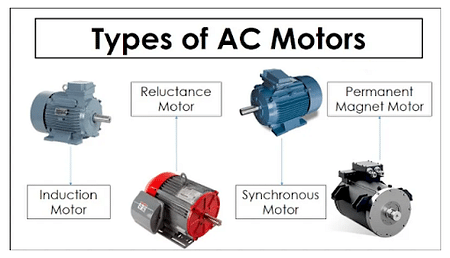
Types of AC motors
The armature winding uses energy and generates torque, which causes the motor shaft to turn, thanks to the magnetic field. The various types of electric motors are divided into three categories: DC motors, AC motors, and motors for specific applications.
Read More: Torque Vs Moment
Working Principle of AC Motor
[Click Here for Previous years Questions]
Electric motors convert electrical energy into rotating mechanical energy by passing a current through electromagnets. Electromagnets are contained within nested rings, and the polarity of the magnets alternates within the rings. The stator magnets are stationary, whereas the rotor magnets are rotating. The polarity of electromagnet is constantly reversing north-south.
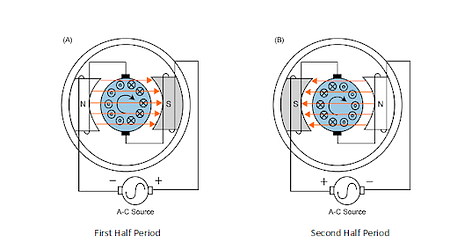
Working Principle of AC motors
Let us look at some interesting features of the AC Motor working principle:
- An alternating current is applied to the stator windings of an AC motor to produce a revolving magnetic field.
- An AC motor does not require any mechanical assistance or power to rotate the rotor due to the rotation of the magnetic field.
- The magnetic field causes the rotor to rotate, creating torque on the motor's driveshaft.
- The synchronous speed of rotation is determined by a specific number of magnetic poles on the stator.
- AC induction motors, on the other hand, have a lag or slip to allow the rotor current to flow.
Read More:
| Important Topics Related to Types of AC Motors | ||
|---|---|---|
| Motor Vs Generator | Power in Alternating Current | Inductance Formula |
| RMS Value of Alternating Current | Inductor Uses | Magnetic Flux Formula |
| EMF Formula | Faraday’s Law of Electromagnetic Induction | Eddy Currents |
Classification of AC Motor
[Click Here for Sample Questions]
The following four criteria are used to classify different types of AC motors:
Operational Principle
Based on the principle of operation, AC Motors can be classified as:
- Synchronous
- Asynchronous
Let us look at each of these in detail.
Synchronous Motors
Synchronous motors use a three-phase power source. In such motors, the stator generates the field current by rotating at a constant speed defined by the AC frequency. The load is attached to the rotor, which spins at the same rate as the stator current. As a result, there is no air gap or slip between the rotor and the stator current speed. There are two types of synchronous motors, depending on how the rotor is magnetised:
- Non-excited
- Direct current-excited

Synchronous Motor
Asynchronous Motors
Often known as induction motors, have an asynchronous speed that slips in relation to the stator current. Electromagnetic induction is used in these motors to convert electrical energy to mechanical energy. Induction motors are classified into the following categories based on the rotor construction:
- Squirrel Cage
- Slip-ring

Asynchronous Motor
Commutator Motors
They are another sort of asynchronous motor, and they come in the following models:
- Series
- Compensated
- Shunt
- Repulsion
- Repulsion-start induction
- Repulsion induction

Commutator Motor
Current Types
AC motors are classified as follows based on the current supply phase:
- Single-phase
- Three-phase
Operational Speed
AC motors are divided into three categories based on the speed of operation:
- Variable speed control
- Constant speed
- Variable speed
Characteristics of the Structure
AC motors are classified into the following categories based on structural characteristics:
- Open
- Semi-enclosed
- Enclosed
- Ventilated
- Pipe-ventilated
- Riveted Frame-eye
Read More: Phasor Representation AC
Applications of AC Motor
[Click Here for Previous years Questions]
- Synchronous motors are useful for high-precision automation procedures like robotics and positioning devices.
- Longevity: AC motors can last for years because they have a few working parts.
- AC motors are a desirable alternative for field applications such as agricultural equipment and commercial applications such as vending machines because of their longevity.
- Efficiency: AC motors' speed-to-torque characteristics allow them to work well in a wide range of applications without overheating, degeneration, or stopping.
- AC Motors are used for high-demand applications like pumps and packaging equipment.
- Seawater cooling pumps and cargo pumps in ships both use adjustable and variable speed motors.
- Quiet Operation: AC motors are appropriate for usage in businesses, hospitals, and restaurants since they produce less noise.
- Availability: AC motors come in a variety of sizes and power capacities. Its broad range makes it suitable for a wide range of applications.

Applications of AC motor
Read More: Universal Motors
Things to Remember
- AC Motors are classified based on the operational speed, structural components, operational principle, and current type.
- No mechanical power is needed for the functioning of an AC Motor.
- Based on the operational principle, AC Motors are classifed as: Synchronous and Asynchronous Motors.
- Based on the current type, AC Motors are classified as single and three-phase motors.
- Based on the operational speed, AC Motors are classified as Variable and Constant Speed.
- AC Motors are known and are widely used owing to their longevity, efficiency, high precision, and availability.
Read More:
| Important Topics From Chapter 6: Electromagnetic Induction | ||
|---|---|---|
| Transformers | Energy Consideration | Alternator Vs Generator |
| AC Voltage Applied to an Inductor | AC Voltage Applied to a Series LCR Circuit | Electromagnetism |
| Faraday Constant | Generator Types | Electromagnetic Damping |
| Electromagnetic Induction MCQs | Induced EMF & Current | Faraday & Henry Experiments |
Previous Year Questions
- The time lag between maximum voltage and current is… [ KCET 2017]
- A current of 5A is flowing at 220V in the primary coil of a transformer. If the voltage produced in...[KCET 2008]
- A step-up transformer operates on a 230 V line and a load current of 2 A…..[KCET 2018]
- An electric heater rated 220V and 550W is connected to AC mains. The current drawn by it is…...[KCET 2009]
- The potential differences across each element is 20V… [ KCET 2013]
- What is the output on the secondary transformer. [NEET 1997]
- Calculate the magnetic flux of the disc? [NEET 2008]
- Calculate the emf in the circular loop? [NEET 2009]
- Calculate theinduced emf in the current carrying coil. [VITEEE 2017]
- Calculate the time when a magnetic field in apllied in the coil. [NEET 1991]
- A dynamo converts? [UPSEE 2014]
- Calculate the induced emf in the coil? [NEET 2019]
- Calculate the emf in the cycle wheel? [NEET 2019]
- Calculate the self-inductance of the solenoid. [NEET 2016]
- Calculate the total charge flowing through the coil. [NEET 2017]
- Determine the direction of emf. [NEET 2009]
- Calculate the power drawn? [NEET 2015]
- Calculate the emf generated. [NEET 2016]
- Calculate the frequency of change of direction if induced emf. [NEET 2013]
- What will be the direction of current. [NEET 2015]
Sample Questions
Ques. When did the AC motor first arise? (1 mark)
Ans. In 1887, Nikola Tesla constructed the first AC induction motor.
Ques. What are the benefits of using an AC motor instead of a DC motor? (1 mark)
Ans. Brushless AC motors produce more torque and are more efficient. An AC motor's speed and power can be adjusted with the help of a controller. Because an AC motor does not require a commutator or brushes, there is no sparking.
Ques. What is the principle of operation of an AC motor? (1 mark)
Ans. AC motors obtain rotational force by generating magnetic flux and induced current inside the motor through the movements of the stator and rotor.
Ques. What is the definition of synchronous speed? (1 mark)
Ans. Synchronous speed refers to the consistent speed at which the motor generates the electromotive force.
Ques. How can you tell the difference between an AC and a DC motor? (1 mark)
Ans. It's an AC motor if it doesn't have a commutator or brush. A DC motor, on the other hand, is one that has a commutator and brushes.
Ques. A light bulb is rated at 100W for a 220 V supply. Find
(a) the resistance of the bulb;
(b) the peak voltage of the source; and
(c) the rms current through the bulb. (3 marks)
Ans. We are given P = 100 W and V = 220 V.
The resistance of the bulb is
R = V2/P
= (220 V)2/100 W
= 484 Ω
The peak voltage of the source is
V m = √2V
= 311 V
Since, P = I V
I = P/V
= 100W/220V = 0.450 A
Ques. A pure inductor of 25.0 mH is connected to a source of 220 V. Find the inductive reactance and rms current in the circuit if the frequency of the source is 50 Hz. (3 marks)
Ans. The inductive reactance,
XL = 2πvL = 2*3.14*50*25*10-3W
= 7.85Ω
The rms current in the circuit is
I = V/XL
= 220 V / 7.85 Ω
= 28 A
Also Check:
For Latest Updates on Upcoming Board Exams, Click Here: https://t.me/class_10_12_board_updates
Also Read:



Comments