



Education Journalist | Study Abroad Lead
Resonance is the anomaly that takes place when an increase in amplitude and the driving force is close to the innate frequency of the oscillator. The regular back and forth movement of a system independently or unforced resonance is referred to as its resonant frequency. Resonance mainly takes place when a system is effectively stored and transmits energy between multiple storage modes, such as Kinetic or Potential energy, as found in a basic pendulum. During resonance, the circuit may either absorb or release the maximum amount of energy. One of the basic applications is in a radio receiver.
| Table of Content |
Key Terms: Resonance, Kinetic Energy, Potential Energy, Series Resonance Circuit, Parallel Resonance Circuit, Resonant Frequency Formula, Amplitude, Oscillator
Resonant Frequency Formula
[Click Here for Sample Questions]
The frequency of a resonant circuit is termed its resonant frequency. The resonance circuit is also known as an LC tank circuit. The resonant circuit comprises a parallel-connected capacitor and inductor.
Read Also: Feedback Amplifier And Transistor Oscillator
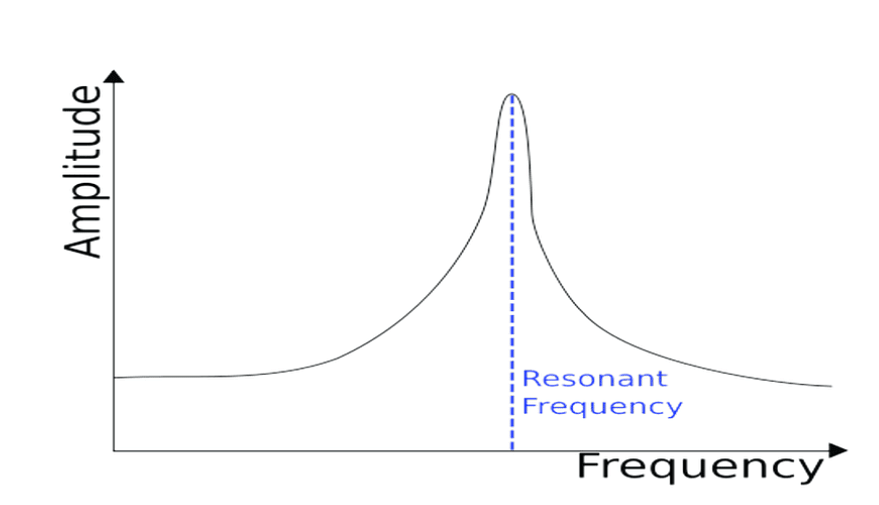
Resonant Frequency
A resonant circuit is mostly used to generate a particular frequency or to consider a specific frequency from a complicated circuit.
The formula of resonant frequency is
fo= 12πLC
Where
fo = resonant frequency in Hz
L = Inductance
C = Capacitance
Read Also: Electric Current and Circuit
Resonant Frequency Derivation: Series Resonance Circuit
[Click Here for Sample Questions]
Suppose a series combination of R, L, and C. This series combination is connected with alternating current.
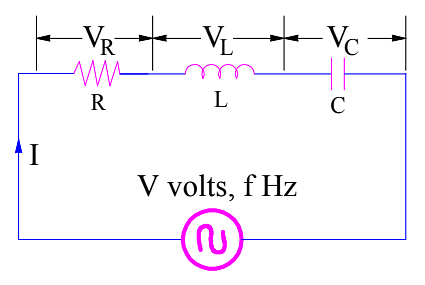
Series Resonance Circuit
Impedance Z of the above circuit is
Z=R+ jL-jC
Z=R+j(L-1C)
The circuit is entirely resistive while it is in resonance. This signifies that during the resonance state or at the resonant frequency, the imaginary component of the impedance Z will be zero. Always keep this in your mind while evaluating the resonant frequency for a given circuit.
Read Also: Difference Between Resistance and Impedance
This means,
(L-1C)= 0
L= 1C
2=1(LC)
=1(LC)
As we know that
=12πf
Therefore, f= 12π
Substituting the values, we get
f0= 12πLC
Therefore, Resonant Frequency (f0) for Series Resonance Circuit,
f0= 12πLC
Read Also: Resistors in Series and Parallel Combination
Resonant Frequency Derivation: Parallel Resonance Circuit
[Click Here for Sample Questions]
Suppose the parallel resonance circuit is given below.

Parallel Resonance Circuit
Impedance Z of the above circuit is:
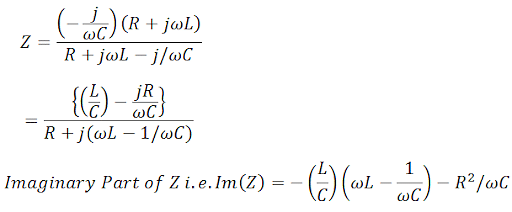
By putting imaginary part = 0. we get
-(L2)C+L(C2)-R2(C)=0
-2L2C+L-R2C=0
2L2C=L-R2C
2=1(LC)-R2L2
Since =12πf
Resonance frequency for parallel combination is
12πLC-R2
Read Also: Oscillations
Application of Resonant Circuits
[Click Here for Sample Questions]
- Resonant circuits are used in radio frequency (RF) applications. These components are fundamentals of a tuner, amplifying signals that correspond to its resonance frequency and rejecting those that are outside of its bandwidth.
- A parallel LC is used as a tank circuit in an oscillator and is powered at its resonant frequency. As a result, a constant series of stable, oscillating clock pulses are generated, which control components such as microcontrollers and communication ICs.
- LCR circuits help to minimize power consumption by preventing excessive current flow through a device or component, which causes it to overheat. LCR circuits also contribute to the reduction of voltage fluctuations, which may harm electrical devices.
Read Also: Radio Waves
Things to Remember
- The resonant circuit comprises Capacitor, Inductor, and Resistor.
- The oscillatory movement of a system without any external effort resonance is referred to as its resonant frequency.
OR
The natural frequency of an object where it tends to vibrate at a higher amplitude.
- LCR circuits may either absorb or release the maximum amount of energy.
- Resonant circuits are used for radio frequency management and also used to minimize power consumption.
- The resonant frequency of an LC circuit is 10 kHz.
- The resonance frequency of granite is 6900 Hz when the excitation frequency is within the range of 0 - 10 kHz, while that of sandstone is 8700 Hz.
- While compared with other metal silver possesses a particularly stronger resonance slightly around 315 nm.
Also Read:
Sample Questions
Ques. In the case of forced oscillations, which of the following statement is not true [1 marks]
(A) Frequency equals that of external periodic force
(B) Amplitude depends upon the damping coefficient
(C) Amplitude tends to infinity at resonance
(D) Higher the damping coefficient, lower is the amplitude at resonance
Ans. Amplitude tends to infinity at resonance
Explanation: The amplitude increases as the damping decreases, and when there is no damping, the amplitude becomes infinite. It is important to note that a small-amplitude driving force can result in a large-amplitude reaction. The phenomenon is called resonance.
Resonance is the phenomenon of increasing amplitude which occurs when the frequency of a periodically applied force is equal to or similar to the natural frequency of the system on which it operates.
Ques. Resonance is an example of [1 marks]
(A) Tuning fork
(B) Forced vibration
(C) Free vibration
(D) Damped vibration
Ans. Forced Vibration
Explanation: Resonance is defined as the phenomenon of increased amplitude that happens when the frequency of a frequently applied force is equal to or close to the natural frequency of the system on which it works, resulting in forced vibration.
Forced vibration occurs whenever an object is forced to vibrate at a specific frequency by a periodic force input. When an object is forced to vibrate at its inherent frequency, resonance occurs and significant amplitude vibrations are noticed.
Ques. Even after the breakup of one prong of the tuning fork, it produces a round of the same frequency, then what is the use of having a tuning fork with two prongs? [1 marks]
Ans. Two prongs of a tuning fork set each other in resonant vibrations, which assist them to keep the vibrations going for a longer period.
The fork's two prongs amplify the sound. Each prong causes the other prong to vibrate at the same rate, allowing the sound to last longer. The sound would be much quieter and would die out much faster if there were only a single prong.
Ques. How is the frequency of oscillation related with the frequency of change in the of K. E and PE of the body in S.H.M.? [1 marks]
Ans. Potential Energy or Kinetic Energy completes two cycles of vibrations in a duration during which S.H.M completes one vibration or the frequency of Potential Energy or Kinetic Energy is double than that of S.H.M.
The time for one oscillation is period T. The number of oscillations per unit time is the frequency f. These quantities are related by f=1/T.
Ques. The soldiers marching on a suspended bridge are advised to go out of steps. Why? [3 marks]
Ans. Soldiers marching on a suspended bridge are recommended to go out of steps because the frequency of the marching steps matches the natural frequency of the suspended bridge, causing resonance. As a result, the amplitude of the oscillation increases exponentially, frequently leading to the bridge collapsing. To avoid the situation of a bridge collapsing the soldiers are advised to go out steps on a suspended bridge.
Ques. Determine the resonant frequency of a circuit whose inductance is 35mH and capacitance is 10μF? [3 marks]
Ans. Given, L = 35mH and C = 10μF
The resonant frequency formula
f0= 12πLC
f0=12×3.14×(35×10-3×10×10-6)
f0 = 269.16 Hz
Ques. The capacitance and inductance of a resonant circuit are given as 0.5F and 1H. Calculate the resonant frequency of the circuit? [3 marks]
Ans. Given, L = 1H and C = 0.5F
The formula for resonant frequency is
f0= 12πLC
f0=12×3.14×10.5
f0 = 0.2251Hz
Ques. Calculate the resonant frequency and Q-factor (Quality factor) of a series L-C-R circuit containing a pure inductor of 4 H, capacitor of capacitance 27 μF and resistor of resistance 8.4 Ω. [5 marks]
Ans. The formula used:
The resonant frequency f0 is given by, f0= 12πLC
The Q-factor of the circuit is given by, Q=1RLC
Inductance, L=4 H
Capacitance, C=27 μF
Resistance, R=8.4 Ω
To find the resonant frequency, substitute the values of L and C in the resonant frequency formula:
f0= 12π(4H27×10-6F)
f0= 15.31 Hz
To find the Q-factor of the circuit, substitute the values of L, C, and R in the Q-factor frequency formula:
Q=18.44H27×10-6F
Q = 45.82
Therefore, the resonant frequency of the L-C-R circuit is 15.31 Hz and the Q-factor is 45.82.
Ques. An electrical circuit is given. Determine the resonant frequency of this circuit. It has an inductance of 25 mH, and capacitance as 5μF? [5 marks]
Ans. Given, L = 50mH = 50×10-3H
C = 5μF = 5×10⁻⁶F
The formula for resonant frequency is: f0= 12πLC
Putting values in the above formula,
f0= 12π5010-3510-6
f0= 123.14510-4
f0=318.47 Hz
Ques. Determine the resonant frequency of a circuit whose value of inductance is 40 mH and capacitance is 8μF. [5 marks]
Ans. Given, L = 40mH = 40×10-3H
C = 8μF = 8×10⁻⁶F
The formula for resonant frequency is: f0= 12πLC
f0= 123.144010-3810-6
f0=281.35 Hz
Ques. The resonance frequency of the LCR series AC circuit is f0 . Now the capacitance is made 4 times. Determine the resonance frequency for the given condition. [5 marks]
Ans.
In the above circuit, RLC is the resistance, inductor, and capacitor respectively. LCR is connected with the AC source in a series combination. The AC flowing in the circuit changes its direction periodically.
The resonance frequency is the frequency at which the RLC circuit resonates. The frequency is measured in hertz. The angular frequency is measured in radians per second.
0=2πf0
Where f0 is the resonance frequency
Because the energy is held in two forms, electric energy in the capacitor and magnetic energy in the inductor, this phenomenon occurs. In the LCR circuit, the energy oscillates. At resonance, the inductor and capacitor impedances are identical in magnitude but opposite in direction, canceling each other out.
XL=XC
L=1C
2=1LC
=1LC
So at resonance, we can say that the angular frequency can be given as,
0=2πf0=1LC
We conclude that the resonance frequency of the LCR series circuit is inversely proportional to the square root of the circuit capacitance.
f0∝1C
When the value of capacitance is increasing by four times, the value of the resonance frequency decreases by two times.
The resonance frequency is f02
For Latest Updates on Upcoming Board Exams, Click Here: https://t.me/class_10_12_board_updates
Check-Out:



Comments