



Education Content Expert
Scabies is a parasitic infestation caused by the parasite Sarcoptes scabiei. Scabies is a microscopic mite that measures up to 0.35 mm in length and is not visible to naked eye. The mite burrows into the skin and lays scabies eggs, thus, triggering a host immune response. Scabies symptoms include intense itching and rash. Scabies Life Cycle has four stages namely the egg, the larvae, the nymph and the adult.
The transmission of scabies is majorly through physical or direct contact of one individual with another. The condition of Scabies can be made more complicated by bacterial infection, which leads to the development of skin sores. This, in turn, causes more serious consequences such as septicaemia, heart disease and chronic kidney disease.
Key Terms: Scabies, Sarcoptes Scabiei, Mite, Itching, Rash, Inflammation, Female Mite
What is Scabies?
[Click Here for Sample Questions]
Scabies is an itchy irritation or inflammation caused by a microscopic burrowing mite named Sarcoptes scabiei. Sarcoptes scabiei, the human itch mite, falls in the arthropod class Arachnida, subclass Acari, and family Sarcoptidae.
- Scabies is a contagious skin irritation which spreads quickly through physical contact.
- It is caused by a tiny, eight-legged mite (Sarcoptes scabiei). The female mite burrows into the skin, makes a tunnel and lays eggs.
- Once the eggs hatch, the mite larvae travel to the surface of the skin and are matured there.
- These matured mites can then spread to other areas of the skin or other people.
- Scabies symptoms include intense itching in the area where the mite burrows, especially during night time.
- Scabies treatment is easy. The scabies-causing mites and their eggs can be killed by medicated skin creams or pills.

Scabies
Life Cycle of Scabies
[Click Here for Sample Questions]
Sarcoptes scabiei, the scabies-causing mite, undergoes four stages during its life cycle:
- Stage 1: Egg
- Stage 2: Larva
- Stage 3: Nymph
- Stage 4: Adult
Stage 1: The Egg
- After fertilization, the female mite finds a desired spot to lay eggs. Then, she burrows into the skin and lays the eggs there.
- The female parasite deposits 2 to 3 eggs daily under the skin.
- The scabies eggs are oval in shape and are about 0.15 mm in length.
- The eggs usually hatch in 3-4 days under favourable conditions.
- Around 10% of the laid eggs transform into adult itch mites.
Stage 2: The Larvae
- Once the scabies eggs hatch, the larvae mite moves to the surface of the skin.
- The larvae then burrows itself into the outermost layer of the skin- stratum corneum.
- Moulting pouches, which are invisible burrows, are created due to this.
- After hatching, the larvae have only three pairs of legs and they last for about 3-4 days.
- Next, the larvae moult and transform into nymphs.
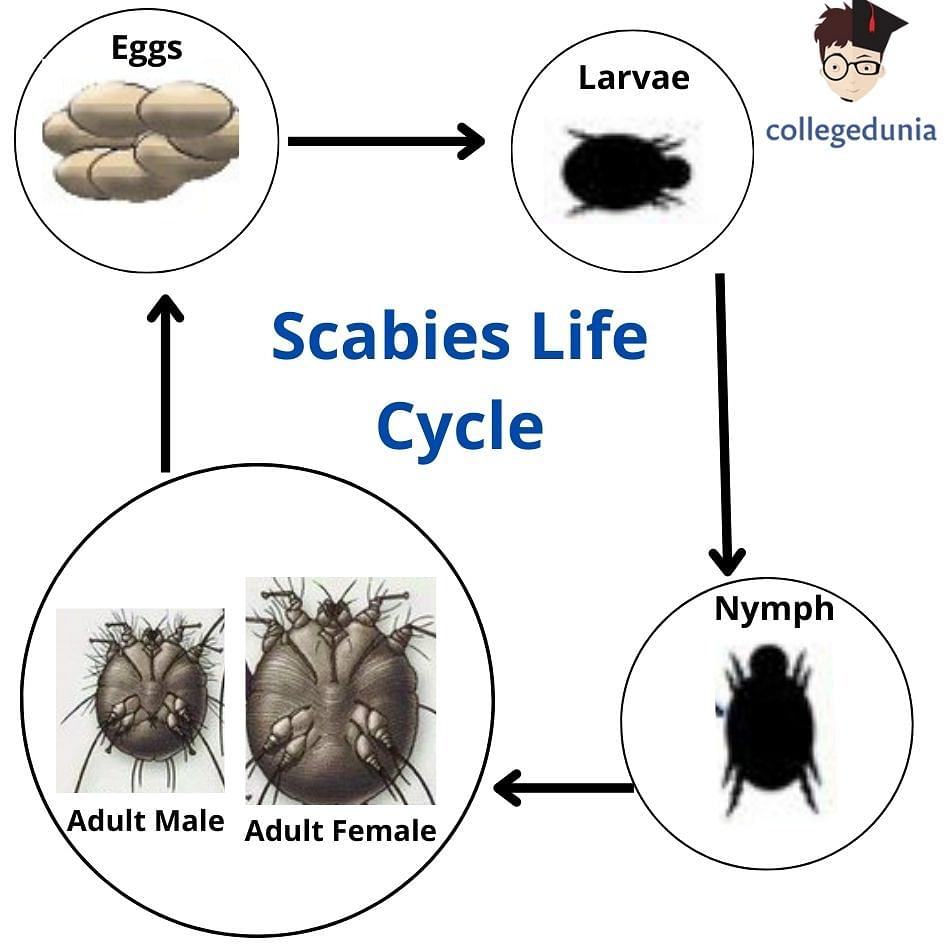
Life Cycle of Scabies
Stage 3: The Nymph
- The nymph has four pairs of legs.
- It then moults into much larger nymphs before transforming into adult mites.
- The nymphs are mostly found in the moulting pouches. They are also found in hair follicles as well.
- Nymphs of scabies mites look similar to adults.
Stage 4: The Adult
- In the last stage, the nymph enters the adult stage and appears to be round, sac-like eyeless itch mites.
- A female adult mite is up to 0.45 mm in length whereas the male adult mite is twice the size of the females.
- The mating process in scabies mites occurs only once in lifetime.
- Mating occurs when the male mite penetrates into the moulting pouch of the female mite.
- The female mite is fertilized for her entire remaining life after mating.
- The fertilized female mites detach their moulting pouches and look for a suitable spot for burrowing permanently.
- A fertilized female mite can survive up to 1-2 months in a host. Male mites are hardly seen during their adult stage.
Transmission of Scabies
[Click Here for Sample Questions]
The transmission of scabies occurs majorly by the transfer of the impregnated females during physical skin-to-skin contact among humans.
- Sometimes, scabies may occur via fomites such as bedding or clothing.
- Human scabies mites are usually found between the fingers and on the wrists.
- The risk of transmission of scabies increases with the level of infestations.
- The highest risk is due to contact with individuals with crusted scabies. Since there is an asymptomatic period of infestation, transmission may occur before the first infected person develops symptoms of scabies.
Read More: Entomology
Things to Remember
- Scabies is a type of skin irritation caused by a parasite Sarcoptes scabiei.
- Sarcoptes scabiei is a tiny, eight-legged mite that is too tiny to be seen with naked eyes.
- The female scabies mite burrows into the skin and lays eggs which causes intense itching and rash.
- Scabies is transmitted by physical contact from one person to another.
- There are four stages in the scabies life cycle namely the egg, the larvae, the nymph and the adult.
- The mating process occurs only once in the entire lifetime of the scabies-causing mite.
Sample Questions
Ques. List the symptoms of scabies. (3 Marks)
Ans. The symptoms of scabies are as follows:
- Intense itching on the skin which is usually severe and worse at night.
- Presence of thin, wavy tunnels made up of tiny blisters or bumps on the skin.
- Tiny pimple-like, itchy rashes on areas like elbows, armpits, wrists, waist, etc.
Ques. Where can be scabies found on the human body? (3 Marks)
Ans. Scabies can be found on the following areas of a human body:
- On the inner elbows
- On the soles of the feet
- On the chest
- Between the fingers and toes
- In the armpits
- Around the waist
- Along the insides of the wrists
- Around the nipples
- Around the belly button
- Near the genitals
- In Groin area
- On Buttocks
Ques. What are the causes of Scabies? (3 Marks)
Ans. Scabies is caused by a tiny itching mite, Sarcoptes scabiei. These itching mites spread to other areas of the skin or to the skin of other people. Severe itching is caused due to the body's allergic reaction to the mites and their waste.
Scabies can be also caused to another person through close skin-to-skin contact or sharing clothing or bedding with an infected person.
Ques. Can a person get scabies from pets or animals? (3 Marks)
Ans. No, scabies cannot be transmitted from pets to humans. Scabies cannot be transmitted between two species. Animals or pets are infected with a different species of scabies, which is exclusive only to animal species. Even if a person comes in close contact with scabies-infected animals, then there are no chances of scabies, however, there are chances of temporary itching that the human may experience.
Ques. What are the complications of Scabies? (3 Marks)
Ans. Scabies can also have severe complications. Scratching too much can break the skin and cause infections such as impetigo (an infection caused most often by staph bacteria (staphylococci) or sometimes by strep bacteria (streptococci)).
Crusted scabies, a more severe type of scabies, makes the skin crusty and scaly, and affects a large area of the body. Crusted scabies are very contagious and can be hard to treat.
Ques. How to prevent Scabies? (3 Marks)
Ans. Scabies can be prevented using the following steps:
- Wash the clothes properly: Wash all your clothes with hot, soapy water as heat kills the mites and their eggs. Also, dry them with heat for better protection.
- Starve the mites: In case you can’t wash a specific item, place those items in sealed plastic bags and leave them in an out-of-the-way place for a week for the mites to die after a few days without food.
- Keep your surroundings clean: Clean your home to prevent scabies from spreading. Vacuum clean the furniture, carpets and floors to remove scales and crusts that may have scabies mites.
Ques. How to treat Scabies? (3 Marks)
Ans. Scabies can be treated with the help of medicated skin creams or pills that kill the mites and their eggs. Sometimes, other skin conditions, such as dermatitis or eczema, can also cause itching and small bumps on the skin. One can visit a doctor to find the exact cause of the symptoms and receive the right treatment for the same. Antihistamines or nonprescription lotions may ease itching caused due to scabies.
Ques. Which countries are most affected by scabies? (3 Marks)
Ans. Scabies is a condition that is present throughout the world. However, the resource-poor communities are easily susceptible to scabies and the secondary complications of infestation. Scabies occur majorly in those countries that have hot, tropical climates, especially in communities where overcrowding and poverty coexist, and there is limited or no access to the right treatment.
Check-Out:



Comments