



Education Content Expert
Ticks are invertebrates that belong to the suborder Ixodida and the subclass Acari. Ticks are parasites that include around 825 species. They are part of domestic parasites that attack people in some cases. The most famous tick is the hard tick called the American dog tick, which feeds on the dog for several days.
Based on the species, ticks can live up to three years, during which they carry on with four distinct life stages namely egg, larvae, nymph, and adult. A tick needs a blood meal at each stage to get by and keep on developing.
Read More: Bird and Insect Life Cycle
| Table of Contents |
Key Terms: Ticks, Tick Life Cycle, Egg, Larvae, Nymph, Hard Tick, Soft Tick, Parasites, Blood
What are Ticks?
[Click Here for Sample Questions]
Ticks are external parasites which can be distributed among two major families, Ixodidae (Hard ticks) and Argasidae (Soft ticks).
- The mouthparts of hard ticks are at the frontal position while the mouthparts of soft ticks underlie their bodies.
- Their main source of feeding for ticks is the blood of mammals, reptiles, birds and amphibians.
- The body of an adult tick is pear-shaped with 8 legs.

Ticks
Life Cycle of Tick
[Click Here for Sample Questions]
Ticks go through distinct stages all throughout their life cycle. It takes more than a year to complete a full life cycle of ticks.
The life cycle of a tick is completed after four stages which are as follows:
- Stage 1: The Egg
- Stage 2: The Larvae
- Stage 3: The Nymph
- Stage 4: The Adult
Stage 1: The Egg
- After the adult female tick has got a decent amount of blood meal, she mates with an adult male tick leave the host, and look for a potential spot to lay her eggs.
- The eggs hatch and six-legged hatchlings rise out of the eggs.
Stage 2: The Larvae
- Aside from missing legs, the larvae tick seems to be the adult tick in this stage.
- After incubating, the larvae climb the leaves of grass and wait for a potential host to connect.
- The aroma of the mammal allows the tick to distinguish it and attach itself to the host.
- Once attached to the host, the hatchlings feed and go through several phases of moulting to change into a nymph.
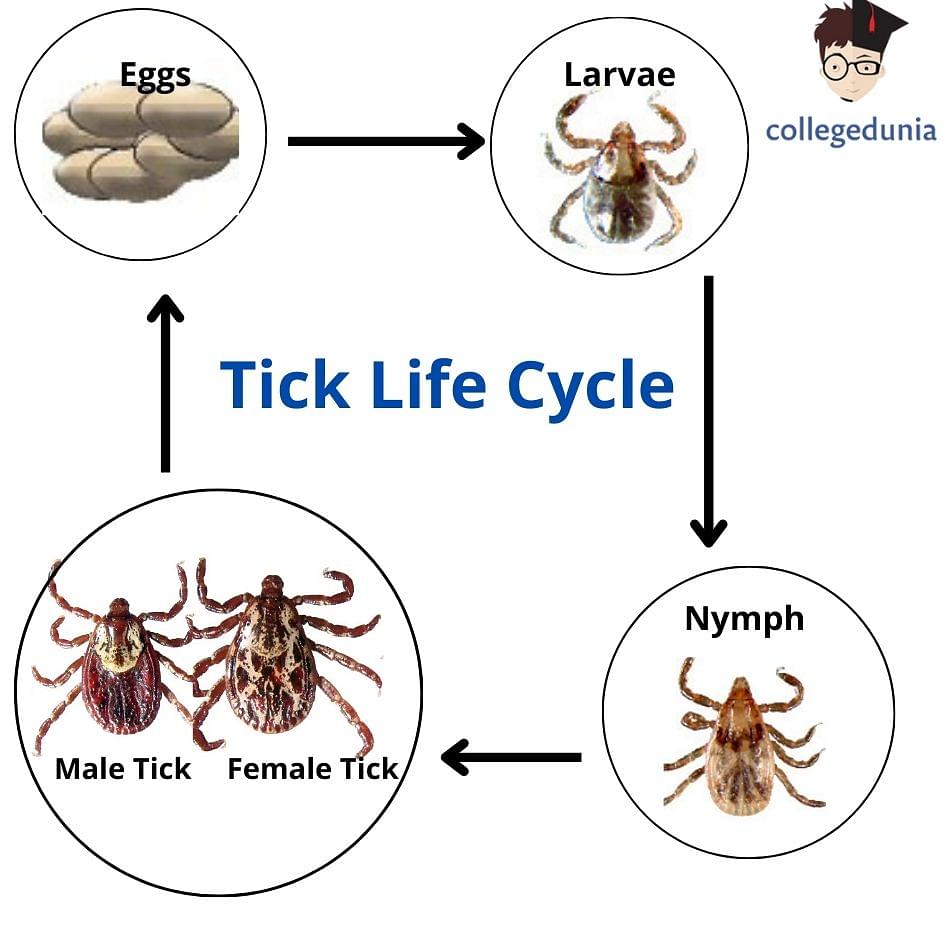
Tick Life Cycle
Read More: Fly Life Cycle
Stage 3: The Nymph
- After completing a good blood meal, the larvae detach and moult in order to develop 8 legs.
- The larvae moult for around two weeks and change into nymph ticks.
- The nymph develops 8 legs and again starts looking for a potential host to join and feed.
- The process is the same as the larvae tick.
Stage 4: The Adult
- Here the tick is physically and sexually developed and can replicate.
- In the case of hard ticks, the male and female adult ticks get adequate blood meals before mating.
- While feeding, the female tick takes a longer time to feed on as compared to male ticks.
- The male tick dies after mating and the female tick dies after laying the eggs.
- The eggs laid by the female tick are roughly 2000 to 18000 eggs.
- In the case of soft ticks, they eat out smaller blood meals and lay eggs several times.
Read More: Grasshopper Life Cycle
Tick-Borne Diseases
[Click Here for Sample Questions]
As ticks feed on blood, they transmit many infectious diseases to the host brought about by microbes like bacteria, viruses, and protozoa. Here is a list of a few tick-borne diseases:
- Anaplasmosis: Communicated to humans primarily by the bite of dark-legged ticks. It is a bacterial kind of sickness that attacks the white blood cells in the body. Side effects inculcate fever, chills, muscle pain, weariness, and stomach pain.
- Babesiosis: It is a protozoan kind of sickness brought about by the Babesia microti parasite primarily transmitted by dark-legged ticks. Side effects inculcate low circulatory strain, paleness, and influenza-like side effects.
- Colorado Tick Fever: It is a viral disease caused by the colorado tick fever transmitted to humans by Rocky Mountain wood ticks.
- Lyme Disease: The most well-known tick-borne sickness is Lyme infection, It is a bacterial kind of illness primarily brought about by deer ticks. Side effects inculcate Fever, headache, cranial nerves paralysis, carditis, weakness, flu-like sickness, and rash, which later gets larger and shows up as a round red ring.
- Tick-Borne Relapsing Fever (TBRF): It is a bacterial disease. Transmitted to people through the bite of infected soft ticks mostly of Ornithodoros species. Side effects inculcate repeating high fever, afflictions, migraines, muscle, and joint pain, and influenza-like side effects.
- Tick-Borne Encephalitis (TBE): It is caused by the TBE infection and is transmitted to people through infected species of ticks called Ixodes.
| Chapter-Related Links | ||
|---|---|---|
| Bed Bug Life Cycle | Dragonfly Life Cycle | Plasmodium Life Cycle |
| Ascariasis | Cockroach Life Cycle | Flea Life Cycle |
Things to Remember
- Ticks are invertebrates belonging to the suborder Ixodida and the subclass Acari.
- Ticks are domestic parasites which are distributed among two major families, Ixodidae namely hard ticks and Argasidae namely soft ticks.
- The life cycle of a tick involves four stages namely egg, larva, nymph, and adult.
- It takes more than a year to complete a full life cycle of a tick.
- Ticks feed on warm-blooded amphibians, reptiles and birds.
- Ticks don't live on one single host and change the host in different stages of their life cycle.
- They transmit many infections to the host caused by microbes like bacteria, viruses, and protozoa.
Read More: Ant Life Cycle
Sample Questions
Ques. How many stages are there in the life cycle of a tick? [3 Marks]
Ans. There are mainly four stages in the life cycle of a tick which are:
- Stage 1: The Egg
- Stage 2: The Larvae
- Stage 3: The Nymph
- Stage 4: The Adult
Ques. What is the Lifespan of a tick? [3 Marks]
Ans. For the most part, a male tick dies after mating with the female tick, While an adult female tick lives even after mating. The adult female tick then dies after laying a few thousand eggs. Adult female ticks gnaw normally more than male ticks as their life expectancy is much longer than that of adult male ticks.
Ques. For how much time can a Tick stay in a host? [3 Marks]
Ans. Ticks stay or remain attached to a single host for a variable period, it fluctuates relying on the types of the tick and also depends on the insusceptibility and life phase of the tick. All things considered, a tick stays in a single host for about possibly more than seven days.
Ques. For what reason do ticks favour warm and sticky regions to live? [3 Marks]
Ans. Tick species like to dwell in areas that have warm environment and damp environments. They need a highly humid climate to stay hydrated and a specific amount of dampness in the air, low temperature in the environment restricts their development from eggs to larva.
Ques. List down a few diseases caused by ticks or through them. [3 Marks]
Ans. The diseases transmitted by ticks are as follows:
- Anaplasmosis
- Babesiosis
- Colorado tick fever
- Ehrlichiosis
- Lyme Disease
- Tick-Borne Relapsing Fever (TBRF)
- Tick-Borne Encephalitis (TBE)
Ques. Where do ticks hide in people? [1 Mark]
Ans. Ticks favour soggy and warm regions to live in. Consequently, ticks are found in the armpits, crotch, or scalp.
Ques. Can people be affected by ticks? [3 Marks]
Ans. Ticks can connect to and feed on people. Individuals and dogs get infections from ticks they come into contact with outside. Diseases, for example, Lyme sickness and Rocky Mountain spotted fever, which has proactively been portrayed in dogs, can similarly be intense in people.
Ques. What amount of time is mandatory for a tick to arrive at development? [2 Marks]
Ans. From the eggs, ticks should eat blood at each stage to head toward the following stages. It can take a period of 1 year to complete a full lifecycle.
Ques. How quickly do ticks replicate? [3 Marks]
Ans. A female hard tick lays her eggs one to two days after mating and eggs hatch in about two weeks in a warm environment, whereas female ticks in cool environments can postpone egg-laying for quite a long time and the eggs will hatch in three to four months to bring forth.
Ques. How much blood can a tick hold? [2 Marks]
Ans. Ticks are not just sucking blood, but, in addition, spewing salvia, and poisons, into the host. A completely engorged tick will take about ½ of a millilitre of blood to be completely at the brim.
Check-Out:



Comments