



Content Writer
Skeletal muscle is one of three types found in the human body, along with visceral and cardiac muscles. Skeletal muscle is a type of muscle tissue that is attached to the bones and helps various parts of the body function. These muscles are also known as voluntary muscles because the nervous system in the body controls them. Numerous fascicles, or bundles of muscular fibers, are found within skeletal muscles. Fascia is a sort of connective tissue layer that surrounds each muscle fiber and each individual fiber. Myogenesis, a process that produces lengthy multinucleated cells from the union of developmental myoblasts, is how muscle fibers are created.
Read more: Ligament
| Table of Content |
KeyTerms: Skeletal muscle, Tissues, Bones, Collagen, Fibers, Muscle cell, Cardiac muscle
What is Skeletal Muscle?
[Click Here for Sample Questions]
Skeletal muscle is a type of contractile tissue that exists in animals. Its primary function is to move the body of an organism.
- A muscle of this type comprises a series of bundles of muscle fibers surrounded by protective membranes.
- This arrangement allows skeletal muscle to contract and release quickly without causing excessive friction between the individual fibers.
- Most skeletal muscles are attached to the bone via collagen fiber bundles.
- These collagen fibers are also tendons.
- These muscles undoubtedly power all of the body's movements.
- Furthermore, unlike smooth and cardiac muscles, skeletal muscles are under voluntary control.
- Because these muscles are striated, they are similar to cardiac muscles in this regard.
Structure of Skeletal Muscle
[Click Here for Sample Questions]
Skeletal muscle is made up of a network of muscle fibers that are made up of muscle cells. Furthermore, these muscles are multinucleated and long.
- The connection of a muscle to the bone occurs at the ends of each skeletal muscle via a tendon.
- This tendon connects directly to the epimysium of skeletal muscle's collagenous outer covering.
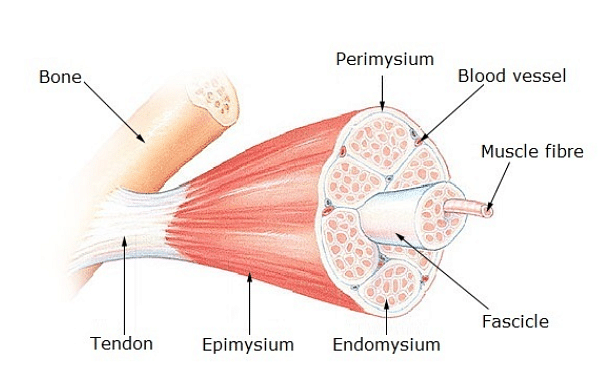
Structure of skeletal muscle
- The fascicle bundles are formed by the grouping of muscle fibers beneath the epimysium.
- These fascicle bundles are protected by collagen covering.
- Additionally, the perimysium allows nerves and blood vessels to pass through the muscle.
- Each fascicle is formed by a group of tens to hundreds of bundled muscle fibers.
- Each muscle fiber is formed by a chain of multinucleated muscle cells.
- Sarcomeres are formed through the interaction of actin, myosin, and other helper proteins.
- The filaments visible between the dark bands are almost certainly actin and myosin filaments.
The Function of Skeletal Muscle
[Click Here for Sample Questions]
- When a person moves his arm, the brain sends a nerve signal to the nerves. This simple act of raising the arms requires a lot of muscles.
- As a result, the signal is sent down many nerves to many muscles by the brain. Furthermore, the nervous impulse is received by the skeletal muscle at neuromuscular junctions. There are also locations where nerves can stimulate an impulse in a specific muscle cell.
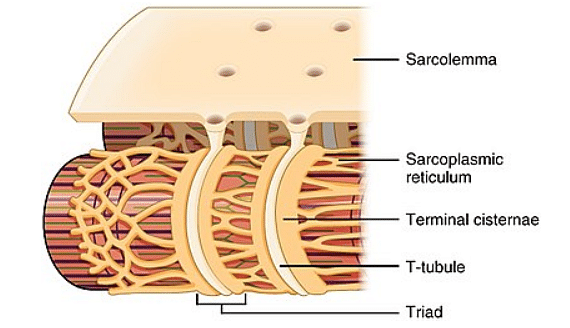
Transverse tubule
- The nervous impulse is carried inside the cell by the transverse tubules. Furthermore, the impulse causes calcium ions to activate troponin, allowing it to be released from tropomyosin.
- The tropomyosin then moves for the myosin heads to attach to the filament. Once the myosin heads have been attached, the ATP available is used to contract the filament.
- This is accomplished by each pair of myosin heads as they slowly crawl down the filament. One head is moved by ATP energy, while the other is attached.
Types Of Skeletal Muscles
[Click Here for Sample Questions]
Red and white muscles are the two types of skeletal muscles:
-
Red Muscles
Red muscles are caused by myoglobin, a red pigment found in high concentrations in the human body. These muscles have a smaller diameter and a high number of mitochondria. Myoglobin stores oxygen, which is then used by the mitochondria to produce ATP. Blood capillaries are densely packed in red muscles.
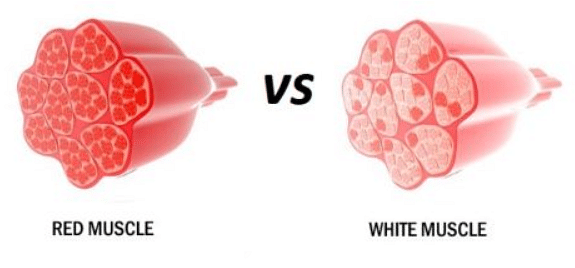
Red and white muscles
-
White Muscles
White muscles are larger in diameter than red muscles and contain a small amount of myoglobin. In addition, they have fewer mitochondria.
Significance Of Skeletal Muscle
[Click Here for Sample Questions]
The important role of skeletal muscle is listed below.
- Skeletal muscles control body movements such as typing, breathing, extending the arm, writing, and so on. Muscles contract, pulling the tendons on the bones and causing movement.
- The skeletal muscles support the body's posture. The gluteal muscle is in charge of keeping the body upright.
- The Sartorius muscles in the thighs control body movement. The skeletal muscles protect and support the internal organs and tissues by protecting them from injury.
- These also support the body's entry and exit points.
- The anus, the mouth, and the urinary tract are all surrounded by sphincter muscles. These muscles contract, reducing the size of the openings and allowing for easier swallowing, defecation, and urination.
- Skeletal muscles also help to regulate body temperature.
- The body becomes hot after strenuous exercise. This is due to skeletal muscle contraction, which converts energy into heat.
Read more:
| Relevant Concepts | ||
|---|---|---|
| Control & Coordination | Peripheral Neural System | Sympathetic Nervous System |
| Arteries | Uses of Microscope | Locomotion & Movement |
Properties Of Skeletal Muscle
[Click Here for Sample Questions]
Skeletal muscles have the following characteristics:
- Extensibility: When muscles are stretched, they can extend this is known as extensibility.
- Elasticity: When muscles are released, they can return to their original structure, this is known as elasticity.
- Excitability: The muscle can respond to a stimulus known as Excitability.
- Contractility: It is a muscle's ability to contract when it comes into contact with a stimulus this is known as Contractility.
Components of Skeletal Muscles
[Click Here for Sample Questions]
Skeletal muscles are made up of flexible muscle fibers that range in diameter from less than half an inch to slightly more than three inches. These fibers typically run the entire length of the muscle. The fibers contract (tighten), allowing the muscles to move bones and perform a variety of movements.

Skeletal muscle, Smooth muscle, Cardiac muscle
Smooth Muscle
- Smooth muscle is a type of muscle tissue that is used by various systems to apply pressure to organs and vessels. Even when examined under a microscope, it is an involuntary muscle with no cross stripes.
- Smooth muscle cells are made up of myosin and actin fibers that run through the cells and are supported by a framework of various proteins, with the filaments arranged in a stacked pattern across the cell.
- It has a staircase arrangement of actin and myosin fibers, which differs from the structure seen in cardiac and skeletal muscles.
- Unlike striated muscles, smooth muscle tissues contract at a slower rate on their own. Smooth muscles make up the majority of the musculature of the digestive system and internal organs.
- Smooth muscles contract in response to stimuli that cause ATP to be released for use by myosin. This ATP release is dependent on the magnitude of the stimuli, allowing the smooth muscles to have a graded contraction as opposed to the skeletal muscles' 'on-or-off' contraction. The actin filaments connect one side of the cell to the other via the cell membrane and dense bodies.
Cardiac Muscle
- The cardiac muscles, one of the three types of muscles, is a muscle tissue found in the heart that performs and causes coordinated contractions that allow the heart to pump blood throughout the body via the circulatory system.
- Through involuntary movements, the cardiac muscle tissues cause the heart to pump continuously. This is one of the distinguishing characteristics of cardiac muscles that distinguishes them from other muscle tissues under one's control. It does so by using specialized cells known as pacemaker cells, which control the heart's contractions.
- The nervous system sends signals to specialized cells that tell them whether to increase or decrease the heart rate. The pacemaker cells are linked to the cardiac muscle cells, allowing them to send signals that cause a wave of contractions in the cardiac muscles, resulting in a heartbeat.
The cardiac muscles consist of the following:
- Nucleus
- Gap junctions
- Intercalated discs
- Desmosomes
Read more:
| Relevant Concepts | ||
|---|---|---|
| Plant cell | Cell organelles | Nuclear membrane |
| Urethra | Rigid bodies | Blood Coagulation |
Things To Remember
- Skeletal muscle is made up of tissue fibers that are attached to your skeleton or bones and are in charge of all your movements.
- Skeletal muscles can be found around some of the body's openings as well as all over your body between the bones.
- The skeletal muscle attaches to bones and aids in movement, whereas cardiac muscle is made up of muscle fibers in the heart and is responsible for its pumping action.
- Smooth muscle is found in the digestive tract, urinary system, arteries, veins, lungs, and other organs.
- Skeletal muscle movement is voluntary, whereas cardiac and smooth muscle movement is involuntary.
- Skeletal muscles aid in temperature regulation.
- The muscles generate heat as they contract by using energy known as ATP.
- Skeletal Muscles Exhibit the Property of Extensibility, Elasticity, Excitability, and Contractility property of Muscles.
Sample Questions
Ques. What are Skeletal Muscles? (2 marks)
Ans. Skeletal muscle is one of the human body's three major muscle tissues. Each skeletal muscle is composed of thousands of muscle fibers that are linked together by connective tissue sheaths. In skeletal muscle, fasciculi are individual bundles of muscle fibers.
Ques. What are smooth muscles? (2 marks)
Ans. Smooth muscle is a type of muscle tissue that is used by various systems to apply pressure to organs and vessels. Smooth muscle cells are made up of myosin and actin fibers that run through the cells and are supported by a framework of various proteins, with the filaments arranged in a stacked pattern across the cell.
Ques. What are the Skeletal Muscle's Four Primary Functions? (4 marks)
Ans. Skeletal muscle serves four primary functions:
- It aids in movement
- It maintains proper body posture,
- It generates energy and heat for the body
- It protects the body's internal organs.
Ques. Why are skeletal muscles referred to as striated muscles? (1 mark)
Ans. Under a microscope, the skeletal muscle appears as alternate black and light bands or stripes. As a result, they're synonymous with striated muscles.
Ques. Name the Muscles that are also known as Skeletal Muscles. (1 mark)
Ans. Skeletal muscle names include Biceps brachii, Anconeus, Pronator teres, Palmaris Longus, and others. They are all parts of the human body.
Ques. What is the skeletal muscle's structure? (5 marks)
Ans.
- Skeletal muscle has the following structure:
- Tendons connect the muscles to the bones.
- They have fascicles, which are cylindrical muscle fibers.
Different layers of fibers surround fascicles:
- The outer layer of the epimysium
- Perimysium is the middle layer.
- The inner layer of Endomysium
The cytoplasm is separated from the extracellular components by the sarcolemma.
The skeletal muscle diagram below depicts all of the parts mentioned above and their positions. Furthermore, the blood vessels can be seen surrounding the muscle cells. Furthermore, each cell has a single nucleus, the myofibril.
Ques. How many skeletal muscles are Present in a Human Body? (2 marks)
Ans. There are over 650 named skeletal muscles in the human body, according to estimates. Other muscle tissue, such as smooth muscle, develops on a cellular level, which means that one can have billions of smooth muscle cells.
Ques. What is the composition of the skeletal muscles? (2 marks)
Ans. Skeletal muscles are made up of flexible muscle fibers that range in diameter from less than half an inch to slightly more than three inches. These fibers typically run the entire length of the muscle. The fibers contract (tighten), allowing the muscles to move bones and perform a variety of movements.
Ques. Differentiate Between Skeletal, Cardiac, and Smooth Muscles? (10 marks)
Ans. The Difference Between Skeletal, Cardiac, and Smooth Muscles are mentioned below.
| Skeletal Muscles | Cardiac Muscles | Smooth Muscles |
|---|---|---|
| Skeletal muscles are voluntary muscles, which means you can control when and how they move. Somatic nervous system nerves send signals to allow them to function. | Cardiac muscles are only found in the heart. They assist your heart in moving blood throughout your body. | Smooth muscle is found in your organs, blood vessels, digestive tract, skin, and other parts of your body. |
| skeletal muscles are used in neck, arm, and shoulder when one reach for a book on a shelf. | They are involuntary muscles that are controlled by your autonomic nervous system. That is, they function without your intervention. | Smooth muscles are also involuntary. As a result, your autonomic nervous system is also in charge of them. |
Ques. What is the weight of skeletal muscles? (2 marks)
Ans. Although skeletal muscles account for approximately 35% of your body weight, this varies from person to person. Males have 36% more skeletal muscle mass than females. People who are tall or obese tend to have more muscle mass. Both men and women lose muscle mass as they age.
Check out:



Comments