



Education Journalist | Study Abroad Lead
Electromagnetic engines help in providing additional power and capacity without emitting toxic pollutants into the atmosphere unlike normal automobile engines. Solenoids, like bar magnets, are made up of a large coil of wire wrapped in many turns that generates a consistent magnetic field when electricity is carried through it. Solenoids are used in a variety of solenoid engines because the coils can be reinforced by adding an iron core.
| Table of Content |
Key Takeaways: Electromagnetic Force, Microcontrollers, Sensor, Piston, Coil, Ignition System, Magnetic field, Electricity, Solenoid engines, Automobile engine
What is Solenoid?
[Click Here for Sample Questions]
Solenoids and electromagnets are not the same things. A solenoid is just a coil of wire that becomes an electromagnet when a current is passed through it. This is by far the most useful application of a coil of wire. Electromagnets are very helpful because, unlike conventional magnets, they can be turned on and off, and their strength can be increased by increasing the current flowing through them.

Solenoid
Functions of Solenoid
[Click Here for Previous Year Questions]
A magnetic field is created when an electric current travels through the coils of a solenoid. The number of coils in the solenoid is used to determine the magnitude's strength. Because the armature in a solenoid is movable, a voltage is sent through the coils, and the armature's movement increases the flux linkage. The air gap between the two movable cores or the armature closes, causing this to happen. They come with a spring that turns off the voltage to the solenoid and then returns it to its original position.
Read More: Magnetic Field in A Solenoid
Uses of Solenoid
[Click Here for Sample Questions]
Solenoids are used in a wide range of applications, from household appliances to electronic hobbies. They're most commonly seen in applications that demand a feature that can switch the appliance on or off automatically. Consider an electric torch or an engine kill switch, both of which are ubiquitous on today's motorcycles.
Also Read:
| Related Articles | ||
|---|---|---|
| Uses of Inductor | Transformers | Electromagnets |
| Electromagnetic Field | Motional emf | Experiment faraday henry |
Solenoid Engine
[Click Here for Previous Year Questions]
In a solenoid engine the coils help in the transferring of the energy that makes the pistons move back and forth due to electromagnetic force. The calendric coil was invented by André-Marie Ampère, a French scientist (i.e. solenoid).
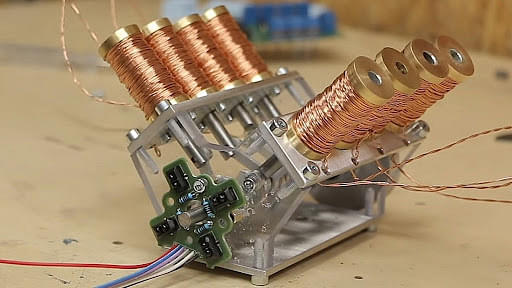
Solenoid Engine
A British physicist named Michael Faraday devised two experiments to demonstrate electromagnetic rotation. The electromagnetic attraction law governs the operation of a solenoid engine. The plunger is attracted by coil magnetism. A spark distributor is used to shift the electromagnet by the piston's position. It can be done without using any sensors or microcontrollers.
The solenoid wastes electrical energy when it is held in place. It does not, however, produce any output. Against the coil's resistance, all of the electrical energy is transformed to heat. As a result, its efficiency is nil. An electric motor and a solenoid operate on the same basic concept.
Variety of Solenoid Engine
[Click Here for Sample Questions]
The variety of solenoid engines is based on a material of construction, design, and function.
- Rotary solenoid
- Linear solenoid
- AC laminated solenoid
- DC C and D frame solenoid
Advantages of Solenoid Engine
[Click Here for Previous Year Questions]
- The solenoid engine emits no pollutants into the atmosphere.
- As a substitute for fossil fuels, these engines are quite beneficial.
- The engine is more efficient, but it produces less torque.
- The solenoid engine requires a very quick reaction time.
- The solenoid engine's core is used to impart mechanical force to the valve.
- Electromagnets are used as secure closing in interior locking systems. Solenoids are used in computer printers, gasoline injectors, and automotive gears.
Read Further: NCERT Solutions for Class 12 Physics Chapter 6 Electromagnetic Induction
How to make a Solenoid Engine?
[Click Here for Sample Questions]
Given below are the list of items required and procedure to make a solenoid engine.
Materials Required
- ACP sheet
- Fiber reaper pieces
- Fisher plugs, screws (1.5” 2 and 3⁄4” 4)
- Insulated copper wire
- 26 gauge 30 m
- 2 syringes GI (galvanized iron) rod 12-30 cm
- Copper wire 18-30 cm
- Cylindrical magnets and wood wheel
Tools Required
- Angle grinder
- Drilling machine
- Drill bit (4 mm and 6 mm)
- Cigar lighter
- Screwdriver and player
Procedure
- Cut two identical pieces of ACP sheet, mark the syringe dia on one, and discard the other.
- Remove 2" of the syringe's cylinder and place it on the sheet.
- Wind a length of 26 gauge copper wire around the syringe piece.
- To fix the magnet wire tightly, the least number of turns is 60 and the maximum is as many as feasible.
- Before preparing the piston, it's crucial to remember that it's made up of three parts: the piston head, connecting rod, and crank.
- A cylindrical magnet is utilized as the piston head, a fiber reaper-screw is used as the connecting rod, and a piece of the reaper is used as the crank.
- Connecting rods are responsible for supplying power to the crankshaft.
- Bend the GI rod such that it produces a wave shape.
- Make and break the arrangement with 18 gauge copper wire, then carefully assemble all of the parts.
- Connect the flywheel to one of the crankshaft's ends, then use an old laptop AC-DC converter for electricity.
Things To Remember
- The solenoid engine emits no pollutants into the atmosphere.
- These engines could be utilized instead of fossil fuels.
- With less torque, the engine is more efficient.
- A solenoid engine requires a very quick reaction time.
- Electromagnets are used as secure closing in interior locking systems.
- Solenoids are used in computer printers and fuel injector gears in automobiles.
Also Read:
Previous Year Questions
- An electric buib rated 220 V, 100 W is connected in series with another bulb… [KEAM]
- A carbon resistor is marked with the ring coloured brown, black, green and gold….[KEAM]
- The effective resistance across the points A and I is...[KEAM]
- A metal conductor of length 1m rotates vertically about one...[KEAM]
- The north pole of a long horizontal bar magnet is being brought closer to a…
- what is the current flow through the resistor during the 0.4 s?
- Revolutions per minute in the earth's magnetic field (B=0.5 gauss), the emf induced in coil will be…
- Which of the following does not use the principle of electromagnetic induction?
- A uniform wire of resistance R and length L is cut into four equal parts…
- At room temperature, copper has free electron density of 8.4 times…
- Three resistances P, Q, R each of 2 Omega….
- A coil having 500 square loops of side 10 cm is placed….
- The north pole of a long horizontal bar magnet is being brought closer to….
- The current in a coil of L = 40 mH is to be… [VITEEE 2017]
- wo identical circular coils A and B are kept on a horizontal tube side by side without touching each other…. [KCET 2013]
- The magnetic flux through a circuit of resistance R changes by an amount….[NEET 2004]
- A conducting loop in the shape of a right angled isosceles triangle of height...[JEE Advance 2016]
- If a transformer of an audio amplifier has output impedance…..[JCECE]
- A wire loop is rotated in magnetic field. The frequency of change of direction of the induced e.m.f. is….[NEET 2013]
- An electron moves on a straight line path XY as shown. The abcd is a coil...[NEET 2015]
Sample Questions
Ques 1. Are solenoid engines practical? How can one empower the solenoid? (2 marks)
Ans. Solenoid engines demonstrate electromagnetics in action. However, because they have limited practical applications, they are frequently relegated to the world of show items.
Switching the current on and off is a simple way to drive the solenoid. It's possible to do it with a low-side MOSFET switch and a current recirculation diode.
Ques 2. How does a solenoid motor work? (2 marks)
Ans. The law of electromagnetic attraction governs the operation of a solenoid engine. The plunger is attracted by coil magnetism, and a spark distributor is utilized to shift the electromagnet by the piston's position without the use of sensors or microcontrollers. An electromagnet is created by this magnetic field.
Ques 3. What is the use of solenoid? (2 marks)
Ans. A solenoid is an electromagnet that uses a coil twisted into a closely packed helix to generate a regulated magnetic field. When an electric current is supplied through the coil, it can be adjusted to produce a consistent magnetic field in a volume of space.
Ques 4. Is a solenoid a starter? (2 marks)
Ans. It's usually found between the ignition module and the engine of your vehicle. Solenoids (also known as starter solenoids or starter relays) work by receiving both big and small electrical currents from the battery and the ignition system when the automobile key is turned.
Ques 5. Where is the solenoid engine used? (2 marks)
Ans. The following are some of the uses for a solenoid engine: The solenoid's core is utilized to exert mechanical force on the valve. Electromagnets are used as secure closing in interior locking systems. Solenoids are used in computer printers and fuel injector gears in automobiles.
Ques 6. Are solenoids AC or DC? (1 mark)
Ans. The most significant components in solenoid valves that control the flow of liquids and gases are solenoids. Solenoids are electromechanical devices that convert alternating current (AC) or direct current (DC) electricity into linear motion.
Ques 7. What is the principle of the solenoid? (2 marks)
Ans. The solenoid operates based on "electromagnetism." When current flows through a coil, a magnetic field is formed in it; if a metal core is placed inside the coil, the magnetic lines of flux are focussed on the core, increasing the coil's induction over an air core.
Ques 8. What is the difference between a coil and a solenoid? (2 marks)
Ans. A coil is a circular coil of wire that works like a magnet when electric current travels through it, whereas a solenoid is a circular coil of insulated wire that acts as a magnet when electric current flows through it.
For Latest Updates on Upcoming Board Exams, Click Here: https://t.me/class_10_12_board_updates
Check-Out:



Comments