



Content Curator
Thermal expansion is the tendency of matter to change its shape, area, and volume in response to a change in temperature. In solids, the atoms are tightly packed together making thermal expansion an important characteristic property in solids. Temperature is a monotonic function of the average molecular kinetic energy of a substance. The article discusses the types of thermal expansion, the relation between the coefficients of thermal expansion, and discusses some important examples to understand the concept.
Read More: States of Matter
| Table of Content |
Key Terms: Thermal Expansion, Heat, Temperature, Coefficient of Thermal Expansion, Linear, Volume, Area, Mechanical Properties, Solids
What is Thermal Expansion?
[Click Here for Sample Questions]
Thermal expansion is defined as the increase in the volume of a material with an increase in temperature. It is the fractional change in length or volume per unit change in temperature. The expansion of the solid material is taken to be the linear expansion coefficient, as the expansion takes place in terms of height, thickness and length. The gaseous and liquid expansion takes the volume expansion coefficient. In fluids, the changes are in terms of a volume change.

Thermal Expansion
The bonding force among the molecules and atoms differs from material to material. These characteristics of the compounds and elements are known as the expansion coefficient.
Read More: Thermal Energy
Types of Thermal Expansion
[Click Here for Sample Questions]
There are three types of thermal expansion:
- Linear Expansion
- Volume Expansion
- Area Expansion
Let us look at each of the types in detail.
Linear Expansion
When heat is passed to a solid material and the material expands along its length, it is known as Linear expansion. For example, consider a rod of length ‘L’ and suppose that the temperature of the rod is increased by a small amount, then, the Linear Expansion is given by,
ΔL/L= αL LΔT
Where,
ΔT is the change in temperature,
ΔL is the change in length
αL is the linear coefficient of thermal expansion
L is the original length
The SI unit is per degree Celsius (°C-1) and in the CGS system, it is per kelvin i.e. K-1.
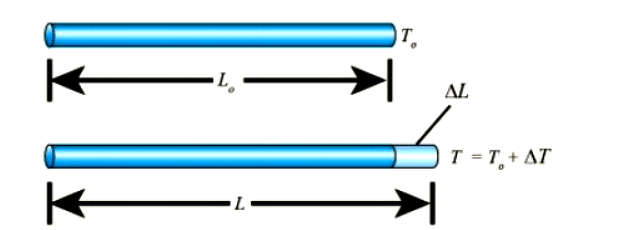
Linear Expansion in a Rod
Volume Expansion
When a solid increases in volume, on being heated, it is called volume expansion. For an initial volume V, at Δt change in temperature, volume expansion is given by
Δv = VγΔt
Where,
'γ' is the coefficient of volume expansion.
Δt is the change of temperature
Δv is the volume change

Volume Expansion on Temperature Increase
Area or Superficial Expansion
If the surface area of a solid increases on being heated, it is called Area or superficial expansion. If the area of a solid is A0 at 0°C, then the area of that solid at t °C is given by
ΔA = A0ß ΔT
Where ß is ed the cocallefficient of superficial expansion, and the unit is given by °C-1 or K-1

Area Expansion on Temperature Change
Also Check:
Coefficients of Thermal Expansion
[Click Here for Sample Questions]
The relationship between the three types of coefficient of expansion of solid material is given as follows:
6α = 3ß = 2γ
Linear expansion is represented by α, Superficial expansion is represented by ß, and γ is the volume expansion. The values of these coefficients are not constant, as they depend on the temperature.
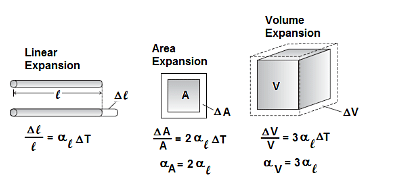
Relation between Coefficients of Thermal Expansion
Factors Affecting Thermal Expansion
[Click Here for Sample Questions]
The factors that affect thermal expansion are:
- There is an inverse relation between thermal energy and bond energy which further affects the melting point.
- The more the melting point is, the lower will be the thermal expansion. Example- Expansion in liquids is slightly more than in solids, and expansion in glasses is higher compared to crystals.
- At a given temperature, the re-arrangements in an amorphous material lead to discontinuities in thermal expansion.
- The phenomena of absorption or desorption of water or any other solvent change the common material, this further affects the thermal expansion.
Applications of Thermal Expansion
[Click Here for Sample Questions]
Here are some of the applications of thermal expansion in our daily life.
Thermometers
The thermometer is used to measure the temperature. In a thermometer, the mercury expands as the result of thermal expansion. Thermometers can be used to measure the temperatures of solids, liquids, or gases. Celsius, Fahrenheit, and Kelvin are the three widely used scales of measurement of temperature.
Removal of Tight Metal Lids
When a bottle has a tightly tied metal lid, then the easiest way to open it is to immerse the bottle in hot water for some time. The metal lid will expand due to the heat of the water and will become loose and easy to open.
Riveting
The rivets used to tightly join the steel plates are heated before it is forced through the holes in the plates. Then the end of the rivets are hammered and when it cools down, the rivets bring the steel plates gripped tightly.
Design of Aircrafts
During flight the aircraft expands by 15-25 cm owing to the heat of friction in the air. Rollers are used to separate the cabin and passenger area so that the thermal expansion does not cause the flight to rip apart while it is airborne.
Overflow Coolant Tanks in Automobiles
The internal heat engine works on the principle of heat rejection onto the surroundings. Thus, an efficient cooling implies a highly efficient engine. Coolants that are used for this purpose themselves undergo volume expansion. to avoid this overflow coolant tanks are provided so that serious accidents from bursting of coolant lines can be avoided.
Check Out:
Things to Remember
[Click Here for Sample Questions]
- Thermal expansion is the phenomenon by which there is an increase in the volume, size, shape, and length of solid, liquid, and gas after being heated.
- There are three types of thermal expansion- Volume Expansion, Linear expansion, and Area expansion.
- The relation between the three coefficients of thermal expansion is given by 6α = 3β = 2γ, where α, β, and γ are the coefficients of linear, area, and volume thermal expansion respectively.
- Multiple industrial applications and household uses of thermal expansion exist.
- The melting point, structure, internal packing, and reaction with water affect the thermal expansion of materials.
Read More: Unit of Heat
Previous Year Questions on Thermal Expansion
- Coefficient of Volume Exapnsion of Glycerine. [NEET 2015]
- Determine the Thermal capacity ratio. [JIPMER 1999]
- Thermal Expansion on the pendulum clock. [BITSAT 2009]
- Linear Expansion in Steel scale. [TS EAMCET 207]
- Expansion of a thermocol box of ice. [TS EAMCET 2017]
- Determine the volume increase of wooden box. [JEE Main 2021]
- Calculate rate of heat flow when dimensions are doubled. [JEE Advanced 2001]
- Level of water when ice melts in a jar. [KEAM 2004]
- Coefficient of Volume Expansion of water. [NEET 2013]
- Cubical to superficial expansion ratio. [NEET 2002]
- Calculate the latent heat of ice. [JEE Main 2019]
- Temperature at the interface of two materials. [JEE Main 2019]
- Temperature at the boundaries of the insulating blocks. [VITEEE 2019]
- Determine the amount of water in the calorimeter. [JEE Main 2013]
- Temperature of a body on cooling in a given time. [JEE Main 2018]
- Determine temperature rise when coefficient of linear expansion is given. [JEE Main 2017]
- Calculate the specific heat of the liquid in a closed vessel. [JEE Main 2013]
- Determine percentage increment in water temperature. [JEE Main 2019]
- Temperature at which the clock will show correct time. [JEE Main 2016]
- Linear expansion in steel rail. [JEE Main 2017]
Sample Questions
Ques. Which state of matter has the maximum value of the temperature coefficient of cubical expansion? (1 Mark)
(1) Gas
(2) Liquid
(3) Solid
(4) None of this
Ans: (1) Gas. It is because gas particles are far apart from each other, therefore they have the maximum coefficient of cubical expansion.
Ques. Give any three uses of thermal expansion on solid. (1 Mark)
Ans: Three examples of thermal expansion on solid are thermometer, rivet, and fixing metal tires.
Ques. Give a reason, why kitchen glasses are made up of Pyrex glass? (1 Mark)
Ans: The kitchen glasses are made up of Pyrex glass because Pyrex glass has a low coefficient of expansion, therefore, it does not break on heating.
Ques. What is the relation between the coefficient of volume expansion and area expansion? (1 Mark)
Ans: The relation between the coefficient of volume expansion ‘r’, and linear expansion ‘s’, is given by s=2/3r.
Ques. Does the thermal expansion depend on the material? Give example (2 Marks)
Ans: Yes, thermal expansion depends on the material.
For example, the Linear expansion coefficient of Aluminium = 2.5 × 10⁻⁵ K-1
The linear expansion coefficient of Iron = 1.2 × 10⁻⁵ K-1
If a thin Aluminium rod of length 1 m is heated to 100º C, then its length will increase by 2.5 mm
If a thin iron rod of length 1 m is heated to 100º C, then its length will increase by 1.2 mm.
Ques. A steel rail of length 5m and area of cross-section 40cm2 is prevented from expanding while the temperature rises by 10°C. Given coefficient of linear expansion of steel is 1.2 × 10⁻⁵ k-1. Explain why space needs to be given for thermal expansion. (2 Marks)
Ans: The Compressive strain,
ΔI/I = αT = 1.2 x 10-5 x 10 = 1.2 x 10⁻⁴
Thermal stress, ΔF/A = γ (ΔL/L) = 2 x 1011 x 1.2 x 10-4
= 2.4 x 10⁷ Nm-2
which corresponds to an external force, ΔF = 2.4 x 107 x 40 x 10-4 = 105 N
Ques. Write any two factors that affect the thermal expansion of any material. (2 Marks)
Ans: The two factors that affect the thermal expansion of any material are:
- There is an inverse relation between thermal energy and bond energy which further affects the melting point. The more the melting point is, the lower will be the thermal expansion.
- The phenomena of absorption or desorption of water or any other solvent change the common material, this further affects the thermal expansion.
Also Check Out:



Comments