



Content Writer
Trigonometry is the branch of mathematics which is primarily concerned with the relationship between the side lengths and the angles of a triangle. It is known for its formulas, identities and functions.
- The word ‘Trigonometry’ is derived from two Latin words, namely “Trigonon” and “Metron”.
- These words mean ‘triangle’ and ‘measure’, respectively.
- In trigonometry, angles are measured in terms of degrees and radians.
- The concept was first developed by Greek astronomer and mathematician Hipparchus.
- Core, plane and spherical trigonometry are three branches of trigonometry.
- There are six functions used in the case of angles.
- It is used to measure the unknown value of a right-angled triangle.
- Trigonometry is applied to many fields, such as surveying, geodesy, celestial mechanics, navigation, and optics.
Read More: Trigonometric Ratios Important Formulas
Key Terms: Trigonometry, Trigonometry Ratios, Trigonometry Table, Trigonometric Function, Trigonometry Identities, Graph, Right-Angle Triangle, Hypotenuse
What is Trigonometry?
[Click Here for Sample Questions]
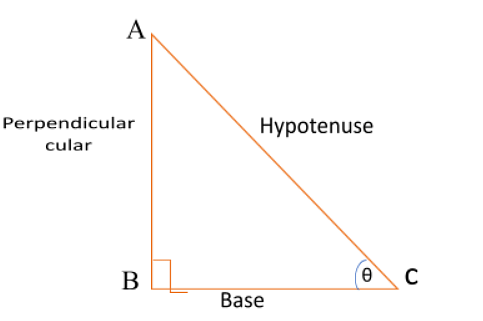
In trigonometry, we study triangles, in particular, right-angle triangles. The right-angle triangle is the one that has one right angle, and the other two angles sum up to 90°. The longest side opposite to the right angle is called Hypotenuse.
- The bottom line is called base or adjacent, and the perpendicular line segment is called opposite.
- In the case of the right-angled triangle ABC, Angle ABC is the right angle.
- Angle ACB is the opposite angle; BC= Base/ Adjacent; AB= Perpendicular, and AC= Hypotenuse.
- It helps us find the measurements of unknown dimensions using the same ratios, formulas, and identities.
- 0°, 30°, 45°, 60° and 90° are some commonly used trigonometric angles.
- Astronomical sides also used the concept of the trigonometry.
Read More:
Trigonometry Ratios
[Click Here for Sample Questions]
There are six primary trigonometry ratios that help to establish relationships between the sides of a triangle and its angle. If θ is the angle between the base and the hypotenuse of the right-angle triangle ABC, then the ratios can be written as below-
- sin θ = Perpendicular/Hypotenuse = AB/AC
- cos θ = Base/Hypotenuse = BC/AC
- tan θ = Perpendicular/Base = AB/BC
The other three ratios are formed from taking the reciprocals of sine, cosine and tangent. These ratios are as follows-
- cot θ = 1/tan θ = Base/Perpendicular = BC/AC
- sec θ = 1/cos θ = Hypotenuse/Base = AC/BC
- cosec θ = 1/sin θ = Hypotenuse/Perpendicular = AC/AB
The summary of six different trigonometry ratio are as follows:
| Trigonometric Function | Abbreviation of Function | Relationship with triangle |
|---|---|---|
| Sine Function | sin | Opposite side/ Hypotenuse |
| Cosine Function | cos | Adjacent side / Hypotenuse |
| Tangent Function | tan | Opposite side / Adjacent side |
| Cosecant Function | cosec | Hypotenuse / Opposite side |
| Secant Function | sec | Hypotenuse / Adjacent side |
| Cotangent Function | cot | Adjacent side / Opposite side |
Read More: Tan 0 Degrees
Trigonometry Table
[Click Here for Sample Questions]
The trigonometry table is composed of the trigonometric ratios that are interrelated to each other. Here, the opposite angle (θ) is taken into consideration while measuring these ratios.
- Some of the trigonometric ratios are sine, cosine, tangent, cosecant, secant, and cotangent, respectively.
- Different trigonometric angles can be represented using different trigonometric functions.
- Some of the standard angles used in trigonometry are 0°, 30°,45°,60°, 90°.
- The trigonometric values can be studied directly in the trigonometric table.
- Some other important angles are 180°, 270°, 360°
Here is the trigonometric table of those standard angles for ready reference-
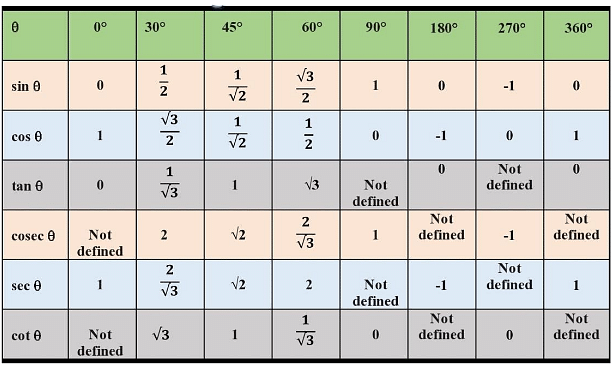
Solved Examples of Trigonometry TableExample 1: Find the values of Sin 45°, Cos 30° and Tan 30°. Solution: Using the trigonometric table, we have Sin 45° = 1/√2 Cos 30° = √3/2 Tan 30° = 1/√3 Example 2: Given the trigonometric ratio of tan θ = 3/4, find the trigonometric ratio of cosec θ. Solution: tan θ = Perpendicular/ Base = 3/4 Perpendicular = 3 and Base = 4 Hypotenuse2 = Perpendicular2 + Base2 Hypotenuse2 = 32 + 42 Hypotenuse2 = 9 + 16 Hypotenuse = √25 Hypotenuse = 5 Now, using trigonometry formulas, cosec θ = Hypotenuse/Perpendicular = 5/3 |
Read More:
Trigonometric Function Graph
[Click Here for Sample Questions]
The different properties of the trigonometric functions like domain, range, etc. can be described using trigonometric function graphs. The value of opposite angle θ represents the domain of the trigonometric functions.
- The resultant value is called the range of the trigonometric function.
- The domain values of θ are expressed in degrees or radians and the range is a real number value.
The below table represents the domain and the range of all six trigonometry functions:
| Trigonometric Functions | Domain | Range |
|---|---|---|
| Sin θ | (-∞, + ∞) | [-1, +1] |
| Cos θ | (-∞, + ∞) | [-1, +1] |
| Tan θ | R - (2n + 1)π/2 | (-∞, +∞) |
| Cot θ | R - nπ | (-∞, +∞) |
| Sec θ | R - (2n + 1)π/2 | (-∞, -1] U [+1, +∞) |
| Cosec θ | R - nπ | (-∞, -1] U [+1, +∞) |
The Trigonometric Function Graphs are given below-

Read More: Tangent Circle Formula
Unit Circle and Trigonometry values
[Click Here for Sample Questions]
A unit circle is nothing but a circle with a radius measuring 1 unit. It is generally represented in the Cartesian Coordinate Plane. The concept of the unit circle helps us to study the values of the sin, cos, tan directly as the center of the circle is at the origin and the radius is 1 unit.
- Let us say the length of the perpendicular is y and the base is x.
- The length of the hypotenuse is equal to the radius of the unit circle, which is 1.
Therefore, we can express the trigonometry ratios as follows-
- Sin θ = y/1 = y
- Cos θ = x/1 = x
- Tan θ = y/x

Read More: Inverse Process of Differentiation
Trigonometry Identities
[Click Here for Sample Questions]
Trigonometry identities can be defined as equalities involving trigonometric functions which hold for every value of the variables involved in a way that both sides of the equality are defined.
- There are six fundamental trigonometry identities called sine, cosine, tangent, cosecant, secant, cotangent.
- These trigonometry identities are expressed as the ratios of adjacent, opposite, and hypotenuse.
Pythagorean Trigonometry Identities
Pythagorean Identities are derived from the Pythagorean theorem, after applied to a right-angled triangle. These Pythagorean Trigonometric Identities are as follows:
- Sin2 A + Cos2A=1 (for all angles, 0°≤ A ≤ 90°, Sin2 A + Cos2A=1 holds true.)
- 1 + Tan2 A = Sec2 (for all angles, 0°≤ A ≤ 90°, 1 + Tan2 A = Sec2 A holds true).
- Cot2 A + 1 = Cosec2 A (for all angles, 0°≤ A ≤ 90°, Cot2 A+ 1 = Cosec2 A holds true)
Reciprocal Trigonometry Identities
There are three fundamental trigonometric identities and if we take their reciprocals there will be six basic identities. The six Reciprocal Identities are as follows:
- sin θ = 1/cosecθ
- cosec θ = 1/sinθ
- cos θ = 1/secθ
- sec θ = 1/cosθ
- tan θ = 1/cotθ
- cot θ = 1/tanθ
Read More: Sin 180 Degress Value and Derivation
Complementary Trigonometry Identities
When the sum of two angles is 90°, the angles are called the Complementary Angles Identities of each other. The complementary angle of an angle θ will be (90°– θ). The trigonometry identities of the complementary angles are as follows-
- sin (90°- θ) = cos θ
- cos (90°- θ) = sin θ
- cosec (90°- θ) = sec θ
- sec (90°- θ) = cosec θ
- tan (90°- θ) = cot θ
- cot (90°- θ) = tan θ
Supplementary Trigonometry Identities
The supplementary angles are the angles whose measures add up to 180°. So, the Supplementary Angles Identities of an angle θ will be (180° – θ). The trigonometry identities of the supplementary angles are as follows-
- sin (180°- θ) = sinθ
- cos (180°- θ) = -cos θ
- cosec (180°- θ) = cosec θ
- sec (180°- θ)= -sec θ
- tan (180°- θ) = -tan θ
- cot (180°- θ) = -cot θ
Sum and Difference Trigonometry Identities
Here we are going to learn about the sum and difference formulae of sin(A+B), cos(A-B), cot(A+B). The formulae are given below:
- sin (A+B) = (sin A cos B) + (cos A sin B)
- sin (A-B) = (sin A cos B) – (cos A sin B)
- cos (A+B) = (cos A cos B) – (sin A sin B)
- cos (A-B) = (cos A cos B) + (sin A sin B)
- tan (A+B) = (tan A + tan B)/(1 - tan A.tan B)
- tan (A-B) = (tan A - tan B)/(1 + tan A.tan B)
If A, B and C are angles and a, b and c are the sides of a triangle, then,
- a/sinA = b/sinB = c/sinC
- c2 = a2 + b2 – (2ab.cos C)
- a2 = b2 + c2 – (2bc.cos A)
- b2 = a2 + c2 – (2ac.cos B)
Read More: Cosine Rule
Application of Trigonometry
[Click Here for Sample Questions]
Trigonometry is used in various areas such as architecture, celestial mechanics, surveying, navigation, optics, acoustics, etc. Some applications of trigonometry include:
- It is used in oceanography, seismology, meteorology, physical sciences, and astronomy.
- Trigonometry is used in the fields of acoustics, navigation, electronics, and many more.
- It is used to measure the distance of long rivers, the height of the mountain, etc.
- Spherical trigonometry has been vigorously applied to locating solar, lunar, and stellar positions.
Read More: Value of cos 60?
Important Topics for JEE MainAs per JEE Main 2024 Session 1, important topics included in the chapter Trigonometry are as follows:
Some memory based important questions asked in JEE Main 2024 Session 1 include:
|
Things to Remember
- Trigonometry is primarily concerned with the relationship between the side lengths and the angles of a right-angle triangle.
- Trigonometric functions determine the value of the domain and range.
- There are six trigonometry identities and are expressed in terms of the ratio of adjacent, opposite, and hypotenuse.
- In trigonometry, the right angle triangle is analysed with the help of Pythagoras theorem.
- Trigonometry helps measure the distance of long rivers, the height of the mountain, etc.
Read More: Calculus
Sample Questions
Ques: Prove (cot A + sec B)2 – (tan B – cosec A)2 = 2(cot A . sec B + tan B. cosec A)? (3 marks)
Ans. (cot A + sec B)2 – (tan B – cosec A)2
= cot2 A + sec2 B + 2 cot A sec B – (tan2 B + cosec2 A – 2 tan B cosec A)
= cot2 A + sec2 B + 2 cot A sec B – tan2 B – cosec2 A + 2 tan B cosec A
= (sec2 B – tan2 B) – (cosec2 A – cot2 A) + 2(cot A sec B + tan B cosec A)
= 1 – 1 + 2(cot A sec B + tan B cosec A) … [\(\because\) sec2B – tan2 B = 1]
cosec2A – cot2 A = 1
= 2(cot A . sec B + tan B. cosec A) [proved]
Ques: Prove that, (sin θ + cos θ + 1). (sin θ – 1 + cos θ). Sec θ. cosec θ = 2? (3 marks)
Ans. LHS= (sin θ + cos θ + 1) (sin θ – 1 + cos θ) . sec θ cosec θ
= [(sin θ + cos θ) + 1] [(sin θ + cos θ) – 1] . sec θ cosec θ
= [(sin θ + cos θ)2 – (1)2] sec θ cosec θ …[\(\because\) (a + b)(a – b) = a2 – b2]
= (sin2 θ + cos2θ + 2 sin θ cos θ – 1]. sec θ cosec θ
= (1 + 2 sin θ cos θ – 1). sec θ cosecθ …[\(\because\)sin2θ + cos2θ = 1]
= (2 sin θ cos θ). 1/cosθ.1/sinθ
= 2 (proved)
Ques: For a right-angle triangle ABC right angle at C for which angle BAC = θ and if the value of sinθ = 4/5 find the value of cosθ? (3 marks)
Ans. We know that Sin2θ+ Cos2θ=1
Putting the value of sin θ =4/5 in the equation we get,
(4/5)2+ Cos2θ=1
Or, 16/25 + Cos2θ=1
Or, Cos2θ=1- 16/25
Or, Cos2θ= 9/25
Or, cos θ = 3/5
So, the value of Cos θ is 3/5.
Ques: If the value of sec θ + tan θ = 16, then evaluate sec θ – tan θ? (3 marks)
Ans. We know, sec2θ – tan2θ =1
Or, (sec θ + tan θ)( sec θ – tan θ)=1
Or, 16(sec θ – tan θ)=1
Or, sec θ – tan θ =1/16
So, the value of sec θ – tan θ =1/16.
Ques: If tan (20° – 3α) = cot(5α – 20°), then find the value of α? (3 marks)
Ans. tan(20° – 3α) = cot(5α – 20°)
tan(20° – 3α) = tan[90° – (5α – 20°)] …[\(\because\) cot θ = tan(90° – θ)]
∴ 20° – 3α = 90° – 5α + 20°
or, -3α + 5α = 90° + 20° – 20°
or, α = 45°
Ques: Evaluate tan 65°/ cot 25°? (3 marks)
Ans. We know,
cot A = tan (90° – A)
So, cot 25° = tan (90° – 25°) = tan 65°
Or, tan 65° cot 25° = tan 65° 1 /tan 65°
Or, tan 65° cot 25°=1
Ques: Create the table for trigonometry ratios? (5 marks)
Ans. The table for trigonometry ratios are as follows:
| Trigonometric Function | Abbreviation of Function | Relationship with triangle |
|---|---|---|
| Sine Function | sin | Opposite side/ Hypotenuse |
| Cosine Function | cos | Adjacent side / Hypotenuse |
| Tangent Function | tan | Opposite side / Adjacent side |
| Cosecant Function | cosec | Hypotenuse / Opposite side |
| Secant Function | sec | Hypotenuse / Adjacent side |
| Cotangent Function | cot | Adjacent side / Opposite side |
Ques: What are the applications of trigonometry? (3 marks)
Ans. The applications of trigonometry are as follows:
- It is used in oceanography, seismology, meteorology, physical sciences, and astronomy.
- Trigonometry is used in the fields of acoustics, navigation, electronics, and many more.
- It is used to measure the distance of long rivers, the height of the mountain, etc.
- Spherical trigonometry has been vigorously applied to locating solar, lunar, and stellar positions.
Ques: Create the table for trigonometry functions? (5 marks)
Ans. The table for trigonometry functions are as follows:
| Trigonometric Functions | Domain | Range |
|---|---|---|
| Sin θ | (-∞, + ∞) | [-1, +1] |
| Cos θ | (-∞, + ∞) | [-1, +1] |
| Tan θ | R - (2n + 1)π/2 | (-∞, +∞) |
| Cot θ | R - nπ | (-∞, +∞) |
| Sec θ | R - (2n + 1)π/2 | (-∞, -1] U [+1, +∞) |
| Cosec θ | R - nπ | (-∞, -1] U [+1, +∞) |
Ques: A man observed a pole of height 80 ft. According to his measurement, the pole cast a 20 ft long shadow. Find the angle of elevation of the sun from the tip of the shadow using trigonometry? (2 marks)
Ans. Let x be the angle of elevation of the sun, then
tan x = 80/20 = 4
x = tan-1(4)
or x = 75.96 degrees
Ques: A man is observing a pole of height 46 foot. According to his measurement, pole cast a 23 feet long shadow. Can you help him to know the angle of elevation of the sun from the tip of shadow? (2 marks)
Ans. Let x be the angle of elevation of the sun, then
tan x = 46/23 = 2
x = tan-1(2)
or x = 63.43 degrees
Ques: A right-angled triangle has a hypotenuse of length 20 cm and one of its acute angles measures 30°. What are the lengths of the other two sides? (3 marks)
Ans. Let’s call the side opposite to the 30° angle as ‘a’ and the side adjacent to it as ‘b’.
- Now, sin (30°) = perpendicular/hypotenuse = a/10
- ⇒ a = 20 × sin(30°) = 10 cm [sin(30°) = 1/2]
- and cos(30°) = b/10
- b = 20 × cos(30°) = 20 × √(3)/2 ≈ 17.3cm
Also Check:



Comments