



Education Journalist | Study Abroad Lead
Natural Selection is the process in which an organism adapts to its surroundings by undergoing various changes in their genes. The variations that are caused in the genotype (set of genes) of an organism determine its survival. It explains how genetic expression of species changes over time. Natural selection determines the survival rate and the reproduction rate, with respect to the differences that each individual goes through in their phenotype.
Read More: Medulla Oblongata
| Table of Content |
Key Terms: Darwin Theory of Evolution, Artificial Selections, Genotype, Inherited Traits, Evolution, Gene, Variation, Natural selection, Reproduction
Read More: Antidiuretic Hormone
Darwin’s Theory of Evolution
[Click Here for Sample Questions]
Darwin’s theory of evolution states that evolution occurs by natural selection. He stated that organisms or individuals in a population might show variation in trait (characteristics) due to differences in their genes with respect to the environment and are more likely to survive and reproduce. Individuals that do not adapt to their environment find it difficult to survive and reproduce. As a result the genes of such individuals fail to be passed on to the next generation.
- Inherited Traits: Darwin believed that the traits or characters possessed by a species or an individual is passed on to their offspring through genes.
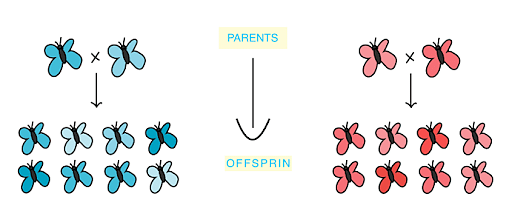
Fig. Genes passed from parent to offspring
Read More: Law of Limiting Factor
- Production of offspring in excess: Overabundance of offspring increases the competition in the environment they live in. There are not always enough resources available for the organism and over-reproducing can drastically decrease the chance of survival.
- Variation in the inherited traits: The offspring of some generations have shown differences in their traits. These changes may be seen in shape, size, color, etc.

Fig. Variation in color between the offspring
Also Read:
| Related Articles | ||
|---|---|---|
| Evolution | Microbiology | Animal Cell |
| Discovery of Cells | Difference between grazing and detritus food chain | Difference between lipids and fats |
Examples of Natural Selection
[Click Here for Sample Questions]
The Peppered Moth
In the pre industrial period, the populations of peppered moths with white and black spots were high compared to the black colored moth. The peppered moth could camouflage themselves on the bark of pale colored trees, whereas the predators easily spotted the black moths.
As the industrial revolution grew, the amount of pollution in the air increased, and in turn turned the bark of the tree black due to soot. The scenario now became favorable for the black colored moth as they could now camouflage in the black bark of the tree whereas, the population of the peppered moth eventually decreased.
This clearly explains the terms ‘Survival of the Fittest’ and ‘Natural Selection’.

Fig. Peppered Moth And Black Colored Moth
Read Also: Corpora Quadrigemina
Types of Natural Selection
[Click Here for Sample Questions]
Stabilizing Selection
Stabilizing selection occurs when there are specific selective pressures opposing two ends of a characteristic trait and an intermediate trait is selected. In stabilizing selection, the population stabilizes on a specific value of trait and eventually the genetic diversity is minimized. The trait distribution is in such a way that the higher peak is formed on the intermediate.
Example: Considering height of the plant
If a plant is too tall, it might be blown off due to wind. If a plant is too short then it might not survive for too long. Therefore, a plant is supposed to have an intermediate height in order to survive in both diverse conditions.
Directional Selection
The directional selection occurs when a single specific trait or phenotype is preferred. The selective pressure favoring one trait causes the allele frequency to lean more towards one direction.
The trait distribution is in such a way that the graphs tends to slant on one side
Example: Peppered moth
The peppered moth seemed to have a good survival rate before the industrial revolution, as they could camouflage. As soon as the industrial revolution grew, the peppered moths were more exposed to the predators and the black moths were able to survive better on the dark bark of the tree.
Disruptive Selection
The disruptive/diversifying selection occurs when the two extreme traits are favored, not considering the intermediate trait. The trait distribution is in such a way that the higher peaks are found on the extreme and a lower curve on the intermediate.
Example: Colored Hamster
An area having white, black, and grey hamsters, has too many black and white rocks helping the hamsters to camouflage from the predators. While the intermediate colored grey bunny fails to survive and becomes the prey.
Also Read:
| Related Articles | ||
|---|---|---|
| Difference between monocytes and lymphocytes | Difference between plant and tree | Productivity in Ecosystem |
| Regions of Roots | Bones of the Ankle | Conduction of Nerve Impulse |
Things to Remember
- Evolution is the change on a genetic level in a population from one generation to another.
- Natural selection is the basic function for evolution.
- Evolution through natural selection is caused by selection pressure, variation, and reproduction
- One great example of coevolution is between the flowing plant and insect.
- Natural selection can lead to speciation, in which one species is capable of giving rise to different species that helps in diversity.
- The mutation of genes is one important source of genetic variation.
- Most species fail to adapt themselves to the environment as it keeps changing rapidly, and it becomes difficult to exhibit natural selection.
Also Read:
Sample Questions
Ques. What is the difference between disruptive and stabilizing selection? (3 Marks)
Ans. The key differences have been tabulated below:
| Disruptive Selection | Stabilizing Selection |
|---|---|
| Two extreme traits are favored. | Only the intermediate stage is favored. |
| The curve forms higher peaks on either side of the graph. | The curve forms a higher peak only on the middle stage of the graph. |
| Increases the genetic variance. | Decreases the genetic variance. |
| More diverse population is formed. | Population is more uniform. |
Ques. Define Selective Pressure and Selective Agent. (2 Marks)
Ans. Selective pressure: Selective pressure is the outcome of natural selection that acts on a species or a population
Selective agent: Selective agent refers to the environmental factors affecting the population or the species.
Ques. What factors affect evolution? (3 Marks)
Ans. There are many factors affecting evolution. From the very environmental factor to the changes in the gene, evolution can be seen anywhere. Few important factors that affect evolution include: variation, migration, mutation, reproduction, adaptation and so on.
Few are listed below:
- Variation: Variation among the individuals in a population determines its survival and hence the natural selection.
- Migration: The movement of a group of individuals or a population as a whole is termed as migration. It empowers the gene flow, which helps in evolution of the population.
- Mutation: Change in the gene expression also helps in determining the survival rate of a particular population or an individual. An individual with an advanced mutation might survive better than those that struggle to adapt to the environment.
- Reproduction: Organisms that are able to survive, also reproduce and help in the expression of favorable genes to the next generation.
- Adaptation: The more an organism or a population adapts well in the environment, the more are the chances of their survival and reproduction.
Ques. Mention any two types of evolution? (3 Marks)
Ans. Coevolution: Coevolution relates to a term of mutualism where a group of species or two species evolve side by side and also adapt to each other’s changes. For example: flowering plants and insects, where insects like butterflies, bees and so on help in pollination.
Pollination of flowering plants is done by many means, such as air, water, insects and so on. The insects feed on the flower for nectar, on feeding; the pollen grains are stuck to the feet of the insect. As they move from one plant to another, the pollen grains are transferred and hence help in the reproduction of new flowering plants. This way both their needs are met.
Convergent evolution: Different organisms live under the same selective pressure and evolve similar traits independently. For example: Birds. Bats, insects, butterflies etc., have evolved to fly independently.
These organisms are not living together, they live in different habitats that they adapt to best. In spite of living in their own habitat, they all have discovered their ability to fly. They fly either for shelter or for protection from the prey, but have definitely evolved themselves to pass on this ability to their next generation.
Ques. What is adaptive radiation? (3 Marks)
Ans. Adaptive radiation occurs when there is a change in the environment that results in new resources or new challenges, and as a result the species splits themselves into a number of other forms. The species living under a certain phenotype have shown to evolve themselves for a better survival rate. Changes in the physical and biological factors can be seen in numbers among the population itself. These organisms somehow learn to adapt and fit in the environment.
Example: On the Galapagos Island, the finches have developed different shaped beaks to adapt themselves for the food available. The beaks of a few birds differed from the others. The evolved species have come from the pre-existing ones, but with better survival skills, this in short is evolution.
Ques. Explain the term survival of the fittest. (2 Marks)
Ans. Organisms that are best adaptive in their environment have a greater chance of survival and reproduction and pass the favorable gene to the next generation. Some of these new offspring experience adverse environmental changes and struggles to survive, while others undergo mutation (variation in gene) and evolve to be the fittest that survives the unfavorable conditions.
Ques. What is genetic drift? (2 Marks)
Ans. Genetic drift is the change in genetic diversity. It is better explained as the change in frequencies of different alleles over generation. Consider a population of red beetles and brown beetles. The allele of the brown beetle being dominant and red beetle being recessive, the offspring ratio of red beetle might eventually be reduced and further be eliminated. This change in the frequency of allele that makes it dominant or recessive is randomly selective for genetic drift to take place.
Ques. Explain Artificial selection. (2 Marks)
Ans. Artificial selection is the process of selecting only the desirable and valuable gene and passing it on to the next generation. Before the discovery of natural selection, farmers have used artificial processes to combine only the desirable trait that can help in better yield of crops. Just as in crop plants, humans have also used artificial selection on animals to create distinct varieties of breeds.
For Latest Updates on Upcoming Board Exams, Click Here: https://t.me/class_10_12_board_updates
Check-Out:



Comments