



Education Journalist | Study Abroad Lead
Specific resistance is the resistance offered per unit length and unit cross-sectional area to the current when a known amount of voltage is applied. Specific resistance is dependent upon the temperature, composition, and pressure of the material. Specific resistance is the reciprocal of specific conductance which measures how much electrical current passes through a material. The SI unit of Specific Resistance is ohm meter which is denoted by Ω m.
Read More: Current Electricity
| Table of Content |
Key Terms: Specific Resistance, Ohm Meter, Current, Resistivity, Ohm’s law, Electrical Current, Electrical Resistivity, Copper
What is Specific Resistance?
[Click Here for Sample Questions]
The specific resistance of a material is a measure of the resistance offered to the flow of current through it. It is an intrinsic property of a material. The mathematical representation of resistivity will be:
ρ = RA/L
where,
- ρ: specific resistance
- R: resistance
- A: cross-sectional area
- L: length of the material
Reciprocal of specific conductance denoted by κ is specific resistance. Other terminologies used for the term are specific electrical resistance, specific airway resistance, and specific resistance due to friction for a mechanism transporting mass.
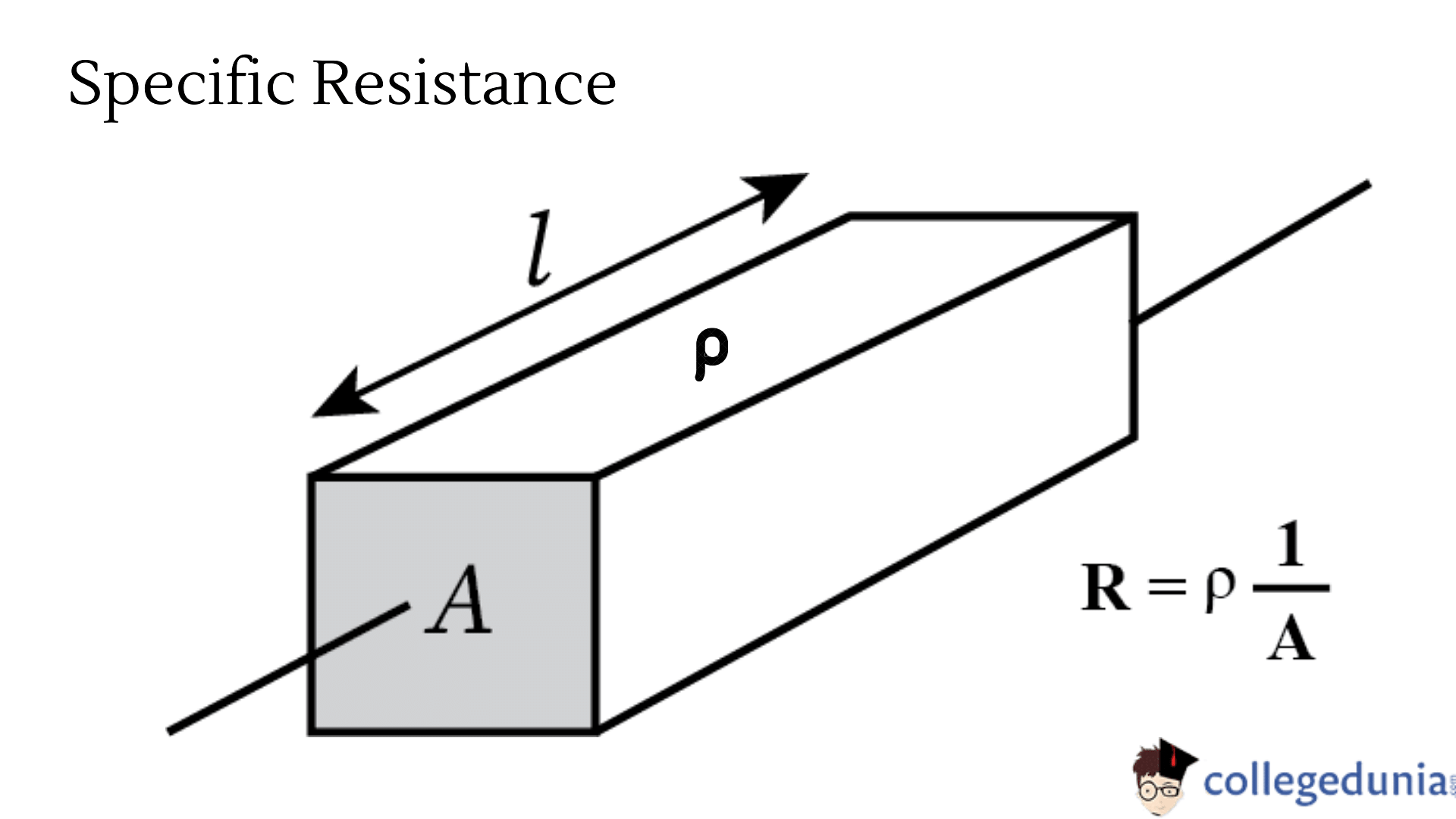
Specific Resistance
Discover about the Chapter video:
Current Electricity Detailed Video Explanation:
Read More:
| Important Topics Related to Specific Resistance | ||
|---|---|---|
| Kirchhoff’s Rules | Wheatstone Bridge | Cells In Series and Parallel |
| Meter Bridge | Potentiometer | Electromotive Force |
| Difference between Earth and Neutral | Equivalent Resistance Formula | Internal Resistance Formula |
Unit of Specific Resistance
[Click Here for Previous Year Questions]
From the specific resistance formula,
Unit of ρ = Unit of R × \(Unit\ of\ A \over Unit\ of\ L\)
- The unit of resistivity can be obtained when resistance R is expressed in Ohm (Ω) and distances are expressed in centimeters (cm).
- The SI unit of resistivity will then be Ohm cm (Ω .cm).
- If the distance is expressed in meter (m), then the SI unit of specific resistance is Ohm. meter (Ωm).
- The SI unit for conductivity is siemens.m-1 (S.m-1) or Ohm-1m-1.
- Since, metals are good conductors of electricity, while insulators are poor; the specific resistance of metals is very low (∼10−8Ω.m), but for typical insulators, the resistance will be very large (∼1016Ω .m).
Read More: Experiment to determine Resistivity of a Wire using Meter Bridge
Solved ExamplesQues: Determine the length and cross-sectional area of a copper wire made from a chunk of copper having a mass of 10 g, having the resistance of the copper wire is 2 Ω. The density and resistivity of copper wire are 9 g/cm3 and 1.8 x 10⁻⁶ Ω . cm respectively. Solution: The density of copper is d = 9 g/cm3 and the mass of the chunk is m = 10 g such that the volume of the copper wire is V = md V = 10/9cm3 If the length of the wire is L and the cross-section is A, the volume is given by V=LA. Therefore, LA = 10/9 cm3 ... (1) Substituting R = 2Ω and ρ = 1.8 x 10⁻⁶ Ω . cm in the formula of specific resistance, 1.8 x 10-6 = 2 x AL LA = 10/9 x 106 cm-1 ... (2) Multiplying equations (1) and (2), LA x L/A = (10/9)2 x 106 cm2 L = 11.1 m Dividing equation (1) by (2), LA x A/L = 10-6 cm4A = 0.1 mm2 Therefore, the length and cross-sectional area of the copper wire are 11.1 m and 0.1 mm2 respectively. Ques: A 5 mm diameter wire is produced from a chunk of metal. Another wire of diameter 1 cm is produced from an identical chunk. Find the ratio of the resistance of the two wires. Solution: Resistance of a wire of length L and cross-section A is R = ρLA, where ρ is the resistivity of the material. The mass and density of the chunk are m and D respectively. If the diameter of a wire of volume V is d, A = πd2/4 V = mD L = VA Therefore, the resistance of a wire of diameter d is, R = 16ρm/πDa4 According to the problem, the mass and density of the two wires of diameters d1 = 5 mm = 0.5cm and d2 = 1 cm are same such that the ratio of resistance is,R1R2 = (d2d1)4 R1R2 = (1cmx 0.5cm)4 R1R2 = 16 The ratio of the resistance of the wires is 16:1. |
Electrical Resistivity
[Click Here for Sample Questions]
Specific electrical resistance is also known as electric resistivity. It is a property of a material that defines how forcefully can the material resist the flow of electric current. It is represented as ρ and its SI unit is ohm-meter.
Airway Resistance
Airway resistance has been defined as the resistance of the respiratory tract to the flow of air while inhaling and exhaling. Given below is the formula similar to Ohm’s law:
RAW = ΔP/V
Where,
- ΔP= PATM-PA
- RAW = (PATM-PA)/V
- where RAW: airway resistance
- ΔP: pressure difference driving airflow
- PATM: atmospheric pressure
- PA: alveolar pressure
- V: volumetric airflow
Also Read: Current Electricity Important Question
Specific Resistance of Copper
[Click Here for Previous Year Questions]
Copper has a specific resistance of 1.68 x 10⁻⁸Ω.m (20oC). This means that at a temperature of 20oC, the resistance between two opposite surfaces of a copper cube of side 1 m is 1.68 x 10⁻⁸ Ω.
- Copper has a conductivity of 5.96 x 10⁷ Sm-1.
- Owing to its high conductivity and low resistivity, the resistance of copper to the flow of current is negligible.
- Copper wires are usually used to conduct electricity in electrical circuits.
Read Also: Static Electricity
Specific Resistance of Other Materials
[Click Here for Sample Questions]
The specific resistance of various other materials are as follows –
| Material | Resistivity in Ohm meter (Ωm) |
|---|---|
| Silver | 1.59 x 10⁻⁸ |
| Copper | 1.68 x 10⁻⁸ |
| Iron | 9.70 x 10⁻⁸ |
| Gold | 2.44 x 10⁻⁸ |
| Platinum | 1.06 x 10⁻⁷ |
| Zinc | 5.90 x 10⁻⁸ |
| Tin | 1.09 x 10⁻⁸ |
Things to Remember
- Resistivity is the measure of the resistance that material provides per unit length and per unit cross-sectional area.
- Mathematical representation of resistance – ρ = RA/L
- The SI unit of specific resistance is ohm-meter (Ωm).
- Superconductors have zero resistivity in the superconducting state, i.e. at very low temperatures.
- Airway resistance has been defined as the resistance of the respiratory tract to the flow of air while inhaling and exhaling.
- The specific resistance of copper is 1.68 x 10⁻⁸ Ω.m
- Electrical Resistivity is how forcefully a material can resist the flow of electric current.
Read More:
Previous Year Questions
- Drift speed of electrons, when 1.5A of current flows in a copper wire….. [JEE Mains 2019]
- The voltage of the electric mains is 220V. The minimum capacity of the main fuse of the building will be….[JEE Main 2014]
- The balanced condition of Wheatstone bridge is…..[JEE Main 2018]
- In a meter bridge, the wire of length 1m has a non-uniform cross-section such that...[JEE Main 2019]
- In a meter bridge experiment, null point is obtained at… [ JEE Main 2013]
- The resistance between any two vertices of the triangle is...[JEE Main 2019]
- A uniform wire of length l and radius r has a resistance of….
- In a potentiometer experiment, when three cells A, B, and C are connected in series…..[KEAM]
- When two resistances R1 and R2 are connected in series, they consume 12W power….[KEAM]
- Nichrome is used as an electrical heating element because of its…[KEAM]
- In the figure shown below, the terminal voltage across E2 is…[KEAM]
- In a potentiometer of wire length ll, a cell of emf V is balanced at a...[KEAM]
- The electrical permittivity and magnetic permeability of free space are… [ DUET 2003 ]
- Just after key K is pressed to complete the circuit, the reading will be …. [ KEAM 1999 ]
Read More:
Sample Questions
Ques. What is resistance? (1 mark)
Ans. The opposition to current flow in an electrical circuit is termed resistance.
Ques. What parameters govern specific resistance? (2 marks)
Ans. The parameters that govern specific resistance are:
- Resistance of the wire
- The cross-sectional area of the wire
- Length of the wire
Ques. What is the specific resistivity of air? (1 mark)
Ans. The specific resistance of air, which is a poor conductor is 1.5 x 10¹⁴ ohmmeters.
Ques. Mention the specific resistance of: (1 mark)
(a) Zinc
(b) Iron
Ans. a) 5.90 x 10⁻⁸
b) 9.70 x 10⁻⁸
Ques. What is the SI unit of resistance? (1 mark)
Ans. The SI unit of specific resistance is ohm meter (Ωm)
Ques. What is the specific resistance of copper? (1 mark)
Ans. Copper is a good conductor and its specific resistance is 1.72 × 10⁻⁸ ohm-meter.
Ques. Distinguish between Resistance and Specific Resistance? (2 marks)
Ans. Specific resistance is an intrinsic property of a material that is dependent upon its composition. While, resistance, on the other hand, is an extrinsic property that depends upon the length and cross-section of a conductor and the applied potential difference. The SI unit to measure resistivity is Ohm (Ω.m) whereas, it is Ohm for resistance.
Ques. Write an expression connecting the resistance of a wire and the specific resistance of its material. State the meaning of the symbol used. (2 marks)
Ans. Resistance of a conductor is given by
R = ρ L/A
Where,
R is the Resistance of the conductor,
ρ is the specific resitance of the material of conductor,
L is the length of the conductor,
A is the area of cross section of the conductor.
Ques. Give reasons for using: Copper in making connection wires; Tungsten in making filament of a bulb. (2 marks)
Ans. Copper is appropriate for making connection wires as it has low specific resistance. Hence connection wires made up of copper will have low resistance. Connection wires made up of copper will not affect the current in the circuit and loss of energy due to heating is also prevented because of low resistance.
Tungsten wire is used to make filaments of electric bulbs because the melting point of tungsten is very high.
Ques. What happens to the resistance of the wire when its length is increased to twice its original length? (3 marks)
Ans.

Now,
 1 = 2
1 = 2
and radius becomes r1
Since volume of the wire remains the same

New Resistance


For Latest Updates on Upcoming Board Exams, Click Here: https://t.me/class_10_12_board_updates
Check Out:



Comments