



Exams Prep Master
Diethyl ether or simply ether is a class of organic compounds that constitute an oxygen atom attached to two alkyl or aryl groups. The word ‘ether’ is derived from the Latin word ‘aether’ meaning ‘to ignite’. Ethers were discovered in 1275. They have a structure very similar to that of water or alcohol and are pleasant-smelling and colorless liquids. Some of the prominent uses of ethers are as general anesthetics to make people unconscious during surgeries. In this article, we will learn more interesting facts about the structure, composition, properties, and uses of ether.
| Table of Content |
Key Takeaways: Ether, Diethyl ether, Alkyl, Aryl, Anesthetic, Therapeutic, Pain-Killers, Antiseptics, Solvent, Ethanol, Drugs
Ether: Structure And Properties
[Click Here for Sample Questions]
The use of ethers dates back to the 1800s. Back then they were used as recreational drugs. Ether is a less dense liquid and partially soluble in water. They are highly unreactive and find use predominantly as solvents for fats, oils, waxes, perfumes, food flavors, dyes, gums, etc. Ethers are the byproducts of ethanol synthesis and are hence less expensive.
Structure
An ether group is formed from an oxygen atom bonded to two alkyl or aryl groups. The general formula for ether is R-O-R, R-O-R’, R-O-Ar, or Ar-O-Ar, where the R represents the alkyl group and Ar represents the aryl group. The oxygen is more electronegative in comparison to the carbon atoms.

Ethers are further classified as Symmetrical Ethers (two identical groups attached to either side of the oxygen atom) or Asymmetrical Ethers (two different groups attached to either side of the oxygen atom).

Structure of Ether
Properties
Ethers are primarily 96 percent absolute ethyl oxide and 4 percent alcohols with little water. The specific gravity ranges from 0.725 to 0.728 at 590F. This makes them lighter than water but their vapor is heavier than air and is highly explosive. When kept outdoors ethers are highly volatile and produce a cooling effect. A hot and pungent odor is characteristic of ethers. The important properties of ethers are-
- Polarity
The presence of alkyl groups on either side of the central oxygen atom makes ethers non-polar. In comparison, ethers are less polar than esters, alcohols, and amines with similar molecular weights. This is because the oxygen atom that is surrounded by the bulkier alkyl groups in ethers does not participate in hydrogen bonding. Ethers are, however, more polar than alkenes.
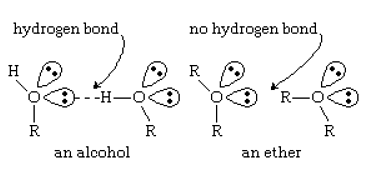
Boiling Point
The boiling points of ethers are comparable to alkanes but lower than alcohols of comparable molecular weights. The primary reason for the lower boiling points is due to the absence of hydrogen bonding in ethers owing to the unreactive oxygen.
- Dipole Moment
The C-O-C bond angle in ethers is not at 1800. As a result, the two dipole moments of the C-O- bonds do not cancel each other, making the net dipole moment very small.
- Solubility
The solubility of ethers in water is almost similar to that of alcohols of comparable molecular weights. This is because the oxygen atom with less bulky alkyl or aryl groups can form hydrogen bonds with water. However, as the carbon atoms increase, the solubility decreases. The increased hydrocarbon content reduces the tendency of the oxygen atom in ethers to form hydrogen bonds.
- Hybridization
The oxygen atom surrounded by the alkyl groups in ethers is sp3 hybridized at an angle of 109.50.
Also Read:
| Related Articles | ||
|---|---|---|
| Classification of Organic Compound | Cis-Trans Isomers | Transesterification |
| Aldehyde | Classification of Phenol | Chapter 11 Alcohols, Phenols and Ethers |
Industrial Uses of Ethers
[Click Here for Sample Questions]
Ethers are colorless liquids that are highly flammable, volatile, and sweet-smelling at room temperature. As a result, they are stored in brown-colored bottles to prevent their reaction to light and thereby putting out a fire. Ethers are common linkages in carbohydrates and lignin. Some industrial uses are-
- Ethers are capable of dissolving oils, fats, resins, caoutchouc, organic alkaloids, and gums. As a result, they are used as a very common solvent. Diethyl Ether (C4H10O) is commonly used as a solvent, owing to its restricted solubility in water (6.05 g/100 cc at 25oC).
- Due to the flammable and volatile properties, ethers are used as refrigerants and along with petrol for motor fuels.
- Ethers are used as a non-polar solvent in liquid-liquid extraction techniques.
- Ethers are also a standard solvent for Grignard reaction or as an alternative to organometallic compounds.
- Phenyl ethers are used as heat transfer media due to their high boiling point.
- Ethers find limited application as cleaning and spotting agents.
- Ethers are used to increase viscosity in the form of penetrants, wetting agents, antioxidants, and stabilizers.
- Ethers are, however, listed under United Nations Convention Against Illicit Traffic in Narcotic Drugs and Minimum Expanding Substances.
Uses of Ethers in The Healthcare Industry
[Click Here for Sample Questions]
Ethers are known for a variety of applications in the pharmaceutics and the healthcare industry. Some of the common uses are-
- Therapeutic
Spirit of Ether which is a common form of ether is made from one part of diethyl ether with three parts of ethanol. This mixture when diluted with alcohol readily mixes with water. Since ancient times this mixture was hence used to influence nervous stimulations, treat flatulent pains, gastric uneasiness, treatment of nervous headaches, and spasmodic diseases.
- Antiseptic
Ethers are used as antiseptics while administering injections to patients. Cotton balls dipped in the ether are used to disinfect the skin where the injection is to be given.
- Anesthetic
Diethyl ether is used as an anesthetic in hospitals. It helps patients to slip into a state of unconsciousness, allowing surgeons to operate on patients without any hassles during surgeries. The volatility of ethers and the vapors released are inhaled by patients or administered intravenously allowing the muscles to relax gradually.
- Pain Reliever
Ethers are also employed as pain relievers in the form of Methoxymethane and are primary ingredients in the drug morphine.
- Recreational Drug
Earlier ethers were once used as appealing recreational drugs. When used in controlled amounts, inhalation of this induced euphoria and sedation. However, overdoses caused serious respiratory paralysis and turned fatal, thereby ethers are restricted in this form.
Things to Remember
- Ethers are a class of organic compounds that have an oxygen atom attached to the alkyl groups or aryl groups.
- Based on the type of alkyl or aryl group attached to either side of the oxygen atom, ethers can be symmetrical or asymmetrical.
- An unreactive central oxygen atom makes ethers less polar in comparison to esters, alcohols, and amines of comparable masses.
- The boiling points of ethers are comparably lower making them extremely volatile. The solubility of ethers decreases as the hydrocarbon content increases.
- Ethers find a wide variety of industrial applications as solvents, refrigerants, wetting agents, penetrants, antioxidants, and stabilizers.
- In the healthcare industry, ethers are used as therapeutic agents, pain killers, antiseptics, anesthetics, and recreational drugs.
Also Read:
Sample Questions
Ques. Why are Ethers unreactive? (2 marks)
Ans. Ethers contain oxygen atoms attached to two or more alkyl or aryl groups. Owing to this structure, when the side groups are bulky, the oxygen atom becomes unreactive and does not participate in hydrogen bond formation. This loss of a reactive O-H bond affects the inert existence of ethers relative to the alcohols of similar molecular masses.
Ques. Are alcohols soluble in the ether? State the reason. (2 marks)
Ans. Ethers contain carbon atoms and are soluble in water by forming hydrogen bonds to a certain extent. However, when the number of carbon atoms increases in the ether structure, the tendency to form a hydrogen bond reduces owing to an increase in the hydrocarbon content. This reduces their solubility. However, ethers have appreciable solubility in alcohols, benzene, and acetone.
Ques. Mention some application of ether in industry. (2 marks)
Ans. Ethers find extensive use in the pharmaceutical industry as solvents, suspending agents, flavoring agents for oral drugs, and dental products. Ethers are used to increase the viscosity and to be used as penetrants, wetting agents, antioxidants, and stabilizers. They are used as fragrances in perfumes and coloring agents in foods. Apart from these, ethers are widely used in rubber, plastic, paints, and coating industries, as refrigerating agents, in petroleum products, cosmetics, and toiletries.
Ques. List some use of Ethers as Solvents. (3 marks)
Ans. Ethers are less soluble in organic solvents owing to their inability to form hydrogen bonds. As a result, they are used as solvents in a wide variety of applications.
- Diethyl Ether- used in laboratories as aprotic solvents and as a major solvent in Grignard’s reaction.
- Tetrahydrofuran- a cyclic ether with a low boiling point is used as a favorable solvent as it can be easily removed by evaporation.
- Dimethyl Ether- a form of ether that is highly miscible in water and used as a solvent in lithium batteries.
- 1,4-Dioxane- a cyclic ether soluble in water and used as a solvent in labs for chemical synthesis.
Ques. What are the uses of ethers in perfumes and the food industry? (3 marks)
Ans. Ethers are used as fragrances in perfumes. Some common applications are-
- Ethers are organoleptic and have olfactory properties that provide flavors to a wide variety of foods and drugs like desserts, jams, yogurts, icecreams, gums, etc.
- The ether 1-methoxy-3-hexanethiol impacts the flavor of grapefruits giving beverages a fruity green exotic flavor.
- The salty aromas of ethers are also used in adding flavors to foods like soups, seasonings, snacks, sauces, etc.
- Methoxy benzene is an ether used as a fragrance in the essential oil of anise seeds.
Ques. List the disadvantages of Ether. (3 marks)
Ans. The disadvantages of ether are as follows:
- It is highly flammable thereby increasing the risks of catching a fire
- Under certain conditions, ether gets oxidized and becomes explosive.
- When used as an anesthetic, ether leads to nausea and unconsciousness. Uncontrolled exposure is toxic and can cause serious side effects.
- Being a highly volatile liquid, the dense vapor of ether when coming in contact with a spark or a flammable substance, can cause a potential explosion.
Ques. List down any 3 important properties of ether. (3 marks)
Ans. Some prominent properties of ether are-
- The weak polarity of ethers in comparison to esters, alcohols, and amines reduces their boiling point making them highly volatile.
- The net dipole moment is negligible as the C-O-C bond angle is not 1800.
- Ethers have an unreactive oxygen atom which restricts their ability to form hydrogen bonds as the size of the side alkyl groups increases. This affects the solubility of ethers.
For Latest Updates on Upcoming Board Exams, Click Here: https://t.me/class_10_12_board_updates
Check-Out:



Comments