


Content Curator
Waves formula explains the transfer of energy through a medium. For example, The ripples experienced by the parachutes is very similar to the waves or how the ocean waves receive power from the wind. It is the water that transfers the energy through a wave. When a space in the state of equilibrium, there is no movement in it. A wave is thus a movement in such equilibrium. These waves move from one region to another in a to and fro motion. A wave has its own wavelength, frequency, and velocity.
Any oscillation that travels through space and transfers energy is thus a wave. This transfer of energy takes place without displacement of particles in the medium. The particles oscillate or vibrate around a fixed spot. In the case of mechanical waves, as the waves travel through the medium, deformation of the medium occurs. This deformation reverses itself due to the restoring forces that get created during the deformation.
Read More: NCERT Solutions Class 11 Waves
| Table of Content |
Key Terms: Waves, Waves Formula, Wavelength, Periodicity, Wave Velocity, Particle Speed, Simple Harmonic Motion, Waves on String
What is a Wave?
[Click Here for Sample Questions]
A wave is the disturbance of a medium in which the oscillation of a physical attribute takes place repeatedly at each point. There is no net particle motion involved. Elastic deformation, a change in pressure, an electric or magnetic intensity, an electric potential, or a change in temperature are a few examples.
- The movement of mechanical waves or vibrations of a string, or the waves moving on the surface of a body of water are some classic examples of waves.
- Non-mechanical waves do not travel in the medium. Examples of non-mechanical waves are Visible light and other electromagnetic waves like radio waves.
- Wave speed is not equal to the speed at which individual particles move. There are many types of mechanical waves, which are depending on the way in which the particles in the medium move.
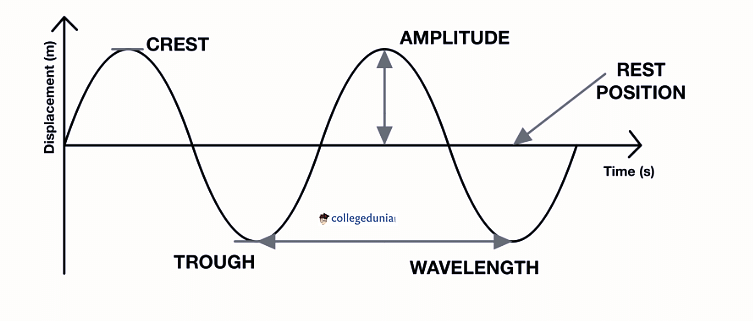
Wave Characteristics
Read More: Relation between Group Velocity & Phase Velocity
Types of Waves
[Click Here for Previous Year Questions]
There are three types of waves:
- Mechanical waves: these are those waves that need a medium to travel through for their travel, eg. Sound waves
- Electromagnetic waves: The kind of waves that do not require any of medium of transport for their travel eg. Light waves
- Matter waves: these waves are unknown to us and are used in modern technology. These waves can be related to electrons, protons and other particles.
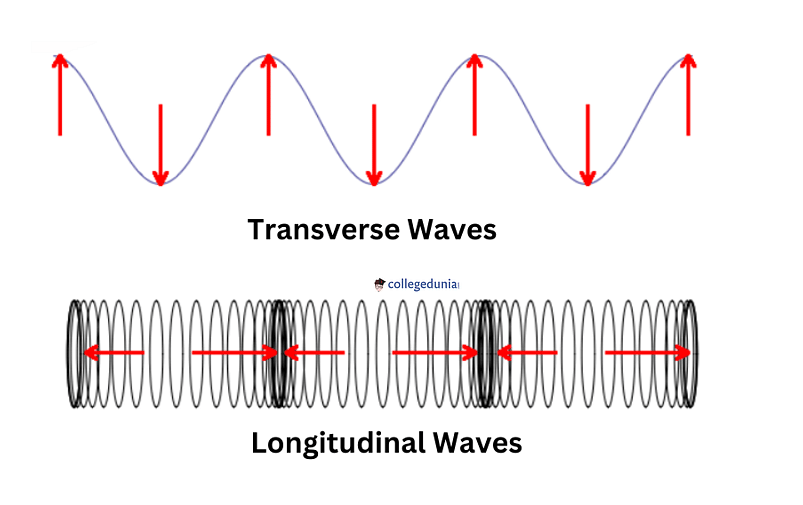
Types of Waves
Read More:
Waves Formula
[Click Here for Sample Questions]
Waves do not have a consistent speed and the speed of a wave is rather dependent on the speed of individual particles that make up the wave. There are many different waves depending on the type of speed and movement of the individual particles.
- Mechanical waves include, for instance, the waves that travel across the surface of a body of water or the movements or vibrations of a string.
- In the medium, non-mechanical waves cannot travel. Non-mechanical waves include radio waves, visible light, and other electromagnetic waves.
- The Simple Harmonic Motion, or SHM, of the medium is another significant type of periodic motion.
- Each particle in this wave moves in accordance with the SHM formula. They are also known as sinusoidal waves. These characteristics will be present in such waves.
Wave Motion
Some of the important notations:
- Amplitude A
- Frequency ν
- Wavelength λ
- Period T
- Angular Frequency ω
- Wave Number k
Now, T = 1 ν = 2π ω , v = νλ, k = 2π λ
Progressive wave travelling with speed v: y=f(t − x/v), +x; y=f(t + x/v), −x
Progressive sine wave: A sin(kx − ωt) = A sin(2π (x/λ − t/T))
Waves on a String
Speed of waves on a string with mass per unit length µ and tension
T: v = p T /µ
Transmitted power: Pav = 2π 2µvA2ν
Interference: y1 = A1 sin(kx − ωt)
y2 = A2 sin(kx − ωt + δ) y
= y1 + y2 = A sin(kx − ωt + ) A
= q A1 2 + A2 2 + 2A1A2 cos δ tan
= A2 sin δ A1 + A2 cos δ δ
= 2nπ, constructive
(2n + 1)π, destructive
Read More: S Waves
Waves Formula Derivation
[Click Here for Previous Year Questions]
A wave is produced when a vibrating source periodically disturbs the first particle of a medium. This creates a wave pattern that begins to travel along the medium from particle to particle. The frequency at which each individual particle vibrates is equal to the frequency at which the source vibrates. Similarly, the period of vibration of each individual particle in the medium is equal to the period of vibration of the source.
- The equation of the wave is y = A sin(ωt−kx) where y is the displacement, A is amplitude, the maximum displacement on either side
- ω is the angular frequency given by 2πT=2πf where, T is the time period and f is the frequency and k is a constant which is equal to 2πλ , where λ is the wavelength.
- Velocity is the rate of change of displacement. It is given by calculating displacement per unit time.
Thus, velocity v=yt where y is the displacement and t is the time taken
Here,
T=z and λ=y and A=x .
Dividing both sides by z , we get,
f′(x)=Asin(2πtz−2πyx)
So we can write,
⇒f′(x)=Acos(2πtz−2πy)x−2πy .
Thus, the expression of wave v is:
v=−2πAycos2π(tz−xy)
Read More: Standing Waves
Important Definitions Related to Waves Formula
[Click Here for Sample Questions]
- Wavelength: The wavelength of a wave is the separation between its two nearest points that are vibrating at the same rate.
- Time Period: Time taken for one vibration to complete is referred to as time period (T).
- Periodicity: The periodicity or frequency of a wave is defined as how many vibrations take place in a second.
- Wave Velocity or Wave Speed: The velocity of a wave is the distance it travels in one second (u).
- Particle Speed or Particle velocity: the speed at which SHM is being executed by the particles.
Read More: Wavelength to Frequency Formula
Notes on Wave Function
[Click Here for Previous Year Questions]
Provided below for quick reference are some important notes on Wave functions:
Download: Notes on Wave Functions


Things to Remember
- A motion pattern for transverse sinusoidal waves is made up of numerous crests and troughs.
- The wavelength is defined as the separation between each crest and is expressed in length units, or meters.
- The medium allows for the simultaneous passage of two or more progressive waves without interfering with one another's motion.
- Superposition Principle: The total displacement caused by the two waves acting independently at any given time is equal to the vector sum of the displacements produced by each particle in the medium.
- Wave Interference: When two waves of the same frequency move through a medium simultaneously and in the same direction, the resultant intensity at any location in the medium differs from the sum of the intensities of the two waves because of their superposition.
- The intensity of the resulting wave varies from very large at some spots to very little or zero at other points.
- When two sound waves with almost similar frequencies are created simultaneously, the resulting sound's intensity changes over time as a result of the superposition of the two waves.
- Beats are the term used to describe this varying sound intensity. Standing waves are another name for this type of wave.
Read More:
| Additional Concepts Related to Waves | ||
|---|---|---|
| Doppler Effect | Uses of Radar | Sound Waves Important Questions |
| Transverse & Longitudinal Waves | Beats | Reflection of Waves |
| Frequency and Wavelength | P Wave | Period Angular Frequency |
Previous Year Questions
- A pipe open at both ends and a pipe closed at one end have same… (MHT CET 2019)
- Which of the following rays is emitted by a human body… (VITEEE 2010)
- A light beam of intensity 20W/cm2 is incident normally on… (KCET 2020)
- The phase velocity of a wave described by the equation … (KEAM)
- The principle of superposition is basic to the phenomenon … (KEAM)
- A wave travelling along a string is described by the equation… (MHT CET 2008)
- The maximum particle velocity in a wavemotion … (KCET 2007)
- A wave along a string has the following equation y … (KEAM 2019)
- For a plane electromagnetic wave propagating in x-direction… (NEET 2021)
- The magnetic field in a traveling electromagnetic wave… (VITEEE 2018)
- For sky wave propagation of 10 MHz signal… (JCECE 2007)
- If \(\overrightarrow{E}\) and \(\overrightarrow{B}\) are the electric and magnetic field vectors of e.m. waves… (BITSAT 2019)
- The equation of progressive wave is y=0.2 sin 2π … (BITSAT 2007)
- Suppose that the electric field amplitude of electromagnetic wave is… (KCET 2021)
- An object flying in air with velocity… (NEET 20190
Read More: Beat Frequency
Sample Questions
Ques. A wave of frequency 500 Hz has a velocity of 360 m s−1. Calculate the distance between two points that are 600 out of phase. (3 marks)
Ans. frequency (ν)=500Hz
velocity (v)=360m/s
∴ wavelength = velocity/frequency
=360/500=0.72m=72cm
∴λ=72cm
60° out of phase implies that the wavelength between two points is
λ/60°/360°=λ/6
∴360°=λ
1°=360λ
60°=360λ×60=12cm
∴ The distance between point A & B is 12cm if they have a phase difference of 60°
Ques. Earth does not hear explosions on other worlds. Why? (1 mark)
Ans. This is due to the absence of any material medium over a significant portion of the space between the earth and the planets, which prevents sound waves from propagating.
Ques. Why are pressure waves referred to as longitudinal waves? (1 mark)
Ans. Pressure waves are called longitudinal waves because compressions and rarefactions produce changes in air pressure and volume during the transmission of longitudinal waves across a medium.
Ques. Why are there two prongs on tuning forks? (1 mark)
Ans. A tuning fork's two prongs create resonant vibrations between them and aid in keeping them going for a longer period of time.
Ques. Two waves are represented by the equations
y1=asin(ω+kx+0.57)m and
y2=acos(ωt+kx)m
where x is in meter and t in sec. The phase difference between them is (3 marks)
Ans. y1=Asin(ωt+kx+0.57)
y2=Acos(ωt+kx)
=Asin(ωt+kx+π/2)
phase difference = π/2−0.57
=1.57−0.57
= 1 radian
Ques. You now know that the function y = f(x, t), where x and t must exist in the combination x-vtorx + vt, i.e. y =f (x vt), represents a travelling wave in one dimension. Is the opposite accurate? Does each function of either (x - vt) or (x + vt) reflect a travelling wave, in other words? Consider whether the following y-functions could be able to depict a travelling wave. (2 marks)
Ans. The opposite is not true, though. A wave function must, for all values of x and t, have a finite value in order to adequately depict a moving wave. None of the functions for y that are offered satisfy this requirement. Thus, nobody can represent a travelling wave.
Ques. An ultrasonic scanner is used at a hospital to find tumours in a tissue. When sound travels through a tissue at a speed of 1.7 km/s, what wavelength does it have? The scanner operates at a frequency of 4.2 MHz. (2 marks)
Ans. Here speed of sound => υ = 1.7 km s-1 = 1700 ms-1 and
frequency υ= 4.2 MHz = 4.2 x 10⁶ Hz
.’. Wavelength, A = υ/V = 1700/(4.2 x 106) =4.1 x 10⁻⁴ m.
Ques. Do all the points on the wave on a string oscillate at the same (a) frequency, (b) phase, or (c) amplitude? Describe your responses, What is a point's amplitude that is 0.375 metres from one end? (3 marks)
Ans. We have observed that l = 1.5 m and = 3 m for the wave on the string mentioned in the questions. It is also evident that = /2, and for a string clamped at both ends, it is only feasible when both ends behave as nodes and there is only one antinode in between, i.e., when the entire string vibrates in just one segment.
(A) All sring particles, with the exception of nodes, vibrate at the same frequency, which is v = 60 Hz.
(b) All string particles are in phase since they are all contained within a single segment.
(c) Each particle's amplitude is unique. Amplitude = 2A = 0.06 m at the antinode. It steadily decreases as it moves in the direction of the nodes, where it reaches zero.
By entering cos (120 t) as + 1 in the wave equation, the amplitude at a position x = 0.375 m can be calculated.
Ques. Two sitar strings A and B playing the note ‘Ga’ are slightly out of tune and produce beats of frequency 6Hz. The tension in the string A is slightly reduced and the beat frequency is found to reduce to 3Hz. If the original frequency of A is 324 Hz, what is the frequency of B? (3 marks)
Ans. Let υ1 and υ2 be the frequencies of strings A and B respectively.
Then, υ1 = 324 Hz, υ2 = ?
Number of beats, b = 6
υ2 = υ1 ± b = 324 ± 6 ; υ2 = 330 Hz or 318 Hz
Since the frequency is directly proportional to square root of tension, on decreasing the tension in the string A, its frequency υ1 will be reduced i.e., number of beats will increase if υ2 = 330 Hz. This is not so because number of beats become 3.
Therefore, it is concluded that the frequency υ2 = 318 Hz. because on reducing the tension in the string A, its frequency may be reduced to 321 Hz, thereby giving 3 beats with υ2 = 318 Hz.
Ques. . Explain why (or how): (5 marks)
(1) in a sound wave, a displacement node is a pressure antinode and vice versa.
(2) bats can ascertain distances, directions, nature and sizes of the obstacles without any “eyes”.
(3) a violin note and sitar note may have the same frequency, yet we can distinguish between the two notes.
(4) solids can support both longitudinal and transverse waves, but only longitudinal waves can propagate in gases, and
(5) the shape of a pulse gets distorted during propagation in a dispersive medium.
Ans. (1) In a sound wave, a decrease in displacement i.e., displacement node causes an increase in the pressure there i.e., a pressure antinode is formed. Also, an increase in displacement is due to the decrease in pressure.
(2) Bats emit ultrasonic waves of high frequency from their mouths. These waves after being reflected back from the obstacles on their path are observed by the bats. These waves give them an idea of distance, direction, nature and size of the obstacles.
(3) The quality of a violin note is different from the quality of sitar. Therefore, they emit different harmonics which can be observed by human ear and used to differentiate between the two notes.
(4) This is due to the fact that gases have only the bulk modulus of elasticity whereas solids have both, the shear modulus as well as the bulk modulus of elasticity.
(5) A pulse of sound consists of a combination of waves of different wavelength. In a dispersive medium, these waves travel with different velocities giving rise to the distortion in the wave.
Read More:



Comments