



Exams Prep Master
Xenon Difluoride, known for its fluorinating property, is a compound that is capable of adding fluorine to any combination due to its fluorinating property. It is one of the most stable compounds with the chemical formula XeF2. Xenon Difluoride is a very moisture-sensitive compound because it decomposes when it comes in contact with water vapor or light. Xenon difluoride is a hazardous chemical, that reacts with water moisture to form hydrofluoric acid.
Read More: Classification of Oxides
Key Terms: Xenon Difluoride, Xenon tetrafluoride, Xenon Fluoride, fluoridating agent, fluorine atoms, xenon atoms.
What is Xenon Difluoride?
[Click Here for Sample Questions]
Xenon Difluoride is a chemical compound of xenon and fluorine with the formula XeF2. Sir William Ramsay discovered Xenon Difluoride (XeF2) in 1904 and was awarded Nobel Prize for his discovery. He created it by combining fluorine and xenon in an electrical discharge.
Read More:
Physical Properties of Xenon Difluoride
[Click Here for Previous Years Questions]
Xenon Difluoride is soluble in solvents such as BrF5, BrF3, anhydrous hydrogen fluoride, methyl cyanide, and IF5. Its molar mass is 169.290 g.mol-1. It is a dense, white-coloured crystalline solid. The Xe-F bond length is 200 picometers in solid xenon difluoride and 197.73 picometers in vapor form.
| Odor | Nauseating odor |
| Appearance | White solid |
| Covalently-Bonded Unit | 1 |
| Hydrogen Bond Acceptor | 2 |
| Complexity | 2.8 |
| Solubility | Insoluble in water |
Chemical Properties of Xenon Difluoride
[Click Here for Sample Questions]
The chemical properties of Xenon Difluoride are as follows:
| XeF2 | Xenon Difluoride |
| Density | 4.32 g/cm³ |
| Molecular Weight/ Molar Mass | 169.29 g/mol |
| Boiling Point | 155 °C |
| Melting Point | 128.6 °C |
| Chemical Formula | XeF2 |
Structure of Xenon Difluoride
[Click Here for Previous Years Questions]
In order to understand the structure of Xenon Difluoride, you need to know the electronic configuration of xenon and fluorine. Xenon difluoride is a linear molecule with a Xe–F bond length of 197.73±0.15 pm in the vapor stage, and 200 pm in the solid phase.
According to the packing pattern in solid XeF2, neighboring molecules' fluorine atoms stay away from the equatorial region of each XeF2 molecule. Two covalent connections between one xenon atom and two fluorine atoms make up the XeF2 structure. Three lone electron pairs are also present in the xenon atom.
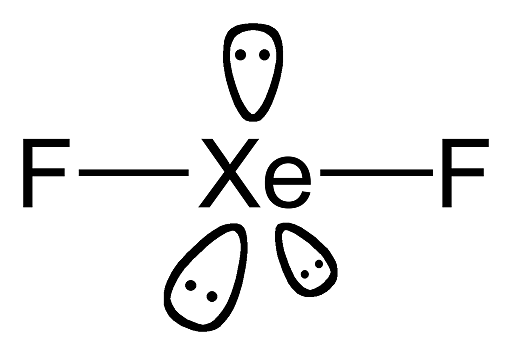
Structure of Xenon Difluoride
We can also observe its solid structure and we will see the fluorine atom will avoid the equatorial region and the equatorial region of the xenon atom will have three pairs of unpaired electrons in this molecule, in accordance with VSEPR theory. XeF2 can easily change into XeF4 at a pressure of 50 Gpa and we have to note that XeF4 is a semiconductor. The structure of XeF4 is the same as graphite. And if we increase the temperature above 90 Gpa it will be converted into a metallic 3d compound I.e. XeF8.
Difluoride of Xenon (XeF2) 8 valence electrons make up xenon. The remaining 6 electrons remain as 3 lone pairs, while 2 of them form sigma bonds with fluorine atoms. It demonstrates sp3d hybridization since you can see one, three, and one d orbitals undergoing hybridization in the excited state of xenon. Its hybridization can also be calculated using the number of lone pairs and sigma bonds in xenon.
Two hybridizations are involved, sp2 and PD, much like in sp3d hybridization. While PD forms axial bonds, Sp2 forms equatorial bonds. S- character percentage in sp2 is 33.33% while it is 0 in PD. The lone pairs are positioned at larger bond angles because of the strong repulsion between them.
Read More: Organic Rearrangement Reactions
Xenon Difluoride Synthesis
[Click Here for Sample Questions]
It is created when fluorine and xenon gases react in the presence of heat, radiation, or an electrical discharge. The resulting xenon difluoride is solid as a result. Using a vacuum duct, it is refined using fractional distillation or selective condensation. Dioxygen difluoride is another method of producing it.
XeF2 is created when a 2:1 mixture of xenon and fluorine is heated to 400°C in a nickel vessel that is sealed.
Xe + F2 → XeF2
At roughly 118oC, xenon and dioxygen difluoride react to form XeF2.
Xe + O2F2 → XeF2 + O2
Applications of Xenon Difluoride
[Click Here for Previous Years Questions]
The following is a list of a few XeF2 applications
- As a potent fluorinating agent, it is employed.
- It also functions as an oxidizing agent.
- In the manufacture of microelectromechanical systems, it is employed as an isotropic gaseous etchant for silicon.
- It offers a rapid etch rate and does not require ion bombardment or external energy to etch silicon. as
- It is also used to find out how much iodine is present and detect it.
- The anticancer medication 5-fluorouracil is created through its interaction with uracil.
- The hetero element in an organometallic compound is used to be oxidized and fluorinated, but it is not harmful to the alkyl or aryl groups.
- The oxidation of iodine to periodate is used as a very practical method for the detection and measurement of very minute levels of iodine and iodide.
- Used as an antiseptic, a laser power source, and to power tracers. As fuel for ion engines, it is chosen for use in deep space to power spacecraft.
Read More:
Things to Remember
- Xenon Difluoride has the formula XeF2 and was discovered by Sir William Ramsay in 1904.
- Xenon difluoride is used to etch silicon microprocessors.
- The use of XeF2 requires caution because it combines with moisture to form explosive and hazardous materials.
- It is used to examine a variety of chemicals that contain sulfur, selenium, and tellurium.
- Molecular Geometry of Xenon Difluoride is Linear.
Previous Years’ Questions
- The reagents used in the conversion are… (DUET 2008)
- 2-butene shows geometrical isomerism due to… (NEET 2000)
- Complete combustion of 1.80g of an oxygen containing compound… [JEE Main 2021]
- Lassaigne's test for the detection of nitrogen fails in… [NEET 1994]
- Example of electrophile is… (AMUEEE 2011)
- The correct statement regarding electrophile is… (NEET 2017)
- Which of the following is an electrophile?
- Among the following the strongest nucleophile is…
- Strongest nucleophile is…
- The most reactive nucleophile among the following is…
- Which of the following can behave as both electrophile and nucleophile…
- The correct set of reagents for the following conversion is…
- Electrophilic reagents are…
Sample Questions
Ques. What is the main purpose of Xenon Difluoride? (2 marks)
Ans. Xenon Difluoride is used as a strong fluorinating agent. It also works as an oxidizing agent. In the manufacturing of microelectromechanical systems, it works as an isotropic gaseous etchant for silicon.
Ques. What is a fluorinating agent and why is xenon difluoride used as a fluorinating agent? (2 marks)
Ans. The fluorinating agent is the agent where, where the electron-deficient fluorine atom serves as a reaction active species.
Ques. Does water hydrolyze Xenon Difluoirde? (2 marks)
Ans. Xenon Difluoride can easily hydrolyze when treated with water and involves oxygen. In XeF2, Xenon is sp3d hybridized and the molecule has a linear structure as shown.
Ques. What gas is produced when Xenon Difluoride Interacts with water? (2 marks)
Ans. When Xenon Difluoride Interacts with Water it produced Hydrogen fluoride and oxygen.
Ques. Why are there 3 lone pairs in XeF2? (2 marks)
Ans. The central atom of Xenon Difluoride has eight valence electrons. In Xenon Difluoride two-electron is responsible to create two bonds with the f atom. This will leave six electrons forming three lone pairs.
Ques. Is Xenon Difluoride linear or curved? (2 marks)
Ans. Xenon Difluoride has 5 pairs of electrons around the Xe and thus, its geometry is trigonal bipyramidal. And the linear position is occupied by fluorine atoms, while another side three lone pairs occupy equatorial positions. Thus we can see, that XeF2 is a linear molecule.
Ques. Why is XeF2 linear yet water is bent? (2 marks)
Ans. The shape of Xenon Difluoride is linear due to lone pairs preferring to the equatorial positions. Water is bent because its oxygen atom, in addition to forming bonds with the hydrogen atoms, also carries two pairs of unshared electrons.
Do Check Out:



Comments