




MHT CET 2017 Mathematics Question Paper is available for download here. Maharashtra State CET Cell conducted MHT CET 2017 on 11 May 2017.
The MHT CET 2017 Mathematics Question Paper includes the following:
- The MHT CET 2017 Mathematics paper consists of 50 multiple-choice questions (MCQs) totalling 100 marks.
- The time allowed is 90 minutes.
MHT CET 2017 Mathematics Question Paper with Solution PDF
| CD PDF | CD PDF with Solutions |
|---|---|
| Download Collegedunia PDF 0.44 MB | - |
Also Check:
MHT CET 2017 Mathematics Questions with Solutions
Mathematics (Q101 - Q150)
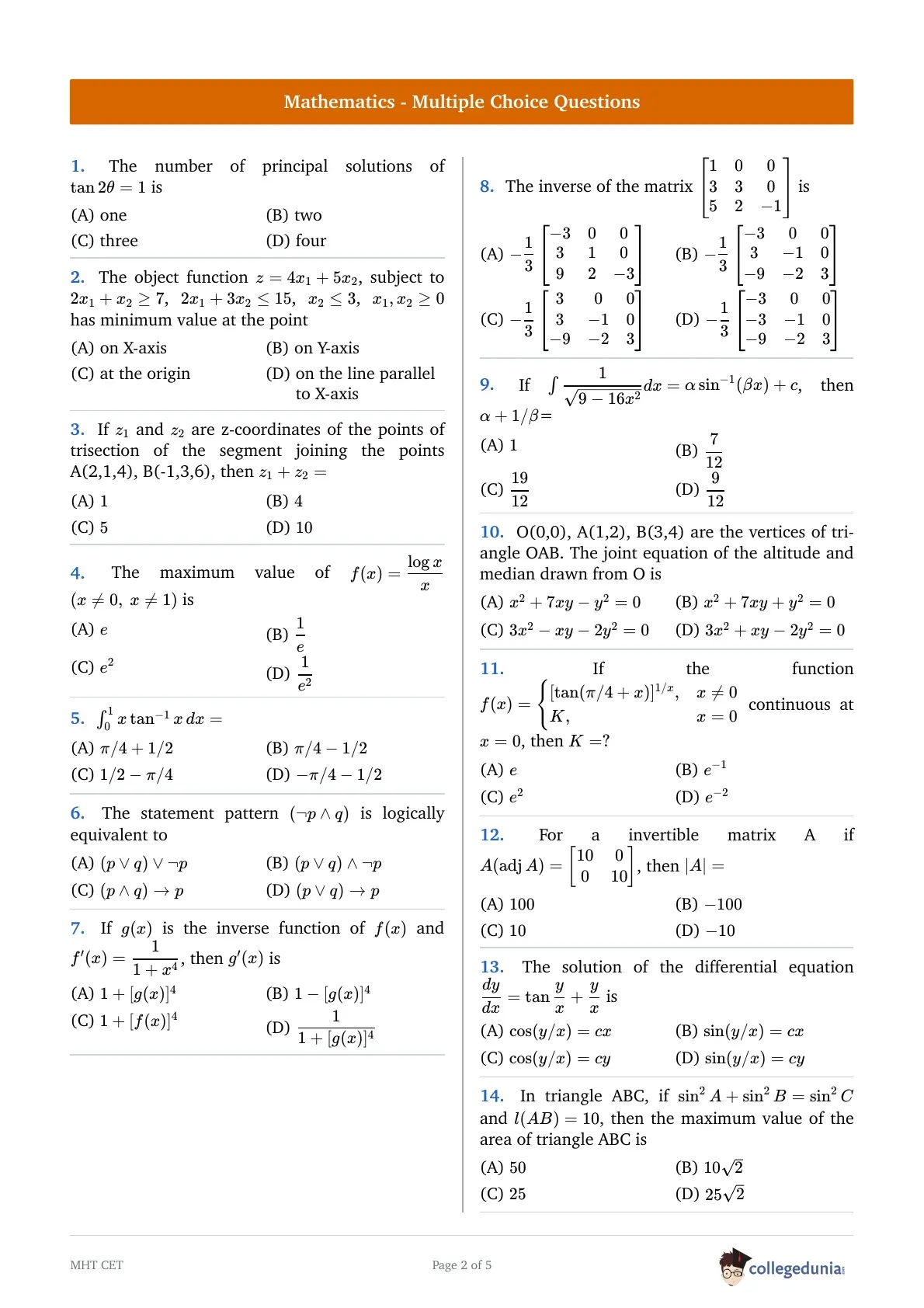
The number of principal solutions of \(\tan 2 \theta = 1\) is
The object function z = 4x1 + 5x2, subject to 2x1+x2>=7, 2x1+3x2<=15, x2<=3, x1,x2>=0 has minimum value at the point
If \(z_1\) and \(z_2\) are z co-ordinates of the points of trisection of the segment joining the points \(A(2, 1, 4), B _1 + z_2 =\)
The maximum value of \(f(x) = \frac{\log \, x }{x} (x \neq 0 , x \neq 1)\) is
\(\int^1_0 x \, \tan^{-1} x\,dx = \)
The statement pattern (~p ^ q) is logically equivalent to
If g(x) is the inverse function of f(x) and f'(x) = 1/(1+x^4), then g'(x) is
The inverse of the matrix [[1,0,0],[3,3,0],[5,2,-1]] is
If \(\int \dfrac{1}{\sqrt{9-16x^2}}dx = \alpha\sin^{-1}(\beta x)+c\), then \(\alpha + 1/\beta\)=
O(0,0), A(1,2), B(3,4) are the vertices of triangle OAB. The joint equation of the altitude and median drawn from O is
If the function f(x) = [tan(pi/4 + x)]^(1/x) for x!=0 is =K for x=0 continuous at x=0, then K=?
For a invertible matrix A if A(adjA) = [[10,0],[0,10]], then |A|=
The solution of the differential equation dy/dx = tan(y/x)+(y/x) is
In triangle ABC, if sin^2A+sin^2B=sin^2C and l(AB)=10, then the maximum value of the area of triangle ABC is
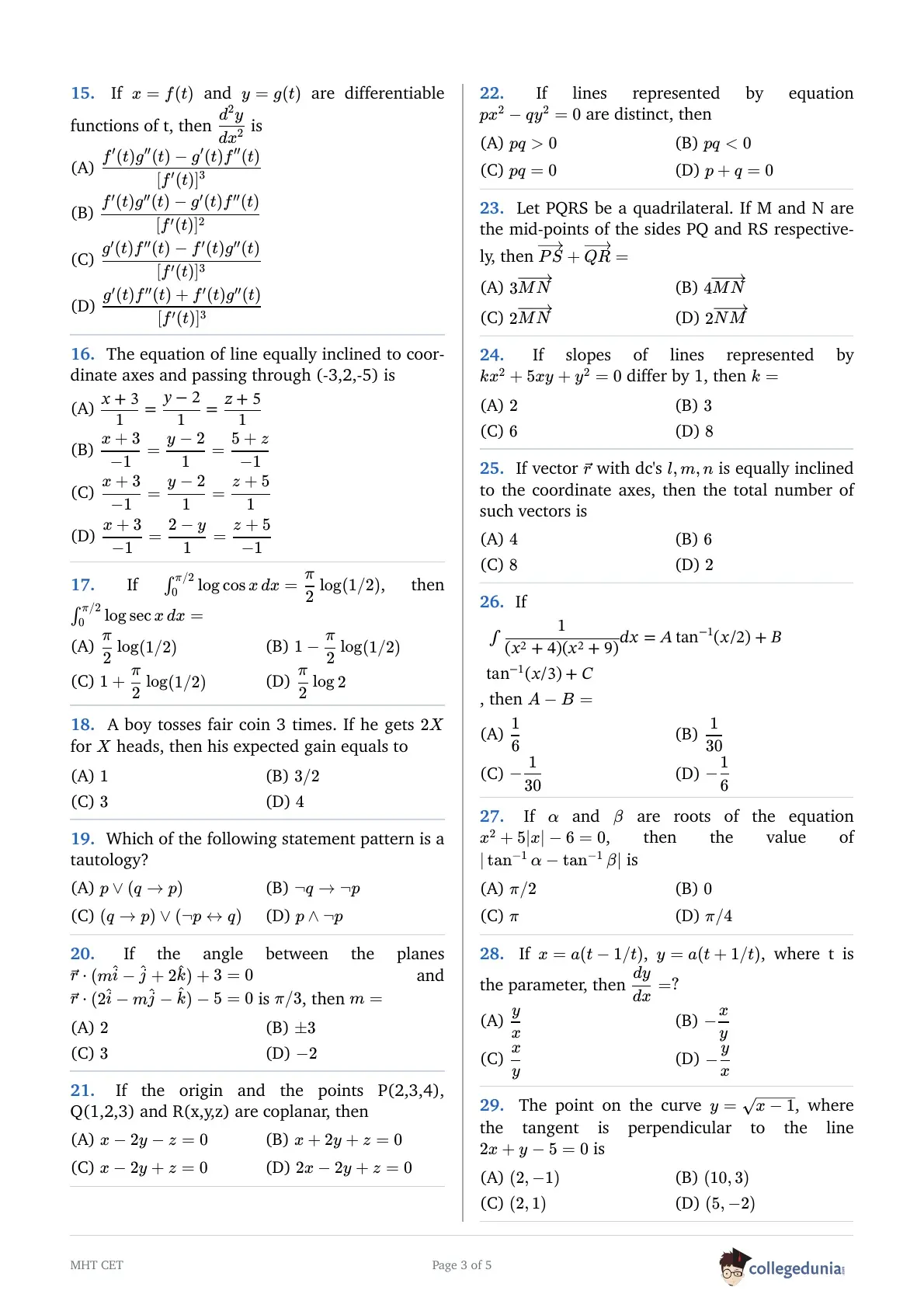
If x=f(t) and y=g(t) are differentiable functions of t, then d^2y/dx^2 is
The equation of line equally inclined to coordinate axes and passing through (-3,2,-5) is
If \(\int^{\pi/2}_{0} \log\cos x dx =\frac{\pi}{2} \log\left(\frac{1}{2}\right)\) then \( \int^{\pi/2}_{0} \log\sec x dx = \)
A boy tosses fair coin 3 times. If he gets 2X for X heads, then his expected gain equals to
Which of the following statement pattern is a tautology?
If the angle between the planes r.(m i - j + 2k)+3=0 and r.(2i - mj - k)-5=0 is pi/3, then m=
If the origin and the points P(2,3,4), Q(1,2,3) and R(x,y,z) are coplanar, then
If lines represented by equation px^2-qy^2=0 are distinct, then
Let PQRS be a quadrilateral. If M and N are the mid-points of the sides PQ and RS respectively, then PS+QR=
If slopes of lines represented by kx^2+5xy+y^2=0 differ by 1, then k=
If vector \(\vec{r}\) with d.c.s. \(l, m, n\) is equally inclined to the co-ordinate axes, then the total number of such vectors is
If \(\int \dfrac{1}{(x^2+4)(x^2+9)}dx = A\tan^{-1}(x/2)+B\tan^{-1}(x/3)+C\), then A-B=
If alpha and beta are roots of the equation x^2+5|x|-6=0, then the value of |tan^-1(alpha) - tan^-1(beta)| is
If x=a(t-1/t), y=a(t+1/t), where t is the parameter, then dy/dx=?
The point on the curve \(y = \sqrt{x - 1}\) where the tangent is perpendicular to the line \(2x + y - 5 = 0 \) is
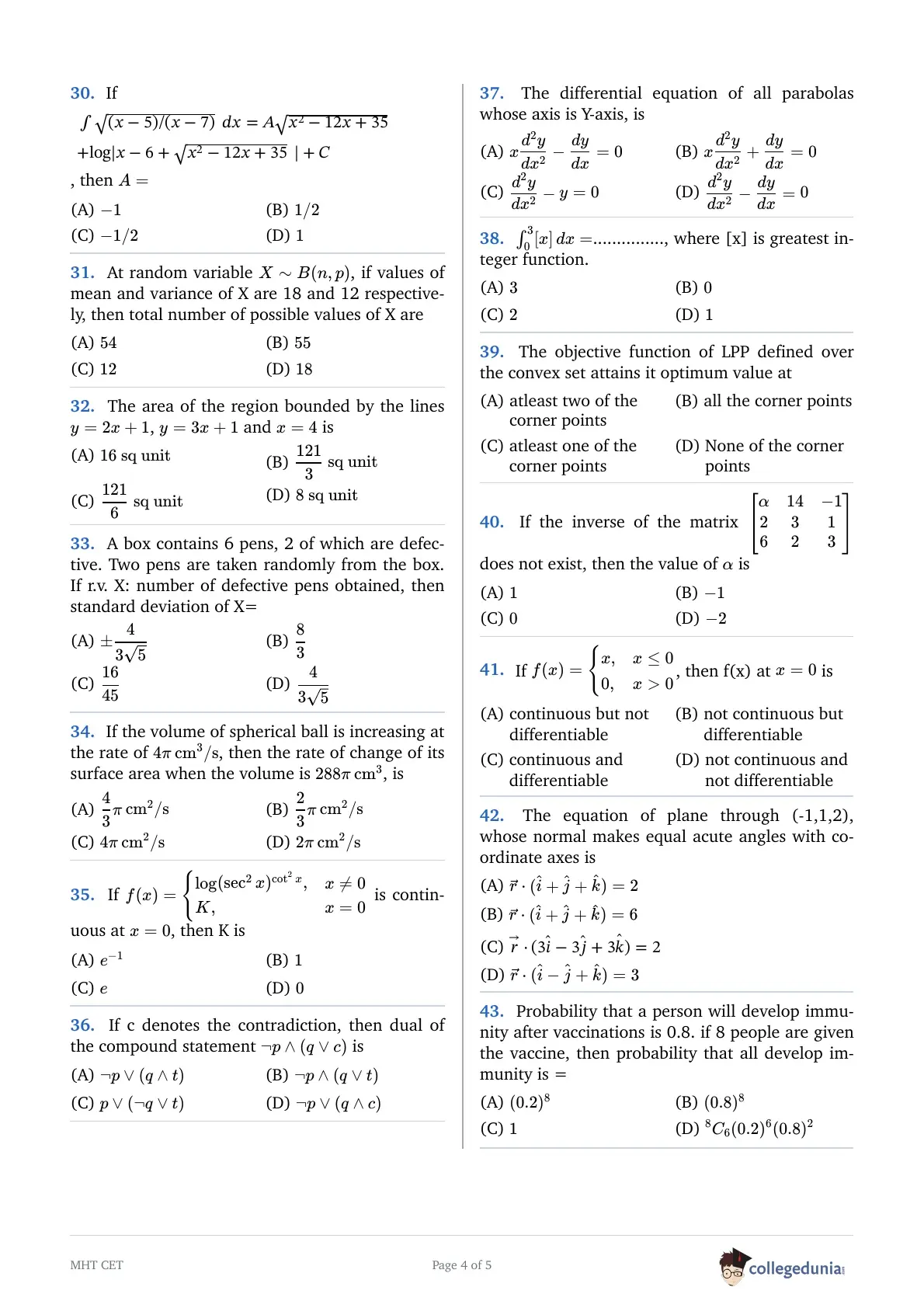
If \(\int \sqrt{\frac{x - 5}{x -7}} dx = A \sqrt{x^2 - 12 x + 35 } + \log \, | x - 6 + \sqrt{x^2 - 12x + 35} | + C \) then \(A = \)
At random variable X~B(n,p), if values of mean and variance of X are 18 and 12 respectively, then total number of possible values of X are
The area of the region bounded by the lines \(y = 2x + 1, y = 3x + 1\) and \(x = 4\) is
A box contains 6 pens, 2 of which are defective. Two pens are taken randomly from the box. If r.v. X: number of defective pens obtained, then standard deviation of X=
If the volume of spherical ball is increasing at the rate of 4pi cm^3/s, then the rate of change of its surface area when the volume is 288pi cm^3, is
If f(x)=log(sec^2 x)^cot^2 x for x!=0 =K for x=0 is continuous at x=0, then K is
If \(c\) denotes the contradiction then dual of the compound statement \(\sim p \wedge ( q \vee c)\) is
The differential equation of all parabolas whose axis is \(y-axis\) is
\(\int_0^3 [x]\,dx = \)..............., where [x] is greatest integer function.
The objective function of \(LPP\) defined over the convex set attains its optimum value at
If the inverse of the matrix [[alpha,14,-1],[2,3,1],[6,2,3]] does not exist, then the value of alpha is
If f(x)=x for x<=0 =0 for x>0, then f(x) at x=0 is
The equation of the plane through \((-1, 1 , 2 ) \) whose normal makes equal acute angles with co-ordinate axes is
Probability that a person will develop immunity after vaccinations is 0.8. if 8 people are given the vaccine, then probability that all develop immunity is =
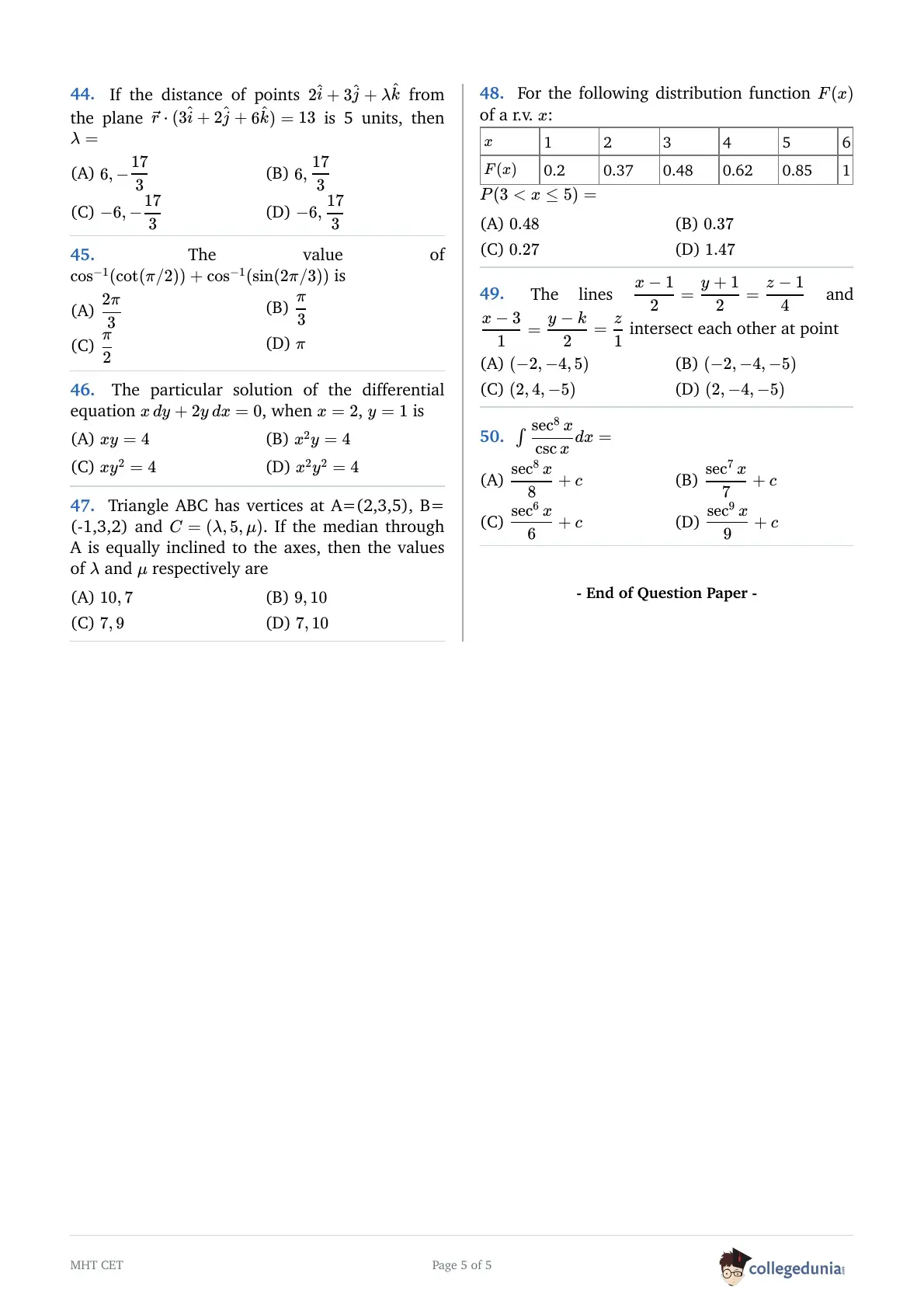
If the distance of points 2i+3j+lambda k from the plane r.(3i+2j+6k)=13 is 5 units, then lambda=
The value of \(\cos^{-1} \left(\cot\left(\frac{\pi}{2}\right)\right) + \cos^{-1} \left(\sin\left(\frac{2\pi}{3}\right)\right) \) is
The particular solution of the differential equation \(xdy + 2ydx = 0\), when \(x = 2, y = 1\) is
\(\Delta \, ABC\) has vertices at \(A = (2, 3,5), B = (-1,3, 2)\) and \(C = (\lambda , 5, \mu )\). If the median through A is equally inclined to the axes, then the values of \(\lambda\) and \(\mu\) respectively are
For the following distribution function \(F(x)\) of a random variable \(x\): \(x = 1, 2, 3, 4, 5, 6\) and \(F(x) = 0.2, 0.37, 0.48, 0.62, 0.85, 1\) respectively. Then \(P(3 < x \le 5) =\)
The lines (x-1)/2=(y+1)/2=(z-1)/4 and (x-3)/1=(y-k)/2=z/1 intersect each other at point
\(\int \dfrac{\sec^8 x}{\csc x}dx=\)



Comments