




MHT CET 2017 Physics and Chemistry Question Paper is available for download here. Maharashtra State CET Cell conducted MHT CET 2017 on 11 May 2017.
The MHT CET 2017 Physics and Chemistry Question Paper includes the following:
- The MHT CET 2017 Physics and Chemistry paper consists of 100 multiple-choice questions (MCQs) totalling 100 marks: Physics (50 questions) and Chemistry (50 questions).
- The time allowed is 90 minutes.
MHT CET 2017 Physics and Chemistry Question Paper with Solution PDF
| CD PDF | CD PDF with Solutions |
|---|---|
| Download Collegedunia PDF 3.49 MB | - |
Also Check:
MHT CET 2017 Physics and Chemistry Questions with Solutions
Physics (Q1 - Q50)
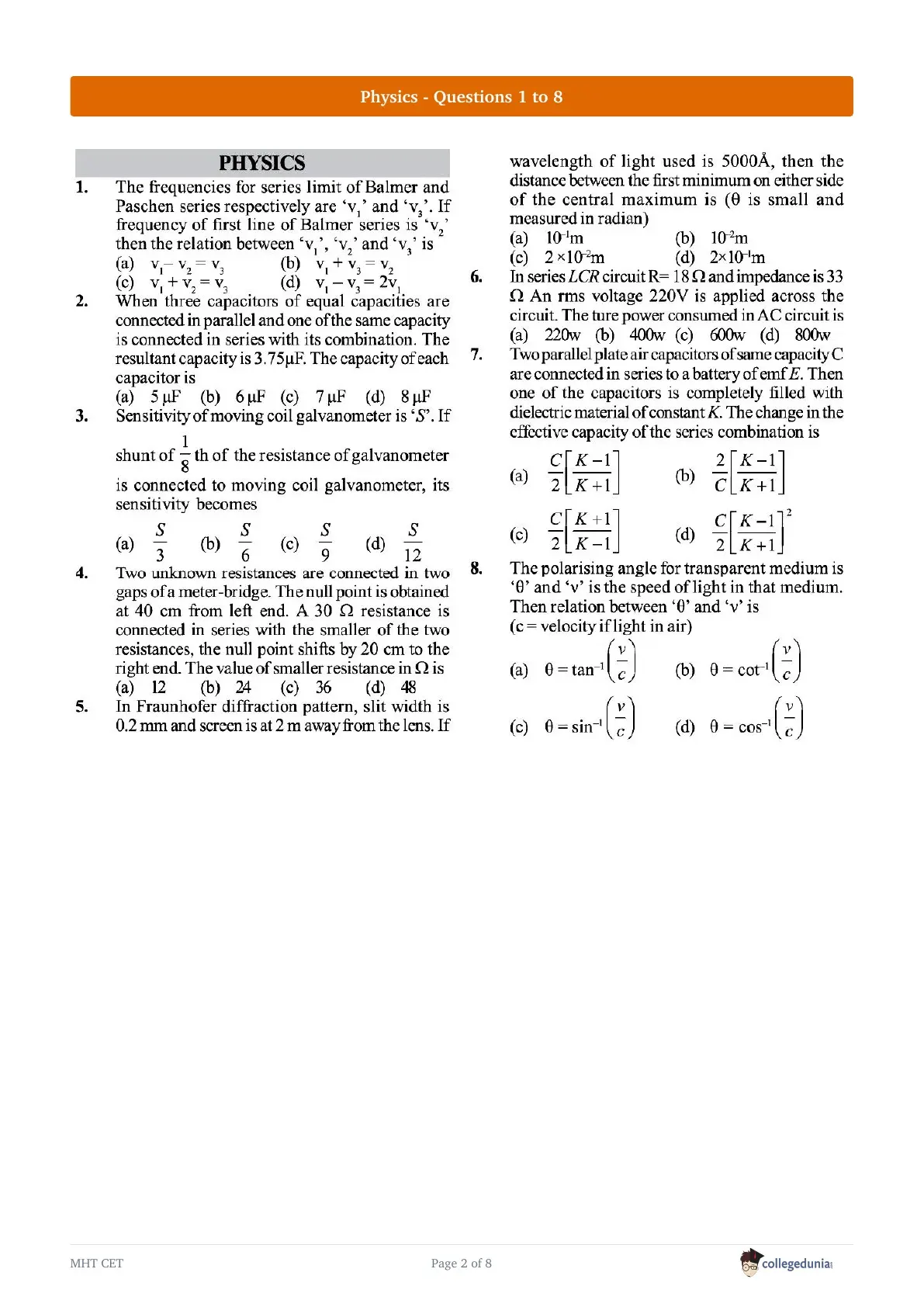
The frequencies for series limit of Balmer and Paschen series respectively are 'v1' and 'v3'. If frequency of first line of Balmer series is 'v2' then the relation between 'v1', 'v2' and 'v3' is
When three capacitors of equal capacities are connected in parallel and one of the same capacity is connected in series with its combination. The resultant capacity is 3.75uF. The capacity of each capacitor is
Sensitivity of moving coil galvanometer is 'S'. If shunt of 1/8th of the resistance of galvanometer is connected to moving coil galvanometer, its sensitivity becomes
Two unknown resistances are connected in two gaps of a meter-bridge. The null point is obtained at 40 cm from left end. A 30 ohm resistance is connected in series with the smaller of the two resistances, the null point shifts by 20 cm to the right end. The value of smaller resistance in ohm is
In Fraunhofer diffraction pattern, slit width is \(0.2\, mm\) and screen is at \(2 \,m\) away from the lens. If wavelength of light used is \(5000 \, \mathring A \) then the distance between the first minimum on either side of the central maximum is (\(\theta\) is small and measured in radian)
In series LCR circuit R=18 ohm and impedance is 33 ohm. An rms voltage 220V is applied across the circuit. The true power consumed in AC circuit is
Two parallel plate air capacitors of same capacity C are connected in series to a battery of emf E. Then one of the capacitors is completely filled with dielectric material of constant K. The change in the effective capacity of the series combination is
The polarising angle for transparent medium is 'theta' and 'v' is the speed of light in that medium. Then relation between 'theta' and 'v' is (c=velocity of light in air)
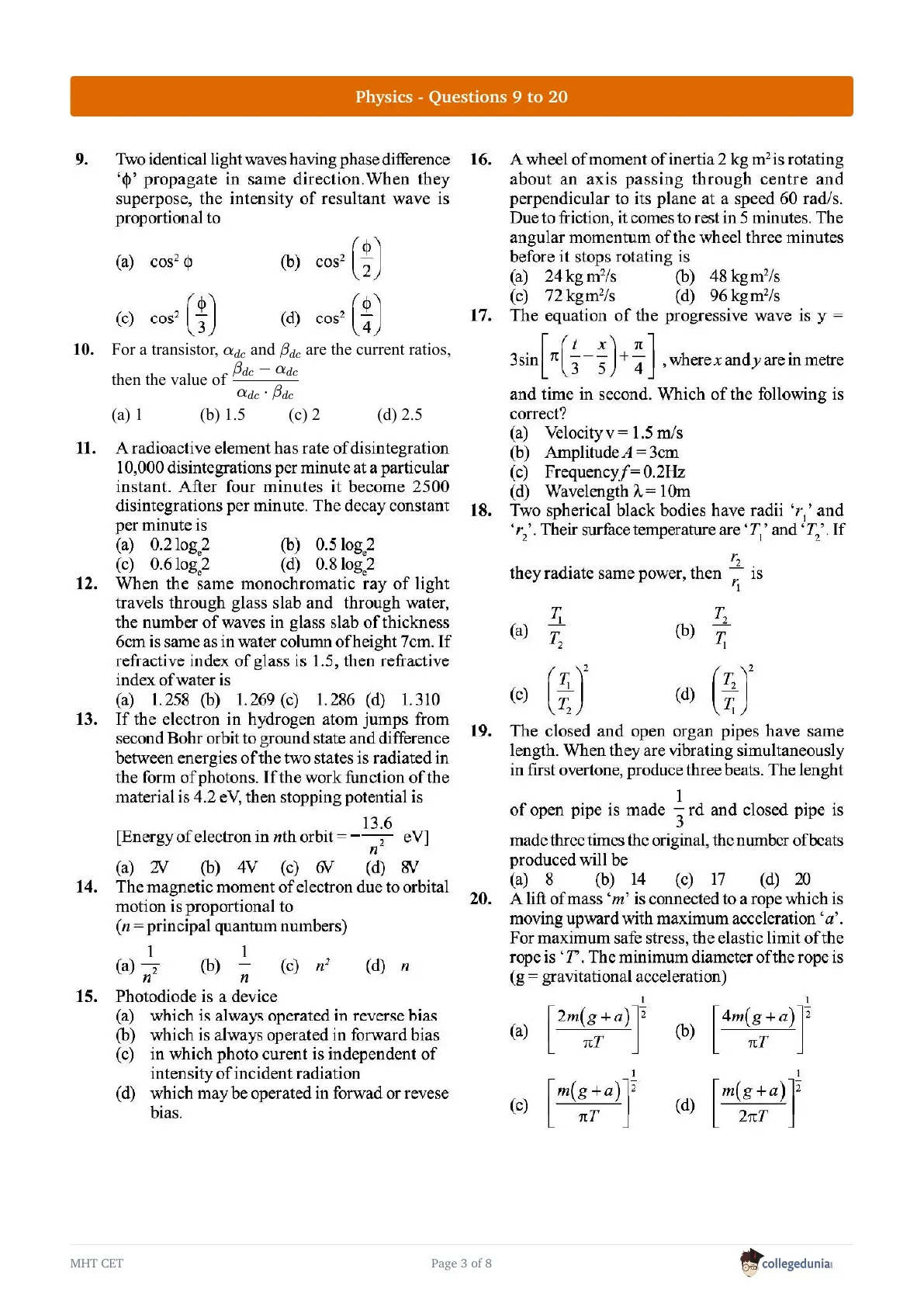
Two identical light waves having phase difference '\(\phi\)' propagate in same direction. When they superpose, the intensity of resultant wave is proportional to
For a transistor, \(\alpha_{dc}\) and \(\beta_{dc}\) are the current ratios, then the value of \(\dfrac{\beta_{dc}-\alpha_{dc}}{\alpha_{dc}\cdot\beta_{dc}}\) is
A radioactive element has rate of disintegration 10,000 disintegrations per minute at a particular instant. After four minutes it becomes 2500 disintegrations per minute. The decay constant per minute is
When the same monochromatic ray of light travels through glass slab and through water, the number of waves in glass slab of thickness 6cm is same as in water column of height 7cm. If refractive index of glass is 1.5, then refractive index of water is
If the electron in hydrogen atom jumps from second Bohr orbit to ground state and difference between energies of the two states is radiated in the form of photons. If the work function of the material is 4.2 eV, then stopping potential is [Energy of electron in nth orbit = \(-13.6/n^2\) eV]
The magnetic moment of electron due to orbital motion is proportional to (n = principal quantum number)
Photodiode is a device
A wheel of moment of inertia 2 kg m^2 is rotating about an axis passing through centre and perpendicular to its plane at a speed 60 rad/s. Due to friction, it comes to rest in 5 minutes. The angular momentum of the wheel three minutes before it stops rotating is
The equation of the progressive wave is \(y = 3\sin[\pi(t/3 - x/5) + \pi/4]\), where x and y are in metre and time in second. Which of the following is correct?
Two spherical black bodies have radii \(?r_1?\) and \('r_2'\) . Their surface temperatures are \('T_1'\) and \('T_2'\). If they radiate same power then \(\frac{r_2}{r_1}\) is
The closed and open organ pipes have same length. When they are vibrating simultaneously in first overtone, produce three heats. The length of open pipe is made \(\frac{1}{2}^{nd}\) and closed pipe is made three times the original, the number of beats produced will be
A lift of mass \(m\) is connected to a rope which is moving upward with maximum acceleration \(a\). For maximum safe stress, the elastic limit of the rope, is \(T\). The minimum diameter of the rope is (g = gravitational acceleration)
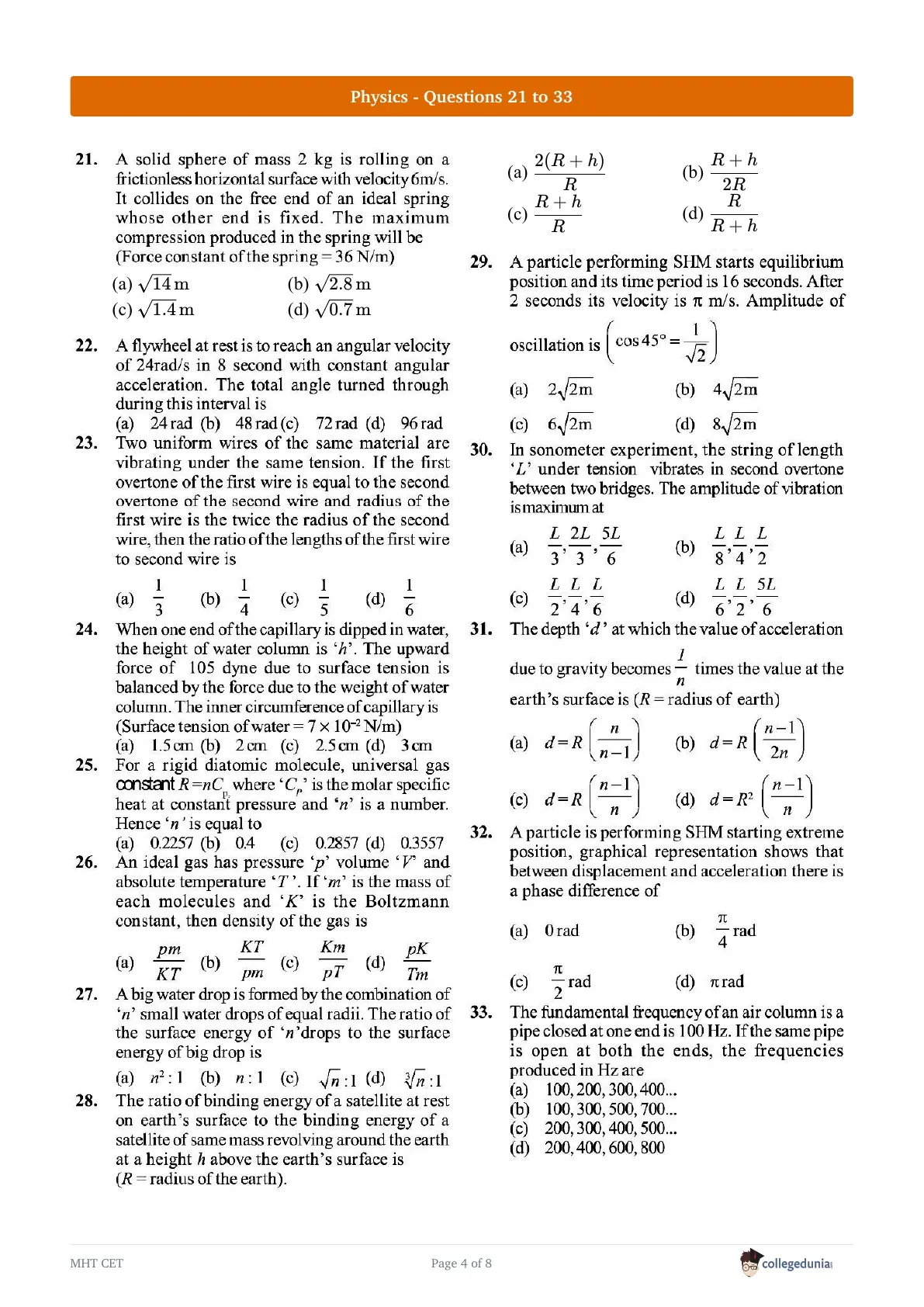
A solid sphere of mass 2 kg is rolling on a frictionless horizontal surface with velocity 6 m/s. It collides on the free end of an ideal spring whose other end is fixed. The maximum compression produced in the spring will be (Force constant of the spring = 36 N/m).
A flywheel at rest is to reach an angular velocity of 24 rad/s in 8 second with constant angular acceleration. The total angle turned through during this interval is
Two uniform wires of the same material are vibrating under the same tension. If the first overtone of the first wire is equal to the second overtone of the second wire and radius of the first wire is the twice the radius of the second wire, then the ratio of the lengths of the first wire to second wire is
When one end of the capillary is dipped in water, the height of water column is 'h'. The upward force of 105 dyne due to surface tension is balanced by the force due to the weight of water column. The inner circumference of capillary is (Surface tension of water = 7*10^-2 N/m)
For a rigid diatomic molecule, universal gas constant R = nCp, where 'Cp' is the molar specific heat at constant pressure and 'n' is a number. Hence 'n' is equal to
An ideal gas has pressure 'p' volume 'V' and absolute temperature 'T'. If 'm' is the mass of each molecules and 'K' is the Boltzmann constant, then density of the gas is
A big water drop is formed by the combination of 'n' small water drops of equal radii. The ratio of the surface energy of 'n' drops to the surface energy of big drop is
The ratio of binding energy of a satellite at rest on earth's surface to the binding energy of a satellite of same mass revolving around the earth at a height h above the earth's surface is (R = radius of the earth)
A particle performing SHM starts equilibrium position and its time period is 16 seconds. After 2 seconds its velocity is \(\pi\) m/s. Amplitude of oscillation is (cos45deg = 1/sqrt2)
In sonometer experiment, the string of length 'L' under tension vibrates in second overtone between two bridges. The amplitude of vibration is maximum at
The depth 'd' at which the value of acceleration due to gravity becomes 1/n times the value at the earth's surface is (R = radius of earth)
A particle is performing SHM starting extreme position, graphical representation shows that between displacement and acceleration there is a phase difference of
The fundamental frequency of an air column is a pipe closed at one end is 100 Hz. If the same pipe is open at both the ends, the frequencies produced in Hz are
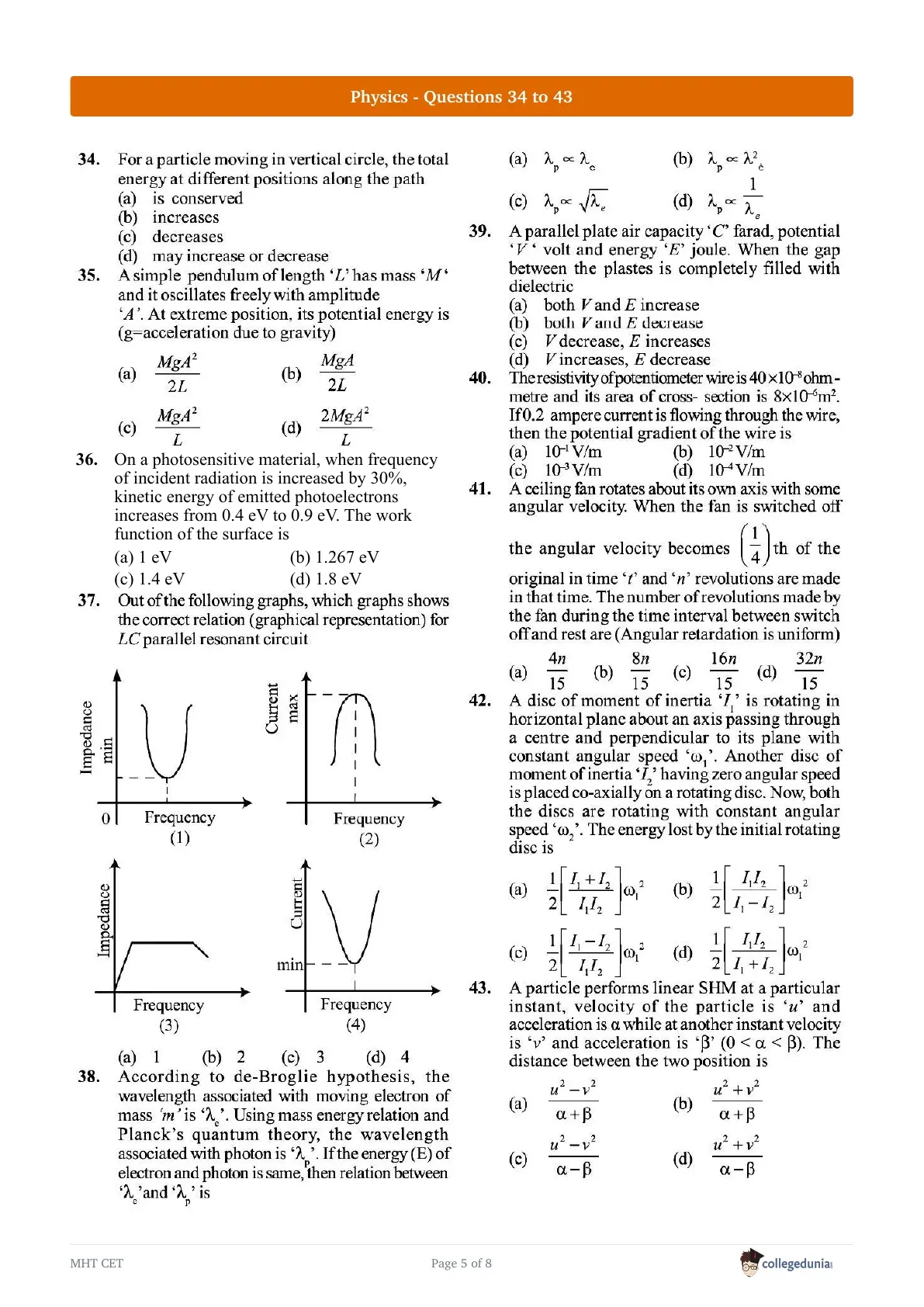
For a particle moving in vertical circle, the total energy at different positions along the path
A simple pendulum of length 'L' has mass 'M' and it oscillates freely with amplitude 'A'. At extreme position, its potential energy is (g=acceleration due to gravity)
On a photosensitive material when frequency of incident radiation is increased by 30%, kinetic energy of emitted photoelectrons increases from 0.4 eV to 0.9 eV. The work function of the surface is
According to de-Broglie hypothesis, the wavelength associated with moving electron of mass 'm' is 'lambda_e'. Using mass energy relation and Planck's quantum theory, the wavelength associated with photon is 'lambda_p'. If the energy (E) of electron and photon is same, then relation between 'lambda_e' and 'lambda_p' is
A parallel plate air capacity 'C' farad, potential 'V' volt and energy 'E' joule. When the gap between the plates is completely filled with dielectric
The resistivity of potentiometer wire is 40*10^-8 ohm-metre and its area of cross-section is 8*10^-6 m^2. If 0.2 ampere current is flowing through the wire, then the potential gradient of the wire is
A ceiling fan rotates about its own axis with some angular velocity. When the fan is switched off, the angular velocity becomes \((\frac{1}{4})^{th}\) of the original in time ?t? and ?n? revolutions are made in that lime. The number of revolutions made by the fan during the time interval between switch off and rest are (Angular retardation is uniform)
A disc of moment of inertia \('I_1'\) is rotating in horizontal plane about an axis passing through a centre and perpendicular to its plane w ith constant angular speed \(?\omega_1'\). Another disc of moment of inertia \(?I_2? \) having zero angular speed is placed coaxially on a rotating disc. Now both the. discs are rotating with constant angular speed \(?\Omega_2 ?\). The energy lost by the initial rotating disc is
A particle performs linear \(S.H.M.\) At a particular instant, velocity of the particle is \(u\) and acceleration is \(\alpha\) while at another instant velocity is \(v\) and acceleration is \( \beta (0 < \alpha < \beta )\). The distance between the two positions is
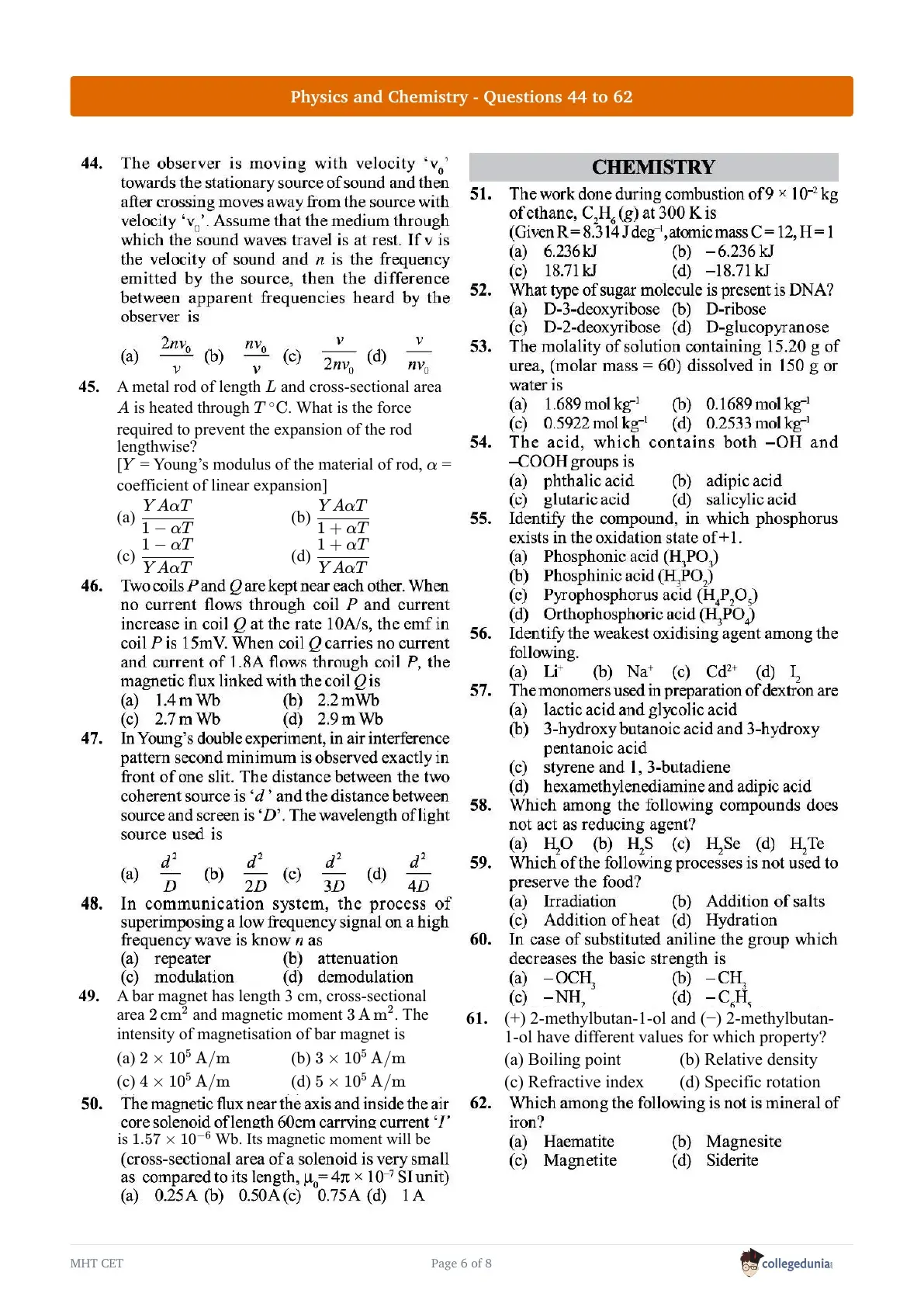
The observer is moving with velocity \(v_0\) towards the stationary source of sound and then after crossing moves away from the source with velocity \(v_0\). Assume that the medium through which the sound waves travel is at rest. If \(V\) is the velocity of sound and \(n\) is the frequency emitted by the source then the difference between apparent frequencies heard by the observer is
A metal rod of length 'L' and cross-sectional area 'A' is heated through 'T degC'. What is the force required to prevent the expansion of the rod lengthwise
Two coils P and Q are kept near each other. When no current flows through coil P and current increase in coil Q at the rate 10A/s, the emf in coil P is 15mV. When coil Q carries no current and current of 1.8A flows through coil P, the magnetic flux linked with the coil Q is
In Young's double experiment, in air interference pattern second minimum is observed exactly in front of one slit. The distance between the two coherent source is 'd' and the distance between source and screen is 'D'. The wavelength of light source used is
In communication system, the process of superimposing a low frequency signal on a high frequency wave is know n as
A bar magnet has length 3 cm, cross-sectional area 2 cm\(^2\) and magnetic moment 3 Am\(^2\). The intensity of magnetisation of bar magnet is
The magnetic flux near the axis and inside the air core solenoid of length 60 cm carrying current \(I\) is \(1.57\times 10^{-6}\ \text{Wb}\). Its magnetic moment will be (the cross-sectional area of the solenoid is very small compared to its length, \(\mu_0 = 4\pi\times 10^{-7}\) SI unit)
Chemistry (Q51 - Q100)
The work done during combustion of 9*10^-2 kg of ethane, C2H6(g) at 300 K is (Given R=8.314 J deg^-1, atomic mass C=12, H=1)
What type of sugar molecule is present in \(DNA\) ?
The molality of solution containing \(15.20\, g\) of urea, (molar mass = \(60\)) dissolved in \(150 \,g\) of water is
The acid, which contains both -OH and -COOH groups is
Identify the compound, in which phosphorus exists in the oxidation state of +1.
Identify the weakest oxidising agent among the following.
The monomers used in preparation of dextron are
Which among the following compounds does not act as reducing agent?
Which of the following processes is not used to preserve the food?
In case of substituted aniline the group which decreases the basic strength is
(+2) 2-methylbutan-1-ol (-) 2-methylbutan-1-ol have different values for which property?
Which among the following is not is mineral of iron?
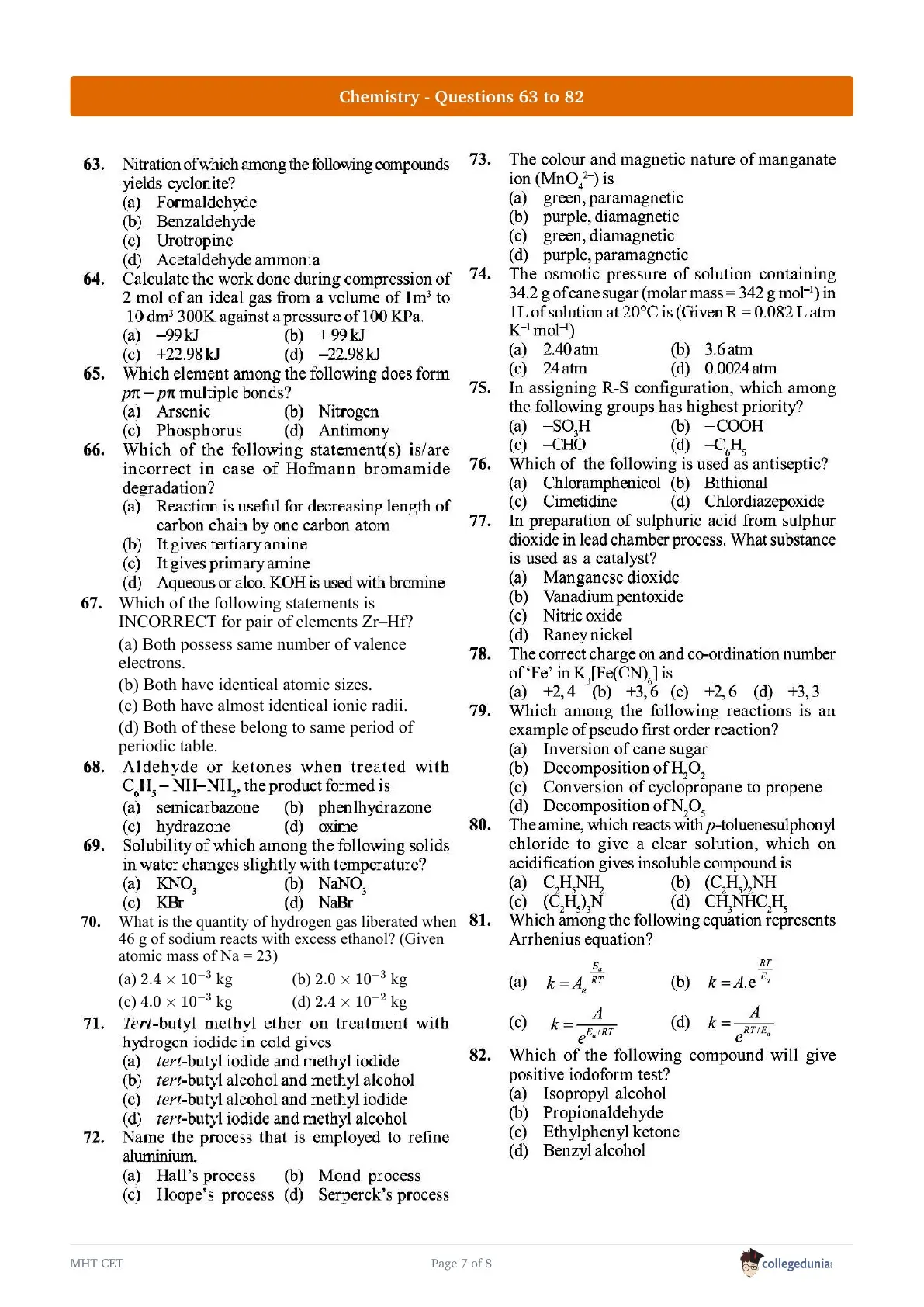
Nitration of which among the following compounds yields cyclonite?
Calculate the work done during compression of 2 mol of an ideal gas from a volume of 1 m^3 to 10 dm^3 300K against a pressure of 100 KPa.
Which element among the following does form p(pi)-p(pi) multiple bonds?
Which of the following statements is INCORRECT in case of Hofmann bromamide degradation ?
Which of the following statements is INCORRECT for pair of elements \(Zr - Hf\) ?
Aldehydes or ketones when treated with \(\ce{C_6H_5 - NH - NH_2}\), the product formed is
Solubility of which among the following solids in water changes slightly with temperature ?
What is the quantity of hydrogen gas liberated when \(46 \,g\) sodium reacts with excess ethanol ? (Given At. mass of Na = 23)
\(tert-butyl\, methyl\) ether on treatment with hydrogen iodide in cold gives
Name the process that is employed to refine aluminium.
The osmotic pressure of solution containing \(34.2 \,g\) of cane sugar (molar mass = \(342 \, g \, mol^{-1}\)) in 1L of solution at \(20^{\circ} C\) is (Given, \(R = 0.082 \, L \, atm \, K^{-1} \, mol^{-1}\))
In assigning \(R-S\) configuration which among the following groups has highest priority ?
Which of the following is used as antiseptic?
In preparation of sulphuric acid from sulphur dioxide in lead chamber process. What substance is used as a catalyst ?
The correct charge on and co-ordination number of 'Fe' in K3[Fe(CN)6] is
Which among the following reactions is an example of pseudo first order reaction ?
The amine, which reacts with p-toluenesulphonyl chloride to give a clear solution, which on acidification gives insoluble compound is
Which among the following equation represents Arrhenius equation?
Which of the following compounds will give positive iodoform test ?
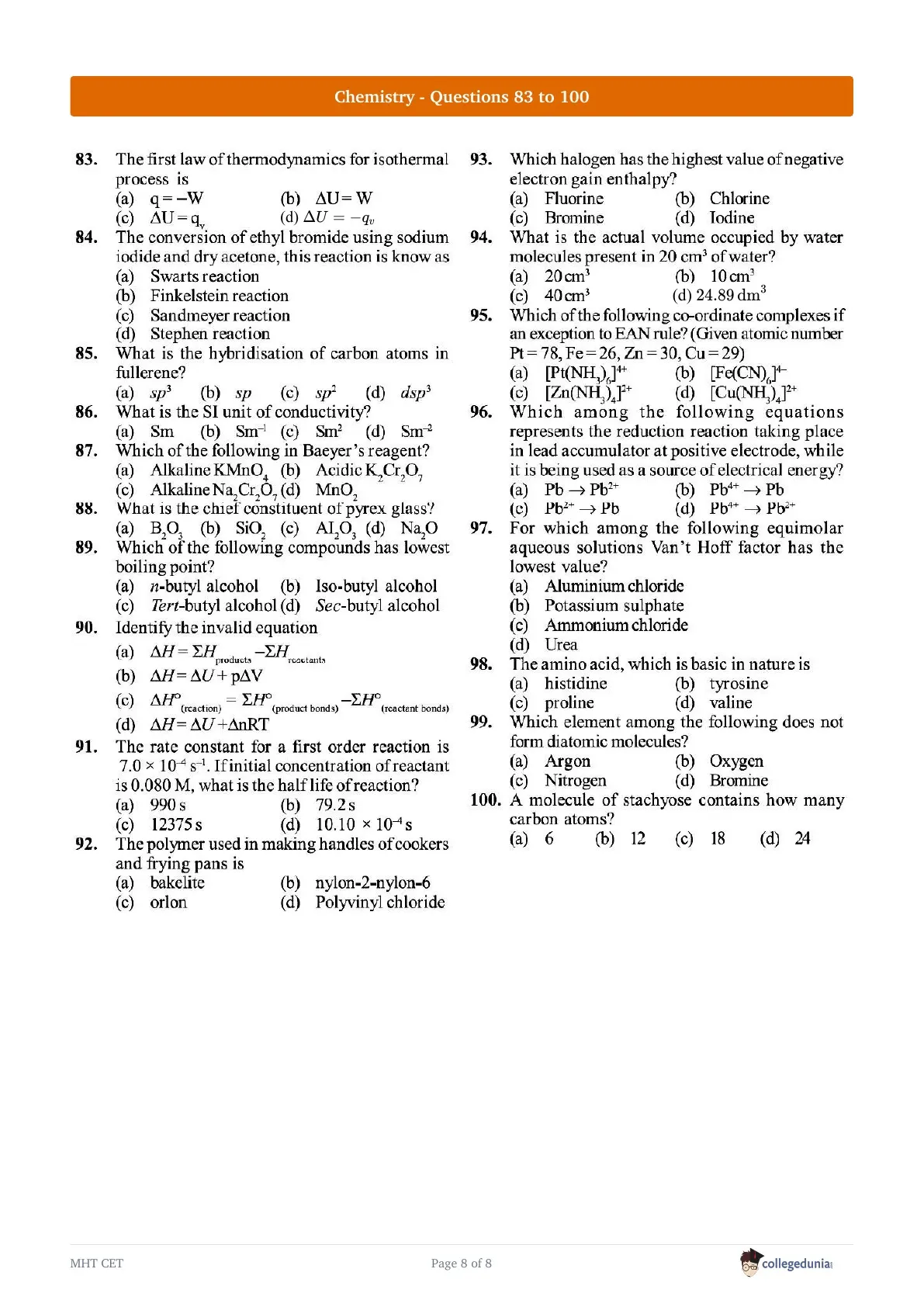
The first law of thermodynamics for isothermal process is
The conversion of ethyl bromide to ethyl iodide using sodium iodide and dry acetone, this reaction is known as
What is the hybridisation of carbon atoms in fullerene?
What is the \(SI\) unit of conductivity ?
Which of the following in Baeyer's reagent?
What is the chief constituent of pyrex glass?
Which of the following compounds has lowest boiling point?
Identify the invalid equation
The rate constant for a first order reaction is 7.0*10^-4 s^-1. If initial concentration of reactant is 0.080 M, what is the half life of reaction?
The polymer used in making handles of cookers and frying pans is
Which halogen has the highest value of negative electron gain enthalpy ?
Which of following coordinate complexes is an exception to \(EAN\) rule ? (Given At. No. Pt = 78, Fe = 26, Zn = 30, Cu = 29)
Which among the following equations represents the reduction reaction taking place in lead accumulator at positive electrode, while it is being used as a source of electrical energy?
For which among the following equimolar aqueous solutions Van't Hoff factor has the lowest value?
The amino acid which is basic in nature is
Which element among the following does not form diatomic molecules?
A molecule of Stachyose contains how many carbon atoms ?



Comments