




MHT CET 2018 Mathematics Question Paper is available for download here. Maharashtra State CET Cell conducted MHT CET 2018 on 10 May 2018.
The MHT CET 2018 Mathematics Question Paper includes the following:
- The MHT CET 2018 Mathematics paper consists of 50 multiple-choice questions (MCQs) totalling 100 marks.
- The time allowed is 90 minutes.
MHT CET 2018 Mathematics Question Paper with Solution PDF
| CD PDF | CD PDF with Solutions |
|---|---|
| Download Collegedunia PDF 0.43 MB | - |
Also Check:
MHT CET 2018 Mathematics Questions with Solutions
Mathematics (Q101 - Q150)
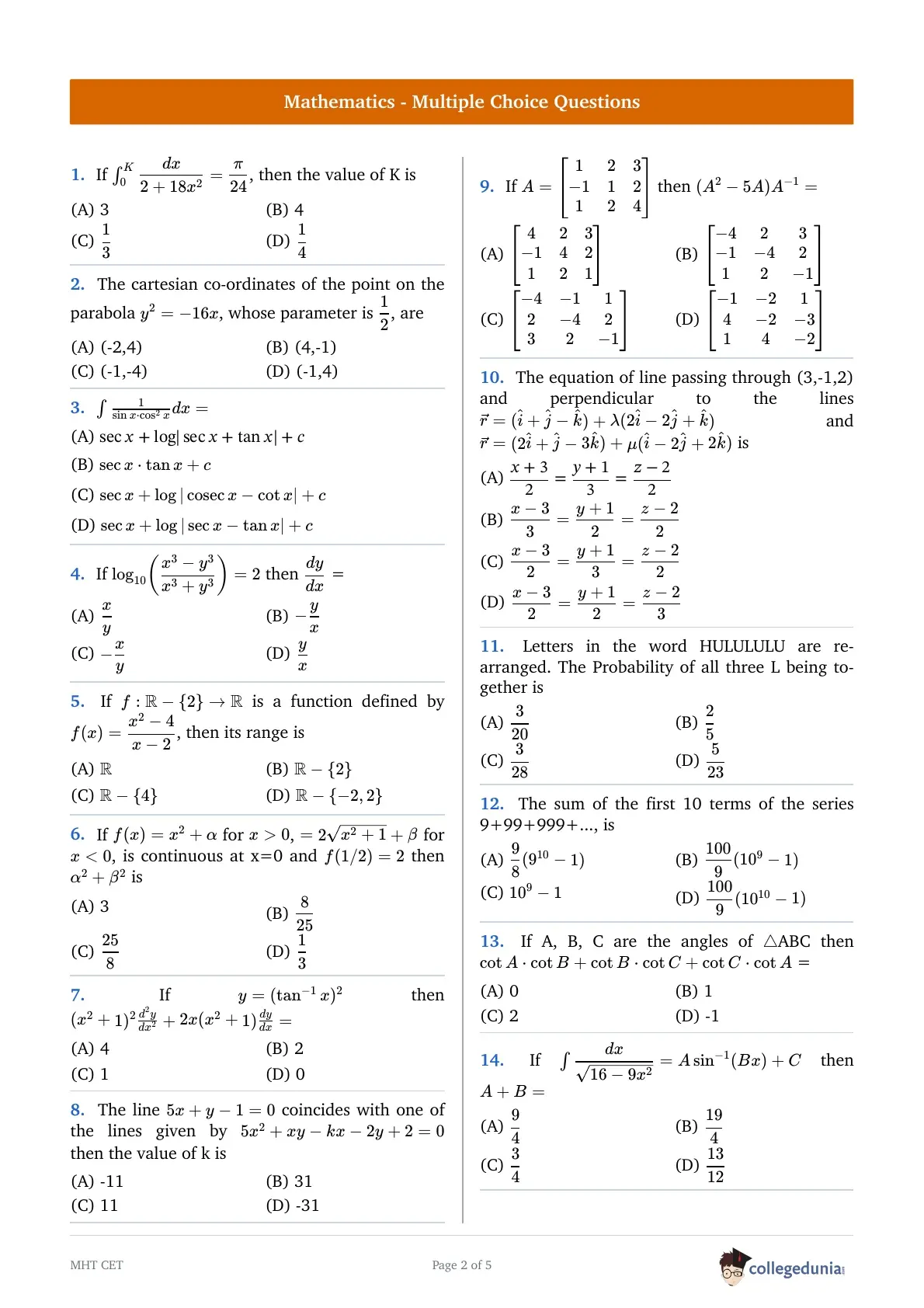
If \(\int\limits^{K}_0 \frac{dx}{2 + 18 x^2} = \frac{\pi}{24}\), then the value of K is
The cartesian co-ordinates of the point on the parabola \(y^2=-16x\), whose parameter is 1/2, are
\(\int \frac{1}{\sin x \cdot \cos^2 x} dx =\)
If \(\log_{10} \left(\frac{x^{3} - y^{3} }{x^{3} + y^3} \right) = 2\) then \( \frac{dy}{dx} = \)
If \(f : R - \{2\} \to R\) is a function defined by \(f(x) = \frac{x^2 - 4}{x - 2}\) , then its range is
If \(f(x)=x^2+\alpha\) for \(x>0\), \(=2\sqrt{x^2+1}+\beta\) for \(x<0\), is continuous at x=0 and \(f(1/2)=2\) then \(\alpha^2+\beta^2\) is
If \(y = \left(\tan^{-1} x\right)^{2}\) then \( \left(x^{2} + 1\right)^{2} \frac{d^{2}y}{dx^{2} } + 2x \left(x^{2} + 1 \right) \frac{dy}{dx} = \)
The line \(5x + y - 1 = 0\) coincides with one of the lines given by \(5x^2 + xy - kx - 2y + 2 = 0 \) then the value of k is
If A = [[1,2,3],[-1,1,2],[1,2,4]] then \((A^2-5A)A^{-1}=\)
The equation of line passing through (3,-1,2) and perpendicular to the lines \(\vec{r}=(\hat{i}+\hat{j}-\hat{k})+\lambda(2\hat{i}-2\hat{j}+\hat{k})\) and \(\vec{r}=(2\hat{i}+\hat{j}-3\hat{k})+\mu(\hat{i}-2\hat{j}+2\hat{k})\) is
Letters in the word HULULULU are rearranged. The probability of all three L being together is
The sum of the first 10 terms of the series 9 + 99 + 999 + ?., is
If A, B, C are the angles of \(\Delta ABC\) then \(\cot \, A. \cot \, B + \cot \, B. \cot \, C + \cot \, C. \cot \, A =\)
If \(\int dx/\sqrt{16-9x^2} = A\sin^{-1}(Bx)+C\) then A+B=
\(\int e^x[(2+\sin 2x)/(1+\cos 2x)]dx=\)
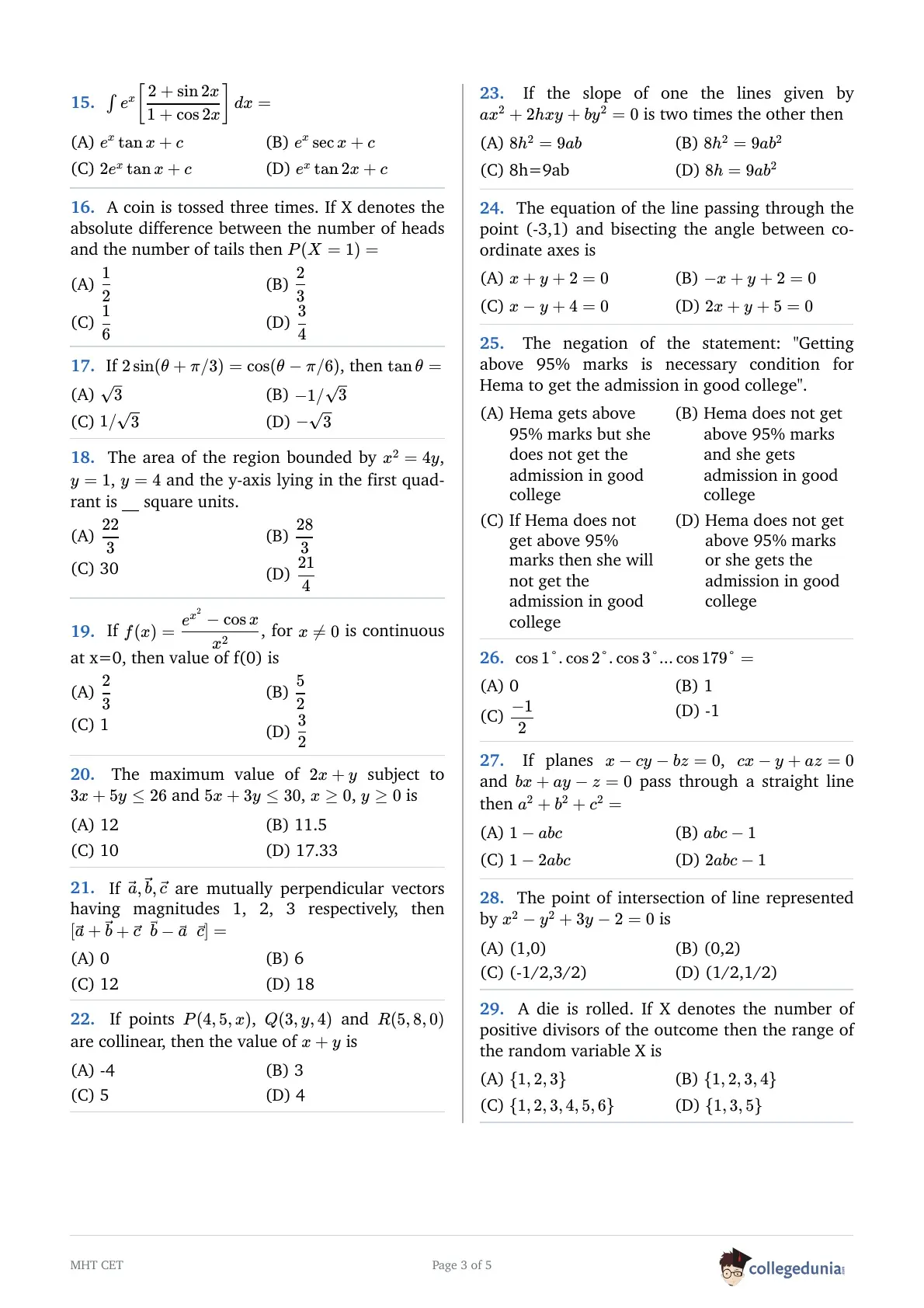
A coin is tossed three times. If X denotes the absolute difference between the number of heads and the number of tails then P(X = 1) =
If \(2 \sin \left( \theta + \frac{\pi}{3}\right) = \cos \left( \theta -\frac{\pi}{6}\right) , \) then \(\tan \, \theta = \)
The area of the region bounded by \(x^2=4y\), y=1, y=4 and the y-axis lying in the first quadrant is __ square units.
If \(f(x)=(e^{x^2}-\cos x)/x^2\), for \(x \ne 0\) is continuous at x=0, then value of f(0) is
The maximum value of \(2x + y\) subject to \(3x + 5y \leq 26\) and \(5x + 3y \leq 30, x \geq 0, y \geq 0\) is
If \(\vec{a} , \vec{b} , \vec{c}\) are mutually perpendicular vectors having magnitudes 1, 2, 3 respectively, then \([\vec{a} + \vec{b} + \vec{c} \, \, \vec{b} - \vec{a} - \vec{c}] = ?\)
If points P(4,5,x), Q(3,y,4) and R(5,8,0) are collinear, then the value of x+y is
If the slope of one the lines given by \(ax^2+2hxy+by^2=0\) is two times the other then
The equation of the line passing through the point (-3,1) and bisecting the angle between co-ordinate axes is
The negation of the statement: "Getting above 95% marks is necessary condition for Hema to get the admission is good college"
\(\cos1°.\cos2°.\cos3°...\cos179°=\)
If planes x-cy-bz=0, cx-y+az=0 and bx+ay-z=0 pass through a straight line then \(a^2+b^2+c^2=\)
The point of intersection of lines represented by \(x^2-y^2+x+3y-2=0\) is
A die is rolled. If X denotes the number of positive divisors of the outcome then the range of the random variable X is
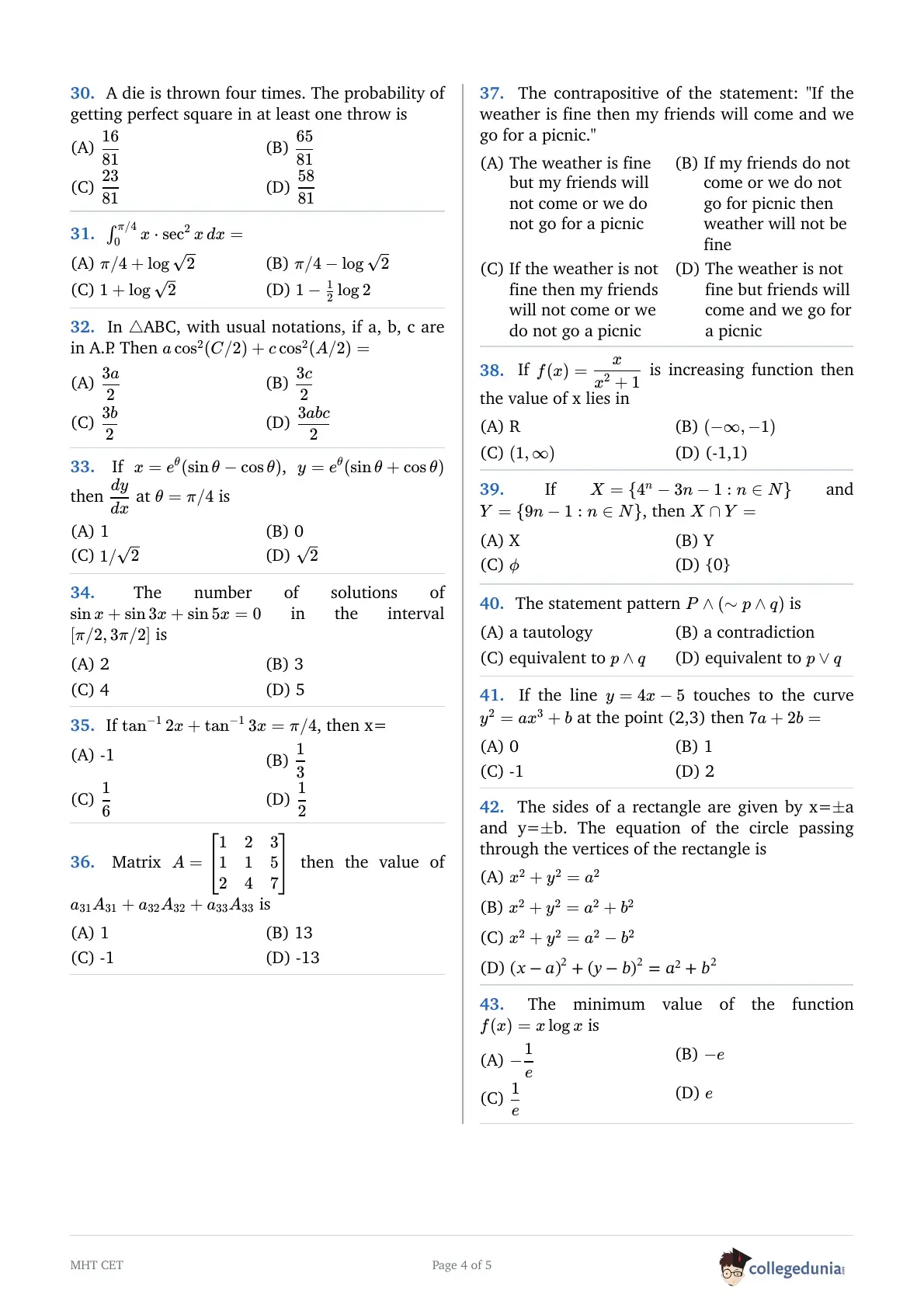
A die is thrown four times. The probability of getting perfect square in at least one throw is
\(\int_0^{\pi/4} x\cdot\sec^2x\,dx=\)
In \(\triangle\)ABC, with usual notations, if a, b, c are in A.P. Then \(a\cos^2(C/2)+c\cos^2(A/2)=\)
If \(x=e^\theta(\sin\theta-\cos\theta)\), \(y=e^\theta(\sin\theta+\cos\theta)\) then dy/dx at \(\theta=\pi/4\) is
The number of solutions of \(\sin \, x + \sin \, 3x + \sin \, 5x = 0\) in the interval \(\left[\frac{\pi}{2} , 3 \frac{\pi}{2}\right] \) is
If \(\tan^{-1}2x+\tan^{-1}3x=\pi/4\), then x=
Matrix \(A = \begin{bmatrix}1&2&3\\ 1&1&5\\ 2&4&7\end{bmatrix}\)then the value of \(a_{31} A_{31} + a_{32} A_{32} + a_{33 } + A_{33} \) is
The contrapositive of the statement: "If the weather is fine then my friends will come and we go for a picnic."
If \(f(x)=x/(x^2+1)\) is increasing function then the value of x lies in
If \(X=\{4^n-3n-1: n \in N\}\) and \(Y=\{9(n-1): n \in N\}\), then \(X\cap Y=\)
The statement pattern \(P\wedge(\sim p\wedge q)\) is
If the line y=4x-5 touches to the curve \(y^2=ax^3+b\) at the point (2,3) then 7a+2b=
The sides of a rectangle are given by \(x = \pm \, a\) and \(y = \pm \, b\). The equation of the circle passing through the vertices of the rectangle is
The minimum value of the function \(f(x)=x\log x\) is
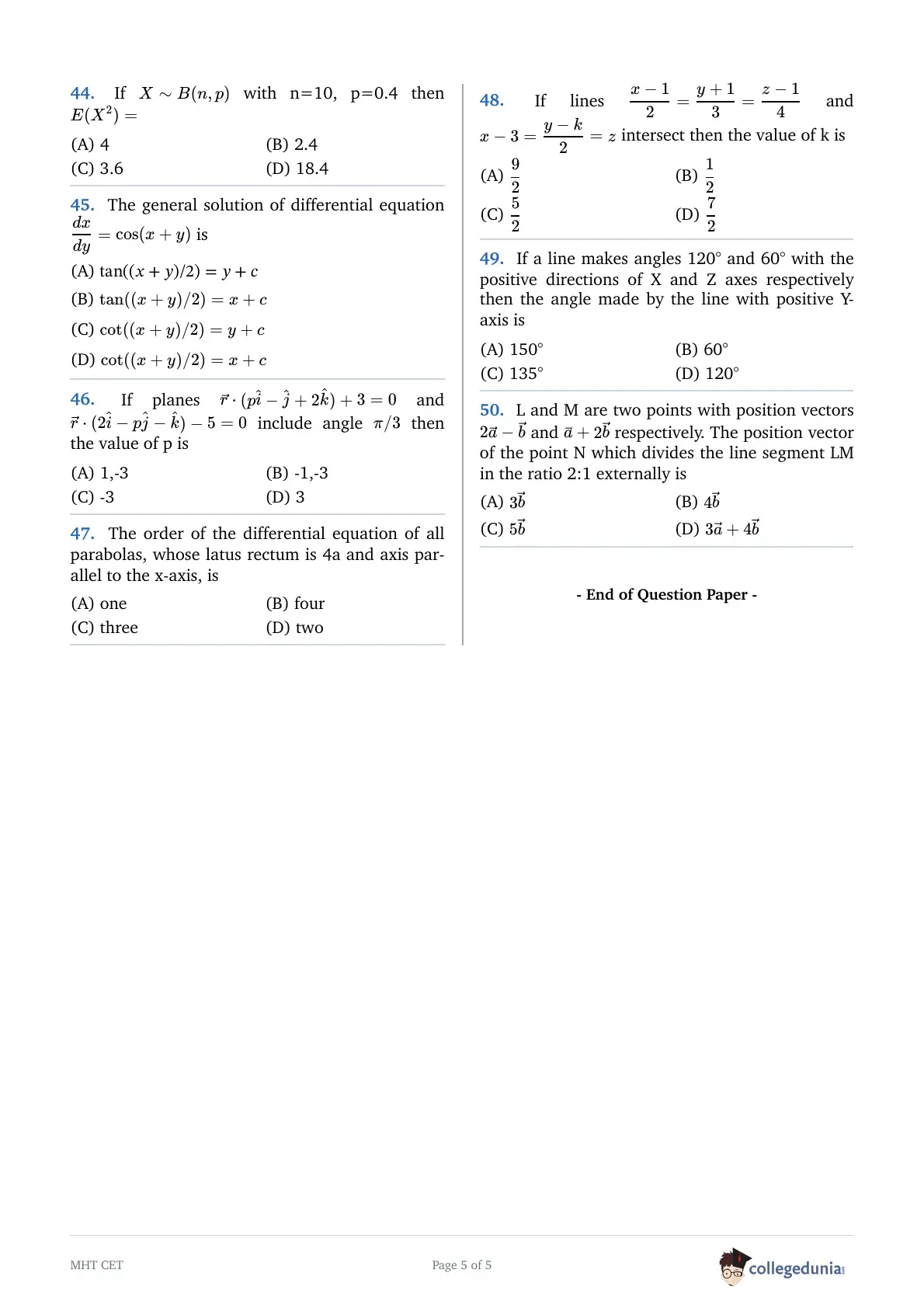
If \(X\sim B(n,p)\) with n=10, p=0.4 then \(E(X^2)=\)
The general solution of differential equation dx/dy=cos(x+y) is
If planes \(\vec{r}\cdot(p\hat{i}-\hat{j}+2\hat{k})+3=0\) and \(\vec{r}\cdot(2\hat{i}-p\hat{j}-\hat{k})-5=0\) include angle \(\pi/3\) then the value of p is
The order of the differential equation of all parabolas, whose latus rectum is 4a and axis parallel to the x-axis, is
If lines (x-1)/2=(y+1)/3=(z-1)/4 and x-3=(y-k)/2=z intersect then the value of k is
If a line makes angles 120° and 60° with the positive directions of X and Z axes respectively then the angle made by the line with positive Y-axis is
L and M are two points with position vectors \(2\vec{a}-\vec{b}\) and \(\vec{a}+2\vec{b}\) respectively. The position vector of the point N which divides the line segment LM in the ratio 2:1 externally is



Comments