




MHT CET 2018 Physics and Chemistry Question Paper is available for download here. Maharashtra State CET Cell conducted MHT CET 2018 on 10 May 2018.
The MHT CET 2018 Physics and Chemistry Question Paper includes the following:
- The MHT CET 2018 Physics and Chemistry paper consists of 100 multiple-choice questions (MCQs) totalling 100 marks: Physics (50 questions) and Chemistry (50 questions).
- The time allowed is 90 minutes.
MHT CET 2018 Physics and Chemistry Question Paper with Solution PDF
| CD PDF | CD PDF with Solutions |
|---|---|
| Download Collegedunia PDF 0.93 MB | - |
Also Check:
MHT CET 2018 Physics and Chemistry Questions with Solutions
Physics (Q1 - Q50)
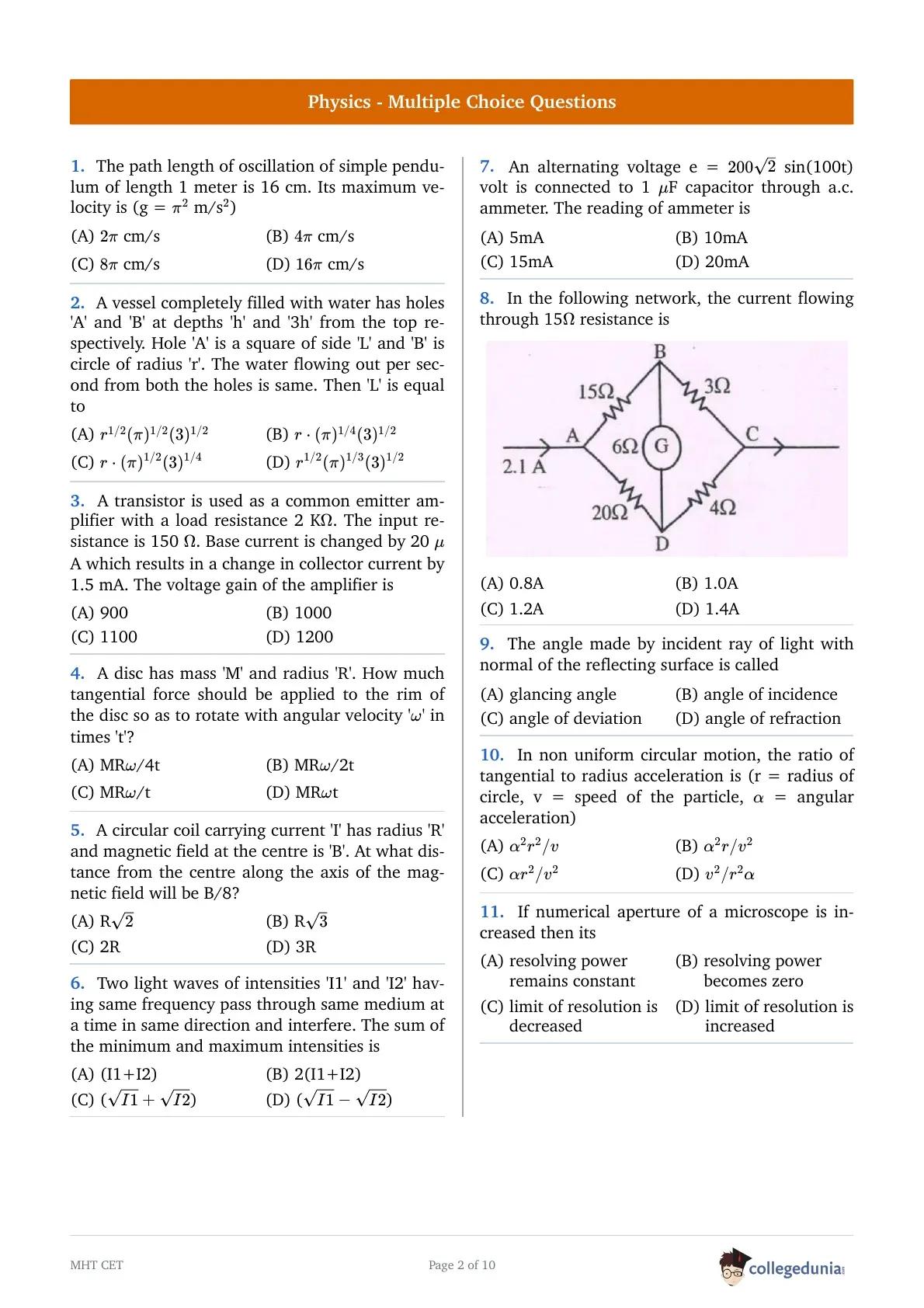
The path length of oscillation of simple pendulum of length 1 metre is 16 cm. Its maximum velocity is \((g = \pi^2 \, m/s^2)\)
A vessel completely filled with water has holes 'A' and 'B' at depths 'h' and '3h' from the top respectively. Hole 'A' is a square of side 'L' and 'B' is circle of radius 'r'. The water flowing out per second from both the holes is same. Then 'L' is equal to
A transistor is used as a common emitter amplifier with a load resistance 2 K\(\Omega\). the input resistance is 150 \(\Omega\). Base current is changed by 20 \(\mu\)A which results in a change in collector current by \(1.5\, mA\). The voltage gain of the amplifier is
A disc has mass 'M' and radius 'R' . How much tangential force should be applied to the rim of the disc so as to rotate with angular velocity \('\omega '\) in time 't' ?
A circular coil carrying current 'I' has radius 'R' and magnetic field at the centre is 'B' . At what distance from the centre along the axis of the same coil, the magnetic field will be \(\frac{B}{8}\) ?
Two light waves of intensities \('I_1'\) and \('I_2'\) having same frequency pass through same medium at a time in same direction and interfere. The sum of the minimum and maximum intensities is
An alternating voltage e = \(200\sqrt{2}\) sin(100t) volt is connected to 1 \(\mu\)F capacitor through a.c. ammeter. The reading of ammeter is
In the following network, the current flowing through 15\(\Omega\) resistance is [Wheatstone-bridge-style circuit: input 2.1A at node A; branch A-B has 15\(\Omega\), branch B-C has 3\(\Omega\); branch A-D has 20\(\Omega\), branch D-C has 4\(\Omega\); a galvanometer G is connected via a 6\(\Omega\) branch between the A-C diagonal; output at node C]
The angle made by incident ray of light with the reflecting surface is called
In non uniform circular motion, the ratio of tangential to radial acceleration is (r = radius of circle, \(v =\) speed of the particle, \(\alpha =\) angular acceleration)
If numerical aperture of a microscope is increased then its
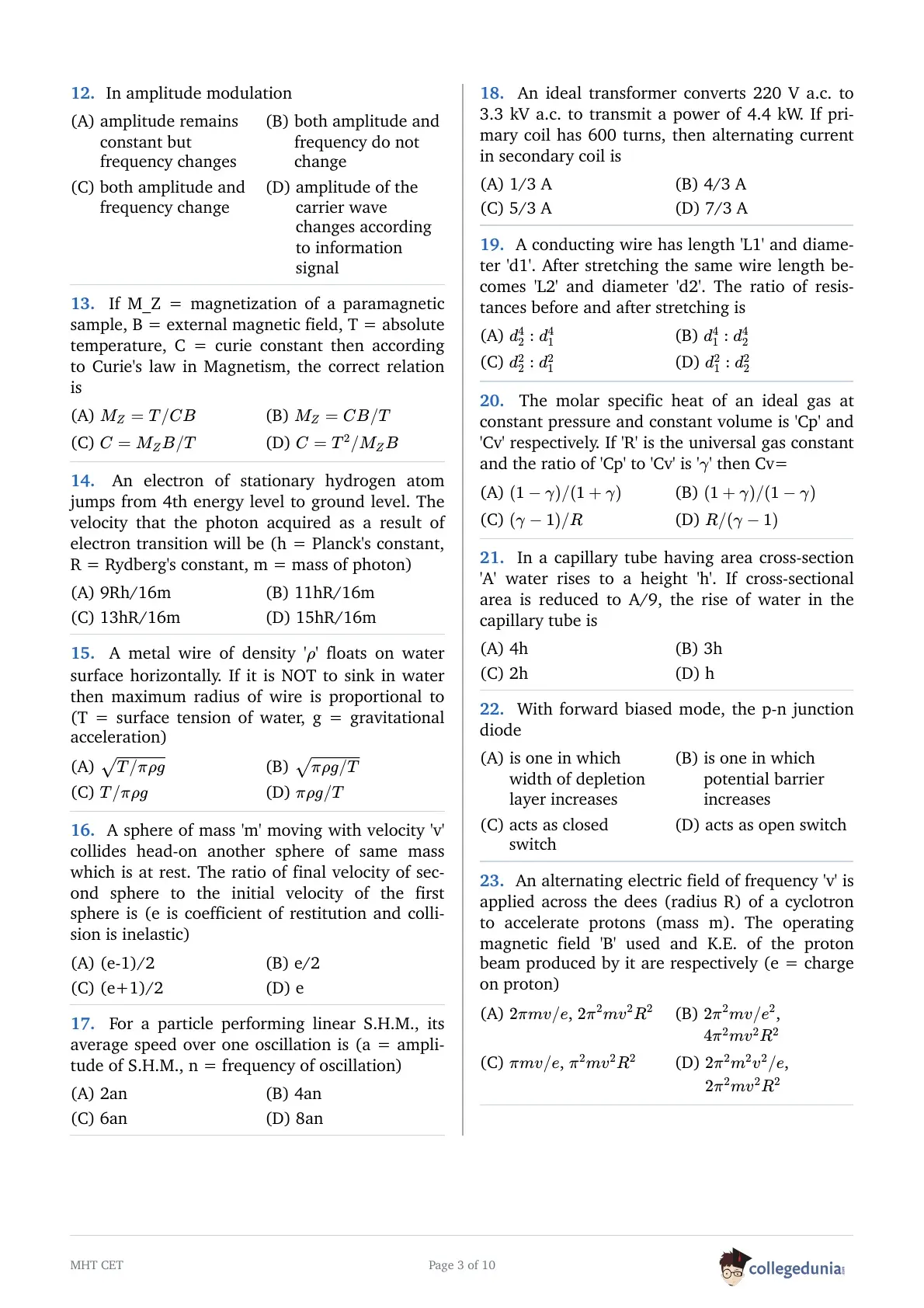
In amplitude modulation
If \(M_z\) = magnetization of a paramagnetic sample, \(B\) = external magnetic field, \(T\) = absolute temperature, \(C\) = curie constant then according to Curie�s law in magnetism, the correct relation is
An electron of stationary hydrogen atom jumps from 4th energy level to ground level. The velocity that the photon acquired as a result of electron transition will be (h = Planck's constant, R = Rydberg's constant, m = mass of photon)
A metal wire of density \('\rho'\) floats on water surface horizontally. If it is NOT to sink in water then maximum radius of wire is proportional to (T = surface tension of water, g = gravitational acceleration)
A sphere of mass 'm' moving with velocity 'v' collides head-on on another sphere of same mass which is at rest. The ratio of final velocity of second sphere to the initial velocity of the first sphere is (e is coefficient of restitution and collision is inelastic)
For a particle performing linear S.H.M., its average speed over one oscillation is (a = amplitude of S.H.M., n = frequency of oscillation)
An ideal transformer converts \(220\, V\) a.c. to \(3.3\, kV\) a.c. to transmit a power of \(4.4\, kW\). If primary coil has \(600\) turns, then alternating current in secondary coil is
A conducting wire has length 'L1' and diameter 'd1'. After stretching the same wire length becomes 'L2' and diameter 'd2'. The ratio of resistances before and after stretching is
The molar specific heat of an ideal gas at constant pressure and constant volume is 'Cp' and 'Cv' respectively. If 'R' is the universal gas constant and the ratio of 'Cp' to 'Cv' is '\(\gamma\)' then Cv=
In a capillary tube having area cross-section 'A' water rises to a height 'h'. If cross-sectional area is reduced to A/9, the rise of water in the capillary tube is
With forward biased mode, the p-n junction diode
An alternating electric field of frequency 'v' is applied across the dees (radius R) of a cyclotron to accelerate protons (mass m). The operating magnetic field 'B' used and K.E. of the proton beam produced by it are respectively (e = charge on proton)
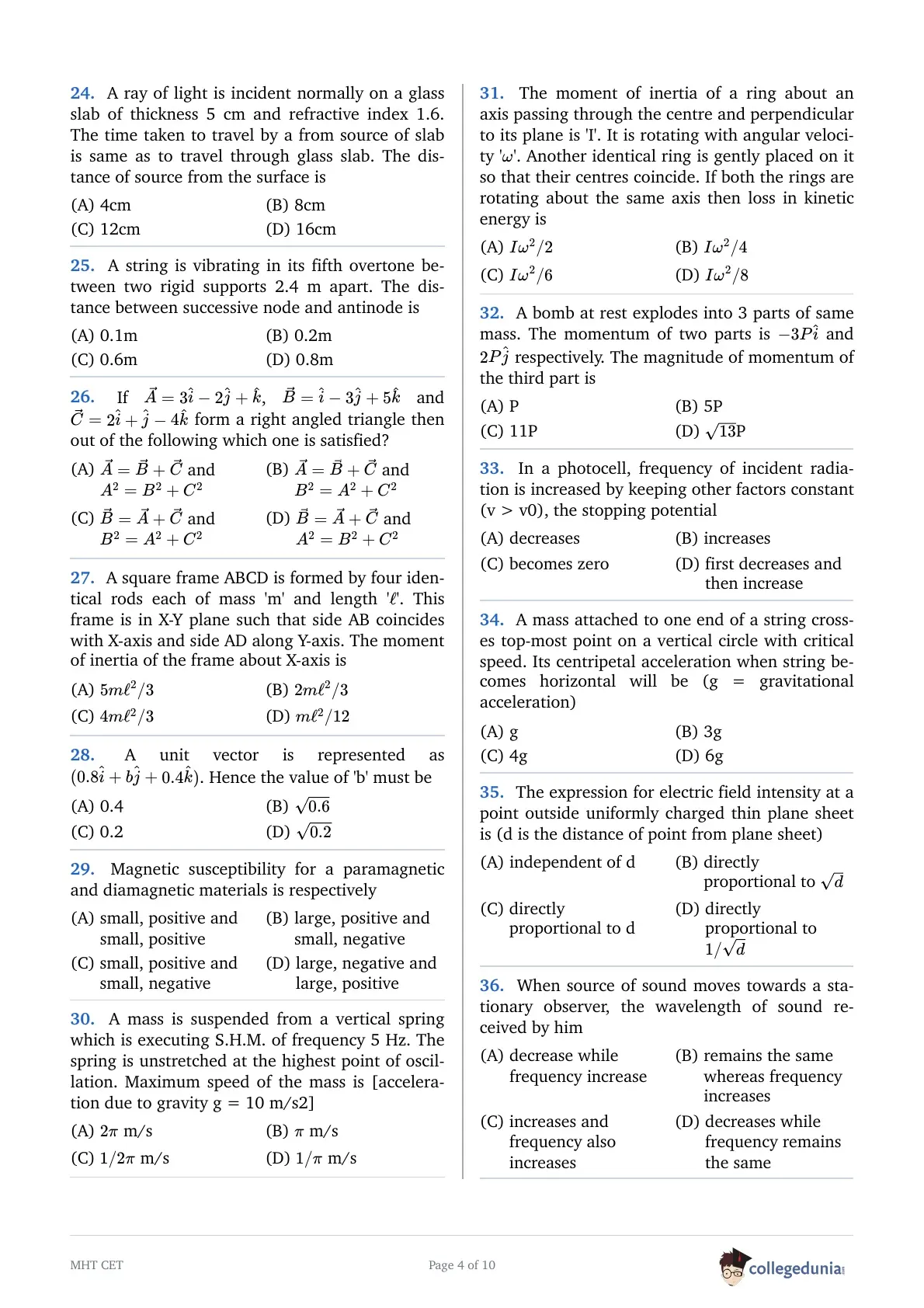
A ray of light is incident normally on a glass slab of thickness \(5\, cm\) and refractive index 1.6. The time taken to travel by a ray from source to surface of slab is same as to travel through glass slab. The distance of source from the surface is
A string is vibrating in its fifth overtone between two rigid supports 2.4 m apart. The distance between successive node and antinode is
If \(\vec{A}=3\hat{i}-2\hat{j}+\hat{k}\), \(\vec{B}=\hat{i}-3\hat{j}+5\hat{k}\) and \(\vec{C}=2\hat{i}+\hat{j}-4\hat{k}\) form a right angled triangle then out of the following which one is satisfied?
A square frame \(ABCD\) is formed by four identical rods each of mass 'm' and length 'l' This frame is in \(XY\) -plane such that side \(AB\) coincides with \(X\)-axis and side \(AD\) along \(Y\)-axis. The moment of inertia of the frame about \(X\)-axis is
A unit vector is represented as \((0.8\hat{i}+b\hat{j}+0.4\hat{k})\). Hence the value of 'b' must be
Magnetic susceptibility for a paramagnetic and diamagnetic materials is respectively
A mass is suspended from a vertical spring which is executing S.H.M. of frequency 5 Hz. The spring is unstretched at the highest point of oscillation. Maximum speed of the mass is [acceleration due to gravity g = 10 m/s2]
The moment of inertia of a ring about an axis passing through the centre and perpendicular to its plane is 'I'. It is rotating with angular velocity '\(\omega\)'. Another identical ring is gently placed on it so that their centres coincide. If both the rings are rotating about the same axis then loss in kinetic energy is
A bomb at rest explodes into 3 parts of same mass. The momentum of two parts is \(-3P\hat{i}\) and \(2P\hat{j}\) respectively. The magnitude of momentum of the third part is
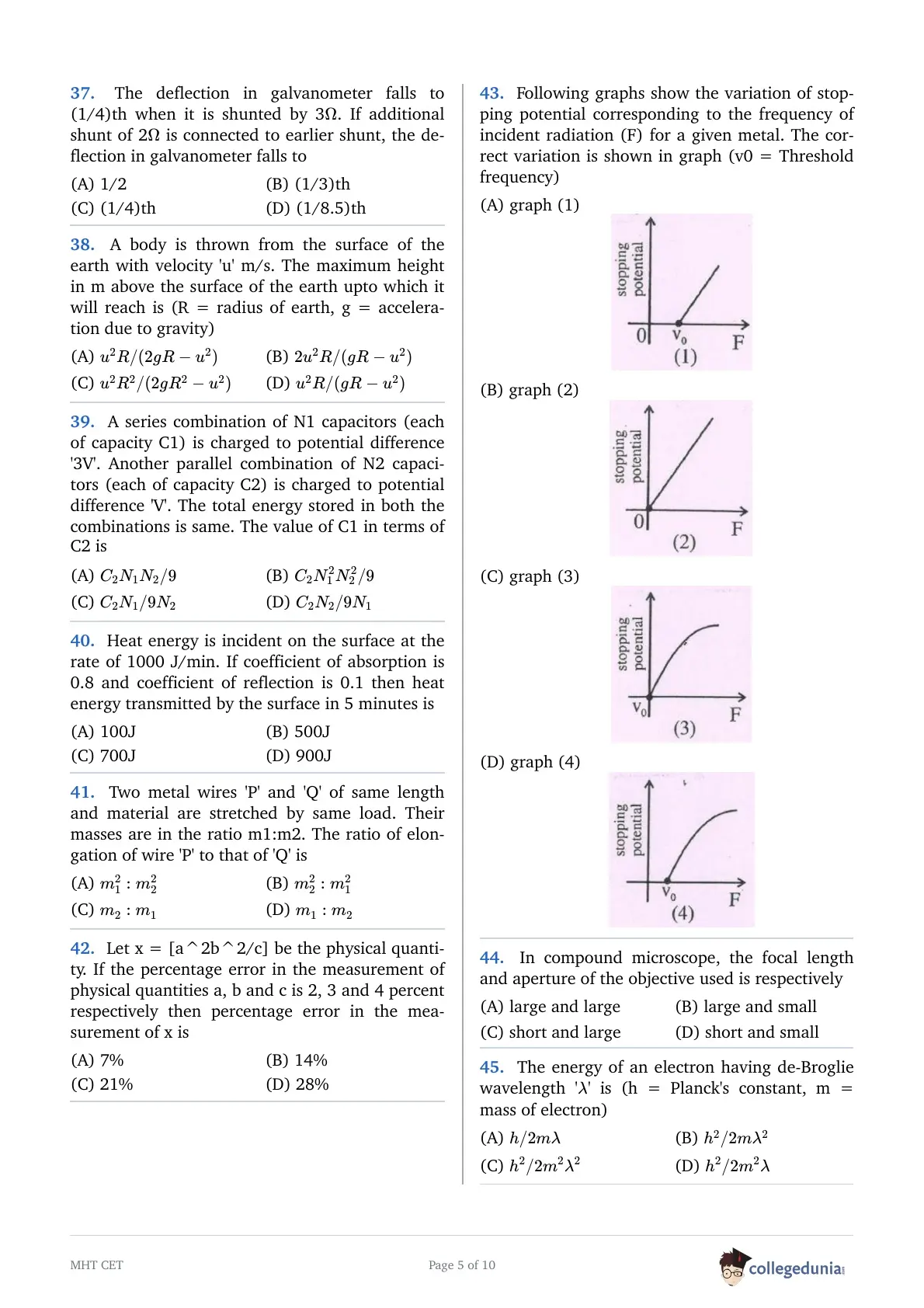
In a photocell, frequency of incident radiation is increased by keeping other factors constant (v > v0), the stopping potential
A mass attached to one end of a string crosses top-most point on a vertical circle with critical speed. Its centripetal acceleration when string becomes horizontal will be (g = gravitational acceleration)
The expression for electric field intensity at a point outside uniformly charged thin plane sheet is (d is the distance of point from plane sheet)
When source of sound moves towards a stationary observer, the wavelength of sound received by him
The deflection in galvanometer falls to (1/4)th when it is shunted by 3\(\Omega\). If additional shunt of 2\(\Omega\) is connected to earlier shunt, the deflection in galvanometer falls to
A body is thrown from the surface of the earth with velocity 'u' m/s. The maximum height in m above the surface of the earth upto which it will reach is (R = radius of earth, g = acceleration due to gravity)
A series combination of N1 capacitors (each of capacity C1) is charged to potential difference '3V'. Another parallel combination of N2 capacitors (each of capacity C2) is charged to potential difference 'V'. The total energy stored in both the combinations is same. The value of C1 in terms of C2 is
Heat energy is incident on the surface at the rate of 1000 J/min. If coefficient of absorption is 0.8 and coefficient of reflection is 0.1 then heat energy transmitted by the surface in 5 minutes is
Two metal wires 'P' and 'Q' of same length and material are stretched by same load. Their masses are in the ratio m1:m2. The ratio of elongation of wire 'P' to that of 'Q' is
Let x = [a^2b^2/c] be the physical quantity. If the percentage error in the measurement of physical quantities a, b and c is 2, 3 and 4 percent respectively then percentage error in the measurement of x is
In compound microscope, the focal length and aperture of the objective used is respectively
The energy of an electron having de-Broglie wavelength '\(\lambda\)' is (h = Planck's constant, m = mass of electron)
'n' number of waves are produced on a string in 0.5 second. Now the tension in the string is doubled (Assume length and radius constant), the number of waves produced in 0.5 second for the same harmonic will be
The increase in energy of a metal bar of length 'L' and cross-sectional area 'A' when compressed with a load 'M' along its length is (Y = Young�s modulus of the material of metal bar)
The ratio of magnetic fields due to a bar magnet at the two axial points \(P_1\) and \(P_2\) which are separated from each other by \(10 \,cm\) is 25 : 2. Point \(P_1\) is situated at 10 cm from the centre of the magnet. Magnetic length of the bar magnet is (Points \(P_1\) and \(P_2\) are on the same side of magnet and distance of \(P_2\) from the centre is greater than distance of \(P_1\) from the centre of magnet)
A satellite is revolving in a circular orbit at a height 'h' above the surface of the earth of radius 'R'. The speed of the satellite in its orbit is one-fourth the escape velocity from the surface of the earth. The relation between 'h' and 'R' is
A pipe closed at one end has length 83 cm. The number of possible natural oscillations of air column whose frequencies lie below 1000 Hz are (velocity of sound in air = 332 m/s)
Chemistry (Q51 - Q100)
A certain reaction occurs in two steps as i) \(\ce{2SO_{2(g)} + 2NO_{2(g)} -> 2SO_{3(g)} + 2NO_{(g)} }\) ii) \(\ce{2NO_{(g)} + O_2(g) -> 2NO_{2(g)}}\) In the reaction,
Which among the following equations represents the first law of thermodynamics under isobaric conditions ?
During galvanization of iron, which metal is used for coating iron surface ?
Formation of \(\ce{PCl_3}\) is explained on the basis of what hybridisation of phosphorus atom
Identify the element that forms amphoteric oxide.
Identify the product 'C' in the following reaction. \(\ce{Aniline ->[(CH_3 CO)_2 O][Pyridine] A ->[Br_2][CH_3COOH] B ->[H^{+} or \, OH^{-}] C }\)
Identify the functional group that has electron donating inductive effect
Which among the following metals crystallise as a simple cube ?
Which among the following oxoacids of phosphorus shows a tendency of disproportionation?
What is the oxidation number of gold in the complex \({[AuCl_4]^{1-}}\) ?
Which symbol replaces the unit of atomic mass, amu?
Which of the following compounds reacts immediately with Lucas reagent?
What is the catalyst used for oxidation of \(\ce{SO_2}\) to \(\ce{SO_3}\) in lead chamber process for manufacture of sulphuric acid?
The number of moles of electrons passed when current of 2 A is passed through a solution of electrolyte for 20 minutes is
The molarity of urea (molar mass \(\ce{60 \, g \, mol^{-1}}\)) solution by dissolving 15 g of urea in 500 \(cm^3\) of water is
Which carbon atom of deoxy Ribose sugar in DNA does NOT contain -C(OH)- bond?
Which of the following carboxylic acids is most reactive towards esterification?
Molarity is
Which of the following is a tricarboxylic acid?
What is the number of donar atoms in dimethylglyoximato ligand?
In which substance does nitrogen exhibit the lowest oxidation state?
Which of the following is most reactive towards addition reaction of hydrogen cyanide to form corresponding cyanohydrin?
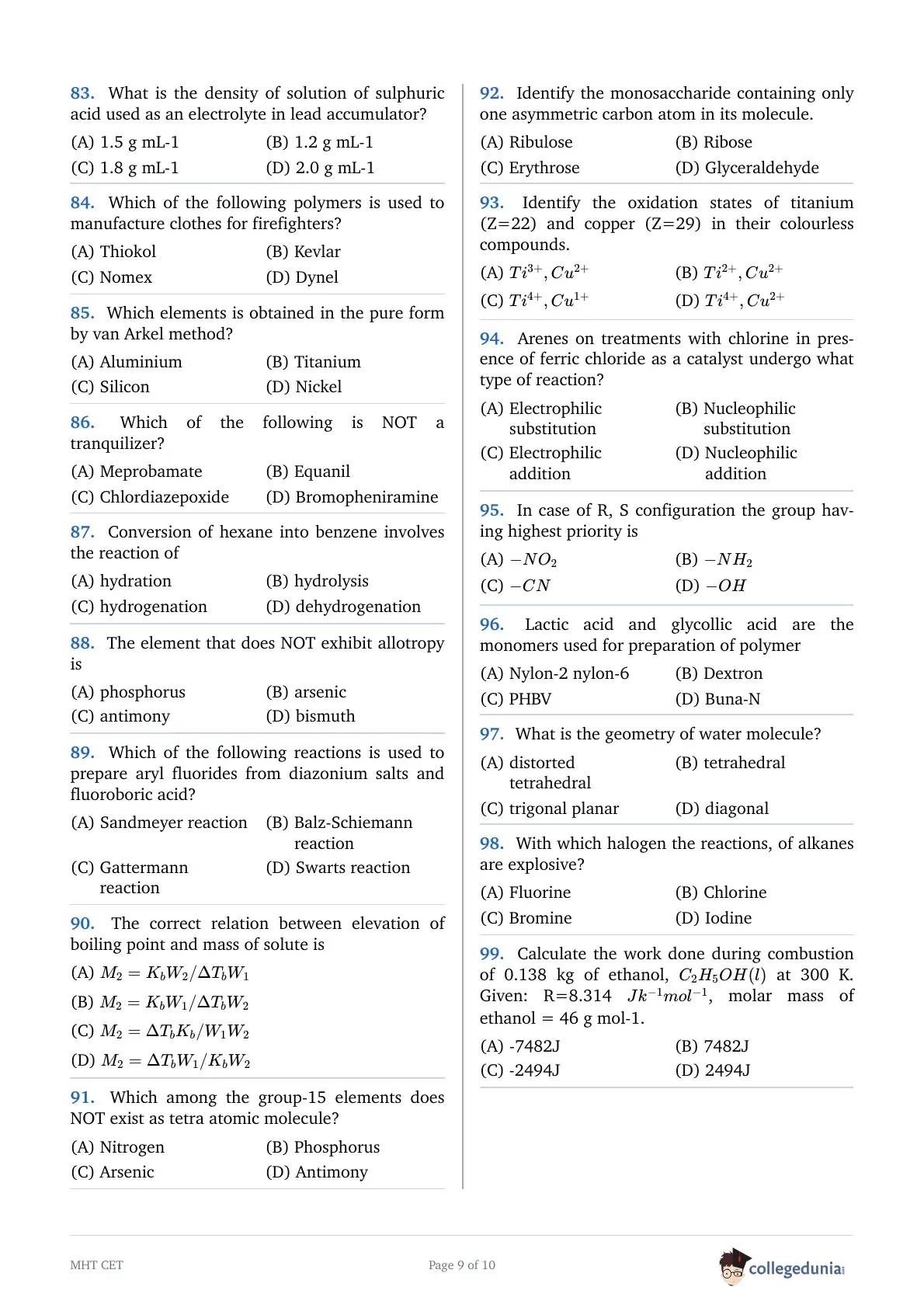
The most basic hydroxide from following is
What is the SI unit of density?
Which of the following compounds does NOT undergo haloform reaction?
Two moles of an ideal gas are allowed to expand from a volume of 10 \(dm^3\) to 2\(m^3\) at 300 K against a pressure of 101.325 KPa. Calculate the work done.
In which among the following solids, Schottky defect is NOT observed?
Bauxite, the ore of aluminium, is purified by which process?
Phenol in presence of sodium hydroxide reacts with chloroform to form salicylaldehyde. The reaction is known as
Which among the following elements of group-2 exhibits anomalous properties?
Excess of ammonia with sodium hypochloride solution in the presence of glue or gelatin gives
What is the density of solution of sulphuric acid used as an electrolyte in lead accumulator?
Which of the following polymers is used to manufacture clothes for firefighters?
Which elements is obtained in the pure form by van Arkel method?
Which of the following is NOT a tranquilizer?
Conversion of hexane into benzene involves the reaction of
The element that does NOT exhibit allotropy is
Which of the following reactions is used to prepare aryl fluorides from diazonium salts and fluoroboric acid?
The correct relation between elevation of boiling point and mass of solute is
Which among the group-15 elements does NOT exists as tetra atomic molecule?
Identify the monosaccharide containing only one asymmetric carbon atom in its molecule.
Identify the oxidation states of titanium (Z=22) and copper (Z=29) in their colourless compounds.
Arenes on treatments with chlorine in presence of ferric chloride as a catalyst undergo what type of reaction?
In case of R, S configuration the group having highest priority is
Lactic acid and glycollic acid are the monomers used for preparation of polymer
What is the geometry of water molecule?
With which halogen the reactions, of alkanes are explosive?
Calculate the work done during combustion of 0.138 kg of ethanol, \(C_2H_5OH(l)\) at 300 K. Given: R=8.314 \(Jk^{-1}mol^{-1}\), molar mass of ethanol = 46 g mol-1.
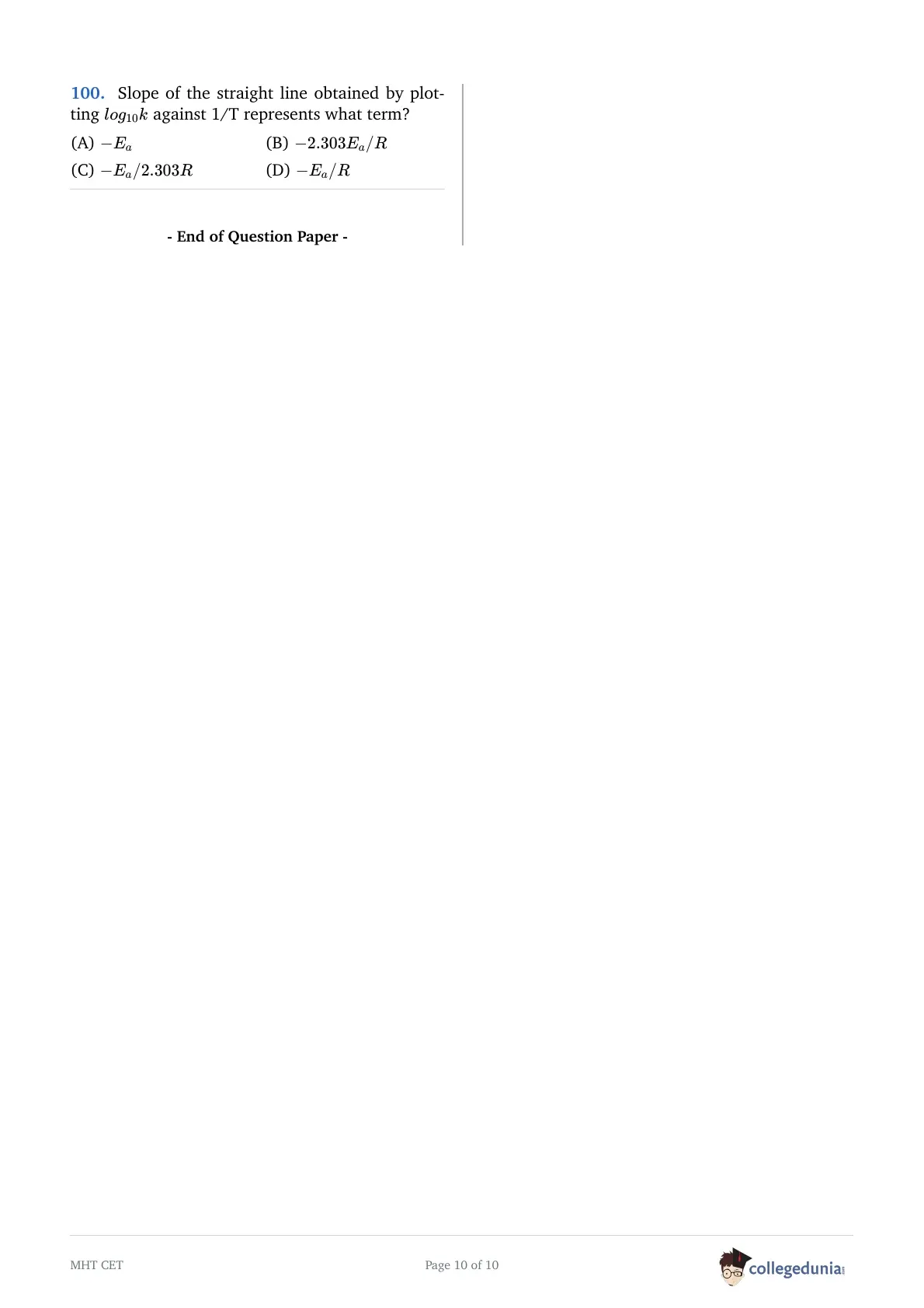
Slope of the straight line obtained by plotting \(log_{10}k\) against 1/T represents what term?



Comments