MHT CET 2019 May 2 Shift 1 PCM Question Paper is available for download here. Maharashtra State CET Cell conducted MHT CET 2019 PCM Exam on May 2 in Shift 1 from 9 AM to 12 PM in CBT mode.

The MHT CET 2019 PCM question paper includes the following:

  • The MHT CET 2019 PCM Question Paper consists of 150 multiple-choice questions (MCQs) totalling 200 marks divided into 3 sections: Physics, Chemistry, and Mathematics, with 50 questions in each subject.
  • Physics and Chemistry questions carry 1 mark each while Mathematics questions carry 2 marks each.
  • There is no negative marking for incorrect answers.

MHT CET 2019 May 2 Shift 1 PCM Question Paper with Solution PDF

CD PDF CD PDF with Solutions
Download Collegedunia PDF 0.80 MB -

Also Check:

MHT CET 2019 May 2 Shift 1 PCM Questions with Solutions


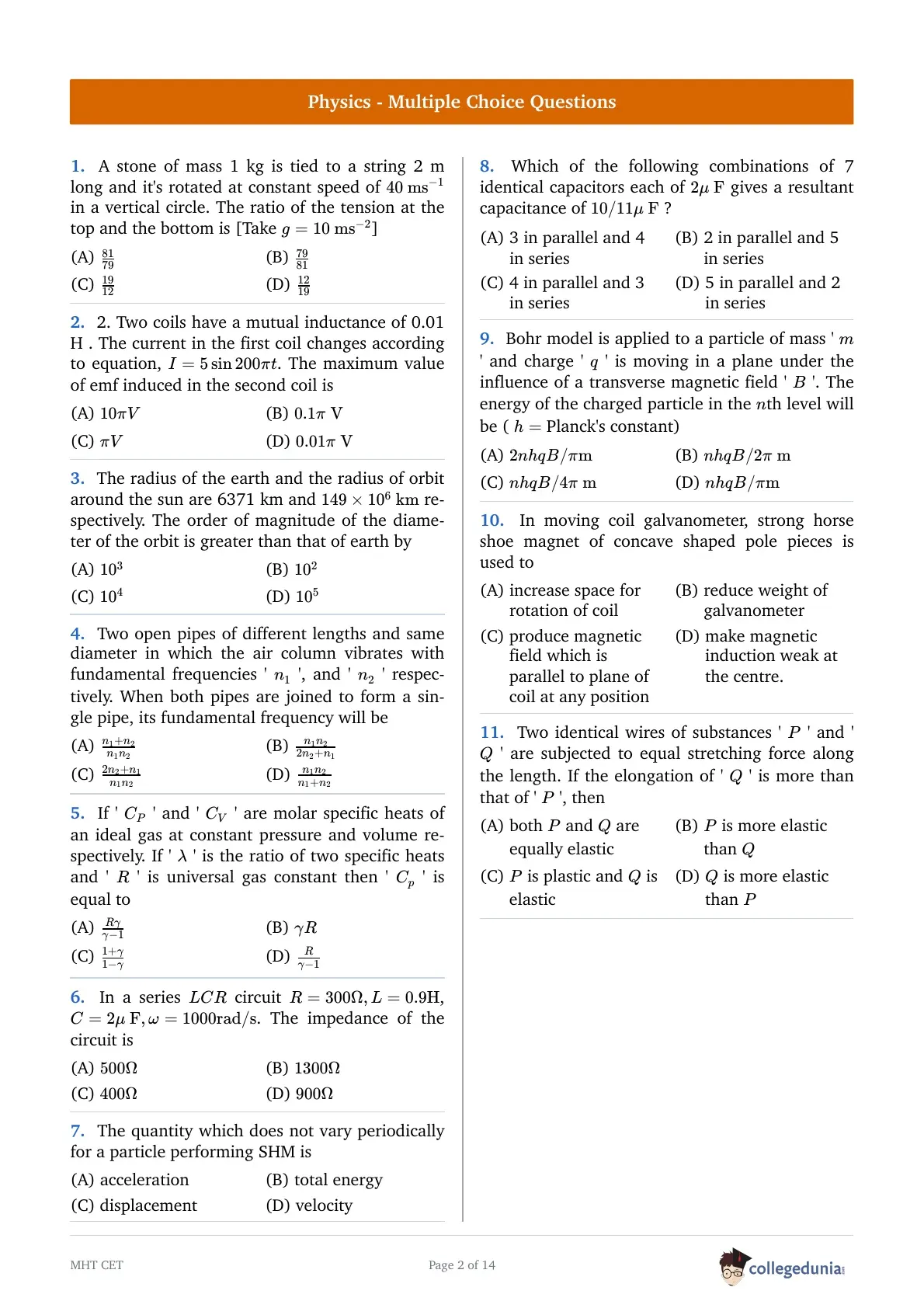
Physics (Q1 - Q50)

Question 1:

A stone of mass 1 kg is tied to a string 2 m long and it's rotated at constant speed of \(40 \mathrm{~ms}^{-1}\) in a vertical circle. The ratio of the tension at the top and the bottom is [Take \(g=10 \mathrm{~ms}^{-2}\)]

  • (A) \(\frac{81}{79}\)
  • (B) \(\frac{79}{81}\)
  • (C) \(\frac{19}{12}\)
  • (D) \(\frac{12}{19}\)

Question 2:

2. Two coils have a mutual inductance of 0.01 H . The current in the first coil changes according to equation, \(I=5 \sin 200 \pi t\). The maximum value of emf induced in the second coil is

  • (A) \(10\pi V\)
  • (B) \(0.1\pi \text{ }\mathrm{V}\)
  • (C) \(\pi V\)
  • (D) \(0.01\pi \text{ }\mathrm{V}\)

Question 3:

The radius of the earth and the radius of orbit around the sun are 6371 km and \(149 \times 10^6 \mathrm{~km}\) respectively. The order of magnitude of the diameter of the orbit is greater than that of earth by

  • (A) \(10^{3}\)
  • (B) \(10^{2}\)
  • (C) \(10^{4}\)
  • (D) \(10^{5}\)

Question 4:

Two open pipes of different lengths and same diameter in which the air column vibrates with fundamental frequencies ' \(n_1\) ', and ' \(n_2\) ' respectively. When both pipes are joined to form a single pipe, its fundamental frequency will be

  • (A) \(\frac{n_{1}+n_{2}}{n_{1}n_{2}}\)
  • (B) \(\frac{n_{1}n_{2}}{2n_{2}+n_{1}}\)
  • (C) \(\frac{2n_{2}+n_{1}}{n_{1}n_{2}}\)
  • (D) \(\frac{n_{1}n_{2}}{n_{1}+n_{2}}\)

Question 5:

If \('C_p'\) and \('C_v'\) are molar specific heats of an ideal gas at constant pressure and volume respectively. If \('\lambda'\) is the ratio of two specific heats and \('R'\) is universal gas constant then \('C_p'\) is equal to

  • (A) \(\frac{R\,\gamma}{\gamma-1}\)
  • (B) \(\gamma\,R\)
  • (C) \(\frac{1 +\gamma}{1-\gamma}\)
  • (D) \(\frac{R}{\gamma-1}\)

Question 6:

In a series \(L C R\) circuit \(R=300 \Omega, L=0.9 \mathrm{H}\), \(C=2 \mu \mathrm{~F}, \omega=1000 \mathrm{rad} / \mathrm{s}\). The impedance of the circuit is

  • (A) \(500\Omega\)
  • (B) \(1300\Omega\)
  • (C) \(400\Omega\)
  • (D) \(900\Omega\)

Question 7:

The quantity which does not vary periodically for a particle performing SHM is

  • (A) acceleration
  • (B) total energy
  • (C) displacement
  • (D) velocity

Question 8:

Which of the following combinations of 7 identical capacitors each of \(2 \mu \mathrm{~F}\) gives a resultant capacitance of \(10 / 11 \mu \mathrm{~F}\) ?

  • (A) 3 in parallel and 4 in series
  • (B) 2 in parallel and 5 in series
  • (C) 4 in parallel and 3 in series
  • (D) 5 in parallel and 2 in series

Question 9:

Bohr model is applied to a particle of mass \('m'\) and charge \('q'\) is moving in a plane under the influence of a transverse magnetic field \('B'\). The energy of the charged particle in the \(nth\) level will be (\(h =\) Planck's constant)

  • (A) \(2nhq\,B/\pi\, m\)
  • (B) \(nhq\,B/2\pi\, m\)
  • (C) \(nhq\,B/4\pi\, m\)
  • (D) \(nhq\,B/\pi\, m\)

Question 10:

In moving coil galvanometer, strong horse shoe magnet of concave shaped pole pieces is used to

  • (A) increase space for rotation of coil
  • (B) reduce weight of galvanometer
  • (C) produce magnetic field which is parallel to plane of coil at any position
  • (D) make magnetic induction weak at the centre

Question 11:

Two identical wires of substances ' \(P\) ' and ' \(Q\) ' are subjected to equal stretching force along the length. If the elongation of ' \(Q\) ' is more than that of ' \(P\) ', then

  • (A) both \(P\) and \(Q\) are equally elastic
  • (B) \(P\) is more elastic than \(Q\)
  • (C) \(P\) is plastic and \(Q\) is elastic
  • (D) \(Q\) is more elastic than \(P\)

Question 12:

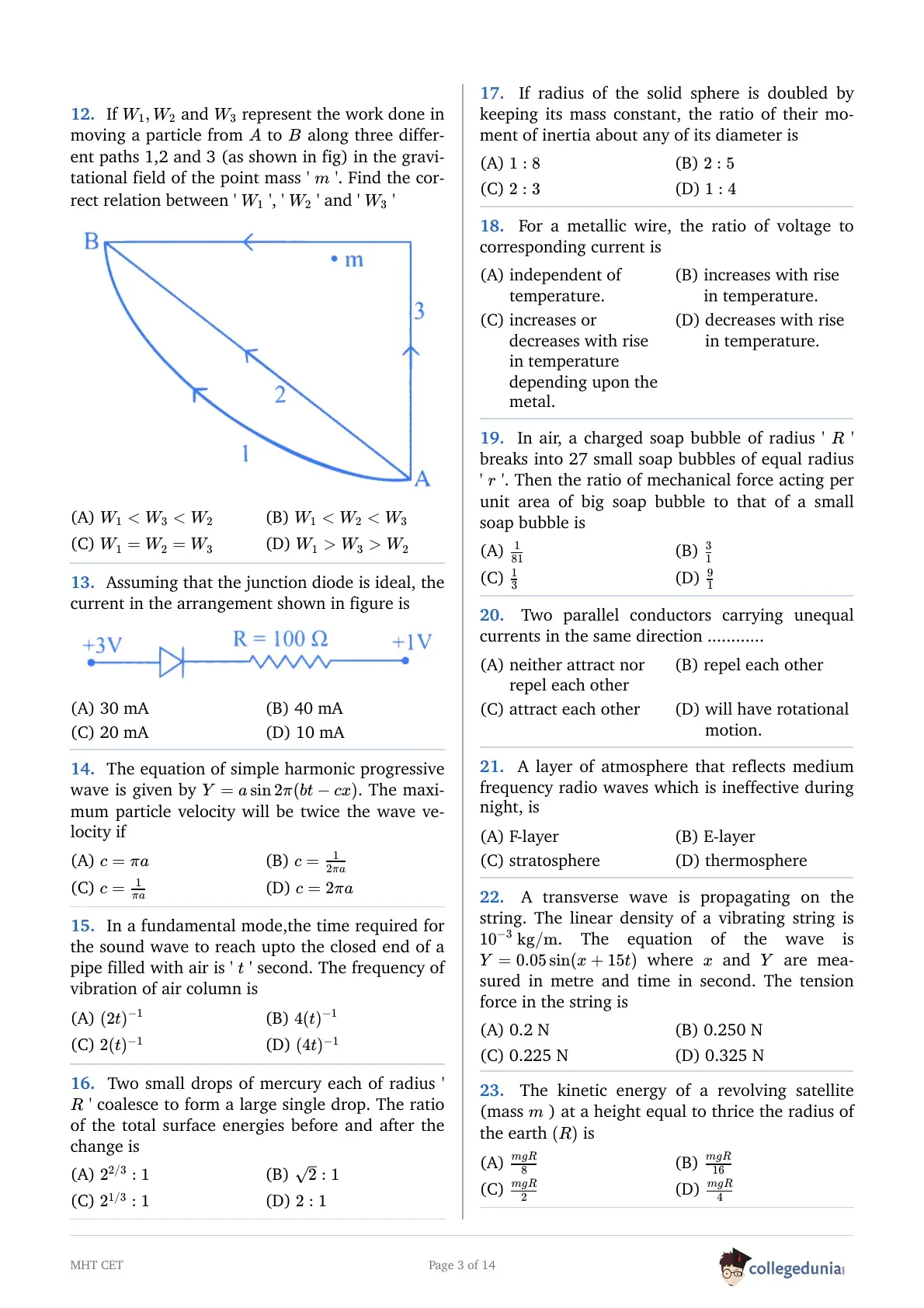
If \(W_1\), \(W_2\) and \(W_3\) represent the work done in moving a particle from \(A\) to \(B\) along three different paths \(1\), \(2\) and \(3\) (as shown in fig) in the gravitational field of the point mass \('m'\). Find the correct relation between \('W'_1\), \('W_2'\) and \('W_3'\)

  • (A) \(W_1 < W_3 < W_2\)
  • (B) \(W_1 < W_2 < W_3\)
  • (C) \(W_1 = W_2 = W_3\)
  • (D) \(W_1 > W_3 > W_2\)

Question 13:

Assuming that the junction diode is ideal, the current in the arrangement shown in figure is

  • (A) 30 mA
  • (B) 40 mA
  • (C) 20 mA
  • (D) 10 mA

Question 14:

The equation of simple harmonic progressive wave is given by \(Y=a \sin 2 \pi(b t-c x)\). The maximum particle velocity will be twice the wave velocity if

  • (A) \(c=\pi a\)
  • (B) \(c=\frac{1}{2\pi a}\)
  • (C) \(c=\frac{1}{\pi a}\)
  • (D) \(c=2\pi a\)

Question 15:

In a fundamental mode, the time required for the sound wave to reach upto the closed end of a pipe filled with air is \('t'\) second. The frequency of vibration of air column is

  • (A) \((2t)^{-1}\)
  • (B) \(4\,(t)^{-1}\)
  • (C) \(2(t)^{-1}\)
  • (D) \((4\,t)^{-1}\)

Question 16:

Two small drops of mercury, each of radius \(R\), coalesce to form a single large drop. The ratio of the total surface energies before and after the change is

  • (A) \(1 : 2^{1/3}\)
  • (B) \(2^{1/3}: 1\)
  • (C) \(2 : 1\)
  • (D) \(1 : 2\)

Question 17:

If radius of the solid sphere is doubled by keeping its mass constant, the ratio of their moment of inertia about any of its diameter is

  • (A) \(1:8\)
  • (B) \(2:5\)
  • (C) \(2:3\)
  • (D) \(1:4\)

Question 18:

For a metallic wire, the ratio of voltage to corresponding current is

  • (A) independent of temperature.
  • (B) increases with rise in temperature.
  • (C) increases or decreases with rise in temperature depending upon the metal.
  • (D) decreases with rise in temperature.

Question 20:

Two parallel conductors carrying unequal currents in the same direction ............

  • (A) neither attract nor repel each other
  • (B) repel each other
  • (C) attract each other
  • (D) will have rotational motion.

Question 21:

A layer of atmosphere that reflects medium frequency radio waves which is ineffective during night, is

  • (A) F-layer
  • (B) E-layer
  • (C) stratosphere
  • (D) thermosphere

Question 22:

A transverse wave is propagating on the string. The linear density of a vibrating string is \(10^{-3} \mathrm{~kg} / \mathrm{m}\). The equation of the wave is \(Y=0.05 \sin (x+15 t)\) where \(x\) and \(Y\) are measured in metre and time in second. The tension force in the string is

  • (A) 0.2 N
  • (B) 0.250 N
  • (C) 0.225 N
  • (D) 0.325 N

Question 23:

The kinetic energy of a revolving satellite (mass \(m\) ) at a height equal to thrice the radius of the earth \((R)\) is

  • (A) \(\frac{mgR}{8}\)
  • (B) \(\frac{mgR}{16}\)
  • (C) \(\frac{mgR}{2}\)
  • (D) \(\frac{mgR}{4}\)

Question 24:

A particle executes the simple harmonic motion with an amplitude \('A'\). The distance travelled by it in one periodic time is

  • (A) \(\frac{A}{2}\)
  • (B) \(A\)
  • (C) \(2A\)
  • (D) \(4A\)

Question 25:

A galvanometer has resistance of \(100\, \Omega\) and a current of \(10 \,mA\) produces full scale deflection in it. The resistance to be connected in series, to get a voltmeter of range \(50\) volt is

  • (A) \(3900\, \Omega\)
  • (B) \(4000\, \Omega\)
  • (C) \(4600\, \Omega\)
  • (D) \(4900\, \Omega\)

Question 26:

The angle made by orbital angular momentum of electron with the direction of the orbital magnetic moment is

  • (A) \(120^{\circ}\)
  • (B) \(60^{\circ}\)
  • (C) \(180^{\circ}\)
  • (D) \(90^{\circ}\)

Question 27:

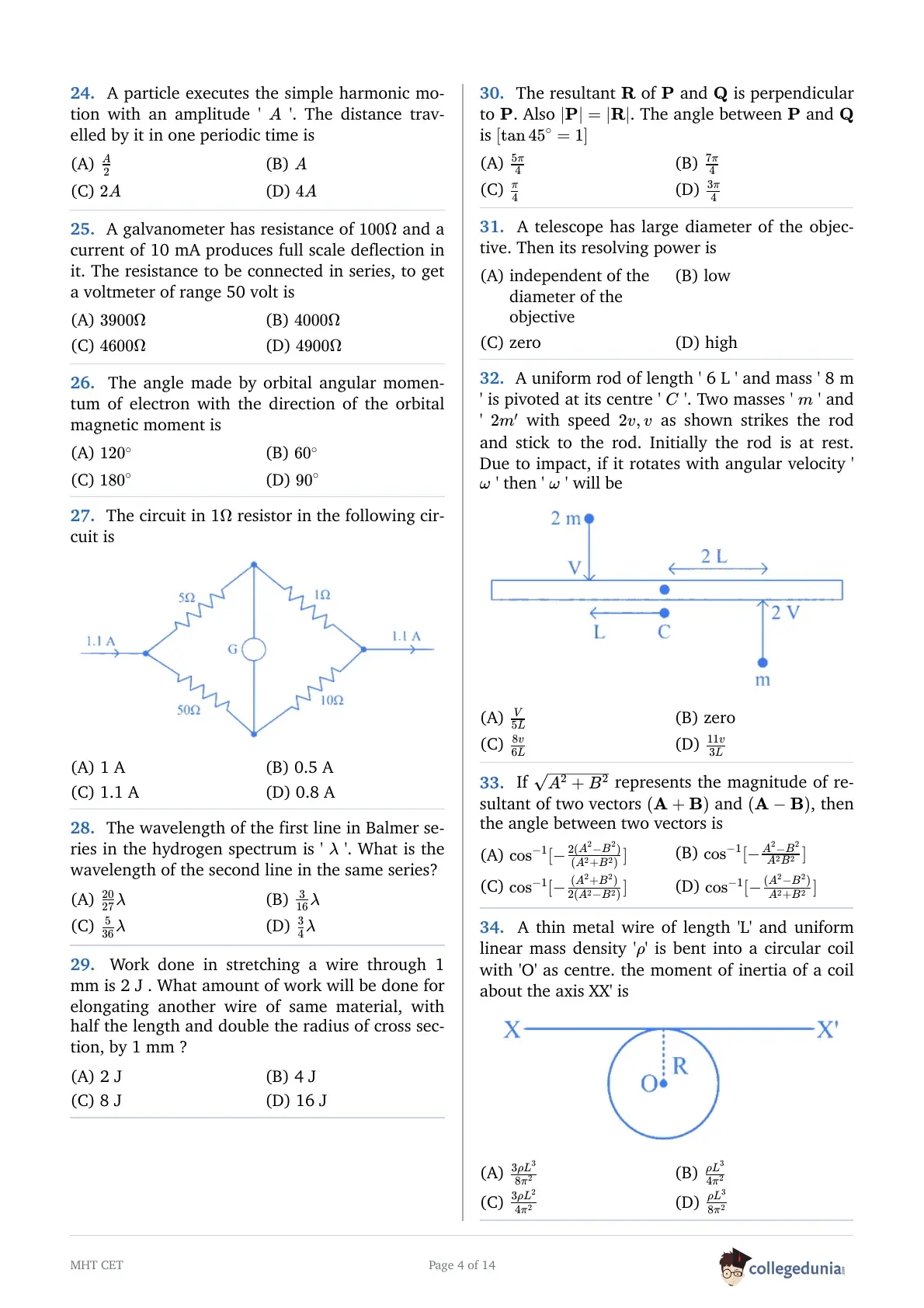
The circuit in 1\[\Omega\] resistor in the following circuit is

  • (A) 1 A
  • (B) 0.5 A
  • (C) 1.1 A
  • (D) 0.8 A

Question 28:

The wavelength of the first line in Balmer series in the hydrogen spectrum is ' \(\lambda\) '. What is the wavelength of the second line in the same series?

  • (A) \(\frac{20}{27}\lambda\)
  • (B) \(\frac{3}{16}\lambda\)
  • (C) \(\frac{5}{36}\lambda\)
  • (D) \(\frac{3}{4}\lambda\)

Question 29:

Work done in stretching a wire through 1 mm is 2 J . What amount of work will be done for elongating another wire of same material, with half the length and double the radius of cross section, by 1 mm ?

  • (A) 2 J
  • (B) 4 J
  • (C) 8 J
  • (D) 16 J

Question 30:

The resultant \(\mathbf{R}\) of \(\mathbf{P}\) and \(\mathbf{Q}\) is perpendicular to \(\mathbf{P}\). Also \(|\mathbf{P}|=|\mathbf{R}|\). The angle between \(\mathbf{P}\) and \(\mathbf{Q}\) is \(\left[\tan 45^{\circ}=1\right]\)

  • (A) \(\frac{5\pi}{4}\)
  • (B) \(\frac{7\pi}{4}\)
  • (C) \(\frac{\pi}{4}\)
  • (D) \(\frac{3\pi}{4}\)

Question 31:

A telescope has large diameter of the objective. Then its resolving power is

  • (A) independent of the diameter of the objective
  • (B) low
  • (C) zero
  • (D) high

Question 32:

A uniform rod of length \('6L'\) and mass \('8 \,m'\) is pivoted at its centre \('C'\). Two masses \('m'\) and \('2m'\) with speed \(2v\), \(v\) as shown strikes the rod and stick to the rod. Initially the rod is at rest. Due to impact, if it rotates with angular velocity \('\omega'\) then \('\omega'\) will be

  • (A) \(\frac{v}{5L}\)
  • (B) zero
  • (C) \(\frac{8v}{6L}\)
  • (D) \(\frac{11v}{3L}\)

Question 33:

If \(\sqrt{A^{2}+B^{2}}\) represents the magnitude of resultant of two vectors \((A + B)\) and \((A - B)\), then the angle between two vectors is

  • (A) \(cos^{-1}\left[-\frac{2\left(A^{2}-B^{2}\right)}{\left(A^{2}+B^{2}\right)}\right]\)
  • (B) \(cos^{-1}\left[-\frac{A^{2}-B^{2}}{A^{2}\,B^{2}}\right]\)
  • (C) \(cos^{-1}\left[-\frac{\left(A^{2}+B^{2}\right)}{2\left(A^{2}-B^{2}\right)}\right]\)
  • (D) \(cos^{-1}\left[-\frac{\left(A^{2}-B^{2}\right)}{A^{2}+B^{2}}\right]\)

Question 34:

A thin metal wire of length \('L'\) and uniform linear mass density \('\rho'\) is bent into a circular coil with \('O'\) as centre. The moment of inertia of a coil about the axis \(XX'\) is

  • (A) \(\frac{3\rho L^{3}}{8\pi^{2}}\)
  • (B) \(\frac{\rho L^{3}}{4\pi^{2}}\)
  • (C) \(\frac{3\rho L^{2}}{4\pi^{2}}\)
  • (D) \(\frac{\rho L^{3}}{8\pi^{2}}\)

Question 35:

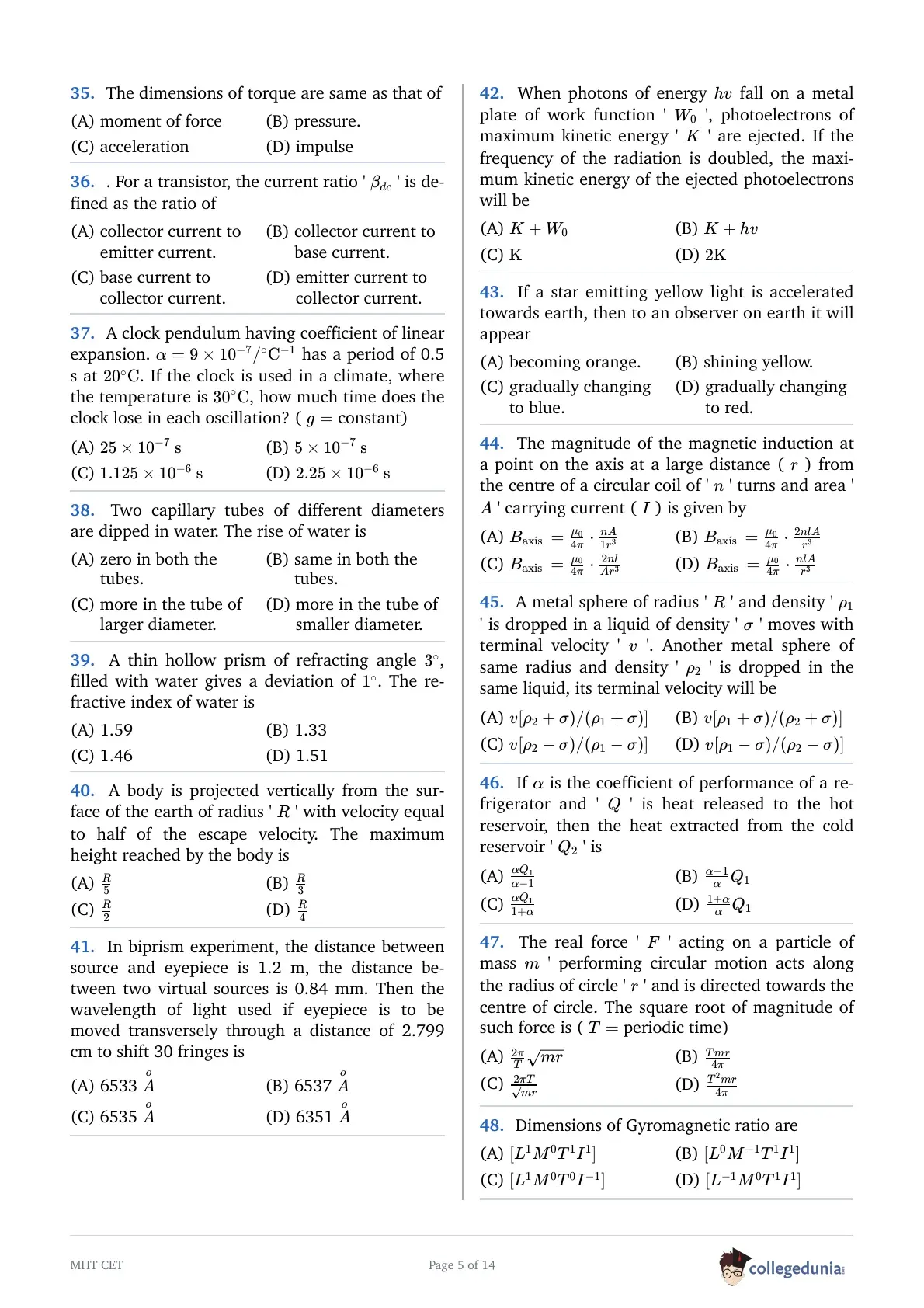
The dimensions of torque are same as that of

  • (A) moment of force
  • (B) pressure
  • (C) acceleration
  • (D) impulse

Question 36:

For a transistor, the current ratio \('\beta'_{dc}\) is defined as the ratio of

  • (A) collector current to emitter current
  • (B) collector current to base current
  • (C) base current to collector current
  • (D) emitter current to collector current

Question 37:

A clock pendulum having coefficient of linear expansion. \(\alpha=9 \times 10^{-7} /{ }^{\circ} \mathrm{C}^{-1}\) has a period of 0.5 s at \(20^{\circ} \mathrm{C}\). If the clock is used in a climate, where the temperature is \(30^{\circ} \mathrm{C}\), how much time does the clock lose in each oscillation? ( \(g=\) constant)

  • (A) \(25\times 10^{-7}\text{ }\mathrm{s}\)
  • (B) \(5\times 10^{-7}\text{ }\mathrm{s}\)
  • (C) \(1.125\times 10^{-6}\text{ }\mathrm{s}\)
  • (D) \(2.25\times 10^{-6}\text{ }\mathrm{s}\)

Question 38:

Two capillary tubes of different diameters are dipped in water. The rise of water is

  • (A) zero in both the tubes.
  • (B) same in both the tubes.
  • (C) more in the tube of larger diameter.
  • (D) more in the tube of smaller diameter.

Question 39:

A thin hollow prism of refracting angle \(3^{\circ}\), filled with water gives a deviation of \(1^{\circ}\). The refractive index of water is

  • (A) 1.59
  • (B) 1.33
  • (C) 1.46
  • (D) 1.51

Question 40:

A body is projected vertically from the surface of the earth of radius ' \(R\) ' with velocity equal to half of the escape velocity. The maximum height reached by the body is

  • (A) \(\frac{R}{5}\)
  • (B) \(\frac{R}{3}\)
  • (C) \(\frac{R}{2}\)
  • (D) \(\frac{R}{4}\)

Question 41:

In biprism experiment, the distance between source and eyepiece is 1.2 m, the distance between two virtual sources is 0.84 mm. Then the wavelength of light used if eyepiece is to be moved transversely through a distance of 2.799 cm to shift 30 fringes is

  • (A) 6533 \(\overset{o}{A}\)
  • (B) 6537 \(\overset{o}{A}\)
  • (C) 6535 \(\overset{o}{A}\)
  • (D) 6351 \(\overset{o}{A}\)

Question 42:

When photons of energy \(h v\) fall on a metal plate of work function ' \(W_0\) ', photoelectrons of maximum kinetic energy ' \(K\) ' are ejected. If the frequency of the radiation is doubled, the maximum kinetic energy of the ejected photoelectrons will be

  • (A) \(K+W_{0}\)
  • (B) \(K+hv\)
  • (C) \(\mathrm{K}\)
  • (D) \(2\mathrm{K}\)

Question 43:

If a star emitting yellow light is accelerated towards earth, then to an observer on earth it will appear

  • (A) becoming orange.
  • (B) shining yellow.
  • (C) gradually changing to blue.
  • (D) gradually changing to red.

Question 44:

The magnitude of the magnetic induction at a point on the axis at a large distance ( \(r\) ) from the centre of a circular coil of ' \(n\) ' turns and area ' \(A\) ' carrying current ( \(I\) ) is given by

  • (A) \(B_{\text{axis }}=\frac{\mu _{0}}{4\pi}\cdot \frac{nA}{1r^{3}}\)
  • (B) \(B_{\text{axis }}=\frac{\mu _{0}}{4\pi}\cdot \frac{2nlA}{r^{3}}\)
  • (C) \(B_{\text{axis }}=\frac{\mu _{0}}{4\pi}\cdot \frac{2nl}{Ar^{3}}\)
  • (D) \(B_{\text{axis }}=\frac{\mu _{0}}{4\pi}\cdot \frac{nlA}{r^{3}}\)

Question 45:

A metal sphere of radius ' \(R\) ' and density ' \(\rho_1\) ' is dropped in a liquid of density ' \(\sigma\) ' moves with terminal velocity ' \(v\) '. Another metal sphere of same radius and density ' \(\rho_2\) ' is dropped in the same liquid, its terminal velocity will be

  • (A) \(v[\rho _{2}+\sigma )/(\rho _{1}+\sigma )]\)
  • (B) \(v[\rho _{1}+\sigma )/(\rho _{2}+\sigma )]\)
  • (C) \(v[\rho _{2}-\sigma )/(\rho _{1}-\sigma )]\)
  • (D) \(v[\rho _{1}-\sigma )/(\rho _{2}-\sigma )]\)

Question 46:

If \(\alpha\) is the coefficient of performance of a refrigerator and ' \(Q\) ' is heat released to the hot reservoir, then the heat extracted from the cold reservoir ' \(Q_2\) ' is

  • (A) \(\frac{\alpha Q_{1}}{\alpha -1}\)
  • (B) \(\frac{\alpha -1}{\alpha}Q_{1}\)
  • (C) \(\frac{\alpha Q_{1}}{1+\alpha}\)
  • (D) \(\frac{1+\alpha}{\alpha}Q_{1}\)

Question 47:

The real force ' \(F\) ' acting on a particle of mass \(m\) ' performing circular motion acts along the radius of circle ' \(r\) ' and is directed towards the centre of circle. The square root of magnitude of such force is ( \(T=\) periodic time)

  • (A) \(\frac{2\pi}{T}\sqrt{mr}\)
  • (B) \(\frac{Tmr}{4\pi}\)
  • (C) \(\frac{2\pi T}{\sqrt{mr}}\)
  • (D) \(\frac{T^{2}mr}{4\pi}\)

Question 48:

Dimensions of Gyromagnetic ratio are

  • (A) \([L^{1}M^{0}T^{1}I^{1}]\)
  • (B) \([L^{0}M^{-1}T^{1}I^{1}]\)
  • (C) \([L^{1}M^{0}T^{0}I^{-1}]\)
  • (D) \([L^{-1}M^{0}T^{1}I^{1}]\)

Question 49:

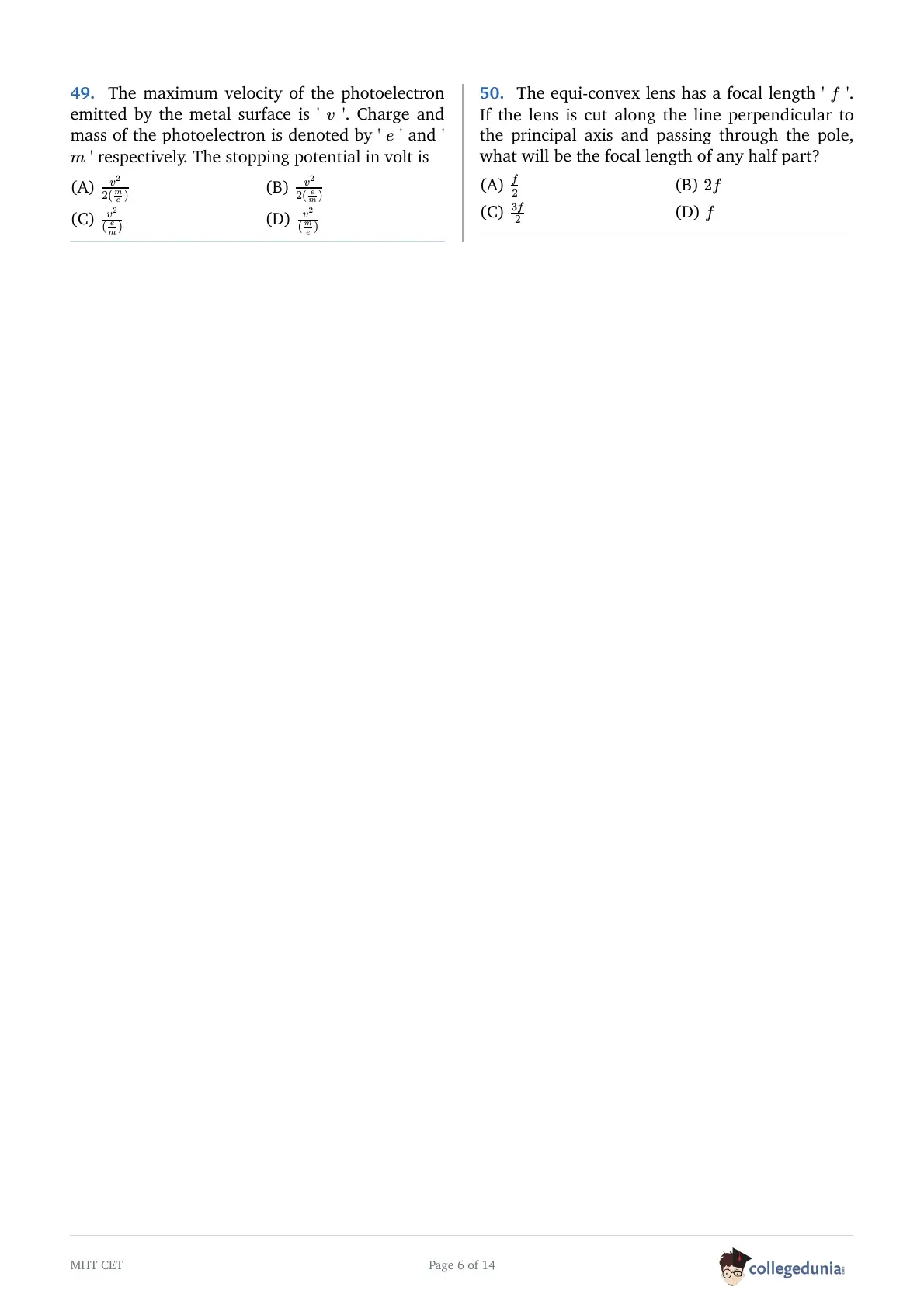
The maximum velocity of the photoelectron emitted by the metal surface is ' \(v\) '. Charge and mass of the photoelectron is denoted by ' \(e\) ' and ' \(m\) ' respectively. The stopping potential in volt is

  • (A) \(\frac{v^{2}}{2(\frac{m}{e})}\)
  • (B) \(\frac{v^{2}}{2(\frac{e}{m})}\)
  • (C) \(\frac{v^{2}}{(\frac{e}{m})}\)
  • (D) \(\frac{v^{2}}{(\frac{m}{e})}\)

Question 50:

The equi-convex lens has a focal length ' \(f\) '. If the lens is cut along the line perpendicular to the principal axis and passing through the pole, what will be the focal length of any half part?

  • (A) \(\frac{f}{2}\)
  • (B) \(2f\)
  • (C) \(\frac{3f}{2}\)
  • (D) \(f\)

Chemistry (Q51 - Q100)

Question 51:

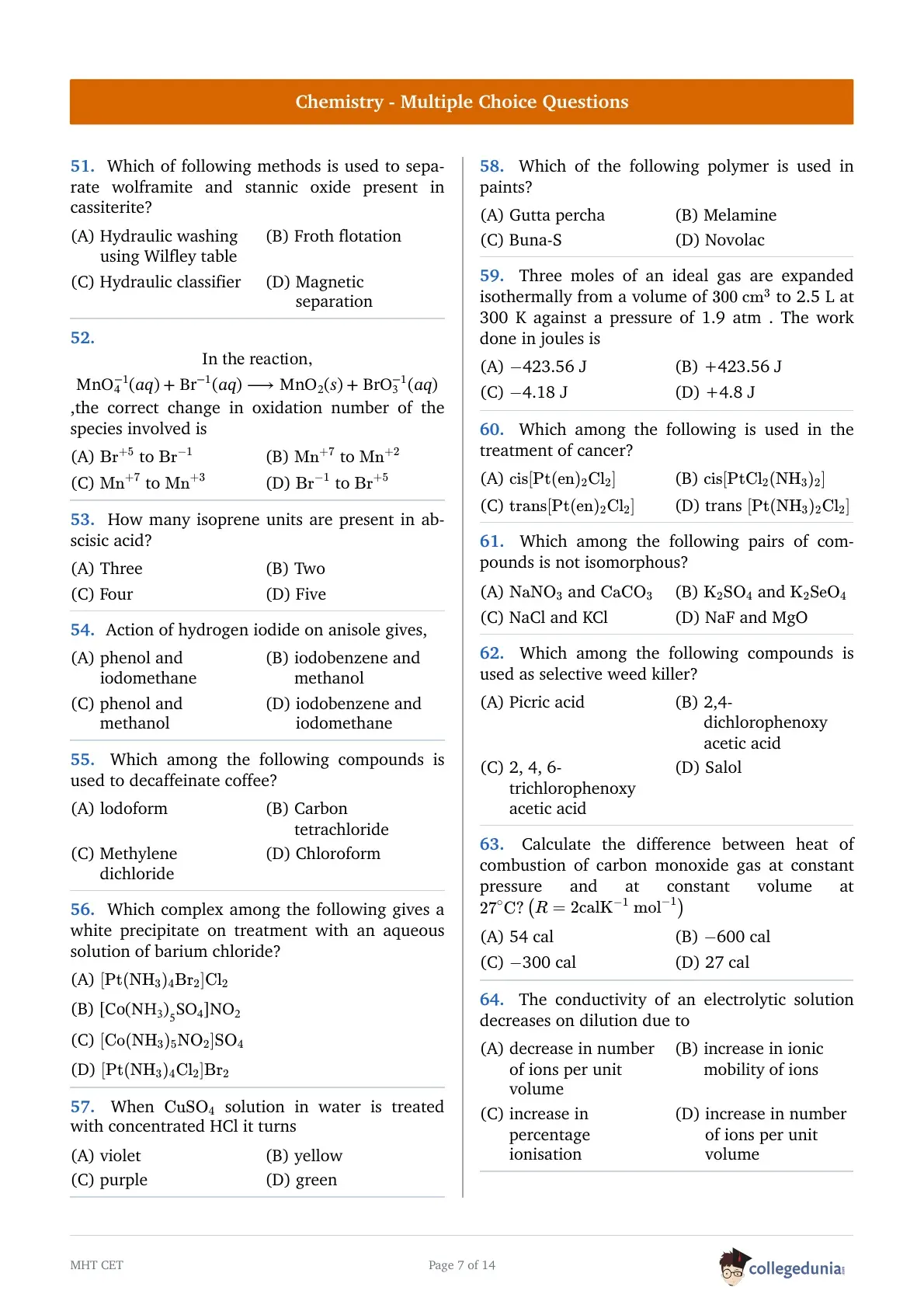
Which of following methods is used to separate wolframite and stannic oxide present in cassiterite?

  • (A) Hydraulic washing using Wilfley table
  • (B) Froth flotation
  • (C) Hydraulic classifier
  • (D) Magnetic separation

Question 52:

\[\begin{aligned} & \text { In the reaction, } \\ & \mathrm{MnO}_4^{-1}(a q)+\mathrm{Br}^{-1}(a q) \longrightarrow \mathrm{MnO}_2(s)+\mathrm{BrO}_3^{-1}(a q) \end{aligned}\]

,the correct change in oxidation number of the species involved is

  • (A) \(\mathrm{Br}^{+5}\) to \(\mathrm{Br}^{-1}\)
  • (B) \(\mathrm{Mn}^{+7}\) to \(\mathrm{Mn}^{+2}\)
  • (C) \(\mathrm{Mn}^{+7}\) to \(\mathrm{Mn}^{+3}\)
  • (D) \(\mathrm{Br}^{-1}\) to \(\mathrm{Br}^{+5}\)

Question 53:

How many isoprene units are present in abscisic acid?

  • (A) Three
  • (B) Two
  • (C) Four
  • (D) Five

Question 54:

Action of hydrogen iodide on anisole gives,

  • (A) phenol and iodomethane
  • (B) iodobenzene and methanol
  • (C) phenol and methanol
  • (D) iodobenzene and iodomethane

Question 55:

Which among the following compounds is used to decaffeinate coffee?

  • (A) lodoform
  • (B) Carbon tetrachloride
  • (C) Methylene dichloride
  • (D) Chloroform

Question 56:

Which complex among the following gives a white precipitate on treatment with an aqueous solution of barium chloride?

  • (A) \([\mathrm{Pt}(\mathrm{NH}_{3})_{4}\mathrm{Br}_{2}]\mathrm{Cl}_{2}\)
  • (B) \([\mathrm{Co}(\mathrm{NH}_{3})_{5}\mathrm{SO}_{4}]\mathrm{NO}_{2}\)
  • (C) \([\mathrm{Co}(\mathrm{NH}_{3})_{5}\mathrm{NO}_{2}]\mathrm{SO}_{4}\)
  • (D) \([\mathrm{Pt}(\mathrm{NH}_{3})_{4}\mathrm{Cl}_{2}]\mathrm{Br}_{2}\)

Question 58:

Which of the following polymer is used in paints?

  • (A) Gutta percha
  • (B) Melamine
  • (C) Buna-S
  • (D) Novolac

Question 59:

Three moles of an ideal gas are expanded isothermally from a volume of \(300 \mathrm{~cm}^3\) to 2.5 L at 300 K against a pressure of 1.9 atm . The work done in joules is

  • (A) \(-\)423.56 J
  • (B) +423.56 J
  • (C) \(-\)4.18 J
  • (D) +4.8 J

Question 60:

Which among the following is used in the treatment of cancer?

  • (A) \(\mathrm{cis}[\mathrm{Pt}(\mathrm{en})_{2}\mathrm{Cl}_{2}]\)
  • (B) \(\mathrm{cis}[\mathrm{PtCl}_{2}(\mathrm{NH}_{3})_{2}]\)
  • (C) \(\mathrm{trans}[\mathrm{Pt}(\mathrm{en})_{2}\mathrm{Cl}_{2}]\)
  • (D) trans \([\mathrm{Pt}(\mathrm{NH}_{3})_{2}\mathrm{Cl}_{2}]\)

Question 62:

Which among the following compounds is used as selective weed killer?

  • (A) Picric acid
  • (B) 2,4-dichlorophenoxy acetic acid
  • (C) 2, 4, 6-trichlorophenoxy acetic acid
  • (D) Salol

Question 63:

Calculate the difference between heat of combustion of carbon monoxide gas at constant pressure and at constant volume at \(27^{\circ} \mathrm{C} ?\left(R=2 \mathrm{cal} \mathrm{K}^{-1} \mathrm{~mol}^{-1}\right)\)

  • (A) 54 cal
  • (B) \(-\)600 cal
  • (C) \(-\)300 cal
  • (D) 27 cal

Question 65:

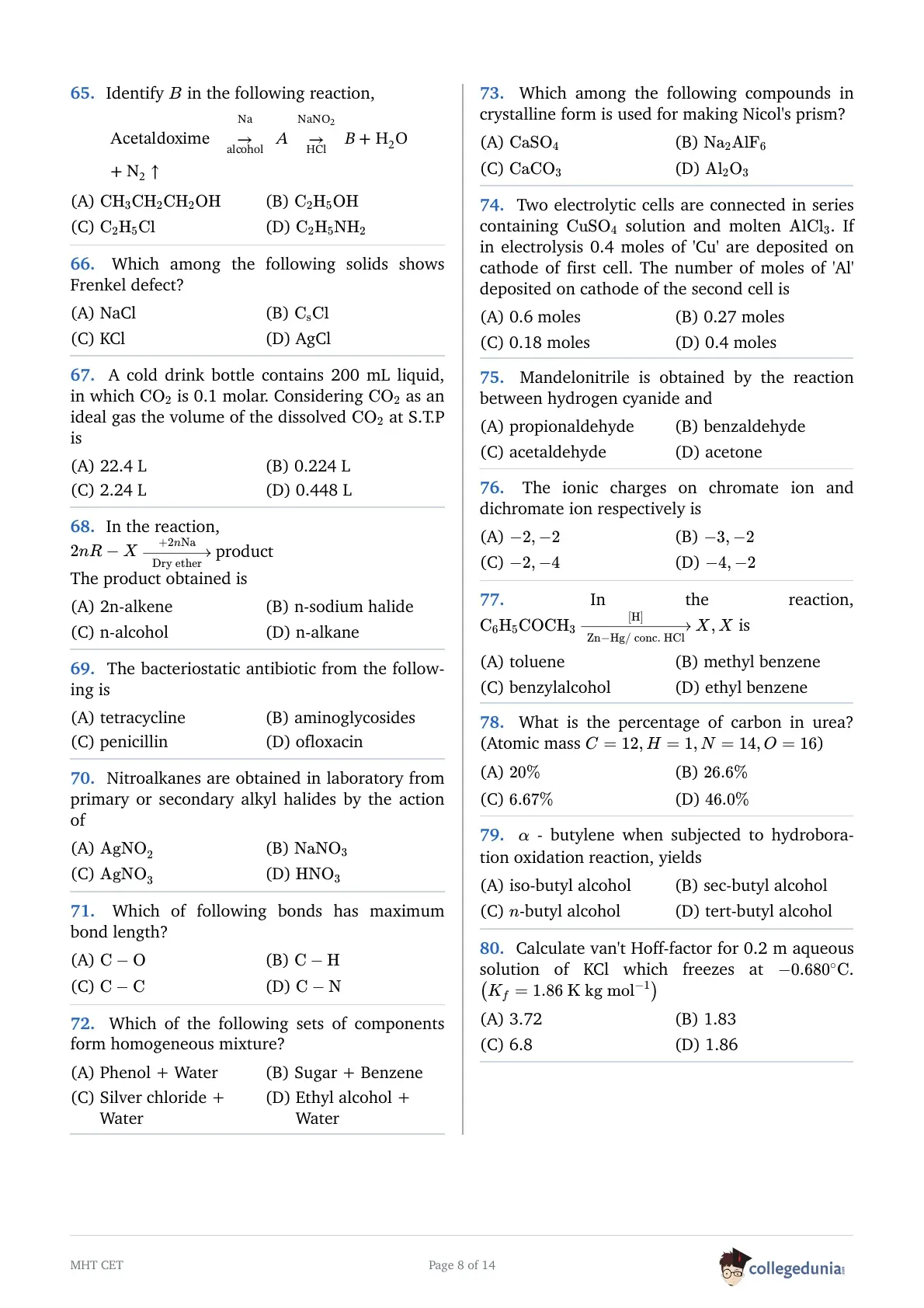
Identify \(B\) in the following reaction,

\[\text { Acetaldoxime } \xrightarrow[\text { alcohol }]{\mathrm{Na}} A \xrightarrow[\text { HCl }]{\mathrm{NaNO}_2} B+\mathrm{H}_2 \mathrm{O}+\mathrm{N}_2 \uparrow\]

  • (A) \(\mathrm{CH}_{3}\mathrm{CH}_{2}\mathrm{CH}_{2}\mathrm{OH}\)
  • (B) \(\mathrm{C}_{2}\mathrm{H}_{5}\mathrm{OH}\)
  • (C) \(\mathrm{C}_{2}\mathrm{H}_{5}\mathrm{Cl}\)
  • (D) \(\mathrm{C}_{2}\mathrm{H}_{5}\mathrm{NH}_{2}\)

Question 66:

Which among the following solids shows Frenkel defect?

  • (A) NaCl
  • (B) \(\mathrm{C}_{\mathrm{s}}\mathrm{Cl}\)
  • (C) KCl
  • (D) AgCl

Question 67:

A cold drink bottle contains 200 mL liquid, in which \(\mathrm{CO}_2\) is 0.1 molar. Considering \(\mathrm{CO}_2\) as an ideal gas the volume of the dissolved \(\mathrm{CO}_2\) at S.T.P is

  • (A) 22.4 L
  • (B) 0.224 L
  • (C) 2.24 L
  • (D) 0.448 L

Question 68:

In the reaction,

\(2 n R-X \xrightarrow[\text { Dry ether }]{+2 n \mathrm{Na}}\) product

The product obtained is

  • (A) 2n-alkene
  • (B) n-sodium halide
  • (C) n-alcohol
  • (D) n-alkane

Question 69:

The bacteriostatic antibiotic from the following is

  • (A) tetracycline
  • (B) aminoglycosides
  • (C) penicillin
  • (D) ofloxacin

Question 70:

Nitroalkanes are obtained in laboratory from primary or secondary alkyl halides by the action of

  • (A) \(\mathrm{AgNO}_{2}\)
  • (B) \(\mathrm{NaNO}_{3}\)
  • (C) \(\mathrm{AgNO}_{3}\)
  • (D) \(\mathrm{HNO}_{3}\)

Question 73:

Which among the following compounds in crystalline form is used for making Nicol's prism?

  • (A) \(\mathrm{CaSO}_{4}\)
  • (B) \(\mathrm{Na}_{2}\mathrm{AlF}_{6}\)
  • (C) \(\mathrm{CaCO}_{3}\)
  • (D) \(\mathrm{Al}_{2}\mathrm{O}_{3}\)

Question 74:

Two electrolytic cells are connected in series containing \(\mathrm{CuSO}_4\) solution and molten \(\mathrm{AlCl}_3\). If in electrolysis 0.4 moles of 'Cu' are deposited on cathode of first cell. The number of moles of 'Al' deposited on cathode of the second cell is

  • (A) 0.6 moles
  • (B) 0.27 moles
  • (C) 0.18 moles
  • (D) 0.4 moles

Question 75:

Mandelonitrile is obtained by the reaction between hydrogen cyanide and

  • (A) propionaldehyde
  • (B) benzaldehyde
  • (C) acetaldehyde
  • (D) acetone

Question 76:

The ionic charges on chromate ion and dichromate ion respectively is

  • (A) \(-2,-2\)
  • (B) \(-3,-2\)
  • (C) \(-2,-4\)
  • (D) \(-4,-2\)

Question 77:

In the reaction, \(\mathrm{C}_6 \mathrm{H}_5 \mathrm{COCH}_3 \xrightarrow[\mathrm{Zn}-\mathrm{Hg} / \text { conc. } \mathrm{HCl}]{[\mathrm{H}]} X,X\) is

  • (A) toluene
  • (B) methyl benzene
  • (C) benzylalcohol
  • (D) ethyl benzene

Question 78:

What is the percentage of carbon in urea? (Atomic mass \(C=12, H=1, N=14, O=16\))

  • (A) \(20\%\)
  • (B) \(26.6\%\)
  • (C) \(6.67\%\)
  • (D) \(46.0\%\)

Question 79:

\(\alpha\) - butylene when subjected to hydroboration oxidation reaction, yields

  • (A) iso-butyl alcohol
  • (B) sec-butyl alcohol
  • (C) \(n\)-butyl alcohol
  • (D) tert-butyl alcohol

Question 80:

Calculate van't Hoff-factor for 0.2 m aqueous solution of KCl which freezes at \(-0.680^{\circ} \mathrm{C}\). \(\left(K_f=1.86 \mathrm{~K} \mathrm{~kg} \mathrm{~mol}^{-1}\right)\)

  • (A) 3.72
  • (B) 1.83
  • (C) 6.8
  • (D) 1.86

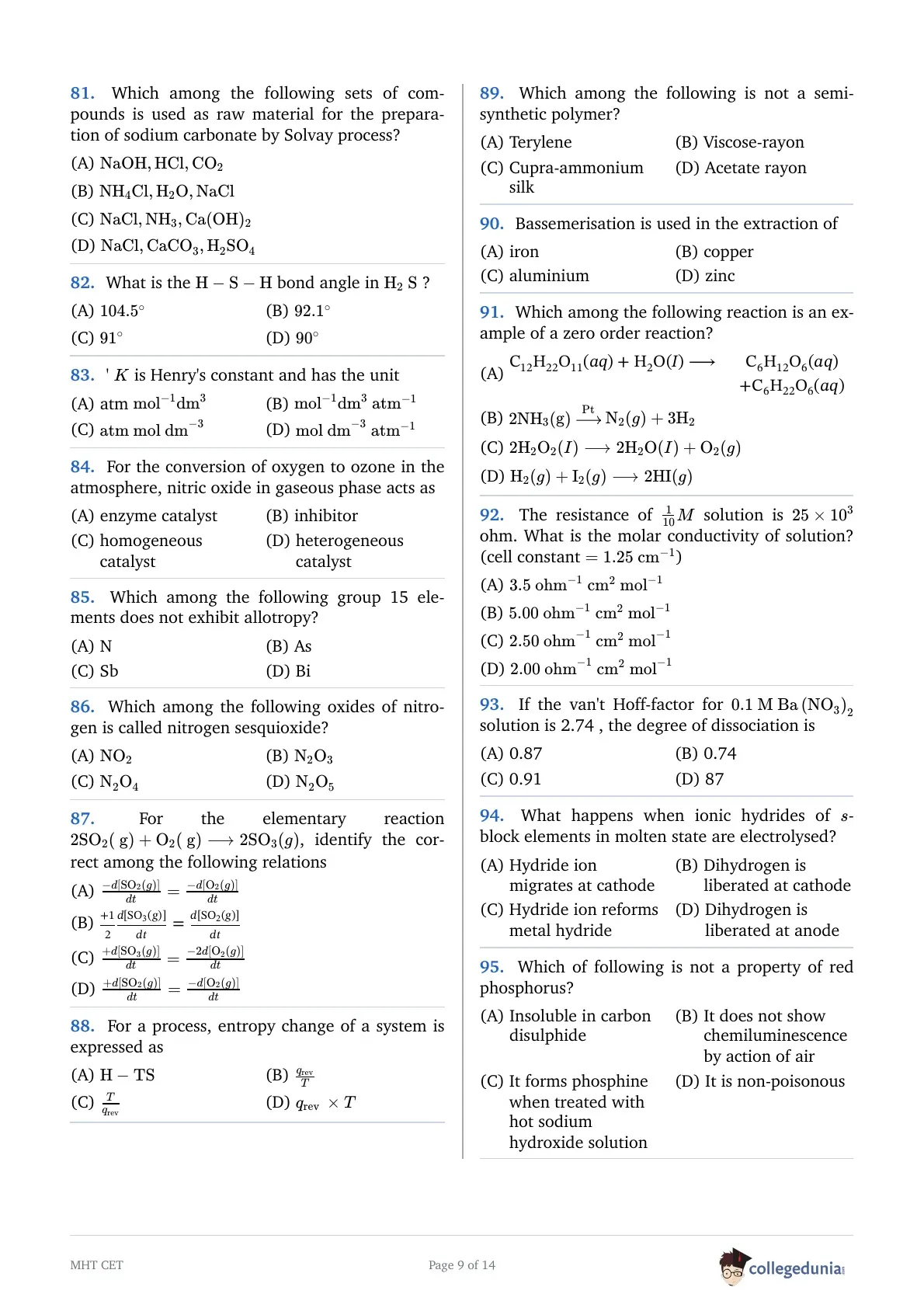
Question 81:

Which among the following sets of compounds is used as raw material for the preparation of sodium carbonate by Solvay process?

  • (A) \(\mathrm{NaOH},\mathrm{HCl},\mathrm{CO}_{2}\)
  • (B) \(\mathrm{NH}_{4}\mathrm{Cl},\mathrm{H}_{2}\mathrm{O},\mathrm{NaCl}\)
  • (C) \(\mathrm{NaCl},\mathrm{NH}_{3},\mathrm{Ca}(\mathrm{OH})_{2}\)
  • (D) \(\mathrm{NaCl},\mathrm{CaCO}_{3},\mathrm{H}_{2}\mathrm{SO}_{4}\)

Question 82:

What is the \(\mathrm{H}-\mathrm{S}-\mathrm{H}\) bond angle in \(\mathrm{H}_2 \mathrm{~S}\) ?

  • (A) \(104.5^{\circ}\)
  • (B) \(92.1^{\circ}\)
  • (C) \(91^{\circ}\)
  • (D) \(90^{\circ}\)

Question 83:

' \(K\) is Henry's constant and has the unit

  • (A) atm \(\mathrm{mol}^{-1}\mathrm{dm}^{3}\)
  • (B) \(\mathrm{mol}^{-1}\mathrm{dm}^{3}\text{ }\mathrm{atm}^{-1}\)
  • (C) \(\mathrm{atm}\text{ }\mathrm{mol}\text{ }\mathrm{dm}^{-3}\)
  • (D) \(\mathrm{mol}\text{ }\mathrm{dm}^{-3}\text{ }\mathrm{atm}^{-1}\)

Question 84:

For the conversion of oxygen to ozone in the atmosphere, nitric oxide in gaseous phase acts as

  • (A) enzyme catalyst
  • (B) inhibitor
  • (C) homogeneous catalyst
  • (D) heterogeneous catalyst

Question 85:

Which among the following group 15 elements does not exhibit allotropy?

  • (A) N
  • (B) As
  • (C) Sb
  • (D) Bi

Question 86:

Which of the following is also called as nitrogen sesquioxide?

  • (A) \( NO_{2}\)
  • (B) \(N_{2}O_{3}\)
  • (C) \(N_{2}O_{4}\)
  • (D) \(N_{2}O_{5}\)

Question 87:

For the elementary reaction \(2 \mathrm{SO}_2(\mathrm{~g})+\mathrm{O}_2(\mathrm{~g}) \longrightarrow 2 \mathrm{SO}_3(g)\), identify the correct among the following relations

  • (A) \(\frac{-d[\mathrm{SO}_{2}(g)]}{dt}=\frac{-d[\mathrm{O}_{2}(g)]}{dt}\)
  • (B) \(\frac{+1}{2}\frac{d[\mathrm{SO}_{3}(g)]}{dt}=\frac{d[\mathrm{SO}_{2}(g)]}{dt}\)
  • (C) \(\frac{+d[\mathrm{SO}_{3}(g)]}{dt}=\frac{-2d[\mathrm{O}_{2}(g)]}{dt}\)
  • (D) \(\frac{+d[\mathrm{SO}_{2}(g)]}{dt}=\frac{-d[\mathrm{O}_{2}(g)]}{dt}\)

Question 88:

For a process, entropy change of a system is expressed as

  • (A) \(\mathrm{H}-\mathrm{TS}\)
  • (B) \(\frac{q_{\mathrm{rev}}}{T}\)
  • (C) \(\frac{T}{q_{\mathrm{rev}}}\)
  • (D) \(q_{\text{rev }}\times T\)

Question 89:

Which among the following is not a semi-synthetic polymer?

  • (A) Terylene
  • (B) Viscose-rayon
  • (C) Cupra-ammonium silk
  • (D) Acetate rayon

Question 90:

Bassemerisation is used in the extraction of

  • (A) iron
  • (B) copper
  • (C) aluminium
  • (D) zinc

Question 91:

Which among the following reaction is an example of a zero order reaction?

  • (A) \(\begin{array}{cc} \mathrm{C}_{12}\mathrm{H}_{22}\mathrm{O}_{11}(aq)+\mathrm{H}_{2}\mathrm{O}(I)\longrightarrow & \mathrm{C}_{6}\mathrm{H}_{12}\mathrm{O}_{6}(aq) \\ & +\mathrm{C}_{6}\mathrm{H}_{22}\mathrm{O}_{6}(aq) \end{array}\)
  • (B) \(2\mathrm{NH}_{3}(\mathrm{g})\xrightarrow{\mathrm{Pt}}\mathrm{N}_{2}(g)+3\mathrm{H}_{2}\)
  • (C) \(2\mathrm{H}_{2}\mathrm{O}_{2}(I)\longrightarrow 2\mathrm{H}_{2}\mathrm{O}(I)+\mathrm{O}_{2}(g)\)
  • (D) \(\mathrm{H}_{2}(g)+\mathrm{I}_{2}(g)\longrightarrow 2\mathrm{HI}(g)\)

Question 93:

If the van't Hoff-factor for \(0.1 \mathrm{~M} \mathrm{~Ba}\left(\mathrm{NO}_3\right)_2\) solution is 2.74 , the degree of dissociation is

  • (A) 0.87
  • (B) 0.74
  • (C) 0.91
  • (D) 87

Question 94:

What happens when ionic hydrides of \(s\)-block elements in molten state are electrolysed?

  • (A) Hydride ion migrates at cathode
  • (B) Dihydrogen is liberated at cathode
  • (C) Hydride ion reforms metal hydride
  • (D) Dihydrogen is liberated at anode

Question 95:

Which of following is not a property of red phosphorus?

  • (A) Insoluble in carbon disulphide
  • (B) It does not show chemiluminescence by action of air
  • (C) It forms phosphine when treated with hot sodium hydroxide solution
  • (D) It is non-poisonous

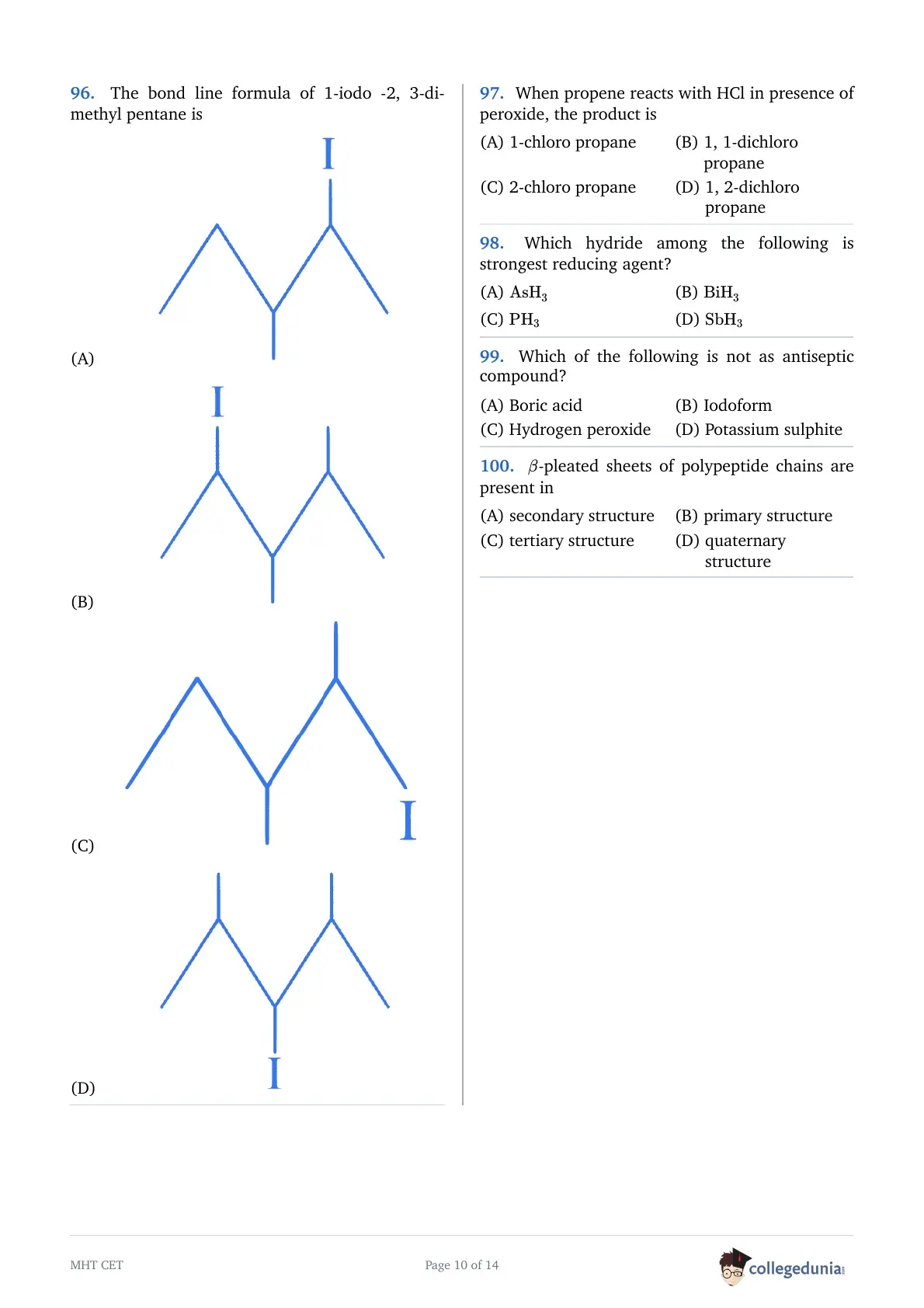
Question 96:

The bond line formula of 1-iodo -2, 3-dimethyl pentane is

  • (A)
  • (B)
  • (C)
  • (D)

Question 97:

When propene reacts with HCl in presence of peroxide, the product is

  • (A) 1-chloro propane
  • (B) 1, 1-dichloro propane
  • (C) 2-chloro propane
  • (D) 1, 2-dichloro propane

Question 98:

Which hydride among the following is strongest reducing agent?

  • (A) \(\mathrm{AsH}_{3}\)
  • (B) \(\mathrm{BiH}_{3}\)
  • (C) \(\mathrm{PH}_{3}\)
  • (D) \(\mathrm{SbH}_{3}\)

Question 99:

Which of the following is not as antiseptic compound?

  • (A) Boric acid
  • (B) Iodoform
  • (C) Hydrogen peroxide
  • (D) Potassium sulphite

Question 100:

\(\beta\)-pleated sheets of polypeptide chains are present in

  • (A) secondary structure
  • (B) primary structure
  • (C) tertiary structure
  • (D) quaternary structure

Mathematics (Q101 - Q150)

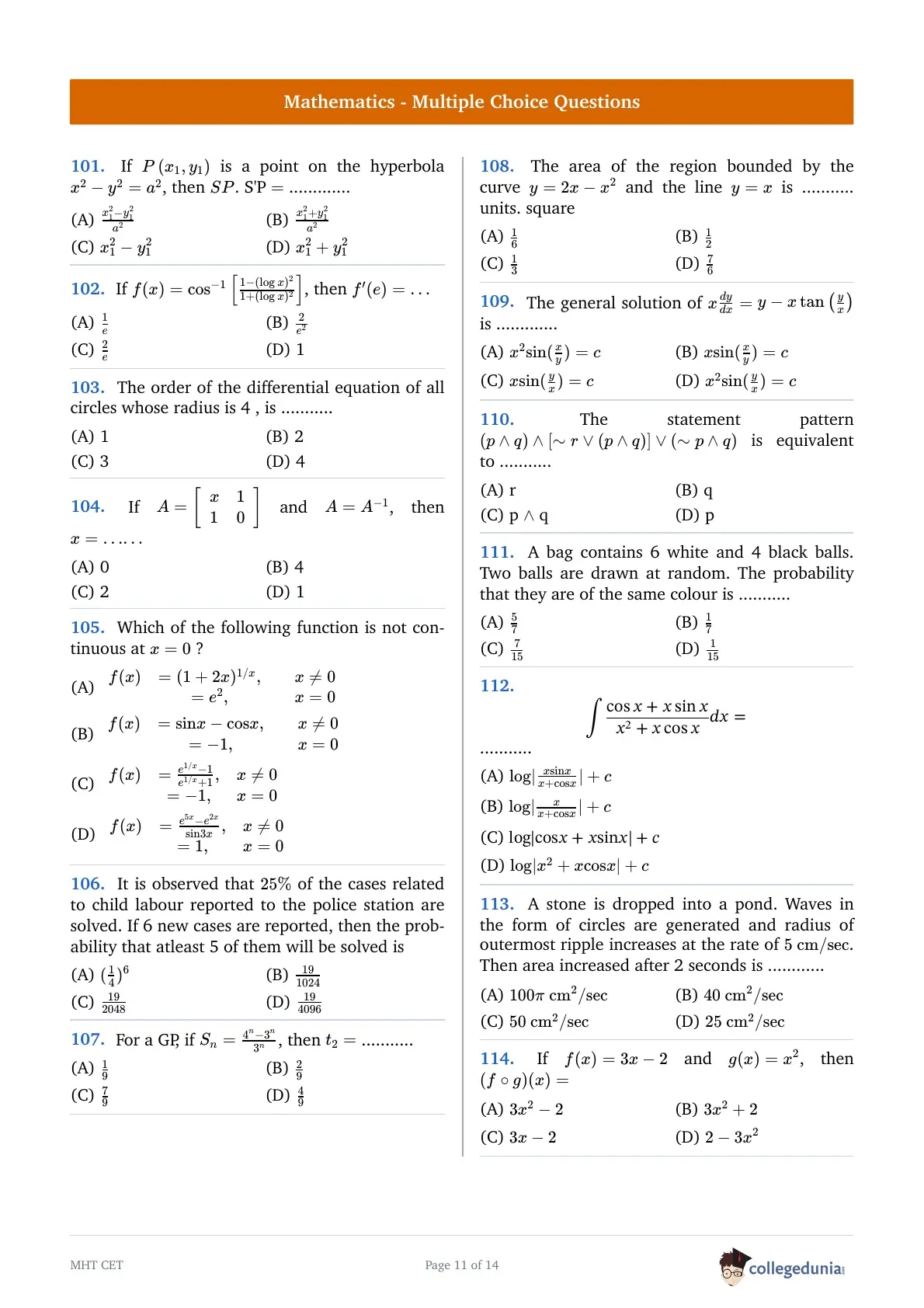
Question 101:

If \(P\left(x_1, y_1\right)\) is a point on the hyperbola \(x^2-y^2=a^2\), then \(S P\). S'P \(=\) .............

  • (A) \(\frac{x_{1}^{2}-y_{1}^{2}}{a^{2}}\)
  • (B) \(\frac{x_{1}^{2}+y_{1}^{2}}{a^{2}}\)
  • (C) \(x_{1}^{2}-y_{1}^{2}\)
  • (D) \(x_{1}^{2}+y_{1}^{2}\)

Question 102:

If \(f(x)=\cos ^{-1}\left[\frac{1-(\log x)^2}{1+(\log x)^2}\right]\), then \(f^{\prime}(e)=\ldots\)

  • (A) \(\frac{1}{e}\)
  • (B) \(\frac{2}{e^{2}}\)
  • (C) \(\frac{2}{e}\)
  • (D) 1

Question 103:

The order of the differential equation of all circles whose radius is 4 , is ...........

  • (A) 1
  • (B) 2
  • (C) 3
  • (D) 4

Question 104:

If \(A=\left[\begin{array}{ll}x & 1 \\ 1 & 0\end{array}\right]\) and \(A=A^{-1}\), then \(x=\ldots \ldots\)

  • (A) 0
  • (B) 4
  • (C) 2
  • (D) 1

Question 105:

Which of the following function is not continuous at \(x=0\) ?

  • (A) \(\begin{array}{cccc} f(x) & =(1+2x)^{1/x}, & & x\neq 0 \\ & =e^{2}, & & x=0 \end{array}\)
  • (B) \(\begin{array}{cccc} f(x) & =\mathrm{sin}x-\mathrm{cos}x, & & x\neq 0 \\ & =-1, & & x=0 \end{array}\)
  • (C) \(\begin{array}{ccc} f(x) & =\frac{e^{1/x}-1}{e^{1/x}+1}, & x\neq 0 \\ & =-1, & x=0 \end{array}\)
  • (D) \(\begin{array}{ccc} f(x) & =\frac{e^{5x}-e^{2x}}{\mathrm{sin}3x}, & x\neq 0 \\ & =1, & x=0 \end{array}\)

Question 106:

It is observed that \(25 \%\) of the cases related to child labour reported to the police station are solved. If 6 new cases are reported, then the probability that atleast 5 of them will be solved is

  • (A) \((\frac{1}{4})^{6}\)
  • (B) \(\frac{19}{1024}\)
  • (C) \(\frac{19}{2048}\)
  • (D) \(\frac{19}{4096}\)

Question 107:

For a GP, if \(S_n=\frac{4^n-3^n}{3^n}\), then \(t_2=\) ...........

  • (A) \(\frac{1}{9}\)
  • (B) \(\frac{2}{9}\)
  • (C) \(\frac{7}{9}\)
  • (D) \(\frac{4}{9}\)

Question 108:

The area of the region bounded by the curve \(y=2 x-x^2\) and the line \(y=x\) is ........... units. square

  • (A) \(\frac{1}{6}\)
  • (B) \(\frac{1}{2}\)
  • (C) \(\frac{1}{3}\)
  • (D) \(\frac{7}{6}\)

Question 109:

The general solution of \(x \frac{d y}{d x}=y-x \tan \left(\frac{y}{x}\right)\) is .............

  • (A) \(x^{2}\mathrm{sin}(\frac{x}{y})=c\)
  • (B) \(x\mathrm{sin}(\frac{x}{y})=c\)
  • (C) \(x\mathrm{sin}(\frac{y}{x})=c\)
  • (D) \(x^{2}\mathrm{sin}(\frac{y}{x})=c\)

Question 110:

The statement pattern \((p \wedge q) \wedge[\sim r \vee(p \wedge q)] \vee(\sim p \wedge q)\) is equivalent to ...........

  • (A) r
  • (B) q
  • (C) p \(\wedge\) q
  • (D) p

Question 111:

A bag contains 6 white and 4 black balls. Two balls are drawn at random. The probability that they are of the same colour is ...........

  • (A) \(\frac{5}{7}\)
  • (B) \(\frac{1}{7}\)
  • (C) \(\frac{7}{15}\)
  • (D) \(\frac{1}{15}\)

Question 112:

\[\int \frac{\cos x+x \sin x}{x^2+x \cos x} d x=\] ...........

  • (A) \(\mathrm{log}|\frac{x\mathrm{sin}x}{x+\mathrm{cos}x}|+c\)
  • (B) \(\mathrm{log}|\frac{x}{x+\mathrm{cos}x}|+c\)
  • (C) \(\mathrm{log}|\mathrm{cos}x+x\mathrm{sin}x|+c\)
  • (D) \(\mathrm{log}|x^{2}+x\mathrm{cos}x|+c\)

Question 113:

A stone is dropped into a pond. Waves in the form of circles are generated and radius of outermost ripple increases at the rate of \(5 \mathrm{~cm} / \mathrm{sec}\). Then area increased after 2 seconds is ............

  • (A) \(100\pi \text{ }\mathrm{cm}^{2}/\mathrm{sec}\)
  • (B) \(40\text{ }\mathrm{cm}^{2}/\mathrm{sec}\)
  • (C) \(50\text{ }\mathrm{cm}^{2}/\mathrm{sec}\)
  • (D) \(25\text{ }\mathrm{cm}^{2}/\mathrm{sec}\)

Question 114:

If \(f(x)=3 x-2\) and \(g(x)=x^2\), then \((f \circ g)(x)=\)

  • (A) \(3x^{2}-2\)
  • (B) \(3x^{2}+2\)
  • (C) \(3x-2\)
  • (D) \(2-3x^{2}\)

Question 115:

Which of the following is not equivalent to \(p \rightarrow q\).

  • (A) \(p\) only if \(q\)
  • (B) \(q\) is necessary for \(p\)
  • (C) \(q\) only if \(p\)
  • (D) \(p\) is sufficient for \(q\)

Question 116:

The value of \(\int_{-3}^3\left(a x^5+b x^3+c x+k\right) d x\), where \(a, b, c, k\) are constants, depends only on

  • (A) \(a,b\) and \(c\)
  • (B) \(k\)
  • (C) \(a\) and \(b\)
  • (D) \(a\) and \(k\)

Question 117:

The general solution of the differential equation of all circles having centre at \(A(-1,2)\) is ........

  • (A) \(x^{2}+y^{2}+x-2y+c=0\)
  • (B) \(x^{2}+y^{2}-2x+4y+c=0\)
  • (C) \(x^{2}+y^{2}-x+2y+c=0\)
  • (D) \(x^{2}+y^{2}+2x-4y+c=0\)

Question 118:

If \(A\) is non-singular matrix such that \((A-2 l)(A-4 I)=0\) then \(A+8 A^{-1}=\) ..........

  • (A) I
  • (B) 0
  • (C) 3I
  • (D) 6I

Question 119:

If \(G(3,-5, r)\) is centroid of triangle \(A B C\) where \(A(7,-8,1), B(p, q, 5)\) and \(C(q+1,5 p, 0)\) are vertices of a triangle then values of \(p, q, r\) are respectively ......

  • (A) \(6,5,4\)
  • (B) \(-4,5,4\)
  • (C) \(-3,4,3\)
  • (D) \(-2,3,2\)

Question 120:

\[\int \frac{1}{\left(x^2+1\right)^2} d x=\ldots\]

  • (A) \(\mathrm{tan}^{-1}x-\frac{1}{2x(x^{2}+1)}+c\)
  • (B) \(\frac{1}{2}\mathrm{tan}^{-1}x+\frac{x}{2(x^{2}+1)}+c\)
  • (C) \(\mathrm{tan}^{-1}x+\frac{1}{x^{2}+1}+c\)
  • (D) \(\mathrm{tan}^{-1}x+\frac{1}{2(x^{2}+1)}+c\)

Question 121:

If \(\theta=\frac{17 \pi}{3}\) then, \(\tan \theta-\cot \theta=\ldots\)

  • (A) \(\frac{1}{2\sqrt{3}}\)
  • (B) \(\frac{-1}{2\sqrt{3}}\)
  • (C) \(\frac{2}{\sqrt{3}}\)
  • (D) \(-\frac{2}{\sqrt{3}}\)

Question 122:

Derivative of \(\log _{e^2}(\log x)\) with respect to \(x\) is

  • (A) \(\frac{2}{x\mathrm{log}x}\)
  • (B) \(\frac{1}{x\mathrm{log}x}\)
  • (C) \(\frac{1}{x\cdot \mathrm{log}x^{2}}\)
  • (D) \(\frac{2}{\mathrm{log}x}\)

Question 123:

In \(\triangle A B C\); with usual notations, if \(\cos A=\frac{\sin B}{\sin C}\) then the triangle is ............

  • (A) Acute angled triangle
  • (B) Equilateral triangle
  • (C) Obtuse angled triangle
  • (D) Right angled triangle

Question 124:

For a GP, if \((m+n)^{\text {th }}\) term is \(p\) and \((m-n)^{\mathrm{th}}\) term is \(q\), then \(m^{\text {th }}\) term is ......

  • (A) \(pq\)
  • (B) \(\sqrt{pq}\)
  • (C) \(\frac{p}{q}\)
  • (D) \(\frac{q}{p}\)

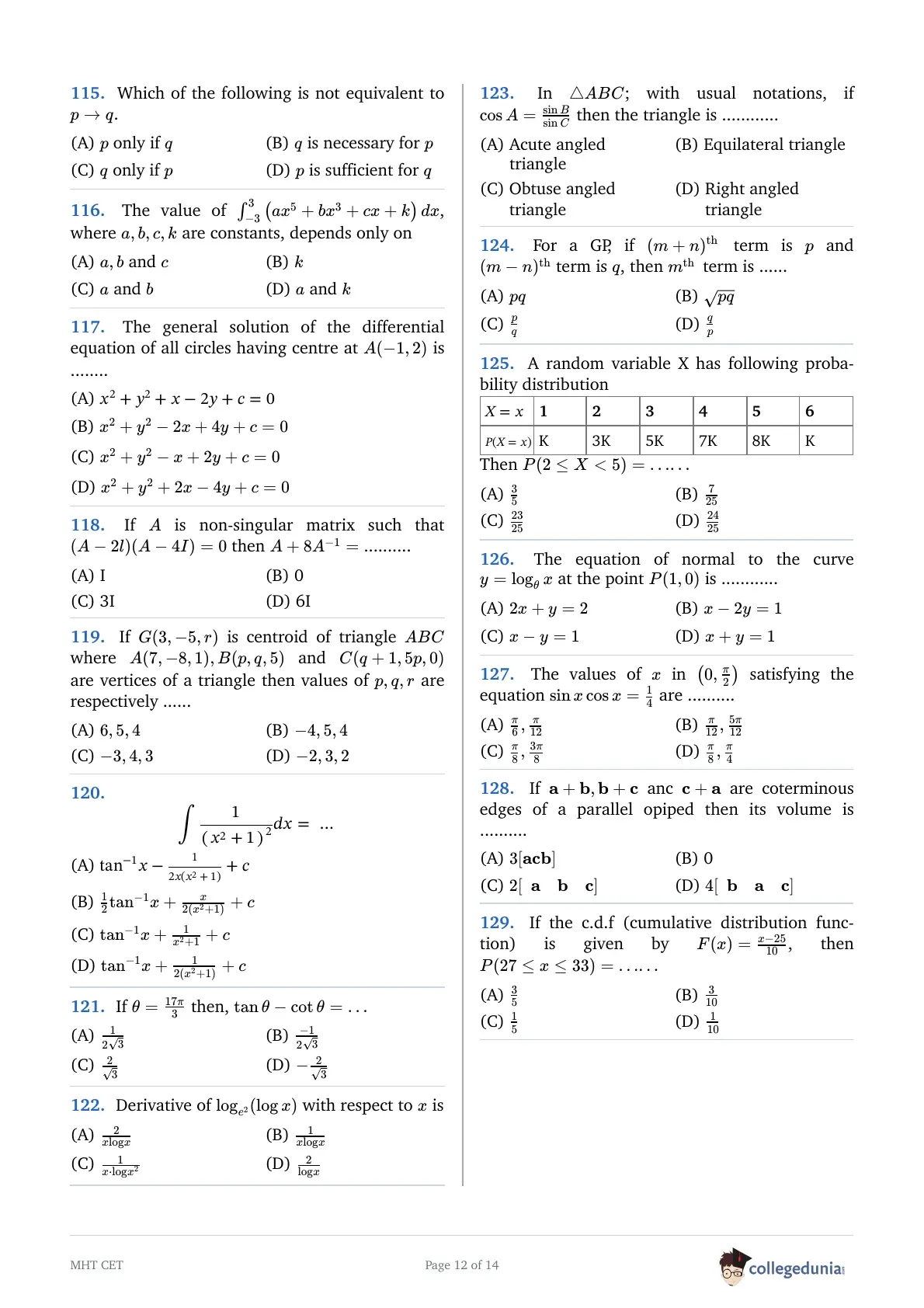
Question 125:

A random variable X has following probability distribution

\(X=x\)123456
\(P(X=x)\)K3K5K7K8KK
  • (A) \(\frac{3}{5}\)
  • (B) \(\frac{7}{25}\)
  • (C) \(\frac{23}{25}\)
  • (D) \(\frac{24}{25}\)

Question 126:

The equation of normal to the curve \(y=\log _\theta x\) at the point \(P(1,0)\) is ............

  • (A) \(2x+y=2\)
  • (B) \(x-2y=1\)
  • (C) \(x-y=1\)
  • (D) \(x+y=1\)

Question 127:

The values of \(x\) in \(\left(0, \frac{\pi}{2}\right)\) satisfying the equation \(\sin x \cos x=\frac{1}{4}\) are ..........

  • (A) \(\frac{\pi}{6},\frac{\pi}{12}\)
  • (B) \(\frac{\pi}{12},\frac{5\pi}{12}\)
  • (C) \(\frac{\pi}{8},\frac{3\pi}{8}\)
  • (D) \(\frac{\pi}{8},\frac{\pi}{4}\)

Question 128:

If \(\mathbf{a}+\mathbf{b}, \mathbf{b}+\mathbf{c}\) anc \(\mathbf{c}+\mathbf{a}\) are coterminous edges of a parallel opiped then its volume is ..........

  • (A) \(3[\mathbf{a}\mathbf{c}\mathbf{b}]\)
  • (B) 0
  • (C) \(2[\begin{array}{ccc} \mathbf{a} & \mathbf{b} & \mathbf{c}] \end{array}\)
  • (D) \(4[\begin{array}{ccc} \mathbf{b} & \mathbf{a} & \mathbf{c}] \end{array}\)

Question 129:

If the c.d.f (cumulative distribution function) is given by \(F(x)=\frac{x-25}{10}\), then \(P(27 \leq x \leq 33)=\ldots \ldots\)

  • (A) \(\frac{3}{5}\)
  • (B) \(\frac{3}{10}\)
  • (C) \(\frac{1}{5}\)
  • (D) \(\frac{1}{10}\)

Question 130:

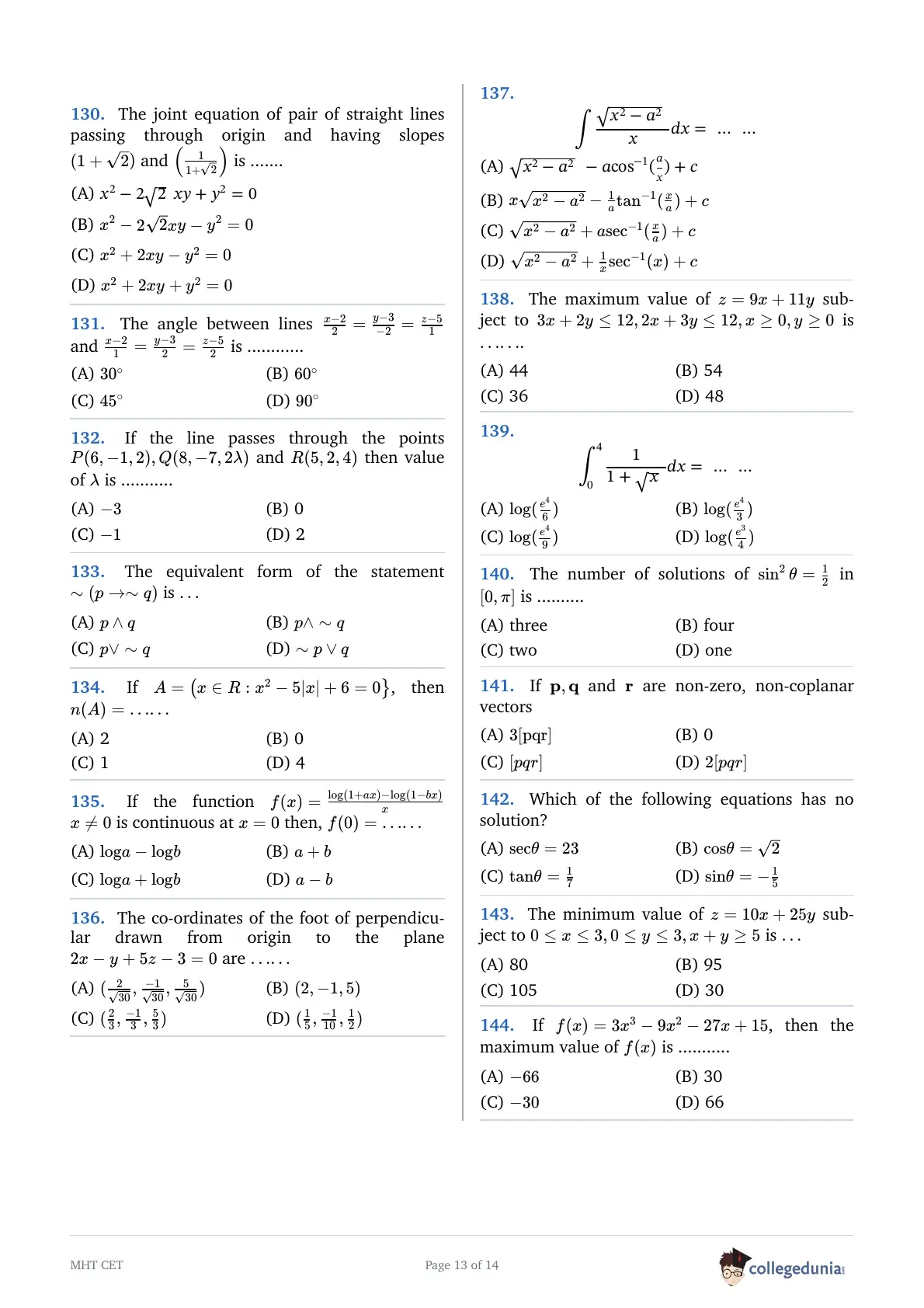
The joint equation of pair of straight lines passing through origin and having slopes \((1+\sqrt{2})\) and \(\left(\frac{1}{1+\sqrt{2}}\right)\) is .......

  • (A) \(x^{2}-2\sqrt{2}xy+y^{2}=0\)
  • (B) \(x^{2}-2\sqrt{2}xy-y^{2}=0\)
  • (C) \(x^{2}+2xy-y^{2}=0\)
  • (D) \(x^{2}+2xy+y^{2}=0\)

Question 131:

The angle between lines \(\frac{x-2}{2}=\frac{y-3}{-2}=\frac{z-5}{1}\) and \(\frac{x-2}{1}=\frac{y-3}{2}=\frac{z-5}{2}\) is ............

  • (A) \(30^{\circ}\)
  • (B) \(60^{\circ}\)
  • (C) \(45^{\circ}\)
  • (D) \(90^{\circ}\)

Question 132:

If the line passes through the points \(P(6,-1,2), Q(8,-7,2 \lambda)\) and \(R(5,2,4)\) then value of \(\lambda\) is ...........

  • (A) \(-3\)
  • (B) 0
  • (C) \(-1\)
  • (D) 2

Question 133:

The equivalent form of the statement \(\sim(p \rightarrow \sim q)\) is \(\ldots\)

  • (A) \(p\wedge q\)
  • (B) \(p\wedge \sim q\)
  • (C) \(p\vee \sim q\)
  • (D) \(\sim p\vee q\)

Question 134:

If \(A=\left(x \in R: x^2-5|x|+6=0\right\}\), then \(n(A)=\ldots \ldots\)

  • (A) 2
  • (B) 0
  • (C) 1
  • (D) 4

Question 135:

If the function \(f(x)=\frac{\log (1+a x)-\log (1-b x)}{x}\) \(x \neq 0\) is continuous at \(x=0\) then, \(f(0)=\ldots \ldots\)

  • (A) \(\mathrm{log}a-\mathrm{log}b\)
  • (B) \(a+b\)
  • (C) \(\mathrm{log}a+\mathrm{log}b\)
  • (D) \(a-b\)

Question 136:

The co-ordinates of the foot of perpendicular drawn from origin to the plane \(2 x-y+5 z-3=0\) are \(\ldots \ldots\)

  • (A) \((\frac{2}{\sqrt{30}},\frac{-1}{\sqrt{30}},\frac{5}{\sqrt{30}})\)
  • (B) \((2,-1,5)\)
  • (C) \((\frac{2}{3},\frac{-1}{3},\frac{5}{3})\)
  • (D) \((\frac{1}{5},\frac{-1}{10},\frac{1}{2})\)

Question 137:

\[\int \frac{\sqrt{x^2-a^2}}{x} d x=\ldots \ldots\]

  • (A) \(\sqrt{x^{2}-a^{2}}-a\mathrm{cos}^{-1}(\frac{a}{x})+c\)
  • (B) \(x\sqrt{x^{2}-a^{2}}-\frac{1}{a}\mathrm{tan}^{-1}(\frac{x}{a})+c\)
  • (C) \(\sqrt{x^{2}-a^{2}}+a\mathrm{sec}^{-1}(\frac{x}{a})+c\)
  • (D) \(\sqrt{x^{2}-a^{2}}+\frac{1}{x}\mathrm{sec}^{-1}(x)+c\)

Question 138:

The maximum value of \(z=9 x+11 y\) subject to \(3 x+2 y \leq 12,2 x+3 y \leq 12, x \geq 0, y \geq 0\) is \(\ldots \ldots\).

  • (A) 44
  • (B) 54
  • (C) 36
  • (D) 48

Question 139:

\[\int_0^4 \frac{1}{1+\sqrt{x}} d x=\ldots \ldots\]

  • (A) \(\mathrm{log}(\frac{e^{4}}{6})\)
  • (B) \(\mathrm{log}(\frac{e^{4}}{3})\)
  • (C) \(\mathrm{log}(\frac{e^{4}}{9})\)
  • (D) \(\mathrm{log}(\frac{e^{3}}{4})\)

Question 140:

The number of solutions of \(\sin ^2 \theta=\frac{1}{2}\) in \([0, \pi]\) is ..........

  • (A) three
  • (B) four
  • (C) two
  • (D) one

Question 142:

Which of the following equations has no solution?

  • (A) \(\mathrm{sec}\theta =23\)
  • (B) \(\mathrm{cos}\theta =\sqrt{2}\)
  • (C) \(\mathrm{tan}\theta =\frac{1}{7}\)
  • (D) \(\mathrm{sin}\theta =-\frac{1}{5}\)

Question 143:

The minimum value of \(z=10 x+25 y\) subject to \(0 \leq x \leq 3,0 \leq y \leq 3, x+y \geq 5\) is \(\ldots\)

  • (A) 80
  • (B) 95
  • (C) 105
  • (D) 30

Question 144:

If \(f(x)=3 x^3-9 x^2-27 x+15\), then the maximum value of \(f(x)\) is ...........

  • (A) \(-66\)
  • (B) 30
  • (C) \(-30\)
  • (D) 66

Question 145:

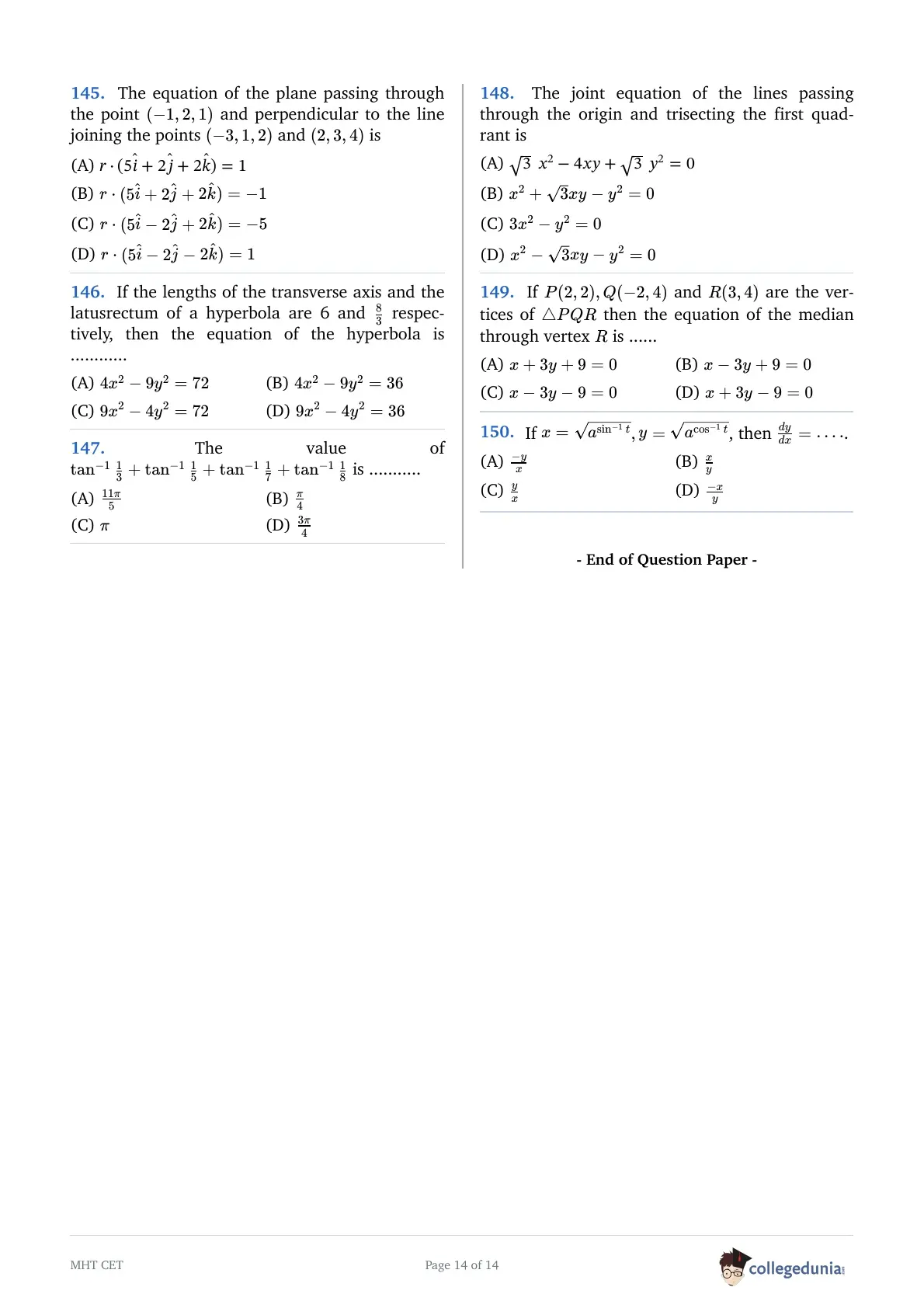
The equation of the plane passing through the point \((-1,2,1)\) and perpendicular to the line joining the points \((-3,1,2)\) and \((2,3,4)\) is

  • (A) \(r\cdot (5\hat{i}+2\hat{j}+2\hat{k})=1\)
  • (B) \(r\cdot (5\hat{i}+2\hat{j}+2\hat{k})=-1\)
  • (C) \(r\cdot (5\hat{i}-2\hat{j}+2\hat{k})=-5\)
  • (D) \(r\cdot (5\hat{i}-2\hat{j}-2\hat{k})=1\)

Question 146:

If the lengths of the transverse axis and the latusrectum of a hyperbola are 6 and \(\frac{8}{3}\) respectively, then the equation of the hyperbola is ............

  • (A) \(4x^{2}-9y^{2}=72\)
  • (B) \(4x^{2}-9y^{2}=36\)
  • (C) \(9x^{2}-4y^{2}=72\)
  • (D) \(9x^{2}-4y^{2}=36\)

Question 147:

The value of \(\tan ^{-1} \frac{1}{3}+\tan ^{-1} \frac{1}{5}+\tan ^{-1} \frac{1}{7}+\tan ^{-1} \frac{1}{8}\) is ...........

  • (A) \(\frac{11\pi}{5}\)
  • (B) \(\frac{\pi}{4}\)
  • (C) \(\pi\)
  • (D) \(\frac{3\pi}{4}\)

Question 148:

The joint equation of the lines passing through the origin and trisecting the first quadrant is

  • (A) \(\sqrt{3}x^{2}-4xy+\sqrt{3}y^{2}=0\)
  • (B) \(x^{2}+\sqrt{3}xy-y^{2}=0\)
  • (C) \(3x^{2}-y^{2}=0\)
  • (D) \(x^{2}-\sqrt{3}xy-y^{2}=0\)

Question 149:

If \(P(2,2), Q(-2,4)\) and \(R(3,4)\) are the vertices of \(\triangle P Q R\) then the equation of the median through vertex \(R\) is ......

  • (A) \(x+3y+9=0\)
  • (B) \(x-3y+9=0\)
  • (C) \(x-3y-9=0\)
  • (D) \(x+3y-9=0\)

Question 150:

If \(x=\sqrt{a^{\sin ^{-1} t}}, y=\sqrt{a^{\cos ^{-1} t}}\), then \(\frac{d y}{d x}=\ldots .\).

  • (A) \(\frac{-y}{x}\)
  • (B) \(\frac{x}{y}\)
  • (C) \(\frac{y}{x}\)
  • (D) \(\frac{-x}{y}\)

MHT CET 2019 PCM Exam Pattern and Marking Scheme

Parameter Details
Conducting Body Maharashtra Common Entrance Test Cell (Maharashtra CET Cell)
Exam Mode Online (Computer-Based Test)
Duration 180 minutes (3 hours)
Groups / Subjects PCM (Physics, Chemistry, Mathematics) for Engineering
Total Questions

150

Total Marks 200
Question Type Multiple Choice Questions (MCQs)
Marks Distribution
  • Mathematics – 2 marks/question
  • Physics and Chemistry – 1 mark/question
Negative Marking No
Syllabus Weightage
  • Class 12 – 80%
  • Class 11 – 20%