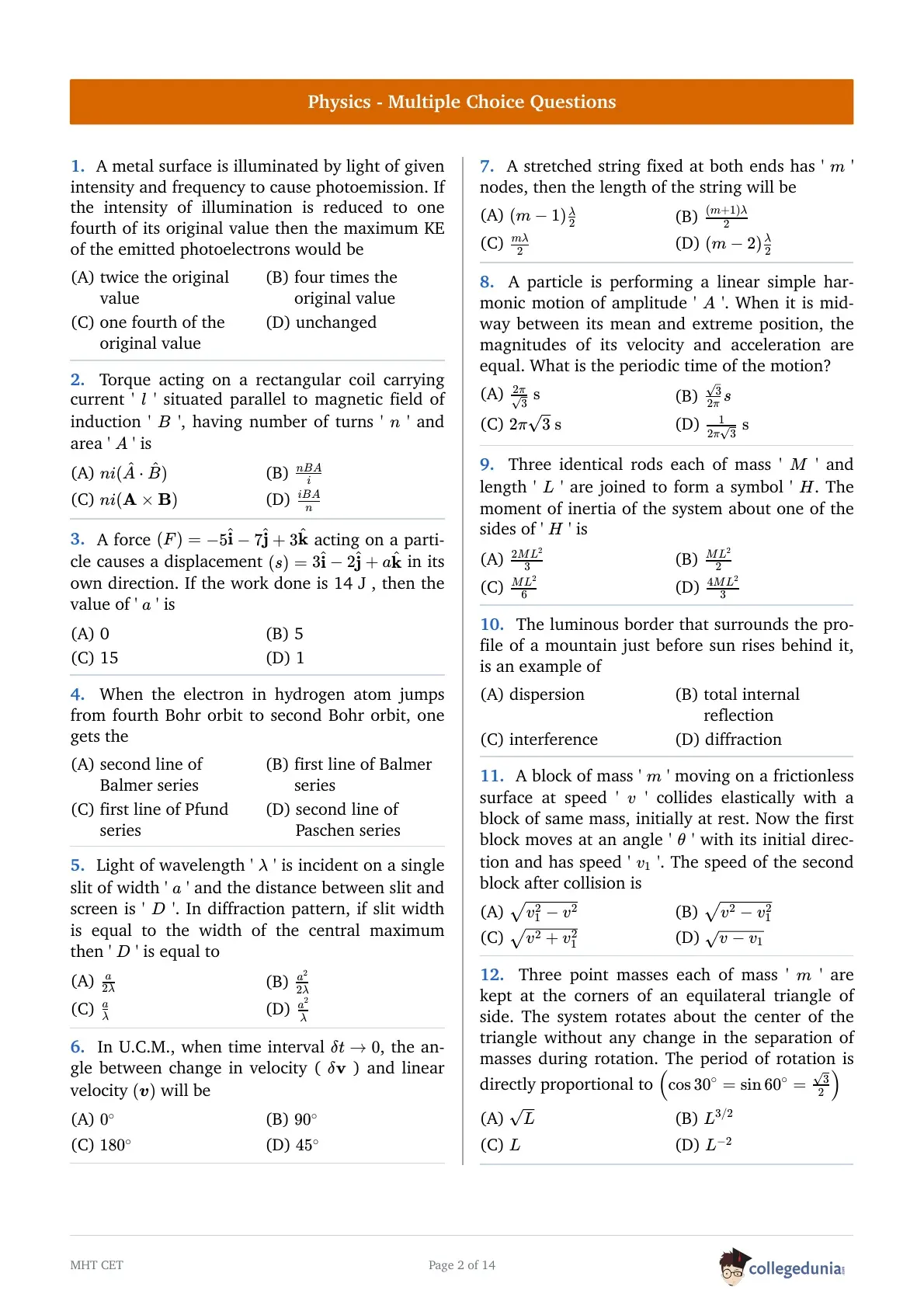
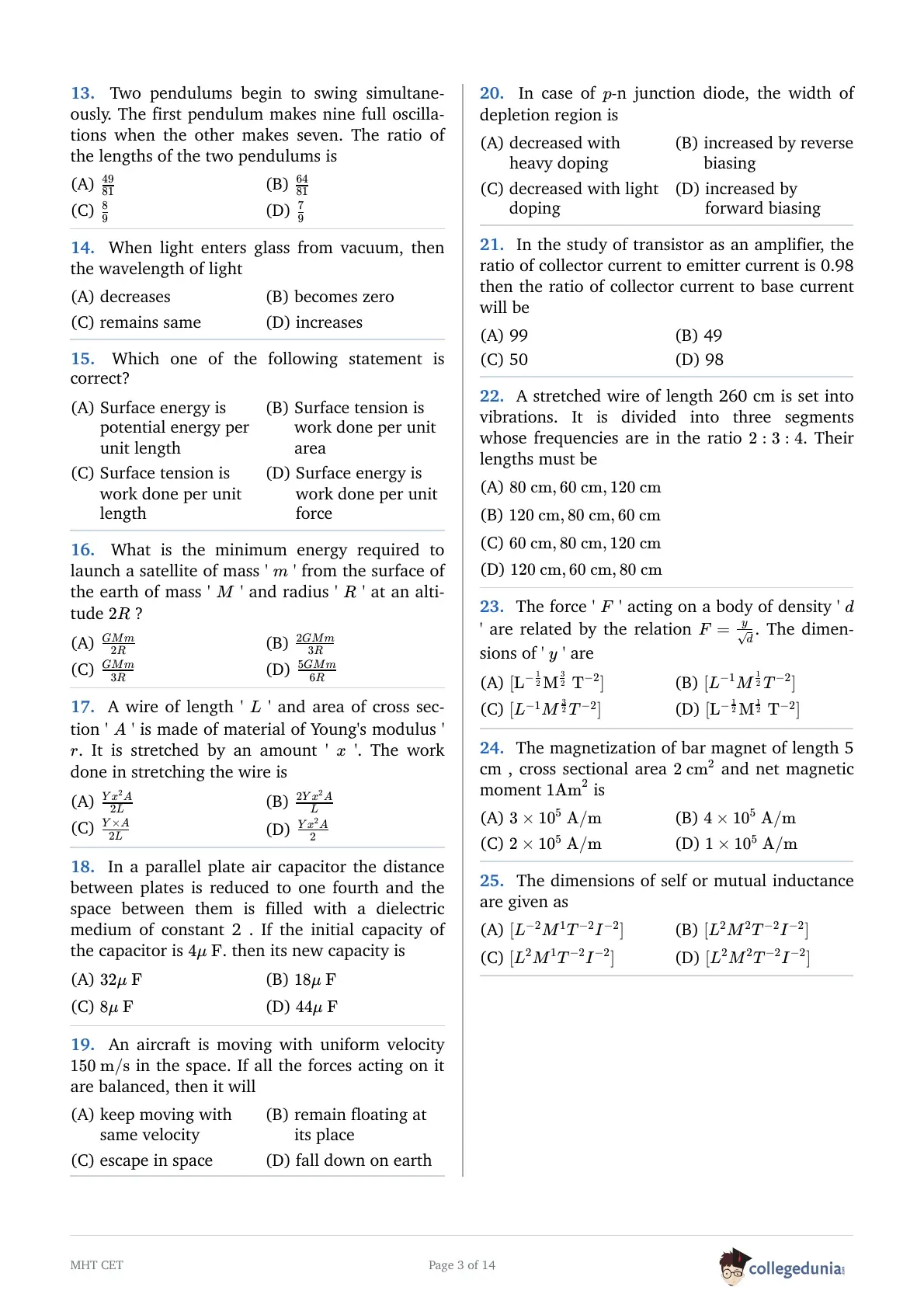
MHT CET 2019 May 2 Shift 2 PCM Question Paper is available for download here. Maharashtra State CET Cell conducted MHT CET 2019 PCM Exam on May 2 in Shift 2 from 2 PM to 5 PM in CBT mode.

The MHT CET 2019 PCM question paper includes the following:

  • The MHT CET 2019 PCM Question Paper consists of 150 multiple-choice questions (MCQs) totalling 200 marks divided into 3 sections: Physics, Chemistry, and Mathematics, with 50 questions in each subject.
  • Physics and Chemistry questions carry 1 mark each while Mathematics questions carry 2 marks each.
  • There is no negative marking for incorrect answers.

MHT CET 2019 May 2 Shift 2 PCM Question Paper with Solution PDF

CD PDF CD PDF with Solutions
Download Collegedunia PDF 0.85 MB -

Also Check:

MHT CET 2019 May 2 Shift 2 PCM Questions with Solutions


Physics (Q1 - Q50)

Question 1:

A metal surface is illuminated by light of given intensity and frequency to cause photoemission. If the intensity of illumination is reduced to one fourth of its original value then the maximum KE of the emitted photoelectrons would be

  • (A) twice the original value
  • (B) four times the original value
  • (C) one fourth of the original value
  • (D) unchanged

Question 2:

Torque acting on a rectangular coil carrying current ' \(l\) ' situated parallel to magnetic field of induction ' \(B\) ', having number of turns ' \(n\) ' and area ' \(A\) ' is

  • (A) \(ni(\hat{A}\cdot \hat{B})\)
  • (B) \(\frac{nBA}{i}\)
  • (C) \(ni(\mathbf{A}\times \mathbf{B})\)
  • (D) \(\frac{iBA}{n}\)

Question 3:

A force \((F)=-5 \hat{\mathbf{i}}-7 \hat{\mathbf{j}}+3 \hat{\mathbf{k}}\) acting on a particle causes a displacement \((s)=3 \hat{\mathbf{i}}-2 \hat{\mathbf{j}}+a \hat{\mathbf{k}}\) in its own direction. If the work done is 14 J , then the value of ' \(a\) ' is

  • (A) 0
  • (B) 5
  • (C) 15
  • (D) 1

Question 4:

When the electron in hydrogen atom jumps from fourth Bohr orbit to second Bohr orbit, one gets the

  • (A) second line of Balmer series
  • (B) first line of Balmer series
  • (C) first line of Pfund series
  • (D) second line of Paschen series

Question 5:

Light of wavelength ' \(\lambda\) ' is incident on a single slit of width ' \(a\) ' and the distance between slit and screen is ' \(D\) '. In diffraction pattern, if slit width is equal to the width of the central maximum then ' \(D\) ' is equal to

  • (A) \(\frac{a}{2\lambda}\)
  • (B) \(\frac{a^{2}}{2\lambda}\)
  • (C) \(\frac{a}{\lambda}\)
  • (D) \(\frac{a^{2}}{\lambda}\)

Question 6:

In U.C.M., when time interval \(\delta t \rightarrow 0\), the angle between change in velocity ( \(\delta \mathbf{v}\) ) and linear velocity \((\boldsymbol{v})\) will be

  • (A) \(0^{\circ}\)
  • (B) \(90^{\circ}\)
  • (C) \(180^{\circ}\)
  • (D) \(45^{\circ}\)

Question 7:

A stretched string fixed at both ends has ' \(m\) ' nodes, then the length of the string will be

  • (A) \((m-1)\frac{\lambda}{2}\)
  • (B) \(\frac{(m+1)\lambda}{2}\)
  • (C) \(\frac{m\lambda}{2}\)
  • (D) \((m-2)\frac{\lambda}{2}\)

Question 8:

A particle is performing a linear simple harmonic motion of amplitude ' \(A\) '. When it is midway between its mean and extreme position, the magnitudes of its velocity and acceleration are equal. What is the periodic time of the motion?

  • (A) \(\frac{2\pi}{\sqrt{3}}\text{ }\mathrm{s}\)
  • (B) \(\frac{\sqrt{3}}{2\pi}s\)
  • (C) \(2\pi \sqrt{3}\text{ }\mathrm{s}\)
  • (D) \(\frac{1}{2\pi \sqrt{3}}\text{ }\mathrm{s}\)

Question 9:

Three identical rods each of mass ' \(M\) ' and length ' \(L\) ' are joined to form a symbol ' \(H\). The moment of inertia of the system about one of the sides of ' \(H\) ' is

  • (A) \(\frac{2ML^{2}}{3}\)
  • (B) \(\frac{ML^{2}}{2}\)
  • (C) \(\frac{ML^{2}}{6}\)
  • (D) \(\frac{4ML^{2}}{3}\)

Question 10:

The luminous border that surrounds the profile of a mountain just before sun rises behind it, is an example of

  • (A) dispersion
  • (B) total internal reflection
  • (C) interference
  • (D) diffraction

Question 11:

A block of mass ' \(m\) ' moving on a frictionless surface at speed ' \(v\) ' collides elastically with a block of same mass, initially at rest. Now the first block moves at an angle ' \(\theta\) ' with its initial direction and has speed ' \(v_1\) '. The speed of the second block after collision is

  • (A) \(\sqrt{v_{1}^{2}-v^{2}}\)
  • (B) \(\sqrt{v^{2}-v_{1}^{2}}\)
  • (C) \(\sqrt{v^{2}+v_{1}^{2}}\)
  • (D) \(\sqrt{v-v_{1}}\)

Question 13:

Two pendulums begin to swing simultaneously. The first pendulum makes nine full oscillations when the other makes seven. The ratio of the lengths of the two pendulums is

  • (A) \(\frac{49}{81}\)
  • (B) \(\frac{64}{81}\)
  • (C) \(\frac{8}{9}\)
  • (D) \(\frac{7}{9}\)

Question 14:

When light enters glass from vacuum, then the wavelength of light

  • (A) decreases
  • (B) becomes zero
  • (C) remains same
  • (D) increases

Question 15:

Which one of the following statement is correct?

  • (A) Surface energy is potential energy per unit length
  • (B) Surface tension is work done per unit area
  • (C) Surface tension is work done per unit length
  • (D) Surface energy is work done per unit force

Question 17:

A wire of length ' \(L\) ' and area of cross section ' \(A\) ' is made of material of Young's modulus ' \(r\). It is stretched by an amount ' \(x\) '. The work done in stretching the wire is

  • (A) \(\frac{Yx^{2}A}{2L}\)
  • (B) \(\frac{2Yx^{2}A}{L}\)
  • (C) \(\frac{Y\times A}{2L}\)
  • (D) \(\frac{Yx^{2}A}{2}\)

Question 18:

In a parallel plate air capacitor the distance between plates is reduced to one fourth and the space between them is filled with a dielectric medium of constant 2 . If the initial capacity of the capacitor is \(4 \mu \mathrm{~F}\). then its new capacity is

  • (A) \(32\mu \text{ }\mathrm{F}\)
  • (B) \(18\mu \text{ }\mathrm{F}\)
  • (C) \(8\mu \text{ }\mathrm{F}\)
  • (D) \(44\mu \text{ }\mathrm{F}\)

Question 19:

An aircraft is moving with uniform velocity \(150 \mathrm{~m} / \mathrm{s}\) in the space. If all the forces acting on it are balanced, then it will

  • (A) keep moving with same velocity
  • (B) remain floating at its place
  • (C) escape in space
  • (D) fall down on earth

Question 21:

In the study of transistor as an amplifier, the ratio of collector current to emitter current is 0.98 then the ratio of collector current to base current will be

  • (A) 99
  • (B) 49
  • (C) 50
  • (D) 98

Question 22:

A stretched wire of length 260 cm is set into vibrations. It is divided into three segments whose frequencies are in the ratio \(2: 3: 4\). Their lengths must be

  • (A) \(80\text{ }\mathrm{cm},60\text{ }\mathrm{cm},120\text{ }\mathrm{cm}\)
  • (B) \(120\text{ }\mathrm{cm},80\text{ }\mathrm{cm},60\text{ }\mathrm{cm}\)
  • (C) \(60\text{ }\mathrm{cm},80\text{ }\mathrm{cm},120\text{ }\mathrm{cm}\)
  • (D) \(120\text{ }\mathrm{cm},60\text{ }\mathrm{cm},80\text{ }\mathrm{cm}\)

Question 23:

The force ' \(F\) ' acting on a body of density ' \(d\) ' are related by the relation \(F=\frac{y}{\sqrt{d}}\). The dimensions of ' \(y\) ' are

  • (A) \([\mathrm{L}^{-\frac{1}{2}}\mathrm{M}^{\frac{3}{2}}\text{ }\mathrm{T}^{-2}]\)
  • (B) \([L^{-1}M^{\frac{1}{2}}T^{-2}]\)
  • (C) \([L^{-1}M^{\frac{3}{2}}T^{-2}]\)
  • (D) \([\mathrm{L}^{-\frac{1}{2}}\mathrm{M}^{\frac{1}{2}}\text{ }\mathrm{T}^{-2}]\)

Question 24:

The magnetization of bar magnet of length 5 cm , cross sectional area \(2 \mathrm{~cm}^2\) and net magnetic moment \(1 \mathrm{Am}^2\) is

  • (A) \(3\times 10^{5}\text{ }\mathrm{A}/\mathrm{m}\)
  • (B) \(4\times 10^{5}\text{ }\mathrm{A}/\mathrm{m}\)
  • (C) \(2\times 10^{5}\text{ }\mathrm{A}/\mathrm{m}\)
  • (D) \(1\times 10^{5}\text{ }\mathrm{A}/\mathrm{m}\)

Question 26:

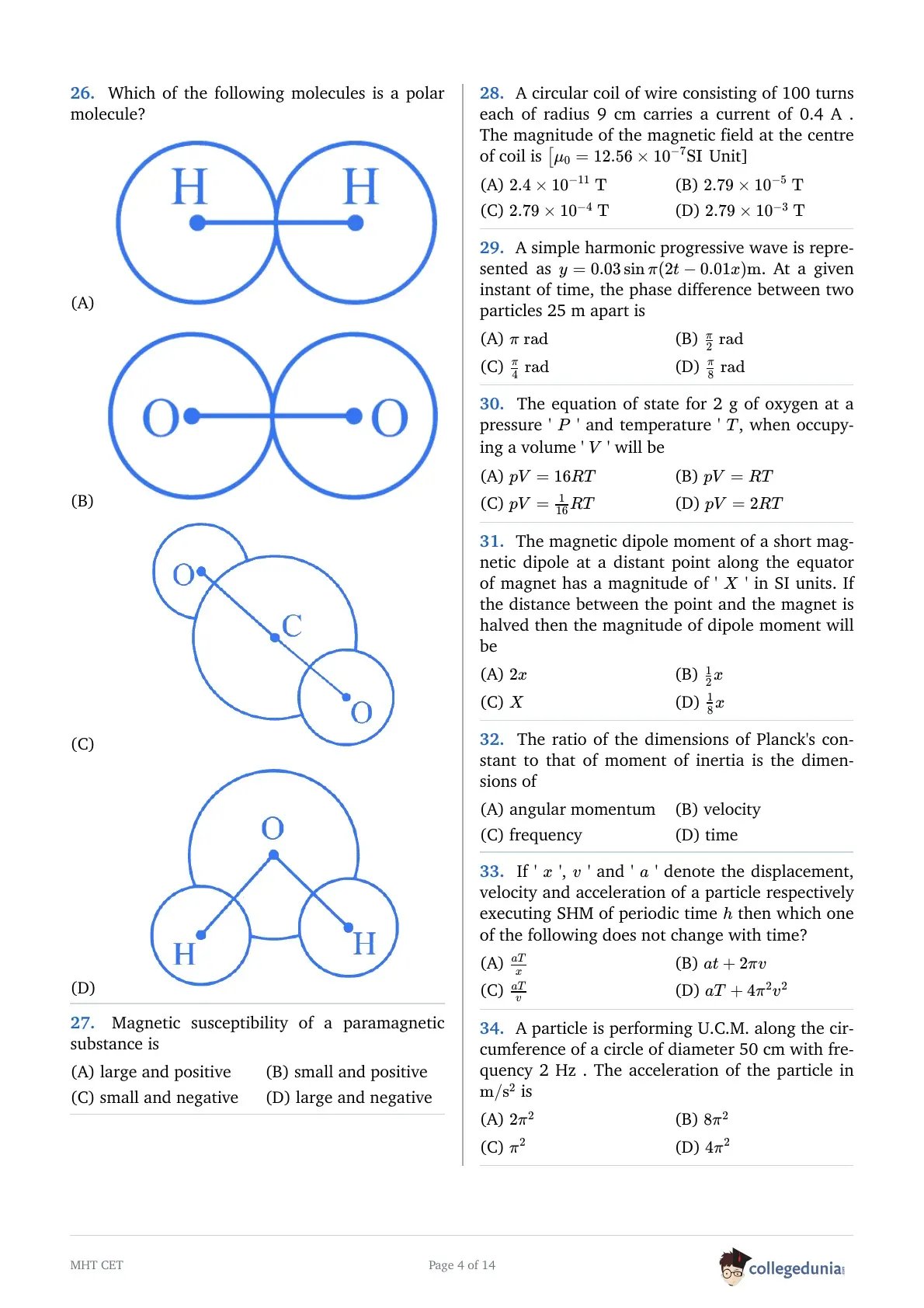
Which of the following molecules is a polar molecule?

  • (A)
  • (B)
  • (C)
  • (D)

Question 27:

Magnetic susceptibility of a paramagnetic substance is

  • (A) large and positive
  • (B) small and positive
  • (C) small and negative
  • (D) large and negative

Question 28:

A circular coil of wire consisting of 100 turns each of radius 9 cm carries a current of 0.4 A . The magnitude of the magnetic field at the centre of coil is \(\left[\mu_0=12.56 \times 10^{-7} \mathrm{SI}\right.\) Unit]

  • (A) \(2.4\times 10^{-11}\text{ }\mathrm{T}\)
  • (B) \(2.79\times 10^{-5}\text{ }\mathrm{T}\)
  • (C) \(2.79\times 10^{-4}\text{ }\mathrm{T}\)
  • (D) \(2.79\times 10^{-3}\text{ }\mathrm{T}\)

Question 29:

A simple harmonic progressive wave is represented as \(y=0.03 \sin \pi(2 t-0.01 x) \mathrm{m}\). At a given instant of time, the phase difference between two particles 25 m apart is

  • (A) \(\pi \text{ }\mathrm{rad}\)
  • (B) \(\frac{\pi}{2}\text{ }\mathrm{rad}\)
  • (C) \(\frac{\pi}{4}\text{ }\mathrm{rad}\)
  • (D) \(\frac{\pi}{8}\text{ }\mathrm{rad}\)

Question 30:

The equation of state for 2 g of oxygen at a pressure ' \(P\) ' and temperature ' \(T\), when occupying a volume ' \(V\) ' will be

  • (A) \(pV=16RT\)
  • (B) \(pV=RT\)
  • (C) \(pV=\frac{1}{16}RT\)
  • (D) \(pV=2RT\)

Question 31:

The magnetic dipole moment of a short magnetic dipole at a distant point along the equator of magnet has a magnitude of ' \(X\) ' in SI units. If the distance between the point and the magnet is halved then the magnitude of dipole moment will be

  • (A) \(2x\)
  • (B) \(\frac{1}{2}x\)
  • (C) \(X\)
  • (D) \(\frac{1}{8}x\)

Question 32:

The ratio of the dimensions of Planck's constant to that of moment of inertia is the dimensions of

  • (A) angular momentum
  • (B) velocity
  • (C) frequency
  • (D) time

Question 34:

A particle is performing U.C.M. along the circumference of a circle of diameter 50 cm with frequency 2 Hz . The acceleration of the particle in \(\mathrm{m} / \mathrm{s}^2\) is

  • (A) \(2\pi ^{2}\)
  • (B) \(8\pi ^{2}\)
  • (C) \(\pi ^{2}\)
  • (D) \(4\pi ^{2}\)

Question 35:

Find the wrong statement from the following about the equation of stationary wave given by \(Y=0.04 \cos (\pi x) \sin (50 \pi t) \mathrm{m}\) where \(t\) is in second. Then for the stationary wave.

  • (A) Time period \(=0.02\text{ }\mathrm{s}\)
  • (B) Wavelength \(=2\text{ }\mathrm{m}\)
  • (C) Velocity \(=50\text{ }\mathrm{m}/\mathrm{s}\)
  • (D) Amplitude \(=0.02\text{ }\mathrm{m}\)

Question 36:

A convex lens of focal length ' \(f\) ' is placed in contact with a concave lens of the same focal length. The equivalent focal length of the combination is

  • (A) \(f\)
  • (B) infinity
  • (C) \(\frac{f}{2}\)
  • (D) zero

Question 37:

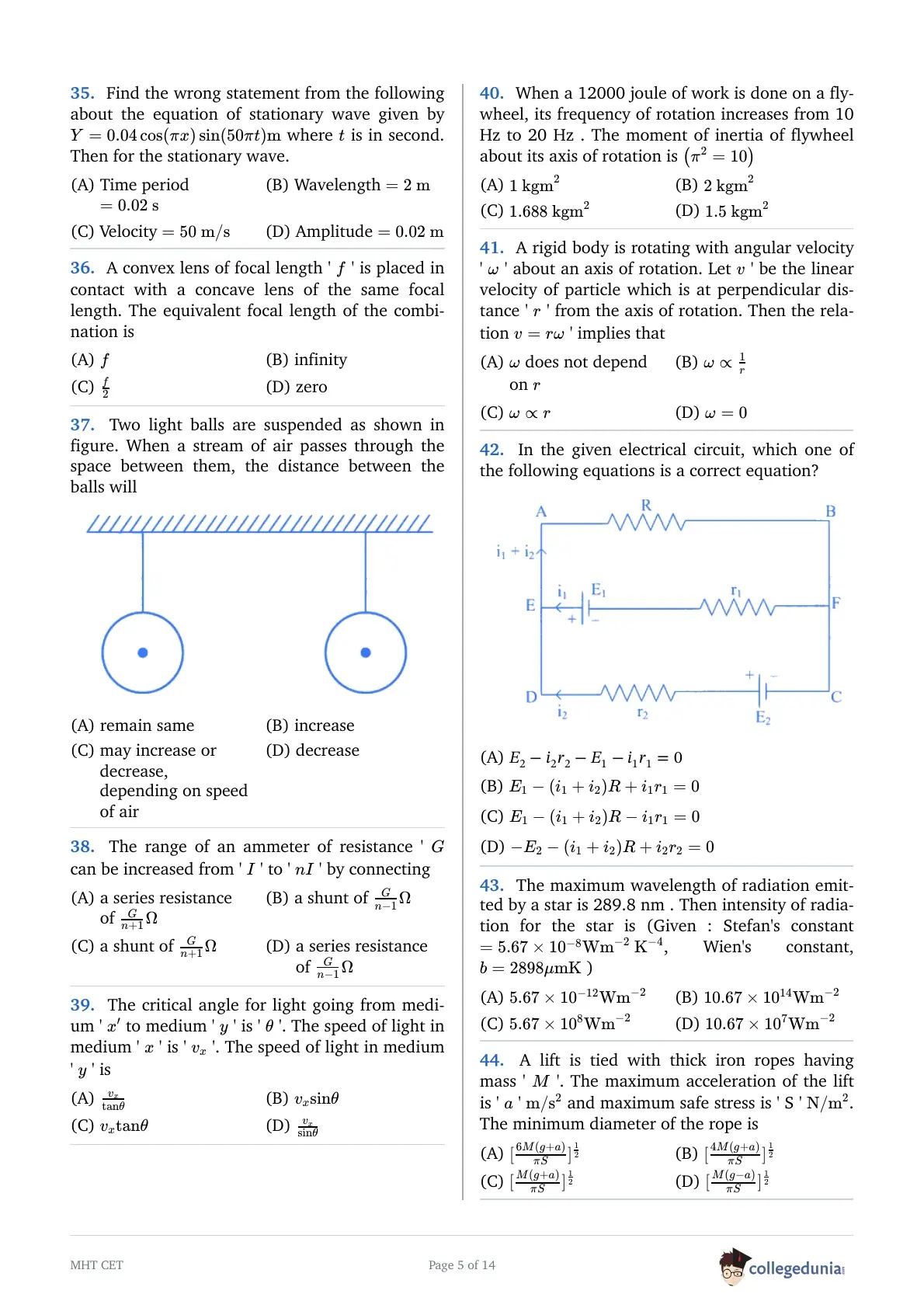
Two light balls are suspended as shown in figure. When a stream of air passes through the space between them, the distance between the balls will

  • (A) remain same
  • (B) increase
  • (C) may increase or decrease, depending on speed of air
  • (D) decrease

Question 38:

The range of an ammeter of resistance ' \(G\) can be increased from ' \(I\) ' to ' \(nI\) ' by connecting

  • (A) a series resistance of \(\frac{G}{n+1}\Omega\)
  • (B) a shunt of \(\frac{G}{n-1}\Omega\)
  • (C) a shunt of \(\frac{G}{n+1}\Omega\)
  • (D) a series resistance of \(\frac{G}{n-1}\Omega\)

Question 39:

The critical angle for light going from medium ' \(x^{\prime}\) to medium ' \(y\) ' is ' \(\theta\) '. The speed of light in medium ' \(x\) ' is ' \(v_x\) '. The speed of light in medium ' \(y\) ' is

  • (A) \(\frac{v_{x}}{\mathrm{tan}\theta}\)
  • (B) \(v_{x}\mathrm{sin}\theta\)
  • (C) \(v_{x}\mathrm{tan}\theta\)
  • (D) \(\frac{v_{x}}{\mathrm{sin}\theta}\)

Question 40:

When a 12000 joule of work is done on a flywheel, its frequency of rotation increases from 10 Hz to 20 Hz . The moment of inertia of flywheel about its axis of rotation is \(\left(\pi^2=10\right)\)

  • (A) \(1\text{ }\mathrm{kgm}^{2}\)
  • (B) \(2\text{ }\mathrm{kgm}^{2}\)
  • (C) \(1.688\text{ }\mathrm{kgm}^{2}\)
  • (D) \(1.5\text{ }\mathrm{kgm}^{2}\)

Question 41:

A rigid body is rotating with angular velocity ' \(\omega\) ' about an axis of rotation. Let \(v\) ' be the linear velocity of particle which is at perpendicular distance ' \(r\) ' from the axis of rotation. Then the relation \(v=r \omega\) ' implies that

  • (A) \(\omega\) does not depend on \(r\)
  • (B) \(\omega \propto \frac{1}{r}\)
  • (C) \(\omega \propto r\)
  • (D) \(\omega =0\)

Question 42:

In the given electrical circuit, which one of the following equations is a correct equation?

  • (A) \(E_{2}-i_{2}r_{2}-E_{1}-i_{1}r_{1}=0\)
  • (B) \(E_{1}-(i_{1}+i_{2})R+i_{1}r_{1}=0\)
  • (C) \(E_{1}-(i_{1}+i_{2})R-i_{1}r_{1}=0\)
  • (D) \(-E_{2}-(i_{1}+i_{2})R+i_{2}r_{2}=0\)

Question 43:

The maximum wavelength of radiation emitted by a star is 289.8 nm . Then intensity of radiation for the star is (Given : Stefan's constant \(=5.67 \times 10^{-8} \mathrm{Wm}^{-2} \mathrm{~K}^{-4}\), Wien's constant, \(b=2898 \mu \mathrm{mK}\) )

  • (A) \(5.67\times 10^{-12}\mathrm{Wm}^{-2}\)
  • (B) \(10.67\times 10^{14}\mathrm{Wm}^{-2}\)
  • (C) \(5.67\times 10^{8}\mathrm{Wm}^{-2}\)
  • (D) \(10.67\times 10^{7}\mathrm{Wm}^{-2}\)

Question 44:

A lift is tied with thick iron ropes having mass ' \(M\) '. The maximum acceleration of the lift is ' \(a\) ' \(\mathrm{m} / \mathrm{s}^2\) and maximum safe stress is ' S ' \(\mathrm{N} / \mathrm{m}^2\). The minimum diameter of the rope is

  • (A) \([\frac{6M(g+a)}{\pi S}]^{\frac{1}{2}}\)
  • (B) \([\frac{4M(g+a)}{\pi S}]^{\frac{1}{2}}\)
  • (C) \([\frac{M(g+a)}{\pi S}]^{\frac{1}{2}}\)
  • (D) \([\frac{M(g-a)}{\pi S}]^{\frac{1}{2}}\)

Question 45:

In Balmer series, wavelength of first line is ' \(\lambda_1\) ' and in Brackett series wavelength of first line is ' \(\lambda_2\) ' then \(\frac{\lambda_1}{\lambda_2}\) is

  • (A) 0.162
  • (B) 0.124
  • (C) 0.138
  • (D) 0.188

Question 46:

An alternating voltage is given by \(E=100 \sin \left(\omega+\frac{\pi}{6}\right) \mathrm{V}\). The voltage will be maximum for the first time when is [ \(T=\) periodic time)

  • (A) \(\frac{T}{12}\)
  • (B) \(\frac{T}{2}\)
  • (C) \(\frac{T}{6}\)
  • (D) \(\frac{T}{3}\)

Question 47:

In frequency modulated wave

  • (A) frequency varies with time
  • (B) both frequency and amplitude vary with time
  • (C) amplitude varies with time
  • (D) both frequency and amplitude are constant

Question 48:

With a resistance of ' \(X\) ' in the left gap and resistance of \(9 \Omega\) in the right gap of a meter bridge, the balance point is obtained at 40 cm from the left end. In what way and to which resistance \(3 \Omega\) resistance be connected to obtain the balance at 50 cm from the left end?

  • (A) In series with \(9\Omega\)
  • (B) Parallel to \(X\Omega\)
  • (C) In series with \(X\Omega\)
  • (D) Parallel to \(9\Omega\)

Question 49:

The excess of pressure, due to surface tension, on a spherical liquid drop of radius ' \(R\) ' is proportional to

  • (A) \(R^{-1}\)
  • (B) \(R\)
  • (C) \(R^{-2}\)
  • (D) \(R^{2}\)

Chemistry (Q51 - Q100)

Question 51:

The number of \(\sigma\) and \(\pi\)-bonds in \(2\)-formylbenzoic acid are respectively

  • (A) \(10, 3\)
  • (B) \(14, 3\)
  • (C) \(12, 5\)
  • (D) \(17, 5\)

Question 52:

The volume of \(1\) mole of any pure gas at standard temperature and pressure is always equal to

  • (A) \( 0.022414 \,m^{3}\)
  • (B) \( 22.414 \,m^{3}\)
  • (C) \( 2.2414 \,m^{3}\)
  • (D) \( 0.22414 \,m^{3}\)

Question 53:

Veronal is used as a/an

  • (A) analgesic
  • (B) antihistamine
  • (C) antibiotic
  • (D) tranquilizer

Question 54:

Which of the following is also called as nitrogen sesquioxide?

  • (A) \( NO_{2}\)
  • (B) \(N_{2}O_{3}\)
  • (C) \(N_{2}O_{4}\)
  • (D) \(N_{2}O_{5}\)

Question 55:

The oxidation number of sulphur in \(\mathrm{S}_8\) molecule is

  • (A) 6
  • (B) 0
  • (C) 2
  • (D) 3

Question 56:

Which among the following is a set of nucleophiles ?

  • (A) \(\mathrm{H}^{+},\mathrm{NH}_{3},\mathrm{Cr}^{-}\)
  • (B) \(\mathrm{BF}_{3},\mathrm{H}_{2}\mathrm{O},\mathrm{NH}_{3}\)
  • (C) \(\mathrm{AlCl}_{3},\mathrm{BF}_{3},\mathrm{NH}_{3}\)
  • (D) \(\mathrm{CN}^{-},\mathrm{H}_{2}\mathrm{O},\mathrm{R}-\mathrm{OH}\)

Question 58:

In ozone molecule the formal charge on the central oxygen atom is

  • (A) \(-1\)
  • (B) \(+2\)
  • (C) \(0\)
  • (D) \(+1\)

Question 59:

According to Werner?s theory the geometry of the complex is determined by

  • (A) only from the primary valence in space
  • (B) number and position of the primary valences in space
  • (C) number and position of the secondary valences in space
  • (D) only from the position of secondary valence in space

Question 60:

How many total constituent particles are present in simple cubic unit cell ?

  • (A) \(1\)
  • (B) \(3\)
  • (C) \(4\)
  • (D) \(2\)

Question 62:

Which among the following is a neutral complex?

  • (A) \([Fe(H_{2}O)_{6}]Cl_{3}\)
  • (B) \([Ni (NH_{3})_{6}]Cl_{2}\)
  • (C) \([Pt(NH_{3})_{2}Cl_{2}]\)
  • (D) \(K[Ag(CN)_{2}]\)

Question 63:

Identify the equation in which change in enthalpy is equal to change in internal energy

  • (A) \(2H_{2}O_{2} (I) \to 2H_{2}O(I) +O_{2}(g)\)
  • (B) \(C(s) +O_{2}(g) \to CO_{2}(g)\)
  • (C) \(PCl_{5}(g) \to PCl_{3}(g) +Cl_{2}(g)\)
  • (D) \(N_{2}(g) + 3\,H_{2}(g) \to 2NH_{3}(g)\)

Question 64:

Limestone is used as a flux in the extraction of

  • (A) iron
  • (B) alumunium
  • (C) zinc
  • (D) copper

Question 65:

Which among the following does not form polyhalide ion?

  • (A) Chlorine
  • (B) Bromine
  • (C) Iodine
  • (D) Fluorine

Question 66:

How many isomers are possible for an alkane having molecular formula \(C_{5}H_{12}\)?

  • (A) \(5\)
  • (B) \(3\)
  • (C) \(4\)
  • (D) \(2\)

Question 68:

Two moles of an ideal gas is expanded isothermally and reversibly at 300 K from 1 L to 10 L . The enthalpy change in kJ is

  • (A) 11.4 kJ
  • (B) 4.8 kJ
  • (C) \(-\)11.4 kJ
  • (D) zero kJ

Question 69:

\(\alpha\)-chlorosodium acetate on boiling with aqueous sodium nitrite gives

  • (A) nitromethane
  • (B) \(\alpha\)-chloronitromethane
  • (C) nitroethane
  • (D) acetyl chloride

Question 70:

The bond angle \(\mathrm{H}-\mathrm{O}-\mathrm{O}\) in \(\mathrm{H}_2 \mathrm{O}_2\) in gaseous phase is

  • (A) \(90.2^{\circ}\)
  • (B) \(111.5^{\circ}\)
  • (C) \(101.9^{\circ}\)
  • (D) \(94.8^{\circ}\)

Question 71:

How many metameric ethers are represented by the molecular formula \(\mathrm{C_4H_{10}O}\) ?

  • (A) 4
  • (B) 3
  • (C) 2
  • (D) 5

Question 72:

The activation energy of a reaction is zero. Its rate constant at 280 K is \(1.6 \times 10^{-6} \mathrm{~s}^{-1}\), the rate constant at 300 K is

  • (A) \(3.2\times 10^{-6}\text{ }\mathrm{s}^{-1}\)
  • (B) zero
  • (C) \(1.6\times 10^{-6}\text{ }\mathrm{s}^{-1}\)
  • (D) \(1.6\times 10^{-5}\text{ }\mathrm{s}^{-1}\)

Question 74:

Which of the following is not a broad spectrum antibiotics ?

  • (A) Penicillin
  • (B) Amoxicillin
  • (C) Chloramphenicol
  • (D) Ampicillin

Question 75:

The oxidation state of sulphur in \(\mathrm{H}_2 \mathrm{S}_2 \mathrm{O}_7\) is

  • (A) +4
  • (B) +6
  • (C) +5
  • (D) +7

Question 76:

The reaction in which \(2\) molecules of chlorobenzene reacts with metallic sodium in presence of dry ether forming diphenyl is an example of,

  • (A) Wurtz-Fittig reaction
  • (B) Wurtz reaction
  • (C) Rosenmund reaction
  • (D) Balz-Schiemann reaction

Question 77:

The percentage of unoccupied volume in simple cubic cell is

  • (A) 52.40%
  • (B) 32.00%
  • (C) 47.60%
  • (D) 68.04%

Question 78:

Isobutylene on hydroboration followed by oxidation with hydrogen peroxide in presence of base yields

  • (A) \(n\)-butyl alcohol
  • (B) sec-butyl alcohol
  • (C) tert-butyl alcohol
  • (D) isobutyl alcohol

Question 79:

What is the density of water vapour at boiling point of water?

  • (A) \(1 \times 10^{-4} \,g \,cm^{-3}\)
  • (B) \(1 \,g \,cm^{-3}\)
  • (C) \(6 \times 10^{-4} \,g \,cm^{-3}\)
  • (D) \(4 \times 10^{-4} \,g \,cm^{-3}\)

Question 80:

Which of the following molecules form a Zwitter ion?

  • (A) \(\mathrm{CH}_{3}\mathrm{COOCH}_{3}\)
  • (B) \(\mathrm{H}_{2}\mathrm{NCH}_{2}\mathrm{COOH}\)
  • (C) \(\mathrm{CH}_{3}\mathrm{COC}_{2}\mathrm{H}_{5}\)
  • (D) \(\mathrm{CH}_{3}\mathrm{CH}_{2}\mathrm{COOH}\)

Question 81:

Which reaction is useful in exchange of halogen in alkyl chloride by iodide?

  • (A) Wurtz reaction
  • (B) Finkelstein reaction
  • (C) Reimer-Tiemann reaction
  • (D) Williamson synthesis

Question 82:

Propene when treated with cold conc. \(H_{2}SO_{4}\) forms a compound which on heating with water gives

  • (A) propan-\(2\)-ol
  • (B) butan-\(1\) -ol
  • (C) ethanol
  • (D) propan- \(1\)-ol

Question 83:

Identify the amine formed when ethyltrimethyl ammonium iodide is treated with silver hydroxide and further heated strongly

  • (A) \(\mathrm{C}_{2}\mathrm{H}_{5}\mathrm{N}(\mathrm{CH}_{3})_{2}\)
  • (B) \(\mathrm{C}_{2}\mathrm{H}_{5}\mathrm{NH}_{2}\)
  • (C) \((\mathrm{CH}_{3})_{3}\mathrm{N}\)
  • (D) \(\mathrm{CH}_{3}\mathrm{NH}_{2}\)

Question 84:

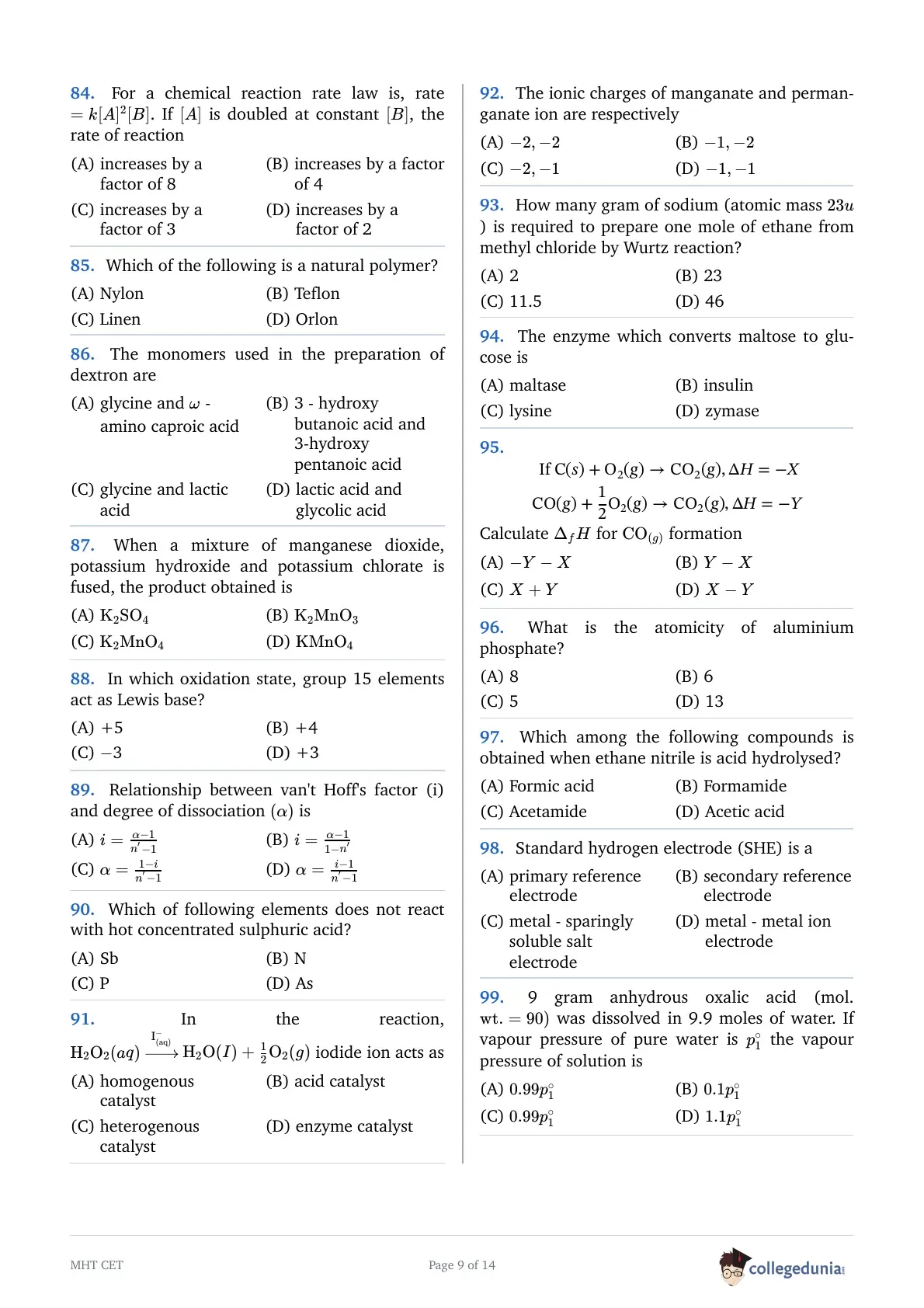
For a chemical reaction rate law is, rate \(= k[A]^{2}[B]\) If \([A]\) is doubled at constant \([B]\), the rate of reaction

  • (A) increases by a factor of \(8\)
  • (B) increases by a factor of \(4\)
  • (C) increases by a factor of \(3\)
  • (D) increases by a factor of \(2\)

Question 85:

Which of the following is a natural polymer?

  • (A) Nylon
  • (B) Teflon
  • (C) Linen
  • (D) Orlon

Question 86:

The monomers used in the preparation of dextron are

  • (A) glycine and \(\omega\) - amino caproic acid
  • (B) 3 - hydroxy butanoic acid and 3-hydroxy pentanoic acid
  • (C) glycine and lactic acid
  • (D) lactic acid and glycolic acid

Question 87:

When a mixture of manganese dioxide, potassium hydroxide and potassium chlorate is fused, the product obtained is

  • (A) \(\mathrm{K}_{2}\mathrm{SO}_{4}\)
  • (B) \(\mathrm{K}_{2}\mathrm{MnO}_{3}\)
  • (C) \(\mathrm{K}_{2}\mathrm{MnO}_{4}\)
  • (D) \(\mathrm{KMnO}_{4}\)

Question 88:

In which oxidation state, group \(15\) elements act as Lewis base?

  • (A) \(+5\)
  • (B) \(+4\)
  • (C) \(-3\)
  • (D) \(+3\)

Question 89:

Relationship between van't Hoff's factor (i) and degree of dissociation \((\alpha)\) is

  • (A) \(i=\frac{\alpha -1}{n^{'}-1}\)
  • (B) \(i=\frac{\alpha -1}{1-n^{'}}\)
  • (C) \(\alpha =\frac{1-i}{n^{'}-1}\)
  • (D) \(\alpha =\frac{i-1}{n^{'}-1}\)

Question 90:

Which of following elements does not react with hot concentrated sulphuric acid?

  • (A) Sb
  • (B) N
  • (C) P
  • (D) As

Question 91:

In the reaction, \( H_{2}O_{2} (aq) \ce{->[I^{-}(aq)]} H_{2}O(I)+\frac{1}{2} O_{2}(g)\) iodide ion acts as

  • (A) homogenous catalyst
  • (B) acid catalyst
  • (C) heterogenous catalyst
  • (D) enzyme catalyst

Question 92:

The ionic charges of manganate and permanganate ion are respectively

  • (A) \(-2,-2\)
  • (B) \(-1,-2\)
  • (C) \(-2,-1\)
  • (D) \(-1,-1\)

Question 93:

How many gram of sodium (atomic mass \(23\, u\)) is required to prepare one mole of ethane from methyl chloride by Wurtz reaction?

  • (A) \(2\)
  • (B) \(23\)
  • (C) \(11.5\)
  • (D) \(46\)

Question 94:

The enzyme which converts maltose to glucose is

  • (A) maltase
  • (B) insulin
  • (C) lysine
  • (D) zymase

Question 95:

\[\begin{aligned} & \text { If } \mathrm{C}(s)+\mathrm{O}_2(g) \rightarrow \mathrm{CO}_2(g), \Delta H=-X \\ & \mathrm{CO}(g)+\frac{1}{2} \mathrm{O}_2(g) \rightarrow \mathrm{CO}_2(g), \Delta H=-Y \end{aligned}\] Calculate \(\Delta_f H\) for \(\mathrm{CO}_{(g)}\) formation

  • (A) \(-Y-X\)
  • (B) \(Y-X\)
  • (C) \(X+Y\)
  • (D) \(X-Y\)

Question 96:

What is the atomicity of aluminium phosphate?

  • (A) \(8\)
  • (B) \(6\)
  • (C) \(5\)
  • (D) \(13\)

Question 97:

Which among the following compounds is obtained when ethane nitrile is acid hydrolysed?

  • (A) Formic acid
  • (B) Acetamide
  • (C) Formamide
  • (D) Acetic acid

Question 98:

Standard hydrogen electrode \((SHE)\) is a

  • (A) primary reference electrode
  • (B) secondary reference electrode
  • (C) metal - sparingly soluble salt electrode
  • (D) metal - metal ion electrode

Question 99:

\(9\) gram anhydrous oxalic acid (mol. wt. = \(90\)) was dissolved in \(9.9\) moles of water. If vapour pressure of pure water is \(p_{1}^\circ 1\) the vapour pressure of solution is

  • (A) \(0.99 p_{1}^{\circ}\)
  • (B) \(0.1 p_{1}^{\circ}\)
  • (C) \(0.90 p_{1}^{\circ}\)
  • (D) \(1.1 p_{1}^{\circ}\)

Question 100:

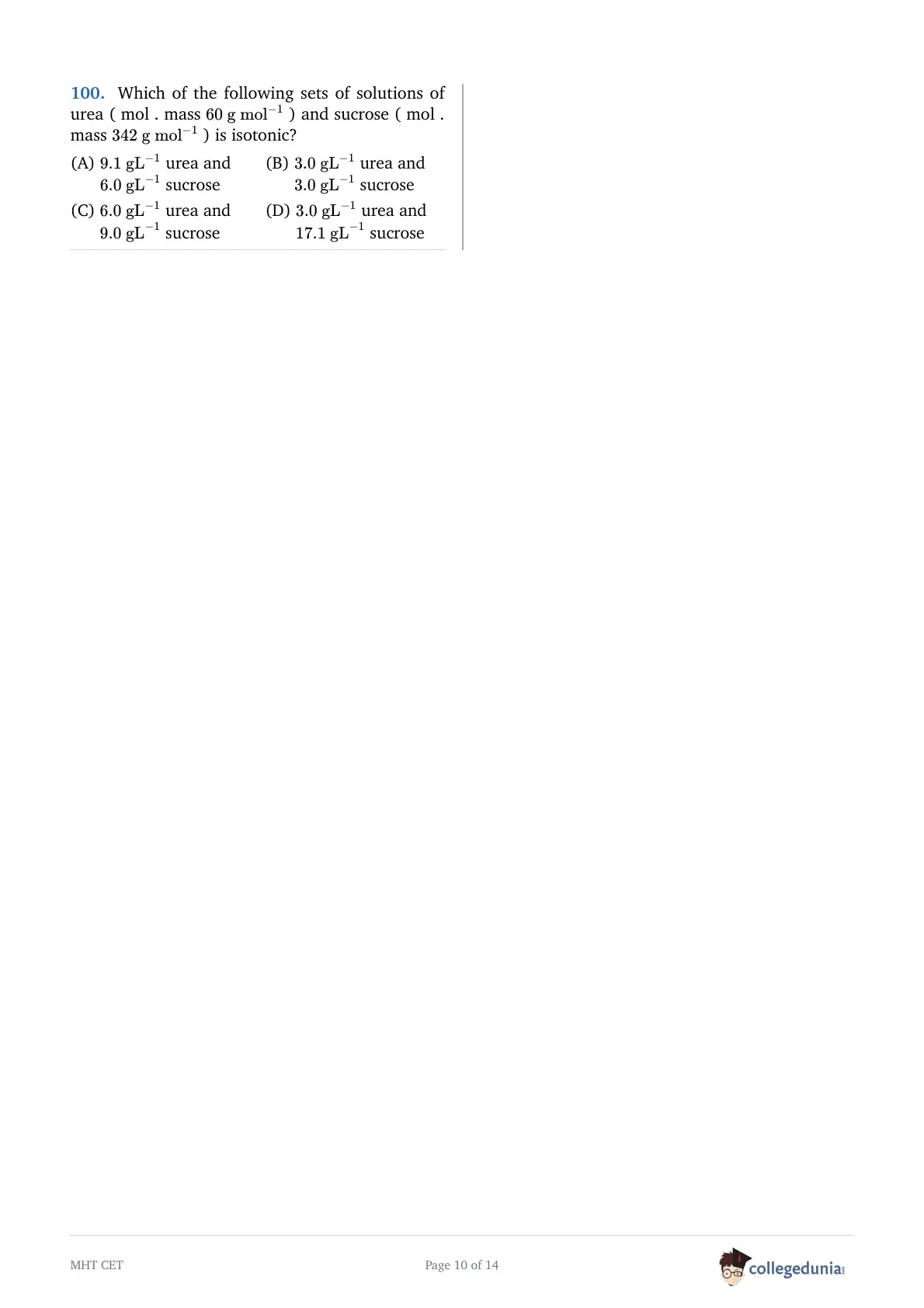
Which of the following sets of solutions of urea (mol. mass \(60 \,g\, mol^{-1}\)) and sucrose (mol. mass \(342\, g \,mol^{-1}\)) is isotonic?

  • (A) \( 9.1 \,gL^{-1}\) urea and \(6.0 \,gL^{-1}\) sucrose
  • (B) \( 3.0 \,gL^{-1}\) urea and \(3.0 \,gL^{-1}\) sucrose
  • (C) \( 6.0 \,gL^{-1}\) urea and \(9.0 \,gL^{-1}\) sucrose
  • (D) \( 3.0 \,gL^{-1}\) urea and \(17.1 \,gL^{-1}\) sucrose

Mathematics (Q101 - Q150)

Question 101:

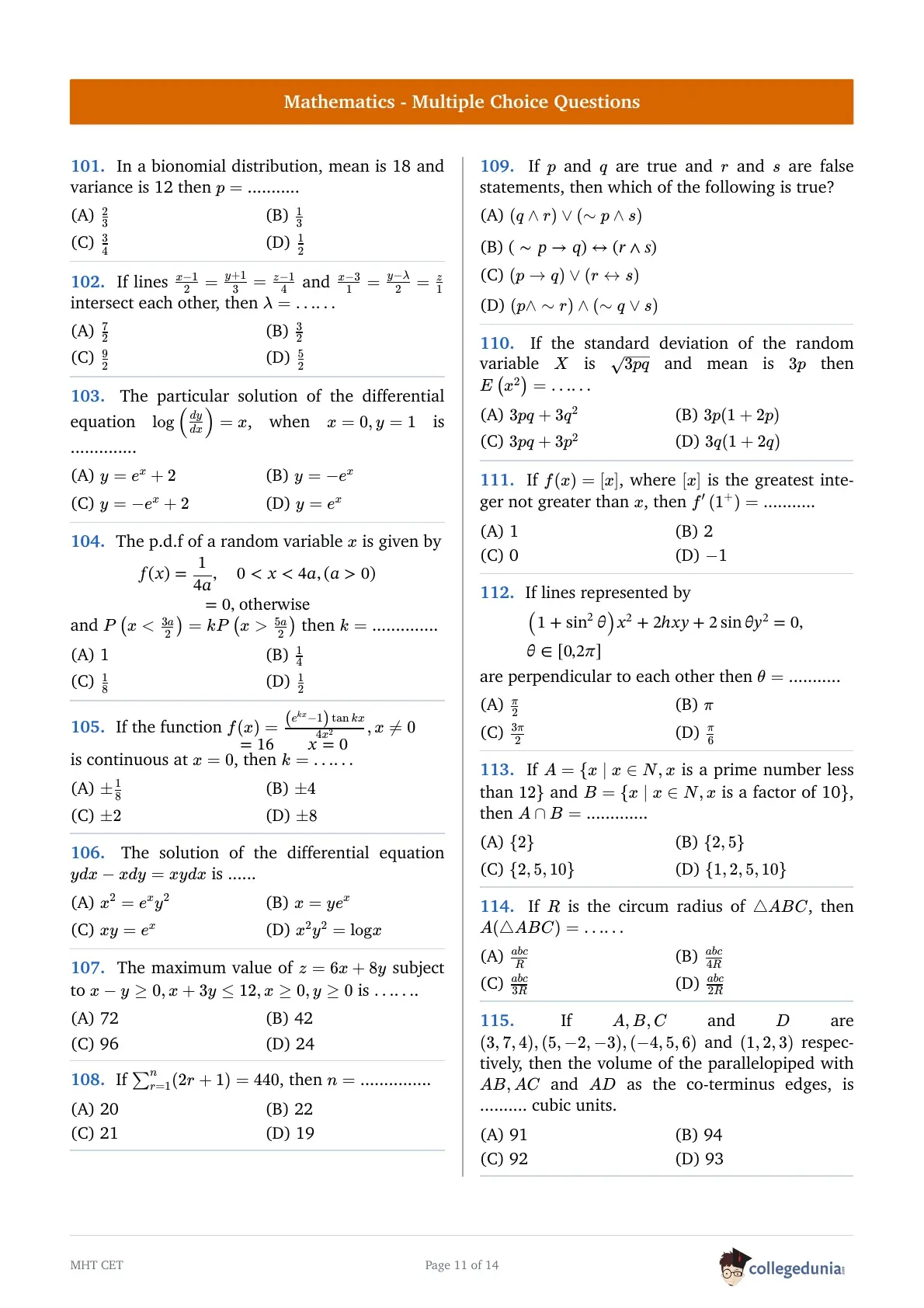
In a bionomial distribution, mean is 18 and variance is 12 then \(p=\) ...........

  • (A) \(\frac{2}{3}\)
  • (B) \(\frac{1}{3}\)
  • (C) \(\frac{3}{4}\)
  • (D) \(\frac{1}{2}\)

Question 102:

If lines \(\frac{x-1}{2}=\frac{y+1}{3}=\frac{z-1}{4}\) and \(\frac{x-3}{1}=\frac{y-\lambda}{2}=\frac{z}{1}\) intersect each other, then \(\lambda=\ldots \ldots\)

  • (A) \(\frac{7}{2}\)
  • (B) \(\frac{3}{2}\)
  • (C) \(\frac{9}{2}\)
  • (D) \(\frac{5}{2}\)

Question 103:

The particular solution of the differential equation \(\log \left(\frac{d y}{d x}\right)=x\), when \(x=0, y=1\) is ..............

  • (A) \(y=e^{x}+2\)
  • (B) \(y=-e^{x}\)
  • (C) \(y=-e^{x}+2\)
  • (D) \(y=e^{x}\)

Question 105:

If the function \(f(x)=\frac{\left(e^{k x}-1\right) \tan k x}{4 x^2}, x \neq 0\)

\[\qquad \qquad=16 \qquad x=0\]

is continuous at \(x=0\), then \(k=\ldots \ldots\)

  • (A) \(\pm \frac{1}{8}\)
  • (B) \(\pm 4\)
  • (C) \(\pm 2\)
  • (D) \(\pm 8\)

Question 106:

The solution of the differential equation \(y d x-x d y=x y d x\) is ......

  • (A) \(x^{2}=e^{x}y^{2}\)
  • (B) \(x=ye^{x}\)
  • (C) \(xy=e^{x}\)
  • (D) \(x^{2}y^{2}=\mathrm{log}x\)

Question 107:

The maximum value of \(z=6 x+8 y\) subject to \(x-y \geq 0, x+3 y \leq 12, x \geq 0, y \geq 0\) is \(\ldots \ldots\).

  • (A) 72
  • (B) 42
  • (C) 96
  • (D) 24

Question 108:

If \(\sum_{r=1}^n(2 r+1)=440\), then \(n=\) ...............

  • (A) 20
  • (B) 22
  • (C) 21
  • (D) 19

Question 109:

If \(p\) and \(q\) are true and \(r\) and \(s\) are false statements, then which of the following is true?

  • (A) \((q\wedge r)\vee (\sim p\wedge s)\)
  • (B) \((\sim p\rightarrow q)\leftrightarrow (r\wedge s)\)
  • (C) \((p\rightarrow q)\vee (r\leftrightarrow s)\)
  • (D) \((p\wedge \sim r)\wedge (\sim q\vee s)\)

Question 110:

If the standard deviation of the random variable \(X\) is \(\sqrt{3 p q}\) and mean is \(3 p\) then \(E\left(x^2\right)=\ldots \ldots\)

  • (A) \(3pq+3q^{2}\)
  • (B) \(3p(1+2p)\)
  • (C) \(3pq+3p^{2}\)
  • (D) \(3q(1+2q)\)

Question 111:

If \(f(x)=[x]\), where \([x]\) is the greatest integer not greater than \(x\), then \(f^{\prime}\left(1^{+}\right)=\) ...........

  • (A) 1
  • (B) 2
  • (C) 0
  • (D) \(-\)1

Question 112:

If lines represented by \[\left(1+\sin ^2 \theta\right) x^2+2 h x y+2 \sin \theta y^2=0, \theta \in[0,2 \pi]\] are perpendicular to each other then \(\theta=\) ...........

  • (A) \(\frac{\pi}{2}\)
  • (B) \(\pi\)
  • (C) \(\frac{3\pi}{2}\)
  • (D) \(\frac{\pi}{6}\)

Question 113:

If \(A=\{x \mid x \in N, x\) is a prime number less than \(12\}\) and \(B=\{x \mid x \in N, x\) is a factor of 10\(\}\), then \(A \cap B=\) .............

  • (A) \(\{2\}\)
  • (B) \(\{2,5\}\)
  • (C) \(\{2,5,10\}\)
  • (D) \(\{1,2,5,10\}\)

Question 114:

If \(R\) is the circum radius of \(\triangle A B C\), then \(A(\triangle A B C)=\ldots \ldots\)

  • (A) \(\frac{abc}{R}\)
  • (B) \(\frac{abc}{4R}\)
  • (C) \(\frac{abc}{3R}\)
  • (D) \(\frac{abc}{2R}\)

Question 115:

If \(A, B, C\) and \(D\) are \((3,7,4),(5,-2,-3),(-4,5,6)\) and \((1,2,3)\) respectively, then the volume of the parallelopiped with \(A B, A C\) and \(A D\) as the co-terminus edges, is .......... cubic units.

  • (A) 91
  • (B) 94
  • (C) 92
  • (D) 93

Question 116:

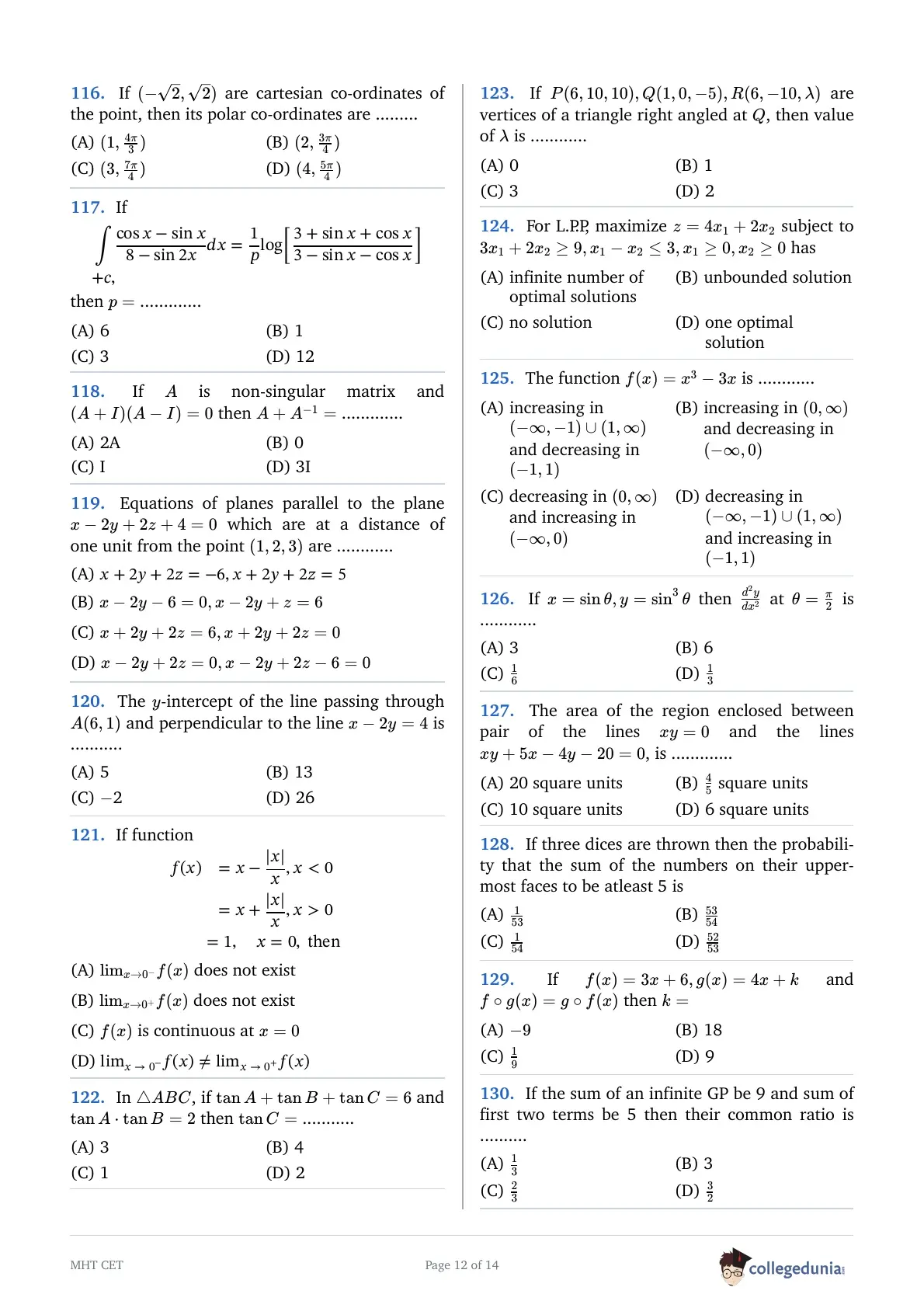
If \((-\sqrt{2}, \sqrt{2})\) are cartesian co-ordinates of the point, then its polar co-ordinates are .........

  • (A) \((1,\frac{4\pi}{3})\)
  • (B) \((2,\frac{3\pi}{4})\)
  • (C) \((3,\frac{7\pi}{4})\)
  • (D) \((4,\frac{5\pi}{4})\)

Question 117:

If \[\int \frac{\cos x-\sin x}{8-\sin 2 x} d x=\frac{1}{p} \log \left[\frac{3+\sin x+\cos x}{3-\sin x-\cos x}\right]+c,\] then \(p=\) .............

  • (A) 6
  • (B) 1
  • (C) 3
  • (D) 12

Question 118:

If \(A\) is non-singular matrix and \((A+I)(A-I)=0\) then \(A+A^{-1}=\) .............

  • (A) 2A
  • (B) 0
  • (C) I
  • (D) 3I

Question 119:

Equations of planes parallel to the plane \(x-2 y+2 z+4=0\) which are at a distance of one unit from the point \((1,2,3)\) are ............

  • (A) \(x+2y+2z=-6,x+2y+2z=5\)
  • (B) \(x-2y-6=0,x-2y+z=6\)
  • (C) \(x+2y+2z=6,x+2y+2z=0\)
  • (D) \(x-2y+2z=0,x-2y+2z-6=0\)

Question 120:

The \(y\)-intercept of the line passing through \(A(6,1)\) and perpendicular to the line \(x-2 y=4\) is ...........

  • (A) 5
  • (B) 13
  • (C) \(-\)2
  • (D) 26

Question 122:

In \(\triangle A B C\), if \(\tan A+\tan B+\tan C=6\) and \(\tan A \cdot \tan B=2\) then \(\tan C=\) ...........

  • (A) 3
  • (B) 4
  • (C) 1
  • (D) 2

Question 123:

If \(P(6,10,10), Q(1,0,-5), R(6,-10, \lambda)\) are vertices of a triangle right angled at \(Q\), then value of \(\lambda\) is ............

  • (A) 0
  • (B) 1
  • (C) 3
  • (D) 2

Question 124:

For L.P.P, maximize \(z=4 x_1+2 x_2\) subject to \(3 x_1+2 x_2 \geq 9, x_1-x_2 \leq 3, x_1 \geq 0, x_2 \geq 0\) has

  • (A) infinite number of optimal solutions
  • (B) unbounded solution
  • (C) no solution
  • (D) one optimal solution

Question 125:

The function \(f(x)=x^3-3 x\) is ............

  • (A) increasing in \((-\infty ,-1)\cup (1,\infty )\) and decreasing in \((-1,1)\)
  • (B) increasing in \((0,\infty )\) and decreasing in \((-\infty ,0)\)
  • (C) decreasing in \((0,\infty )\) and increasing in \((-\infty ,0)\)
  • (D) decreasing in \((-\infty ,-1)\cup (1,\infty )\) and increasing in \((-1,1)\)

Question 126:

If \(x=\sin \theta, y=\sin ^3 \theta\) then \(\frac{d^2 y}{d x^2}\) at \(\theta=\frac{\pi}{2}\) is ............

  • (A) 3
  • (B) 6
  • (C) \(\frac{1}{6}\)
  • (D) \(\frac{1}{3}\)

Question 127:

The area of the region enclosed between pair of the lines \(x y=0\) and the lines \(x y+5 x-4 y-20=0\), is .............

  • (A) 20 square units
  • (B) \(\frac{4}{5}\) square units
  • (C) 10 square units
  • (D) 6 square units

Question 128:

If three dices are thrown then the probability that the sum of the numbers on their uppermost faces to be atleast 5 is

  • (A) \(\frac{1}{53}\)
  • (B) \(\frac{53}{54}\)
  • (C) \(\frac{1}{54}\)
  • (D) \(\frac{52}{53}\)

Question 129:

If \(f(x)=3 x+6, g(x)=4 x+k\) and \(f \circ g(x)=g \circ f(x)\) then \(k=\)

  • (A) \(-9\)
  • (B) 18
  • (C) \(\frac{1}{9}\)
  • (D) 9

Question 130:

If the sum of an infinite GP be 9 and sum of first two terms be 5 then their common ratio is ..........

  • (A) \(\frac{1}{3}\)
  • (B) 3
  • (C) \(\frac{2}{3}\)
  • (D) \(\frac{3}{2}\)

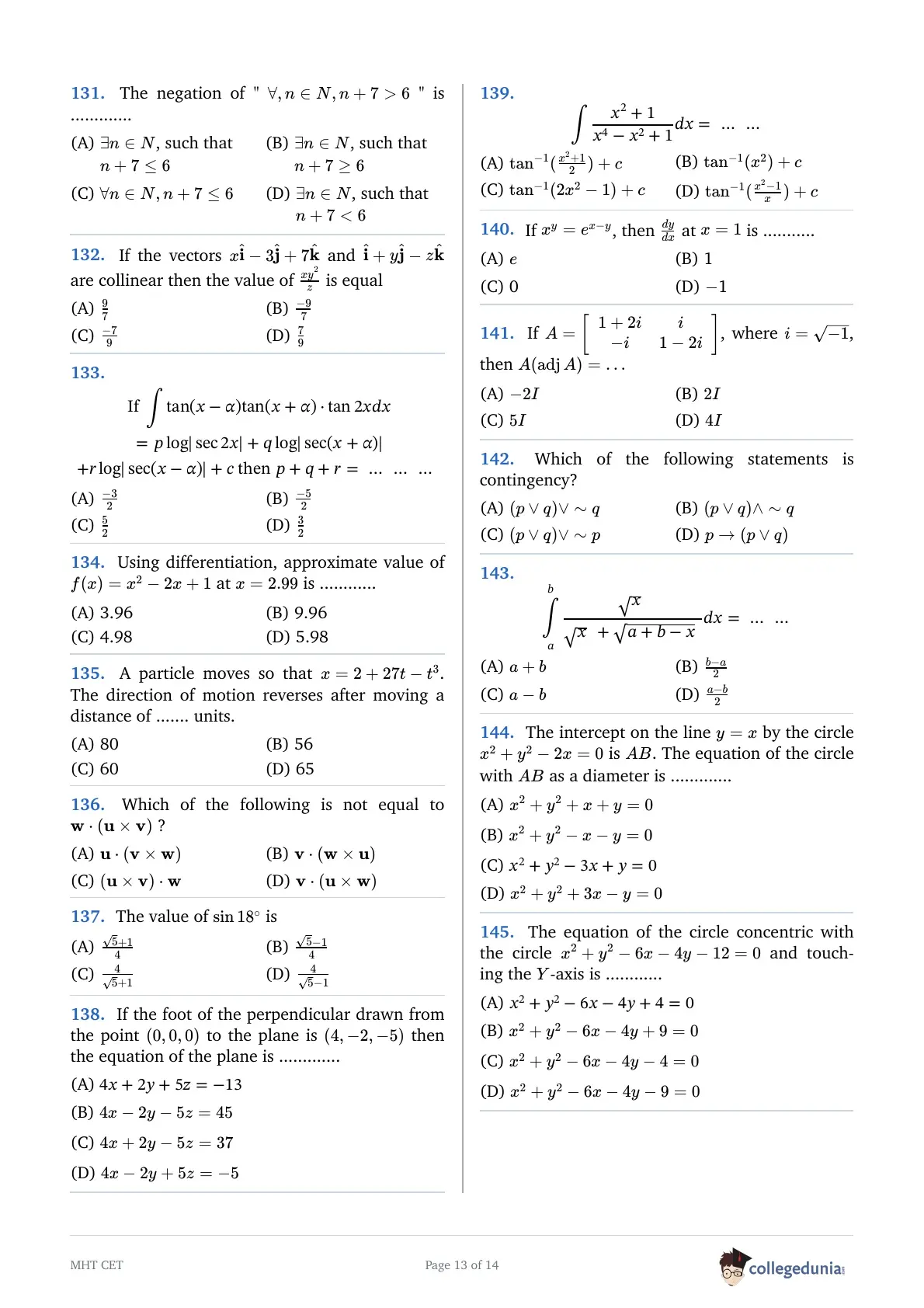
Question 131:

The negation of " \(\forall, n \in N, n+7>6\) " is .............

  • (A) \(\exists n\in N\), such that \(n+7\leq 6\)
  • (B) \(\exists n\in N\), such that \(n+7\geq 6\)
  • (C) \(\forall n\in N,n+7\leq 6\)
  • (D) \(\exists n\in N\), such that \(n+7<6\)

Question 132:

If the vectors \(x \hat{\mathbf{i}}-3 \hat{\mathbf{j}}+7 \hat{\mathbf{k}}\) and \(\hat{\mathbf{i}}+y \hat{\mathbf{j}}-z \hat{\mathbf{k}}\) are collinear then the value of \(\frac{x y^2}{z}\) is equal

  • (A) \(\frac{9}{7}\)
  • (B) \(\frac{-9}{7}\)
  • (C) \(\frac{-7}{9}\)
  • (D) \(\frac{7}{9}\)

Question 133:

\[\begin{aligned} & \text { If } \int \tan (x-\alpha) \tan (x+\alpha) \cdot \tan 2 x d x \\ & =p \log |\sec 2 x|+q \log |\sec (x+\alpha)| \\ & +r \log |\sec (x-\alpha)|+c \text { then } p+q+r=\ldots \ldots \ldots \end{aligned}\]

  • (A) \(\frac{-3}{2}\)
  • (B) \(\frac{-5}{2}\)
  • (C) \(\frac{5}{2}\)
  • (D) \(\frac{3}{2}\)

Question 134:

Using differentiation, approximate value of \(f(x)=x^2-2 x+1\) at \(x=2.99\) is ............

  • (A) 3.96
  • (B) 9.96
  • (C) 4.98
  • (D) 5.98

Question 136:

Which of the following is not equal to \(\mathbf{w} \cdot(\mathbf{u} \times \mathbf{v})\) ?

  • (A) \(\mathbf{u}\cdot (\mathbf{v}\times \mathbf{w})\)
  • (B) \(\mathbf{v}\cdot (\mathbf{w}\times \mathbf{u})\)
  • (C) \((\mathbf{u}\times \mathbf{v})\cdot \mathbf{w}\)
  • (D) \(\mathbf{v}\cdot (\mathbf{u}\times \mathbf{w})\)

Question 137:

The value of \(\sin 18^{\circ}\) is \(\qquad\)

  • (A) \(\frac{\sqrt{5}+1}{4}\)
  • (B) \(\frac{\sqrt{5}-1}{4}\)
  • (C) \(\frac{4}{\sqrt{5}+1}\)
  • (D) \(\frac{4}{\sqrt{5}-1}\)

Question 138:

If the foot of the perpendicular drawn from the point \((0,0,0)\) to the plane is \((4,-2,-5)\) then the equation of the plane is .............

  • (A) \(4x+2y+5z=-13\)
  • (B) \(4x-2y-5z=45\)
  • (C) \(4x+2y-5z=37\)
  • (D) \(4x-2y+5z=-5\)

Question 139:

\[\int \frac{x^2+1}{x^4-x^2+1} d x=\ldots \ldots\]

  • (A) \(\mathrm{tan}^{-1}(\frac{x^{2}+1}{2})+c\)
  • (B) \(\mathrm{tan}^{-1}(x^{2})+c\)
  • (C) \(\mathrm{tan}^{-1}(2x^{2}-1)+c\)
  • (D) \(\mathrm{tan}^{-1}(\frac{x^{2}-1}{x})+c\)

Question 140:

If \(x^y=e^{x-y}\), then \(\frac{d y}{d x}\) at \(x=1\) is ...........

  • (A) \(e\)
  • (B) 1
  • (C) 0
  • (D) \(-\)1

Question 141:

If \(A=\left[\begin{array}{cc}1+2 i & i \\ -i & 1-2 i\end{array}\right]\), where \(i=\sqrt{-1}\), then \(A(\operatorname{adj} A)=\ldots\)

  • (A) \(-2I\)
  • (B) \(2I\)
  • (C) \(5I\)
  • (D) \(4I\)

Question 143:

\[\int_\limits a^b \frac{\sqrt{x}}{\sqrt{x}+\sqrt{a+b-x}} d x=\ldots \ldots\]

  • (A) \(a+b\)
  • (B) \(\frac{b-a}{2}\)
  • (C) \(a-b\)
  • (D) \(\frac{a-b}{2}\)

Question 144:

The intercept on the line \(y=x\) by the circle \(x^2+y^2-2 x=0\) is \(A B\). The equation of the circle with \(A B\) as a diameter is .............

  • (A) \(x^{2}+y^{2}+x+y=0\)
  • (B) \(x^{2}+y^{2}-x-y=0\)
  • (C) \(x^{2}+y^{2}-3x+y=0\)
  • (D) \(x^{2}+y^{2}+3x-y=0\)

Question 145:

The equation of the circle concentric with the circle \(x^2+y^2-6 x-4 y-12=0\) and touching the \(Y\)-axis is ............

  • (A) \(x^{2}+y^{2}-6x-4y+4=0\)
  • (B) \(x^{2}+y^{2}-6x-4y+9=0\)
  • (C) \(x^{2}+y^{2}-6x-4y-4=0\)
  • (D) \(x^{2}+y^{2}-6x-4y-9=0\)

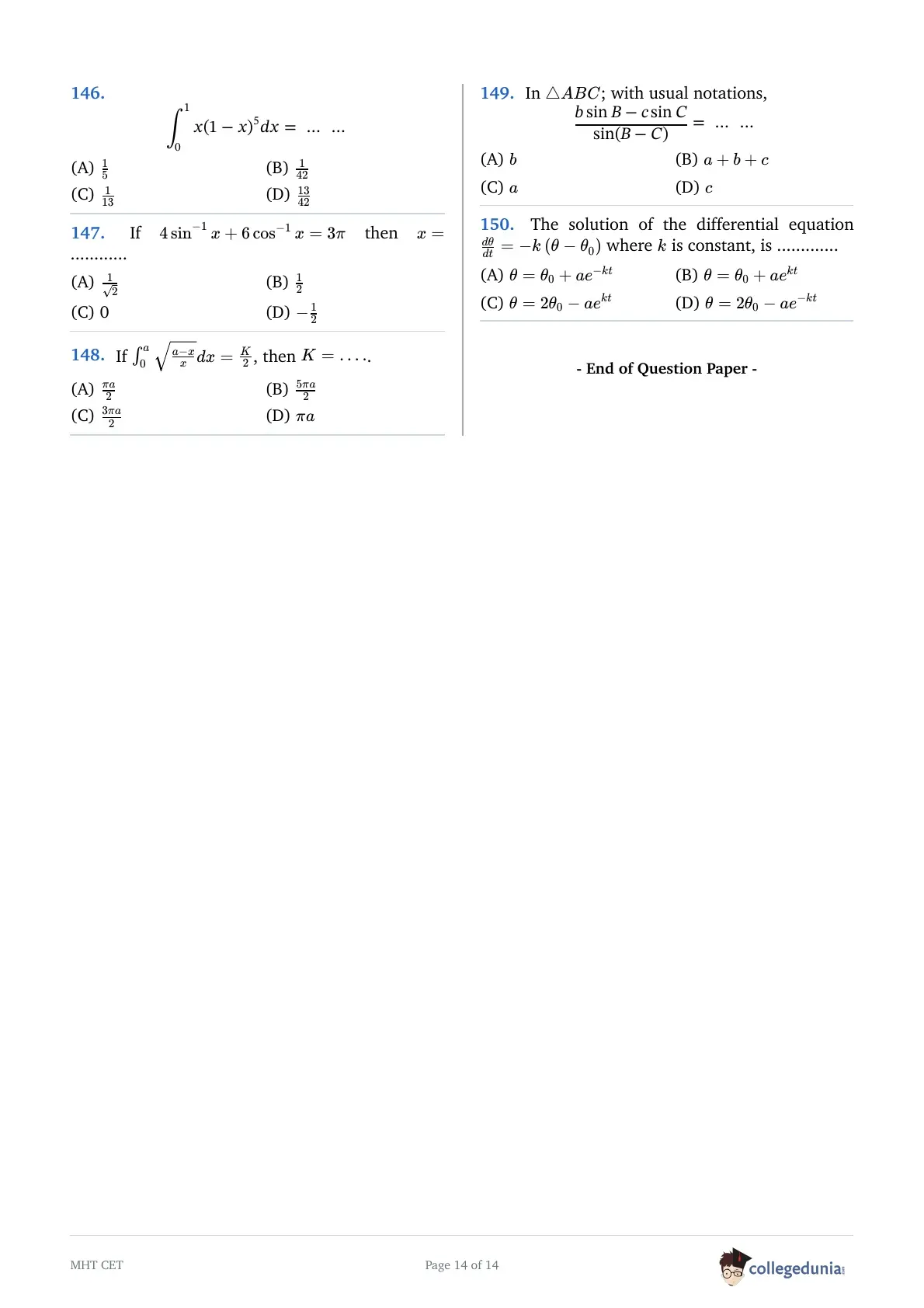
Question 146:

\[\int_0^1 x(1-x)^5 d x=\ldots \ldots\]

  • (A) \(\frac{1}{5}\)
  • (B) \(\frac{1}{42}\)
  • (C) \(\frac{1}{13}\)
  • (D) \(\frac{13}{42}\)

Question 147:

If \(4 \sin ^{-1} x+6 \cos ^{-1} x=3 \pi\) then \(x=\) ............

  • (A) \(\frac{1}{\sqrt{2}}\)
  • (B) \(\frac{1}{2}\)
  • (C) 0
  • (D) \(-\frac{1}{2}\)

Question 148:

If \(\int_0^a \sqrt{\frac{a-x}{x}} d x=\frac{K}{2}\), then \(K=\ldots .\).

  • (A) \(\frac{\pi a}{2}\)
  • (B) \(\frac{5\pi a}{2}\)
  • (C) \(\frac{3\pi a}{2}\)
  • (D) \(\pi a\)

Question 149:

In \(\triangle A B C\); with usual notations, \[\frac{b \sin B-c \sin C}{\sin (B-C)}=\ldots \ldots\]

  • (A) \(b\)
  • (B) \(a+b+c\)
  • (C) \(a\)
  • (D) \(c\)

Question 150:

The solution of the differential equation \(\frac{d \theta}{d t}=-k\left(\theta-\theta_0\right)\) where \(k\) is constant, is .............

  • (A) \(\theta =\theta _{0}+ae^{-kt}\)
  • (B) \(\theta =\theta _{0}+ae^{kt}\)
  • (C) \(\theta =2\theta _{0}-ae^{kt}\)
  • (D) \(\theta =2\theta _{0}-ae^{-kt}\)

MHT CET 2019 PCM Exam Pattern and Marking Scheme

Parameter Details
Conducting Body Maharashtra Common Entrance Test Cell (Maharashtra CET Cell)
Exam Mode Online (Computer-Based Test)
Duration 180 minutes (3 hours)
Groups / Subjects PCM (Physics, Chemistry, Mathematics) for Engineering
Total Questions

150

Total Marks 200
Question Type Multiple Choice Questions (MCQs)
Marks Distribution
  • Mathematics – 2 marks/question
  • Physics and Chemistry – 1 mark/question
Negative Marking No
Syllabus Weightage
  • Class 12 – 80%
  • Class 11 – 20%