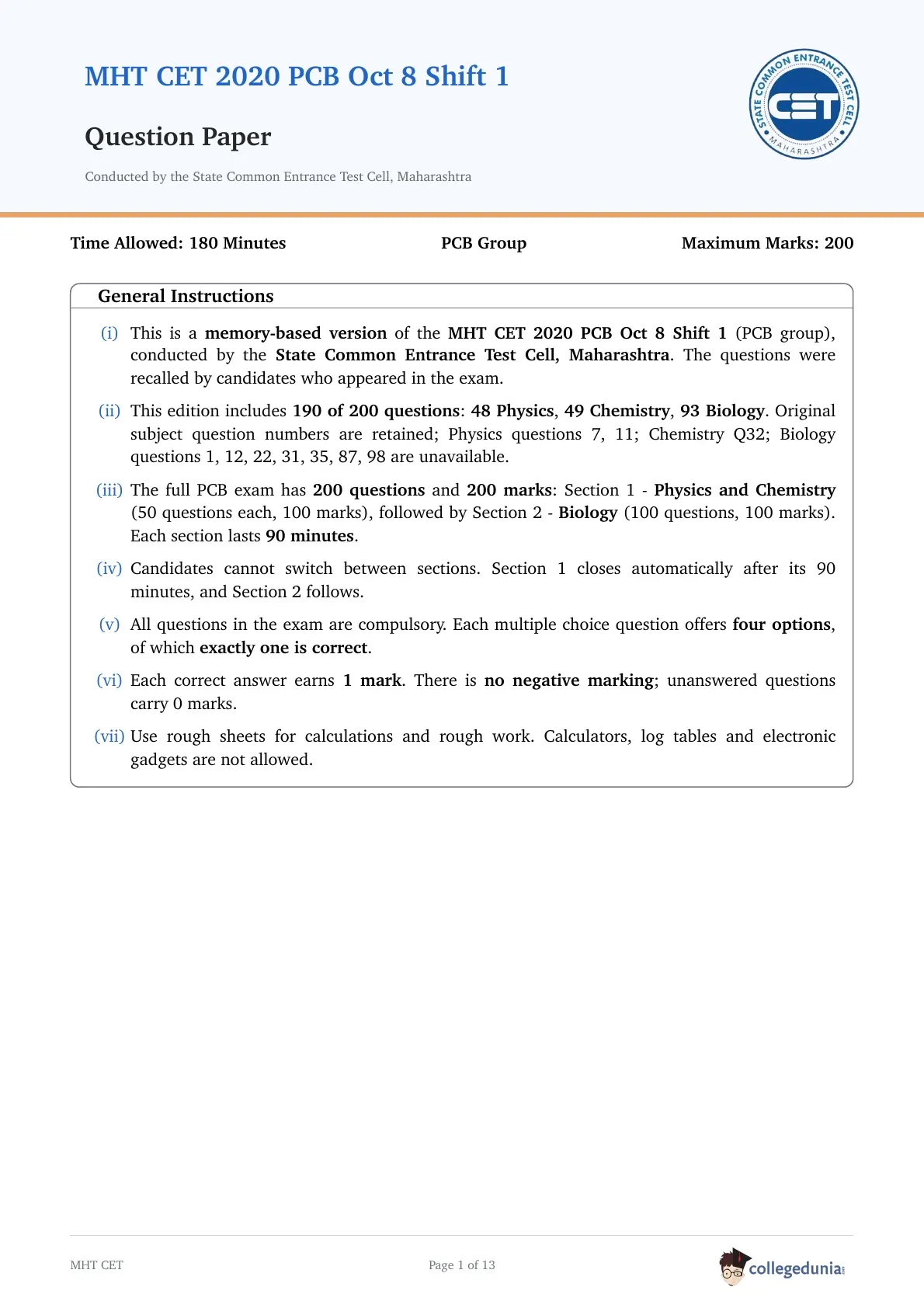
MHT CET 2020 Oct 8 Shift 1 PCB Question Paper is available for download here. Maharashtra State CET Cell conducted MHT CET 2020 PCB Exam on Oct 8 in Shift 1 from 9 AM to 12 PM in CBT mode. This paper is memory-based: it is compiled from the questions candidates recalled after the exam, so it does not contain every question of the shift.
The MHT CET 2020 PCB question paper includes the following:
- The MHT CET 2020 PCB Question Paper consists of 200 multiple-choice questions (MCQs) totalling 200 marks divided into 3 sections: Physics (50 questions), Chemistry (50 questions), and Biology (100 questions).
- All questions carry 1 mark each. There is no negative marking for incorrect answers.
MHT CET 2020 Oct 8 Shift 1 PCB Question Paper with Solution PDF
Also Check:
MHT CET 2020 Oct 8 Shift 1 PCB Questions with Solutions
Physics (Q1 - Q50)
Question 1:
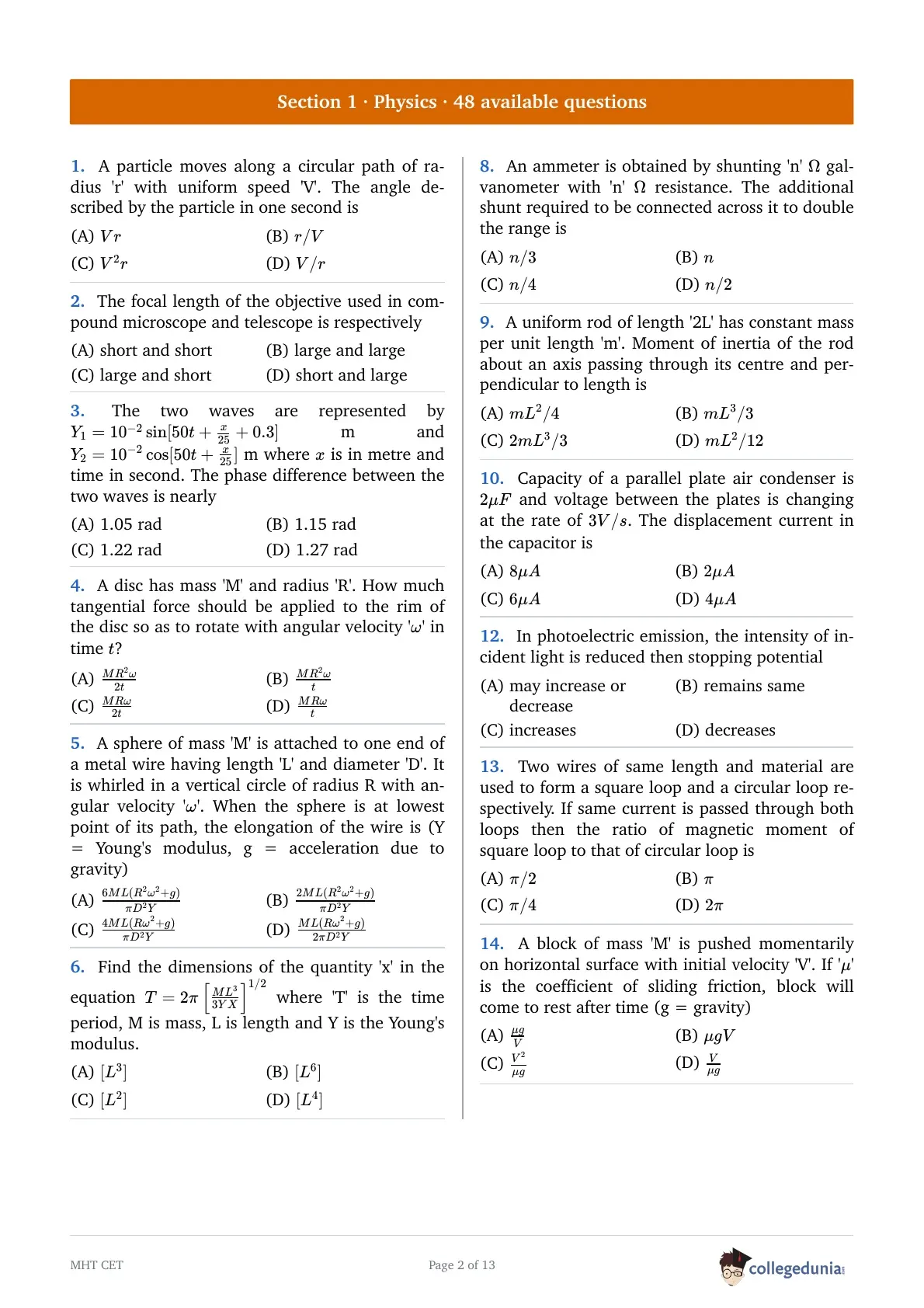
A particle moves along a circular path of radius \( r \) with uniform speed \( V \). The angle described by the particle in one second is
- (A) \( V r \)
- (B) \( \frac{r}{V} \)
- (C) \( V^2 r \)
- (D) \( \frac{V}{r} \)
Question 2:
The focal length of the objective used in compound microscope and telescope is respectively
- (A) short and short
- (B) large and large
- (C) large and short
- (D) short and large
Question 3:
The two waves are represented by \( Y_1 = 10^{-2} \sin \left[ 50t + \frac{x}{25} + 0.3 \right] \, \text{m} \) and \( Y_2 = 10^{-2} \cos \left[ 50t + \frac{x}{25} \right] \, \text{m} \), where \( x \) is in metre and time in second. The phase difference between the two waves is nearly
- (A) 1:05 rad
- (B) 1:15 rad
- (C) 1:22 rad
- (D) 1:27 rad
Question 4:
A disc has mass \( M \) and radius \( R \). How much tangential force should be applied to the rim of the disc so as to rotate with angular velocity \( \omega \) in time \( t \)?
- (A) \( \frac{MR^2 \omega}{2t} \)
- (B) \( \frac{MR^2 \omega}{t} \)
- (C) \( \frac{MR \omega}{2t} \)
- (D) \( \frac{MR \omega}{t} \)
Question 5:
A sphere of mass \( M \) is attached to one end of a metal wire having length \( L \) and diameter \( D \). It is whirled in a vertical circle of radius \( R \) with angular velocity \( \omega \). When the sphere is at the lowest point of its path, the elongation of the wire is
- (A) \( \frac{6ML \left( R^2 \omega^2 + g \right)}{\pi D^2 Y} \)
- (B) \( \frac{2ML \left( R^2 \omega^2 + g \right)}{\pi D^2 Y} \)
- (C) \( \frac{4ML \left( R \omega^2 + g \right)}{\pi D^2 Y} \)
- (D) \( \frac{ML \left( R \omega^2 + g \right)}{2 D^2 Y} \)
Question 6:
Find the dimensions of the quantity \( x \) in the equation \( T = 2\pi \left( \frac{ML^3}{3XY} \right)^{\frac{1}{2}} \), where \( T \) is the time period, \( M \) is mass, \( L \) is length, and \( Y \) is the Young’s modulus.
- (A) \( [L^3] \)
- (B) \( [L^6] \)
- (C) \( [L^2] \)
- (D) \( [L^4] \)
Question 9:
A uniform rod of length \( 2L \) has constant mass per unit length \( m \). The moment of inertia of the rod about an axis passing through its center and perpendicular to its length is
- (A) \( \frac{mL^2}{4} \)
- (B) \( \frac{mL^3}{3} \)
- (C) \( \frac{2mL^3}{3} \)
- (D) \( \frac{mL^2}{12} \)
Question 10:
Capacity of a parallel plate air condenser is 2 μF and voltage between the plates is changing at the rate of 3 V/s. The displacement current in the capacitor is
- (A) 8 μA
- (B) 2 μA
- (C) 6 μA
- (D) 4 μA
Question 12:
In photoelectric emission, the intensity of incident light is reduced then stopping potential
- (A) may increase or decrease.
- (B) remains same.
- (C) increases.
- (D) decreases.
Question 13:
Two wires of the same length and material are used to form a square loop and a circular loop respectively. If the same current is passed through both loops, then the ratio of the magnetic moment of the square loop to that of the circular loop is
- (A) \( \frac{\pi}{2} \)
- (B) \( \pi \)
- (C) \( \frac{\pi}{4} \)
- (D) \( 2\pi \)
Question 14:
A block of mass \( M \) is pushed momentarily on a horizontal surface with initial velocity \( V \). If \( \mu \) is the coefficient of sliding friction between the block and surface, the block will come to rest after time \( t \) (where \( g \) is the acceleration due to gravity)
- (A) \( \frac{\mu g}{V} \)
- (B) \( \mu g V \)
- (C) \( \frac{v^2}{\mu g} \)
- (D) \( \frac{V}{\mu g} \)
Question 15:
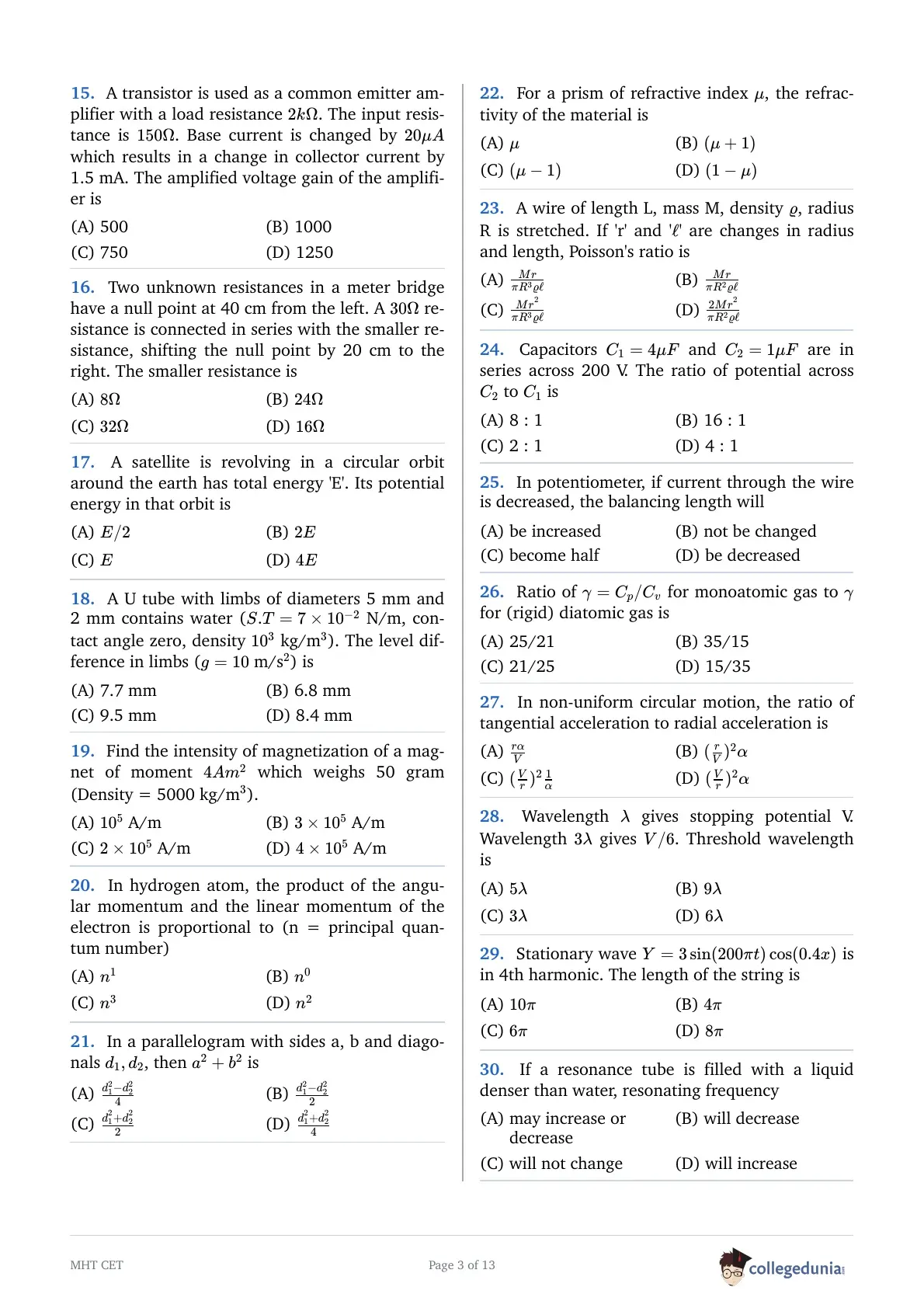
A transistor is used as a common emitter amplifier with a load resistance of 2 k\(\Omega\). The input resistance is 150 \(\Omega\). Base current is changed by 20 \(\mu A\), which results in a change in collector current by 1.5 mA. The amplified voltage gain of the amplifier is
- (A) 500
- (B) 1000
- (C) 750
- (D) 1250
Question 16:
Two unknown resistances are connected in two gaps of a meter bridge. The null point is obtained at 40 cm from the left end. A 30 \(\Omega\) resistance is connected in series with the smaller of the two resistances, the null point shifts by 20 cm to the right end. The value of the smaller resistance is
- (A) 8 \(\Omega\)
- (B) 24 \(\Omega\)
- (C) 32 \(\Omega\)
- (D) 16 \(\Omega\)
Question 17:
A satellite is revolving in a circular orbit around the earth with total energy \( E \). Its potential energy in that orbit is
- (A) \( \frac{E}{2} \)
- (B) \( 2E \)
- (C) \( E \)
- (D) \( 4E \)
Question 18:
A U tube with limbs of diameters 5 mm and 2 mm contains water of surface tension \( 7 \times 10^{-2} \, \text{N/m} \), angle of contact is zero and density \( 10^3 \, \text{kg/m}^3 \). The difference in the level in the two limbs is \( (g = 10 \, \text{m/s}^2) \)
- (A) 7.7 mm
- (B) 6.8 mm
- (C) 9.5 mm
- (D) 8.4 mm
Question 19:
Find the intensity of magnetization of a magnet with moment \( 4 \, \text{Am}^2 \) which weighs 50 grams. (Density of the material of a magnet = 5000 kg/m\(^3\))
- (A) \( 10^5 \, \text{A/m} \)
- (B) \( 3 \times 10^5 \, \text{A/m} \)
- (C) \( 2 \times 10^5 \, \text{A/m} \)
- (D) \( 4 \times 10^5 \, \text{A/m} \)
Question 20:
In hydrogen atom, the product of the angular momentum and the linear momentum of the electron is proportional to \( (n = \) principal quantum number)
- (A) \( n^1 \)
- (B) \( n^0 \)
- (C) \( n^3 \)
- (D) \( n^2 \)
Question 21:
In a parallelogram with sides a, b and diagonals \(d_1, d_2\), then \(a^{2} + b^{2}\) is
- (A) \(\frac{d_1^{2}-d_2^{2}}{4}\)
- (B) \(\frac{d_1^{2}-d_2^{2}}{2}\)
- (C) \(\frac{d_1^{2}+d_2^{2}}{2}\)
- (D) \(\frac{d_1^{2}+d_2^{2}}{4}\)
Question 22:
For a prism, \( A \) is the angle of the prism, \( \delta \) is the angle of deviation, \( \mu \) is the refractive index of the material of a prism, the refractivity of the material of a prism is
- (A) \( \mu \)
- (B) \( (\mu + 1) \)
- (C) \( (\mu - 1) \)
- (D) \( (1 - \mu) \)
Question 23:
A wire of length \( L \), mass \( M \), density \( \rho \), radius \( R \) is stretched by a certain load. If \( r \) and \( \ell \) are the changes in radius and length respectively, then Poisson's ratio is
- (A) \( \frac{Mr}{\pi R^3 \rho \ell} \)
- (B) \( \frac{Mr}{\pi R^2 \rho \ell} \)
- (C) \( \frac{Mr^2}{\pi R^3 \rho \ell} \)
- (D) \( \frac{2 Mr^2}{\pi R^2 \rho \ell} \)
Question 24:
A capacitor \( C_1 = 4 \, \mu F \) is connected in series with another capacitor \( C_2 = 1 \, \mu F \). The combination is connected across a d.c. source of 200 V. The ratio of potential across \( C_2 \) to that across \( C_1 \) is
- (A) 8:1
- (B) 16:1
- (C) 2:1
- (D) 4:1
Question 25:
In potentiometer experiment, for a given current, the balancing length for a cell is obtained at \( L \) cm. If the current through potentiometer wire is decreased, then the balancing length will
- (A) be increased.
- (B) not be changed.
- (C) become half.
- (D) be decreased.
Question 26:
Ratio of \(\gamma = C_p/C_v\) for monoatomic gas to \(\gamma\) for (rigid) diatomic gas is
- (A) 25/21
- (B) 35/15
- (C) 21/25
- (D) 15/35
Question 27:
In non-uniform circular motion, the ratio of tangential acceleration to radial acceleration is
- (A) \(\frac{r\alpha}{V}\)
- (B) \((\frac{r}{V})^{2}\alpha\)
- (C) \((\frac{V}{r})^{2}\frac{1}{\alpha}\)
- (D) \((\frac{V}{r})^{2}\alpha\)
Question 28:
Wavelength \(\lambda\) gives stopping potential V. Wavelength \(3\lambda\) gives \(V/6\). Threshold wavelength is
- (A) \(5\lambda\)
- (B) \(9\lambda\)
- (C) \(3\lambda\)
- (D) \(6\lambda\)
Question 29:
Stationary wave \(Y = 3\sin(200\pi t)\cos(0.4x)\) is in 4th harmonic. The length of the string is
- (A) \(10\pi\)
- (B) \(4\pi\)
- (C) \(6\pi\)
- (D) \(8\pi\)
Question 30:
The resonance tube is filled with a liquid of density higher than that of water, then the resonating frequency
- (A) may increase or decrease.
- (B) will decrease.
- (C) will not change.
- (D) will increase.
Question 31:
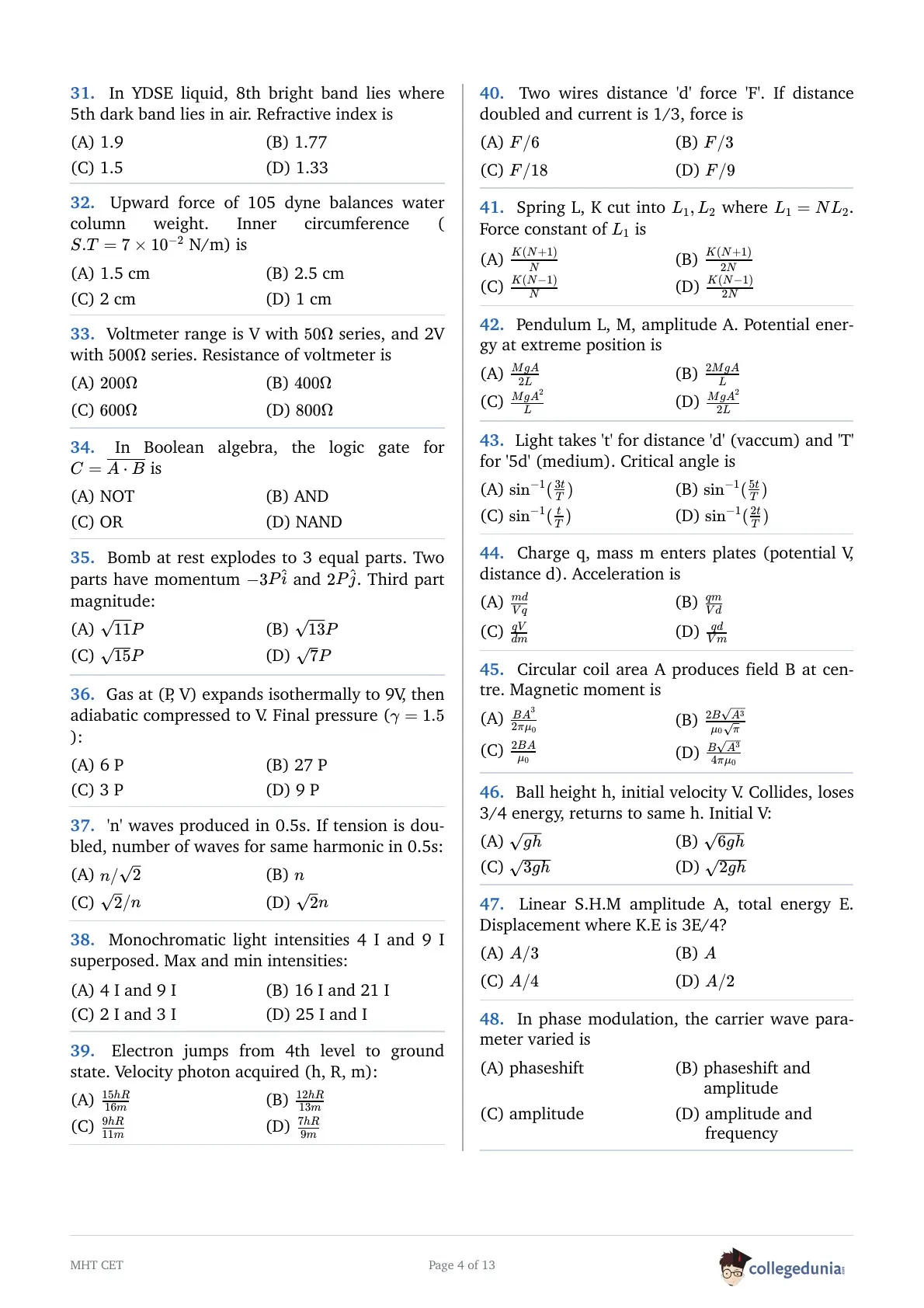
In YDSE liquid, 8th bright band lies where 5th dark band lies in air. Refractive index is
- (A) 1.9
- (B) 1.77
- (C) 1.5
- (D) 1.33
Question 32:
Upward force of 105 dyne balances water column weight. Inner circumference (\(S.T = 7\times10^{-2}\) N/m) is
- (A) 1.5 cm
- (B) 2.5 cm
- (C) 2 cm
- (D) 1 cm
Question 33:
The range of the voltmeter is \( V \) when \( 50 \, \Omega \) resistance is connected in series. Its range gets doubled when \( 500 \, \Omega \) resistance is connected in series. The resistance of the voltmeter is
- (A) 200 \(\Omega\)
- (B) 400 \(\Omega\)
- (C) 600 \(\Omega\)
- (D) 800 \(\Omega\)
Question 34:
In Boolean algebra, the logic gate for \(C = \overline{A \cdot B}\) is
- (A) NOT
- (B) AND
- (C) OR
- (D) NAND
Question 35:
Bomb at rest explodes to 3 equal parts. Two parts have momentum \(-3P\hat{i}\) and \(2P\hat{j}\). Third part magnitude:
- (A) \(\sqrt{11}P\)
- (B) \(\sqrt{13}P\)
- (C) \(\sqrt{15}P\)
- (D) \(\sqrt{7}P\)
Question 36:
Gas at (P, V) expands isothermally to 9V, then adiabatic compressed to V. Final pressure (\(\gamma = 1.5\)):
- (A) 6 P
- (B) 27 P
- (C) 3 P
- (D) 9 P
Question 37:
'n' waves produced in 0.5s. If tension is doubled, number of waves for same harmonic in 0.5s:
- (A) \(n/\sqrt{2}\)
- (B) \(n\)
- (C) \(\sqrt{2}/n\)
- (D) \(\sqrt{2}n\)
Question 38:
Monochromatic light intensities 4 I and 9 I superposed. Max and min intensities:
- (A) 4 I and 9 I
- (B) 16 I and 21 I
- (C) 2 I and 3 I
- (D) 25 I and I
Question 39:
Electron jumps from 4th level to ground state. Velocity photon acquired (h, R, m):
- (A) \(\frac{15hR}{16m}\)
- (B) \(\frac{12hR}{13m}\)
- (C) \(\frac{9hR}{11m}\)
- (D) \(\frac{7hR}{9m}\)
Question 40:
Two wires distance 'd' force 'F'. If distance doubled and current is 1/3, force is
- (A) \(F/6\)
- (B) \(F/3\)
- (C) \(F/18\)
- (D) \(F/9\)
Question 41:
Spring L, K cut into \(L_1, L_2\) where \(L_1 = NL_2\). Force constant of \(L_1\) is
- (A) \(\frac{K(N+1)}{N}\)
- (B) \(\frac{K(N+1)}{2N}\)
- (C) \(\frac{K(N-1)}{N}\)
- (D) \(\frac{K(N-1)}{2N}\)
Question 42:
Pendulum L, M, amplitude A. Potential energy at extreme position is
- (A) \(\frac{MgA}{2L}\)
- (B) \(\frac{2MgA}{L}\)
- (C) \(\frac{MgA^{2}}{L}\)
- (D) \(\frac{MgA^{2}}{2L}\)
Question 43:
Light takes 't' for distance 'd' (vaccum) and 'T' for '5d' (medium). Critical angle is
- (A) \(\sin^{-1}(\frac{3t}{T})\)
- (B) \(\sin^{-1}(\frac{5t}{T})\)
- (C) \(\sin^{-1}(\frac{t}{T})\)
- (D) \(\sin^{-1}(\frac{2t}{T})\)
Question 44:
Charge q, mass m enters plates (potential V, distance d). Acceleration is
- (A) \(\frac{md}{Vq}\)
- (B) \(\frac{qm}{Vd}\)
- (C) \(\frac{qV}{dm}\)
- (D) \(\frac{qd}{Vm}\)
Question 45:
A current carrying circular coil of area \( A \) produces magnetic field \( B \) at the centre. The magnetic moment of the coil is ( \( \mu_0 \) = permeability of free space)
- (A) \( \frac{BA^3}{2 \pi \mu_0} \)
- (B) \( \frac{2 B A^3}{\mu_0 \sqrt{\pi}} \)
- (C) \( \frac{2 B A}{\mu_0} \)
- (D) \( \frac{B A^3}{4 \pi \mu_0} \)
Question 46:
Ball height h, initial velocity V. Collides, loses 3/4 energy, returns to same h. Initial V:
- (A) \(\sqrt{gh}\)
- (B) \(\sqrt{6gh}\)
- (C) \(\sqrt{3gh}\)
- (D) \(\sqrt{2gh}\)
Question 47:
Linear S.H.M amplitude A, total energy E. Displacement where K.E is 3E/4?
- (A) \(A/3\)
- (B) \(A\)
- (C) \(A/4\)
- (D) \(A/2\)
Question 48:
In phase modulation, the carrier wave parameter varied is
- (A) phaseshift
- (B) phaseshift and amplitude
- (C) amplitude
- (D) amplitude and frequency
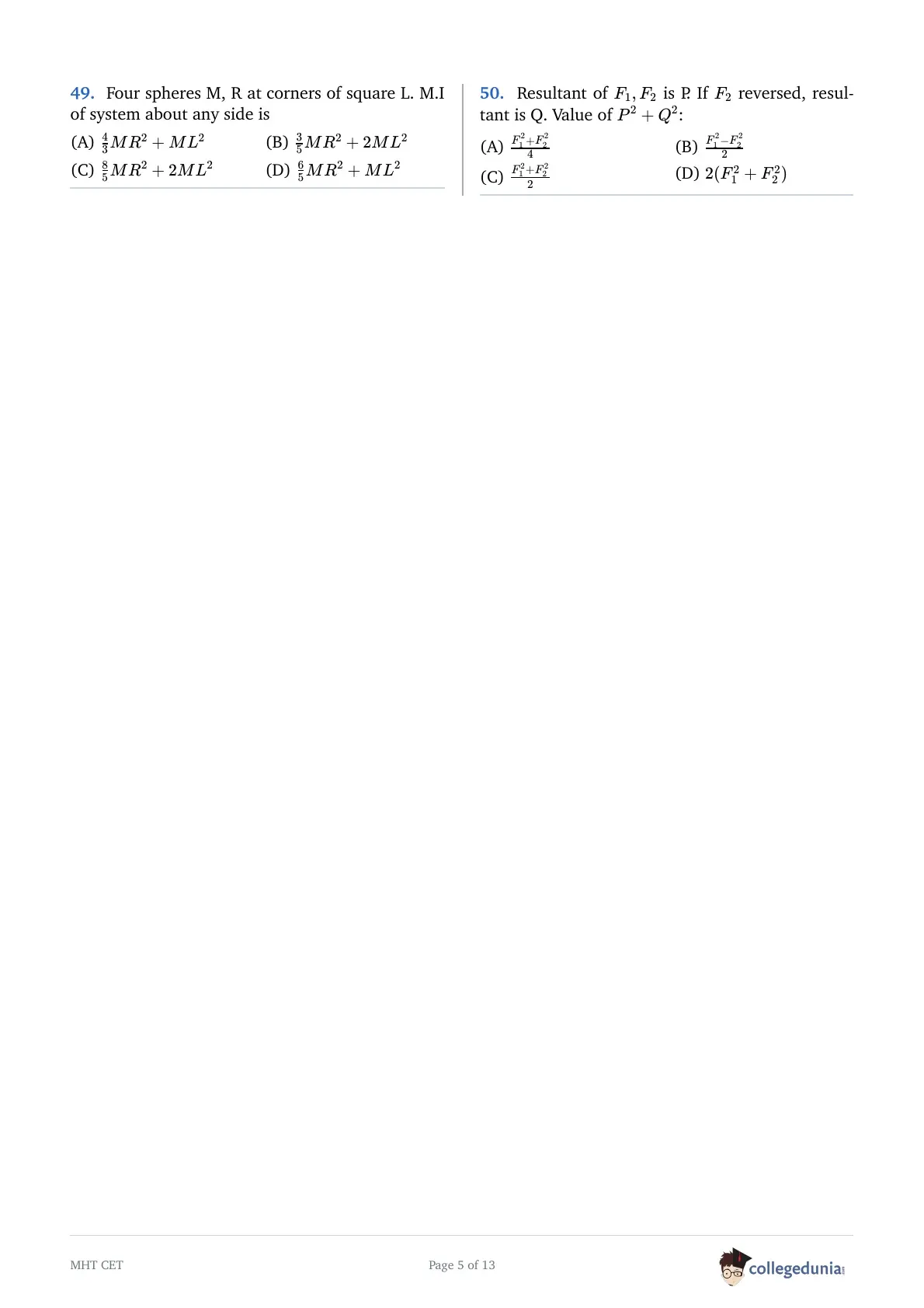
Question 49:
Four spheres M, R at corners of square L. M.I of system about any side is
- (A) \(\frac{4}{3}MR^{2}+ML^{2}\)
- (B) \(\frac{3}{5}MR^{2}+2ML^{2}\)
- (C) \(\frac{8}{5}MR^{2}+2ML^{2}\)
- (D) \(\frac{6}{5}MR^{2}+ML^{2}\)
Question 50:
Resultant of \(F_1, F_2\) is P. If \(F_2\) reversed, resultant is Q. Value of \(P^{2}+Q^{2}\):
- (A) \(\frac{F_1^{2}+F_2^{2}}{4}\)
- (B) \(\frac{F_1^{2}-F_2^{2}}{2}\)
- (C) \(\frac{F_1^{2}+F_2^{2}}{2}\)
- (D) \(2(F_1^{2}+F_2^{2})\)
Chemistry (Q51 - Q100)
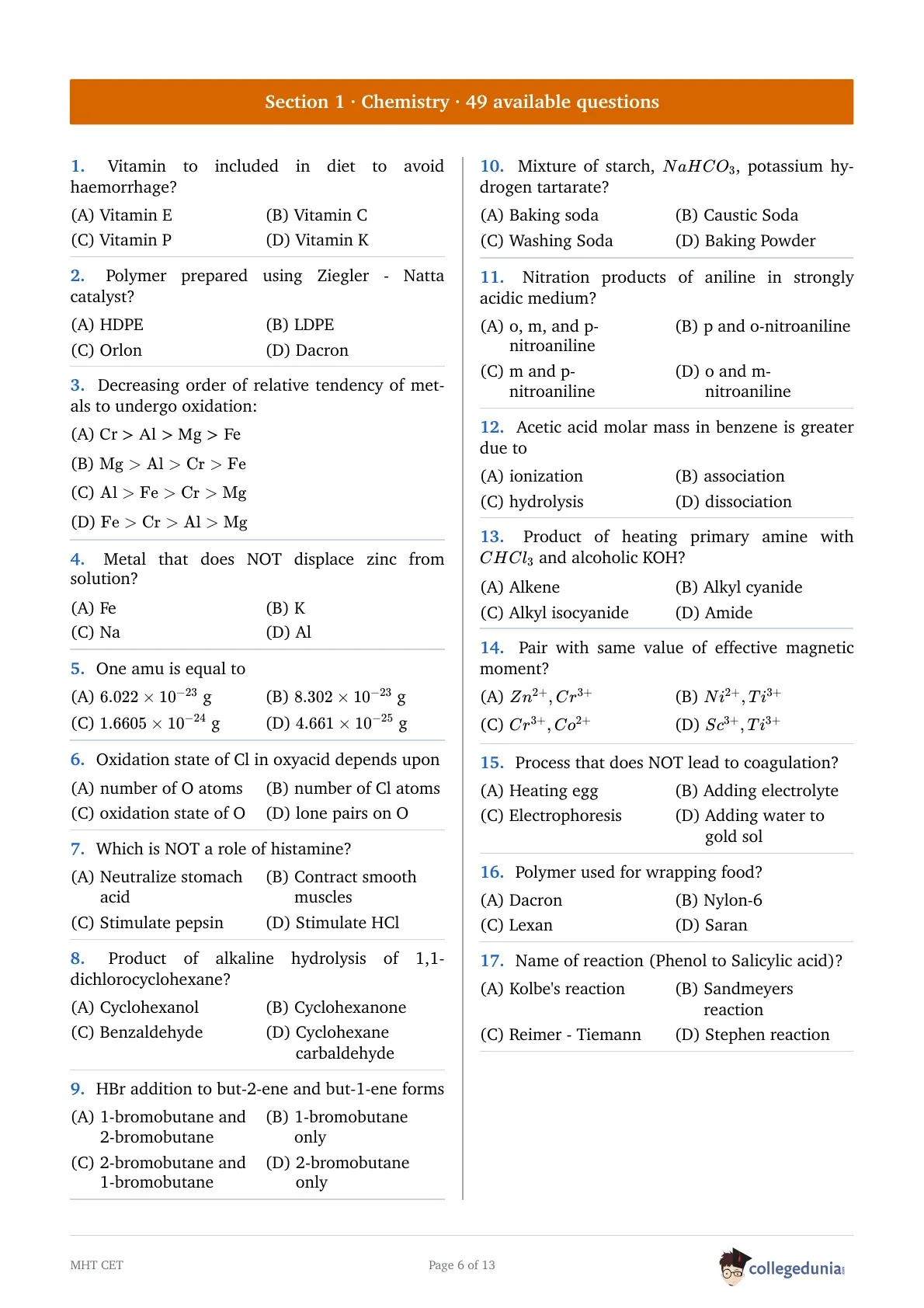
Question 51:
Vitamin to included in diet to avoid haemorrhage?
- (A) Vitamin E
- (B) Vitamin C
- (C) Vitamin P
- (D) Vitamin K
Question 52:
Polymer prepared using Ziegler - Natta catalyst?
- (A) HDPE
- (B) LDPE
- (C) Orlon
- (D) Dacron
Question 53:
Identify the correct decreasing order of relative tendency of metals to undergo oxidation from the following.
- (A) Cr>Al>Mg>Fe
- (B) Mg>Al>Cr>Fe
- (C) Al>Fe>Cr>Mg
- (D) Fe>Cr>Al>Mg
Question 54:
Metal that does NOT displace zinc from solution?
- (A) Fe
- (B) K
- (C) Na
- (D) Al
Question 55:
One amu is equal to,
- (A) 6.022 × 10⁻²³ g
- (B) 8.302 × 10⁻²³ g
- (C) 1.6605 × 10⁻²⁴ g
- (D) 4.661 × 10⁻²⁵ g
Question 56:
Oxidation state of Cl in oxyacid depends upon
- (A) number of O atoms
- (B) number of Cl atoms
- (C) oxidation state of O
- (D) lone pairs on O
Question 57:
Which is NOT a role of histamine?
- (A) Neutralize stomach acid
- (B) Contract smooth muscles
- (C) Stimulate pepsin
- (D) Stimulate HCl
Question 58:
Product of alkaline hydrolysis of 1,1-dichlorocyclohexane?
- (A) Cyclohexanol
- (B) Cyclohexanone
- (C) Benzaldehyde
- (D) Cyclohexane carbaldehyde
Question 59:
Addition of hydrogen bromide to but-2-ene and but-1-ene forms
- (A) 1-bromobutane and 2-bromobutane respectively
- (B) 1-bromobutane only
- (C) 2-bromobutane and 1-bromobutane respectively
- (D) 2-bromobutane only
Question 60:
Mixture of starch, \(NaHCO_3\), potassium hydrogen tartarate?
- (A) Baking soda
- (B) Caustic Soda
- (C) Washing Soda
- (D) Baking Powder
Question 62:
Acetic acid molar mass in benzene is greater due to
- (A) ionization
- (B) association
- (C) hydrolysis
- (D) dissociation
Question 63:
Product of heating primary amine with \(CHCl_3\) and alcoholic KOH?
- (A) Alkene
- (B) Alkyl cyanide
- (C) Alkyl isocyanide
- (D) Amide
Question 64:
Pair with same value of effective magnetic moment?
- (A) \(Zn^{2+}, Cr^{3+}\)
- (B) \(Ni^{2+}, Ti^{3+}\)
- (C) \(Cr^{3+}, Co^{2+}\)
- (D) \(Sc^{3+}, Ti^{3+}\)
Question 65:
Process that does NOT lead to coagulation?
- (A) Heating egg
- (B) Adding electrolyte
- (C) Electrophoresis
- (D) Adding water to gold sol
Question 66:
Polymer used for wrapping food?
- (A) Dacron
- (B) Nylon-6
- (C) Lexan
- (D) Saran
Question 67:
Name of reaction (Phenol to Salicylic acid)?
- (A) Kolbe's reaction
- (B) Sandmeyers reaction
- (C) Reimer - Tiemann
- (D) Stephen reaction
Question 68:
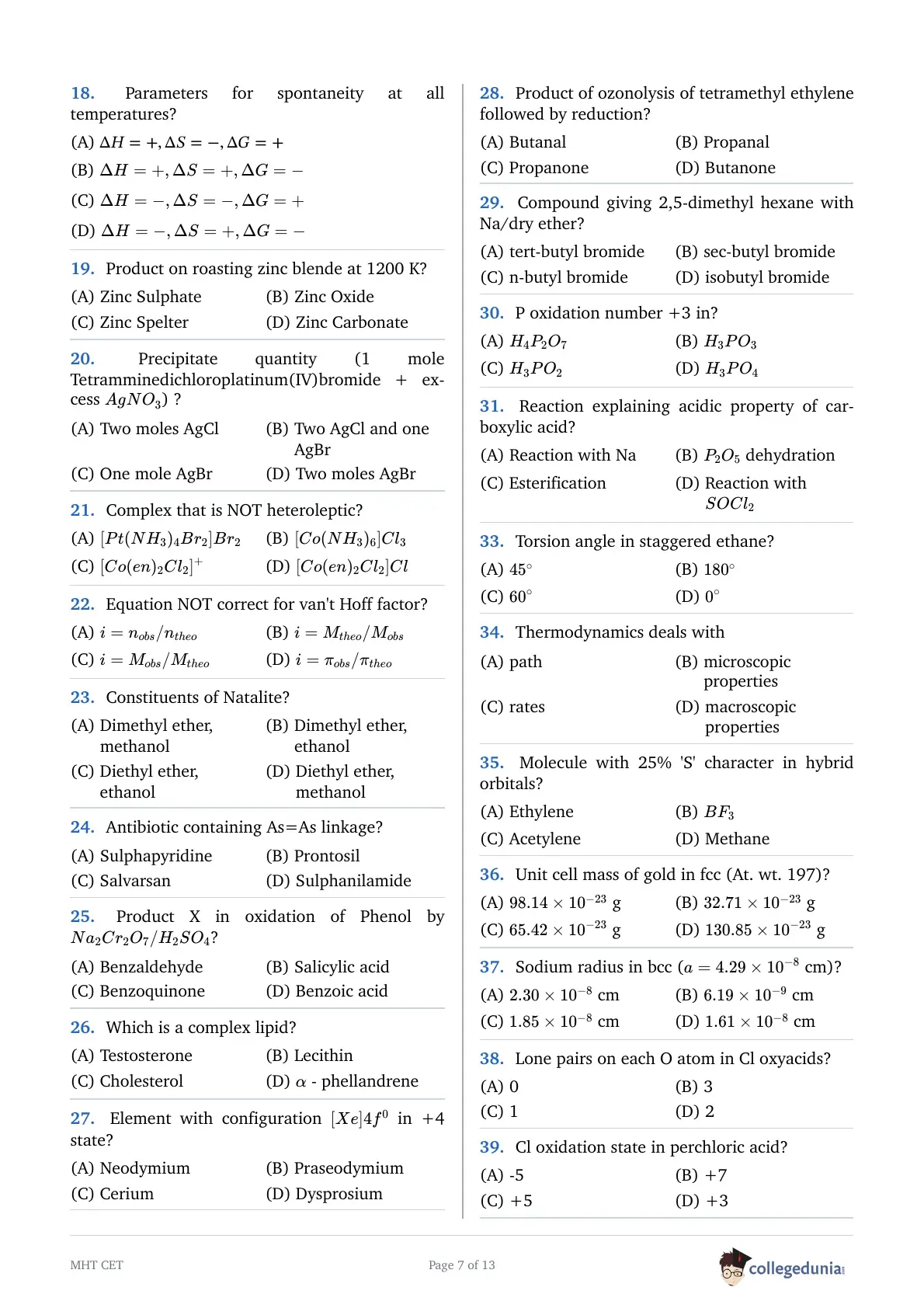
Parameters for spontaneity at all temperatures?
- (A) \(\Delta H = +, \Delta S = -, \Delta G = +\)
- (B) \(\Delta H = +, \Delta S = +, \Delta G = -\)
- (C) \(\Delta H = -, \Delta S = -, \Delta G = +\)
- (D) \(\Delta H = -, \Delta S = +, \Delta G = -\)
Question 69:
Identify the product obtained on roasting of concentrated zinc blende at about 1200 K?
- (A) Zinc Sulphate
- (B) Zinc Oxide
- (C) Zinc Spelter
- (D) Zinc Carbonate
Question 70:
Precipitate quantity (1 mole Tetramminedichloroplatinum(IV)bromide + excess \(AgNO_3\)) ?
- (A) Two moles AgCl
- (B) Two AgCl and one AgBr
- (C) One mole AgBr
- (D) Two moles AgBr
Question 71:
Which among the following complexes is NOT a heteroleptic complex?
- (A) \([Pt(NH_3)_4Br_2]Br_2\)
- (B) \([Co(NH_3)_6]Cl_3\)
- (C) \([Co(en)_2Cl_2]^+\)
- (D) \([Co(en)_2Cl_2]Cl\)
Question 72:
Equation NOT correct for van't Hoff factor?
- (A) \(i = n_{obs}/n_{theo}\)
- (B) \(i = M_{theo}/M_{obs}\)
- (C) \(i = M_{obs}/M_{theo}\)
- (D) \(i = \pi_{obs}/\pi_{theo}\)
Question 73:
What are the constituents of Natalite?
- (A) Dimethyl ether and methanol
- (B) Dimethyl ether and ethanol
- (C) Diethyl ether and ethanol
- (D) Diethyl ether and methanol
Question 74:
Antibiotic containing As=As linkage?
- (A) Sulphapyridine
- (B) Prontosil
- (C) Salvarsan
- (D) Sulphanilamide
Question 75:
Product X in oxidation of Phenol by \(Na_2Cr_2O_7/H_2SO_4\)?
- (A) Benzaldehyde
- (B) Salicylic acid
- (C) Benzoquinone
- (D) Benzoic acid
Question 76:
Which among the following is a complex lipid?
- (A) Testosterone
- (B) Lecithin
- (C) Cholesterol
- (D) α - phellandrene
Question 77:
Element with configuration \([Xe]4f^0\) in +4 state?
- (A) Neodymium
- (B) Praseodymium
- (C) Cerium
- (D) Dysprosium
Question 78:
Product of ozonolysis of tetramethyl ethylene followed by reduction?
- (A) Butanal
- (B) Propanal
- (C) Propanone
- (D) Butanone
Question 79:
Compound giving 2,5-dimethyl hexane with Na/dry ether?
- (A) tert-butyl bromide
- (B) sec-butyl bromide
- (C) n-butyl bromide
- (D) isobutyl bromide
Question 80:
P oxidation number +3 in?
- (A) \(H_4P_2O_7\)
- (B) \(H_3PO_3\)
- (C) \(H_3PO_2\)
- (D) \(H_3PO_4\)
Question 81:
Reaction explaining acidic property of carboxylic acid?
- (A) Reaction with Na
- (B) \(P_2O_5\) dehydration
- (C) Esterification
- (D) Reaction with \(SOCl_2\)
Question 83:
What is the torsion angle in the staggered conformation of ethane?
- (A) 45°
- (B) 180°
- (C) 60°
- (D) 0°
Question 84:
Thermodynamics deals with
- (A) path
- (B) microscopic properties
- (C) rates
- (D) macroscopic properties
Question 85:
Molecule with 25% 'S' character in hybrid orbitals?
- (A) Ethylene
- (B) \(BF_3\)
- (C) Acetylene
- (D) Methane
Question 86:
What is the mass of the unit cell of gold if it crystallizes in fcc structure?
- (A) \( 98.14 \times 10^{-23} \, g \)
- (B) \( 32.71 \times 10^{-23} \, g \)
- (C) \( 65.42 \times 10^{-23} \, g \)
- (D) \( 130.85 \times 10^{-23} \, g \)
Question 87:
Sodium radius in bcc (\(a = 4.29 \times 10^{-8}\) cm)?
- (A) \(2.30 \times 10^{-8}\) cm
- (B) \(6.19 \times 10^{-9}\) cm
- (C) \(1.85 \times 10^{-8}\) cm
- (D) \(1.61 \times 10^{-8}\) cm
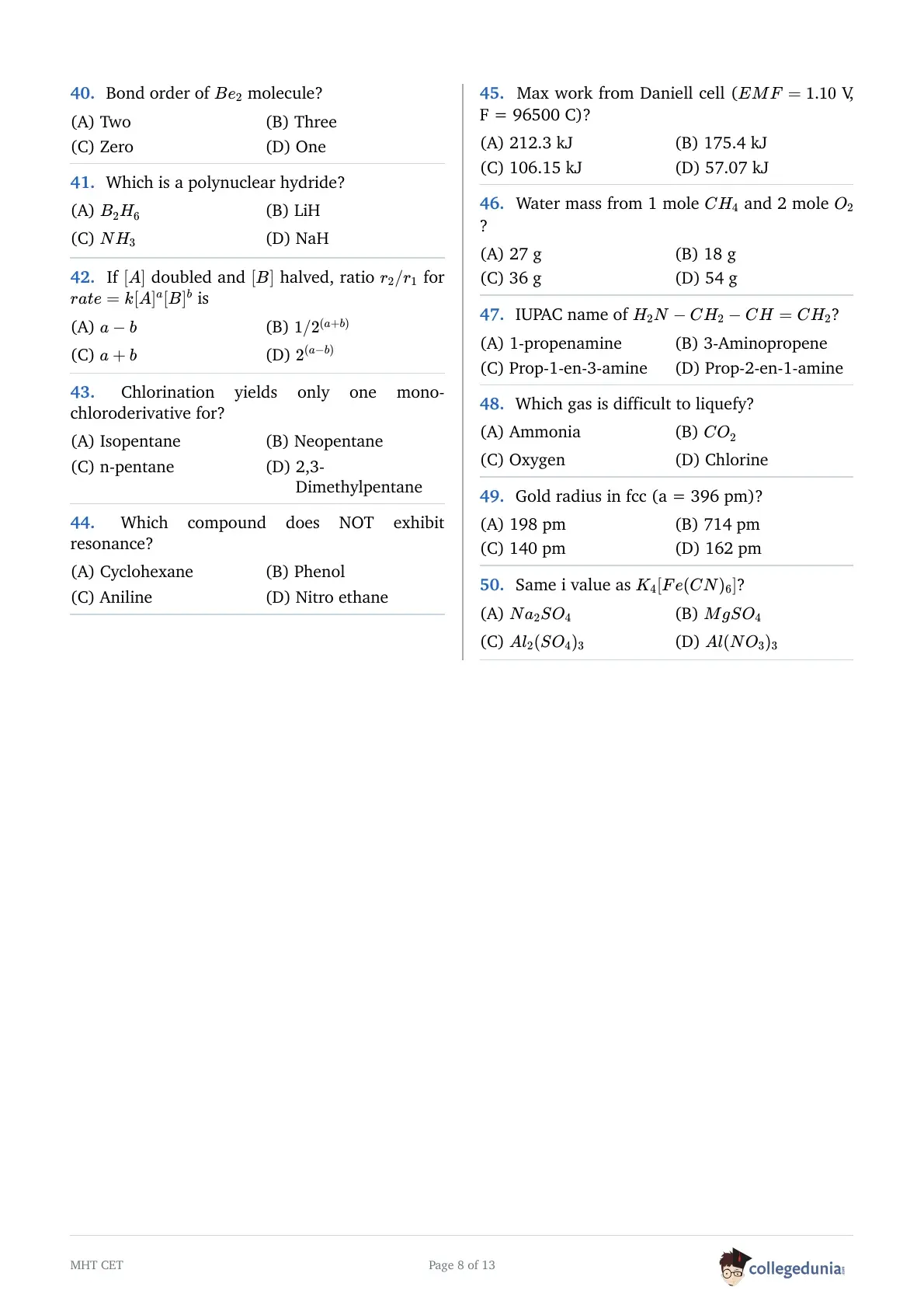
Question 88:
Lone pairs on each O atom in Cl oxyacids?
Question 89:
Cl oxidation state in perchloric acid?
- (A) -5
- (B) +7
- (C) +5
- (D) +3
Question 90:
What is the bond order of \( \text{Be}_2 \) molecule?
- (A) Two
- (B) Three
- (C) Zero
- (D) One
Question 91:
Which among the following is a polynuclear hydride?
- (A) \( \text{B}_2\text{H}_6 \)
- (B) \( \text{LiH} \)
- (C) \( \text{NH}_3 \)
- (D) \( \text{NaH} \)
Question 92:
If \([A]\) doubled and \([B]\) halved, ratio \(r_2/r_1\) for \(rate = k[A]^a[B]^b\) is
- (A) \(a - b\)
- (B) \(1/2^{(a+b)}\)
- (C) \(a + b\)
- (D) \(2^{(a-b)}\)
Question 93:
Which among the following on chlorination yields only one monochloroderivative?
- (A) Isopentane
- (B) Neopentane
- (C) n-pentane
- (D) 2, 3-Dimethylpentane
Question 94:
Which among the following compounds does not exhibit resonance?
- (A) Cyclohexane
- (B) Phenol
- (C) Aniline
- (D) Nitro ethane
Question 95:
Max work from Daniell cell (\(EMF = 1.10\) V, F = 96500 C)?
- (A) 212.3 kJ
- (B) 175.4 kJ
- (C) 106.15 kJ
- (D) 57.07 kJ
Question 96:
Water mass from 1 mole \(CH_4\) and 2 mole \(O_2\)?
- (A) 27 g
- (B) 18 g
- (C) 36 g
- (D) 54 g
Question 97:
IUPAC name of \( \text{H}_2\text{N-CH}_2\text{C=CH}_2 \) is
- (A) 1-propenamine
- (B) 3-Aminopropene
- (C) Prop-1-en-3-amine
- (D) Prop-2-en-1-amine
Question 98:
Which gas is difficult to liquefy?
- (A) Ammonia
- (B) \(CO_2\)
- (C) Oxygen
- (D) Chlorine
Question 99:
Gold radius in fcc (a = 396 pm)?
- (A) 198 pm
- (B) 714 pm
- (C) 140 pm
- (D) 162 pm
Question 100:
Same i value as \(K_4[Fe(CN)_6]\)?
- (A) \(Na_2SO_4\)
- (B) \(MgSO_4\)
- (C) \(Al_2(SO_4)_3\)
- (D) \(Al(NO_3)_3\)
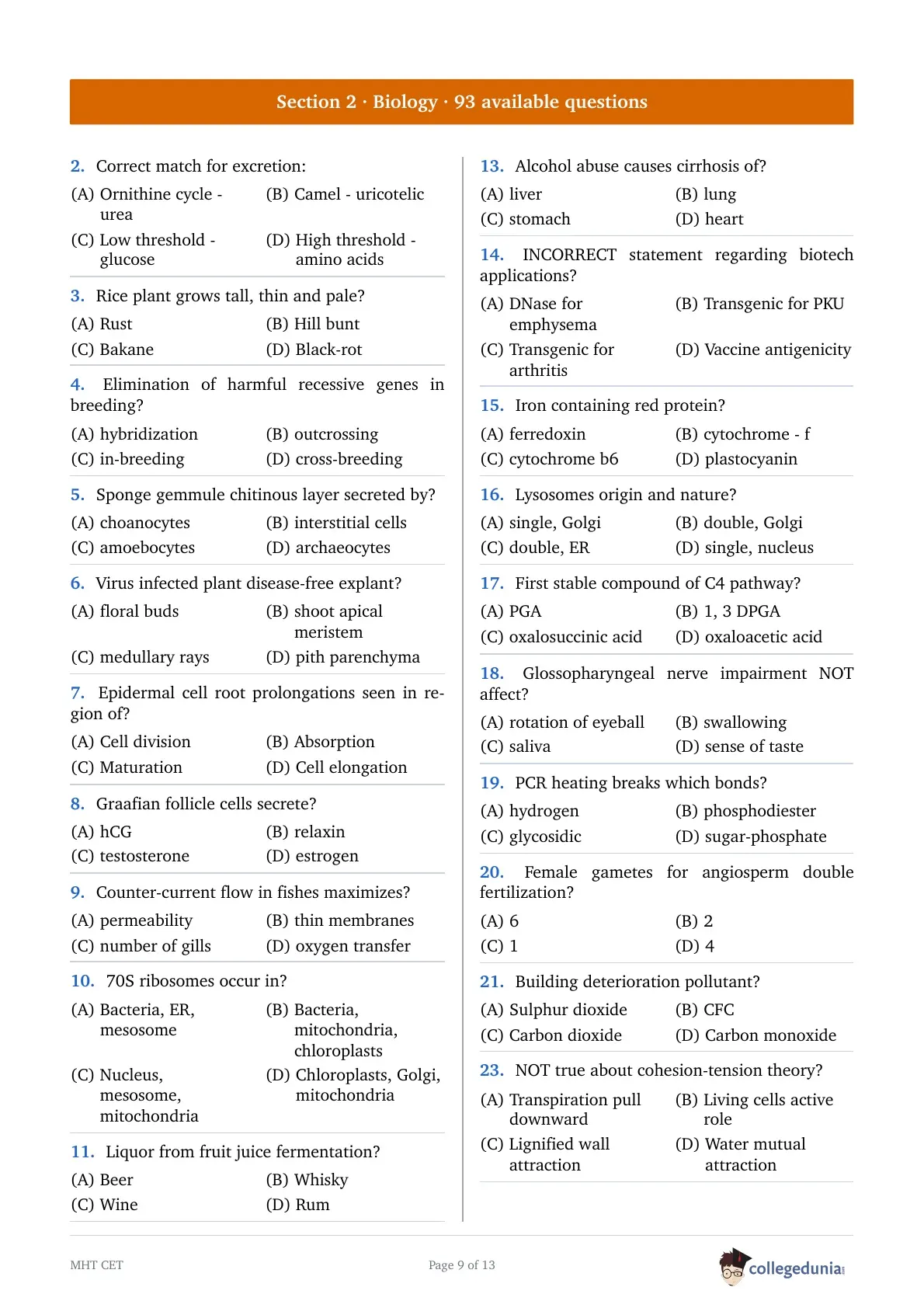
Question 103:
Rice plant grows tall, thin and pale?
- (A) Rust
- (B) Hill bunt
- (C) Bakane
- (D) Black-rot
Question 104:
Elimination of harmful recessive genes in breeding?
- (A) hybridization
- (B) outcrossing
- (C) in-breeding
- (D) cross-breeding
Question 105:
The outer chitinous layer of the gemmule of a sponge is secreted by .............
- (A) choanocytes
- (B) interstitial cells
- (C) amoebocytes
- (D) archaeocytes
Question 106:
Virus infected plant disease-free explant?
- (A) floral buds
- (B) shoot apical meristem
- (C) medullary rays
- (D) pith parenchyma
Question 107:
Epidermal cell root prolongations seen in region of?
- (A) Cell division
- (B) Absorption
- (C) Maturation
- (D) Cell elongation
Question 108:
Graafian follicle cells secrete?
- (A) hCG
- (B) relaxin
- (C) testosterone
- (D) estrogen
Question 109:
Counter-current flow in fishes maximizes?
- (A) permeability
- (B) thin membranes
- (C) number of gills
- (D) oxygen transfer
Question 110:
70S ribosomes occur in?
- (A) Bacteria, ER, mesosome
- (B) Bacteria, mitochondria, chloroplasts
- (C) Nucleus, mesosome, mitochondria
- (D) Chloroplasts, Golgi, mitochondria
Question 111:
Liquor from fruit juice fermentation?
- (A) Beer
- (B) Whisky
- (C) Wine
- (D) Rum
Question 113:
Alcohol abuse causes cirrhosis of?
- (A) liver
- (B) lung
- (C) stomach
- (D) heart
Question 114:
INCORRECT statement regarding biotech applications?
- (A) DNase for emphysema
- (B) Transgenic for PKU
- (C) Transgenic for arthritis
- (D) Vaccine antigenicity
Question 115:
An iron containing red protein is ..............
- (A) ferredoxin
- (B) cytochrome - f
- (C) cytochrome b6
- (D) plastocyanin
Question 116:
Lysosomes origin and nature?
- (A) single, Golgi
- (B) double, Golgi
- (C) double, ER
- (D) single, nucleus
Question 117:
The first stable compound of C4 pathway is ................
- (A) phosphoglyceric acid
- (B) 1, 3 diphosphoglyceric acid
- (C) oxalosuccinic acid
- (D) oxaloacetic acid
Question 118:
Impairment of Glossopharyngeal nerve will most probably NOT affect ............
- (A) rotation of eyeball
- (B) swallowing secretion
- (C) saliva secretion
- (D) sense of taste
Question 119:
PCR heating breaks which bonds?
- (A) hydrogen
- (B) phosphodiester
- (C) glycosidic
- (D) sugar-phosphate
Question 120:
Female gametes for angiosperm double fertilization?
Question 121:
Building deterioration pollutant?
- (A) Sulphur dioxide
- (B) CFC
- (C) Carbon dioxide
- (D) Carbon monoxide
Question 124:
Which group of vitamins given below are water soluble?
- (A) Vitamin A and B
- (B) Vitamin B and C
- (C) Vitamin E and K
- (D) Vitamin C and D
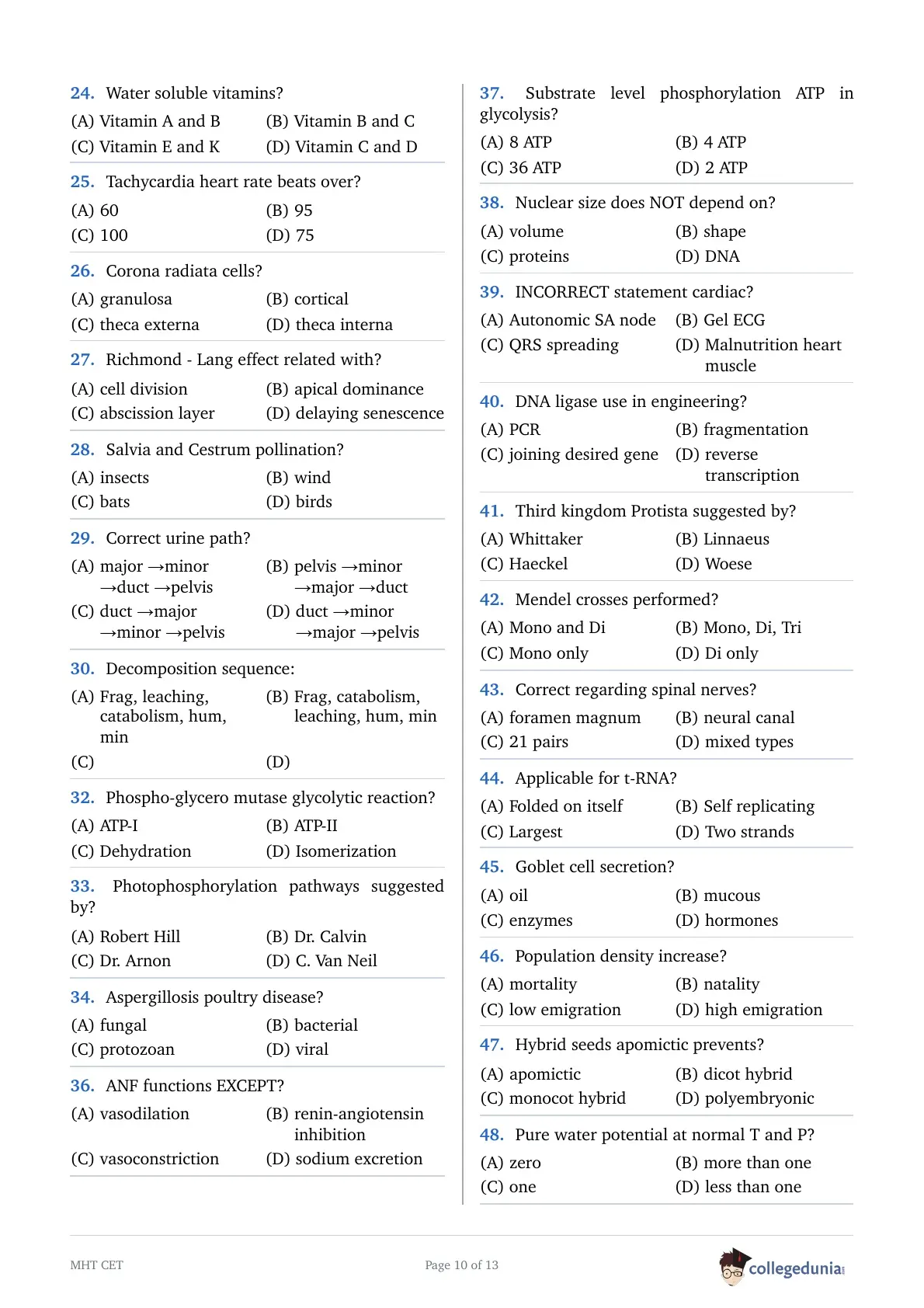
Question 125:
Tachycardia means fast heart rate with beats over ....... per minute.
- (A) 60
- (B) 95
- (C) 100
- (D) 75
Question 126:
Corona radiata cells?
- (A) granulosa
- (B) cortical
- (C) theca externa
- (D) theca interna
Question 127:
Richmond - Lang effect is related with ...............
- (A) promoting cell division
- (B) apical dominance
- (C) prevention of abscission layer formation
- (D) delaying senescence
Question 128:
Salvia and Cestrum pollination?
- (A) insects
- (B) wind
- (C) bats
- (D) birds
Question 129:
Correct urine path?
- (A) major →minor →duct →pelvis
- (B) pelvis →minor →major →duct
- (C) duct →major →minor →pelvis
- (D) duct →minor →major →pelvis
Question 132:
Phospho-glycero mutase glycolytic reaction?
- (A) ATP-I
- (B) ATP-II
- (C) Dehydration
- (D) Isomerization
Question 133:
Two pathways of photophosphorylation i.e., cyclic and non-cyclic were suggested by .................
- (A) Robert Hill
- (B) Dr. Calvin
- (C) Dr. Arnon
- (D) C. Van Neil
Question 134:
Aspergillosis is ............... disease of poultry.
- (A) fungal
- (B) bacterial
- (C) protozoan
- (D) viral
Question 136:
ANF carries out following functions EXCEPT ..............
- (A) vasodilation
- (B) inhibition of renin-angiotensin mechanism
- (C) vasoconstriction
- (D) promotes sodium excretion
Question 137:
Total how many ATP molecules are formed by substrate-level phosphorylation in glycolysis?
- (A) 8 ATP
- (B) 4 ATP
- (C) 36 ATP
- (D) 2 ATP
Question 138:
The nuclear size does NOT depend on .............
- (A) volume of the cell
- (B) shape of the cell
- (C) amount of proteins
- (D) amount of DNA
Question 139:
INCORRECT statement cardiac?
- (A) Autonomic SA node
- (B) Gel ECG
- (C) QRS spreading
- (D) Malnutrition heart muscle
Question 140:
DNA ligase use in engineering?
- (A) PCR
- (B) fragmentation
- (C) joining desired gene
- (D) reverse transcription
Question 141:
Third kingdom Protista suggested by?
- (A) Whittaker
- (B) Linnaeus
- (C) Haeckel
- (D) Woese
Question 142:
Mendel crosses performed?
- (A) Mono and Di
- (B) Mono, Di, Tri
- (C) Mono only
- (D) Di only
Question 143:
Correct regarding spinal nerves?
- (A) foramen magnum
- (B) neural canal
- (C) 21 pairs
- (D) mixed types
Question 144:
Which one of the following is applicable for t-RNA?
- (A) Folded on itself
- (B) Self replicating
- (C) Largest molecule
- (D) Has two strands
Question 145:
Goblet cell secretes .........
- (A) oil
- (B) mucous
- (C) enzymes
- (D) hormones
Question 146:
Population density increase?
- (A) mortality
- (B) natality
- (C) low emigration
- (D) high emigration
Question 147:
Hybrid seeds apomictic prevents?
- (A) apomictic
- (B) dicot hybrid
- (C) monocot hybrid
- (D) polyembryonic
Question 148:
Water potential of pure water at normal temperature and pressure is ........
- (A) zero
- (B) always more than one
- (C) one
- (D) less than one
Question 149:
........ carries the message for formation of polypeptide chain.
- (A) r-RNA
- (B) r-DNA
- (C) m-RNA
- (D) t-RNA
Question 150:
Pulses protein RQ?
- (A) infinity
- (B) more than one
- (C) one
- (D) less than one
Question 152:
Insoluble carbohydrate?
- (A) Cellulose
- (B) Glucose
- (C) Lactose
- (D) Fructose
Question 153:
Sample DNA + Probe DNA form double strand?
- (A) electrophoresis
- (B) restriction digestion
- (C) hybridization
- (D) amplification
Question 154:
Tall axial x Dwarf terminal F2 ratio cross?
- (A) Test
- (B) Trihybrid
- (C) Dihybrid
- (D) Monohybrid
Question 155:
Bacterial herbicide?
- (A) Alternaria
- (B) Xanthomonas
- (C) Fusarium
- (D) Bacillus
Question 156:
Co-dominance of alleles?
- (A) one recessive
- (B) both dominant
- (C) one dominant
- (D) both recessive
Question 157:
First decarboxylation Krebs cycle?
- (A) Isocitrate
- (B) Succinate
- (C) Oxalosuccinate
- (D) α-ketoglutarate
Question 158:
Childhood dwarfism due to?
- (A) somatotropin hyposecretion
- (B) thyrotropin hyposecretion
- (C) thymosin hypersecretion
- (D) secretin hypersecretion
Question 159:
Lichen rhizines used in?
- (A) Crustose
- (B) Foliose
- (C) Shruby
- (D) Fruticose
Question 160:
Which one of the following is NOT a tool in recombinant DNA technology?
- (A) Restriction endonuclease
- (B) Prokaryotic nucleoid
- (C) Vector
- (D) Reverse transcription
Question 161:
In human beings, the largest cell formed during oogenesis is .................
- (A) secondary oocyte
- (B) 1st polar body
- (C) primordial cell
- (D) oogonium
Question 162:
Sum total of all populations?
- (A) community
- (B) biome
- (C) biomass
- (D) ecosystem
Question 163:
Max number in normal total blood count?
- (A) erythrocytes
- (B) eosinophils
- (C) lymphocytes
- (D) thrombocytes
Question 164:
INCORRECT statement Haemophilia?
- (A) clotting factor
- (B) normal clotting
- (C) RBC sickle
- (D) carrier female
Question 165:
Photorespiration oxidation RUBP?
- (A) High T, High I, Low CO2
- (B) Low T, Low I, Low CO2
- (C) Low T, High I, Low CO2
- (D) High T, High I, High CO2
Question 166:
Somatic reflex effectors?
- (A) skin
- (B) glands
- (C) smooth muscles
- (D) skeletal muscles
Question 167:
Human fertilization specific reaction?
- (A) gametogenesis
- (B) same size
- (C) fertilizin-antifertilizin
- (D) ovum/sperm size
Question 168:
Coenocytic hyphae characteristic?
- (A) Ascomycetes
- (B) Phycomycetes
- (C) Deuteromycetes
- (D) Basidiomycetes
Question 169:
Major reservoir of carbon?
- (A) Ocean
- (B) Detritus
- (C) Plants
- (D) Atmosphere
Question 170:
Oldest fossil record ape/man?
- (A) Ramapithecus
- (B) Propliopithecus
- (C) Kenyapithecus
- (D) Dryopithecus
Question 171:
Which of the following is NOT a nutrient in the blood plasma?
- (A) Glycine
- (B) Creatinine
- (C) Fatty acid
- (D) Glucose
Question 172:
In heterozygous condition both the alleles are expressed in ................
- (A) diabetes
- (B) AB blood group
- (C) colour blindness
- (D) haemophilia
Question 173:
Restriction endonuclease nomenclature refers to?
- (A) place
- (B) bacterium
- (C) author
- (D) naming procedure
Question 174:
Medulla oblongata injury sudden death?
- (A) reflex stop
- (B) vital activities stop
- (C) CSF stop
- (D) plexuses damaged
Question 175:
Rice variety with five times more ................ has been developed.
- (A) tryptophan
- (B) vitamin B12
- (C) iron
- (D) protein
Question 176:
Mulattoes in F2 64 offspring?
- (A) One
- (B) Six
- (C) Twenty
- (D) Fifteen
Question 177:
Sex chromosomes of male birds are ......................
- (A) XY
- (B) ZW
- (C) XX
- (D) ZZ
Question 178:
The site for glycolysis in a cell is .............
- (A) Golgi body
- (B) mitochondria
- (C) chloroplast
- (D) cytoplasm
Question 180:
Which one of the following is an example of predation?
- (A) Remora - shark
- (B) Whale - barnacle
- (C) Orchid - tree
- (D) Tiger - deer
Question 182:
NOT during expiration?
- (A) dome diaphragm
- (B) compression
- (C) thoracic volume increase
- (D) ribs inwards
Question 184:
Stunted growth, oedema child?
- (A) Jaundice
- (B) Kwashiorkor
- (C) Marasmus
- (D) Constipation
Question 185:
Menstrual cycle found in?
- (A) monkeys, apes, humans
- (B) monkeys/apes
- (C) apes/humans
- (D) humans only
Question 186:
Reptiles were dominant during ........ period.
- (A) Triassic
- (B) Jurassic
- (C) Cretaceous
- (D) Tertiary
Question 188:
LSD source?
- (A) Cannabis
- (B) Poppy
- (C) Datura
- (D) ergot fungus
Question 189:
The bad taste in monarch butterfly develops .......
- (A) while pupating
- (B) in adult stage
- (C) during egg laying
- (D) in larval stage
Question 191:
NOT significance of vegetative propagation?
- (A) Variations caused
- (B) increased yield
- (C) production clones
- (D) easy method
Question 192:
Basophil selection?
- (A) heparin
- (B) fibrin
- (C) globulin
- (D) anti-histamine
Question 193:
Membrane surrounding axon?
- (A) neurilemma
- (B) sarcolemma
- (C) chromonema
- (D) nucleolonema
Question 194:
Factors R1, R2, S synthesis?
- (A) t-RNA complex
- (B) release chain
- (C) transcription
- (D) linking codon
Question 195:
The length of DNA segment having 44 base pairs is ......
- (A) 149.2 Å
- (B) 149.3 Å
- (C) 149.4 Å
- (D) 149.6 Å
Question 196:
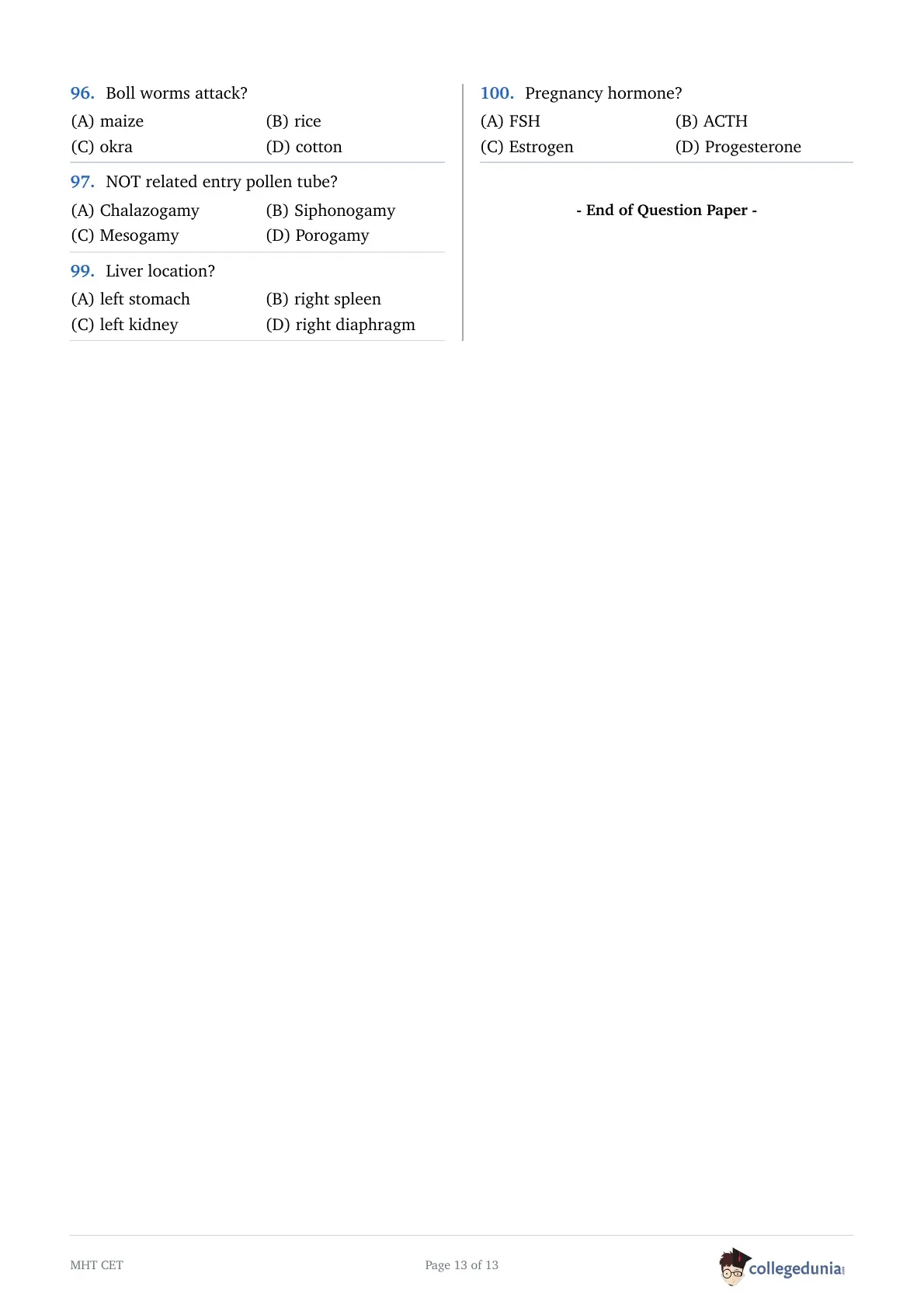
The boll worms attack ......
- (A) maize
- (B) rice
- (C) okra
- (D) cotton
Question 197:
NOT related entry pollen tube?
- (A) Chalazogamy
- (B) Siphonogamy
- (C) Mesogamy
- (D) Porogamy
Question 199:
Liver location?
- (A) left stomach
- (B) right spleen
- (C) left kidney
- (D) right diaphragm
Question 200:
Pregnancy hormone?
- (A) FSH
- (B) ACTH
- (C) Estrogen
- (D) Progesterone
MHT CET 2020 PCB Exam Pattern and Marking Scheme
| Parameter |
Details |
| Conducting Body |
Maharashtra Common Entrance Test Cell (Maharashtra CET Cell) |
| Exam Mode |
Online (Computer-Based Test) |
| Duration |
180 minutes (3 hours) |
| Groups / Subjects |
PCB (Physics, Chemistry, Biology) for Pharmacy and Agriculture |
| Total Questions |
200
|
| Total Marks |
200 |
| Question Type |
Multiple Choice Questions (MCQs) |
| Marking Scheme |
1 mark for each correct answer |
| Negative Marking |
No |
| Syllabus Weightage |
- Class 12 – 80%
- Class 11 – 20%
|








Comments