




MHT CET 2020 Oct 12 Shift 1 PCM Question Paper is available for download here. Maharashtra State CET Cell conducted MHT CET 2020 PCM Exam on Oct 12 in Shift 1 from 9 AM to 12 PM in CBT mode.
The MHT CET 2020 PCM question paper includes the following:
- The MHT CET 2020 PCM Question Paper consists of 150 multiple-choice questions (MCQs) totalling 200 marks divided into 3 sections: Physics, Chemistry, and Mathematics, with 50 questions in each subject.
- Physics and Chemistry questions carry 1 mark each while Mathematics questions carry 2 marks each.
- There is no negative marking for incorrect answers.
MHT CET 2020 Oct 12 Shift 1 PCM Question Paper with Solution PDF
| CD PDF | CD PDF with Solutions |
|---|---|
| Download Collegedunia PDF 2.31 MB | - |
Also Check:
MHT CET 2020 Oct 12 Shift 1 PCM Questions with Solutions
Physics (Q1 - Q50)
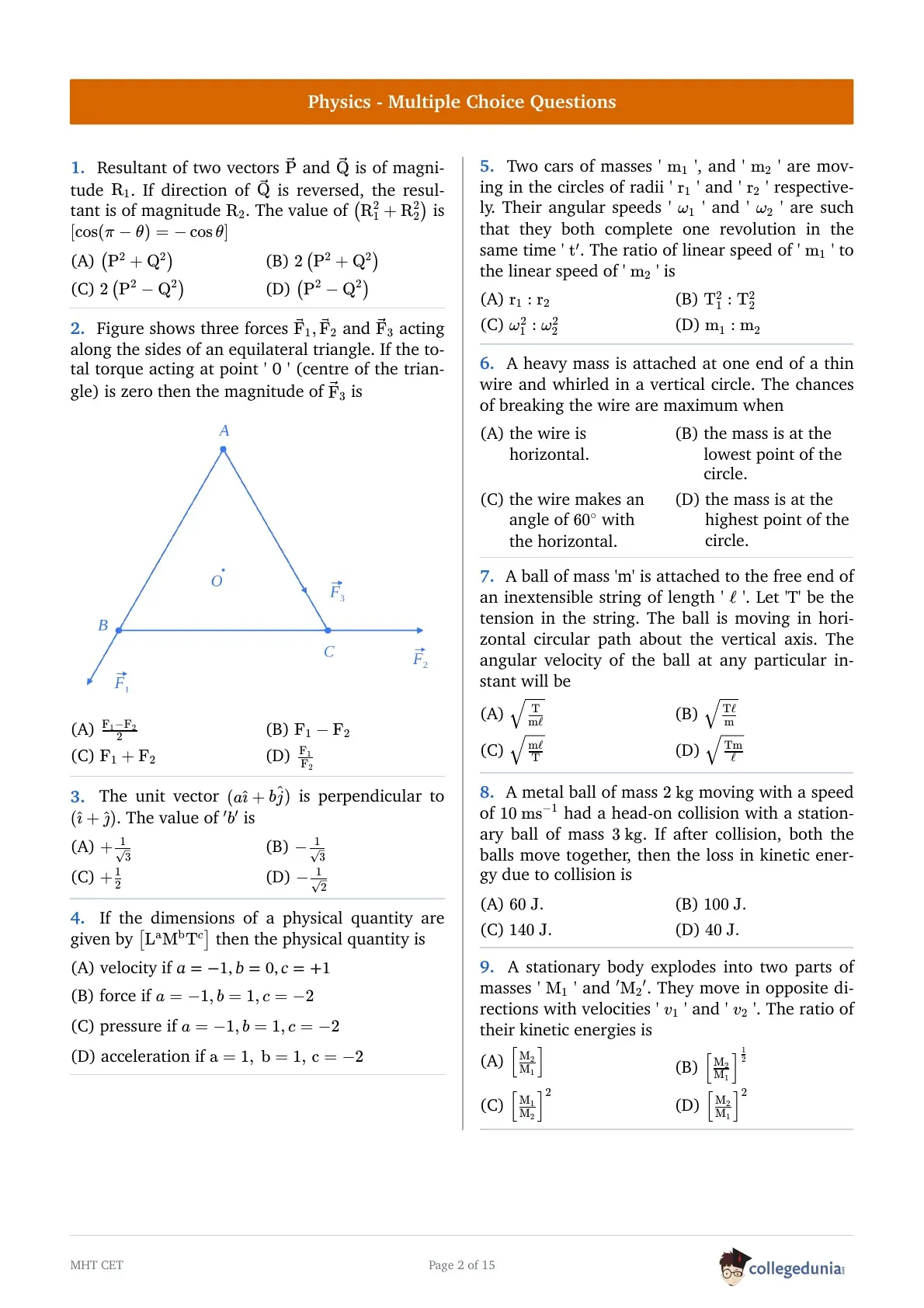
Resultant of two vectors \( \vec{P} \) and \( \vec{Q} \) is of magnitude \( R_1 \). If the direction of \( \vec{Q} \) is reversed, the resultant is of magnitude \( R_2 \). The value of \( (R_1^2 + R_2^2) \) is \( \cos (\pi - \theta) = - \cos \theta \)
Figure shows three forces \( F_1, F_2, F_3 \) acting along the sides of an equilateral triangle. If the total torque acting at point 'O' (centre of the triangle) is zero then the magnitude of \( F_3 \) is

The unit vector \( (ai + bj) \) is perpendicular to \( (i + j) \). The value of 'b' is
If the dimensions of a physical quantity are given by \( [L^{-1} M^0 T^1] \), then the physical quantity is
Two cars of masses \( m_1 \) and \( m_2 \) are moving in the circles of radii \( r_1 \) and \( r_2 \) respectively. Their angular speeds \( \omega_1 \) and \( \omega_2 \) are such that they both complete one revolution in the same time \( t \). The ratio of linear speed of \( m_1 \) to the linear speed of \( m_2 \) is
A heavy mass is attached at one end of a thin wire and whirled in a vertical circle. The chances of breaking the wire are maximum when
A ball of mass \( m \) is attached to the free end of an inextensible string of length \( \ell \). Let \( T \) be the tension in the string. The ball is moving in a horizontal circular path about the vertical axis. The angular velocity of the ball at any particular instant will be
A metal ball of mass 2 kg moving with a speed of 10 m/s had a head-on collision with a stationary ball of mass 3 kg. If after collision, both the balls move together, then the loss in kinetic energy due to collision is
A stationary body explodes into two parts of masses \( M_1 \) and \( M_2 \). They move in opposite directions with velocities \( v_1 \) and \( v_2 \). The ratio of their kinetic energies is
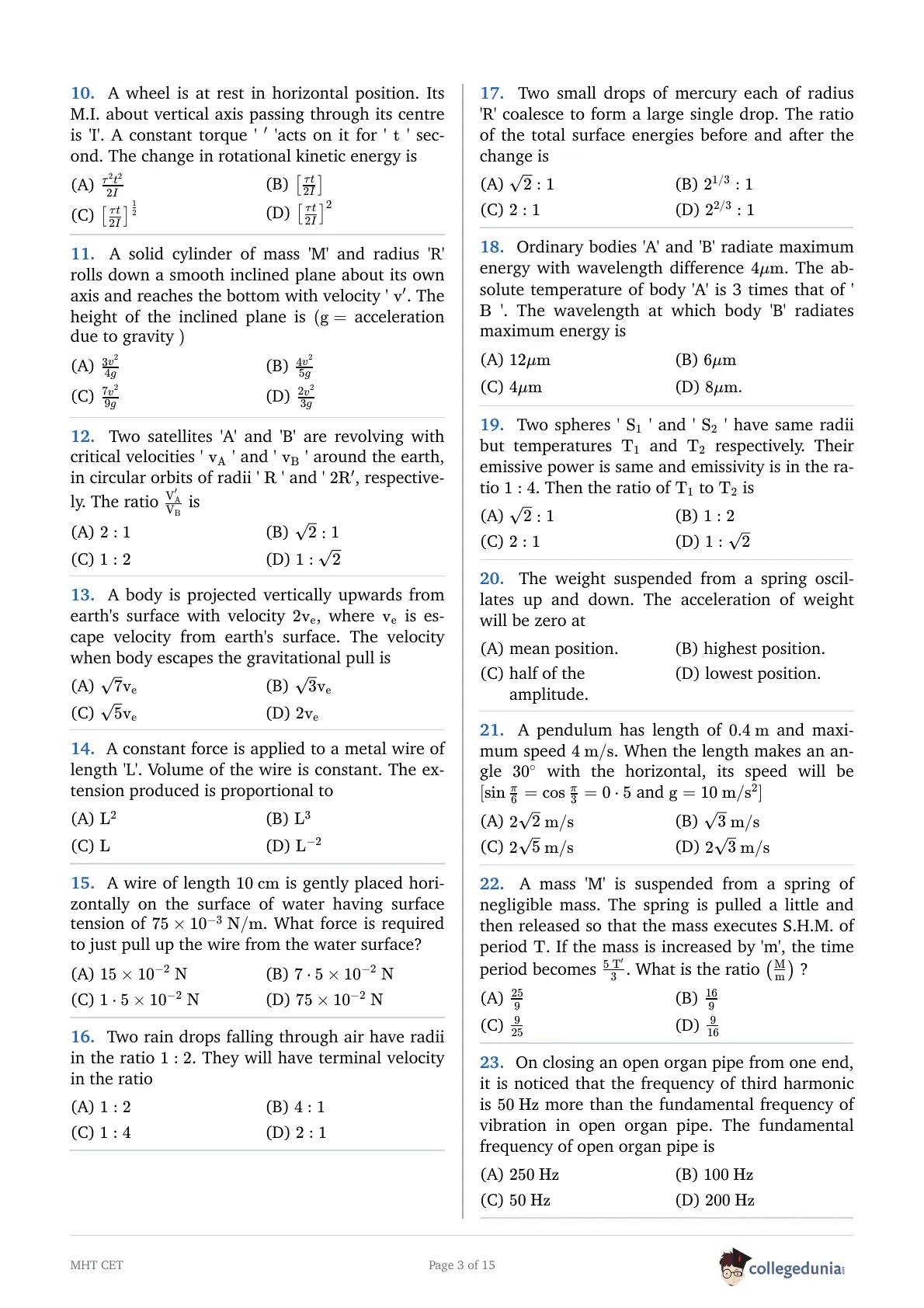
A wheel is at rest in horizontal position. Its moment of inertia about vertical axis passing through its center is \( I \). A constant torque \( \tau \) acts on it for \( t \) seconds. The change in rotational kinetic energy is
A solid cylinder of mass \( M \) and radius \( R \) rolls down a smooth inclined plane about its own axis and reaches the bottom with velocity \( v \). The height of the inclined plane is
Two satellites \( A \) and \( B \) are revolving with critical velocities \( v_A \) and \( v_B \) around the earth, in circular orbits of radii \( R \) and \( 2R \), respectively. The ratio \( \frac{v_A}{v_B} \) is
A body is projected vertically upwards from earth’s surface with velocity \( 2v_e \), where \( v_e \) is escape velocity from earth’s surface. The velocity when body escapes the gravitational pull is
A constant force is applied to a metal wire of length \( L \). Volume of the wire is constant. The extension produced is proportional to
A wire of length 10 cm is gently placed horizontally on the surface of water having surface tension of \( 75 \times 10^{-3} \, \text{N/m} \). What force is required to just pull up the wire from the water surface?
Two rain drops falling through air have radii in the ratio 1:2. They will have terminal velocity in the ratio
Two small drops of mercury each of radius \( R \) coalesce to form a large single drop. The ratio of the total surface energies before and after the change is
Ordinary bodies \( A \) and \( B \) radiate maximum energy with wavelength difference 4μm. The absolute temperature of body \( A \) is 3 times that of body \( B \). The wavelength at which body \( B \) radiates maximum energy is
Two spheres \( S_1 \) and \( S_2 \) have same radii but temperatures \( T_1 \) and \( T_2 \) respectively. Their emissive power is the same and emissivity is in the ratio 1:4. Then the ratio of \( T_1 \) to \( T_2 \) is
The weight suspended from a spring oscillates up and down. The acceleration of weight will be zero at
A pendulum has length of 0.4 m and maximum speed 4 m/s. When the length makes an angle 30° with the horizontal, its speed will be
A mass \( M \) is suspended from a spring of negligible mass. The spring is pulled a little and then released so that the mass executes simple harmonic motion (S.H.M.) of period \( T \). If the mass is increased by \( m \), the time period becomes \( \frac{T}{3} \). What is the ratio \( \frac{M}{m} \)?
On closing an open organ pipe from one end, it is noticed that the frequency of third harmonic is 50 Hz more than the fundamental frequency of vibration in open organ pipe. The fundamental frequency of open organ pipe is
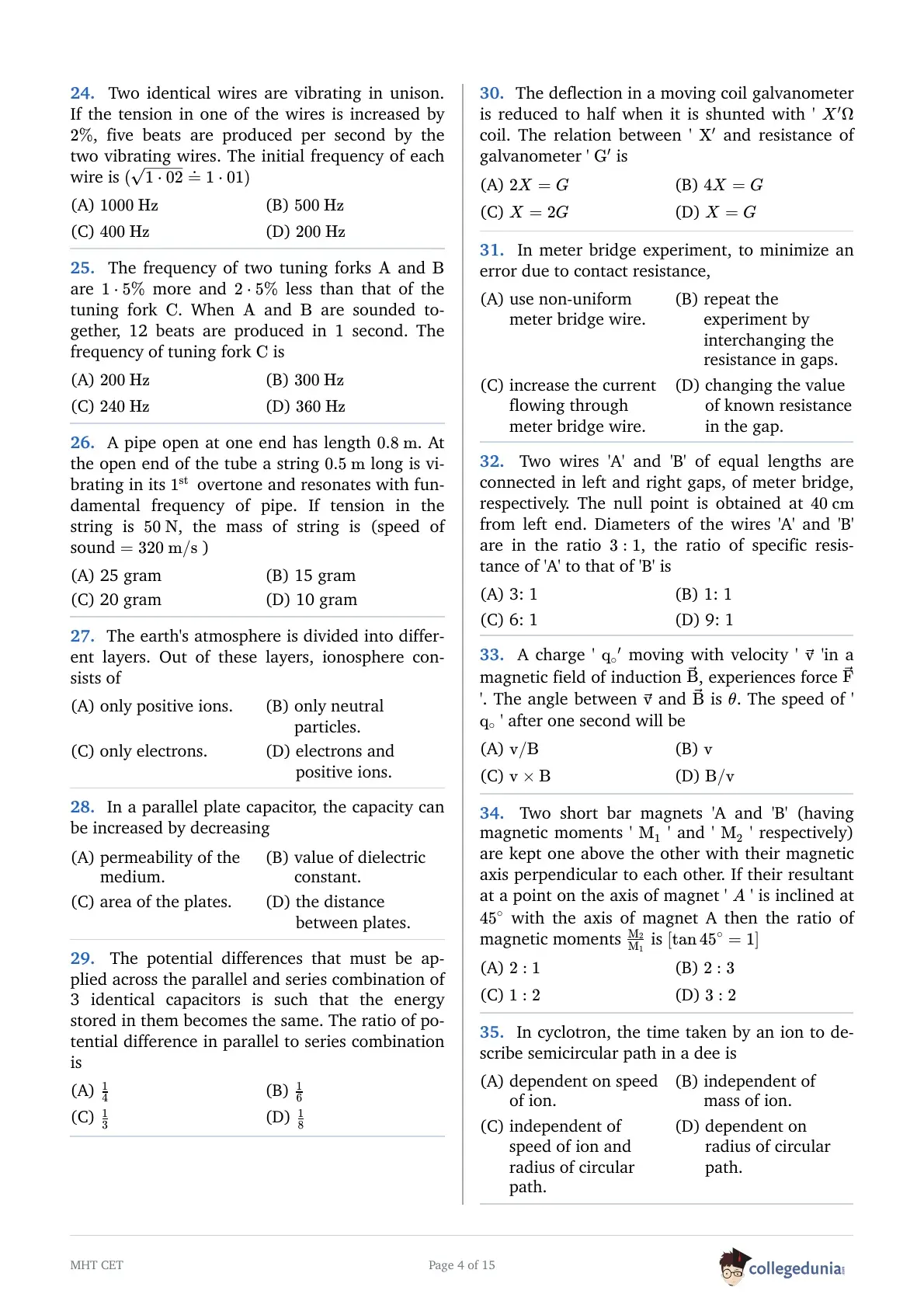
Two identical wires are vibrating in unison. If the tension in one of the wires is increased by 2%, five beats are produced per second by the two vibrating wires. The initial frequency of each wire is
The frequency of two tuning forks A and B are 1.5% more and 2.5% less than that of the tuning fork C. When A and B are sounded together, 12 beats are produced in 1 second. The frequency of tuning fork C is
A pipe open at one end has length 0.8 m. At the open end of the tube a string 0.5 m long is vibrating in its 1st overtone and resonates with the fundamental frequency of the pipe. If tension in the string is 50 N, the mass of the string is (speed of sound = 320 m/s)
The earth's atmosphere is divided into different layers. Out of these layers, ionosphere consists of
In a parallel plate capacitor, the capacity can be increased by decreasing
The potential differences that must be applied across the parallel and series combination of 3 identical capacitors is such that the energy stored in them becomes the same. The ratio of potential difference in parallel to series combination is
The deflection in a moving coil galvanometer is reduced to half when it is shunted with \( X \, \Omega \) coil. The relation between \( X \) and resistance of galvanometer \( G \) is
In meter bridge experiment, to minimize an error due to contact resistance,
Two wires 'A' and 'B' of equal lengths are connected in left and right gaps of a meter bridge, respectively. The null point is obtained at 40 cm from the left end. Diameters of the wires 'A' and 'B' are in the ratio 3:1, the ratio of specific resistance of 'A' to that of 'B' is
A charge \( q \) moving with velocity \( v \) in a magnetic field of induction \( B \), experiences force \( F \). The angle between \( v \) and \( B \) is \( \theta \). The speed of \( q \) after one second will be
Two short bar magnets 'A' and 'B' (having magnetic moments \( M_1 \) and \( M_2 \) respectively) are kept one above the other with their magnetic axes perpendicular to each other. If their resultant at a point on the axis of magnet 'A' is inclined at 45° with the axis of magnet 'A', then the ratio of magnetic moments \( \frac{M_2}{M_1} \) is
In cyclotron, the time taken by an ion to describe semicircular path in a dee is
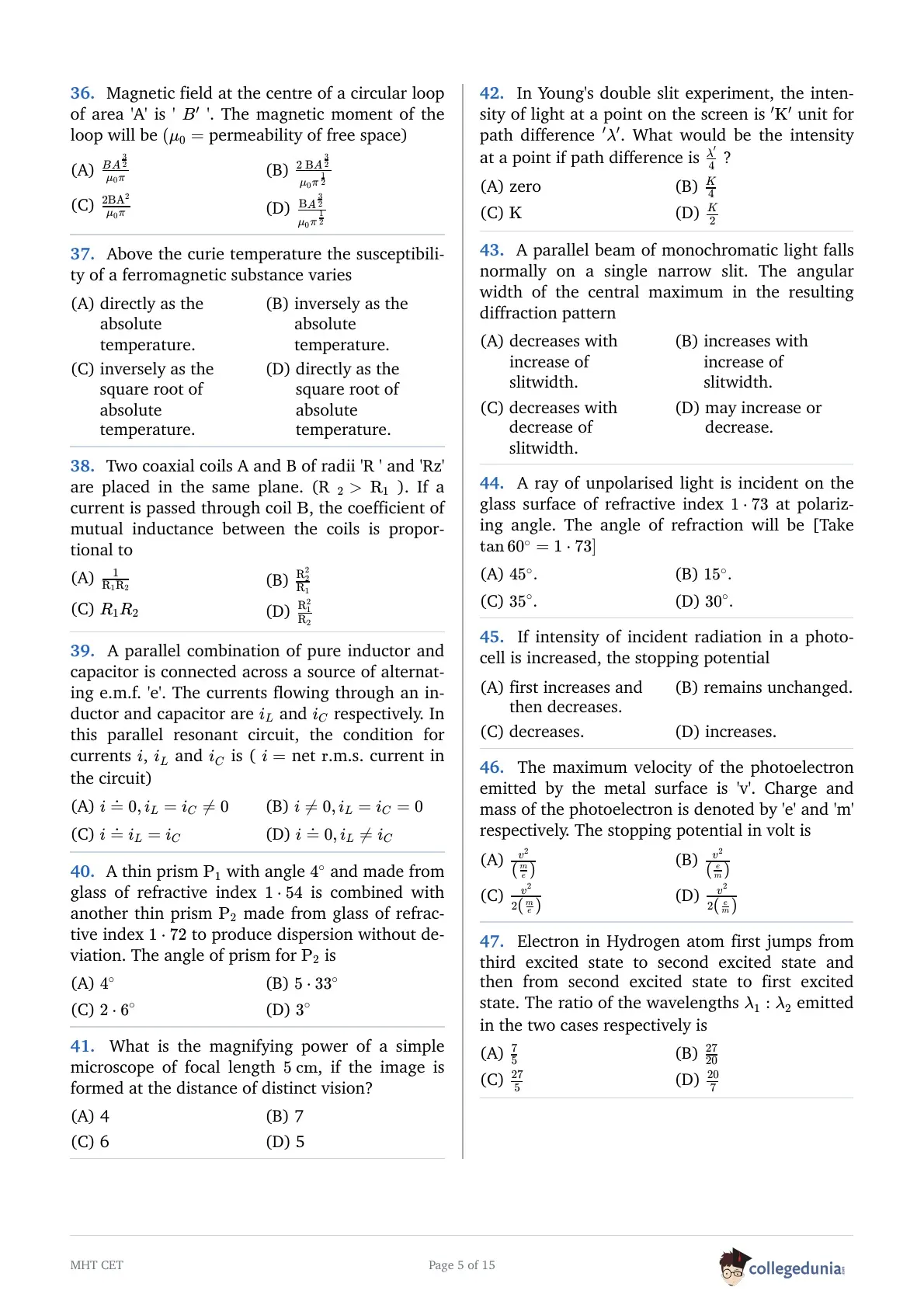
Magnetic field at the centre of a circular loop of area \( A \) is \( B \). The magnetic moment of the loop will be (\( \mu_0 \) = permeability of free space)
Above the curie temperature the susceptibility of a ferromagnetic substance varies
A parallel combination of pure inductor and capacitor is connected across a source of alternating e.m.f. \( e \). The currents flowing through an inductor and capacitor are \( i_L \) and \( i_C \) respectively. In this parallel resonant circuit, the condition for currents \( i, i_L, i_C \) (i.e. \( i \) = net r.m.s. current in the circuit) is
A thin prism \( P_1 \), with angle \( 4^\circ \) and made from glass of refractive index 1.54, is combined with another thin prism \( P_2 \), made from glass of refractive index 1.72 to produce dispersion without deviation. The angle of prism for \( P_2 \) is
What is the magnifying power of a simple microscope of focal length 5 cm, if the image is formed at the distance of distinct vision?
In Young's double slit experiment, the intensity of light at a point on the screen is \( K \) unit for path difference \( \Delta \). What would be the intensity at a point if the path difference is \( \frac{\Delta}{4} \)?
A parallel beam of monochromatic light falls normally on a single narrow slit. The angular width of the central maximum in the resulting diffraction pattern
A ray of unpolarised light is incident on the glass surface of refractive index 1.73 at polarizing angle. The angle of refraction will be [Take \( \tan 60^\circ = 1.73 \)]
If intensity of incident radiation in a photocell is increased, the stopping potential
The maximum velocity of the photoelectron emitted by the metal surface is 'v'. Charge and mass of the photoelectron is denoted by 'e' and 'm' respectively. The stopping potential in volt is
Electron in Hydrogen atom first jumps from third excited state to second excited state and then from second excited state to first excited state. The ratio of the wavelengths \( \lambda_1 : \lambda_2 \) emitted in the two cases respectively is
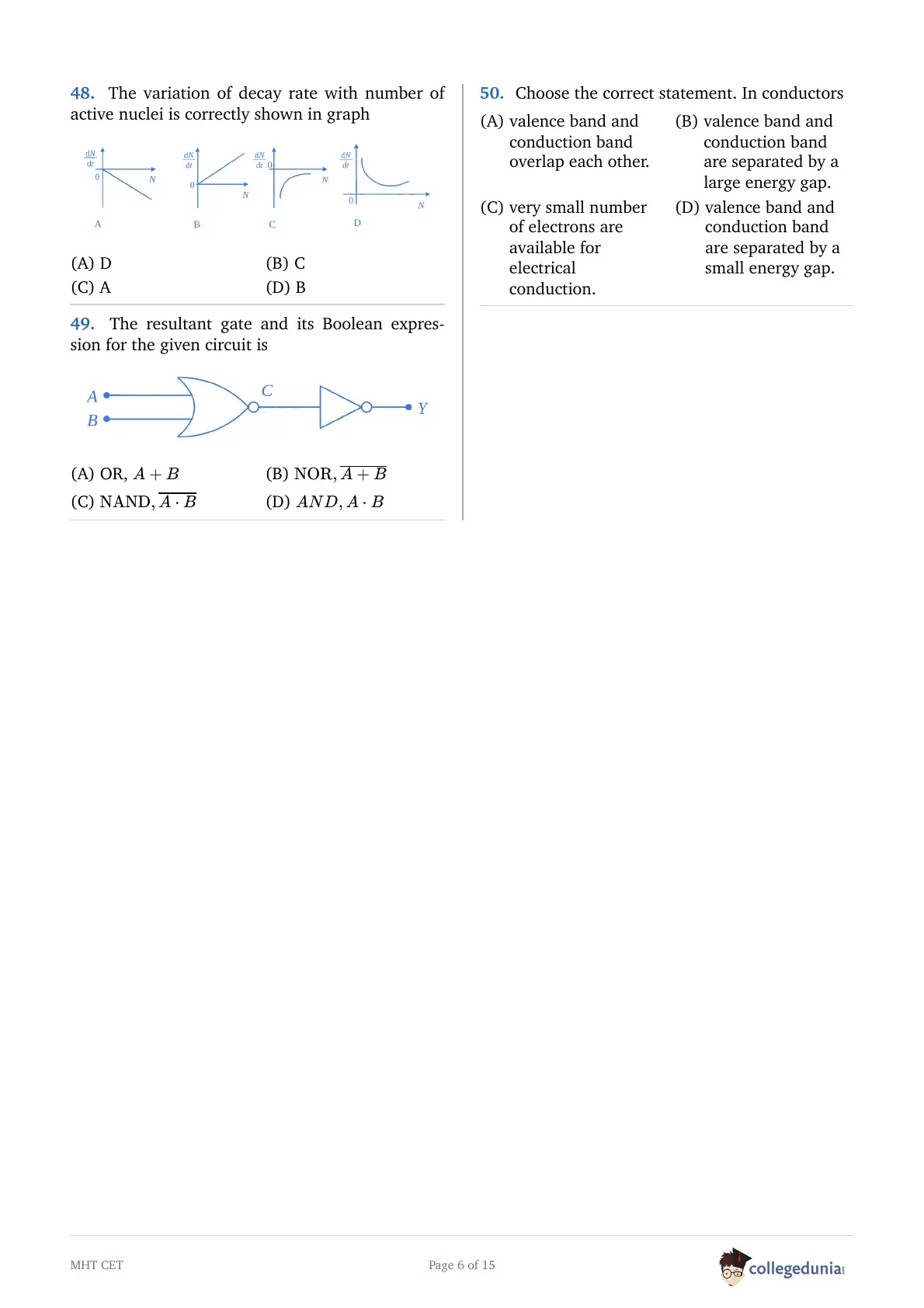
The variation of decay rate with number of active nuclei is correctly shown in graph

Choose the correct statement. In conductors
Chemistry (Q51 - Q100)
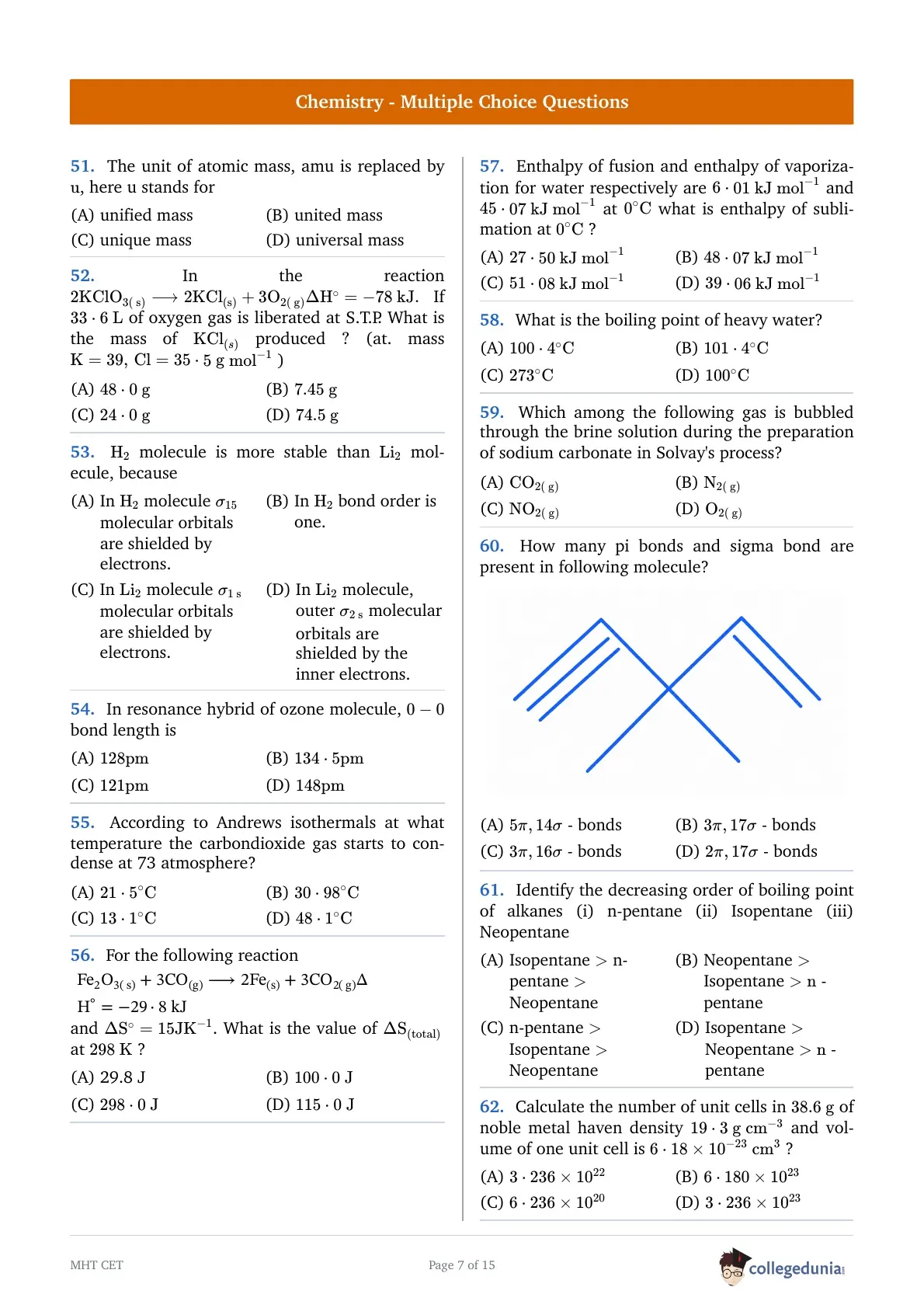
The unit of atomic mass, amu is replaced by u, here u stands for:
In the reaction \(2\mathrm{KClO}_{3(\ \mathrm{s})}\longrightarrow 2\mathrm{KCl}_{(\mathrm{s})}+3\mathrm{O}_{2(\ \mathrm{g})}\Delta \mathrm{H}^{\circ }=-78\ \mathrm{kJ}.\) If \(33\cdot 6\ \mathrm{L}\) of oxygen gas is liberated at S.T.P. What is the mass of \(\mathrm{KCl}_{(s)}\) produced \(?\) (at. mass \(\mathrm{K}=39,\,\mathrm{Cl}=35\cdot 5\ \mathrm{g}\ \mathrm{mol}^{-1}\) )
H\(_2\) molecule is more stable than Li\(_2\) molecule, because:
In resonance hybrid of ozone molecule, O-O bond length is
According to Andrews isothermals, at what temperature the carbon dioxide gas starts to condense at 73 atmosphere?
For the following reaction \(\mathrm{Fe}_{2}\mathrm{O}_{3(\ \mathrm{s})}+3\mathrm{CO}_{(\mathrm{g})}\longrightarrow 2\mathrm{Fe}_{(\mathrm{s})}+3\mathrm{CO}_{2(\ \mathrm{g})}\Delta \mathrm{H}^{\circ }=-29\cdot 8\ \mathrm{kJ}\) and \(\Delta \mathrm{S}^{\circ }=15\mathrm{JK}^{-1}\). What is the value of \(\Delta \mathrm{S}_{\text{(total) }}\) at \(298\ \mathrm{K}\) ?
Enthalpy of fusion and enthalpy of vaporization for water respectively are 6.01 kJ mol\(^{-1}\) and 45.07 kJ mol\(^{-1}\) at 0°C. What is enthalpy of sublimation at 0°C?
What is the boiling point of heavy water?
Which among the following gas is bubbled through the brine solution during the preparation of sodium carbonate in Solvay's process?
How many pi bonds and sigma bonds are present in the following molecule?

Identify the decreasing order of boiling point of alkanes (i) n-pentane (ii) Isopentane (iii) Neopentane
Calculate the number of unit cells in \(38.6\ \mathrm{g}\) of noble metal haven density \(19\cdot 3\ \mathrm{g}\ \mathrm{cm}^{-3}\) and volume of one unit cell is \(6\cdot 18\times 10^{-23}\ \mathrm{cm}^{3}\) ?
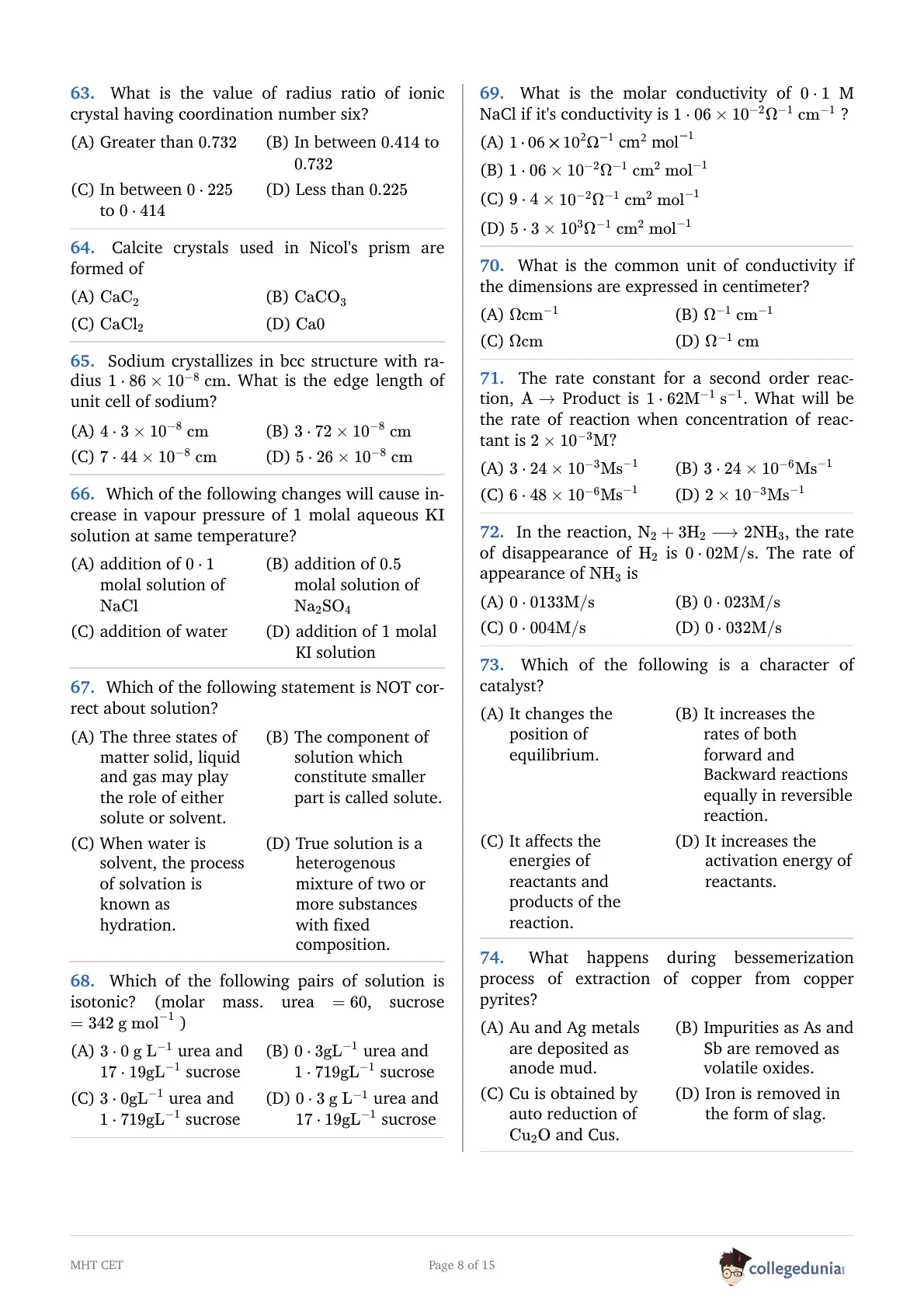
What is the value of radius ratio of ionic crystal having coordination number six?
Calcite crystals used in Nicol’s prism are formed of:
Sodium crystallizes in bcc structure with radius 1.86 \(\times\) 10\(^{-8}\) cm. What is the edge length of unit cell of sodium?
Which of the following changes will cause an increase in vapor pressure of 1 molal aqueous KI solution at the same temperature?
Which of the following statement is NOT correct about solution?
Which of the following pairs of solution is isotonic?
(Molar mass of urea = 60, sucrose = 342 g mol\(^{-1}\))
What is the molar conductivity of 0.1 M NaCl if its conductivity is \(1.06 \times 10^{-2} \, \Omega^{-1} \, \text{cm}^{-1}\text{cm}^{-1}\)?
What is the common unit of conductivity if the dimensions are expressed in centimeter?
The rate constant for a second-order reaction, A \(\rightarrow\) Product is 1.62 M\(^{-1}\)s\(^{-1}\). What will be the rate of reaction when the concentration of reactant is 2 \(\times\) 10\(^{-3}\) M?
In the reaction, \(\mathrm{N}_{2}+3\mathrm{H}_{2}\longrightarrow 2\mathrm{NH}_{3}\), the rate of disappearance of \(\mathrm{H}_{2}\) is \(0\cdot 02\mathrm{M}/\mathrm{s}\). The rate of appearance of \(\mathrm{NH}_{3}\) is
Which of the following is a character of catalyst?
What happens during Bessemerization process of extraction of copper from copper pyrites?
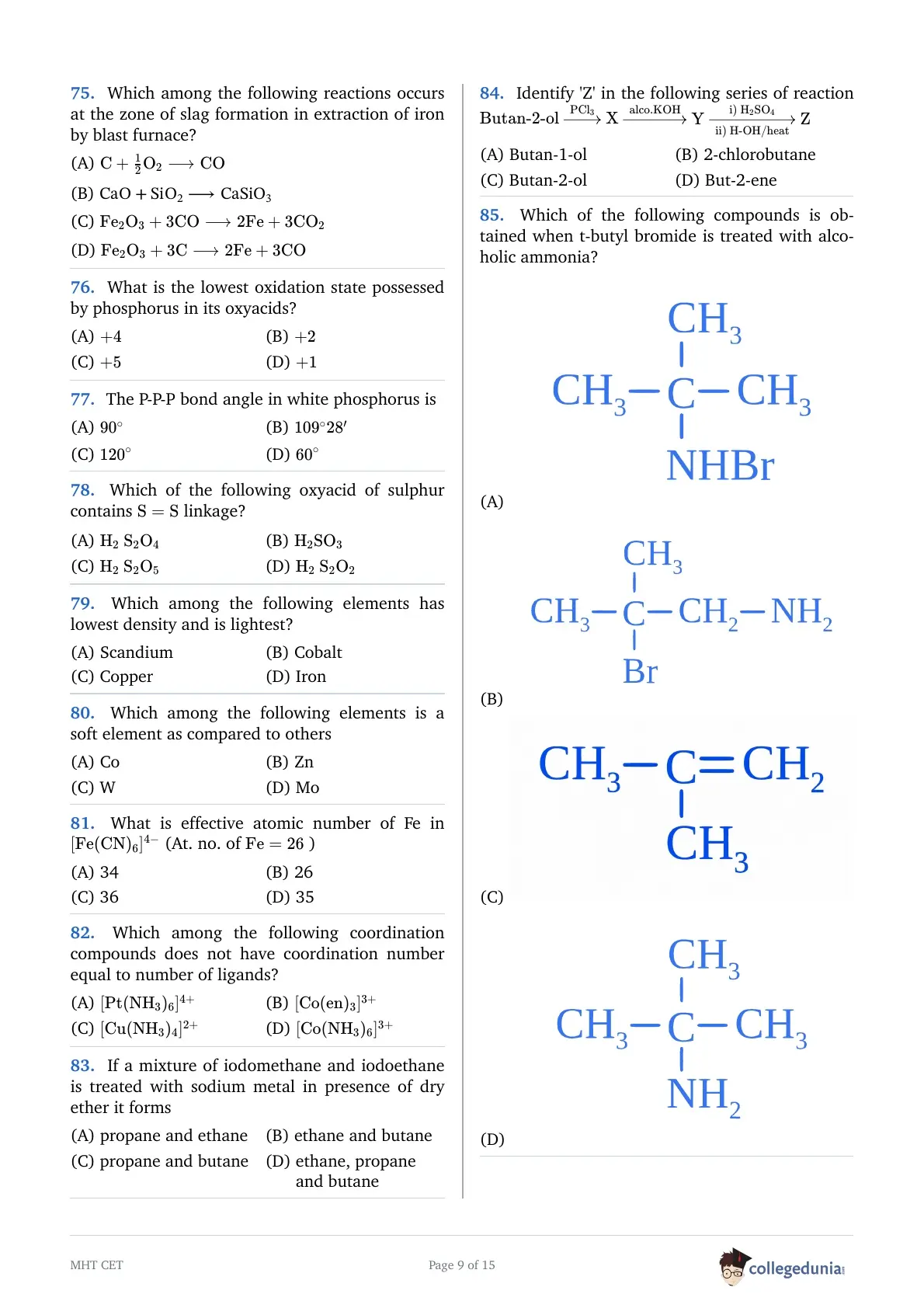
Which among the following reactions occurs at the zone of slag formation in extraction of iron by blast furnace?
What is the lowest oxidation state possessed by phosphorus in its oxyacids?
The P-P-P bond angle in white phosphorus is
Which of the following oxyacid of sulfur contains S=S linkage?
Which among the following elements has the lowest density and is lightest?
Which among the following elements is a soft element as compared to others?
What is the effective atomic number of Fe in [Fe(CN)\(_6\)]\(^{4-}\) (At. no. of Fe = 26)?
Which among the following coordination compounds does not have coordination number equal to the number of ligands?
If a mixture of iodomethane and iodethane is treated with sodium metal in presence of dry ether, it forms:
Which of the following compounds is obtained when t-butyl bromide is treated with alcoholic ammonia?
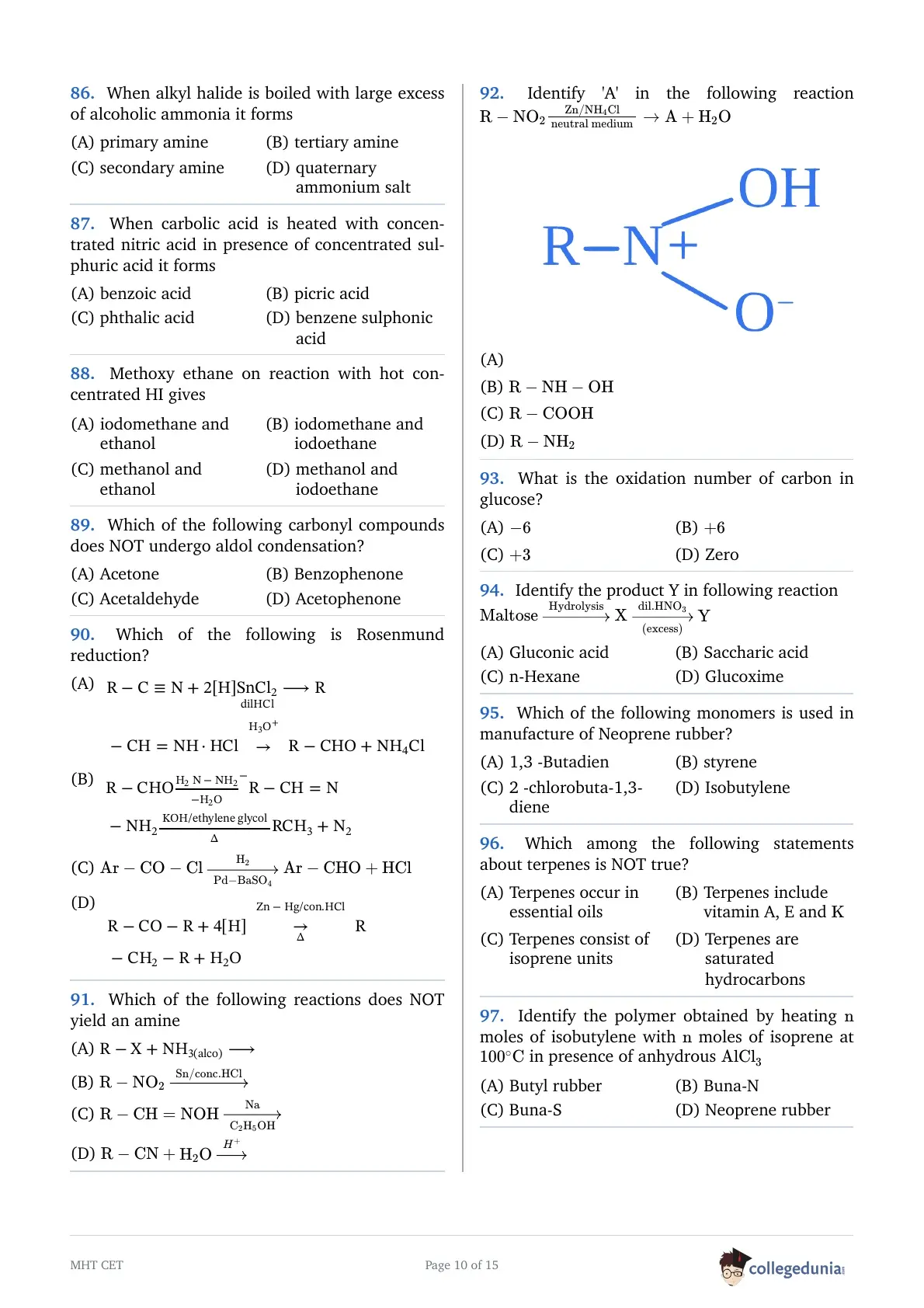
When alkyl halide is boiled with large excess of alcoholic ammonia it forms
When carbolic acid is heated with concentrated nitric acid in the presence of concentrated sulphuric acid, it forms:
Methoxy ethane on reaction with hot concentrated HI gives
Which of the following carbonyl compounds does NOT undergo aldol condensation?
Which of the following is Rosenmund reduction?
Which of the following reactions does NOT yield an amine
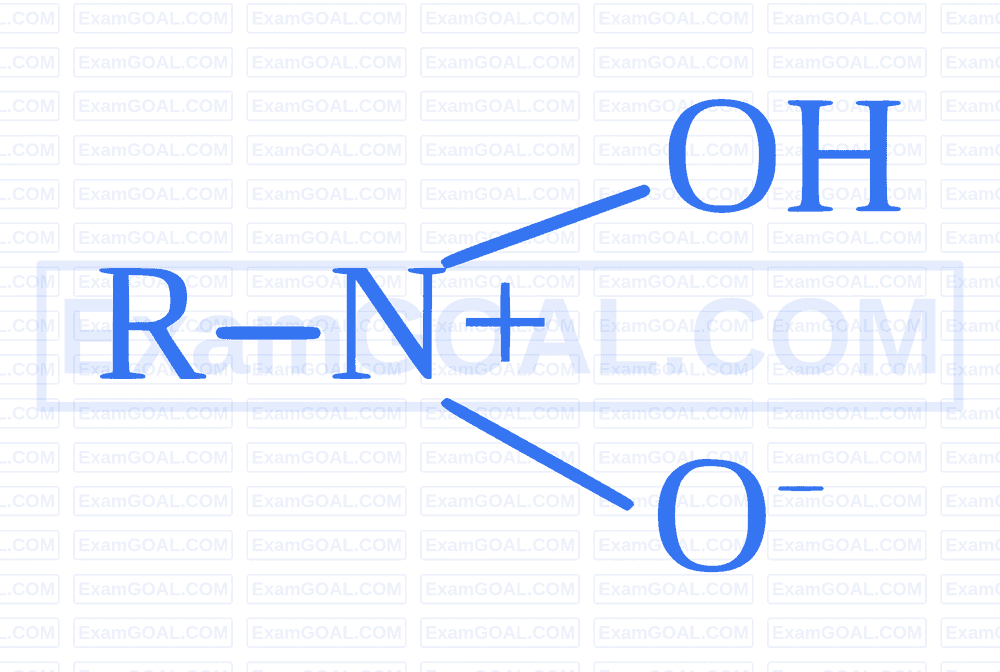
Identify 'A' in the following reaction \(\mathrm{R}-\mathrm{NO}_{2}\frac{\mathrm{Zn}/\mathrm{NH}_{4}\mathrm{Cl}}{\text{ neutral medium }}\rightarrow \mathrm{A}+\mathrm{H}_{2}\mathrm{O}\)
- (A)
![MHT CET 2020 12th October Morning Shift Chemistry - Compounds Containing Nitrogen Question 23 English Option 1]()
- (B) \(\mathrm{R}-\mathrm{NH}-\mathrm{OH}\)
- (C) \(\mathrm{R}-\mathrm{COOH}\)
- (D) \(\mathrm{R}-\mathrm{NH}_{2}\)
What is the oxidation number of carbon in glucose?
Identify the product Y in following reaction
\(\text{Maltose}\xrightarrow{\text{Hydrolysis}}\mathrm{X}\xrightarrow[\text{(excess)}]{\text{dil.}\mathrm{HNO}_{3}}\mathrm{Y}\)
Which of the following monomers is used in manufacture of Neoprene rubber?
Which among the following statements about terpenes is NOT true?
Identify the polymer obtained by heating n moles of isobutylene with n moles of isoprene at 100°C in the presence of anhydrous AlCl\(_3\).
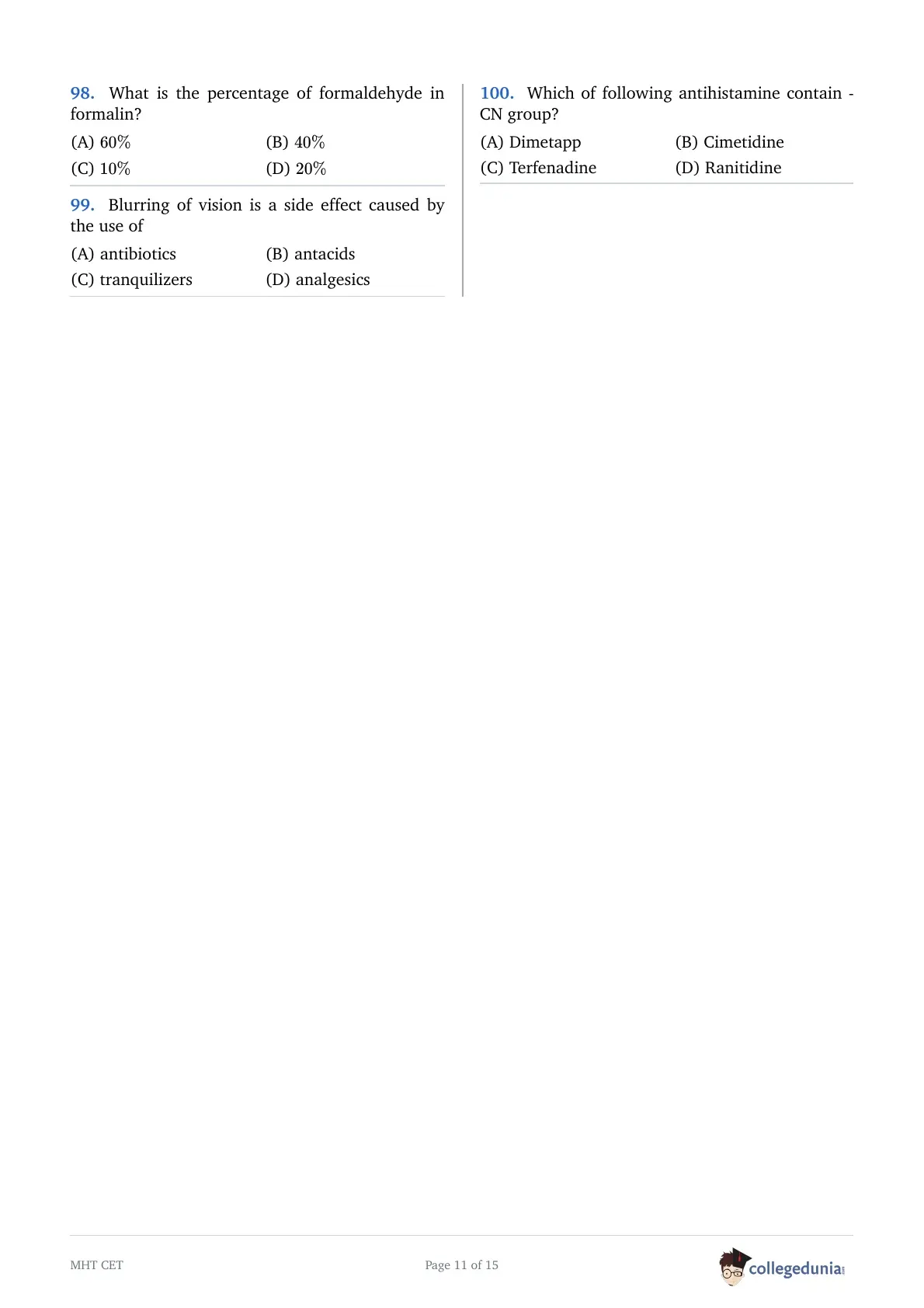
What is the percentage of formaldehyde in formalin?
Blurring of vision is a side effect caused by the use of:
Which of the following antihistamines contains the -CN group?
Mathematics (Q101 - Q150)
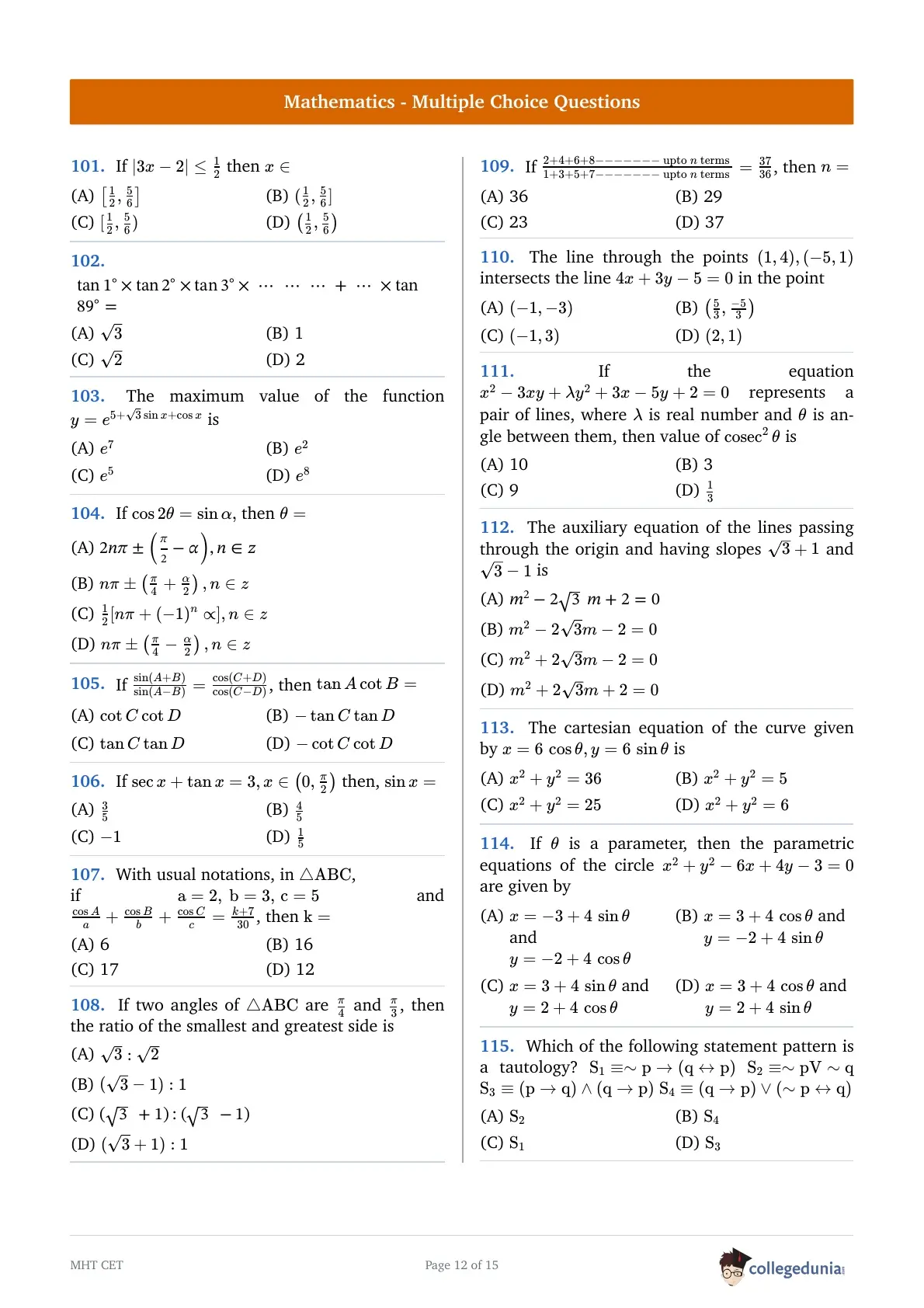
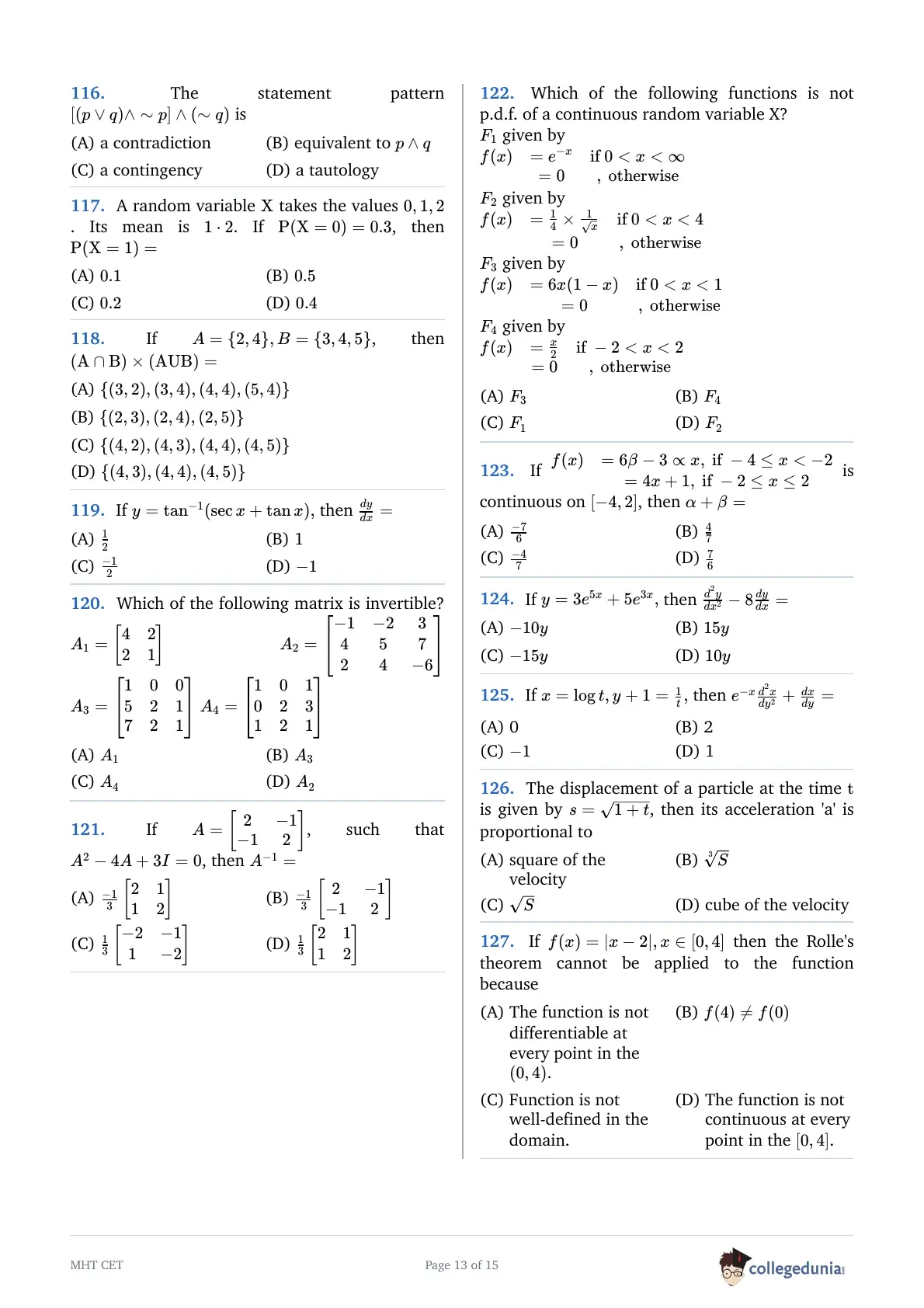
If \(|3x-2|\leq \frac{1}{2}\) then \(x\in\)
\(\tan 1^{\circ }\times \tan 2^{\circ }\times \tan 3^{\circ }\times \cdots \cdots \cdots +\cdots \times \tan 89^{\circ }=\)
The maximum value of the function \(y=e^{5+\sqrt{3}\sin x+\cos x}\) is
If \( \cos 2\theta = \sin \alpha \), then \( \theta = \)
If \(\frac{\sin (A+B)}{\sin (A-B)}=\frac{\cos (C+D)}{\cos (C-D)}\), then \(\tan A\cot B=\)
If \(\sec x+\tan x=3,x\in \left(0,\frac{\pi }{2}\right)\) then, \(\sin x=\)
With usual notations, in \(\triangle \mathrm{ABC}\),
if \(\mathrm{a}=2,\ \mathrm{b}=3,\,\mathrm{c}=5\) and \(\frac{\cos A}{a}+\frac{\cos B}{b}+\frac{\cos C}{c}=\frac{k+7}{30}\), then \(\mathrm{k}=\)
If two angles of \( \triangle ABC \) are \( \frac{\pi}{4} \) and \( \frac{\pi}{3} \), then the ratio of the smallest and greatest side is
If \(\frac{2+4+6+8-------\text{ upto }n\text{ terms }}{1+3+5+7-------\text{ upto }n\text{ terms }}=\frac{37}{36}\), then \(n=\)
The line through the points \( (1, 4), (-5, 1) \) intersects the line \( 4x + 3y - 5 = 0 \) in the point
If the equation
\[
x^2 - 3xy + y^2 + 3x - 5y + 2 = 0
\]
represents a pair of lines, where \( \theta \) is the angle between them, then the value of \( \csc^2 \theta \) is
The auxiliary equation of the lines passing through the origin and having slopes \(\sqrt{3}+1\) and \(\sqrt{3}-1\) is
The cartesian equation of the curve given by \(x=6\,\cos \theta ,y=6\,\sin \theta\) is
Which of the following statement pattern is a tautology? \(\mathrm{S}_{1}\equiv \sim \mathrm{p}\rightarrow (\mathrm{q}\leftrightarrow \mathrm{p})\) \(\mathrm{S}_{2}\equiv \sim \mathrm{pV}\sim \mathrm{q}\) \(\mathrm{S}_{3}\equiv (\mathrm{p}\rightarrow \mathrm{q})\wedge (\mathrm{q}\rightarrow \mathrm{p})\) \(\mathrm{S}_{4}\equiv (\mathrm{q}\rightarrow \mathrm{p})\vee (\sim \mathrm{p}\leftrightarrow \mathrm{q})\)
The statement pattern \([(p\vee q)\wedge \sim p]\wedge (\sim q)\) is
A random variable \( X \) takes the values 0, 1, 2. Its mean is 1.2. If \( P(X = 0) = 0.3 \), then \( P(X = 1) = \)
If \(A=\{2,4\},B=\{3,4,5\}\), then \((\mathrm{A}\cap \mathrm{B})\times (\mathrm{AUB})=\)
If \(y=\tan ^{-1}(\sec x+\tan x),\) then \(\frac{dy}{dx}=\)
Which of the following matrix is invertible? \(A_{1}=\begin{bmatrix} 4 & 2 \\ 2 & 1 \end{bmatrix}\) \(A_{2}=\begin{bmatrix} -1 & -2 & 3 \\ 4 & 5 & 7 \\ 2 & 4 & -6 \end{bmatrix}\) \(A_{3}=\begin{bmatrix} 1 & 0 & 0 \\ 5 & 2 & 1 \\ 7 & 2 & 1 \end{bmatrix}\) \(A_{4}=\begin{bmatrix} 1 & 0 & 1 \\ 0 & 2 & 3 \\ 1 & 2 & 1 \end{bmatrix}\)
If \(A=\begin{bmatrix} 2 & -1 \\ -1 & 2 \end{bmatrix}\), such that \(A^{2}-4A+3I=0\), then \(A^{-1}=\)
Which of the following functions is not p.d.f. of a continuous random variable X?
\(F_{1}\) given by
\(\begin{matrix} f(x) & =e^{-x} & \text{if }0\lt x\lt \infty \\ & =0 & ,\ \text{otherwise} \end{matrix}\)
\(F_{2}\) given by
\(\begin{matrix} f(x) & =\frac{1}{4}\times \frac{1}{\sqrt{x}} & \text{if }0\lt x\lt 4 \\ & =0 & ,\ \text{otherwise} \end{matrix}\)
\(F_{3}\) given by
\(\begin{matrix} f(x) & =6x(1-x) & \text{if }0\lt x\lt 1 \\ & =0 & ,\ \text{otherwise} \end{matrix}\)
\(F_{4}\) given by
\(\begin{matrix} f(x) & =\frac{x}{2} & \text{if }-2\lt x\lt 2 \\ & =0 & ,\ \text{otherwise} \end{matrix}\)
If \(\begin{matrix} f(x) & =6\beta -3\propto x,\text{ if }-4\leq x\lt -2 \\ & =4x+1,\text{ if }-2\leq x\leq 2 \end{matrix}\) is continuous on \([-4,2]\), then \(\alpha +\beta =\)
If \(y=3e^{5x}+5e^{3x},\) then \(\frac{d^{2}y}{dx^{2}}-8\frac{dy}{dx}=\)
If \(x=\log t,y+1=\frac{1}{t},\) then \(e^{-x}\frac{d^{2}x}{dy^{2}}+\frac{dx}{dy}=\)
The displacement of a particle at the time \(\mathrm{t}\) is given by \(s=\sqrt{1+t}\), then its acceleration 'a' is proportional to
If \(f(x)=|x-2|,x\in [0,4]\) then the Rolle's theorem cannot be applied to the function because
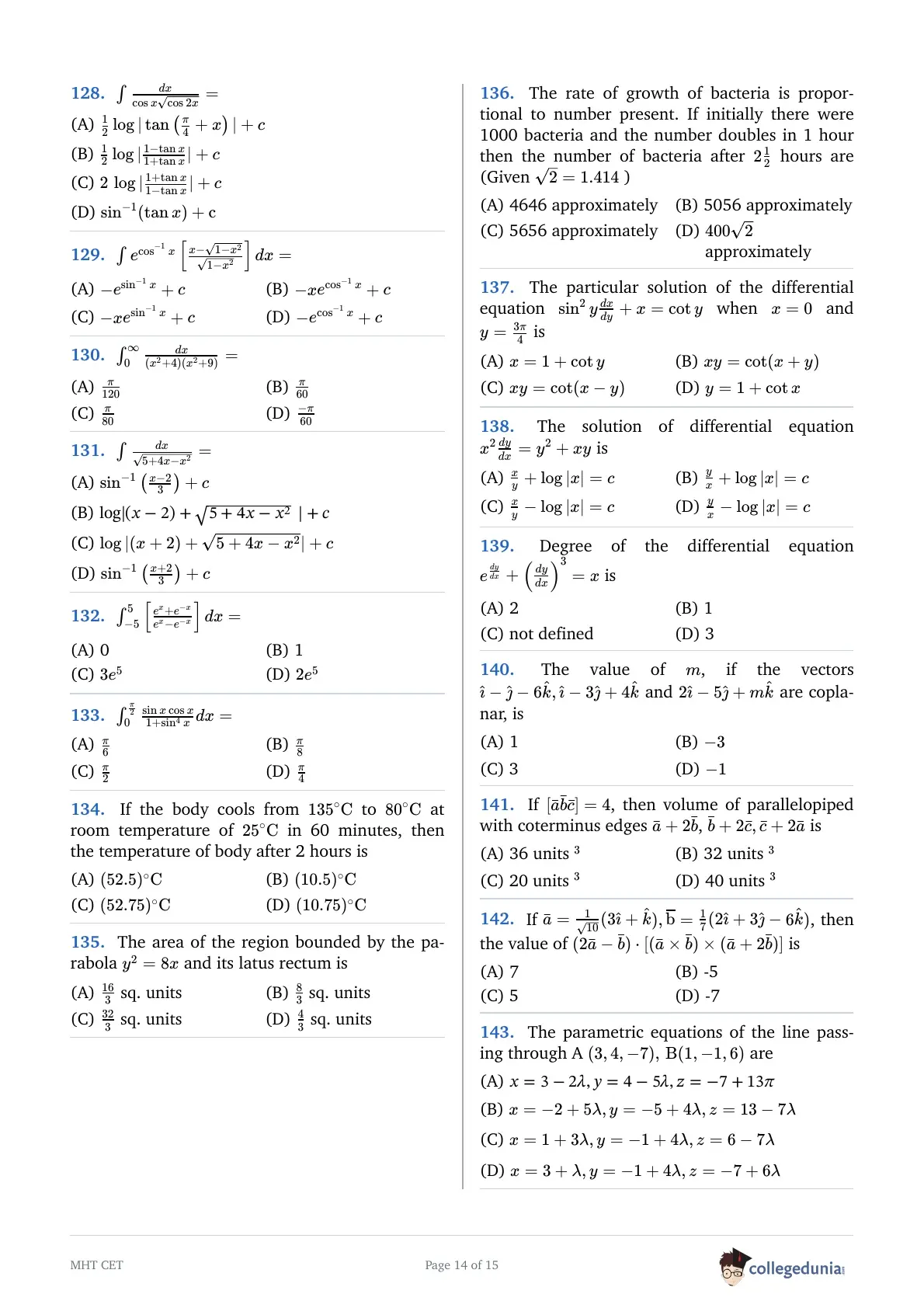
\(\int \frac{dx}{\cos x\sqrt{\cos 2x}}=\)
\(\int e^{\cos ^{-1}x}\left[\frac{x-\sqrt{1-x^{2}}}{\sqrt{1-x^{2}}}\right]dx=\)
\(\int _{0}^{\infty }\frac{dx}{(x^{2}+4)(x^{2}+9)}=\)
\(\int \frac{dx}{\sqrt{5+4x-x^{2}}}=\)
\(\int _{-5}^{5}\left[\frac{e^{x}+e^{-x}}{e^{x}-e^{-x}}\right]dx=\)
\(\int _{0}^{\frac{\pi }{2}}\frac{\sin x\cos x}{1+\sin ^{4}x}dx=\)
If the body cools from \( 135^\circ C \) to \( 80^\circ C \) at room temperature of \( 25^\circ C \) in 60 minutes, then the temperature of the body after 2 hours is
The area of the region bounded by the parabola \(y^{2}=8x\) and its latus rectum is
The rate of growth of bacteria is proportional to the number present. If initially there were 1000 bacteria and the number doubles in 1 hour, then the number of bacteria after \( 2\frac{1}{2} \) hours are (Given \( \sqrt{2} = 1.414 \))
The particular solution of the differential equation \(\sin ^{2}y\frac{dx}{dy}+x=\cot y\) when \(x=0\) and \(y=\frac{3\pi }{4}\) is
The solution of differential equation \(x^{2}\frac{dy}{dx}=y^{2}+xy\) is
Degree of the differential equation \(e^{\frac{dy}{dx}}+\left(\frac{dy}{dx}\right)^{3}=x\) is
The value of \(m\), if the vectors \(\hat{\imath}-\hat{\jmath}-6\hat{k},\hat{\imath}-3\hat{\jmath}+4\hat{k}\) and \(2\hat{\imath}-5\hat{\jmath}+m\hat{k}\) are coplanar, is
If \([\bar{a}\bar{b}\bar{c}]=4\), then volume of parallelopiped with coterminus edges \(\bar{a}+2\bar{b}\), \(\bar{b}+2\bar{c},\bar{c}+2\bar{a}\) is
If \(\bar{a}=\frac{1}{\sqrt{10}}(3\hat{\imath}+\hat{k}),\overline{\mathrm{b}}=\frac{1}{7}(2\hat{\imath}+3\hat{\jmath}-6\hat{k})\), then the value of \((2\bar{a}-\bar{b})\cdot [(\bar{a}\times \bar{b})\times (\bar{a}+2\bar{b})]\) is
The parametric equations of the line passing through \( A(3, 4, -7) \), \( B(1, -1, 6) \) are
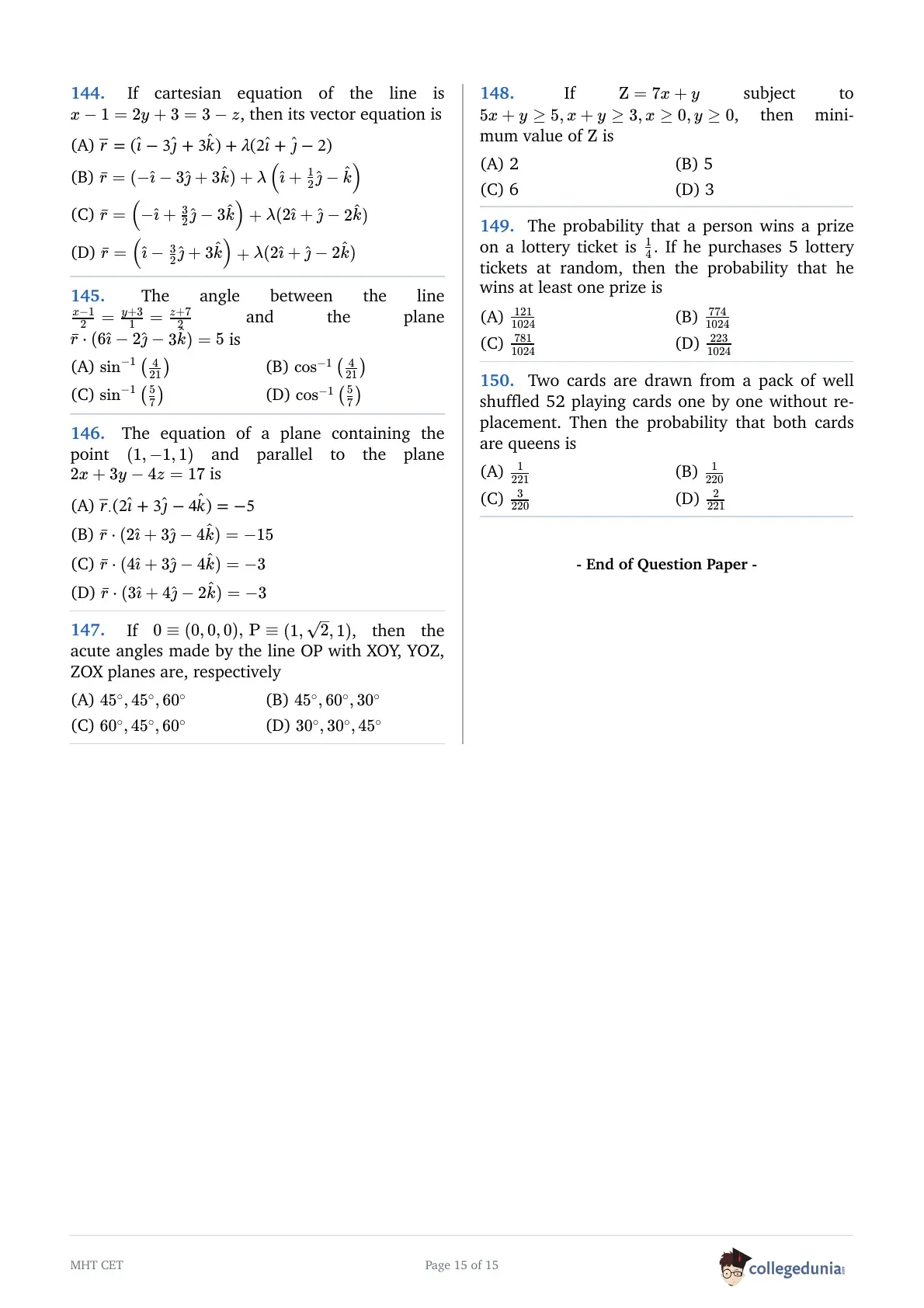
If the Cartesian equation of the line is
\[
x - 1 = 2y + 3 = 3 - z,
\]
then its vector equation is
The angle between the line \(\frac{x-1}{2}=\frac{y+3}{1}=\frac{z+7}{2}\) and the plane \(\bar{r}\cdot (6\hat{\imath}-2\hat{\jmath}-3\hat{k})=5\) is
The equation of a plane containing the point \((1,-1,1)\) and parallel to the plane \(2x+3y-4z=17\) is
If \(0\equiv (0,0,0),\,\mathrm{P}\equiv (1,\sqrt{2},1)\), then the acute angles made by the line OP with XOY, YOZ, ZOX planes are, respectively
If \(\mathrm{Z}=7x+y\) subject to \(5x+y\geq 5,x+y\geq 3,x\geq 0,y\geq 0\), then minimum value of \(\mathrm{Z}\) is
The probability that a person wins a prize on a lottery ticket is \( \frac{1}{4} \). If he purchases 5 lottery tickets at random, then the probability that he wins at least one prize is
Two cards are drawn from a pack of well shuffled 52 playing cards one by one without replacement. Then the probability that both cards are queens is
MHT CET 2020 PCM Exam Pattern and Marking Scheme
| Parameter | Details |
|---|---|
| Conducting Body | Maharashtra Common Entrance Test Cell (Maharashtra CET Cell) |
| Exam Mode | Online (Computer-Based Test) |
| Duration | 180 minutes (3 hours) |
| Groups / Subjects | PCM (Physics, Chemistry, Mathematics) for Engineering |
| Total Questions |
150 |
| Total Marks | 200 |
| Question Type | Multiple Choice Questions (MCQs) |
| Marks Distribution |
|
| Negative Marking | No |
| Syllabus Weightage |
|



Comments