MHT CET 2020 Oct 12 Shift 2 PCM Question Paper is available for download here. Maharashtra State CET Cell conducted MHT CET 2020 PCM Exam on Oct 12 in Shift 2 from 2 PM to 5 PM in CBT mode.

The MHT CET 2020 PCM question paper includes the following:

  • The MHT CET 2020 PCM Question Paper consists of 150 multiple-choice questions (MCQs) totalling 200 marks divided into 3 sections: Physics, Chemistry, and Mathematics, with 50 questions in each subject.
  • Physics and Chemistry questions carry 1 mark each while Mathematics questions carry 2 marks each.
  • There is no negative marking for incorrect answers.

MHT CET 2020 Oct 12 Shift 2 PCM Question Paper with Solution PDF

CD PDF CD PDF with Solutions
Download Collegedunia PDF 1.51 MB -

Also Check:

MHT CET 2020 Oct 12 Shift 2 PCM Questions with Solutions


Physics (Q1 - Q50)

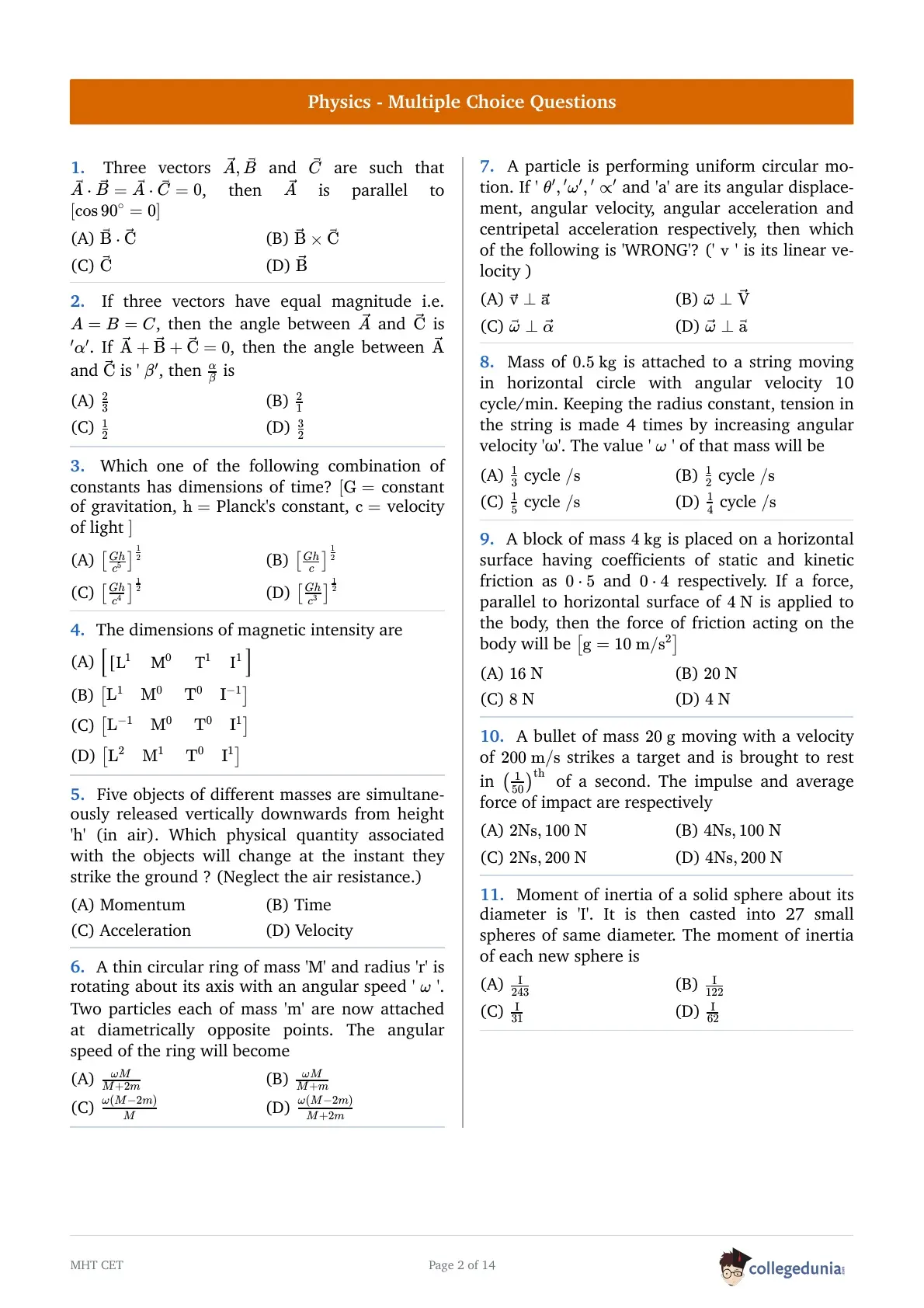
Question 1:

Three vectors \(\vec{A}\), \(\vec{B}\) and \(\vec{C}\) are such that \(\vec{A}\cdot\vec{B} = \vec{A}\cdot\vec{C} = 0\), then \(\vec{A}\) is parallel to
\(\left[\cos 90^\circ = 0\right]\)

  • (A) \(\vec{B}\cdot\vec{C}\)
  • (B) \(\vec{B} \times \vec{C}\)
  • (C) \(\vec{C}\)
  • (D) \(\vec{B}\)

Question 2:

If three vectors have equal magnitude i.e. \(A=B=C\), then the angle between \(\vec{A}\) and \(\vec{\mathrm{C}}\) is \({}'\alpha '\). If \(\vec{\mathrm{A}}+\vec{\mathrm{B}}+\vec{\mathrm{C}}=0\), then the angle between \(\vec{\mathrm{A}}\) and \(\vec{\mathrm{C}}\) is ' \(\beta '\), then \(\frac{\alpha }{\beta }\) is

  • (A) \(\frac{2}{3}\)
  • (B) \(\frac{2}{1}\)
  • (C) \(\frac{1}{2}\)
  • (D) \(\frac{3}{2}\)

Question 3:

Which one of the following combination of constants has dimensions of time?
[\(G\) = constant of gravitation, \(h\) = Planck's constant, \(c\) = velocity of light]

  • (A) \(\left[\dfrac{Gh}{c^{5}}\right]^{1/2}\)
  • (B) \(\left[\dfrac{Gh}{c}\right]^{1/2}\)
  • (C) \(\left[\dfrac{Gh}{c^{4}}\right]^{1/2}\)
  • (D) \(\left[\dfrac{Gh}{c^{3}}\right]^{1/2}\)

Question 4:

The dimensions of magnetic intensity are

  • (A) \([L^{1} M^{0} T^{1} I^{1}]\)
  • (B) \([L^{1} M^{0} T^{0} I^{-1}]\)
  • (C) \([L^{-1} M^{0} T^{0} I^{1}]\)
  • (D) \([L^{2} M^{1} T^{0} I^{1}]\)

Question 5:

Five objects of different masses are simultaneously released vertically downwards from height \(h\) (in air). Which physical quantity associated with the objects will change at the instant they strike the ground? (Neglect air resistance.)

  • (A) Momentum
  • (B) Time
  • (C) Acceleration
  • (D) Velocity

Question 6:

A thin circular ring of mass \(M\) and radius \(r\) is rotating about its axis with an angular speed \(\omega\). Two particles each of mass \(m\) are now attached at diametrically opposite points. The angular speed of the ring will become

  • (A) \(\dfrac{\omega M}{M+2m}\)
  • (B) \(\dfrac{\omega M}{M+m}\)
  • (C) \(\dfrac{\omega(M-2m)}{M}\)
  • (D) \(\dfrac{\omega(M-2m)}{M+2m}\)

Question 7:

A particle is performing uniform circular motion. If \(\theta\), \(\omega\), \(\alpha\) and \(\vec{a}\) are its angular displacement, angular velocity, angular acceleration and centripetal acceleration respectively, then which of the following is WRONG?
(\(\vec{v}\) is its linear velocity)

  • (A) \(\vec{v} \perp \vec{a}\)
  • (B) \(\vec{\omega} \perp \vec{v}\)
  • (C) \(\vec{\omega} \perp \vec{\alpha}\)
  • (D) \(\vec{\omega} \perp \vec{a}\)

Question 8:

Mass of \(0.5\,\text{kg}\) is attached to a string moving in a horizontal circle with angular velocity \(10\) cycle/min. Keeping radius constant, tension in the string is made \(4\) times by increasing angular velocity \(\omega'\). The value of \(\omega'\) of that mass will be

  • (A) \(\dfrac{1}{3}\) cycle/s
  • (B) \(\dfrac{1}{2}\) cycle/s
  • (C) \(\dfrac{1}{5}\) cycle/s
  • (D) \(\dfrac{1}{4}\) cycle/s

Question 9:

A block of mass \(4\,\text{kg}\) is placed on a horizontal surface having coefficients of static and kinetic friction as \(0.5\) and \(0.4\) respectively. If a force parallel to the horizontal surface of \(4\,\text{N}\) is applied to the body, then the force of friction acting on the body will be
\(\left[g = 10\,\text{m/s}^2\right]\)

  • (A) \(16\,\text{N}\)
  • (B) \(20\,\text{N}\)
  • (C) \(8\,\text{N}\)
  • (D) \(4\,\text{N}\)

Question 10:

A bullet of mass \(20\,\text{g}\) moving with a velocity of \(200\,\text{m/s}\) strikes a target and is brought to rest in \(\left(\dfrac{1}{50}\right)^{\text{th}}\) of a second. The impulse and average force of impact are respectively

  • (A) \(2\,\text{Ns},\,100\,\text{N}\)
  • (B) \(4\,\text{Ns},\,100\,\text{N}\)
  • (C) \(2\,\text{Ns},\,200\,\text{N}\)
  • (D) \(4\,\text{Ns},\,200\,\text{N}\)

Question 11:

Moment of inertia of a solid sphere about its diameter is \(I\). It is then cast into \(27\) small spheres of same diameter. The moment of inertia of each new sphere is

  • (A) \(\dfrac{I}{243}\)
  • (B) \(\dfrac{I}{122}\)
  • (C) \(\dfrac{I}{31}\)
  • (D) \(\dfrac{I}{62}\)

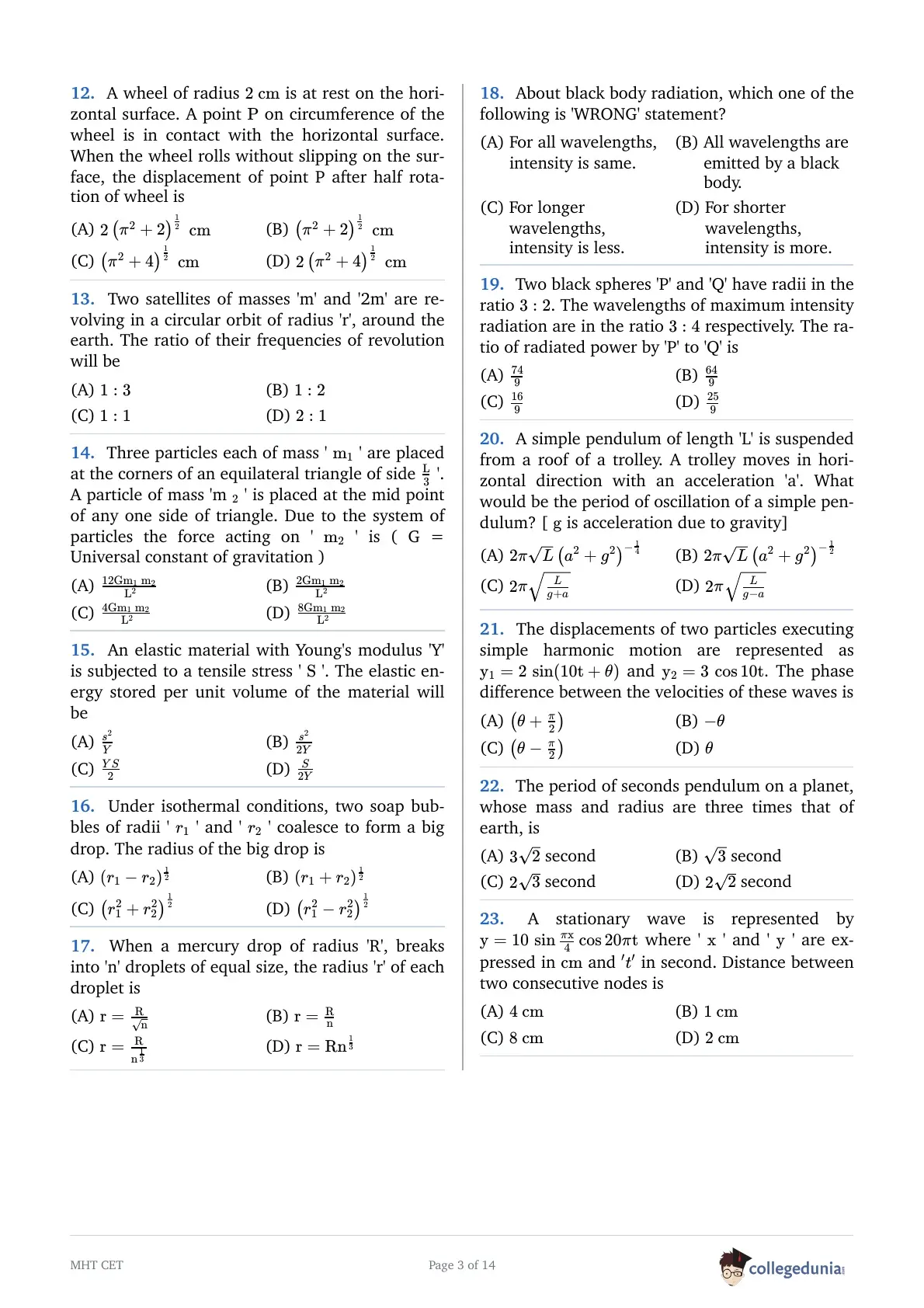
Question 12:

A wheel of radius \(2\ \mathrm{cm}\) is at rest on the horizontal surface. A point \(\mathrm{P}\) on circumference of the wheel is in contact with the horizontal surface. When the wheel rolls without slipping on the surface, the displacement of point P after half rotation of wheel is

  • (A) \(2\left(\pi ^{2}+2\right)^{\frac{1}{2}}\ \mathrm{cm}\)
  • (B) \(\left(\pi ^{2}+2\right)^{\frac{1}{2}}\ \mathrm{cm}\)
  • (C) \(\left(\pi ^{2}+4\right)^{\frac{1}{2}}\ \mathrm{cm}\)
  • (D) \(2\left(\pi ^{2}+4\right)^{\frac{1}{2}}\ \mathrm{cm}\)

Question 13:

Two satellites of masses \(m\) and \(2m\) are revolving in a circular orbit of radius \(r\) around the earth. The ratio of their frequencies of revolution will be

  • (A) \(1:3\)
  • (B) \(1:2\)
  • (C) \(1:1\)
  • (D) \(2:1\)

Question 14:

Three particles each of mass \(m_1\) are placed at the corners of an equilateral triangle of side \(L\). A particle of mass \(m_2\) is placed at the midpoint of any one side of the triangle. Due to the system of particles the force acting on \(m_2\) is (G = universal constant of gravitation)

  • (A) \(\dfrac{12 G m_1 m_2}{L^2}\)
  • (B) \(\dfrac{2 G m_1 m_2}{L^2}\)
  • (C) \(\dfrac{4 G m_1 m_2}{L^2}\)
  • (D) \(\dfrac{8 G m_1 m_2}{L^2}\)

Question 15:

An elastic material with Young's modulus \(Y\) is subjected to a tensile stress \(S\). The elastic energy stored per unit volume of the material will be

  • (A) \(\dfrac{S^2}{Y}\)
  • (B) \(\dfrac{S^2}{2Y}\)
  • (C) \(\dfrac{YS}{2}\)
  • (D) \(\dfrac{S}{2Y}\)

Question 16:

Under isothermal conditions, two soap bubbles of radii \(r_1\) and \(r_2\) coalesce to form a big drop. The radius of the big drop is

  • (A) \((r_1 - r_2)^{1/2}\)
  • (B) \((r_1 + r_2)^{1/2}\)
  • (C) \((r_1^2 + r_2^2)^{1/2}\)
  • (D) \((r_1^2 - r_2^2)^{1/2}\)

Question 17:

When a mercury drop of radius \(R\) breaks into \(n\) droplets of equal size, the radius \(r\) of each droplet is

  • (A) \(r = \dfrac{R}{\sqrt{n}}\)
  • (B) \(r = \dfrac{R}{n}\)
  • (C) \(r = \dfrac{R}{n^{1/3}}\)
  • (D) \(r = R n^{1/3}\)

Question 18:

About black body radiation, which one of the following is 'WRONG' statement?

  • (A) For all wavelengths, intensity is same.
  • (B) All wavelengths are emitted by a black body.
  • (C) For longer wavelengths, intensity is less.
  • (D) For shorter wavelengths, intensity is more.

Question 19:

Two black spheres \(P\) and \(Q\) have radii in the ratio \(3:2\). The wavelengths of maximum intensity radiation are in the ratio \(3:4\) respectively. The ratio of radiated power by \(P\) to \(Q\) is

  • (A) \(\dfrac{74}{9}\)
  • (B) \(\dfrac{64}{9}\)
  • (C) \(\dfrac{16}{9}\)
  • (D) \(\dfrac{25}{9}\)

Question 20:

A simple pendulum of length \(L\) is suspended from the roof of a trolley. The trolley moves in horizontal direction with an acceleration \(a\). What would be the period of oscillation of a simple pendulum? [\(g\) is acceleration due to gravity]

  • (A) \(2\pi \sqrt{L}\,(a^2+g^2)^{-1/4}\)
  • (B) \(2\pi \sqrt{L}\,(a^2+g^2)^{-1/2}\)
  • (C) \(2\pi \sqrt{\dfrac{L}{g+a}}\)
  • (D) \(2\pi \sqrt{\dfrac{L}{g-a}}\)

Question 21:

The displacements of two particles executing simple harmonic motion are represented as
\(y_1 = 2\sin(10t + \theta)\) and \(y_2 = 3\cos(10t)\). The phase difference between the velocities of these waves is

  • (A) \(\theta + \dfrac{\pi}{2}\)
  • (B) \(-\theta\)
  • (C) \(\theta - \dfrac{\pi}{2}\)
  • (D) \(\theta\)

Question 22:

The period of seconds pendulum on a planet, whose mass and radius are three times that of earth, is

  • (A) \(3\sqrt{2}\) second
  • (B) \(\sqrt{3}\) second
  • (C) \(2\sqrt{3}\) second
  • (D) \(2\sqrt{2}\) second

Question 23:

A stationary wave is represented by \(y = 10\sin\left(\dfrac{\pi x}{4}\right)\cos(20\pi t)\), where \(x\) and \(y\) are expressed in cm and \(t\) in second. Distance between two consecutive nodes is

  • (A) \(4\,\text{cm}\)
  • (B) \(1\,\text{cm}\)
  • (C) \(8\,\text{cm}\)
  • (D) \(2\,\text{cm}\)

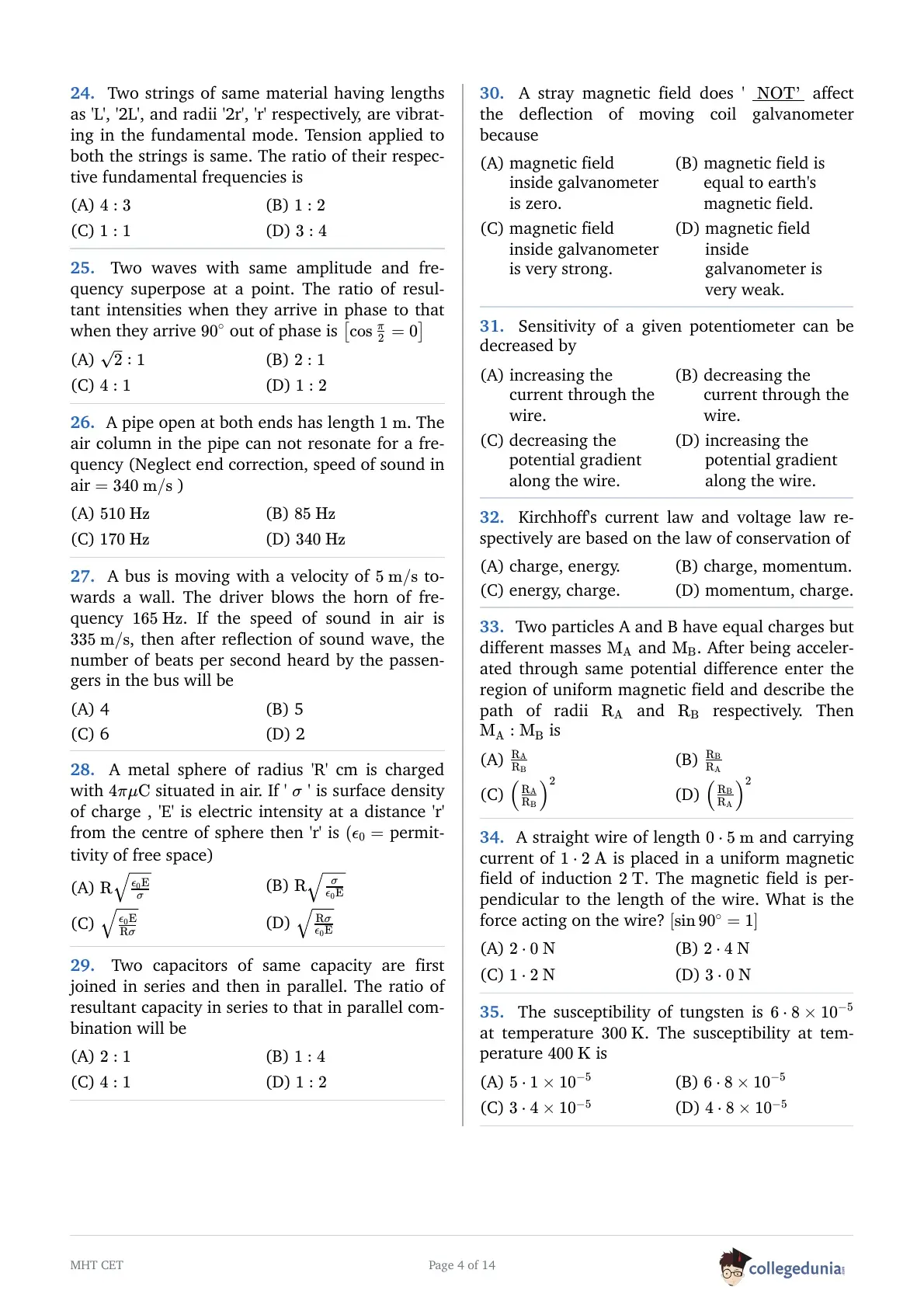
Question 24:

Two strings of same material having lengths as \(L\), \(2L\) and radii \(2r\), \(r\) respectively, are vibrating in the fundamental mode. Tension applied to both the strings is same. The ratio of their respective fundamental frequencies is

  • (A) \(4:3\)
  • (B) \(1:2\)
  • (C) \(1:1\)
  • (D) \(3:4\)

Question 25:

Two waves with same amplitude and frequency superpose at a point. The ratio of resultant intensities when they arrive in phase to that when they arrive \(90^\circ\) out of phase is \(\left[\cos \frac{\pi}{2} = 0\right]\)

  • (A) \(\sqrt{2}:1\)
  • (B) \(2:1\)
  • (C) \(4:1\)
  • (D) \(1:2\)

Question 26:

A pipe open at both ends has length 1 m. The air column in the pipe cannot resonate for a frequency (Neglect end correction, speed of sound in air = 340 m/s)

  • (A) 510 Hz
  • (B) 85 Hz
  • (C) 170 Hz
  • (D) 340 Hz

Question 27:

A bus is moving with a velocity of 5 m/s towards a wall. The driver blows the horn of frequency 165 Hz. If the speed of sound in air is 335 m/s, then after reflection of the sound wave, the number of beats per second heard by the passengers in the bus will be

  • (A) 4
  • (B) 5
  • (C) 6
  • (D) 2

Question 28:

A metal sphere of radius \(R\) cm is charged with \(4\pi \mu\) C situated in air. If \(\sigma\) is surface density of charge, \(E\) is electric intensity at a distance \(r\) from the centre of sphere, then \(r\) is
(\(\varepsilon_0\) = permittivity of free space)

  • (A) \(R\sqrt{\dfrac{\varepsilon_0 E}{\sigma}}\)
  • (B) \(R\sqrt{\dfrac{\sigma}{\varepsilon_0 E}}\)
  • (C) \(\sqrt{\dfrac{\varepsilon_0 E}{R\sigma}}\)
  • (D) \(\sqrt{\dfrac{R\sigma}{\varepsilon_0 E}}\)

Question 29:

Two capacitors of same capacity are first joined in series and then in parallel. The ratio of resultant capacity in series to that in parallel combination will be

  • (A) \(2:1\)
  • (B) \(1:4\)
  • (C) \(4:1\)
  • (D) \(1:2\)

Question 31:

Sensitivity of a given potentiometer can be decreased by

  • (A) increasing the current through the wire
  • (B) decreasing the current through the wire
  • (C) decreasing the potential gradient along the wire
  • (D) increasing the potential gradient along the wire

Question 32:

Kirchhoff's current law and voltage law respectively are based on the law of conservation of

  • (A) charge, energy
  • (B) charge, momentum
  • (C) energy, charge
  • (D) momentum, charge

Question 33:

Two particles A and B have equal charges but different masses \(M_A\) and \(M_B\). After being accelerated through the same potential difference, they enter a region of uniform magnetic field and describe paths of radii \(R_A\) and \(R_B\) respectively. Then \(M_A : M_B\) is

  • (A) \(\dfrac{R_A}{R_B}\)
  • (B) \(\dfrac{R_B}{R_A}\)
  • (C) \(\left(\dfrac{R_A}{R_B}\right)^2\)
  • (D) \(\left(\dfrac{R_B}{R_A}\right)^2\)

Question 34:

A straight wire of length \(0\cdot 5\ \mathrm{m}\) and carrying current of \(1\cdot 2\ \mathrm{A}\) is placed in a uniform magnetic field of induction \(2\ \mathrm{T}\). The magnetic field is perpendicular to the length of the wire. What is the force acting on the wire? \([\sin 90^{\circ }=1]\)

  • (A) \(2\cdot 0\ \mathrm{N}\)
  • (B) \(2\cdot 4\ \mathrm{N}\)
  • (C) \(1\cdot 2\ \mathrm{N}\)
  • (D) \(3\cdot 0\ \mathrm{N}\)

Question 35:

The susceptibility of tungsten is \(6.8 \times 10^{-5}\) at temperature \(300\,\text{K}\). The susceptibility at temperature \(400\,\text{K}\) is

  • (A) \(5.1 \times 10^{-5}\)
  • (B) \(6.8 \times 10^{-5}\)
  • (C) \(3.4 \times 10^{-5}\)
  • (D) \(4.8 \times 10^{-5}\)

Question 36:

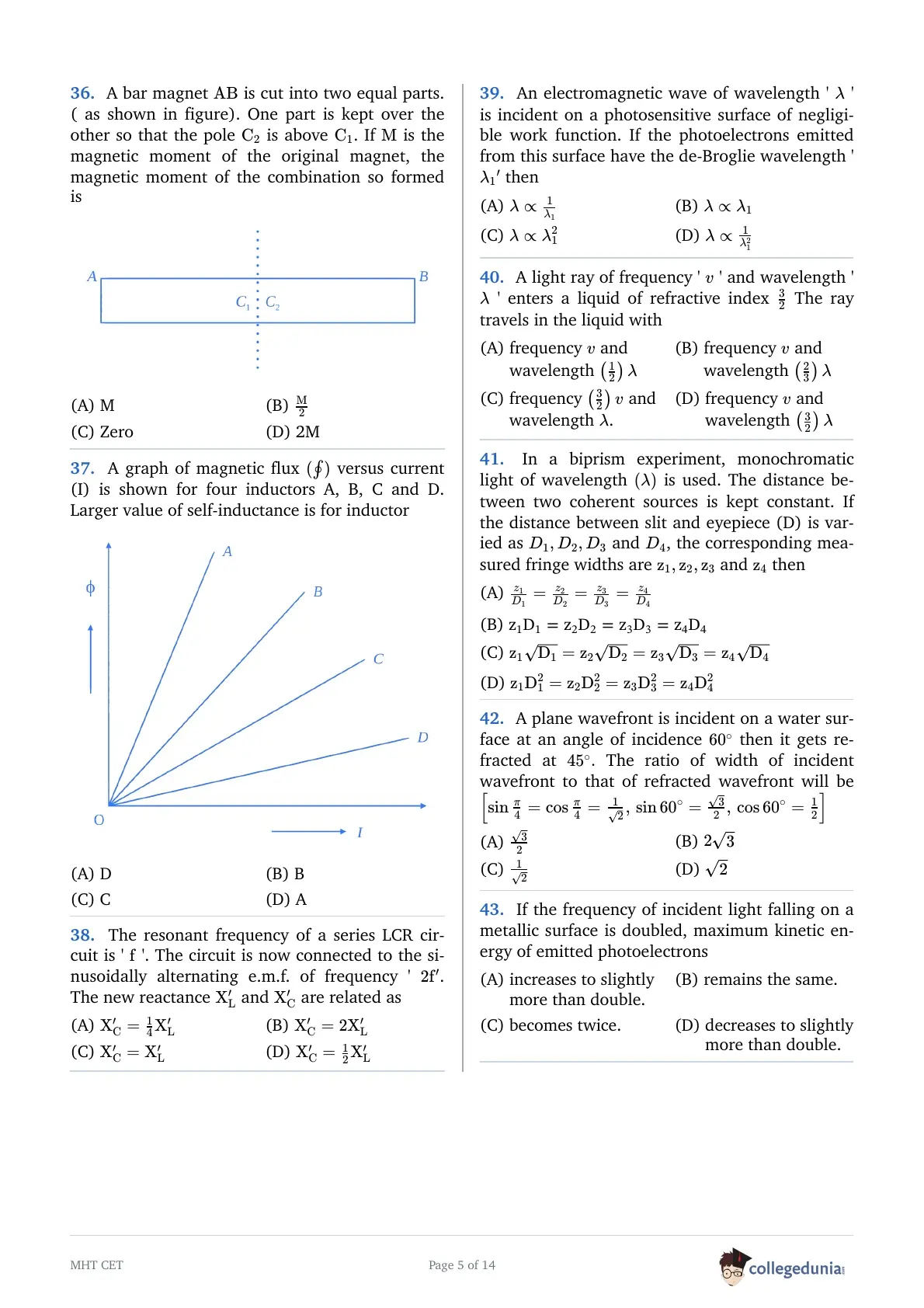
A bar magnet \(AB\) is cut into two equal parts (as shown in figure). One part is kept over the other such that the pole \(C_2\) is above \(C_1\). If \(M\) is the magnetic moment of the original magnet, the magnetic moment of the combination so formed is

  • (A) \(M\)
  • (B) \(\dfrac{M}{2}\)
  • (C) Zero
  • (D) \(2M\)

Question 37:

A graph of magnetic flux (\(\phi\)) versus current (\(I\)) is shown for four inductors A, B, C and D. Larger value of self-inductance is for inductor

  • (A) D
  • (B) B
  • (C) C
  • (D) A

Question 38:

The resonant frequency of a series LCR circuit is \(f\). The circuit is now connected to the sinusoidally alternating e.m.f. of frequency \(2f\). The new reactances \(X'_L\) and \(X'_C\) are related as

  • (A) \(X'_C = \dfrac{1}{4} X'_L\)
  • (B) \(X'_C = 2X'_L\)
  • (C) \(X'_C = X'_L\)
  • (D) \(X'_C = \dfrac{1}{2} X'_L\)

Question 39:

An electromagnetic wave of wavelength \(\lambda\) is incident on a photosensitive surface of negligible work function. If the photoelectrons emitted from this surface have the de-Broglie wavelength \(\lambda_1\), then

  • (A) \(\lambda \propto \dfrac{1}{\lambda_1}\)
  • (B) \(\lambda \propto \lambda_1\)
  • (C) \(\lambda \propto \lambda_1^2\)
  • (D) \(\lambda \propto \dfrac{1}{\lambda_1^2}\)

Question 40:

A light ray of frequency ' \(v\) ' and wavelength ' \(\lambda\) ' enters a liquid of refractive index \(\frac{3}{2}\) The ray travels in the liquid with

  • (A) frequency \(v\) and wavelength \(\left(\frac{1}{2}\right)\lambda\)
  • (B) frequency \(v\) and wavelength \(\left(\frac{2}{3}\right)\lambda\)
  • (C) frequency \(\left(\frac{3}{2}\right)v\) and wavelength \(\lambda\).
  • (D) frequency \(v\) and wavelength \(\left(\frac{3}{2}\right)\lambda\)

Question 41:

In a biprism experiment, monochromatic light of wavelength \(\lambda\) is used. The distance between two coherent sources is kept constant. If the distance between slit and eyepiece is varied as \(D_1, D_2, D_3\) and \(D_4\), the corresponding measured fringe widths are \(z_1, z_2, z_3\) and \(z_4\), then

  • (A) \(\dfrac{z_1}{D_1} = \dfrac{z_2}{D_2} = \dfrac{z_3}{D_3} = \dfrac{z_4}{D_4}\)
  • (B) \(z_1 D_1 = z_2 D_2 = z_3 D_3 = z_4 D_4\)
  • (C) \(z_1 \sqrt{D_1} = z_2 \sqrt{D_2} = z_3 \sqrt{D_3} = z_4 \sqrt{D_4}\)
  • (D) \(z_1 D_1^2 = z_2 D_2^2 = z_3 D_3^2 = z_4 D_4^2\)

Question 42:

A plane wavefront is incident on a water surface at an angle of incidence \(60^\circ\) then it gets refracted at \(45^\circ\). The ratio of width of incident wavefront to that of refracted wavefront will be
\(\left[\sin \frac{\pi}{4} = \cos \frac{\pi}{4} = \frac{1}{\sqrt{2}}, \; \sin 60^\circ = \frac{\sqrt{3}}{2}, \; \cos 60^\circ = \frac{1}{2}\right]\)

  • (A) \(\dfrac{\sqrt{3}}{2}\)
  • (B) \(2\sqrt{3}\)
  • (C) \(\dfrac{1}{\sqrt{2}}\)
  • (D) \(\sqrt{2}\)

Question 43:

If the frequency of incident light falling on a metallic surface is doubled, maximum kinetic energy of emitted photoelectrons

  • (A) increases to slightly more than double
  • (B) remains the same
  • (C) becomes twice
  • (D) decreases to slightly more than double

Question 45:

If \(T\) is the half-life of a radioactive substance, then its instantaneous rate of change of activity is proportional to

  • (A) \(\sqrt{T}\)
  • (B) \(T\)
  • (C) \(T^2\)
  • (D) \(T^{-2}\)

Question 46:

The region near the junction of an unbiased p-n junction diode is known as depletion layer. The layer is depleted of

  • (A) only negative ions
  • (B) electrons and holes
  • (C) both positive and negative ions
  • (D) only positive ions

Question 47:

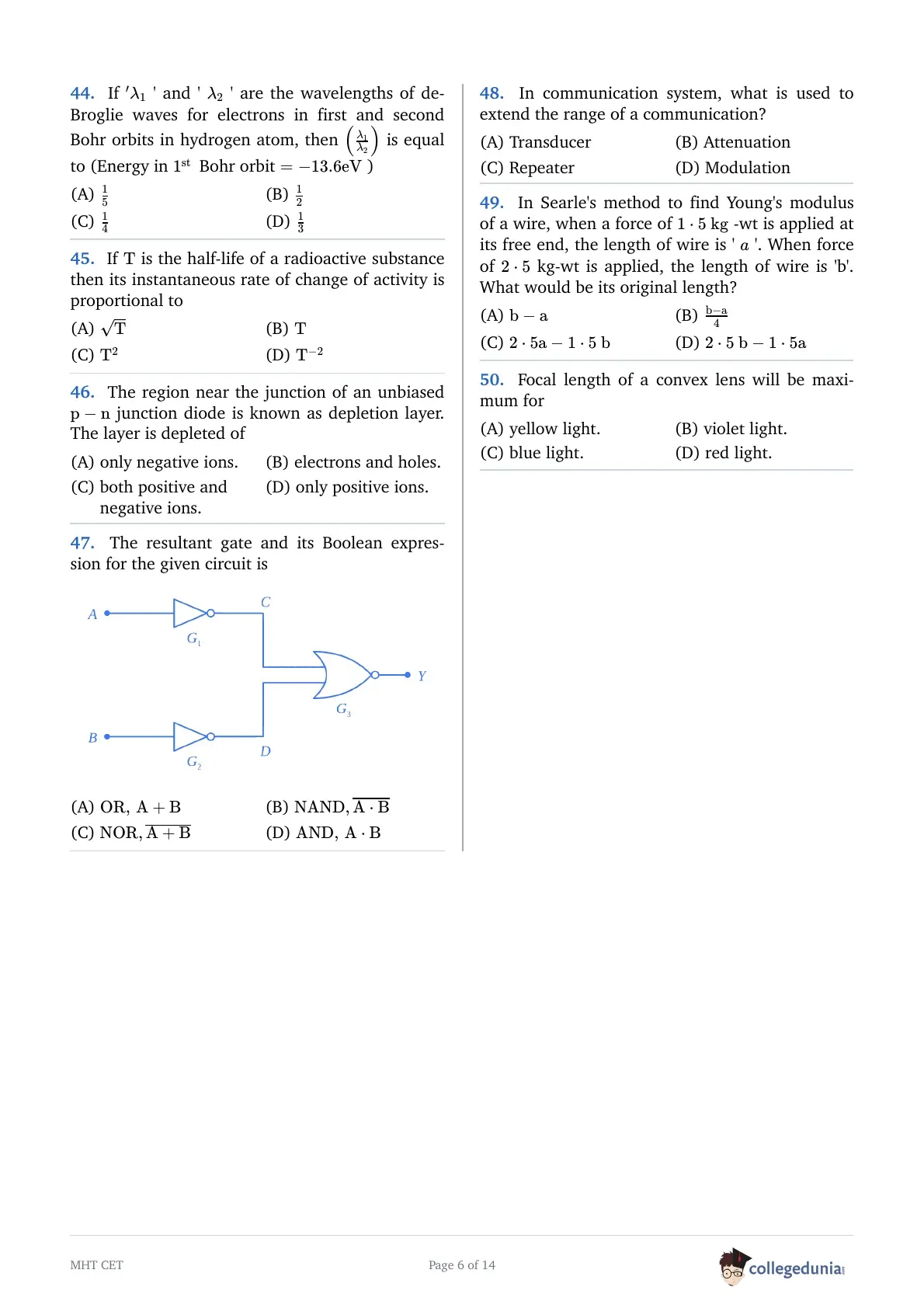
The resultant gate and its Boolean expression for the given circuit is

  • (A) OR, \(A + B\)
  • (B) NAND, \(\overline{A \cdot B}\)
  • (C) NOR, \(\overline{A + B}\)
  • (D) AND, \(A \cdot B\)

Question 48:

In communication system, what is used to extend the range of a communication?

  • (A) Transducer
  • (B) Attenuation
  • (C) Repeater
  • (D) Modulation

Question 49:

In Searle's method to find Young's modulus of a wire, when a force of \(1.5\) kg-wt is applied at its free end, the length of wire is \(a\). When force of \(2.5\) kg-wt is applied, the length of wire is \(b\). What would be its original length?

  • (A) \(b - a\)
  • (B) \(\dfrac{b - a}{4}\)
  • (C) \(2.5a - 1.5b\)
  • (D) \(2.5b - 1.5a\)

Question 50:

Focal length of a convex lens will be maximum for

  • (A) yellow light
  • (B) violet light
  • (C) blue light
  • (D) red light

Chemistry (Q51 - Q100)

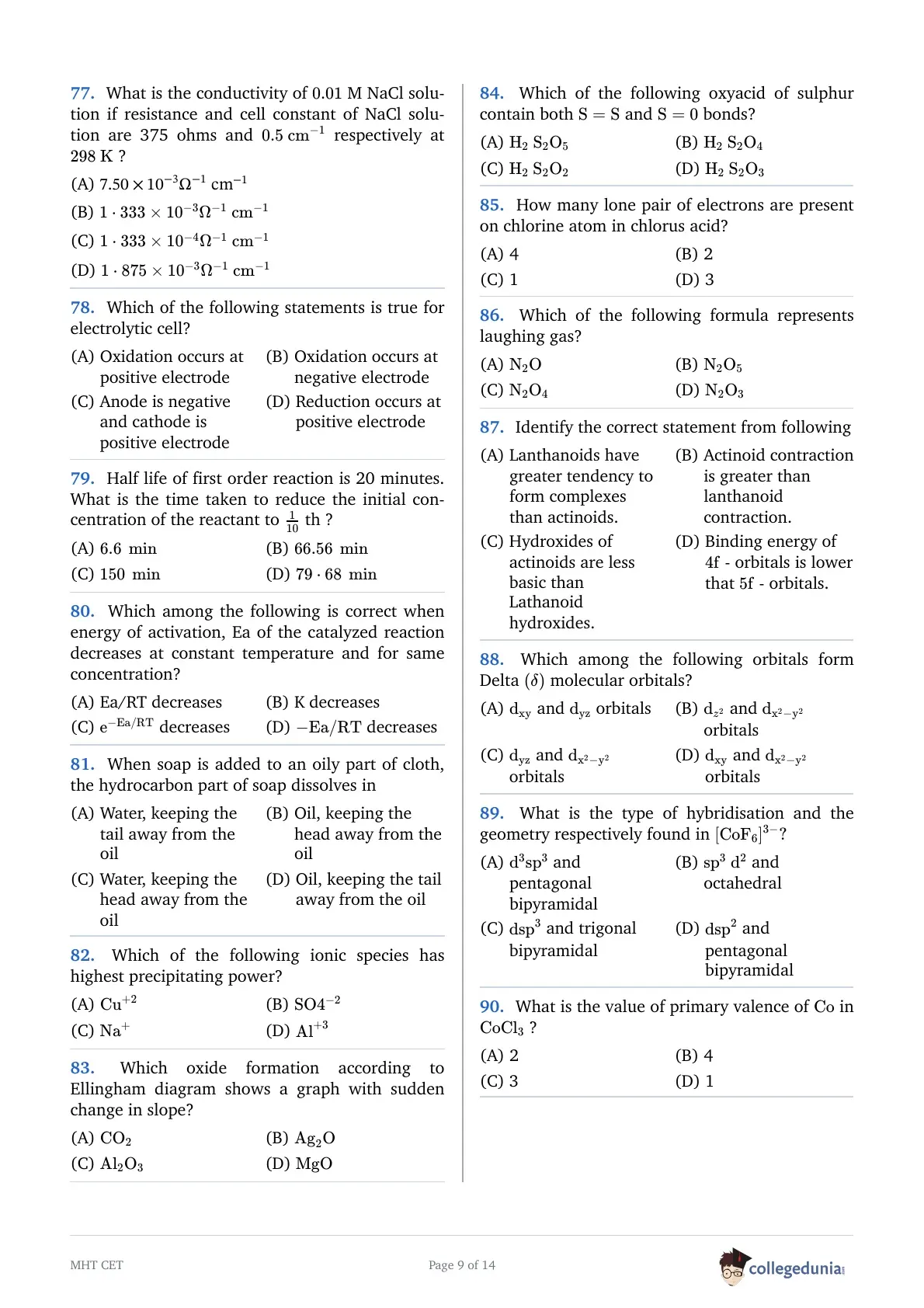
Question 51:

Which gas among the following contains maximum number of molecules at STP ?
(Molar masses in g mol\(^{-1}\): CO\(_2\) = 44, Ar = 39.9, CH\(_4\) = 16, O\(_2\) = 32)

  • (A) \(24.0\) g of \(\mathrm{O_2}\)
  • (B) \(16.0\) g of \(\mathrm{CH_4}\)
  • (C) \(13.3\) g of \(\mathrm{Ar}\)
  • (D) \(11\) g of \(\mathrm{CO_2}\)

Question 52:

Which among the following is a heaviest isotope of water?

  • (A) \(\mathrm{T_2^{17}O}\)
  • (B) \(\mathrm{T_2^{16}O}\)
  • (C) \(\mathrm{HD^{18}O}\)
  • (D) \(\mathrm{T_2^{18}O}\)

Question 53:

What is the position of elements \(\mathrm{La}(\mathrm{Z}=57)\) and \(\mathrm{Ce}(\mathrm{Z}=58)\) respectively in the long form of periodic table?

  • (A) \(\mathrm{La}=\) Group-3, Period-6 \(\mathrm{Ce}=\) Group-3, Period-6
  • (B) La \(=\) Group \(-4\), Period-7 \(\mathrm{Ce}=\) Group-5, Period-7
  • (C) \(\mathrm{La}=\) Group \(-3\), Period-7 \(\mathrm{Ce}=\) Group-3, Period-6
  • (D) \(\mathrm{La}=\) Group-3, Period-6 \(\mathrm{Ce}=\) Group-3, Period-7

Question 54:

What is the formal charge on hydrogen atom in water molecule?

  • (A) \(1\)
  • (B) \(0\)
  • (C) \(-\dfrac{1}{2}\)
  • (D) \(+\dfrac{1}{2}\)

Question 55:

If two moles of an ideal gas at \(546\ \text{K}\) occupy a volume of \(44.8\ \text{L}\), what is the pressure of ideal gas at \(546\ \text{K}\)? 
(\(R = 0.0821\ \text{L atm mol}^{-1}\text{K}^{-1}\)) 

  • (A) \(20\ \text{atm}\)
  • (B) \(0.2\ \text{atm}\)
  • (C) \(0.5\ \text{atm}\)
  • (D) \(2.0\ \text{atm}\)

Question 56:

Which of the following equations has \(\Delta_f H^\circ\) and \(\Delta H^\circ\) same ?

  • (A) \(\mathrm{H_2(g) + \dfrac{1}{2}O_2(g) \rightarrow H_2O(l)}\)
  • (B) \(\mathrm{N_2(l) + O_3(g) \rightarrow N_2O_3(g)}\)
  • (C) \(\mathrm{CH_4(g) + 2Cl_2(g) \rightarrow CH_2Cl_2(g) + 2HCl(g)}\)
  • (D) \(\mathrm{2CO(g) + O_2(g) \rightarrow 2CO_2(g)}\)

Question 57:

Which of the following equations is correct for heat of sublimation?

  • (A) \(\Delta_{\text{vap}}H = \Delta_{\text{sub}}H + \Delta_{\text{fus}}H\)
  • (B) \(\Delta_{\text{sub}}H = \Delta_{\text{fus}}H - \Delta_{\text{vap}}H\)
  • (C) \(\Delta_{\text{fus}}H = \Delta_{\text{sub}}H \times \Delta_{\text{vap}}H\)
  • (D) \(\Delta_{\text{sub}}H = \Delta_{\text{fus}}H + \Delta_{\text{vap}}H\)

Question 58:

When 2 moles of an ideal gas are expanded isothermally from a volume of 12.5 L to 15.0 L against constant external pressure of 760 mm Hg, calculate the amount of work done in joule?

  • (A) \(-253.25\ \text{J}\)
  • (B) \(-190.0\ \text{J}\)
  • (C) \(-1924.0\ \text{J}\)
  • (D) \(-25.325\ \text{J}\)

Question 59:

The sum of oxidation number of all atoms in \(\mathrm{S_2O_3^{2-}}\) ion is

  • (A) \(+2\)
  • (B) \(+5\)
  • (C) \(-2\)
  • (D) \(+7\)

Question 60:

What is the formula of lithium imide?

  • (A) \(\mathrm{LiNO_3}\)
  • (B) \(\mathrm{Li_2NH}\)
  • (C) \(\mathrm{Li_3N}\)
  • (D) \(\mathrm{LiNH_2}\)

Question 61:

Identify the ore of magnesium from following ?

  • (A) Siderite
  • (B) Calamine
  • (C) Limonite
  • (D) Dolomite

Question 62:

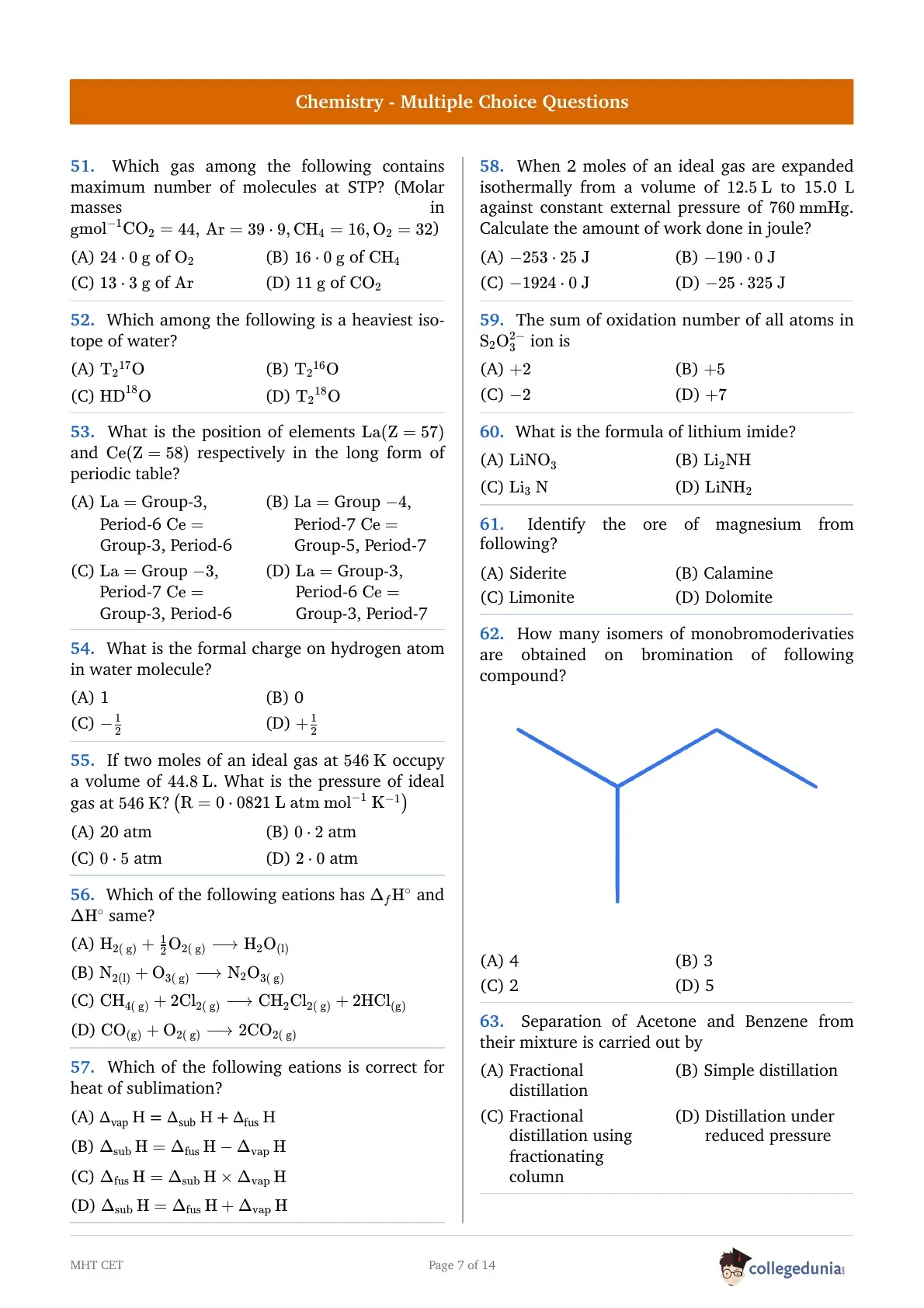
How many isomers of monobromoderivatives are obtained on bromination of the following compound ?

  • (A) \(4\)
  • (B) \(3\)
  • (C) \(2\)
  • (D) \(5\)

Question 63:

Separation of Acetone and Benzene from their mixture is carried out by

  • (A) Fractional distillation
  • (B) Simple distillation
  • (C) Fractional distillation using fractionating column
  • (D) Distillation under reduced pressure

Question 65:

IUPAC name of benzylamine is

  • (A) phenylethanamine
  • (B) phenylmethanamine
  • (C) benzenamine
  • (D) N-methylbenzenamine

Question 66:

Which among the following formulae represents glycollic acid?

  • (A) \(\mathrm{CH_3-CH(OH)-COOH}\)
  • (B) \(\mathrm{HOOC-CH_2-CH_2-CH(NH_2)-COOH}\)
  • (C) \(\mathrm{HOOC-CH_2-CH(NH_2)-COOH}\)
  • (D) \(\mathrm{HO-CH_2-COOH}\)

Question 67:

Which among the following substituent groups decreases the acidic strength of aromatic carboxylic acid?

  • (A) \(-\mathrm{NH_2}\)
  • (B) \(-\mathrm{CN}\)
  • (C) \(-\mathrm{Cl}\)
  • (D) \(-\mathrm{NO_2}\)

Question 68:

Which of the following compounds is obtained when quaternary ammonium hydroxide is strongly heated ?

  • (A) Alkane
  • (B) Alkyne
  • (C) Alkene
  • (D) Amide

Question 69:

Which of the following compounds on heating with potassium permanganate and dilute sulphuric acid forms adipic acid ?

  • (A) Methylbenzene
  • (B) Phenylethene
  • (C) Cyclohexene
  • (D) n-butylbenzene

Question 70:

What is the number of carbon atoms in alkanes found in diesel?

  • (A) \(\mathrm{C_{29}}\) to \(\mathrm{C_{31}}\)
  • (B) \(\mathrm{C_{6}}\) to \(\mathrm{C_{8}}\)
  • (C) \(\mathrm{C_{1}}\) to \(\mathrm{C_{4}}\)
  • (D) \(\mathrm{C_{15}}\) to \(\mathrm{C_{18}}\)

Question 71:

What is the type of hole occupied if limiting value of \(\dfrac{r^+}{r^-}\) is in the range of \(0.225\) to \(0.414\) ?

  • (A) Octahedral
  • (B) Cubic
  • (C) Planar triangular
  • (D) Tetrahedral

Question 72:

What is the percentage of void space in bcc type of unit cell?

  • (A) \(68\ %\)
  • (B) \(26\ %\)
  • (C) \(74\ %\)
  • (D) \(32\ %\)

Question 73:

What is the mass of an fcc unit cell if mass of one atom of an element is \(6\times 10^{-23}\ \mathrm{g}\) ?

  • (A) \(24\times 10^{-22}\ \mathrm{g}\)
  • (B) \(4\times 10^{-23}\ \mathrm{g}\)
  • (C) \(2\cdot 4\times 10^{-22}\ \mathrm{g}\)
  • (D) \(2\cdot 4\times 10^{-23}\ \mathrm{g}\)

Question 74:

If \(2\cdot 0\ \mathrm{g}\) of \(\mathrm{NaOH}\) is dissolved in \(500\ \mathrm{cm}^{3}\) of water, what is molarity of solution?

  • (A) \(0\cdot 25\ \mathrm{mol}\mathrm{dm}^{-3}\)
  • (B) \(0\cdot 1\ \mathrm{mol}\mathrm{dm}^{-3}\)
  • (C) \(0\cdot 4\ \mathrm{mol}\mathrm{dm}^{-3}\)
  • (D) \(0\cdot 50\ \mathrm{mol}\mathrm{dm}^{-3}\)

Question 75:

The Henry's law constant for oxygen is \(1.3 \times 10^{-3}\ \text{mol dm}^{-3}\text{atm}^{-1}\). If partial pressure of oxygen is \(0.46\) atmosphere, what is the concentration of dissolved oxygen at \(25^\circ\)C and 1 atm pressure?

  • (A) \(5.98 \times 10^{-4}\ \text{mol dm}^{-3}\)
  • (B) \(3.53 \times 10^{-4}\ \text{mol dm}^{-3}\)
  • (C) \(5.98\ \text{mol dm}^{-3}\)
  • (D) \(2.82 \times 10^{-3}\ \text{mol dm}^{-3}\)

Question 76:

According to Raoult's law, relative lowering of vapour pressure for a solution containing a non-volatile solute is equal to

  • (A) mole fraction of solvent
  • (B) moles of solute
  • (C) moles of solvent
  • (D) mole fraction of solute

Question 77:

What is the conductivity of 0.01 M NaCl solution if resistance and cell constant of NaCl solution are 375 ohms and \(0.5\ \text{cm}^{-1}\) respectively at 298 K ?

  • (A) \(7.50 \times 10^{-3}\ \Omega^{-1}\ \text{cm}^{-1}\)
  • (B) \(1.333 \times 10^{-3}\ \Omega^{-1}\ \text{cm}^{-1}\)
  • (C) \(1.333 \times 10^{-4}\ \Omega^{-1}\ \text{cm}^{-1}\)
  • (D) \(1.875 \times 10^{-3}\ \Omega^{-1}\ \text{cm}^{-1}\)

Question 78:

Which of the following statements is true for electrolytic cell?

  • (A) Oxidation occurs at positive electrode
  • (B) Oxidation occurs at negative electrode
  • (C) Anode is negative and cathode is positive electrode
  • (D) Reduction occurs at positive electrode

Question 79:

Half life of first order reaction is 20 minutes. What is the time taken to reduce the initial concentration of the reactant to \(\frac{1}{10}\) th ?

  • (A) \(6.6\ \min\)
  • (B) \(66.56\ \min\)
  • (C) \(150\ \min\)
  • (D) \(79\cdot 68\ \min\)

Question 80:

Which among the following is correct when energy of activation, \(E_a\), of the catalyzed reaction decreases at constant temperature and for same concentration?

  • (A) \(\dfrac{E_a}{RT}\) decreases
  • (B) \(K\) decreases
  • (C) \(e^{-E_a/RT}\) decreases
  • (D) \(-\dfrac{E_a}{RT}\) decreases

Question 81:

When soap is added on an oily part of cloth, the hydrocarbon part of soap dissolves in

  • (A) Water, keeping the tail away from the oil
  • (B) Oil, keeping the head away from the oil
  • (C) Water, keeping the head away from the oil
  • (D) Oil, keeping the tail away from the oil

Question 82:

Which of the following ionic species has highest precipitating power?

  • (A) \(\mathrm{Cu^{2+}}\)
  • (B) \(\mathrm{SO_4^{2-}}\)
  • (C) \(\mathrm{Na^{+}}\)
  • (D) \(\mathrm{Al^{3+}}\)

Question 83:

Which oxide formation according to Ellingham diagram shows a graph with sudden change in slope?

  • (A) \(\mathrm{CO_2}\)
  • (B) \(\mathrm{Ag_2O}\)
  • (C) \(\mathrm{Al_2O_3}\)
  • (D) \(\mathrm{MgO}\)

Question 84:

Which of the following oxyacid of sulphur contain both S=S and S=O bonds ?

  • (A) \(\mathrm{H_2S_2O_5}\)
  • (B) \(\mathrm{H_2S_2O_4}\)
  • (C) \(\mathrm{H_2S_2O_2}\)
  • (D) \(\mathrm{H_2S_2O_3}\)

Question 85:

How many lone pair of electrons are present on chlorine atom in chlorous acid ?

  • (A) \(4\)
  • (B) \(2\)
  • (C) \(1\)
  • (D) \(3\)

Question 86:

Which of the following formula represents laughing gas?

  • (A) \(\mathrm{N_2O}\)
  • (B) \(\mathrm{N_2O_5}\)
  • (C) \(\mathrm{N_2O_4}\)
  • (D) \(\mathrm{N_2O_3}\)

Question 87:

Identify the correct statement from following

  • (A) Lanthanoids have greater tendency to form complexes than actinoids.
  • (B) Actinoid contraction is greater than lanthanoid contraction.
  • (C) Hydroxides of actinoids are less basic than lanthanoid hydroxides.
  • (D) Binding energy of \(4f\)-orbitals is lower than \(5f\)-orbitals.

Question 88:

Which among the following orbitals form Delta (\(\delta\)) molecular orbitals?

  • (A) \(d_{xy}\) and \(d_{yz}\) orbitals
  • (B) \(d_{z^2}\) and \(d_{x^2-y^2}\) orbitals
  • (C) \(d_{yz}\) and \(d_{x^2-y^2}\) orbitals
  • (D) \(d_{xy}\) and \(d_{x^2-y^2}\) orbitals

Question 89:

What is the type of hybridisation and the geometry respectively found in \([\mathrm{CoF}_{6}]^{3-}?\)

  • (A) \(\mathrm{d}^{3}\mathrm{sp}^{3}\) and pentagonal bipyramidal
  • (B) \(\mathrm{sp}^{3}\ \mathrm{d}^{2}\) and octahedral
  • (C) \(\mathrm{dsp}^{3}\) and trigonal bipyramidal
  • (D) \(\mathrm{dsp}^{2}\) and pentagonal bipyramidal

Question 90:

What is the value of primary valence of Co in CoCl\(_3\)?

  • (A) 2
  • (B) 4
  • (C) 3
  • (D) 1

Question 91:

Which of the following is a major product obtained in the reaction of isobutylene with hydrogen bromide?

  • (A) tert-butyl bromide
  • (B) sec-butyl bromide
  • (C) n-butyl bromide
  • (D) iso-butyl bromide

Question 92:

How many hydroxy groups are present in hydroxyquinol?

  • (A) \(4\)
  • (B) \(1\)
  • (C) \(3\)
  • (D) \(2\)

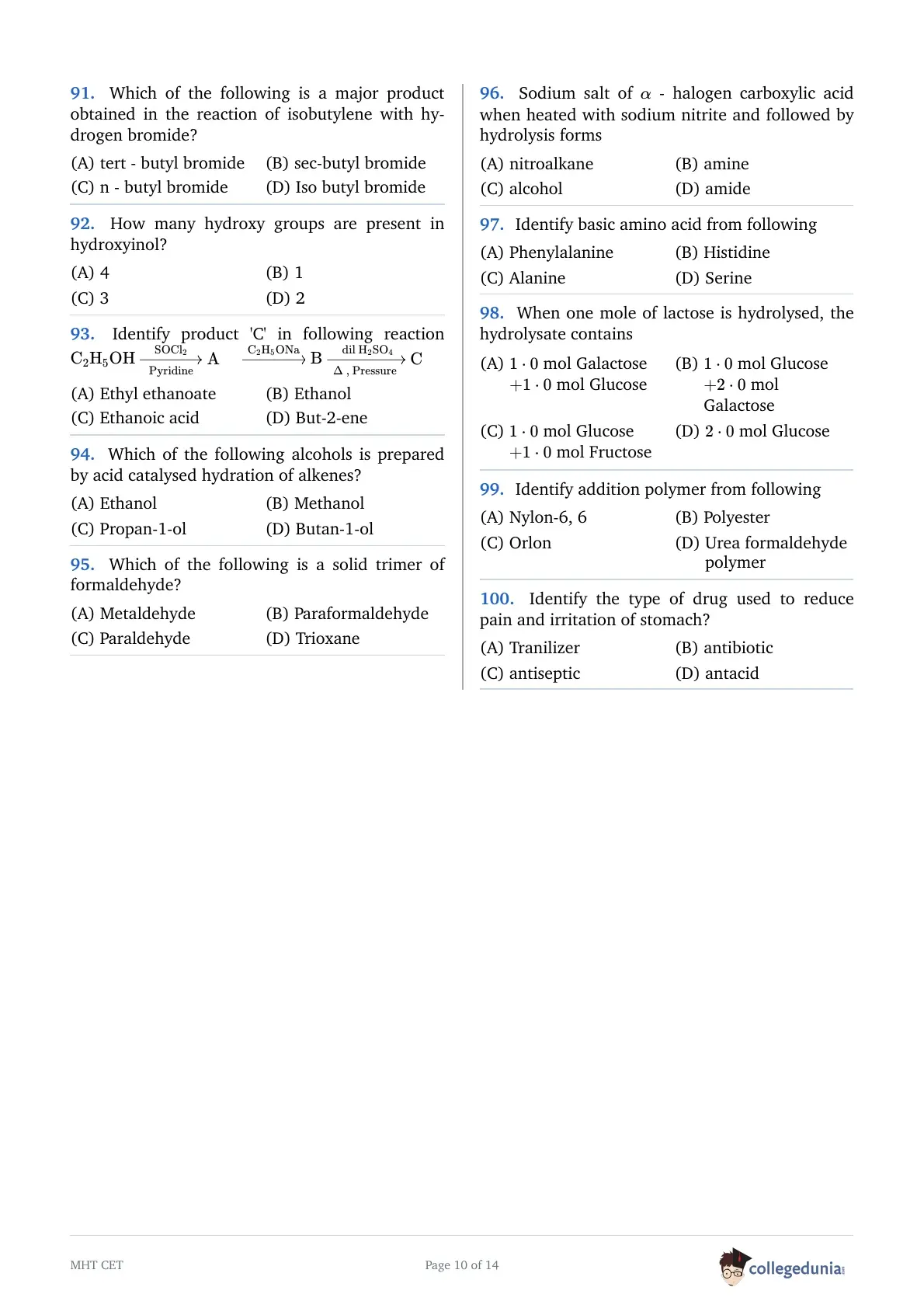
Question 93:

Identify product 'C' in following reaction \(\mathrm{C}_{2}\mathrm{H}_{5}\mathrm{OH}\xrightarrow[\text{ Pyridine }]{\mathrm{SOCl}_{2}}\mathrm{A}\text{\ad}\xrightarrow{\mathrm{C}_{2}\mathrm{H}_{5}\mathrm{ONa}}\mathrm{B}\xrightarrow[\Delta \text{ , Pressure }]{\text{ dil }\mathrm{H}_{2}\mathrm{SO}_{4}}\mathrm{C}\)

  • (A) Ethyl ethanoate
  • (B) Ethanol
  • (C) Ethanoic acid
  • (D) But-2-ene

Question 94:

Which of the following alcohols is prepared by acid catalysed hydration of alkenes?

  • (A) Ethanol
  • (B) Methanol
  • (C) Propan-1-ol
  • (D) Butan-1-ol

Question 95:

Which of the following is a solid trimer of formaldehyde?

  • (A) Metaldehyde
  • (B) Paraformaldehyde
  • (C) Paraldehyde
  • (D) Trioxane

Question 96:

Sodium salt of \(\alpha\)-halogen carboxylic acid when heated with sodium nitrite and followed by hydrolysis forms

  • (A) nitroalkane
  • (B) amine
  • (C) alcohol
  • (D) amide

Question 97:

Identify basic amino acid from following

  • (A) Phenylalanine
  • (B) Histidine
  • (C) Alanine
  • (D) Serine

Question 98:

When one mole of lactose is hydrolysed, the hydrolysate contains

  • (A) \(1.0\) mol Galactose \(+ 1.0\) mol Glucose
  • (B) \(1.0\) mol Glucose \(+ 2.0\) mol Galactose
  • (C) \(1.0\) mol Glucose \(+ 1.0\) mol Fructose
  • (D) \(2.0\) mol Glucose

Question 99:

Identify addition polymer from following

  • (A) Nylon-6,6
  • (B) Polyester
  • (C) Orlon
  • (D) Urea formaldehyde polymer

Question 100:

Identify the type of drug used to reduce pain and irritation of stomach?

  • (A) Tranquilizer
  • (B) Antibiotic
  • (C) Antiseptic
  • (D) Antacid

Mathematics (Q101 - Q150)

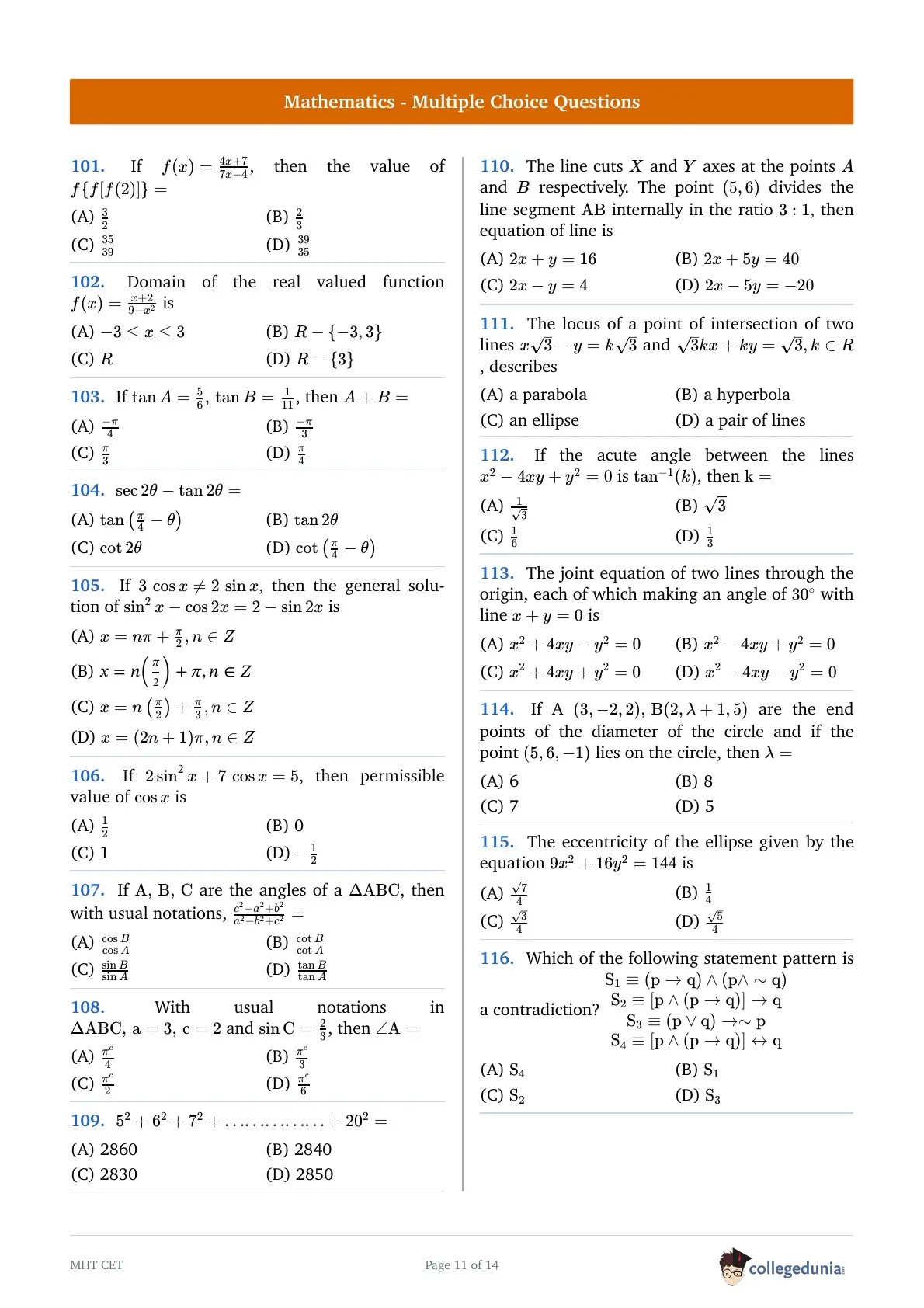
Question 101:

If \( f(x)=\dfrac{4x+7}{7x-4} \), then the value of \[ f\{f[f(2)]\} \] is

  • (A) \( \dfrac{3}{2} \)
  • (B) \( \dfrac{2}{3} \)
  • (C) \( \dfrac{35}{39} \)
  • (D) \( \dfrac{39}{35} \)

Question 102:

Domain of the real valued function \(f(x)=\frac{x+2}{9-x^{2}}\) is

  • (A) \(-3\leq x\leq 3\)
  • (B) \(R-\{-3,3\}\)
  • (C) \(R\)
  • (D) \(R-\{3\}\)

Question 103:

If \(\tan A = \dfrac{5}{6}\), \(\tan B = \dfrac{1}{11}\), then find \(A + B\).

  • (A) \(-\dfrac{\pi}{4}\)
  • (B) \(-\dfrac{\pi}{3}\)
  • (C) \(\dfrac{\pi}{3}\)
  • (D) \(\dfrac{\pi}{4}\)

Question 104:

\(\sec 2\theta -\tan 2\theta =\)

  • (A) \(\tan \left(\frac{\pi }{4}-\theta \right)\)
  • (B) \(\tan 2\theta\)
  • (C) \(\cot 2\theta\)
  • (D) \(\cot \left(\frac{\pi }{4}-\theta \right)\)

Question 105:

If \(3\,\cos x\neq 2\,\sin x\), then the general solution of \(\sin ^{2}x-\cos 2x=2-\sin 2x\) is

  • (A) \(x=n\pi +\frac{\pi }{2},n\in Z\)
  • (B) \(x=n\left(\frac{\pi }{2}\right)+\pi ,n\in Z\)
  • (C) \(x=n\left(\frac{\pi }{2}\right)+\frac{\pi }{3},n\in Z\)
  • (D) \(x=(2n+1)\pi ,n\in Z\)

Question 106:

If \(2\sin^2 x + 7\cos x = 5\), then the permissible value of \(\cos x\) is

  • (A) \(\dfrac{1}{2}\)
  • (B) \(0\)
  • (C) \(1\)
  • (D) \(-\dfrac{1}{2}\)

Question 107:

If \(\mathrm{A},\,\mathrm{B},\,\mathrm{C}\) are the angles of a \(\Delta \mathrm{ABC}\), then with usual notations, \(\frac{c^{2}-a^{2}+b^{2}}{a^{2}-b^{2}+c^{2}}=\)

  • (A) \(\frac{\cos B}{\cos A}\)
  • (B) \(\frac{\cot B}{\cot A}\)
  • (C) \(\frac{\sin B}{\sin A}\)
  • (D) \(\frac{\tan B}{\tan A}\)

Question 108:

With usual notations in \( \triangle ABC \), \(a = 3\), \(c = 2\) and \(\sin C = \dfrac{2}{3}\), then \(\angle A =\)

  • (A) \( \dfrac{\pi}{4} \)
  • (B) \( \dfrac{\pi}{3} \)
  • (C) \( \dfrac{\pi}{2} \)
  • (D) \( \dfrac{\pi}{6} \)

Question 109:

\(5^{2}+6^{2}+7^{2}+\ldots \ldots \ldots \ldots \ldots +20^{2}=\)

  • (A) 2860
  • (B) 2840
  • (C) 2830
  • (D) 2850

Question 110:

The line cuts the \(X\)-axis and \(Y\)-axis at the points \(A\) and \(B\) respectively. The point \((5,6)\) divides the line segment \(AB\) internally in the ratio \(3:1\). Then the equation of the line is

  • (A) \(2x+y=16\)
  • (B) \(2x+5y=40\)
  • (C) \(2x-y=4\)
  • (D) \(2x-5y=-20\)

Question 111:

The locus of a point of intersection of two lines \(x\sqrt{3}-y=k\sqrt{3}\) and \(\sqrt{3}kx+ky=\sqrt{3},k\in R\), describes

  • (A) a parabola
  • (B) a hyperbola
  • (C) an ellipse
  • (D) a pair of lines

Question 112:

If the acute angle between the lines \[ x^2-4xy+y^2=0 \] is \(\tan^{-1}(k)\), then \(k=\)

  • (A) \(\dfrac{1}{\sqrt{3}}\)
  • (B) \(\sqrt{3}\)
  • (C) \(\dfrac{1}{6}\)
  • (D) \(\dfrac{1}{3}\)

Question 113:

The joint equation of two lines through the origin, each of which makes an angle of \(30^\circ\) with the line \(x + y = 0\), is

  • (A) \(x^2 + 4xy - y^2 = 0\)
  • (B) \(x^2 - 4xy + y^2 = 0\)
  • (C) \(x^2 + 4xy + y^2 = 0\)
  • (D) \(x^2 - 4xy - y^2 = 0\)

Question 114:

If \(A(3,-2,2)\), \(B(2,\lambda+1,5)\) are the end points of the diameter of a circle and if the point \((5,6,-1)\) lies on the circle, then \(\lambda =\)

  • (A) 6
  • (B) 8
  • (C) 7
  • (D) 5

Question 115:

The eccentricity of the ellipse given by the equation \[ 9x^2 + 16y^2 = 144 \] is

  • (A) \(\dfrac{\sqrt{7}}{4}\)
  • (B) \(\dfrac{1}{4}\)
  • (C) \(\dfrac{\sqrt{3}}{4}\)
  • (D) \(\dfrac{\sqrt{5}}{4}\)

Question 116:

Which of the following statement pattern is a contradiction? \(\begin{matrix} \mathrm{S}_{1}\equiv (\mathrm{p}\rightarrow \mathrm{q})\wedge (\mathrm{p}\wedge \sim \mathrm{q}) \\ \mathrm{S}_{2}\equiv [\mathrm{p}\wedge (\mathrm{p}\rightarrow \mathrm{q})]\rightarrow \mathrm{q} \\ \mathrm{S}_{3}\equiv (\mathrm{p}\vee \mathrm{q})\rightarrow \sim \mathrm{p} \\ \mathrm{S}_{4}\equiv [\mathrm{p}\wedge (\mathrm{p}\rightarrow \mathrm{q})]\leftrightarrow \mathrm{q} \end{matrix}\)

  • (A) \(\mathrm{S}_{4}\)
  • (B) \(\mathrm{S}_{1}\)
  • (C) \(\mathrm{S}_{2}\)
  • (D) \(\mathrm{S}_{3}\)

Question 117:

The negation of the statement \(\exists x \in A\) such that \(x+5>8\) is

  • (A) \(\forall x \in A,\; x+5 \ge 8\)
  • (B) \(\forall x \in A,\; x+5 \le 8\)
  • (C) \(\forall x \in A,\; x+5>8\)
  • (D) \(\exists x \in A\) such that \(x+5<8\)

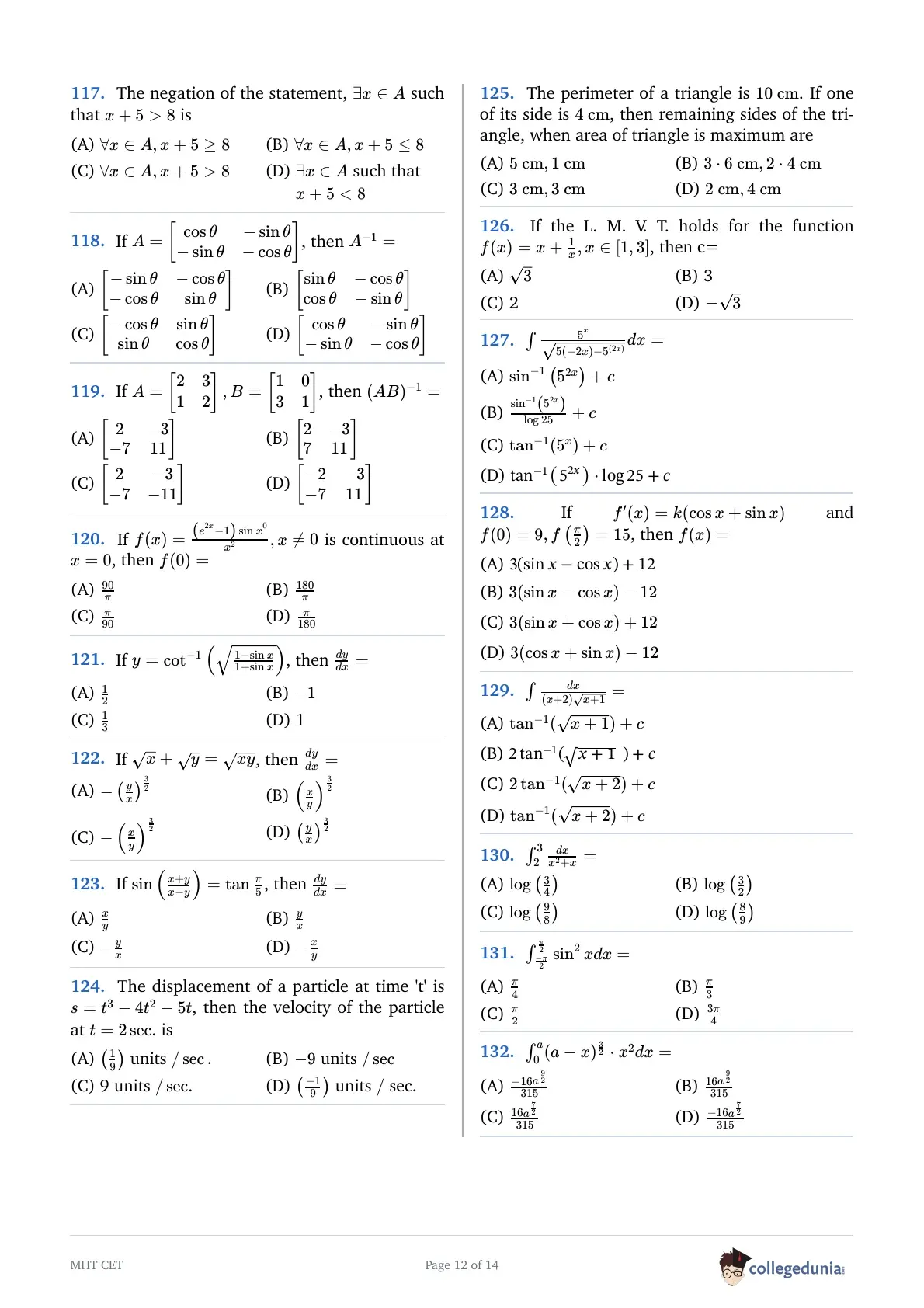
Question 118:

If \(A=\begin{bmatrix} \cos \theta & -\sin \theta \\ -\sin \theta & -\cos \theta \end{bmatrix}\), then \(A^{-1}=\)

  • (A) \(\begin{bmatrix} -\sin \theta & -\cos \theta \\ -\cos \theta & \sin \theta \end{bmatrix}\)
  • (B) \(\begin{bmatrix} \sin \theta & -\cos \theta \\ \cos \theta & -\sin \theta \end{bmatrix}\)
  • (C) \(\begin{bmatrix} -\cos \theta & \sin \theta \\ \sin \theta & \cos \theta \end{bmatrix}\)
  • (D) \(\begin{bmatrix} \cos \theta & -\sin \theta \\ -\sin \theta & -\cos \theta \end{bmatrix}\)

Question 119:

If \(A=\begin{bmatrix} 2 & 3 \\ 1 & 2 \end{bmatrix},B=\begin{bmatrix} 1 & 0 \\ 3 & 1 \end{bmatrix}\), then \((AB)^{-1}=\)

  • (A) \(\begin{bmatrix} 2 & -3 \\ -7 & 11 \end{bmatrix}\)
  • (B) \(\begin{bmatrix} 2 & -3 \\ 7 & 11 \end{bmatrix}\)
  • (C) \(\begin{bmatrix} 2 & -3 \\ -7 & -11 \end{bmatrix}\)
  • (D) \(\begin{bmatrix} -2 & -3 \\ -7 & 11 \end{bmatrix}\)

Question 120:

If \(f(x)=\frac{\left(e^{2x}-1\right)\sin x^{0}}{x^{2}},x\neq 0\) is continuous at \(x=0\), then \(f(0)=\)

  • (A) \(\frac{90}{\pi }\)
  • (B) \(\frac{180}{\pi }\)
  • (C) \(\frac{\pi }{90}\)
  • (D) \(\frac{\pi }{180}\)

Question 121:

If \(y=\cot ^{-1}\left(\sqrt{\frac{1-\sin x}{1+\sin x}}\right)\), then \(\frac{dy}{dx}=\)

  • (A) \(\frac{1}{2}\)
  • (B) \(-1\)
  • (C) \(\frac{1}{3}\)
  • (D) 1

Question 122:

If \(\sqrt{x} + \sqrt{y} = \sqrt{xy}\), then find \(\dfrac{dy}{dx}\).

  • (A) \(-\left(\dfrac{y}{x}\right)^{\frac{3}{2}}\)
  • (B) \(\left(\dfrac{x}{y}\right)^{\frac{3}{2}}\)
  • (C) \(-\left(\dfrac{x}{y}\right)^{\frac{3}{2}}\)
  • (D) \(\left(\dfrac{y}{x}\right)^{\frac{3}{2}}\)

Question 123:

If \(\displaystyle \sin\!\left(\frac{x+y}{x-y}\right) = \tan \frac{\pi}{5}\), then find \(\displaystyle \frac{dy}{dx}\).

  • (A) \( \dfrac{x}{y} \)
  • (B) \( \dfrac{y}{x} \)
  • (C) \( -\dfrac{y}{x} \)
  • (D) \( -\dfrac{x}{y} \)

Question 124:

The displacement of a particle at time \(t\) is \[ s = t^3 - 4t^2 - 5t \] Then the velocity of the particle at \(t = 2\) sec is

  • (A) \(\dfrac{1}{9}\) units/sec
  • (B) \(-9\) units/sec
  • (C) \(9\) units/sec
  • (D) \(-\dfrac{1}{9}\) units/sec

Question 125:

The perimeter of a triangle is \(10\) cm. If one of its sides is \(4\) cm, then the remaining sides of the triangle, when the area of the triangle is maximum, are

  • (A) \(5\text{ cm}, 1\text{ cm}\)
  • (B) \(3.6\text{ cm}, 2.4\text{ cm}\)
  • (C) \(3\text{ cm}, 3\text{ cm}\)
  • (D) \(2\text{ cm}, 4\text{ cm}\)

Question 126:

If the L.M.V.T. holds for the function \( f(x) = x + \dfrac{1}{x} \), \(x \in [1,3]\), then \(c =\)

  • (A) \( \sqrt{3} \)
  • (B) \( 3 \)
  • (C) \( 2 \)
  • (D) \( -\sqrt{3} \)

Question 127:

\(\int \frac{5^{x}}{\sqrt{5(-2x)-5^{(2x)}}}dx=\)

  • (A) \(\sin ^{-1}\left(5^{2x}\right)+c\)
  • (B) \(\frac{\sin ^{-1}\left(5^{2x}\right)}{\log 25}+c\)
  • (C) \(\tan ^{-1}(5^{x})+c\)
  • (D) \(\tan ^{-1}\left(5^{2x}\right)\cdot \log 25+c\)

Question 128:

If \(f'(x) = k(\cos x + \sin x)\) and \(f(0) = 9,\ f\!\left(\dfrac{\pi}{2}\right) = 15\), then \(f(x)=\)

  • (A) \(3(\sin x - \cos x) + 12\)
  • (B) \(3(\sin x - \cos x) - 12\)
  • (C) \(3(\sin x + \cos x) + 12\)
  • (D) \(3(\cos x + \sin x) - 12\)

Question 129:

\(\int \frac{dx}{(x+2)\sqrt{x+1}}=\)

  • (A) \(\tan ^{-1}(\sqrt{x+1})+c\)
  • (B) \(2\tan ^{-1}(\sqrt{x+1})+c\)
  • (C) \(2\tan ^{-1}(\sqrt{x+2})+c\)
  • (D) \(\tan ^{-1}(\sqrt{x+2})+c\)

Question 130:

\(\int _{2}^{3}\frac{dx}{x^{2}+x}=\)

  • (A) \(\log \left(\frac{3}{4}\right)\)
  • (B) \(\log \left(\frac{3}{2}\right)\)
  • (C) \(\log \left(\frac{9}{8}\right)\)
  • (D) \(\log \left(\frac{8}{9}\right)\)

Question 131:

\(\int _{\frac{-\pi }{2}}^{\frac{\pi }{2}}\sin ^{2}xdx=\)

  • (A) \(\frac{\pi }{4}\)
  • (B) \(\frac{\pi }{3}\)
  • (C) \(\frac{\pi }{2}\)
  • (D) \(\frac{3\pi }{4}\)

Question 132:

\(\int _{0}^{a}(a-x)^{\frac{3}{2}}\cdot x^{2}dx=\)

  • (A) \(\frac{-16a^{\frac{9}{2}}}{315}\)
  • (B) \(\frac{16a^{\frac{9}{2}}}{315}\)
  • (C) \(\frac{16a^{\frac{7}{2}}}{315}\)
  • (D) \(\frac{-16a^{\frac{7}{2}}}{315}\)

Question 133:

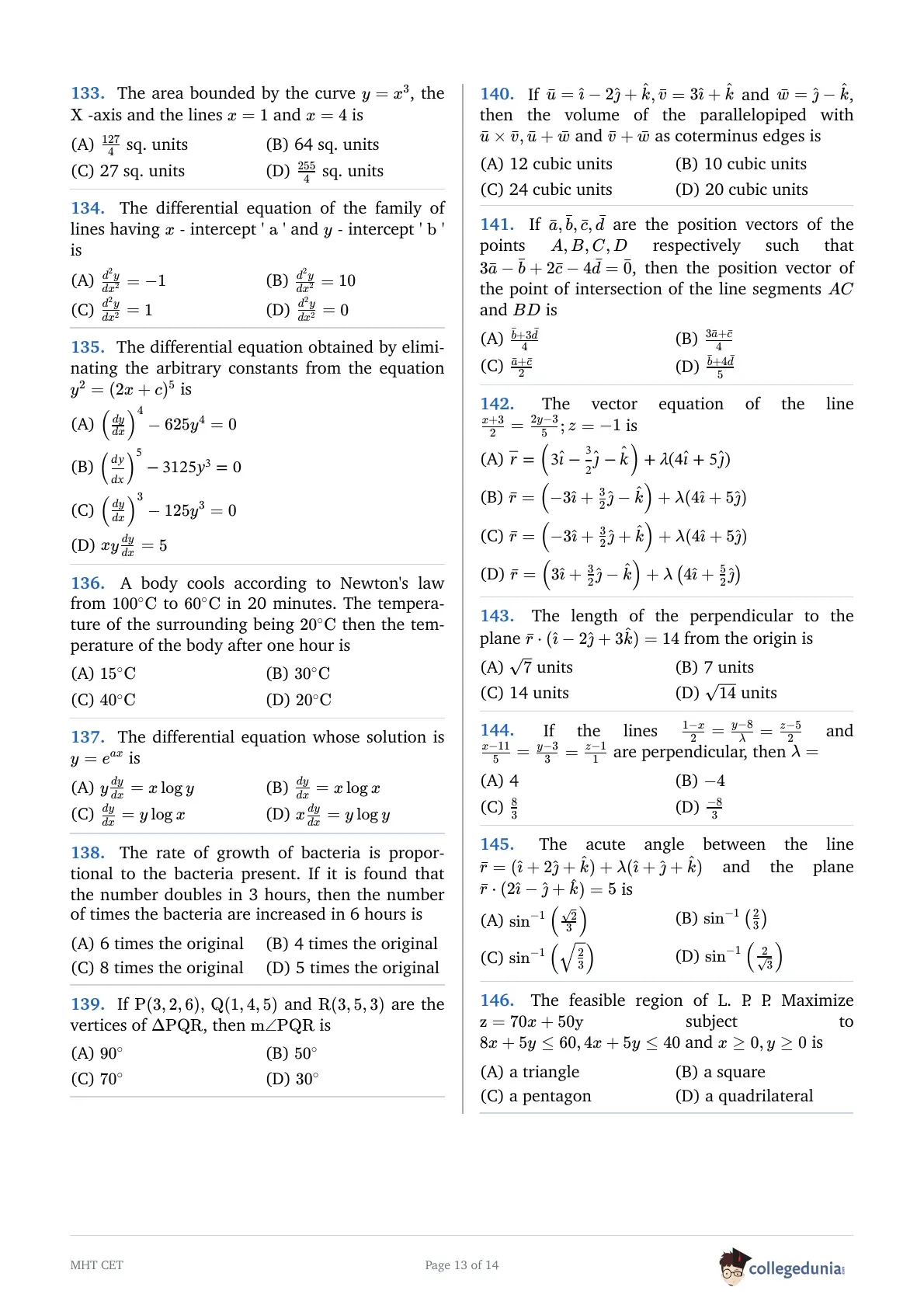
The area bounded by the curve \(y = x^3\), the \(x\)-axis and the lines \(x = 1\) and \(x = 4\) is

  • (A) \(\dfrac{127}{4}\) sq. units
  • (B) \(64\) sq. units
  • (C) \(27\) sq. units
  • (D) \(\dfrac{255}{4}\) sq. units

Question 134:

The differential equation of the family of lines having \(x\)-intercept \(a\) and \(y\)-intercept \(b\) is

  • (A) \(\dfrac{d^2y}{dx^2} = -1\)
  • (B) \(\dfrac{d^2y}{dx^2} = 10\)
  • (C) \(\dfrac{d^2y}{dx^2} = 1\)
  • (D) \(\dfrac{d^2y}{dx^2} = 0\)

Question 135:

The differential equation obtained by eliminating the arbitrary constant from the equation \[ y^2 = (2x+c)^5 \] is

  • (A) \(\left(\dfrac{dy}{dx}\right)^4 - 625y^4 = 0\)
  • (B) \(\left(\dfrac{dy}{dx}\right)^5 - 3125y^3 = 0\)
  • (C) \(\left(\dfrac{dy}{dx}\right)^3 - 125y^3 = 0\)
  • (D) \(xy\dfrac{dy}{dx} = 5\)

Question 136:

A body cools according to Newton’s law from \(100^\circ\text{C}\) to \(60^\circ\text{C}\) in 20 minutes. The temperature of the surroundings being \(20^\circ\text{C}\), the temperature of the body after one hour is

  • (A) \(15^\circ\text{C}\)
  • (B) \(30^\circ\text{C}\)
  • (C) \(40^\circ\text{C}\)
  • (D) \(20^\circ\text{C}\)

Question 137:

The differential equation whose solution is \(y = e^{ax}\) is

  • (A) \( y \dfrac{dy}{dx} = x \log y \)
  • (B) \( \dfrac{dy}{dx} = x \log x \)
  • (C) \( \dfrac{dy}{dx} = y \log x \)
  • (D) \( x \dfrac{dy}{dx} = y \log y \)

Question 138:

The rate of growth of bacteria is proportional to the bacteria present. If it is found that the number doubles in 3 hours, then the number of times the bacteria are increased in 6 hours is

  • (A) 6 times the original
  • (B) 4 times the original
  • (C) 8 times the original
  • (D) 5 times the original

Question 139:

If \(P(3,2,6)\), \(Q(1,4,5)\) and \(R(3,5,3)\) are the vertices of \(\triangle PQR\), then the measure of \(\angle PQR\) is

  • (A) \(90^\circ\)
  • (B) \(50^\circ\)
  • (C) \(70^\circ\)
  • (D) \(30^\circ\)

Question 140:

If \(\vec u = \hat i - 2\hat j + \hat k\), \(\vec v = 3\hat i + \hat k\) and \(\vec w = \hat j - \hat k\), then the volume of the parallelepiped with \(\vec u \times \vec v\), \(\vec u + \vec w\) and \(\vec v + \vec w\) as coterminous edges is

  • (A) 12 cubic units
  • (B) 10 cubic units
  • (C) 24 cubic units
  • (D) 20 cubic units

Question 141:

If \(\bar{a},\bar{b},\bar{c},\bar{d}\) are the position vectors of the points \(A,B,C,D\) respectively such that \(3\bar{a}-\bar{b}+2\bar{c}-4\bar{d}=\bar{0}\), then the position vector of the point of intersection of the line segments \(AC\) and \(BD\) is

  • (A) \(\frac{\bar{b}+3\bar{d}}{4}\)
  • (B) \(\frac{3\bar{a}+\bar{c}}{4}\)
  • (C) \(\frac{\bar{a}+\bar{c}}{2}\)
  • (D) \(\frac{\bar{b}+4\bar{d}}{5}\)

Question 142:

The vector equation of the line \(\frac{x+3}{2}=\frac{2y-3}{5};z=-1\) is

  • (A) \(\bar{r}=\left(3\hat{\imath}-\frac{3}{2}\hat{\jmath}-\hat{k}\right)+\lambda (4\hat{\imath}+5\hat{\jmath})\)
  • (B) \(\bar{r}=\left(-3\hat{\imath}+\frac{3}{2}\hat{\jmath}-\hat{k}\right)+\lambda (4\hat{\imath}+5\hat{\jmath})\)
  • (C) \(\bar{r}=\left(-3\hat{\imath}+\frac{3}{2}\hat{\jmath}+\hat{k}\right)+\lambda (4\hat{\imath}+5\hat{\jmath})\)
  • (D) \(\bar{r}=\left(3\hat{\imath}+\frac{3}{2}\hat{\jmath}-\hat{k}\right)+\lambda \left(4\hat{\imath}+\frac{5}{2}\hat{\jmath}\right)\)

Question 143:

The length of the perpendicular to the plane \(\bar{r}\cdot (\hat{\imath}-2\hat{\jmath}+3\hat{k})=14\) from the origin is

  • (A) \(\sqrt{7}\) units
  • (B) 7 units
  • (C) 14 units
  • (D) \(\sqrt{14}\) units

Question 144:

If the lines \(\frac{1-x}{2}=\frac{y-8}{\lambda }=\frac{z-5}{2}\) and \(\frac{x-11}{5}=\frac{y-3}{3}=\frac{z-1}{1}\) are perpendicular, then \(\lambda =\)

  • (A) 4
  • (B) \(-4\)
  • (C) \(\frac{8}{3}\)
  • (D) \(\frac{-8}{3}\)

Question 145:

The acute angle between the line \(\bar{r}=(\hat{\imath}+2\hat{\jmath}+\hat{k})+\lambda (\hat{\imath}+\hat{\jmath}+\hat{k})\) and the plane \(\bar{r}\cdot (2\hat{\imath}-\hat{\jmath}+\hat{k})=5\) is

  • (A) \(\sin ^{-1}\left(\frac{\sqrt{2}}{3}\right)\)
  • (B) \(\sin ^{-1}\left(\frac{2}{3}\right)\)
  • (C) \(\sin ^{-1}\left(\sqrt{\frac{2}{3}}\right)\)
  • (D) \(\sin ^{-1}\left(\frac{2}{\sqrt{3}}\right)\)

Question 146:

The feasible region of L. P. P. Maximize \(\mathrm{z}=70x+50\mathrm{y}\) subject to \(8x+5y\leq 60,4x+5y\leq 40\) and \(x\geq 0,y\geq 0\) is

  • (A) a triangle
  • (B) a square
  • (C) a pentagon
  • (D) a quadrilateral

Question 147:

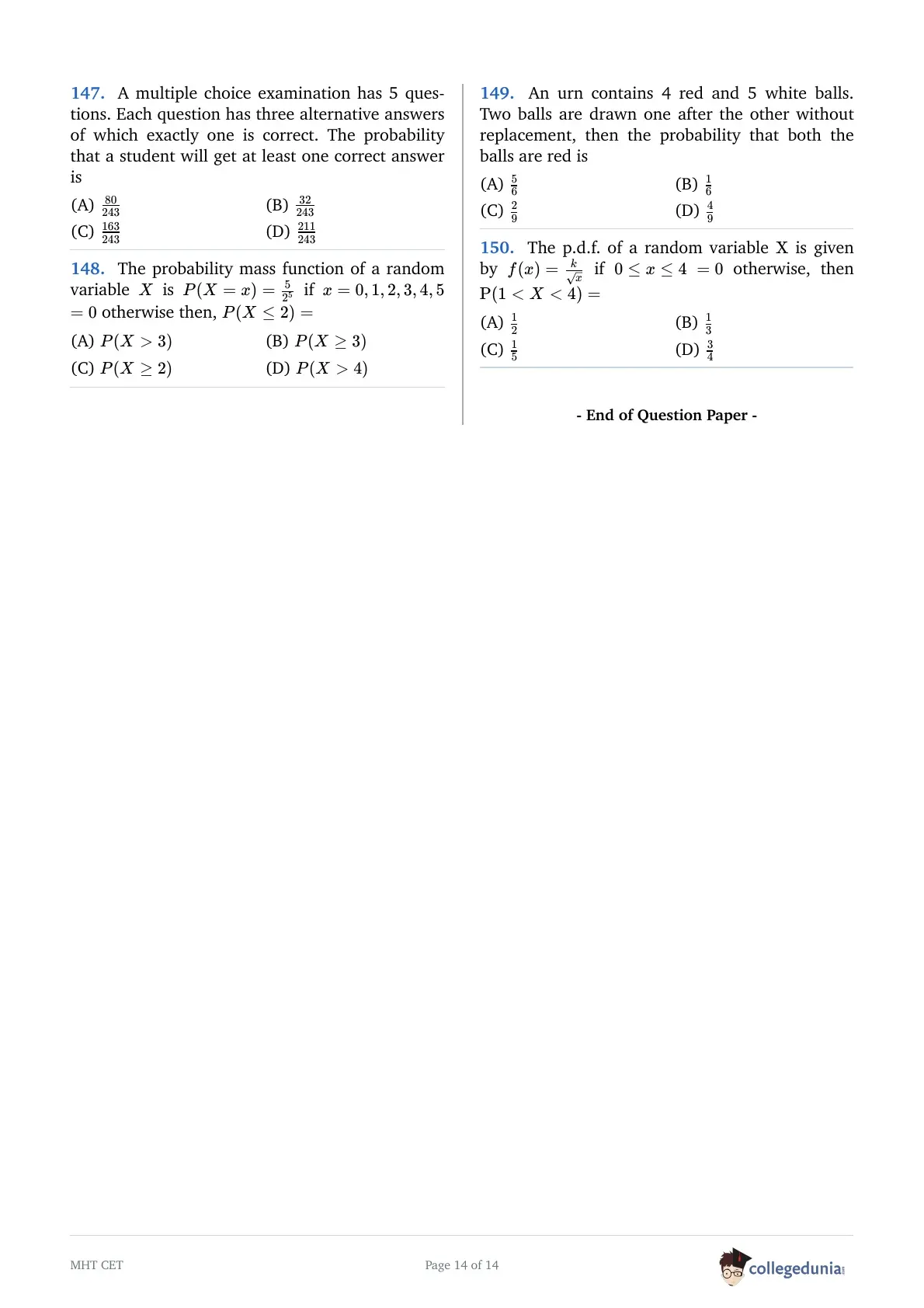
A multiple choice examination has 5 questions. Each question has three alternative answers of which exactly one is correct. The probability that a student will get at least one correct answer is

  • (A) \(\dfrac{80}{243}\)
  • (B) \(\dfrac{32}{243}\)
  • (C) \(\dfrac{163}{243}\)
  • (D) \(\dfrac{211}{243}\)

Question 148:

The probability mass function of a random variable \(X\) is \(P(X=x)=\frac{5}{2^{5}}\) if \(x=0,1,2,3,4,5\) \(=0\) otherwise then, \(P(X\leq 2)=\)

  • (A) \(P(X>3)\)
  • (B) \(P(X\geq 3)\)
  • (C) \(P(X\geq 2)\)
  • (D) \(P(X>4)\)

Question 149:

An urn contains 4 red and 5 white balls. Two balls are drawn one after the other without replacement. Find the probability that both the balls are red.

  • (A) \( \dfrac{5}{6} \)
  • (B) \( \dfrac{1}{6} \)
  • (C) \( \dfrac{2}{9} \)
  • (D) \( \dfrac{4}{9} \)

Question 150:

The p.d.f. of a random variable \(\mathrm{X}\) is given by \(f(x)=\frac{k}{\sqrt{x}}\) if \(0\leq x\leq 4\) \(=0\) otherwise, then \(\mathrm{P}(1\lt X\lt 4)=\)

  • (A) \(\frac{1}{2}\)
  • (B) \(\frac{1}{3}\)
  • (C) \(\frac{1}{5}\)
  • (D) \(\frac{3}{4}\)

MHT CET 2020 PCM Exam Pattern and Marking Scheme

Parameter Details
Conducting Body Maharashtra Common Entrance Test Cell (Maharashtra CET Cell)
Exam Mode Online (Computer-Based Test)
Duration 180 minutes (3 hours)
Groups / Subjects PCM (Physics, Chemistry, Mathematics) for Engineering
Total Questions

150

Total Marks 200
Question Type Multiple Choice Questions (MCQs)
Marks Distribution
  • Mathematics – 2 marks/question
  • Physics and Chemistry – 1 mark/question
Negative Marking No
Syllabus Weightage
  • Class 12 – 80%
  • Class 11 – 20%