




MHT CET 2020 Oct 13 Shift 1 PCM Question Paper is available for download here. Maharashtra State CET Cell conducted MHT CET 2020 PCM Exam on Oct 13 in Shift 1 from 9 AM to 12 PM in CBT mode.
The MHT CET 2020 PCM question paper includes the following:
- The MHT CET 2020 PCM Question Paper consists of 150 multiple-choice questions (MCQs) totalling 200 marks divided into 3 sections: Physics, Chemistry, and Mathematics, with 50 questions in each subject.
- Physics and Chemistry questions carry 1 mark each while Mathematics questions carry 2 marks each.
- There is no negative marking for incorrect answers.
MHT CET 2020 Oct 13 Shift 1 PCM Question Paper with Solution PDF
| CD PDF | CD PDF with Solutions |
|---|---|
| Download Collegedunia PDF 0.86 MB | - |
Also Check:
MHT CET 2020 Oct 13 Shift 1 PCM Questions with Solutions
Physics (Q1 - Q50)
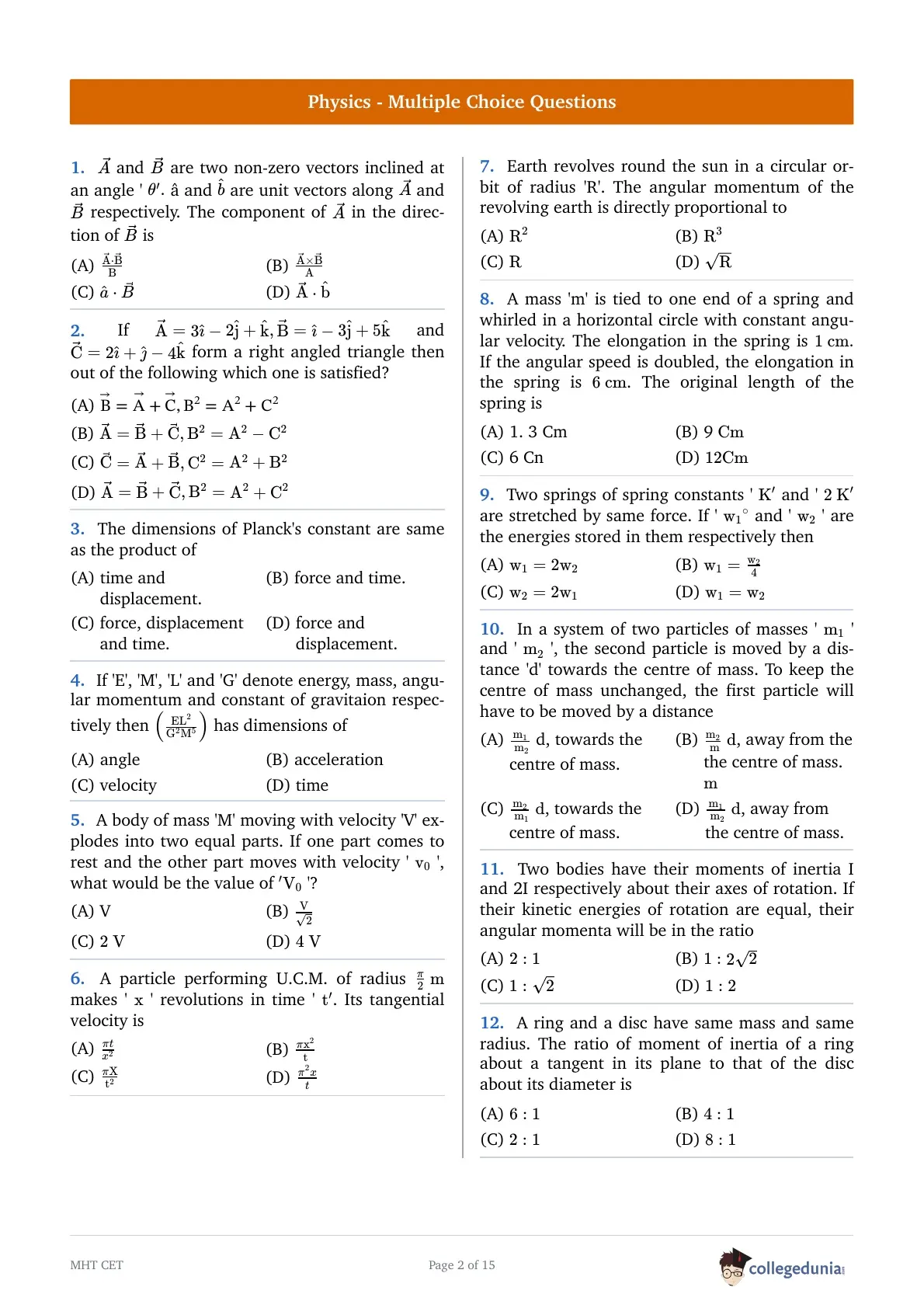
\( \vec{A} \) and \( \vec{B} \) are two non-zero vectors inclined at an angle \( \theta \). \( \hat{a} \) and \( \hat{b} \) are unit vectors along \( \vec{A} \) and \( \vec{B} \) respectively. The component of \( \vec{A} \) in the direction of \( \vec{B} \) is
If \( \vec{A} = 3\hat{i} - 2\hat{j} + \hat{k} \), \( \vec{B} = \hat{i} - 3\hat{j} + 5\hat{k} \) and \( \vec{C} = 2\hat{i} + \hat{j} - 4\hat{k} \) form a right angled triangle, then out of the following which one is satisfied?
The dimensions of Planck’s constant are same as the product of
If \(E\), \(M\), \(L\) and \(G\) denote energy, mass, angular momentum and constant of gravitation respectively, then the quantity \( \left(\dfrac{EL^2}{G^2M^5}\right) \) has dimensions of
A body of mass \(M\) moving with velocity \(V\) explodes into two equal parts. If one part comes to rest and the other part moves with velocity \(V_0\), what would be the value of \(V_0\)?
A particle performing U.C.M. of radius \( \dfrac{\pi}{2}\,\text{m} \) makes \(x\) revolutions in time \(t\). Its tangential velocity is
Earth revolves round the sun in a circular orbit of radius \(R\). The angular momentum of the revolving earth is directly proportional to
A mass \( m \) is tied to one end of a spring and whirled in a horizontal circle with constant angular velocity. The elongation in the spring is 1 cm. If the angular speed is doubled, the elongation in the spring is 6 cm. The original length of the spring is
Two springs of spring constants \(K\) and \(2K\) are stretched by the same force. If \(W_1\) and \(W_2\) are the energies stored in them respectively, then
In a system of two particles of masses \(m_1\) and \(m_2\), the second particle is moved by a distance \(d\) towards the centre of mass. To keep the centre of mass unchanged, the first particle will have to be moved by a distance
Two bodies have their moments of inertia \(I\) and \(2I\) respectively about their axes of rotation. If their kinetic energies of rotation are equal, their angular momenta will be in the ratio
A ring and a disc have same mass and same radius. The ratio of moment of inertia of a ring about a tangent in its plane to that of the disc about its diameter is
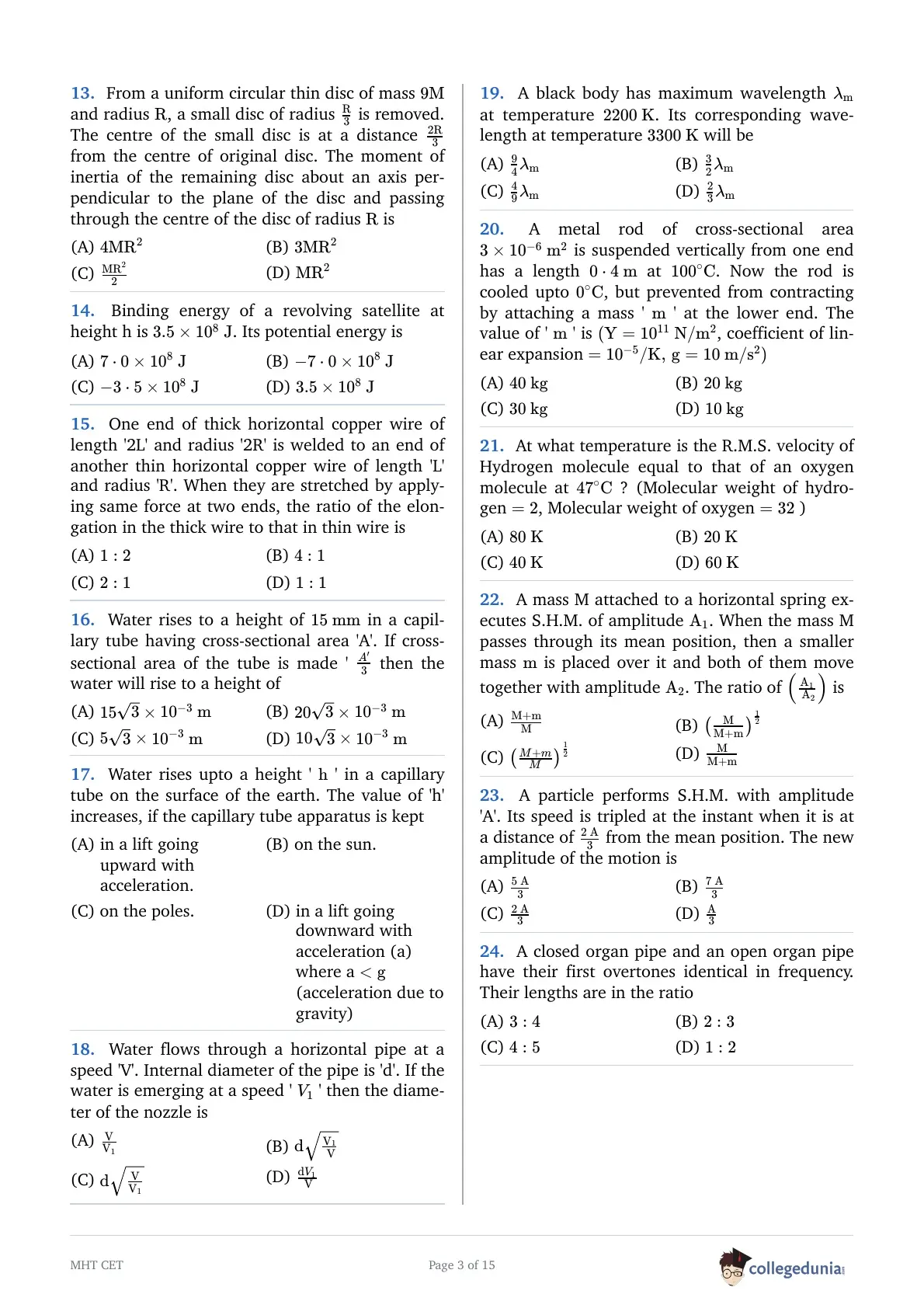
From a uniform circular thin disc of mass \(9M\) and radius \(R\), a small disc of radius \(\frac{R}{3}\) is removed. The centre of the small disc is at a distance \(\frac{2R}{3}\) from the centre of the original disc. The moment of inertia of the remaining disc about an axis perpendicular to the plane of the disc and passing through the centre of the original disc is
Binding energy of a revolving satellite at height \(h\) is \(3.5\times10^8\,\text{J}\). Its potential energy is
One end of thick horizontal copper wire of length \(2L\) and radius \(2R\) is welded to the end of another thin horizontal copper wire of length \(L\) and radius \(R\). When they are stretched by applying the same force at the two ends, the ratio of the elongation in the thick wire to that in the thin wire is
Water rises to a height of \(15\,\text{mm}\) in a capillary tube having cross-sectional area \(A\). If the cross-sectional area of the tube is made \( \dfrac{A}{3} \), then the water will rise to a height
Water rises upto a height ' \(\mathrm{h}\) ' in a capillary tube on the surface of the earth. The value of 'h' increases, if the capillary tube apparatus is kept
Water flows through a horizontal pipe at a speed \(V\). Internal diameter of the pipe is \(d\). If the water is emerging at a speed \(V_1\), then the diameter of the nozzle is
A black body has maximum wavelength \(\lambda_m\) at temperature \(2200\,\text{K}\). Its corresponding wavelength at temperature \(3300\,\text{K}\) will be
A metal rod of cross-sectional area \(3 \times 10^{-6}\,\text{m}^2\) is suspended vertically from one end and has a length of \(0.4\,\text{m}\) at \(100^\circ\text{C}\). Now the rod is cooled upto \(0^\circ\text{C}\), but prevented from contracting by attaching a mass \(m\) at the lower end. The value of \(m\) is
(\(Y = 10^{11}\,\text{N/m}^2\), coefficient of linear expansion \(= 10^{-5}\,\text{K}^{-1}\), \(g = 10\,\text{m/s}^2\))
At what temperature is the R.M.S. velocity of a hydrogen molecule equal to that of an oxygen molecule at \(47^\circ\text{C}\)? (Molecular weight of hydrogen = 2, molecular weight of oxygen = 32)
A mass \(M\) attached to a horizontal spring executes S.H.M. of amplitude \(A_1\). When the mass passes through its mean position, a smaller mass \(m\) is placed over it and both move together with amplitude \(A_2\). The ratio \( \left(\dfrac{A_1}{A_2}\right) \) is
A particle performs S.H.M. with amplitude \( A \). Its speed is tripled at the instant when it is at a distance of \( \frac{2A}{3} \) from the mean position. The new amplitude of the motion is
A closed organ pipe and an open organ pipe have their first overtones identical in frequency. Their lengths are in the ratio
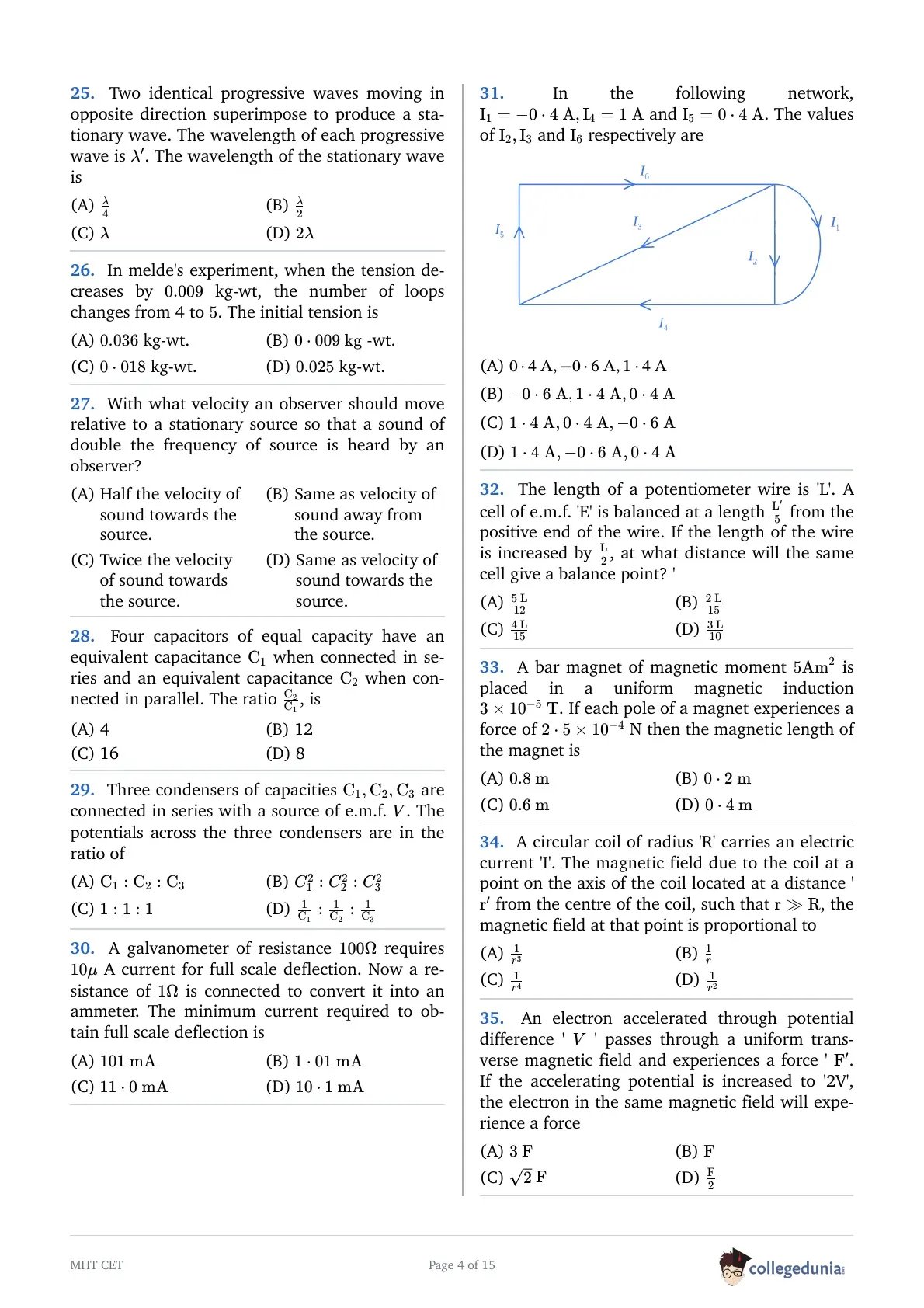
Two identical progressive waves moving in opposite directions superimpose to produce a stationary wave. The wavelength of each progressive wave is \( \lambda \). The wavelength of the stationary wave is
In Melde’s experiment, when the tension decreases by \(0.009\,\text{kg-wt}\), the number of loops changes from 4 to 5. The initial tension is
With what velocity should an observer move relative to a stationary source so that a sound of double the frequency of source is heard by an observer?
Four capacitors of equal capacity have an equivalent capacitance \(C_1\) when connected in series and an equivalent capacitance \(C_2\) when connected in parallel. The ratio \(\dfrac{C_2}{C_1}\) is
Three condensers of capacities \(C_1, C_2, C_3\) are connected in series with a source of e.m.f. \(V\). The potentials across the three condensers are in the ratio of
A galvanometer of resistance \(100\,\Omega\) requires \(10\,\mu\text{A}\) current for full scale deflection. Now a resistance of \(1\,\Omega\) is connected to convert it into an ammeter. The minimum current required to obtain full scale deflection is
In the following network, \(I_1=-0.4\,\text{A}\), \(I_4=1\,\text{A}\) and \(I_5=0.4\,\text{A}\). The values of \(I_2\), \(I_3\) and \(I_6\) respectively are

The length of a potentiometer wire is \(L\). A cell of e.m.f. \(E\) is balanced at a length \( \frac{L}{5} \) from the positive end of the wire. If the length of the wire is increased by \( \frac{L}{2} \), at what distance will the same cell give a balance point?
A bar magnet of magnetic moment \(5\,\text{A m}^2\) is placed in a uniform magnetic induction \(3\times10^{-5}\,\text{T}\). If each pole of the magnet experiences a force of \(2.5\times10^{-4}\,\text{N}\), then the magnetic length of the magnet is
A circular coil of radius \(R\) carries an electric current \(I\). The magnetic field due to the coil at a point on the axis of the coil located at a distance \(r\) from the centre of the coil, such that \(r \gg R\), the magnetic field at that point is proportional to
An electron accelerated through potential difference \(V\) passes through a uniform transverse magnetic field and experiences a force \(F\). If the accelerating potential is increased to \(2V\), the electron in the same magnetic field will experience a force
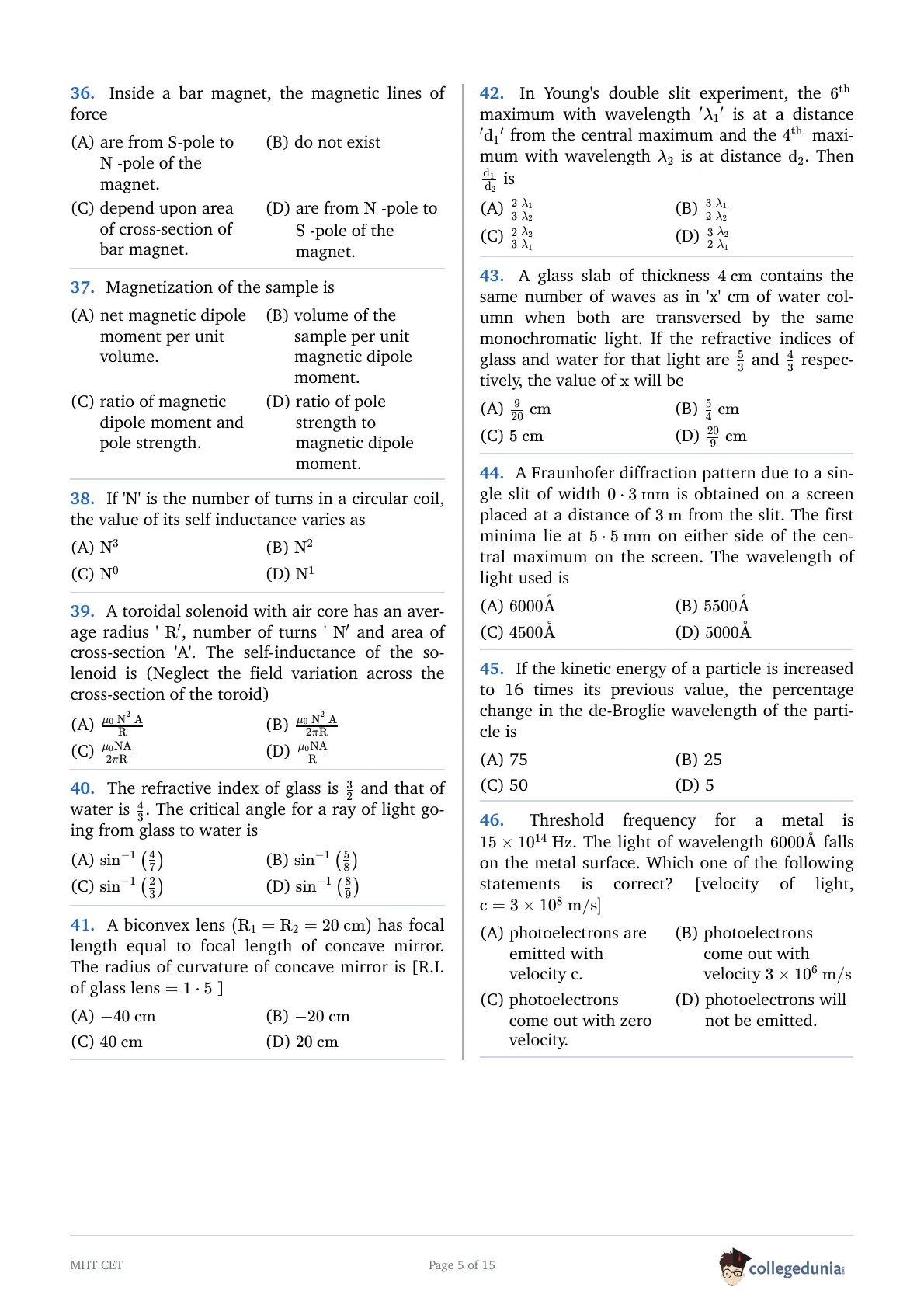
Inside a bar magnet, the magnetic lines of force
Magnetization of the sample is
If \(N\) is the number of turns in a circular coil, the value of its self-inductance varies as
A toroidal solenoid with air core has an average radius \(R\), number of turns \(N\) and area of cross-section \(A\). The self-inductance of the solenoid is (Neglect the field variation across the cross-section of the toroid)
The refractive index of glass is \( \frac{3}{2} \) and that of water is \( \frac{4}{3} \). The critical angle for a ray of light going from glass to water is
A biconvex lens (\(R_1 = R_2 = 20\,\text{cm}\)) has focal length equal to the focal length of a concave mirror. The radius of curvature of the concave mirror is (\(\mu\) of glass lens = 1.5)
In Young’s double slit experiment, the 6th maximum with wavelength \( \lambda_1 \) is at a distance \( d_1 \) from the central maximum and the 4th maximum with wavelength \( \lambda_2 \) is at distance \( d_2 \). Then \( \dfrac{d_1}{d_2} \) is
A glass slab of thickness \(4\,\text{cm}\) contains the same number of waves as in \(x\,\text{cm}\) of water column when both are traversed by the same monochromatic light. If the refractive indices of glass and water for that light are \( \frac{5}{3} \) and \( \frac{4}{3} \) respectively, the value of \(x\) will be
A Fraunhofer diffraction pattern due to a single slit of width \(0.3\,\text{mm}\) is obtained on a screen placed at a distance of \(3\,\text{m}\) from the slit. The first minima lie at \(5.5\,\text{mm}\) on either side of the central maximum on the screen. The wavelength of light used is
If the kinetic energy of a particle is increased to 16 times its previous value, the percentage change in the de-Broglie wavelength of the particle is
Threshold frequency for a metal is \(15 \times 10^{14}\,\text{Hz}\). The light of wavelength \(6000\,\text{\AA}\) falls on the metal surface. Which one of the following statements is correct?
(Velocity of light, \(c = 3 \times 10^8\,\text{m/s}\))
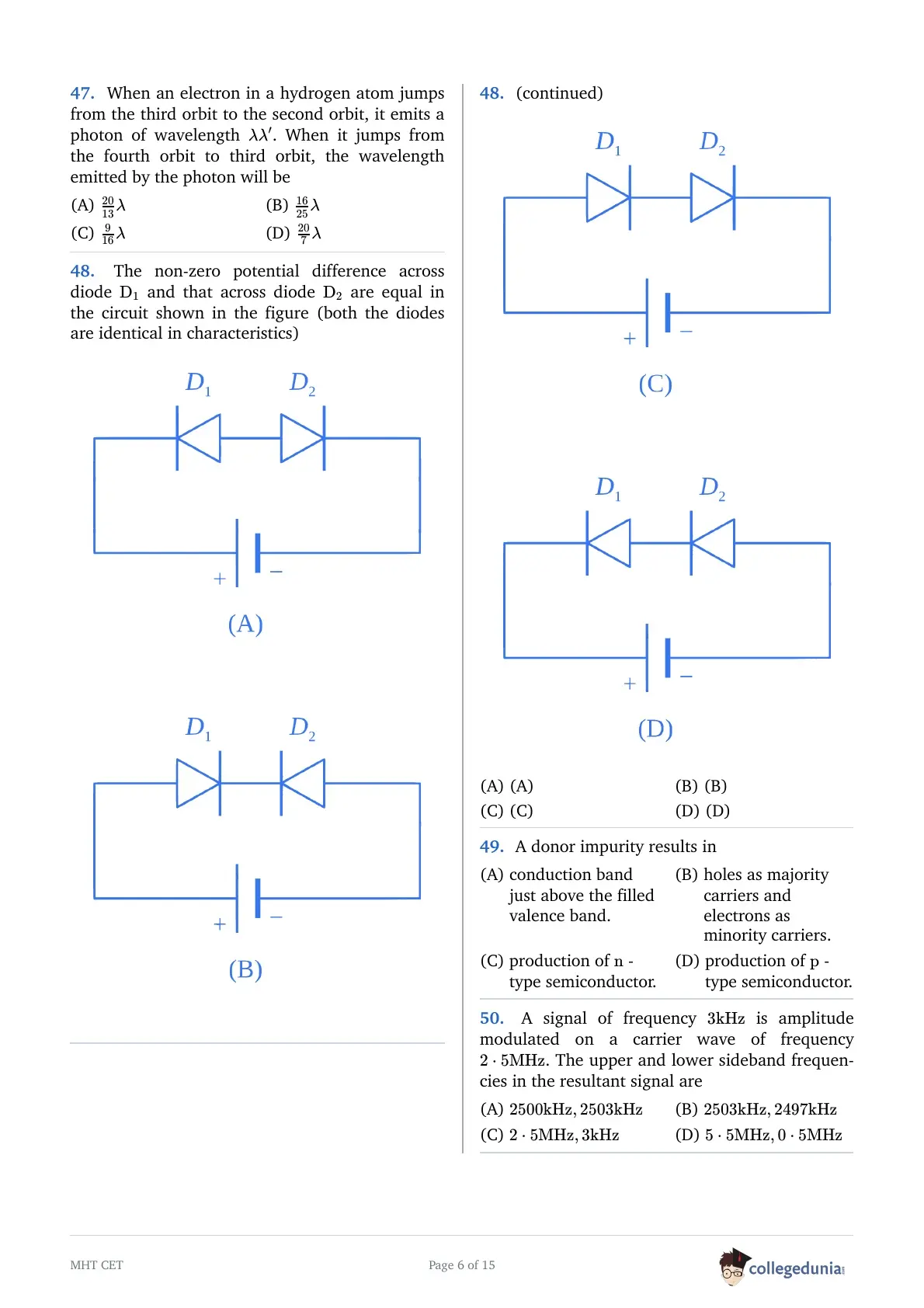
When an electron in a hydrogen atom jumps from the third orbit to the second orbit, it emits a photon of wavelength \( \lambda \). When it jumps from the fourth orbit to the third orbit, the wavelength emitted by the photon will be
The non-zero potential difference across diode \(D_1\) and that across diode \(D_2\) are equal in the circuit shown in the figure (both diodes are identical in characteristics)

A donor impurity results in
A signal of frequency \(3\,\text{kHz}\) is amplitude modulated on a carrier wave of frequency \(2.5\,\text{MHz}\). The upper and lower sideband frequencies in the resultant signal are
Chemistry (Q51 - Q100)
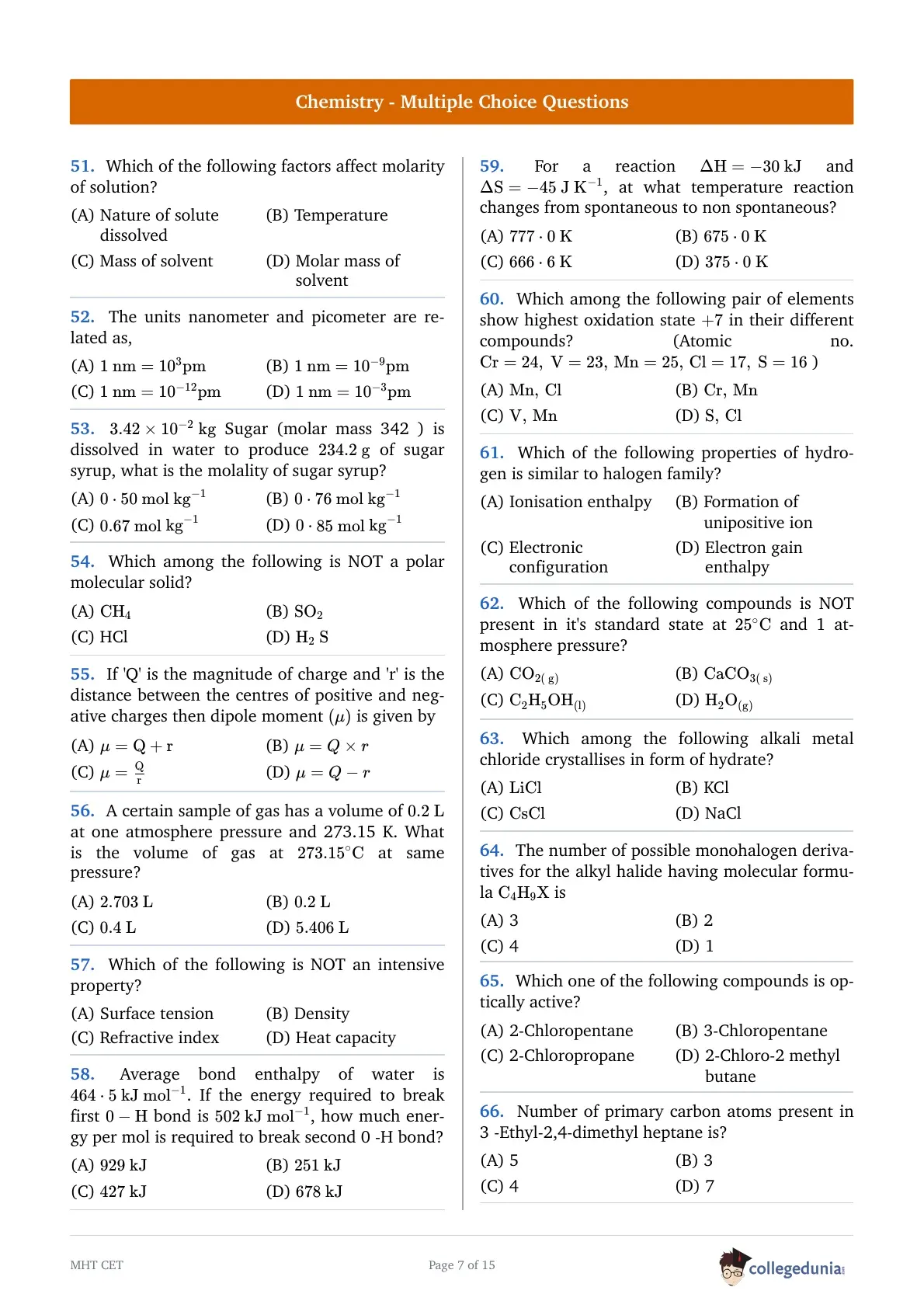
Which of the following factors affect molarity of solution?
The units nanometer and picometer are related as,
\(3.42 \times 10^{-2}\ \text{kg}\) sugar (molar mass = 342) is dissolved in water to produce \(234.2\ \text{g}\) of sugar syrup. What is the molality of sugar syrup?
Which among the following is NOT a polar molecular solid?
If \(Q\) is the magnitude of charge and \(r\) is the distance between the centres of positive and negative charges, then dipole moment (\(\mu\)) is given by
A certain sample of gas has a volume of \(0.2\ \text{L}\) at one atmosphere pressure and \(273.15\ \text{K}\). What is the volume of gas at \(273.15^\circ\text{C}\) at the same pressure?
Which of the following is NOT an intensive property?
Average bond enthalpy of water is \(464.5\ \text{kJ mol}^{-1}\). If the energy required to break the first O–H bond is \(502\ \text{kJ mol}^{-1}\), how much energy per mole is required to break the second O–H bond?
For a reaction \(\Delta H = -30\ \text{kJ}\) and \(\Delta S = -45\ \text{J K}^{-1}\), at what temperature does the reaction change from spontaneous to non-spontaneous?
Which among the following pair of elements show highest oxidation state +7 in their different compounds?
(Atomic no. Cr = 24, V = 23, Mn = 25, Cl = 17, S = 16)
Which of the following properties of hydrogen is similar to the halogen family?
Which of the following compounds is NOT present in its standard state at 25\(^\circ\)C and 1 atmosphere pressure?
Which among the following alkali metal chlorides crystallises in the form of a hydrate?
The number of possible monohalogen derivatives for the alkyl halide having molecular formula \(\mathrm{C_4H_9X}\) is
Which one of the following compounds is optically active?
Number of primary carbon atoms present in 3-Ethyl-2,4-dimethyl heptane is
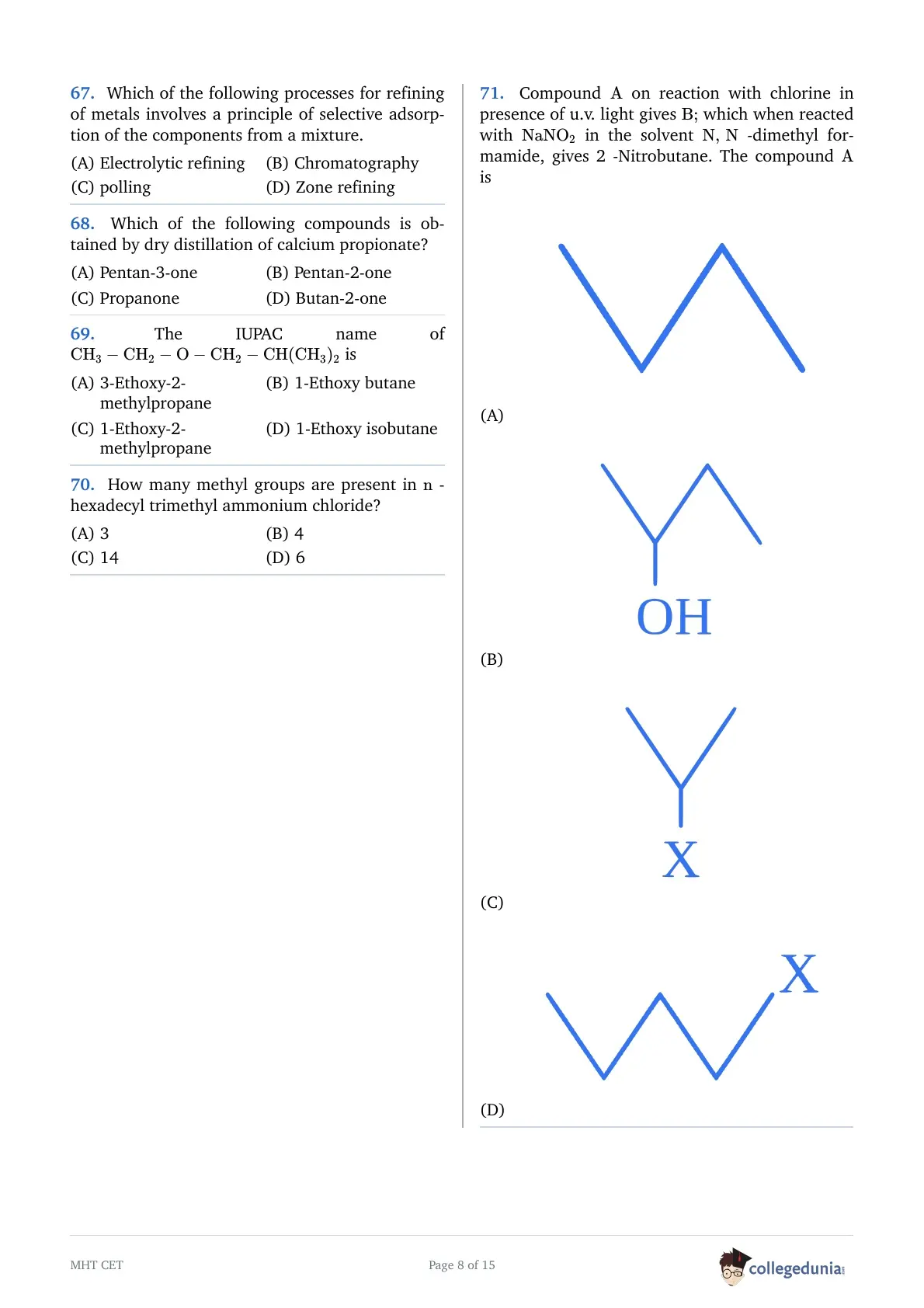
Which of the following processes for refining of metals involves the principle of selective adsorption of the components from a mixture?
Which of the following compounds is obtained by dry distillation of calcium propionate?
The IUPAC name of \(\text{CH}_3-\text{CH}_2-\text{O}-\text{CH}_2-\text{CH}(\text{CH}_3)_2\) is
Compound \(\mathrm{A}\) on reaction with chlorine in presence of u.v. light gives \(\mathrm{B};\) which when reacted with \(\mathrm{NaNO}_{2}\) in the solvent \(\mathrm{N},\,\mathrm{N}\) -dimethyl formamide, gives 2 -Nitrobutane. The compound \(\mathrm{A}\) is
- (A)
![MHT CET 2020 13th October Morning Shift Chemistry - Haloalkanes and Haloarenes Question 30 English Option 1]()
- (B)
![MHT CET 2020 13th October Morning Shift Chemistry - Haloalkanes and Haloarenes Question 30 English Option 2]()
- (C)
![MHT CET 2020 13th October Morning Shift Chemistry - Haloalkanes and Haloarenes Question 30 English Option 3]()
- (D)
![MHT CET 2020 13th October Morning Shift Chemistry - Haloalkanes and Haloarenes Question 30 English Option 4]()

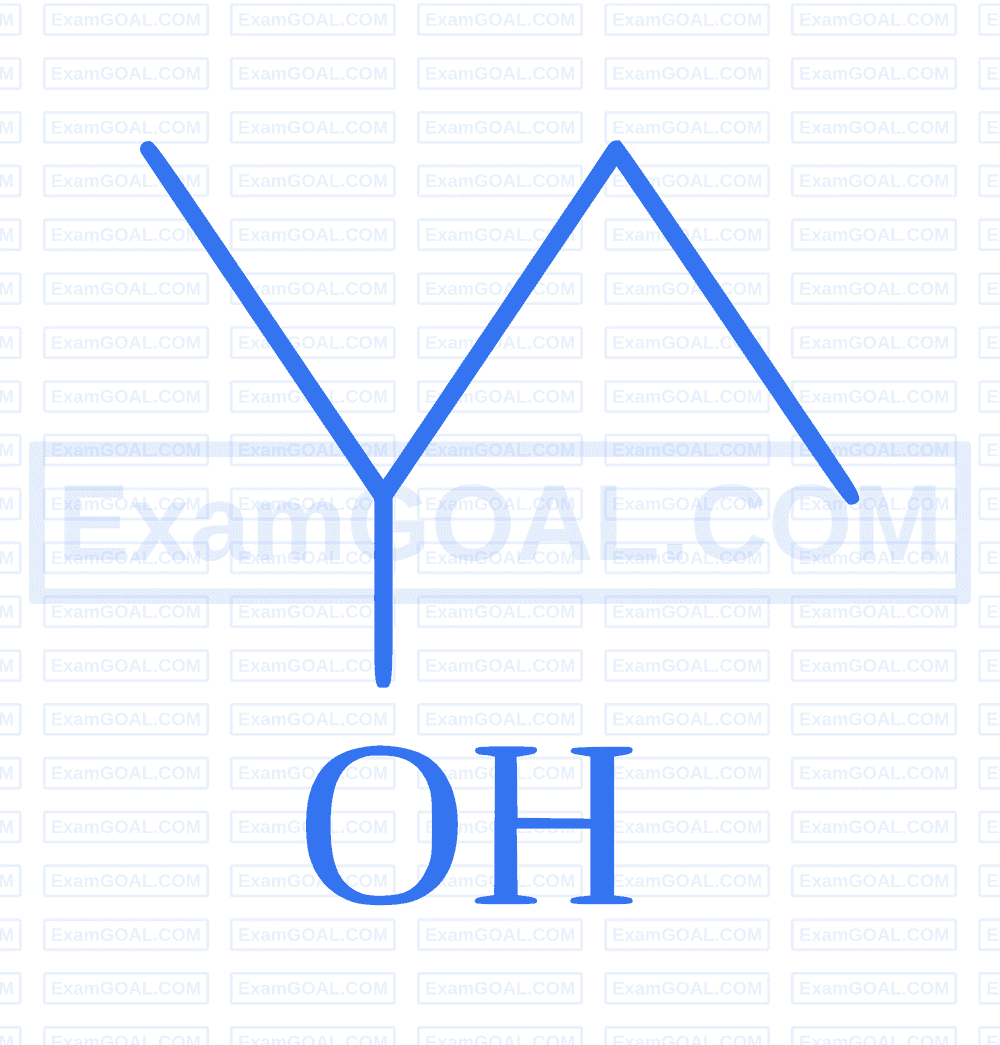
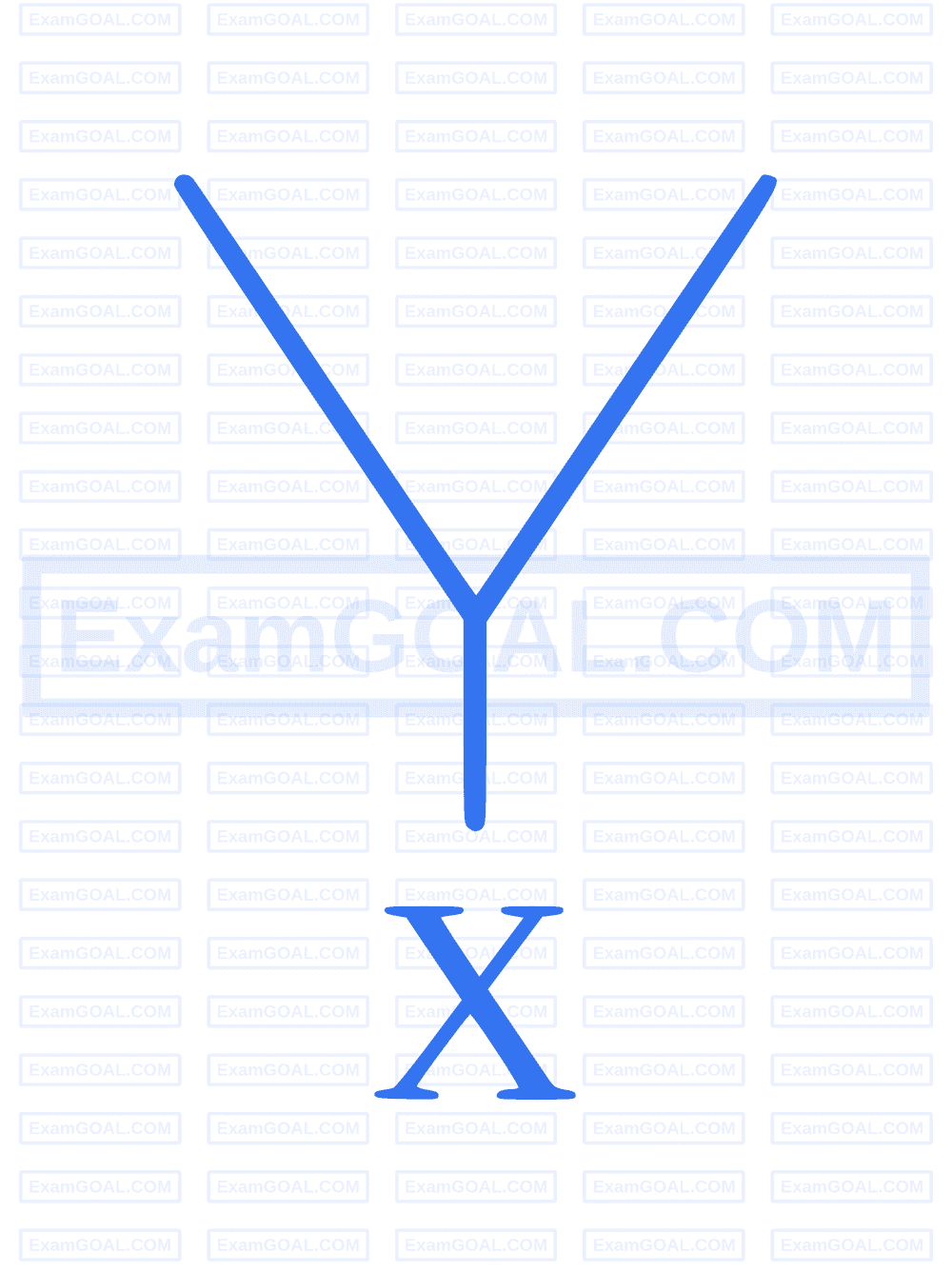

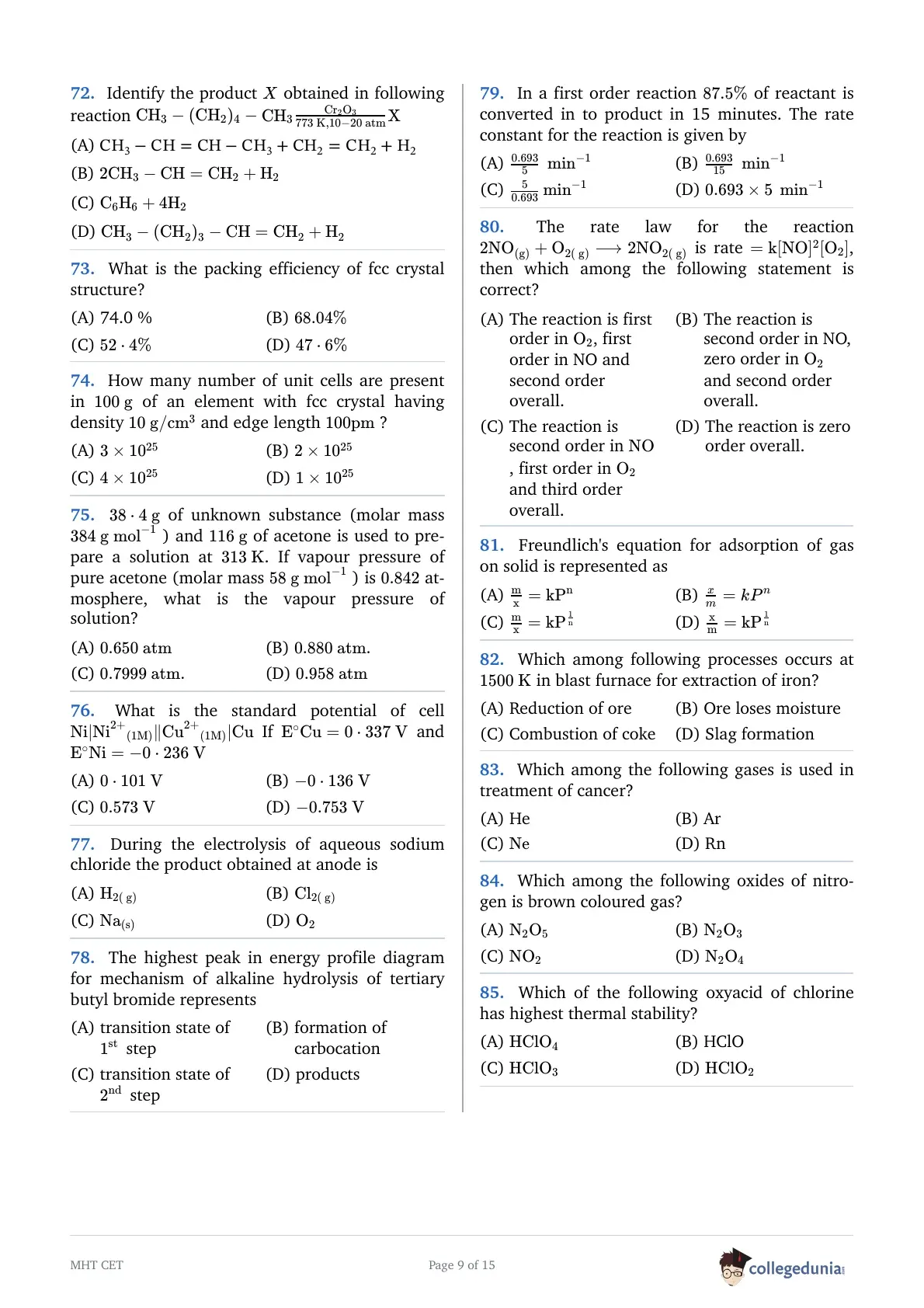
Identify the product \(X\) obtained in following reaction \(\mathrm{CH}_{3}-(\mathrm{CH}_{2})_{4}-\mathrm{CH}_{3}\frac{\mathrm{Cr}_{2}\mathrm{O}_{3}}{773\ \mathrm{K},10-20\ \mathrm{atm}}\mathrm{X}\)
What is the packing efficiency of fcc crystal structure?
How many unit cells are present in 100 g of an element with fcc crystal structure having density \(10\ \text{g cm}^{-3}\) and edge length \(100\ \text{pm}\)?
38.4 g of an unknown substance (molar mass \(= 384\ \text{g mol}^{-1}\)) and 116 g of acetone are used to prepare a solution at 313 K. If vapour pressure of pure acetone (molar mass \(= 58\ \text{g mol}^{-1}\)) is 0.842 atm, what is the vapour pressure of the solution?
What is the standard potential of cell \(\mathrm{Ni}|\mathrm{Ni}^{2+}{}_{(1\mathrm{M})}\| \mathrm{Cu}^{2+}{}_{(1\mathrm{M})}|\mathrm{Cu}\) If \(\mathrm{E}^{\circ }\mathrm{Cu}=0\cdot 337\ \mathrm{V}\) and \(\mathrm{E}^{\circ }\mathrm{Ni}=-0\cdot 236\ \mathrm{V}\)
During the electrolysis of aqueous sodium chloride, the product obtained at the anode is
The highest peak in the energy profile diagram for mechanism of alkaline hydrolysis of tertiary butyl bromide represents
In a first order reaction, 87.5% of reactant is converted into product in 15 minutes. The rate constant for the reaction is given by
The rate law for the reaction \(2\mathrm{NO}_{(\mathrm{g})}+\mathrm{O}_{2(\ \mathrm{g})}\longrightarrow 2\mathrm{NO}_{2(\ \mathrm{g})}\) is rate \(=\mathrm{k}[\mathrm{NO}]^{2}[\mathrm{O}_{2}]\), then which among the following statement is correct?
Freundlich’s equation for adsorption of gas on solid is represented as
Which among the following processes occurs at 1500 K in a blast furnace for extraction of iron?
Which among the following gases is used in treatment of cancer?
Which among the following oxides of nitrogen is a brown coloured gas?
Which of the following oxyacid of chlorine has highest thermal stability?
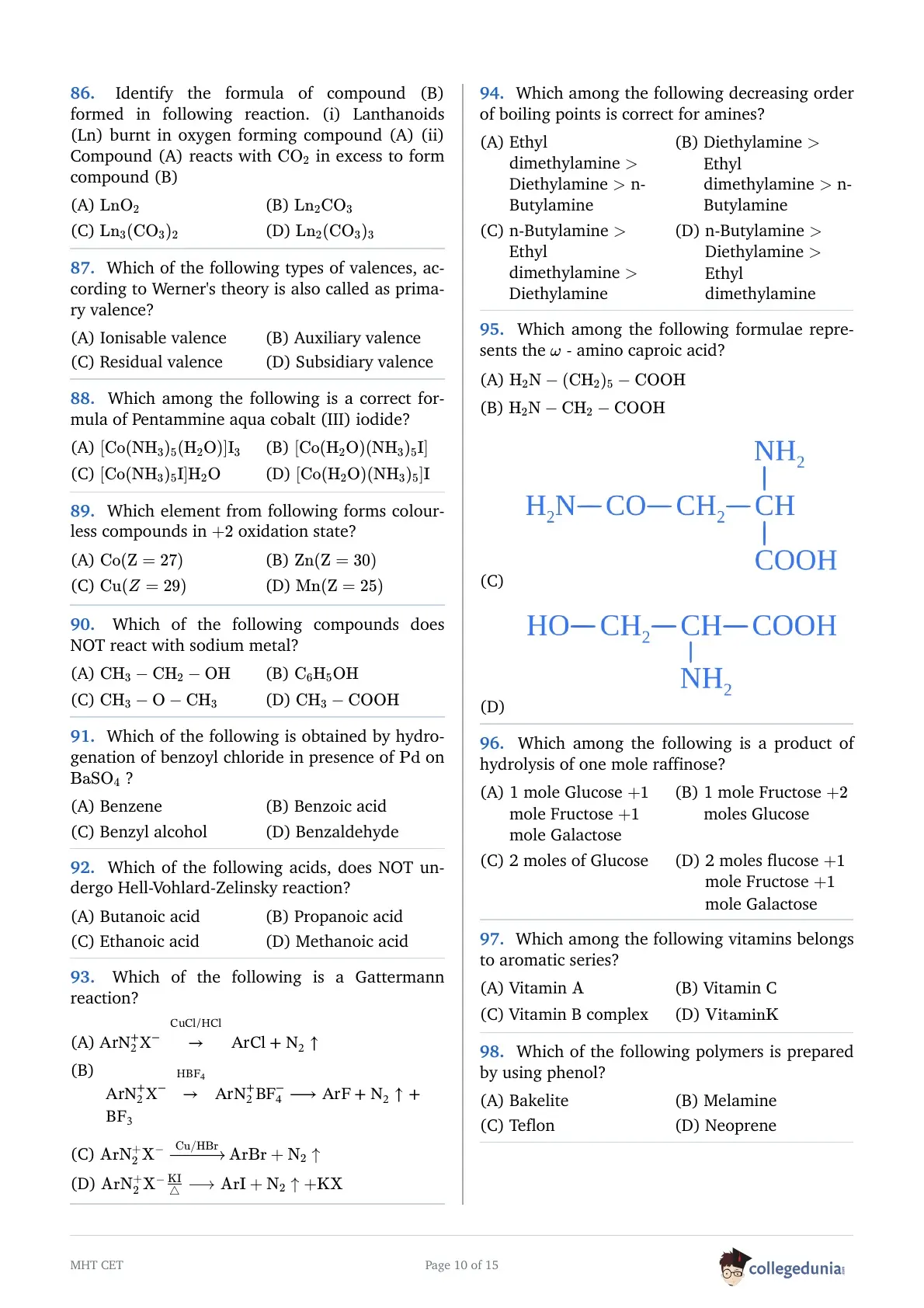
Identify the formula of compound (B) formed in the following reactions:
(i) Lanthanoids (Ln) burn in oxygen forming compound (A).
(ii) Compound (A) reacts with excess \(\mathrm{CO_2}\) to form compound (B).
Which of the following types of valences, according to Werner’s theory, is also called primary valence?
Which among the following is a correct formula of pentaammine aqua cobalt(III) iodide?
Which element from the following forms colourless compounds in +2 oxidation state?
Which of the following compounds does NOT react with sodium metal?
Which of the following is obtained by hydrogenation of benzoyl chloride in presence of Pd on BaSO\(_4\)?
Which of the following acids does NOT undergo Hell–Volhard–Zelinsky reaction?
Which of the following is a Gattermann reaction?
Which among the following decreasing order of boiling points is correct for amines?
Which among the following formulae represents the \(\omega\)-amino caproic acid?
Which among the following is a product of hydrolysis of one mole raffinose?
Which among the following vitamins belongs to aromatic series?
Which of the following polymers is prepared by using phenol?
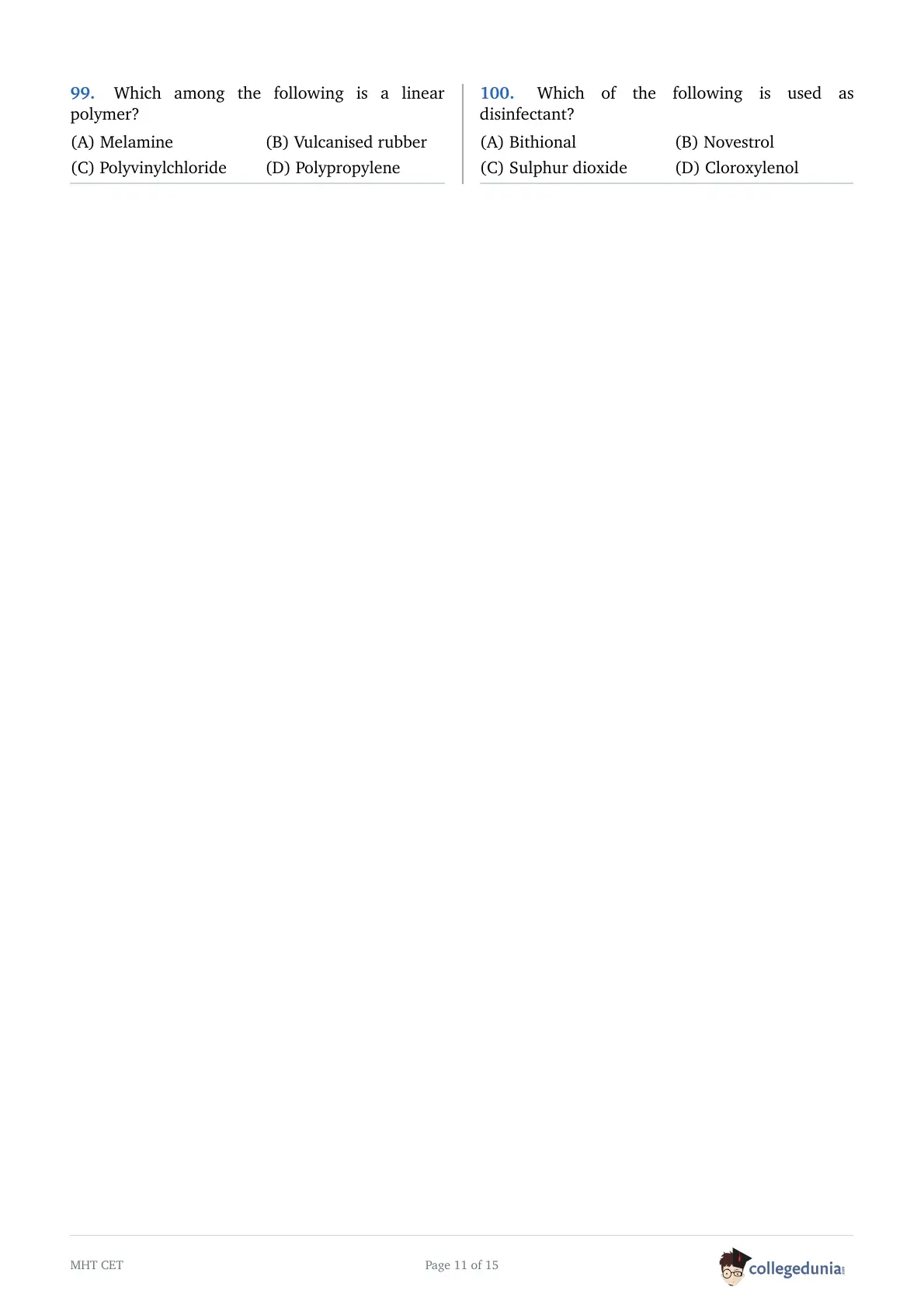
Which among the following is a linear polymer?
Which of the following is used as disinfectant?
Mathematics (Q101 - Q150)
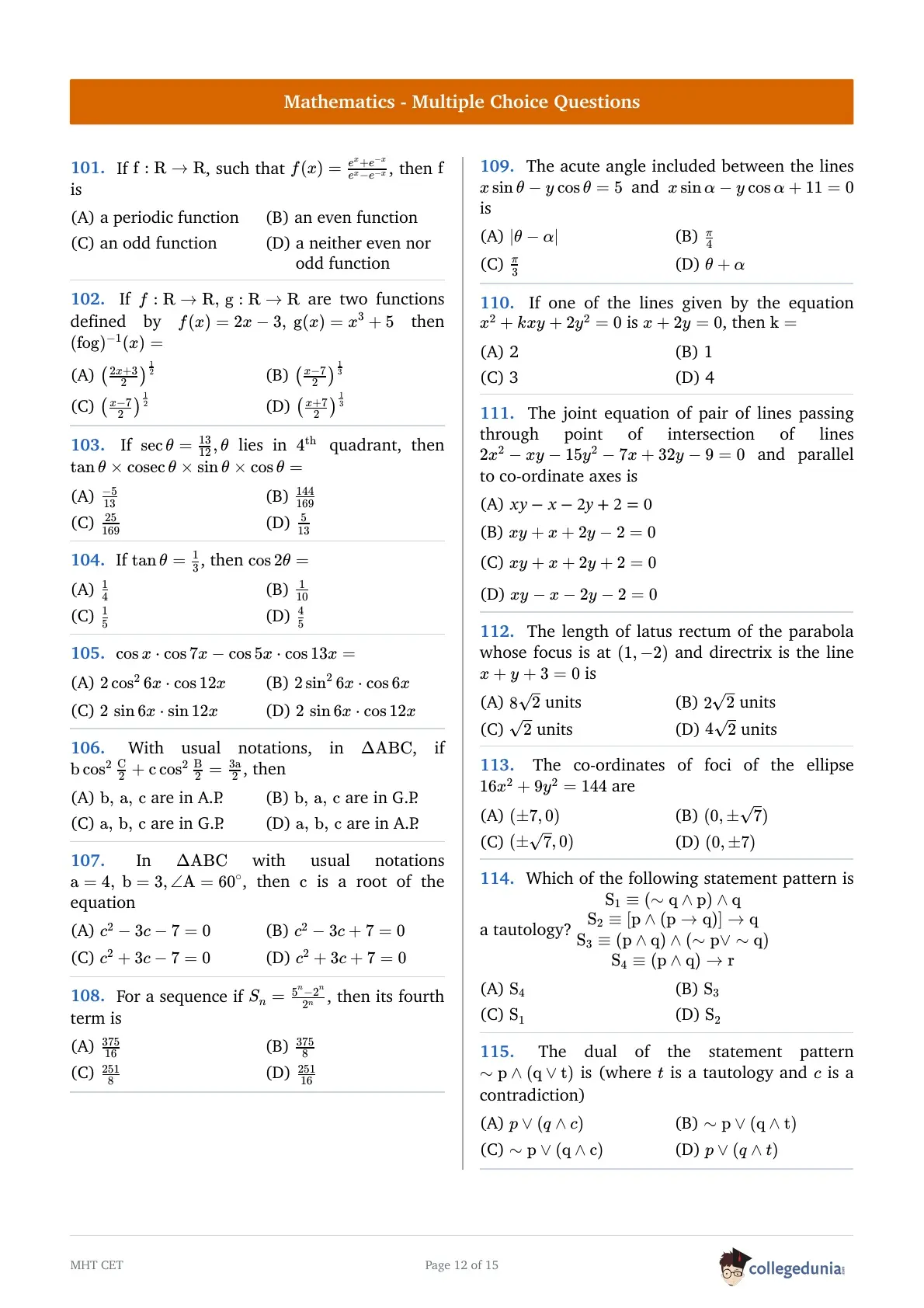
If \(\mathrm{f}:\mathrm{R}\rightarrow \mathrm{R}\), such that \(f(x)=\frac{e^{x}+e^{-x}}{e^{x}-e^{-x}}\), then \(\mathrm{f}\) is
If \(f:\mathrm{R}\rightarrow \mathrm{R},\,\mathrm{g}:\mathrm{R}\rightarrow \mathrm{R}\) are two functions defined by \(f(x)=2x-3,\ \mathrm{g}(x)=x^{3}+5\) then \((\mathrm{fog})^{-1}(x)=\)
If \(\sec \theta =\frac{13}{12},\theta\) lies in \(4^{\text{th }}\) quadrant, then \(\tan \theta \times \operatorname{cosec} \theta \times \sin \theta \times \cos \theta =\)
If \( \tan \theta = \dfrac{1}{3} \), then find \( \cos 2\theta \).
\(\cos x\cdot \cos 7x-\cos 5x\cdot \cos 13x=\)
With usual notations, in \( \triangle ABC \), if
\( b\cos^2\frac{C}{2} + c\cos^2\frac{B}{2} = \frac{3a}{2} \), then
In \( \triangle ABC \) with usual notations, \( a = 4 \), \( b = 3 \), \( \angle A = 60^\circ \), then \( c \) is a root of the equation
For a sequence if \( S_n = \dfrac{5^n - 2^n}{2^n} \), then its fourth term is
The acute angle included between the lines \(x\sin \theta -y\cos \theta =5\) and \(x\sin \alpha -y\cos \alpha +11=0\) is
If one of the lines given by the equation
\( x^2 + kxy + 2y^2 = 0 \) is \( x + 2y = 0 \), then the value of \( k \) is
The joint equation of the pair of lines passing through the point of intersection of the lines
\[
2x^2 - xy - 15y^2 - 7x + 32y - 9 = 0
\]
and parallel to the coordinate axes is
The length of the latus rectum of the parabola whose focus is at \( (1,-2) \) and directrix is the line \( x + y + 3 = 0 \) is
The coordinates of the foci of the ellipse \( 16x^2 + 9y^2 = 144 \) are
Which of the following statement pattern is a tautology? \(\begin{matrix} \mathrm{S}_{1}\equiv (\sim \mathrm{q}\wedge \mathrm{p})\wedge \mathrm{q} \\ \mathrm{S}_{2}\equiv [\mathrm{p}\wedge (\mathrm{p}\rightarrow \mathrm{q})]\rightarrow \mathrm{q} \\ \mathrm{S}_{3}\equiv (\mathrm{p}\wedge \mathrm{q})\wedge (\sim \mathrm{p}\vee \sim \mathrm{q}) \\ \mathrm{S}_{4}\equiv (\mathrm{p}\wedge \mathrm{q})\rightarrow \mathrm{r} \end{matrix}\)
The dual of the statement pattern \( \sim p \land (q \lor t) \) is
(where \( t \) is a tautology and \( c \) is a contradiction)
If \(\tan ^{-1}\left(\frac{1-x}{1+x}\right)-\frac{1}{2}\tan ^{-1}x=0\), for \(x>0\), then \(x=\)
If \(A=\begin{bmatrix} 1 & 2 & i \\ 1 & 1 & 1 \\ 1 & 1 & 0 \end{bmatrix}\), then \([\mathrm{adj}(\mathrm{adj}A)]^{-1}=\)
If \( A=\begin{bmatrix}2 & 3 \\ 1 & 2\end{bmatrix} \) and \( B=\begin{bmatrix}2 & -3 \\-1 & 2\end{bmatrix} \), then \( (B^{-1}A^{-1})^{-1} \) is
If the function \(f(x)=\frac{1-\sin 2x+\cos 2x}{1+\sin 2x+\cos 2x}\) if \(x\neq \frac{\pi }{2}\) \(=\mathrm{k}\) if \(x=\frac{\pi }{2}\) is continuous at \(x=\frac{\pi }{2}\), then \(\mathrm{k}=\)
If \( x^2 + y^2 = 1 \), then find \( \dfrac{d^2x}{dy^2} \).
If \( \log_{10}\!\left(\dfrac{x^3-y^3}{x^3+y^3}\right)=2 \), then find \( \dfrac{dx}{dy} \).
If \( y = e^{4x}\cos 5x \), then find \( \dfrac{d^2y}{dx^2} \) at \( x = 0 \).
The equation of a normal to the curve \(x=4\,\sec \theta\) and \(y=4\tan ^{2}\theta\) at \(\theta =\frac{\pi }{4}\) is
The radius of a circle is increasing at the rate of \( 2 \,\text{cm/sec} \).
Find the rate at which its area is increasing when the radius of the circle is \( 5 \) decimeters.
A tangent to the curve \( x = at^2,\; y = 2at \) is perpendicular to the X-axis.
Then the point of contact is
\(\int \frac{x^{2}+1}{x^{4}+x^{2}+1}dx=\)
\(\int \frac{\sin 2x}{\sin ^{2}x\cos ^{2}x}dx=\)
\(\int \frac{\sec x}{\sqrt{\log (\sec x+\tan x)}}dx=\)
\(\int _{0}^{1}\tan ^{-1}\left[\frac{2x-1}{1+x-x^{2}}\right]dx=\)
\(\int _{0}^{\frac{\pi }{2}}\frac{\sin ^{\frac{2}{3}}x}{\sin ^{\frac{2}{3}}x+\cos ^{\frac{2}{3}}x}dx=\)
\(\int _{-a}^{a}x^{2}\left(\frac{e^{x3}-e^{-x3}}{e^{x3}+e^{-x3}}\right)dx=\)
The equation of the curve which passes through point \((1,0)\) and has tangent with slope \(1+\frac{y}{x}+\left(\frac{y}{x}\right)^{2}\) is
Water at \(100^\circ\text{C}\) cools in 15 minutes to \(75^\circ\text{C}\) in a room temperature of \(25^\circ\text{C}\).
Then the temperature of water after 30 minutes is
The general solution of the differential equation \(\sec ^{2}x\) tany \(dx+\sec ^{2}y\tan xdy=0\) is
The integrating factor of the differential equation \(\frac{dy}{dx}+\frac{1}{x}y=x^{3}-3\) is
In a certain culture of bacteria, the rate of increase is proportional to the number present.
It is found that the number doubles in 4 hours.
Then the number of times the bacteria are increased in 12 hours is
If \( \vec{AB} = 3\hat{i} + 5\hat{j} + 4\hat{k} \),
\( \vec{AC} = 5\hat{i} - 5\hat{j} + 2\hat{k} \) represent the sides of triangle \( ABC \),
then the length of the median through \( A \) is
If \( a, b, c \) are lengths of the sides \( BC, CA, AB \) respectively of \( \triangle ABC \) and
\( a\vec{AH} + b\vec{BH} + c\vec{CH} = \vec{0} \), then point \( H \) is the
If the vectors \( \vec{a} = \hat{i} - 2\hat{j} + \hat{k} \),
\( \vec{b} = 2\hat{i} - 5\hat{j} + p\hat{k} \) and
\( \vec{c} = 5\hat{i} - 9\hat{j} + 4\hat{k} \) are coplanar, then the value of \( p \) is
The distance of the point \((3,4,5)\) from the point of intersection of the line \(\frac{x-3}{1}=\frac{y-4}{2}=\frac{z-5}{2}\) and plane \(x+y+z=2\) is
If a line in octant OXYZ makes equal angles with the coordinate axes, then
A plane \( E_1 \) makes intercepts \( 1, -3, 4 \) on the coordinate axes.
The equation of a plane parallel to \( E_1 \) and passing through \( (2,6,-8) \) is
The equation of the line passing through the point \( (2, 3, -4) \) and perpendicular to the XOZ plane is
The shortest distance between the lines \(\bar{r}=(1-t)\hat{\imath}+(t-2)\hat{\jmath}+(3-2t)\hat{k}\) and \(\bar{r}=(p+1)\hat{\imath}+(2p-1)\hat{\jmath}+(2p+1)\hat{k}\) is
The L.P.P. to maximize \(z=x+y\), subject to \(x+y\leq 30,x\leq 15,y\leq 20,x+y\geq 15\), \(x,y\geq 0\) has
If \( P(A') = 0.6 \), \( P(B) = 0.8 \) and \( P(B|A) = 0.3 \), then find \( P(A|B) \).
Given below is the probability distribution of discrete r.v. X \(\begin{array}{|c|c|c|c|c|c|c|} \hline \mathrm{X}=x & 1 & 2 & 3 & 4 & 5 & 6 \\ \hline \mathrm{P}[\mathrm{X}=x] & \mathrm{k} & 0 & 2\mathrm{k} & 5\mathrm{k} & \mathrm{k} & 3\mathrm{k} \\ \hline \end{array}\) Then \(\mathrm{P}[\mathrm{X}\geq 4]=\)
If the function \(f\) defined by \(f(x)=K\left(x-x^{2}\right)\) if \(0\lt x\lt 1\) \(=0,\) other wise is the p.d.f. of a r. v. \(X\), then the value of \(P\left(X\lt \frac{1}{2}\right)\) is
The probability that a person who undergoes a certain operation will survive is 0.2. If 5 patients undergo similar operations, find the probability that exactly four will survive.
MHT CET 2020 PCM Exam Pattern and Marking Scheme
| Parameter | Details |
|---|---|
| Conducting Body | Maharashtra Common Entrance Test Cell (Maharashtra CET Cell) |
| Exam Mode | Online (Computer-Based Test) |
| Duration | 180 minutes (3 hours) |
| Groups / Subjects | PCM (Physics, Chemistry, Mathematics) for Engineering |
| Total Questions |
150 |
| Total Marks | 200 |
| Question Type | Multiple Choice Questions (MCQs) |
| Marks Distribution |
|
| Negative Marking | No |
| Syllabus Weightage |
|



Comments