




MHT CET 2020 Oct 13 Shift 2 PCM Question Paper is available for download here. Maharashtra State CET Cell conducted MHT CET 2020 PCM Exam on Oct 13 in Shift 2 from 2 PM to 5 PM in CBT mode.
The MHT CET 2020 PCM question paper includes the following:
- The MHT CET 2020 PCM Question Paper consists of 150 multiple-choice questions (MCQs) totalling 200 marks divided into 3 sections: Physics, Chemistry, and Mathematics, with 50 questions in each subject.
- Physics and Chemistry questions carry 1 mark each while Mathematics questions carry 2 marks each.
- There is no negative marking for incorrect answers.
MHT CET 2020 Oct 13 Shift 2 PCM Question Paper with Solution PDF
| CD PDF | CD PDF with Solutions |
|---|---|
| Download Collegedunia PDF 1.08 MB | - |
Also Check:
MHT CET 2020 Oct 13 Shift 2 PCM Questions with Solutions
Physics (Q1 - Q50)
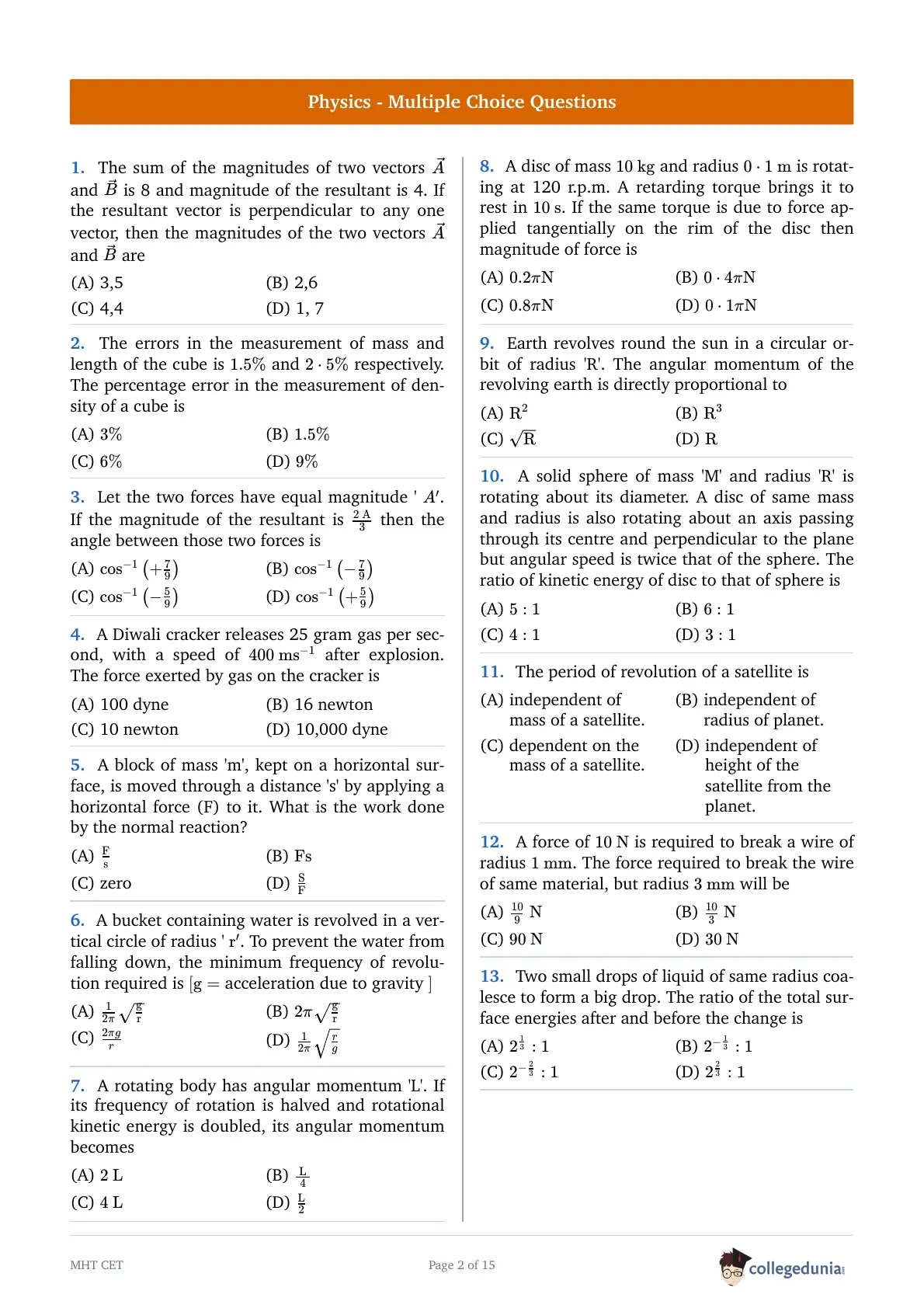
The sum of the magnitudes of two vectors \(\vec{A}\) and \(\vec{B}\) is 8 and magnitude of the resultant is 4. If the resultant vector is perpendicular to any one vector, then the magnitudes of the two vectors \(\vec{A}\) and \(\vec{B}\) are
The errors in the measurement of mass and length of the cube is \(1.5%\) and \(2.5%\) respectively. The percentage error in the measurement of density of a cube is
Let the two forces have equal magnitude ' \(A'\). If the magnitude of the resultant is \(\frac{2\ \mathrm{A}}{3}\) then the angle between those two forces is
A Diwali cracker releases 25 gram gas per second, with a speed of \(400\ \mathrm{ms}^{-1}\) after explosion. The force exerted by gas on the cracker is
A block of mass \(m\), kept on a horizontal surface, is moved through a distance \(s\) by applying a horizontal force \(F\) to it. What is the work done by the normal reaction?
A bucket containing water is revolved in a vertical circle of radius \(r\). To prevent the water from falling down, the minimum frequency of revolution required is (where \(g\) = acceleration due to gravity)
A rotating body has angular momentum \(L\). If its frequency of rotation is halved and rotational kinetic energy is doubled, its angular momentum becomes
A disc of mass \(10\ \mathrm{kg}\) and radius \(0\cdot 1\ \mathrm{m}\) is rotating at 120 r.p.m. A retarding torque brings it to rest in \(10\ \mathrm{s}\). If the same torque is due to force applied tangentially on the rim of the disc then magnitude of force is
Earth revolves round the sun in a circular orbit of radius \(R\). The angular momentum of the revolving earth is directly proportional to
A solid sphere of mass \(M\) and radius \(R\) is rotating about its diameter. A disc of same mass and radius is also rotating about an axis passing through its centre and perpendicular to the plane but angular speed is twice that of the sphere. The ratio of kinetic energy of disc to that of sphere is
The period of revolution of a satellite is
A force of \(10\ \mathrm{N}\) is required to break a wire of radius \(1\ \mathrm{mm}\). The force required to break the wire of same material, but radius \(3\ \mathrm{mm}\) will be
Two small drops of liquid of same radius coalesce to form a big drop. The ratio of the total surface energies after and before the change is
Water is flowing through a horizontal pipe of non-uniform cross-section. In the region of narrowest part inside the pipe, the water will have
The excess pressure inside a spherical drop of water is three times that of another drop of water. The ratio of their surface area is
A metal rod of Young’s modulus \(Y\) and coefficient of linear expansion \(\alpha\) has its temperature raised by \(\Delta \theta\). The linear stress to prevent the expansion of rod is (\(L\) and \(\ell\) are original length of rod and expansion respectively)
Two spheres \({}'\mathrm{S}_{1}{}'\) and \({}'\mathrm{S}_{2}{}'\) have radii \({}'\mathrm{R}'\) and \({}'3\mathrm{R}'\), temperature \({}'\mathrm{T}'\mathrm{K}\) and \(\frac{\mathrm{T}}{3}\ \mathrm{K}\) respectively. If they are coated with a material of same emissivity, rate of radiation of \({}'\mathrm{S}_{1}{}'\) is \(\mathrm{E}\) then rate of radiation of \(\mathrm{S}_{2}{}'\) is (spheres are of the same material)
One mole of a diatomic gas does a work \(\frac{\mathrm{Q}}{3}\), when the amount of heat supplied is 'Q'. In this process, the molar heat capacity of the gas is
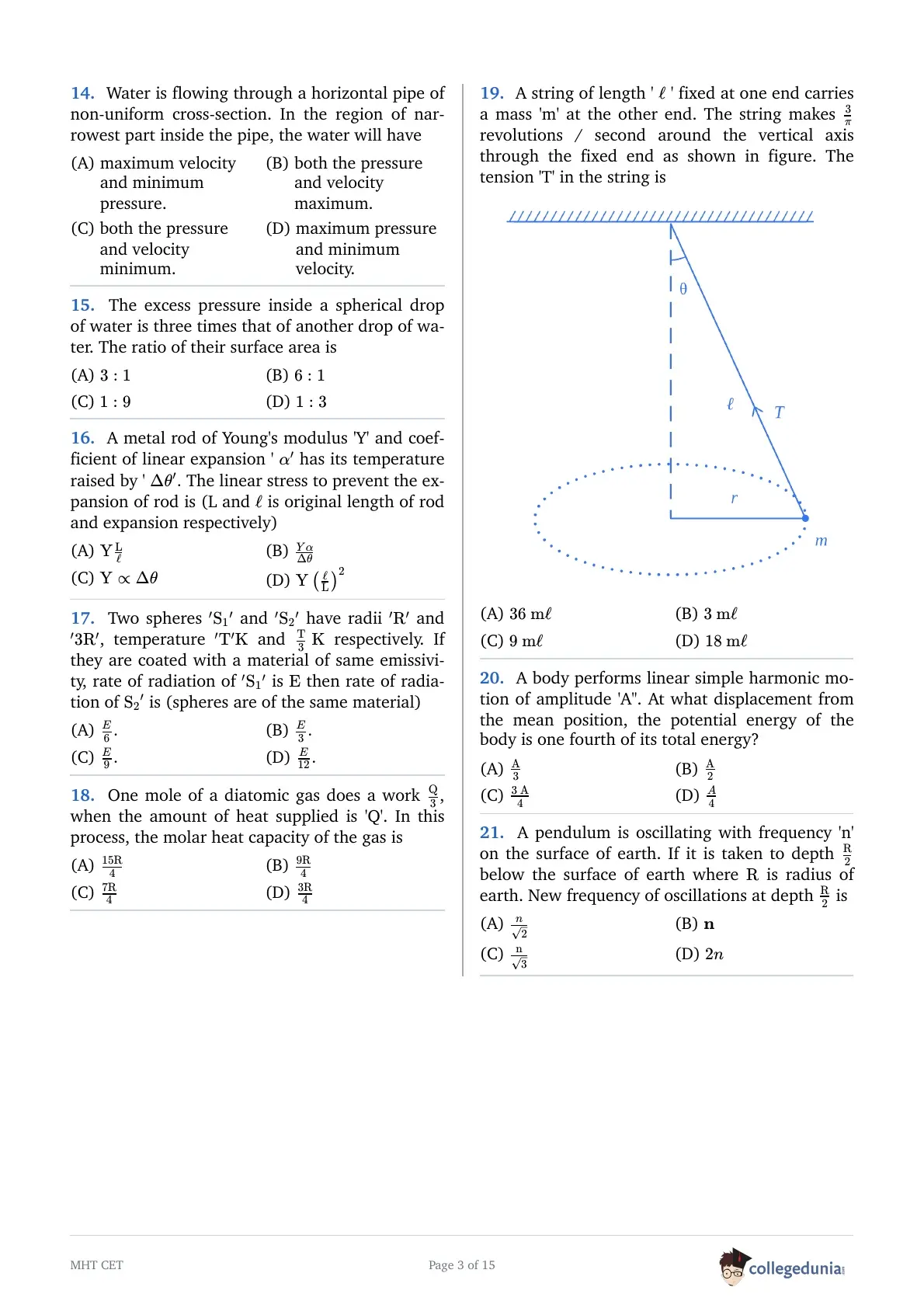
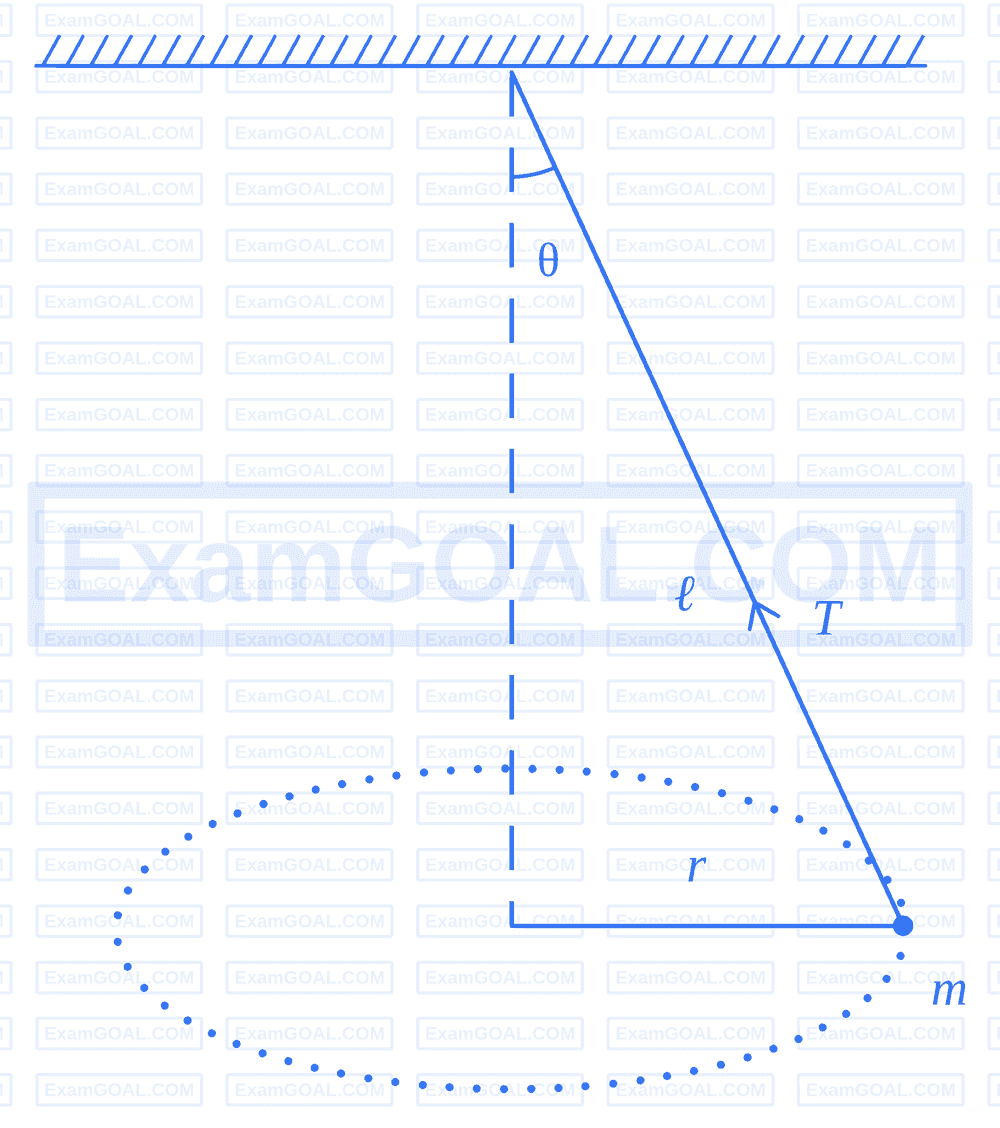
A string of length ' \(\ell\) ' fixed at one end carries a mass 'm' at the other end. The string
makes \(\frac{3}{\pi }\) revolutions / second around the vertical axis through the fixed end as
shown in figure. The tension 'T' in the string is
A body performs linear simple harmonic motion of amplitude \(A\). At what displacement from the mean position, the potential energy of the body is one fourth of its total energy?
A pendulum is oscillating with frequency 'n' on the surface of earth. If it is taken to depth \(\frac{\mathrm{R}}{2}\) below the surface of earth where \(\mathrm{R}\) is radius of earth. New frequency of oscillations at depth \(\frac{\mathrm{R}}{2}\) is
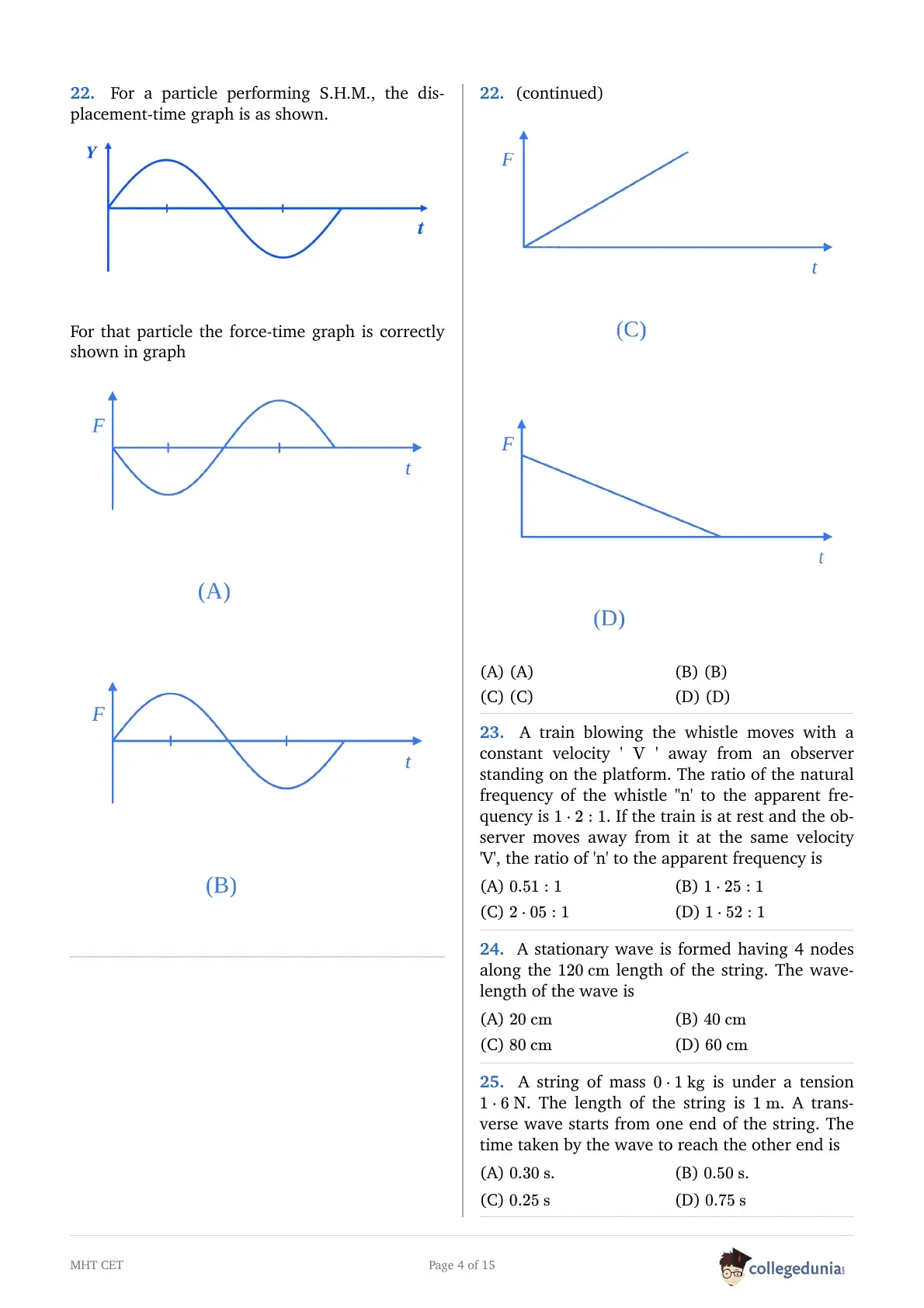
For a particle performing S.H.M., the displacement–time graph is as shown.

A train blowing the whistle moves with a constant velocity \(V\) away from an observer standing on the platform. The ratio of the natural frequency of the whistle \(n\) to the apparent frequency is \(1.2:1\). If the train is at rest and the observer moves away from it at the same velocity \(V\), the ratio of \(n\) to the apparent frequency is
A stationary wave is formed having 4 nodes along the \(120\ \mathrm{cm}\) length of the string. The wavelength of the wave is
A string of mass \(0\cdot 1\ \mathrm{kg}\) is under a tension \(1\cdot 6\ \mathrm{N}\). The length of the string is \(1\ \mathrm{m}\). A transverse wave starts from one end of the string. The time taken by the wave to reach the other end is
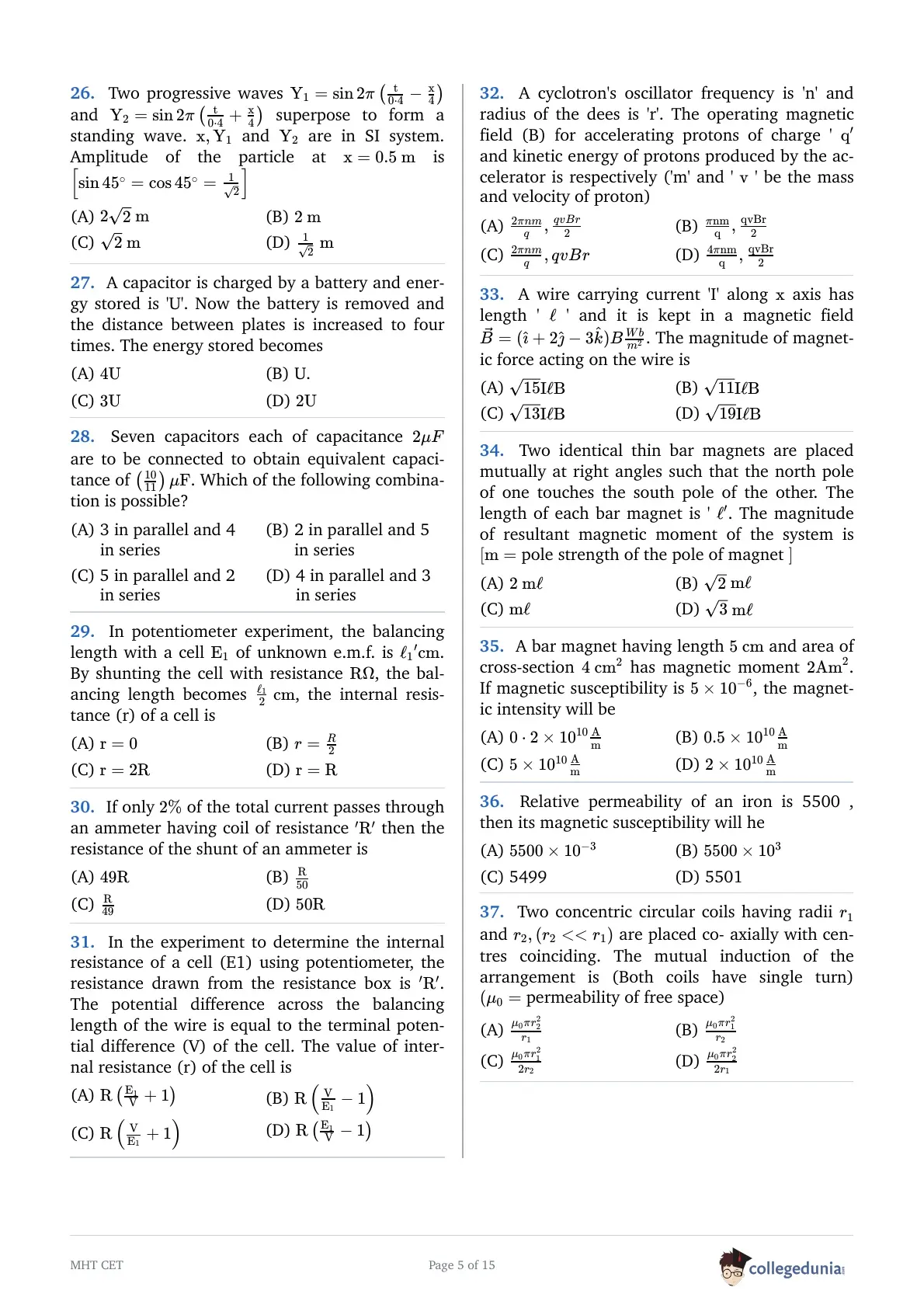
Two progressive waves \(\mathrm{Y}_{1}=\sin 2\pi \left(\frac{\mathrm{t}}{0\cdot 4}-\frac{\mathrm{x}}{4}\right)\) and \(\mathrm{Y}_{2}=\sin 2\pi \left(\frac{\mathrm{t}}{0\cdot 4}+\frac{\mathrm{x}}{4}\right)\) superpose to form a standing wave. \(\mathrm{x},\mathrm{Y}_{1}\) and \(\mathrm{Y}_{2}\) are in SI system. Amplitude of the particle at \(\mathrm{x}=0.5\ \mathrm{m}\) is \(\left[\sin 45^{\circ }=\cos 45^{\circ }=\frac{1}{\sqrt{2}}\right]\)
A capacitor is charged by a battery and energy stored is \(U\). Now the battery is removed and the distance between plates is increased to four times. The energy stored becomes
Seven capacitors each of capacitance \(2\mu F\) are to be connected to obtain equivalent capacitance of \(\left(\frac{10}{11}\right)\mu \mathrm{F}\). Which of the following combination is possible?
In potentiometer experiment, the balancing length with a cell \(E_1\) of unknown e.m.f. is \(\ell_1\) cm. By shunting the cell with resistance \(R\), the balancing length becomes \(\ell_2\) cm, the internal resistance \(r\) of a cell is
If only \(2%\) of the total current passes through an ammeter having coil of resistance \(R\), then the resistance of the shunt of an ammeter is
In the experiment to determine the internal resistance of a cell (\(E_1\)) using potentiometer, the resistance drawn from the resistance box is \(R\). The potential difference across the balancing length of the wire is equal to the terminal potential difference \((V)\) of the cell. The value of internal resistance \((r)\) of the cell is
A cyclotron’s oscillator frequency is \(n\) and radius of the dees is \(r\). The operating magnetic field \((B)\) for accelerating protons of charge \(q\) and kinetic energy of protons produced by the accelerator is respectively (\(m\) and \(v\) be the mass and velocity of proton)
A wire carrying current 'I' along \(\mathrm{x}\) axis has length ' \(\ell\) ' and it is kept in a magnetic field \(\vec{B}=(\hat{\imath}+2\hat{\jmath}-3\hat{k})B\frac{Wb}{m^{2}}\). The magnitude of magnetic force acting on the wire is
Two identical thin bar magnets are placed mutually at right angles such that the north pole of one touches the south pole of the other. The length of each bar magnet is \(\ell\). The magnitude of resultant magnetic moment of the system is
\(\left[m = \text{pole strength of the magnet}\right]\)
A bar magnet having length \(5\ \mathrm{cm}\) and area of cross-section \(4\ \mathrm{cm}^{2}\) has magnetic moment \(2\mathrm{Am}^{2}\). If magnetic susceptibility is \(5\times 10^{-6}\), the magnetic intensity will be
Relative permeability of an iron is \(5500\), then its magnetic susceptibility will be
Two concentric circular coils having radii \(r_1\) and \(r_2\) \((r_2 \ll r_1)\) are placed co-axially with centres coinciding. The mutual induction of the arrangement is (Both coils have single turn, \(\mu_0\) = permeability of free space)
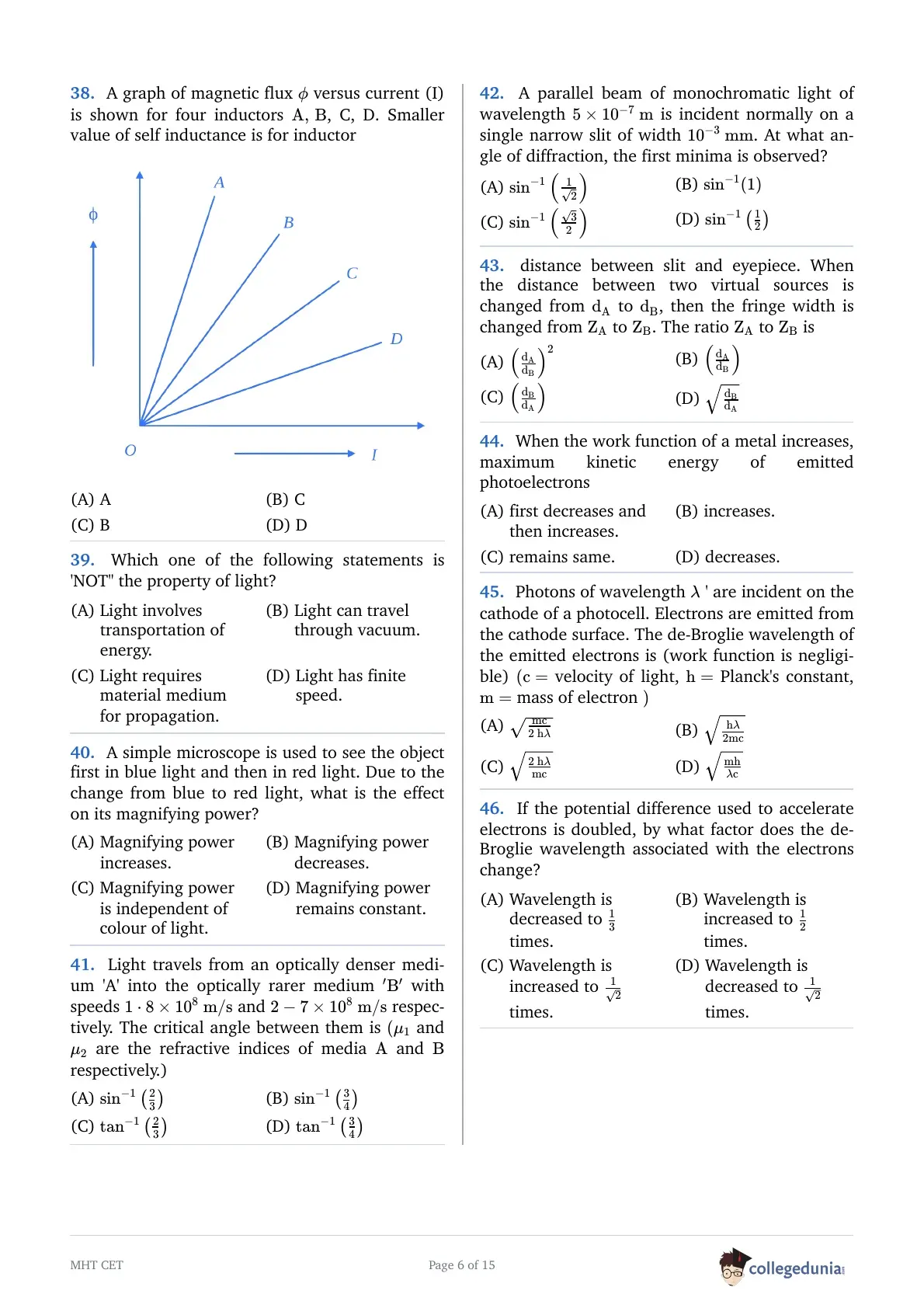
A graph of magnetic flux \(\phi\) versus current \((I)\) is shown for four inductors A, B, C, D. Smaller value of self inductance is for inductor

Which one of the following statements is NOT the property of light?
A simple microscope is used to see the object first in blue light and then in red light. Due to the change from blue to red light, what is the effect on its magnifying power?
Light travels from an optically denser medium 'A' into the optically rarer medium \({}'\mathrm{B}'\) with speeds \(1\cdot 8\times 10^{8}\ \mathrm{m}/\mathrm{s}\) and \(2-7\times 10^{8}\ \mathrm{m}/\mathrm{s}\) respectively. The critical angle between them is \((\mu _{1}\) and \(\mu _{2}\) are the refractive indices of media \(\mathrm{A}\) and \(\mathrm{B}\) respectively.)
A parallel beam of monochromatic light of wavelength \(5\times 10^{-7}\ \mathrm{m}\) is incident normally on a single narrow slit of width \(10^{-3}\ \mathrm{mm}\). At what angle of diffraction, the first minima is observed?
In biprism experiment, a source of monochromatic light is used for a certain distance between slit and eyepiece. When the distance between two virtual sources is changed from \(d_A\) to \(d_B\), then the fringe width is changed from \(Z_A\) to \(Z_B\). The ratio \(Z_A\) to \(Z_B\) is
When the work function of a metal increases, maximum kinetic energy of emitted photoelectrons
Photons of wavelength \(\lambda\) are incident on the cathode of a photocell. Electrons are emitted from the cathode surface. The de-Broglie wavelength of the emitted electrons (work function is negligible) is
\(\left(c = \text{velocity of light},\; h = \text{Planck’s constant},\; m = \text{mass of electron}\right)\)
If the potential difference used to accelerate electrons is doubled, by what factor does the de-Broglie wavelength associated with the electrons change?
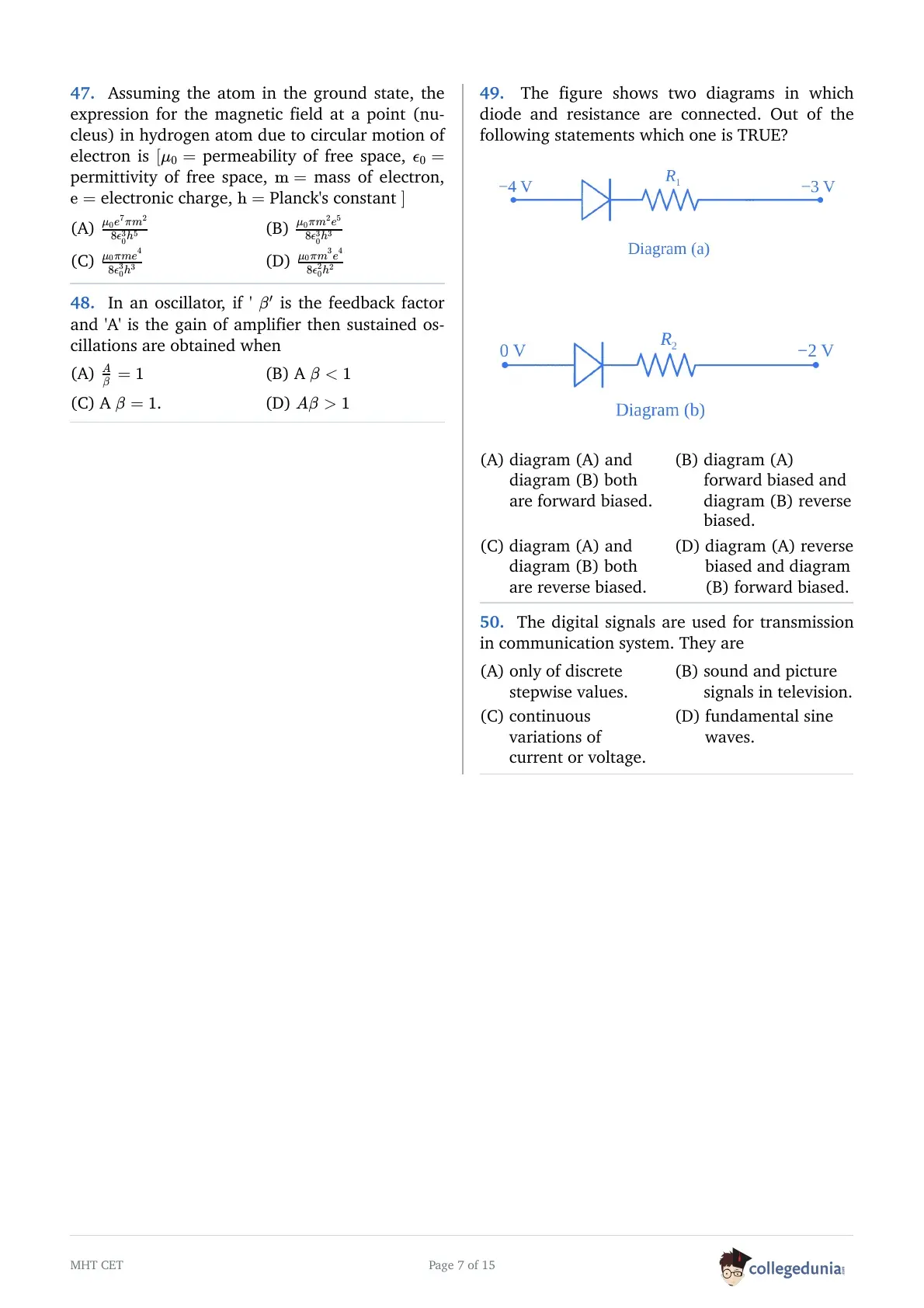
Assuming the atom in the ground state, the expression for the magnetic field at a point (nucleus) in hydrogen atom due to circular motion of electron is \([\mu _{0}=\) permeability of free space, \(\epsilon _{0}=\) permittivity of free space, \(\mathrm{m}=\) mass of electron, \(\mathrm{e}=\) electronic charge, \(\mathrm{h}=\) Planck's constant \(]\)
In an oscillator, if \(A\) is the feedback factor and \(A'\) is the gain of amplifier, then sustained oscillations are obtained when
The figure shows two diagrams in which diode and resistance are connected. Out of the following statements which one is TRUE?

The digital signals are used for transmission in communication system. They are
Chemistry (Q51 - Q100)
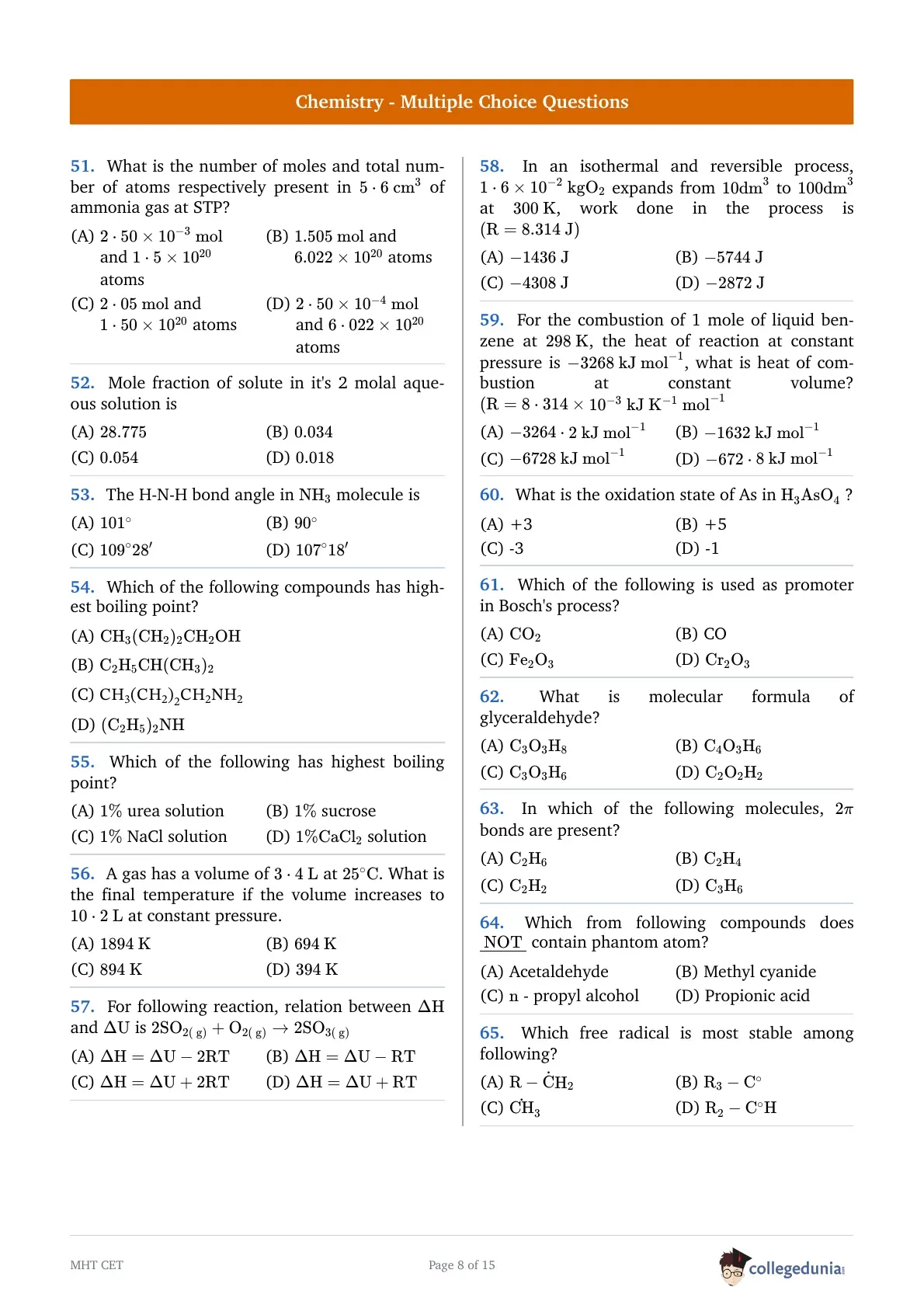
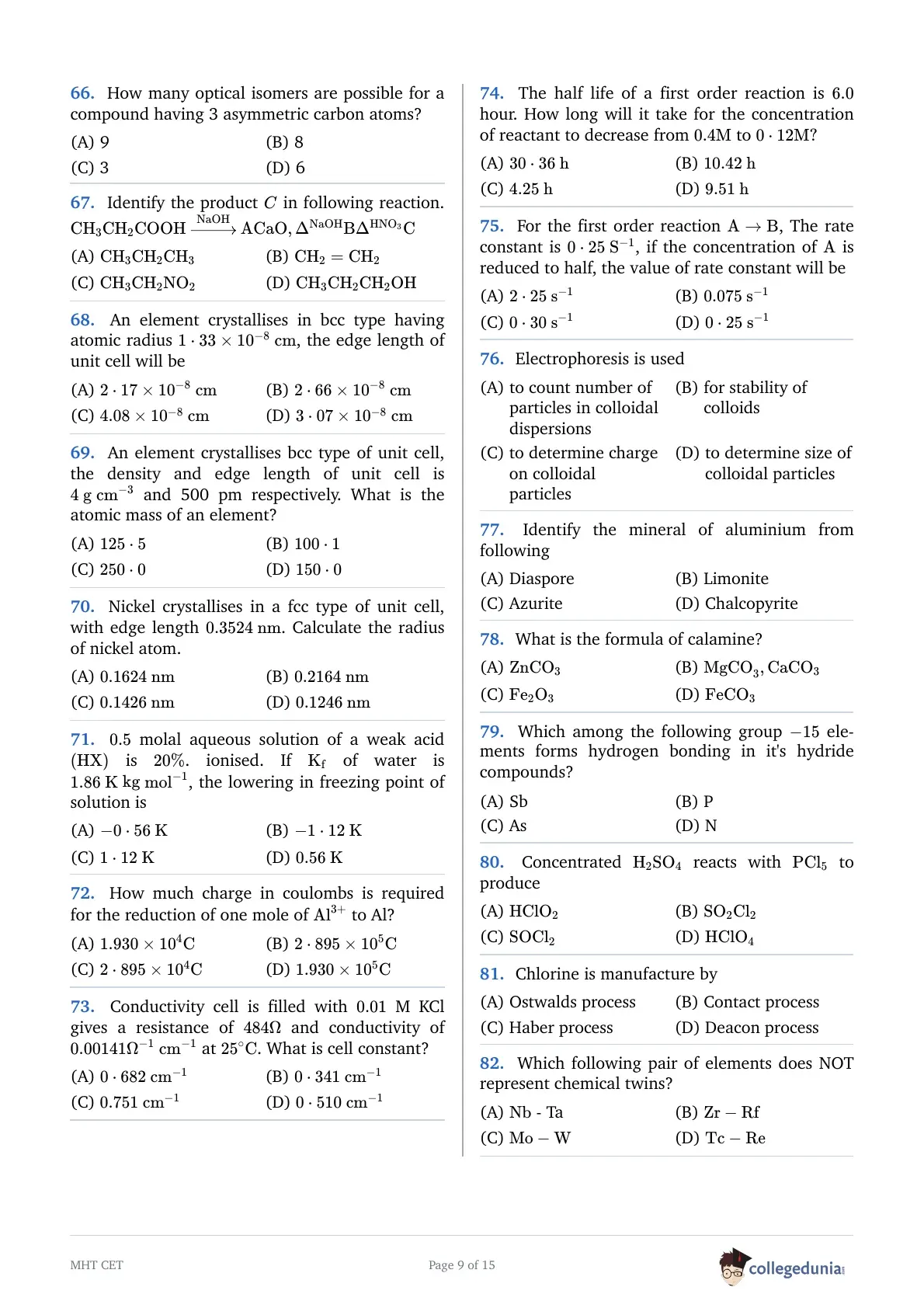
What is the number of moles and total number of atoms respectively present in 5.6 cm\(^3\) of ammonia gas at STP?
Mole fraction of solute in its 2 molal aqueous solution is
The H-N-H bond angle in NH\(_3\) molecule is
Which of the following compounds has the highest boiling point?
A gas has a volume of 3.4 L at 25°C. What is the final temperature if the volume increases to 10 L at constant pressure?
For following reaction, relation between \(\Delta \mathrm{H}\) and \(\Delta \mathrm{U}\) is \(2\mathrm{SO}_{2(\ \mathrm{g})}+\mathrm{O}_{2(\ \mathrm{g})}\rightarrow 2\mathrm{SO}_{3(\ \mathrm{g})}\)
In an isothermal and reversible process, \(1.6 \times 10^{-2}\) kg O\(_2\) expands from 10 dm\(^3\) to 100 dm\(^3\) at 300 K, work done in the process is (R = 8.314 J/mol·K)
For the combustion of 1 mole of liquid benzene at 298K, the heat of reaction at constant pressure is -3268 kJ mol\(^{-1}\), what is the heat of combustion at constant volume?
What is the oxidation state of As in H\(_3\)AsO\(_4\)?
Which of the following is used as a promoter in Bosch’s process?
What is the molecular formula of glyceraldehyde?
In which of the following molecules, 2\(\pi\) bonds are present?
Which from the following compounds does NOT contain phantom atom?
Which free radical is most stable among the following?
How many optical isomers are possible for a compound having 3 asymmetric carbon atoms?
Identify the product \(C\) in following reaction. \(\mathrm{CH}_{3}\mathrm{CH}_{2}\mathrm{COOH}\xrightarrow{\mathrm{NaOH}}\mathrm{A}\mathrm{CaO},\Delta ^{\mathrm{NaOH}}\mathrm{B}\Delta ^{\mathrm{HNO}_{3}}\mathrm{C}\)
An element crystallizes in bcc type of unit cell having atomic radius \( 1.33 \times 10^{-8} \) cm, the edge length of unit cell will be
An element crystallizes in bcc type of unit cell, the density and edge length of unit cell is 4 g cm\(^{-3}\) and 500 pm respectively. What is the atomic mass of an element?
Nickel crystallises in a fcc type of unit cell, with edge length 0.3524 nm. Calculate the radius of the nickel atom.
How much charge in coulombs is required for the reduction of one mole of Al\(^{3+}\) to Al?
Conductivity cell is filled with 0.01 M KCl gives a resistance of 484\(\Omega\) and conductivity of 0.004141 \(\Omega\)\(^{-1}\) cm\(^{-1}\) at 25°C. What is the cell constant?
The half life of a first order reaction is 6.0 hours. How long will it take for the concentration of reactant to decrease from 0.4 M to 0.12 M?
For the first order reaction A → B, the rate constant is 0.25 s\(^{-1}\), if the concentration of A is reduced to half, the value of the rate constant will be
Electrophoresis is used .......
Identify the mineral of aluminium from following.
What is the formula of calamine?
Which among the following group -15 elements forms hydrogen bonding in its hydride compounds?
Concentrated H\(_2\)SO\(_4\) reacts with PCl\(_5\) to produce
Chlorine is manufactured by
Which following pair of elements does NOT represent chemical twins?
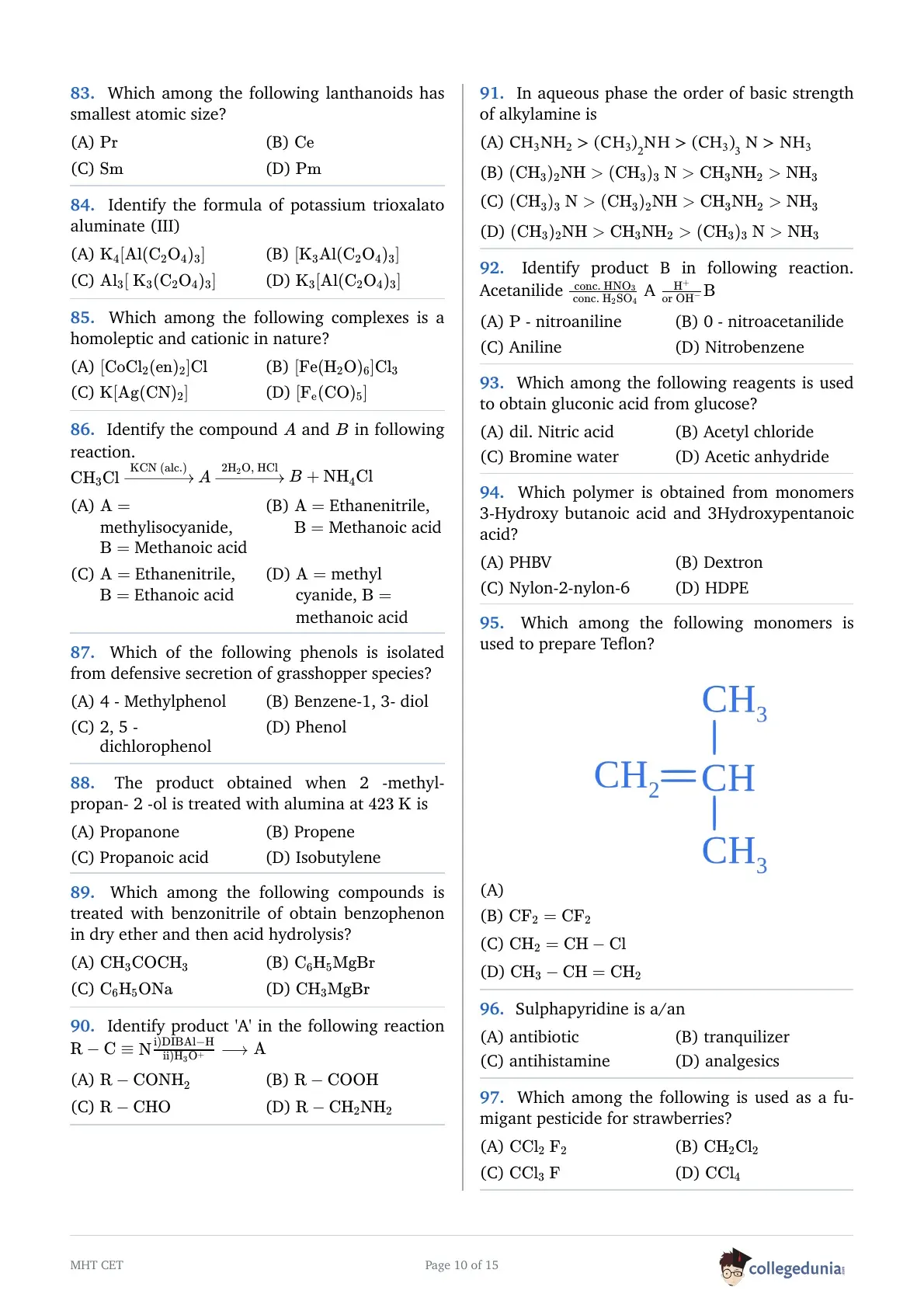
Which among the following lanthanoids has the smallest atomic size?
Identify the formula of potassium trioxalato aluminate (III).
Which among the following complexes is a homoleptic and cationic in nature?
Identify the compound \(A\) and \(B\) in following reaction.
\(\mathrm{CH_3Cl}\xrightarrow{\mathrm{KCN\ (alc.)}}A\xrightarrow{\mathrm{2H_2O,\ HCl}}B+\mathrm{NH_4Cl}\)
Which of the following phenols is isolated from defensive secretion of grasshopper species?
The product obtained when 2-methylpropan-2-ol is treated with alumina at 423 K is
Which among the following compounds is treated with benzonitrile to obtain benzophenone in dry ether and then acid hydrolysis?
Identify product 'A' in the following reaction \(\mathrm{R}-\mathrm{C}\equiv \mathrm{N}\frac{\mathrm{i})\mathrm{DIBAl}-\mathrm{H}}{\mathrm{ii})\mathrm{H}_{3}\mathrm{O}^{+}}\longrightarrow \mathrm{A}\)
In aqueous phase the order of basic strength of alkylamine is
Identify product B in following reaction. Acetanilide \(\frac{\text{ conc. }\mathrm{HNO}_{3}}{\text{ conc. }\mathrm{H}_{2}\mathrm{SO}_{4}}\) A \(\frac{\mathrm{H}^{+}}{\text{or }\mathrm{OH}^{-}}\mathrm{B}\)
Which among the following reagents is used to obtain gluconic acid from glucose?
Which polymer is obtained from monomers 3-Hydroxy butanoic acid and 3-Hydroxy pentanoic acid?
Which among the following monomers is used to prepare Teflon?
Sulphapyridine is a/an
Which among the following is used as a fumigant pesticide for strawberries?
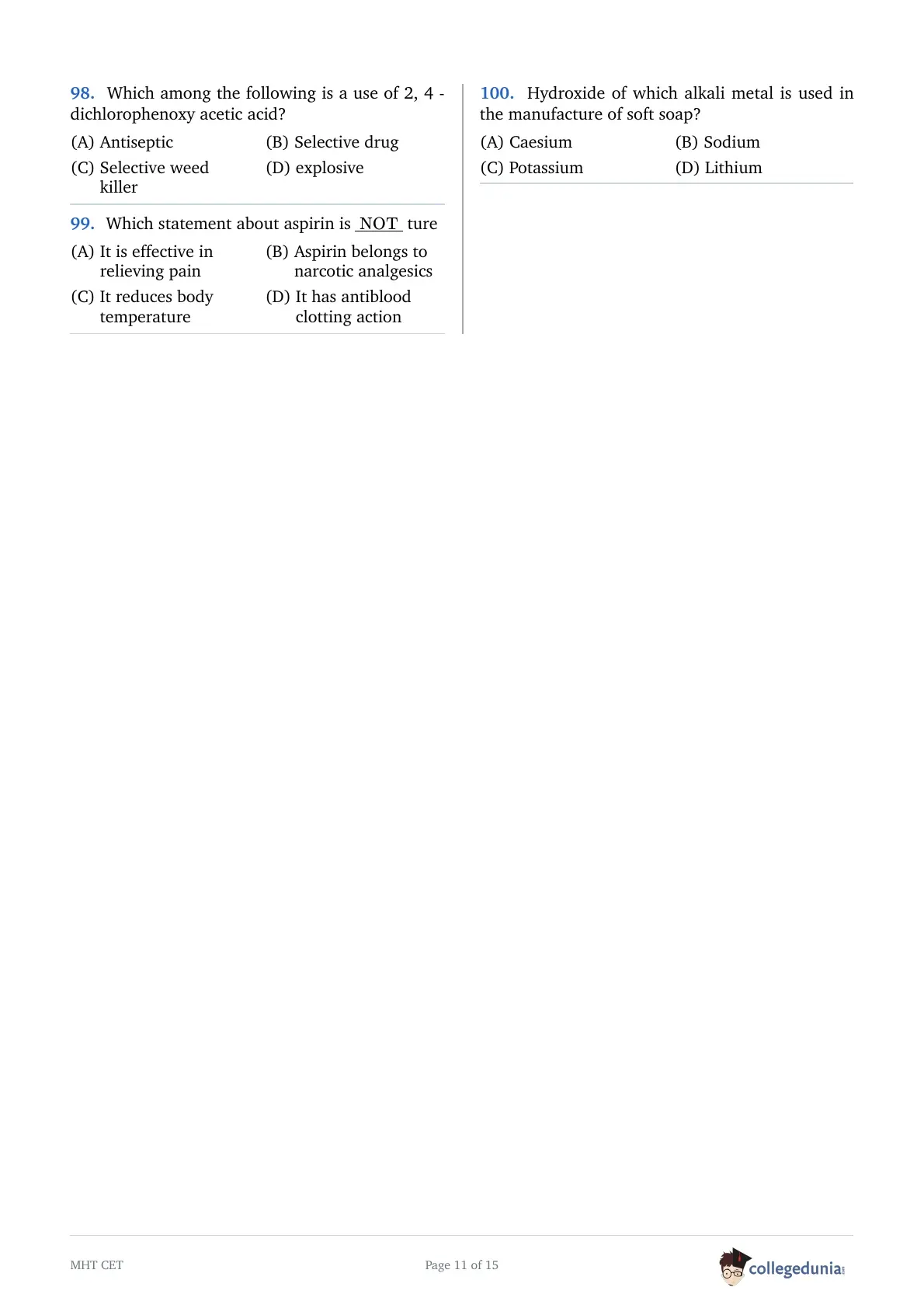
Which among the following is a use of 2, 4-dichlorophenoxy acetic acid?
Which statement about aspirin is NOT true?
Hydroxide of which alkali metal is used in the manufacture of soft soap?
Mathematics (Q101 - Q150)
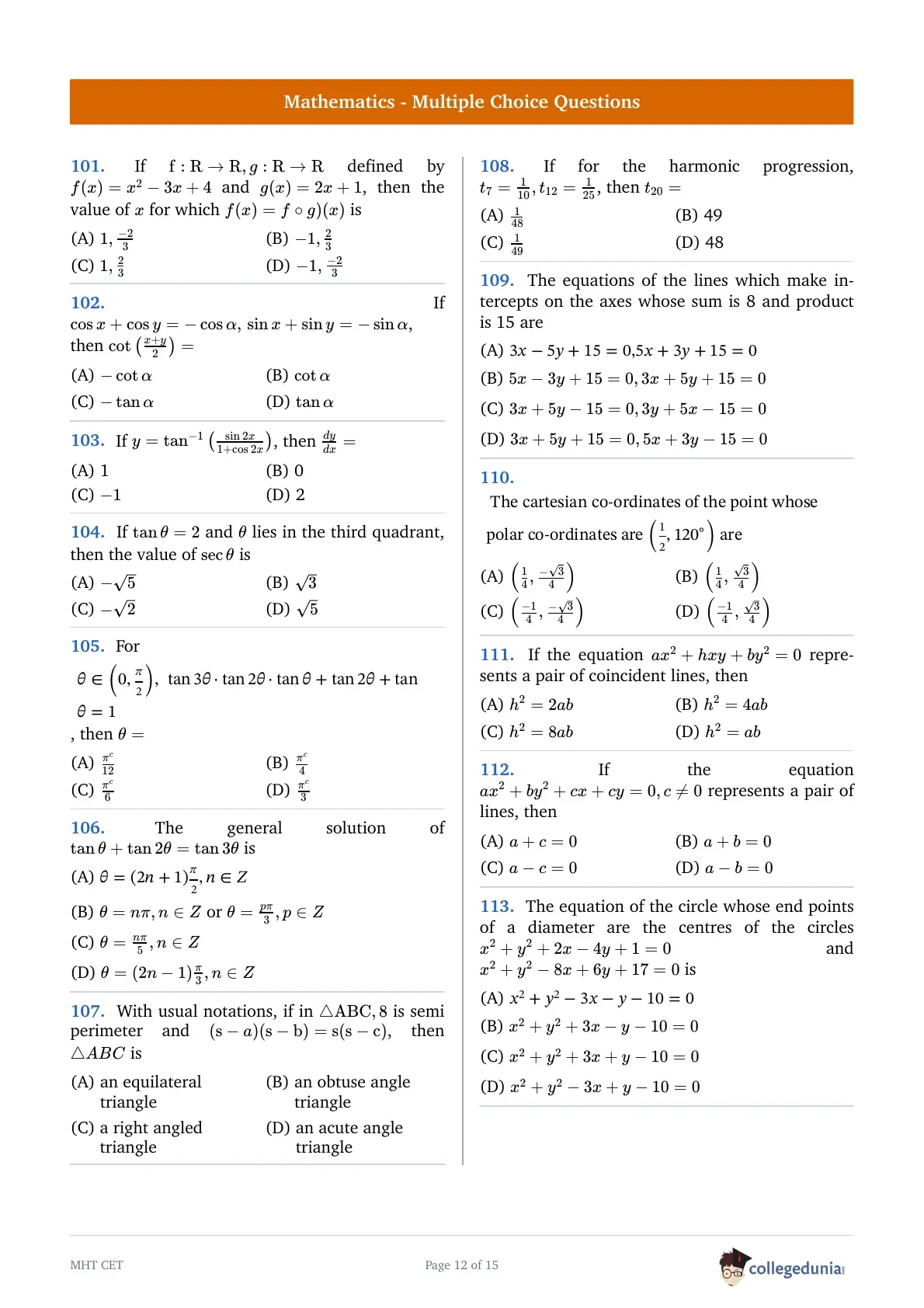
If \(\mathrm{f}:\mathrm{R}\rightarrow \mathrm{R},g:\mathrm{R}\rightarrow \mathrm{R}\) defined by \(f(x)=x^{2}-3x+4\) and \(g(x)=2x+1\), then the value of \(x\) for which \(f(x)=f\circ g)(x)\) is
If \(\cos x+\cos y=-\cos \alpha ,\,\sin x+\sin y=-\sin \alpha\), then \(\cot \left(\frac{x+y}{2}\right)=\)
If \(y=\tan ^{-1}\left(\frac{\sin 2x}{1+\cos 2x}\right)\), then \(\frac{dy}{dx}=\)
If \( \tan \theta = 2 \) and \( \theta \) lies in the third quadrant, then the value of \( \sec \theta \) is
For \( \theta \in \left( 0, \frac{\pi}{2} \right) \), if \( \tan 3\theta \cdot \tan 2\theta \cdot \tan \theta + \tan 2\theta + \tan \theta = 1 \), then \( \theta = \)
The general solution of \( \tan \theta + \tan 2\theta = \tan 3\theta \)
With usual notations, if in \( \triangle ABC \), \( s \) is the semi-perimeter and \( (s - a)(s - b) = (s - c) \), then \( \triangle ABC \) is
If for the harmonic progression,
\( t_7 = \frac{1}{10}, \, t_{12} = \frac{1}{25}, \) then \( t_{20} = \)
The equations of the lines which make intercepts on the axes whose sum is 8 and product is 15 are
\(\text{ The cartesian co-ordinates of the point whose polar co-ordinates are }\left(\frac{1}{2},120^{\circ }\right)\text{ are }\)
If the equation \(ax^{2}+hxy+by^{2}=0\) represents a pair of coincident lines, then
If the equation \( ax^2 + hy^2 + cx + cy = 0, c \neq 0 \) represents a pair of lines, then
The equation of the circle whose end points of a diameter are the centres of the circles \(x^{2}+y^{2}+2x-4y+1=0\) and \(x^{2}+y^{2}-8x+6y+17=0\) is
The focal distance of the point \( (4, 4) \) on the parabola with vertex at \( (0, 0) \) and symmetric about the y-axis is
The symbolic form of the following circuit is
(where \( p, q, r \) represent switches \( s_1, s_2, s_3 \) which are closed respectively)
If \(A=\{x/x\) is a prime number, \(0\leq x\leq 9]\), then the number of elements of power set of \(A\) is
The adjoint of the matrix \(A=\begin{bmatrix} 2 & -3 \\ 3 & 5 \end{bmatrix}\) is
If \(A=\begin{bmatrix} 2 & 0 & 0 \\ 0 & -2 & 0 \\ 0 & 0 & -1 \end{bmatrix}\), then \(A^{4}A^{-1}=\)
If \(f(x)=\left[\tan \left(\frac{\pi }{4}+x\right)\right]^{\frac{1}{x}}\) if \(x\neq 0\) \(=k\) if \(x=0\), is continuous at \(x=0\) then \(k=\)
If \(\tan u=\sqrt{\frac{1-x}{1+x}},\,\cos v=4x^{3}-3x\), then \(\frac{du}{dv}=\)
If \(y=\left(\frac{x^{2}}{x+1}\right)^{x}\) and \(\frac{dy}{dx}=y\left[g(x)+\log \left(\frac{x^{2}}{x+1}\right)\right]\), then \(g(x)=\)
The maximum value of the function \( \frac{\log x}{x}, x \neq 0 \) is
If the line \( 6x - y - 4 = 0 \) touches the curve \( y^2 = ax^3 + b \) at the point (1, 2), then \( a + b = \)
The approximate value of \( \cot^{-1} (1 \cdot 001) \) is
\(\int \frac{dx}{\sqrt{(x-1)(x-2)}}=\)
\(\int \left[\frac{(1+\log x)}{\cos ^{2}(x\log x)}\right]dx=\)
\(\int x^{3}\cdot e^{x^{2}}dx=\)
\(\int _{0}^{\frac{\pi }{2}}\frac{\sqrt[3]{\sec x}}{\sqrt[3]{\sec x}+\sqrt[3]{\operatorname{cosec} x}}dx=\)
\(\int _{0}^{\frac{\pi }{2}}\frac{1-\cot x}{\operatorname{cosec} x+\cos x}dx=\)
\(\int _{0}^{\frac{\pi }{4}}\frac{\sin x+\cos x}{9+16\,\sin 2x}dx=k\log 3\), then \(k=\)
The area of the region bounded by the curve \( y = 4x - x^2 \) and the x-axis is
\(\tan ^{-1}x+\tan ^{-1}y=c\) is the general solution of the differential equation
The solution of \( rdx + (x - r^2) dr = 0 \) is
A metal has half-life period of 10 days. A sample originally has a mass of 1000 mg, then the mass remaining after 50 days is
The particular solution of the differential equation \( x \, dy + 2y \, dx = 0 \), when \( x = 2 \) and \( y = 1 \) is
If the population grows at the rate of 5% per year, the time taken for the population to become double is (Given \( \log 2 = 0.6912 \))
If the vectors \( \hat{i} + 2\hat{j} + \hat{k} \) and \( \hat{i} + 6\hat{j} + 4\hat{k} \) are collinear, then the values of \( x \) and \( y \) are respectively
If \(\bar{a}=2i+3j-\hat{k},\bar{b}=-i+2j-4\hat{k}\) and \(\bar{c}=i+j+\hat{k}\), then \((\bar{a}\times \bar{b})\cdot (\bar{a}\times \bar{c})=\)
The equation of a line passing through the point \( (2, 4, 6) \) and parallel to the line
\[
3x + 4 = 4y - 1 = 1 - 4z
\]
is
The equation of the plane passing through the points \( (2, 3, 1), (4, -5, 3) \) and parallel to the y-axis is
The direction cosines of a line which makes equal acute angles with the co-ordinate axes are
If the lines \(\frac{x-1}{5}=\frac{y+1}{3}=\frac{3-z}{\lambda }\) and \(\frac{x+1}{4}=\frac{1-3y}{15}=z+1\) are perpendicular to each other, then \(\lambda =\)
The foot of the perpendicular drawn from the origin to the plane \( x + y + 3z - 4 = 0 \) is
For the following shaded region, the linear constraints are:
If \( A \) and \( B \) are independent events such that odds in favour of \( A \) is 2:3 and odds against \( B \) is 4:5, then \( P(A \cap B) = \)
If \(\mu\) and \(\sigma^{2}\) are mean and variance of a random variable \(X\) whose p. \(m.f\). is given by \(P(X=x)=\begin{pmatrix} 6 \\ x \end{pmatrix}\left(\frac{1}{3}\right)^{x}\left(\frac{2}{3}\right)^{6-x},x=0,1,2,3,\ldots \ldots 6\), then the value of \(2\mu +12\sigma ^{2}=\)
If the p. m. f. of a random variable \(\mathrm{X}\) is \(\begin{array}{|c|c|c|c|c|c|} \hline \mathrm{X} & 1 & 2 & 3 & 4 & 5 \\ \hline \mathrm{P}(\mathrm{X}=x) & k & \frac{k}{3} & \frac{k}{4} & \frac{k}{2} & \frac{k}{2} \\ \hline \end{array}\) then \(k=\)
If the probability density function of a continuous random variable is \(f(x)=\frac{x^{3}}{3}\) if \(-1\lt x\lt 2\) \(=0\), otherwise, then the cumulative distribution function of \(X\) is
MHT CET 2020 PCM Exam Pattern and Marking Scheme
| Parameter | Details |
|---|---|
| Conducting Body | Maharashtra Common Entrance Test Cell (Maharashtra CET Cell) |
| Exam Mode | Online (Computer-Based Test) |
| Duration | 180 minutes (3 hours) |
| Groups / Subjects | PCM (Physics, Chemistry, Mathematics) for Engineering |
| Total Questions |
150 |
| Total Marks | 200 |
| Question Type | Multiple Choice Questions (MCQs) |
| Marks Distribution |
|
| Negative Marking | No |
| Syllabus Weightage |
|



Comments