




MHT CET 2020 Oct 14 Shift 1 PCM Question Paper is available for download here. Maharashtra State CET Cell conducted MHT CET 2020 PCM Exam on Oct 14 in Shift 1 from 9 AM to 12 PM in CBT mode.
The MHT CET 2020 PCM question paper includes the following:
- The MHT CET 2020 PCM Question Paper consists of 150 multiple-choice questions (MCQs) totalling 200 marks divided into 3 sections: Physics, Chemistry, and Mathematics, with 50 questions in each subject.
- Physics and Chemistry questions carry 1 mark each while Mathematics questions carry 2 marks each.
- There is no negative marking for incorrect answers.
MHT CET 2020 Oct 14 Shift 1 PCM Question Paper with Solution PDF
| CD PDF | CD PDF with Solutions |
|---|---|
| Download Collegedunia PDF 0.80 MB | - |
Also Check:
MHT CET 2020 Oct 14 Shift 1 PCM Questions with Solutions
Physics (Q1 - Q50)
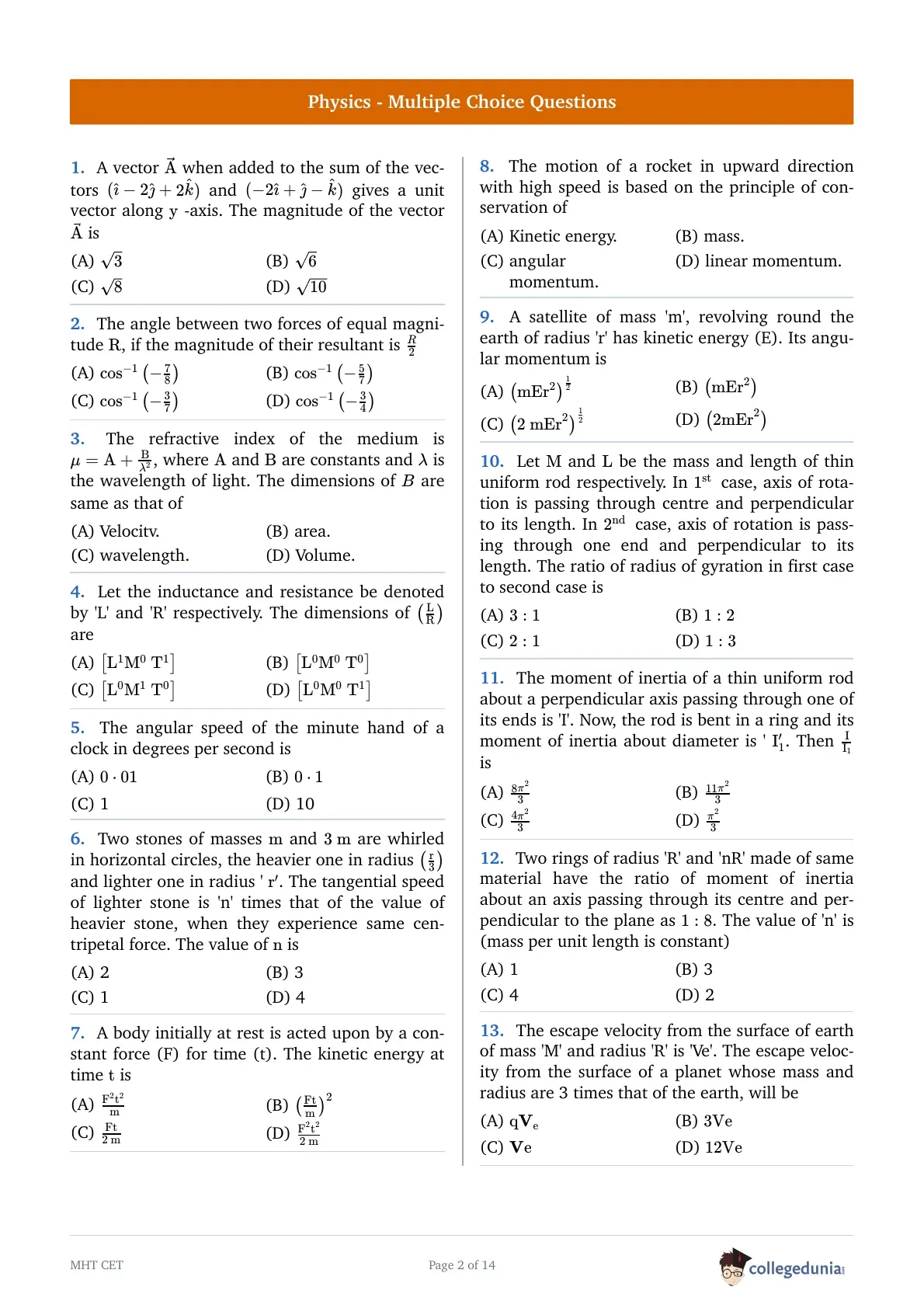
A vector \( \vec{A} \) when added to the sum of the vectors \( (\hat{i}-2\hat{j}+2\hat{k}) \) and \( (-2\hat{i}+\hat{j}-\hat{k}) \) gives a unit vector along y-axis. The magnitude of vector \( \vec{A} \) is
The angle between two forces of equal magnitude \( R \), if the magnitude of their resultant is \( \dfrac{R}{2} \), is
The refractive index of a medium is \( \mu = A + \dfrac{B}{\lambda^2} \), where \( A \) and \( B \) are constants and \( \lambda \) is the wavelength of light. The dimensions of \( B \) are same as that of
Let the inductance and resistance be denoted by \( L \) and \( R \) respectively. The dimensions of \( \left(\dfrac{L}{R}\right) \) are
The angular speed of the minute hand of a clock in degrees per second is
Two stones of masses \( m \) and \( 3m \) are whirled in horizontal circles, the heavier one in radius \( \dfrac{r}{3} \) and lighter one in radius \( r \). The tangential speed of lighter stone is \( n \) times that of the heavier stone when both experience the same centripetal force. The value of \( n \) is
A body initially at rest is acted upon by a constant force \( F \) for time \( t \). The kinetic energy at time \( t \) is
The motion of a rocket in upward direction with high speed is based on the principle of conservation of
A satellite of mass \( m \), revolving round the earth of radius \( r \), has kinetic energy \( E \). Its angular momentum is
Let \( M \) and \( L \) be the mass and length of a thin uniform rod respectively. In the first case, the axis of rotation passes through the centre and is perpendicular to its length. In the second case, the axis of rotation passes through one end and is perpendicular to its length. The ratio of radii of gyration in first case to second case is
The moment of inertia of a thin uniform rod about a perpendicular axis passing through one of its ends is \( I \). Now the rod is bent into a ring. Its moment of inertia about its diameter is
Two rings of radius \( R \) and \( nR \) made of the same material have the ratio of moment of inertia about an axis passing through their centre and perpendicular to the plane as \( 1 : 8 \). The value of \( n \) is (mass per unit length is constant).
The escape velocity from the surface of earth of mass \( M \) and radius \( R \) is \( V_e \). The escape velocity from the surface of a planet whose mass and radius are 3 times that of the earth will be
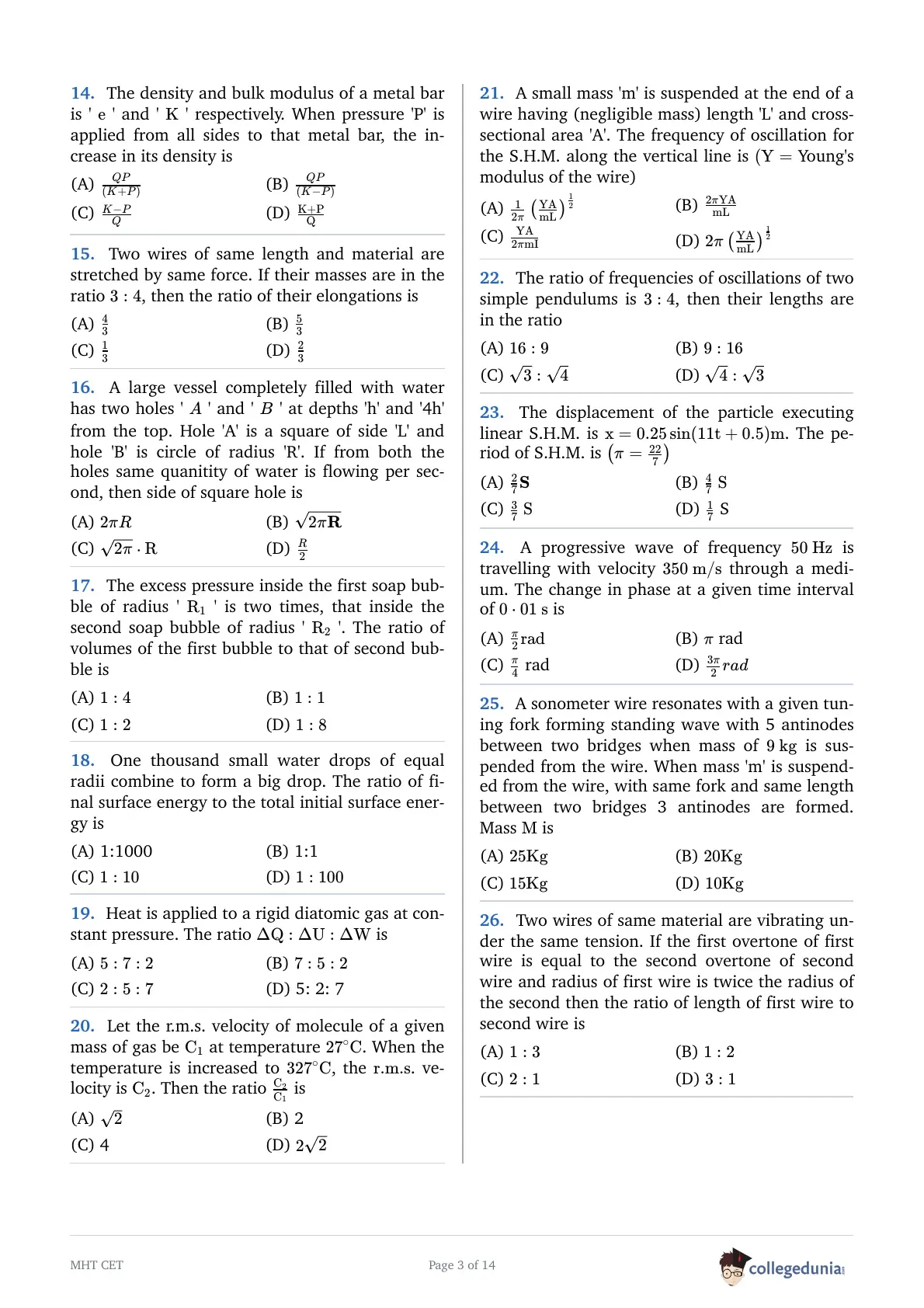
The density and bulk modulus of a metal bar is \( \rho \) and \( K \) respectively. When pressure \( P \) is applied from all sides to that metal bar, the increase in its density is
Two wires of same length and material are stretched by the same force. If their masses are in the ratio \( 3 : 4 \), then the ratio of their elongations is
A large vessel completely filled with water has two holes ‘A’ and ‘B’ at depths \( h \) and \( 4h \) from the top. Hole ‘A’ is a square of side \( L \) and hole ‘B’ is a circle of radius \( R \). If from both the holes same quantity of water is flowing per second, then side of square hole is
The excess pressure inside the first soap bubble of radius \( R_1 \) is two times that inside the second soap bubble of radius \( R_2 \). The ratio of volumes of the first bubble to that of the second bubble is
One thousand small water drops of equal radii combine to form a big drop. The ratio of final surface energy to the total initial surface energy is
Heat is applied to a rigid diatomic gas at constant pressure. The ratio \( \Delta Q : \Delta U : \Delta W \) is
Let the r.m.s. velocity of molecules of a given mass of gas be \( C_1 \) at temperature \( 27^\circ\text{C} \). When the temperature is increased to \( 327^\circ\text{C} \), the r.m.s. velocity is \( C_2 \). Then the ratio \( \dfrac{C_2}{C_1} \) is
A small mass \( m \) is suspended at the end of a wire having negligible mass, length \( L \) and cross-sectional area \( A \). The frequency of oscillation for the S.H.M. along the vertical line is ( \( Y \) = Young’s modulus of the wire )
The ratio of frequencies of oscillations of two simple pendulums is \( 3:4 \). Their lengths are in the ratio
The displacement of a particle executing linear S.H.M. is \( x = 0.25 \sin (11t + 0.5) \) m. If \( \pi = \dfrac{22}{7} \), the period of S.H.M. is
A progressive wave of frequency \( 50\,\text{Hz} \) is travelling with velocity \( 350\,\text{m s}^{-1} \) through a medium. The change in phase at a given point in a time interval of \( 0.01\,\text{s} \) is
A sonometer wire resonates with a given tuning fork forming standing waves with 5 antinodes when mass of 9 kg is suspended from the wire. When mass \( M \) is suspended from the wire with same fork and same length between two bridges, 3 antinodes are formed. The mass \( M \) is
Two wires of same material are vibrating under the same tension. If the first overtone of first wire is equal to the second overtone of second wire and radius of first wire is twice the radius of the second wire, then the ratio of length of first wire to second wire is
Two open organ pipes of fundamental frequencies \( n_1 \) and \( n_2 \) are joined in series. The fundamental frequency of the new pipe is
An air filled parallel plate capacitor has a uniform electric field 'E' in the space between the plates. If the distance between the plates is 'd' and area of each plate is ' \(A'\), the energy stored in the capacitor is \((\epsilon _{0}=\) permittivity of free space)
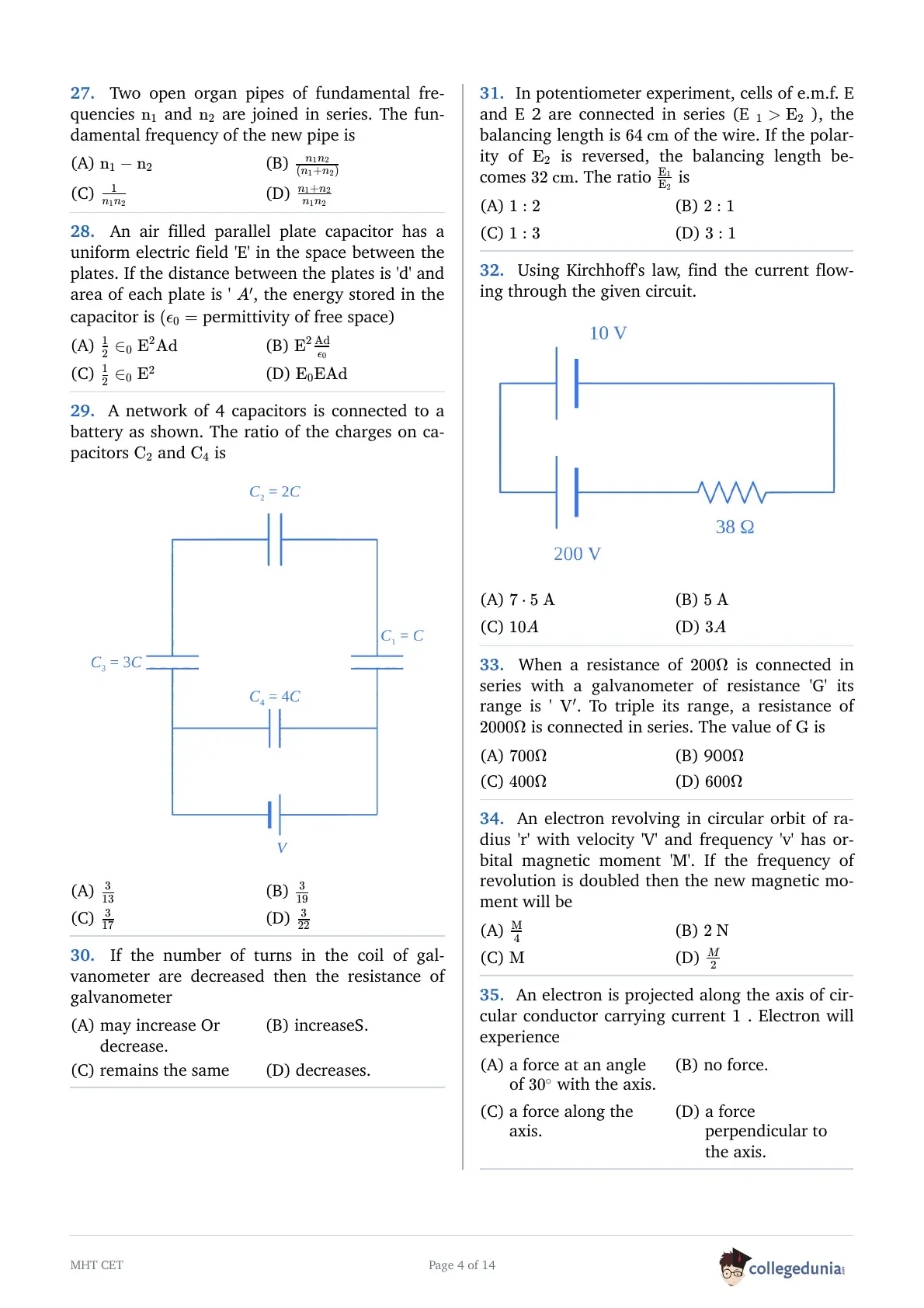
A network of four capacitors is connected to a battery as shown. The ratio of the charges on capacitors \( C_2 \) and \( C_4 \) is

If the number of turns in the coil of a galvanometer are decreased, then the resistance of galvanometer
In a potentiometer experiment, cells of e.m.f. \( E_1 \) and \( E_2 \) are connected in series (\( E_1>E_2 \)). The balancing length is 64 cm. If the polarity of \( E_2 \) is reversed, the balancing length becomes 32 cm. The ratio \( \dfrac{E_1}{E_2} \) is
Using Kirchhoff’s law, find the current flowing through the given circuit.

When a resistance of \( 200\Omega \) is connected in series with a galvanometer of resistance \( G \), its range is \( V \). To triple its range, a resistance of \( 2000\Omega \) is connected in series. The value of \( G \) is
An electron revolving in circular orbit of radius \( r \) with velocity \( v \) and frequency \( \nu \) has orbital magnetic moment \( M \). If the frequency of revolution is doubled, then the new magnetic moment will be
An electron is projected along the axis of a circular conductor carrying current \( I \). The electron will experience
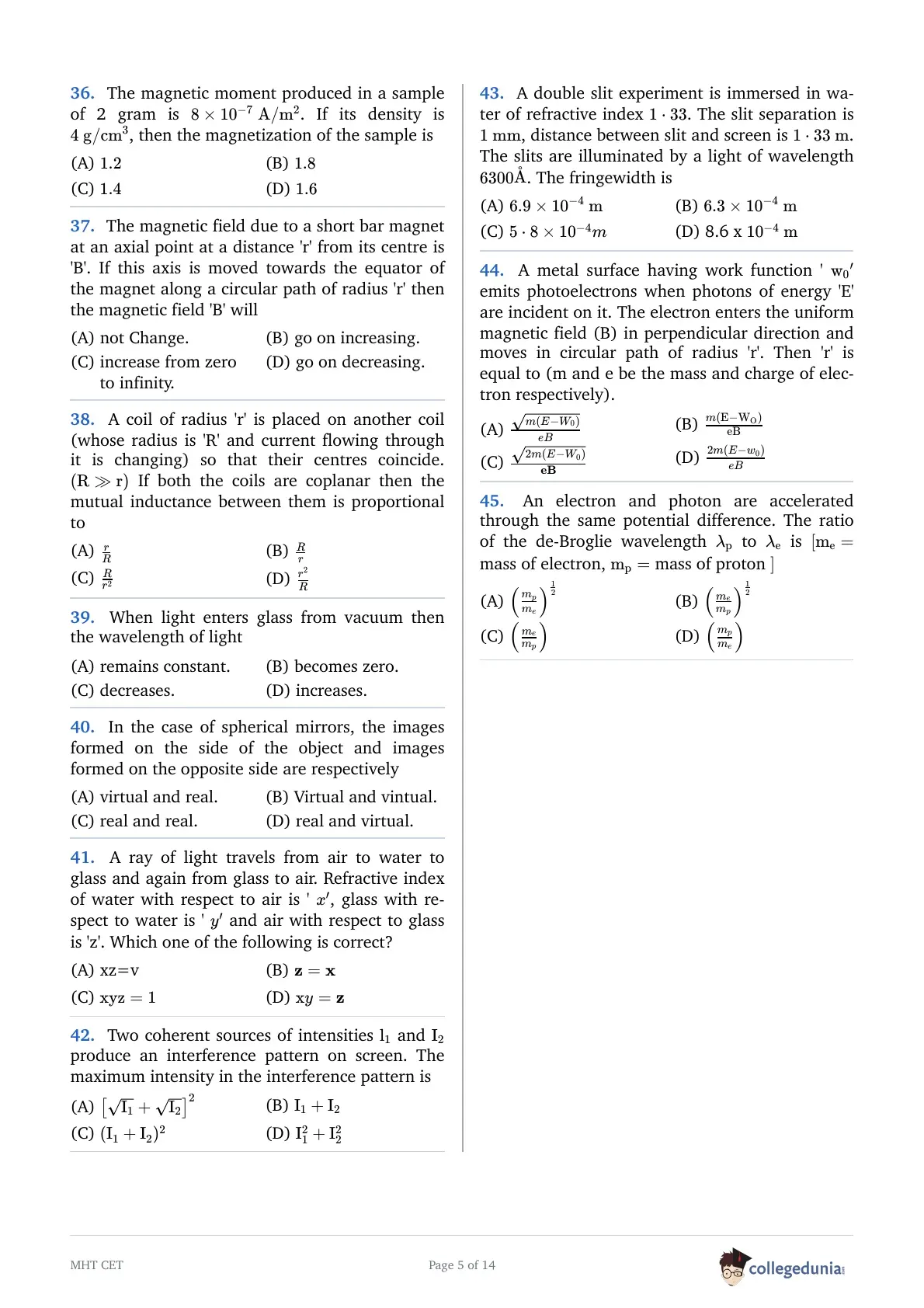
The magnetic moment produced in a sample of 2 grams is \( 8 \times 10^{-7} \,\text{A m}^2 \). If its density is \( 4\,\text{g cm}^{-3} \), then the magnetization of the sample is
The magnetic field due to a short bar magnet at an axial point at a distance \( r \) from its centre is \( B \). If this axis is moved towards the equator of the magnet along a circular path of radius \( r \), then the magnetic field \( B \) will
A coil of radius \( r \) is placed on another coil of radius \( R \) carrying a changing current such that their centres coincide. If both the coils are coplanar, the mutual inductance between them is proportional to
When light enters glass from vacuum then the wavelength of light
In the case of spherical mirrors, the images formed on the side of the object and images formed on the opposite side are respectively
A ray of light travels from air to water to glass and again from glass to air. Refractive index of water with respect to air is \( x \), glass with respect to water is \( y \) and air with respect to glass is \( z \). Which one of the following is correct?
Two coherent sources of intensities \( I_1 \) and \( I_2 \) produce an interference pattern on screen. The maximum intensity in the interference pattern is
A double slit experiment is immersed in water of refractive index \( 1.33 \). The slit separation is \( 1\,\text{mm} \), distance between slit and screen is \( 1.33\,\text{m} \). The slits are illuminated by light of wavelength \( 6300\,\text{\AA} \). The fringe width is
A metal surface having work function \( w_0 \) emits photoelectrons when photons of energy \( E \) are incident on it. The electron enters a uniform magnetic field \( B \) in perpendicular direction and moves in a circular path of radius \( r \). Then \( r \) is equal to ( \( m \) and \( e \) are the mass and charge of electron respectively)
An electron and proton are accelerated through the same potential difference. The ratio of their de-Broglie wavelengths \( \lambda_p \) to \( \lambda_e \) is (\( m_e \) = mass of electron, \( m_p \) = mass of proton)
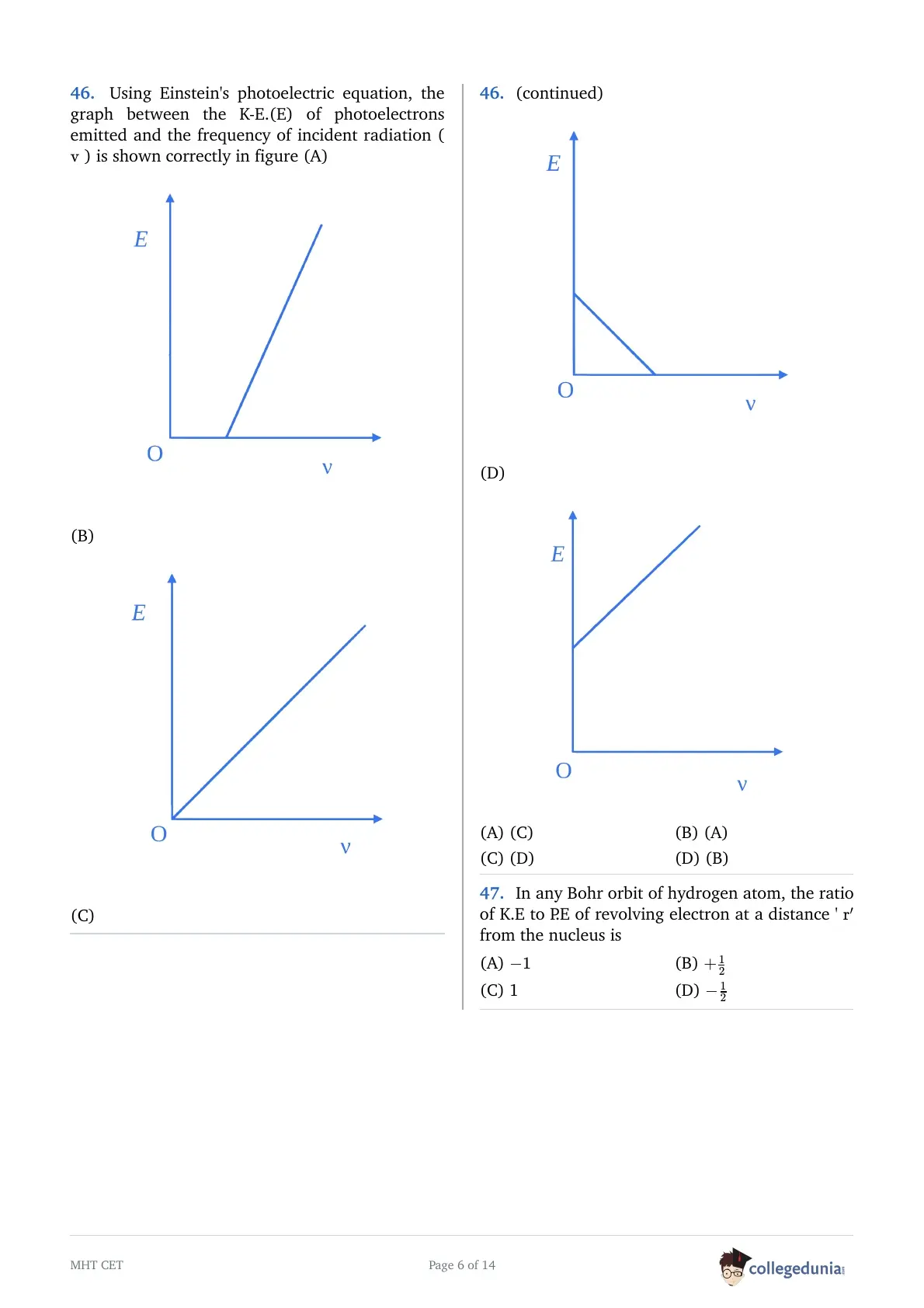
Using Einstein’s photoelectric equation, the graph between the kinetic energy \( E \) of photoelectrons emitted and the frequency \( \nu \) of incident radiation is shown correctly in figure

In any Bohr orbit of hydrogen atom, the ratio of kinetic energy to potential energy of revolving electron at a distance \( r \) from the nucleus is

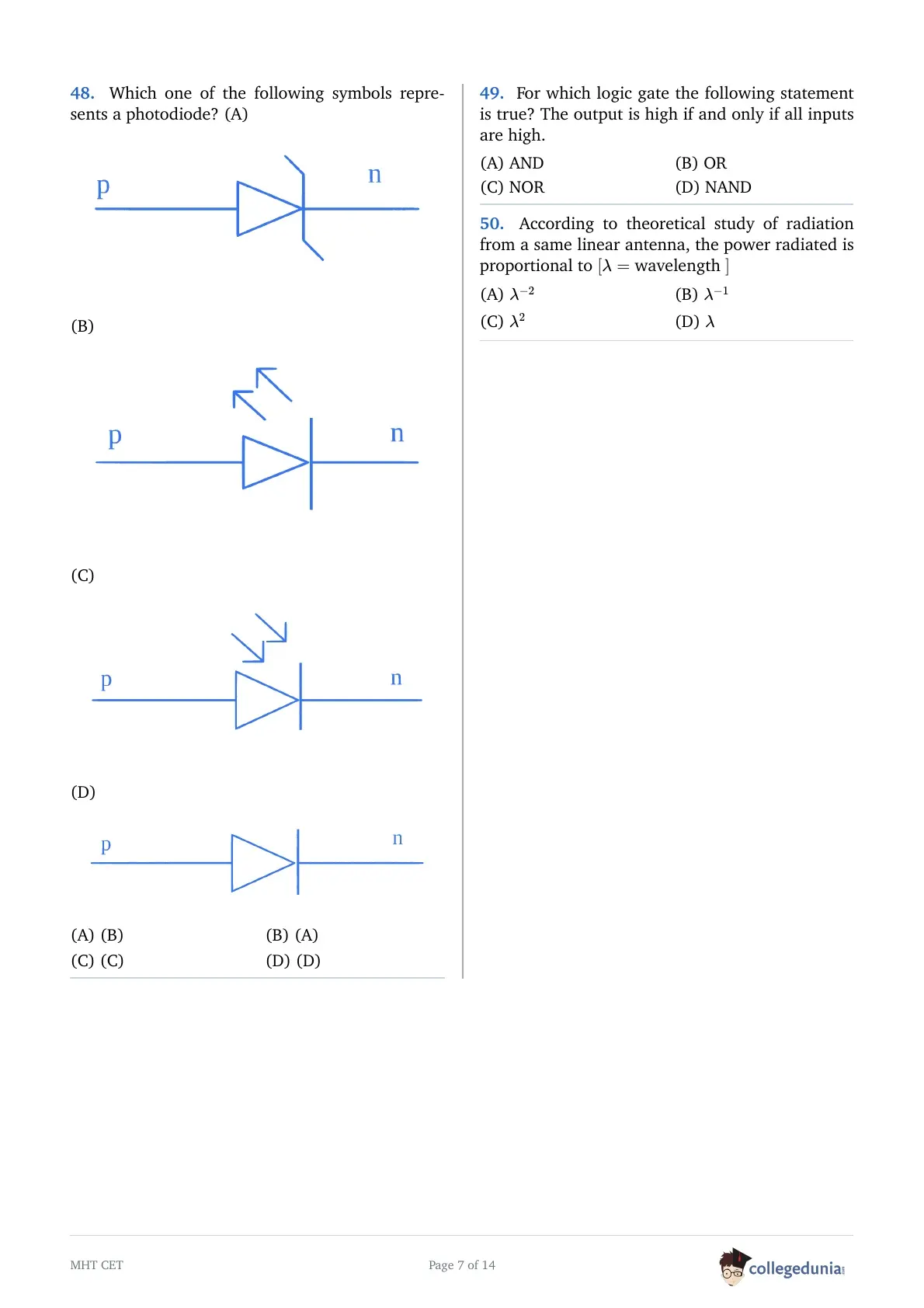
For which logic gate is the following statement true? The output is high if and only if all inputs are high.
According to theoretical study of radiation from the same linear antenna, the power radiated is proportional to ( \( \lambda \) = wavelength )
Chemistry (Q51 - Q100)
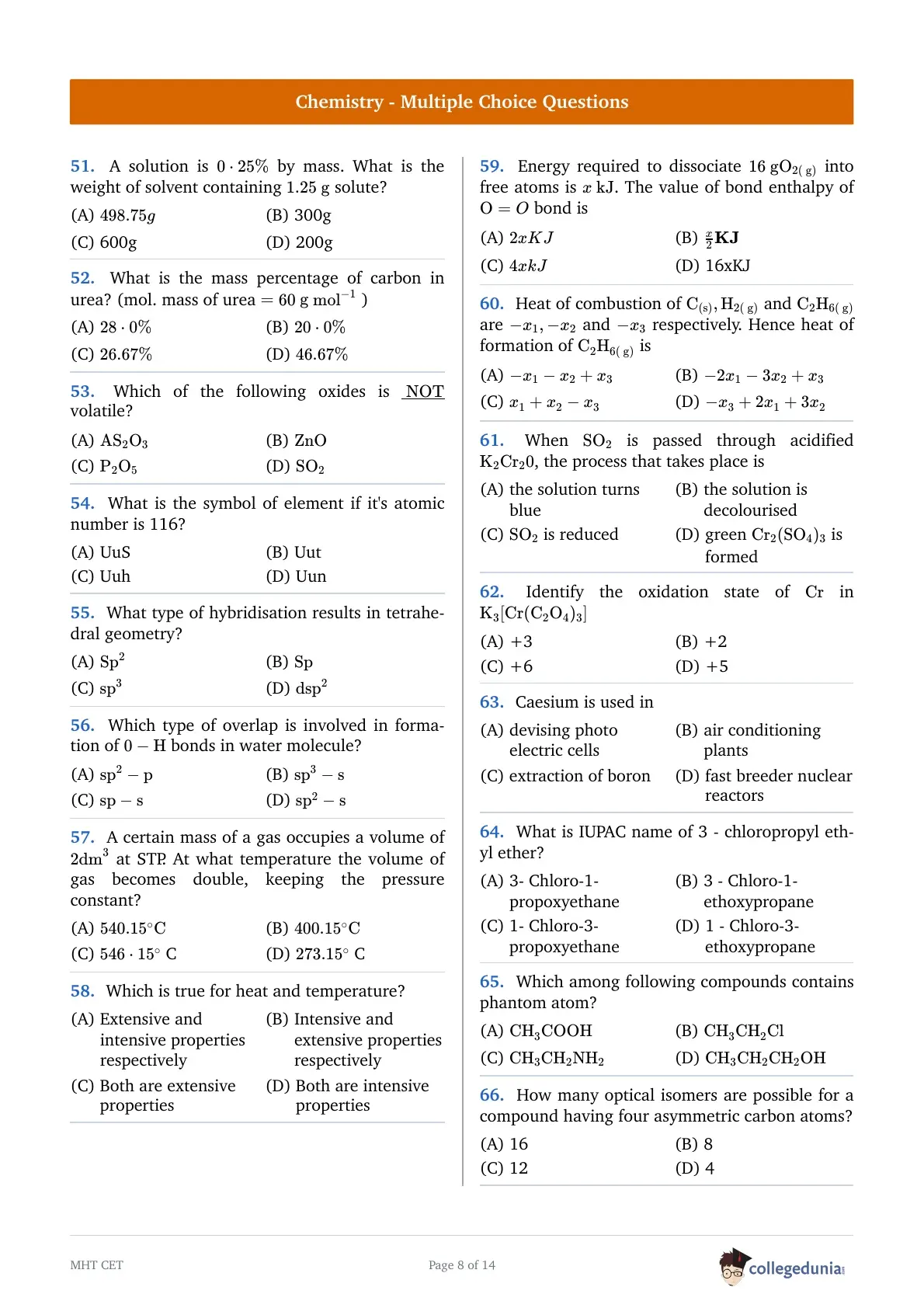
A solution is \(0\cdot 25\%\) by mass. What is the weight of solvent containing \(1.25\ \mathrm{g}\) solute?
What is the mass percentage of carbon in urea? (Molar mass of urea = \(60\,\text{g mol}^{-1}\))
Which of the following oxides is NOT volatile?
What is the symbol of the element if its atomic number is 116?
What type of hybridisation results in tetrahedral geometry?
Which type of overlap is involved in the formation of O–H bonds in a water molecule?
A certain mass of a gas occupies a volume of \(2~\text{dm}^3\) at STP. At what temperature will the volume of the gas become double, keeping the pressure constant?
Which is true for heat and temperature?
Energy required to dissociate \(16\ \mathrm{g}\mathrm{O}_{2(\ \mathrm{g})}\) into free atoms is \(x\ \mathrm{kJ}\). The value of bond enthalpy of \(\mathrm{O}=O\) bond is
Heat of combustion of \(\text{C(s)}\), \(\text{H}_2(g)\) and \(\text{C}_2\text{H}_6(g)\) are \(-x_1\), \(-x_2\) and \(-x_3\) respectively. Hence, the heat of formation of \(\text{C}_2\text{H}_6(g)\) is
When \(\text{SO}_2\) is passed through acidified \(\text{K}_2\text{Cr}_2\text{O}_7\), the process that takes place is
Identify the oxidation state of chromium in \( \text{K}_3[\text{Cr}(\text{C}_2\text{O}_4)_3] \).
Caesium is used in
What is the IUPAC name of 3–chloropropyl ethyl ether?
Which among the following compounds contains phantom atom?
How many optical isomers are possible for a compound having four asymmetric carbon atoms?
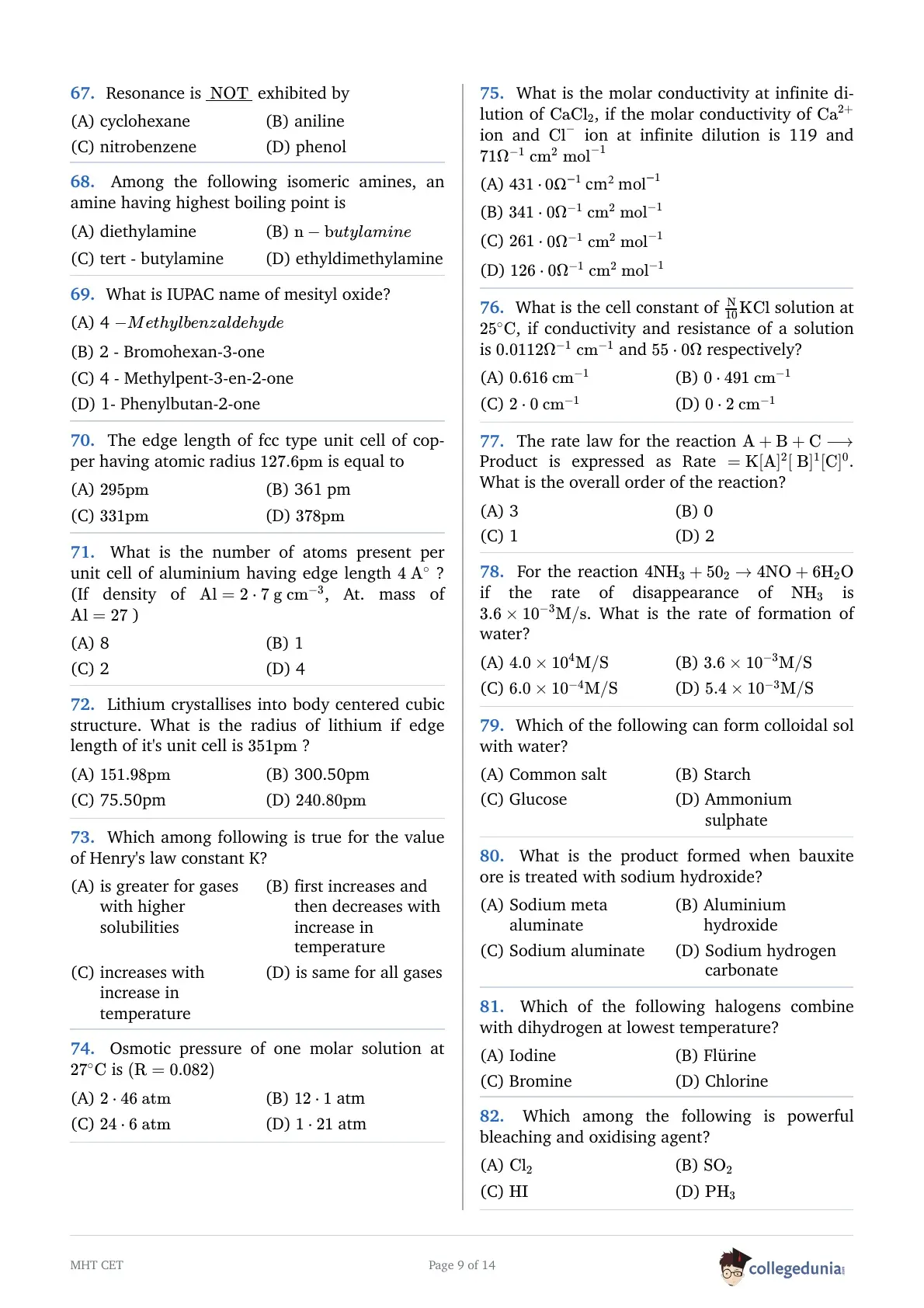
Resonance is NOT exhibited by
Among the following isomeric amines, an amine having the highest boiling point is
What is the IUPAC name of mesityl oxide?
The edge length of an fcc type unit cell of copper having atomic radius \(127.6~\text{pm}\) is equal to
What is the number of atoms present per unit cell of aluminium having edge length \(4~\text{\AA}\)?
(Given: Density of Al = \(2.7~\text{g cm}^{-3}\), Atomic mass of Al = 27)
Lithium crystallises into a body centered cubic structure. What is the radius of lithium if the edge length of its unit cell is \(351~\text{pm}\)?
Which among the following is true for the value of Henry’s law constant \(K\)?
Osmotic pressure of a one molar solution at \(27^\circ\text{C}\) is (given \(R = 0.082\)).
What is the molar conductivity at infinite dilution of \(\text{CaCl}_2\), if the molar conductivity of \(\text{Ca}^{2+}\) ion and \(\text{Cl}^-\) ion at infinite dilution is \(119\) and \(71~\Omega^{-1}\text{cm}^2\text{mol}^{-1}\) respectively?
What is the cell constant of \( \frac{N}{10} \) KCl solution at \(25^\circ\text{C}\), if conductivity and resistance of the solution are \(0.0112~\Omega^{-1}\text{cm}^{-1}\) and \(55.0~\Omega\) respectively?
The rate law for the reaction \(\mathrm{A}+\mathrm{B}+\mathrm{C}\longrightarrow\) Product is expressed as Rate \(=\mathrm{K}[\mathrm{A}]^{2}[\ \mathrm{B}]^{1}[\mathrm{C}]^{0}.\) What is the overall order of the reaction?
For the reaction \(4\text{NH}_3 + 5\text{O}_2 \rightarrow 4\text{NO} + 6\text{H}_2\text{O}\), if the rate of disappearance of \(\text{NH}_3\) is \(3.6 \times 10^{-3}\,\text{M s}^{-1}\), what is the rate of formation of water?
Which of the following can form a colloidal sol with water?
What is the product formed when bauxite ore is treated with sodium hydroxide?
Which of the following halogens combine with dihydrogen at the lowest temperature?
Which among the following is a powerful bleaching and oxidising agent?
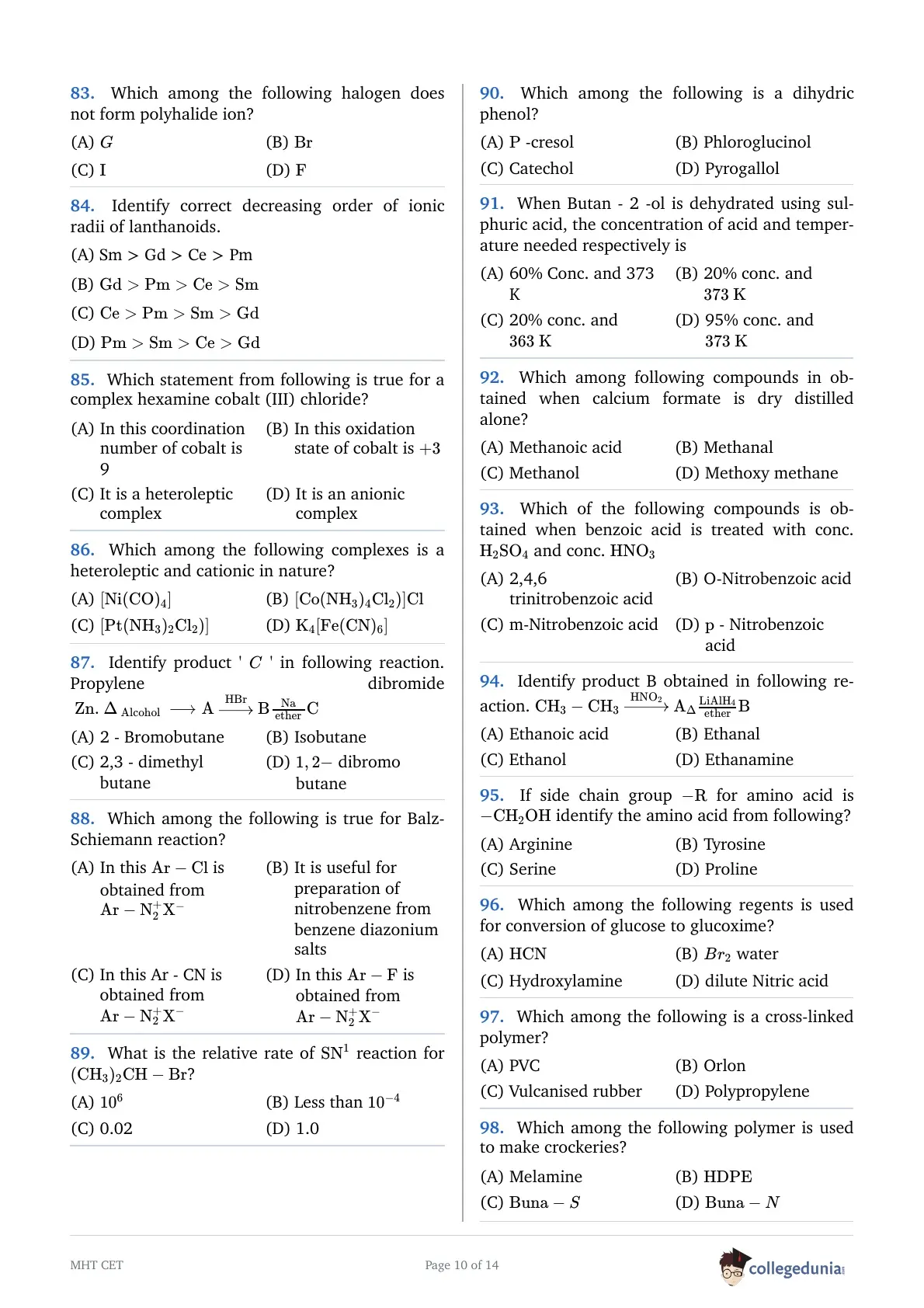
Which among the following halogen does not form polyhalide ion?
Identify the correct decreasing order of ionic radii of lanthanoids.
Which statement from the following is true for a complex hexammine cobalt(III) chloride?
Which among the following complexes is heteroleptic and cationic in nature?
Identify product ' \(C\) ' in following reaction. Propylene dibromide \(\text{ Zn. }\Delta _{\text{ Alcohol }}\longrightarrow \mathrm{A}\xrightarrow{\mathrm{HBr}}\mathrm{B}\frac{\mathrm{Na}}{\text{ ether }}\mathrm{C}\)
Which among the following is true for Balz–Schiemann reaction?
What is the relative rate of \( \text{S}_\text{N}1 \) reaction for \( (\text{CH}_3)_2\text{CH–Br} \)?
Which among the following is a dihydric phenol?
When butan-2-ol is dehydrated using sulphuric acid, the concentration of acid and temperature needed respectively is
Which among the following compounds is obtained when calcium formate is dry distilled alone?
Which of the following compounds is obtained when benzoic acid is treated with concentrated \(\text{H}_2\text{SO}_4\) and concentrated \(\text{HNO}_3\)?
Identify product B obtained in following reaction. \(\mathrm{CH}_{3}-\mathrm{CH}_{3}\xrightarrow{\mathrm{HNO}_{2}}\mathrm{A}_{\Delta }\frac{\mathrm{LiAlH}_{4}}{\text{ ether }}\mathrm{B}\)
If side chain group \(-R\) for an amino acid is \(-\text{CH}_2\text{OH}\), identify the amino acid from the following.
Which among the following reagents is used for conversion of glucose to glucosime?
Which among the following is a cross-linked polymer?
Which among the following polymer is used to make crockeries?
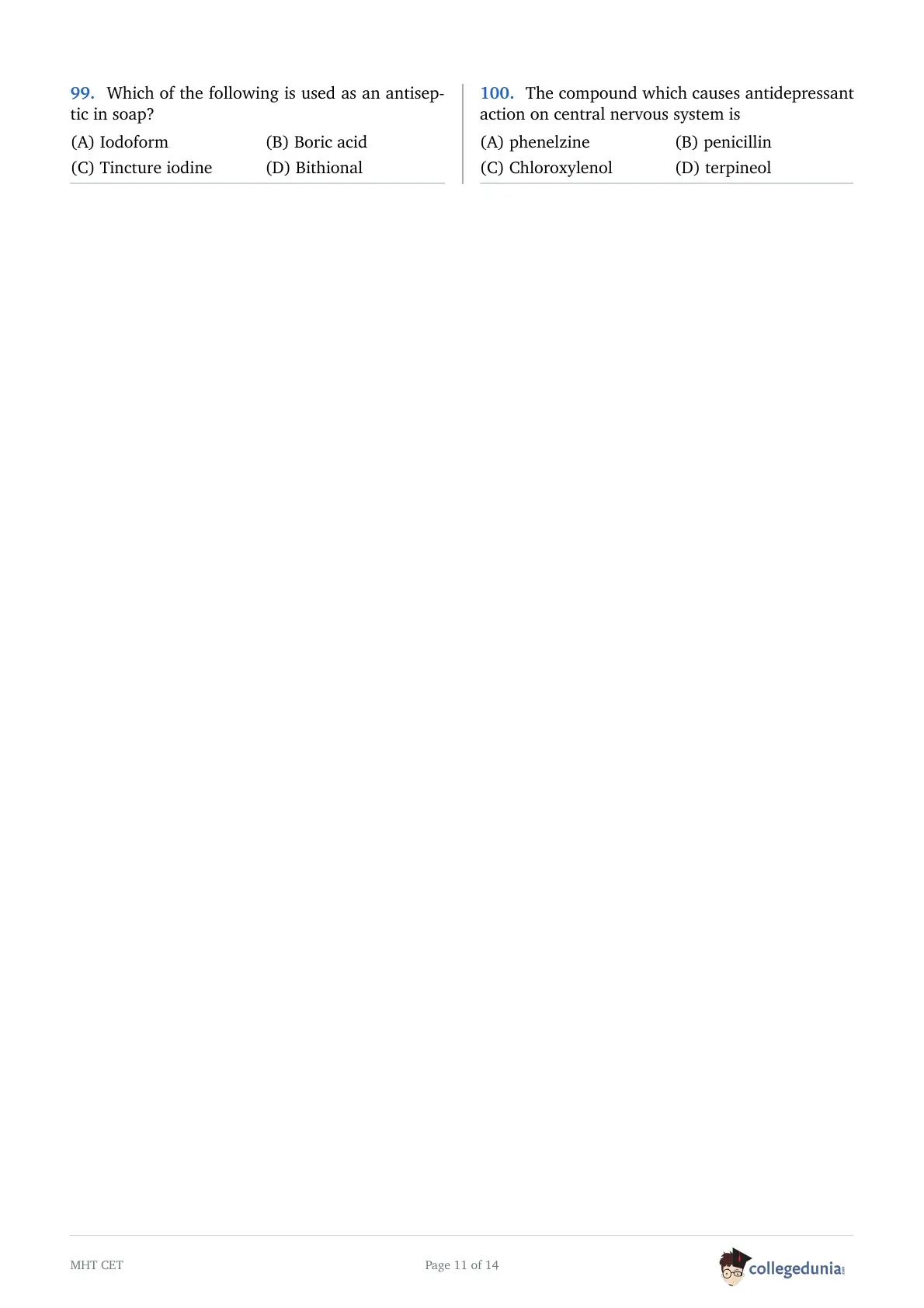
Which of the following is used as an antiseptic in soap?
The compound which causes antidepressant action on the central nervous system is
Mathematics (Q101 - Q150)
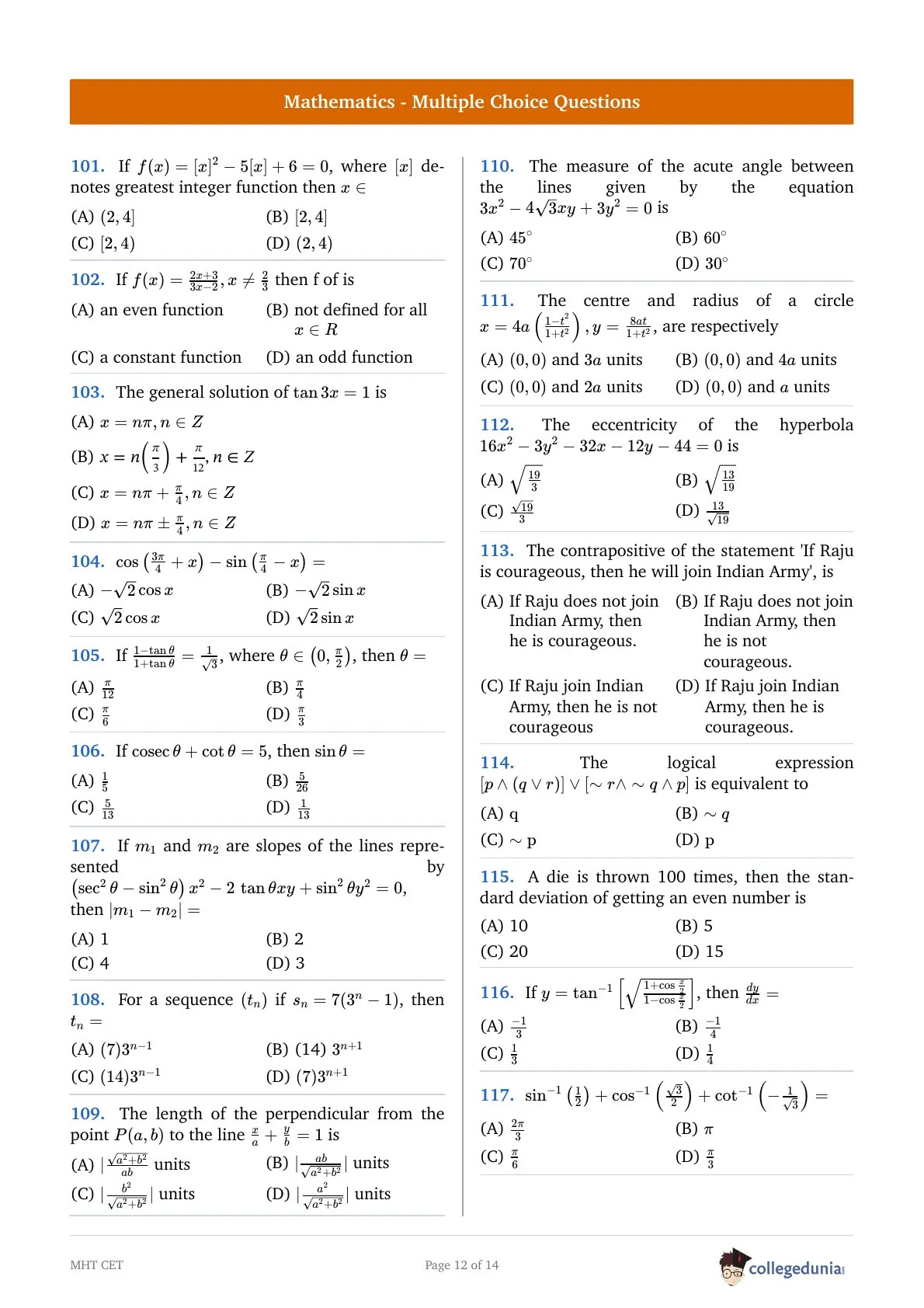
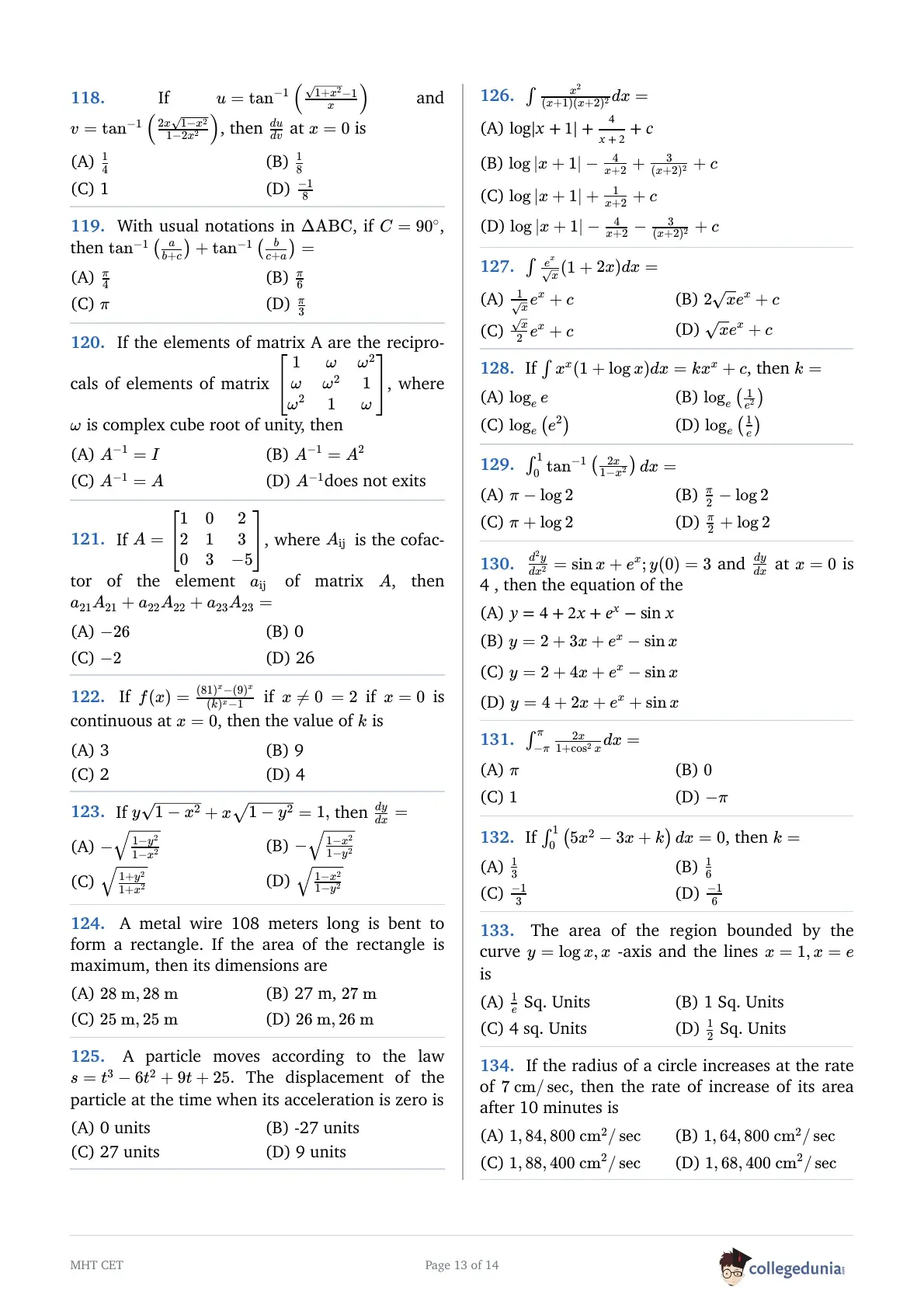
If \( f(x) = [x]^2 - 5[x] + 6 = 0 \), where \( [x] \) denotes the greatest integer function, then \( x \in \)
If \(f(x) = \dfrac{2x + 3}{3x - 2}\), \( x \neq \dfrac{2}{3} \), then \( f \circ f \) is{
The general solution of \( \tan 3x = 1 \) is
Simplify \( \cos\left(\dfrac{3\pi}{4}+x\right) - \sin\left(\dfrac{\pi}{4}-x\right) \)
If
\(
\frac{1-\tan\theta}{1+\tan\theta} = \frac{1}{\sqrt{3}},
\)
where \( \theta \in \left(0,\frac{\pi}{2}\right) \), then \( \theta = \)
If \( \cosec\theta + \cot\theta = 5 \), then \( \sin\theta = \)
If \( m_1 \) and \( m_2 \) are slopes of the lines represented by
\(
\left( \sec^2 \theta - \sin^2 \theta \right) x - 2 \tan \theta \, xy + \sin^2 \theta \, y^2 = 0
\),
then \( |m_1 - m_2| = \)
For a sequence \( (t_n) \), if \( s_n = 7(3^n - 1) \), then \( t_n = \)
The length of the perpendicular from the point \( P(a,b) \) to the line
\( \dfrac{x}{a} + \dfrac{y}{b} = 1 \) is
The measure of the acute angle between the lines given by the equation \( 3x^2 - 4\sqrt{3}xy + 3y^2 = 0 \) is
The centre and radius of a circle \(x=4a\left(\frac{1-t^{2}}{1+t^{2}}\right),y=\frac{8at}{1+t^{2}}\), are respectively
The eccentricity of the hyperbola
\( 16x^2 - 3y^2 - 32x - 12y - 44 = 0 \) is
The contrapositive of the statement 'If Raju is courageous, then he will join Indian Army', is
The logical expression
\(
[p \wedge (q \vee r)] \vee [\neg r \wedge \neg q \wedge p]
\)
is equivalent to
A die is thrown 100 times, then the standard deviation of getting an even number is
If \(y=\tan ^{-1}\left[\sqrt{\frac{1+\cos \frac{x}{2}}{1-\cos \frac{x}{2}}}\right]\), then \(\frac{dy}{dx}=\)
Evaluate \( \sin^{-1}\left(\frac{1}{2}\right) + \cos^{-1}\left(\frac{\sqrt{3}}{2}\right) + \cot^{-1}\left(-\frac{1}{\sqrt{3}}\right) \)
If \( u = \tan^{-1}\!\left(\dfrac{1+x^2-1}{x}\right) \) and \( v = \tan^{-1}\!\left(\dfrac{2x(1-x^2)}{1-2x^2}\right) \), then \( \dfrac{du}{dv} \) at \( x = 0 \) is
With usual notations in \( \triangle ABC \), if \( C = 90^\circ \), then \( \tan^{-1}\left(\dfrac{a}{b+c}\right) + \tan^{-1}\left(\dfrac{b}{c+a}\right) \) is
If the elements of matrix \( A \) are the reciprocals of the elements of the matrix
\(
\begin{pmatrix}
1 & \omega & \omega^2 \\
\omega & \omega^2 & 1 \\
\omega^2 & 1 & \omega
\end{pmatrix}
\),
where \( \omega \) is a complex cube root of unity, then
If
\(
A =
\begin{pmatrix}
1 & 0 & 2 \\
2 & 1 & 3 \\
0 & 3 & -5
\end{pmatrix}
\)
where \( A_{ij} \) is the cofactor of the element \( a_{ij} \) of matrix \( A \), then
\( a_{21}A_{21} + a_{22}A_{22} + a_{23}A_{23} = \)
If \(f(x)=\frac{(81)^{x}-(9)^{x}}{(k)^{x}-1}\) if \(x\neq 0\) \(=2\) if \(x=0\) is continuous at \(x=0\), then the value of \(k\) is
If \( y\sqrt{1-x^2} + x\sqrt{1-y^2} = 1 \), then \( \dfrac{dy}{dx} = \)
A metal wire \(108\) meters long is bent to form a rectangle. If the area of the rectangle is maximum, then its dimensions are
A particle moves according to the law \( s = t^3 - 6t^2 + 9t + 25 \). The displacement of the particle at the time when its acceleration is zero is
\(\int \frac{x^{2}}{(x+1)(x+2)^{2}}dx=\)
Evaluate the integral \( \displaystyle \int \frac{e^x}{\sqrt{x}}(1+2x)\,dx \)
If \( \int x^x (1 + \log x) \, dx = k x^x + c \), then \( k = \)
Evaluate
\(
\displaystyle \int_{0}^{1} \tan^{-1}\!\left(\frac{2x}{1-x^2}\right)\,dx
\)
If \( \dfrac{d^2y}{dx^2} = \sin x + e^x \), \( y(0) = 3 \) and \( \left.\dfrac{dy}{dx}\right|_{x=0} = 4 \), then the equation of the curve is
Evaluate \( \displaystyle \int_{-\pi}^{\pi} \frac{2x}{1+\cos^2 x}\,dx \)
If \( \int_{0}^{1} (5x^2 - 3x + k) \, dx = 0 \), then \( k = \)
The area of the region bounded by the curve \( y = \log x \), x-axis and the lines \( x = 1 \), \( x = e \) is
If the radius of a circle increases at the rate of \(7\ \mathrm{cm}/\sec\), then the rate of increase of its area after 10 minutes is
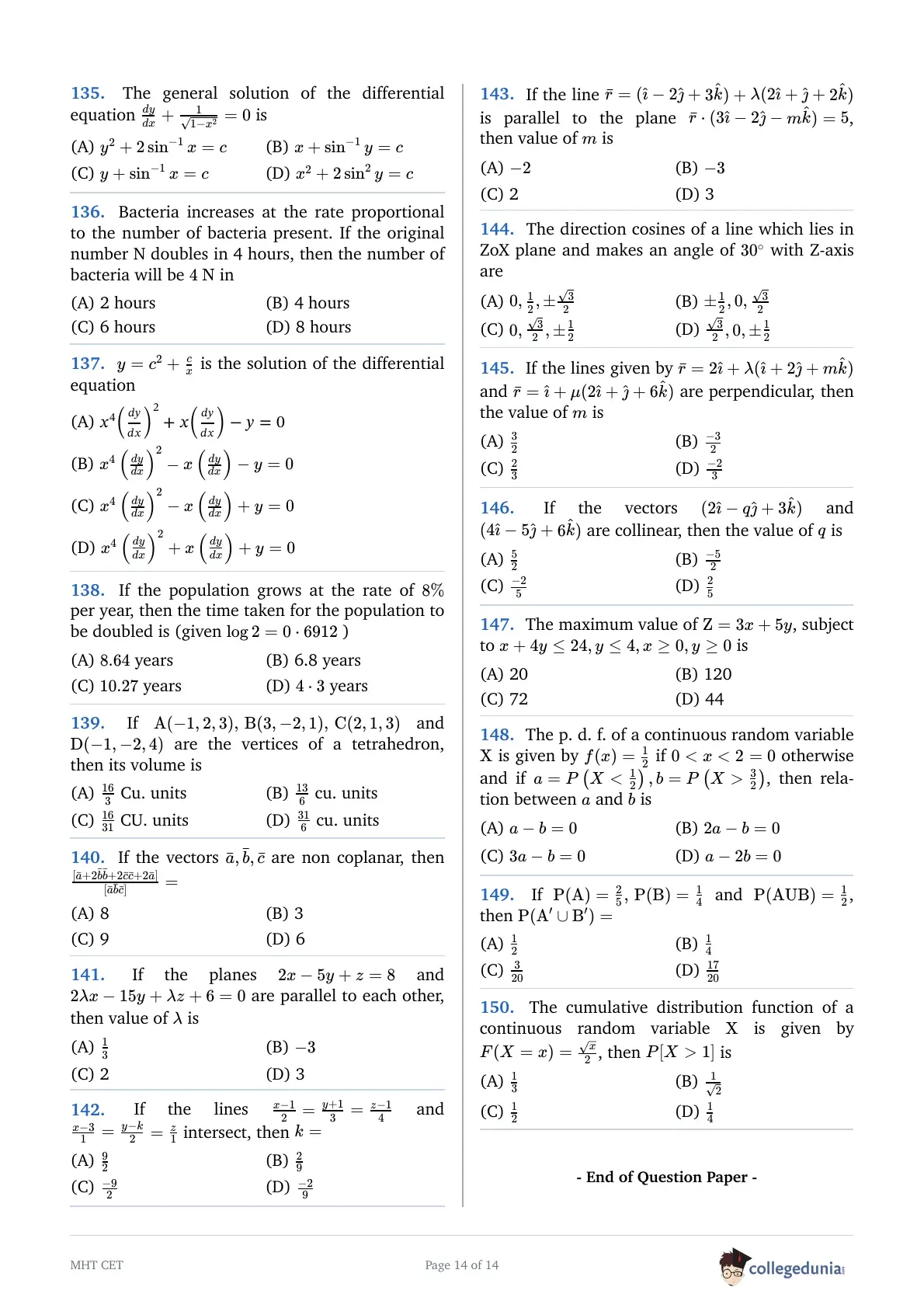
The general solution of the differential equation \(\frac{dy}{dx}+\frac{1}{\sqrt{1-x^{2}}}=0\) is
Bacteria increases at the rate proportional to the number of bacteria present. If the original number \( N \) doubles in \( 4 \) hours, then the number of bacteria will be \( 4N \) in
\( y = c^2 + \dfrac{c}{x} \) is the solution of the differential equation
If the population grows at the rate of \( 8% \) per year, then the time taken for the population to be doubled is \([ \log 2 = 0.6912 ]\)
If \( A(-1,2,3) \), \( B(3,-2,1) \), \( C(2,1,3) \) and \( D(-1,-2,4) \) are the vertices of a tetrahedron, then its volume is
If the vectors \( \vec{a}, \vec{b}, \vec{c} \) are non-coplanar, then
\(
\dfrac{\left| \vec{a} + 2\vec{b} \;\; \vec{b} + 2\vec{c} \;\; \vec{c} + 2\vec{a} \right|}
{\left| \vec{a} \;\; \vec{b} \;\; \vec{c} \right|}
\)
is
If the lines \(\frac{x-1}{2}=\frac{y+1}{3}=\frac{z-1}{4}\) and \(\frac{x-3}{1}=\frac{y-k}{2}=\frac{z}{1}\) intersect, then \(k=\)
If the line \(\bar{r}=(\hat{\imath}-2\hat{\jmath}+3\hat{k})+\lambda (2\hat{\imath}+\hat{\jmath}+2\hat{k})\) is parallel to the plane \(\bar{r}\cdot (3\hat{\imath}-2\hat{\jmath}-m\hat{k})=5\), then value of \(m\) is
The direction cosines of a line which lies in the \( ZOX \) plane and makes an angle of \( 30^\circ \) with the \( Z \)-axis are
If the lines given by
\(
\vec{r} = 2\hat{i} + \lambda(\hat{i} + 2\hat{j} + m\hat{k})
\)
and
\(
\vec{r} = \hat{i} + \mu(2\hat{i} + \hat{j} + 6\hat{k})
\)
are perpendicular, then the value of \( m \) is
If the vectors \( (2\mathbf{i}-q\mathbf{j}+3\mathbf{k}) \) and \( (4\mathbf{i}-5\mathbf{j}+6\mathbf{k}) \) are collinear, then the value of \( q \) is
The maximum value of \(\mathrm{Z}=3x+5y\), subject to \(x+4y\leq 24,y\leq 4,x\geq 0,y\geq 0\) is
The p. d. f. of a continuous random variable \(\mathrm{X}\) is given by \(f(x)=\frac{1}{2}\) if \(0\lt x\lt 2\) \(=0\) otherwise and if \(a=P\left(X\lt \frac{1}{2}\right),b=P\left(X>\frac{3}{2}\right)\), then relation between \(a\) and \(b\) is
If \( P(A) = \frac{2}{5}, \, P(B) = \frac{1}{4}, \, P(A \cup B) = \frac{1}{2}, \) then \( P(A' \cup B') = \)
The cumulative distribution function of a continuous random variable \( X \) is given by \( F(X = x) = \dfrac{\sqrt{x}}{2} \). Then \( P(X>1) \) is
MHT CET 2020 PCM Exam Pattern and Marking Scheme
| Parameter | Details |
|---|---|
| Conducting Body | Maharashtra Common Entrance Test Cell (Maharashtra CET Cell) |
| Exam Mode | Online (Computer-Based Test) |
| Duration | 180 minutes (3 hours) |
| Groups / Subjects | PCM (Physics, Chemistry, Mathematics) for Engineering |
| Total Questions |
150 |
| Total Marks | 200 |
| Question Type | Multiple Choice Questions (MCQs) |
| Marks Distribution |
|
| Negative Marking | No |
| Syllabus Weightage |
|



Comments