




MHT CET 2020 Oct 14 Shift 2 PCM Question Paper is available for download here. Maharashtra State CET Cell conducted MHT CET 2020 PCM Exam on Oct 14 in Shift 2 from 2 PM to 5 PM in CBT mode.
The MHT CET 2020 PCM question paper includes the following:
- The MHT CET 2020 PCM Question Paper consists of 150 multiple-choice questions (MCQs) totalling 200 marks divided into 3 sections: Physics, Chemistry, and Mathematics, with 50 questions in each subject.
- Physics and Chemistry questions carry 1 mark each while Mathematics questions carry 2 marks each.
- There is no negative marking for incorrect answers.
MHT CET 2020 Oct 14 Shift 2 PCM Question Paper with Solution PDF
| CD PDF | CD PDF with Solutions |
|---|---|
| Download Collegedunia PDF 0.79 MB | - |
Also Check:
MHT CET 2020 Oct 14 Shift 2 PCM Questions with Solutions
Physics (Q1 - Q50)
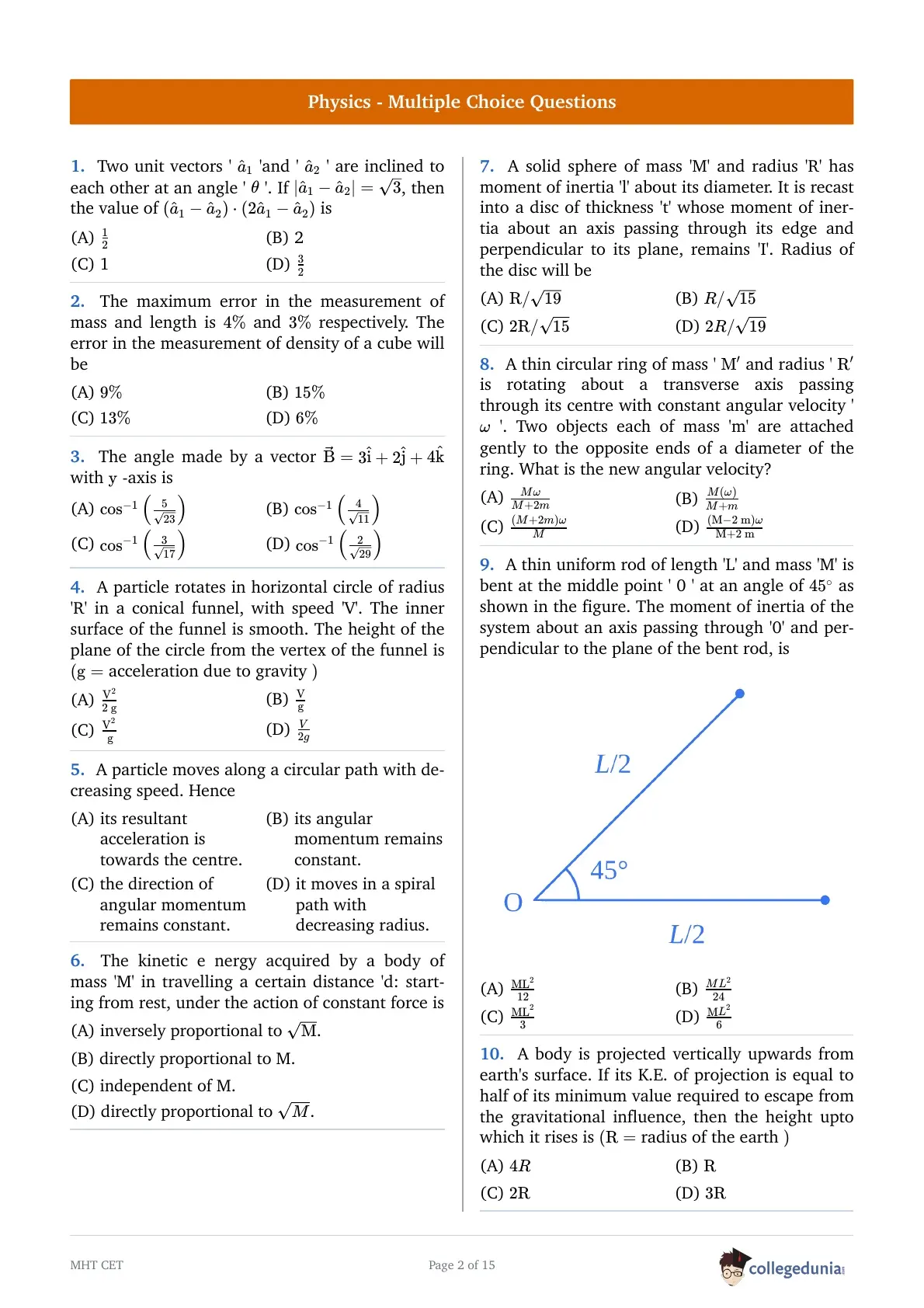
Two unit vectors \( \hat{a_1} \) and \( \hat{a_2} \) are inclined to each other at an angle \( \theta \). If \( | \hat{a_1} - \hat{a_2} | = \sqrt{3} \), then the value of \( ( \hat{a_1} - \hat{a_2} ) \cdot ( 2\hat{a_1} - \hat{a_2} ) \) is
The maximum error in the measurement of mass and length is 4% and 3% respectively. The error in the measurement of density of a cube will be
The angle made by a vector \( \vec{B} = 3\hat{i} + 2\hat{j} + 4\hat{k} \) with the y-axis is
A particle rotates in a horizontal circle of radius \( R \) in a conical funnel, with speed \( V \). The inner surface of the funnel is smooth. The height of the plane of the circle from the vertex of the funnel is (g = acceleration due to gravity)
A particle moves along a circular path with decreasing speed. Hence
The kinetic energy acquired by a body of mass \( M \) in travelling a certain distance \( d \), starting from rest, under the action of constant force is
A solid sphere of mass \( M \) and radius \( R \) has moment of inertia \( I \) about its diameter. It is recast into a disc of thickness \( t \) whose moment of inertia about an axis passing through its edge and perpendicular to its plane, remains \( I \). Radius of the disc will be
A thin circular ring of mass \( M \) and radius \( R \) is rotating about a transverse axis passing through its centre with constant angular velocity \( \omega \). Two objects each of mass \( m \) are attached gently to the opposite ends of a diameter of the ring. What is the new angular velocity?
A thin uniform rod of length 'L' and mass 'M' is bent at the middle point 'O' at an angle of 45° as shown in the figure. The moment of inertia of the system about an axis passing through 'O' and perpendicular to the plane of the bent rod, is

A body is projected vertically upwards from earth's surface. If its K.E. of projection is equal to half of its minimum value required to escape from the gravitational influence, then the height upto which it rises is (R = radius of the earth)
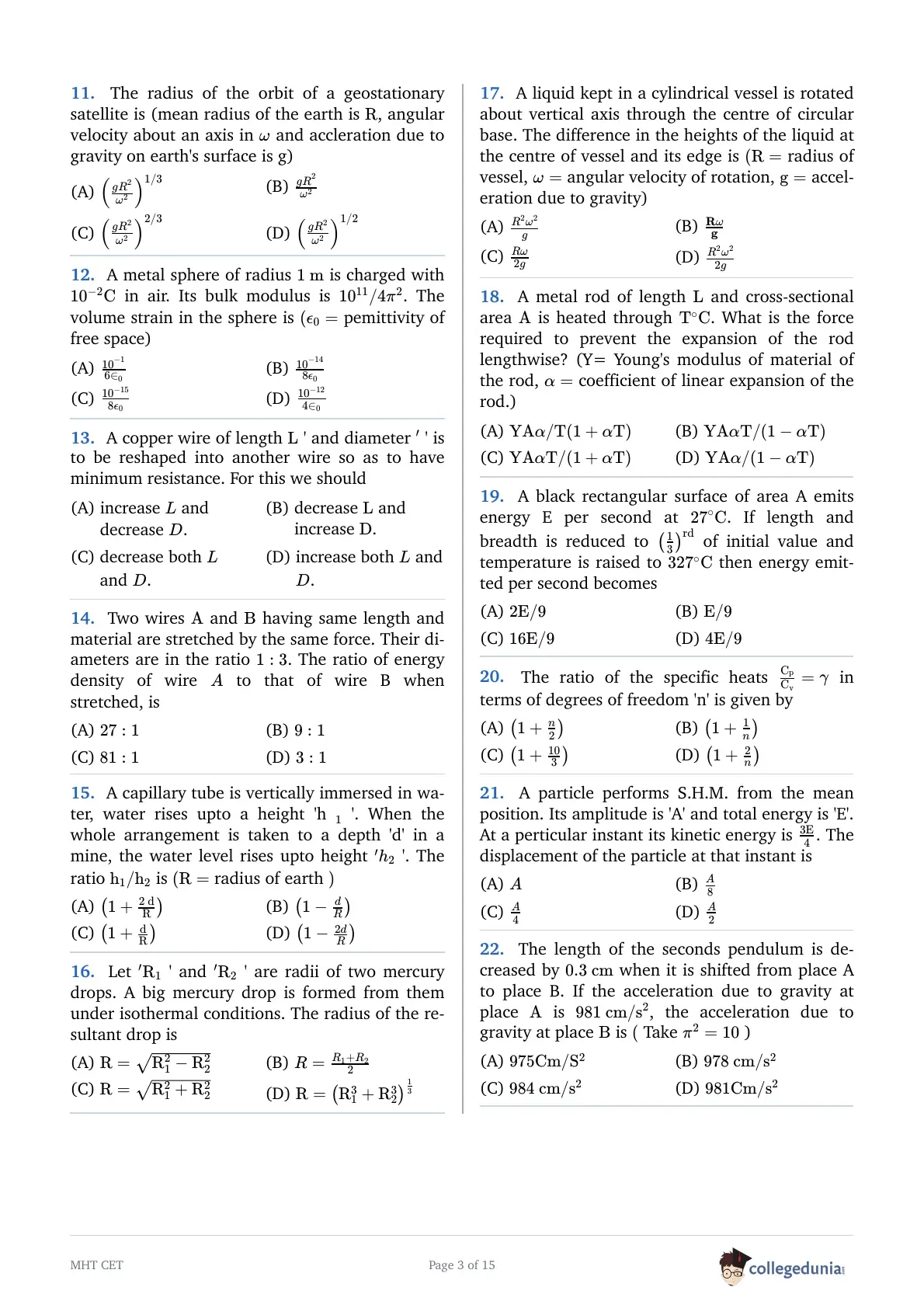
The radius of the orbit of a geostationary satellite is (mean radius of the earth is \( R \), angular velocity about an axis is \( \omega \), and acceleration due to gravity on earth's surface is \( g \))
A metal sphere of radius 1 m is charged with \( 10^{-2} \) C in air. Its bulk modulus is \( \frac{10^{11}}{4\pi^2} \). The volume strain in the sphere is \( \epsilon_0 \) (permittivity of free space)
A copper wire of length \( L \) and diameter \( D \) is to be reshaped into another wire so as to have minimum resistance. For this we should
Two wires A and B having same length and material are stretched by the same force. Their diameters are in the ratio 1 : 3. The ratio of energy density of wire A to that of wire B when stretched, is
A capillary tube is vertically immersed in water, water rises up to a height \( h_1 \). When the whole arrangement is taken to a depth \( d \) in a mine, the water level rises up to height \( h_2 \). The ratio \( \frac{h_1}{h_2} \) is (R = radius of earth)
Let \( R_1 \) and \( R_2 \) are radii of two mercury drops. A big mercury drop is formed from them under isothermal conditions. The radius of the resultant drop is
A liquid kept in a cylindrical vessel is rotated about vertical axis through the centre of circular base. The difference in the heights of the liquid at the centre of vessel and its edge is \( R \) (radius of vessel), \( \omega \) (angular velocity of rotation), and \( g \) (acceleration due to gravity)
A metal rod of length \( L \) and cross-sectional area \( A \) is heated through \( T \) °C. What is the force required to prevent the expansion of the rod lengthwise?
(Y = Young's modulus of material of the rod, \( \alpha \) = coefficient of linear expansion of the rod.)
A black rectangular surface of area A emits energy E per second at 27°C. If length and breadth is reduced to \( \frac{1}{3} \) of initial value and temperature is raised to 327°C, then energy emitted per second becomes
The ratio of the specific heats \( \frac{C_p}{C_v} = \gamma \) in terms of degrees of freedom 'n' is given by
A particle performs S.H.M. from the mean position. Its amplitude is \( A \) and total energy is \( E \). At a particular instant its kinetic energy is \( \frac{3E}{4} \). The displacement of the particle at that instant is
The length of the seconds pendulum is decreased by 0.3 cm when it is shifted from place A to place B. If the acceleration due to gravity at place A is 981 cm/s\(^2\), the acceleration due to gravity at place B is (Take \( \pi^2 = 10 \))
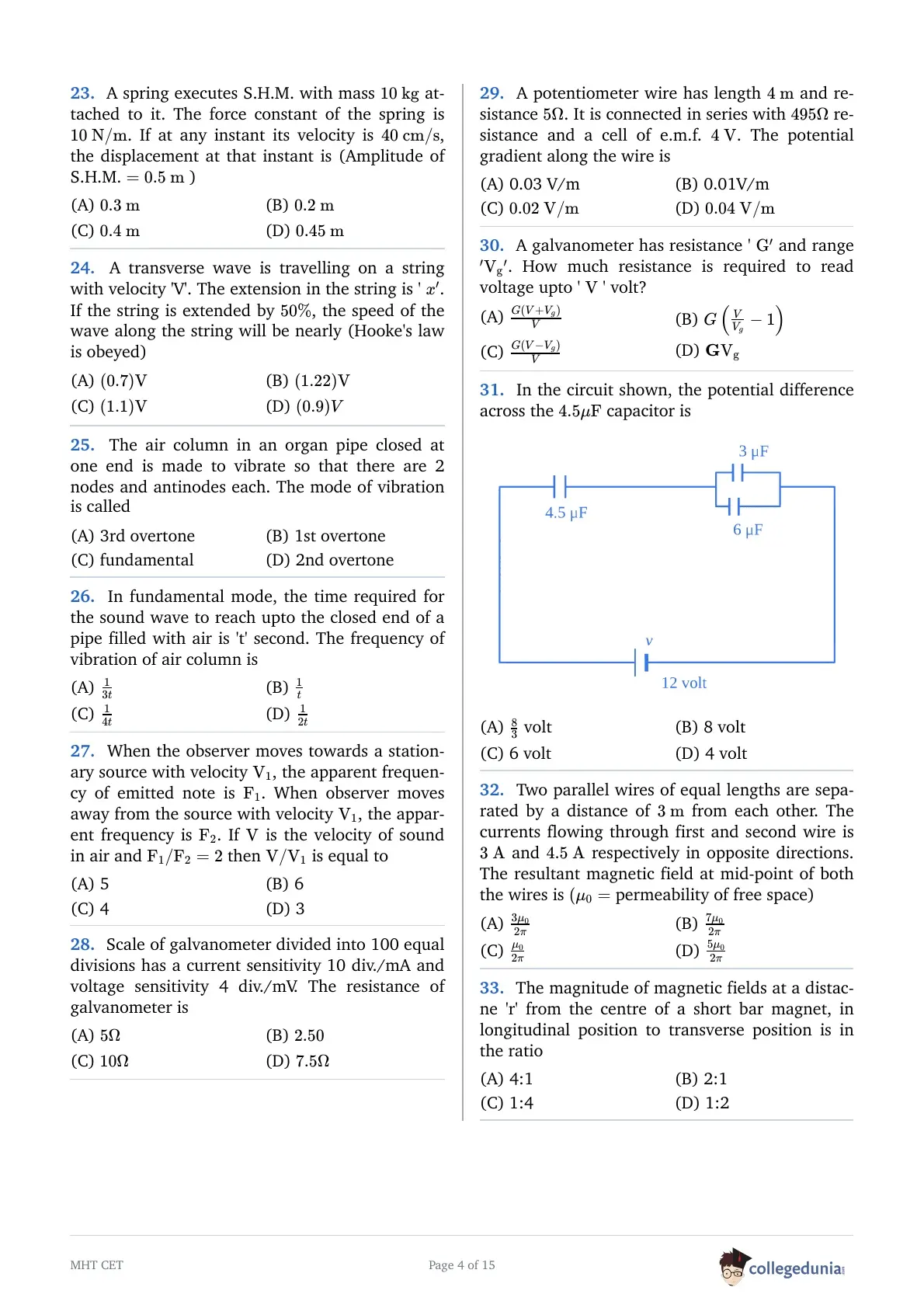
A spring executes S.H.M. with mass 10 kg attached to it. The force constant of the spring is 10 N/m. If at any instant its velocity is 40 cm/s, the displacement at that instant is (Amplitude of S.H.M. = 0.5 m)
A transverse wave is travelling on a string with velocity \( V \). The extension in the string is \( x \). If the string is extended by 50%, the speed of the wave along the string will be nearly (Hooke's law is obeyed)
The air column in an organ pipe closed at one end is made to vibrate so that there are 2 nodes and antinodes each. The mode of vibration is called
In fundamental mode, the time required for the sound wave to reach up to the closed end of a pipe filled with air is \( t \) second. The frequency of vibration of air column is
When the observer moves towards a stationary source with velocity \( V_o \), the apparent frequency of emitted note is \( F_1 \). When the observer moves away from the source with velocity \( V_o \), the apparent frequency is \( F_2 \). If \( V \) is the velocity of sound in air and \( \frac{F_1}{F_2} = 2 \), then \( \frac{V}{V_o} \) is equal to
Scale of galvanometer divided into 100 equal divisions has a current sensitivity 10 div/mA and voltage sensitivity 4 div/mV. The resistance of the galvanometer is
A potentiometer wire has length 4 m and resistance 5 \( \Omega \). It is connected in series with 495 \( \Omega \) resistance and a cell of e.m.f. 4V. The potential gradient along the wire is
A galvanometer has resistance \( G \) and range \( V_g \). How much resistance is required to read voltage up to \( V \) volts?
In the circuit shown, the potential difference across the 4.5\( \mu F \) capacitor is

Two parallel wires of equal lengths are separated by a distance of 3m from each other. The currents flowing through the first and second wire are 3A and 4.5A respectively in opposite directions. The resultant magnetic field at the mid-point of both the wires is \( \mu_0 \) (permeability of free space) is
The magnitude of magnetic fields at a distance \( r \) from the centre of a short bar magnet, in longitudinal position to transverse position is in the ratio
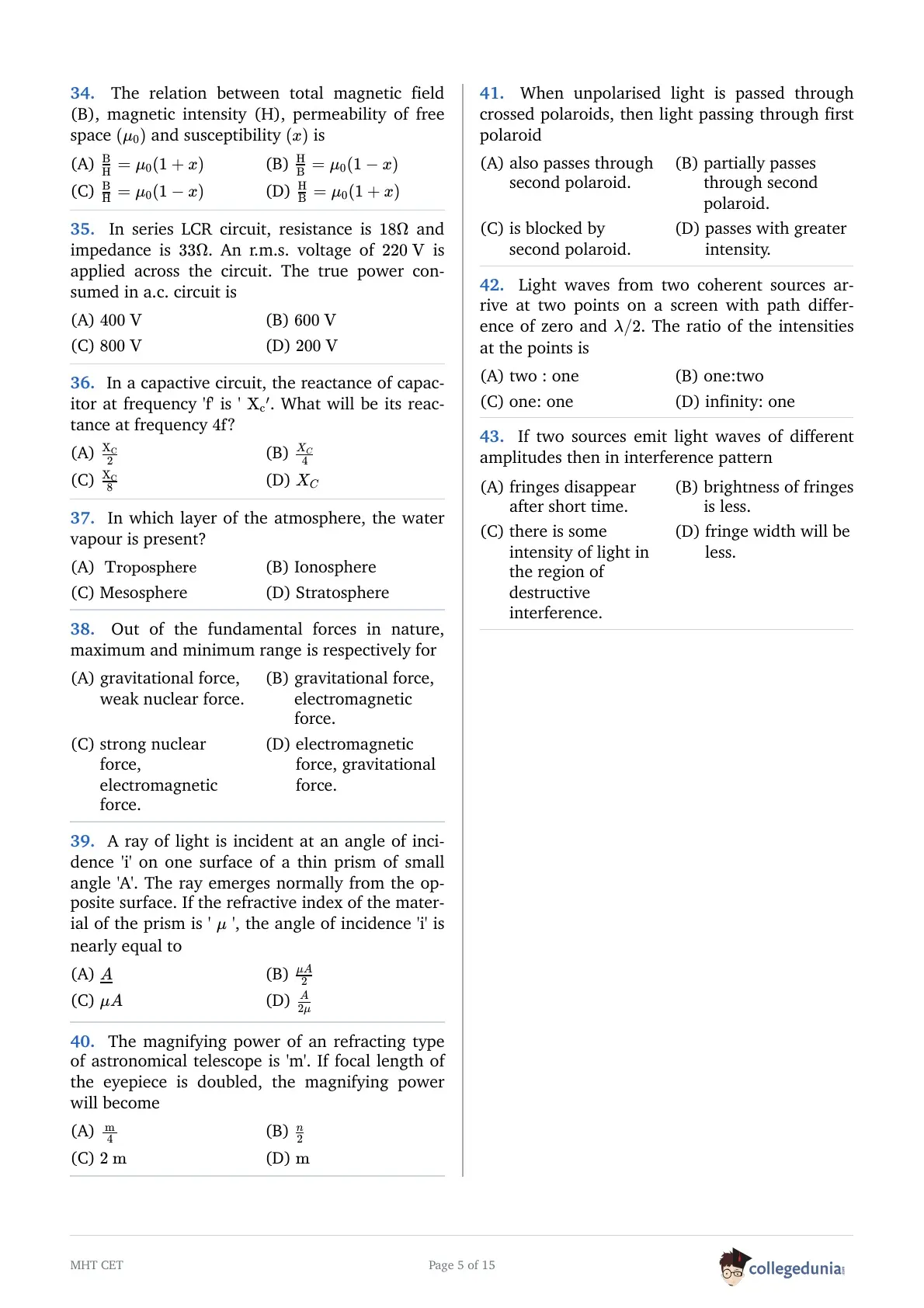
The relation between total magnetic field \( B \), magnetic intensity \( H \), permeability of free space \( \mu_0 \) and susceptibility \( x \) is
In series LCR circuit, resistance is 18 \( \Omega \) and impedance is 33 \( \Omega \). An r.m.s. voltage of 220 V is applied across the circuit. The true power consumed in a.c. circuit is
In a capacitive circuit, the reactance of capacitor at frequency \( f \) is \( X_C \). What will be its reactance at frequency \( 2f \)?
In which layer of the atmosphere is water vapour present?
Out of the fundamental forces in nature, maximum and minimum range is respectively for
A ray of light is incident at an angle of incidence \( i \) on one surface of a thin prism of small angle \( A \). The ray emerges normally from the opposite surface. If the refractive index of the material of the prism is \( \mu \), the angle of incidence \( i \) is nearly equal to
The magnifying power of an astronomical telescope is \( m \). If the focal length of the eyepiece is doubled, the magnifying power will become
When unpolarised light is passed through crossed polaroids, then light passing through first polaroid
Light waves from two coherent sources arrive at two points on a screen with path difference of zero and \( \lambda / 2 \). The ratio of the intensities at the points is
If two sources emit light waves of different amplitudes then in interference pattern
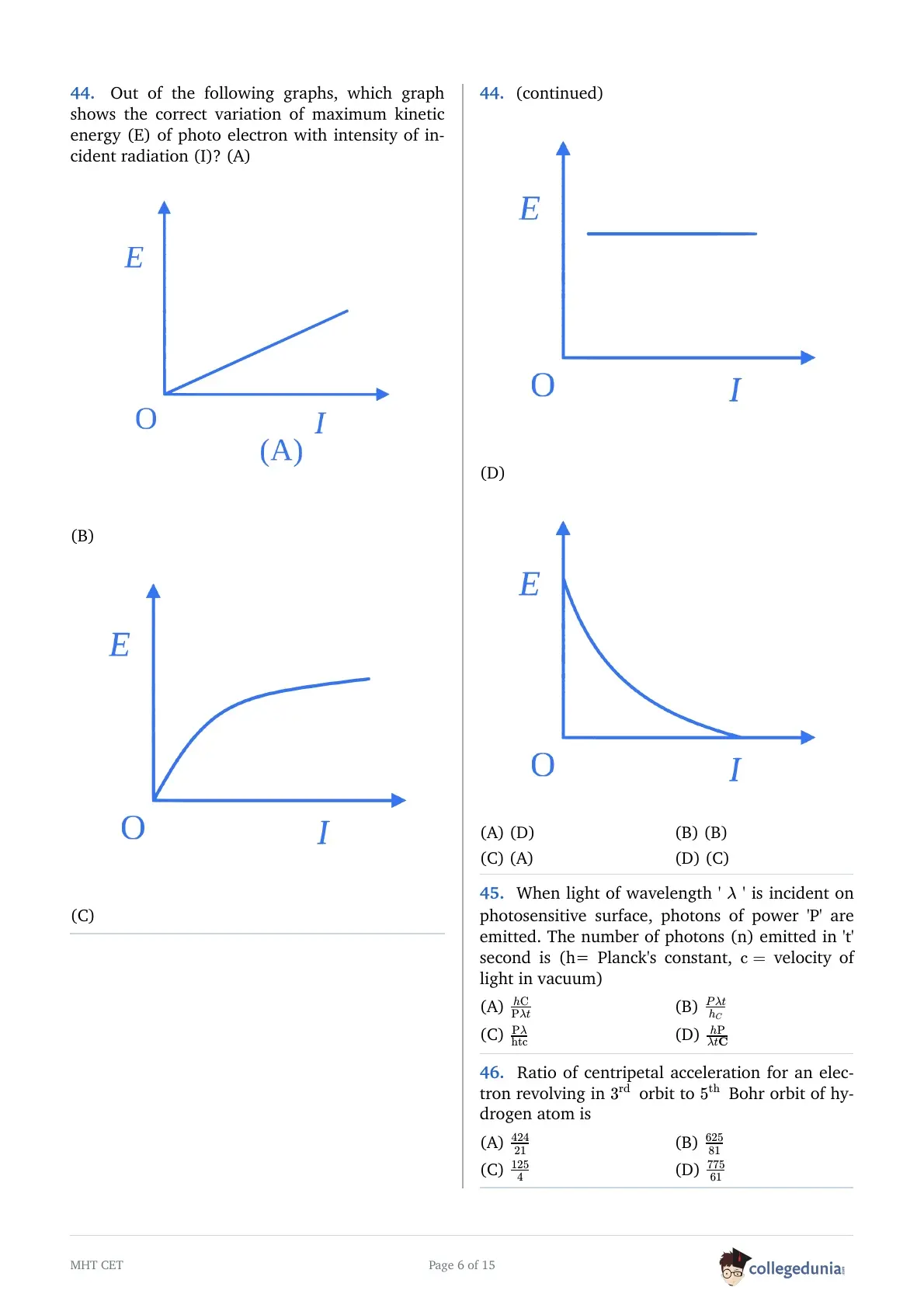
Out of the following graphs, which graph shows the correct variation of maximum kinetic energy (E) of photoelectron with intensity of incident radiation (I)?

When light of wavelength \( \lambda \) is incident on photosensitive surface, photons of power \( P \) are emitted. The number of photons \( n \) emitted in \( t \) second is
Ratio of centripetal acceleration for an electron revolving in 3rd orbit to 5th Bohr orbit of hydrogen atom is
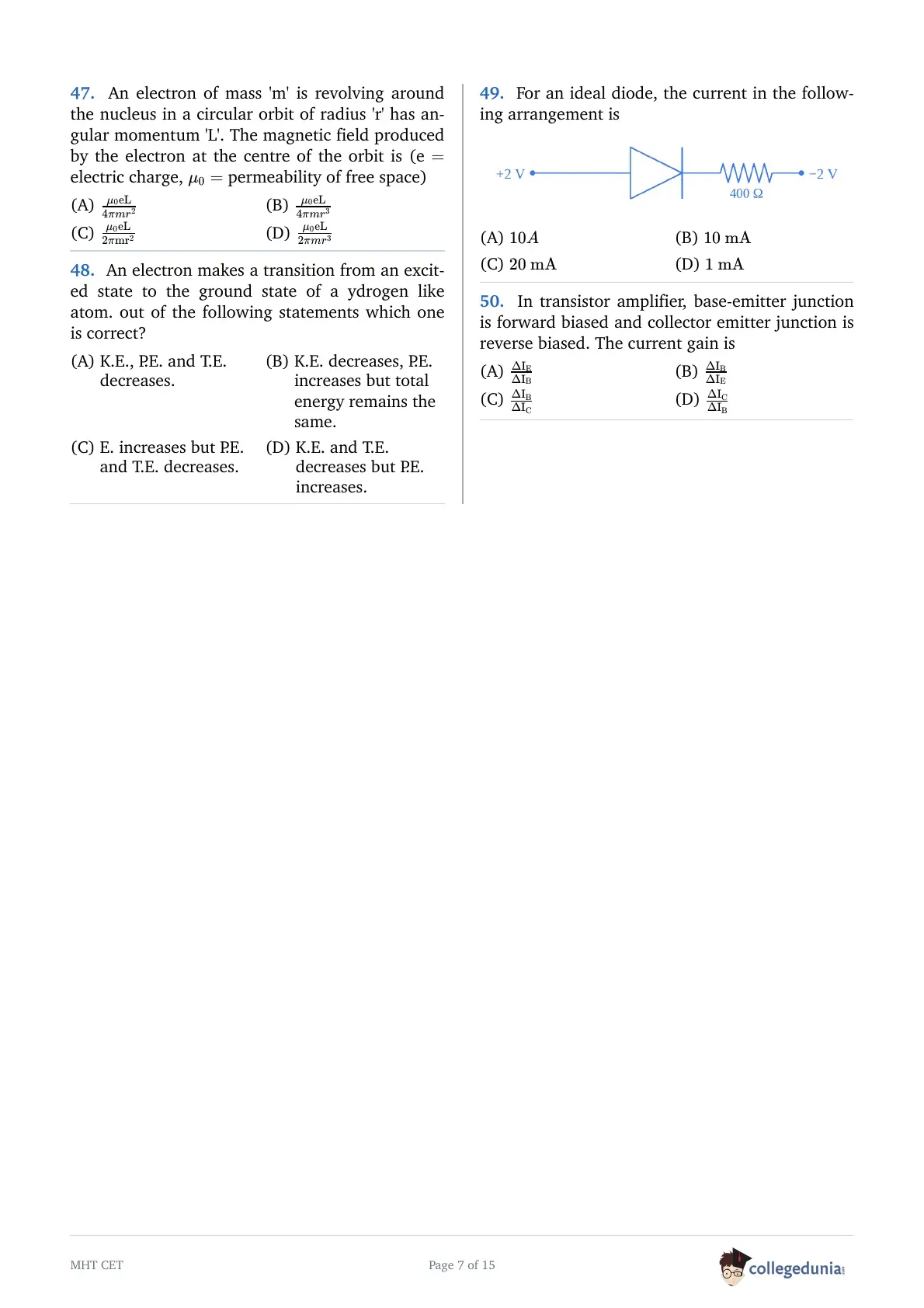
An electron of mass \( m \) is revolving around the nucleus in a circular orbit of radius \( r \) has angular momentum \( L \). The magnetic field produced by the electron at the centre of the orbit is
An electron makes a transition from an excited state to the ground state of a hydrogen-like atom. Out of the following statements, which one is correct?

In a transistor amplifier, base-emitter junction is forward biased and collector-emitter junction is reverse biased. The current gain is
Chemistry (Q51 - Q100)
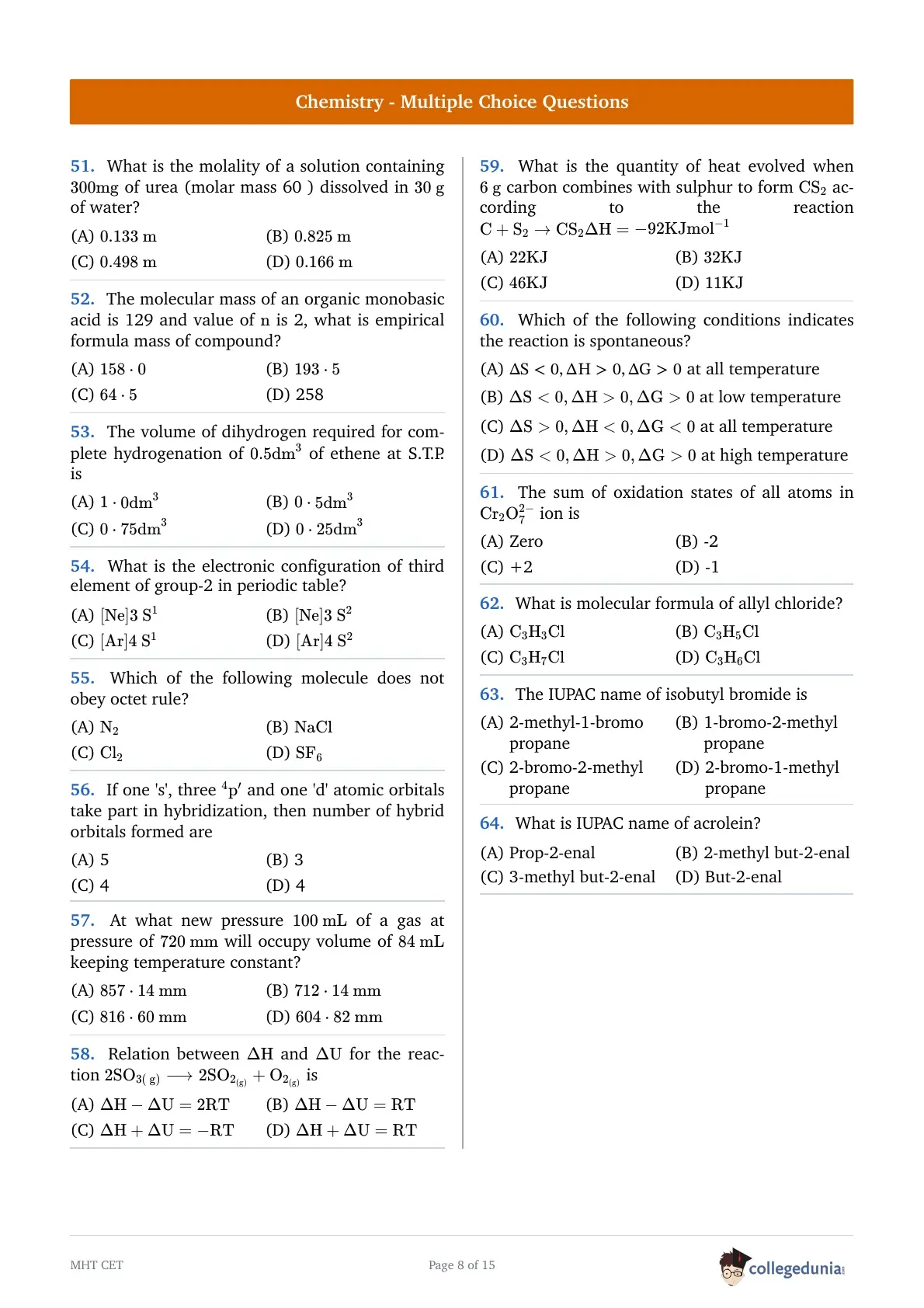
What is the molality of a solution containing 300 mg of urea (molar mass 60) dissolved in 30 g of water?
The volume of dihydrogen required for complete hydrogenation of 0.5 dm³ of ethene at S.T.P. is
What is the electronic configuration of third element of group-2 in periodic table?
Which of the following molecules does not obey octet rule?
If one 's', three 'p' and one 'd' atomic orbitals take part in hybridization, then number of hybrid orbitals formed are
At what new pressure will 100 mL of a gas at pressure 720 mm occupy volume of 84 mL, keeping temperature constant?
Relation between \(\Delta \mathrm{H}\) and \(\Delta \mathrm{U}\) for the reaction \(2\mathrm{SO}_{3(\ \mathrm{g})}\longrightarrow 2\mathrm{SO}_{2_{(\mathrm{g})}}+\mathrm{O}_{2_{(\mathrm{g})}}\) is
What is the quantity of heat evolved when \(6\ \mathrm{g}\) carbon combines with sulphur to form \(\mathrm{CS}_{2}\) according to the reaction \(\mathrm{C}+\mathrm{S}_{2}\rightarrow \mathrm{CS}_{2}\Delta \mathrm{H}=-92\mathrm{KJ}\mathrm{mol}^{-1}\)
Which of the following conditions indicates the reaction is spontaneous?
The sum of oxidation states of all atoms in \(\text{Cr}_2\text{O}_7^{2-}\) ion is
What is the molecular formula of allyl chloride?
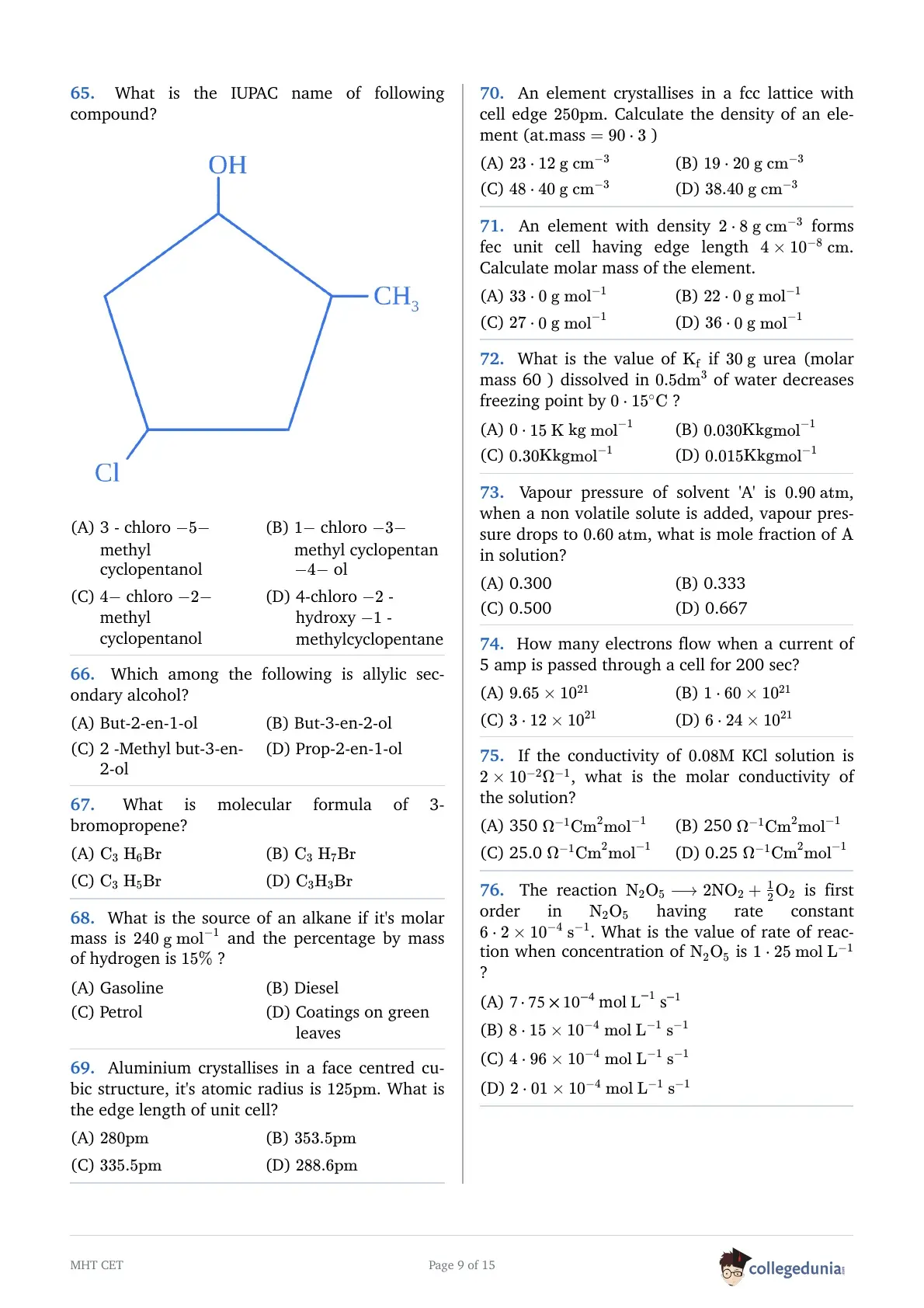
The IUPAC name of isobutyl bromide is
What is IUPAC name of acrolein?

What is the molecular formula of 3-bromopropene?
What is the source of an alkane if its molar mass is 240 g mol\(^{-1}\) and the percentage by mass of hydrogen is 15%?
Aluminium crystallises in a face-centred cubic structure, its atomic radius is 125 pm. What is the edge length of unit cell?
An element crystallizes in a fcc lattice with cell edge 250 pm. Calculate the density of an element (at mass = 90.3).
What is the value of \( K_f \) if 30 g urea (molar mass 60) dissolved in 0.5 dm³ of water decreases freezing point by 0.15°C?
Vapour pressure of solvent 'A' is 0.90 atm, when a non-volatile solute is added, vapour pressure drops to 0.60 atm. What is mole fraction of A in solution?
How many electrons flow when a current of 5 amp is passed through a cell for 200 sec?
If the conductivity of 0.08 M KCl solution is \( 2 \times 10^{-3} \, \Omega^{-1} \, \text{cm}^2 \, \text{mol}^{-1} \), what is the molar conductivity of the solution?
The rate constant for first order reaction is 0.02232 min\(^{-1}\). Calculate the time required for 75% completion of the reaction.
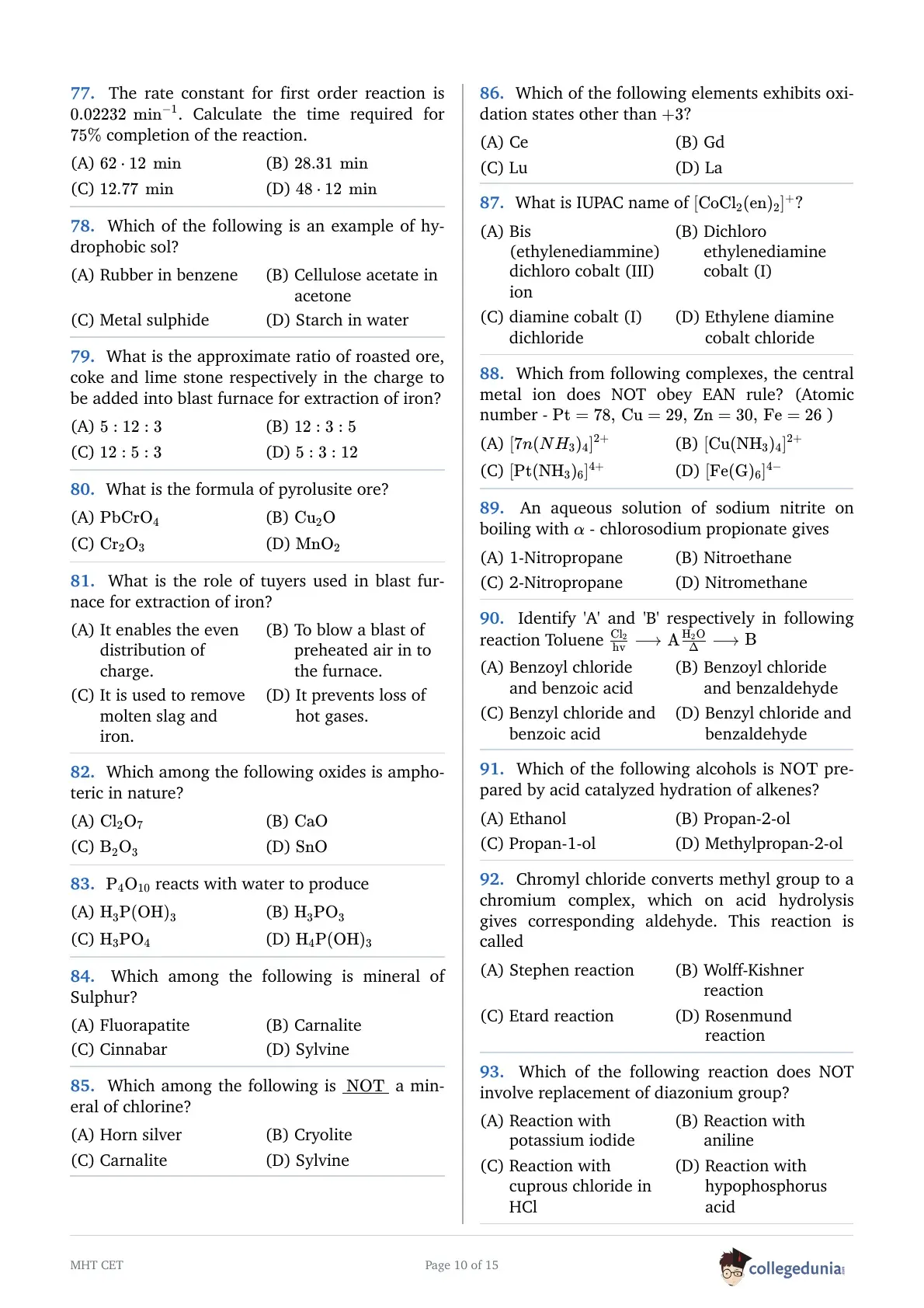
What is the approximate ratio of roasted ore, coke, and lime stone respectively in the charge to be added into the blast furnace for extraction of iron?
What is the formula of pyrolusite ore?
What is the role of tuyères used in blast furnace for extraction of iron?
Which among the following oxides is amphoteric in nature?
P\(_4\)O\(_{10}\) reacts with water to produce
Which among the following is a mineral of Sulphur?
Which of the following elements exhibits oxidation states other than +3?
What is IUPAC name of \([ \text{CoCl}_2 (\text{en})_2 ]^+ \)?
Which from the following complexes, the central metal ion does NOT obey the EAN rule?
(Atomic number = Pt = 78, Cu = 29, Zn = 30, Fe = 26)
An aqueous solution of sodium nitrite on boiling with \( \alpha \)-chlorosodium propionate gives
Identify 'A' and 'B' respectively in following reaction Toluene \(\frac{\mathrm{Cl}_{2}}{\mathrm{hv}}\longrightarrow \mathrm{A}\frac{\mathrm{H}_{2}\mathrm{O}}{\Delta }\longrightarrow \mathrm{B}\)
Which of the following alcohols is NOT prepared by acid-catalyzed hydration of alkenes?
Chromyl chloride converts methyl group to a chromium complex, which on acid hydrolysis gives corresponding aldehyde. This reaction is called
Which of the following reactions does NOT involve replacement of diazonium group?
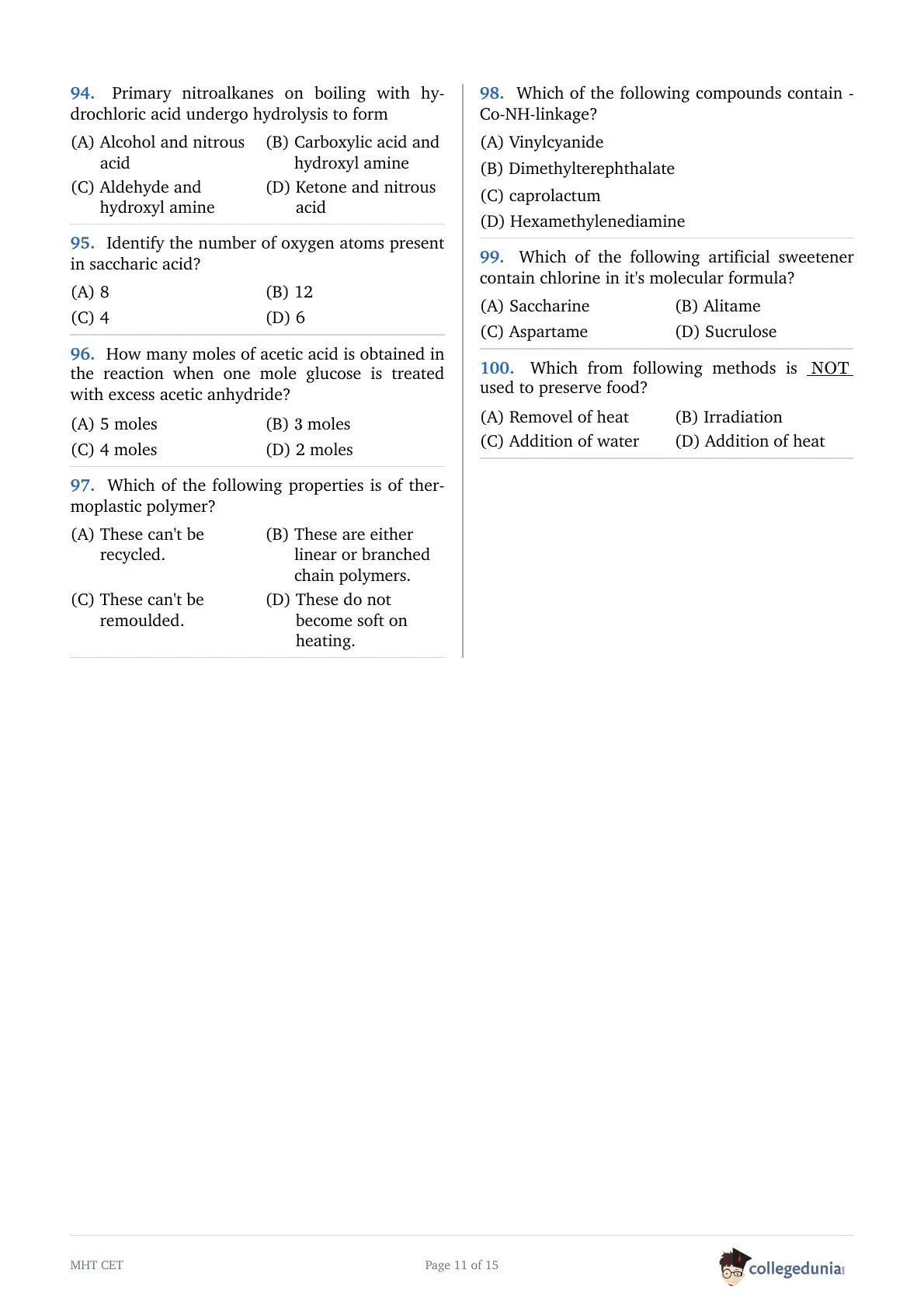
Primary nitroalkanes on boiling with hydrochloric acid undergo hydrolysis to form
Identify the number of oxygen atoms present in saccharic acid.
How many moles of acetic acid are obtained in the reaction when one mole glucose is treated with excess acetic anhydride?
Which of the following properties is of thermoplastic polymer?
Which of the following compounds contain \(-\text{CO}-\text{NH}-\) linkage?
Which of the following artificial sweeteners contain chlorine in its molecular formula?
Which from the following methods is NOT used to preserve food?
Mathematics (Q101 - Q150)
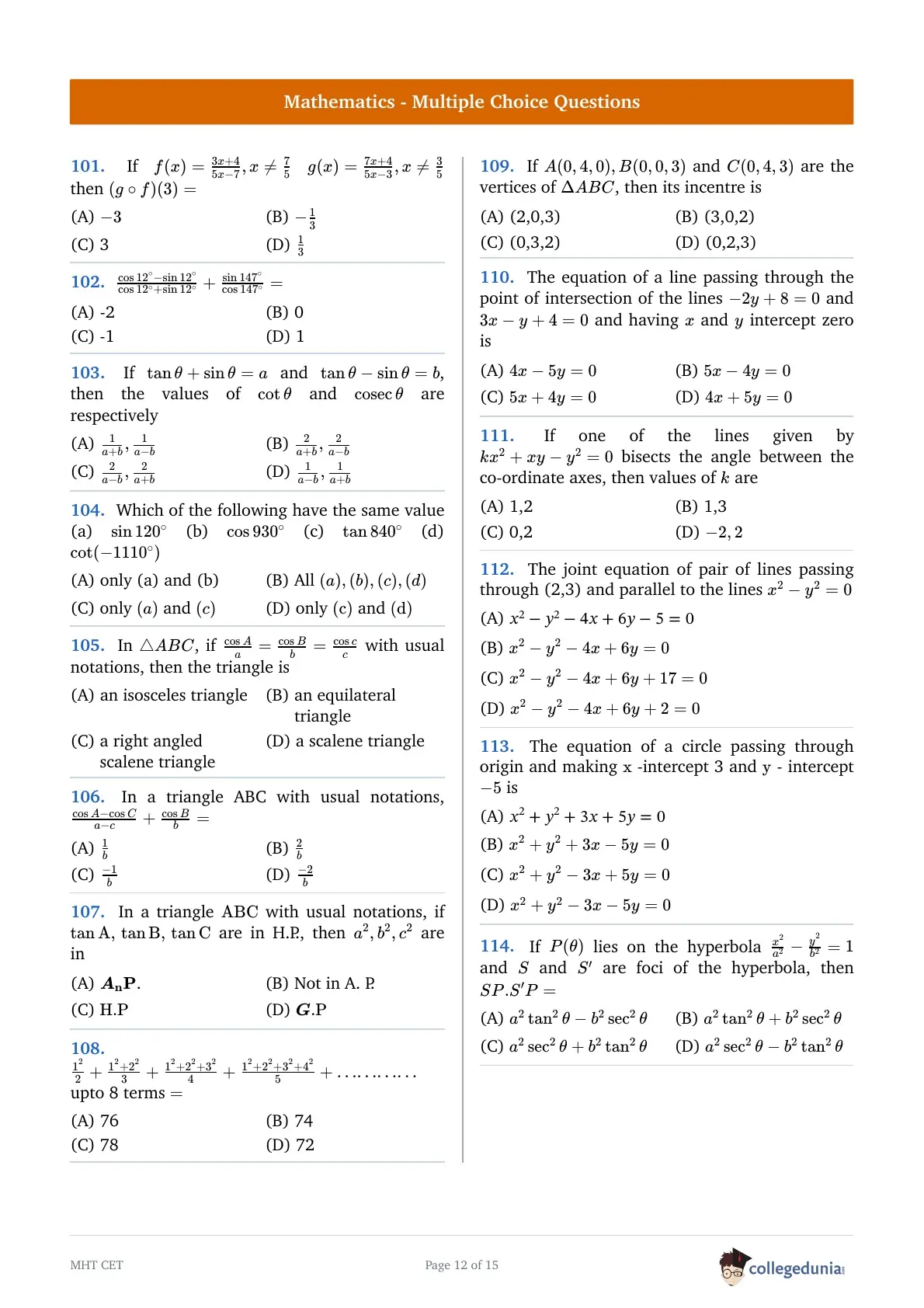
If \(f(x)=\frac{3x+4}{5x-7},x\neq \frac{7}{5}\) \(g(x)=\frac{7x+4}{5x-3},x\neq \frac{3}{5}\) then \((g\circ f)(3)=\)
\(\frac{\cos 12^{\circ }-\sin 12^{\circ }}{\cos 12^{\circ }+\sin 12^{\circ }}+\frac{\sin 147^{\circ }}{\cos 147^{\circ }}=\)
If \( \tan \theta + \sin \theta = a \) and \( \tan \theta - \sin \theta = b \), then the values of \( \cot \theta \) and \( \csc \theta \) are respectively:
Which of the following have the same value:
(a) \( \sin 120^\circ \)
(b) \( \cos 930^\circ \)
(c) \( \tan 840^\circ \)
(d) \( \cot(-1110^\circ) \)
In \( \triangle ABC \), if \( \frac{\cos A}{a} = \frac{\cos B}{b} = \frac{\cos C}{c} \) with usual notations, then the triangle is:
In a triangle ABC with usual notations, \(\frac{\cos A-\cos C}{a-c}+\frac{\cos B}{b}=\)
In a triangle \(ABC\) with usual notations, if \(\tan A,\tan B,\tan C\) are in H.P., then \(a^2,b^2,c^2\) are in
\(\frac{1^{2}}{2}+\frac{1^{2}+2^{2}}{3}+\frac{1^{2}+2^{2}+3^{2}}{4}+\frac{1^{2}+2^{2}+3^{2}+4^{2}}{5}+\ldots \ldots \ldots \ldots\) upto 8 terms \(=\)
If \( A(0, 4, 0) \), \( B(0, 0, 3) \), and \( C(0, 4, 3) \) are the vertices of \( \Delta ABC \), then its incenter is:
The equation of a line passing through the point of intersection of the lines \(-2y+8=0\) and \(3x-y+4=0\) and having \(x\) and \(y\) intercept zero is
If one of the lines given by \( kx^2 + xy - y^2 = 0 \) bisects the angle between the co-ordinate axes, then values of \( k \) are:
The joint equation of a pair of lines passing through \((2,3)\) and parallel to the lines
\[
x^2 - y^2 = 0
\]
is
The equation of a circle passing through the origin and making x-intercept 3 and y-intercept -5 is:
If \( P(\theta) \) lies on the hyperbola \( \frac{x^2}{a^2} - \frac{y^2}{b^2} = 1 \) and \( S \) and \( S' \) are foci of the hyperbola, then \( SP \cdot SP' = \)
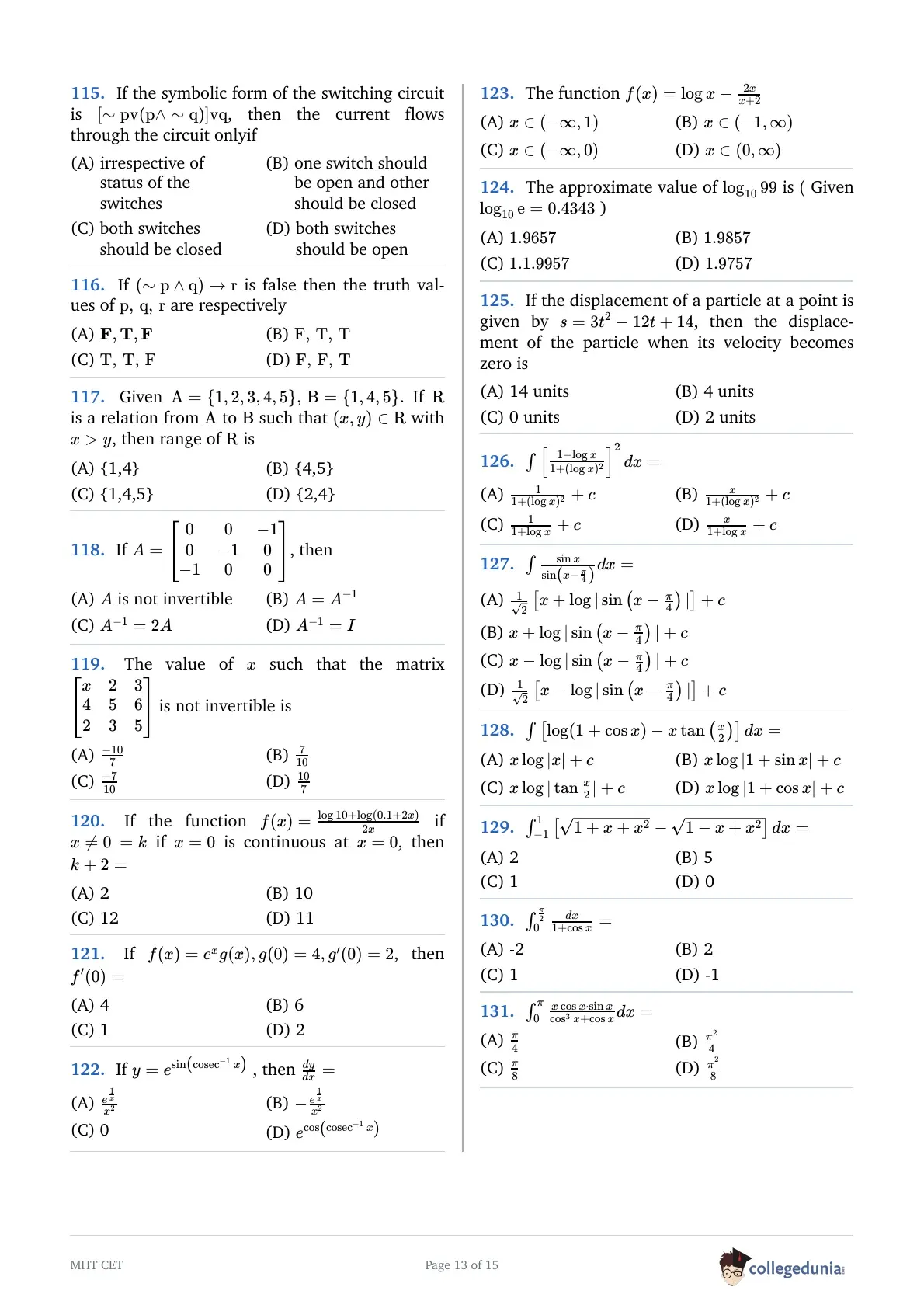
If the symbolic form of the switching circuit is \( \sim p \vee ( p \wedge \sim q) \vee q \), then the current flows through the circuit only if:
If \((\sim p \wedge q)\rightarrow r\) is false, then the truth values of \(p,q,r\) respectively are
Given \(A = \{1,2,3,4,5\}\), \(B = \{1,4,5\}\). If \(R\) is a relation from \(A\) to \(B\) such that \((x,y) \in R\) with \(x>y\), then the range of \(R\) is
If \(A=\begin{bmatrix} 0 & 0 & -1 \\ 0 & -1 & 0 \\ -1 & 0 & 0 \end{bmatrix}\), then
The value of \(x\) such that the matrix \(\begin{bmatrix} x & 2 & 3 \\ 4 & 5 & 6 \\ 2 & 3 & 5 \end{bmatrix}\) is not invertible is
If the function \(f(x)=\frac{\log 10+\log (0.1+2x)}{2x}\) if \(x\neq 0\) \(=k\) if \(x=0\) is continuous at \(x=0\), then \(k+2=\)
If \( f(x) = e^{x}g(x) \), \( g(0) = 4 \), and \( g'(0) = 2 \), then \( f'(0) = \)
If \( y = e^{\sin(\cosec^{-1}x)} \), then \( \dfrac{dy}{dx} \) is
The function \( f(x) = \log x - \frac{2x}{x+2} \) is increasing for all:
The approximate value of \( \log_{10}99 \) is (Given \( \log_{10}e = 0.4343 \))
If the displacement of a particle at time \(t\) is given by
\[
s = 3t^2 - 12t + 14,
\]
then the displacement of the particle when its velocity becomes zero is
\(\int \left[\frac{1-\log x}{1+(\log x)^{2}}\right]^{2}dx=\)
\(\int \frac{\sin x}{\sin \left(x-\frac{\pi }{4}\right)}dx=\)
\(\int \left[\log (1+\cos x)-x\tan \left(\frac{x}{2}\right)\right]dx=\)
\(\int _{-1}^{1}\left[\sqrt{1+x+x^{2}}-\sqrt{1-x+x^{2}}\right]dx=\)
\(\int _{0}^{\frac{\pi }{2}}\frac{dx}{1+\cos x}=\)
\(\int _{0}^{\pi }\frac{x\cos x\cdot \sin x}{\cos ^{3}x+\cos x}dx=\)
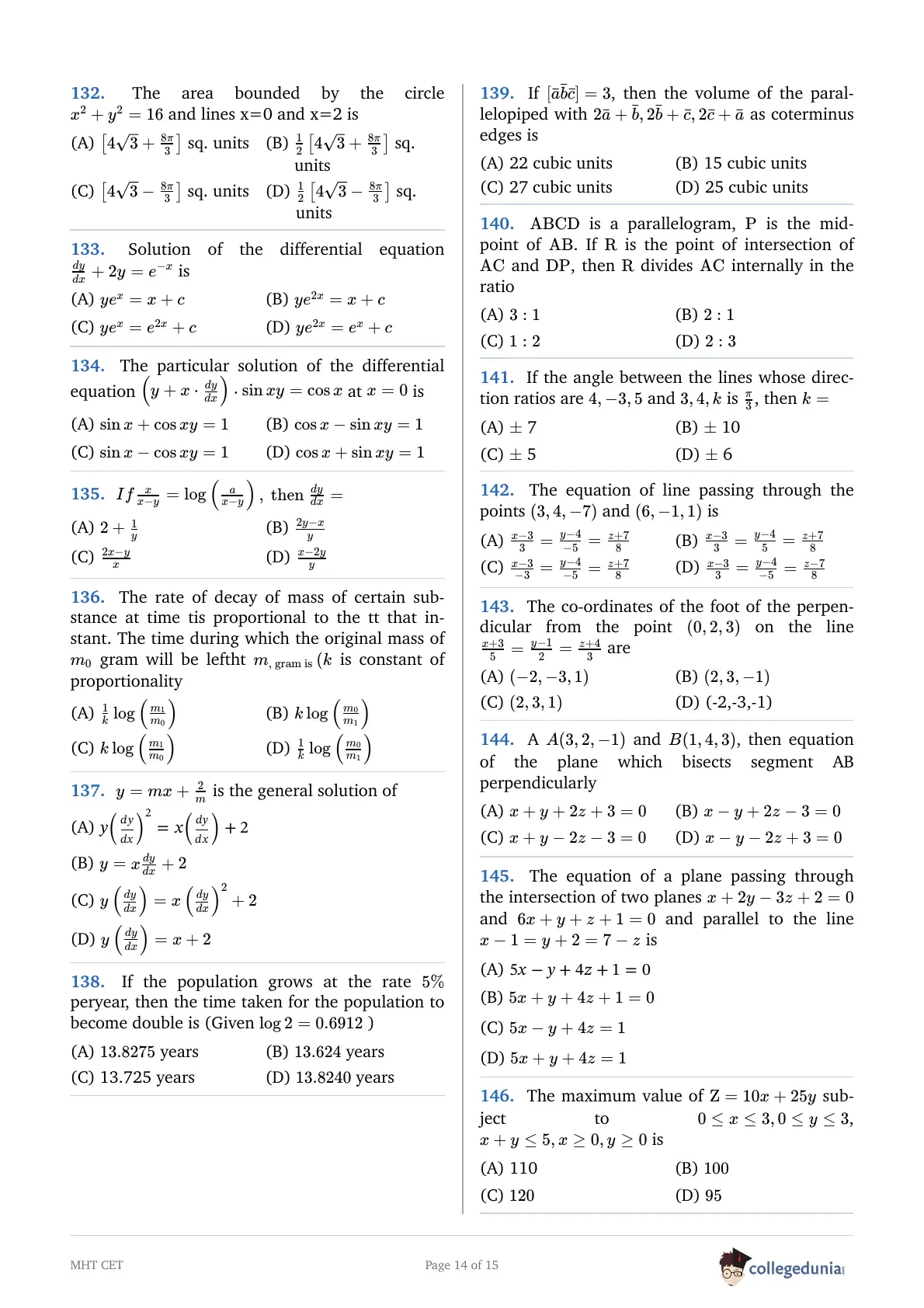
The area bounded by the circle \(x^2 + y^2 = 16\) and the lines \(x = 0\) and \(x = 2\) is
Solution of the differential equation \(\frac{dy}{dx}+2y=e^{-x}\) is
The particular solution of the differential equation \(\left(y+x\cdot \frac{dy}{dx}\right)\cdot \sin xy=\cos x\) at \(x=0\) is
If \( \frac{x}{x-y} = \log \left( \frac{a}{x-y} \right) \), then \( \frac{dy}{dx} = \)
The rate of decay of mass of certain substance at time tis proportional to the tt that instant. The time during which the original mass of \(m_{0}\) gram will be leftht \(m_{\text{, gram is }}(k\) is constant of proportionality
\(y = mx + \dfrac{2}{m}\) is the general solution of
If the population grows at the rate of 5% per year, the time taken for the population to become double is (Given \( \log 2 = 0.6912 \))
If \( | \vec{a} \, \vec{b} \, \vec{c} | = 3 \), then the volume of the parallelepiped with \( 2\vec{a} + \vec{b} \), \( 2\vec{b} + \vec{c} \), \( 2\vec{c} + \vec{a} \) as coterminous edges is:
ABCD is a parallelogram. \(P\) is the midpoint of \(AB\). If \(R\) is the point of intersection of \(AC\) and \(DP\), then \(R\) divides \(AC\) internally in the ratio
If the angle between the lines whose direction ratios are \( 4, -3, 5 \) and \( 3, 4, k \) is \( \frac{\pi}{3} \), then \( k = \)
The equation of the line passing through the points \( (3, 4, -7) \) and \( (6, -1, 1) \) is:
The co-ordinates of the foot of the perpendicular from the point \((0,2,3)\) on the line \(\frac{x+3}{5}=\frac{y-1}{2}=\frac{z+4}{3}\) are
If \(A(3,2,-1)\) and \(B(1,4,3)\), then the equation of the plane which bisects the segment \(AB\) perpendicularly is
The equation of a plane passing through the intersection of the planes
\(x + 2y - 3z + 2 = 0\) and \(6x + y + z + 1 = 0\) and parallel to the line
\(x - 1 = y + 2 = 7 - z\) is
The maximum value of \(\mathrm{Z}=10x+25y\) subject to \(0\leq x\leq 3,0\leq y\leq 3\), \(x+y\leq 5,x\geq 0,y\geq 0\) is
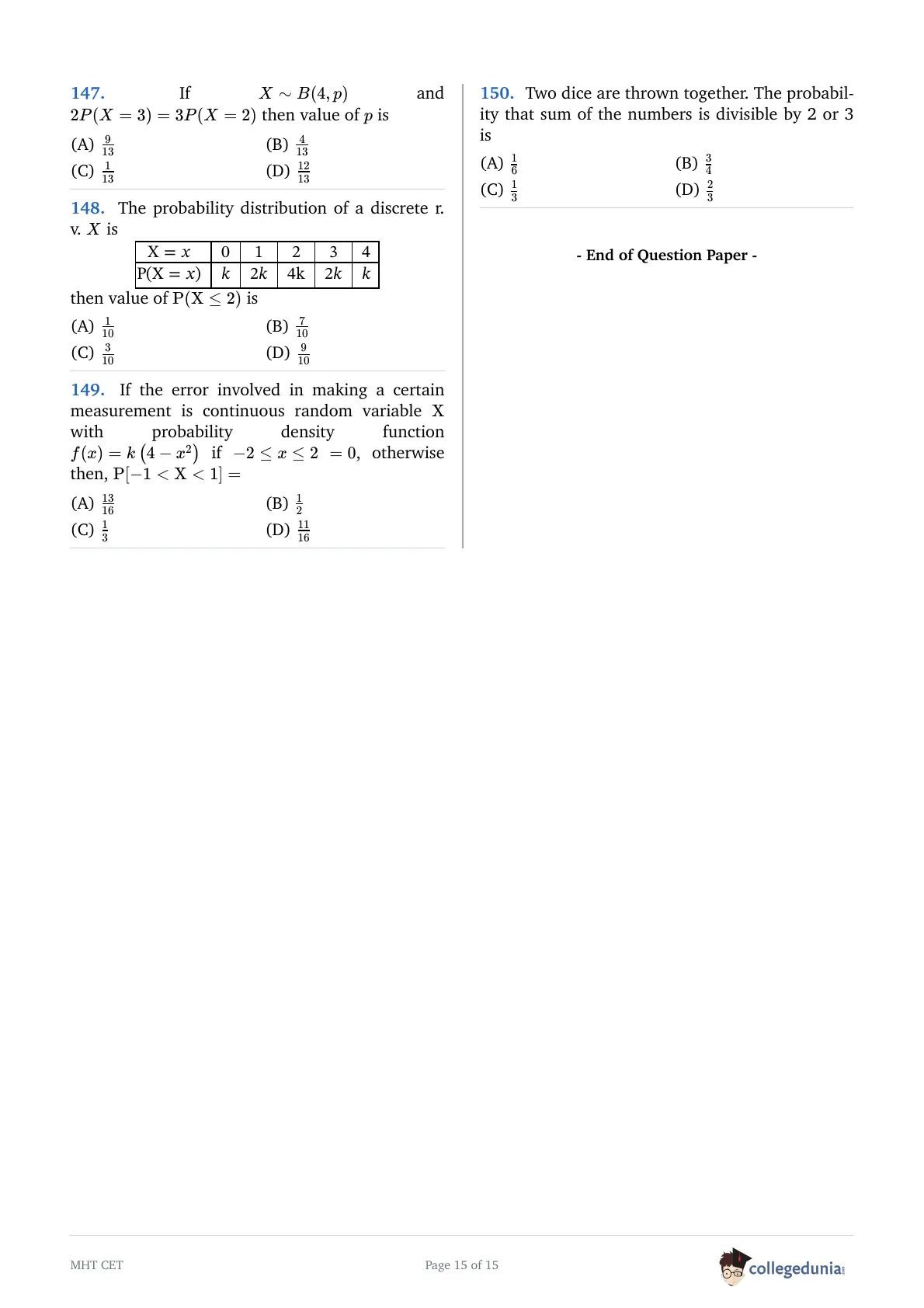
If \( X \sim B(4, p) \) and \( 2 P(X = 3) = 3 P(X = 2) \), then the value of \( p \) is:
The probability distribution of a discrete r. v. \(X\) is \(\begin{array}{|c|c|c|c|c|c|} \hline \mathrm{X}=x & 0 & 1 & 2 & 3 & 4 \\ \hline \mathrm{P}(\mathrm{X}=x) & k & 2k & 4\mathrm{k} & 2k & k \\ \hline \end{array}\) then value of \(\mathrm{P}(\mathrm{X}\leq 2)\) is
If the error involved in making a certain measurement is continuous random variable \( X \) with probability density function \( f(x) = k (4 - x^2) \) for \( -2 \leq x \leq 2 \), and \( f(x) = 0 \) otherwise, then
\[
P(|-1<X<1|)
\]
Two dice are thrown together. The probability that the sum of the numbers is divisible by 2 or 3 is
MHT CET 2020 PCM Exam Pattern and Marking Scheme
| Parameter | Details |
|---|---|
| Conducting Body | Maharashtra Common Entrance Test Cell (Maharashtra CET Cell) |
| Exam Mode | Online (Computer-Based Test) |
| Duration | 180 minutes (3 hours) |
| Groups / Subjects | PCM (Physics, Chemistry, Mathematics) for Engineering |
| Total Questions |
150 |
| Total Marks | 200 |
| Question Type | Multiple Choice Questions (MCQs) |
| Marks Distribution |
|
| Negative Marking | No |
| Syllabus Weightage |
|



Comments