




MHT CET 2020 Oct 15 Shift 1 PCM Question Paper is available for download here. Maharashtra State CET Cell conducted MHT CET 2020 PCM Exam on Oct 15 in Shift 1 from 9 AM to 12 PM in CBT mode.
The MHT CET 2020 PCM question paper includes the following:
- The MHT CET 2020 PCM Question Paper consists of 150 multiple-choice questions (MCQs) totalling 200 marks divided into 3 sections: Physics, Chemistry, and Mathematics, with 50 questions in each subject.
- Physics and Chemistry questions carry 1 mark each while Mathematics questions carry 2 marks each.
- There is no negative marking for incorrect answers.
MHT CET 2020 Oct 15 Shift 1 PCM Question Paper with Solution PDF
| CD PDF | CD PDF with Solutions |
|---|---|
| Download Collegedunia PDF 2.06 MB | - |
Also Check:
MHT CET 2020 Oct 15 Shift 1 PCM Questions with Solutions
Physics (Q1 - Q50)
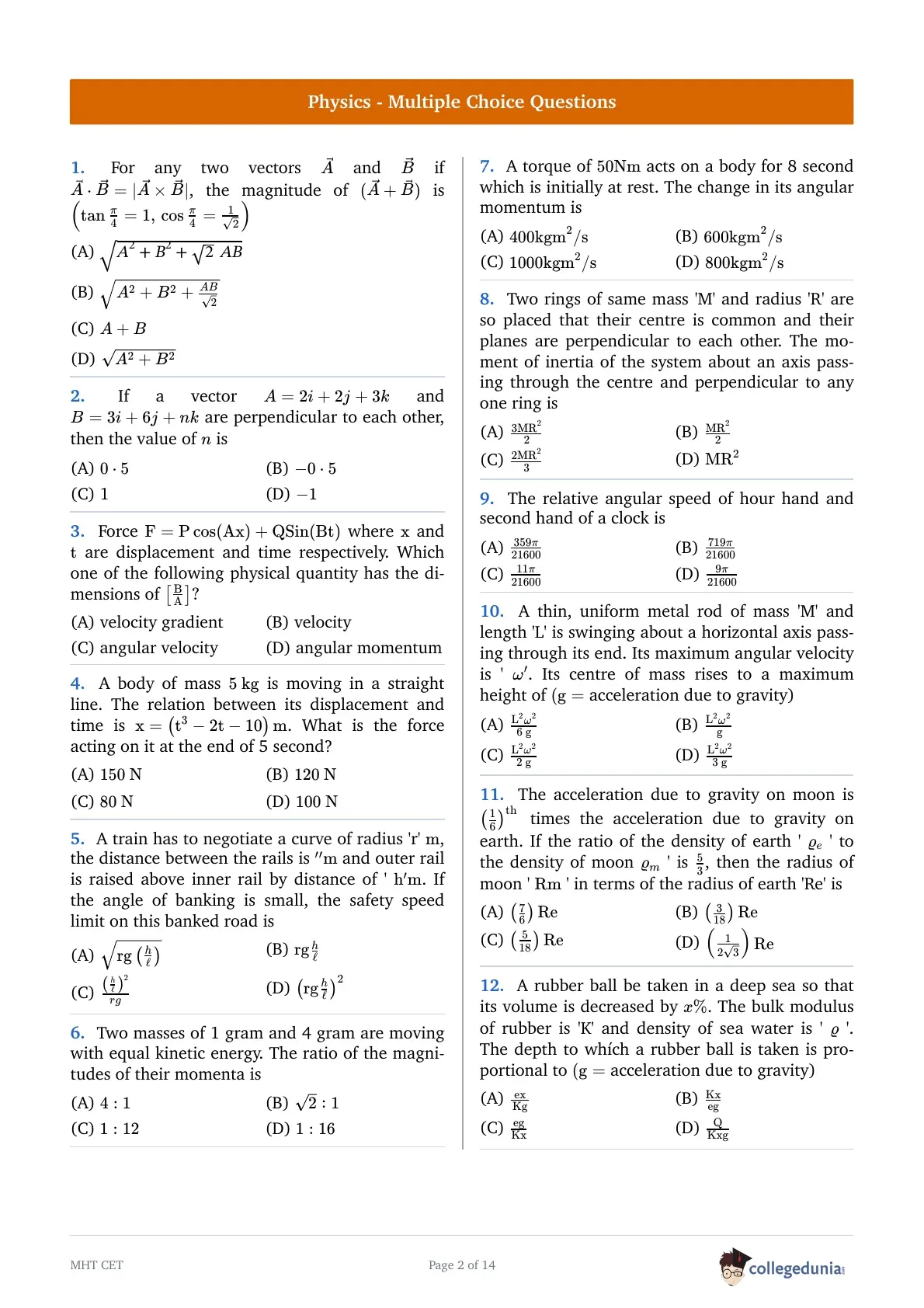
For any two vectors \( \mathbf{A} \) and \( \mathbf{B} \) if \( \mathbf{A} \cdot \mathbf{B} = |\mathbf{A}| |\mathbf{B}| \cos \theta \), the magnitude of \( (\mathbf{A} + \mathbf{B}) \) is (given \( \tan \theta = 1 \), \( \cos \theta = \frac{1}{\sqrt{2}} \))
Force \( F = P \cos(Ax) + Q \sin(Bt) \), where \( x \) and \( t \) are displacement and time respectively. Which one of the following physical quantity has the dimensions of \( \frac{[B]}{[A]} \)?
A body of mass 5 kg is moving in a straight line. The relation between its displacement and time is \( x = (t^3 - 2t - 10) \) m. What is the force acting on it at the end of 5 seconds?
A train has to negotiate a curve of radius \( r \) m, the distance between the rails is \( \ell \) m and outer rail is raised above inner rail by distance of \( h \) m. If the angle of banking is small, the safety speed limit on this banked road is
Two masses of 1 gram and 4 gram are moving with equal kinetic energy. The ratio of the magnitudes of their momenta is
A torque of 50 Nm acts on a body for 8 seconds which is initially at rest. The change in its angular momentum is
Two rings of same mass \( M \) and radius \( R \) are so placed that their centre is common and their planes are perpendicular to each other. The moment of inertia of the system about an axis passing through the centre and perpendicular to any one ring is
The relative angular speed of hour hand and second hand of a clock is
A thin, uniform metal rod of mass \( M \) and length \( L \) is swinging about a horizontal axis passing through its end. Its maximum angular velocity is \( \omega \). Its centre of mass rises to a maximum height of \( \frac{L^2 \omega^2}{6g} \). (where \( g \) is the acceleration due to gravity)
The acceleration due to gravity on moon is \( \frac{1}{6} \)th times the acceleration due to gravity on earth. If the ratio of the density of earth \( \rho_e \) to the density of moon \( \rho_m \) is \( \frac{5}{3} \), then the radius of moon \( R_m \) in terms of the radius of earth \( R_e \) is
A rubber ball be taken in a deep sea so that its volume is decreased by \( x %\). The bulk modulus of rubber is \( K \) and density of sea water is \( \rho \). The depth to which a rubber ball is taken is proportional to
A transverse wave is travelling with velocity \( V \) through a metal wire of length \( L \) and density \( \rho \). The tensile stress in the wire is
In a sphere of influence, the liquid molecule at its centre is
A metal sphere of mass \( m \) and density \( \sigma_1 \) falls with terminal velocity through a container containing liquid. The density of liquid is \( \sigma_2 \). The viscous force acting on the sphere is
Water rises to height 2.2 cm in glass capillary tube. The height to which same water rises in another capillary having \( \frac{1}{4} \)th area of cross-section is
A steel wire of length \( L \) and area of cross-section \( A \) is suspended from rigid support. If \( Y \) is the Young's modulus of material of the wire and \( \alpha \) is the coefficient of linear expansion, then the increase in tension when temperature falls by \( t^\circ C \) is
If \( \Delta Q \) is the amount of heat supplied to \( n \) moles of a diatomic gas at constant pressure, \( \Delta U \) is the change in internal energy and \( \Delta W \) is the work done, then \( \Delta W : \Delta U : \Delta Q \) is
The quantity \( \frac{pV}{kT} \) represents (where \( k \) is the Boltzmann constant)
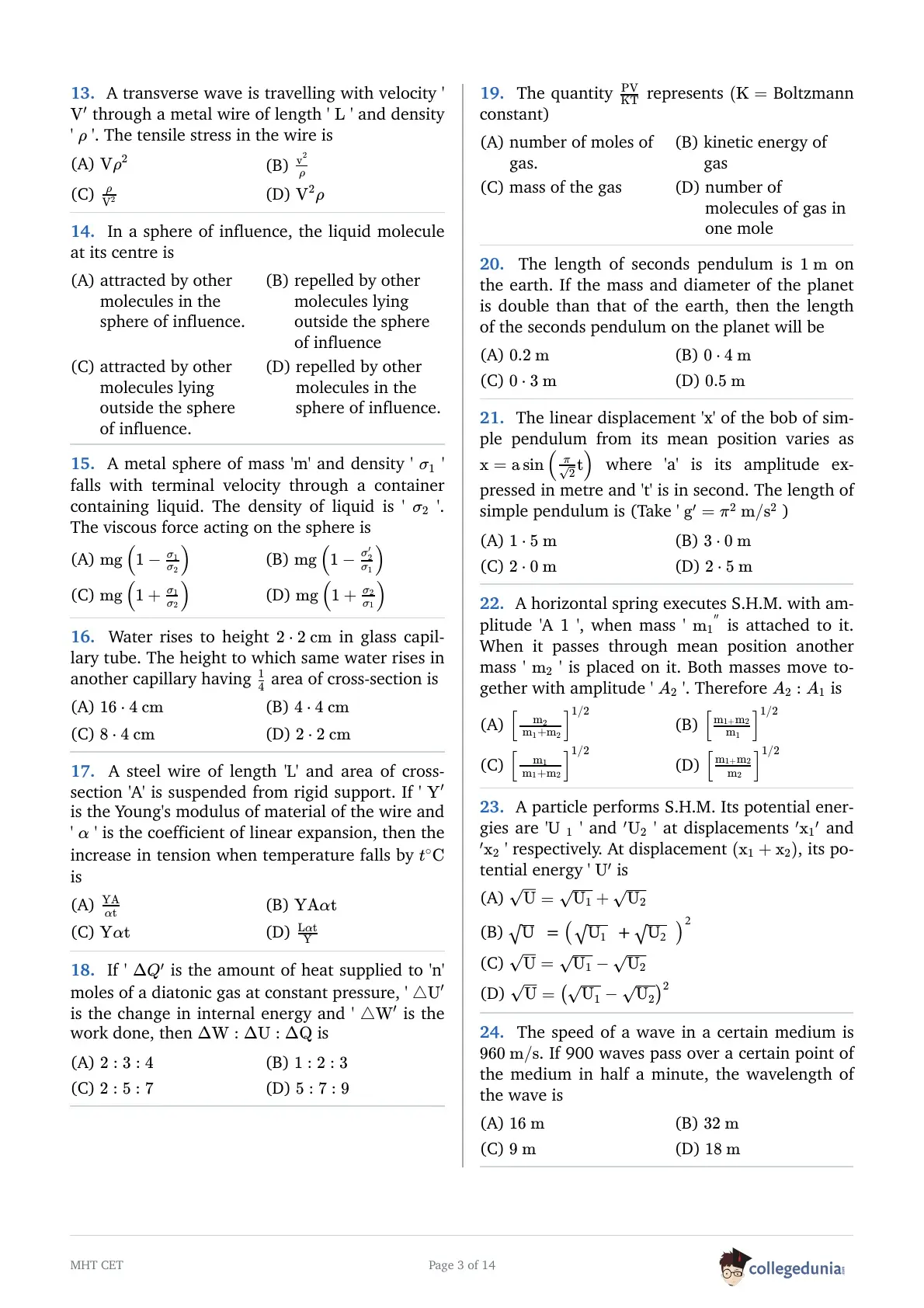
The linear displacement \( x \) of the bob of simple pendulum from its mean position varies as \( x = a \sin \left( \frac{\pi}{2} t \right) \), where \( a \) is its amplitude expressed in meter and \( t \) is in second. The length of simple pendulum is (Take \( g = \pi^2 \, \text{m/s}^2 \))
A horizontal spring executes S.H.M. with amplitude \( A_1 \), when mass \( m_1 \) is attached to it. When it passes through mean position, another mass \( m_2 \) is placed on it. Both masses move together with amplitude \( A_2 \). Therefore \( A_2 : A_1 \) is
A particle performs S.H.M. Its potential energies are \( U_1 \) and \( U_2 \) at displacements \( x_1 \) and \( x_2 \) respectively. At displacement \( x_1 + x_2 \), its potential energy \( U \) is
The speed of a wave in a certain medium is 960 m/s. If 900 waves pass over a certain point of the medium in half a minute, the wavelength of the wave is
The equation of vibration of a stretched string fixed at both ends and vibrating in 5th harmonic is \( Y = 3 \sin(0.4x) \cos(200\pi t) \), where \( x \) and \( Y \) are in cm and \( t \) in seconds. The length of the string is
A capacitor of unknown capacitance \( C \) is connected across a battery of \( V \) volt. The charge stored in it becomes \( Q \) coulomb. When potential across the capacitor is reduced by \( V' \) volt, the charge stored in it becomes \( Q' \) coulomb. The capacitance \( C \) is
A parallel plate capacitor has uniform electric field \( E \) in the space between the plates. If the distance between plates is \( d \) and area of each plate is \( A \), the energy stored in the capacitor is \( \epsilon_0 \) = permittivity of free space
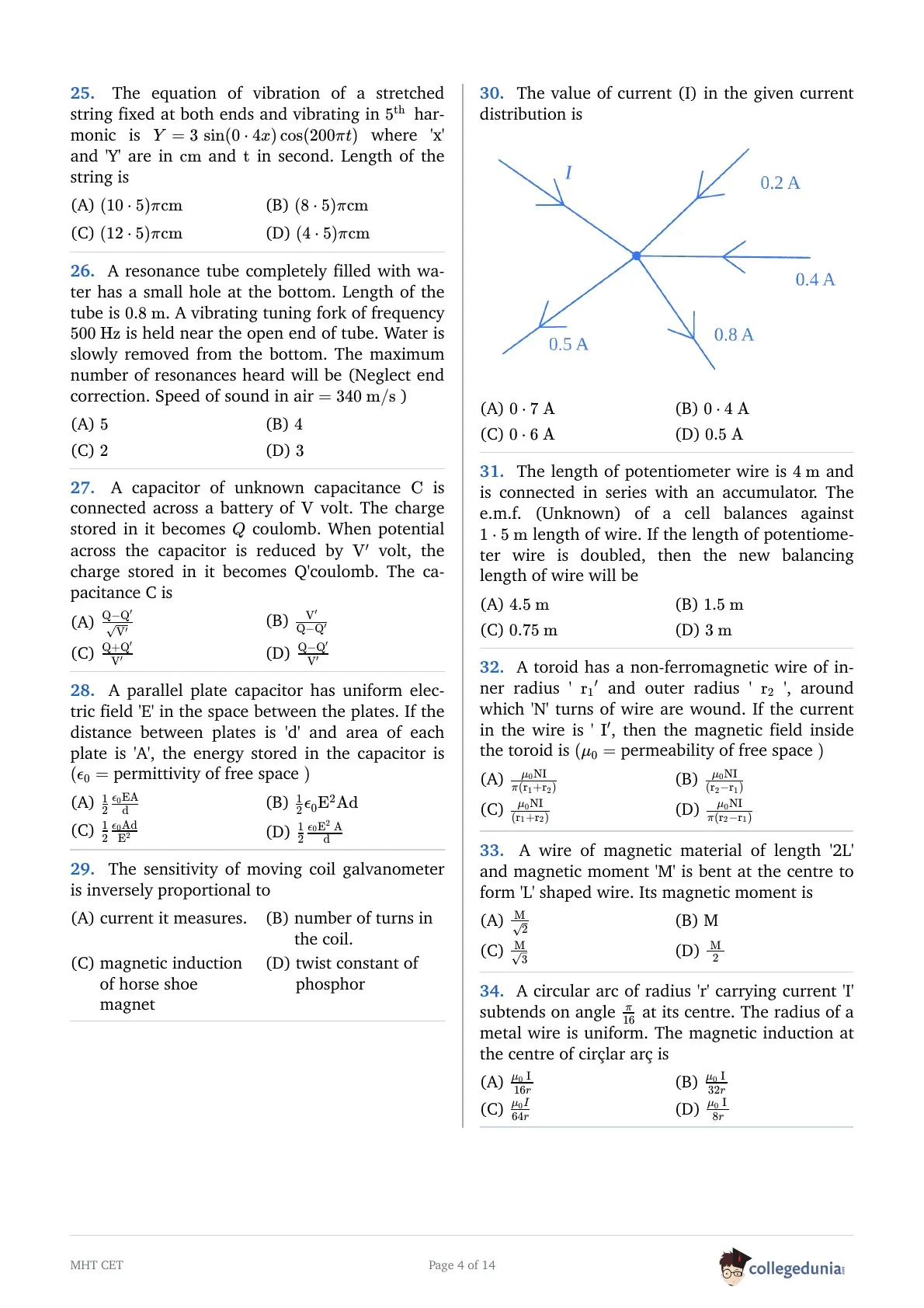
The value of current \( I \) in the given current distribution is

The length of potentiometer wire is 4m and is connected in series with an accumulator. The e.m.f. (unknown) of a cell balances against 1.5 m length of wire. If the length of potentiometer wire is doubled, then the new balancing length of wire will be
A toroid has a non-ferromagnetic wire of inner radius \( r_1 \) and outer radius \( r_2 \), around which \( N \) turns of wire are wound. If the current in the wire is \( I \), then the magnetic field inside the toroid is
A wire of magnetic material of length \( 2L \) and magnetic moment \( M \) is bent at the centre to form 'L' shaped wire. Its magnetic moment is
A circular arc of radius \( r \) carrying current \( I \) subtends an angle \( \frac{\pi}{16} \) at its centre. The radius of a metal wire is uniform. The magnetic induction at the centre of circular arc is
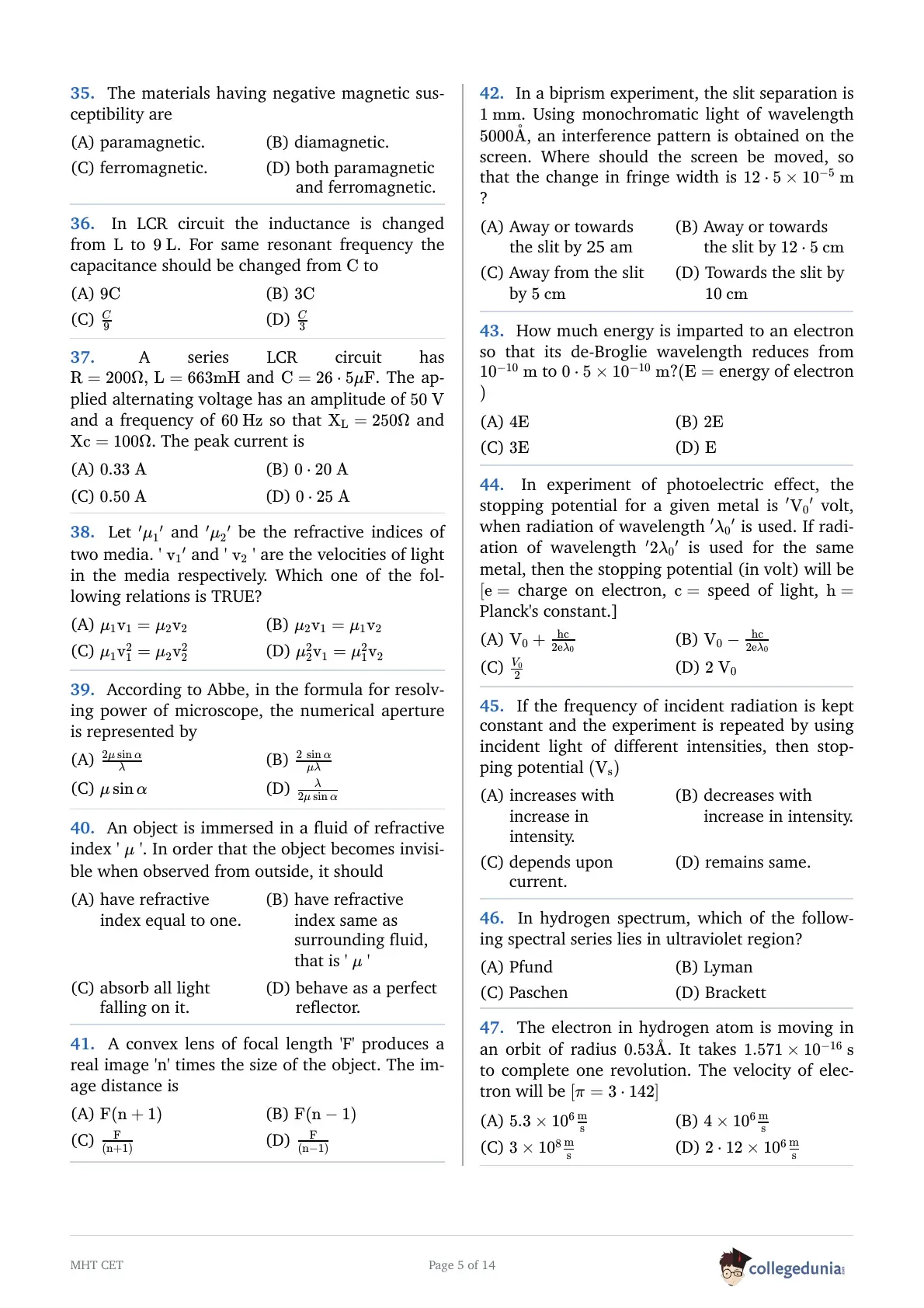
The materials having negative magnetic susceptibility are
In an LCR circuit the inductance is changed from \( L \) to \( 9L \). For the same resonant frequency, the capacitance should be changed from \( C \) to
A series LCR circuit has \( R = 200 \, \Omega \), \( L = 663 \, \text{mH} \), and \( C = 265 \, \mu\text{F} \). The applied alternating voltage has an amplitude of 50 V and a frequency of 60 Hz so that \( X_L = 250 \, \Omega \) and \( X_C = 100 \, \Omega \). The peak current is
Let \( \mu_1 \) and \( \mu_2 \) be the refractive indices of two media. \( v_1 \) and \( v_2 \) are the velocities of light in the media respectively. Which one of the following relations is TRUE?
According to Abbe, in the formula for resolving power of microscope, the numerical aperture is represented by
An object is immersed in a fluid of refractive index \( \mu \). In order that the object becomes invisible when observed from outside, it should
A convex lens of focal length \( F \) produces a real image \( n \) times the size of the object. The image distance is
In a biprism experiment, the slit separation is 1 mm. Using monochromatic light of wavelength 5000Å, an interference pattern is obtained on the screen. Where should the screen be moved, so that the change in fringe width is \( 12.5 \times 10^{-5} \, \text{m} \)?
How much energy is imparted to an electron so that its de-Broglie wavelength reduces from \( 10^{-10} \) m to \( 0.5 \times 10^{-10} \) m?
In experiment of photoelectric effect, the stopping potential for a given metal is \( V_0 \) volt, when radiation of wavelength \( \lambda_0 \) is used. If radiation of wavelength \( 2\lambda_0 \) is used for the same metal, then the stopping potential (in volts) will be
If the frequency of incident radiation is kept constant and the experiment is repeated by using incident light of different intensities, then stopping potential (\( V_s \))
In hydrogen spectrum, which of the following spectral series lies in ultraviolet region?
The electron in hydrogen atom is moving in an orbit of radius 0.53 Å. It takes \( 1.571 \times 10^{-16} \, \text{s} \) to complete one revolution. The velocity of electron will be
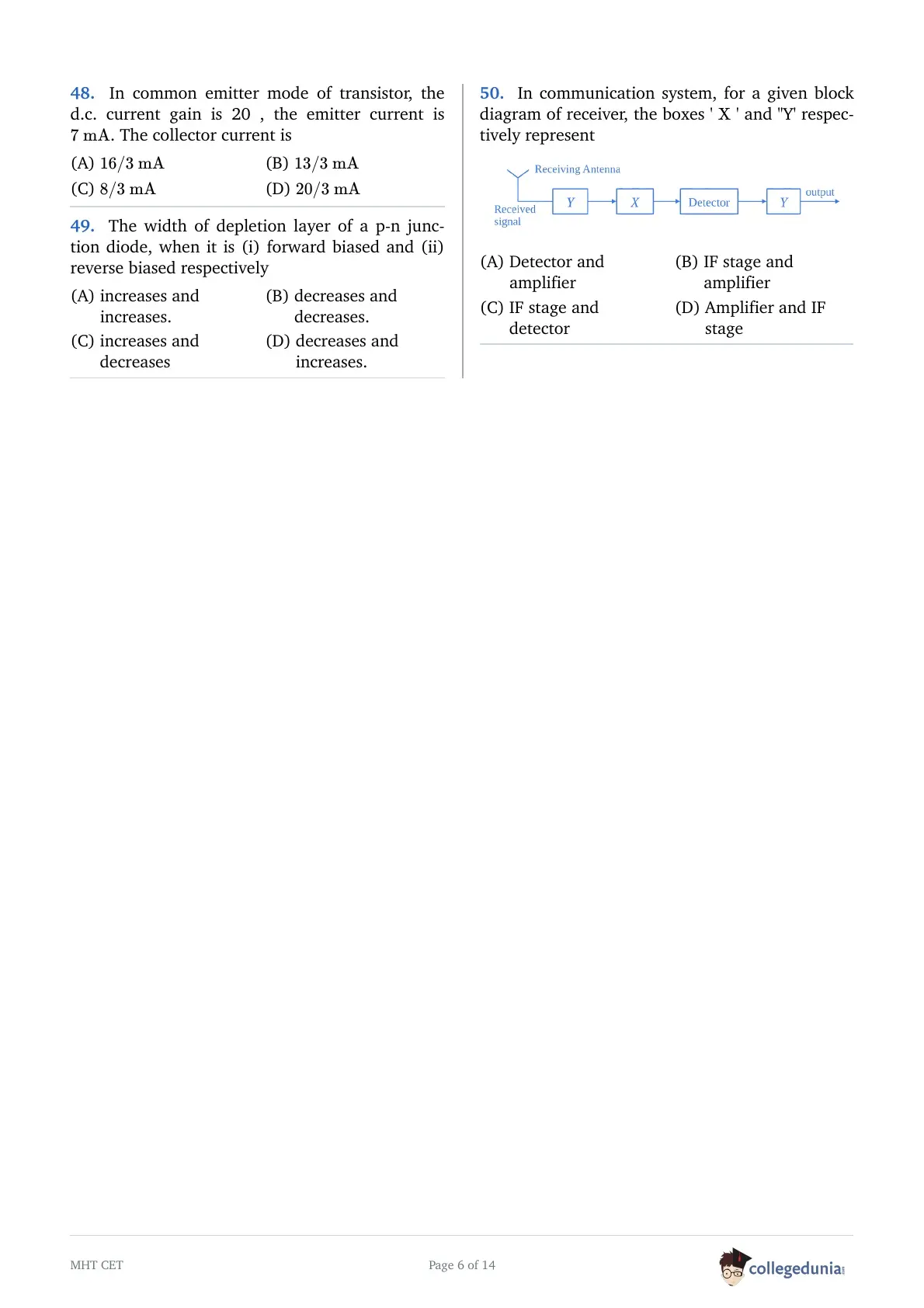
In common emitter mode of transistor, the d.c. current gain is 20, the emitter current is 7 mA. The collector current is
The width of the depletion layer of a p-n junction diode, when it is (i) forward biased and (ii) reverse biased respectively
In communication system, for a given block diagram of receiver, the boxes 'X' and 'Y' respectively represent

Chemistry (Q51 - Q100)
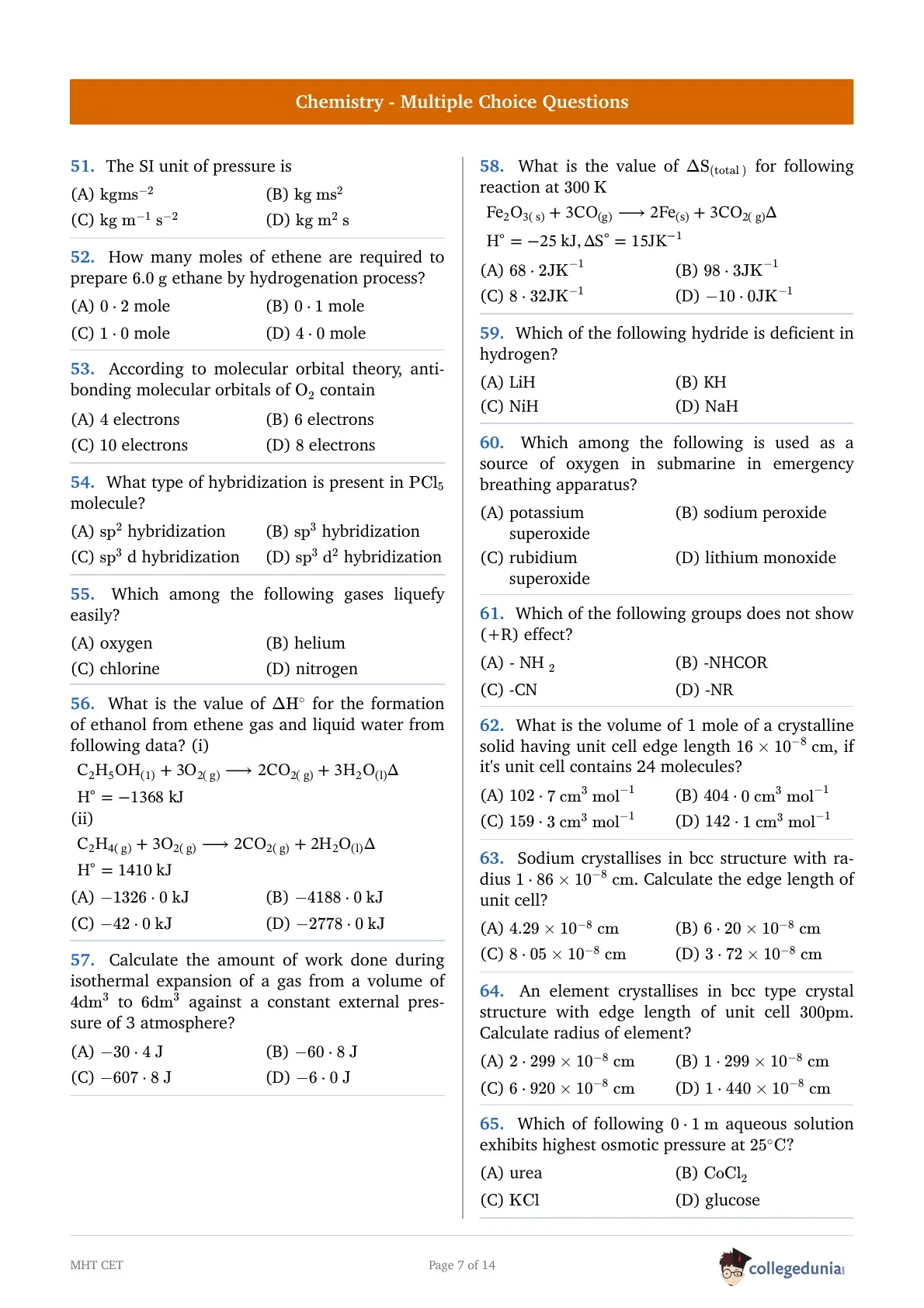
The SI unit of pressure is
How many moles of ethene are required to prepare 6 g of ethane by hydrogenation process?
What type of hybridization is present in PCl\(_5\) molecule?
Which among the following gases liquefy easily?
Calculate the amount of work done during isothermal expansion of a gas from a volume of 4 dm\(^3\) to 6 dm\(^3\) against a constant external pressure of 3 atmosphere.
What is the value of \(\Delta \mathrm{S}_{(\text{total })}\) for following reaction at \(300\ \mathrm{K}\) \(\mathrm{Fe}_{2}\mathrm{O}_{3(\ \mathrm{s})}+3\mathrm{CO}_{(\mathrm{g})}\longrightarrow 2\mathrm{Fe}_{(\mathrm{s})}+3\mathrm{CO}_{2(\ \mathrm{g})}\Delta \mathrm{H}^{\circ }=-25\ \mathrm{kJ},\Delta \mathrm{S}^{\circ }=15\mathrm{JK}^{-1}\)
Which of the following hydride is deficient in hydrogen?
Which among the following is used as a source of oxygen in submarine in emergency breathing apparatus?
Which of the following groups does not show (+R) effect?
What is the volume of 1 mole of a crystalline solid having unit cell edge length 16 \(\times\) 10\(^{-10}\) cm, if its unit cell contains 24 molecules?
Sodium crystallizes in bcc structure with radius \(186 \times 10^{-8} \,\) \(\text{cm}. \)Calculate the edge length of the unit cell?
An element crystallises in bcc type crystal structure with edge length of unit cell \(300\mathrm{pm}.\) Calculate radius of element?
Which of the following 0.1 M aqueous solution exhibits highest osmotic pressure at 25°C?
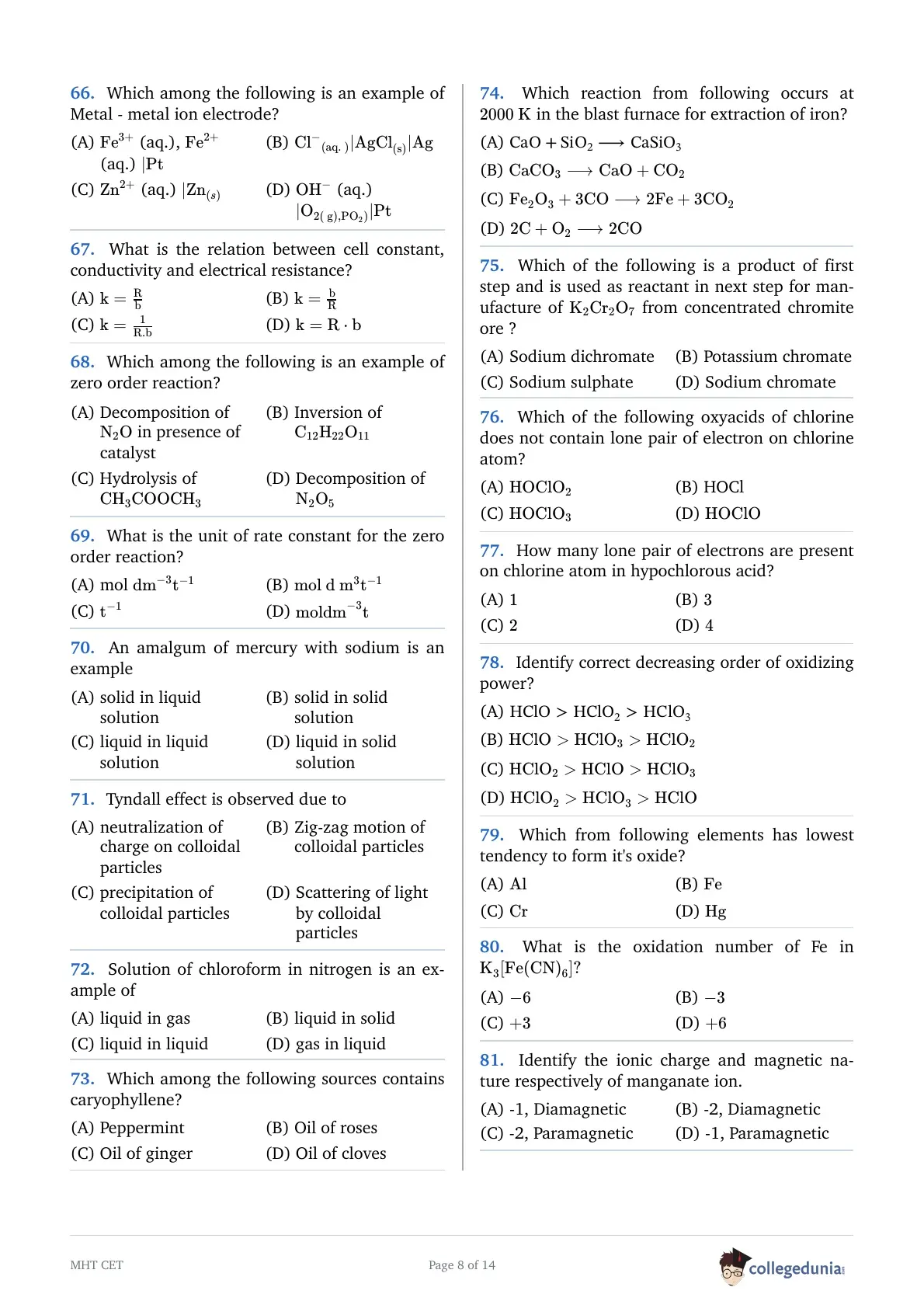
Which among the following is an example of Metal - metal ion electrode?
What is the relation between cell constant, conductivity, and electrical resistance?
Which among the following is an example of a zero order reaction?
What is the unit of rate constant for the zero-order reaction?
An amalgum of mercury with sodium is an example of
Tyndall effect is observed due to
Solution of chloroform in nitrogen is an example of
Which among the following sources contains caryophyllene?
Which of the following is a product of first step and is used as reactant in next step for manufacture of K\(_2\)Cr\(_2\)O\(_7\), from concentrated chromic acid?
Which of the following oxyacids of chlorine does not contain lone pair of electrons on chlorine atom?
How many lone pair of electrons are present on chlorine atom in chlorous acid ?
Identify correct decreasing order of oxidizing power?
Which from the following elements has the lowest tendency to form its oxide?
What is the oxidation number of Fe in K\(_3\)[Fe(CN)\(_6\)]?
Identify the ionic charge and magnetic nature respectively of manganate ion.
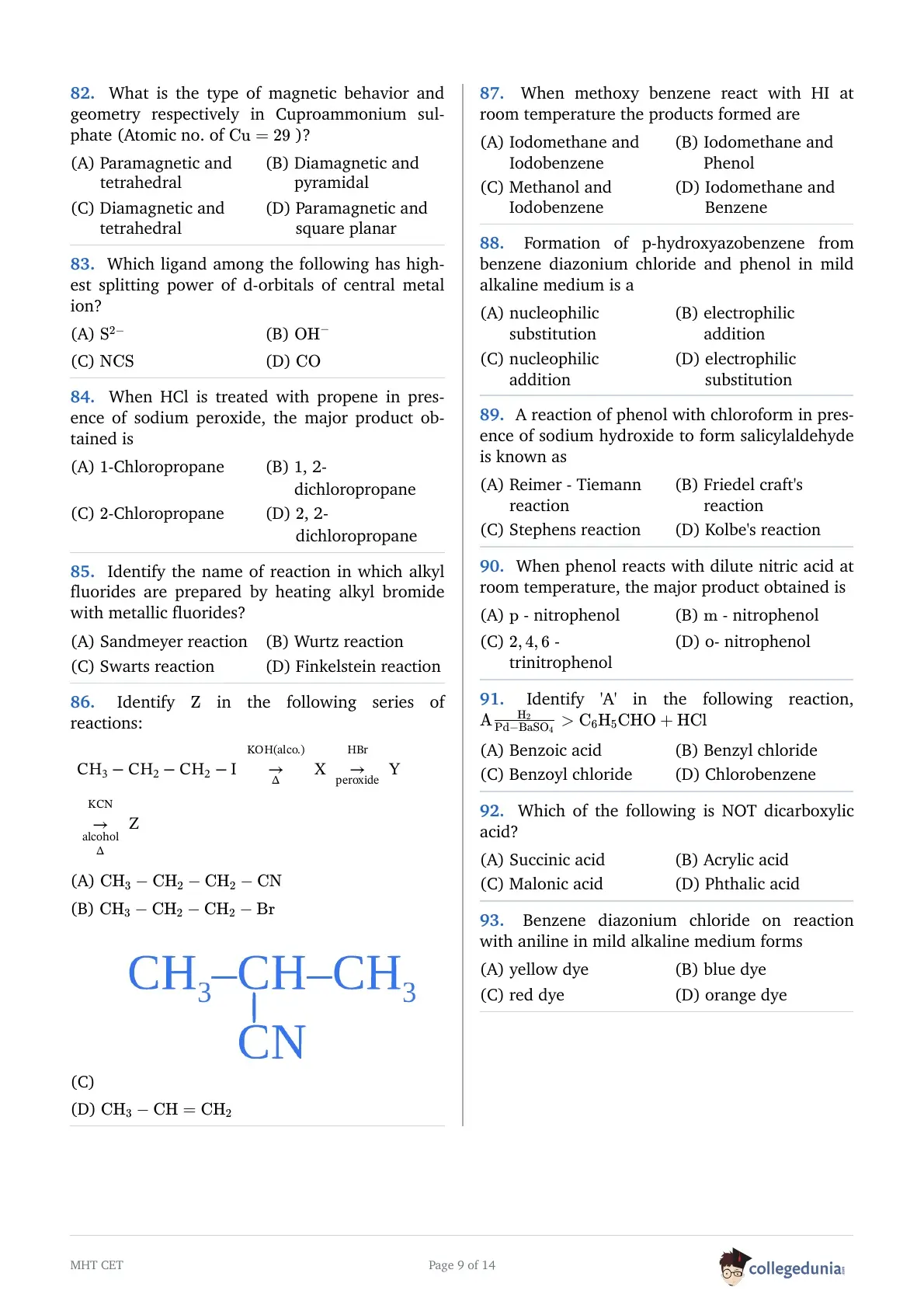
What is the type of magnetic behavior and geometry respectively in Cuprammonium sulfate (atomic no. of Cu = 29)?
Which ligand among the following has the highest splitting power of d-orbitals of central metal ion?
Identify the name of reaction in which alkyl fluorides are prepared by heating alkyl bromide with metallic fluorides.
Identify \(\mathrm{Z}\) in the following series of reactions:
\(\mathrm{CH}_{3}-\mathrm{CH}_{2}-\mathrm{CH}_{2}-\mathrm{I}\xrightarrow[\Delta ]{\mathrm{KOH}(\text{alco.})}\mathrm{X}\xrightarrow[\text{peroxide}]{\mathrm{HBr}}\mathrm{Y}\xrightarrow[\begin{matrix} \text{alcohol} \\ \Delta \end{matrix}]{\mathrm{KCN}}\mathrm{Z}\)
- (A) \(\mathrm{CH}_{3}-\mathrm{CH}_{2}-\mathrm{CH}_{2}-\mathrm{CN}\)
- (B) \(\mathrm{CH}_{3}-\mathrm{CH}_{2}-\mathrm{CH}_{2}-\mathrm{Br}\)
- (C)
![]()
- (D) \(\mathrm{CH}_{3}-\mathrm{CH}=\mathrm{CH}_{2}\)

When methoxybenzene reacts with HI at room temperature the products formed are
Formation of p-hydroxyazobenzene from benzene diazonium chloride and phenol in mild alkaline medium is
A reaction of phenol with chloroform in presence of sodium hydroxide to form salicylaldehyde is known as
Identify 'A' in the following reaction, \(\mathrm{A}\frac{\mathrm{H}_{2}}{\mathrm{Pd}-\mathrm{BaSO}_{4}}>\mathrm{C}_{6}\mathrm{H}_{5}\mathrm{CHO}+\mathrm{HCl}\)
Which of the following is NOT a dicarboxylic acid?
Benzene diazonium chloride on reaction with aniline in mild alkaline medium forms
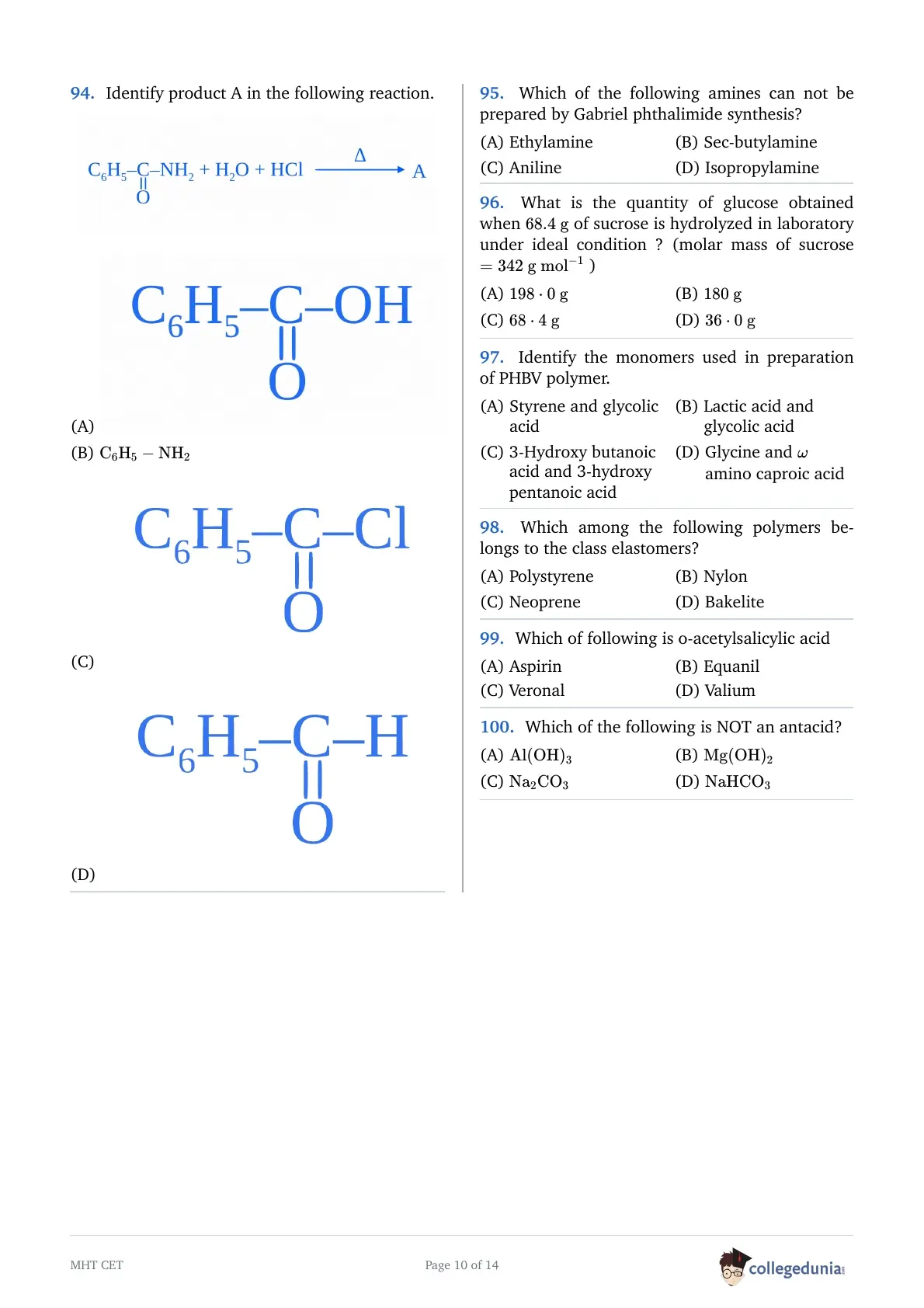
Identify product A in the following reaction.

- (A)
![]()
- (B) \(\mathrm{C}_{6}\mathrm{H}_{5}-\mathrm{NH}_{2}\)
- (C)
![]()
- (D)
![]()


Which of the following amines can not be prepared by Gabriel phthalimide synthesis?
What is the quantity of glucose obtained when 68.4 g of sucrose is hydrolyzed in laboratory under ideal conditions? (molar mass of sucrose = 342 g mol\(^{-1}\))
Identify the monomers used in preparation of PHBV polymer.
Which among the following polymers belongs to the class elastomers?
Which of the following is o-acetylsalicylic acid?
Which of the following is NOT an antacid?
Mathematics (Q101 - Q150)
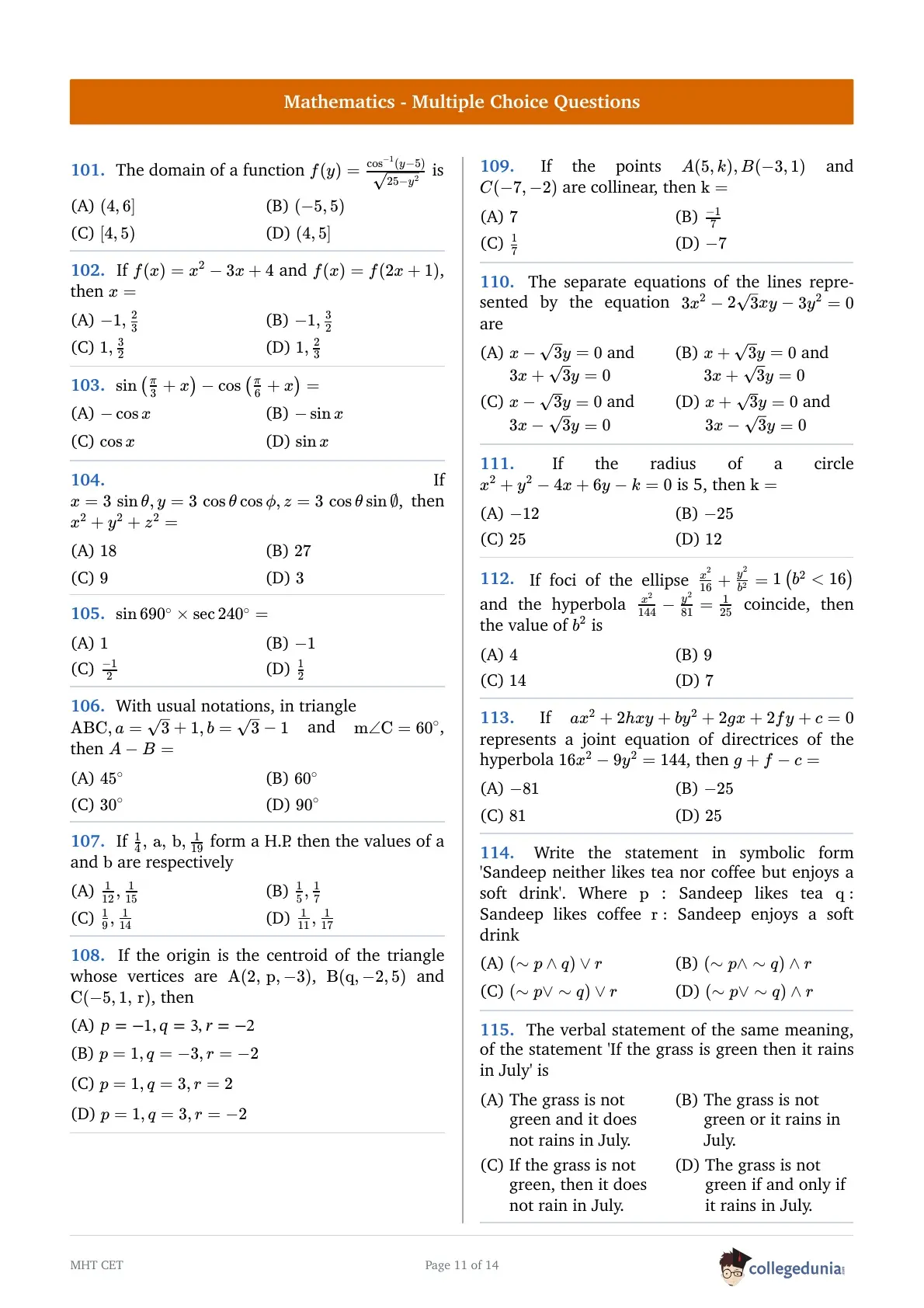
The domain of a function \(f(y)=\frac{\cos ^{-1}(y-5)}{\sqrt{25-y^{2}}}\) is
If \( f(x) = x^2 - 3x + 4 \) and \( f(x) = f(2x + 1) \), then \( x = \)
Simplify the expression \( \sin \left( \frac{\pi}{3} + x \right) - \cos \left( \frac{\pi}{6} + x \right) \)
If \( x = 3 \sin \theta \), \( y = 3 \cos \theta \cos \phi \), \( z = 3 \cos \theta \sin \phi \), then \( x^2 + y^2 + z^2 = \)
Evaluate \( \sin 690^\circ \times \sec 240^\circ \)
With usual notations, in triangle ABC, \( a = \sqrt{3} + 1 \), \( b = \sqrt{3} - 1 \) and \( \angle C = 60^\circ \), then \( A - B = \)
If \( \frac{1}{4}, a, b, \frac{1}{19} \) form a harmonic progression (H.P.), then the values of \( a \) and \( b \) are respectively
If the origin is the centroid of the triangle whose vertices are \( A(2, p, -3) \), \( B(q, -2, 5) \) and \( C(-5, 1, r) \), then
If the points \( A(5, k) \), \( B(-3, 1) \) and \( C(-7, -2) \) are collinear, then \( k = \)
The separate equations of the lines represented by the equation \( 3x^2 - 2\sqrt{3} xy - 3y^2 = 0 \) are
If the radius of a circle \( x^2 + y^2 - 4x + 6y - k = 0 \) is 5, then \( k = \)
If foci of the ellipse \( \frac{x^2}{16} + \frac{y^2}{b^2} = 1 \) (\( b^2<16 \)) and the hyperbola \( \frac{x^2}{144} - \frac{y^2}{81} = 1 \) coincide, then the value of \( b^2 \) is
If \( ax^2 + 2hxy + by^2 + 2gx + 2fy + c = 0 \) represents a joint equation of directrices of the hyperbola \( 16x^2 - 9y^2 = 144 \), then \( g + f - c = \)
Write the statement in symbolic form 'Sandeep neither likes tea nor coffee but enjoys a soft drink'. Where \( p \): Sandeep likes tea, \( q \): Sandeep likes coffee, \( r \): Sandeep enjoys a soft drink
The verbal statement of the same meaning, of the statement 'If the grass is green then it rains in July' is
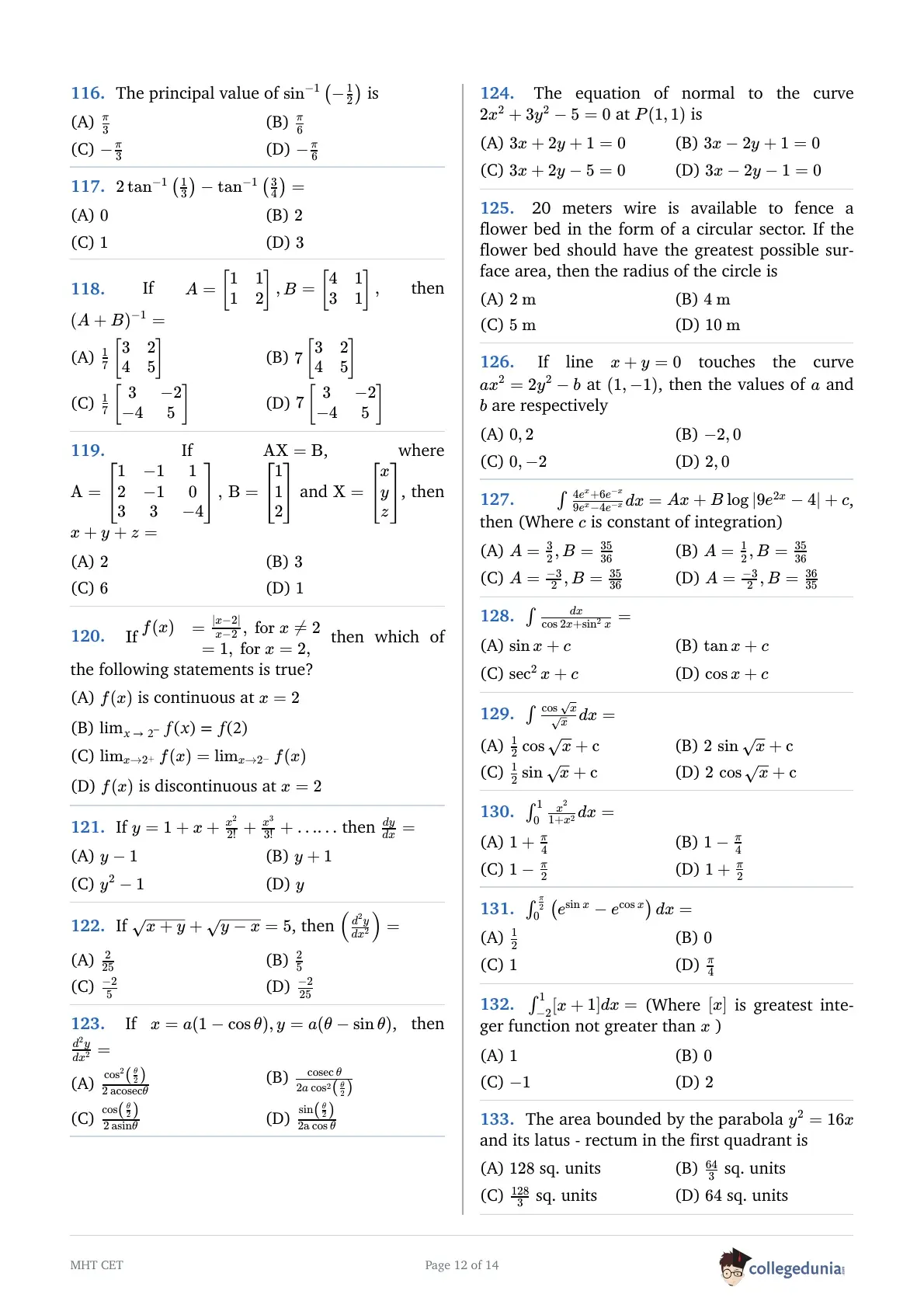
The principal value of \( \sin^{-1} \left( -\frac{1}{2} \right) \) is
\(2\tan ^{-1}\left(\frac{1}{3}\right)-\tan ^{-1}\left(\frac{3}{4}\right)=\)
If \( A = \begin{bmatrix} 1 & 1 \\ 2 & 1 \end{bmatrix}, B = \begin{bmatrix} 4 & 3 \\ 1 & 1 \end{bmatrix} \), then \( (A + B)^{-1x} = \)
If \( AX = B \), where \( A = \begin{bmatrix} 1 & -1 & 1 \\ 2 & -1 & 0 \\ 3 & 3 & -4 \end{bmatrix} \), \( B = \begin{bmatrix} 1 \\ 2 \end{bmatrix} \) and \( X = \begin{bmatrix} x \\ y \\ z \end{bmatrix} \), then \( x + y + z = \)
If \( f(x) = \frac{|x - 2|}{x - 2} \) for \( x \neq 2 \), and \( f(x) = 1 \) for \( x = 2 \), then which of the following statements is true?
If \(y=1+x+\frac{x^{2}}{2!}+\frac{x^{3}}{3!}+\ldots \ldots\) then \(\frac{dy}{dx}=\)
If \( \sqrt{x + y} + \sqrt{y - x} = 5 \), then \( \frac{d^2y}{dx^2} = \)
If \( x = a(1 - \cos\theta) \), \( y = a(\theta - \sin\theta) \), then \( \frac{d^2y}{dx^2} = \)
The equation of the normal to the curve \( 2x^2 + 3y^2 - 5 = 0 \) at \( P(1, 1) \) is
20 meters of wire is available to fence a flower bed in the form of a circular sector. If the flower bed should have the greatest possible surface area, then the radius of the circle is
If line \( x + y = 0 \) touches the curve \( ax^2 = 2y^2 - b \) at \( (1, -1) \), then the values of \( a \) and \( b \) are respectively
Evaluate the integral \( \int \frac{4e^x + 6e^{-x}}{9e^x - 4e^{-x}} dx = Ax + B \log |9e^{2x} - 4| + c \), then (where \( c \) is the constant of integration)
Evaluate \( \int \frac{dx}{\cos 2x + \sin^2 x} \)
Evaluate \( \int \frac{\cos \sqrt{x}}{\sqrt{x}} \, dx \)
Evaluate the integral \( \int_0^1 \frac{x^2}{1 + x^2} dx \)
Evaluate \( \int_0^{\frac{\pi}{2}} \left( e^{\sin x} - e^{\cos x} \right) \, dx \)
Evaluate \( \int_{-2}^{1} \left[ x + 1 \right] \, dx \), where \( [x] \) is the greatest integer function not greater than \( x \)
The area bounded by the parabola \( y^2 = 16x \) and its latus-rectum in the first quadrant is
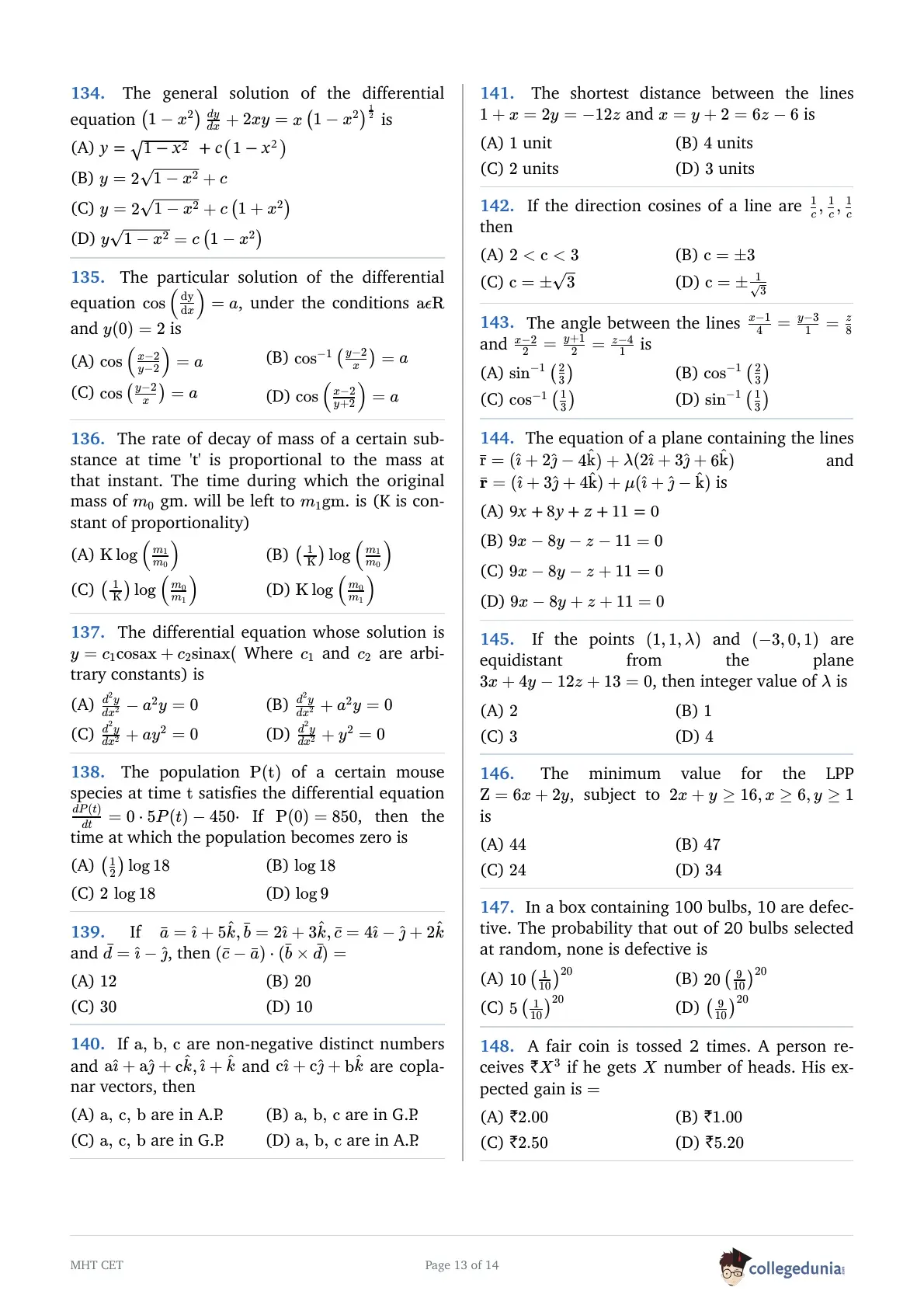
The general solution of the differential equation \(\left(1-x^{2}\right)\frac{dy}{dx}+2xy=x\left(1-x^{2}\right)^{\frac{1}{2}}\) is
The particular solution of the differential equation \( \cos \left( \frac{dy}{dx} \right) = a \), under the conditions \( a \in \mathbb{R} \) and \( y(0) = 2 \) is
The rate of decay of mass of a certain substance at time 't' is proportional to the mass at that instant. The time during which the original mass of \(m_{0}\) gm. will be left to \(m_{1}\mathrm{gm}\). is (K is constant of proportionality)
The differential equation whose solution is \( y = c_1 \cos ax + c_2 \sin ax \) (where \( c_1 \) and \( c_2 \) are arbitrary constants) is
The population \(\mathrm{P}(\mathrm{t})\) of a certain mouse species at time \(\mathrm{t}\) satisfies the differential equation \(\frac{dP(t)}{dt}=0\cdot 5P(t)-450\cdot\) If \(\mathrm{P}(0)=850\), then the time at which the population becomes zero is
If \( \vec{a} = \hat{i} + 5\hat{k}, \, \vec{b} = 2\hat{i} + 3\hat{k}, \, \vec{c} = 4\hat{i} - \hat{j} + 2\hat{k}, \, \vec{d} = \hat{i} - \hat{j} \), then \( (\vec{c} - \vec{a}) \cdot (\vec{b} \times \vec{d}) = \)
If \( a \), \( b \), \( c \) are non-negative distinct numbers and \( ai + aj + ck \), \( i + j + k \), and \( ci + cj + bk \) are coplanar vectors, then
The shortest distance between the lines \( 1 + x = 2y = -12z \) and \( x = y + 2 = 6z - 6 \) is
If the direction cosines of a line are \( \frac{1}{c}, \frac{1}{c}, \frac{1}{c} \), then
The angle between the lines \( \frac{x - 1}{4} = \frac{y - 3}{1} = \frac{z}{8} \) and \( \frac{x - 2}{2} = \frac{y + 1}{2} = \frac{z - 4}{1} \) is
The equation of a plane containing the lines \(\bar{\mathrm{r}}=(\hat{\imath}+2\hat{\jmath}-4\hat{\mathrm{k}})+\lambda (2\hat{\imath}+3\hat{\jmath}+6\hat{\mathrm{k}})\) and \(\bar{\mathbf{r}}=(\hat{\imath}+3\hat{\jmath}+4\hat{\mathrm{k}})+\mu (\hat{\imath}+\hat{\jmath}-\hat{\mathrm{k}})\) is
If the points \( (1, 1, \lambda) \) and \( (-3, 0, 1) \) are equidistant from the plane \( 3x + 4y - 12z + 13 = 0 \), then the integer value of \( \lambda \) is
The minimum value for the LPP \( Z = 6x + 2y \), subject to \( 2x + y \geq 16, x \geq 6, y \geq 1 \) is
In a box containing 100 bulbs, 10 are defective. The probability that out of 20 bulbs selected at random, none is defective is
A fair coin is tossed 2 times. A person receives \( X^3 \) if he gets \( X \) number of heads. His expected gain is
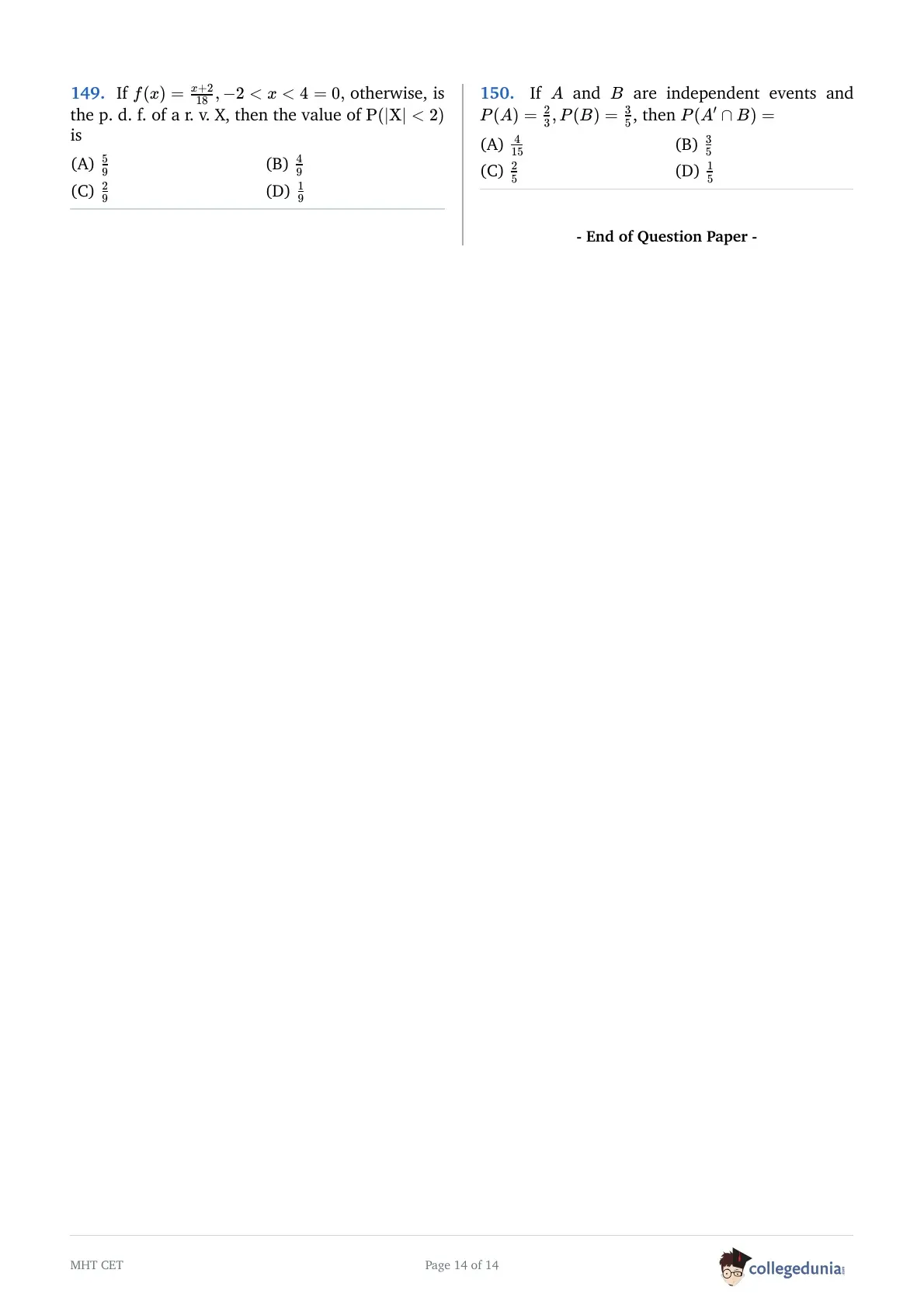
If \(f(x)=\frac{x+2}{18},-2\lt x\lt 4\) \(=0,\) otherwise, is the p. d. f. of a r. v. X, then the value of \(\mathrm{P}(|\mathrm{X}|\lt 2)\) is
If \(A\) and \(B\) are independent events and \(P(A)=\frac{2}{3},P(B)=\frac{3}{5}\), then \(P(A'\cap B)=\)
MHT CET 2020 PCM Exam Pattern and Marking Scheme
| Parameter | Details |
|---|---|
| Conducting Body | Maharashtra Common Entrance Test Cell (Maharashtra CET Cell) |
| Exam Mode | Online (Computer-Based Test) |
| Duration | 180 minutes (3 hours) |
| Groups / Subjects | PCM (Physics, Chemistry, Mathematics) for Engineering |
| Total Questions |
150 |
| Total Marks | 200 |
| Question Type | Multiple Choice Questions (MCQs) |
| Marks Distribution |
|
| Negative Marking | No |
| Syllabus Weightage |
|



Comments