




MHT CET 2020 Oct 15 Shift 2 PCM Question Paper is available for download here. Maharashtra State CET Cell conducted MHT CET 2020 PCM Exam on Oct 15 in Shift 2 from 2 PM to 5 PM in CBT mode.
The MHT CET 2020 PCM question paper includes the following:
- The MHT CET 2020 PCM Question Paper consists of 150 multiple-choice questions (MCQs) totalling 200 marks divided into 3 sections: Physics, Chemistry, and Mathematics, with 50 questions in each subject.
- Physics and Chemistry questions carry 1 mark each while Mathematics questions carry 2 marks each.
- There is no negative marking for incorrect answers.
MHT CET 2020 Oct 15 Shift 2 PCM Question Paper with Solution PDF
| CD PDF | CD PDF with Solutions |
|---|---|
| Download Collegedunia PDF 0.80 MB | - |
Also Check:
MHT CET 2020 Oct 15 Shift 2 PCM Questions with Solutions
Physics (Q1 - Q50)
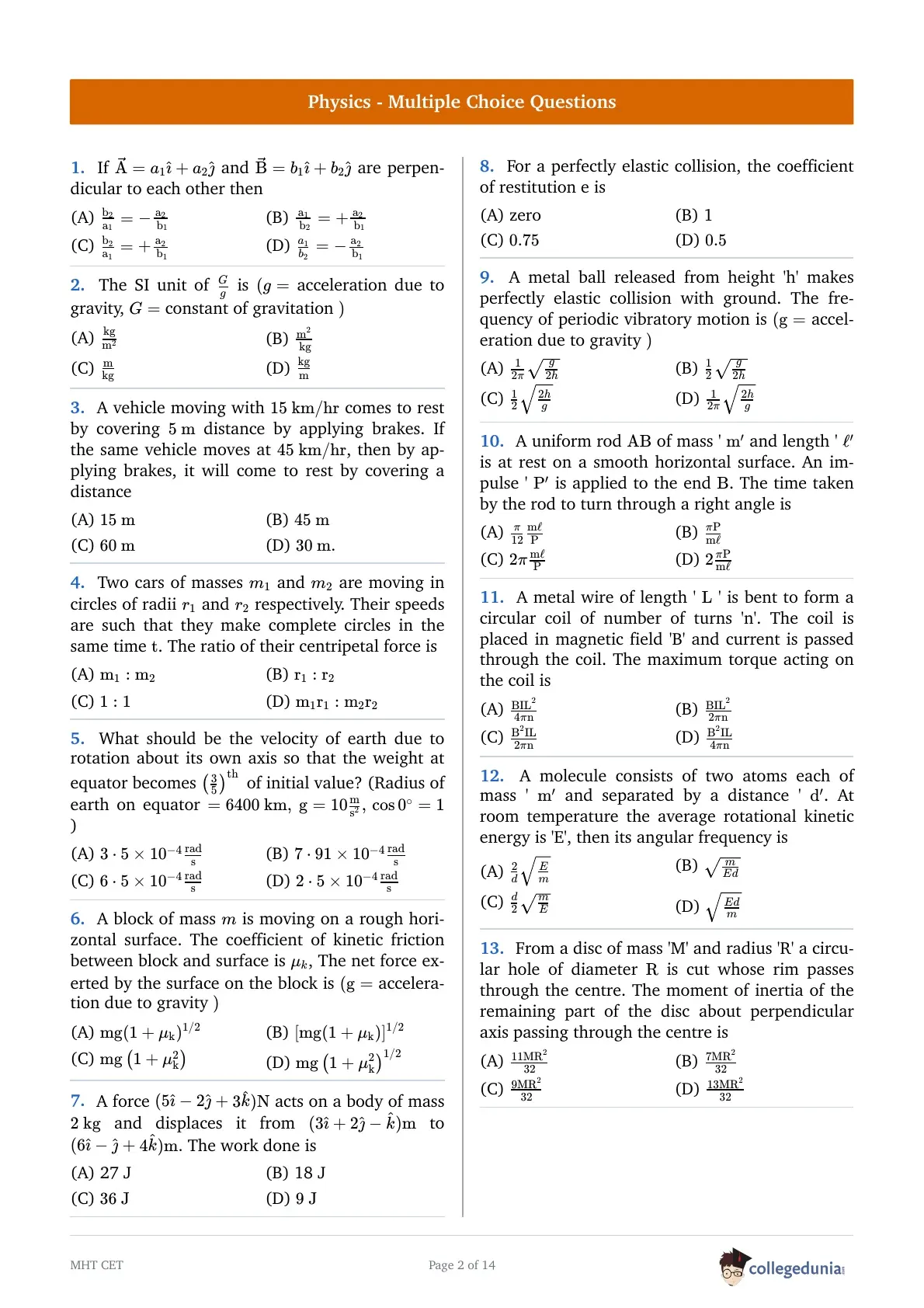
If \( \vec{A} = a_1 \hat{i} + a_2 \hat{j} \) and \( \vec{B} = b_1 \hat{i} + b_2 \hat{j} \) are perpendicular to each other, then
The SI unit of \( \frac{G}{g} \) is ( \( g \) = acceleration due to gravity, \( G \) = constant of gravitation)
A vehicle moving with 15 km/hr comes to rest by covering 5 m distance by applying brakes. If the same vehicle moves at 45 km/hr, then by applying brakes, it will come to rest by covering a distance of
Two cars of masses \( m_1 \) and \( m_2 \) are moving in circles of radii \( r_1 \) and \( r_2 \) respectively. Their speeds are such that they make complete circles in the same time \( t \). The ratio of their centripetal force is
What should be the velocity of earth due to rotation about its own axis so that the weight at equator becomes \( \frac{1}{25} \) of initial value?
(Radius of Earth on equator = 6400 km, \( g = 10 \, \text{m/s}^2 \), \( \cos 0^\circ = 1 \))
A block of mass \( m \) is moving on a rough horizontal surface. The coefficient of kinetic friction between block and surface is \( \mu_k \). The net force exerted by the surface on the block is
A force \( (5i - 2j + 3k) \, \text{N} \) acts on a body of mass 2 kg and displaces it from \( (3i + 2j - k) \, \text{m} \) to \( (6i - j + 4k) \, \text{m} \). The work done is
For a perfectly elastic collision, the coefficient of restitution \( e \) is
A metal ball released from height \( h \) makes perfectly elastic collision with ground. The frequency of periodic vibratory motion is
A uniform rod AB of mass \( m \) and length \( l \) is at rest on a smooth horizontal surface. An impulse \( P \) is applied to the end B. The time taken by the rod to turn through a right angle is
A metal wire of length \( L \) is bent to form a circular coil of number of turns \( n \). The coil is placed in magnetic field \( B \) and current is passed through the coil. The maximum torque acting on the coil is
A molecule consists of two atoms each of mass \( m \) and separated by a distance \( d \). At room temperature the average rotational kinetic energy is \( E \), then its angular frequency is
A lift is tied with thick iron ropes having mass \( M \). The maximum acceleration of the lift is \( a \) m/s² and maximum safe stress is \( s \) N/m². The minimum diameter of the rope is
A wire of length \( L \) and radius \( r \) is loaded with a weight \( Mg \). If \( Y \) and \( \sigma \) denote the Young's modulus and Poisson's ratio of the material of the wire respectively, then the decrease in the radius of the wire \( \Delta r \) is given by
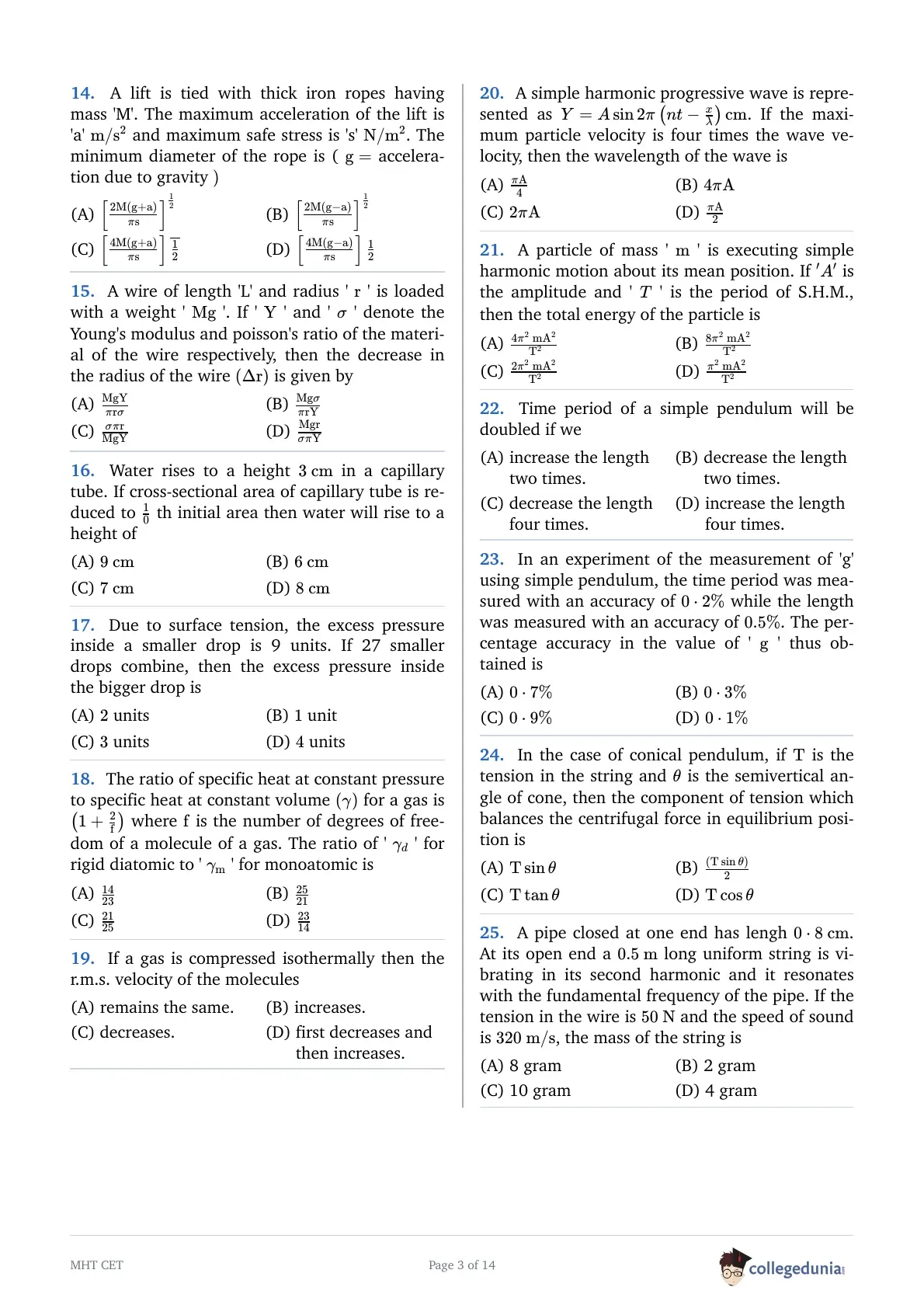
Water rises to a height 3 cm in a capillary tube. If cross-sectional area of capillary tube is reduced to \( \frac{1}{10} \)th of initial area then water will rise to a height of
Due to surface tension, the excess pressure inside a smaller drop is 9 units. If 27 smaller drops combine, then the excess pressure inside the bigger drop is
The ratio of specific heat at constant pressure to specific heat at constant volume (\( \gamma \)) for a gas is \( \gamma = \left( 1 + \frac{2}{f} \right) \) where \( f \) is the number of degrees of freedom of a molecule of a gas. The ratio of \( \gamma_{r} \) for rigid diatomic to \( \gamma_{m} \) for monatomic is
If a gas is compressed isothermally then the r.m.s. velocity of the molecules
A simple harmonic progressive wave is represented as \( Y = A \sin 2\pi \left( \frac{nt - x}{\lambda} \right) \) cm. If the maximum particle velocity is four times the wave velocity, then the wavelength of the wave is
A particle of mass \( m \) is executing simple harmonic motion about its mean position. If \( A \) is the amplitude and \( T \) is the period of S.H.M., then the total energy of the particle is
Time period of a simple pendulum will be doubled if we
In an experiment of the measurement of \( g \) using simple pendulum, the time period was measured with an accuracy of \( 0.2% \), while the length was measured with an accuracy of \( 0.5% \). The percentage accuracy in the value of \( g \) thus obtained is
In the case of conical pendulum, if \( T \) is the tension in the string and \( \theta \) is the semi-vertical angle of the cone, then the component of tension which balances the centrifugal force in equilibrium position is
A pipe closed at one end has length 0.8 m. At its open end, a 0.5 m long uniform string is vibrating in its second harmonic and it resonates with the fundamental frequency of the pipe. If the tension in the wire is 50 N and the speed of sound is 320 m/s, the mass of the string is
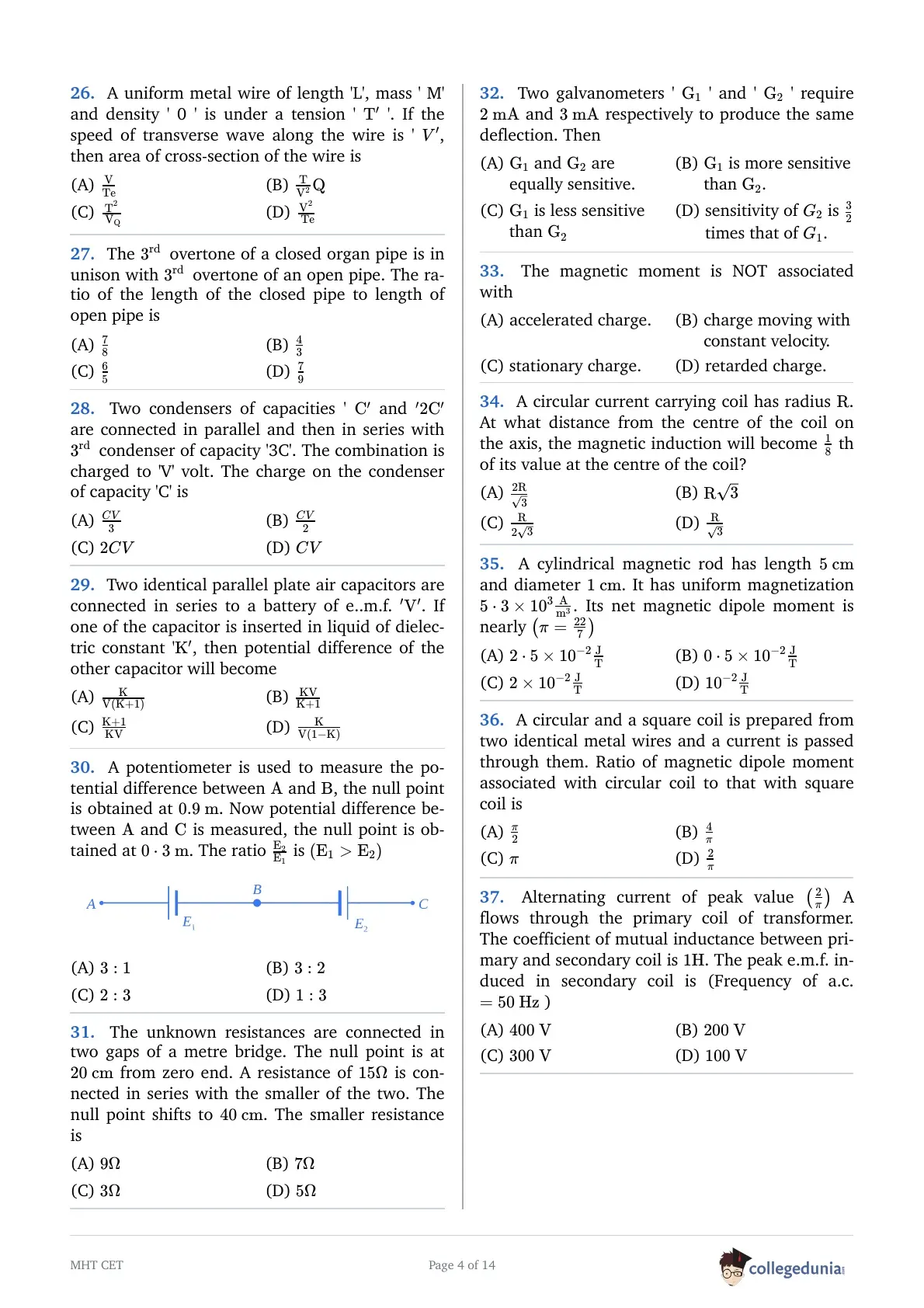
A uniform metal wire of length \( L \), mass \( M \) and density \( \rho \) is under a tension \( T \). If the speed of transverse wave along the wire is \( V \), then area of cross-section of the wire is
The 3rd overtone of a closed organ pipe is in unison with 3rd overtone of an open pipe. The ratio of the length of the closed pipe to the length of open pipe is
Two condensers of capacities \( C \) and \( 2C \) are connected in parallel and then in series with 3rd condenser of capacity \( 3C \). The combination is charged to \( V \) volt. The charge on the condenser of capacity \( C \) is
Two identical parallel plate air capacitors are connected in series to a battery of e.m.f. \( V \). If one of the capacitors is inserted in liquid of dielectric constant \( K \), then potential difference of the other capacitor will become
A potentiometer is used to measure the potential difference between A and B, the null point is obtained at 0.9 m. Now potential difference between A and C is measured, the null point is obtained at 0.3 m. The ratio \( \frac{E_2}{E_1} \) is \( (E_1>E_2) \)

The unknown resistances are connected in two gaps of a metre bridge. The null point is at 20 cm from zero end. A resistance of 15 \( \Omega \) is connected in series with the smaller of the two. The null point shifts to 40 cm. The smaller resistance is
Two galvanometers 'G1' and 'G2' require 2 mA and 3 mA respectively to produce the same deflection. Then
The magnetic moment is NOT associated with
A circular current-carrying coil has radius \( R \). At what distance from the centre of the coil on the axis, the magnetic induction will become \( \frac{1}{\sqrt{8}} \) of its value at the centre of the coil?
A cylindrical magnetic rod has length 5 cm and diameter 1 cm. It has uniform magnetization \( 5 \times 10^3 \, \text{A/m} \). Its net magnetic dipole moment is nearly
A circular and a square coil is prepared from two identical metal wires and a current is passed through them. Ratio of magnetic dipole moment associated with circular coil to that with square coil is
Alternating current of peak value \( \frac{I}{\sqrt{2}} \) A flows through the primary coil of transformer. The coefficient of mutual inductance between primary and secondary coil is 1 H. The peak e.m.f. induced in secondary coil is (Frequency of a.c. = 50 Hz)
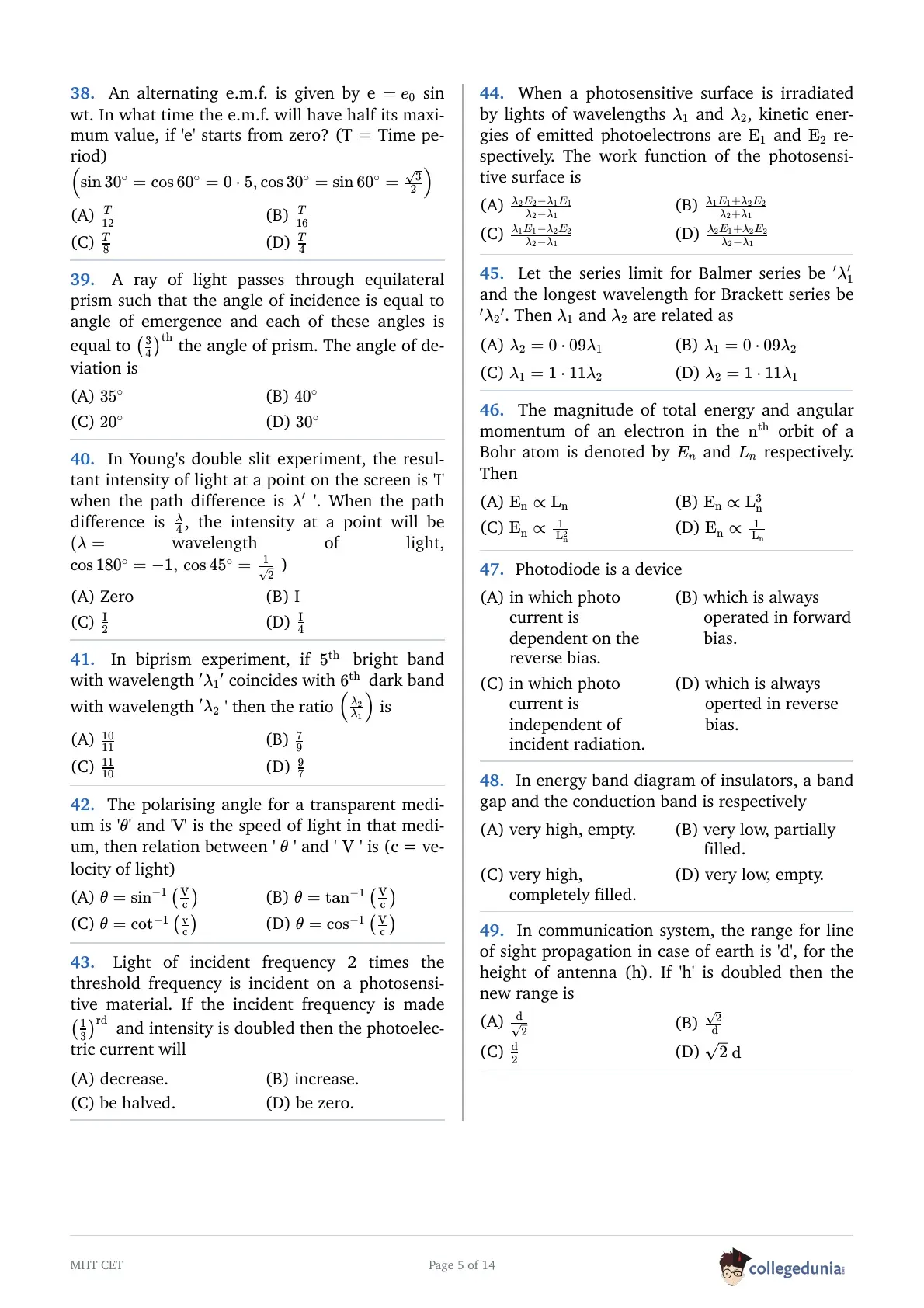
An alternating e.m.f. is given by \( e = e_0 \sin \omega t \). In what time the e.m.f. will have half its maximum value, if \( e_0 \) starts from zero? (T = Time period)
A ray of light passes through an equilateral prism such that the angle of incidence is equal to angle of emergence and each of these angles is equal to \( \frac{1}{3} \)rd the angle of prism. The angle of deviation is
In Young's double slit experiment, the resultant intensity of light at a point on the screen is \( I \) when the path difference is \( \lambda \). When the path difference is \( \frac{\lambda}{4} \), the intensity at a point will be ( \( \lambda \) = wavelength of light, \( \cos 180^\circ = -1, \cos 45^\circ = \frac{1}{\sqrt{2}} \))
In biprism experiment, if 5th bright band with wavelength \( \lambda_1 \) coincides with 6th dark band with wavelength \( \lambda_2 \), then the ratio \( \frac{\lambda_2}{\lambda_1} \) is
The polarising angle for a transparent medium is \( \theta \) and \( v \) is the speed of light in that medium, then relation between \( \theta \) and \( v \) is (c = velocity of light)
Light of incident frequency 2 times the threshold frequency is incident on a photosensitive material. If the incident frequency is made \( \frac{1}{3} \)rd and intensity is doubled then the photoelectric current will
When a photosensitive surface is irradiated by lights of wavelengths \( \lambda_1 \) and \( \lambda_2 \), kinetic energies of emitted photoelectrons are \( E_1 \) and \( E_2 \) respectively. The work function of the photosensitive surface is
Let the series limit for Balmer series be \( \lambda_1 \) and the longest wavelength for Brackett series be \( \lambda_2 \). Then \( \lambda_1 \) and \( \lambda_2 \) are related as
The magnitude of total energy and angular momentum of an electron in the \( n \)th orbit of a Bohr atom is denoted by \( E_n \) and \( L_n \), respectively. Then
Photodiode is a device
In energy band diagram of insulators, a band gap and the conduction band is respectively
In communication system, the range for line of sight propagation in case of earth is \( d \), for the height of antenna \( h \). If \( h \) is doubled then the new range is
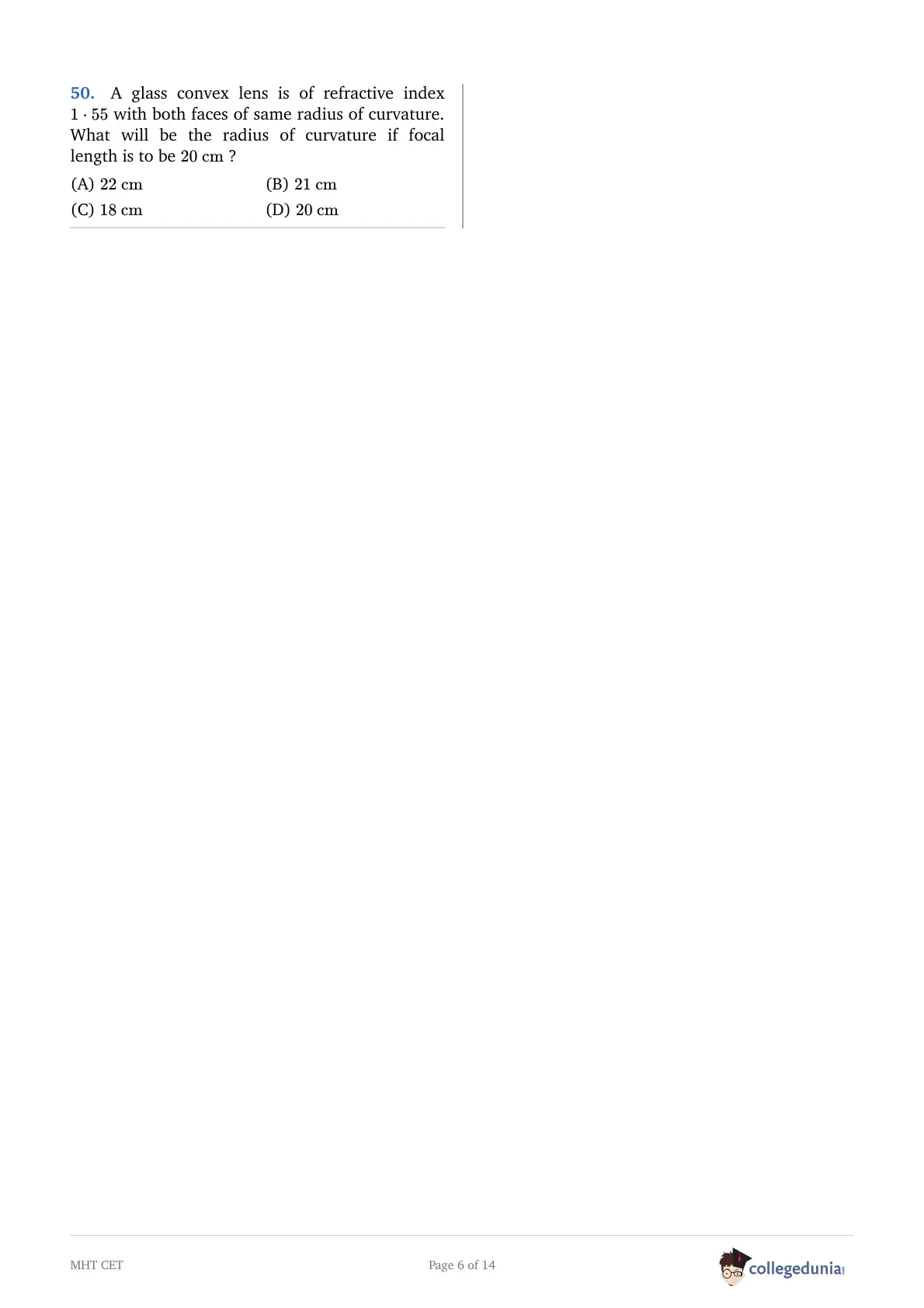
A glass convex lens is of refractive index 1.55 with both faces of same radius of curvature. What will be the radius of curvature if focal length is to be 20 cm?
Chemistry (Q51 - Q100)
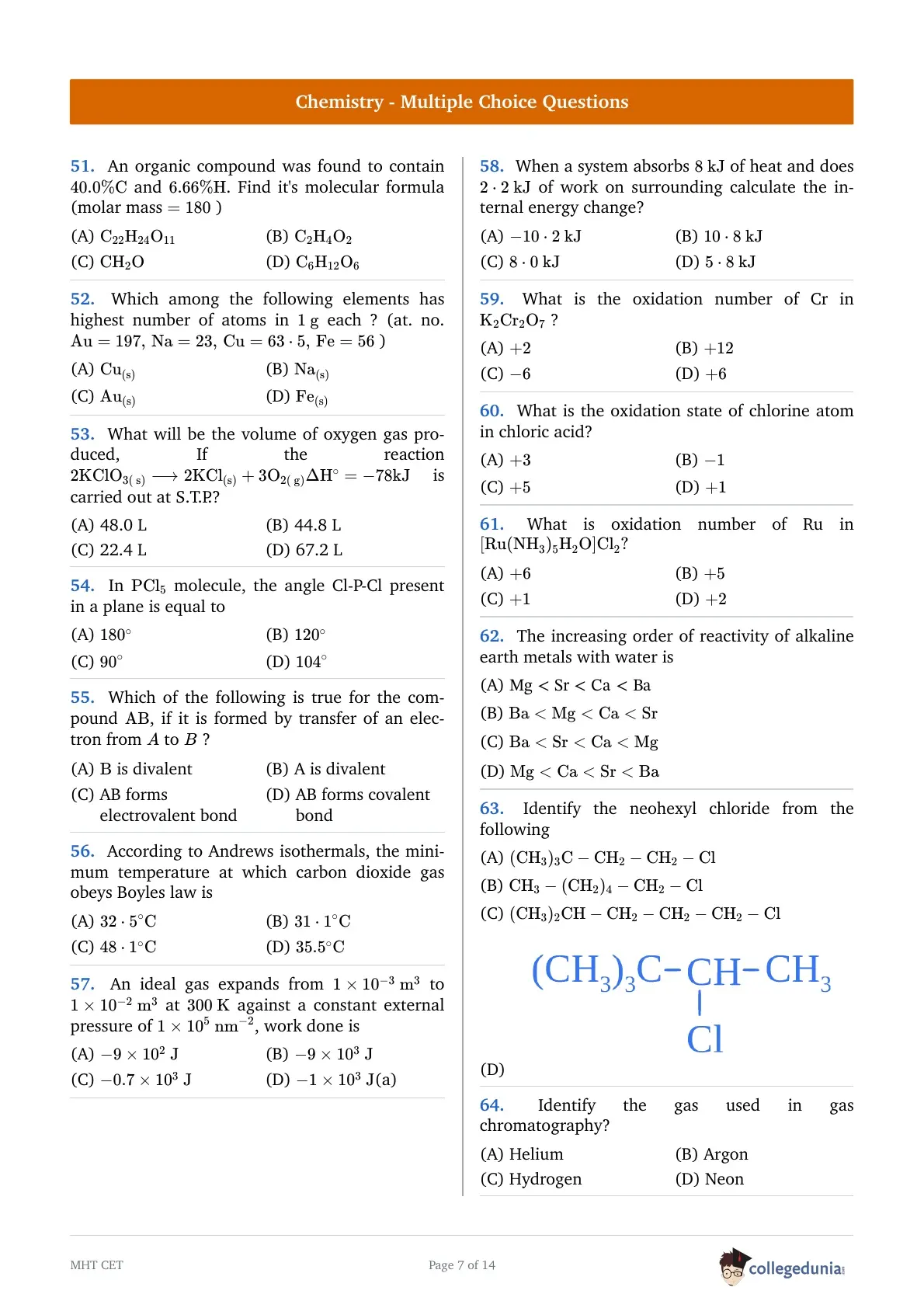
An organic compound was found to contain 40.0% C and 6.66% H. Find its molecular formula (molar mass = 180).
Which among the following elements has the highest number of atoms in 1 g each?
(at. no. Au = 197, Na = 23, Cu = 63.5, Fe = 56)
What will be the volume of oxygen gas produced, If the reaction
2 KClO\(_3\)(s) \(\rightarrow\) 2 KCl(s) + 3 O\(_2\)(g) \(\Delta H^\circ = -78 \, \text{kJ}\)
is carried out at S.T.P.?
In PCl\(_5\) molecule, the angle Cl-P-Cl present in a plane is equal to
Which of the following is true for the compound AB, if it is formed by the transfer of an electron from A to B?
According to Andrews isothermals, the minimum temperature at which carbon dioxide gas obeys Boyle’s law is
An ideal gas expands from 1 × 10\(^-3\) m\(^3\) to 1 × 10\(^-2\) m\(^3\) at 300 K against a constant external pressure of 1 × 10\(^5\) N/m\(^2\). Work done is
When a system absorbs 8 kJ of heat and does 2.2 kJ of work on surroundings, calculate the internal energy change.
What is the oxidation number of Cr in K\(_2\)Cr\(_2\)O\(_7\)?
What is the oxidation state of chlorine atom in chloric acid?
What is the oxidation number of Ru in [Ru(NH\(_3\))\(_5\)H\(_2\)O]Cl\(_2\)?
The increasing order of reactivity of alkaline earth metals with water is
Identify the neohhexyl chloride from the following.
Identify the gas used in gas chromatography.
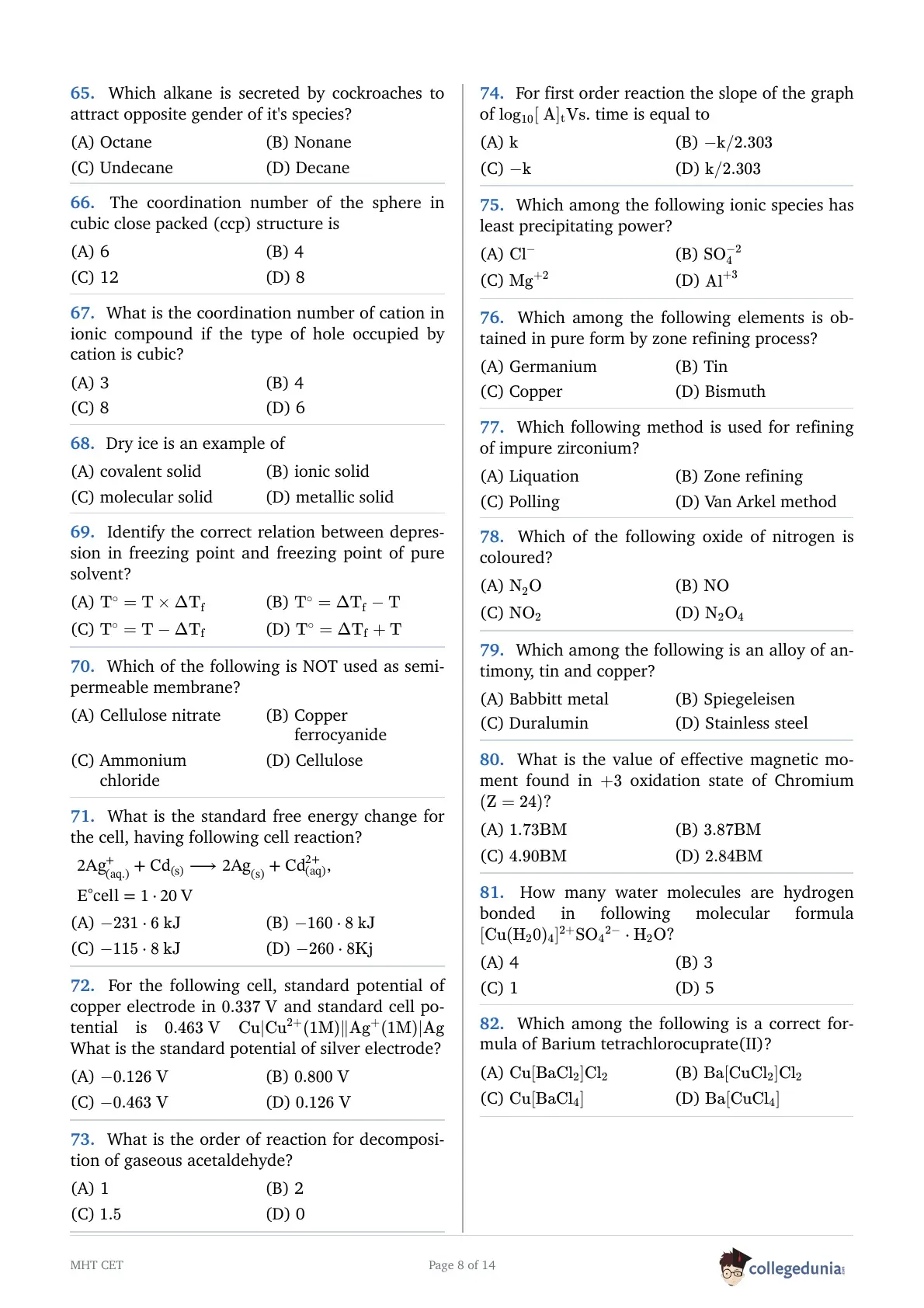
Which alkane is secreted by cockroaches to attract the opposite gender of its species?
The coordination number of the sphere in cubic close packed (ccp) structure is
What is the coordination number of cation in ionic compound if the type of hole occupied by cation is cubic?
Dry ice is an example of
Identify the correct relation between depression in freezing point and freezing point of pure solvent.
Which of the following is NOT used as a semipermeable membrane?
What is the standard free energy change for the cell, having following cell reaction? \(2\mathrm{Ag}_{(\mathrm{aq}.)}^{+}+\mathrm{Cd}_{(\mathrm{s})}\longrightarrow 2\mathrm{Ag}_{(\mathrm{s})}+\mathrm{Cd}_{(\mathrm{aq})}^{2+},\mathrm{E}^{\circ }\mathrm{cell}=1\cdot 20\ \mathrm{V}\)
For the following cell, standard potential of copper electrode is 0.337 V and standard cell potential is 0.463 V.
Cu\(^{2+}\) (1M) / Cu (1M) || Ag\(^+\) (1M) / Ag
What is the standard potential of silver electrode?
What is the order of reaction for decomposition of gaseous acetaldehyde?
For first order reaction the slope of the graph of log\(_{10}\)[A] vs. time is equal to
Which among the following ionic species has least precipitating power?
Which among the following elements is obtained in pure form by zone refining process?
Which following method is used for refining of impure zirconium?
Which of the following oxide of nitrogen is coloured?
Which among the following is an alloy of antimony, tin and copper?
What is the value of effective magnetic moment found in +3 oxidation state of Chromium (Z=24)?
How many water molecules are hydrogen bonded in the following molecular formula?
[Cu(H\(_2\)O)\(_6\)]\(^{2+}\) SO\(_4^{2-}\) \(\cdot\) H\(_2\)O
Which among the following is a correct formula of Barium tetrachlorocuprate(II)?
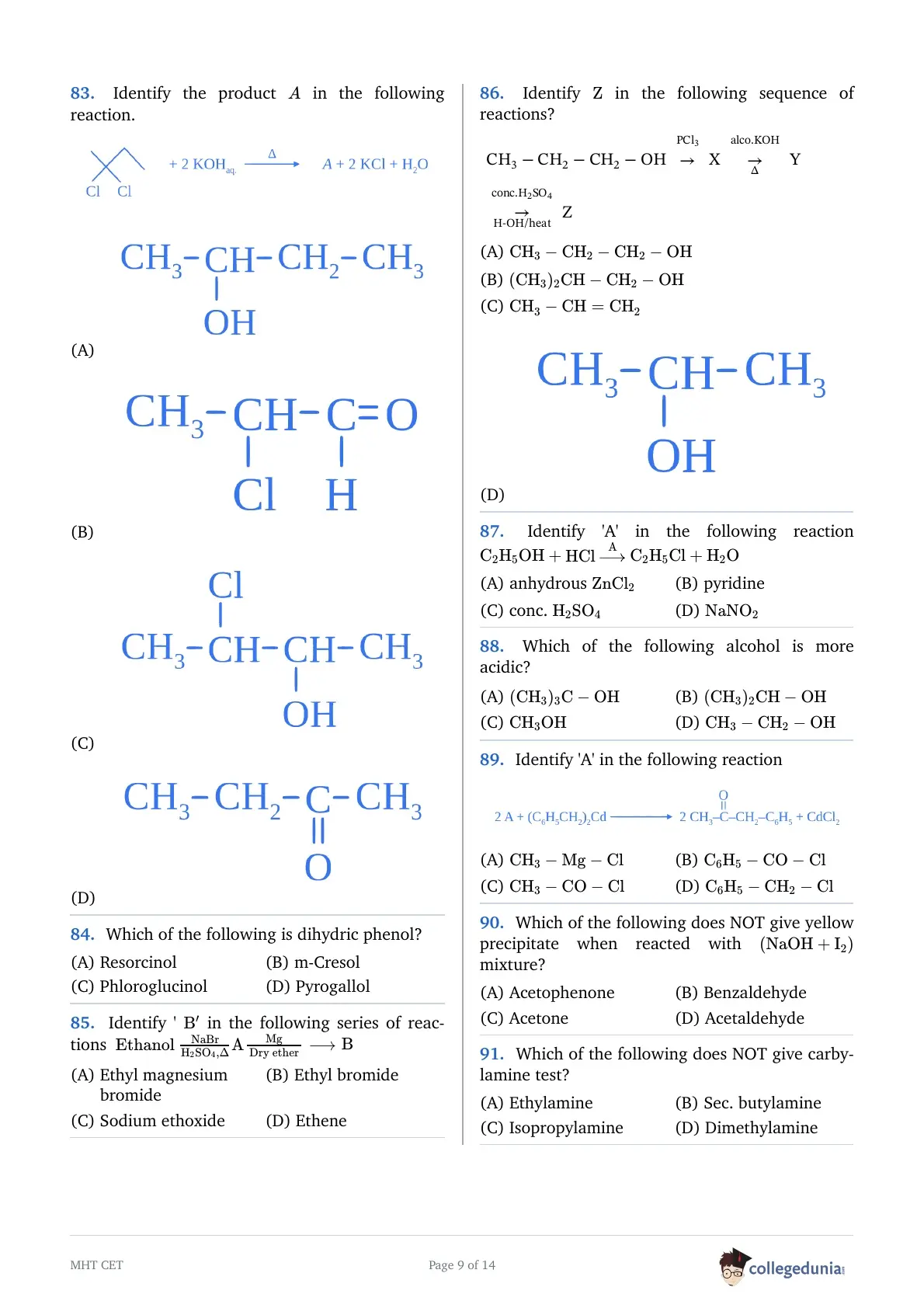
Identify the product \(A\) in the following reaction.

- (A)
![]()
- (B)
![]()
- (C)
![]()
- (D)
![]()


Which of the following is dihydric phenol?
Identify ' \(\mathrm{B}'\) in the following series of reactions \(\text{ Ethanol }\frac{\mathrm{NaBr}}{\mathrm{H}_{2}\mathrm{SO}_{4},\Delta }\mathrm{A}\frac{\mathrm{Mg}}{\text{ Dry ether }}\longrightarrow \mathrm{B}\)
Identify \(\mathrm{Z}\) in the following sequence of reactions? \(\mathrm{CH}_{3}-\mathrm{CH}_{2}-\mathrm{CH}_{2}-\mathrm{OH}\xrightarrow{\mathrm{PCl}_{3}}\mathrm{X}\xrightarrow[\Delta ]{\text{alco.KOH}}\mathrm{Y}\xrightarrow[\text{H-OH/heat}]{\text{conc.}\mathrm{H}_{2}\mathrm{SO}_{4}}\mathrm{Z}\)
- (A) \(\mathrm{CH}_{3}-\mathrm{CH}_{2}-\mathrm{CH}_{2}-\mathrm{OH}\)
- (B) \((\mathrm{CH}_{3})_{2}\mathrm{CH}-\mathrm{CH}_{2}-\mathrm{OH}\)
- (C) \(\mathrm{CH}_{3}-\mathrm{CH}=\mathrm{CH}_{2}\)
- (D)
![MHT CET 2020 15th October Evening Shift Chemistry - Alcohol, Phenols and Ethers Question 42 English Option 4]()
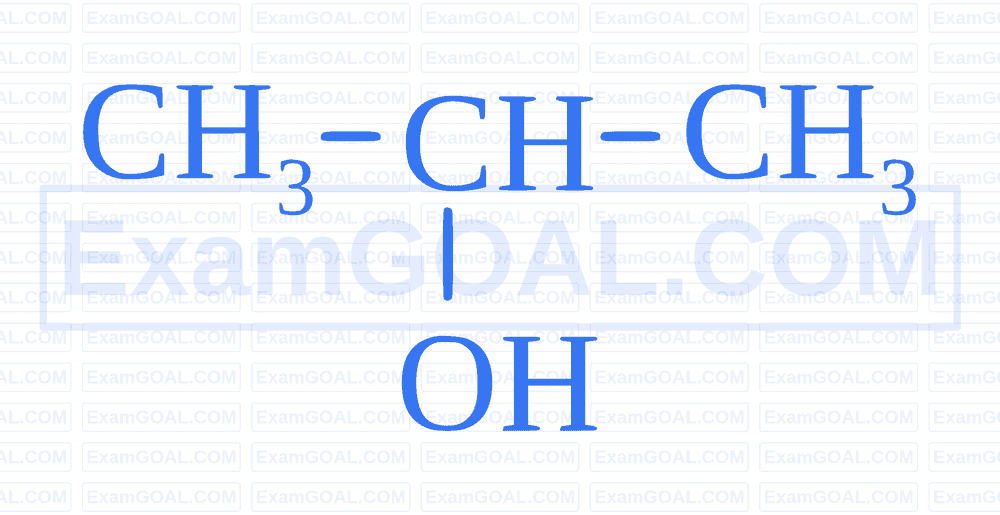
Identify 'A' in the following reaction
C\(_2\)H\(_5\)OH + HCl \(\xrightarrow{A}\) C\(_2\)H\(_5\)Cl + H\(_2\)O
Which of the following alcohol is more acidic?

Which of the following does NOT give yellow precipitate when reacted with (NaOH + I\(_2\)) mixture?
Which of the following does NOT give carbylamine test?
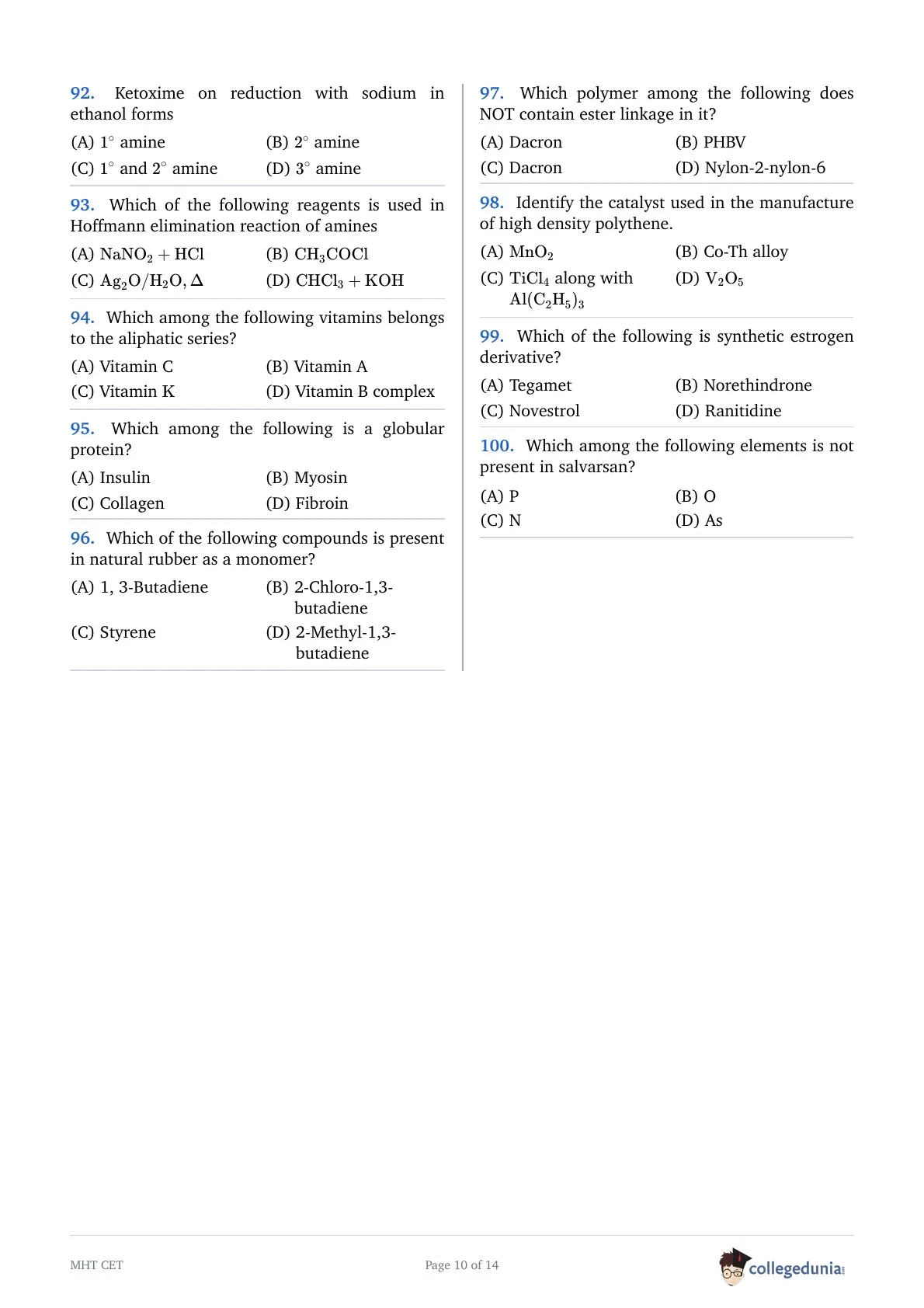
Ketoxime on reduction with sodium in ethanol forms
Which of the following reagents is used in the Hoffmann elimination reaction of amines?
Which among the following vitamins belongs to the aliphatic series?
Which among the following is a globular protein?
Which of the following compounds is present in natural rubber as a monomer?
Which polymer among the following does NOT contain ester linkage in it?
Identify the catalyst used in the manufacture of high-density polythene.
Which of the following is a synthetic estrogen derivative?
Which among the following elements is not present in salvarsan?
Mathematics (Q101 - Q150)
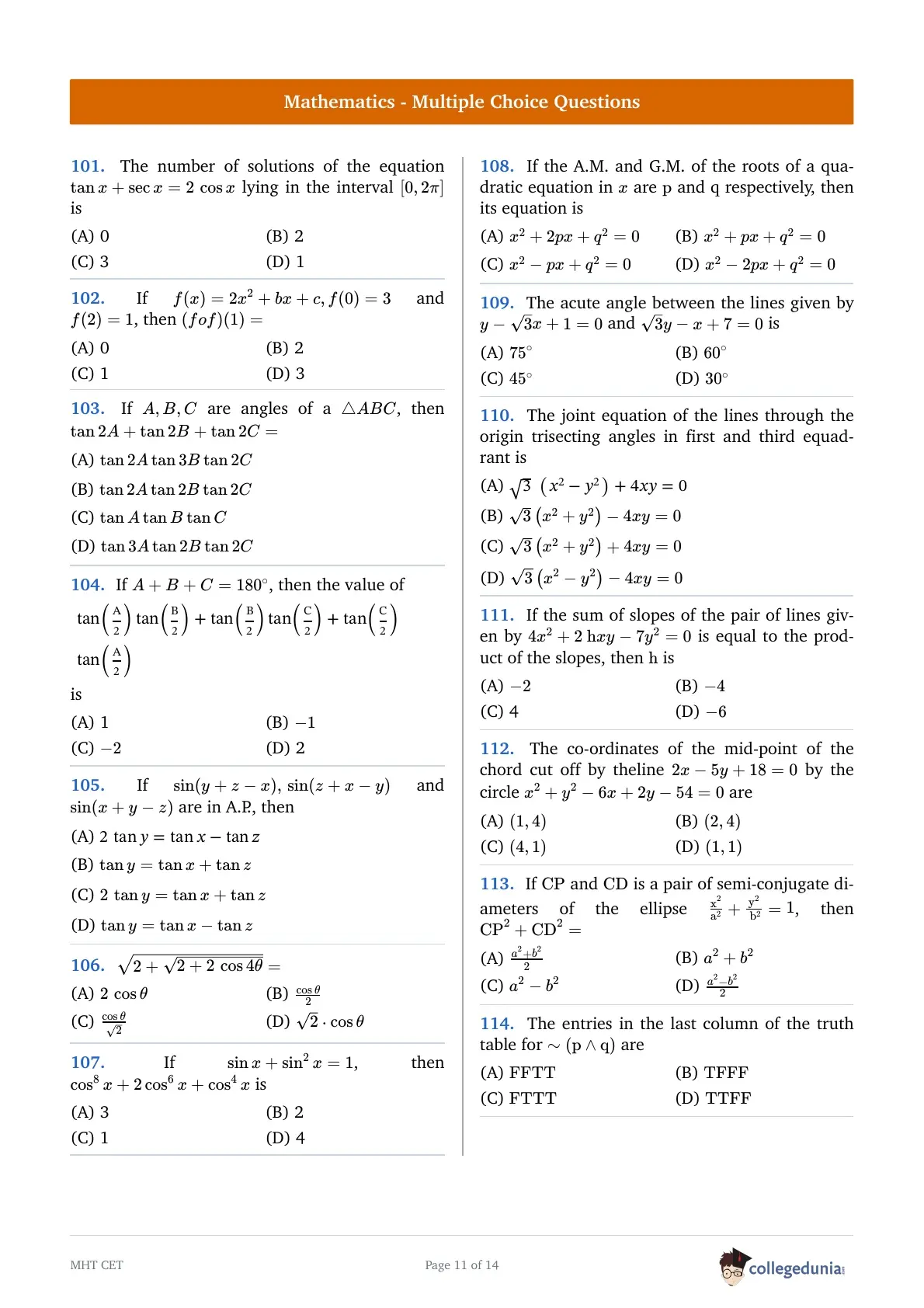
The number of solutions of the equation \( \tan x + \sec x = 2 \cos x \) lying in the interval \( [0, 2\pi] \) is
If \( A, B, C \) are angles of a triangle ABC, then \( \tan 2A + \tan 2B + \tan 2C = \)
If \( A + B + C = 180^\circ \), then the value of \( \tan \left( \frac{A}{2} \right) \tan \left( \frac{B}{2} \right) + \tan \left( \frac{B}{2} \right) \tan \left( \frac{C}{2} \right) + \tan \left( \frac{C}{2} \right) \tan \left( \frac{A}{2} \right) \) is
If \( \sin(y + z - x) \), \( \sin(z + x - y) \), and \( \sin(x + y - z) \) are in A.P., then
Simplify \( \sqrt{2} + \sqrt{2} + 2 \cos 4\theta = \)
If \( \sin x + \sin^2 x = 1 \), then \( \cos^8 x + 2 \cos^6 x + \cos^4 x \) is
If the A.M. and G.M. of the roots of a quadratic equation in \( x \) are \( p \) and \( q \) respectively, then its equation is
The acute angle between the lines given by \( y - \sqrt{3}x + 1 = 0 \) and \( \sqrt{3}y - x + 7 = 0 \) is
The joint equation of the lines through the origin trisecting angles in the first and third quadrant is
If the sum of the slopes of the pair of lines given by \( 4x^2 + 2hxy - 7y^2 = 0 \) is equal to the product of the slopes, then \( h \) is
The co-ordinates of the mid-point of the chord cut off by the line \( 2x - 5y + 18 = 0 \) by the circle \( x^2 + y^2 - 6x + 2y - 54 = 0 \) are
If \( CP \) and \( CD \) is a pair of semi-conjugate diameters of the ellipse \( \frac{x^2}{a^2} + \frac{y^2}{b^2} = 1 \), then \( CP^2 + CD^2 = \)
The entries in the last column of the truth table for \(\sim (\mathrm{p}\wedge \mathrm{q})\) are
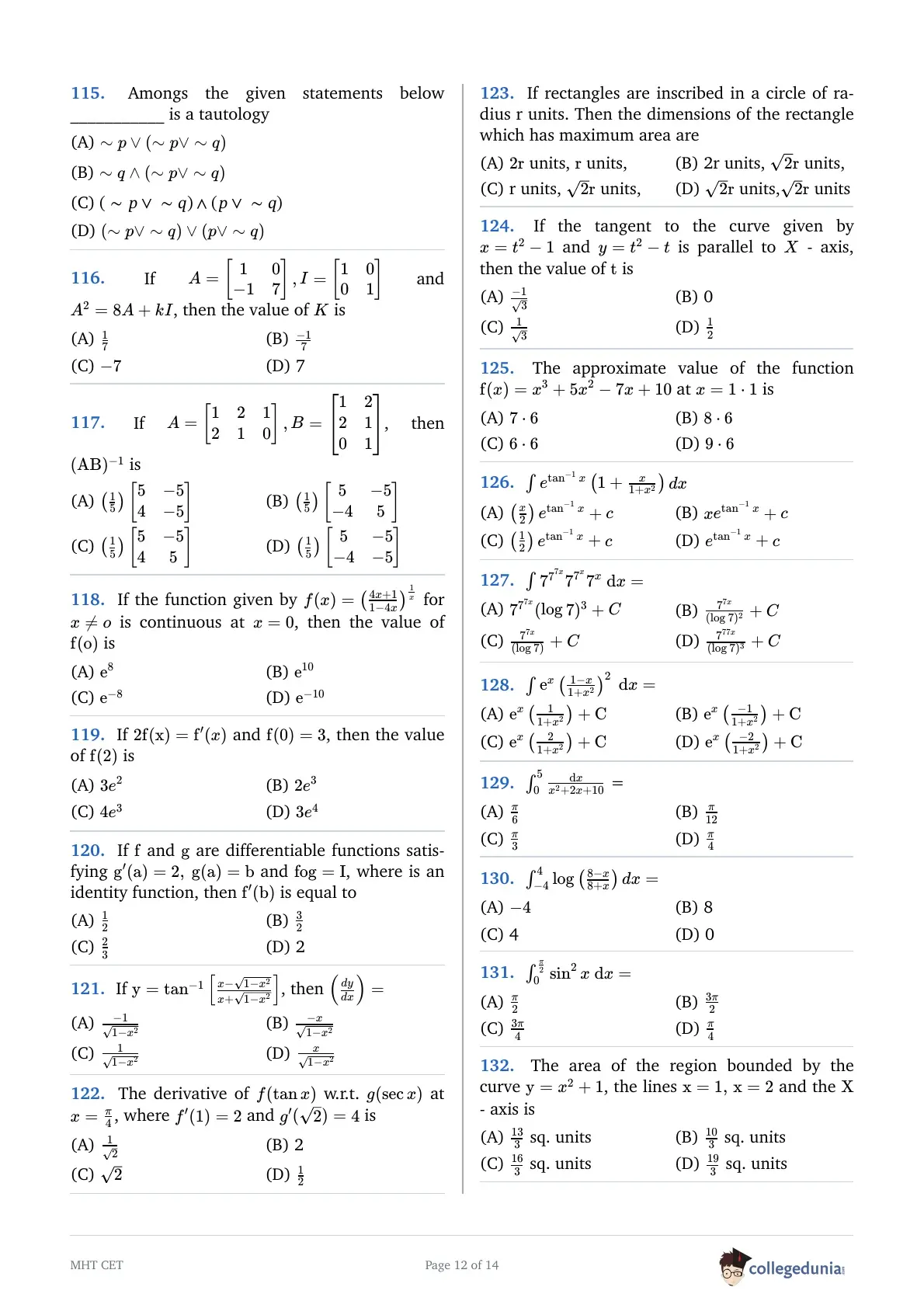
Amongs the given statements below ___________ is a tautology
If \(A=\begin{bmatrix} 1 & 2 & 1 \\ 2 & 1 & 0 \end{bmatrix},B=\begin{bmatrix} 1 & 2 \\ 2 & 1 \\ 0 & 1 \end{bmatrix}\), then \((\mathrm{AB})^{-1}\) is
If the function given by \( f(x) = \left( \frac{4x + 1}{1 - 4x} \right)^{\frac{1}{3}} \) for \( x \neq 0 \) is continuous at \( x = 0 \), the value of \( f(0) \) is
If \( 2f(x) = f'(x) \) and \( f(0) = 3 \), then the value of \( f(2) \) is
If \( f \) and \( g \) are differentiable functions satisfying \( g'(a) = 2 \), \( g(a) = b \), and \( f \circ g = 1 \), where 1 is an identity function, then \( f'(b) \) is equal to
If \( y = \tan^{-1} \left( \frac{x - \sqrt{1 - x^2}}{x + \sqrt{1 - x^2}} \right) \), then \( \frac{dy}{dx} \) is
The derivative of \( f(\tan x) \) w.r.t. \( g(\sec x) \) at \( x = \frac{\pi}{4} \), where \( f'(1) = 2 \) and \( g'( \sqrt{2} ) = 4 \), is
If rectangles are inscribed in a circle of radius \( r \) units, then the dimensions of the rectangle which has maximum area are
If the tangent to the curve given by \( x = t^2 - 1 \) and \( y = t^2 - t \) is parallel to the x-axis, then the value of \( t \) is
The approximate value of the function \( f(x) = x^3 + 5x^2 - 7x + 10 \) at \( x = 1 \) is
Evaluate \( \int e^{\tan^{-1} x} \left( 1 + \frac{x}{1 + x^2} \right) dx \)
Evaluate the integral \( \int e^x \left( \frac{1 - x}{1 + x^2} \right)^2 dx = \)
Evaluate the integral \( \int_0^5 \frac{dx}{x^2 + 2x + 10} \)
Evaluate \( \int_{-4}^{4} \log \left( \frac{8 - x}{8 + x} \right) dx \)
Evaluate \( \int_0^{\frac{\pi}{2}} \sin^2 x \, dx \)
The area of the region bounded by the curve \( y = x^2 + 1 \), the lines \( x = 1 \), \( x = 2 \), and the x-axis is
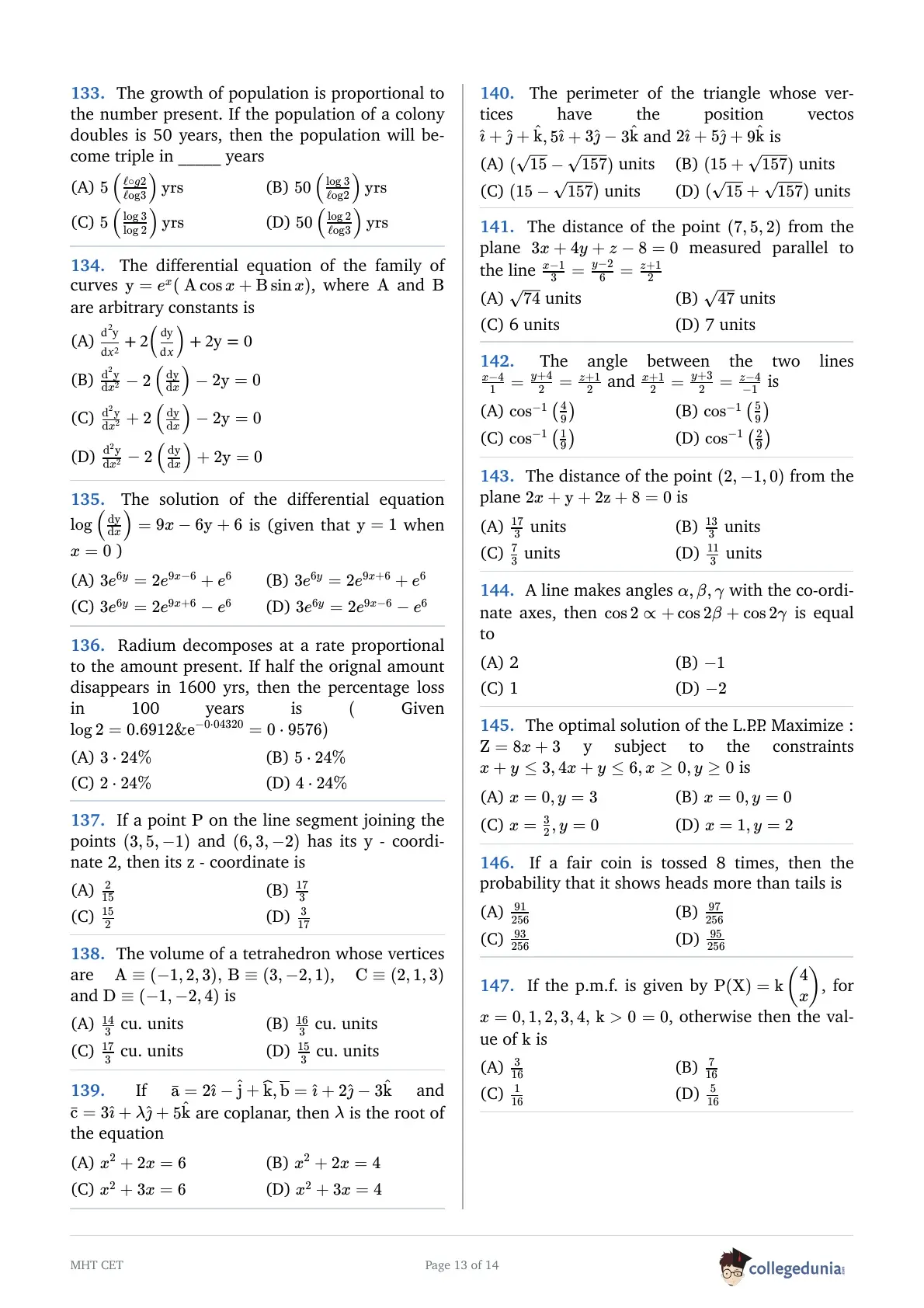
The growth of population is proportional to the number present. If the population of a colony doubles in 50 years, then the population will become triple in
The differential equation of the family of curves \( y = e^{x} (A \cos x + B \sin x) \), where \( A \) and \( B \) are arbitrary constants, is
The solution of the differential equation \( \log \left( \frac{dy}{dx} \right) = 9x - 6y + 6 \) is (given that \( y = 1 \) when \( x = 0 \))
Radium decomposes at a rate proportional to the amount present. If half the original amount disappears in 1600 years, then the percentage loss in 100 years is
If a point \( P \) on the line segment joining the points \( (3, 5, -1) \) and \( (6, 3, -2) \) has its \( y \)-coordinate 2, then its \( z \)-coordinate is
The volume of a tetrahedron whose vertices are \( A = (-1, 2, 3) \), \( B = (3, -2, 1) \), \( C = (2, 1, 3) \), and \( D = (-1, -2, 4) \) is
The distance of the point \( (7, 5, 2) \) from the plane \( 3x + 4y + 2z - 8 = 0 \) measured parallel to the line \( \frac{x - 1}{3} = \frac{y - 2}{6} = \frac{z + 1}{2} \) is
The angle between the two lines \( \frac{x-4}{1} = \frac{y+4}{2} = \frac{z+1}{2} \) and \( \frac{x+1}{2} = \frac{y+3}{2} = \frac{z-4}{-1} \) is
The distance of the point \( (2, -1, 0) \) from the plane \( 2x + y + 2z + 8 = 0 \) is
A line makes angles \( \alpha \), \( \beta \), \( \gamma \) with the co-ordinate axes, then \( \cos 2\alpha + \cos 2\beta + \cos 2\gamma \) is equal to
The optimal solution of the L.P.P. \( Z = 8x + 3y \) subject to the constraints \( x + y \leq 3 \), \( 4x + y \leq 6 \), \( x \geq 0 \), \( y \geq 0 \) is
If a fair coin is tossed 8 times, then the probability that it shows heads more than tails is
If the p.m.f. is given by \( P(X) = k \left( \frac{4}{x} \right) \) for \( x = 0, 1, 2, 3, 4 \) and \( k>0 \), then the value of \( k \) is
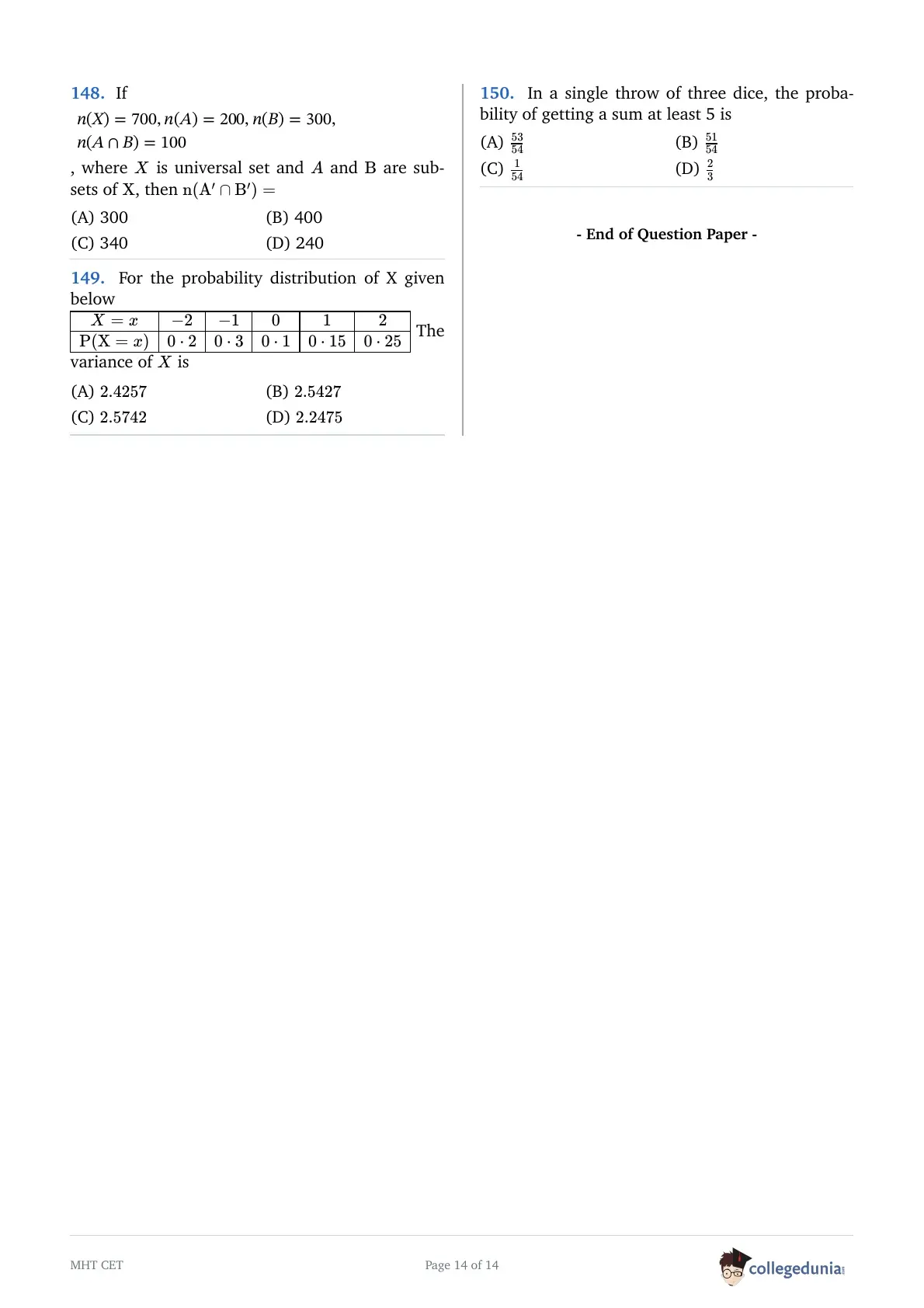
For the probability distribution of X given below \(\begin{array}{|c|c|c|c|c|c|} \hline X=x & -2 & -1 & 0 & 1 & 2 \\ \hline \mathrm{P}(\mathrm{X}=x) & 0\cdot 2 & 0\cdot 3 & 0\cdot 1 & 0\cdot 15 & 0\cdot 25 \\ \hline \end{array}\) The variance of \(X\) is
In a single throw of three dice, the probability of getting a sum of at least 5 is
MHT CET 2020 PCM Exam Pattern and Marking Scheme
| Parameter | Details |
|---|---|
| Conducting Body | Maharashtra Common Entrance Test Cell (Maharashtra CET Cell) |
| Exam Mode | Online (Computer-Based Test) |
| Duration | 180 minutes (3 hours) |
| Groups / Subjects | PCM (Physics, Chemistry, Mathematics) for Engineering |
| Total Questions |
150 |
| Total Marks | 200 |
| Question Type | Multiple Choice Questions (MCQs) |
| Marks Distribution |
|
| Negative Marking | No |
| Syllabus Weightage |
|



Comments