




MHT CET 2020 Oct 16 Shift 1 PCM Question Paper is available for download here. Maharashtra State CET Cell conducted MHT CET 2020 PCM Exam on Oct 16 in Shift 1 from 9 AM to 12 PM in CBT mode.
The MHT CET 2020 PCM question paper includes the following:
- The MHT CET 2020 PCM Question Paper consists of 150 multiple-choice questions (MCQs) totalling 200 marks divided into 3 sections: Physics, Chemistry, and Mathematics, with 50 questions in each subject.
- Physics and Chemistry questions carry 1 mark each while Mathematics questions carry 2 marks each.
- There is no negative marking for incorrect answers.
MHT CET 2020 Oct 16 Shift 1 PCM Question Paper with Solution PDF
| CD PDF | CD PDF with Solutions |
|---|---|
| Download Collegedunia PDF 1.00 MB | - |
Also Check:
MHT CET 2020 Oct 16 Shift 1 PCM Questions with Solutions
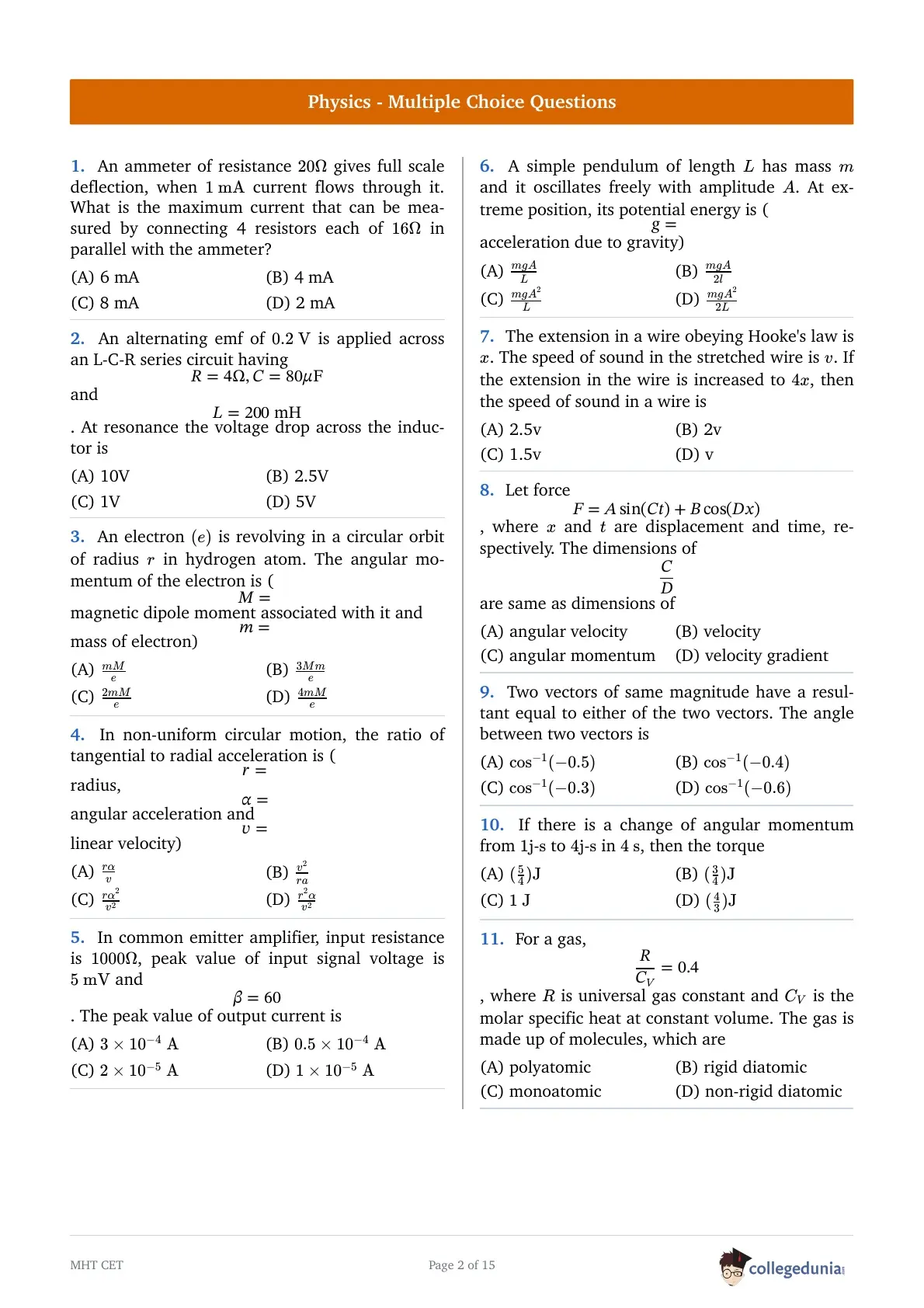
An alternating e.m.f. of 0.2 V is applied across an LCR series circuit having \( R = 4 \, \Omega \), \( C = 80 \, \mu \text{F} \), and \( L = 200 \, \text{mH} \). At resonance, the voltage drop across the inductor is
An electron \((e)\) is revolving in a circular orbit of radius \(r\) in hydrogen atom. The angular momentum of the electron is (\(M=\) magnetic dipole moment associated with it and \(m=\) mass of electron)
In non-uniform circular motion, the ratio of tangential to radial acceleration is (\[r=\] radius, \[\alpha=\] angular acceleration and \[v=\] linear velocity)
In common emitter amplifier, input resistance is \( 1000 \, \Omega \), peak value of input signal voltage is 5 mV and \( \beta = 60 \). The peak value of output current is
A simple pendulum of length \( L \) has mass \( M \) and it oscillates freely with amplitude \( A \). At extreme position its potential energy is \( (g = \text{acceleration due to gravity}) \)
The extension in a wire obeying Hooke’s law is \( x \). The speed of sound in the stretched wire is \( V \). If the extension in the wire is increased to \( 4x \), then the speed of sound in the wire is
Two vectors of same magnitude have a resultant equal to either of the two vectors. The angle between two vectors is
If there is a change of angular momentum from 1 J·s to 4 J·s in 4 seconds, then the torque is
For a gas, \( \frac{R}{C_V} = 0.4 \), where \( R \) is universal gas constant and \( C_V \) is the molar specific heat at constant volume. The gas is made up of molecules which are
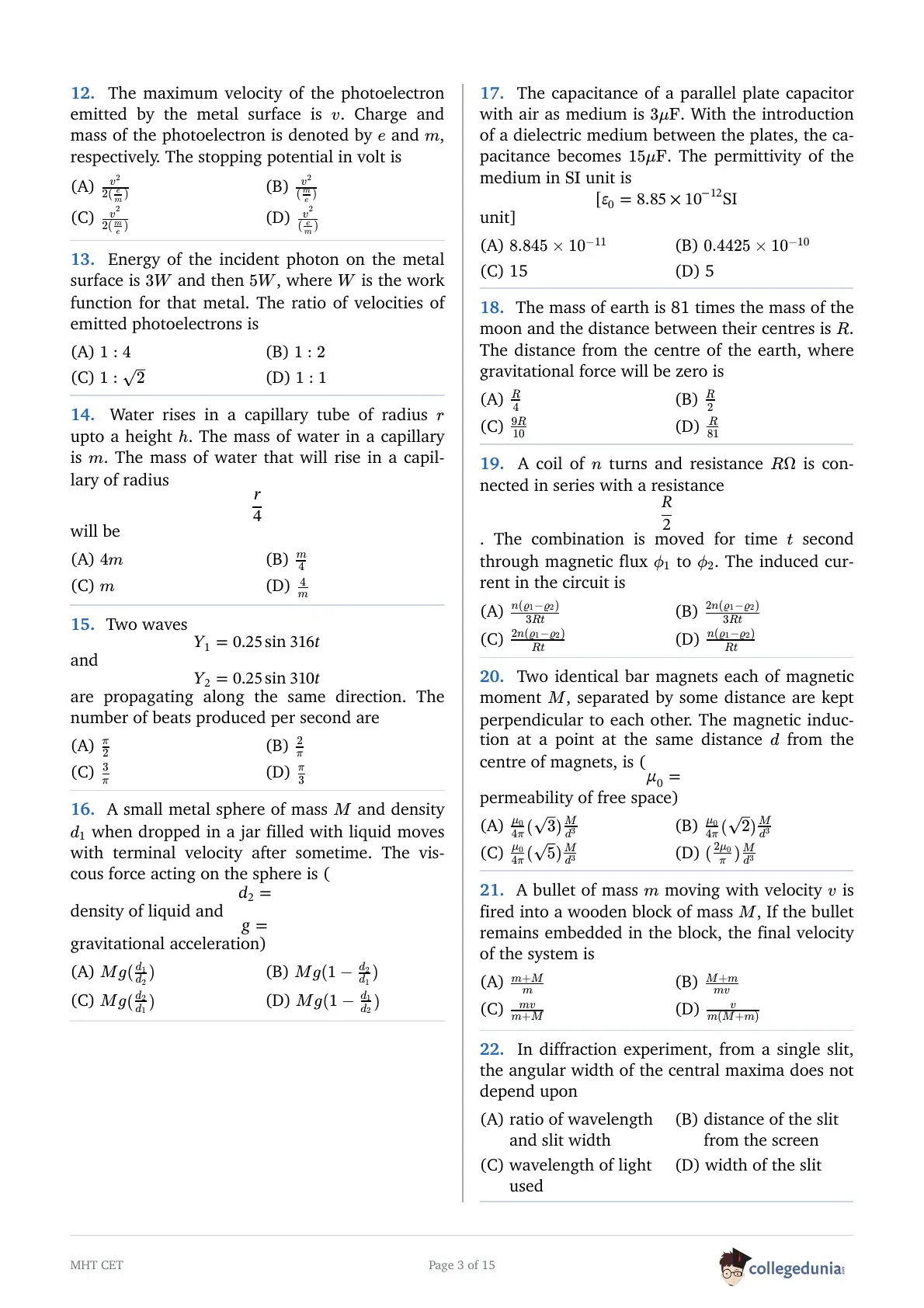
Energy of the incident photon on the metal surface is ' 3W ' and then ' 5W ', where 'W' is the work function for that metal. The ratio of velocities of emitted photoelectrons is
Water rises in a capillary tube of radius \( r \) upto a height \( h \). The mass of water in a capillary is \( m \). The mass of water that will rise in a capillary of radius \( \frac{r}{4} \) will be
Two waves \( y_1 = 0.25 \sin(316 t) \) and \( y_2 = 0.25 \sin(310 t) \) are propagating along the same direction. The number of beats produced per second are
A small metal sphere of mass \(M\) and density \(d_1\) when dropped in a jar filled with liquid moves with terminal velocity after sometime. The viscous force acting on the sphere is (\(d_2=\) density of liquid and \(g=\) gravitational acceleration)
The capacitance of a parallel plate capacitor with air as medium is \( 3 \, \mu \text{F} \)
. With the introduction of a dielectric medium between the plates, the capacitance becomes \( 15 \, \mu \text{F} \)
. The permittivity of the medium in SI units is \( \epsilon_0 = 8.85 \times 10^{-12} \, \text{F/m} \).
The mass of the earth is 81 times the mass of the moon and the distance between their centres is \( R \). The distance from the centre of the earth where gravitational force will be zero is
A coil of \( n \) turns and resistance \( R \, \Omega \) is connected in series with a resistance \( \frac{R}{2} \). The combination is moved for time \( t \) second through magnetic flux \( \phi_1 \) to \( \phi_2 \). The induced current in the circuit is
Two identical bar magnets each of magnetic moment \(M\), separated by some distance are kept perpendicular to each other. The magnetic induction at a point at the same distance \(d\) from the centre of magnets, is (\(\mu_0=\) permeability of free space)
A bullet of mass \( m \) moving with velocity \( v \) is fired into a wooden block of mass \( M \). If the bullet remains embedded in the block, the final velocity of the system is
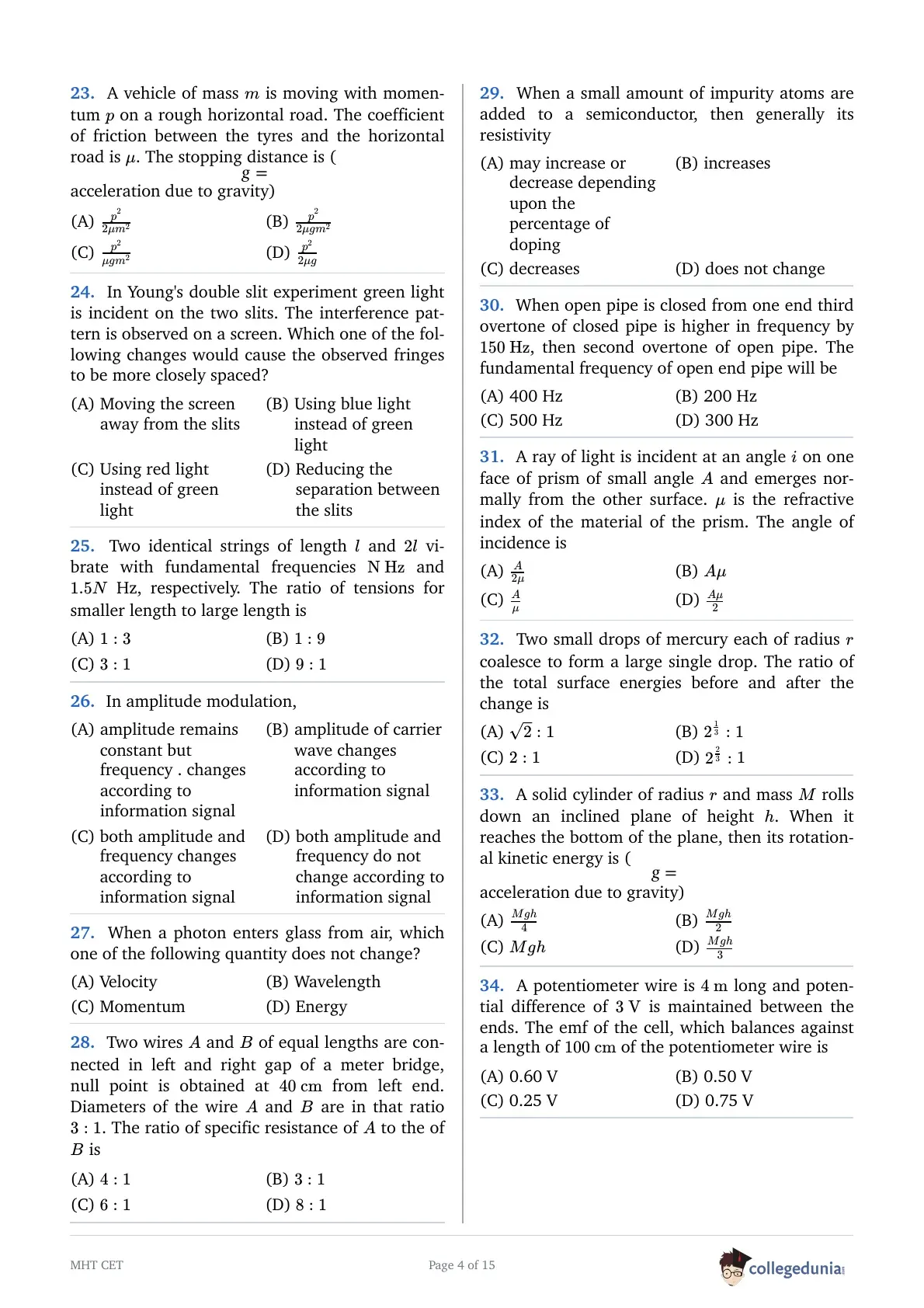
Two identical strings of length \( l \) and \( 2l \) vibrate with fundamental frequencies \( N \) hertz and \( 1.5N \) hertz, respectively. The ratio of tensions for smaller length to larger length is
In amplitude modulation,
When a photon enters glass from air, which one of the following quantity does NOT change?
When a small amount of impurity atoms are added to a semiconductor then generally its resistivity
When open pipe is closed from one end then third overtone of closed pipe is higher in frequency by 150 Hz than second overtone of open pipe. The fundamental frequency of open end pipe will be
A ray of light is incident at an angle \( i \) on one face of a prism of small angle \( A \) and emerges normally from the other surface. \( \mu \) is the refractive index of the material of the prism. The angle of incidence is
A solid cylinder of radius \(r\) and mass \(M\) rolls down an inclined plane of height \(h\). When it reaches the bottom of the plane, then its rotational kinetic energy is (\(g=\) acceleration due to gravity)
A potentiometer wire is 4 m long and potential difference of 3 V is maintained between the ends. The e.m.f. of the cell which balances against a length of 100 cm of the potentiometer wire is
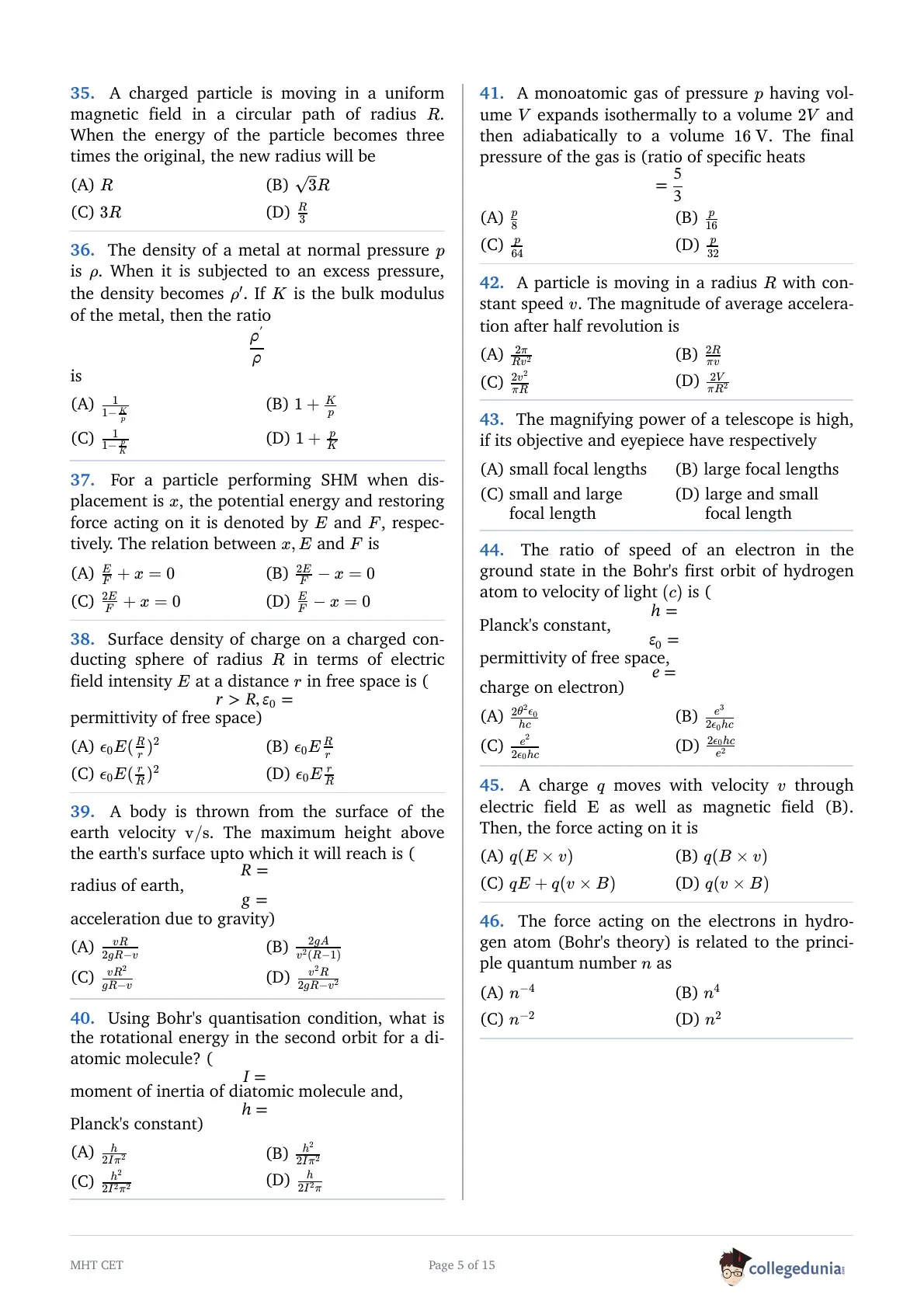
The density of a metal at normal pressure \( P \) is \( \rho \). When it is subjected to an excess pressure, the density becomes \( \rho' \). If \( K \) is the bulk modulus of the metal, then the ratio \( \frac{\rho'}{\rho} \) is
For a particle performing simple harmonic motion, when displacement is \( x \), the potential energy and restoring force acting on it is denoted by \( E \) and \( F \) respectively. The relation between \( x \), \( E \), and \( F \) is
Surface density of charge on a charged conducting sphere of radius \(R\) in terms of electric field intensity \(E\) at a distance \(r\) in free space is (\(r>R, \varepsilon_0=\) permittivity of free space)
A body is thrown from the surface of the earth velocity \(\mathrm{v} / \mathrm{s}\). The maximum height above the earth's surface upto which it will reach is (\(R=\) radius of earth, \(g=\) acceleration due to gravity)
Using Bohr’s quantization condition, what is the rotational energy in the second orbit for a diatomic molecule? (I = moment of inertia of diatomic molecule, \( h \) = Planck’s constant)
A monoatomic gas of pressure \(p\) having volume \(V\) expands isothermally to a volume \(2V\) and then adiabatically to a volume \(16 \mathrm{~V}\). The final pressure of the gas is (ratio of specific heats \(=\frac{5}{3}\)
A particle is moving in a circle of radius \( R \) with constant speed \( V \). The magnitude of average acceleration after half revolution is
The magnifying power of a telescope is high if its objective and eyepiece have respectively
The ratio of speed of an electron in the ground state in an atom to the velocity of light (c) is
\((h = \text{Planck's constant}, \epsilon_0 = \text{permittivity of free space})\)
A charge \( q \) moves with velocity \( \vec{v} \) through electric field \( \vec{E} \) as well as magnetic field \( \vec{B} \). Then the force acting on it is
The force acting on the electrons in hydrogen atom (Bohr’s theory) is related to the principle quantum number \( n \) as
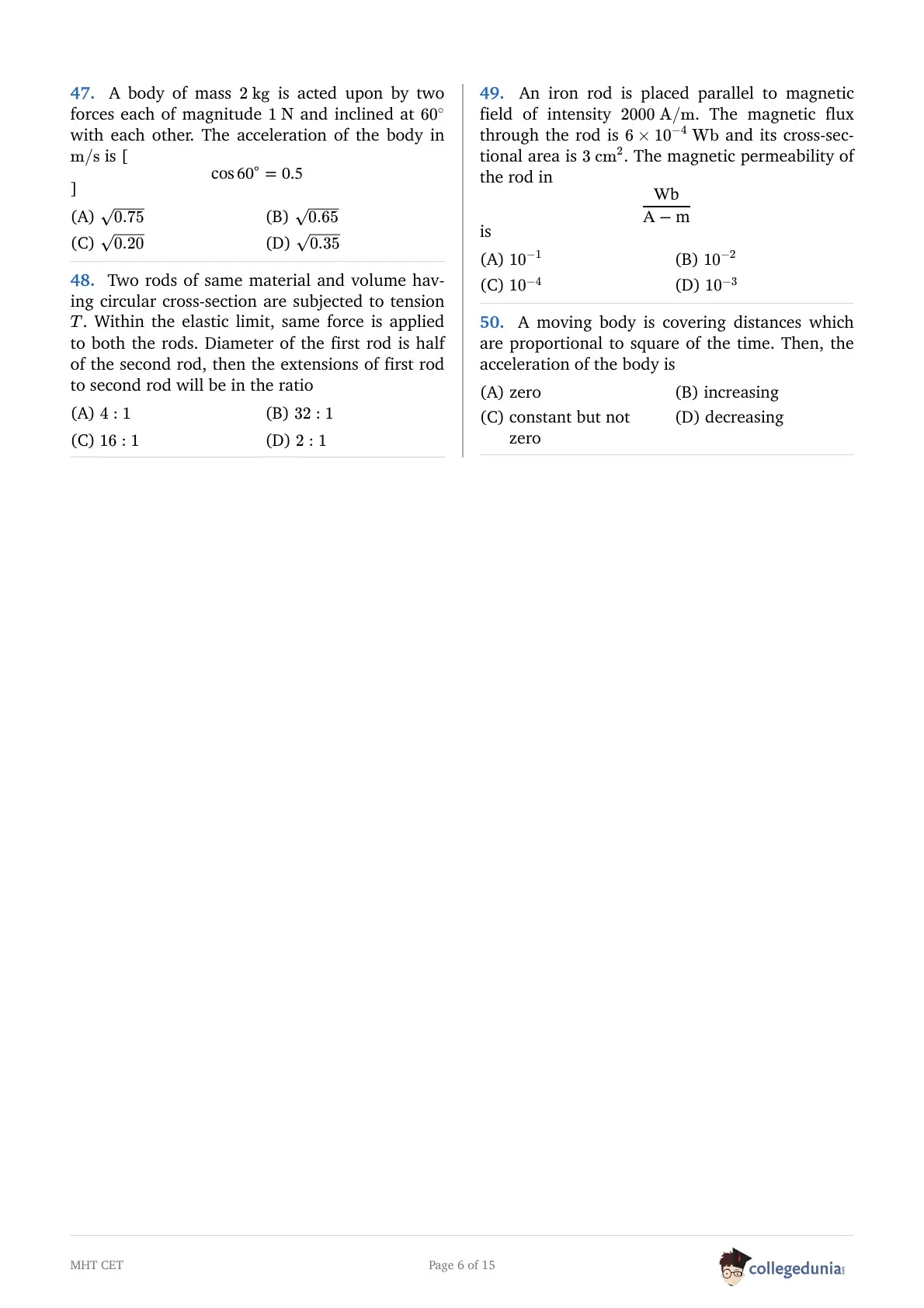
A body of mass \(2 \mathrm{~kg}\) is acted upon by two forces each of magnitude \(1 \mathrm{~N}\) and inclined at \(60^{\circ}\) with each other. The acceleration of the body in \(\mathrm{m} / \mathrm{s}\) is [\(\cos 60^{\circ}=0.5\)]
An iron rod is placed parallel to the magnetic field of intensity 2000 \( A/m \). The magnetic flux through the rod is \( 6 \times 10^{-4} \, Wb \) and its cross-sectional area is \( 3 \, cm^2 \). The magnetic permeability of the rod in \( \frac{Wb}{A \cdot m} \) is
A moving body is covering distances which are proportional to the square of the time. Then the acceleration of the body is
Chemistry (Q51 - Q100)
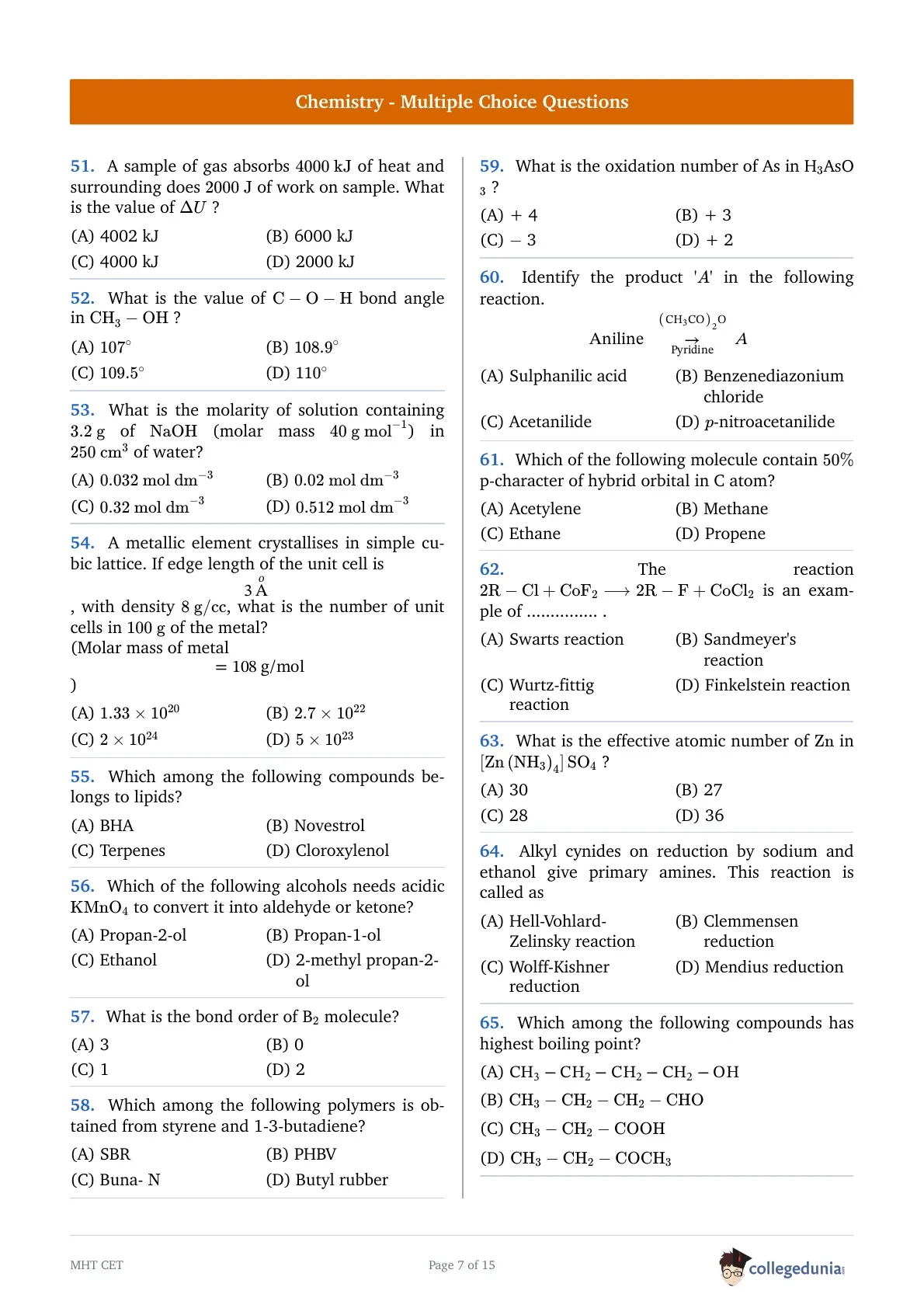
A sample of gas absorbs 4000 kJ of heat and surrounding does 2000 J of work on sample, what is the value of \(\Delta U\)?
What is the value of C-O-H bond angle in CH\(_3\)-OH?
What is the molarity of solution containing 3.2g of NaOH (Molar mass 40g mol\(^{-1}\)) in 250 cm\(^3\) of water?
A metallic element crystallizes in simple cubic lattice. If edge length of the unit cell is 34Å, with density 8 g/cm\(^3\), what is the number of unit cells in 100 g of the metal? (Molar mass of metal = 108 g/mol)
Which among the following compounds belongs to lipids?
Which of the following alcohols needs acidic KMnO\(_4\) to convert it into aldehyde or ketone?
Which among the following polymers is obtained from styrene and 1-3-Butadiene?
What is the oxidation number of As in H\(_3\)AsO\(_3\)?
Identify the product '\(A\)' in the following reaction.
\(\text { Aniline } \xrightarrow[\text { Pyridine }]{\left(\mathrm{CH}_3 \mathrm{CO}\right)_2 \mathrm{O}} A\)
Which of the following molecule contains 50% p\(_\pi\) character of hybrid orbital in C atom?
The reaction \( 2R - Cl + CoF_2 \rightarrow 2R - F + CoCl_2 \) is an example of .......
What is the effective atomic number of Zn in \([Zn(NH_3)_4]SO_4\)? (Atomic number of Zn = 30)
Alkyl cyanides on reduction by sodium and ethanol give primary amines. This reaction is called as _____.
Which among the following compounds has the highest boiling point?
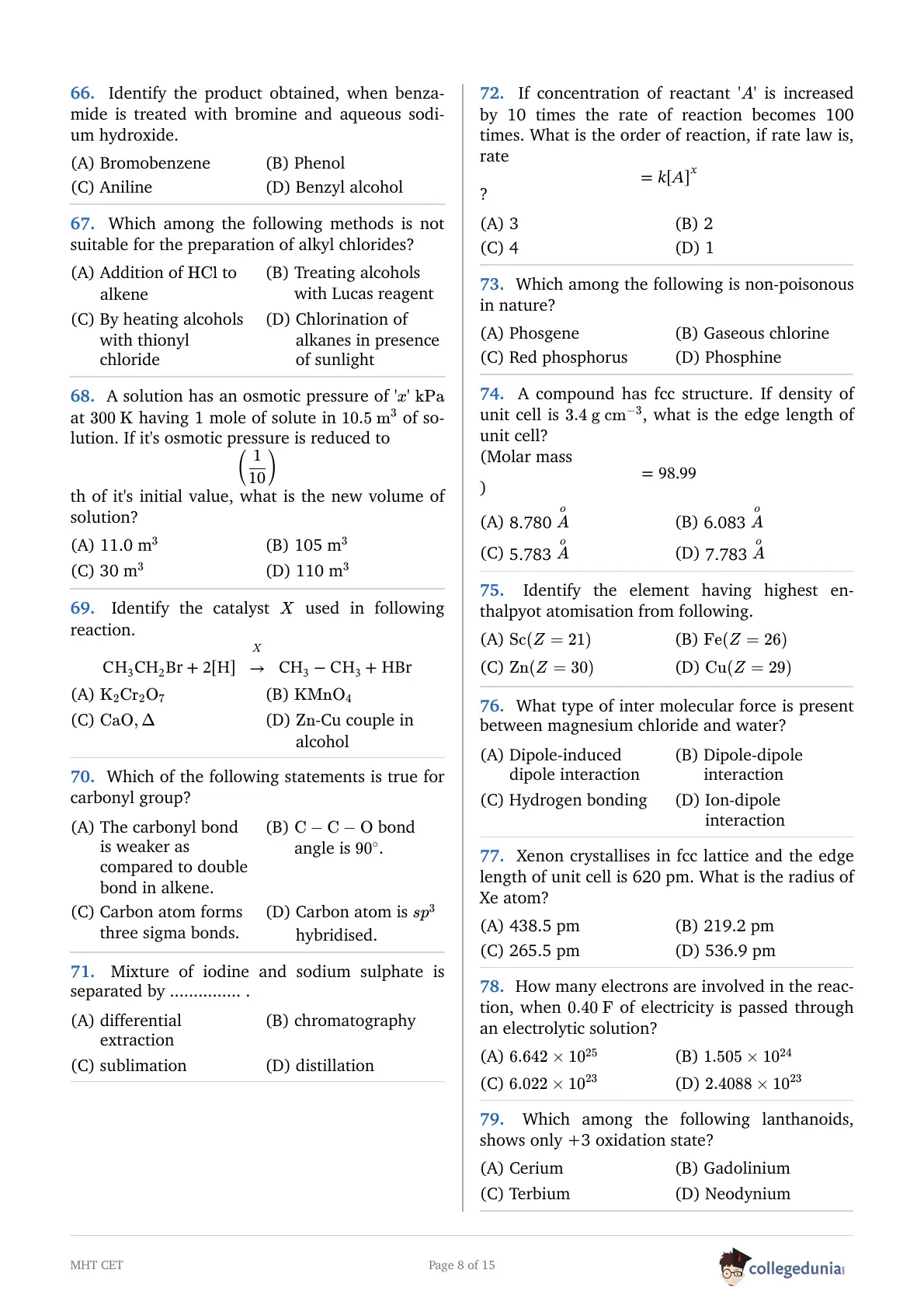
Identify the product obtained when benzamide is treated with bromine and aqueous sodium hydroxide.
Which among the following methods is NOT suitable for the preparation of alkyl chlorides?
A solution has an osmotic pressure of X kPa at 300 K having one mole of solute in \(10.5\ \text{m}^3\) of solution. If its osmotic pressure is reduced to \(\frac{1}{10}\) of its initial value, what is the new volume of solution?
Identify the catalyst X used in the following reaction:
CH\(_3\)CH\(_2\)Br + 2[H] \(\xrightarrow{X}\) CH\(_3\)CH\(_3\) + HBr
Which of the following statements is true for the carbonyl group?
Mixture of iodine and Sodium Sulphate is separated by .........
If concentration of reactant ‘A’ is increased by 10 times, the rate of reaction becomes 100 times. What is the order of reaction if rate law is rate = k[A]\(^n\)?
Which among the following is non-poisonous in nature?
A compound has fcc structure. If density of unit cell is 3.4 g cm^{-3, what is the edge length of unit cell? (Molar mass = 98-99)
Identify the element having the highest enthalpy of atomization from the following.
What type of intermolecular force is present between magnesium chloride and water?
Xenon crystallizes in fcc lattice and the edge length of unit cell is 620 pm. What is the radius of Xe atom?
How many electrons are involved in the reaction when 0.40 F of electricity is passed through an electrolytic solution?
Which among the following lanthanoids shows only +3 oxidation state?
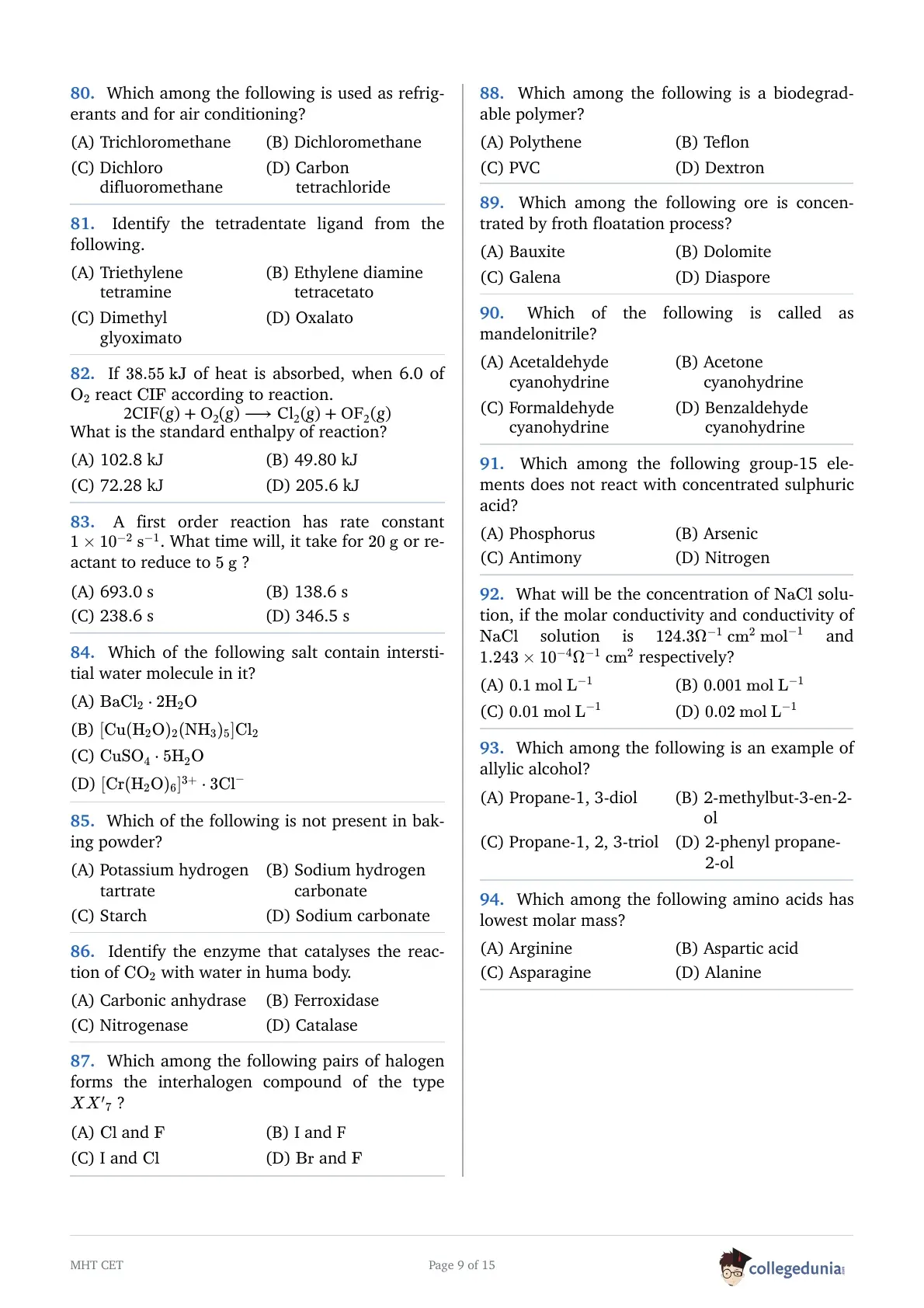
Which among the following is used as refrigerants and for air conditioning?
Identify the tetradentate ligand from the following.
If \(38.55 \mathrm{~kJ}\) of heat is absorbed, when 6.0 of \(\mathrm{O}_2\) react \(\mathrm{CIF}\) according to reaction.
\(2 \mathrm{CIF}(g)+\mathrm{O}_2(g) \longrightarrow \mathrm{Cl}_2(g)+\mathrm{OF}_2(g)\)
What is the standard enthalpy of reaction?
A first-order reaction has rate constant \(1 \times 10^{-2} \, \text{s}^{-1}\). What time will it take for 20 g of reactant to reduce to 5 g?
Which of the following salts contain interstitial water molecules in it?
Which of the following is NOT present in baking powder?
Identify the enzyme that catalyses the reaction of CO\(_2\) with water in the human body.
Which among the following pairs of halogen forms the interhalogen compound of the type XX'Y?
Which among the following is a biodegradable polymer?
Which among the following ore is concentrated by froth flotation process?
Which of the following is called as Mandelonitrile?
Which among the following group-15 elements does NOT react with concentrated sulfuric acid?
What will be the concentration of NaCl solution, if the molar conductivity and conductivity of NaCl solution are 124.3 \(\Omega^{-1}\)cm\(^2\)mol\(^{-1}\) and 1.243 × 10\(^-4\) \(\Omega^{-1}\)cm\(^1\) respectively?
Which among the following is an example of allylic alcohol?
Which among the following amino acids has the lowest molar mass?
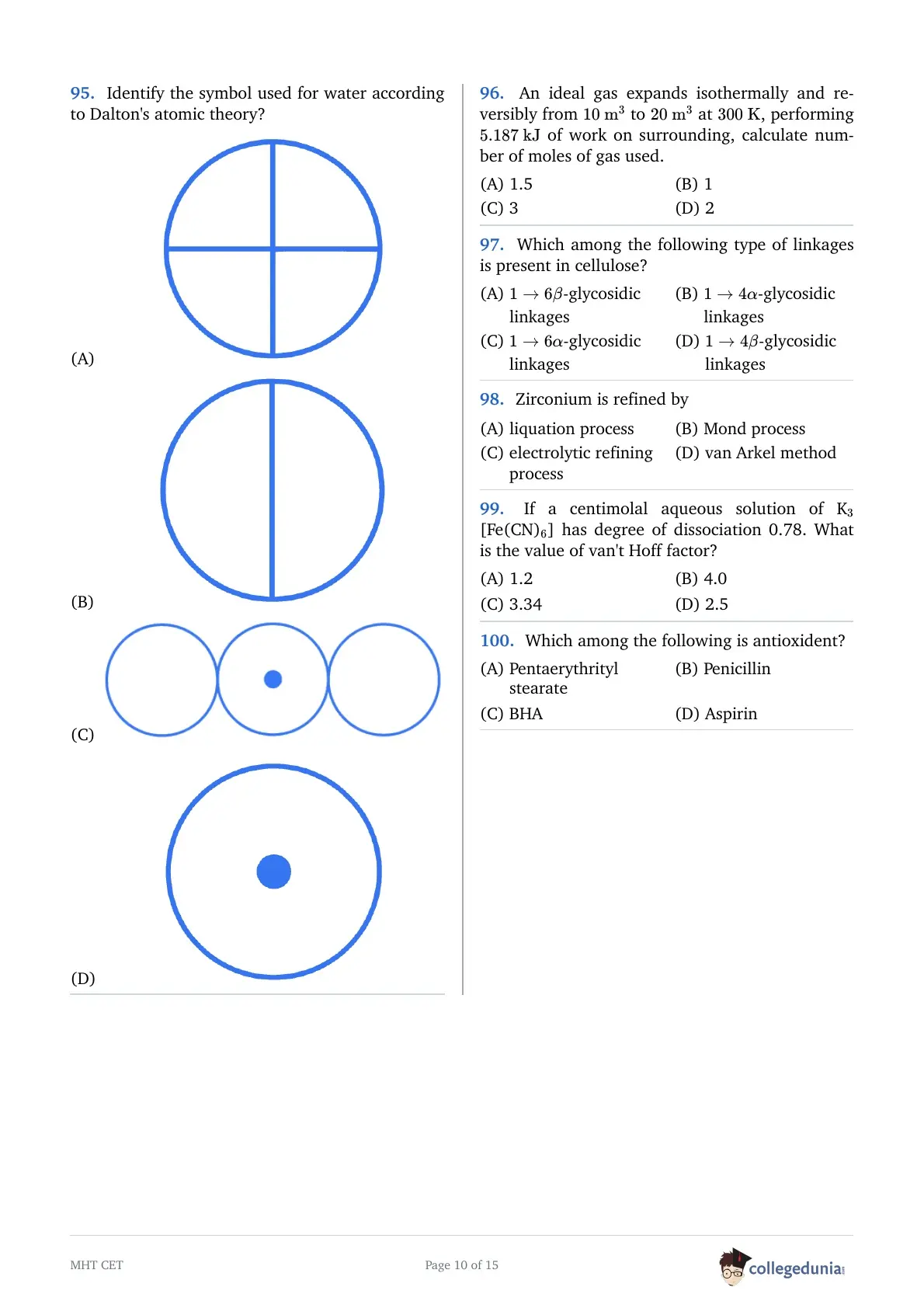
An ideal gas expands isothermally and reversibly from 10m\(^3\) to 20m\(^3\) at 300K, performing 5×10\(^3\) J of work on surroundings, calculate number of moles of gas used?
Which among the following type of linkages is present in cellulose?
Zirconium is refined by ..................
If a centimolar aqueous solution of K\(_3\)[Fe(CN)\(_6\)] has degree of dissociation 0.78, what is the value of van't Hoff factor?
Which among the following is an antioxidant?
Mathematics (Q101 - Q150)
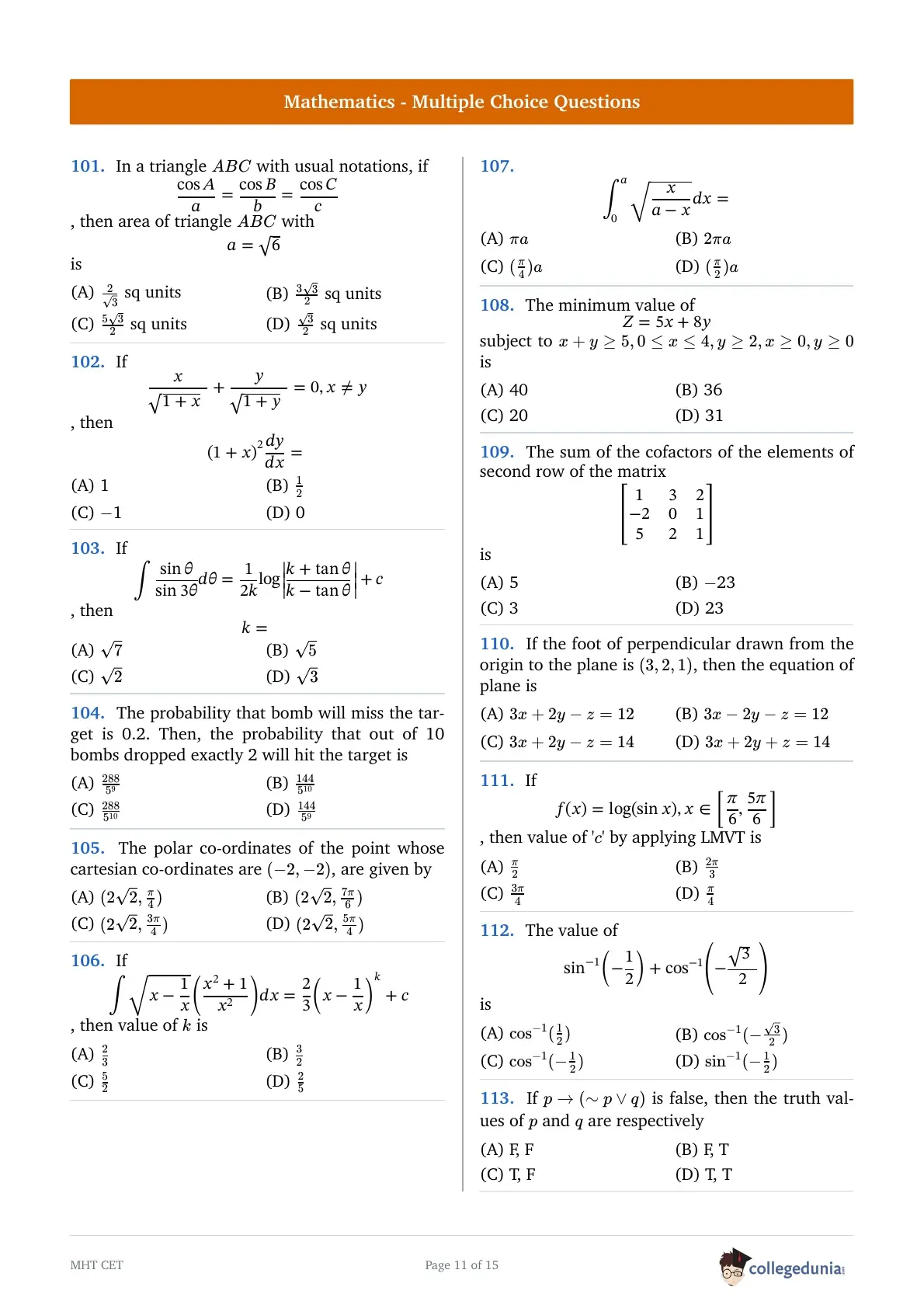
In a triangle \( ABC \) with usual notations, if \( \frac{\cos A}{a} = \frac{\cos B}{b} = \frac{\cos C}{c} \), then the area of triangle \( ABC \) with \( a = \sqrt{6} \) is
If \(\frac{x}{\sqrt{1+x}}+\frac{y}{\sqrt{1+y}}=0, x \neq y\), then \((1+x)^2 \frac{d y}{d x}=\)
If \(\int \frac{\sin \theta}{\sin 3 \theta} d \theta=\frac{1}{2 k} \log \left|\frac{k+\tan \theta}{k-\tan \theta}\right|+c\), then \(k=\)
The probability that a bomb will miss the target is 0.2. Then the probability that out of 10 bombs dropped exactly 2 will hit the target is
The polar co-ordinates of the point whose cartesian co-ordinates are \( (-2, -2) \), are given by
If \(\int \sqrt{x-\frac{1}{x}}\left(\frac{x^2+1}{x^2}\right) d x=\frac{2}{3}\left(x-\frac{1}{x}\right)^k+c\), then value of \(k\) is
The minimum value of \(Z=5 x+8 y\) subject to \(x+y \geq 5,0 \leq x \leq 4, y \geq 2, x \geq 0, y \geq 0\) is
The sum of the cofactors of the elements of second row of the matrix \(\left[\begin{array}{rrr}1 & 3 & 2 \\ -2 & 0 & 1 \\ 5 & 2 & 1\end{array}\right]\) is
If \( f(x) = \log(\sin x) \), \( x \in \left[ \frac{\pi}{6}, \frac{5\pi}{6} \right] \), then the value of \( c \) by applying L.M.V.T. is
The value of \( \sin^{-1} \left( -\frac{1}{2} \right) + \cos^{-1} \left( -\frac{\sqrt{3}}{2} \right) \) is
If \(p \rightarrow(\sim p \vee q)\) is false, then the truth values of \(p\) and \(q\) are respectively
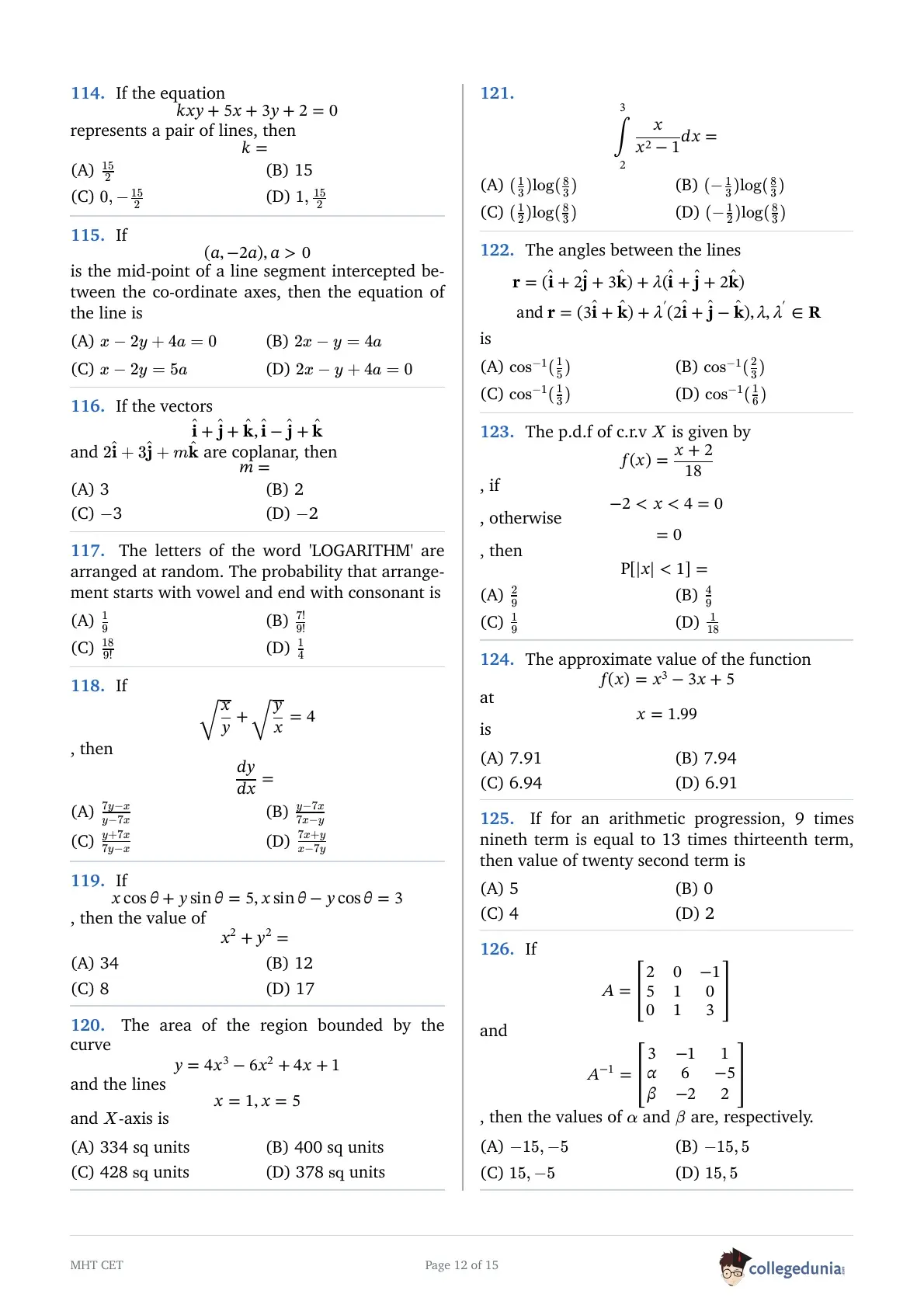
If the equation \(k x y+5 x+3 y+2=0\) represents a pair of lines, then \(k=\)
If \( (a, -2a), \, a>0 \) is the midpoint of a line segment intercepted between the co-ordinate axes, then the equation of the line is
If the vectors \( i + j + k \), \( i - j + k \) and \( 2i + 3j + mk \) are coplanar, then \( m = \)
The letters of the word 'LOGARITHM' are arranged at random. The probability that the arrangement starts with a vowel and ends with a consonant is
If \(\sqrt{\frac{x}{y}}+\sqrt{\frac{y}{x}}=4\), then \(\frac{d y}{d x}=\)
If \(x \cos \theta+y \sin \theta=5, x \sin \theta-y \cos \theta=3\), then the value of \(x^2+y^2=\)
The area of the region bounded by the curve \( y = 4x^3 - 6x^2 + 4x + 1 \) and the lines \( x = 1, x = 5 \) and the X axis is
The angles between the lines \[\mathbf{r}=(\hat{\mathbf{i}}+2 \hat{\mathbf{j}}+3 \hat{\mathbf{k}})+\lambda(\hat{\mathbf{i}}+\hat{\mathbf{j}}+2 \hat{\mathbf{k}}) \text { and } \mathbf{r}=(3 \hat{\mathbf{i}}+\hat{\mathbf{k}})+\lambda^{\prime}(2 \hat{\mathbf{i}}+\hat{\mathbf{j}}-\hat{\mathbf{k}}), \lambda, \lambda^{\prime} \in \mathbf{R}\] is
The approximate value of the function \(f(x)=x^3-3 x+5\) at \(x=1.99\) is
If for an Arithmetic progression, 9 times the ninth term is equal to 13 times the thirteenth term, then the value of the twenty-second term is
If \(A=\left[\begin{array}{rrr}2 & 0 & -1 \\ 5 & 1 & 0 \\ 0 & 1 & 3\end{array}\right]\) and \(A^{-1}=\left[\begin{array}{rrr}3 & -1 & 1 \\ \alpha & 6 & -5 \\ \beta & -2 & 2\end{array}\right]\), then the values of \(\alpha\) and \(\beta\) are, respectively.
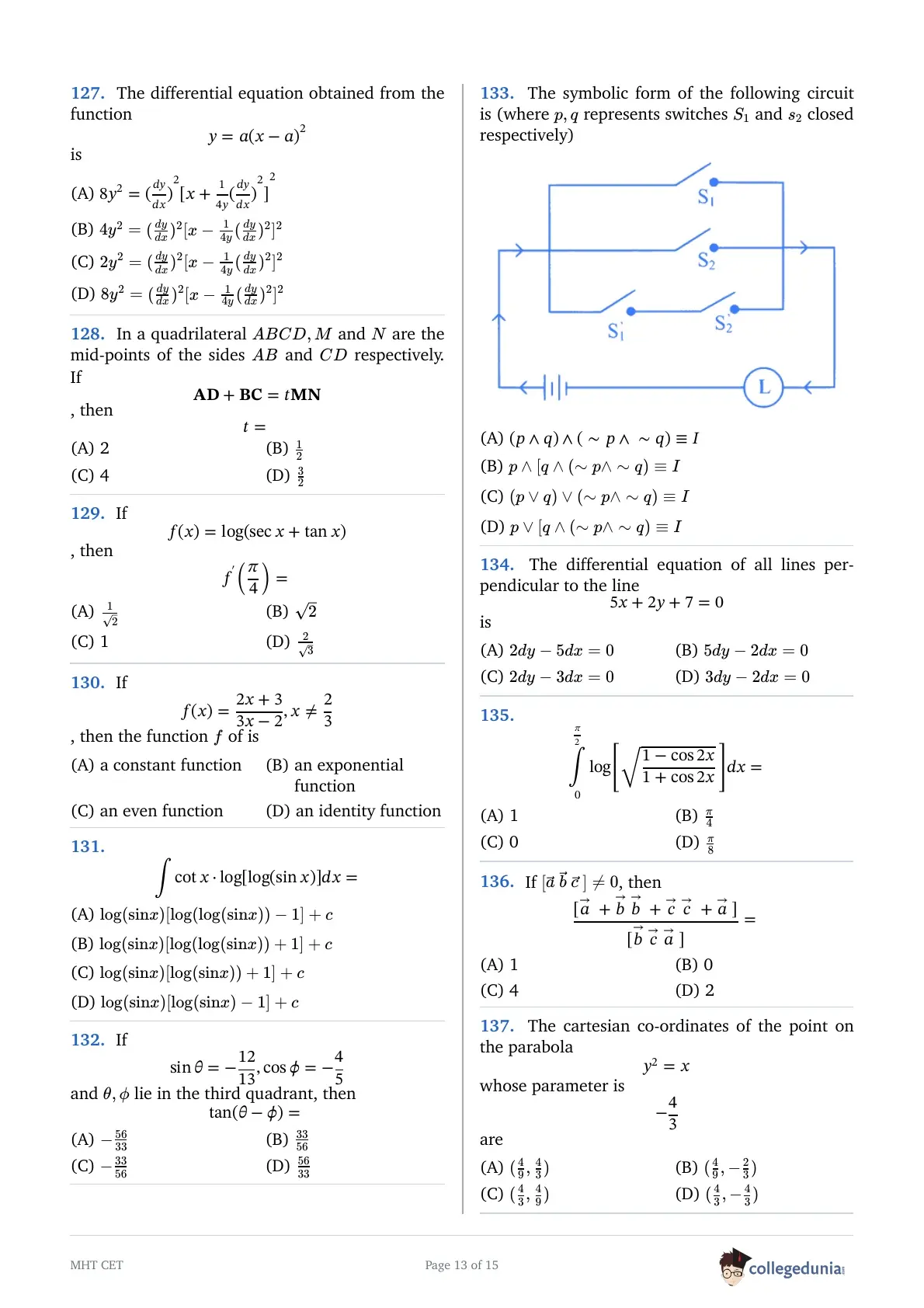
The differential equation obtained from the function \( y = a(x - a)^2 \) is
In a quadrilateral \( ABCD \), \( M \) and \( N \) are the mid-points of the sides \( AB \) and \( CD \) respectively. If \( AD + BC = t \cdot MN \), then \( t = \)
If \(f(x)=\log (\sec x+\tan x)\), then \(f^{\prime}\left(\frac{\pi}{4}\right)=\)
If \( f(x) = \frac{2x + 3}{3x - 2}, \, x \neq \frac{2}{3}, \) then the function \( f \circ f \) is
If \(\sin \theta=-\frac{12}{13}, \cos \phi=-\frac{4}{5}\) and \(\theta, \phi\) lie in the third quadrant, then \(\tan (\theta-\phi)=\)
The differential equation of all lines perpendicular to the line \(5 x+2 y+7=0\) is
\(\int_\limits0^{\frac{\pi}{2}} \log \left[\sqrt{\frac{1-\cos 2 x}{1+\cos 2 x}}\right] d x=\)
If \[[\vec{a}\ \vec{b}\ \vec{c}\ ] \neq 0\], then \[\frac{[\vec{a}\ +\vec{b}\ \vec{b}\ +\vec{c}\ \vec{c}\ +\vec{a}\ ]}{[\vec{b}\ \vec{c}\ \vec{a}\ ]}=\]
The cartesian co-ordinates of the point on the parabola \(y^2=x\) whose parameter is \(-\frac{4}{3}\) are
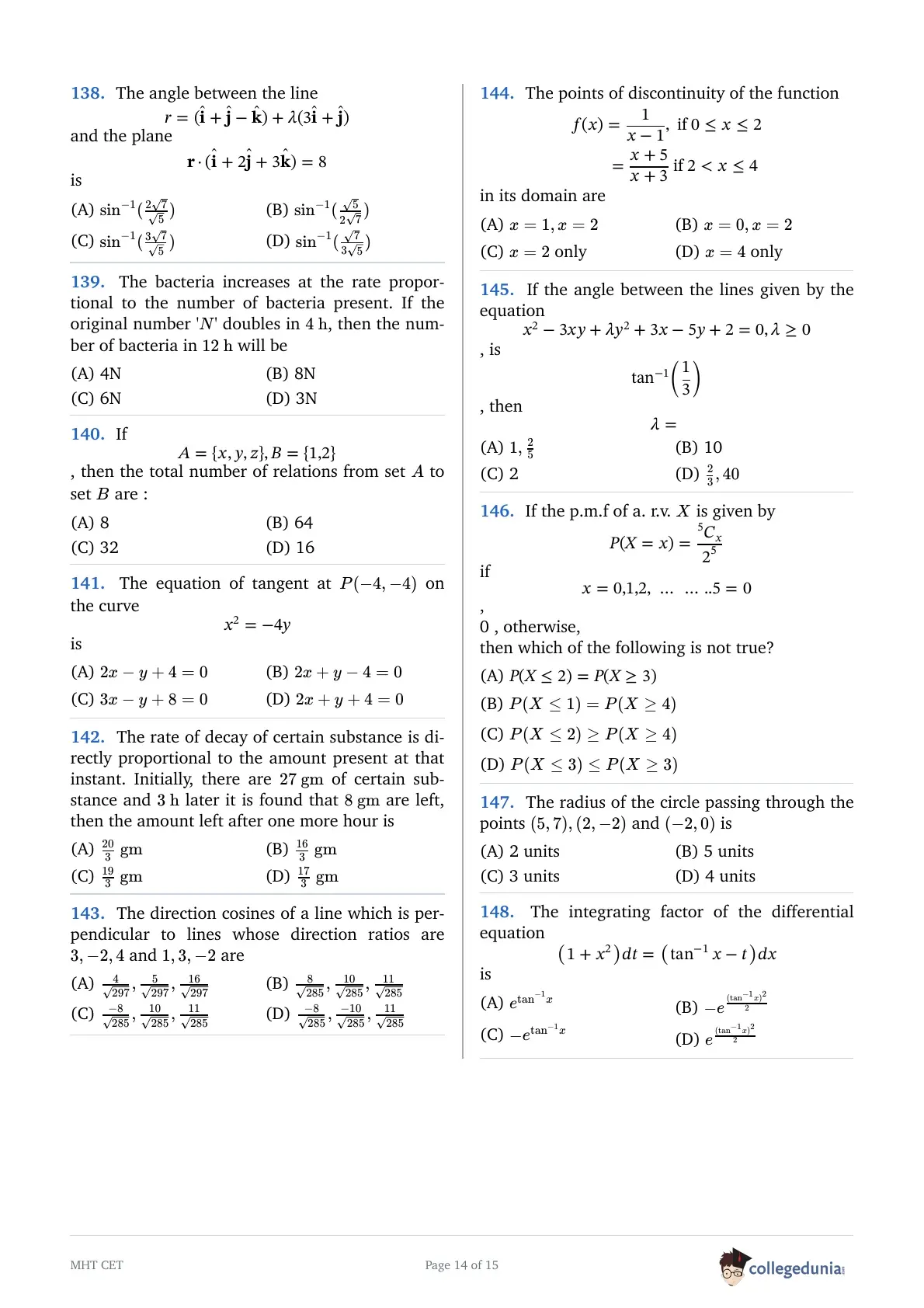
The angle between the line \(r =(\hat{\mathbf{i}}+\hat{\mathbf{j}}-\hat{\mathbf{k}})+\lambda(3 \hat{\mathbf{i}}+\hat{\mathbf{j}})\) and the plane \(\mathbf{r} \cdot(\hat{\mathbf{i}}+2 \hat{\mathbf{j}}+3 \hat{\mathbf{k}})=8\) is
The bacteria increases at the rate proportional to the number of bacteria present. If the original number \(N\) doubles in \(4\) hours, then the number of bacteria in \(12\) hours will be
If \(A=\{x, y, z\}, B=\{1,2\}\), then the total number of relations from set \(A\) to set \(B\) are :
The equation of the tangent at \( P(-4, -4) \) on the curve
\[
x^2 = -4y
\]
is
The rate of decay of a certain substance is directly proportional to the amount present at that instant. Initially, there are 27 grams of the substance and 3 hours later it is found that 8 grams are left, then the amount left after one more hour is
The direction cosines of a line which is perpendicular to lines whose direction ratios are \( 3, -2, 4 \) and \( 1, 3, -2 \) are
The points of discontinuity of the function
\(\begin{aligned} f(x) & =\frac{1}{x-1}, \text { if } 0 \leq x \leq 2 \\ & =\frac{x+5}{x+3} \text { if } 2< x \leq 4 \end{aligned}\)
in its domain are
If the angle between the lines given by the equation \(x^2-3 x y+\lambda y^2+3 x-5 y+2=0, \lambda \geq 0\), is \(\tan ^{-1}\left(\frac{1}{3}\right)\), then \(\lambda=\)
If the p.m.f of a. r.v. \(X\) is given by
\(P(X=x)=\frac{{ }^5 C_x}{2^5}\)
if \(x=0,1,2, \ldots \ldots . .5=0\),
0 , otherwise,
then which of the following is not true?
The radius of the circle passing through the points \((5,7),(2,-2)\) and \((-2,0)\) is
The integrating factor of the differential equation \(\left(1+x^2\right) d t=\left(\tan ^{-1} x-t\right) d x\) is
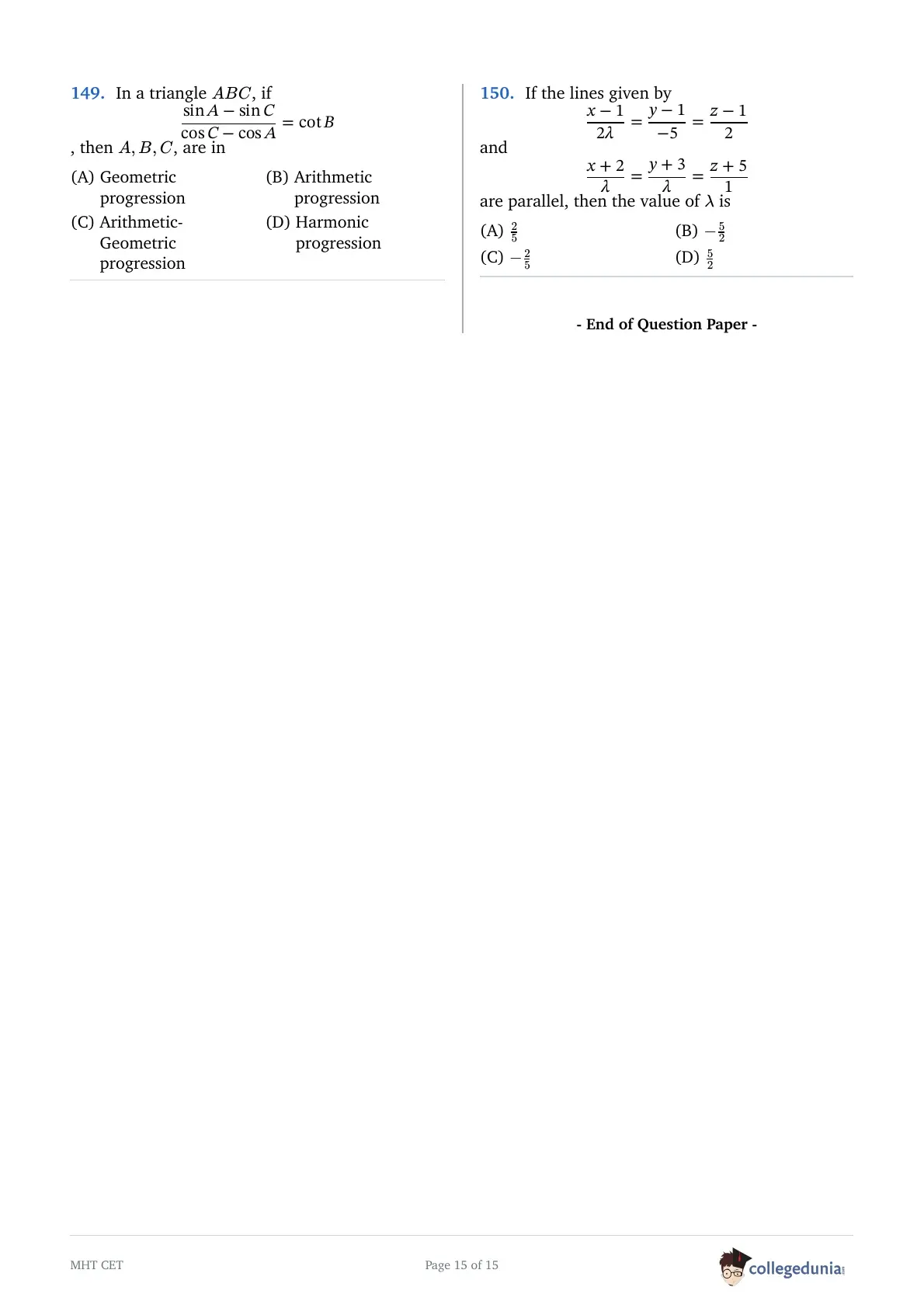
In a triangle \(A B C\), if \(\frac{\sin A-\sin C}{\cos C-\cos A}=\cot B\), then \(A, B, C\), are in
MHT CET 2020 PCM Exam Pattern and Marking Scheme
| Parameter | Details |
|---|---|
| Conducting Body | Maharashtra Common Entrance Test Cell (Maharashtra CET Cell) |
| Exam Mode | Online (Computer-Based Test) |
| Duration | 180 minutes (3 hours) |
| Groups / Subjects | PCM (Physics, Chemistry, Mathematics) for Engineering |
| Total Questions |
150 |
| Total Marks | 200 |
| Question Type | Multiple Choice Questions (MCQs) |
| Marks Distribution |
|
| Negative Marking | No |
| Syllabus Weightage |
|



Comments