




MHT CET 2020 Oct 16 Shift 2 PCM Question Paper is available for download here. Maharashtra State CET Cell conducted MHT CET 2020 PCM Exam on Oct 16 in Shift 2 from 2 PM to 5 PM in CBT mode.
The MHT CET 2020 PCM question paper includes the following:
- The MHT CET 2020 PCM Question Paper consists of 150 multiple-choice questions (MCQs) totalling 200 marks divided into 3 sections: Physics, Chemistry, and Mathematics, with 50 questions in each subject.
- Physics and Chemistry questions carry 1 mark each while Mathematics questions carry 2 marks each.
- There is no negative marking for incorrect answers.
MHT CET 2020 Oct 16 Shift 2 PCM Question Paper with Solution PDF
| CD PDF | CD PDF with Solutions |
|---|---|
| Download Collegedunia PDF 0.94 MB | - |
Also Check:
MHT CET 2020 Oct 16 Shift 2 PCM Questions with Solutions
Physics (Q1 - Q50)
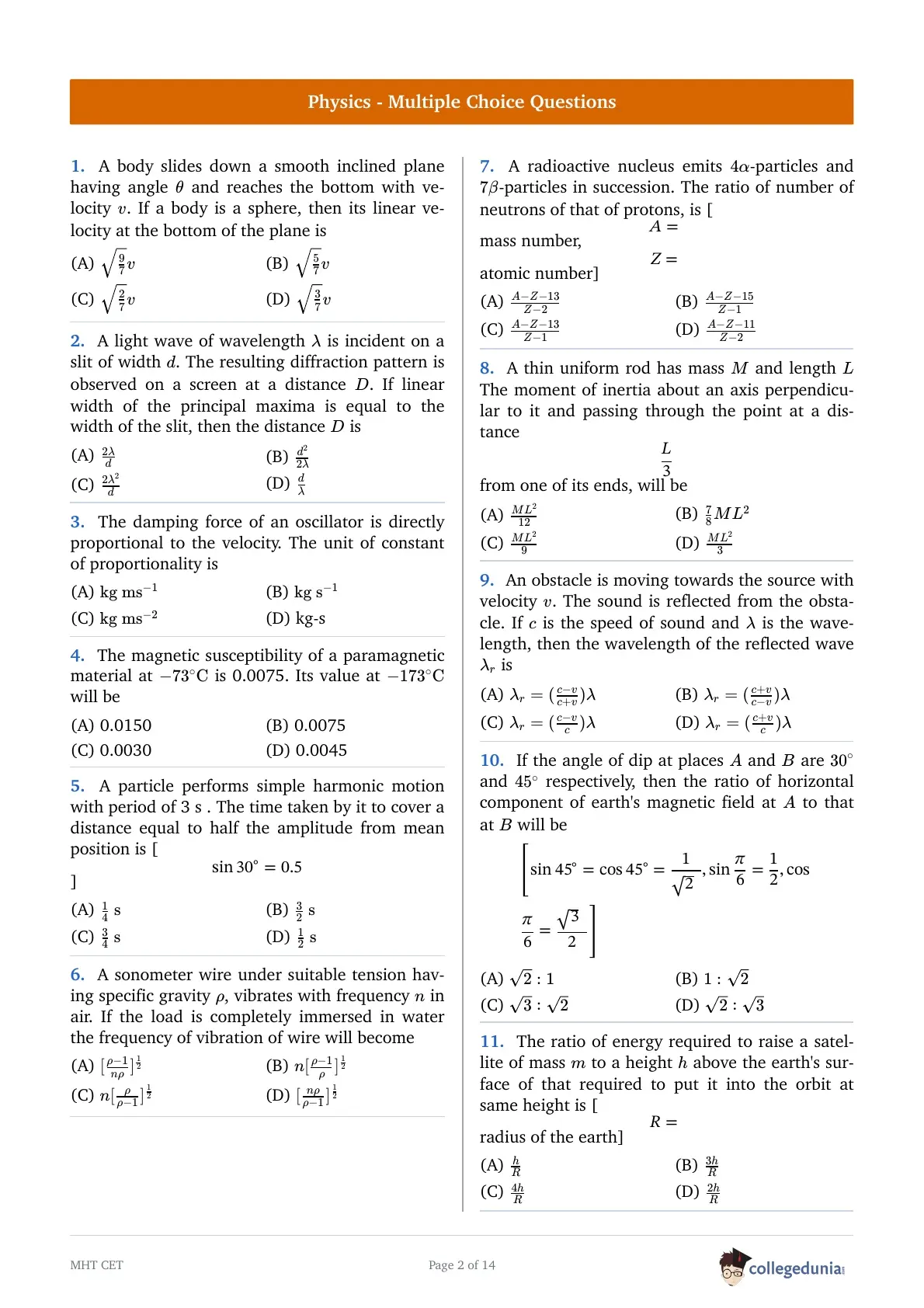
A body slides down a smooth inclined plane having angle \( \theta \) and reaches the bottom with velocity \( v \). If a body is a sphere then its linear velocity at the bottom of the plane is
A light wave of wavelength \( \lambda \) is incident on a slit of width \( d \). The resulting diffraction pattern is observed on a screen at a distance \( D \). If linear width of the principal maxima is equal to the width of the slit, then the distance \( D \) is
The damping force of an oscillator is directly proportional to the velocity. The unit of constant of proportionality is
The magnetic susceptibility of a paramagnetic material at \( -73^\circ \text{C} \) is \( 0.0075 \). Its value at \( -173^\circ \text{C} \) will be
A particle performs simple harmonic motion with period of 3 second. The time taken by it to cover a distance equal to half the amplitude from mean position is
A sonometer wire under suitable tension having specific gravity \( Q \), vibrates with frequency \( n \) in air. If the load is completely immersed in water the frequency of vibration of the wire will become
A radioactive nucleus emits \( \alpha \) particles and \( \beta \) particles in succession. The ratio of number of neutrons to that of protons is \( A = \) mass number, \( Z = \) atomic number
A thin uniform rod has mass \( M \) and length \( L \). The moment of inertia about an axis perpendicular to it and passing through the point at a distance \( \frac{L}{3} \) from one of its ends, will be
An obstacle is moving towards the source with velocity \( v \). The sound is reflected from the obstacle. If \( c \) is the speed of sound and \( \lambda \) is the wavelength, then the wavelength of the reflected wave \( \lambda_r \) is
If the angle of dip at places A and B are 30° and 45° respectively, the ratio of horizontal component of earth's magnetic field at A to that at B will be
The ratio of energy required to raise a satellite of mass \( m \) to a height \( h \) above the earth's surface to that required to put it into the orbit at same height is
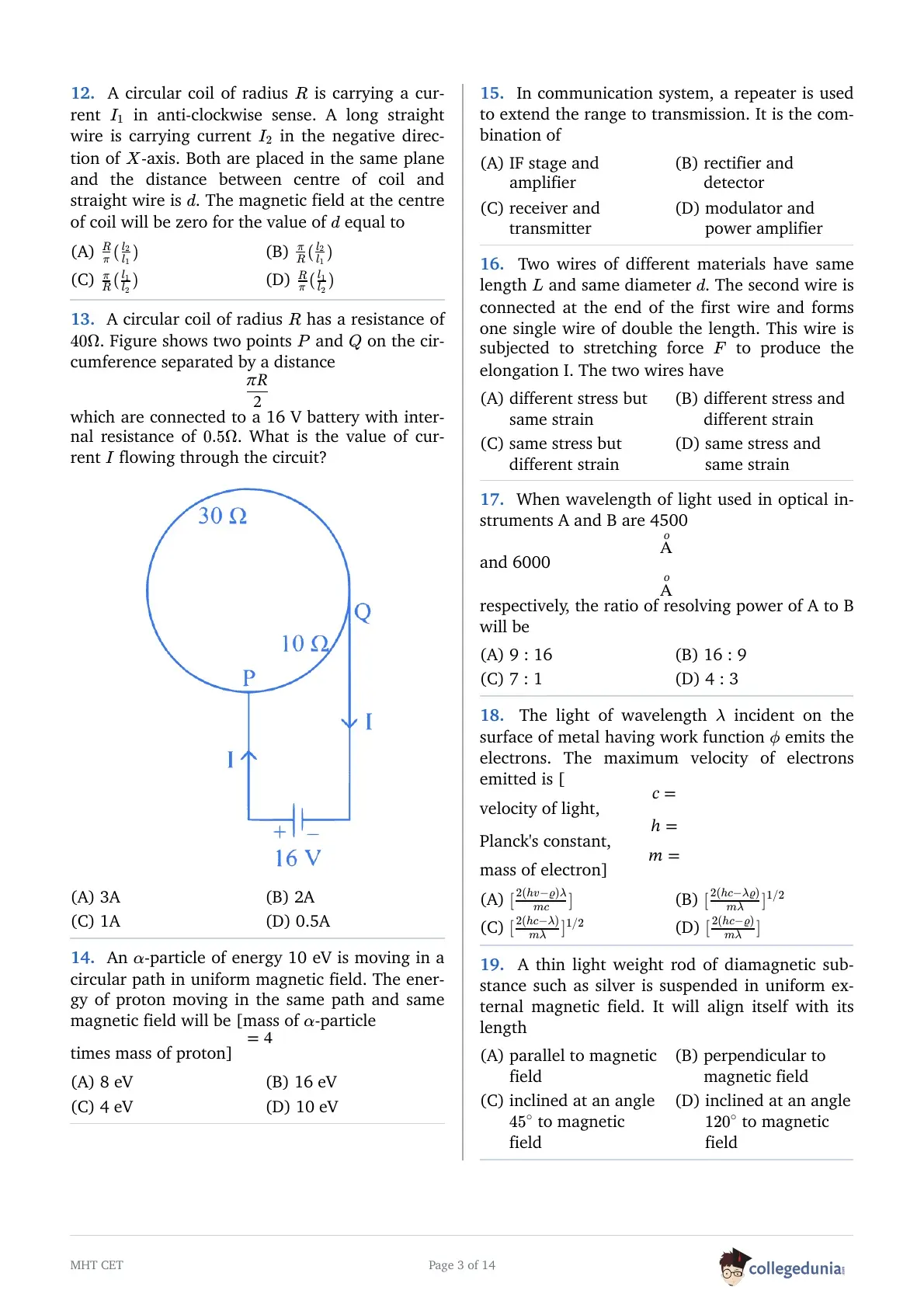
A circular coil of radius \( R \) is carrying a current \( I_1 \) in anticlockwise sense. A long straight wire is carrying current \( I_2 \) in the negative direction of x-axis. Both are placed in the same plane and the distance between the centre of coil and straight wire is \( d \). The magnetic field at the centre of coil will be zero for the value of \( d \) equal to
A circular coil of radius \( R \) has a resistance of 40\( \Omega \). Figure shows two points \( P \) and \( Q \) on the circumference separated by a distance \( \frac{\pi R}{2} \), which are connected to a 16 V battery with internal resistance of 0.5 \( \Omega \). What is the value of current \( I \) flowing through the circuit?

In communication system, a repeater is used to extend the range of transmission. It is the combination of
Two wires of different materials have same length \( L \) and same diameter \( d \). The second wire is connected at the end of the first wire and forms one single wire of double the length. This wire is subjected to stretching force \( F \) to produce the elongation \( \Delta L \). The two wires have
When wavelength of light used in optical instruments A and B are 4500Å and 6000Å respectively, the ratio of resolving power of A to B will be
The light of wavelength \( \lambda \) incident on the surface of metal having work function \( \phi \) emits the electrons. The maximum velocity of electrons emitted is
A thin light weight rod of diamagnetic substance such as silver is suspended in a uniform external magnetic field. It will align itself with its length
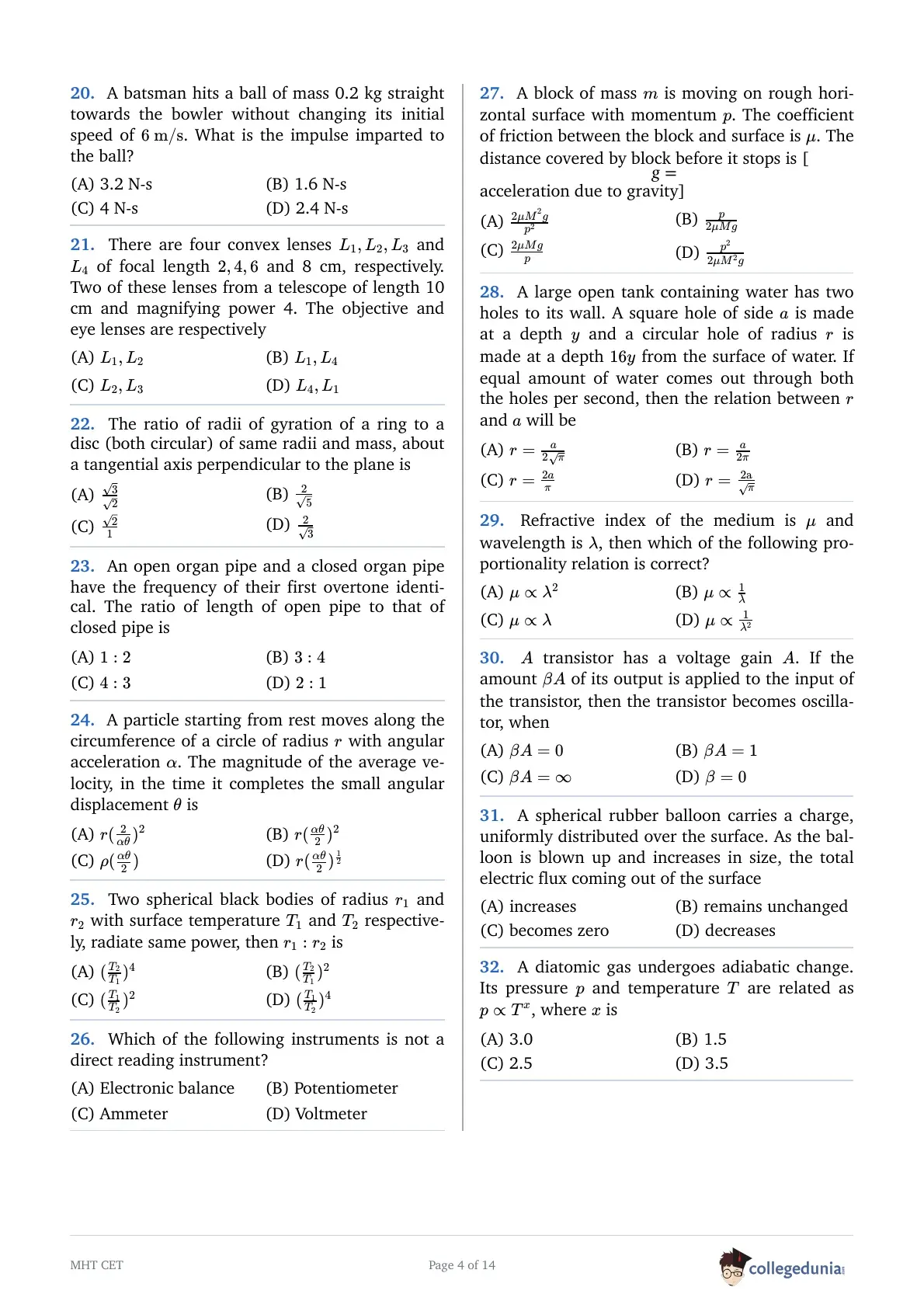
A batsman hits a ball of mass 0.2 kg straight towards the bowler without changing its initial speed of 6 m/s. What is the impulse imparted to the ball?
There are four convex lenses \( L_1 \), \( L_2 \), \( L_3 \), and \( L_4 \) of focal length 2, 4, 6, and 8 cm respectively. Two of these lenses form a telescope of length 10 cm and magnifying power 4. The objective and eye lenses are respectively
The ratio of radii of gyration of a ring to a disc (both circular of same radii and mass), about a tangential axis perpendicular to the plane is
An open organ pipe and a closed organ pipe have the frequency of their first overtone identical. The ratio of length of open pipe to that of closed pipe is
A particle starting from rest moves along the circumference of a circle of radius \( r \) with angular acceleration \( \alpha \). The magnitude of the average velocity, in the time it completes the small angular displacement \( \theta \), is
Two spherical black bodies of radius \( r_1 \) and \( r_2 \) with surface temperature \( T_1 \) and \( T_2 \) respectively, radiate the same power, then \( \frac{r_1}{r_2} \) is
Which of the following instruments is not a direct reading instrument?
A block of mass \( M \) is moving on rough horizontal surface with momentum \( P \). The coefficient of friction between the block and surface is \( \mu \). The distance covered by the block before it stops is
Refractive index of the medium is \( \mu \) and wavelength is \( \lambda \), then which of the following proportionality relation is correct?
A transistor has a voltage gain \( A \). If the amount \( \beta A \) of its output is applied to the input of the transistor, then the transistor becomes oscillator when
A spherical rubber balloon carries a charge, uniformly distributed over the surface. As the balloon is blown up and increases in size, the total electric flux coming out of the surface
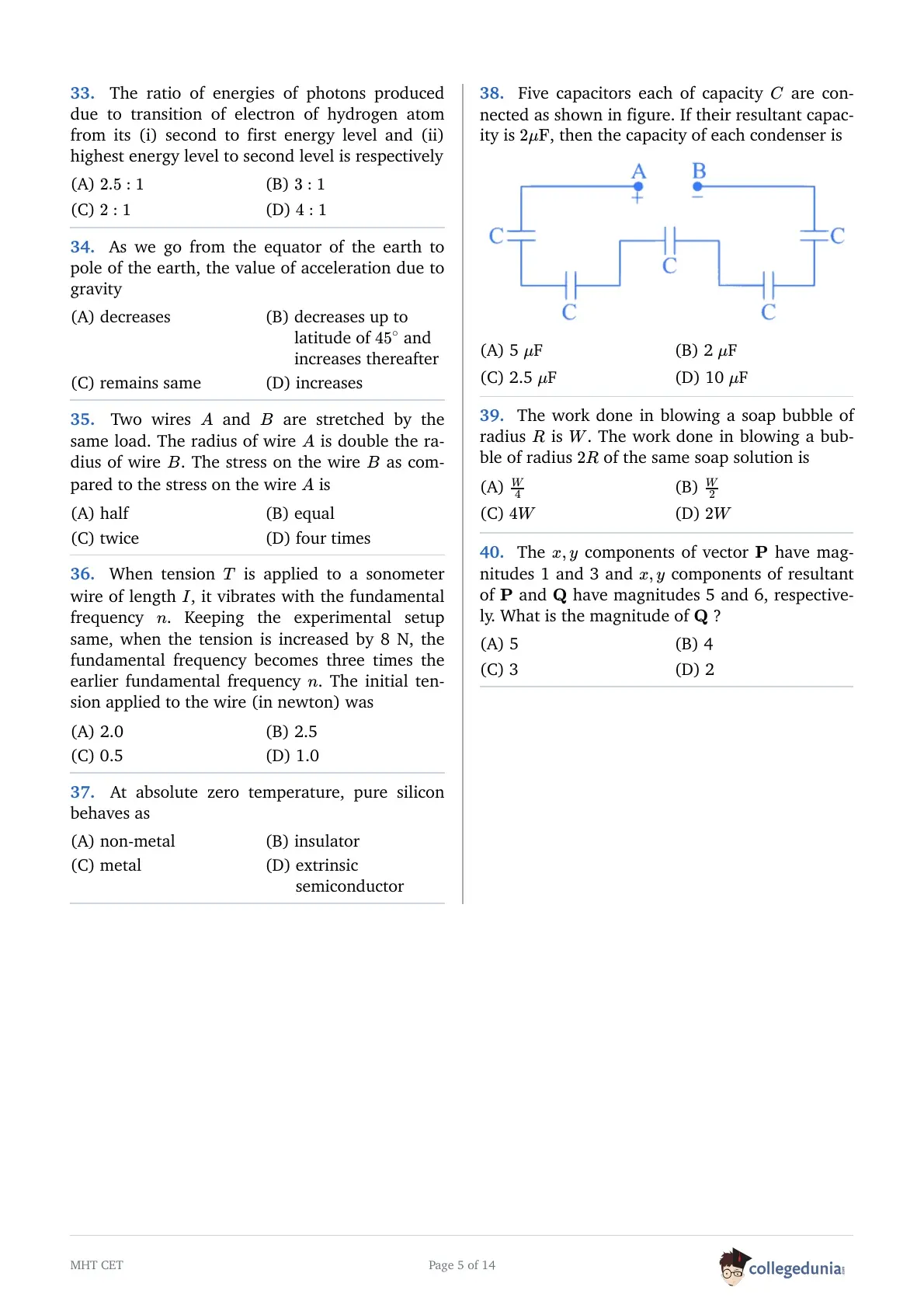
The ratio of energies of photons produced due to transition of electron of hydrogen atom from its (i) second to first energy level and (ii) highest energy level to 2\(^\text{nd}\) level is respectively
As we go from the equator of the earth to pole of the earth, the value of acceleration due to gravity
Two wires A and B are stretched by the same load. The radius of wire A is double the radius of wire B. The stress on the wire B as compared to the stress on the wire A is
When tension \( T \) is applied to a sonometer wire of length \( \ell \), it vibrates with the fundamental frequency \( n \). Keeping the experimental setup same, when the tension is increased by 8 newton, the fundamental frequency becomes three times the earlier fundamental frequency (\( n \)). The initial tension applied to the wire in newton was
At absolute zero temperature, pure silicon behaves as
Five capacitors each of capacity \(C\) are connected as shown in figure. If their resultant capacity is \(2 \mu \mathrm{F}\), then the capacity of each condenser is

The work done in blowing a soap bubble of radius \( R \) is \( W \). The work done in blowing a bubble of radius \( 2R \) of the same soap solution is
The x, y components of vector \( \vec{P} \) have magnitudes 1 and 3 and the x, y components of resultant of \( \vec{P} \) and \( \vec{Q} \) have magnitudes 5 and 6 respectively. What is the magnitude of \( \vec{Q} \)?
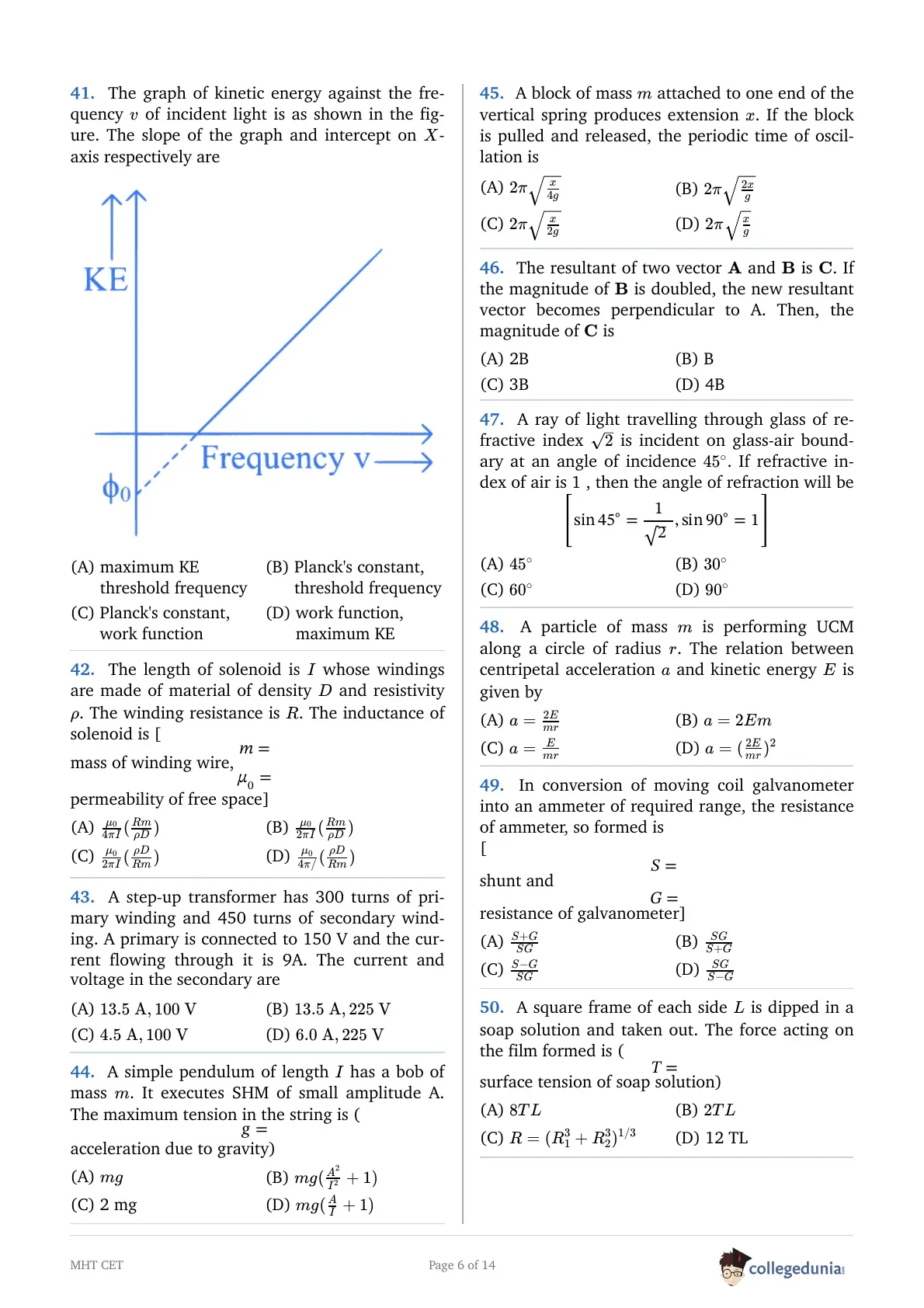
The graph of kinetic energy against the frequency \( v \) of incident light is as shown in the figure. The slope of the graph and intercept on X-axis respectively are

The length of solenoid is \[I\] whose windings are made of material of density \[D\] and resistivity \[\rho\]. The winding resistance is \[R\]. The inductance of solenoid is [\[m=\] mass of winding wire, \[\mu_0=\] permeability of free space]
A step-up transformer has 300 turns of primary winding and 450 turns of secondary winding. A primary is connected to 150 volt and the current flowing through it is 9A. The current and voltage in the secondary are
A simple pendulum of length \( \ell \) has a bob of mass \( m \). It executes S.H.M. of small amplitude \( A \). The maximum tension in the string is
A block of mass \( m \) attached to one end of the vertical spring produces extension \( x \). If the block is pulled and released, the periodic time of oscillation is
The resultant of two vectors \( \vec{A} \) and \( \vec{B} \) is \( \vec{C} \). If the magnitude of \( \vec{B} \) is doubled, the new resultant vector becomes perpendicular to \( \vec{A} \). Then the magnitude of \( \vec{C} \) is
A ray of light travelling through glass of refractive index \( \sqrt{2} \) is incident on glass-air boundary at an angle of incidence 45°. If refractive index of air is 1, then the angle of refraction will be
A particle of mass \( m \) is performing U.C.M. along a circle of radius \( r \). The relation between centripetal acceleration \( a \) and kinetic energy \( E \) is given by
In conversion of moving coil galvanometer into an ammeter of required range, the resistance of ammeter so formed is
A square frame of each side \( L \) is dipped in a soap solution and taken out. The force acting on the film formed is \( T = \) surface tension of soap solution
Chemistry (Q51 - Q100)
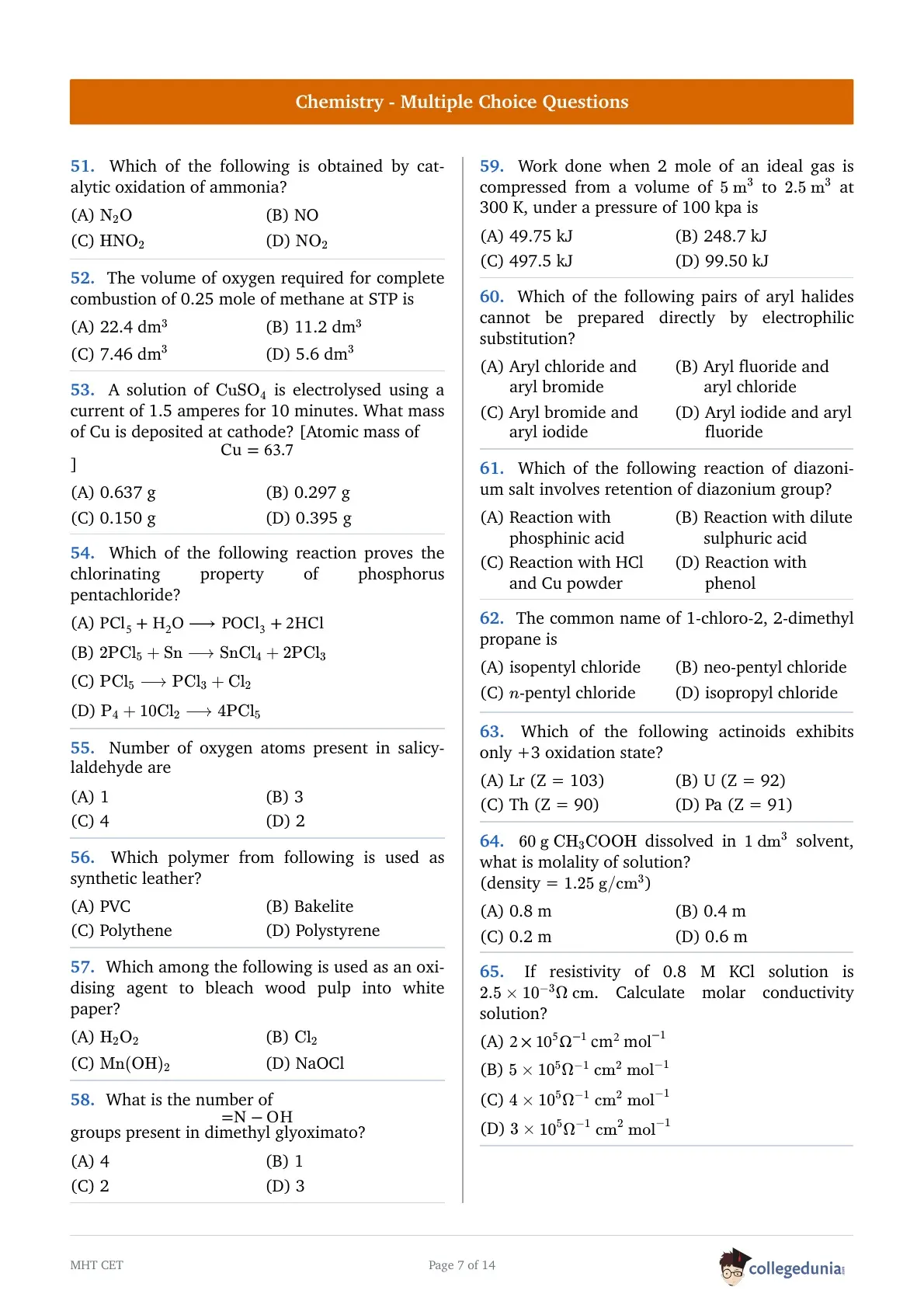
Which of the following is obtained by catalytic oxidation of ammonia?
A solution of CuSO₄ is electrolyzed using a current of 1.5 amperes for 10 minutes. What mass of Cu is deposited at the cathode? (At. mass of Cu = 63.7)
Which of the following reactions proves the chlorinating property of phosphorus pentachloride?
Number of oxygen atoms present in salicylaldehyde are
Which polymer from the following is used as synthetic leather?
Which among the following is used as an oxidizing agent to bleach wood pulp into white paper?
What is the number of =N-OH groups present in dimethyl glyoximato?
Which of the following reaction of diazonium salt involves retention of diazonium group?
The common name of 1-Chloro-2, 2-dimethyl propane is
Which of the following actinoids exhibits only +3 oxidation state?
60 g of CH₃COOH dissolved in 1 dm³ solvent. What is molality of solution? (density = 1.25 g/cm³)
If resistivity of 0.8 M KCl solution is \( 2.5 \times 10^{-3} \, \Omega \, \text{cm} \), calculate molar conductivity of solution?
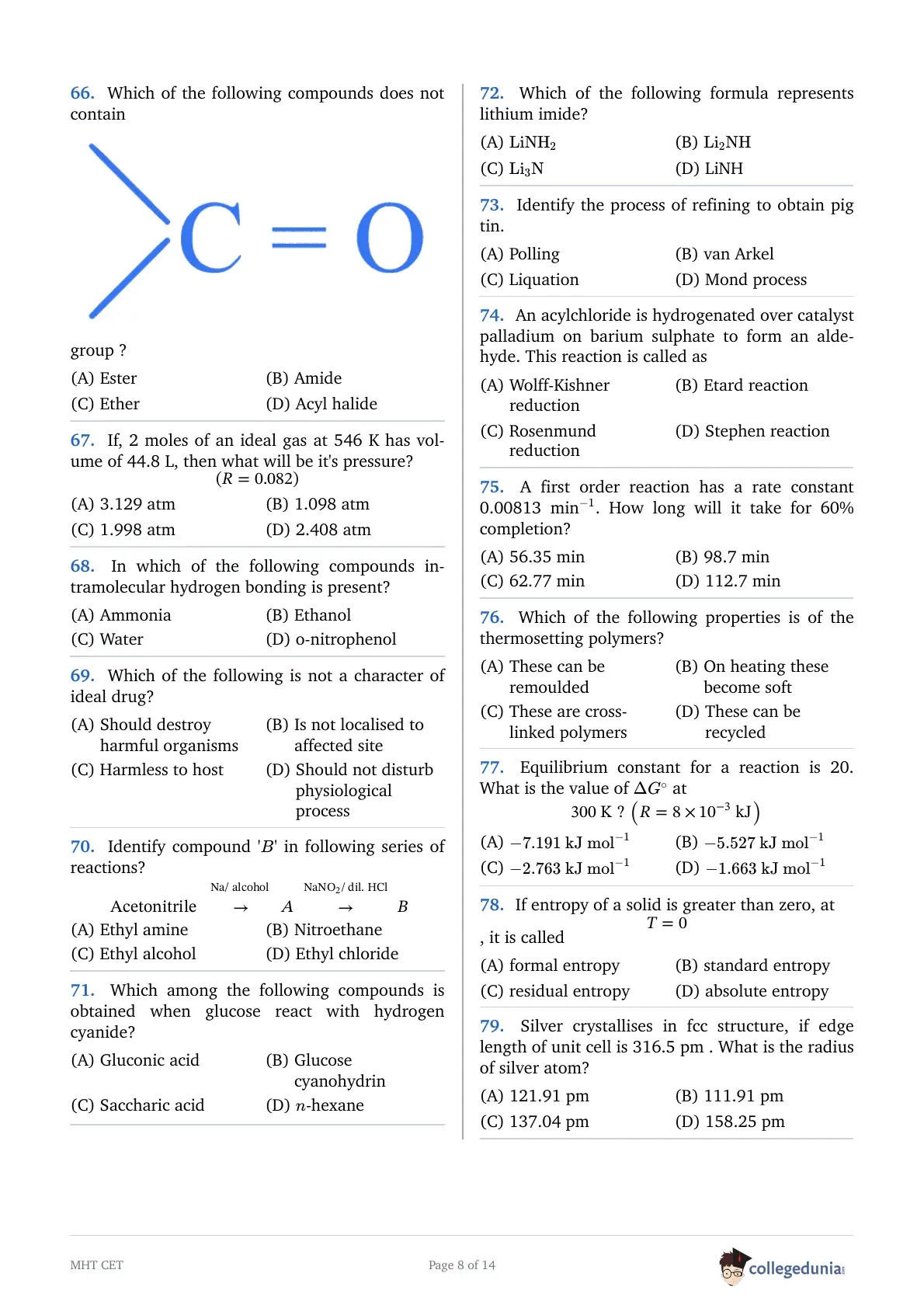
Which of the following compounds does NOT contain >C=O group?
If 2 moles of an ideal gas at 546 K has a volume of 44.8 L, then what will be its pressure?
In which of the following compounds intramolecular hydrogen bonding is present?
Which of the following is NOT a character of an ideal drug?
Identify compound '\[B\]' in following series of reactions?
\[\text { Acetonitrile } \xrightarrow{\mathrm{Na} / \text { alcohol }} A \xrightarrow{\mathrm{NaNO}_2 / \text { dil. } \mathrm{HCl}} B\]
Which among the following compounds is obtained when glucose reacts with hydrogen cyanide?
Which of the following formula represents lithium imide?
Identify the process of refining to obtain pig tin.
An acyl chloride is hydrogenated over catalyst palladium on barium sulfate to form an aldehyde. This reaction is called as
A first order reaction has a rate constant 0.00813 min\(^{-1}\). How long will it take for 60% completion?
Which of the following properties is of the thermosetting polymers?
If the entropy of a solid is greater than zero, at \( T = 0 \), it is called
Silver crystallizes in fcc structure. If edge length of unit cell is 316.5 pm, what is the radius of silver atom?
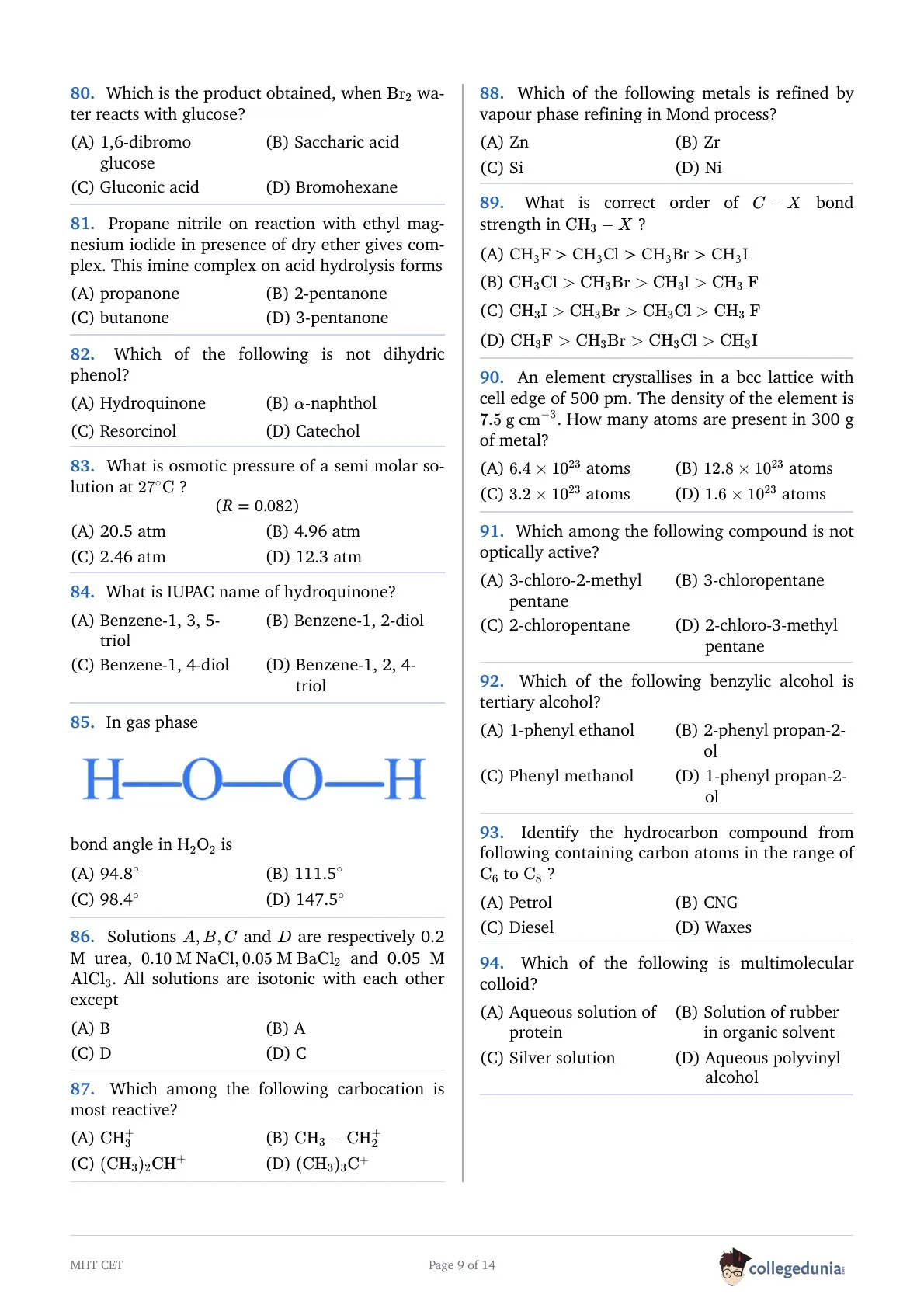
What is the product obtained when Br\(_2\) water reacts with glucose?
Propane nitrile on reaction with ethyl magnesium iodide in the presence of dry ether gives complex. This imine complex on acid hydrolysis forms
Which of the following is NOT dihydric phenol?
What is the osmotic pressure of a semi-molar solution at 27°C? (\( R = 0.0821 \, \text{atm L mol}^{-1} \text{K}^{-1} \))
What is the IUPAC name of hydroquinone?
In gas phase, \( \text{H-O-O-H} \) bond angle in \( \text{H}_2\text{O}_2 \) is
Which among the following carbocation is most reactive?
Which of the following metals is refined by vapour phase refining in Mond process?
What is the correct order of C-X bond strength in CH\(_3\)-X?
An element crystallizes in a bcc lattice with cell edge of 500 pm. The density of the element is 7.5 g/cm\(^3\). How many atoms are present in 300 g of metal?
Which among the following compound is NOT optically active?
Which of the following benzylic alcohol is tertiary alcohol?
Identify the hydrocarbon compound from the following containing carbon atoms in the range of C\(_6\) to C\(_7\)?
Which of the following is a multimolecular colloid?
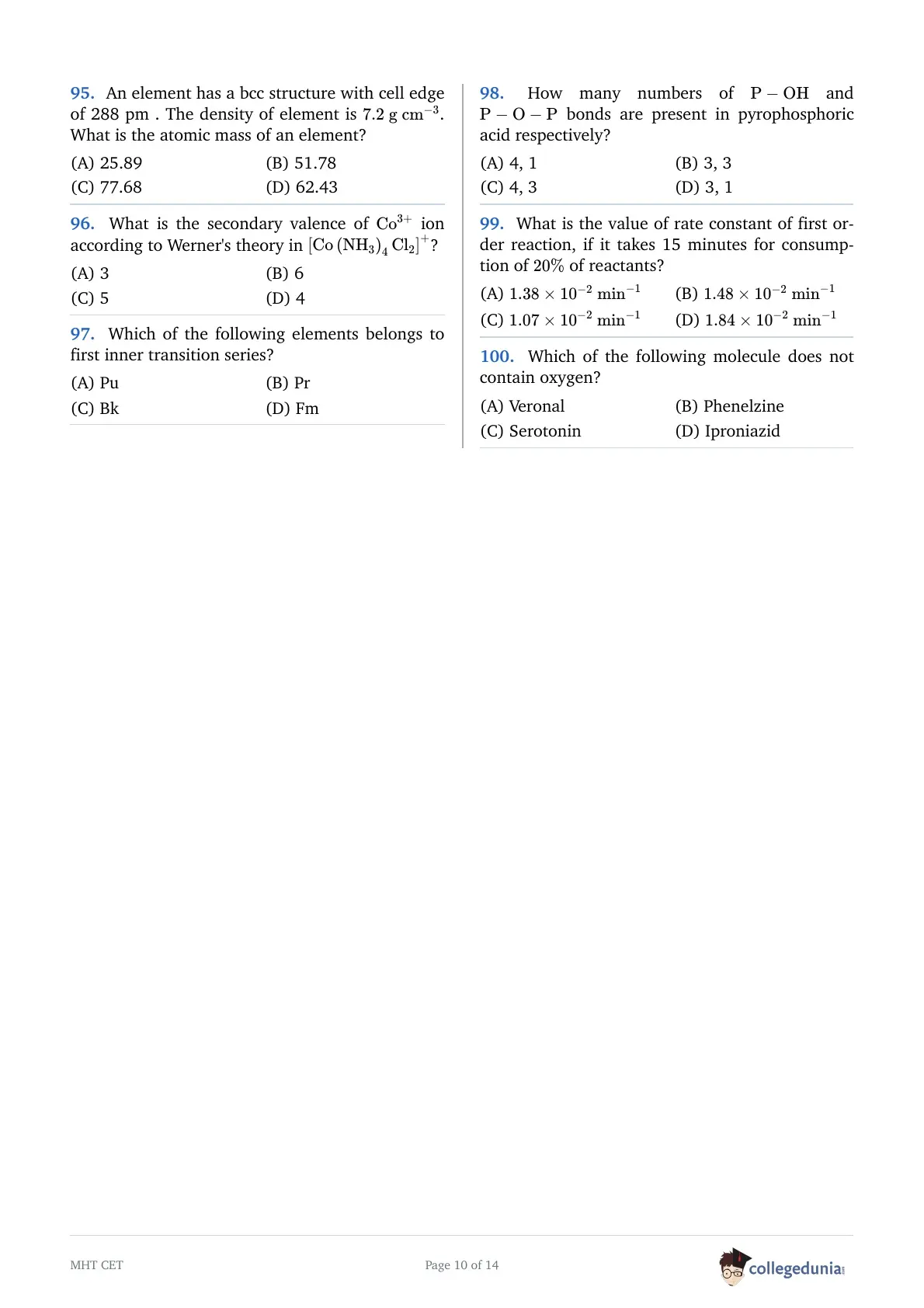
An element has a bcc structure with cell edge of 288 pm. The density of element is 7.2 g/cm\(^3\). What is the atomic mass of an element?
Which of the following elements belongs to the first inner transition series?
How many numbers of P-OH and P-O-P bonds are present in pyrophosphoric acid respectively?
What is the value of rate constant of first-order reaction, if it takes 15 minutes for consumption of 20% of reactants?
Which of the following molecules does not contain oxygen?
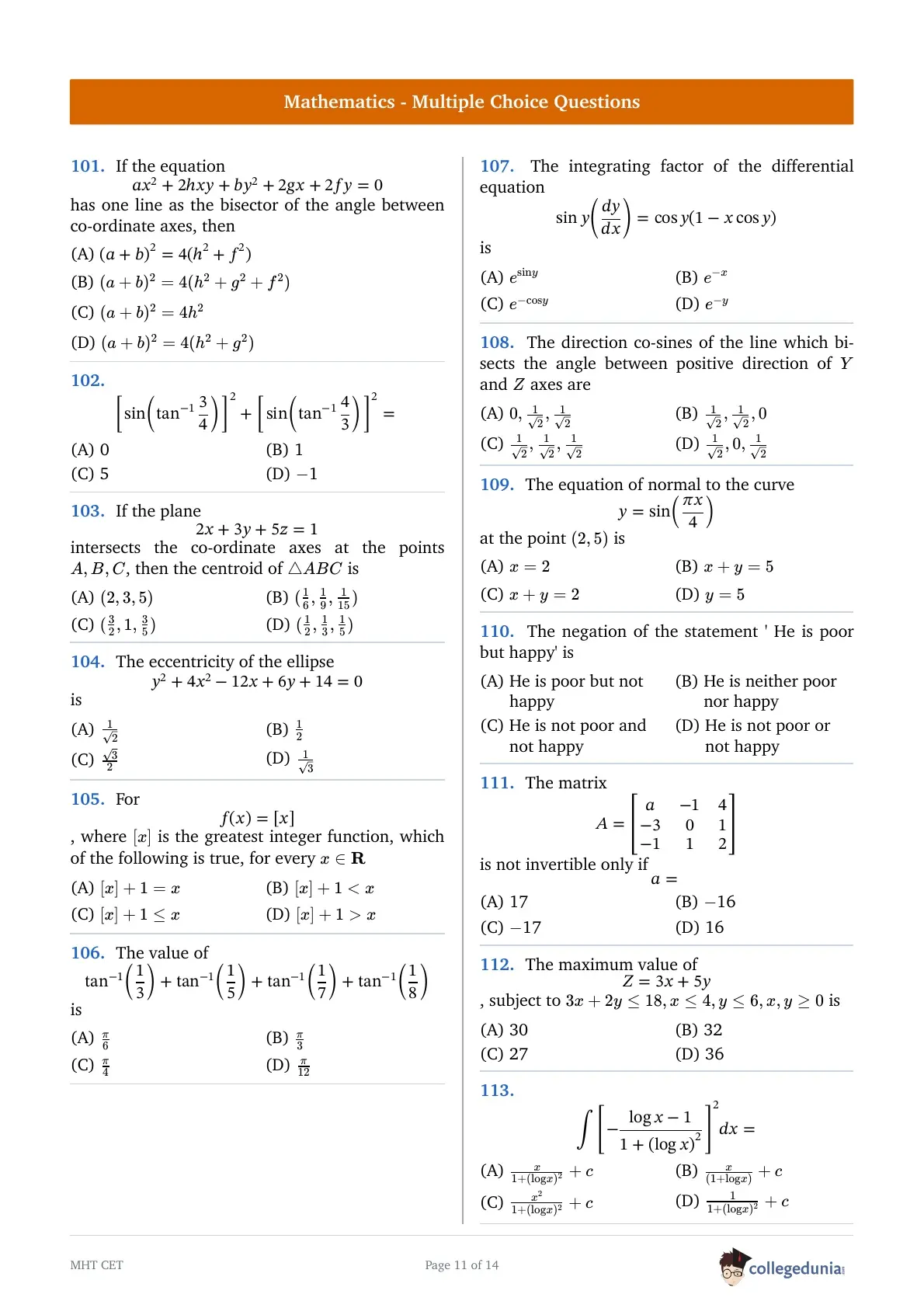
\(\left[\sin \left(\tan ^{-1} \frac{3}{4}\right)\right]^2+\left[\sin \left(\tan ^{-1} \frac{4}{3}\right)\right]^2=\)
If the plane
\[
2x + 3y + 5z = 1
\]
intersects the coordinate axes at the points A, B, C, then the centroid of \( \triangle ABC \) is
The eccentricity of the ellipse
\[
y^2 + 4x^2 - 12x + 6y + 14 = 0
\]
is
For \( f(x) = [x] \), where \( [x] \) is the greatest integer function, which of the following is true, for every \( x \in \mathbb{R} \)?
The value of \(\tan ^{-1}\left(\frac{1}{3}\right)+\tan ^{-1}\left(\frac{1}{5}\right)+\tan ^{-1}\left(\frac{1}{7}\right)+\tan ^{-1}\left(\frac{1}{8}\right)\) is
The integrating factor of the differential equation \(\sin y \frac{dy}{dx} = \cos y (1 - x \cos y)\) is
The direction cosines of the line which bisects the angle between the positive direction of Y and Z axes are
The equation of normal to the curve \( y = \sin \left( \frac{\pi x}{4} \right) \) at the point (2, 5) is
The negation of the statement 'He is poor but happy' is
The matrix \( A = \begin{bmatrix} a & -1 & 4 \\ -3 & 0 & 1 \\ -1 & 1 & 2 \end{bmatrix} \) is not invertible only if \( a = \)
The maximum value of \( z = 3x + 5y \), subject to \( 3x + 2y \leq 18 \), \( x \leq 4 \), \( y \leq 6 \), \( x, y \geq 0 \) is
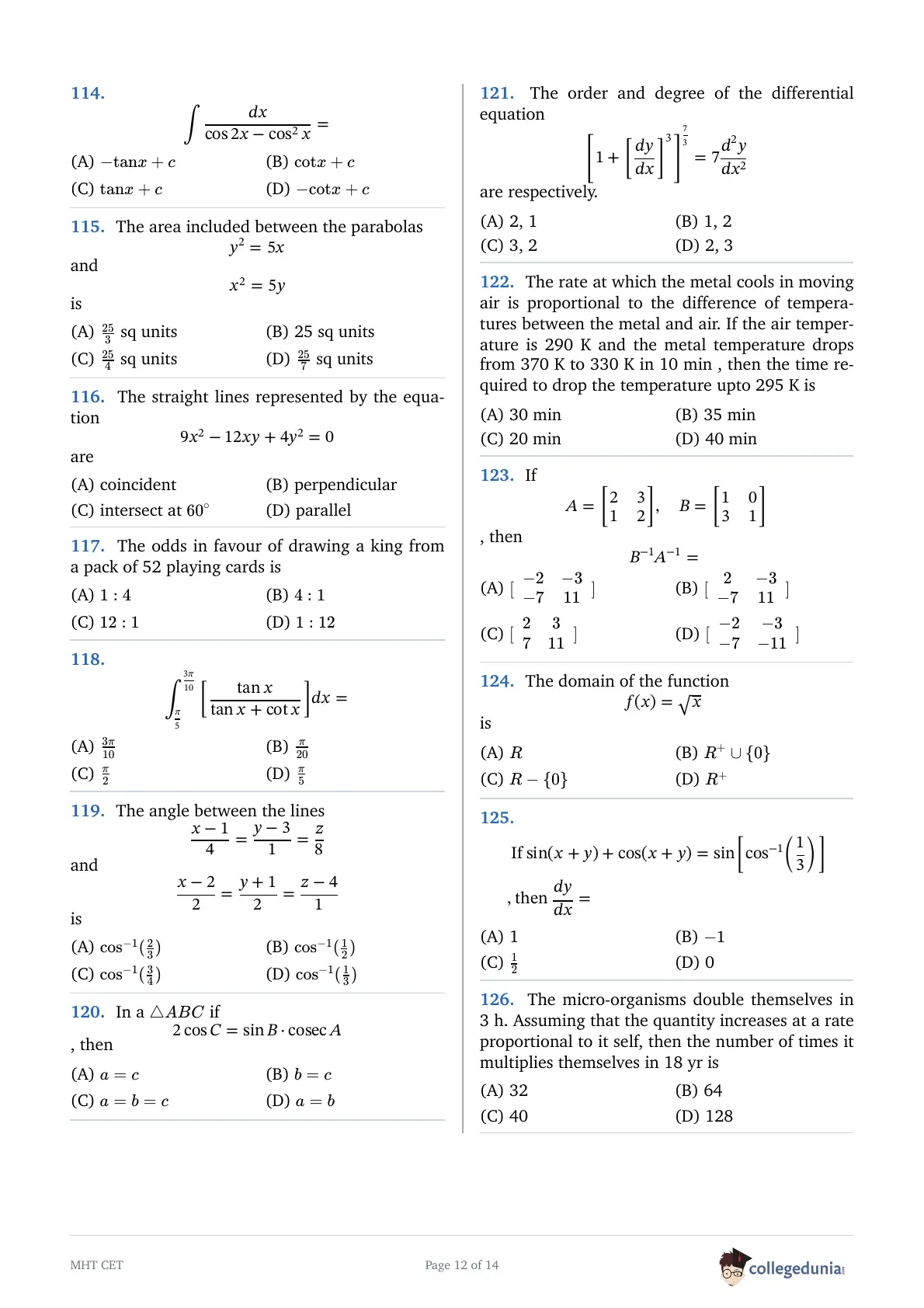
The area included between the parabolas \( y^2 = 5x \) and \( x^2 = 5y \) is
The odds in favour of drawing a king from a pack of 52 playing cards is
\(\int_{\frac{\pi}{5}}^{\frac{3 \pi}{10}}\left[\frac{\tan x}{\tan x+\cot x}\right] d x=\)
The angle between the lines \(\frac{x-1}{4}=\frac{y-3}{1}=\frac{z}{8}\) and \(\frac{x-2}{2}=\frac{y+1}{2}=\frac{z-4}{1}\) is
In a \( \triangle ABC \), if \( 2 \cos C = \sin B \cdot \csc A \), then
The order and degree of the differential equation \(\left[1+\left[\frac{d y}{d x}\right]^3\right]^{\frac{7}{3}}=7 \frac{d^2 y}{d x^2}\) are respectively.
The rate at which the metal cools in moving air is proportional to the difference of temperatures between the metal and air. If the air temperature is 290K and the metal temperature drops from 370K to 330K in 10 minutes, then the time required to drop the temperature up to 295K is
The domain of the function \( f(x) = \sqrt{x} \) is
\(\text { If } \sin (x+y)+\cos (x+y)=\sin \left[\cos ^{-1}\left(\frac{1}{3}\right)\right] \text {, then } \frac{dy}{dx}=\)
The micro-organisms double themselves in 3 hours. Assuming that the quantity increases at a rate proportional to itself, then the number of times it multiplies itself in 18 years is
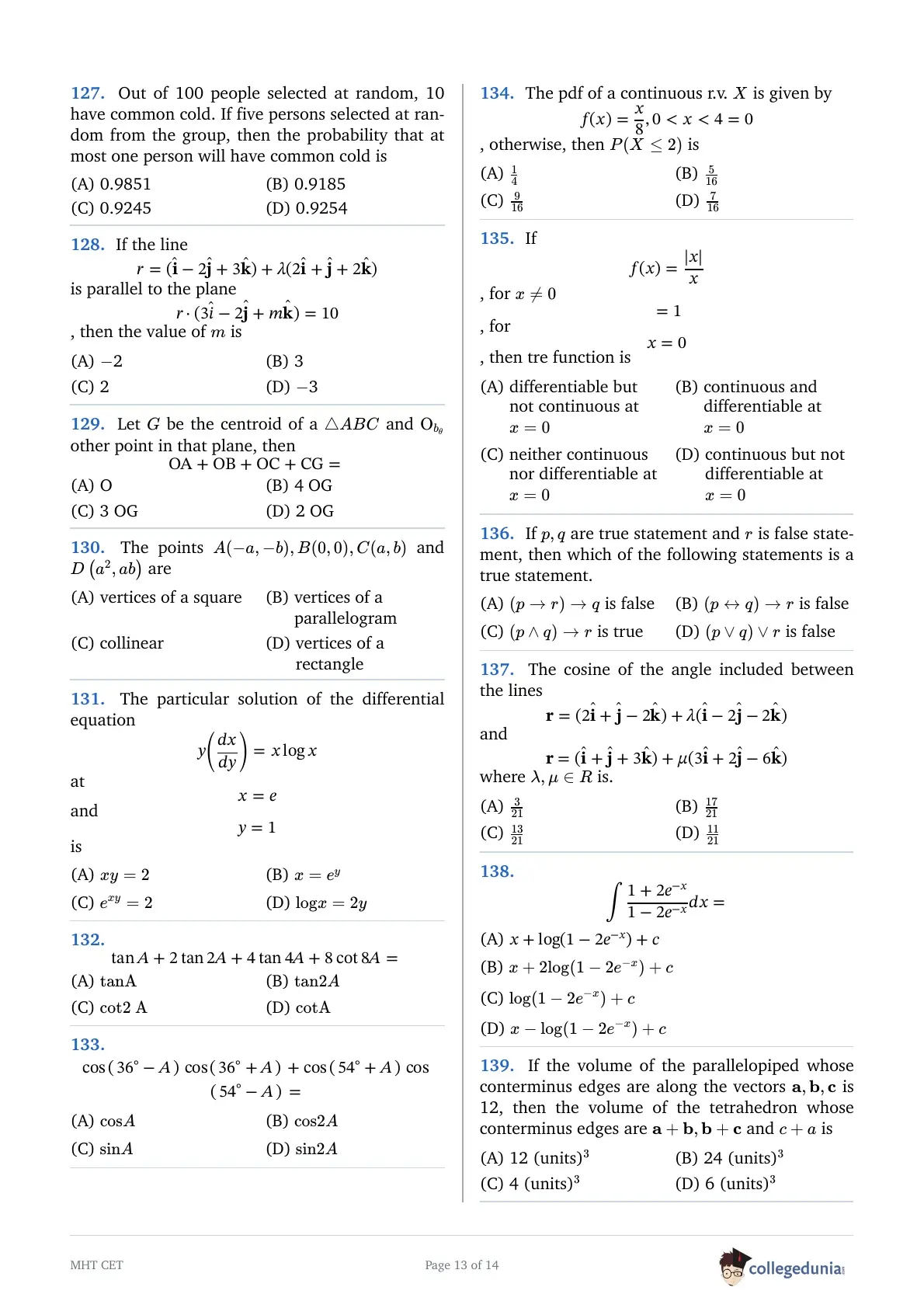
If the line \[r=(\hat{\mathbf{i}}-2 \hat{\mathbf{j}}+3 \hat{\mathbf{k}})+\lambda(2 \hat{\mathbf{i}}+\hat{\mathbf{j}}+2 \hat{\mathbf{k}})\] is parallel to the plane \[r \cdot(3 \hat{i}-2 \hat{\mathbf{j}}+m \hat{\mathbf{k}})=10\], then the value of \[m\] is
The points A \( (-a, -b) \), B \( (0, 0) \), C \( (a, b) \) and D \( (a^2, ab) \) are
The particular solution of the differential equation \(y\left(\frac{d x}{d y}\right)=x \log x\) at \(x=e\) and \(y=1\) is
\( \cos(36^\circ - A) \cos(36^\circ + A) + \cos(54^\circ + A) \cos(54^\circ - A) = \)
The pdf of a continuous r.v. \(X\) is given by \(f(x)=\frac{x}{8}, 0 < x < 4=0\), otherwise, then \(P(X \leq 2)\) is
If \( f(x) = \frac{|x|}{x} \) for \( x \neq 0 \) and \( f(x) = 1 \) for \( x = 0 \), then the function is
If \( p, q \) are true statements and \( r \) is a false statement, then which of the following statements is a true statement?
The cosine of the angle included between the lines \[\mathbf{r}=(2 \hat{\mathbf{i}}+\hat{\mathbf{j}}-2 \hat{\mathbf{k}})+\lambda(\hat{\mathbf{i}}-2 \hat{\mathbf{j}}-2 \hat{\mathbf{k}})\] and \[\mathbf{r}=(\hat{\mathbf{i}}+\hat{\mathbf{j}}+3 \hat{\mathbf{k}})+\mu(3 \hat{\mathbf{i}}+2 \hat{\mathbf{j}}-6 \hat{\mathbf{k}})\] where \[\lambda, \mu \in R\] is.
If the volume of the parallelopiped whose conterminus edges are along the vectors \(\mathbf{a}, \mathbf{b}, \mathbf{c}\) is 12, then the volume of the tetrahedron whose conterminus edges are \(\mathbf{a}+\mathbf{b}, \mathbf{b}+\mathbf{c}\) and \(c+a\) is
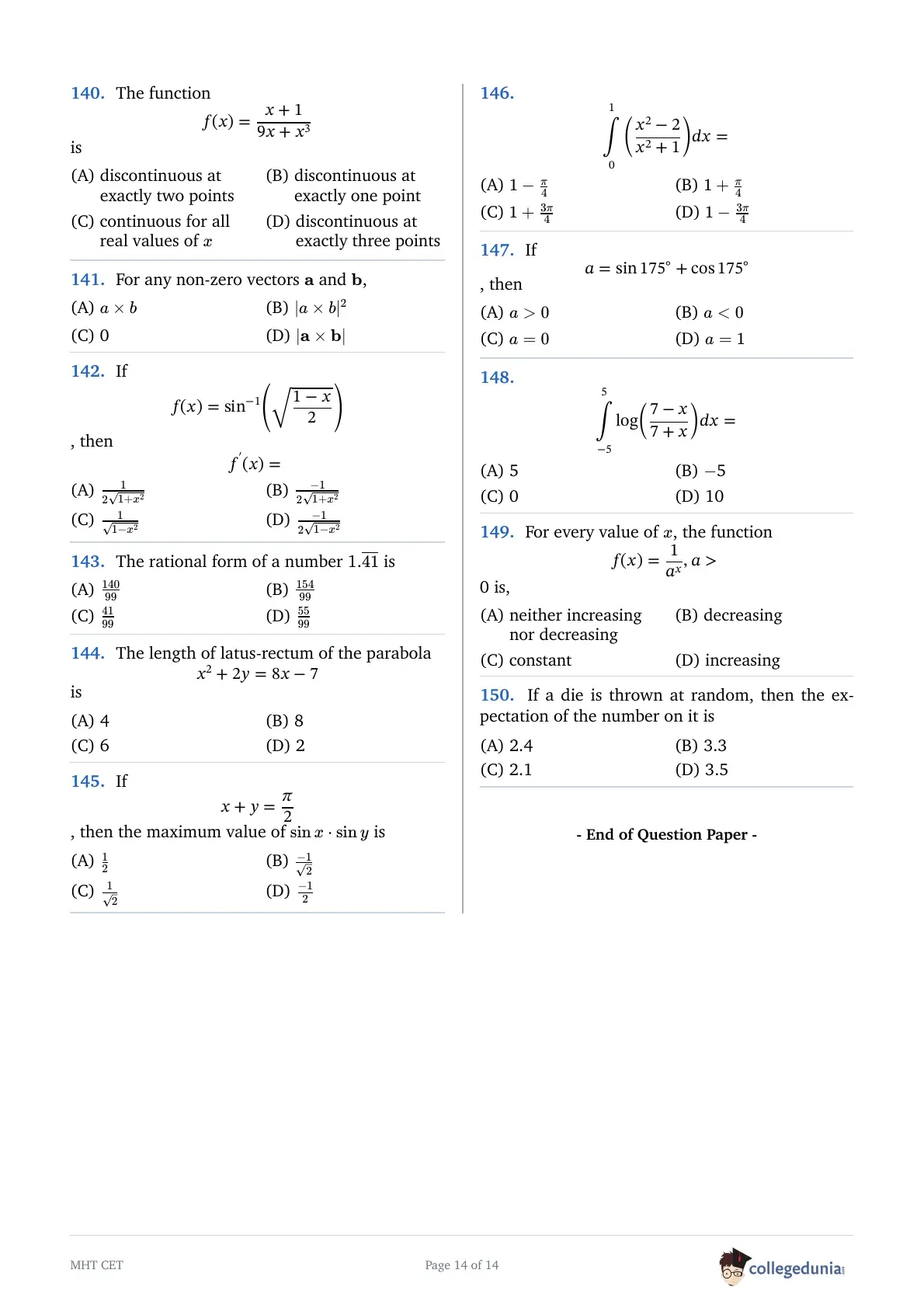
If \( f(x) = \sin^{-1} \left( \sqrt{\frac{1 - x}{2}} \right) \), then
\[
f'(x) =
\]
The rational form of the number \( 1.41 \overline{41} \) is
The length of the latus rectum of the parabola \( x^2 + 2y = 8x - 7 \) is
If \( x + y = \frac{\pi}{2} \), then the maximum value of \( \sin x \cdot \sin y \) is
If \( a = \sin 175^\circ + \cos 175^\circ \), then
For every value of \( x \), the function \( f(x) = \frac{1}{a^x}, a>0 \) is
If a die is thrown at random, then the expectation of the number on it is
MHT CET 2020 PCM Exam Pattern and Marking Scheme
| Parameter | Details |
|---|---|
| Conducting Body | Maharashtra Common Entrance Test Cell (Maharashtra CET Cell) |
| Exam Mode | Online (Computer-Based Test) |
| Duration | 180 minutes (3 hours) |
| Groups / Subjects | PCM (Physics, Chemistry, Mathematics) for Engineering |
| Total Questions |
150 |
| Total Marks | 200 |
| Question Type | Multiple Choice Questions (MCQs) |
| Marks Distribution |
|
| Negative Marking | No |
| Syllabus Weightage |
|



Comments