




MHT CET 2020 Oct 19 Shift 1 PCM Question Paper is available for download here. Maharashtra State CET Cell conducted MHT CET 2020 PCM Exam on Oct 19 in Shift 1 from 9 AM to 12 PM in CBT mode.
The MHT CET 2020 PCM question paper includes the following:
- The MHT CET 2020 PCM Question Paper consists of 150 multiple-choice questions (MCQs) totalling 200 marks divided into 3 sections: Physics, Chemistry, and Mathematics, with 50 questions in each subject.
- Physics and Chemistry questions carry 1 mark each while Mathematics questions carry 2 marks each.
- There is no negative marking for incorrect answers.
MHT CET 2020 Oct 19 Shift 1 PCM Question Paper with Solution PDF
| CD PDF | CD PDF with Solutions |
|---|---|
| Download Collegedunia PDF 0.77 MB | - |
Also Check:
MHT CET 2020 Oct 19 Shift 1 PCM Questions with Solutions
Physics (Q1 - Q50)
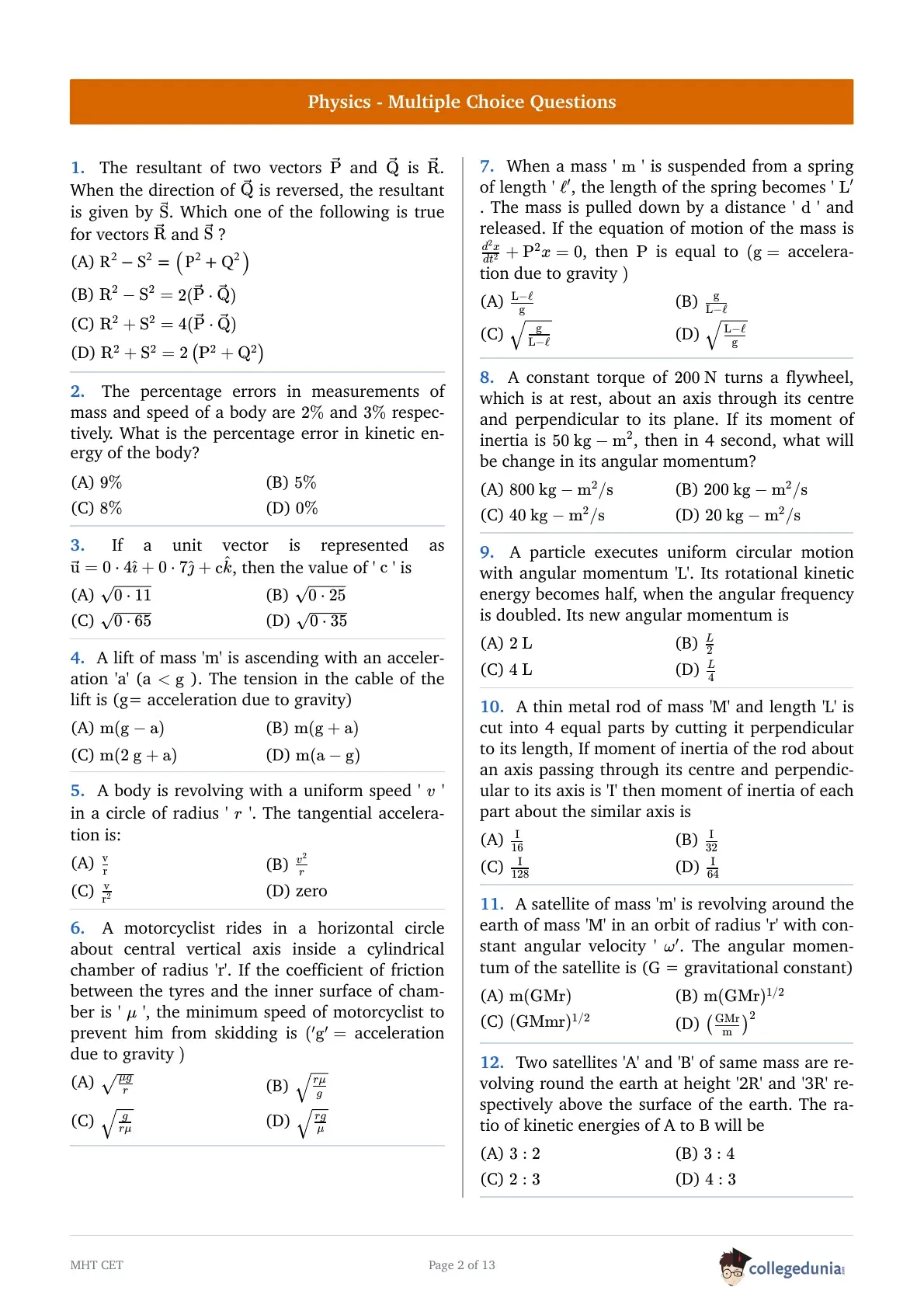
The resultant of two vectors \(\vec{P}\) and \(\vec{Q}\) is \(\vec{R}\). When the direction of \(\vec{Q}\) is reversed, the resultant is given by \(\vec{S}\). Which one of the following is true for vectors \(\vec{R}\) and \(\vec{S}\)?
The percentage errors in measurements of mass and speed of a body are 2% and 3% respectively. What is the percentage error in kinetic energy of the body?
If a unit vector is represented as \( \vec{u} = 0.4\hat{i} + 0.7\hat{j} + c\hat{k} \), then the value of \(c\) is
A lift of mass \(m\) is ascending with an acceleration \(a\) (\(a<g\)). The tension in the cable of the lift is ( \(g\) = acceleration due to gravity )
A body is revolving with a uniform speed ' \(v\) ' in a circle of radius ' \(r\) '. The tangential acceleration is:
A motorcyclist rides in a horizontal circle about a central vertical axis inside a cylindrical chamber of radius \(r\). If the coefficient of friction between the tyres and the inner surface of the chamber is \(\mu\), the minimum speed of motorcyclist to prevent him from skidding is (\(g\) = acceleration due to gravity)
When a mass \(m\) is suspended from a spring of length \(\ell\), the length of the spring becomes \(L\). The mass is pulled down by a distance \(d\) and released. If the equation of motion of the mass is \( \frac{d^2x}{dt^2} + Px = 0 \), then \(P\) is equal to ( \(g\) = acceleration due to gravity )
A constant torque of 200 N m turns a flywheel, which is at rest, about an axis through its centre and perpendicular to its plane. If its moment of inertia is \(50 \, \text{kg m}^2\), then in 4 second, what will be change in its angular momentum?
A particle executes uniform circular motion with angular momentum \(L\). Its rotational kinetic energy becomes half when the angular frequency is doubled. Its new angular momentum is
A thin metal rod of mass \(M\) and length \(L\) is cut into 4 equal parts by cutting it perpendicular to its length. If moment of inertia of the rod about an axis passing through its centre and perpendicular to its axis is \(I\), then moment of inertia of each part about the similar axis is
A satellite of mass \(m\) is revolving around earth of mass \(M\) in an orbit of radius \(r\) with constant angular velocity \(\omega\). The angular momentum of the satellite is (G = gravitational constant)
Two satellites \(A\) and \(B\) of same mass are revolving round the earth at height \(2R\) and \(3R\) respectively above the surface of the earth. The ratio of kinetic energies of \(A\) to \(B\) will be
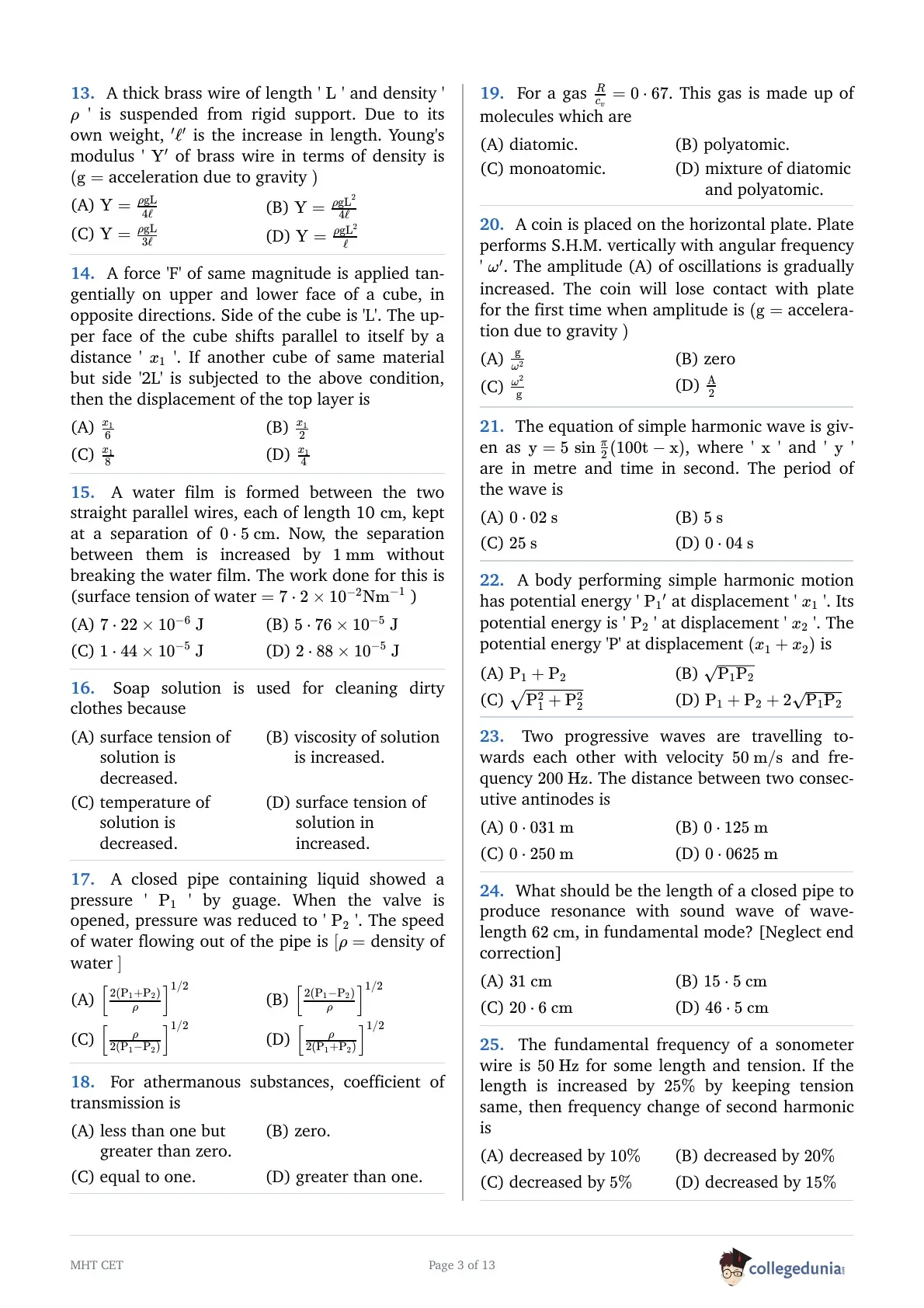
A thick brass wire of length \(L\) and density \(\rho\) is suspended from a rigid support. Due to its own weight, \(\ell\) is the increase in length. Young’s modulus \(Y\) of brass wire in terms of density is ( \(g\) = acceleration due to gravity )
A force \(F\) of same magnitude is applied tangentially on upper and lower face of a cube, in opposite directions. Side of the cube is \(L\). The upper face of the cube shifts parallel to itself by a distance \(x_1\). If another cube of same material but side \(2L\) is subjected to the above condition, then the displacement of the top layer is
A water film is formed between two straight parallel wires, each of length \(10\,\text{cm}\), kept at a separation of \(0.5\,\text{cm}\). Now, the separation between them is increased by \(1\,\text{mm}\) without breaking the water film. The work done for this is (surface tension of water \(= 7.2 \times 10^{-2}\,\text{N m}^{-1}\))
Soap solution is used for cleaning dirty clothes because
A closed pipe containing liquid showed a pressure \(P_1\) by gauge. When the valve is opened, pressure was reduced to \(P_2\). The speed of water flowing out of the pipe is ( \(\rho\) = density of water )
For athermanous substances, coefficient of transmission is
For a gas \(\dfrac{R}{C_v} = 0.67\). This gas is made up of molecules which are
A coin is placed on a horizontal plate. The plate performs S.H.M. vertically with angular frequency \(\omega\). The amplitude \(A\) of oscillations is gradually increased. The coin will lose contact with the plate for the first time when amplitude is ( \(g\) = acceleration due to gravity )
The equation of simple harmonic wave is given as \(y = 5 \sin\frac{\pi}{2}(100t - x)\), where \(x\) and \(y\) are in metre and time in second. The period of the wave is
A body performing simple harmonic motion has potential energy \(P_1\) at displacement \(x_1\). Its potential energy is \(P_2\) at displacement \(x_2\). The potential energy \(P\) at displacement \((x_1 + x_2)\) is
Two progressive waves are travelling towards each other with velocity \(50 \, \text{m s}^{-1}\) and frequency \(200 \, \text{Hz}\). The distance between two consecutive antinodes is
What should be the length of a closed pipe to produce resonance with sound wave of wavelength 62 cm, in fundamental mode? (Neglect end correction)
The fundamental frequency of a sonometer wire is 50 Hz for some length and tension. If the length is increased by 25% by keeping tension same, then frequency change of second harmonic is
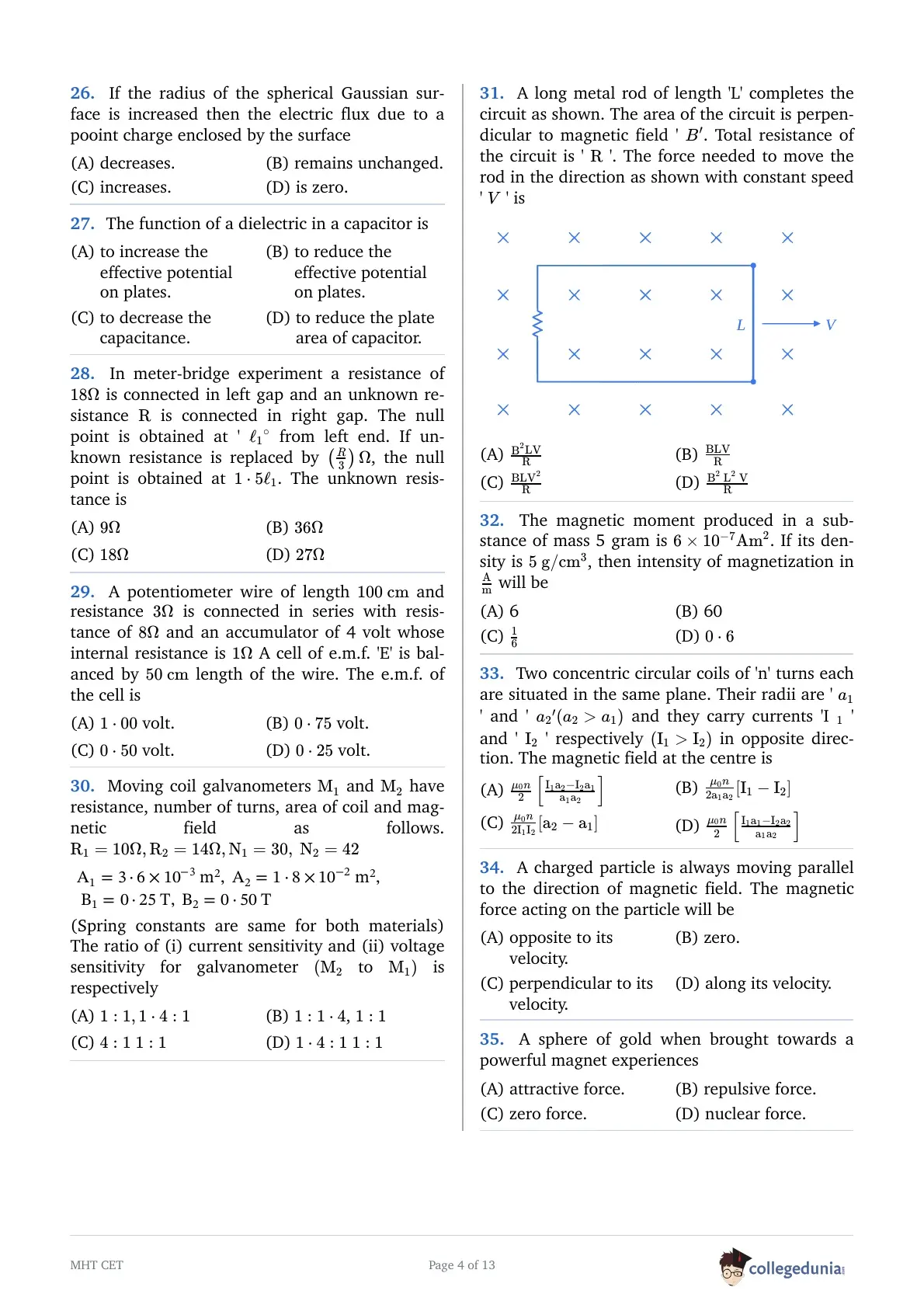
If the radius of the spherical Gaussian surface is increased then the electric flux due to a point charge enclosed by the surface
The function of a dielectric in a capacitor is
In meter-bridge experiment a resistance of \(18\,\Omega\) is connected in left gap and unknown resistance \(R\) is connected in right gap. The null point is obtained at \(\ell_1\) from left end. If unknown resistance is replaced by \(\left(\frac{R}{3}\right)\Omega\), the null point is obtained at \(1.5\ell_1\). The unknown resistance is
A potentiometer wire of length 100 cm and resistance \(3\,\Omega\) is connected in series with resistance of \(8\,\Omega\) and an accumulator of 4 volt whose internal resistance is \(1\,\Omega\).
A cell of e.m.f. \(E\) is balanced at 50 cm length of the wire. The e.m.f. of the cell is
Moving coil galvanometers \(M_1\) and \(M_2\) have resistance, number of turns, area of coil and magnetic field as follows:
\(R_1 = 10\Omega,\; R_2 = 14\Omega,\; N_1 = 30,\; N_2 = 42,\)
\(A_1 = 3.6 \times 10^{-3}\,\text{m}^2,\; A_2 = 1.8 \times 10^{-2}\,\text{m}^2,\; B_1 = 0.25\,\text{T},\; B_2 = 0.50\,\text{T}\).
(Spring constants are same for both materials.)
The ratio of (i) current sensitivity and (ii) voltage sensitivity for galvanometer \(M_2\) to \(M_1\) is respectively
A long metal rod of length \(L\) completes the circuit as shown. The area of the circuit is perpendicular to magnetic field \(B\). Total resistance of the circuit is \(R\). The force needed to move the rod in the direction as shown with constant speed \(V\) is

The magnetic moment produced in a substance of mass 5 g is \(6 \times 10^{-7} \, \text{A m}^2\). If its density is \(5 \, \text{g cm}^{-3}\), then intensity of magnetization in \(\text{A m}^{-1}\) will be
Two concentric circular coils of \(n\) turns each are situated in the same plane. Their radii are \(a_1\) and \(a_2\) (\(a_2>a_1\)) and they carry currents \(I_1\) and \(I_2\) respectively (\(I_1>I_2\)) in opposite direction. The magnetic field at the centre is
A charged particle is always moving parallel to the direction of magnetic field. The magnetic force acting on the particle will be
A sphere of gold when brought towards a powerful magnet experiences
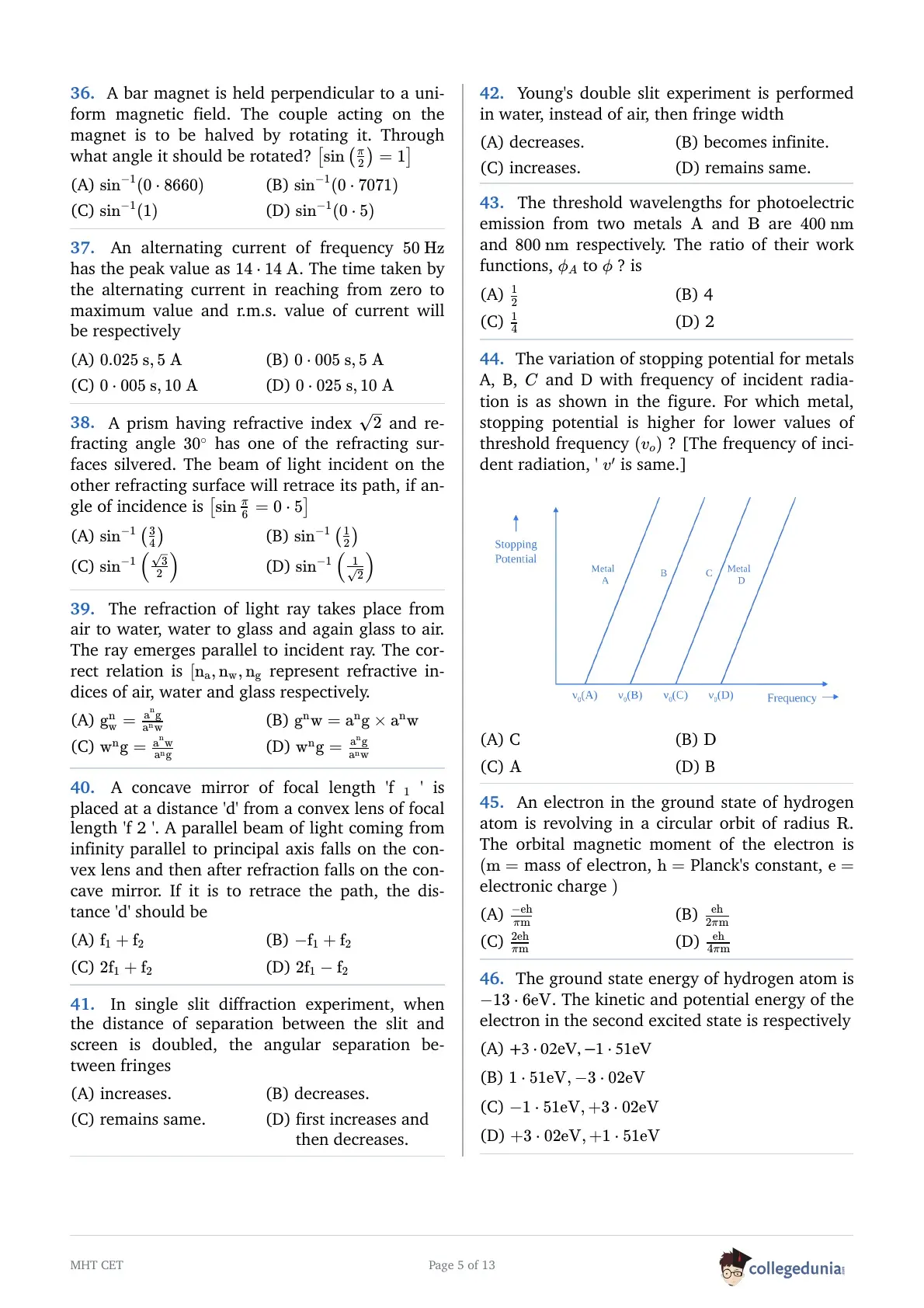
A bar magnet is held perpendicular to a uniform magnetic field. The couple acting on the magnet is to be halved by rotating it. Through what angle should it be rotated?
\([\sin(\pi/2)=1]\)
An alternating current of frequency 50 Hz has the peak value as 14.14 A. The time taken by the alternating current in reaching from zero to maximum value and r.m.s. value of current will be respectively
A prism having refractive index \(\sqrt{2}\) and refracting angle \(30^\circ\) has one of the refracting surfaces silvered. The beam of light incident on the other refracting surface will retrace its path, if angle of incidence is
\([\sin(\pi/6)=0.5]\)
The refraction of light ray takes place from air to water, water to glass and again glass to air. The ray emerges parallel to incident ray. The correct relation is [\(n_a, n_w, n_g\) represent refractive indices of air, water and glass respectively]
A concave mirror of focal length \(f_1\) is placed at a distance \(d\) from a convex lens of focal length \(f_2\). A parallel beam of light coming from infinity parallel to principal axis falls on the convex lens and then after refraction falls on the concave mirror. If it is to retrace the path, the distance \(d\) should be
In single slit diffraction experiment, when the distance of separation between the slit and screen is doubled, the angular separation between fringes
Young's double slit experiment is performed in water instead of air, then fringe width
The threshold wavelengths for photoelectric emission from two metals A and B are 400 nm and 800 nm respectively. The ratio of their work functions \(\phi_A\) to \(\phi_B\) is
The variation of stopping potential for metals A, B, C and D with frequency of incident radiation is as shown in the figure. For which metal, stopping potential is higher for lower values of threshold frequency (\(\nu_0\))?
[The frequency of incident radiation \(\nu\) is same.]

An electron in the ground state of hydrogen atom is revolving in a circular orbit of radius \(R\). The orbital magnetic moment of the electron is
(\(m\) = mass of electron, \(h\) = Planck’s constant, \(e\) = electronic charge)
The ground state energy of hydrogen atom is \(-13.6 \, \text{eV}\). The kinetic and potential energy of the electron in the second excited state is respectively
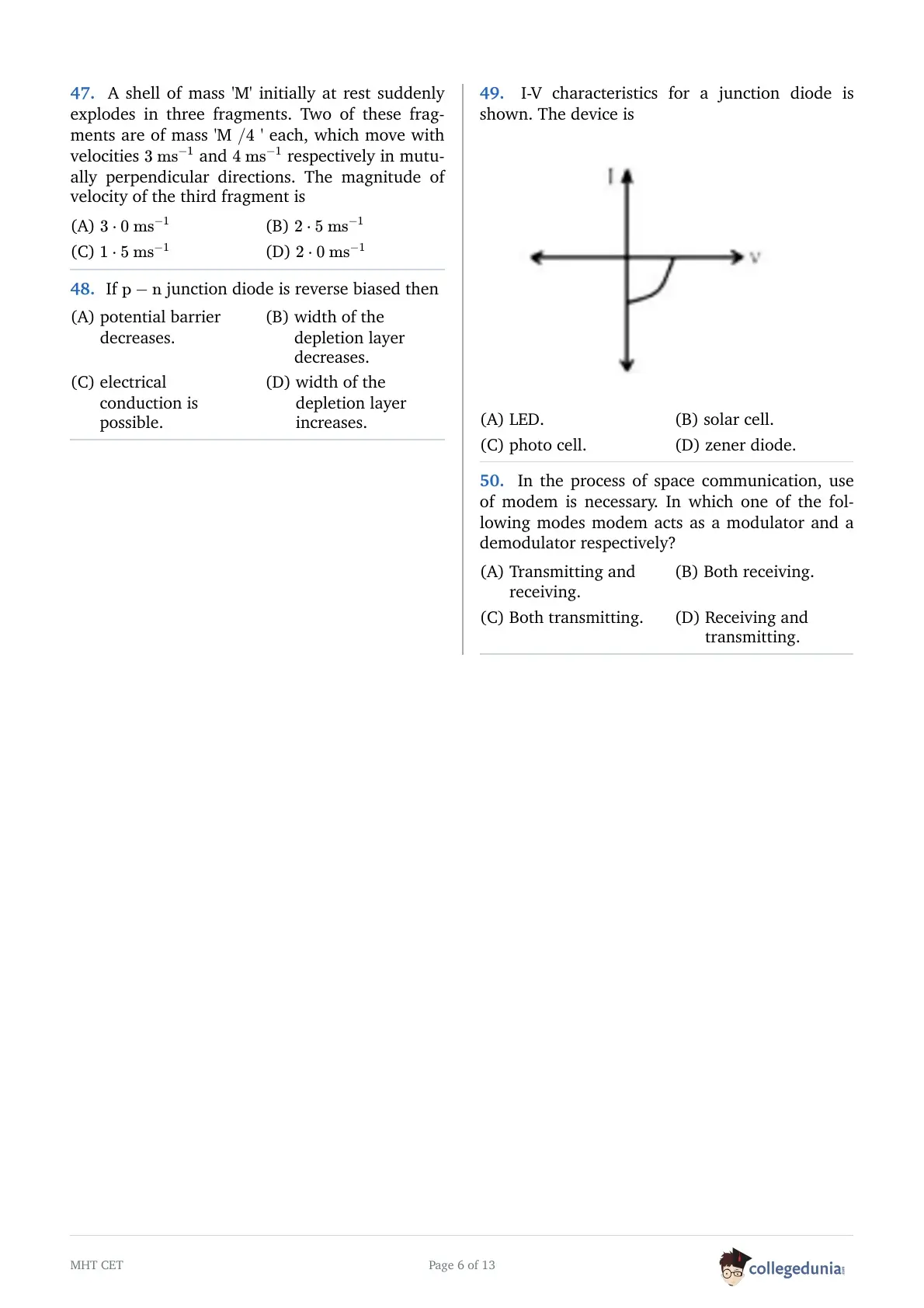
A shell of mass \(M\) initially at rest suddenly explodes into three fragments. Two of these fragments are of mass \(M/4\) each, which move with velocities \(3 \, \text{m s}^{-1}\) and \(4 \, \text{m s}^{-1}\) respectively in mutually perpendicular directions. The magnitude of velocity of the third fragment is
If a p–n junction diode is reverse biased then

In the process of space communication, use of modem is necessary. In which one of the following modes modem acts as a modulator and a demodulator respectively?
Chemistry (Q51 - Q100)
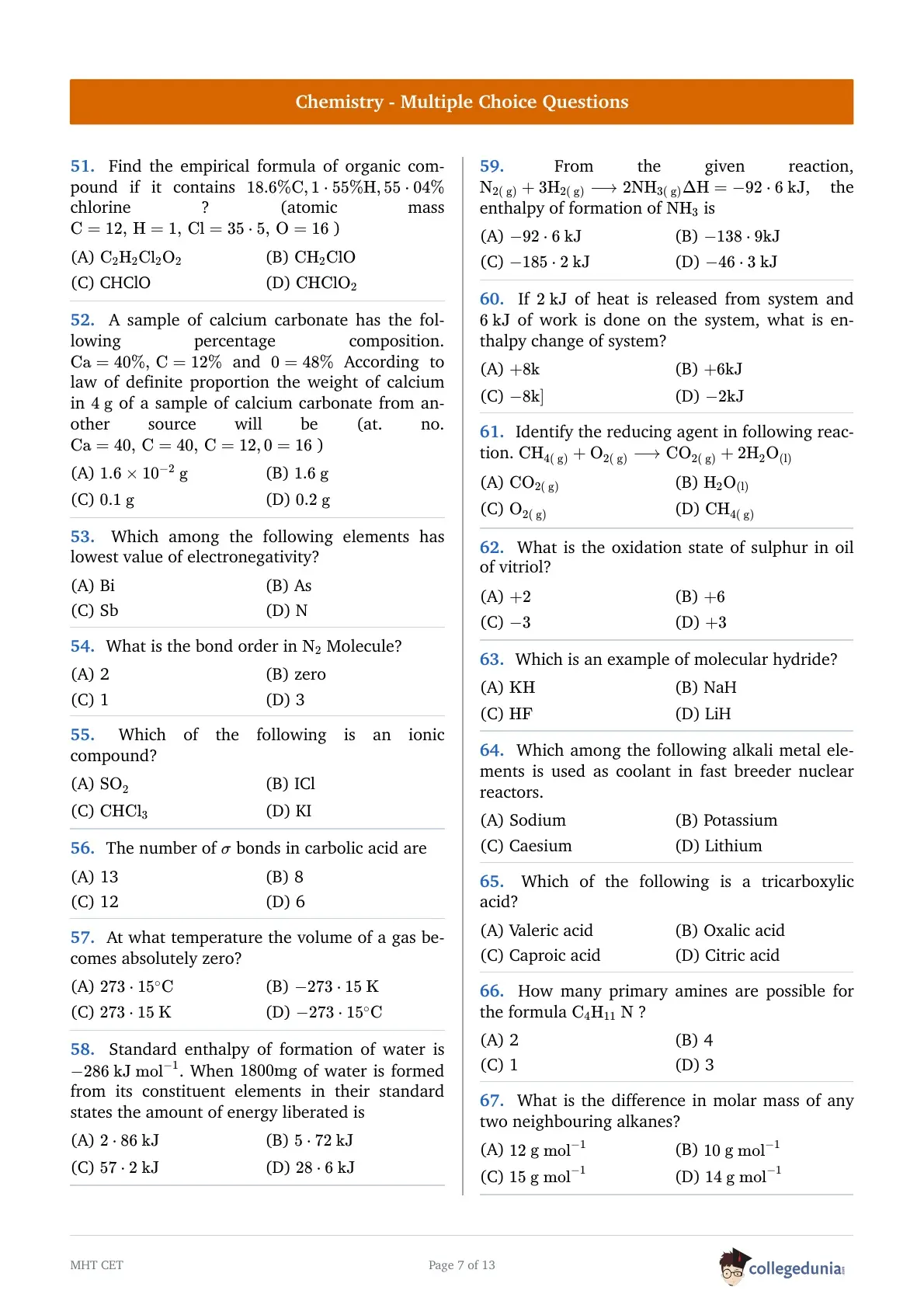
Find the empirical formula of organic compound if it contains \(18.6\%\mathrm{C},1\cdot 55\%\mathrm{H},55\cdot 04\%\) chlorine ? (atomic mass \(\mathrm{C}=12,\,\mathrm{H}=1,\,\mathrm{Cl}=35\cdot 5,\,\mathrm{O}=16\) )
A sample of calcium carbonate has the following percentage composition:
\(\mathrm{Ca}=40%,\)\(\mathrm{C}=12%,\) \(\mathrm{O}=48%. A\).According to the law of definite proportion, the weight of calcium in \(4\text{g}\) of a sample of calcium carbonate from another source will be \(\text{ (at. no. Ca = 40, C = 12, O = 16)}\).
Which among the following elements has the lowest value of electronegativity?
Which of the following is an ionic compound?
At what temperature does the volume of a gas become absolutely zero?
Standard enthalpy of formation of water is \(-286\,\text{kJ mol}^{-1}\). When \( 1800\,\text{mg}\) of water is formed from its constituent elements in their standard states, the amount of energy liberated is
From the given reaction,
\(\mathrm{N_2(g) + 3H_2(g) \rightarrow 2NH_3(g)},\ \Delta H = -92.6\,\text{kJ}, the enthalpy of formation of \mathrm{NH_3} is\)
If \(2\ \mathrm{kJ}\) of heat is released from system and \(6\ \mathrm{kJ}\) of work is done on the system, what is enthalpy change of system?
Identify the reducing agent in following reaction. \(\mathrm{CH}_{4(\ \mathrm{g})}+\mathrm{O}_{2(\ \mathrm{g})}\longrightarrow \mathrm{CO}_{2(\ \mathrm{g})}+2\mathrm{H}_{2}\mathrm{O}_{(\mathrm{l})}\)
What is the oxidation state of sulphur in oil of vitriol?
Which is an example of molecular hydride?
Which among the following alkali metal elements is used as coolant in fast breeder nuclear reactors?
Which of the following is a tricarboxylic acid?
How many primary amines are possible for the molecular formula \(\mathrm{C_4H_{11}N}\,?\)
What is the difference in molar mass of any two neighbouring alkanes?
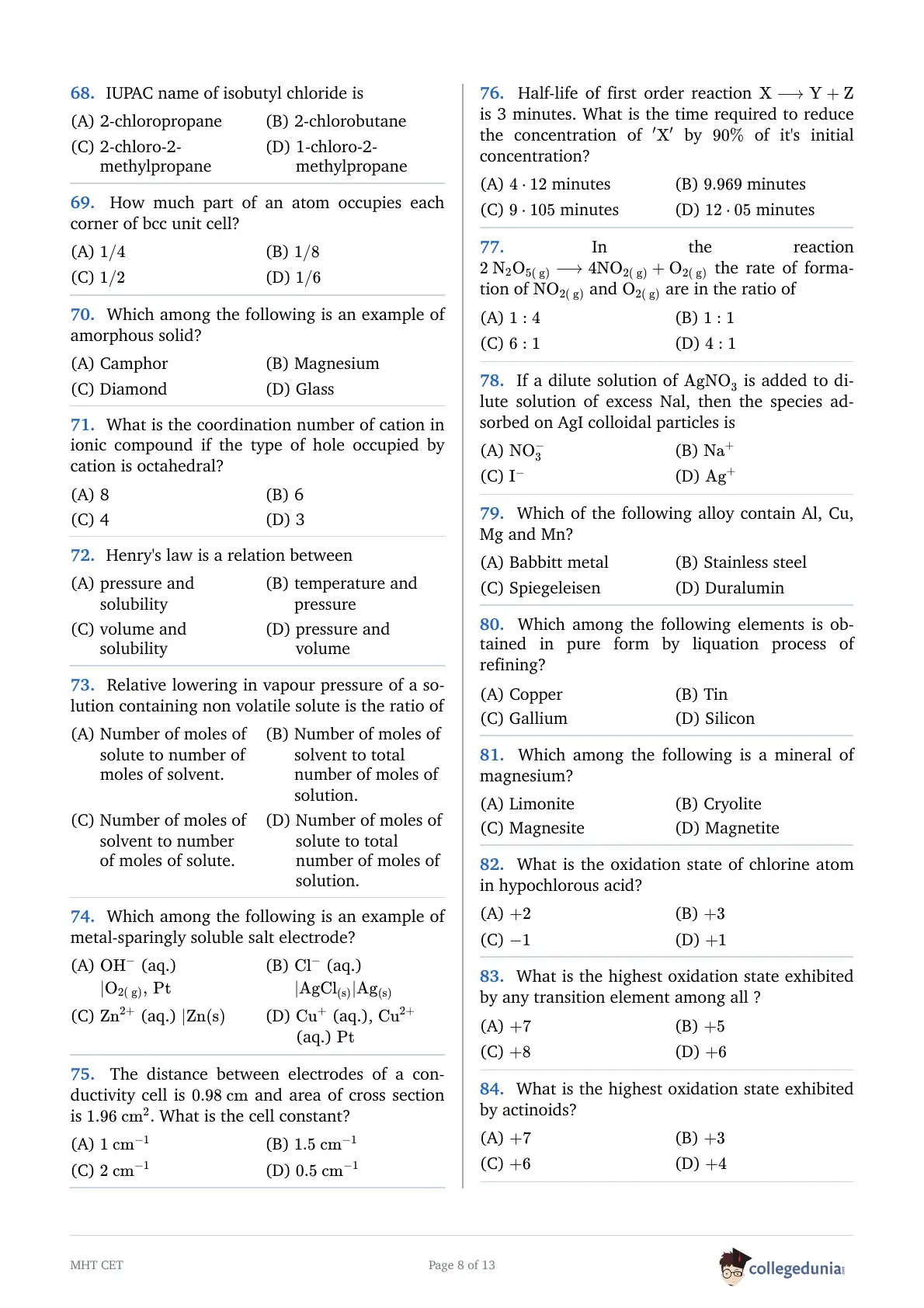
IUPAC name of isobutyl chloride is
How much part of an atom occupies each corner of a bcc unit cell?
Which among the following is an example of amorphous solid?
What is the coordination number of a cation in an ionic compound if the type of hole occupied by the cation is octahedral?
Henry’s law is a relation between
Relative lowering in vapour pressure of a solution containing non-volatile solute is the ratio of
Which among the following is an example of metal–sparingly soluble salt electrode?
The distance between electrodes of a conductivity cell is \(0.98\,\text{cm}\) and the area of cross-section is \(1.96\,\text{cm}^2\). What is the cell constant?
Half-life of first order reaction \(X \rightarrow Y + Z is 3 \text{ minutes.}\) What is the time required to reduce the concentration of X by 90% of its initial concentration?
If a dilute solution of\( \mathrm{AgNO_3}\) is added to a dilute solution of excess \(\mathrm{NaI}\), then the species adsorbed on AgI colloidal particles is
Which of the following alloy contains Al, Cu, Mg and Mn?
Which among the following elements is obtained in pure form by liquation process of refining?
Which among the following is a mineral of magnesium?
What is the oxidation state of chlorine atom in hypochlorous acid?
What is the highest oxidation state exhibited by any transition element among all?
What is the highest oxidation state exhibited by actinoids?
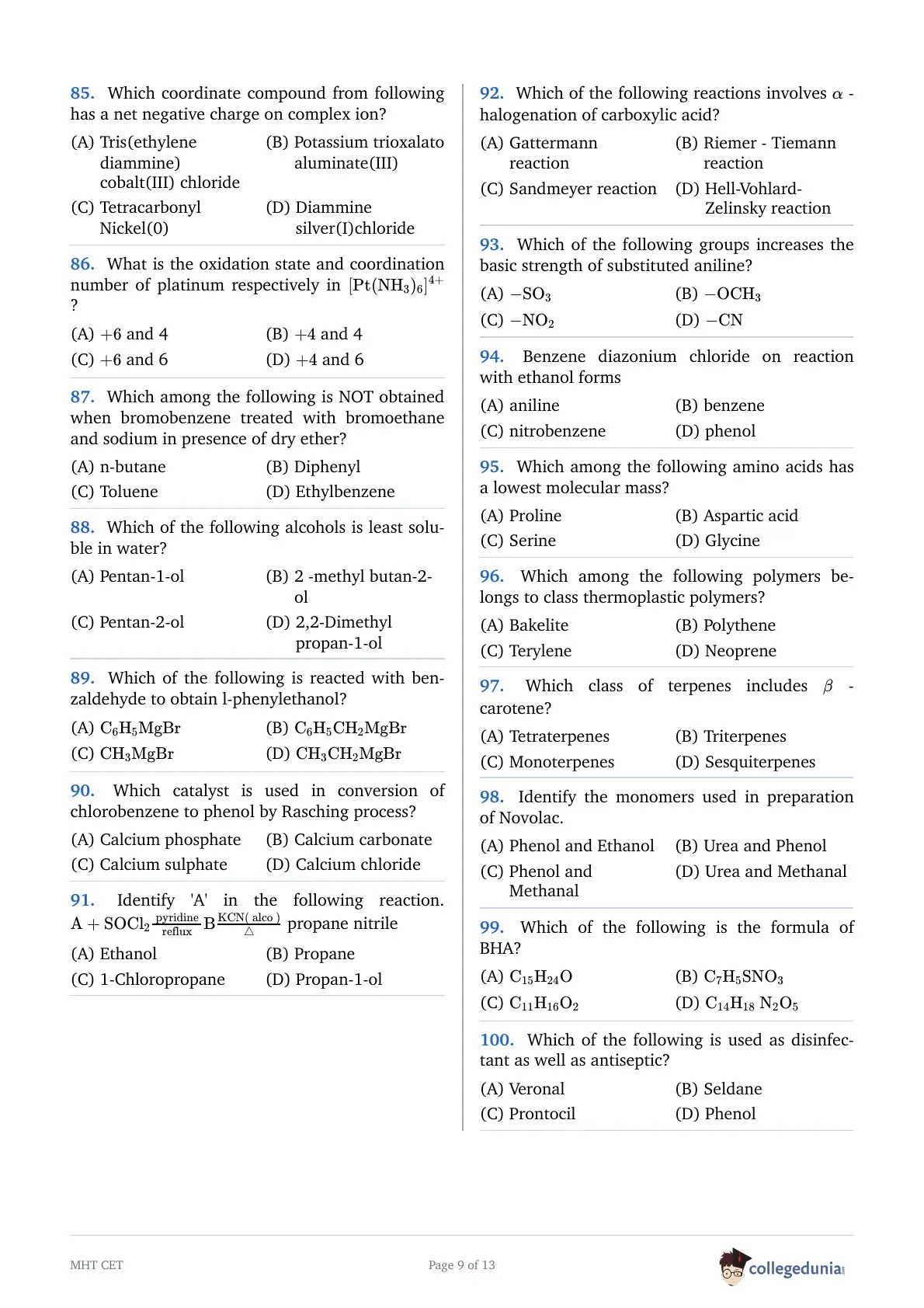
Which coordinate compound from the following has a net negative charge on the complex ion?
What is the oxidation state and coordination number of platinum respectively in \([\mathrm{Pt}(\mathrm{NH}_{3})_{6}]^{4+}\) ?
Which among the following is NOT obtained when bromobenzene is treated with bromoethane and sodium in presence of dry ether?
Which of the following alcohols is least soluble in water?
Which of the following is reacted with benzaldehyde to obtain l-phenylethanol?
Which catalyst is used in conversion of chlorobenzene to phenol by Rasching process?
Identify 'A' in the following reaction. \(\mathrm{A}+\mathrm{SOCl}_{2}\frac{\text{ pyridine }}{\text{ reflux }}\mathrm{B}\frac{\mathrm{KCN}(\text{ alco })}{\triangle }\) propane nitrile
Which of the following reactions involves \(\alpha-halogenation\) of carboxylic acid?
Which of the following groups increases the basic strength of substituted aniline?
Benzene diazonium chloride on reaction with ethanol forms
Which among the following amino acids has the lowest molecular mass?
Which among the following polymers belongs to the class of thermoplastic polymers?
Which class of terpenes includes \(\beta\)-carotene?
Identify the monomers used in preparation of Novolac.
Which of the following is the formula of BHA?
Which of the following is used as disinfectant as well as antiseptic?
Mathematics (Q101 - Q150)
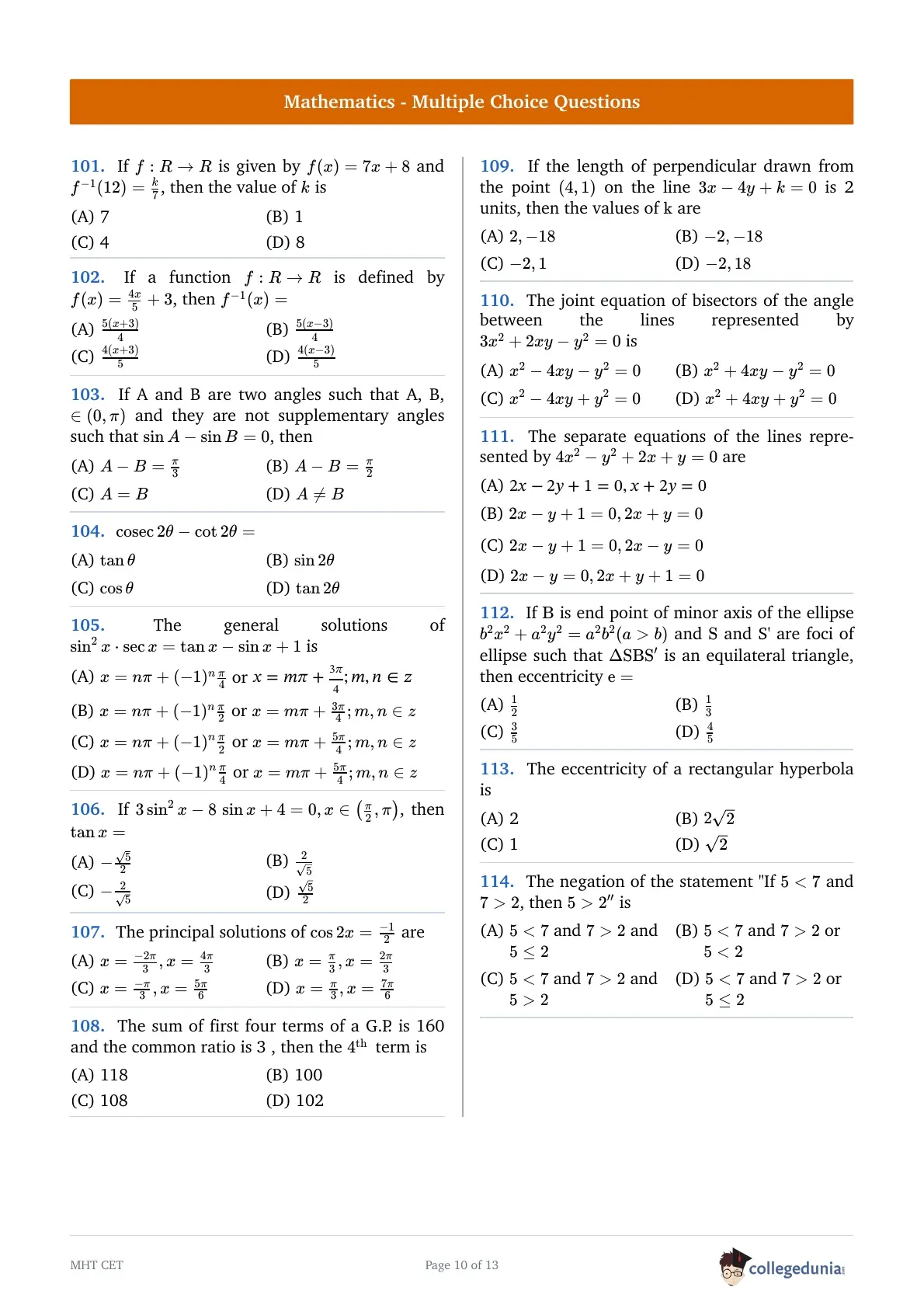
If \(f:\mathbb{R}\rightarrow\mathbb{R}\) is given by \(f(x)=7x+8\) and \(f^{-1}(12)=\dfrac{k}{7}\), then the value of \(k\) is
If a function \(f:\mathbb{R} \to \mathbb{R}\) is defined by \(f(x) = \dfrac{4x}{5} + 3\), then \(f^{-1}(x) =\)
If \(A\) and \(B\) are two angles such that \(A,B\in(0,\pi)\) and they are not supplementary angles such that \(\sin A-\sin B=0\), then
\(\cosec 2\theta-\cot 2\theta=\)
The general solutions of \(\sin^2x\cdot\sec x=\tan x-\sin x+1\) are
If \(3\sin^2x-8\sin x+4=0\), \(x\in\left(\dfrac{\pi}{2},\pi\right)\), then \(\tan x=\)
The principal solutions of \(\cos 2x = -\frac{1}{2}\) are
The sum of first four terms of a G.P. is \(160\) and the common ratio is \(3\), then the \(4^{\text{th}}\) term is
If the length of perpendicular drawn from the point \((4,1)\) on the line \(3x - 4y + k = 0\) is \(2\) units, then the values of \(k\) are
The joint equation of bisectors of the angle between the lines represented by
\(3x^2+2xy-y^2=0\) is
The separate equations of the lines represented by \(4x^2 - y^2 + 2x + y = 0\) are
If \(B\) is the end point of minor axis of the ellipse \(b^2x^2+a^2y^2=a^2b^2\ (a>b)\) and \(S\) and \(S'\) are the foci of the ellipse such that \(\triangle BSS'\) is an equilateral triangle, then the eccentricity \(e\) is
The eccentricity of a rectangular hyperbola is
The negation of the statement "If \(5\lt 7\) and \(7>2\), then \(5>2''\) is
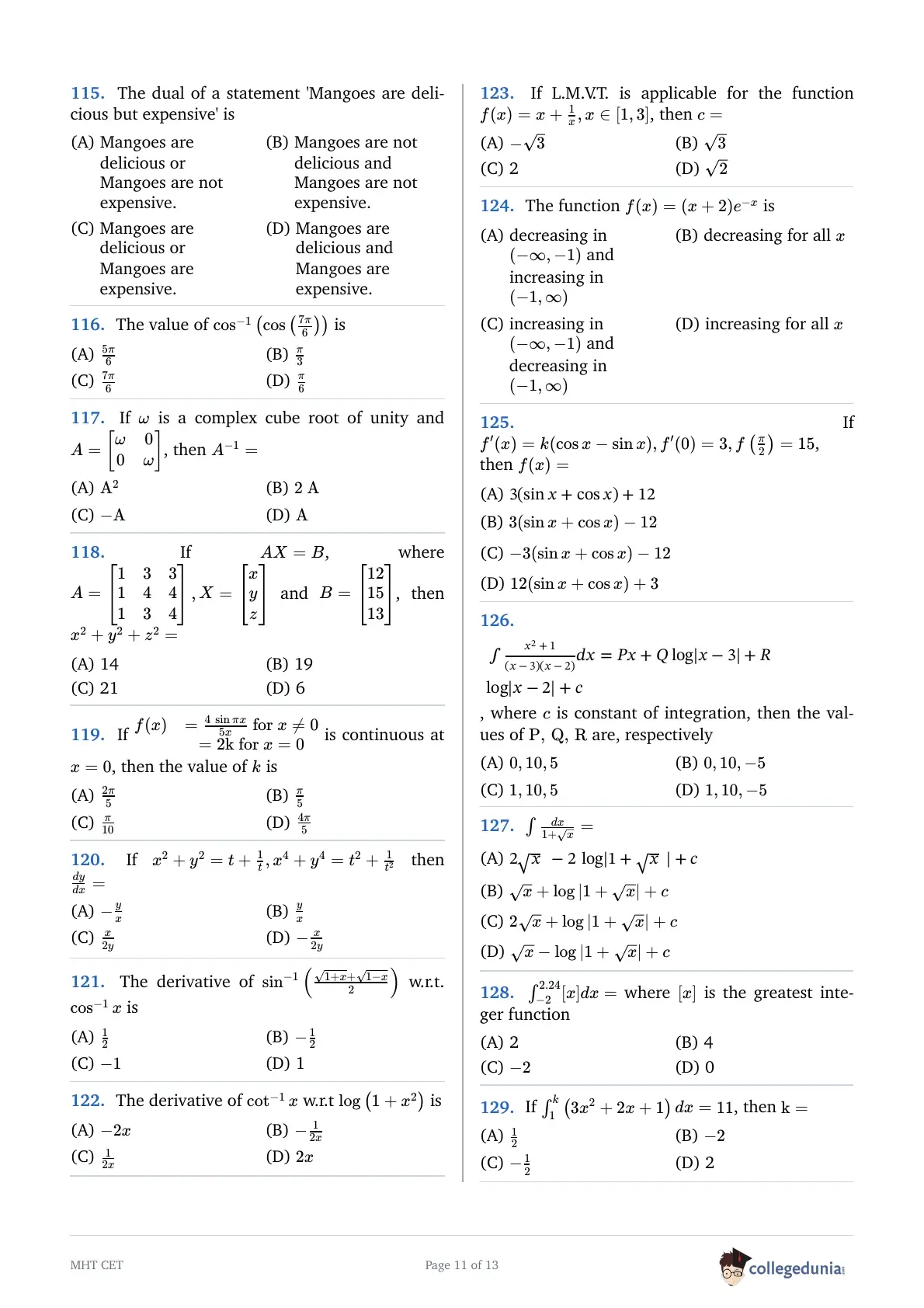
The dual of the statement `Mangoes are delicious but expensive' is
The value of \(\cos^{-1}\left(\cos\left(\frac{7\pi}{6}\right)\right)\) is
If \(\omega\) is a complex cube root of unity and \(A=\begin{pmatrix}\omega & 0\\0 & \omega\end{pmatrix}\), then \(A^{-1}=\)
If \(AX = B\), where \(A = \begin{bmatrix} 1 & 3 & 3 \\ 1 & 4 & 4 \\ 1 & 3 & 4 \end{bmatrix}\), \(X = \begin{bmatrix} x \\ y \\ z \end{bmatrix}\) and \(B = \begin{bmatrix} 12 \\ 15 \\ 13 \end{bmatrix}\), then \(x^2 + y^2 + z^2 =\)
If \(f(x)=\dfrac{4\sin \pi x}{5x}\) for \(x\neq 0\) and \(f(x)=2k\) for \(x=0\), and \(f(x)\) is continuous at \(x=0\), then the value of \(k\) is
If \(x^2+y^2=t+\dfrac{1}{t}\) and \(x^4+y^4=t^2+\dfrac{1}{t^2}\), then \(\dfrac{dy}{dx}=\)
The derivative of \(\sin ^{-1}\left(\frac{\sqrt{1+x}+\sqrt{1-x}}{2}\right)\) w.r.t. \(\cos ^{-1}x\) is
The derivative of \(\cot ^{-1}x\) w.r.t \(\log \left(1+x^{2}\right)\) is
If L.M.V.T. is applicable for the function \(f(x) = x + \dfrac{1}{x}\) on \([1,3]\), then \(c =\)
The function \(f(x) = (x + 2)e^{-x}\) is
If \(f'(x)=k(\cos x-\sin x)\), \(f'(0)=3\), \(f\!\left(\dfrac{\pi}{2}\right)=15\), then \(f(x)=\)
If \(\displaystyle \int \frac{x^2+1}{(x-3)(x-2)}\,dx = Px + Q\log|x-3| + R\log|x-2| + c\), where \(c\) is constant of integration, then the values of \(P,Q,R\) are respectively
Evaluate \(\displaystyle \int \frac{dx}{1+\sqrt{x}}\)
Evaluate \(\displaystyle \int_{-2}^{2} [x]\,dx\), where \([x]\) denotes the greatest integer function
If \(\displaystyle \int_{1}^{k} (3x^2 + 2x + 1)\,dx = 11\), then \(k =\)
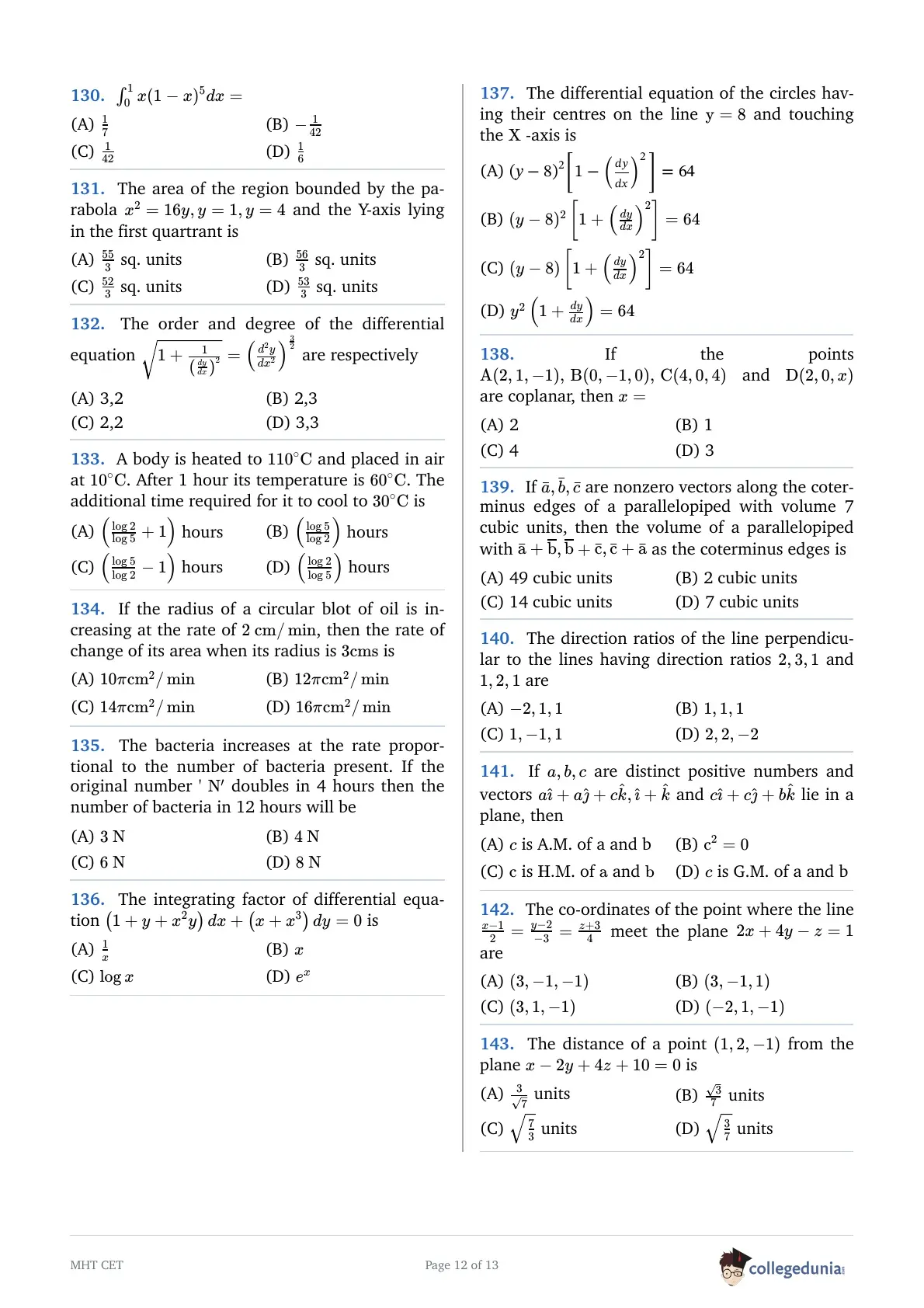
Evaluate \(\displaystyle \int_{0}^{1} x(1-x)^5 \, dx\)
The area of the region bounded by the parabola \(x^2=16y\), the lines \(y=1\), \(y=4\) and the \(y\)-axis lying in the first quadrant is
The order and degree of the differential equation \(\sqrt{1+\dfrac{1}{\left(\dfrac{dy}{dx}\right)^2}}=\left(\dfrac{d^2y}{dx^2}\right)^{\tfrac{3}{2}}\) are respectively
A body is heated to \(110^\circ\)C and placed in air at \(10^\circ\)C. After \(1\) hour its temperature is \(60^\circ\)C. The additional time required for it to cool to \(30^\circ\)C is
If the radius of a circular blot of oil is increasing at the rate of \(2\) cm/min, then the rate of change of its area when its radius is \(3\) cm is
The bacteria increases at the rate proportional to the number of bacteria present. If the original number ' \(\mathrm{N}'\) doubles in 4 hours then the number of bacteria in 12 hours will be
The integrating factor of the differential equation \((1 + y + x^2y)\,dx + (x + x^3)\,dy = 0\) is
The differential equation of the circles having their centres on the line \(y = 8\) and touching the \(x\)-axis is
If the points \(A(2,1,-1)\), \(B(0,-1,0)\), \(C(4,0,4)\) and \(D(2,0,x)\) are coplanar, then \(x=\)
If \(\vec a,\vec b,\vec c\) are nonzero vectors along the coterminous edges of a parallelepiped with volume \(7\) cubic units, then the volume of the parallelepiped with
\(\vec a+\vec b,\ \vec b+\vec c,\ \vec c+\vec a\) as the coterminous edges is
The direction ratios of the line perpendicular to the lines having direction ratios \(2,3,1\) and \(1,2,1\) are
If \(a,b,c\) are distinct positive numbers and the vectors
\(a\hat i+a\hat j+c\hat k,\ \hat i+\hat k\) and
\(c\hat i+c\hat j+b\hat k\) lie in a plane, then
The coordinates of the point where the line \(\dfrac{x-1}{2}=\dfrac{y-2}{-3}=\dfrac{z+3}{4}\) meets the plane \(2x+4y-z=1\) are
The distance of the point \((1,2,-1)\) from the plane \(x-2y+4z+10=0\) is
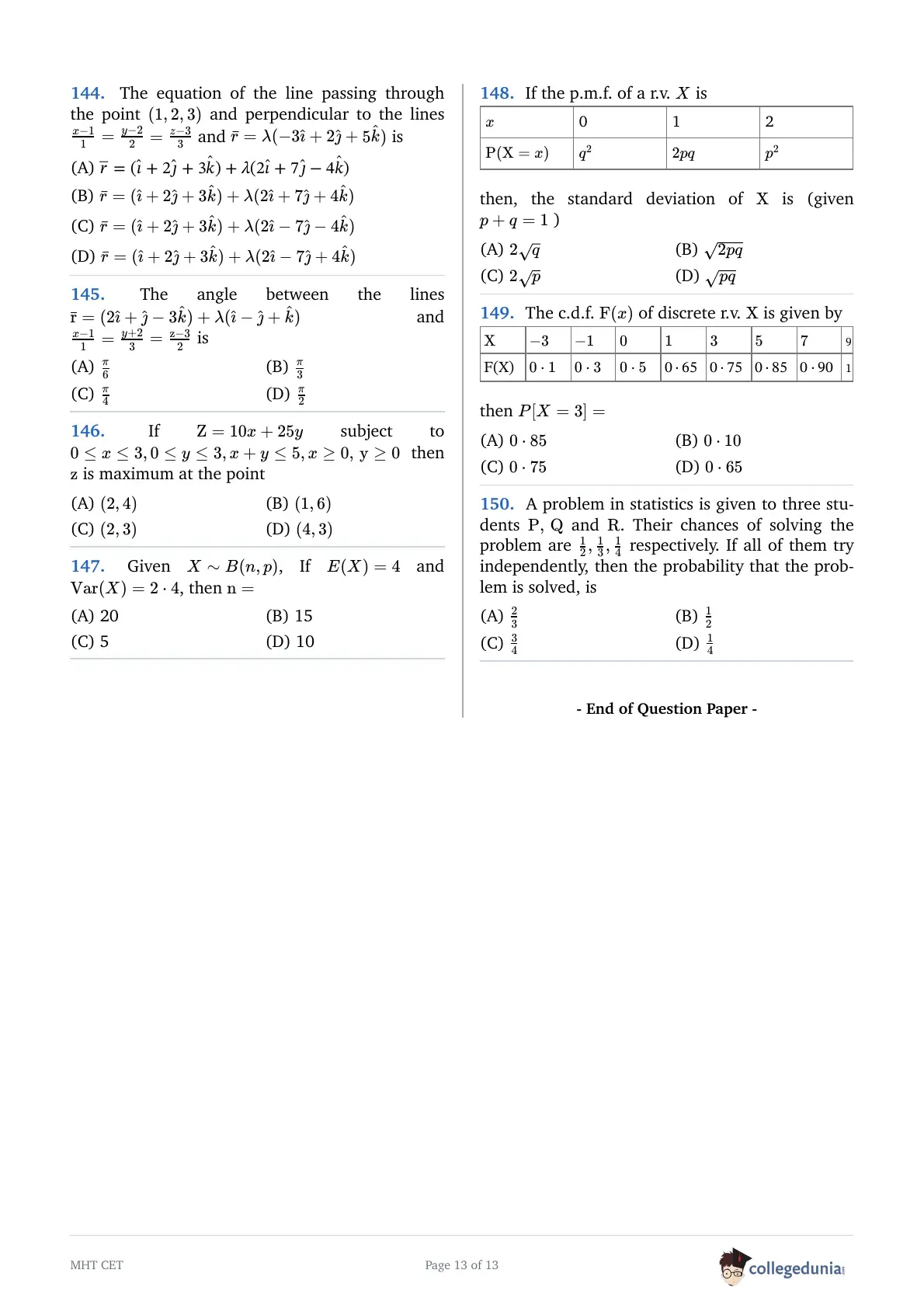
The equation of the line passing through the point \((1,2,3)\) and perpendicular to the lines \(\dfrac{x-1}{1} = \dfrac{y-2}{2} = \dfrac{z-3}{3}\) and \(\vec r = \lambda(-3\hat i + 2\hat j + 5\hat k)\) is
The angle between the lines \(\vec r = (2\hat i + \hat j - 3\hat k) + \lambda(\hat i - \hat j + \hat k)\) and \(\dfrac{x-1}{1} = \dfrac{y+2}{3} = \dfrac{z-3}{2}\) is
If \(Z = 10x + 25y\) subject to \(0 \le x \le 3\), \(0 \le y \le 3\), \(x + y \le 5\), \(x \ge 0\), \(y \ge 0\), then \(Z\) is maximum at the point
Given \(X\sim B(n,p)\), if \(E(X)=4\) and \(\text{Var}(X)=2.4\), then \(n=\)
If the p.m.f. of a r.v. \(X\) is
| \(x\) | 0 | 1 | 2 |
| \(\mathrm{P}(\mathrm{X}=x)\) | \(q^{2}\) | \(2pq\) | \(p^{2}\) |
then, the standard deviation of \(\mathrm{X}\) is (given \(p+q=1\) )
The c.d.f. \(\mathrm{F}(x)\) of discrete r.v. \(\mathrm{X}\) is given by
| \(\mathrm{X}\) | \(-3\) | \(-1\) | \(0\) | \(1\) | \(3\) | \(5\) | \(7\) | \(9\) |
| \(\mathrm{F}(\mathrm{X})\) | \(0\cdot 1\) | \(0\cdot 3\) | \(0\cdot 5\) | \(0\cdot 65\) | \(0\cdot 75\) | \(0\cdot 85\) | \(0\cdot 90\) | \(1\) |
then \(P[X=3]=\)
A problem in statistics is given to three students \(P\), \(Q\) and \(R\). Their chances of solving the problem are \(\frac{1}{2}\), \(\frac{1}{3}\) and \(\frac{1}{4}\) respectively. If all of them try independently, then the probability that the problem is solved is
MHT CET 2020 PCM Exam Pattern and Marking Scheme
| Parameter | Details |
|---|---|
| Conducting Body | Maharashtra Common Entrance Test Cell (Maharashtra CET Cell) |
| Exam Mode | Online (Computer-Based Test) |
| Duration | 180 minutes (3 hours) |
| Groups / Subjects | PCM (Physics, Chemistry, Mathematics) for Engineering |
| Total Questions |
150 |
| Total Marks | 200 |
| Question Type | Multiple Choice Questions (MCQs) |
| Marks Distribution |
|
| Negative Marking | No |
| Syllabus Weightage |
|



Comments