




MHT CET 2020 Oct 19 Shift 2 PCM Question Paper is available for download here. Maharashtra State CET Cell conducted MHT CET 2020 PCM Exam on Oct 19 in Shift 2 from 2 PM to 5 PM in CBT mode.
The MHT CET 2020 PCM question paper includes the following:
- The MHT CET 2020 PCM Question Paper consists of 150 multiple-choice questions (MCQs) totalling 200 marks divided into 3 sections: Physics, Chemistry, and Mathematics, with 50 questions in each subject.
- Physics and Chemistry questions carry 1 mark each while Mathematics questions carry 2 marks each.
- There is no negative marking for incorrect answers.
MHT CET 2020 Oct 19 Shift 2 PCM Question Paper with Solution PDF
| CD PDF | CD PDF with Solutions |
|---|---|
| Download Collegedunia PDF 0.90 MB | - |
Also Check:
MHT CET 2020 Oct 19 Shift 2 PCM Questions with Solutions
Physics (Q1 - Q50)
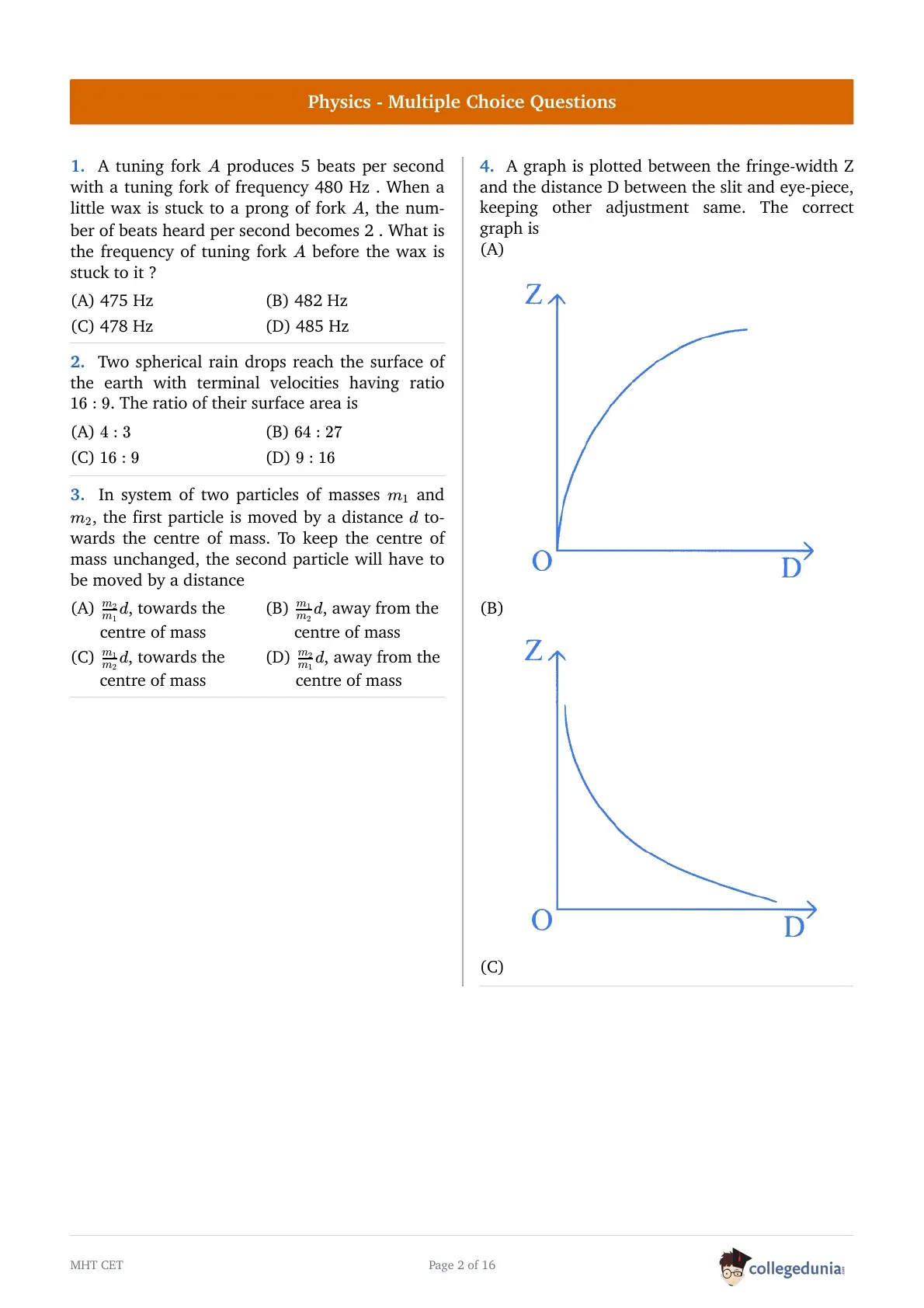
A tuning fork \(A\) produces 5 beats per second with a tuning fork of frequency 480 Hz . When a little wax is stuck to a prong of fork \(A\), the number of beats heard per second becomes 2 . What is the frequency of tuning fork \(A\) before the wax is stuck to it ?
Two spherical rain drops reach the surface of the earth with terminal velocities having ratio \(16: 9\). The ratio of their surface area is
In a system of two particles of masses \(m_1\) and \(m_2\), the second particle is moved by a distance \(d\) towards the centre of mass. To keep the centre of mass unchanged, the first particle will have to be moved by a distance
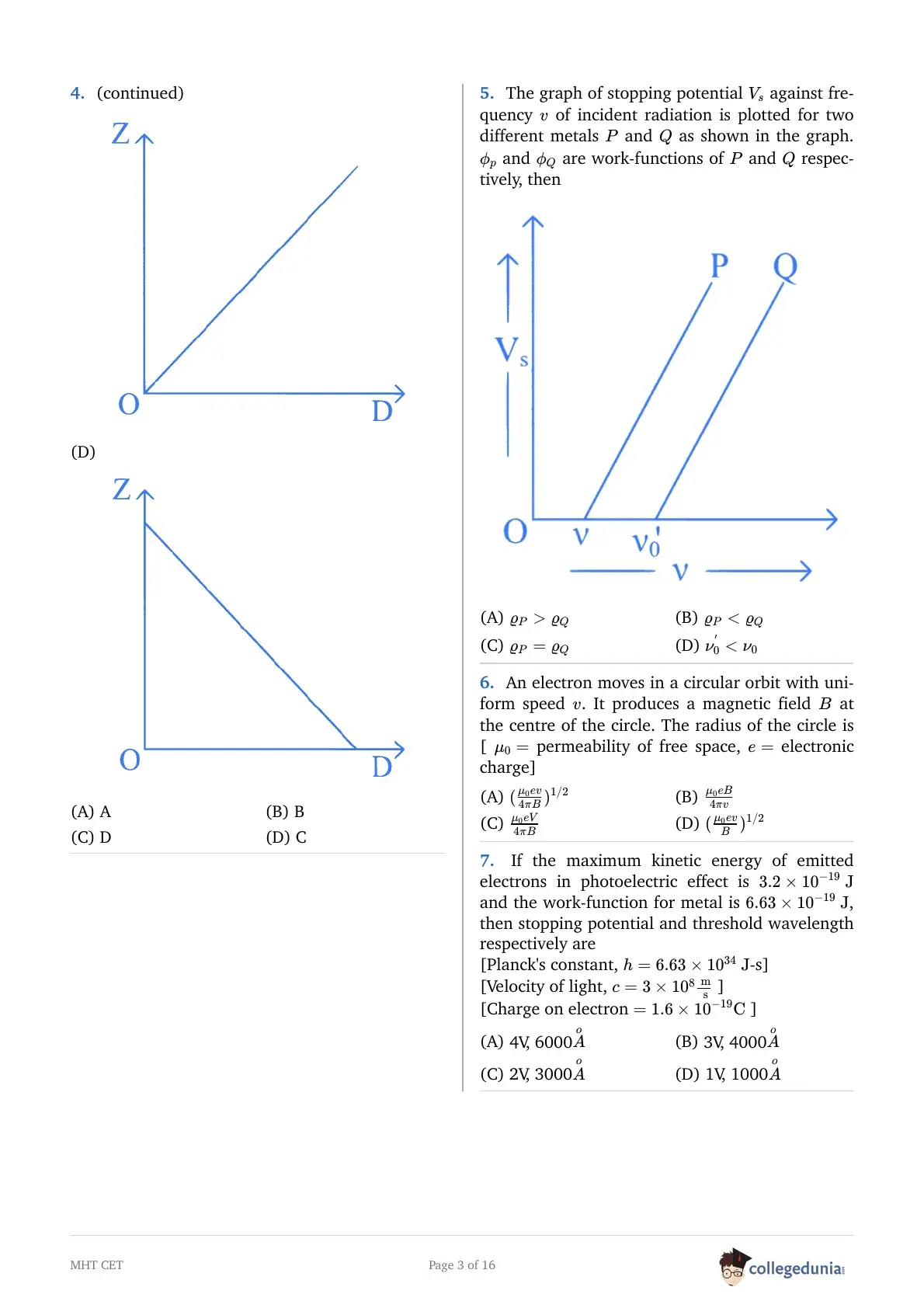
A graph is plotted between the fringe-width Z and the distance D between the slit and eye-piece, keeping other adjustment same. The correct graph is
(A)


The graph of stopping potential \(V_s\) against frequency \(v\) of incident radiation is plotted for two different metals \(P\) and \(Q\) as shown in the graph. \(\phi_p\) and \(\phi_Q\) are work-functions of \(P\) and \(Q\) respectively, then

An electron moves in a circular orbit with uniform speed \(v\). It produces a magnetic field \(B\) at the centre of the circle. The radius of the circle is [ \(\mu_0=\) permeability of free space, \(e=\) electronic charge]
The root mean square velocity of molecules of a gas is \(200 \mathrm{~m} / \mathrm{s}\). What will be the root mean square velocity of the molecules, if the molecular weight is doubled and the absolute temperature is halved?
Earth has mass \(M_1\) and radius \(R_1\). Moon has mass \(M_2\) and radius \(R_2\). Distance between their centre is \(r\). A body of mass \(M\) is placed on the line joining them at a distance \(\frac{r}{3}\) from centre of the earth. To project the mass \(M\) to escape to infinity, the minimum speed required is
A carrier wave of peak voltage 16 V is used to transmit a signal. If the modulation index is \(75 \%\), the peak voltage of the modulating signal is
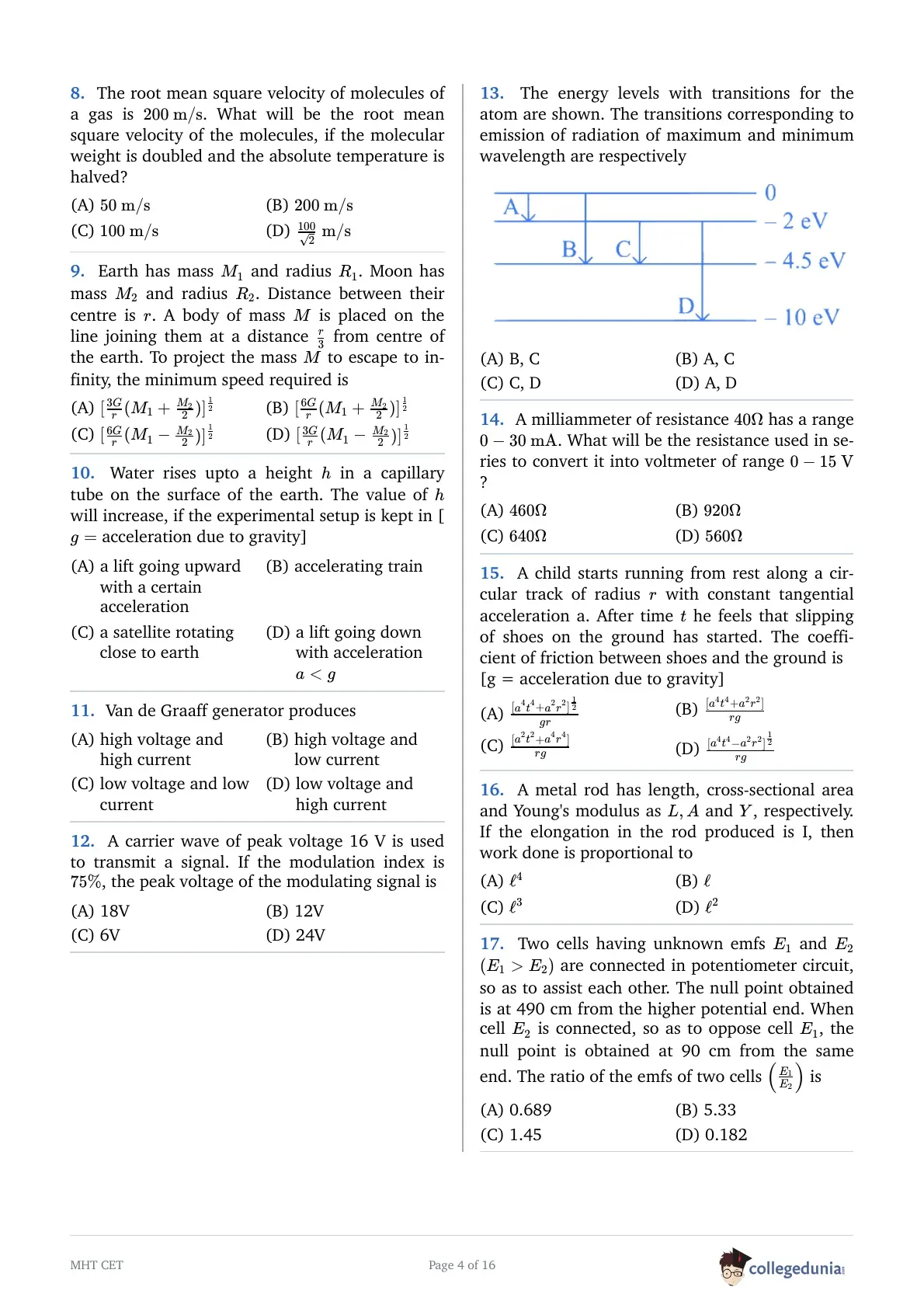
The energy levels with transitions for the atom are shown. The transitions corresponding to emission of radiation of maximum and minimum wavelength are respectively

A milliammeter of resistance \(40 \Omega\) has a range \(0-30 \mathrm{~mA}\). What will be the resistance used in series to convert it into voltmeter of range \(0-15 \mathrm{~V}\) ?
A child starts running from rest along a circular track of radius \(r\) with constant tangential acceleration a. After time \(t\) he feels that slipping of shoes on the ground has started. The coefficient of friction between shoes and the ground is
[g = acceleration due to gravity]
A metal rod has length, cross-sectional area and Young's modulus as \(L, A\) and \(Y\), respectively. If the elongation in the rod produced is I, then work done is proportional to
Two cells having unknown emfs \(E_1\) and \(E_2\) \(\left(E_1>E_2\right)\) are connected in potentiometer circuit, so as to assist each other. The null point obtained is at 490 cm from the higher potential end. When cell \(E_2\) is connected, so as to oppose cell \(E_1\), the null point is obtained at 90 cm from the same end. The ratio of the emfs of two cells \(\left(\frac{E_1}{E_2}\right)\) is
Three points masses, each of mass \(m\) are placed at the corners of an equilateral triangle of side \(\ell\). The moment of inertia of the system about an axis passing through one of the vertices and parallel to the side joining other two vertices, will be
Using Bohr's model, the orbital period of electron in hydrogen atom in \(n\)th orbit is ( \(\varepsilon_0=\) permittivity of free space, \(h=\) Planck's constant, \(m=\) mass of electron and \(\theta=\) electronic charge)
Let \(\sigma\) and \(b\) be Stefan's constant and Wien's constant respectively, then dimensions of \(\sigma b\) are
At the poles, a stretched wire of a given length vibrates in unison with a tuning fork. At the equator, for same setting to produce resonance with same fork, the vibrating length of wire
A steel wire of length / has a magnetic moment \(M\). It is then bent into a semicircular arc. The new magnetic moment is
The angle subtended by the vector \(A=4 \hat{\mathbf{i}}+3 \hat{\mathbf{j}}+12 \hat{\mathbf{k}}\) with the \(X\)-axis is
\(N\) number of balls of mass \(m \mathrm{~kg}\) moving along positive direction of \(X\) - axis, strike a wall per second and return elastically. The velocity of each ball is \(u \mathrm{~m} / \mathrm{s}\). The force exerted on the wall by the balls in newton, is
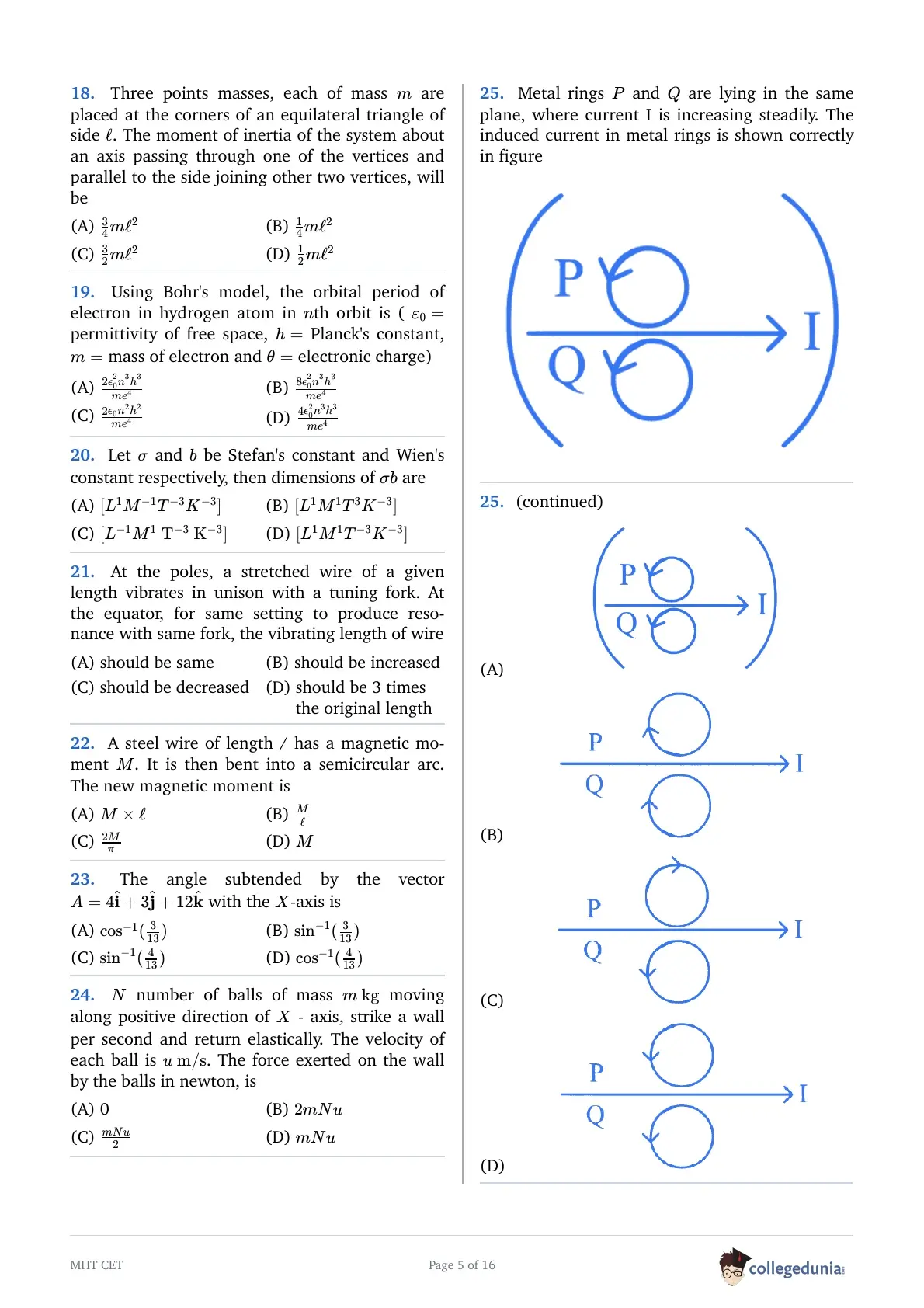
Metal rings \(P\) and \(Q\) are lying in the same plane, where current I is increasing steadily. The induced current in metal rings is shown correctly in figure

- (A)
![]()
- (B)
![]()
- (C)
![]()
- (D)
![]()


A 10 m long wire of resistance \(20 \Omega\) is connected in series with a battery of emf 3 V and a resistance of \(10 \Omega\). The potential gradient along the wire in \(\mathrm{V} / \mathrm{m}\) is
A domain in a ferromagnetic substance is in the form of a cube of side \(1 \mu \mathrm{~m}\). If it contains \(8 \times 10^{10}\) atoms and each atomic dipole has a dipole moment of \(9 \times 10^{-24} \mathrm{Am}^2\), then the magnetisation of the domain is
If the surface tension of a soap solution is \(3 \times 10^{-2} \mathrm{~N} / \mathrm{m}\) then the work done in forming a soap film of \(20 \mathrm{~cm} \times 5 \mathrm{~cm}\) will be
The compressibility of water is \(5 \times 10^{-10} \mathrm{~m}^2 / \mathrm{N}\). Pressure of \(15 \times 10^6 \mathrm{~Pa}\) is applied on 100 mL volume of water. The change in the volume of water is
Two bodies \(A\) and \(B\) of equal mass are suspended from two separate massles springs of force constant \(k_1\) and \(k_2\), respectively. The bodies oscillate vertically such that their maximum velocities are equal. The ratio of the amplitudes of body \(A\) to that of body \(B\) is
Two capacitors of capacities \(2 \mu \mathrm{~F}\) and \(4 \mu \mathrm{~F}\) are connected in parallel. A third capacitor of \(6 \mu \mathrm{~F}\) capacity is connected in series with this combination. A battery of 12 V is connected across this combination. The charge on \(2 \mu \mathrm{~F}\) capacitor is
The escape velocity of a body from any planet, whose mass is six times the mass of earth and radius is twice the radius of earth will (v\(_e\) = escape velocity of a body from the earth's surface)
A ray of light is incident at an angle \(i\) on one face of a thin angled prism. The ray emerges normally from the other face. Refractive inder of the glass prims is \(n\) and angle of prism is \(A\). The value of \(i\) is
What is the angle between resultant of \(A+B\) and \(\mathbf{A} \times \mathbf{B}\).
A rope is wound around a solid cylinder of mass 1 kg and radius 0.4 m . What is the angular acceleration of cylinder, if the rope is pulled with a force of 25 N ? (Cylinder is rotating about its own axis.)
A transistor having \(\alpha=0.8\) is connected in common emitter configuration. When the base current changes by 6 mA , then the change in collector current is
A uniform metal wire has length \(L\), mass \(M\) and density \(\rho\). It is under tension \(T\) and \(v\) is the speed of transverse wave along the wire. The area of cross-section of the wire is
An object is clearly seen through an astronomical telescope of length 50 cm . The focal lengths of its objective and eye-piece respectively, can be
A bob of a simple pendulum has mass \(m\) and is oscillating with an amplitude \(a\). If the length of the pendulum is \(L\), then the maximum tension in the string is \(\left[\cos 0^{\circ}=1\right.\), \(g=\) acceleration due to gravity]
The Brewster's angle for the glass-air interface is \((54.74)^{\circ}\). If a ray of light passing from air to glass strickes at an angle of incidence \(45^{\circ}\), then the angle of refraction is
\[\left[\tan (54.74)^{\circ}=\sqrt{2}, \sin 45=\frac{1}{\sqrt{2}}\right]\]
Let \(x=\pi R\left(\frac{P^2-Q^2}{2}\right)\), where \(P, Q\) and \(R\) are lengths. The physical quantity \(x\) is
The fundamental frequency of a closed pipe is 400 Hz . If \(\frac{1}{3}\) rd pipe is filled with water, then the frequency of 2nd harmonic of the pipe will be (neglect and correction)
An AC circuit contains resistance of \(12 \Omega\) and inductive reactance \(5 \Omega\). The phase angle between current and potential difference will be
In an intrinsic semiconductor, at an ordinary temperature, the correct relation between the number of electrons per unit volume \(n_e\) and number of holes per unit volume \(n_h\).
Two galvanometers \(A\) and \(B\) require currents of 4 mA and 7 mA , respectively to produce the same deflection of 20 divisions. If \(S_A\) and \(S_B\) are their sensitivities respectively, then
Two circular loop \(A\) and \(B\) of radii \(R\) and \(N R\) respectively are made from a uniform wire. Moment of inertia of \(B\) about its axis is 3 times that of \(A\) about its axis. The value of \(N\) is
A body is moving along a circular track of radius 100 m with velocity \(20 \mathrm{~m} / \mathrm{s}\). Its tangential acceleration is \(3 \mathrm{~m} / \mathrm{s}^2\), then its resultant acceleration will be
A body of mass 64 g is made to oscillate turn by turn on two different springs \(A\) and \(B\). Spring \(A\) and \(B\) has force constant \(4 \frac{\mathrm{~N}}{\mathrm{~m}}\) and \(16 \frac{\mathrm{~N}}{\mathrm{~m}}\) respectively. If \(T_1\) and \(T_2\) are period of oscillations of springs \(A\) and \(B\) respectively, then \(\frac{T_1+T_2}{T_1-T_2}\) will be
Chemistry (Q51 - Q100)
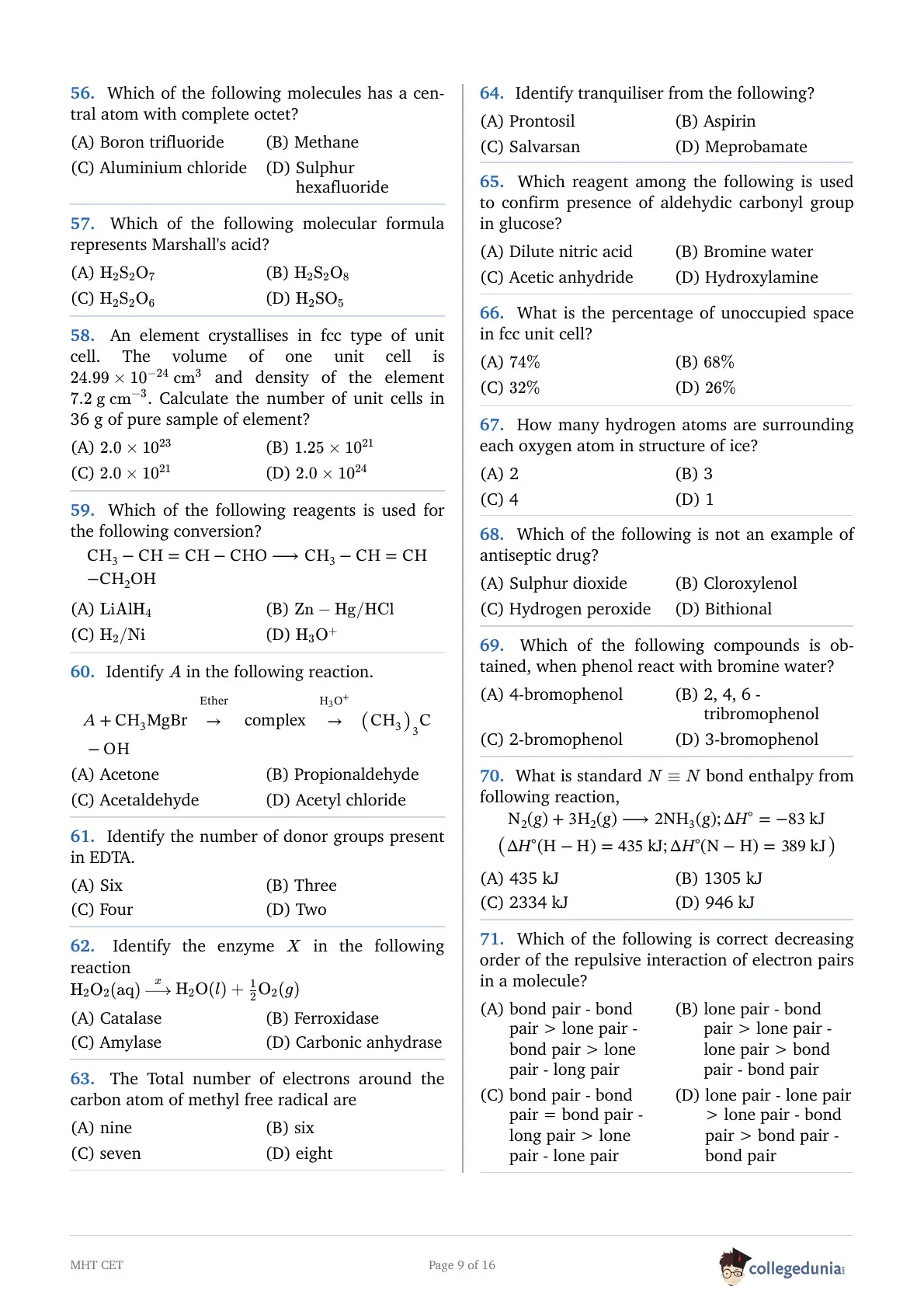
Which of the following is least reactive towards \(\mathrm{S}_{\mathrm{N}} 1\) reactions?
Which of the following oxyacids of sulphur contain four \(\mathrm{S}=\mathrm{O}\) bonds?
Which of the following molecules has a central atom with complete octet?
An element crystallises in fcc type of unit cell. The volume of one unit cell is \(24.99 \times 10^{-24} \mathrm{~cm}^3\) and density of the element \(7.2 \mathrm{~g} \mathrm{~cm}^{-3}\). Calculate the number of unit cells in 36 g of pure sample of element?
Which of the following reagents is used for the following conversion?
\[\mathrm{CH}_3-\mathrm{CH}=\mathrm{CH}-\mathrm{CHO} \longrightarrow \mathrm{CH}_3-\mathrm{CH}=\mathrm{CH}-\mathrm{CH}_2 \mathrm{OH}\]
Identify \(A\) in the following reaction.
\[A+\mathrm{CH}_3 \mathrm{MgBr} \xrightarrow{\text { Ether }} \text { complex }\xrightarrow{\mathrm{H}_3 \mathrm{O}^{+}}\left(\mathrm{CH}_3\right)_3 \mathrm{C}-\mathrm{OH}\]
Identify the enzyme \(X\) in the following reaction
\(\mathrm{H}_2 \mathrm{O}_2(\mathrm{aq}) \xrightarrow{x} \mathrm{H}_2 \mathrm{O}(l)+\frac{1}{2} \mathrm{O}_2(g)\)
The Total number of electrons around the carbon atom of methyl free radical are
Which reagent among the following is used to confirm presence of aldehydic carbonyl group in glucose?
How many hydrogen atoms are surrounding each oxygen atom in structure of ice?
Which of the following compounds is obtained, when phenol react with bromine water?
What is standard \(N \equiv N\) bond enthalpy from following reaction,
\[\begin{aligned} & \mathrm{N}_2(g)+3 \mathrm{H}_2(g) \longrightarrow 2 \mathrm{NH}_3(g) ; \Delta H^{\circ}=-83 \mathrm{~kJ} \\ & \left(\Delta H^{\circ}(\mathrm{H}-\mathrm{H})=435 \mathrm{~kJ} ; \Delta H^{\circ}(\mathrm{N}-\mathrm{H})=389 \mathrm{~kJ}\right) \\ \end{aligned}\]
Which of the following is correct decreasing order of the repulsive interaction of electron pairs in a molecule?
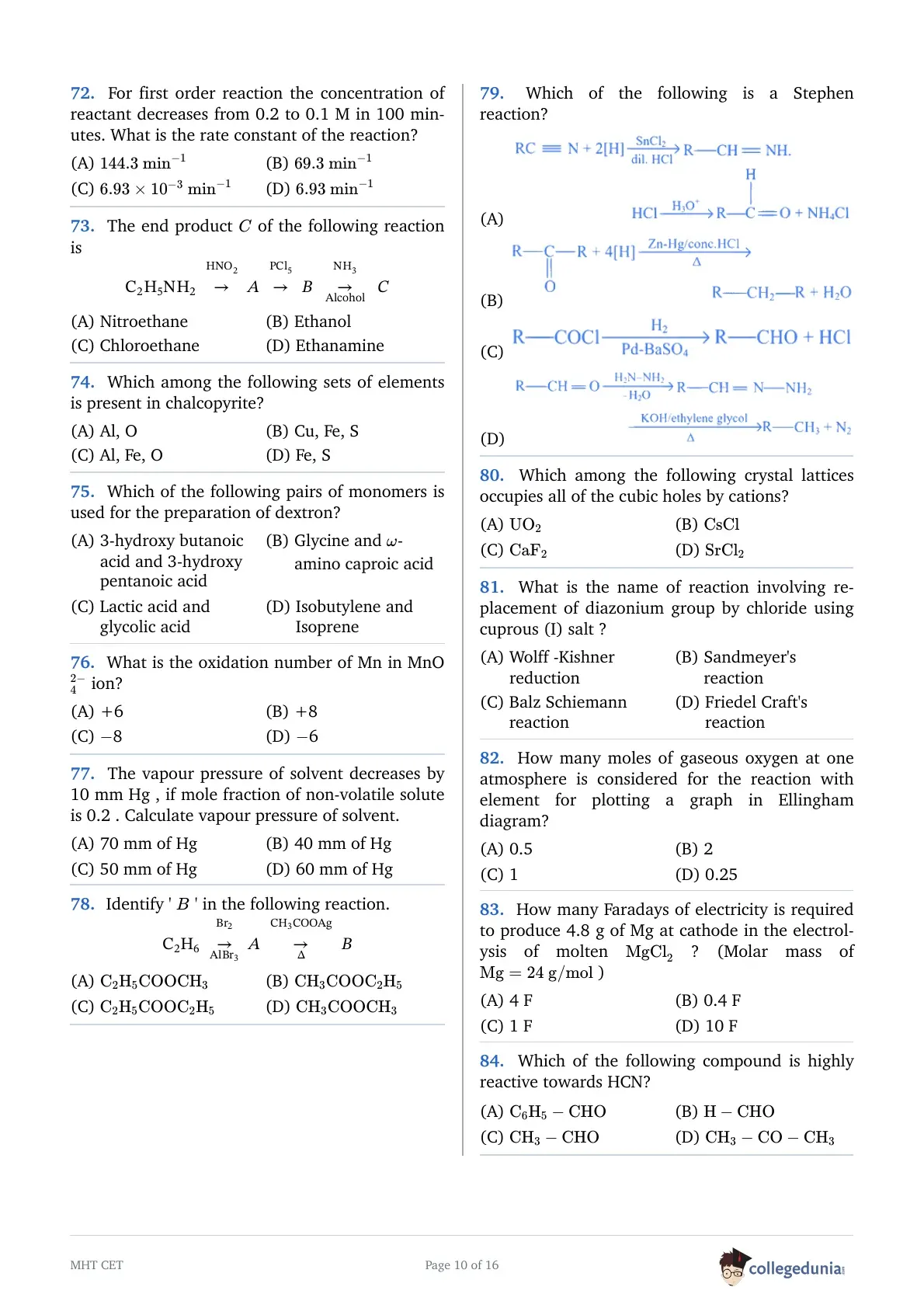
For first order reaction the concentration of reactant decreases from 0.2 to 0.1 M in 100 minutes. What is the rate constant of the reaction?
The end product \(C\) of the following reaction is
\[\mathrm{C}_2 \mathrm{H}_5 \mathrm{NH}_2 \xrightarrow{\mathrm{HNO}_2} A \xrightarrow{\mathrm{PCl}_5} B \xrightarrow[\text { Alcohol }]{\mathrm{NH}_3} C\]
Which among the following sets of elements is present in chalcopyrite?
Which of the following pairs of monomers is used for the preparation of dextron?
The vapour pressure of solvent decreases by 10 mm Hg , if mole fraction of non-volatile solute is 0.2 . Calculate vapour pressure of solvent.
Identify ' \(B\) ' in the following reaction.
\[\mathrm{C}_2 \mathrm{H}_6 \xrightarrow[\mathrm{AlBr}_3]{\mathrm{Br}_2} A \xrightarrow[\Delta]{\mathrm{CH}_3 \mathrm{COOAg}} B\]


Which among the following crystal lattices occupies all of the cubic holes by cations?
What is the name of reaction involving replacement of diazonium group by chloride using cuprous (I) salt ?
How many moles of gaseous oxygen at one atmosphere is considered for the reaction with element for plotting a graph in Ellingham diagram?
How many Faradays of electricity is required to produce 4.8 g of Mg at cathode in the electrolysis of molten \(\mathrm{MgCl}_2\) ? (Molar mass of \(\mathrm{Mg}=24 \mathrm{~g} / \mathrm{mol}\) )
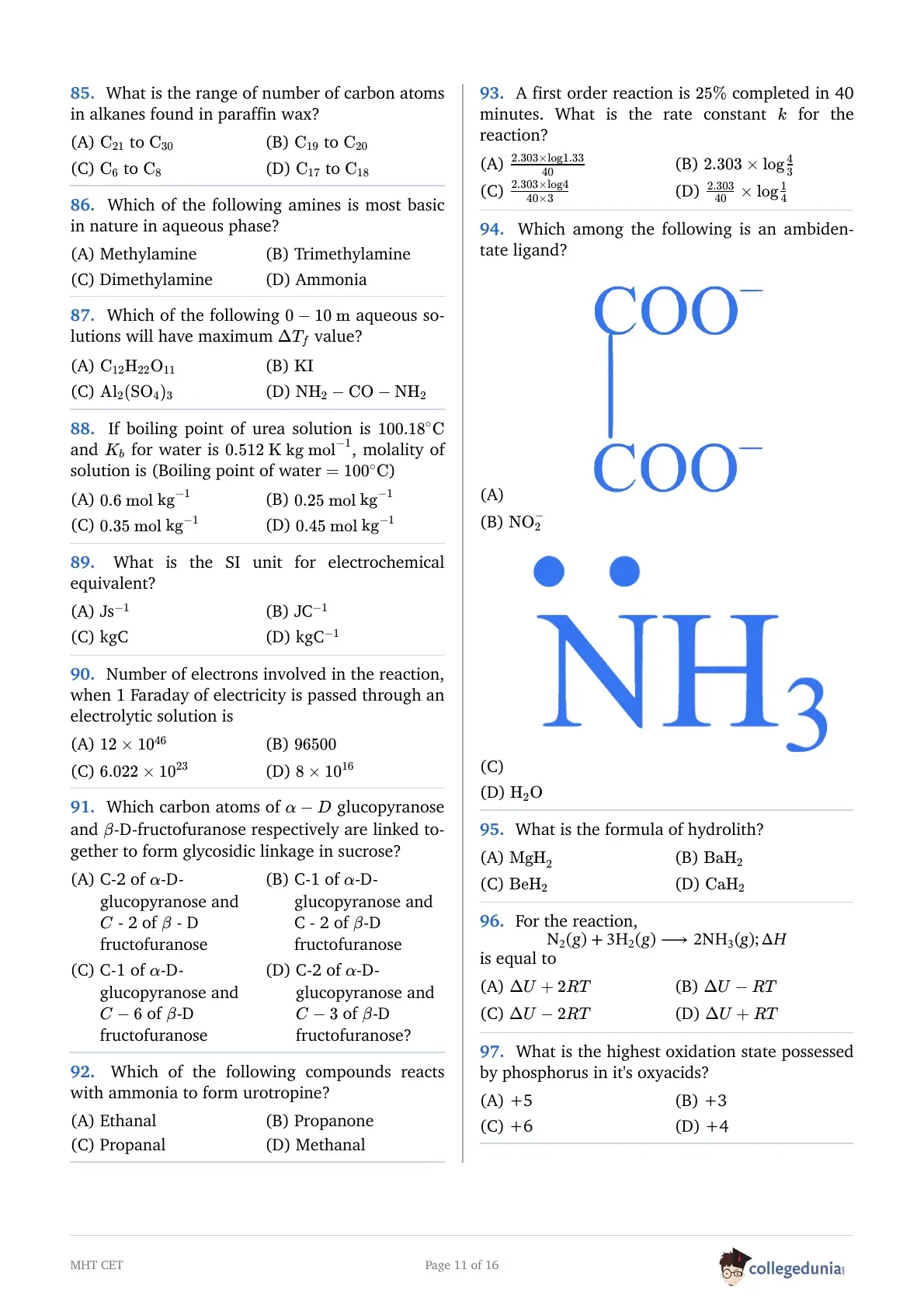
What is the range of number of carbon atoms in alkanes found in paraffin wax?
Which of the following amines is most basic in nature in aqueous phase?
Which of the following \(0-10 \mathrm{~m}\) aqueous solutions will have maximum \(\Delta T_f\) value?
If boiling point of urea solution is \(100.18^{\circ} \mathrm{C}\) and \(K_b\) for water is \(0.512 \mathrm{~K} \mathrm{~kg} \mathrm{~mol}^{-1}\), molality of solution is (Boiling point of water \(=100^{\circ} \mathrm{C}\))
Number of electrons involved in the reaction, when 1 Faraday of electricity is passed through an electrolytic solution is
Which carbon atoms of \(\alpha-D\) glucopyranose and \(\beta\)-D-fructofuranose respectively are linked together to form glycosidic linkage in sucrose?
Which of the following compounds reacts with ammonia to form urotropine?
A first order reaction is \(25 \%\) completed in 40 minutes. What is the rate constant \(k\) for the reaction?
Which among the following is an ambidentate ligand?
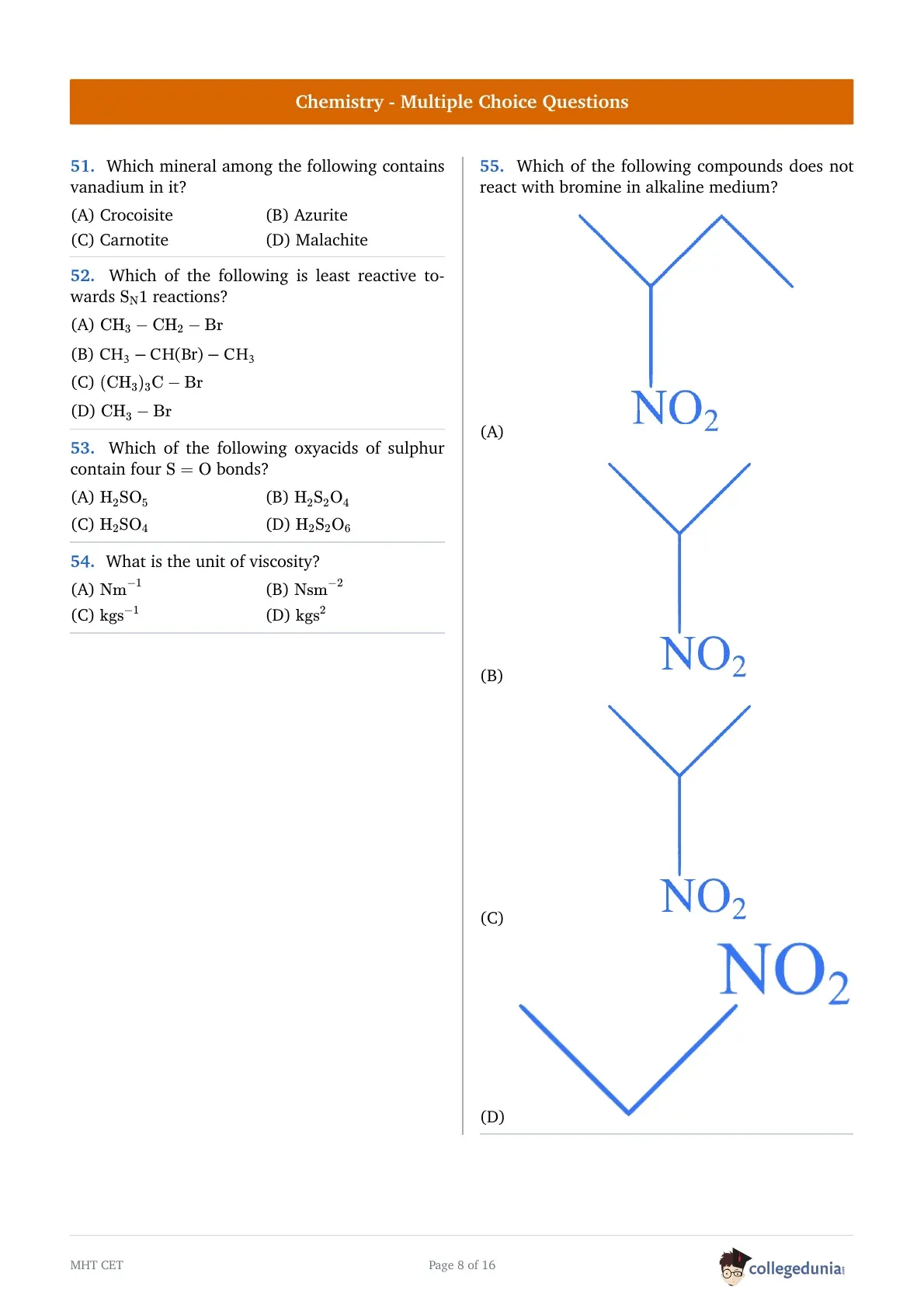
- (A)
![]()
- (B) \(\mathrm{NO}_{2}^{-}\)
- (C)
![]()
- (D) \(\mathrm{H}_{2}\mathrm{O}\)


For the reaction,
\[\mathrm{N}_2(g)+3 \mathrm{H}_2(g) \longrightarrow 2 \mathrm{NH}_3(g) ; \Delta H\]
is equal to
What is the highest oxidation state possessed by phosphorus in it's oxyacids?
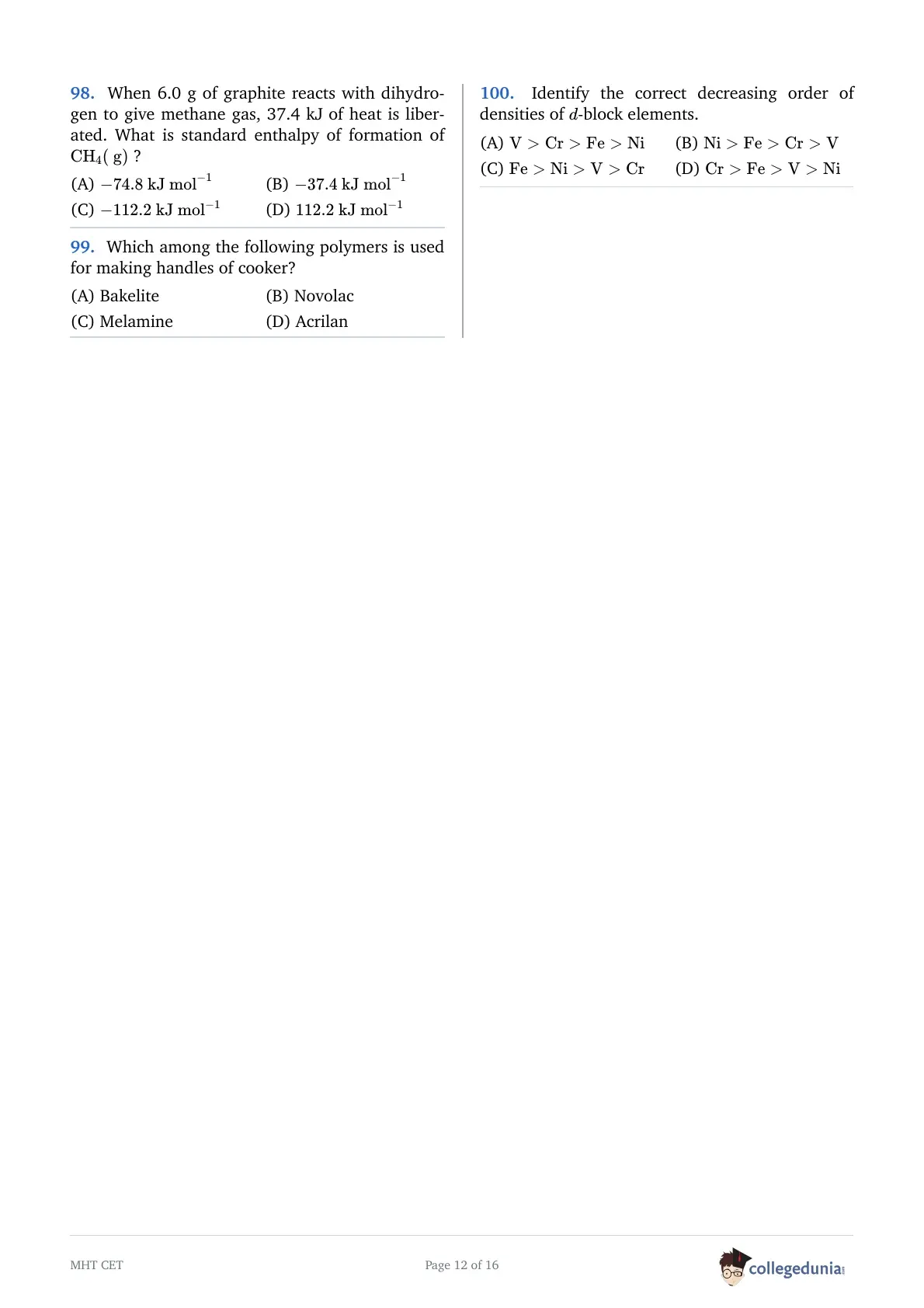
When 6.0 g of graphite reacts with dihydrogen to give methane gas, 37.4 kJ of heat is liberated. What is standard enthalpy of formation of \(\mathrm{CH}_4(\mathrm{~g})\) ?
Which among the following polymers is used for making handles of cooker?
Identify the correct decreasing order of densities of \(d\)-block elements.
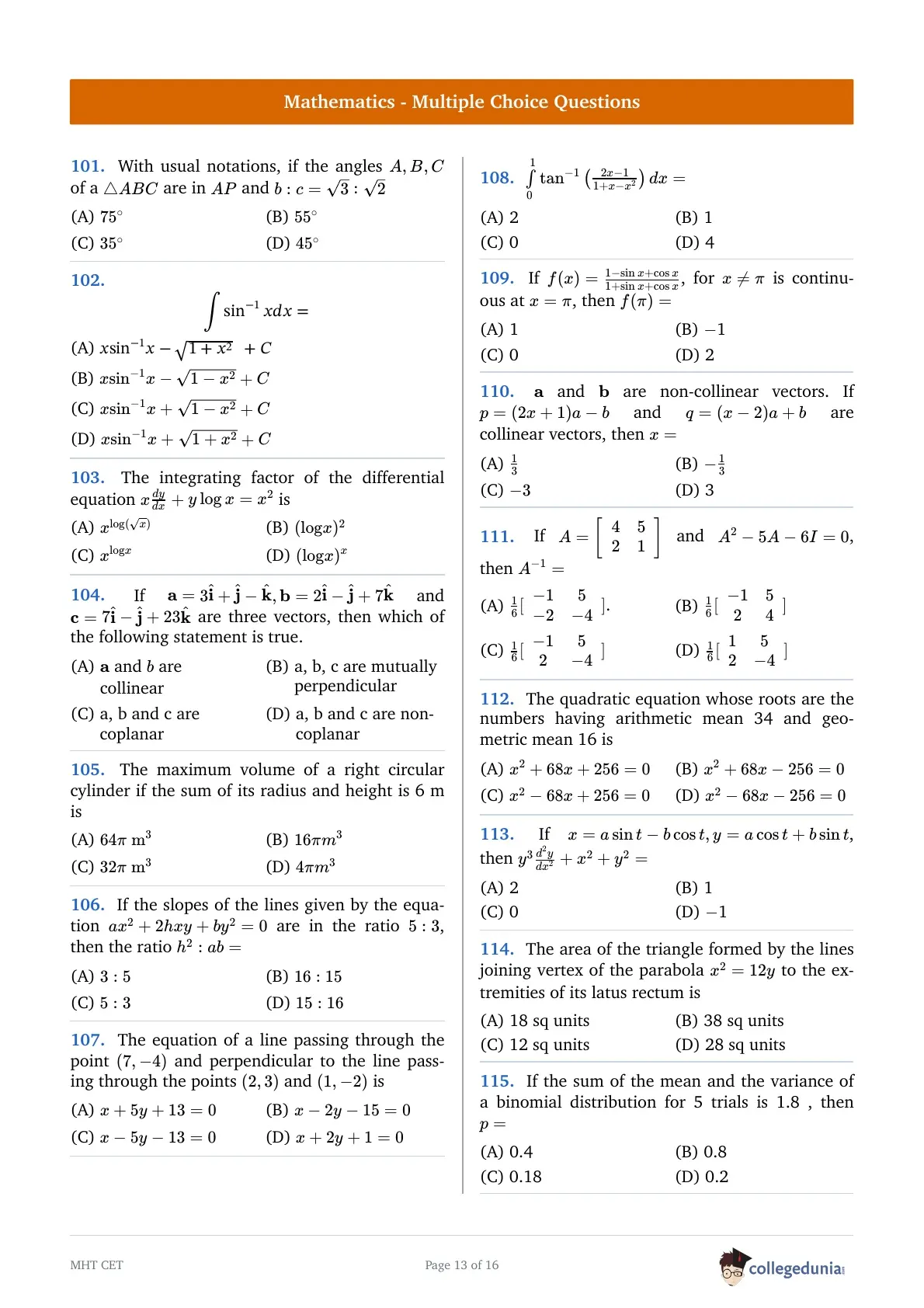
The integrating factor of the differential equation \(x \frac{d y}{d x}+y \log x=x^2\) is
If \(\mathbf{a}=3 \hat{\mathbf{i}}+\hat{\mathbf{j}}-\hat{\mathbf{k}}, \mathbf{b}=2 \hat{\mathbf{i}}-\hat{\mathbf{j}}+7 \hat{\mathbf{k}}\) and \(\mathbf{c}=7 \hat{\mathbf{i}}-\hat{\mathbf{j}}+23 \hat{\mathbf{k}}\) are three vectors, then which of the following statement is true.
The maximum volume of a right circular cylinder if the sum of its radius and height is 6 m is
If the slopes of the lines given by the equation \(a x^2+2 h x y+b y^2=0\) are in the ratio \(5: 3\), then the ratio \(h^2: a b=\)
The equation of a line passing through the point \((7,-4)\) and perpendicular to the line passing through the points \((2,3)\) and \((1,-2)\) is
\(\int_\limits0^1 \tan ^{-1}\left(\frac{2 x-1}{1+x-x^2}\right) d x=\)
If \(f(x)=\frac{1-\sin x+\cos x}{1+\sin x+\cos x}\), for \(x \neq \pi\) is continuous at \(x=\pi\), then \(f(\pi)=\)
\(\mathbf{a}\) and \(\mathbf{b}\) are non-collinear vectors. If \(p=(2 x+1) a-b\) and \(q=(x-2) a+b\) are collinear vectors, then \(x=\)
If \(A=\left[\begin{array}{ll}4 & 5 \\ 2 & 1\end{array}\right]\) and \(A^2-5 A-6 I=0\), then \(A^{-1}=\)
The quadratic equation whose roots are the numbers having arithmetic mean 34 and geometric mean 16 is
If \(x=a \sin t-b \cos t, y=a \cos t+b \sin t\), then \(y^3 \frac{d^2 y}{d x^2}+x^2+y^2=\)
The area of the triangle formed by the lines joining vertex of the parabola \(x^2=12 y\) to the extremities of its latus rectum is
If the sum of the mean and the variance of a binomial distribution for 5 trials is 1.8 , then \(p=\)
The odds in favour of getting sum multiple of 3 , when pair of dice are thrown is
The rate of disintegration of a radio active element at time \(t\) is proportional to its mass, at the time. Then the time during which the original mass of 1.5 gm . Will disintegrate into its mass of 0.5 gm . is proportional to
If \(\mathbf{a}, \mathbf{b}, \mathbf{c}\) are non-coplanar vectors and \(p=\frac{\mathbf{b} \times \mathbf{c}}{[a b c]}, q=\frac{\mathbf{c} \times \mathbf{a}}{[a b c]}, r=\frac{\mathbf{a} \times \mathbf{b}}{[a b c]}\), then \(\mathbf{a} \cdot \mathbf{p}+\mathbf{b} \cdot \mathbf{q}+\mathbf{c} \cdot \mathbf{r}=\)
The negation of the statement pattern \(\sim p \vee(q \rightarrow \sim r)\) is
The point \(P\) lies on the line \(A, B\) where \(A=(2,4,5)\) and \(B \equiv(1,2,3)\). If \(z\) co-ordinate of point \(P\) is 3 , the its \(y\) co-ordinate is
If \(y=\sin ^{-1}\left[\frac{\sqrt{1+x}+\sqrt{1-x}}{2}\right]\), then \(\frac{d y}{d x}=\)
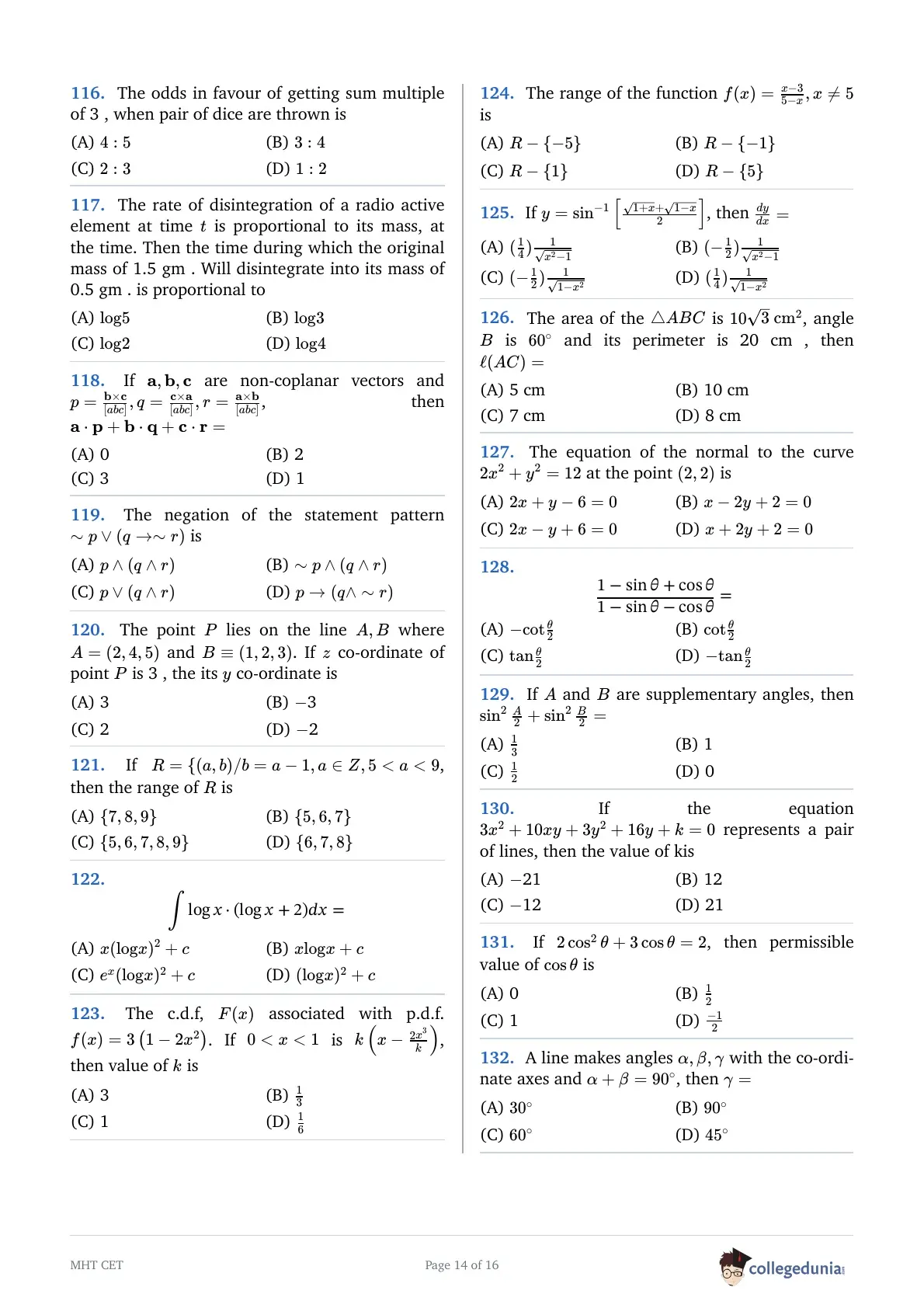
The area of the \(\triangle A B C\) is \(10 \sqrt{3} \mathrm{~cm}^2\), angle \(B\) is \(60^{\circ}\) and its perimeter is 20 cm , then \(\ell(A C)=\)
The equation of the normal to the curve \(2 x^2+y^2=12\) at the point \((2,2)\) is
If \(A\) and \(B\) are supplementary angles, then \(\sin ^2 \frac{A}{2}+\sin ^2 \frac{B}{2}=\)
If the equation \(3 x^2+10 x y+3 y^2+16 y+k=0\) represents a pair of lines, then the value of kis
If \(2 \cos ^2 \theta+3 \cos \theta=2\), then permissible value of \(\cos \theta\) is
A line makes angles \(\alpha, \beta, \gamma\) with the co-ordinate axes and \(\alpha+\beta=90^{\circ}\), then \(\gamma=\)
The equations of planes parallel to the plane \(x+2 y+2 z+8=0\), which are at a distance of 2 units from the point \((1,1,2)\) are
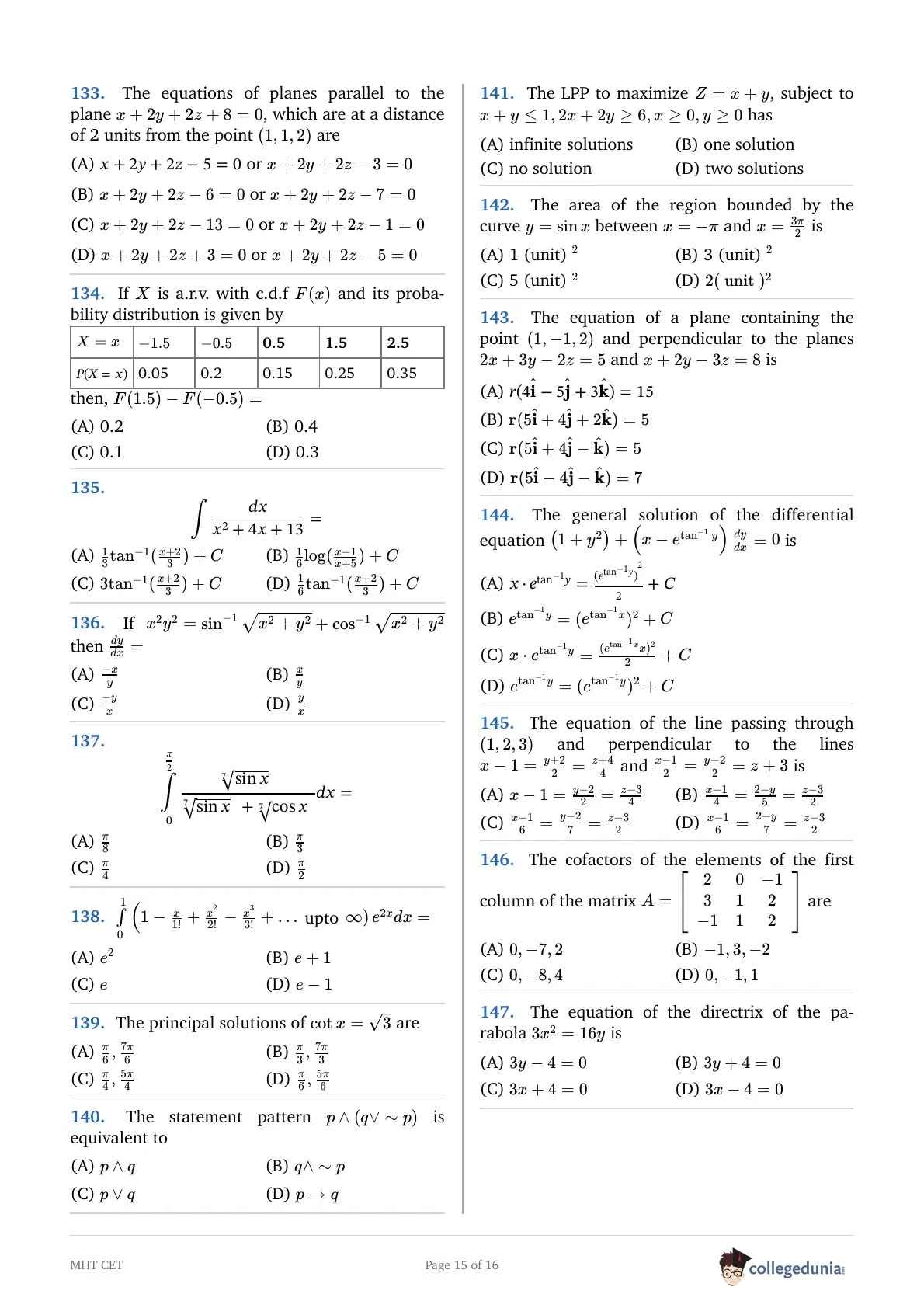
If \(X\) is a.r.v. with c.d.f \(F(x)\) and its probability distribution is given by
| \(X=x\) | \(-1.5\) | \(-0.5\) | 0.5 | 1.5 | 2.5 |
|---|---|---|---|---|---|
| \(P(X=x)\) | 0.05 | 0.2 | 0.15 | 0.25 | 0.35 |
If \(x^2 y^2=\sin ^{-1} \sqrt{x^2+y^2}+\cos ^{-1} \sqrt{x^2+y^2}\) then \(\frac{d y}{d x}=\)
\[\int_\limits0^{\frac{\pi}{2}} \frac{\sqrt[7]{\sin x}}{\sqrt[7]{\sin x}+\sqrt[7]{\cos x}} d x=\]
\(\int_\limits0^1\left(1-\frac{x}{1!}+\frac{x^2}{2!}-\frac{x^3}{3!}+\ldots\right.\) upto \(\left.\infty\right) e^{2 x} d x=\)
The LPP to maximize \(Z=x+y\), subject to \(x+y \leq 1,2 x+2 y \geq 6, x \geq 0, y \geq 0\) has
The area of the region bounded by the curve \(y=\sin x\) between \(x=-\pi\) and \(x=\frac{3 \pi}{2}\) is
The equation of a plane containing the point \((1,-1,2)\) and perpendicular to the planes \(2 x+3 y-2 z=5\) and \(x+2 y-3 z=8\) is
The general solution of the differential equation \(\left(1+y^2\right)+\left(x-e^{\tan ^{-1} y}\right) \frac{d y}{d x}=0\) is
The equation of the line passing through \((1,2,3)\) and perpendicular to the lines \(x-1=\frac{y+2}{2}=\frac{z+4}{4}\) and \(\frac{x-1}{2}=\frac{y-2}{2}=z+3\) is
The cofactors of the elements of the first column of the matrix \(A=\left[\begin{array}{ccc}2 & 0 & -1 \\ 3 & 1 & 2 \\ -1 & 1 & 2\end{array}\right]\) are
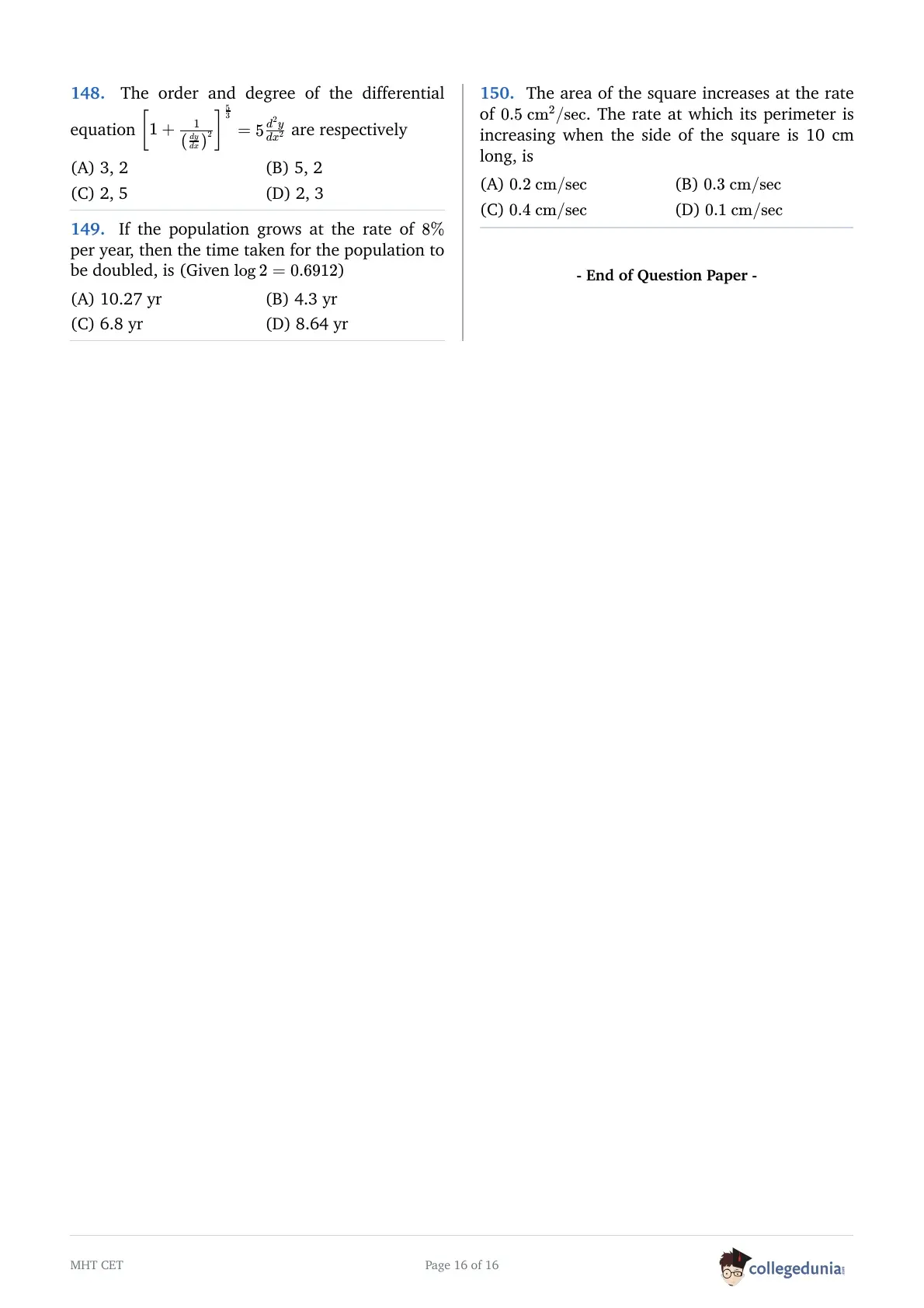
If the population grows at the rate of \( 8% \) per year, then the time taken for the population to be doubled is \([ \log 2 = 0.6912 ]\)
The area of the square increases at the rate of \(0.5 \mathrm{~cm}^2 / \mathrm{sec}\). The rate at which its perimeter is increasing when the side of the square is 10 cm long, is
MHT CET 2020 PCM Exam Pattern and Marking Scheme
| Parameter | Details |
|---|---|
| Conducting Body | Maharashtra Common Entrance Test Cell (Maharashtra CET Cell) |
| Exam Mode | Online (Computer-Based Test) |
| Duration | 180 minutes (3 hours) |
| Groups / Subjects | PCM (Physics, Chemistry, Mathematics) for Engineering |
| Total Questions |
150 |
| Total Marks | 200 |
| Question Type | Multiple Choice Questions (MCQs) |
| Marks Distribution |
|
| Negative Marking | No |
| Syllabus Weightage |
|



Comments