




MHT CET 2020 Oct 20 Shift 1 PCM Question Paper is available for download here. Maharashtra State CET Cell conducted MHT CET 2020 PCM Exam on Oct 20 in Shift 1 from 9 AM to 12 PM in CBT mode.
The MHT CET 2020 PCM question paper includes the following:
- The MHT CET 2020 PCM Question Paper consists of 150 multiple-choice questions (MCQs) totalling 200 marks divided into 3 sections: Physics, Chemistry, and Mathematics, with 50 questions in each subject.
- Physics and Chemistry questions carry 1 mark each while Mathematics questions carry 2 marks each.
- There is no negative marking for incorrect answers.
MHT CET 2020 Oct 20 Shift 1 PCM Question Paper with Solution PDF
| CD PDF | CD PDF with Solutions |
|---|---|
| Download Collegedunia PDF 0.84 MB | - |
Also Check:
MHT CET 2020 Oct 20 Shift 1 PCM Questions with Solutions
Physics (Q1 - Q50)
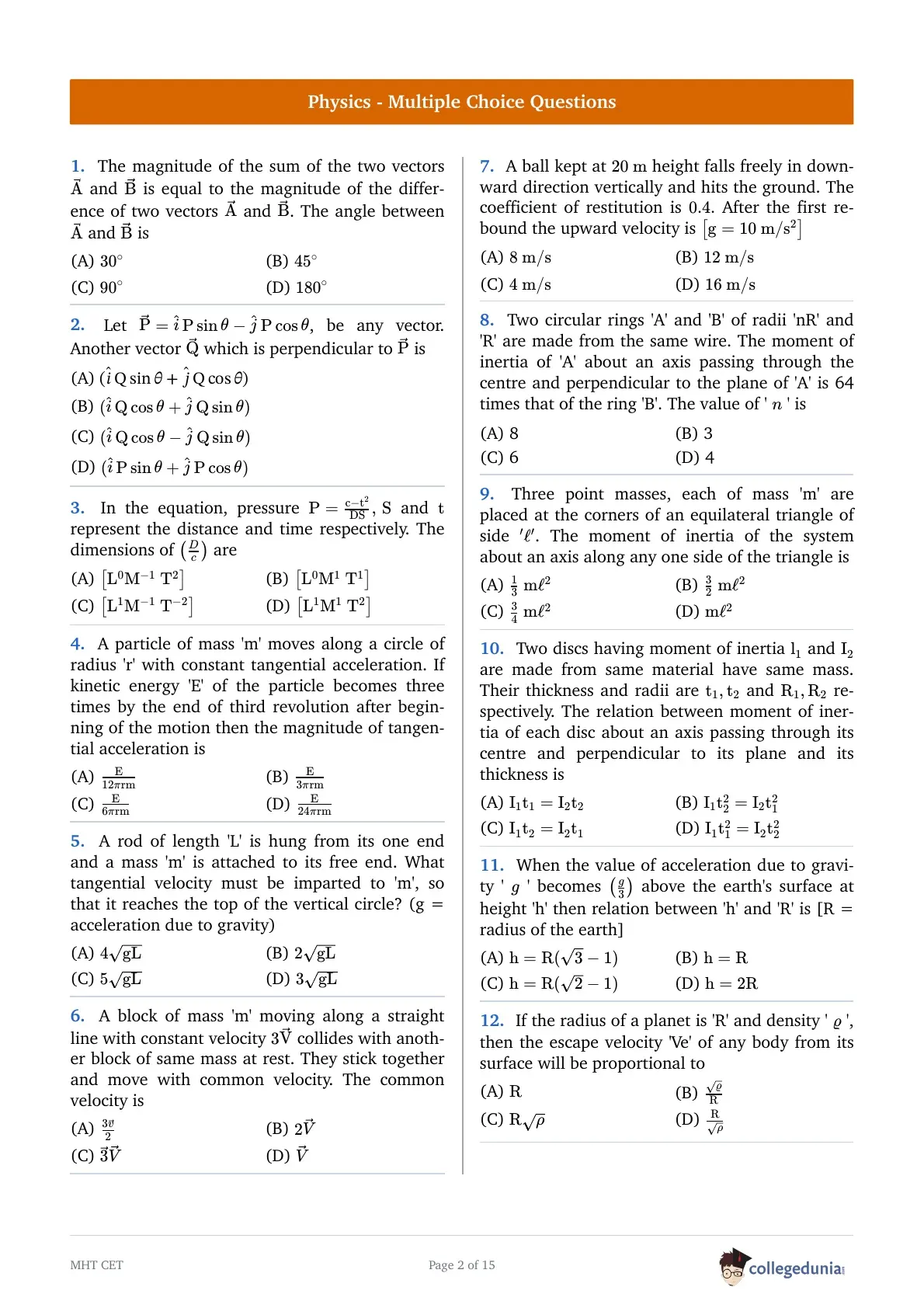
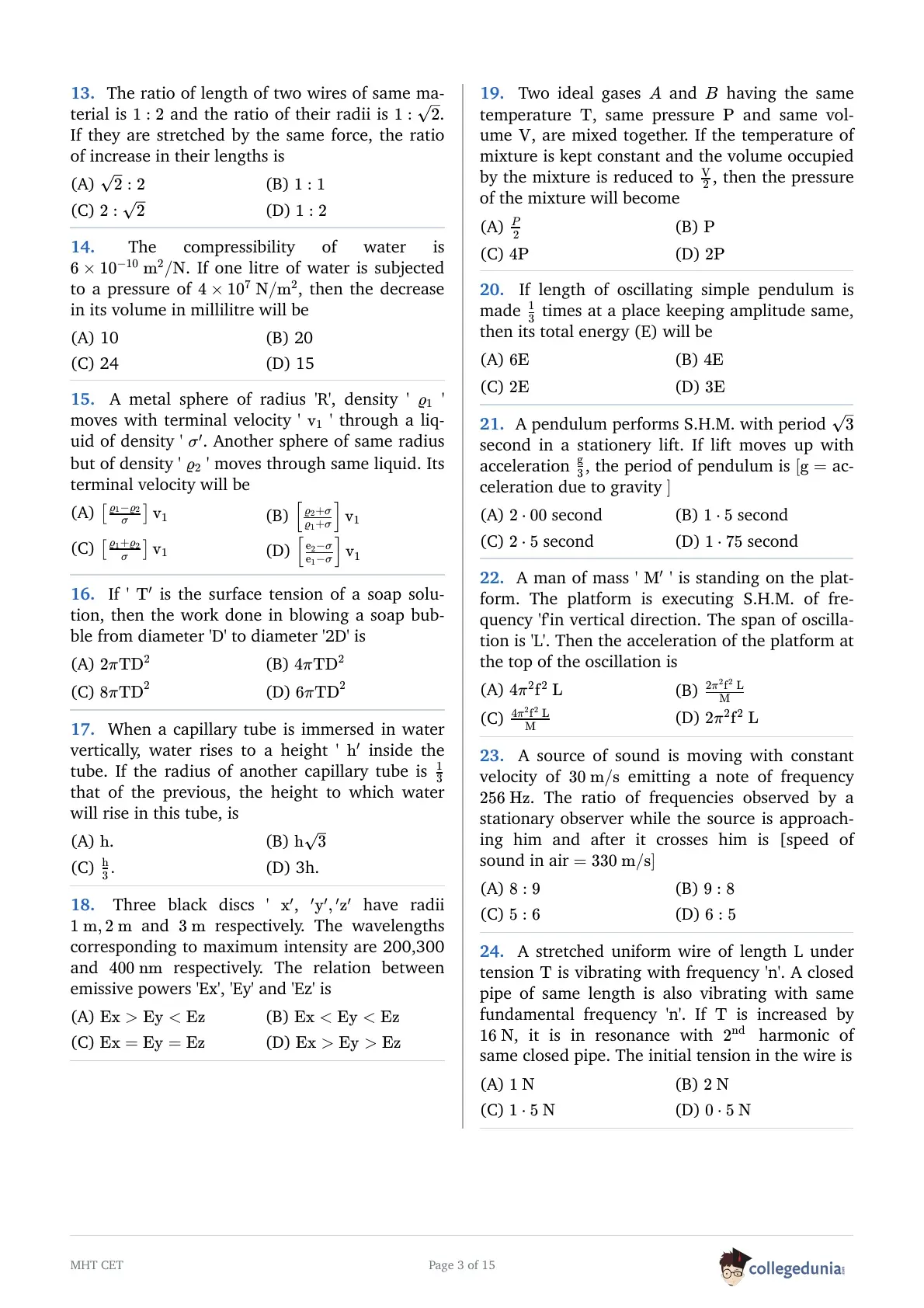
The magnitude of the sum of the two vectors \(\vec{\mathrm{A}}\) and \(\vec{\mathrm{B}}\) is equal to the magnitude of the difference of two vectors \(\vec{\mathrm{A}}\) and \(\vec{\mathrm{B}}\). The angle between \(\vec{\mathrm{A}}\) and \(\vec{\mathrm{B}}\) is
Let \(\vec{\mathrm{P}}=\hat{i}\,\mathrm{P}\sin \theta -\hat{j}\,\mathrm{P}\cos \theta\), be any vector. Another vector \(\vec{\mathrm{Q}}\) which is perpendicular to \(\vec{\mathrm{P}}\) is
A particle of mass 'm' moves along a circle of radius 'r' with constant tangential acceleration. If kinetic energy 'E' of the particle becomes three times by the end of third revolution after beginning of the motion then the magnitude of tangential acceleration is
A rod of length 'L' is hung from its one end and a mass 'm' is attached to its free end. What tangential velocity must be imparted to 'm', so that it reaches the top of the vertical circle? (g = acceleration due to gravity)
A block of mass 'm' moving along a straight line with constant velocity \(3\vec{\mathrm{V}}\) collides with another block of same mass at rest. They stick together and move with common velocity. The common velocity is
A ball kept at \(20\ \mathrm{m}\) height falls freely in downward direction vertically and hits the ground. The coefficient of restitution is \(0.4.\) After the first rebound the upward velocity is \(\left[\mathrm{g}=10\ \mathrm{m}/\mathrm{s}^{2}\right]\)
Two circular rings 'A' and 'B' of radii 'nR' and 'R' are made from the same wire. The moment of inertia of 'A' about an axis passing through the centre and perpendicular to the plane of 'A' is 64 times that of the ring 'B'. The value of ' \(n\) ' is
Three point masses, each of mass 'm' are placed at the corners of an equilateral triangle of side \({}'\ell '\). The moment of inertia of the system about an axis along any one side of the triangle is
Two discs having moment of inertia \(\mathrm{l}_{1}\) and \(\mathrm{I}_{2}\) are made from same material have same mass. Their thickness and radii are \(\mathrm{t}_{1},\mathrm{t}_{2}\) and \(\mathrm{R}_{1},\mathrm{R}_{2}\) respectively. The relation between moment of inertia of each disc about an axis passing through its centre and perpendicular to its plane and its thickness is
When the value of acceleration due to gravity ' \(g\) ' becomes \(\left(\frac{g}{3}\right)\) above the earth's surface at height 'h' then relation between 'h' and 'R' is [R = radius of the earth]
The ratio of length of two wires of same material is \(1:2\) and the ratio of their radii is \(1:\sqrt{2}\). If they are stretched by the same force, the ratio of increase in their lengths is
The compressibility of water is \(6\times 10^{-10}\ \mathrm{m}^{2}/\mathrm{N}\). If one litre of water is subjected to a pressure of \(4\times 10^{7}\ \mathrm{N}/\mathrm{m}^{2}\), then the decrease in its volume in millilitre will be
If ' \(\mathrm{T}'\) is the surface tension of a soap solution, then the work done in blowing a soap bubble from diameter 'D' to diameter '2D' is
When a capillary tube is immersed in water vertically, water rises to a height ' \(\mathrm{h}'\) inside the tube. If the radius of another capillary tube is \(\frac{1}{3}\) that of the previous, the height to which water will rise in this tube, is
Three black discs ' \(\mathrm{x}'\), \({}'\mathrm{y}',{}'\mathrm{z}'\) have radii \(1\ \mathrm{m},2\ \mathrm{m}\) and \(3\ \mathrm{m}\) respectively. The wavelengths corresponding to maximum intensity are 200,300 and \(400\ \mathrm{nm}\) respectively. The relation between emissive powers 'Ex', 'Ey' and 'Ez' is
Two ideal gases \(A\) and \(B\) having the same temperature \(\mathrm{T}\), same pressure \(\mathrm{P}\) and same volume \(\mathrm{V}\), are mixed together. If the temperature of mixture is kept constant and the volume occupied by the mixture is reduced to \(\frac{\mathrm{V}}{2}\), then the pressure of the mixture will become
If length of oscillating simple pendulum is made \(\frac{1}{3}\) times at a place keeping amplitude same, then its total energy (E) will be
A pendulum performs S.H.M. with period \(\sqrt{3}\) second in a stationery lift. If lift moves up with acceleration \(\frac{\mathrm{g}}{3}\), the period of pendulum is \([\mathrm{g}=\) acceleration due to gravity \(]\)
A man of mass ' \(\mathrm{M}'\) ' is standing on the platform. The platform is executing S.H.M. of frequency 'f'in vertical direction. The span of oscillation is 'L'. Then the acceleration of the platform at the top of the oscillation is
A source of sound is moving with constant velocity of \(30\ \mathrm{m}/\mathrm{s}\) emitting a note of frequency \(256\ \mathrm{Hz}\). The ratio of frequencies observed by a stationary observer while the source is approaching him and after it crosses him is [speed of sound in air \(=330\ \mathrm{m}/\mathrm{s}]\)
A stretched uniform wire of length L under tension \(\mathrm{T}\) is vibrating with frequency 'n'. A closed pipe of same length is also vibrating with same fundamental frequency 'n'. If \(\mathrm{T}\) is increased by \(16\ \mathrm{N}\), it is in resonance with \(2^{\text{nd }}\) harmonic of same closed pipe. The initial tension in the wire is
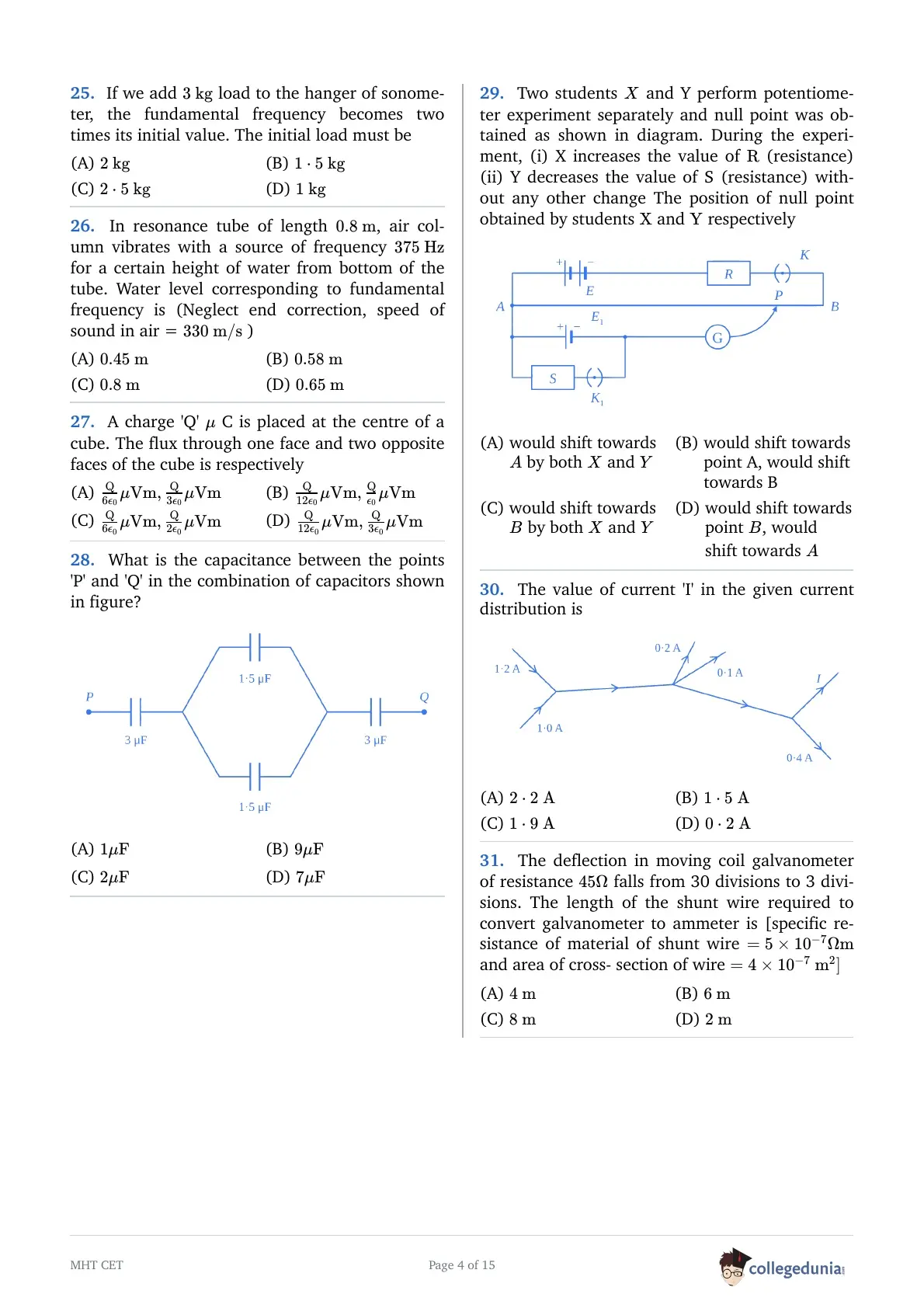
If we add \(3\ \mathrm{kg}\) load to the hanger of sonometer, the fundamental frequency becomes two times its initial value. The initial load must be
In resonance tube of length \(0.8\ \mathrm{m}\), air column vibrates with a source of frequency \(375\ \mathrm{Hz}\) for a certain height of water from bottom of the tube. Water level corresponding to fundamental frequency is (Neglect end correction, speed of sound in air = \(330\ \mathrm{m}/\mathrm{s}\) )
A charge 'Q' \(\mu\) C is placed at the centre of a cube. The flux through one face and two opposite faces of the cube is respectively
What is the capacitance between the points 'P' and 'Q' in the combination of capacitors shown in figure?

Two students \(X\) and Y perform potentiometer experiment separately and null point was obtained as shown in diagram. During the experiment, (i) X increases the value of \(\mathrm{R}\) (resistance) (ii) Y decreases the value of S (resistance) without any other change The position of null point obtained by students \(\mathrm{X}\) and \(\mathrm{Y}\) respectively

The deflection in moving coil galvanometer of resistance \(45\Omega\) falls from 30 divisions to 3 divisions. The length of the shunt wire required to convert galvanometer to ammeter is [specific resistance of material of shunt wire \(=5\times 10^{-7}\Omega \mathrm{m}\) and area of cross- section of wire \(=4\times 10^{-7}\ \mathrm{m}^{2}]\)
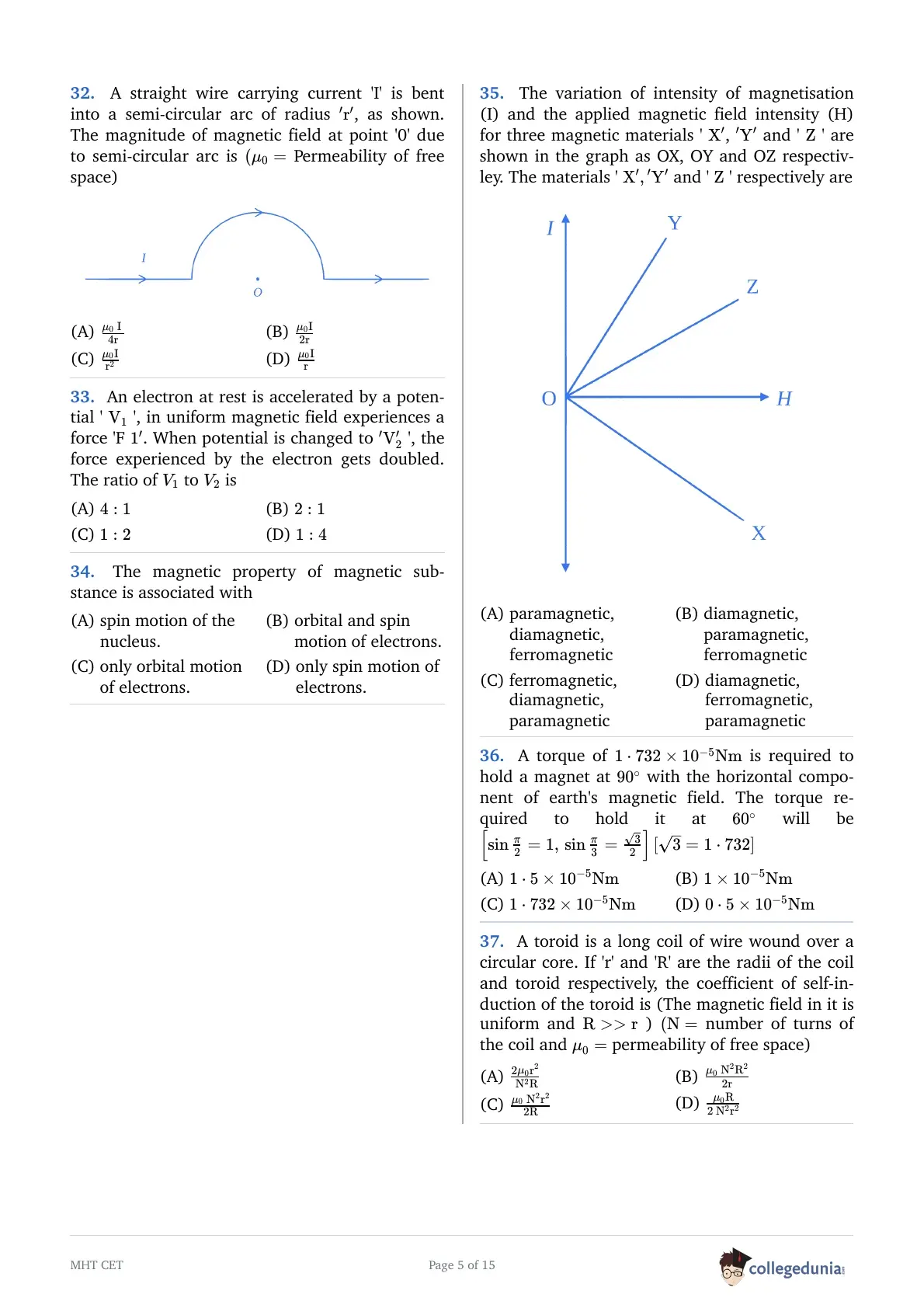
A straight wire carrying current 'I' is bent into a semi-circular arc of radius \({}'\mathrm{r}'\), as shown. The magnitude of magnetic field at point '0' due to semi-circular arc is \((\mu _{0}=\) Permeability of free space)

An electron at rest is accelerated by a potential ' \(\mathrm{V}_{1}\) ', in uniform magnetic field experiences a force 'F \(1'\). When potential is changed to \({}'\mathrm{V}_{2}'\) ', the force experienced by the electron gets doubled. The ratio of \(V_{1}\) to \(V_{2}\) is
The magnetic property of magnetic substance is associated with
The variation of intensity of magnetisation (I) and the applied magnetic field intensity (H) for three magnetic materials ' \(\mathrm{X}'\), \({}'\mathrm{Y}'\) and ' \(\mathrm{Z}\) ' are shown in the graph as OX, OY and OZ respectivley. The materials ' \(\mathrm{X}',{}'\mathrm{Y}'\) and ' \(\mathrm{Z}\) ' respectively are

A torque of \(1\cdot 732\times 10^{-5}\mathrm{Nm}\) is required to hold a magnet at \(90^{\circ }\) with the horizontal component of earth's magnetic field. The torque required to hold it at \(60^{\circ }\) will be \(\left[\sin \frac{\pi }{2}=1,\,\sin \frac{\pi }{3}=\frac{\sqrt{3}}{2}\right][\sqrt{3}=1\cdot 732]\)
A toroid is a long coil of wire wound over a circular core. If 'r' and 'R' are the radii of the coil and toroid respectively, the coefficient of self-induction of the toroid is (The magnetic field in it is uniform and \(\mathrm{R}>>\mathrm{r}\) ) \((\mathrm{N}=\) number of turns of the coil and \(\mu _{0}=\) permeability of free space)
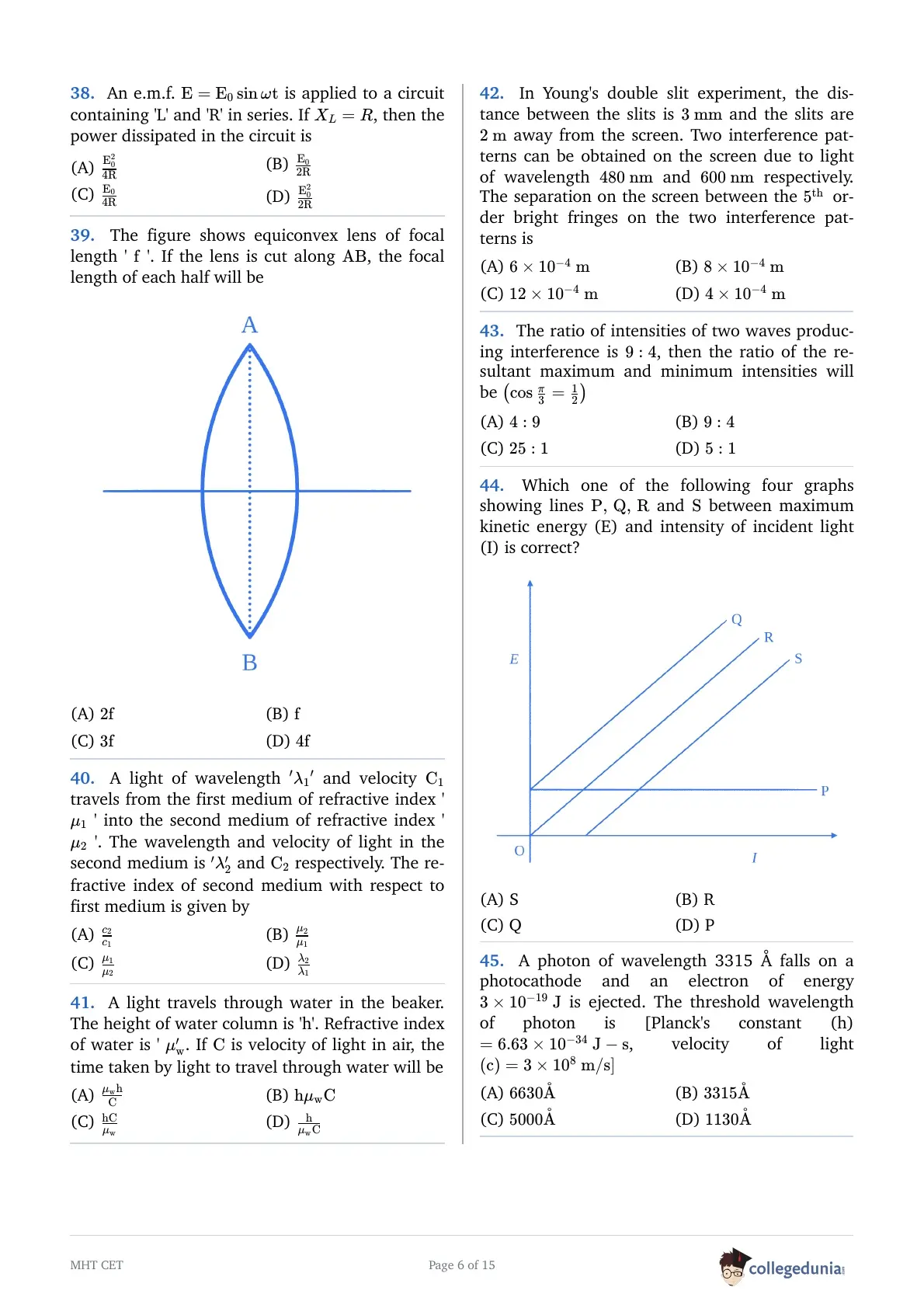
An e.m.f. \(\mathrm{E}=\mathrm{E}_{0}\sin \omega \mathrm{t}\) is applied to a circuit containing 'L' and 'R' in series. If \(X_{L}=R\), then the power dissipated in the circuit is
The figure shows equiconvex lens of focal length ' \(\mathrm{f}\) '. If the lens is cut along \(\mathrm{AB}\), the focal length of each half will be

A light of wavelength \({}'\lambda _{1}{}'\) and velocity \(\mathrm{C}_{1}\) travels from the first medium of refractive index ' \(\mu _{1}\) ' into the second medium of refractive index ' \(\mu _{2}\) '. The wavelength and velocity of light in the second medium is \({}'\lambda _{2}'\) and \(\mathrm{C}_{2}\) respectively. The refractive index of second medium with respect to first medium is given by
A light travels through water in the beaker. The height of water column is 'h'. Refractive index of water is ' \(\mu _{\mathrm{w}}'\). If \(\mathrm{C}\) is velocity of light in air, the time taken by light to travel through water will be
In Young's double slit experiment, the distance between the slits is \(3\ \mathrm{mm}\) and the slits are \(2\ \mathrm{m}\) away from the screen. Two interference patterns can be obtained on the screen due to light of wavelength \(480\ \mathrm{nm}\) and \(600\ \mathrm{nm}\) respectively. The separation on the screen between the \(5^{\text{th }}\) order bright fringes on the two interference patterns is
The ratio of intensities of two waves producing interference is \(9:4\), then the ratio of the resultant maximum and minimum intensities will be \(\left(\cos \frac{\pi }{3}=\frac{1}{2}\right)\)
Which one of the following four graphs showing lines \(\mathrm{P},\,\mathrm{Q},\,\mathrm{R}\) and \(\mathrm{S}\) between maximum kinetic energy (E) and intensity of incident light (I) is correct?

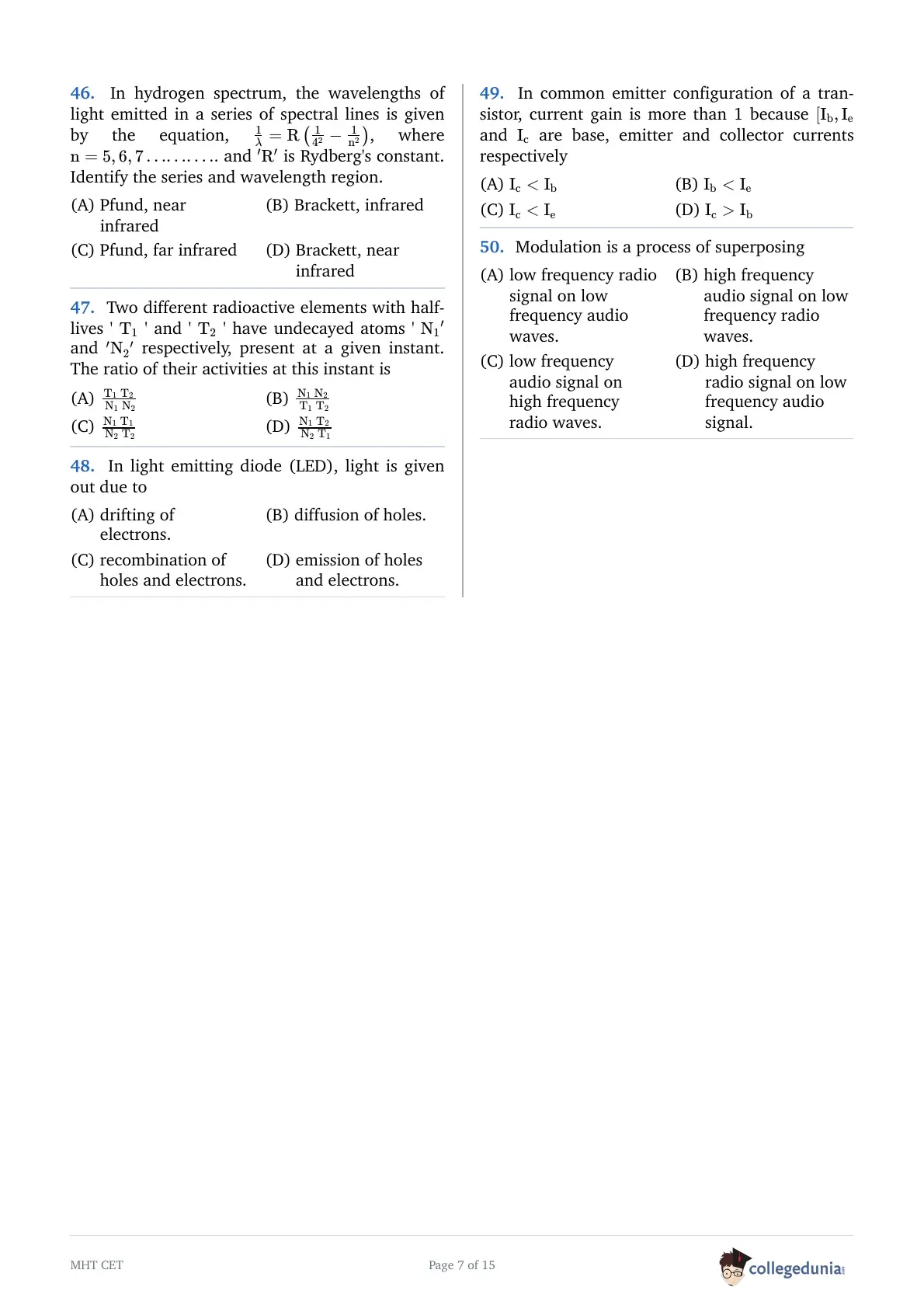
Two different radioactive elements with half-lives ' \(\mathrm{T}_{1}\) ' and ' \(\mathrm{T}_{2}\) ' have undecayed atoms ' \(\mathrm{N}_{1}{}'\) and \({}'\mathrm{N}_{2}{}'\) respectively, present at a given instant. The ratio of their activities at this instant is
In light emitting diode (LED), light is given out due to
In common emitter configuration of a transistor, current gain is more than 1 because \([\mathrm{I}_{\mathrm{b}},\mathrm{I}_{\mathrm{e}}\) and \(\mathrm{I}_{\mathrm{c}}\) are base, emitter and collector currents respectively
Modulation is a process of superposing
Chemistry (Q51 - Q100)
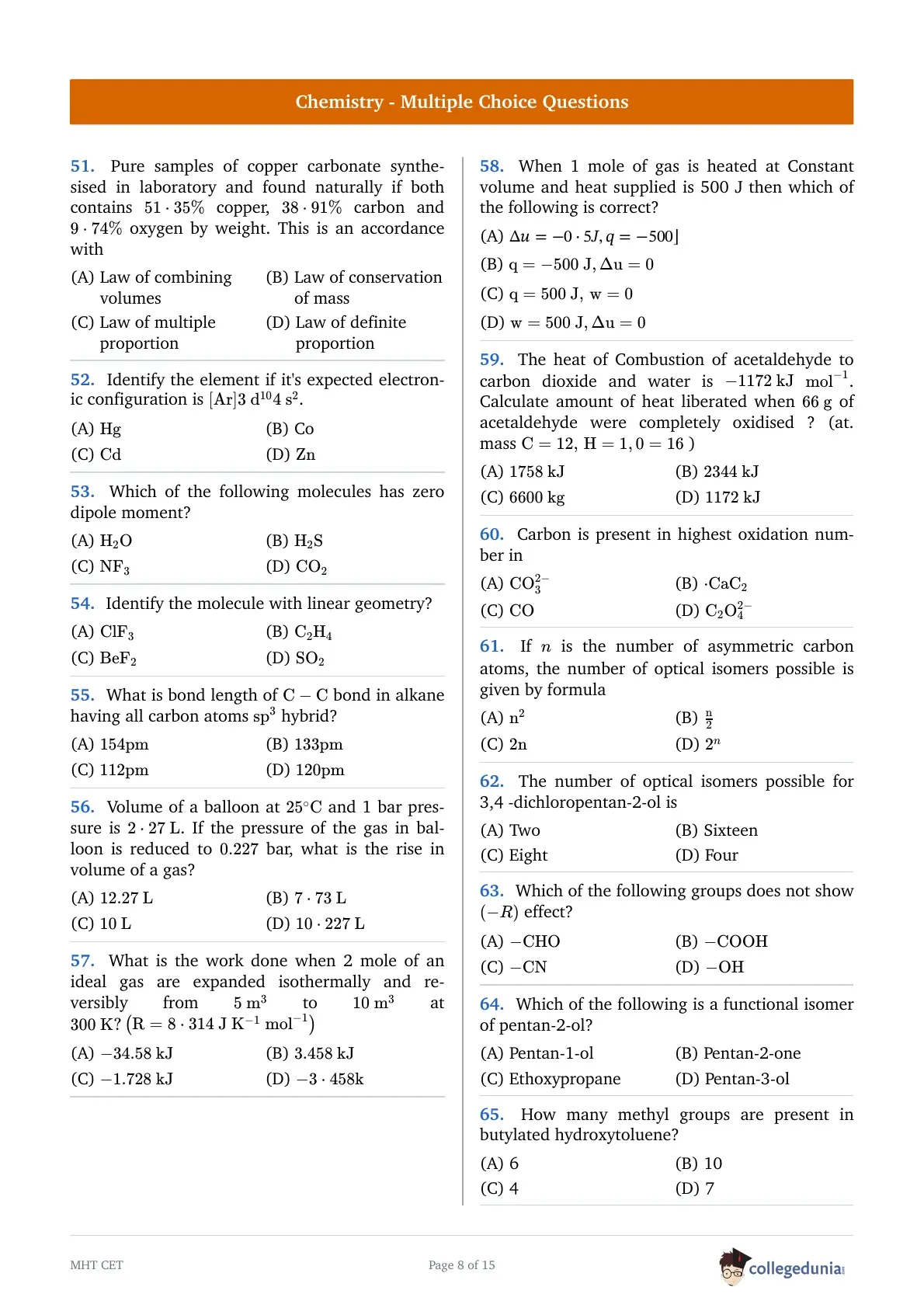
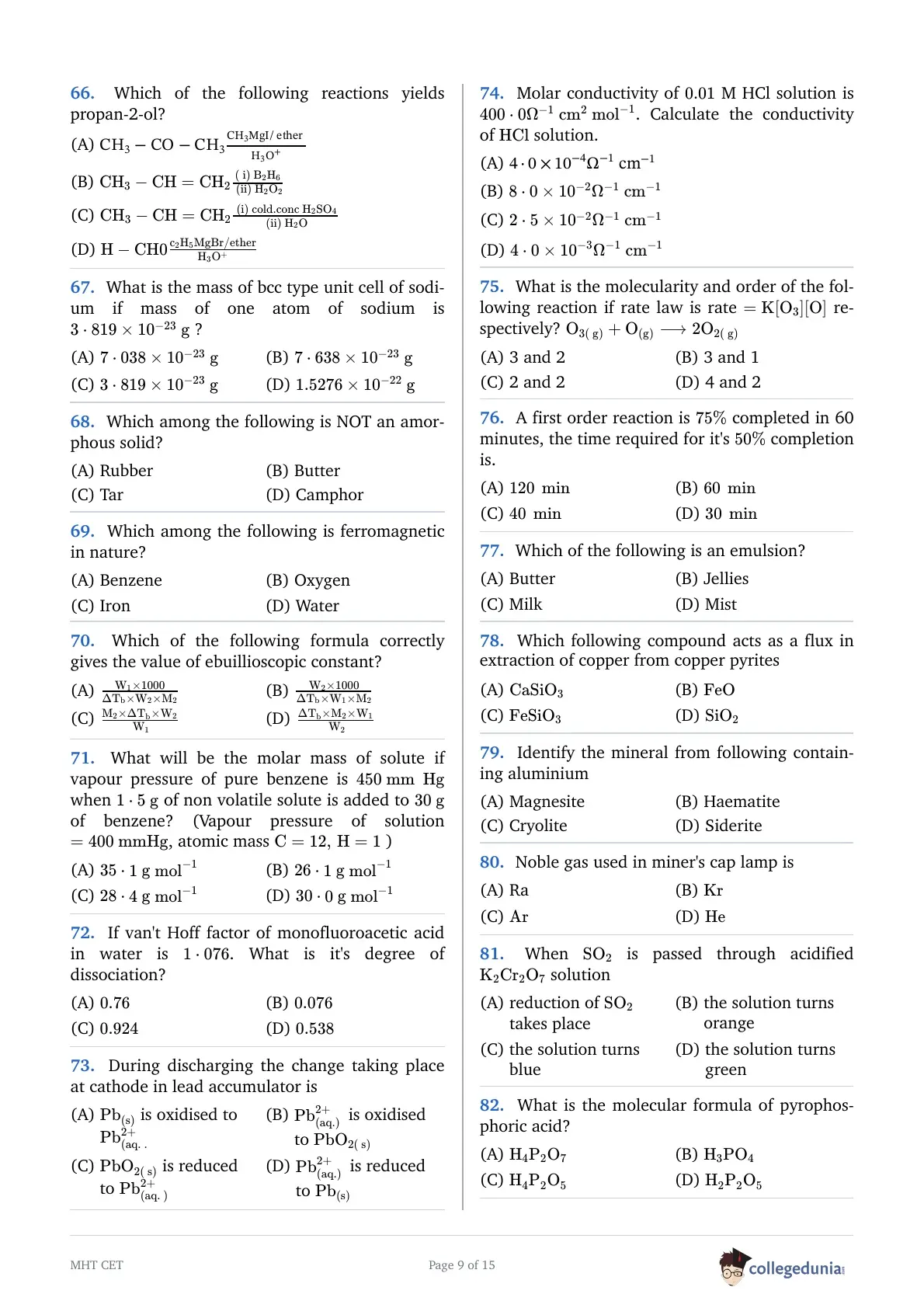
Pure samples of copper carbonate synthesised in laboratory and found naturally if both contains \(51\cdot 35\%\) copper, \(38\cdot 91\%\) carbon and \(9\cdot 74\%\) oxygen by weight. This is an accordance with
Identify the element if it's expected electronic configuration is \([\mathrm{Ar}]3\ \mathrm{d}^{10}4\ \mathrm{s}^{2}\).
Which of the following molecules has zero dipole moment?
Identify the molecule with linear geometry?
What is bond length of \(\mathrm{C}-\mathrm{C}\) bond in alkane having all carbon atoms \(\mathrm{sp}^{3}\) hybrid?
Volume of a balloon at \(25^{\circ }\mathrm{C}\) and 1 bar pressure is \(2\cdot 27\ \mathrm{L}\). If the pressure of the gas in balloon is reduced to \(0.227\) bar, what is the rise in volume of a gas?
When 1 mole of gas is heated at Constant volume and heat supplied is 500 J then which of the following is correct?
The heat of Combustion of acetaldehyde to carbon dioxide and water is \(-1172\ \mathrm{kJ}\) \(\mathrm{mol}^{-1}\). Calculate amount of heat liberated when \(66\ \mathrm{g}\) of acetaldehyde were completely oxidised ? (at. mass \(\mathrm{C}=12,\,\mathrm{H}=1,0=16\) )
Carbon is present in highest oxidation number in
If \(n\) is the number of asymmetric carbon atoms, the number of optical isomers possible is given by formula
The number of optical isomers possible for 3,4 -dichloropentan-2-ol is
Which of the following groups does not show \((-R)\) effect?
Which of the following is a functional isomer of pentan-2-ol?
How many methyl groups are present in butylated hydroxytoluene?
Which of the following reactions yields propan-2-ol?
What is the mass of bcc type unit cell of sodium if mass of one atom of sodium is \(3\cdot 819\times 10^{-23}\ \mathrm{g}\) ?
Which among the following is NOT an amorphous solid?
Which among the following is ferromagnetic in nature?
Which of the following formula correctly gives the value of ebuillioscopic constant?
What will be the molar mass of solute if vapour pressure of pure benzene is \(450\ \mathrm{mm}\) \(\mathrm{Hg}\) when \(1\cdot 5\ \mathrm{g}\) of non volatile solute is added to \(30\ \mathrm{g}\) of benzene? (Vapour pressure of solution \(=400\ \mathrm{mm}\mathrm{Hg}\), atomic mass \(\mathrm{C}=12,\,\mathrm{H}=1\) )
If van't Hoff factor of monofluoroacetic acid in water is \(1\cdot 076\). What is it's degree of dissociation?
During discharging the change taking place at cathode in lead accumulator is
Molar conductivity of \(0.01\) M HCl solution is \(400\cdot 0\Omega ^{-1}\ \mathrm{cm}^{2}\ \mathrm{mol}^{-1}\). Calculate the conductivity of \(\mathrm{HCl}\) solution.
What is the molecularity and order of the following reaction if rate law is rate \(=\mathrm{K}[\mathrm{O}_{3}][\mathrm{O}]\) respectively? \(\mathrm{O}_{3(\ \mathrm{g})}+\mathrm{O}_{(\mathrm{g})}\longrightarrow 2\mathrm{O}_{2(\ \mathrm{g})}\)
A first order reaction is \(75\%\) completed in 60 minutes, the time required for it's \(50\%\) completion is.
Which of the following is an emulsion?
Which following compound acts as a flux in extraction of copper from copper pyrites
Identify the mineral from following containing aluminium
Noble gas used in miner's cap lamp is
When \(\mathrm{SO}_{2}\) is passed through acidified \(\mathrm{K}_{2}\mathrm{Cr}_{2}\mathrm{O}_{7}\) solution
What is the molecular formula of pyrophosphoric acid?
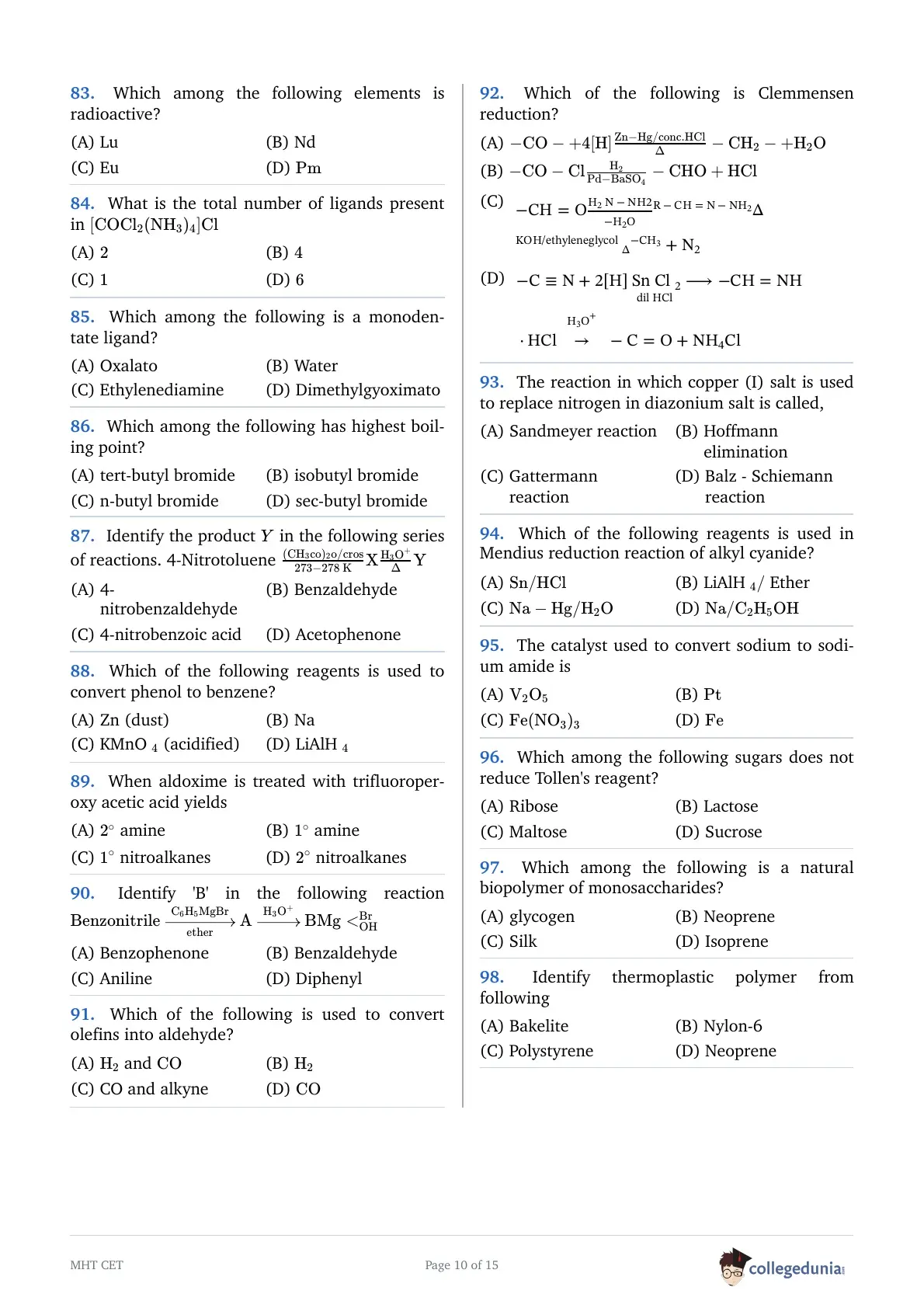
Which among the following elements is radioactive?
What is the total number of ligands present in \([\mathrm{COCl}_{2}(\mathrm{NH}_{3})_{4}]\mathrm{Cl}\)
Which among the following is a monodentate ligand?
Which among the following has highest boiling point?
Identify the product \(Y\) in the following series of reactions. 4-Nitrotoluene \(\frac{(\mathrm{CH}_{3}\mathrm{co})_{2}\mathrm{o}/\mathrm{cros}}{273-278\ \mathrm{K}}\mathrm{X}\frac{\mathrm{H}_{3}\mathrm{O}^{+}}{\Delta }\mathrm{Y}\)
Which of the following reagents is used to convert phenol to benzene?
When aldoxime is treated with trifluoroperoxy acetic acid yields
Which of the following is used to convert olefins into aldehyde?
Which of the following is Clemmensen reduction?
The reaction in which copper (I) salt is used to replace nitrogen in diazonium salt is called,
Which of the following reagents is used in Mendius reduction reaction of alkyl cyanide?
The catalyst used to convert sodium to sodium amide is
Which among the following sugars does not reduce Tollen's reagent?
Which among the following is a natural biopolymer of monosaccharides?
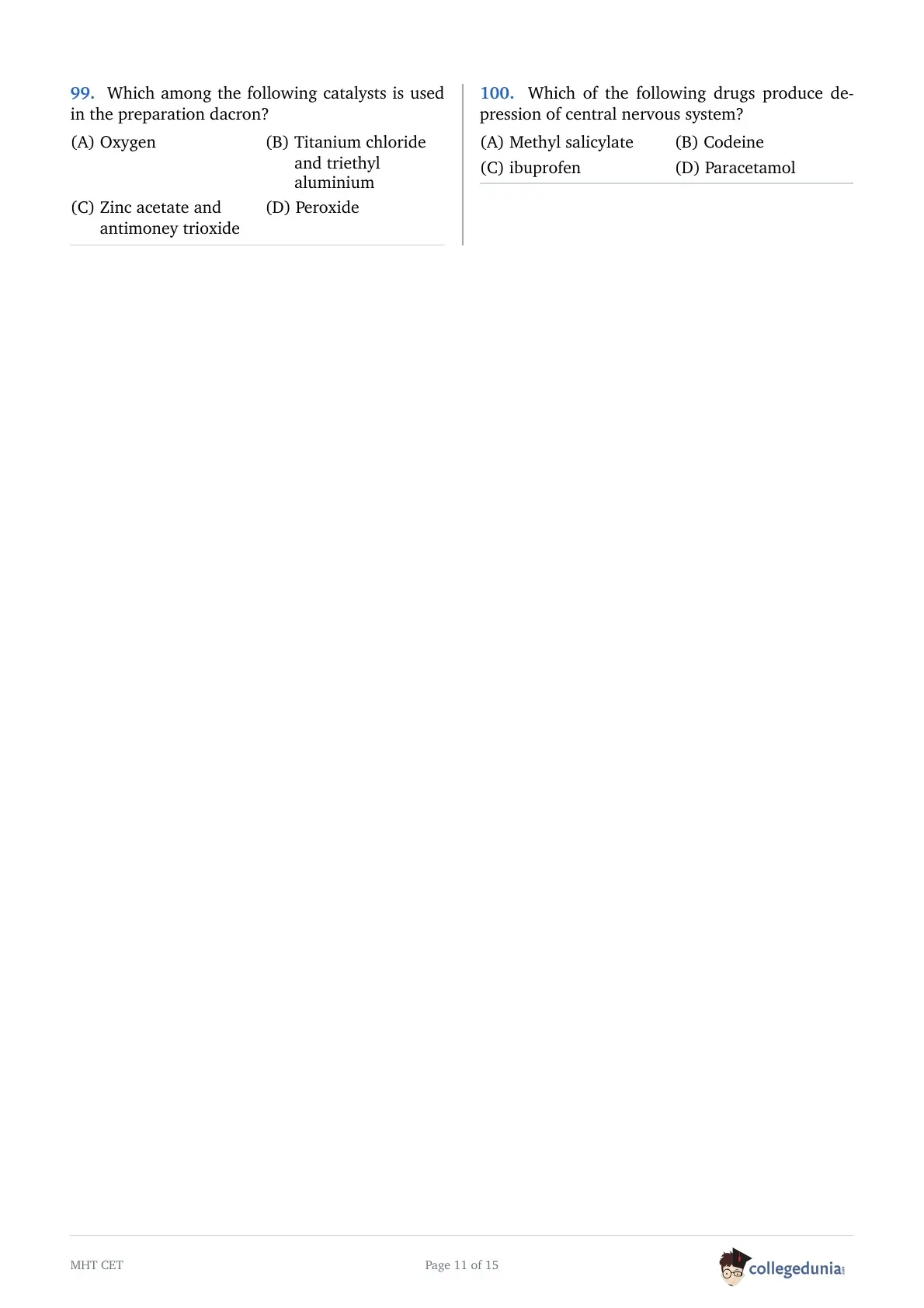
Which among the following catalysts is used in the preparation dacron?
Which of the following drugs produce depression of central nervous system?
Mathematics (Q101 - Q150)
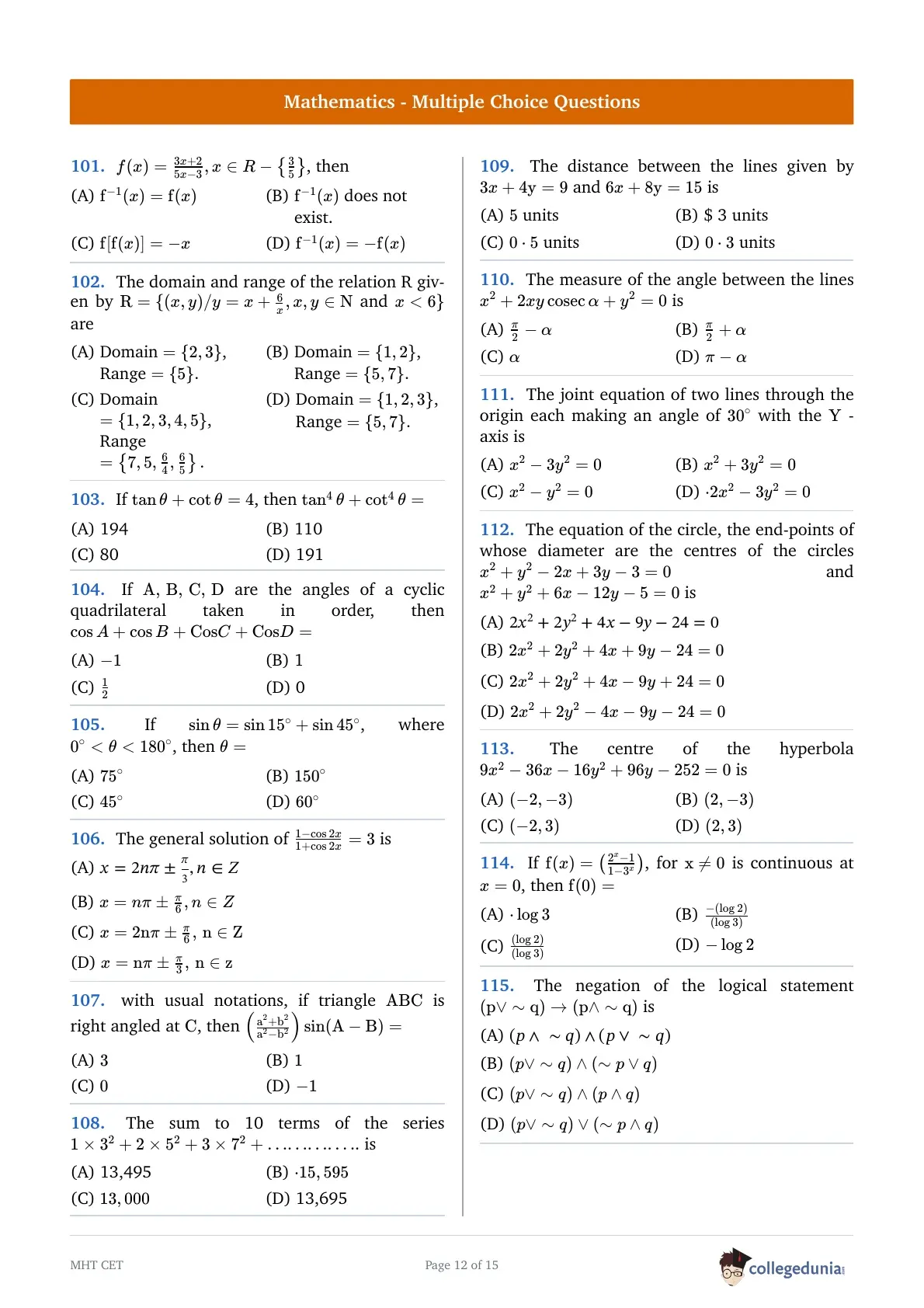
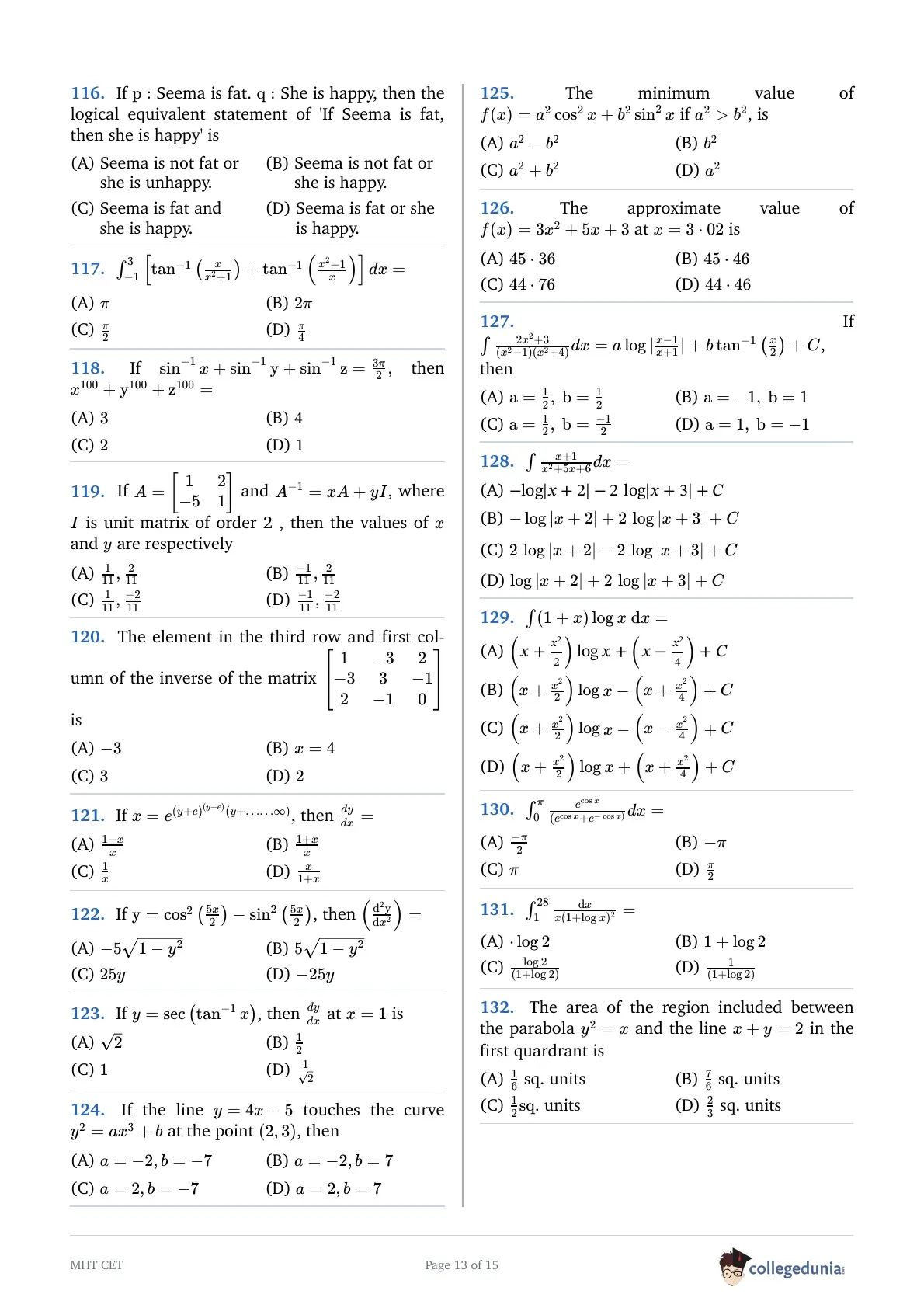
\(f(x)=\frac{3x+2}{5x-3},x\in R-\left\{\frac{3}{5}\right\}\), then
The domain and range of the relation R given by \(\mathrm{R}=\{(x,y)/y=x+\frac{6}{x},x,y\in \mathrm{N}\) and \(x\lt 6\}\) are
If \(\tan \theta +\cot \theta =4\), then \(\tan ^{4}\theta +\cot ^{4}\theta =\)
If \(\mathrm{A},\,\mathrm{B},\,\mathrm{C},\,\mathrm{D}\) are the angles of a cyclic quadrilateral taken in order, then \(\cos A+\cos B+\mathrm{Cos}C+\mathrm{Cos}D=\)
If \(\sin \theta =\sin 15^{\circ }+\sin 45^{\circ }\), where \(0^{\circ }\lt \theta \lt 180^{\circ }\), then \(\theta =\)
The general solution of \(\frac{1-\cos 2x}{1+\cos 2x}=3\) is
with usual notations, if triangle \(\mathrm{ABC}\) is right angled at \(\mathrm{C}\), then \(\left(\frac{\mathrm{a}^{2}+\mathrm{b}^{2}}{\mathrm{a}^{2}-\mathrm{b}^{2}}\right)\sin (\mathrm{A}-\mathrm{B})=\)
The sum to 10 terms of the series \(1\times 3^{2}+2\times 5^{2}+3\times 7^{2}+\ldots \ldots \ldots \ldots ..\) is
The measure of the angle between the lines \(x^{2}+2xy\operatorname{cosec} \alpha +y^{2}=0\) is
The equation of the circle, the end-points of whose diameter are the centres of the circles \(x^{2}+y^{2}-2x+3y-3=0\) and \(x^{2}+y^{2}+6x-12y-5=0\) is
The centre of the hyperbola \(9x^{2}-36x-16y^{2}+96y-252=0\) is
If \(\mathrm{f}(x)=\left(\frac{2^{x}-1}{1-3^{x}}\right)\), for \(\mathrm{x}\neq 0\) is continuous at \(x=0\), then \(\mathrm{f}(0)=\)
The negation of the logical statement \((\mathrm{p}\vee \sim \mathrm{q})\rightarrow (\mathrm{p}\wedge \sim \mathrm{q})\) is
If \(\mathrm{p}:\) Seema is fat. \(\mathrm{q}:\) She is happy, then the logical equivalent statement of 'If Seema is fat, then she is happy' is
\(\int _{-1}^{3}\left[\tan ^{-1}\left(\frac{x}{x^{2}+1}\right)+\tan ^{-1}\left(\frac{x^{2}+1}{x}\right)\right]dx=\)
If \(\sin ^{-1}x+\sin ^{-1}\mathrm{y}+\sin ^{-1}\mathrm{z}=\frac{3\pi }{2},\) then \(x^{100}+\mathrm{y}^{100}+\mathrm{z}^{100}=\)
If \(A=\begin{bmatrix} 1 & 2 \\ -5 & 1 \end{bmatrix}\) and \(A^{-1}=xA+yI\), where \(I\) is unit matrix of order 2 , then the values of \(x\) and \(y\) are respectively
If \(\mathrm{y}=\cos ^{2}\left(\frac{5x}{2}\right)-\sin ^{2}\left(\frac{5x}{2}\right)\), then \(\left(\frac{\mathrm{d}^{2}\mathrm{y}}{\mathrm{d}x^{2}}\right)=\)
If \(y=\sec \left(\tan ^{-1}x\right)\), then \(\frac{dy}{dx}\) at \(x=1\) is
If the line \(y=4x-5\) touches the curve \(y^{2}=ax^{3}+b\) at the point \((2,3)\), then
The minimum value of \(f(x)=a^{2}\cos ^{2}x+b^{2}\sin ^{2}x\) if \(a^{2}>b^{2}\), is
The approximate value of \(f(x)=3x^{2}+5x+3\) at \(x=3\cdot 02\) is
If \(\int \frac{2x^{2}+3}{(x^{2}-1)(x^{2}+4)}dx=a\log |\frac{x-1}{x+1}|+b\tan ^{-1}\left(\frac{x}{2}\right)+C\), then
\(\int (1+x)\log x\ \mathrm{d}x=\)
\(\int _{0}^{\pi }\frac{e^{\cos x}}{(e^{\cos x}+e^{-\cos x)}}dx=\)
The area of the region included between the parabola \(y^{2}=x\) and the line \(x+y=2\) in the first quardrant is
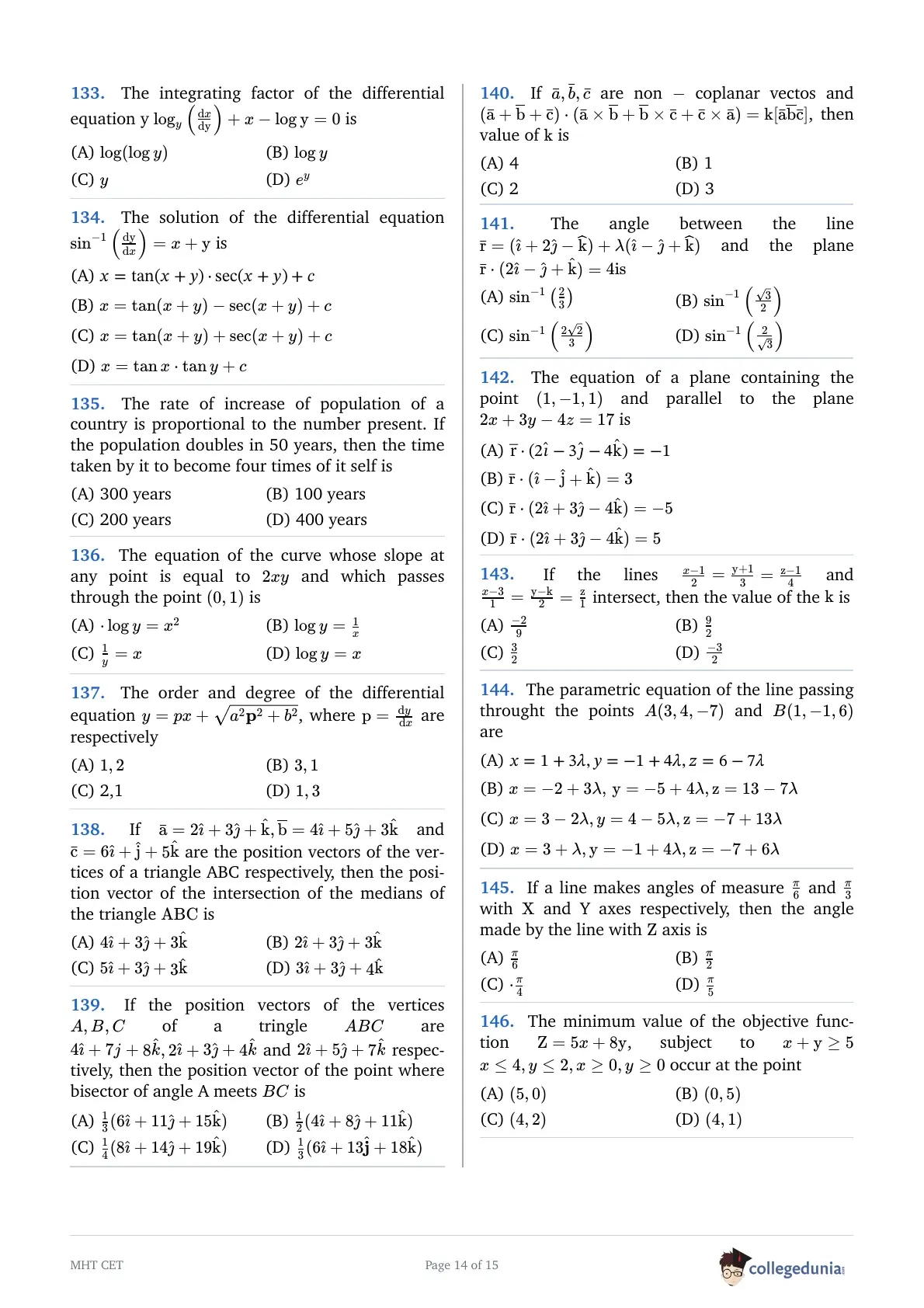
The solution of the differential equation \(\sin ^{-1}\left(\frac{\mathrm{dy}}{\mathrm{d}x}\right)=x+\mathrm{y}\) is
The rate of increase of population of a country is proportional to the number present. If the population doubles in 50 years, then the time taken by it to become four times of it self is
The equation of the curve whose slope at any point is equal to \(2xy\) and which passes through the point \((0,1)\) is
The order and degree of the differential equation \(y=px+\sqrt{a^{2}\mathbf{p}^{2}+b^{2}}\), where \(\mathrm{p}=\frac{\mathrm{d}y}{\ \mathrm{d}x}\) are respectively
If \(\bar{\mathrm{a}}=2\hat{\imath}+3\hat{\jmath}+\hat{\mathrm{k}},\overline{\mathrm{b}}=4\hat{\imath}+5\hat{\jmath}+3\hat{\mathrm{k}}\) and \(\bar{\mathrm{c}}=6\hat{\imath}+\hat{\mathrm{j}}+5\hat{\mathrm{k}}\) are the position vectors of the vertices of a triangle ABC respectively, then the position vector of the intersection of the medians of the triangle \(\mathrm{ABC}\) is
If the position vectors of the vertices \(A,B,C\) of a tringle \(ABC\) are \(4\hat{\imath}+7j+8\hat{k},2\hat{\imath}+3\hat{\jmath}+4\hat{k}\) and \(2\hat{\imath}+5\hat{\jmath}+7\hat{k}\) respectively, then the position vector of the point where bisector of angle A meets \(BC\) is
If \(\bar{a},\bar{b},\bar{c}\) are non \(-\) coplanar vectos and \((\bar{\mathrm{a}}+\overline{\mathrm{b}}+\bar{\mathrm{c}})\cdot (\bar{\mathrm{a}}\times \overline{\mathrm{b}}+\overline{\mathrm{b}}\times \bar{\mathrm{c}}+\bar{\mathrm{c}}\times \bar{\mathrm{a}})=\mathrm{k}[\bar{\mathrm{a}}\overline{\mathrm{b}}\bar{\mathrm{c}}]\), then value of \(\mathrm{k}\) is
The angle between the line \(\bar{\mathrm{r}}=(\hat{\imath}+2\hat{\jmath}-\widehat{\mathrm{k}})+\lambda (\hat{\imath}-\hat{\jmath}+\widehat{\mathrm{k}})\) and the plane \(\bar{\mathrm{r}}\cdot (2\hat{\imath}-\hat{\jmath}+\hat{\mathrm{k}})=4\mathrm{is}\)
The equation of a plane containing the point \((1,-1,1)\) and parallel to the plane \(2x+3y-4z=17\) is
If the lines \(\frac{x-1}{2}=\frac{\mathrm{y}+1}{3}=\frac{\mathrm{z}-1}{4}\) and \(\frac{x-3}{1}=\frac{\mathrm{y}-\mathrm{k}}{2}=\frac{\mathrm{z}}{1}\) intersect, then the value of the \(\mathrm{k}\) is
The parametric equations of the line passing through \( A(3, 4, -7) \), \( B(1, -1, 6) \) are
If a line makes angles of measure \(\frac{\pi }{6}\) and \(\frac{\pi }{3}\) with \(\mathrm{X}\) and Y axes respectively, then the angle made by the line with \(\mathrm{Z}\) axis is
The minimum value of the objective function \(\mathrm{Z}=5x+8\mathrm{y}\), subject to \(x+\mathrm{y}\geq 5\) \(x\leq 4,y\leq 2,x\geq 0,y\geq 0\) occur at the point
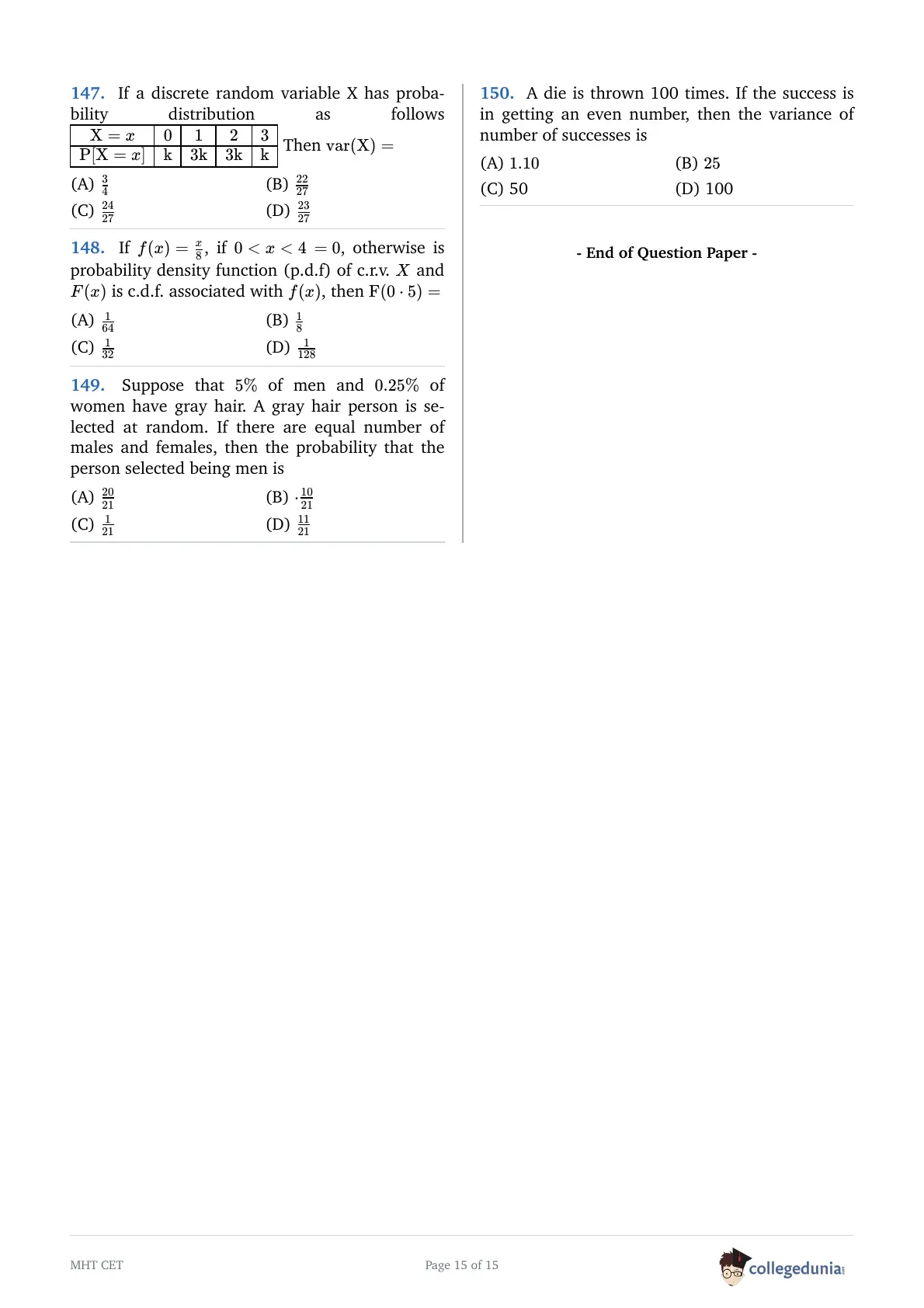
If a discrete random variable X has probability distribution as follows \(\begin{array}{|c|c|c|c|c|} \hline \mathrm{X}=x & 0 & 1 & 2 & 3 \\ \hline \mathrm{P}[\mathrm{X}=x] & \mathrm{k} & 3\mathrm{k} & 3\mathrm{k} & \mathrm{k} \\ \hline \end{array}\) Then \(\mathrm{var}(\mathrm{X})=\)
If \(f(x)=\frac{x}{8}\), if \(0\lt x\lt 4\) \(=0\), otherwise is probability density function (p.d.f) of c.r.v. \(X\) and \(F(x)\) is c.d.f. associated with \(f(x)\), then \(\mathrm{F}(0\cdot 5)=\)
Suppose that \(5\%\) of men and \(0.25\%\) of women have gray hair. A gray hair person is selected at random. If there are equal number of males and females, then the probability that the person selected being men is
A die is thrown 100 times. If the success is in getting an even number, then the variance of number of successes is
MHT CET 2020 PCM Exam Pattern and Marking Scheme
| Parameter | Details |
|---|---|
| Conducting Body | Maharashtra Common Entrance Test Cell (Maharashtra CET Cell) |
| Exam Mode | Online (Computer-Based Test) |
| Duration | 180 minutes (3 hours) |
| Groups / Subjects | PCM (Physics, Chemistry, Mathematics) for Engineering |
| Total Questions |
150 |
| Total Marks | 200 |
| Question Type | Multiple Choice Questions (MCQs) |
| Marks Distribution |
|
| Negative Marking | No |
| Syllabus Weightage |
|



Comments