MHT CET 2020 Oct 20 Shift 2 PCM Question Paper is available for download here. Maharashtra State CET Cell conducted MHT CET 2020 PCM Exam on Oct 20 in Shift 2 from 2 PM to 5 PM in CBT mode.

The MHT CET 2020 PCM question paper includes the following:

  • The MHT CET 2020 PCM Question Paper consists of 150 multiple-choice questions (MCQs) totalling 200 marks divided into 3 sections: Physics, Chemistry, and Mathematics, with 50 questions in each subject.
  • Physics and Chemistry questions carry 1 mark each while Mathematics questions carry 2 marks each.
  • There is no negative marking for incorrect answers.

MHT CET 2020 Oct 20 Shift 2 PCM Question Paper with Solution PDF

CD PDF CD PDF with Solutions
Download Collegedunia PDF 0.79 MB -

Also Check:

MHT CET 2020 Oct 20 Shift 2 PCM Questions with Solutions


Physics (Q1 - Q50)

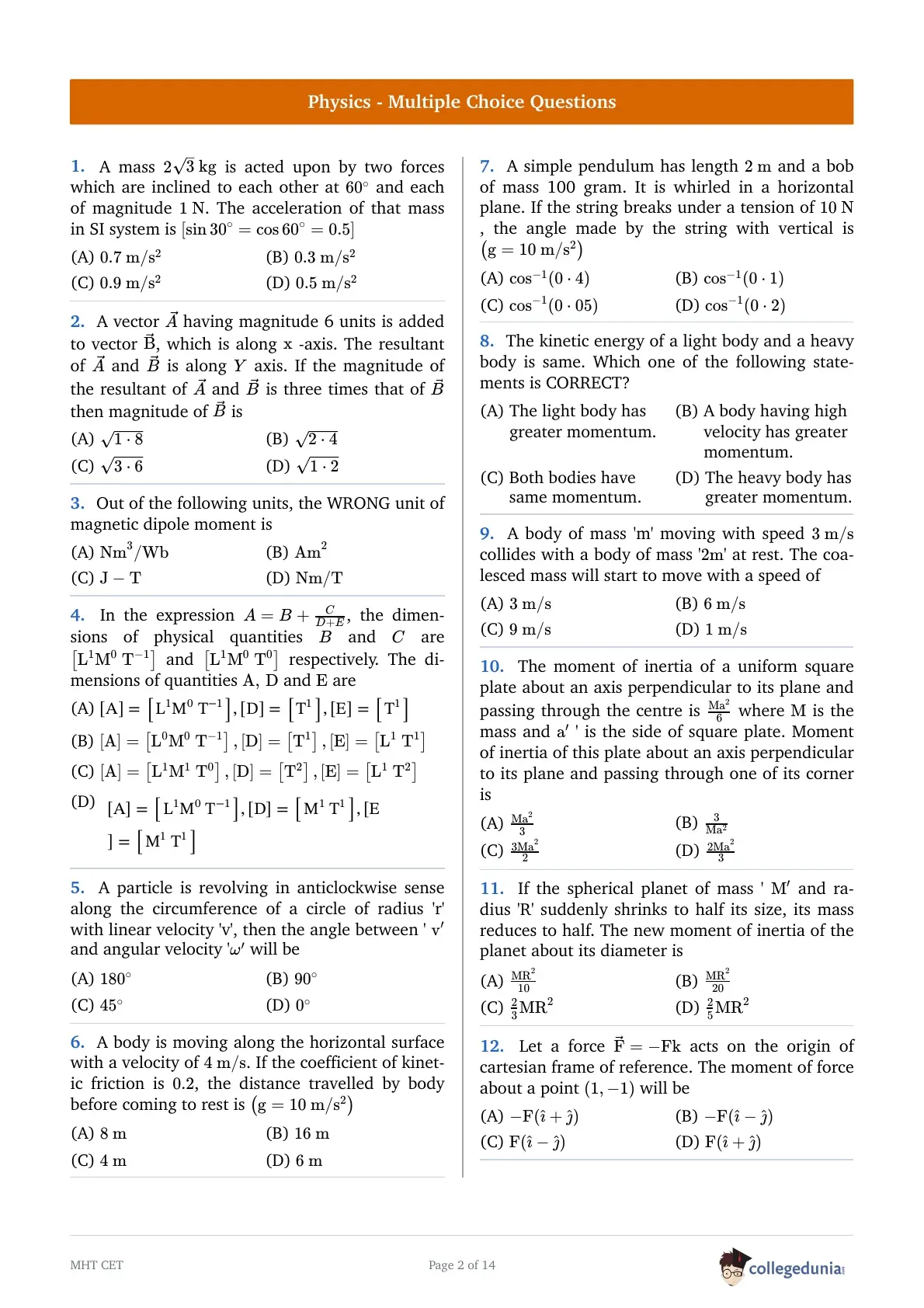
Question 1:

A mass \(2\sqrt{3}\ \mathrm{kg}\) is acted upon by two forces which are inclined to each other at \(60^{\circ }\) and each of magnitude \(1\ \mathrm{N}\). The acceleration of that mass in SI system is \([\sin 30^{\circ }=\cos 60^{\circ }=0.5]\)

  • (A) \(0.7\ \mathrm{m}/\mathrm{s}^{2}\)
  • (B) \(0.3\ \mathrm{m}/\mathrm{s}^{2}\)
  • (C) \(0.9\ \mathrm{m}/\mathrm{s}^{2}\)
  • (D) \(0.5\ \mathrm{m}/\mathrm{s}^{2}\)

Question 2:

A vector \(\vec{A}\) having magnitude 6 units is added to vector \(\vec{\mathrm{B}}\), which is along \(\mathrm{x}\) -axis. The resultant of \(\vec{A}\) and \(\vec{B}\) is along \(Y\) axis. If the magnitude of the resultant of \(\vec{A}\) and \(\vec{B}\) is three times that of \(\vec{B}\) then magnitude of \(\vec{B}\) is

  • (A) \(\sqrt{1\cdot 8}\)
  • (B) \(\sqrt{2\cdot 4}\)
  • (C) \(\sqrt{3\cdot 6}\)
  • (D) \(\sqrt{1\cdot 2}\)

Question 3:

Out of the following units, the WRONG unit of magnetic dipole moment is

  • (A) \(\mathrm{Nm}^{3}/\mathrm{Wb}\)
  • (B) \(\mathrm{Am}^{2}\)
  • (C) \(\mathrm{J}-\mathrm{T}\)
  • (D) \(\mathrm{Nm}/\mathrm{T}\)

Question 4:

In the expression \(A=B+\frac{C}{D+E}\), the dimensions of physical quantities \(B\) and \(C\) are \(\left[\mathrm{L}^{1}\mathrm{M}^{0}\ \mathrm{T}^{-1}\right]\) and \(\left[\mathrm{L}^{1}\mathrm{M}^{0}\ \mathrm{T}^{0}\right]\) respectively. The dimensions of quantities \(\mathrm{A},\,\mathrm{D}\) and \(\mathrm{E}\) are

  • (A) \([\mathrm{A}]=\left[\mathrm{L}^{1}\mathrm{M}^{0}\ \mathrm{T}^{-1}\right],[\mathrm{D}]=\left[\mathrm{T}^{1}\right],[\mathrm{E}]=\left[\mathrm{T}^{1}\right]\)
  • (B) \([\mathrm{A}]=\left[\mathrm{L}^{0}\mathrm{M}^{0}\ \mathrm{T}^{-1}\right],[\mathrm{D}]=\left[\mathrm{T}^{1}\right],[\mathrm{E}]=\left[\mathrm{L}^{1}\ \mathrm{T}^{1}\right]\)
  • (C) \([\mathrm{A}]=\left[\mathrm{L}^{1}\mathrm{M}^{1}\ \mathrm{T}^{0}\right],[\mathrm{D}]=\left[\mathrm{T}^{2}\right],[\mathrm{E}]=\left[\mathrm{L}^{1}\ \mathrm{T}^{2}\right]\)
  • (D) \([\mathrm{A}]=\left[\mathrm{L}^{1}\mathrm{M}^{0}\ \mathrm{T}^{-1}\right],[\mathrm{D}]=\left[\mathrm{M}^{1}\ \mathrm{T}^{1}\right],[\mathrm{E}]=\left[\mathrm{M}^{1}\ \mathrm{T}^{1}\right]\)

Question 5:

A particle is revolving in anticlockwise sense along the circumference of a circle of radius 'r' with linear velocity 'v', then the angle between ' \(\mathrm{v}'\) and angular velocity '\(\omega '\) will be

  • (A) \(180^{\circ }\)
  • (B) \(90^{\circ }\)
  • (C) \(45^{\circ }\)
  • (D) \(0^{\circ }\)

Question 6:

A body is moving along the horizontal surface with a velocity of \(4\ \mathrm{m}/\mathrm{s}\). If the coefficient of kinetic friction is \(0.2\), the distance travelled by body before coming to rest is \(\left(\mathrm{g}=10\ \mathrm{m}/\mathrm{s}^{2}\right)\)

  • (A) \(8\ \mathrm{m}\)
  • (B) \(16\ \mathrm{m}\)
  • (C) \(4\ \mathrm{m}\)
  • (D) \(6\ \mathrm{m}\)

Question 7:

A simple pendulum has length \(2\ \mathrm{m}\) and a bob of mass 100 gram. It is whirled in a horizontal plane. If the string breaks under a tension of \(10\ \mathrm{N}\), the angle made by the string with vertical is \(\left(\mathrm{g}=10\ \mathrm{m}/\mathrm{s}^{2}\right)\)

  • (A) \(\cos ^{-1}(0\cdot 4)\)
  • (B) \(\cos ^{-1}(0\cdot 1)\)
  • (C) \(\cos ^{-1}(0\cdot 05)\)
  • (D) \(\cos ^{-1}(0\cdot 2)\)

Question 8:

The kinetic energy of a light body and a heavy body is same. Which one of the following statements is CORRECT?

  • (A) The light body has greater momentum.
  • (B) A body having high velocity has greater momentum.
  • (C) Both bodies have same momentum.
  • (D) The heavy body has greater momentum.

Question 9:

A body of mass 'm' moving with speed \(3\ \mathrm{m}/\mathrm{s}\) collides with a body of mass '\(2\mathrm{m}\)' at rest. The coalesced mass will start to move with a speed of

  • (A) \(3\ \mathrm{m}/\mathrm{s}\)
  • (B) \(6\ \mathrm{m}/\mathrm{s}\)
  • (C) \(9\ \mathrm{m}/\mathrm{s}\)
  • (D) \(1\ \mathrm{m}/\mathrm{s}\)

Question 10:

The moment of inertia of a uniform square plate about an axis perpendicular to its plane and passing through the centre is \(\frac{\mathrm{Ma}^{2}}{6}\) where \(\mathrm{M}\) is the mass and \(\mathrm{a}'\) ' is the side of square plate. Moment of inertia of this plate about an axis perpendicular to its plane and passing through one of its corner is

  • (A) \(\frac{\mathrm{Ma}^{2}}{3}\)
  • (B) \(\frac{3}{\mathrm{Ma}^{2}}\)
  • (C) \(\frac{3\mathrm{Ma}^{2}}{2}\)
  • (D) \(\frac{2\mathrm{Ma}^{2}}{3}\)

Question 11:

If the spherical planet of mass ' \(\mathrm{M}'\) and radius 'R' suddenly shrinks to half its size, its mass reduces to half. The new moment of inertia of the planet about its diameter is

  • (A) \(\frac{\mathrm{MR}^{2}}{10}\)
  • (B) \(\frac{\mathrm{MR}^{2}}{20}\)
  • (C) \(\frac{2}{3}\mathrm{MR}^{2}\)
  • (D) \(\frac{2}{5}\mathrm{MR}^{2}\)

Question 12:

Let a force \(\vec{\mathrm{F}}=-\mathrm{Fk}\) acts on the origin of cartesian frame of reference. The moment of force about a point \((1,-1)\) will be

  • (A) \(-\mathrm{F}(\hat{\imath}+\hat{\jmath})\)
  • (B) \(-\mathrm{F}(\hat{\imath}-\hat{\jmath})\)
  • (C) \(\mathrm{F}(\hat{\imath}-\hat{\jmath})\)
  • (D) \(\mathrm{F}(\hat{\imath}+\hat{\jmath})\)

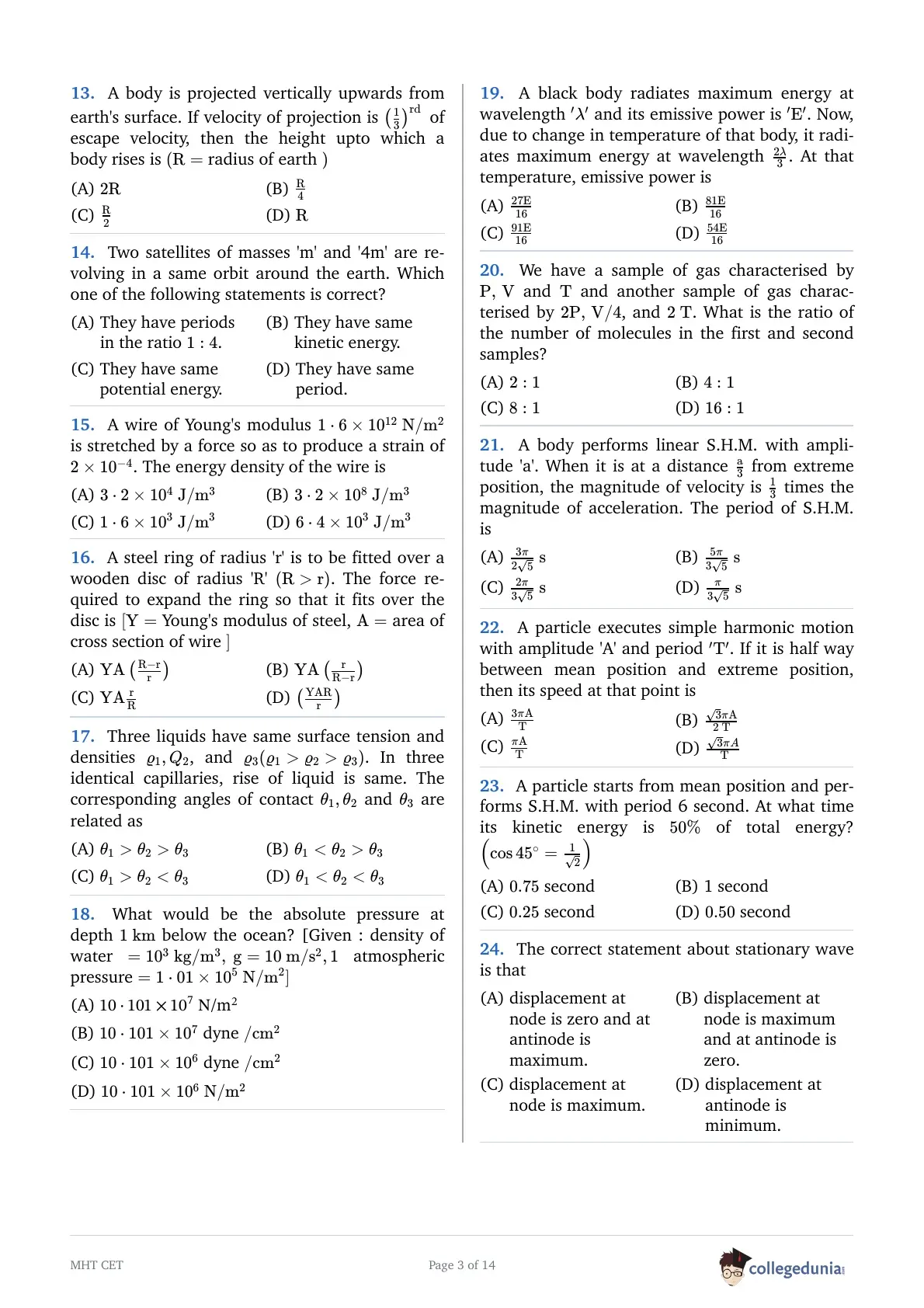
Question 14:

Two satellites of masses 'm' and '4m' are revolving in a same orbit around the earth. Which one of the following statements is correct?

  • (A) They have periods in the ratio \(1:4\).
  • (B) They have same kinetic energy.
  • (C) They have same potential energy.
  • (D) They have same period.

Question 15:

A wire of Young's modulus \(1\cdot 6\times 10^{12}\ \mathrm{N}/\mathrm{m}^{2}\) is stretched by a force so as to produce a strain of \(2\times 10^{-4}\). The energy density of the wire is

  • (A) \(3\cdot 2\times 10^{4}\ \mathrm{J}/\mathrm{m}^{3}\)
  • (B) \(3\cdot 2\times 10^{8}\ \mathrm{J}/\mathrm{m}^{3}\)
  • (C) \(1\cdot 6\times 10^{3}\ \mathrm{J}/\mathrm{m}^{3}\)
  • (D) \(6\cdot 4\times 10^{3}\ \mathrm{J}/\mathrm{m}^{3}\)

Question 16:

A steel ring of radius 'r' is to be fitted over a wooden disc of radius 'R' \((\mathrm{R}>\mathrm{r})\). The force required to expand the ring so that it fits over the disc is \([\mathrm{Y}=\) Young's modulus of steel, \(\mathrm{A}=\) area of cross section of wire \(]\)

  • (A) \(\mathrm{YA}\left(\frac{\mathrm{R}-\mathrm{r}}{\mathrm{r}}\right)\)
  • (B) \(\mathrm{YA}\left(\frac{\mathrm{r}}{\mathrm{R}-\mathrm{r}}\right)\)
  • (C) \(\mathrm{YA}\frac{\mathrm{r}}{\mathrm{R}}\)
  • (D) \(\left(\frac{\mathrm{YAR}}{\mathrm{r}}\right)\)

Question 17:

Three liquids have same surface tension and densities \(\varrho _{1},Q_{2}\), and \(\varrho _{3}(\varrho _{1}>\varrho _{2}>\varrho _{3})\). In three identical capillaries, rise of liquid is same. The corresponding angles of contact \(\theta _{1},\theta _{2}\) and \(\theta _{3}\) are related as

  • (A) \(\theta _{1}>\theta _{2}>\theta _{3}\)
  • (B) \(\theta _{1}\lt \theta _{2}>\theta _{3}\)
  • (C) \(\theta _{1}>\theta _{2}\lt \theta _{3}\)
  • (D) \(\theta _{1}\lt \theta _{2}\lt \theta _{3}\)

Question 19:

A black body radiates maximum energy at wavelength \({}'\lambda '\) and its emissive power is \({}'\mathrm{E}'\). Now, due to change in temperature of that body, it radiates maximum energy at wavelength \(\frac{2\lambda }{3}\). At that temperature, emissive power is

  • (A) \(\frac{27\mathrm{E}}{16}\)
  • (B) \(\frac{81\mathrm{E}}{16}\)
  • (C) \(\frac{91\mathrm{E}}{16}\)
  • (D) \(\frac{54\mathrm{E}}{16}\)

Question 20:

We have a sample of gas characterised by \(\mathrm{P},\,\mathrm{V}\) and \(\mathrm{T}\) and another sample of gas characterised by \(2\mathrm{P},\,\mathrm{V}/4\), and \(2\ \mathrm{T}\). What is the ratio of the number of molecules in the first and second samples?

  • (A) \(2:1\)
  • (B) \(4:1\)
  • (C) \(8:1\)
  • (D) \(16:1\)

Question 22:

A particle executes simple harmonic motion with amplitude 'A' and period \({}'\mathrm{T}'\). If it is half way between mean position and extreme position, then its speed at that point is

  • (A) \(\frac{3\pi \mathrm{A}}{\mathrm{T}}\)
  • (B) \(\frac{\sqrt{3}\pi \mathrm{A}}{2\ \mathrm{T}}\)
  • (C) \(\frac{\pi \mathrm{A}}{\mathrm{T}}\)
  • (D) \(\frac{\sqrt{3}\pi A}{\ \mathrm{T}}\)

Question 23:

A particle starts from mean position and performs S.H.M. with period 6 second. At what time its kinetic energy is \(50\%\) of total energy? \(\left(\cos 45^{\circ }=\frac{1}{\sqrt{2}}\right)\)

  • (A) \(0.75\) second
  • (B) 1 second
  • (C) \(0.25\) second
  • (D) \(0.50\) second

Question 24:

The correct statement about stationary wave is that

  • (A) displacement at node is zero and at antinode is maximum.
  • (B) displacement at node is maximum and at antinode is zero.
  • (C) displacement at node is maximum.
  • (D) displacement at antinode is minimum.

Question 25:

An engine is moving on a circular path of radius \(200\ \mathrm{m}\) with speed of \(15\ \mathrm{m}/\mathrm{s}\). What will be the frequency heard by an observer who is at rest at the centre of the circular path, when engine blows the whistle with frequency \(250\ \mathrm{Hz}\)?

  • (A) Less than \(250\ \mathrm{Hz}\)
  • (B) Greater than \(250\ \mathrm{Hz}\)
  • (C) \(250\ \mathrm{Hz}\)
  • (D) Zero

Question 26:

The fundamental frequency of open pipe is 'n'. If it is closed from one end then frequency of the \(2^{\text{nd }}\) harmonic of closed pipe is higher by \(200\ \mathrm{Hz}\) than \({}'\mathrm{n}'\). The value of 'n' is

  • (A) \(800\ \mathrm{Hz}\)
  • (B) \(200\ \mathrm{Hz}\)
  • (C) \(100\ \mathrm{Hz}\)
  • (D) \(400\ \mathrm{Hz}\)

Question 27:

Choose the correct relation between polarisation 'P' and electric susceptibility \({}^{4}\chi _{e}{}'\) of dielectric material. \((\mathrm{E}=\) electric field \()\)

  • (A) \(\mathrm{P}=\frac{\chi _{\mathrm{e}}}{\mathrm{E}^{2}}\)
  • (B) \(\mathrm{P}=\frac{\chi _{\mathrm{e}}}{\mathrm{E}}\)
  • (C) \(\mathrm{P}=\chi _{\mathrm{e}}\mathrm{E}\)
  • (D) \(\mathrm{P}=\chi _{\mathrm{e}}^{2}\mathrm{E}\)

Question 28:

The earth is assumed to be a charged conducting sphere having volume ' \(\mathrm{V}'\) and surface area 'A'. The capacitance of the earth in free space is \((\mathrm{E}_{0}=\) permittivity of free space \()\)

  • (A) \(12\pi \in _{0}\frac{\mathrm{V}}{\mathrm{A}}\)
  • (B) \(4\pi \in _{0}\frac{\mathrm{V}}{\mathrm{A}}\)
  • (C) \(2\pi \in _{0}\frac{\mathrm{V}}{\mathrm{A}}\)
  • (D) \(8\pi \in _{0}\frac{\mathrm{V}}{\mathrm{A}}\)

Question 29:

What will be the resistance of the shunt when \(5\%\) of the main current is passed through a galvanometer of resistance G?

  • (A) \(\frac{G}{20}\)
  • (B) \(\frac{G}{21}\)
  • (C) \(\frac{G}{5}\)
  • (D) \(\frac{G}{19}\)

Question 30:

In an atom, electron of charge (-e) performs U.C.M. around a stationary positively charged nucleus, with period of revolution 'T'. If 'r' is the radius of the orbit of the electron and ' \(\mathrm{v}'\) is the orbital velocity, then the circulating current (I) is proportional to

  • (A) \(\mathrm{e}^{1}\mathrm{r}^{-1}\mathrm{v}^{-1}\)
  • (B) \(\mathrm{e}^{1}\mathrm{r}^{1}\ \mathrm{V}^{-1}\)
  • (C) \(\mathrm{e}^{1}\ \mathrm{V}^{1}\mathrm{r}^{-1}\)
  • (D) \(\mathrm{v}^{1}\mathrm{r}^{1}\mathrm{e}^{-1}\)

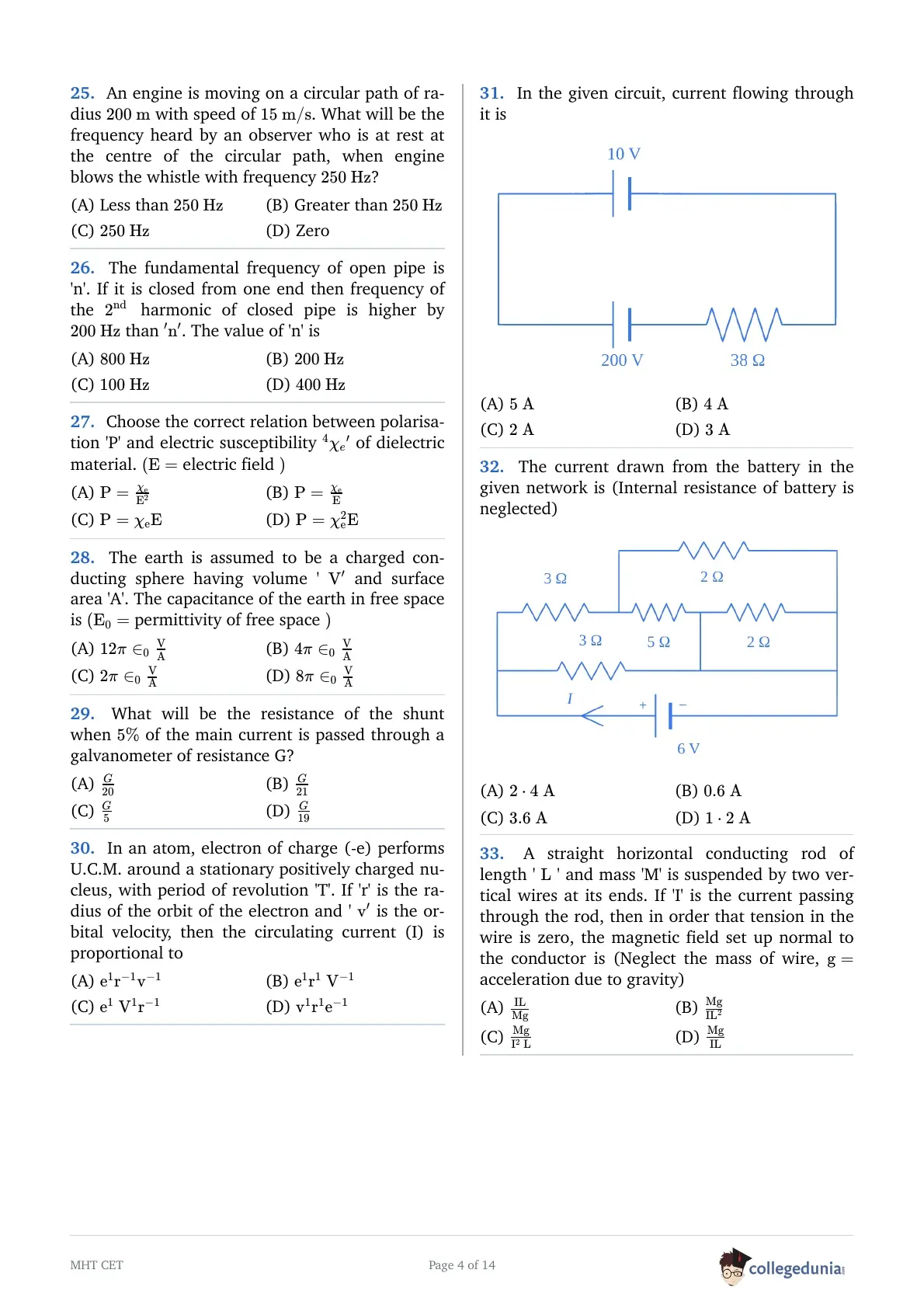
Question 31:

In the given circuit, current flowing through it is

  • (A) \(5\ \mathrm{A}\)
  • (B) \(4\ \mathrm{A}\)
  • (C) \(2\ \mathrm{A}\)
  • (D) \(3\ \mathrm{A}\)

Question 33:

A straight horizontal conducting rod of length ' \(\mathrm{L}\) ' and mass 'M' is suspended by two vertical wires at its ends. If 'I' is the current passing through the rod, then in order that tension in the wire is zero, the magnetic field set up normal to the conductor is (Neglect the mass of wire, \(\mathrm{g}=\) acceleration due to gravity)

  • (A) \(\frac{\text{ IL }}{\mathrm{Mg}}\)
  • (B) \(\frac{\mathrm{Mg}}{\mathrm{IL}^{2}}\)
  • (C) \(\frac{\mathrm{Mg}}{\mathrm{I}^{2}\ \mathrm{L}}\)
  • (D) \(\frac{\mathrm{Mg}}{\mathrm{IL}}\)

Question 34:

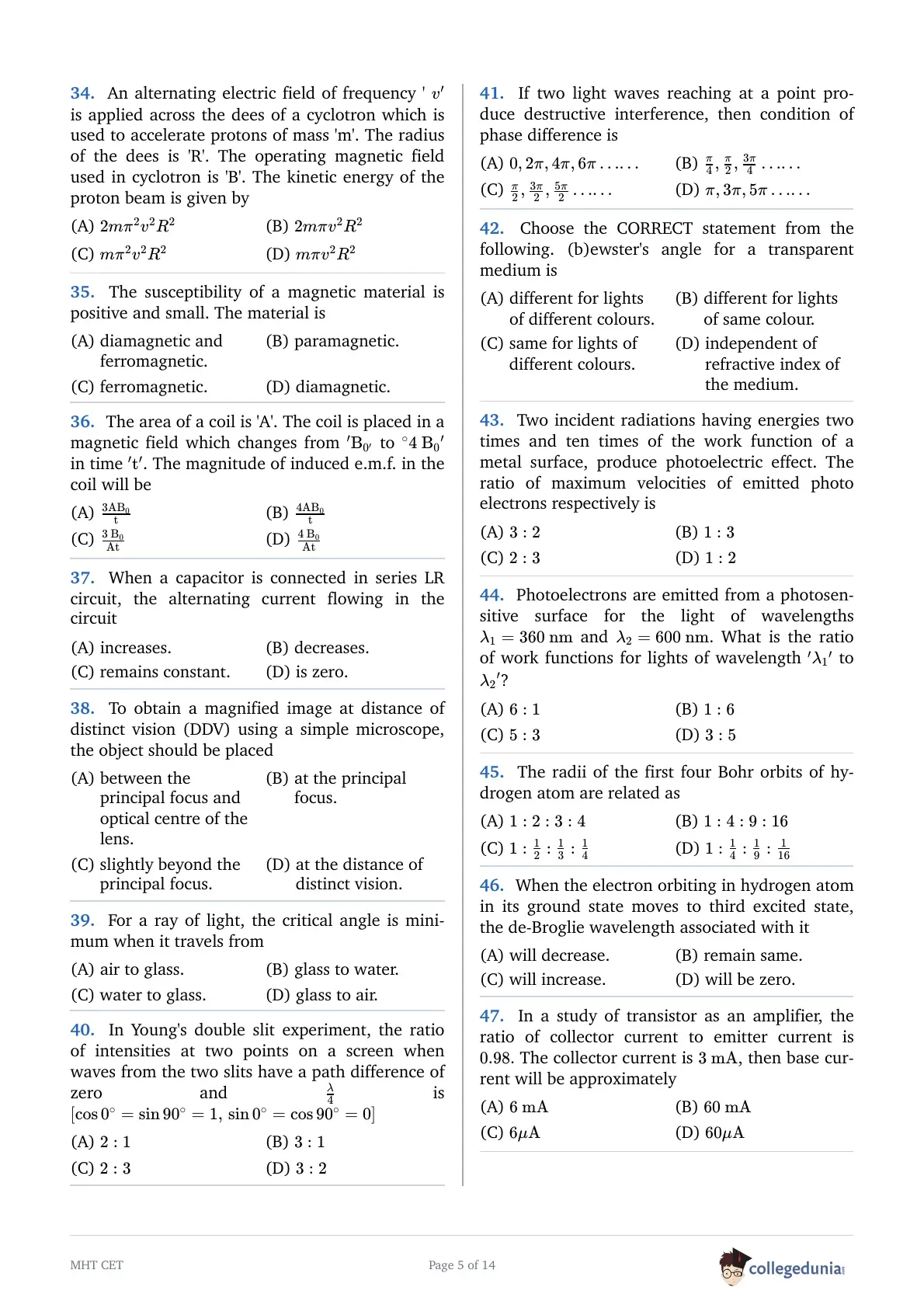
An alternating electric field of frequency ' \(v'\) is applied across the dees of a cyclotron which is used to accelerate protons of mass 'm'. The radius of the dees is 'R'. The operating magnetic field used in cyclotron is 'B'. The kinetic energy of the proton beam is given by

  • (A) \(2m\pi ^{2}v^{2}R^{2}\)
  • (B) \(2m\pi v^{2}R^{2}\)
  • (C) \(m\pi ^{2}v^{2}R^{2}\)
  • (D) \(m\pi v^{2}R^{2}\)

Question 35:

The susceptibility of a magnetic material is positive and small. The material is

  • (A) diamagnetic and ferromagnetic.
  • (B) paramagnetic.
  • (C) ferromagnetic.
  • (D) diamagnetic.

Question 36:

The area of a coil is 'A'. The coil is placed in a magnetic field which changes from \({}'\mathrm{B}_{0'}\) to \({}^{\circ }4\ \mathrm{B}_{0}{}'\) in time \({}'\mathrm{t}'\). The magnitude of induced e.m.f. in the coil will be

  • (A) \(\frac{3\mathrm{AB}_{0}}{\mathrm{t}}\)
  • (B) \(\frac{4\mathrm{AB}_{0}}{\mathrm{t}}\)
  • (C) \(\frac{3\ \mathrm{B}_{0}}{\mathrm{At}}\)
  • (D) \(\frac{4\ \mathrm{B}_{0}}{\mathrm{At}}\)

Question 37:

When a capacitor is connected in series LR circuit, the alternating current flowing in the circuit

  • (A) increases.
  • (B) decreases.
  • (C) remains constant.
  • (D) is zero.

Question 38:

To obtain a magnified image at distance of distinct vision (DDV) using a simple microscope, the object should be placed

  • (A) between the principal focus and optical centre of the lens.
  • (B) at the principal focus.
  • (C) slightly beyond the principal focus.
  • (D) at the distance of distinct vision.

Question 39:

For a ray of light, the critical angle is minimum when it travels from

  • (A) air to glass.
  • (B) glass to water.
  • (C) water to glass.
  • (D) glass to air.

Question 40:

In Young's double slit experiment, the ratio of intensities at two points on a screen when waves from the two slits have a path difference of zero and \(\frac{\lambda }{4}\) is \([\cos 0^{\circ }=\sin 90^{\circ }=1,\,\sin 0^{\circ }=\cos 90^{\circ }=0]\)

  • (A) \(2:1\)
  • (B) \(3:1\)
  • (C) \(2:3\)
  • (D) \(3:2\)

Question 41:

If two light waves reaching at a point produce destructive interference, then condition of phase difference is

  • (A) \(0,2\pi ,4\pi ,6\pi \ldots \ldots\)
  • (B) \(\frac{\pi }{4},\frac{\pi }{2},\frac{3\pi }{4}\ldots \ldots\)
  • (C) \(\frac{\pi }{2},\frac{3\pi }{2},\frac{5\pi }{2}\ldots \ldots\)
  • (D) \(\pi ,3\pi ,5\pi \ldots \ldots\)

Question 42:

Choose the CORRECT statement from the following. (b)ewster's angle for a transparent medium is

  • (A) different for lights of different colours.
  • (B) different for lights of same colour.
  • (C) same for lights of different colours.
  • (D) independent of refractive index of the medium.

Question 43:

Two incident radiations having energies two times and ten times of the work function of a metal surface, produce photoelectric effect. The ratio of maximum velocities of emitted photo electrons respectively is

  • (A) \(3:2\)
  • (B) \(1:3\)
  • (C) \(2:3\)
  • (D) \(1:2\)

Question 45:

The radii of the first four Bohr orbits of hydrogen atom are related as

  • (A) \(1:2:3:4\)
  • (B) \(1:4:9:16\)
  • (C) \(1:\frac{1}{2}:\frac{1}{3}:\frac{1}{4}\)
  • (D) \(1:\frac{1}{4}:\frac{1}{9}:\frac{1}{16}\)

Question 46:

When the electron orbiting in hydrogen atom in its ground state moves to third excited state, the de-Broglie wavelength associated with it

  • (A) will decrease.
  • (B) remain same.
  • (C) will increase.
  • (D) will be zero.

Question 47:

In a study of transistor as an amplifier, the ratio of collector current to emitter current is \(0.98.\) The collector current is \(3\ \mathrm{mA}\), then base current will be approximately

  • (A) \(6\ \mathrm{mA}\)
  • (B) \(60\ \mathrm{mA}\)
  • (C) \(6\mu \mathrm{A}\)
  • (D) \(60\mu \mathrm{A}\)

Question 48:

When \(\mathrm{p}-\mathrm{n}\) junction diode is reverse biased, then the width of the barrier potential will

  • (A) increase and it will offer more resistance.
  • (B) decrease and it will offer zero resistance.
  • (C) remain constant and it will not offer resistance.
  • (D) decrease and it will offer more resistance.

Question 49:

Identify the 'INCORRECT' statement from the following.

  • (A) Modulation index \(\mu\) is kept greater than one to avoid distortion.
  • (B) The receiving antenna is followed by amplifier, intermediate frequency (IF) stage and detector.
  • (C) AM detection is carried out using a rectifier and an envelop detector.
  • (D) Modulated signal is to be followed by power amplifier and then fed to an antenna.

Question 50:

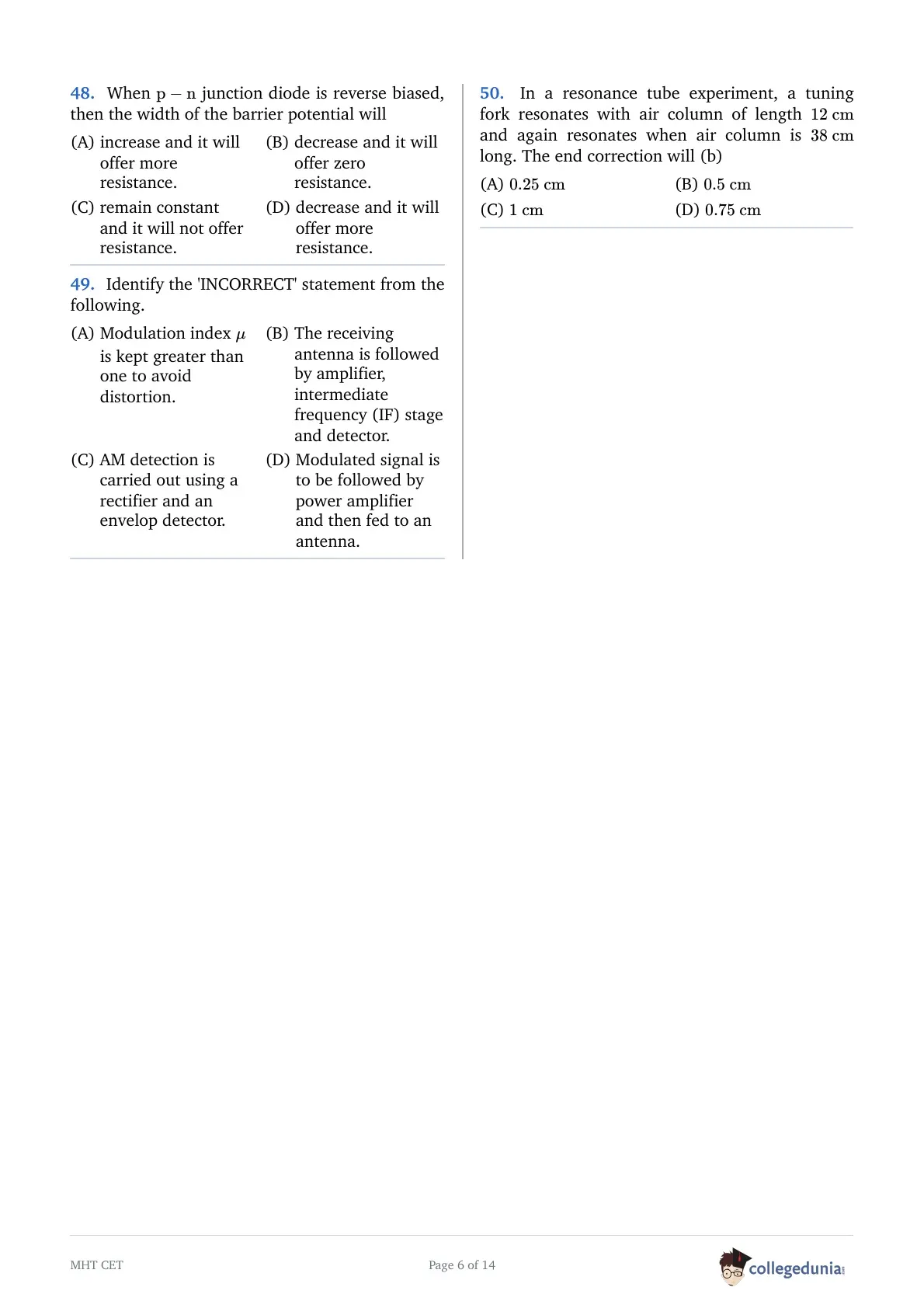
In a resonance tube experiment, a tuning fork resonates with air column of length \(12\ \mathrm{cm}\) and again resonates when air column is \(38\ \mathrm{cm}\) long. The end correction will (b)

  • (A) \(0.25\ \mathrm{cm}\)
  • (B) \(0.5\ \mathrm{cm}\)
  • (C) \(1\ \mathrm{cm}\)
  • (D) \(0.75\ \mathrm{cm}\)

Chemistry (Q51 - Q100)

Question 51:

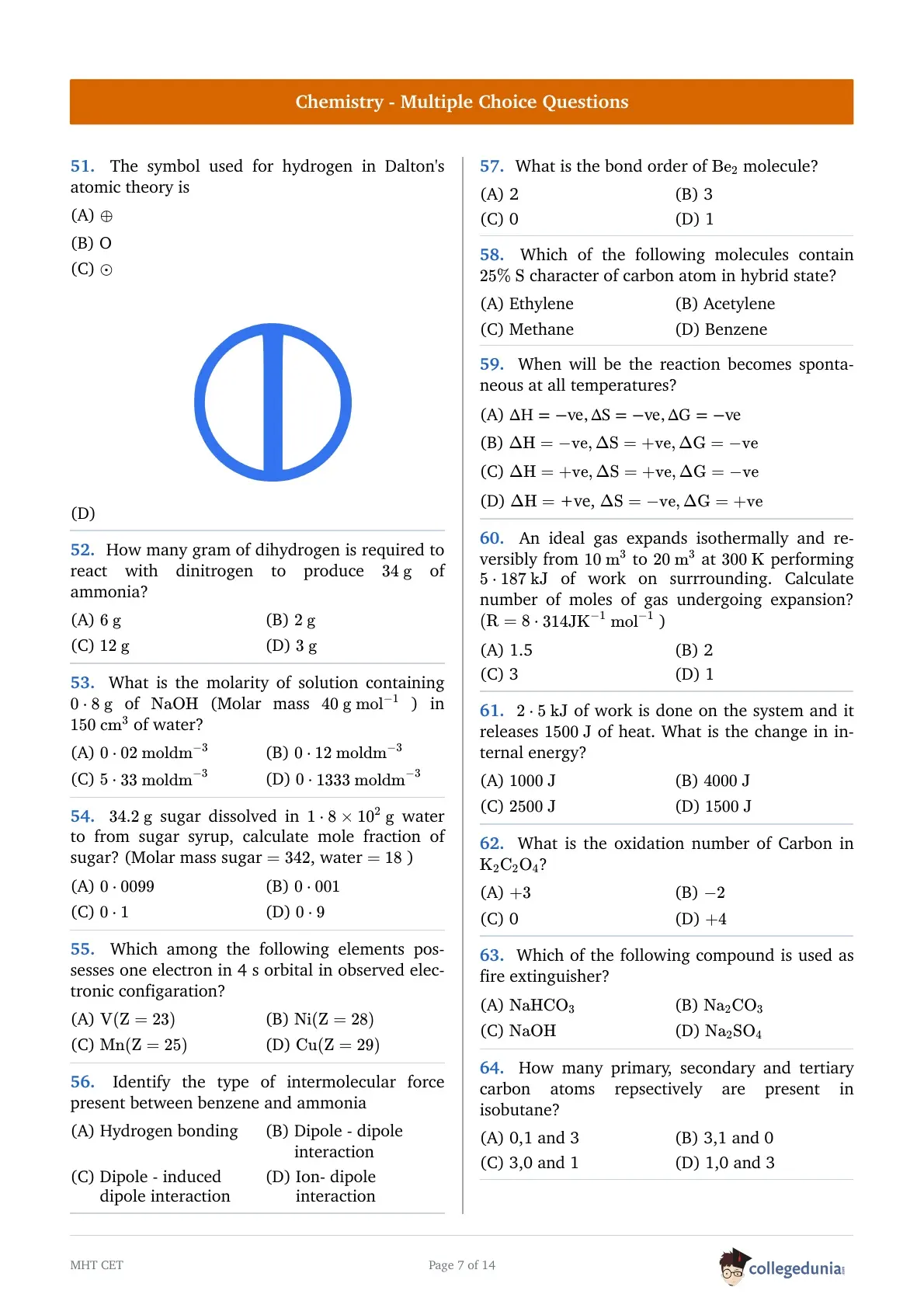
The symbol used for hydrogen in Dalton's atomic theory is

  • (A) \(\oplus\)
  • (B) O
  • (C) \(\odot\)
  • (D)

Question 52:

How many gram of dihydrogen is required to react with dinitrogen to produce \(34\ \mathrm{g}\) of ammonia?

  • (A) \(6\ \mathrm{g}\)
  • (B) \(2\ \mathrm{g}\)
  • (C) \(12\ \mathrm{g}\)
  • (D) \(3\ \mathrm{g}\)

Question 53:

What is the molarity of solution containing \(0\cdot 8\ \mathrm{g}\) of \(\mathrm{NaOH}\) (Molar mass \(40\ \mathrm{g}\ \mathrm{mol}^{-1}\) ) in \(150\ \mathrm{cm}^{3}\) of water?

  • (A) \(0\cdot 02\ \mathrm{mol}\mathrm{dm}^{-3}\)
  • (B) \(0\cdot 12\ \mathrm{mol}\mathrm{dm}^{-3}\)
  • (C) \(5\cdot 33\ \mathrm{mol}\mathrm{dm}^{-3}\)
  • (D) \(0\cdot 1333\ \mathrm{mol}\mathrm{dm}^{-3}\)

Question 54:

\(34.2\ \mathrm{g}\) sugar dissolved in \(1\cdot 8\times 10^{2}\ \mathrm{g}\) water to from sugar syrup, calculate mole fraction of sugar? (Molar mass sugar \(=342\), water \(=18\) )

  • (A) \(0\cdot 0099\)
  • (B) \(0\cdot 001\)
  • (C) \(0\cdot 1\)
  • (D) \(0\cdot 9\)

Question 55:

Which among the following elements possesses one electron in 4 s orbital in observed electronic configaration?

  • (A) \(\mathrm{V}(\mathrm{Z}=23)\)
  • (B) \(\mathrm{Ni}(\mathrm{Z}=28)\)
  • (C) \(\mathrm{Mn}(\mathrm{Z}=25)\)
  • (D) \(\mathrm{Cu}(\mathrm{Z}=29)\)

Question 56:

Identify the type of intermolecular force present between benzene and ammonia

  • (A) Hydrogen bonding
  • (B) Dipole - dipole interaction
  • (C) Dipole - induced dipole interaction
  • (D) Ion- dipole interaction

Question 57:

What is the bond order of B\(_2\) molecule?

  • (A) 0
  • (B) 1
  • (C) 3
  • (D) 2

Question 58:

Which of the following molecules contain \(25\%\ \mathrm{S}\) character of carbon atom in hybrid state?

  • (A) Ethylene
  • (B) Acetylene
  • (C) Methane
  • (D) Benzene

Question 59:

When will the reaction become spontaneous at all temperatures?

  • (A) \( \Delta H = -\text{ve}, \Delta S = +\text{ve}, \Delta G = -\text{ve} \)
  • (B) \( \Delta H = +\text{ve or -ve}, \Delta S = 0, \Delta G = 0 \)
  • (C) \( \Delta H = -\text{ve}, \Delta S = -\text{ve}, \Delta G = -\text{ve or +ve} \)
  • (D) \( \Delta H = +\text{ve}, \Delta S = -\text{ve}, \Delta G = +\text{ve} \)

Question 60:

An ideal gas expands isothermally and reversibly from \(10\ \mathrm{m}^{3}\) to \(20\ \mathrm{m}^{3}\) at \(300\ \mathrm{K}\) performing \(5\cdot 187\ \mathrm{kJ}\) of work on surrrounding. Calculate number of moles of gas undergoing expansion? \((\mathrm{R}=8\cdot 314\mathrm{JK}^{-1}\ \mathrm{mol}^{-1}\) )

  • (A) 1.5
  • (B) 2
  • (C) 3
  • (D) 1

Question 61:

\(2\cdot 5\ \mathrm{kJ}\) of work is done on the system and it releases \(1500\ \mathrm{J}\) of heat. What is the change in internal energy?

  • (A) \(1000\ \mathrm{J}\)
  • (B) \(4000\ \mathrm{J}\)
  • (C) \(2500\ \mathrm{J}\)
  • (D) \(1500\ \mathrm{J}\)

Question 62:

What is the oxidation number of carbon in K\(_2\)C\(_2\)O\(_4\)?

  • (A) –2
  • (B) +3
  • (C) 0
  • (D) +4

Question 63:

Which of the following compound is used as fire extinguisher?

  • (A) \(\mathrm{NaHCO}_{3}\)
  • (B) \(\mathrm{Na}_{2}\mathrm{CO}_{3}\)
  • (C) \(\mathrm{NaOH}\)
  • (D) \(\mathrm{Na}_{2}\mathrm{SO}_{4}\)

Question 64:

How many primary, secondary and tertiary carbon atoms repsectively are present in isobutane?

  • (A) 0,1 and 3
  • (B) 3,1 and 0
  • (C) 3,0 and 1
  • (D) 1,0 and 3

Question 66:

Mixture of sodium chloride and ammonium chloride is separated by

  • (A) sublimation
  • (B) distillation
  • (C) chromatography
  • (D) differential extraction

Question 67:

Which of the following is NOT an example of freons?

  • (A) Dichloro difluoromethane
  • (B) Diphenyl
  • (C) Trichloro fluoromethane
  • (D) Chloro difluoromethane

Question 68:

If radius ratio for an ionic solid is \(0.5248\) and radius of cation is \(0.95\ \mathrm{A}^{\circ }\). What is the radius of anion?

  • (A) \(1\cdot 45\ \mathrm{A}^{\circ }\)
  • (B) \(1\cdot 81\ \mathrm{A}^{\circ }\)
  • (C) \(1\cdot 20\ \mathrm{A}^{\circ }\)
  • (D) \(1\cdot 60\ \mathrm{A}^{\circ }\)

Question 69:

Which of the following is ferromagnetic in nature?

  • (A) Oxygen
  • (B) Gadolinium
  • (C) Benzene
  • (D) Water

Question 70:

If radius of anion is double that of cation, coordination number of cation and type of hole occupied respectively are

  • (A) 3, trigonal
  • (B) 4, tetrahedral
  • (C) 8, cubic
  • (D) 6, octahedral

Question 71:

Molal elevation constant is the elevation in boiling point produced by

  • (A) 1 mole of solute in one litre of solvent
  • (B) \(1\ \mathrm{g}\) of solute in \(100\ \mathrm{g}\) of solvent
  • (C) \(100\ \mathrm{g}\) of solute in \(1000\ \mathrm{g}\) of solvent
  • (D) 1 mole of solute in one Kg of solvent

Question 72:

\(\mathrm{E}^{\circ }\) cell is \(1\cdot 049\ \mathrm{V}\) and involves transfer of 2 electrons, calculate equilibrium constant of cell?

  • (A) \(2.75\times 10^{35}\)
  • (B) \(2.75\times 10^{10}\)
  • (C) \(0\cdot 524\times 10^{35}\)
  • (D) \(2\cdot 098\times 10^{10}\)

Question 73:

Conductivity of a conductor is

  • (A) equal to resistivity
  • (B) inverse of resistance
  • (C) inverse of conductance
  • (D) inverse of resistivity

Question 74:

Consider the reaction \(2\ \mathrm{A}+2\ \mathrm{B}\rightarrow \mathrm{C}+2\mathrm{D}\). If the concentration of \(\mathrm{A}\) is doubled at constant \(\mathrm{B}\), the rate increases by a factor 4 . If the concentration of \(\mathrm{B}\) is doubled at constant \(A\), rate is doubled. What is the rate law?

  • (A) \(r=k[A]^{2}[B]^{2}\)
  • (B) \(r=k[A]^{4}[B]^{2}\)
  • (C) \(r=k[A][B]^{2}\)
  • (D) \(r=k[A]^{2}[B]\)

Question 75:

For the reaction \(2\mathrm{NOBr}_{(\mathrm{g})}\rightarrow 2\mathrm{NO}_{(\mathrm{g})}+\mathrm{Br}_{2_{(\mathrm{g})})}\), rate law is \(\mathrm{r}=\mathrm{K}[\mathrm{NOBr}]^{2}\) If rate constant is \(1\cdot 62\mathrm{M}^{-1}\ \mathrm{s}^{-1}\) and concentration of \(\mathrm{NOBr}\) is \(2\cdot 00\times 10^{-3}\mathrm{M}\), What is the rate of reaction?

  • (A) \(6\cdot 48\times 10^{-6}\mathrm{Ms}^{-1}\)
  • (B) \(4\cdot 05\times 10^{-5}\mathrm{Ms}^{-1}\)
  • (C) \(2\cdot 46\times 10^{-6}\mathrm{Ms}^{-1}\)
  • (D) \(5\cdot 24\times 10^{-6}\mathrm{Ms}^{-1}\)

Question 77:

Which of the following magnetic impurity is present in Cassiterite ore?

  • (A) \(\mathrm{Fe}_{2}\mathrm{O}_{3}\)
  • (B) \(\mathrm{FeW}\mathrm{O}_{4}\)
  • (C) \(\mathrm{FeO}\)
  • (D) \(\mathrm{Fe}_{3}\mathrm{O}_{4}\)

Question 78:

Which among the following is a mineral of copper?

  • (A) Carnotite
  • (B) Azurite
  • (C) Pyrolusite
  • (D) Chromite

Question 79:

Which of the following pairs of inert gases is used in flash bulb?

  • (A) \(\mathrm{Xe}\) and \(\mathrm{He}\)
  • (B) \(\mathrm{Xe}\) and \(\mathrm{Kr}\)
  • (C) \(\mathrm{Xe}\) and \(\mathrm{Rn}\)
  • (D) \(\mathrm{Xe}\) and \(\mathrm{Ar}\)

Question 80:

\(\text{ Identify the inert gas used for filling balloons? }\)

  • (A) Krypton
  • (B) Neon
  • (C) Helium
  • (D) Argon

Question 81:

Which of the following compounds is formed when tungsten adsorbs oxygen gas?

  • (A) Tungsten dioxide
  • (B) Tungsten oxide
  • (C) Tungsten tetraoxide
  • (D) Tungsten trioxide

Question 82:

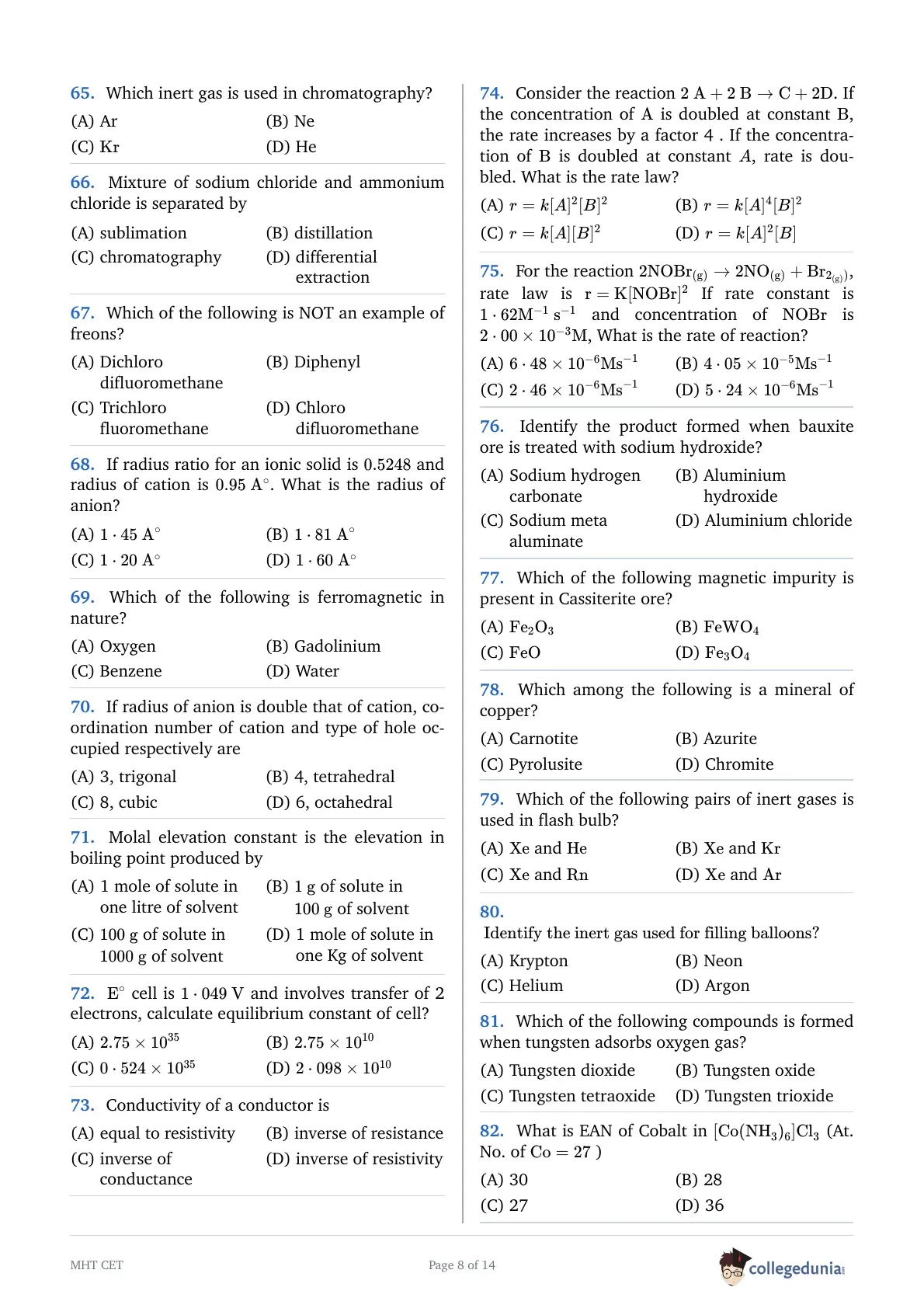
What is EAN of Cobalt in \([\mathrm{Co}(\mathrm{NH}_{3})_{6}]\mathrm{Cl}_{3}\) (At. No. of \(\mathrm{Co}=27\) )

  • (A) 30
  • (B) 28
  • (C) 27
  • (D) 36

Question 83:

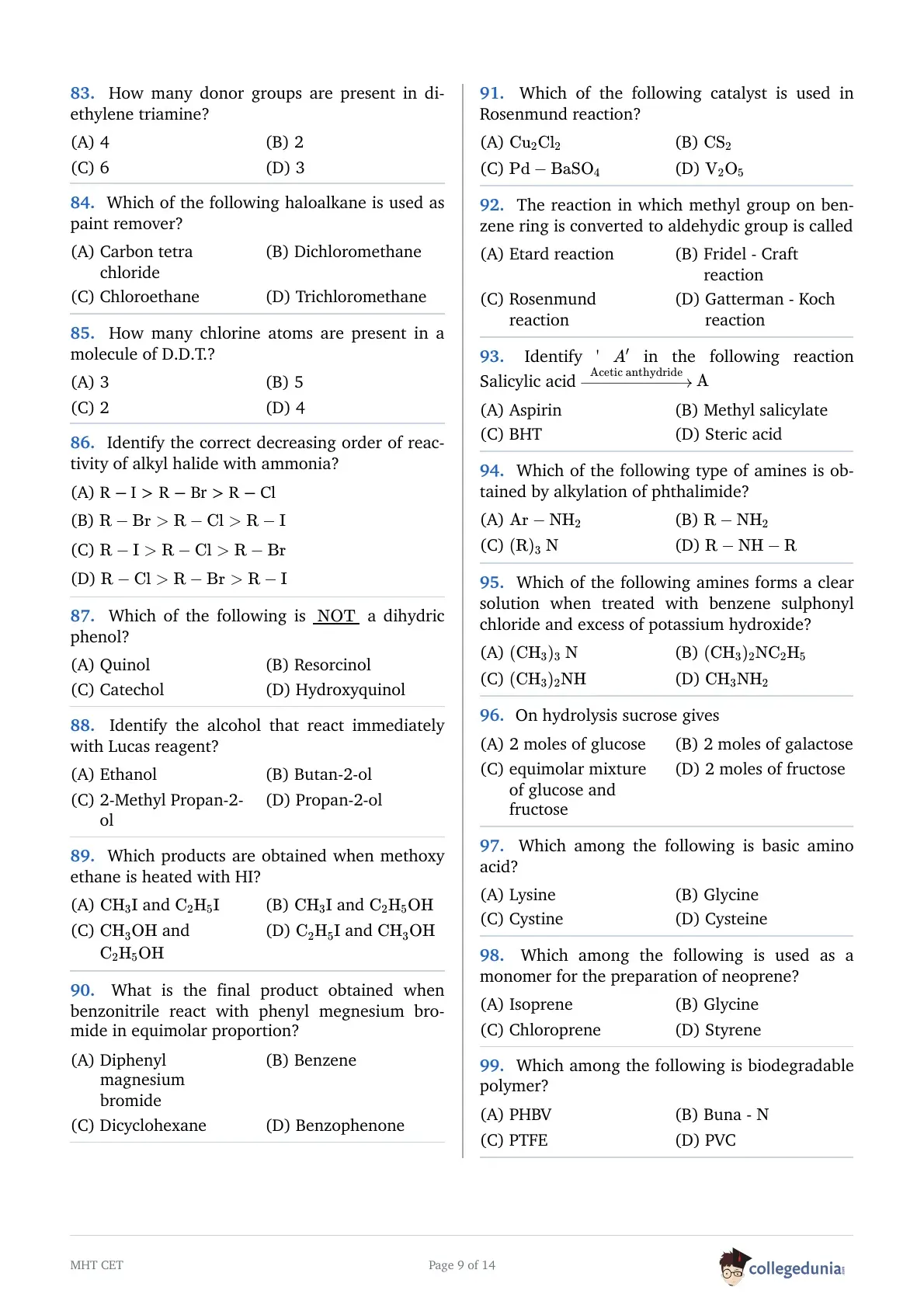
How many donor groups are present in diethylene triamine?

  • (A) 4
  • (B) 2
  • (C) 6
  • (D) 3

Question 84:

Which of the following haloalkane is used as paint remover?

  • (A) Carbon tetra chloride
  • (B) Dichloromethane
  • (C) Chloroethane
  • (D) Trichloromethane

Question 85:

How many chlorine atoms are present in a molecule of D.D.T.?

  • (A) 3
  • (B) 5
  • (C) 2
  • (D) 4

Question 86:

Identify the correct decreasing order of reactivity of alkyl halide with ammonia?

  • (A) \(\mathrm{R}-\mathrm{I}>\mathrm{R}-\mathrm{Br}>\mathrm{R}-\mathrm{Cl}\)
  • (B) \(\mathrm{R}-\mathrm{Br}>\mathrm{R}-\mathrm{Cl}>\mathrm{R}-\mathrm{I}\)
  • (C) \(\mathrm{R}-\mathrm{I}>\mathrm{R}-\mathrm{Cl}>\mathrm{R}-\mathrm{Br}\)
  • (D) \(\mathrm{R}-\mathrm{Cl}>\mathrm{R}-\mathrm{Br}>\mathrm{R}-\mathrm{I}\)

Question 87:

Which of the following is NOT dihydric phenol?

  • (A) Quinol
  • (B) Catechol
  • (C) Phloroglucinol
  • (D) Resorcinol

Question 88:

Identify the alcohol that react immediately with Lucas reagent?

  • (A) Ethanol
  • (B) Butan-2-ol
  • (C) 2-Methyl Propan-2-ol
  • (D) Propan-2-ol

Question 90:

What is the final product obtained when benzonitrile react with phenyl megnesium bromide in equimolar proportion?

  • (A) Diphenyl magnesium bromide
  • (B) Benzene
  • (C) Dicyclohexane
  • (D) Benzophenone

Question 91:

Which of the following catalyst is used in Rosenmund reaction?

  • (A) \(\mathrm{Cu}_{2}\mathrm{Cl}_{2}\)
  • (B) \(\mathrm{CS}_{2}\)
  • (C) \(\mathrm{Pd}-\mathrm{BaSO}_{4}\)
  • (D) \(\mathrm{V}_{2}\mathrm{O}_{5}\)

Question 92:

The reaction in which methyl group on benzene ring is converted to aldehydic group is called

  • (A) Etard reaction
  • (B) Fridel - Craft reaction
  • (C) Rosenmund reaction
  • (D) Gatterman - Koch reaction

Question 93:

Identify ' \(A'\) in the following reaction Salicylic acid \(\xrightarrow{\text{ Acetic anthydride }}\mathrm{A}\)

  • (A) Aspirin
  • (B) Methyl salicylate
  • (C) BHT
  • (D) Steric acid

Question 94:

Which of the following type of amines is obtained by alkylation of phthalimide?

  • (A) \(\mathrm{Ar}-\mathrm{NH}_{2}\)
  • (B) \(\mathrm{R}-\mathrm{NH}_{2}\)
  • (C) \((\mathrm{R})_{3}\ \mathrm{N}\)
  • (D) \(\mathrm{R}-\mathrm{NH}-\mathrm{R}\)

Question 95:

Which of the following amines forms a clear solution when treated with benzene sulphonyl chloride and excess of potassium hydroxide?

  • (A) \((\mathrm{CH}_{3})_{3}\ \mathrm{N}\)
  • (B) \((\mathrm{CH}_{3})_{2}\mathrm{NC}_{2}\mathrm{H}_{5}\)
  • (C) \((\mathrm{CH}_{3})_{2}\mathrm{NH}\)
  • (D) \(\mathrm{CH}_{3}\mathrm{NH}_{2}\)

Question 96:

On hydrolysis sucrose gives

  • (A) 2 moles of glucose
  • (B) 2 moles of galactose
  • (C) equimolar mixture of glucose and fructose
  • (D) 2 moles of fructose

Question 97:

Which among the following is basic amino acid?

  • (A) Lysine
  • (B) Glycine
  • (C) Cystine
  • (D) Cysteine

Question 98:

Which among the following is used as a monomer for the preparation of neoprene?

  • (A) Isoprene
  • (B) Glycine
  • (C) Chloroprene
  • (D) Styrene

Question 99:

Which among the following is biodegradable polymer?

  • (A) PHBV
  • (B) Buna - \(\mathrm{N}\)
  • (C) PTFE
  • (D) PVC

Question 100:

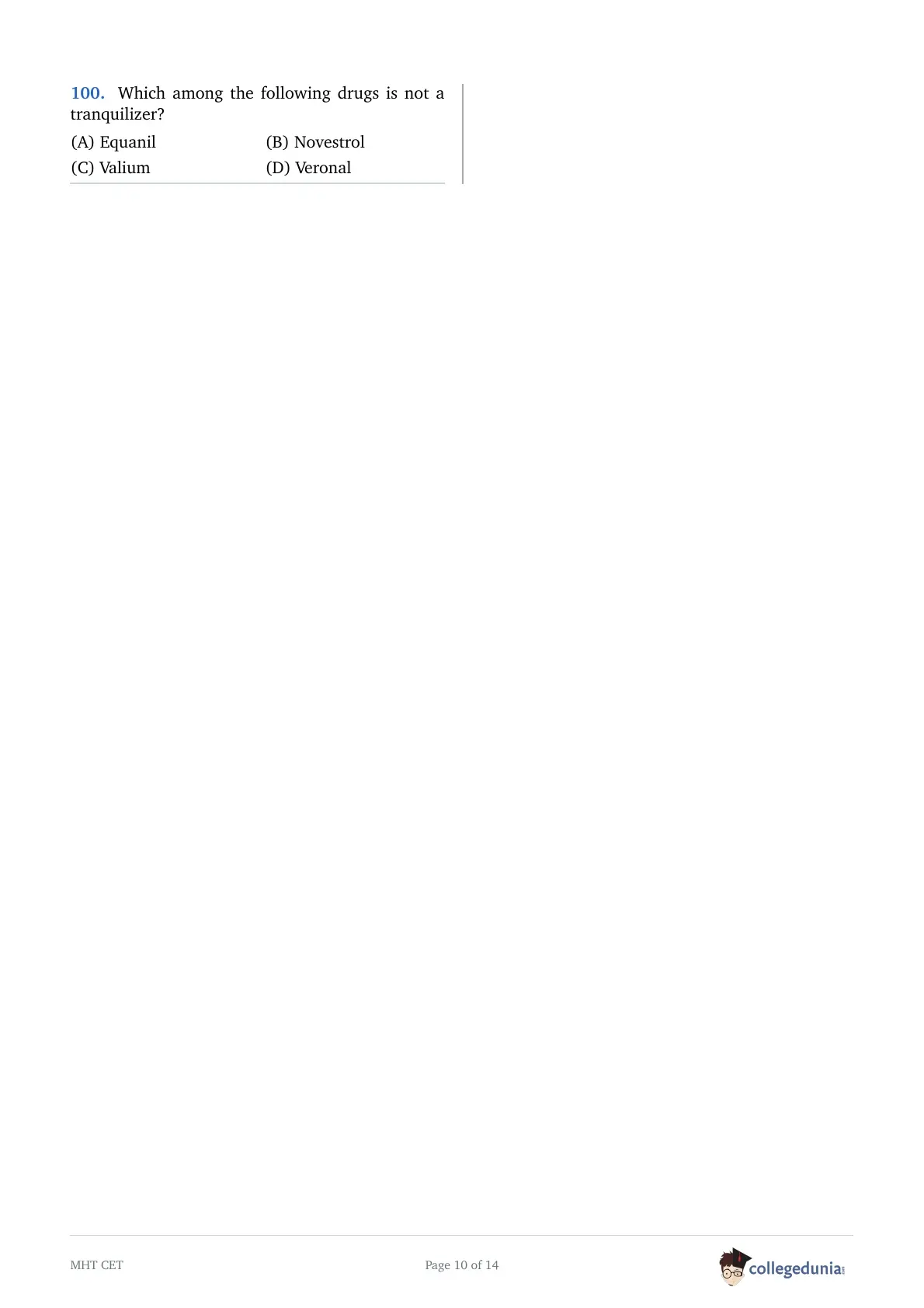
Which among the following drugs is not a tranquilizer?

  • (A) Equanil
  • (B) Novestrol
  • (C) Valium
  • (D) Veronal

Mathematics (Q101 - Q150)

Question 101:

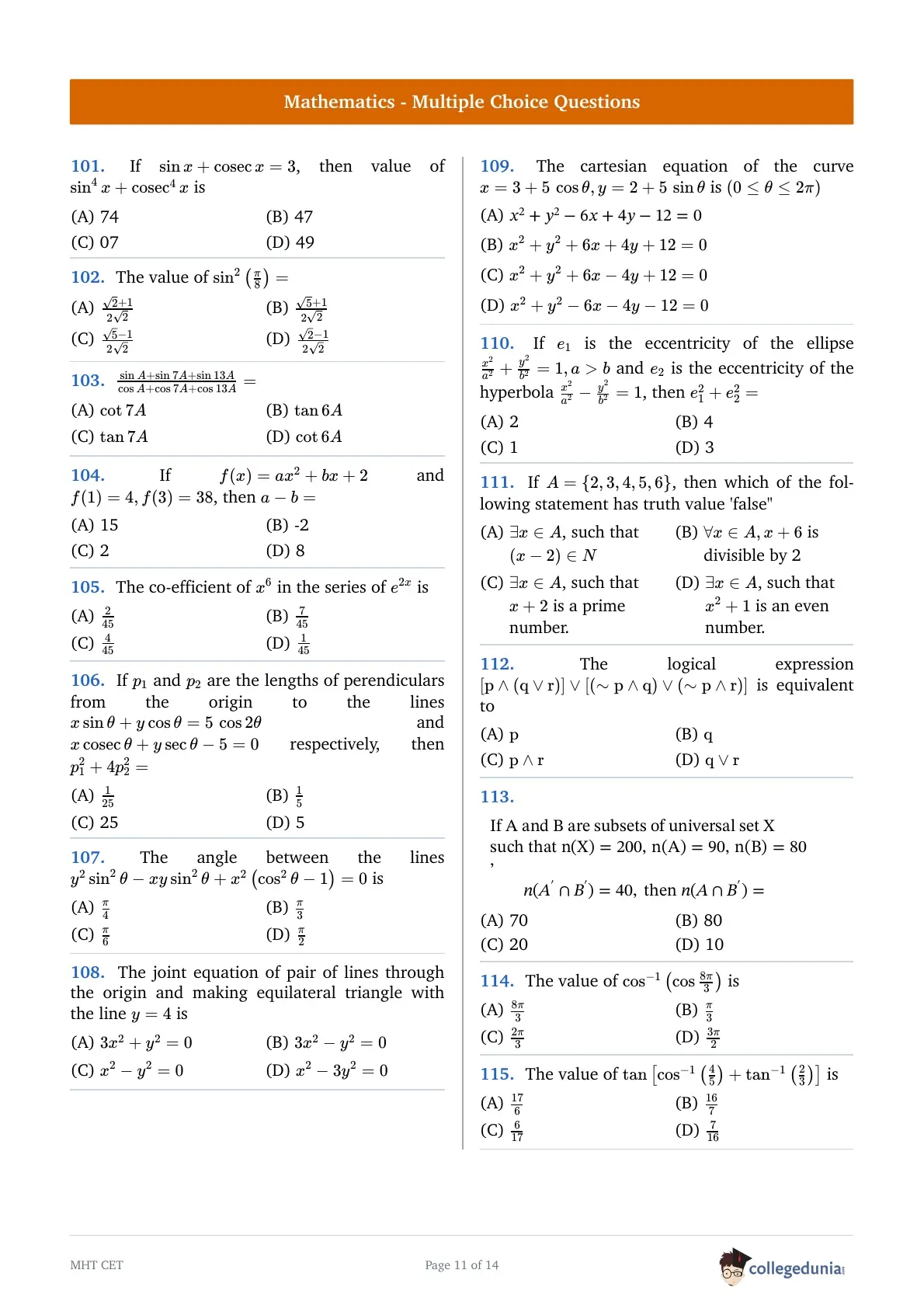
If \(\sin x+\operatorname{cosec} x=3\), then value of \(\sin ^{4}x+\operatorname{cosec}^{4}x\) is

  • (A) 74
  • (B) 47
  • (C) 07
  • (D) 49

Question 102:

The value of \(\sin ^{2}\left(\frac{\pi }{8}\right)=\)

  • (A) \(\frac{\sqrt{2}+1}{2\sqrt{2}}\)
  • (B) \(\frac{\sqrt{5}+1}{2\sqrt{2}}\)
  • (C) \(\frac{\sqrt{5}-1}{2\sqrt{2}}\)
  • (D) \(\frac{\sqrt{2}-1}{2\sqrt{2}}\)

Question 103:

\(\frac{\sin A+\sin 7A+\sin 13A}{\cos A+\cos 7A+\cos 13A}=\)

  • (A) \(\cot 7A\)
  • (B) \(\tan 6A\)
  • (C) \(\tan 7A\)
  • (D) \(\cot 6A\)

Question 104:

If \(f(x)=ax^{2}+bx+2\) and \(f(1)=4,f(3)=38\), then \(a-b=\)

  • (A) 15
  • (B) -2
  • (C) 2
  • (D) 8

Question 105:

The co-efficient of \(x^{6}\) in the series of \(e^{2x}\) is

  • (A) \(\frac{2}{45}\)
  • (B) \(\frac{7}{45}\)
  • (C) \(\frac{4}{45}\)
  • (D) \(\frac{1}{45}\)

Question 106:

If \(p_{1}\) and \(p_{2}\) are the lengths of perendiculars from the origin to the lines \(x\sin \theta +y\cos \theta =5\,\cos 2\theta\) and \(x\operatorname{cosec} \theta +y\sec \theta -5=0\) respectively, then \(p_{1}^{2}+4p_{2}^{2}=\)

  • (A) \(\frac{1}{25}\)
  • (B) \(\frac{1}{5}\)
  • (C) 25
  • (D) 5

Question 107:

The angle between the lines \(y^{2}\sin ^{2}\theta -xy\sin ^{2}\theta +x^{2}\left(\cos ^{2}\theta -1\right)=0\) is

  • (A) \(\frac{\pi }{4}\)
  • (B) \(\frac{\pi }{3}\)
  • (C) \(\frac{\pi }{6}\)
  • (D) \(\frac{\pi }{2}\)

Question 108:

The joint equation of pair of lines through the origin and making equilateral triangle with the line \(y=4\) is

  • (A) \(3x^{2}+y^{2}=0\)
  • (B) \(3x^{2}-y^{2}=0\)
  • (C) \(x^{2}-y^{2}=0\)
  • (D) \(x^{2}-3y^{2}=0\)

Question 109:

The cartesian equation of the curve \(x=3+5\,\cos \theta ,y=2+5\,\sin \theta\) is \((0\leq \theta \leq 2\pi )\)

  • (A) \(x^{2}+y^{2}-6x+4y-12=0\)
  • (B) \(x^{2}+y^{2}+6x+4y+12=0\)
  • (C) \(x^{2}+y^{2}+6x-4y+12=0\)
  • (D) \(x^{2}+y^{2}-6x-4y-12=0\)

Question 110:

If \(e_{1}\) is the eccentricity of the ellipse \(\frac{x^{2}}{a^{2}}+\frac{y^{2}}{b^{2}}=1,a>b\) and \(e_{2}\) is the eccentricity of the hyperbola \(\frac{x^{2}}{a^{2}}-\frac{y^{2}}{b^{2}}=1\), then \(e_{1}^{2}+e_{2}^{2}=\)

  • (A) 2
  • (B) 4
  • (C) 1
  • (D) 3

Question 111:

If \(A=\{2,3,4,5,6\}\), then which of the following statement has truth value 'false"

  • (A) \(\exists x\in A\), such that \((x-2)\in N\)
  • (B) \(\forall x\in A,x+6\) is divisible by 2
  • (C) \(\exists x\in A\), such that \(x+2\) is a prime number.
  • (D) \(\exists x\in A\), such that \(x^{2}+1\) is an even number.

Question 112:

The logical expression \([\mathrm{p}\wedge (\mathrm{q}\vee \mathrm{r})]\vee [(\sim \mathrm{p}\wedge \mathrm{q})\vee (\sim \mathrm{p}\wedge \mathrm{r})]\) is equivalent to

  • (A) \(\mathrm{p}\)
  • (B) \(\mathrm{q}\)
  • (C) \(\mathrm{p}\wedge \mathrm{r}\)
  • (D) \(\mathrm{q}\vee \mathrm{r}\)

Question 113:

\(\begin{matrix} \text{ If }\mathrm{A}\text{ and }\mathrm{B}\text{ are subsets of universal set }\mathrm{X}\text{ such that }\mathrm{n}(\mathrm{X})=200,\,\mathrm{n}(\mathrm{A})=90,\,\mathrm{n}(\mathrm{B})=80\text{ , } \\ n(A'\cap B')=40,\text{ then }n(A\cap B')= \end{matrix}\)

  • (A) 70
  • (B) 80
  • (C) 20
  • (D) 10

Question 114:

The value of \(\cos ^{-1}\left(\cos \frac{8\pi }{3}\right)\) is

  • (A) \(\frac{8\pi }{3}\)
  • (B) \(\frac{\pi }{3}\)
  • (C) \(\frac{2\pi }{3}\)
  • (D) \(\frac{3\pi }{2}\)

Question 115:

The value of \(\tan \left[\cos ^{-1}\left(\frac{4}{5}\right)+\tan ^{-1}\left(\frac{2}{3}\right)\right]\) is

  • (A) \(\frac{17}{6}\)
  • (B) \(\frac{16}{7}\)
  • (C) \(\frac{6}{17}\)
  • (D) \(\frac{7}{16}\)

Question 116:

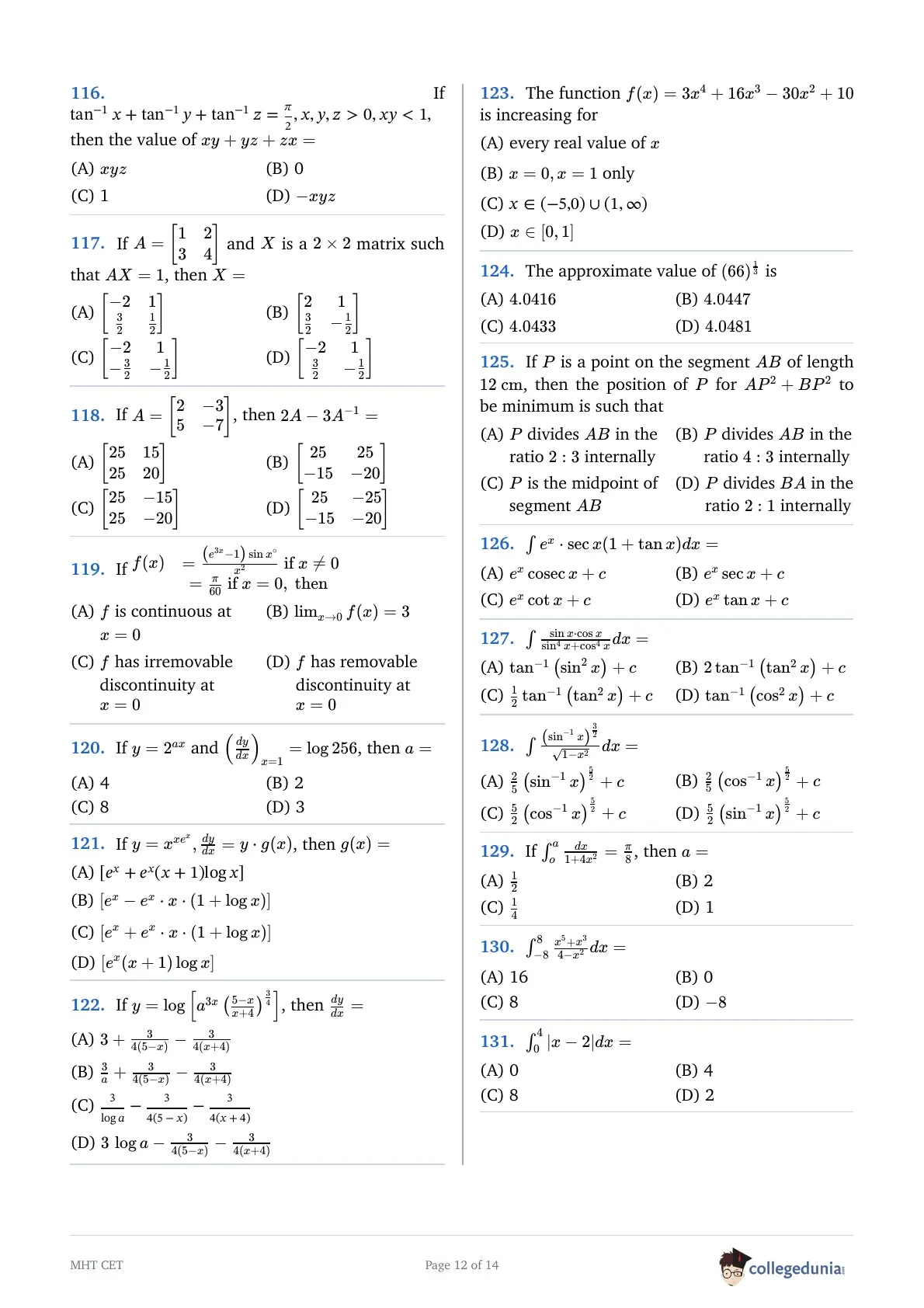
If \(\tan ^{-1}x+\tan ^{-1}y+\tan ^{-1}z=\frac{\pi }{2},x,y,z>0,xy\lt 1,\) then the value of \(xy+yz+zx=\)

  • (A) \(xyz\)
  • (B) 0
  • (C) 1
  • (D) \(-xyz\)

Question 117:

If \(A=\begin{bmatrix} 1 & 2 \\ 3 & 4 \end{bmatrix}\) and \(X\) is a \(2\times 2\) matrix such that \(AX=1\), then \(X=\)

  • (A) \(\begin{bmatrix} -2 & 1 \\ \frac{3}{2} & \frac{1}{2} \end{bmatrix}\)
  • (B) \(\begin{bmatrix} 2 & 1 \\ \frac{3}{2} & -\frac{1}{2} \end{bmatrix}\)
  • (C) \(\begin{bmatrix} -2 & 1 \\ -\frac{3}{2} & -\frac{1}{2} \end{bmatrix}\)
  • (D) \(\begin{bmatrix} -2 & 1 \\ \frac{3}{2} & -\frac{1}{2} \end{bmatrix}\)

Question 118:

If \(A=\begin{bmatrix} 2 & -3 \\ 5 & -7 \end{bmatrix}\), then \(2A-3A^{-1}=\)

  • (A) \(\begin{bmatrix} 25 & 15 \\ 25 & 20 \end{bmatrix}\)
  • (B) \(\begin{bmatrix} 25 & 25 \\ -15 & -20 \end{bmatrix}\)
  • (C) \(\begin{bmatrix} 25 & -15 \\ 25 & -20 \end{bmatrix}\)
  • (D) \(\begin{bmatrix} 25 & -25 \\ -15 & -20 \end{bmatrix}\)

Question 119:

If \(\begin{matrix} f(x) & =\frac{\left(e^{3x}-1\right)\sin x^{\circ }}{x^{2}}\text{ if }x\neq 0 \\ & =\frac{\pi }{60}\text{ if }x=0,\text{ then } \end{matrix}\)

  • (A) \(f\) is continuous at \(x=0\)
  • (B) \(\lim _{x\rightarrow 0}f(x)=3\)
  • (C) \(f\) has irremovable discontinuity at \(x=0\)
  • (D) \(f\) has removable discontinuity at \(x=0\)

Question 120:

If \(y=2^{ax}\) and \(\left(\frac{dy}{dx}\right)_{x=1}=\log 256\), then \(a=\)

  • (A) 4
  • (B) 2
  • (C) 8
  • (D) 3

Question 121:

If \(y=x^{xe^{x}},\frac{dy}{dx}=y\cdot g(x)\), then \(g(x)=\)

  • (A) \([e^{x}+e^{x}(x+1)\log x]\)
  • (B) \([e^{x}-e^{x}\cdot x\cdot (1+\log x)]\)
  • (C) \([e^{x}+e^{x}\cdot x\cdot (1+\log x)]\)
  • (D) \([e^{x}(x+1)\log x]\)

Question 122:

If \(y=\log \left[a^{3x}\left(\frac{5-x}{x+4}\right)^{\frac{3}{4}}\right]\), then \(\frac{dy}{dx}=\)

  • (A) \(3+\frac{3}{4(5-x)}-\frac{3}{4(x+4)}\)
  • (B) \(\frac{3}{a}+\frac{3}{4(5-x)}-\frac{3}{4(x+4)}\)
  • (C) \(\frac{3}{\log a}-\frac{3}{4(5-x)}-\frac{3}{4(x+4)}\)
  • (D) \(3\,\log a-\frac{3}{4(5-x)}-\frac{3}{4(x+4)}\)

Question 123:

The function \(f(x)=3x^{4}+16x^{3}-30x^{2}+10\) is increasing for

  • (A) every real value of \(x\)
  • (B) \(x=0,x=1\) only
  • (C) \(x\in (-5,0)\cup (1,\infty )\)
  • (D) \(x\in [0,1]\)

Question 124:

The approximate value of \((66)^{\frac{1}{3}}\) is

  • (A) \(4.0416\)
  • (B) \(4.0447\)
  • (C) \(4.0433\)
  • (D) \(4.0481\)

Question 125:

If \(P\) is a point on the segment \(AB\) of length \(12\ \mathrm{cm}\), then the position of \(P\) for \(AP^{2}+BP^{2}\) to be minimum is such that

  • (A) \(P\) divides \(AB\) in the ratio \(2:3\) internally
  • (B) \(P\) divides \(AB\) in the ratio \(4:3\) internally
  • (C) \(P\) is the midpoint of segment \(AB\)
  • (D) \(P\) divides \(BA\) in the ratio \(2:1\) internally

Question 126:

\(\int e^{x}\cdot \sec x(1+\tan x)dx=\)

  • (A) \(e^{x}\operatorname{cosec} x+c\)
  • (B) \(e^{x}\sec x+c\)
  • (C) \(e^{x}\cot x+c\)
  • (D) \(e^{x}\tan x+c\)

Question 127:

\(\int \frac{\sin x\cdot \cos x}{\sin ^{4}x+\cos ^{4}x}dx=\)

  • (A) \(\tan ^{-1}\left(\sin ^{2}x\right)+c\)
  • (B) \(2\tan ^{-1}\left(\tan ^{2}x\right)+c\)
  • (C) \(\frac{1}{2}\tan ^{-1}\left(\tan ^{2}x\right)+c\)
  • (D) \(\tan ^{-1}\left(\cos ^{2}x\right)+c\)

Question 128:

\(\int \frac{\left(\sin ^{-1}x\right)^{\frac{3}{2}}}{\sqrt{1-x^{2}}}dx=\)

  • (A) \(\frac{2}{5}\left(\sin ^{-1}x\right)^{\frac{5}{2}}+c\)
  • (B) \(\frac{2}{5}\left(\cos ^{-1}x\right)^{\frac{5}{2}}+c\)
  • (C) \(\frac{5}{2}\left(\cos ^{-1}x\right)^{\frac{5}{2}}+c\)
  • (D) \(\frac{5}{2}\left(\sin ^{-1}x\right)^{\frac{5}{2}}+c\)

Question 129:

If \(\int _{o}^{a}\frac{dx}{1+4x^{2}}=\frac{\pi }{8}\), then \(a=\)

  • (A) \(\frac{1}{2}\)
  • (B) 2
  • (C) \(\frac{1}{4}\)
  • (D) 1

Question 130:

\(\int _{-8}^{8}\frac{x^{5}+x^{3}}{4-x^{2}}dx=\)

  • (A) 16
  • (B) 0
  • (C) 8
  • (D) \(-8\)

Question 131:

\(\int _{0}^{4}|x-2|dx=\)

  • (A) 0
  • (B) 4
  • (C) 8
  • (D) 2

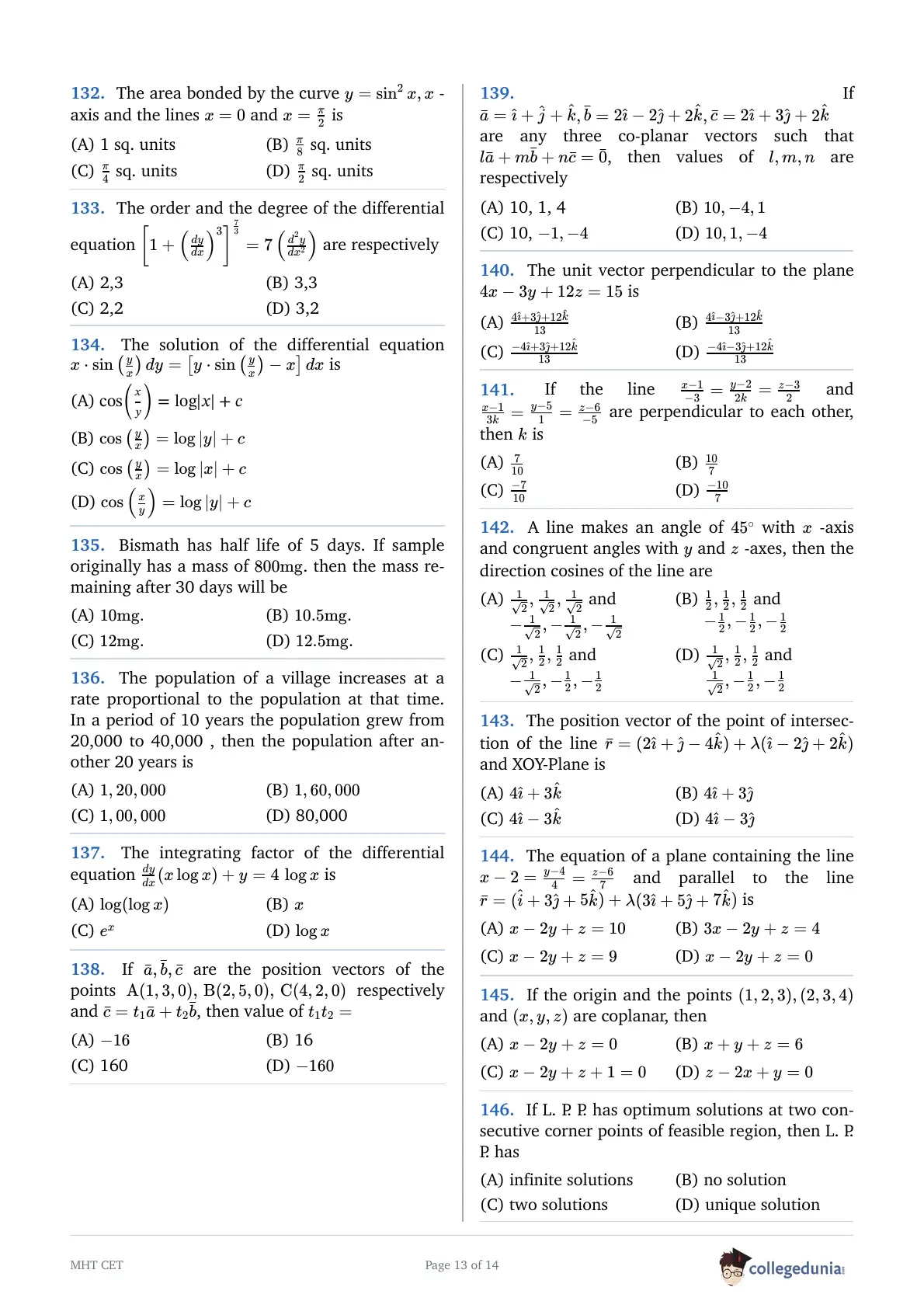
Question 132:

The area bonded by the curve \(y=\sin ^{2}x,x\) -axis and the lines \(x=0\) and \(x=\frac{\pi }{2}\) is

  • (A) 1 sq. units
  • (B) \(\frac{\pi }{8}\) sq. units
  • (C) \(\frac{\pi }{4}\) sq. units
  • (D) \(\frac{\pi }{2}\) sq. units

Question 134:

The solution of the differential equation \(x\cdot \sin \left(\frac{y}{x}\right)dy=\left[y\cdot \sin \left(\frac{y}{x}\right)-x\right]dx\) is

  • (A) \(\cos \left(\frac{x}{y}\right)=\log |x|+c\)
  • (B) \(\cos \left(\frac{y}{x}\right)=\log |y|+c\)
  • (C) \(\cos \left(\frac{y}{x}\right)=\log |x|+c\)
  • (D) \(\cos \left(\frac{x}{y}\right)=\log |y|+c\)

Question 135:

Bismath has half life of 5 days. If sample originally has a mass of \(800\mathrm{mg}\). then the mass remaining after 30 days will be

  • (A) \(10\mathrm{mg}.\)
  • (B) \(10.5\mathrm{mg}.\)
  • (C) \(12\mathrm{mg}.\)
  • (D) \(12.5\mathrm{mg}.\)

Question 136:

The population of a village increases at a rate proportional to the population at that time. In a period of 10 years the population grew from 20,000 to 40,000 , then the population after another 20 years is

  • (A) \(1,20,000\)
  • (B) \(1,60,000\)
  • (C) \(1,00,000\)
  • (D) 80,000

Question 137:

The integrating factor of the differential equation \(\frac{dy}{dx}(x\log x)+y=4\,\log x\) is

  • (A) \(\log (\log x)\)
  • (B) \(x\)
  • (C) \(e^{x}\)
  • (D) \(\log x\)

Question 138:

If \(\bar{a},\bar{b},\bar{c}\) are the position vectors of the points \(\mathrm{A}(1,3,0),\,\mathrm{B}(2,5,0),\,\mathrm{C}(4,2,0)\) respectively and \(\bar{c}=t_{1}\bar{a}+t_{2}\bar{b}\), then value of \(t_{1}t_{2}=\)

  • (A) \(-16\)
  • (B) 16
  • (C) 160
  • (D) \(-160\)

Question 139:

If \(\bar{a}=\hat{\imath}+\hat{j}+\hat{k},\bar{b}=2\hat{\imath}-2\hat{\jmath}+2\hat{k},\bar{c}=2\hat{\imath}+3\hat{\jmath}+2\hat{k}\) are any three co-planar vectors such that \(l\bar{a}+m\bar{b}+n\bar{c}=\bar{0}\), then values of \(l,m,n\) are respectively

  • (A) 10, 1, 4
  • (B) \(10,-4,1\)
  • (C) 10, \(-1,-4\)
  • (D) \(10,1,-4\)

Question 140:

The unit vector perpendicular to the plane \(4x-3y+12z=15\) is

  • (A) \(\frac{4\hat{\imath}+3\hat{\jmath}+12\hat{k}}{13}\)
  • (B) \(\frac{4\hat{\imath}-3\hat{\jmath}+12\hat{k}}{13}\)
  • (C) \(\frac{-4\hat{\imath}+3\hat{\jmath}+12\hat{k}}{13}\)
  • (D) \(\frac{-4\hat{\imath}-3\hat{\jmath}+12\hat{k}}{13}\)

Question 141:

If the line \(\frac{x-1}{-3}=\frac{y-2}{2k}=\frac{z-3}{2}\) and \(\frac{x-1}{3k}=\frac{y-5}{1}=\frac{z-6}{-5}\) are perpendicular to each other, then \(k\) is

  • (A) \(\frac{7}{10}\)
  • (B) \(\frac{10}{7}\)
  • (C) \(\frac{-7}{10}\)
  • (D) \(\frac{-10}{7}\)

Question 142:

A line makes an angle of \(45^{\circ }\) with \(x\) -axis and congruent angles with \(y\) and \(z\) -axes, then the direction cosines of the line are

  • (A) \(\frac{1}{\sqrt{2}},\frac{1}{\sqrt{2}},\frac{1}{\sqrt{2}}\) and \(-\frac{1}{\sqrt{2}},-\frac{1}{\sqrt{2}},-\frac{1}{\sqrt{2}}\)
  • (B) \(\frac{1}{2},\frac{1}{2},\frac{1}{2}\) and \(-\frac{1}{2},-\frac{1}{2},-\frac{1}{2}\)
  • (C) \(\frac{1}{\sqrt{2}},\frac{1}{2},\frac{1}{2}\) and \(-\frac{1}{\sqrt{2}},-\frac{1}{2},-\frac{1}{2}\)
  • (D) \(\frac{1}{\sqrt{2}},\frac{1}{2},\frac{1}{2}\) and \(\frac{1}{\sqrt{2}},-\frac{1}{2},-\frac{1}{2}\)

Question 143:

The position vector of the point of intersection of the line \(\bar{r}=(2\hat{\imath}+\hat{\jmath}-4\hat{k})+\lambda (\hat{\imath}-2\hat{\jmath}+2\hat{k})\) and XOY-Plane is

  • (A) \(4\hat{\imath}+3\hat{k}\)
  • (B) \(4\hat{\imath}+3\hat{\jmath}\)
  • (C) \(4\hat{\imath}-3\hat{k}\)
  • (D) \(4\hat{\imath}-3\hat{\jmath}\)

Question 144:

The equation of a plane containing the line \(x-2=\frac{y-4}{4}=\frac{z-6}{7}\) and parallel to the line \(\bar{r}=(\hat{i}+3\hat{\jmath}+5\hat{k})+\lambda (3\hat{\imath}+5\hat{\jmath}+7\hat{k})\) is

  • (A) \(x-2y+z=10\)
  • (B) \(3x-2y+z=4\)
  • (C) \(x-2y+z=9\)
  • (D) \(x-2y+z=0\)

Question 145:

If the origin and the points \((1,2,3),(2,3,4)\) and \((x,y,z)\) are coplanar, then

  • (A) \(x-2y+z=0\)
  • (B) \(x+y+z=6\)
  • (C) \(x-2y+z+1=0\)
  • (D) \(z-2x+y=0\)

Question 146:

If L. P. P. has optimum solutions at two consecutive corner points of feasible region, then L. P. P. has

  • (A) infinite solutions
  • (B) no solution
  • (C) two solutions
  • (D) unique solution

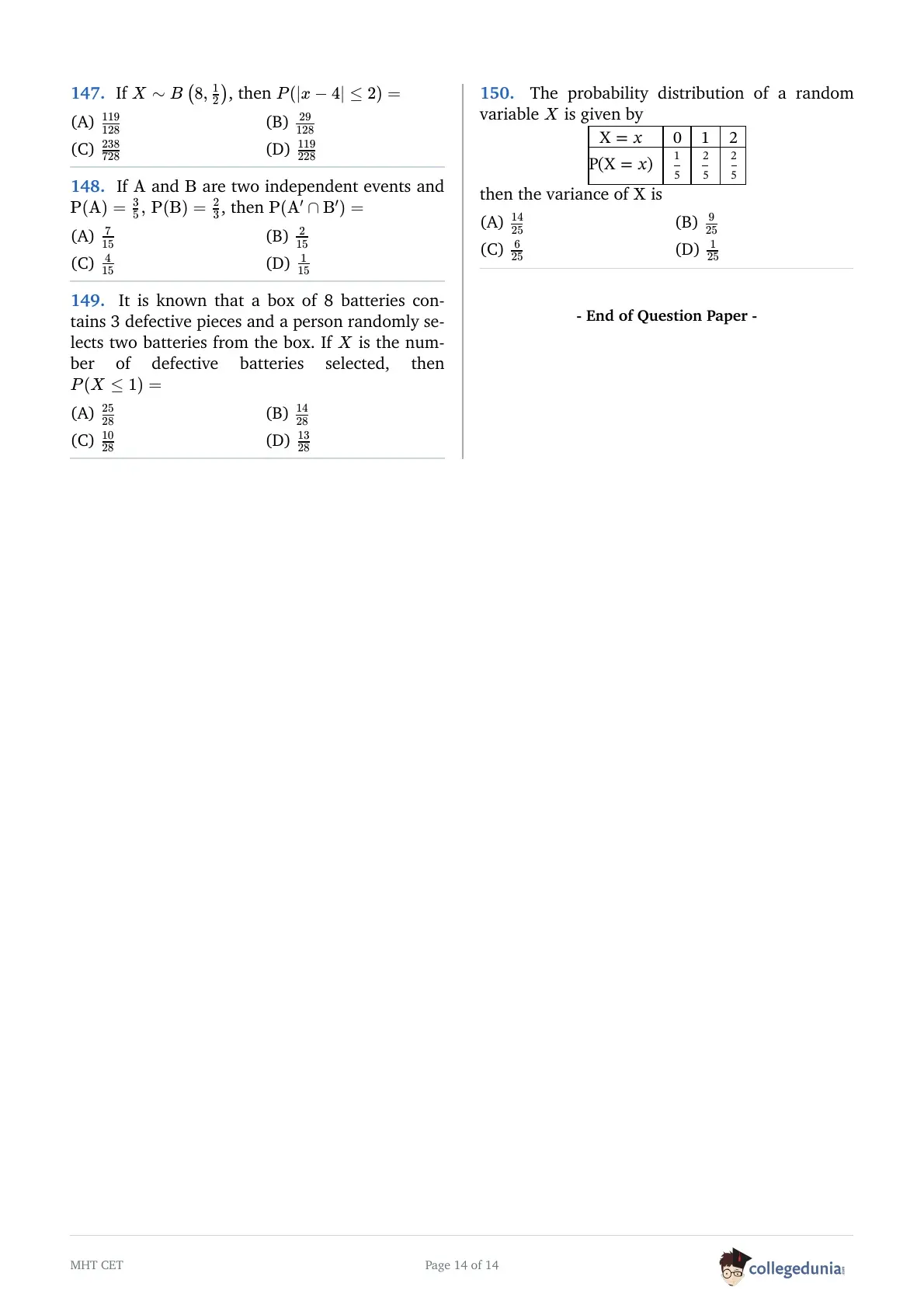
Question 147:

If \(X\sim B\left(8,\frac{1}{2}\right)\), then \(P(|x-4|\leq 2)=\)

  • (A) \(\frac{119}{128}\)
  • (B) \(\frac{29}{128}\)
  • (C) \(\frac{238}{728}\)
  • (D) \(\frac{119}{228}\)

Question 148:

If \(\mathrm{A}\) and \(\mathrm{B}\) are two independent events and \(\mathrm{P}(\mathrm{A})=\frac{3}{5},\,\mathrm{P}(\mathrm{B})=\frac{2}{3}\), then \(\mathrm{P}(\mathrm{A}'\cap \mathrm{B}')=\)

  • (A) \(\frac{7}{15}\)
  • (B) \(\frac{2}{15}\)
  • (C) \(\frac{4}{15}\)
  • (D) \(\frac{1}{15}\)

Question 149:

It is known that a box of 8 batteries contains 3 defective pieces and a person randomly selects two batteries from the box. If \(X\) is the number of defective batteries selected, then \(P(X\leq 1)=\)

  • (A) \(\frac{25}{28}\)
  • (B) \(\frac{14}{28}\)
  • (C) \(\frac{10}{28}\)
  • (D) \(\frac{13}{28}\)

Question 150:

The probability distribution of a random variable \(X\) is given by \[\begin{array}{|c|c|c|c|} \hline \mathrm{X}=x & 0 & 1 & 2 \\ \hline \mathrm{P}(\mathrm{X}=x) & \frac{1}{5} & \frac{2}{5} & \frac{2}{5} \\ \hline \end{array}\] then the variance of \(\mathrm{X}\) is

  • (A) \(\frac{14}{25}\)
  • (B) \(\frac{9}{25}\)
  • (C) \(\frac{6}{25}\)
  • (D) \(\frac{1}{25}\)

MHT CET 2020 PCM Exam Pattern and Marking Scheme

Parameter Details
Conducting Body Maharashtra Common Entrance Test Cell (Maharashtra CET Cell)
Exam Mode Online (Computer-Based Test)
Duration 180 minutes (3 hours)
Groups / Subjects PCM (Physics, Chemistry, Mathematics) for Engineering
Total Questions

150

Total Marks 200
Question Type Multiple Choice Questions (MCQs)
Marks Distribution
  • Mathematics – 2 marks/question
  • Physics and Chemistry – 1 mark/question
Negative Marking No
Syllabus Weightage
  • Class 12 – 80%
  • Class 11 – 20%