MHT CET 2023 May 14 Shift 1 PCM Question Paper is available for download here. Maharashtra State CET Cell conducted MHT CET 2023 PCM Exam on May 14 in Shift 1 from 9 AM to 12 PM in CBT mode.

The MHT CET 2023 PCM question paper includes the following:

  • The MHT CET 2023 PCM Question Paper consists of 150 multiple-choice questions (MCQs) totalling 200 marks divided into 3 sections: Physics, Chemistry, and Mathematics, with 50 questions in each subject.
  • Physics and Chemistry questions carry 1 mark each while Mathematics questions carry 2 marks each.
  • There is no negative marking for incorrect answers.

MHT CET 2023 May 14 Shift 1 PCM Question Paper with Solution PDF

CD PDF CD PDF with Solutions
Download Collegedunia PDF 1.07 MB -

Also Check:

MHT CET 2023 May 14 Shift 1 PCM Questions with Solutions


Physics (Q1 - Q50)

Question 1:

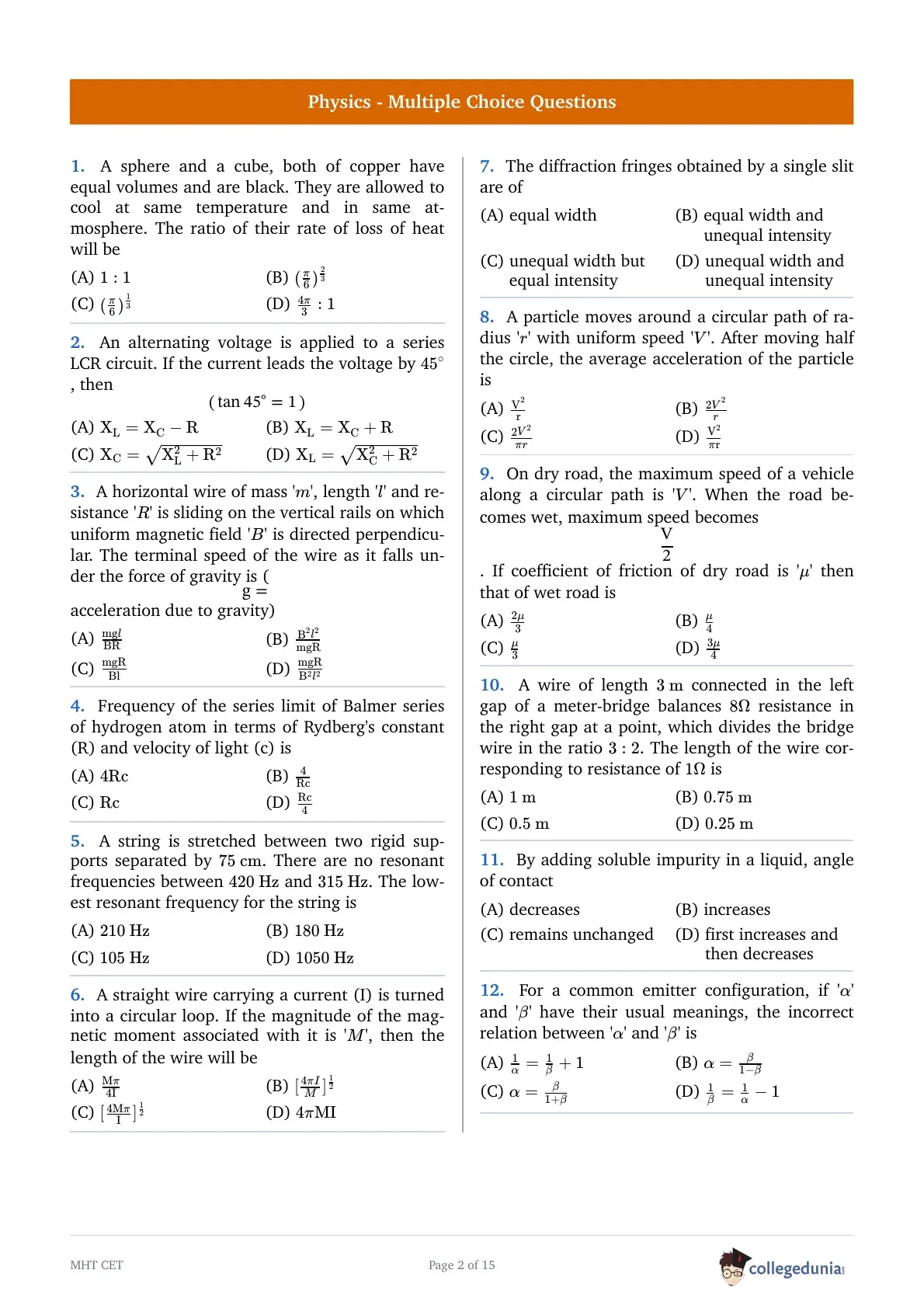
A sphere and a cube, both of copper have equal volumes and are black. They are allowed to cool at same temperature and in same atmosphere. The ratio of their rate of loss of heat will be

  • (A) \(1:1\)
  • (B) \((\frac{\pi}{6})^{\frac{2}{3}}\)
  • (C) \((\frac{\pi}{6})^{\frac{1}{3}}\)
  • (D) \(\frac{4\pi}{3}:1\)

Question 3:

A horizontal wire of mass '\[m\]', length '\[l\]' and resistance '\[R\]' is sliding on the vertical rails on which uniform magnetic field '\[B\]' is directed perpendicular. The terminal speed of the wire as it falls under the force of gravity is ( \[\mathrm{g}=\] acceleration due to gravity)

  • (A) \(\frac{\mathrm{mg}l}{\mathrm{BR}}\)
  • (B) \(\frac{\mathrm{B}^{2}l^{2}}{\mathrm{mgR}}\)
  • (C) \(\frac{\mathrm{mgR}}{\mathrm{Bl}}\)
  • (D) \(\frac{\mathrm{mgR}}{\mathrm{B}^{2}l^{2}}\)

Question 4:

Frequency of the series limit of Balmer series of hydrogen atom in terms of Rydberg's constant (R) and velocity of light (c) is

  • (A) \(4\mathrm{Rc}\)
  • (B) \(\frac{4}{\mathrm{Rc}}\)
  • (C) \(\mathrm{Rc}\)
  • (D) \(\frac{\mathrm{Rc}}{4}\)

Question 5:

A string is stretched between two rigid supports separated by \[75 \mathrm{~cm}\]. There are no resonant frequencies between \[420 \mathrm{~Hz}\] and \[315 \mathrm{~Hz}\]. The lowest resonant frequency for the string is

  • (A) \(210\text{ }\mathrm{Hz}\)
  • (B) \(180\text{ }\mathrm{Hz}\)
  • (C) \(105\text{ }\mathrm{Hz}\)
  • (D) \(1050\text{ }\mathrm{Hz}\)

Question 6:

A straight wire carrying a current (I) is turned into a circular loop. If the magnitude of the magnetic moment associated with it is '\[M\]', then the length of the wire will be

  • (A) \(\frac{\mathrm{M}\pi}{4\mathrm{I}}\)
  • (B) \([\frac{4\pi I}{M}]^{\frac{1}{2}}\)
  • (C) \([\frac{4\mathrm{M}\pi}{\mathrm{I}}]^{\frac{1}{2}}\)
  • (D) \(4\pi \mathrm{MI}\)

Question 7:

The diffraction fringes obtained by a single slit are of

  • (A) equal width
  • (B) equal width and unequal intensity
  • (C) unequal width but equal intensity
  • (D) unequal width and unequal intensity

Question 8:

A particle moves around a circular path of radius '\[r\]' with uniform speed '\[V\]'. After moving half the circle, the average acceleration of the particle is

  • (A) \(\frac{\mathrm{V}^{2}}{\mathrm{r}}\)
  • (B) \(\frac{2V^{2}}{r}\)
  • (C) \(\frac{2V^{2}}{\pi r}\)
  • (D) \(\frac{\mathrm{V}^{2}}{\pi \mathrm{r}}\)

Question 9:

On dry road, the maximum speed of a vehicle along a circular path is '\[V\]'. When the road becomes wet, maximum speed becomes \[\frac{\mathrm{V}}{2}\]. If coefficient of friction of dry road is '\[\mu\]' then that of wet road is

  • (A) \(\frac{2\mu}{3}\)
  • (B) \(\frac{\mu}{4}\)
  • (C) \(\frac{\mu}{3}\)
  • (D) \(\frac{3\mu}{4}\)

Question 10:

A wire of length \[3 \mathrm{~m}\] connected in the left gap of a meter-bridge balances \[8 \Omega\] resistance in the right gap at a point, which divides the bridge wire in the ratio \[3: 2\]. The length of the wire corresponding to resistance of \[1 \Omega\] is

  • (A) \(1\text{ }\mathrm{m}\)
  • (B) \(0.75\text{ }\mathrm{m}\)
  • (C) \(0.5\text{ }\mathrm{m}\)
  • (D) \(0.25\text{ }\mathrm{m}\)

Question 11:

By adding soluble impurity in a liquid, angle of contact

  • (A) decreases
  • (B) increases
  • (C) remains unchanged
  • (D) first increases and then decreases

Question 12:

For a common emitter configuration, if '\[\alpha\]' and '\[\beta\]' have their usual meanings, the incorrect relation between '\[\alpha\]' and '\[\beta\]' is

  • (A) \(\frac{1}{\alpha}=\frac{1}{\beta}+1\)
  • (B) \(\alpha =\frac{\beta}{1-\beta}\)
  • (C) \(\alpha =\frac{\beta}{1+\beta}\)
  • (D) \(\frac{1}{\beta}=\frac{1}{\alpha}-1\)

Question 13:

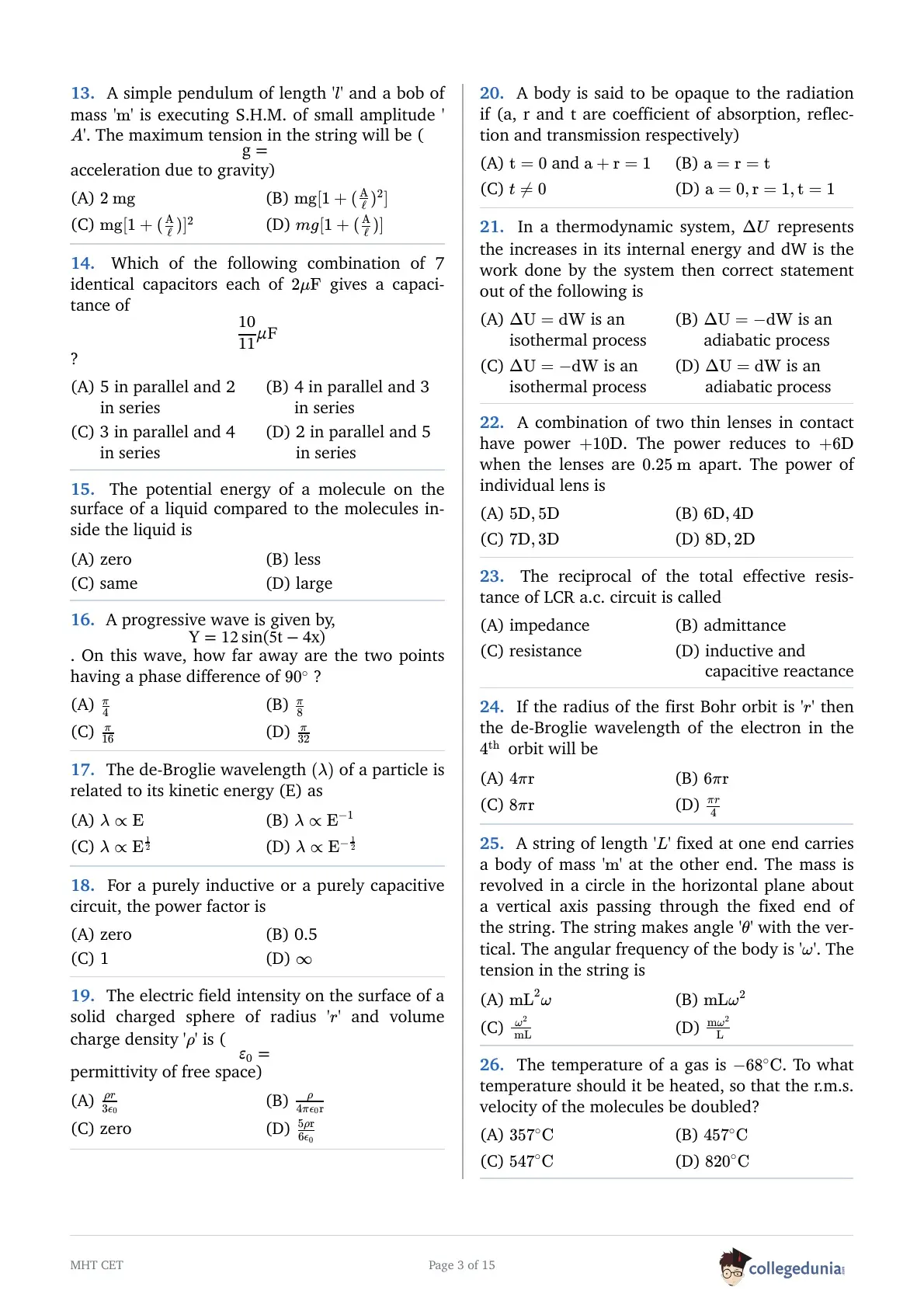
A simple pendulum of length '\[l\]' and a bob of mass '\[\mathrm{m}\]' is executing S.H.M. of small amplitude '\[A\]'. The maximum tension in the string will be (\[\mathrm{g}=\] acceleration due to gravity)

  • (A) \(2\text{ }\mathrm{mg}\)
  • (B) \(\mathrm{mg}[1+(\frac{\mathrm{A}}{\ell})^{2}]\)
  • (C) \(\mathrm{mg}[1+(\frac{\mathrm{A}}{\ell})]^{2}\)
  • (D) \(mg[1+(\frac{\mathrm{A}}{\ell})]\)

Question 14:

Which of the following combination of 7 identical capacitors each of \[2 \mu \mathrm{F}\] gives a capacitance of \[\frac{10}{11} \mu \mathrm{F}\] ?

  • (A) 5 in parallel and 2 in series
  • (B) 4 in parallel and 3 in series
  • (C) 3 in parallel and 4 in series
  • (D) 2 in parallel and 5 in series

Question 15:

The potential energy of a molecule on the surface of a liquid compared to the molecules inside the liquid is

  • (A) zero
  • (B) less
  • (C) same
  • (D) large

Question 16:

A progressive wave is given by, \[\mathrm{Y}=12 \sin (5 \mathrm{t}-4 \mathrm{x})\]. On this wave, how far away are the two points having a phase difference of \[90^{\circ}\] ?

  • (A) \(\frac{\pi}{4}\)
  • (B) \(\frac{\pi}{8}\)
  • (C) \(\frac{\pi}{16}\)
  • (D) \(\frac{\pi}{32}\)

Question 17:

The de-Broglie wavelength \[(\lambda)\] of a particle is related to its kinetic energy (E) as

  • (A) \(\lambda \propto \mathrm{E}\)
  • (B) \(\lambda \propto \mathrm{E}^{-1}\)
  • (C) \(\lambda \propto \mathrm{E}^{\frac{1}{2}}\)
  • (D) \(\lambda \propto \mathrm{E}^{-\frac{1}{2}}\)

Question 18:

For a purely inductive or a purely capacitive circuit, the power factor is

  • (A) zero
  • (B) 0.5
  • (C) 1
  • (D) \(\infty\)

Question 19:

The electric field intensity on the surface of a solid charged sphere of radius '\[r\]' and volume charge density '\[\rho\]' is (\[\varepsilon_0=\] permittivity of free space)

  • (A) \(\frac{\rho r}{3\epsilon _{0}}\)
  • (B) \(\frac{\rho}{4\pi \epsilon _{0}\mathrm{r}}\)
  • (C) zero
  • (D) \(\frac{5\rho \mathrm{r}}{6\epsilon _{0}}\)

Question 20:

A body is said to be opaque to the radiation if (a, r and t are coefficient of absorption, reflection and transmission respectively)

  • (A) \(\mathrm{t}=0\) and \(\mathrm{a}+\mathrm{r}=1\)
  • (B) \(\mathrm{a}=\mathrm{r}=\mathrm{t}\)
  • (C) \(t\neq 0\)
  • (D) \(\mathrm{a}=0,\mathrm{r}=1,\mathrm{t}=1\)

Question 21:

In a thermodynamic system, \[\Delta U\] represents the increases in its internal energy and dW is the work done by the system then correct statement out of the following is

  • (A) \(\Delta \mathrm{U}=\mathrm{dW}\) is an isothermal process
  • (B) \(\Delta \mathrm{U}=-\mathrm{dW}\) is an adiabatic process
  • (C) \(\Delta \mathrm{U}=-\mathrm{dW}\) is an isothermal process
  • (D) \(\Delta \mathrm{U}=\mathrm{dW}\) is an adiabatic process

Question 22:

A combination of two thin lenses in contact have power \[+10 \mathrm{D}\]. The power reduces to \[+6 \mathrm{D}\] when the lenses are \[0.25 \mathrm{~m}\] apart. The power of individual lens is

  • (A) \(5\mathrm{D},5\mathrm{D}\)
  • (B) \(6\mathrm{D},4\mathrm{D}\)
  • (C) \(7\mathrm{D},3\mathrm{D}\)
  • (D) \(8\mathrm{D},2\mathrm{D}\)

Question 23:

The reciprocal of the total effective resistance of LCR a.c. circuit is called

  • (A) impedance
  • (B) admittance
  • (C) resistance
  • (D) inductive and capacitive reactance

Question 24:

If the radius of the first Bohr orbit is '\[r\]' then the de-Broglie wavelength of the electron in the \[4^{\text {th }}\] orbit will be

  • (A) \(4\pi \mathrm{r}\)
  • (B) \(6\pi \mathrm{r}\)
  • (C) \(8\pi \mathrm{r}\)
  • (D) \(\frac{\pi r}{4}\)

Question 25:

A string of length '\[L\]' fixed at one end carries a body of mass '\[\mathrm{m}\]' at the other end. The mass is revolved in a circle in the horizontal plane about a vertical axis passing through the fixed end of the string. The string makes angle '\[\theta\]' with the vertical. The angular frequency of the body is '\[\omega\]'. The tension in the string is

  • (A) \(\mathrm{mL}^{2}\omega\)
  • (B) \(\mathrm{mL}\omega ^{2}\)
  • (C) \(\frac{\omega ^{2}}{\text{ }\mathrm{mL}}\)
  • (D) \(\frac{\mathrm{m}\omega ^{2}}{\text{ }\mathrm{L}}\)

Question 26:

The temperature of a gas is \[-68^{\circ} \mathrm{C}\]. To what temperature should it be heated, so that the r.m.s. velocity of the molecules be doubled?

  • (A) \(357^{\circ}\mathrm{C}\)
  • (B) \(457^{\circ}\mathrm{C}\)
  • (C) \(547^{\circ}\mathrm{C}\)
  • (D) \(820^{\circ}\mathrm{C}\)

Question 27:

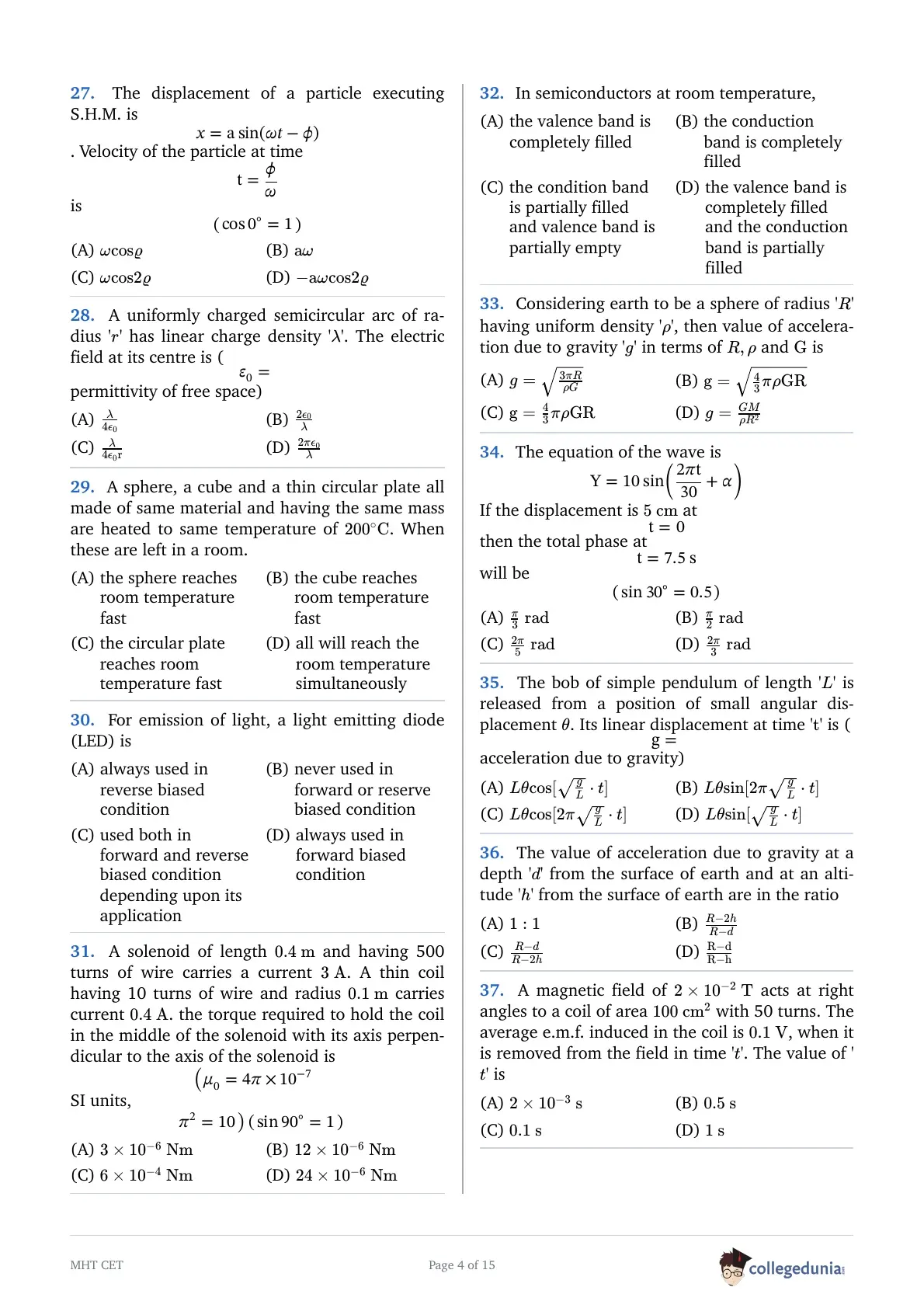
The displacement of a particle executing S.H.M. is \[x=\mathrm{a} \sin (\omega t-\phi)\]. Velocity of the particle at time \[\mathrm{t}=\frac{\phi}{\omega}\] is \[\left(\cos 0^{\circ}=1\right)\]

  • (A) \(\omega \mathrm{cos}\varrho\)
  • (B) \(\mathrm{a}\omega\)
  • (C) \(\omega \mathrm{cos}2\varrho\)
  • (D) \(-\mathrm{a}\omega \mathrm{cos}2\varrho\)

Question 29:

A sphere, a cube and a thin circular plate all made of same material and having the same mass are heated to same temperature of \[200^{\circ} \mathrm{C}\]. When these are left in a room.

  • (A) the sphere reaches room temperature fast
  • (B) the cube reaches room temperature fast
  • (C) the circular plate reaches room temperature fast
  • (D) all will reach the room temperature simultaneously

Question 30:

For emission of light, a light emitting diode (LED) is

  • (A) always used in reverse biased condition
  • (B) never used in forward or reserve biased condition
  • (C) used both in forward and reverse biased condition depending upon its application
  • (D) always used in forward biased condition

Question 31:

A solenoid of length \[0.4 \mathrm{~m}\] and having 500 turns of wire carries a current \[3 \mathrm{~A}\]. A thin coil having 10 turns of wire and radius \[0.1 \mathrm{~m}\] carries current \[0.4 \mathrm{~A}\]. the torque required to hold the coil in the middle of the solenoid with its axis perpendicular to the axis of the solenoid is \[\left(\mu_0=4 \pi \times 10^{-7}\right.\] SI units, \[\left.\pi^2=10\right)\left(\sin 90^{\circ}=1\right)\]

  • (A) \(3\times 10^{-6}\text{ }\mathrm{Nm}\)
  • (B) \(12\times 10^{-6}\text{ }\mathrm{Nm}\)
  • (C) \(6\times 10^{-4}\text{ }\mathrm{Nm}\)
  • (D) \(24\times 10^{-6}\text{ }\mathrm{Nm}\)

Question 33:

Considering earth to be a sphere of radius '\[R\]' having uniform density '\[\rho\]', then value of acceleration due to gravity '\[g\]' in terms of \[R, \rho\] and \[\mathrm{G}\] is

  • (A) \(g=\sqrt{\frac{3\pi R}{\rho G}}\)
  • (B) \(\mathrm{g}=\sqrt{\frac{4}{3}\pi \rho \mathrm{GR}}\)
  • (C) \(\mathrm{g}=\frac{4}{3}\pi \rho \mathrm{GR}\)
  • (D) \(g=\frac{GM}{\rho R^{2}}\)

Question 34:

The equation of the wave is \[\mathrm{Y}=10 \sin \left(\frac{2 \pi \mathrm{t}}{30}+\alpha\right)\] If the displacement is \[5 \mathrm{~cm}\] at \[\mathrm{t}=0\] then the total phase at \[\mathrm{t}=7.5 \mathrm{~s}\] will be \[\left(\sin 30^{\circ}=0.5\right)\]

  • (A) \(\frac{\pi}{3}\text{ }\mathrm{rad}\)
  • (B) \(\frac{\pi}{2}\text{ }\mathrm{rad}\)
  • (C) \(\frac{2\pi}{5}\text{ }\mathrm{rad}\)
  • (D) \(\frac{2\pi}{3}\text{ }\mathrm{rad}\)

Question 35:

The bob of simple pendulum of length '\[L\]' is released from a position of small angular displacement \[\theta\]. Its linear displacement at time '\[\mathrm{t}\]' is ( \[\mathrm{g}=\] acceleration due to gravity)

  • (A) \(L\theta \mathrm{cos}[\sqrt{\frac{g}{L}}\cdot t]\)
  • (B) \(L\theta \mathrm{sin}[2\pi \sqrt{\frac{g}{L}}\cdot t]\)
  • (C) \(L\theta \mathrm{cos}[2\pi \sqrt{\frac{g}{L}}\cdot t]\)
  • (D) \(L\theta \mathrm{sin}[\sqrt{\frac{g}{L}}\cdot t]\)

Question 36:

The value of acceleration due to gravity at a depth '\[d\]' from the surface of earth and at an altitude '\[h\]' from the surface of earth are in the ratio

  • (A) \(1:1\)
  • (B) \(\frac{R-2h}{R-d}\)
  • (C) \(\frac{R-d}{R-2h}\)
  • (D) \(\frac{\mathrm{R}-\mathrm{d}}{\mathrm{R}-\mathrm{h}}\)

Question 37:

A magnetic field of \[2 \times 10^{-2} \mathrm{~T}\] acts at right angles to a coil of area \[100 \mathrm{~cm}^2\] with 50 turns. The average e.m.f. induced in the coil is \[0.1 \mathrm{~V}\], when it is removed from the field in time '\[t\]'. The value of '\[t\]' is

  • (A) \(2\times 10^{-3}\text{ }\mathrm{s}\)
  • (B) \(0.5\text{ }\mathrm{s}\)
  • (C) \(0.1\text{ }\mathrm{s}\)
  • (D) \(1\text{ }\mathrm{s}\)

Question 38:

In Young's double slit experiment, \[8^{\text {th }}\] maximum with wavelength '\[\lambda_1\]' is at a distance '\[d_1\]' from the central maximum and \[6^{\text {th }}\] maximum with wavelength '\[\lambda_2\]' is at a distance '\[\mathrm{d}_2\]'. Then \[\frac{\mathrm{d}_2}{\mathrm{~d}_1}\] is

  • (A) \(\frac{3\lambda _{1}}{4\lambda _{2}}\)
  • (B) \(\frac{3\lambda _{2}}{4\lambda _{1}}\)
  • (C) \(\frac{4\lambda _{1}}{3\lambda _{2}}\)
  • (D) \(\frac{4\lambda _{2}}{3\lambda _{1}}\)

Question 39:

The alternating e.m.f. induced in the secondary coil of a transformer is mainly due to

  • (A) varying electric field
  • (B) varying magnetic field
  • (C) the iron core
  • (D) heat produced in the coil

Question 40:

The efficiency of a heat engine is '\[\eta\]' and the coefficient of performance of a refrigerator is '\[\beta\]'. Then

  • (A) \(\eta =\frac{1}{\beta}\)
  • (B) \(\eta =\frac{1}{\beta +1}\)
  • (C) \(\eta \beta =\frac{1}{2}\)
  • (D) \(\eta =\frac{1}{\beta -1}\)

Question 41:

A conducting sphere of radius \[0.1 \mathrm{~m}\] has uniform charge density \[1.8 \mu \mathrm{C} / \mathrm{m}^2\] on its surface. The electric field in free space at radial distance \[0.2 \mathrm{~m}\] from a point on the surface is ( \[\varepsilon_0=\] permittivity of free space)

  • (A) \(\frac{6\times 10^{-6}}{\epsilon _{0}}\mathrm{Vm}^{-1}\)
  • (B) \(\frac{6\times 10^{-8}}{\epsilon _{0}}\mathrm{Vm}^{-1}\)
  • (C) \(\frac{2\times 10^{-7}}{\epsilon _{0}}\mathrm{Vm}^{-1}\)
  • (D) \(\frac{1\times 10^{-7}}{\epsilon _{0}}\mathrm{Vm}^{-1}\)

Question 43:

Two circular coils made from same wire but radius of \[1^{\text {st }}\] coil is twice that of \[2^{\text {nd }}\] coil. If magnetic field at their centres is same then ratio of potential difference applied across them is (\[1^{\text {st }}\] to \[2^{\text {nd }}\] coil)

  • (A) 2
  • (B) 3
  • (C) 4
  • (D) 6

Question 44:

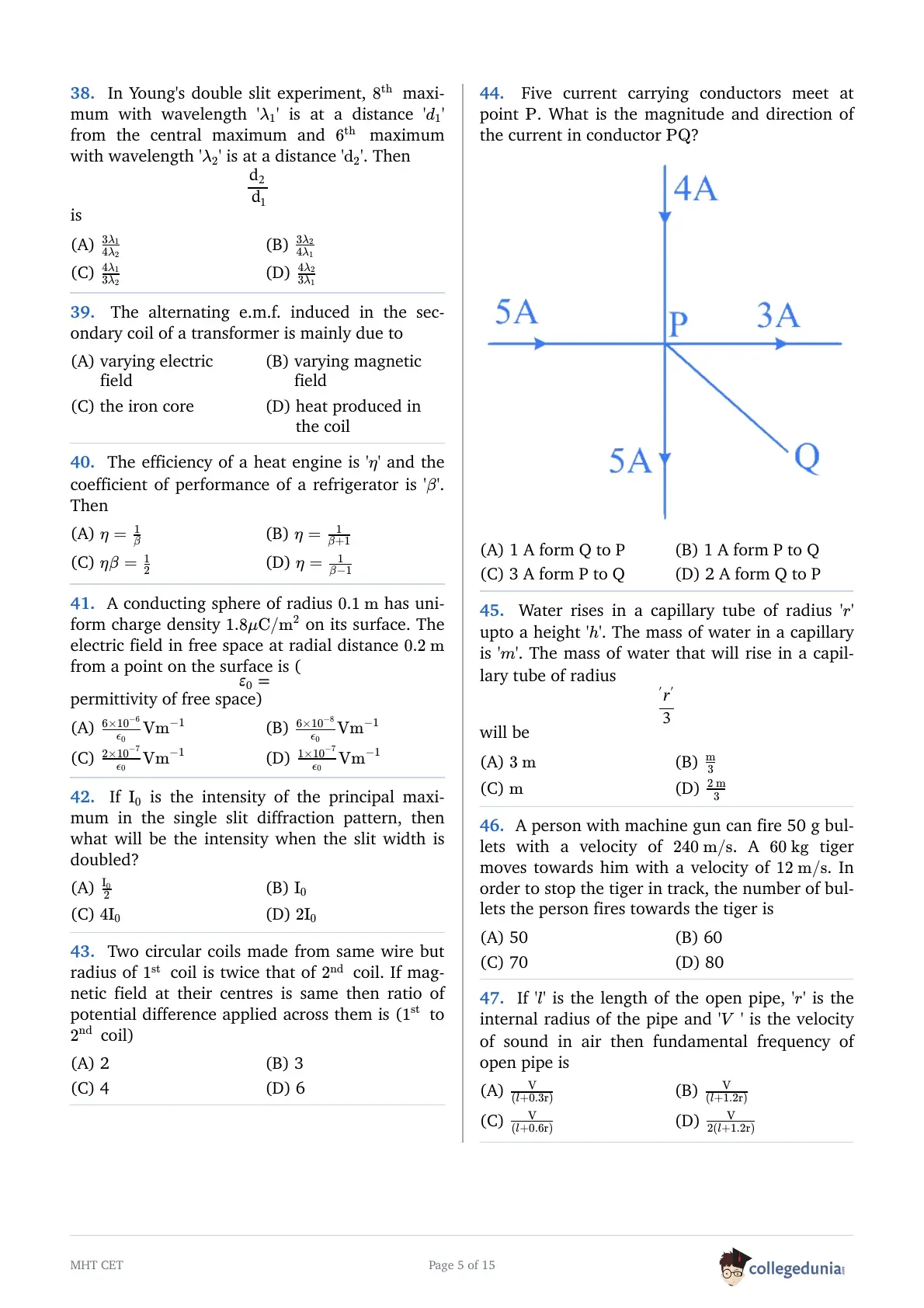
Five current carrying conductors meet at point \[\mathrm{P}\]. What is the magnitude and direction of the current in conductor \[\mathrm{PQ}\]?

  • (A) 1 A form Q to P
  • (B) 1 A form P to Q
  • (C) 3 A form P to Q
  • (D) 2 A form Q to P

Question 45:

Water rises in a capillary tube of radius '\[r\]' upto a height '\[h\]'. The mass of water in a capillary is '\[m\]'. The mass of water that will rise in a capillary tube of radius \[\frac{'r'}{3}\] will be

  • (A) \(3\text{ }\mathrm{m}\)
  • (B) \(\frac{\mathrm{m}}{3}\)
  • (C) \(\mathrm{m}\)
  • (D) \(\frac{2\text{ }\mathrm{m}}{3}\)

Question 46:

A person with machine gun can fire 50 g bullets with a velocity of \[240 \mathrm{~m} / \mathrm{s}\]. A \[60 \mathrm{~kg}\] tiger moves towards him with a velocity of \[12 \mathrm{~m} / \mathrm{s}\]. In order to stop the tiger in track, the number of bullets the person fires towards the tiger is

  • (A) 50
  • (B) 60
  • (C) 70
  • (D) 80

Question 47:

If '\[l\]' is the length of the open pipe, '\[r\]' is the internal radius of the pipe and '\(V\) ' is the velocity of sound in air then fundamental frequency of open pipe is

  • (A) \(\frac{\mathrm{V}}{(l+0.3\mathrm{r})}\)
  • (B) \(\frac{\mathrm{V}}{(l+1.2\mathrm{r})}\)
  • (C) \(\frac{\mathrm{V}}{(l+0.6\mathrm{r})}\)
  • (D) \(\frac{\mathrm{V}}{2(l+1.2\mathrm{r})}\)

Question 48:

The angle of deviation produced by a thin prism when placed in air is '\[\delta_1\]' and that when immersed in water is '\[\delta_2\]'. The refractive index of glass and water are \[\frac{3}{2}\] and \[\frac{4}{3}\] respectively. The ratio \[\delta_1: \delta_2\] is

  • (A) \(1:2\)
  • (B) \(2:1\)
  • (C) \(1:4\)
  • (D) \(4:1\)

Question 49:

A thin uniform rod of mass '\[m\]' and length '\[P\]' is suspended from one end which can oscillate in a vertical plane about the point of intersection. It is pulled to one side and then released. It passes through the equilibrium position with angular speed '\[\omega\]'. The kinetic energy while passing through mean position is

  • (A) \(\mathrm{ml}{}^{2}\omega ^{2}\)
  • (B) \(\frac{\mathrm{m}l^{2}\omega ^{2}}{4}\)
  • (C) \(\frac{\mathrm{m}l^{2}\omega ^{2}}{6}\)
  • (D) \(\frac{\mathrm{ml}^{2}\omega ^{2}}{12}\)

Question 50:

Magnetic field at the centre of the hydrogen atom due to motion of electron in \[\mathrm{n}^{\text {th }}\] orbit is proportional to

  • (A) \(\mathrm{n}^{4}\)
  • (B) \(\mathrm{n}^{-3}\)
  • (C) \(n^{3}\)
  • (D) \(\mathrm{n}^{-5}\)

Chemistry (Q51 - Q100)

Question 51:

Which from following molecules does NOT contain nitrogen in it?

  • (A) Pyrrole
  • (B) Piperidine
  • (C) Pyridine
  • (D) Pyran

Question 52:

Calculate the volume of unit cell if an element having molar mass \[56 \mathrm{~g} \mathrm{~mol}^{-1}\] that forms bcc unit cells.

\[\left[\rho \cdot \mathrm{N}_{\mathrm{A}}=4.8 \times 10^{24} \mathrm{~g} \mathrm{~cm}^{-3} \mathrm{~mol}^{-1}\right]\]

  • (A) \(1.17\times 10^{-23}\text{ }\mathrm{cm}^{3}\)
  • (B) \(4.79\times 10^{-23}\text{ }\mathrm{cm}^{3}\)
  • (C) \(3.31\times 10^{-23}\text{ }\mathrm{cm}^{3}\)
  • (D) \(2.33\times 10^{-23}\text{ }\mathrm{cm}^{3}\)

Question 53:

Find the number of orbitals and maximum electrons respectively present in \[\mathrm{M}\]-shell?

  • (A) \(4,8\)
  • (B) \(9,18\)
  • (C) \(16,32\)
  • (D) \(1,2\)

Question 54:

Which from following expressions is used to find the cell potential of \[\mathrm{Cd}_{(\mathrm{s})}\left|\mathrm{Cd}_{(\mathrm{aq})}^{++}\right|\left|\mathrm{Cu}_{(\mathrm{aq})}^{+}\right| \mathrm{Cu}_{(\mathrm{s})}\] cell at \[25^{\circ} \mathrm{C}\] ?

  • (A) \(\mathrm{E}_{\text{cell }}=\mathrm{E}_{\text{cell }}^{o}-0.0296\mathrm{log}\frac{[\mathrm{Cd}^{++}]}{[\mathrm{Cu}^{++}]}\)
  • (B) \(\mathrm{E}_{\text{cell }}=\mathrm{E}_{\text{cell }}^{o}+0.0296\mathrm{log}\frac{[\mathrm{Cd}^{++}]}{[\mathrm{Cu}^{++}]}\)
  • (C) \(\mathrm{E}_{\text{cell }}=\mathrm{E}_{\text{cell }}^{o}-0.0592\mathrm{log}\frac{[\mathrm{Cu}^{++}]}{[\mathrm{Cd}^{++}]}\)
  • (D) \(\mathrm{E}_{\text{cell }}=\mathrm{E}_{\text{cell }}^{\circ}+0.0592\mathrm{log}\frac{[\mathrm{Cu}^{++}]}{[\mathrm{Cd}^{++}]}\)

Question 55:

Which of the following is formed when propene is heated with bromine at high temperature?

  • (A) 1,2-Dibromopropane
  • (B) 1-Bromopropane
  • (C) 2-Bromopropene
  • (D) 3-Bromopropene

Question 56:

Identify the product '\[B\]' in the following sequence of reactions.

\[\mathrm{CH}_3 \mathrm{Br} \xrightarrow{\mathrm{KCN}} \mathrm{A} \xrightarrow{\mathrm{NaC}_2 \mathrm{H}_3 \mathrm{OH}} \mathrm{B}\]

  • (A) Methyl cyanide
  • (B) Ethylamine
  • (C) Methylamine
  • (D) Ethyl cyanide

Question 57:

Identify '\[\mathrm{A}\]' in the following reaction.

A+ Acetic anhydride \[\xrightarrow{\mathrm{H}^{+}}\] Aspirin + Acetic acid

  • (A) Acrylic acid
  • (B) Oxalic acid
  • (C) Salicylic acid
  • (D) Phthalic acid

Question 58:

What is the value of \[\angle \mathrm{S}-\mathrm{S}-\mathrm{S}\] in puckered \[\mathrm{S}_8\] rhombic sulfur?

  • (A) \(107^{\circ}\)
  • (B) \(120^{\circ}\)
  • (C) \(104.5^{\circ}\)
  • (D) \(60^{\circ}\)

Question 59:

Identify the reagent used in the following reaction.

Benzoic acid \[\xrightarrow[\Delta]{\text { Reagent }}\] Benzoyl chloride + Phosphorous oxychloride + Hydrogen chloride

  • (A) \(\mathrm{PCl}_{3}\)
  • (B) \(\mathrm{HCl}\)
  • (C) \(\mathrm{PCl}_{5}\)
  • (D) \(\mathrm{SOCl}_{2}\)

Question 60:

Which activity from following is exhibited by Lewis base according to definition?

  • (A) accept a pair of electron
  • (B) donate a pair of electron
  • (C) accept \(\mathrm{H}^{+}\) ions
  • (D) donate \(\mathrm{OH}^{-}\) ions

Question 61:

Which of the following ion has greater coagulating power for negatively charged sol?

  • (A) \(\mathrm{Fe}(\mathrm{CN})_{6}^{4-}\)
  • (B) \(\mathrm{PO}_{4}^{3-}\)
  • (C) \(\mathrm{Ba}^{2+}\)
  • (D) \(\mathrm{Al}^{3+}\)

Question 62:

If enthalpy change for following reaction at \[300 \mathrm{~K}\] is \[+7 \mathrm{~kJ} \mathrm{~mol}^{-1}\] find the entropy change of surrounding?

\[\mathrm{H}_2 \mathrm{O}_{(\mathrm{s})} \longrightarrow \mathrm{H}_2 \mathrm{O}_{(\ell)}\]

  • (A) \(-42.8\text{ }\mathrm{J}\text{ }\mathrm{K}^{-1}\)
  • (B) \(-23.3\text{ }\mathrm{J}\text{ }\mathrm{K}^{-1}\)
  • (C) \(-30.7\text{ }\mathrm{J}\text{ }\mathrm{K}^{-1}\)
  • (D) \(-110.0\text{ }\mathrm{J}\text{ }\mathrm{K}^{-1}\)

Question 63:

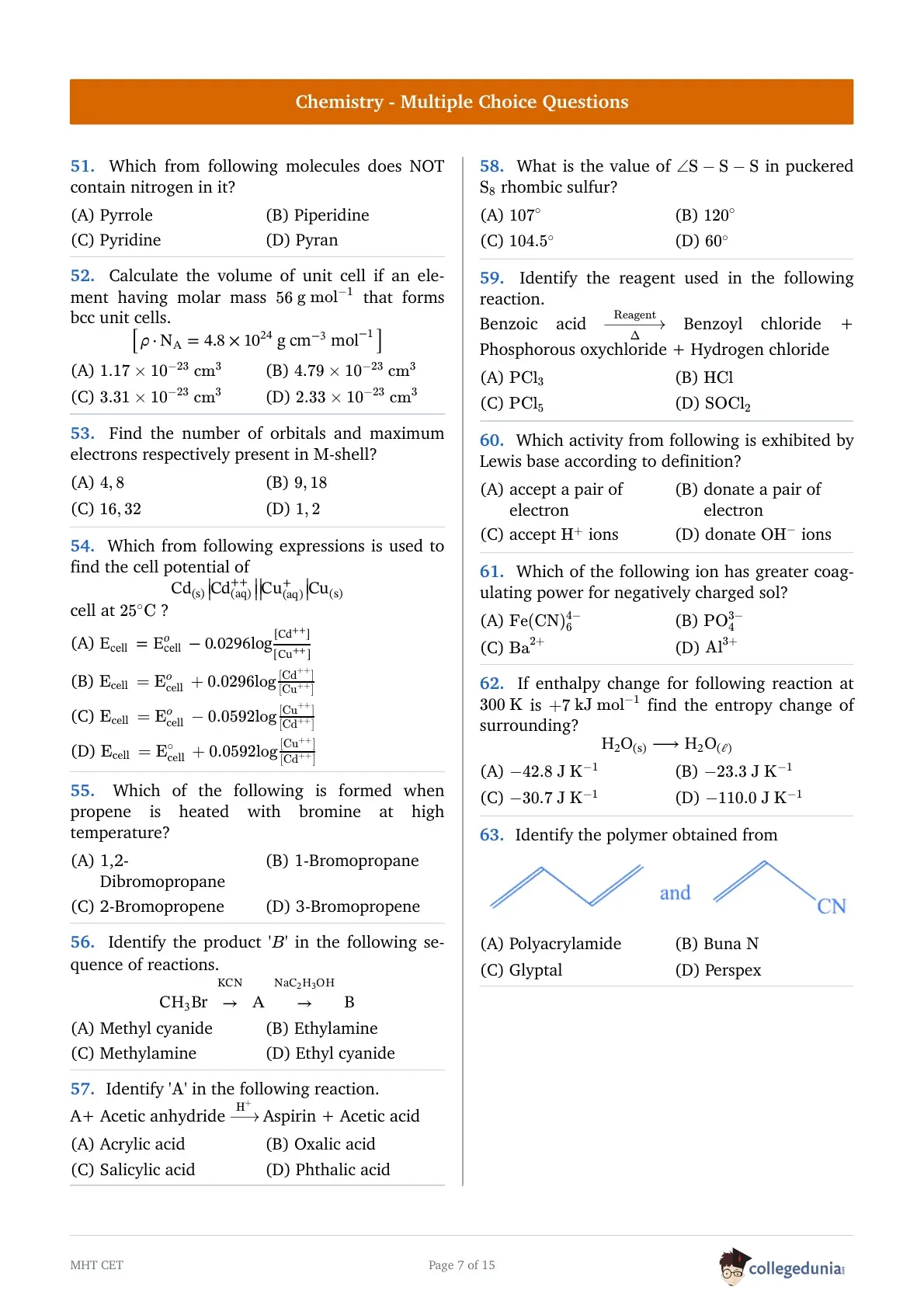
Identify the polymer obtained from

  • (A) Polyacrylamide
  • (B) Buna \(\mathrm{N}\)
  • (C) Glyptal
  • (D) Perspex

Question 64:

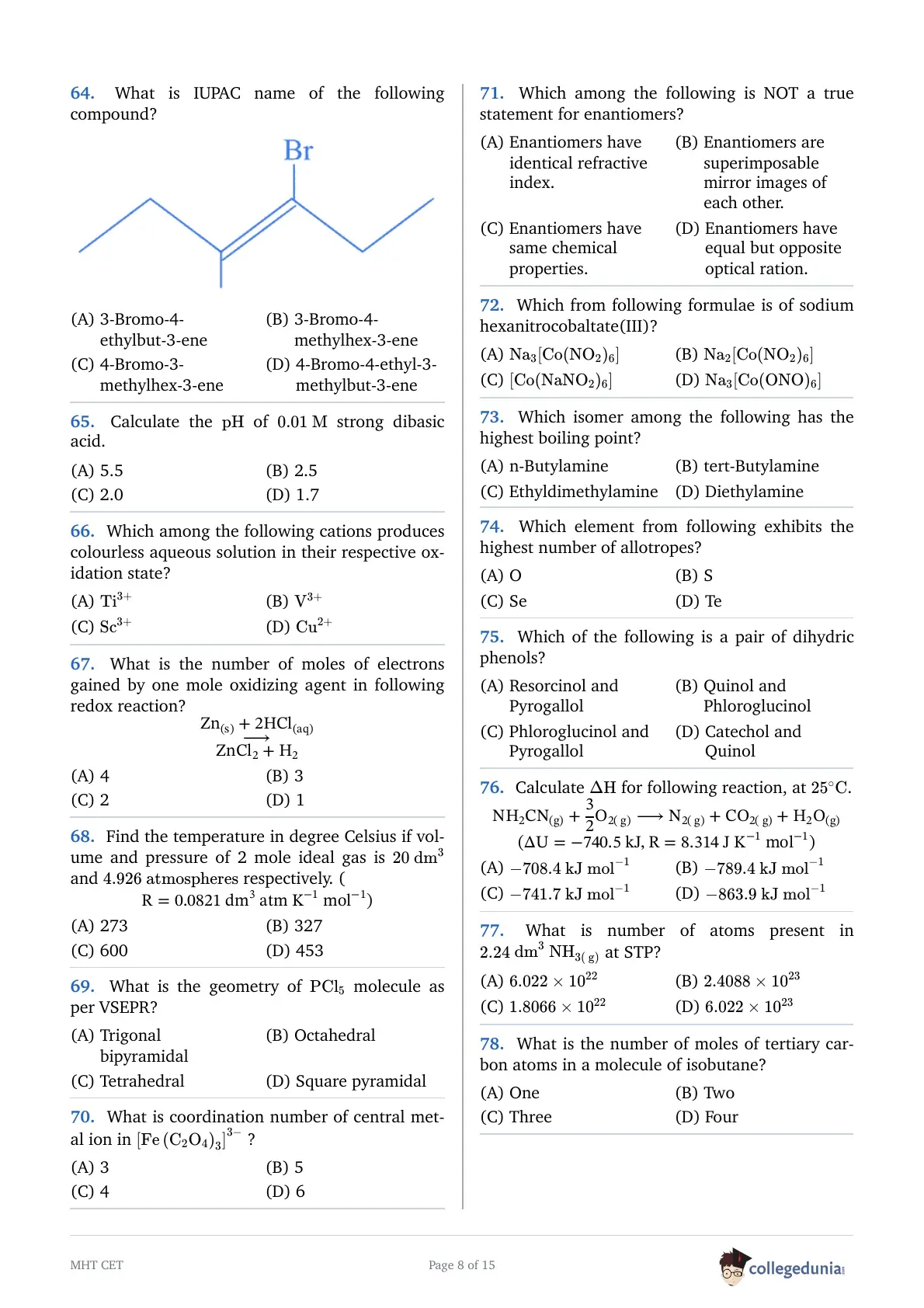
What is IUPAC name of the following compound?

  • (A) 3-Bromo-4-ethylbut-3-ene
  • (B) 3-Bromo-4-methylhex-3-ene
  • (C) 4-Bromo-3-methylhex-3-ene
  • (D) 4-Bromo-4-ethyl-3-methylbut-3-ene

Question 65:

Calculate the \[\mathrm{pH}\] of \[0.01 \mathrm{~M}\] strong dibasic acid.

  • (A) 5.5
  • (B) 2.5
  • (C) 2.0
  • (D) 1.7

Question 66:

Which among the following cations produces colourless aqueous solution in their respective oxidation state?

  • (A) \(\mathrm{Ti}^{3+}\)
  • (B) \(\mathrm{V}^{3+}\)
  • (C) \(\mathrm{Sc}^{3+}\)
  • (D) \(\mathrm{Cu}^{2+}\)

Question 67:

What is the number of moles of electrons gained by one mole oxidizing agent in following redox reaction?

\[\mathrm{Zn_{(s)}+2HCl_{(aq)}}\] \[\longrightarrow\] \[\mathrm{ZnCl_2+H_2}\]

  • (A) 4
  • (B) 3
  • (C) 2
  • (D) 1

Question 68:

Find the temperature in degree Celsius if volume and pressure of 2 mole ideal gas is \[20 \mathrm{~dm}^3\] and \[4.926 \mathrm{~atmospheres}\] respectively. (\[\mathrm{R}=0.0821 \mathrm{~dm}^3 \mathrm{~atm} \mathrm{~K}^{-1} \mathrm{~mol}^{-1})\]

  • (A) 273
  • (B) 327
  • (C) 600
  • (D) 453

Question 69:

What is the geometry of \[\mathrm{PCl}_5\] molecule as per VSEPR?

  • (A) Trigonal bipyramidal
  • (B) Octahedral
  • (C) Tetrahedral
  • (D) Square pyramidal

Question 70:

What is coordination number of central metal ion in \[\left[\mathrm{Fe}\left(\mathrm{C}_2 \mathrm{O}_4\right)_3\right]^{3-}\] ?

  • (A) 3
  • (B) 5
  • (C) 4
  • (D) 6

Question 71:

Which among the following is NOT a true statement for enantiomers?

  • (A) Enantiomers have identical refractive index.
  • (B) Enantiomers are superimposable mirror images of each other.
  • (C) Enantiomers have same chemical properties.
  • (D) Enantiomers have equal but opposite optical ration.

Question 72:

Which from following formulae is of sodium hexanitrocobaltate(III)?

  • (A) \(\mathrm{Na}_{3}[\mathrm{Co}(\mathrm{NO}_{2})_{6}]\)
  • (B) \(\mathrm{Na}_{2}[\mathrm{Co}(\mathrm{NO}_{2})_{6}]\)
  • (C) \([\mathrm{Co}(\mathrm{NaNO}_{2})_{6}]\)
  • (D) \(\mathrm{Na}_{3}[\mathrm{Co}(\mathrm{ONO})_{6}]\)

Question 73:

Which isomer among the following has the highest boiling point?

  • (A) n-Butylamine
  • (B) tert-Butylamine
  • (C) Ethyldimethylamine
  • (D) Diethylamine

Question 74:

Which element from following exhibits the highest number of allotropes?

  • (A) O
  • (B) S
  • (C) Se
  • (D) Te

Question 75:

Which of the following is a pair of dihydric phenols?

  • (A) Resorcinol and Pyrogallol
  • (B) Quinol and Phloroglucinol
  • (C) Phloroglucinol and Pyrogallol
  • (D) Catechol and Quinol

Question 77:

What is number of atoms present in \[2.24 \mathrm{~dm}^3 \mathrm{~NH}_{3(\mathrm{~g})}\] at STP?

  • (A) \(6.022\times 10^{22}\)
  • (B) \(2.4088\times 10^{23}\)
  • (C) \(1.8066\times 10^{22}\)
  • (D) \(6.022\times 10^{23}\)

Question 78:

What is the number of moles of tertiary carbon atoms in a molecule of isobutane?

  • (A) One
  • (B) Two
  • (C) Three
  • (D) Four

Question 79:

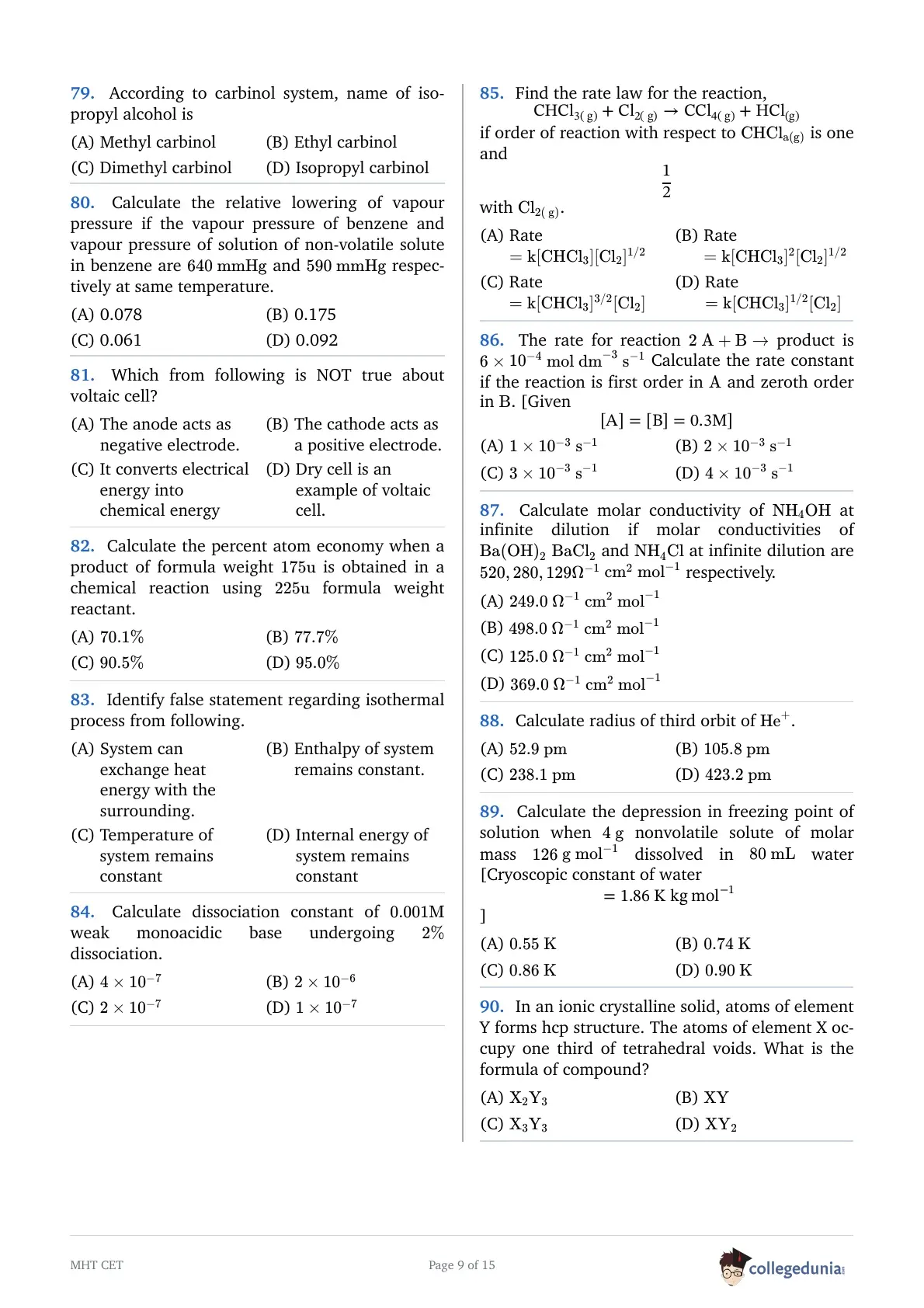
According to carbinol system, name of isopropyl alcohol is

  • (A) Methyl carbinol
  • (B) Ethyl carbinol
  • (C) Dimethyl carbinol
  • (D) Isopropyl carbinol

Question 80:

Calculate the relative lowering of vapour pressure if the vapour pressure of benzene and vapour pressure of solution of non-volatile solute in benzene are \[640 \mathrm{~mmHg}\] and \[590 \mathrm{~mmHg}\] respectively at same temperature.

  • (A) 0.078
  • (B) 0.175
  • (C) 0.061
  • (D) 0.092

Question 81:

Which from following is NOT true about voltaic cell?

  • (A) The anode acts as negative electrode.
  • (B) The cathode acts as a positive electrode.
  • (C) It converts electrical energy into chemical energy
  • (D) Dry cell is an example of voltaic cell.

Question 82:

Calculate the percent atom economy when a product of formula weight \[175 \mathrm{u}\] is obtained in a chemical reaction using \[225 \mathrm{u}\] formula weight reactant.

  • (A) \(70.1\%\)
  • (B) \(77.7\%\)
  • (C) \(90.5\%\)
  • (D) \(95.0\%\)

Question 84:

Calculate dissociation constant of \[0.001 \mathrm{M}\] weak monoacidic base undergoing \[2 \%\] dissociation.

  • (A) \(4\times 10^{-7}\)
  • (B) \(2\times 10^{-6}\)
  • (C) \(2\times 10^{-7}\)
  • (D) \(1\times 10^{-7}\)

Question 85:

Find the rate law for the reaction, \[\mathrm{CHCl}_{3(\mathrm{~g})}+\mathrm{Cl}_{2(\mathrm{~g})} \rightarrow \mathrm{CCl}_{4(\mathrm{~g})}+\mathrm{HCl}_{(\mathrm{g})}\] if order of reaction with respect to \[\mathrm{CHCl}_{\mathrm{a}(\mathrm{g})}\] is one and \[\frac{1}{2}\] with \[\mathrm{Cl}_{2(\mathrm{~g})}\].

  • (A) Rate \(=\mathrm{k}[\mathrm{CHCl}_{3}][\mathrm{Cl}_{2}]^{1/2}\)
  • (B) Rate \(=\mathrm{k}[\mathrm{CHCl}_{3}]^{2}[\mathrm{Cl}_{2}]^{1/2}\)
  • (C) Rate \(=\mathrm{k}[\mathrm{CHCl}_{3}]^{3/2}[\mathrm{Cl}_{2}]\)
  • (D) Rate \(=\mathrm{k}[\mathrm{CHCl}_{3}]^{1/2}[\mathrm{Cl}_{2}]\)

Question 86:

The rate for reaction \[2 \mathrm{~A}+\mathrm{B} \rightarrow\] product is \[6 \times 10^{-4} \mathrm{~mol} \mathrm{~dm}^{-3} \mathrm{~s}^{-1}\] Calculate the rate constant if the reaction is first order in \[\mathrm{A}\] and zeroth order in \[\mathrm{B}\]. [Given \[[\mathrm{A}]=[\mathrm{B}]=0.3 \mathrm{M}]\]

  • (A) \(1\times 10^{-3}\text{ }\mathrm{s}^{-1}\)
  • (B) \(2\times 10^{-3}\text{ }\mathrm{s}^{-1}\)
  • (C) \(3\times 10^{-3}\text{ }\mathrm{s}^{-1}\)
  • (D) \(4\times 10^{-3}\text{ }\mathrm{s}^{-1}\)

Question 87:

Calculate molar conductivity of \[\mathrm{NH}_4 \mathrm{OH}\] at infinite dilution if molar conductivities of \[\mathrm{Ba}(\mathrm{OH})_2\] \[\mathrm{BaCl}_2\] and \[\mathrm{NH}_4 \mathrm{Cl}\] at infinite dilution are \[520,280,129 \Omega^{-1} \mathrm{~cm}^2 \mathrm{~mol}^{-1}\] respectively.

  • (A) \(249.0\text{ }\Omega ^{-1}\text{ }\mathrm{cm}^{2}\text{ }\mathrm{mol}^{-1}\)
  • (B) \(498.0\text{ }\Omega ^{-1}\text{ }\mathrm{cm}^{2}\text{ }\mathrm{mol}^{-1}\)
  • (C) \(125.0\text{ }\Omega ^{-1}\text{ }\mathrm{cm}^{2}\text{ }\mathrm{mol}^{-1}\)
  • (D) \(369.0\text{ }\Omega ^{-1}\text{ }\mathrm{cm}^{2}\text{ }\mathrm{mol}^{-1}\)

Question 88:

Calculate radius of third orbit of \[\mathrm{He}^{+}\].

  • (A) \(52.9\text{ }\mathrm{pm}\)
  • (B) \(105.8\text{ }\mathrm{pm}\)
  • (C) \(238.1\text{ }\mathrm{pm}\)
  • (D) \(423.2\text{ }\mathrm{pm}\)

Question 89:

Calculate the depression in freezing point of solution when \[4 \mathrm{~g}\] nonvolatile solute of molar mass \[126 \mathrm{~g} \mathrm{~mol}^{-1}\] dissolved in \[80 \mathrm{~mL}\] water [Cryoscopic constant of water \[=1.86 \mathrm{~K} \mathrm{~kg} \mathrm{~mol}^{-1}\] ]

  • (A) \(0.55\text{ }\mathrm{K}\)
  • (B) \(0.74\text{ }\mathrm{K}\)
  • (C) \(0.86\text{ }\mathrm{K}\)
  • (D) \(0.90\text{ }\mathrm{K}\)

Question 90:

In an ionic crystalline solid, atoms of element Y forms hcp structure. The atoms of element X occupy one third of tetrahedral voids. What is the formula of compound?

  • (A) \(\mathrm{X}_{2}\mathrm{Y}_{3}\)
  • (B) \(\mathrm{XY}\)
  • (C) \(\mathrm{X}_{3}\mathrm{Y}_{3}\)
  • (D) \(\mathrm{XY}_{2}\)

Question 91:

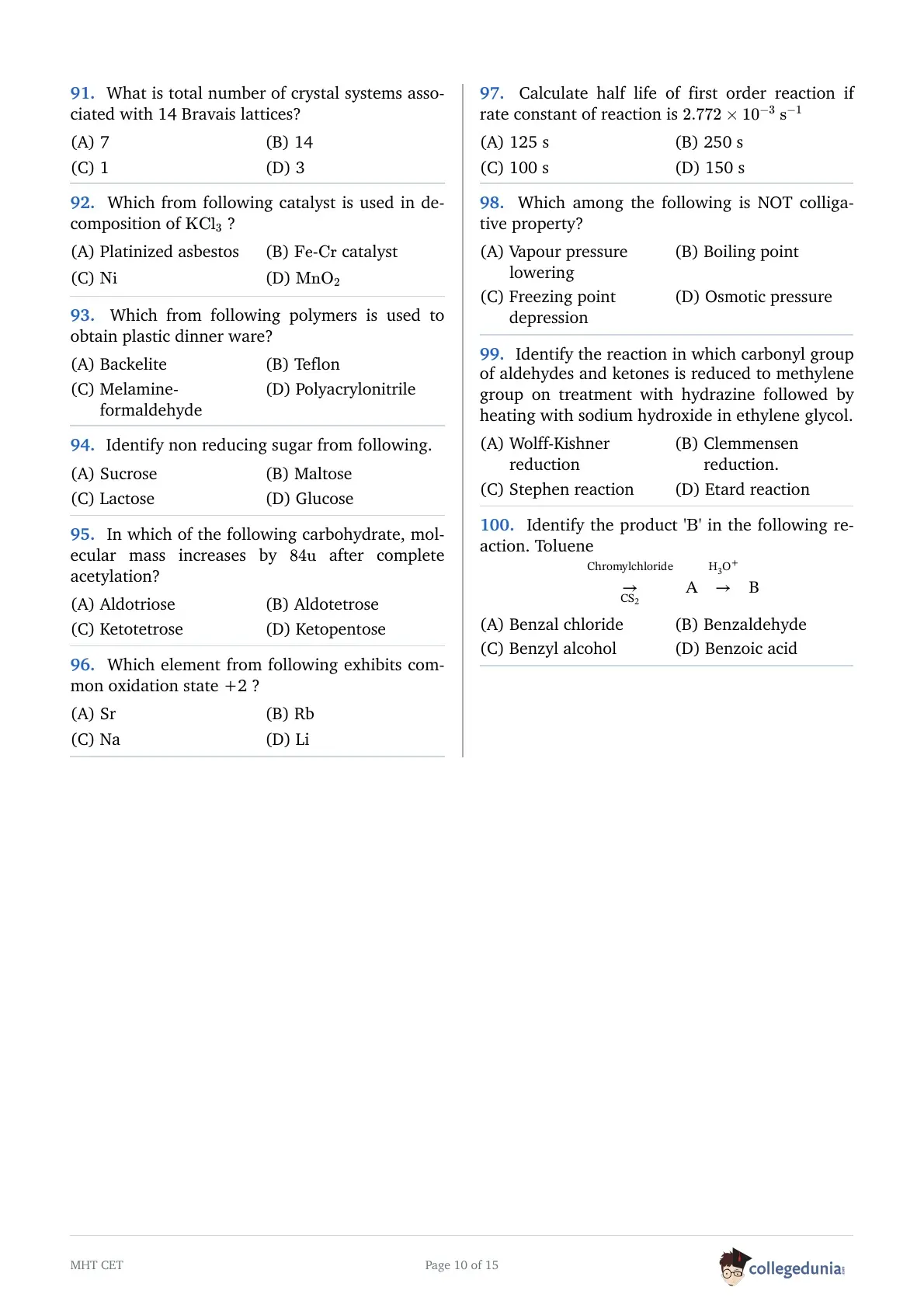
What is total number of crystal systems associated with 14 Bravais lattices?

  • (A) 7
  • (B) 14
  • (C) 1
  • (D) 3

Question 92:

Which from following catalyst is used in decomposition of \[\mathrm{KCl}_3\] ?

  • (A) Platinized asbestos
  • (B) \(\mathrm{Fe}\)-\(\mathrm{Cr}\) catalyst
  • (C) \(\mathrm{Ni}\)
  • (D) \(\mathrm{MnO}_{2}\)

Question 93:

Which from following polymers is used to obtain plastic dinner ware?

  • (A) Backelite
  • (B) Teflon
  • (C) Melamine-formaldehyde
  • (D) Polyacrylonitrile

Question 94:

Identify non reducing sugar from following.

  • (A) Sucrose
  • (B) Maltose
  • (C) Lactose
  • (D) Glucose

Question 95:

In which of the following carbohydrate, molecular mass increases by \[84 \mathrm{u}\] after complete acetylation?

  • (A) Aldotriose
  • (B) Aldotetrose
  • (C) Ketotetrose
  • (D) Ketopentose

Question 96:

Which element from following exhibits common oxidation state +2 ?

  • (A) Sr
  • (B) Rb
  • (C) Na
  • (D) Li

Question 97:

Calculate half life of first order reaction if rate constant of reaction is \[2.772 \times 10^{-3} \mathrm{~s}^{-1}\]

  • (A) 125 s
  • (B) 250 s
  • (C) 100 s
  • (D) 150 s

Question 98:

Which among the following is NOT colligative property?

  • (A) Vapour pressure lowering
  • (B) Boiling point
  • (C) Freezing point depression
  • (D) Osmotic pressure

Question 99:

Identify the reaction in which carbonyl group of aldehydes and ketones is reduced to methylene group on treatment with hydrazine followed by heating with sodium hydroxide in ethylene glycol.

  • (A) Wolff-Kishner reduction
  • (B) Clemmensen reduction.
  • (C) Stephen reaction
  • (D) Etard reaction

Question 100:

Identify the product '\[\mathrm{B}\]' in the following reaction. Toluene \[\xrightarrow[\mathrm{CS}_2]{\text { Chromylchloride }} \mathrm{A} \xrightarrow{\mathrm{H}_3 \mathrm{O}^{+}}\mathrm{B}\]

  • (A) Benzal chloride
  • (B) Benzaldehyde
  • (C) Benzyl alcohol
  • (D) Benzoic acid

Mathematics (Q101 - Q150)

Question 101:

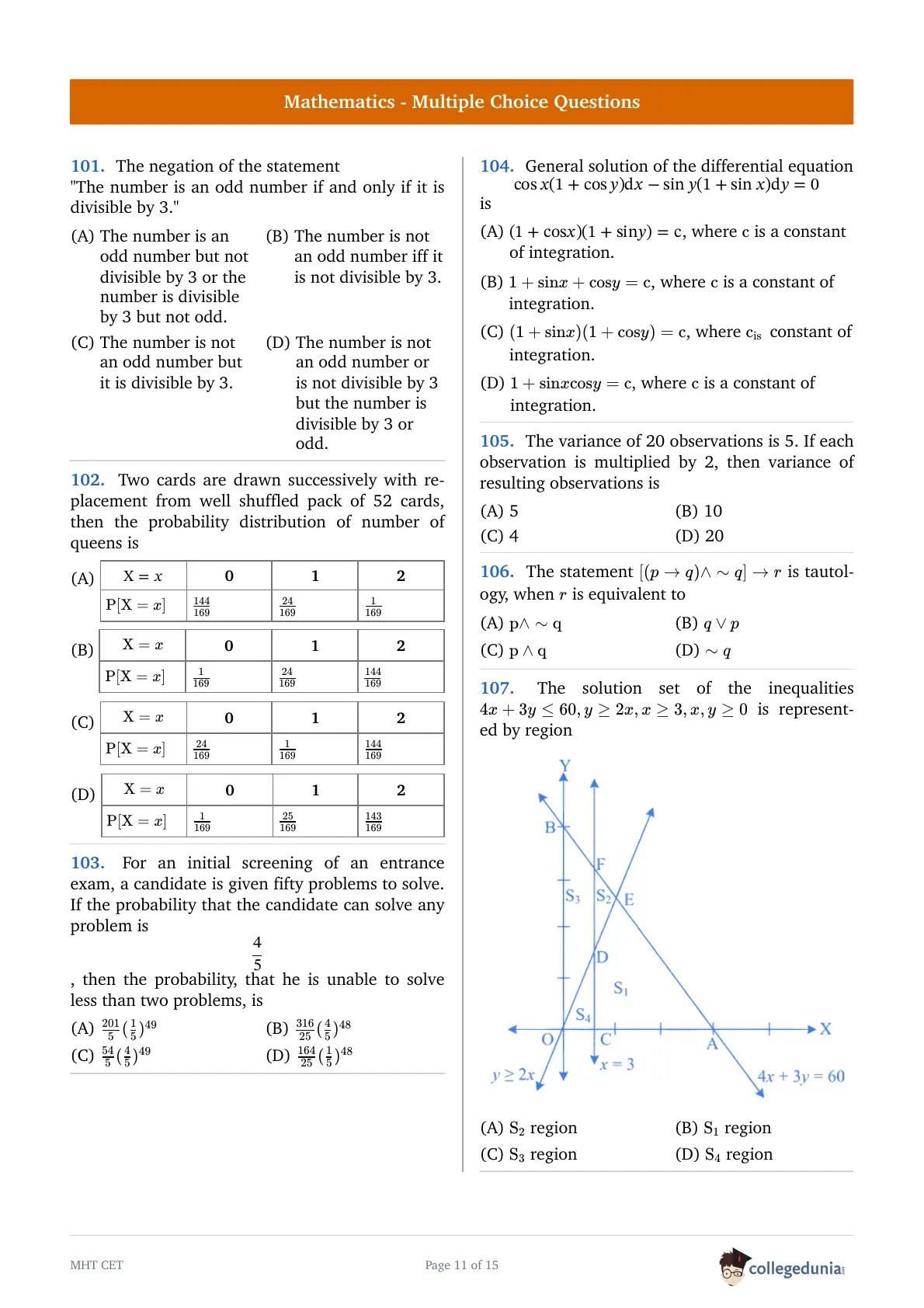
The negation of the statement

"The number is an odd number if and only if it is divisible by 3."

  • (A) The number is an odd number but not divisible by 3 or the number is divisible by 3 but not odd.
  • (B) The number is not an odd number iff it is not divisible by 3.
  • (C) The number is not an odd number but it is divisible by 3.
  • (D) The number is not an odd number or is not divisible by 3 but the number is divisible by 3 or odd.

Question 102:

Two cards are drawn successively with replacement from well shuffled pack of 52 cards, then the probability distribution of number of queens is

  • (A)
    \(\mathrm{X}=x\)012
    \(\mathrm{P}[\mathrm{X}=x]\)\(\frac{144}{169}\)\(\frac{24}{169}\)\(\frac{1}{169}\)
  • (B)
    \(\mathrm{X}=x\)012
    \(\mathrm{P}[\mathrm{X}=x]\)\(\frac{1}{169}\)\(\frac{24}{169}\)\(\frac{144}{169}\)
  • (C)
    \(\mathrm{X}=x\)012
    \(\mathrm{P}[\mathrm{X}=x]\)\(\frac{24}{169}\)\(\frac{1}{169}\)\(\frac{144}{169}\)
  • (D)
    \(\mathrm{X}=x\)012
    \(\mathrm{P}[\mathrm{X}=x]\)\(\frac{1}{169}\)\(\frac{25}{169}\)\(\frac{143}{169}\)

Question 103:

For an initial screening of an entrance exam, a candidate is given fifty problems to solve. If the probability that the candidate can solve any problem is \[\frac{4}{5}\], then the probability, that he is unable to solve less than two problems, is

  • (A) \(\frac{201}{5}(\frac{1}{5})^{49}\)
  • (B) \(\frac{316}{25}(\frac{4}{5})^{48}\)
  • (C) \(\frac{54}{5}(\frac{4}{5})^{49}\)
  • (D) \(\frac{164}{25}(\frac{1}{5})^{48}\)

Question 104:

General solution of the differential equation \[\cos x(1+\cos y) \mathrm{d} x-\sin y(1+\sin x) \mathrm{d} y=0\] is

  • (A) \((1+\mathrm{cos}x)(1+\mathrm{sin}y)=\mathrm{c}\), where \(\mathrm{c}\) is a constant of integration.
  • (B) \(1+\mathrm{sin}x+\mathrm{cos}y=\mathrm{c}\), where \(\mathrm{c}\) is a constant of integration.
  • (C) \((1+\mathrm{sin}x)(1+\mathrm{cos}y)=\mathrm{c}\), where \(\mathrm{c}_{\text{is }}\) constant of integration.
  • (D) \(1+\mathrm{sin}x\mathrm{cos}y=\mathrm{c}\), where \(\mathrm{c}\) is a constant of integration.

Question 105:

The variance of 20 observations is 5. If each observation is multiplied by 2, then variance of resulting observations is

  • (A) 5
  • (B) 10
  • (C) 4
  • (D) 20

Question 106:

The statement \[[(p \rightarrow q) \wedge \sim q] \rightarrow r\] is tautology, when \[r\] is equivalent to

  • (A) \(\mathrm{p}\wedge \sim \mathrm{q}\)
  • (B) \(q\vee p\)
  • (C) \(\mathrm{p}\wedge \mathrm{q}\)
  • (D) \(\sim q\)

Question 107:

The solution set of the inequalities \[4 x+3 y \leq 60, y \geq 2 x, x \geq 3, x, y \geq 0\] is represented by region

  • (A) \(\mathrm{S}_{2}\) region
  • (B) \(\mathrm{S}_{1}\) region
  • (C) \(\mathrm{S}_{3}\) region
  • (D) \(\mathrm{S}_{4}\) region

Question 108:

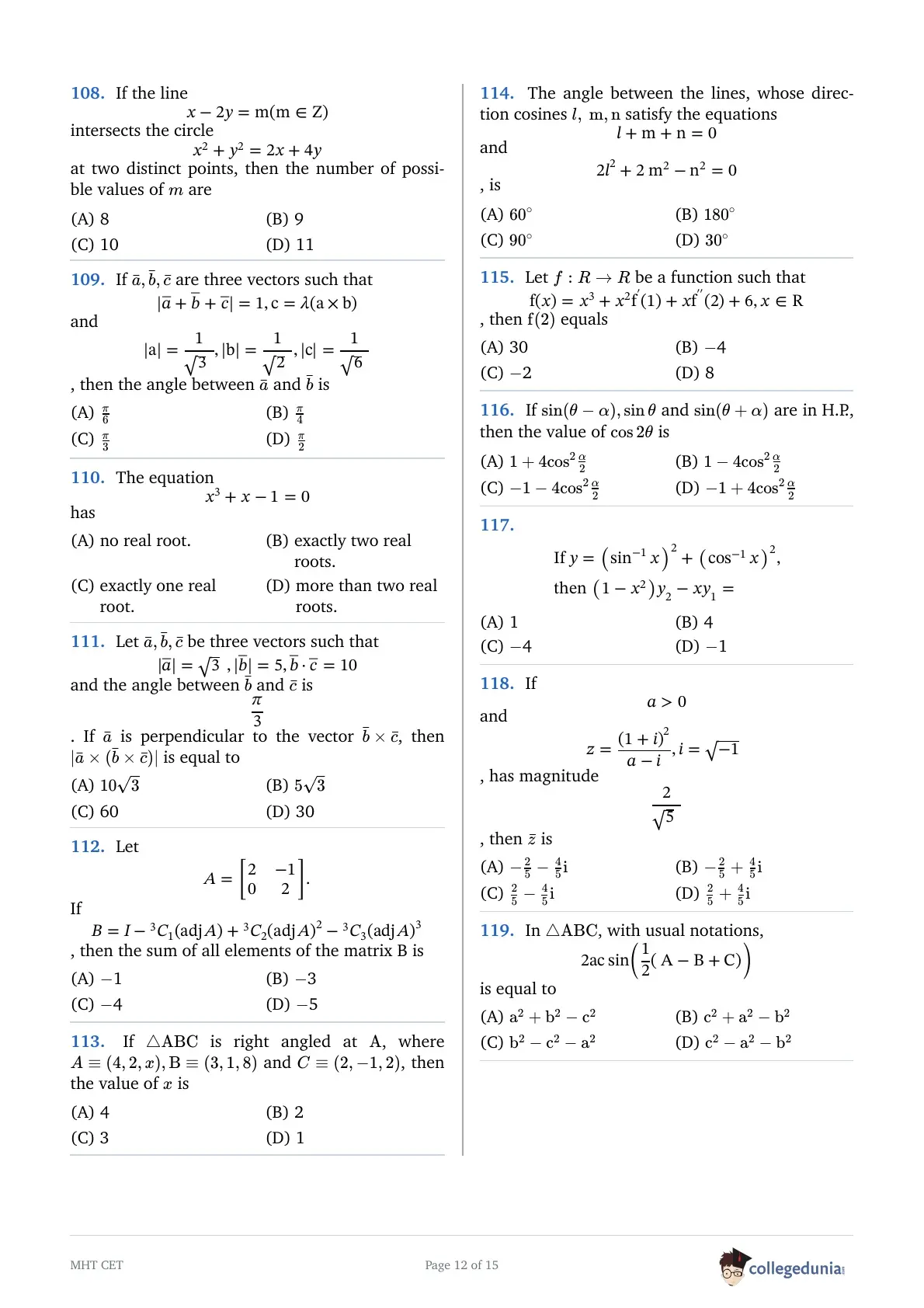
If the line \[x-2 y=\mathrm{m}(\mathrm{m} \in \mathrm{Z})\] intersects the circle \[x^2+y^2=2 x+4 y\] at two distinct points, then the number of possible values of \(m\) are

  • (A) 8
  • (B) 9
  • (C) 10
  • (D) 11

Question 109:

If \[\bar{a}, \bar{b}, \bar{c}\] are three vectors such that \[|\bar{a}+\bar{b}+\bar{c}|=1, \overline{\mathrm{c}}=\lambda(\overline{\mathrm{a}} \times \overline{\mathrm{b}})\] and \[|\overline{\mathrm{a}}|=\frac{1}{\sqrt{3}},|\overline{\mathrm{b}}|=\frac{1}{\sqrt{2}},|\overline{\mathrm{c}}|=\frac{1}{\sqrt{6}}\], then the angle between \[\bar{a}\] and \[\bar{b}\] is

  • (A) \(\frac{\pi}{6}\)
  • (B) \(\frac{\pi}{4}\)
  • (C) \(\frac{\pi}{3}\)
  • (D) \(\frac{\pi}{2}\)

Question 110:

The equation \[x^3+x-1=0\] has

  • (A) no real root.
  • (B) exactly two real roots.
  • (C) exactly one real root.
  • (D) more than two real roots.

Question 111:

Let \[\bar{a}, \bar{b}, \bar{c}\] be three vectors such that \[|\bar{a}|=\sqrt{3}, |\bar{b}|=5, \bar{b} \cdot \bar{c}=10\] and the angle between \[\bar{b}\] and \[\bar{c}\] is \[\frac{\pi}{3}\]. If \[\bar{a}\] is perpendicular to the vector \[\bar{b} \times \bar{c}\], then \[|\bar{a} \times(\bar{b} \times \bar{c})|\] is equal to

  • (A) \(10\sqrt{3}\)
  • (B) \(5\sqrt{3}\)
  • (C) 60
  • (D) 30

Question 112:

Let \[A=\left[\begin{array}{cc}2 & -1 \\ 0 & 2\end{array}\right].\] If \[B=I-{ }^3 C_1(\operatorname{adj} A)+{ }^3 C_2(\operatorname{adj} A)^2-{ }^3 C_3(\operatorname{adj} A)^3\], then the sum of all elements of the matrix B is

  • (A) \(-\)1
  • (B) \(-\)3
  • (C) \(-\)4
  • (D) \(-\)5

Question 113:

If \[\triangle \mathrm{ABC}\] is right angled at \[\mathrm{A}\], where \[A \equiv(4,2, x), \mathrm{B} \equiv(3,1,8)\] and \[C \equiv(2,-1,2)\], then the value of \[x\] is

  • (A) 4
  • (B) 2
  • (C) 3
  • (D) 1

Question 114:

The angle between the lines, whose direction cosines \[l, \mathrm{~m}, \mathrm{n}\] satisfy the equations \[l+\mathrm{m}+\mathrm{n}=0\] and \[2 l^2+2 \mathrm{~m}^2-\mathrm{n}^2=0\], is

  • (A) \(60^{\circ}\)
  • (B) \(180^{\circ}\)
  • (C) \(90^{\circ}\)
  • (D) \(30^{\circ}\)

Question 115:

Let \[f: R \rightarrow R\] be a function such that \[\mathrm{f}(x)=x^3+x^2 \mathrm{f}^{\prime}(1)+x \mathrm{f}^{\prime \prime}(2)+6, x \in \mathrm{R}\], then \[\mathrm{f}(2)\] equals

  • (A) 30
  • (B) \(-\)4
  • (C) \(-\)2
  • (D) 8

Question 116:

If \[\sin (\theta-\alpha), \sin \theta\] and \[\sin (\theta+\alpha)\] are in H.P., then the value of \[\cos 2 \theta\] is

  • (A) \(1+4\mathrm{cos}^{2}\frac{\alpha}{2}\)
  • (B) \(1-4\mathrm{cos}^{2}\frac{\alpha}{2}\)
  • (C) \(-1-4\mathrm{cos}^{2}\frac{\alpha}{2}\)
  • (D) \(-1+4\mathrm{cos}^{2}\frac{\alpha}{2}\)

Question 117:

\[\text { If } y=\left(\sin ^{-1} x\right)^2+\left(\cos ^{-1} x\right)^2, \text { then }\left(1-x^2\right) y_2-x y_1=\]

  • (A) 1
  • (B) 4
  • (C) \(-\)4
  • (D) \(-\)1

Question 118:

If \[a>0\] and \[z=\frac{(1+i)^2}{a-i}, i=\sqrt{-1}\], has magnitude \[\frac{2}{\sqrt{5}}\], then \[\bar{z}\] is

  • (A) \(-\frac{2}{5}-\frac{4}{5}\mathrm{i}\)
  • (B) \(-\frac{2}{5}+\frac{4}{5}\mathrm{i}\)
  • (C) \(\frac{2}{5}-\frac{4}{5}\mathrm{i}\)
  • (D) \(\frac{2}{5}+\frac{4}{5}\mathrm{i}\)

Question 119:

In \[\triangle \mathrm{ABC}\], with usual notations, \[2 \mathrm{ac} \sin \left(\frac{1}{2}(\mathrm{~A}-\mathrm{B}+\mathrm{C})\right)\] is equal to

  • (A) \(\mathrm{a}^{2}+\mathrm{b}^{2}-\mathrm{c}^{2}\)
  • (B) \(\mathrm{c}^{2}+\mathrm{a}^{2}-\mathrm{b}^{2}\)
  • (C) \(\mathrm{b}^{2}-\mathrm{c}^{2}-\mathrm{a}^{2}\)
  • (D) \(\mathrm{c}^{2}-\mathrm{a}^{2}-\mathrm{b}^{2}\)

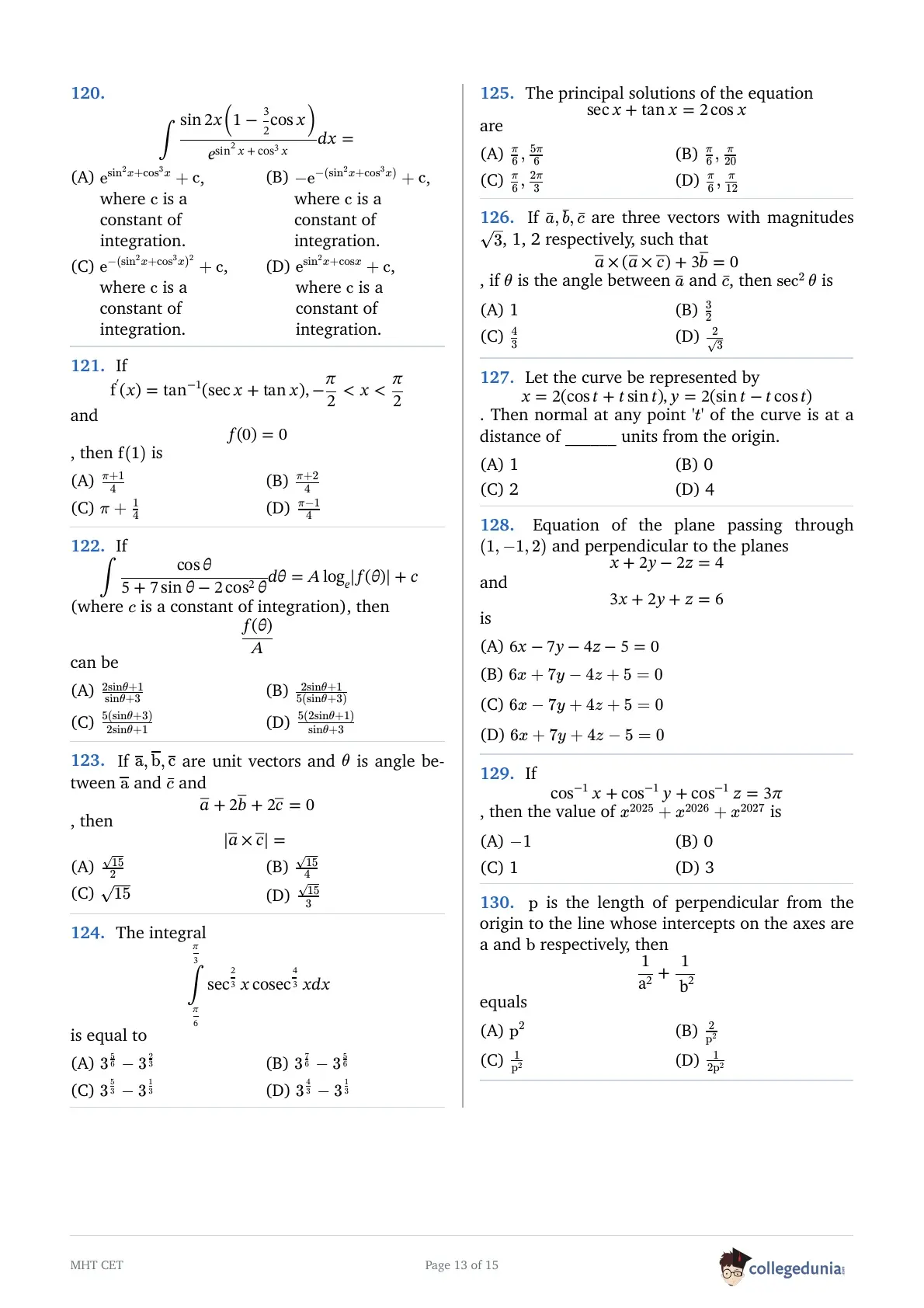
Question 120:

\[\int \frac{\sin 2 x\left(1-\frac{3}{2} \cos x\right)}{e^{\sin ^2 x+\cos ^3 x}} d x=\]

  • (A) \(\mathrm{e}^{\mathrm{sin}^{2}x+\mathrm{cos}^{3}x}+\mathrm{c}\), where \(\mathrm{c}\) is a constant of integration.
  • (B) \(-\mathrm{e}^{-(\mathrm{sin}^{2}x+\mathrm{cos}^{3}x)}+\mathrm{c}\), where \(\mathrm{c}\) is a constant of integration.
  • (C) \(\mathrm{e}^{-(\mathrm{sin}^{2}x+\mathrm{cos}^{3}x)^{2}}+\mathrm{c}\), where \(\mathrm{c}\) is a constant of integration.
  • (D) \(\mathrm{e}^{\mathrm{sin}^{2}x+\mathrm{cos}x}+\mathrm{c}\), where \(\mathrm{c}\) is a constant of integration.

Question 121:

If \(\mathrm{f}^{\prime}(x)=\tan ^{-1}(\sec x+\tan x),-\frac{\pi}{2} < x < \frac{\pi}{2}\) and \(f(0)=0\), then \(\mathrm{f}(1)\) is

  • (A) \(\frac{\pi +1}{4}\)
  • (B) \(\frac{\pi +2}{4}\)
  • (C) \(\pi +\frac{1}{4}\)
  • (D) \(\frac{\pi -1}{4}\)

Question 122:

If \[\int \frac{\cos \theta}{5+7 \sin \theta-2 \cos ^2 \theta} d \theta=A \log _e|f(\theta)|+c\] (where \[c\] is a constant of integration), then \[\frac{f(\theta)}{A}\] can be

  • (A) \(\frac{2\mathrm{sin}\theta +1}{\mathrm{sin}\theta +3}\)
  • (B) \(\frac{2\mathrm{sin}\theta +1}{5(\mathrm{sin}\theta +3)}\)
  • (C) \(\frac{5(\mathrm{sin}\theta +3)}{2\mathrm{sin}\theta +1}\)
  • (D) \(\frac{5(2\mathrm{sin}\theta +1)}{\mathrm{sin}\theta +3}\)

Question 123:

If \[\overline{\mathrm{a}}, \overline{\mathrm{b}}, \overline{\mathrm{c}}\] are unit vectors and \[\theta\] is angle between \[\overline{\mathrm{a}}\] and \[\bar{c}\] and \[\bar{a}+2 \bar{b}+2 \bar{c}=\overline{0}\], then \[|\bar{a} \times \bar{c}|=\]

  • (A) \(\frac{\sqrt{15}}{2}\)
  • (B) \(\frac{\sqrt{15}}{4}\)
  • (C) \(\sqrt{15}\)
  • (D) \(\frac{\sqrt{15}}{3}\)

Question 124:

The integral \[\int_\limits{\frac{\pi}{6}}^{\frac{\pi}{3}} \sec ^{\frac{2}{3}} x \operatorname{cosec}^{\frac{4}{3}} x d x\] is equal to

  • (A) \(3^{\frac{5}{6}}-3^{\frac{2}{3}}\)
  • (B) \(3^{\frac{7}{6}}-3^{\frac{5}{6}}\)
  • (C) \(3^{\frac{5}{3}}-3^{\frac{1}{3}}\)
  • (D) \(3^{\frac{4}{3}}-3^{\frac{1}{3}}\)

Question 125:

The principal solutions of the equation \[\sec x+\tan x=2 \cos x\] are

  • (A) \(\frac{\pi}{6},\frac{5\pi}{6}\)
  • (B) \(\frac{\pi}{6},\frac{\pi}{20}\)
  • (C) \(\frac{\pi}{6},\frac{2\pi}{3}\)
  • (D) \(\frac{\pi}{6},\frac{\pi}{12}\)

Question 126:

If \[\bar{a}, \bar{b}, \bar{c}\] are three vectors with magnitudes \[\sqrt{3}\], 1, 2 respectively, such that \[\bar{a} \times(\bar{a} \times \bar{c})+3 \bar{b}=\overline{0}\], if \[\theta\] is the angle between \[\bar{a}\] and \[\bar{c}\], then \[\sec ^2 \theta\] is

  • (A) 1
  • (B) \(\frac{3}{2}\)
  • (C) \(\frac{4}{3}\)
  • (D) \(\frac{2}{\sqrt{3}}\)

Question 127:

Let the curve be represented by \[x=2(\cos t+t \sin t), y=2(\sin t-t \cos t)\]. Then normal at any point '\[t\]' of the curve is at a distance of ______ units from the origin.

  • (A) 1
  • (B) 0
  • (C) 2
  • (D) 4

Question 128:

Equation of the plane passing through \[(1,-1,2)\] and perpendicular to the planes \[x+2 y-2 z=4\] and \[3 x+2 y+z=6\] is

  • (A) \(6x-7y-4z-5=0\)
  • (B) \(6x+7y-4z+5=0\)
  • (C) \(6x-7y+4z+5=0\)
  • (D) \(6x+7y+4z-5=0\)

Question 129:

If \[\cos ^{-1} x+\cos ^{-1} y+\cos ^{-1} z=3 \pi\], then the value of \[x^{2025}+x^{2026}+x^{2027}\] is

  • (A) \(-\)1
  • (B) 0
  • (C) 1
  • (D) 3

Question 130:

\[\mathrm{p}\] is the length of perpendicular from the origin to the line whose intercepts on the axes are a and \[\mathrm{b}\] respectively, then \[\frac{1}{\mathrm{a}^2}+\frac{1}{\mathrm{~b}^2}\] equals

  • (A) \(\mathrm{p}^{2}\)
  • (B) \(\frac{2}{\mathrm{p}^{2}}\)
  • (C) \(\frac{1}{\mathrm{p}^{2}}\)
  • (D) \(\frac{1}{2\mathrm{p}^{2}}\)

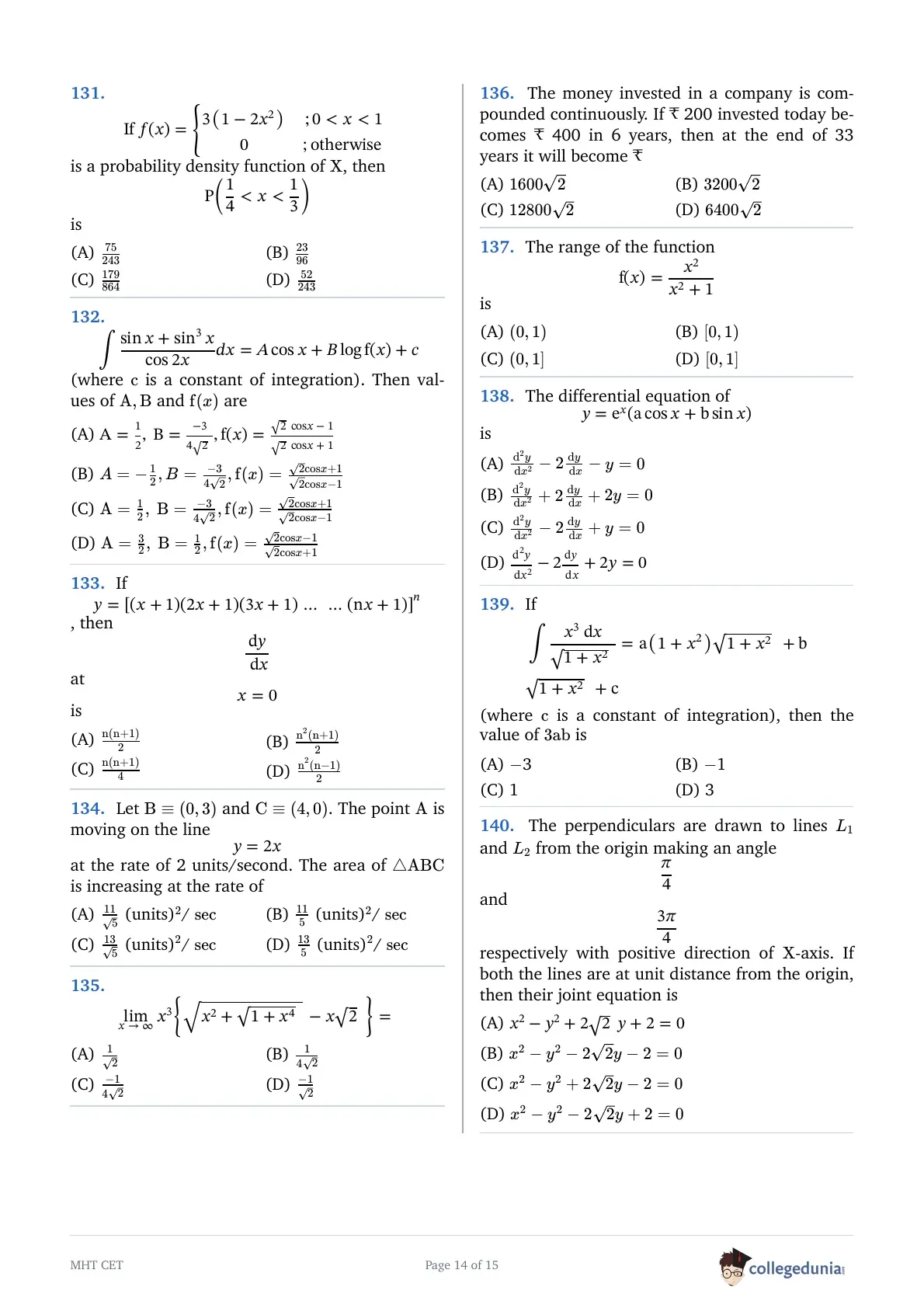
Question 131:

\(\text { If } f(x)= \begin{cases}3\left(1-2 x^2\right) & ; 0< x < 1 \\ 0 & ; \text { otherwise }\end{cases}\) is a probability density function of \(\mathrm{X}\), then \(\mathrm{P}\left(\frac{1}{4} < x < \frac{1}{3}\right)\) is

  • (A) \(\frac{75}{243}\)
  • (B) \(\frac{23}{96}\)
  • (C) \(\frac{179}{864}\)
  • (D) \(\frac{52}{243}\)

Question 132:

\[\int \frac{\sin x+\sin ^3 x}{\cos 2 x} d x=A \cos x+B \log \mathrm{f}(x)+c\] (where \[\mathrm{c}\] is a constant of integration). Then values of \[\mathrm{A}, \mathrm{B}\] and \[\mathrm{f}(x)\] are

  • (A) \(\mathrm{A}=\frac{1}{2},\text{ }\mathrm{B}=\frac{-3}{4\sqrt{2}},\mathrm{f}(x)=\frac{\sqrt{2}\mathrm{cos}x-1}{\sqrt{2}\mathrm{cos}x+1}\)
  • (B) \(A=-\frac{1}{2},B=\frac{-3}{4\sqrt{2}},\mathrm{f}(x)=\frac{\sqrt{2}\mathrm{cos}x+1}{\sqrt{2}\mathrm{cos}x-1}\)
  • (C) \(\mathrm{A}=\frac{1}{2},\text{ }\mathrm{B}=\frac{-3}{4\sqrt{2}},\mathrm{f}(x)=\frac{\sqrt{2}\mathrm{cos}x+1}{\sqrt{2}\mathrm{cos}x-1}\)
  • (D) \(\mathrm{A}=\frac{3}{2},\text{ }\mathrm{B}=\frac{1}{2},\mathrm{f}(x)=\frac{\sqrt{2}\mathrm{cos}x-1}{\sqrt{2}\mathrm{cos}x+1}\)

Question 133:

If \[y=[(x+1)(2 x+1)(3 x+1) \ldots \ldots(\mathrm{n} x+1)]^n\], then \[\frac{\mathrm{d} y}{\mathrm{~d} x}\] at \[x=0\] is

  • (A) \(\frac{\mathrm{n}(\mathrm{n}+1)}{2}\)
  • (B) \(\frac{\mathrm{n}^{2}(\mathrm{n}+1)}{2}\)
  • (C) \(\frac{\mathrm{n}(\mathrm{n}+1)}{4}\)
  • (D) \(\frac{\mathrm{n}^{2}(\mathrm{n}-1)}{2}\)

Question 134:

Let \[\mathrm{B} \equiv(0,3)\] and \[\mathrm{C} \equiv(4,0)\]. The point \[\mathrm{A}\] is moving on the line \[y=2 x\] at the rate of 2 units/second. The area of \[\triangle \mathrm{ABC}\] is increasing at the rate of

  • (A) \(\frac{11}{\sqrt{5}}\) (units)\({}^{2}\)/ \(\mathrm{sec}\)
  • (B) \(\frac{11}{5}\) (units)\({}^{2}\)/ \(\mathrm{sec}\)
  • (C) \(\frac{13}{\sqrt{5}}\) (units)\({}^{2}\)/ \(\mathrm{sec}\)
  • (D) \(\frac{13}{5}\) (units)\({}^{2}\)/ \(\mathrm{sec}\)

Question 135:

\[\lim _\limits{x \rightarrow \infty} x^3\left\{\sqrt{x^2+\sqrt{1+x^4}}-x \sqrt{2}\right\}=\]

  • (A) \(\frac{1}{\sqrt{2}}\)
  • (B) \(\frac{1}{4\sqrt{2}}\)
  • (C) \(\frac{-1}{4\sqrt{2}}\)
  • (D) \(\frac{-1}{\sqrt{2}}\)

Question 136:

The money invested in a company is compounded continuously. If ₹ 200 invested today becomes ₹ 400 in 6 years, then at the end of 33 years it will become ₹

  • (A) \(1600\sqrt{2}\)
  • (B) \(3200\sqrt{2}\)
  • (C) \(12800\sqrt{2}\)
  • (D) \(6400\sqrt{2}\)

Question 137:

The range of the function \[\mathrm{f}(x)=\frac{x^2}{x^2+1}\] is

  • (A) \((0,1)\)
  • (B) \([0,1)\)
  • (C) \((0,1]\)
  • (D) \([0,1]\)

Question 138:

The differential equation of \[y=\mathrm{e}^x(\mathrm{a} \cos x+\mathrm{b} \sin x)\] is

  • (A) \(\frac{\mathrm{d}^{2}y}{\text{ }\mathrm{d}x^{2}}-2\frac{\mathrm{d}y}{\text{ }\mathrm{d}x}-y=0\)
  • (B) \(\frac{\mathrm{d}^{2}y}{\text{ }\mathrm{d}x^{2}}+2\frac{\mathrm{d}y}{\text{ }\mathrm{d}x}+2y=0\)
  • (C) \(\frac{\mathrm{d}^{2}y}{\text{ }\mathrm{d}x^{2}}-2\frac{\mathrm{d}y}{\text{ }\mathrm{d}x}+y=0\)
  • (D) \(\frac{\mathrm{d}^{2}y}{\text{ }\mathrm{d}x^{2}}-2\frac{\mathrm{d}y}{\text{ }\mathrm{d}x}+2y=0\)

Question 139:

If \[\int \frac{x^3 \mathrm{~d} x}{\sqrt{1+x^2}}=\mathrm{a}\left(1+x^2\right) \sqrt{1+x^2}+\mathrm{b} \sqrt{1+x^2}+\mathrm{c}\] (where \[\mathrm{c}\] is a constant of integration), then the value of \[3 \mathrm{ab}\] is

  • (A) \(-\)3
  • (B) \(-\)1
  • (C) 1
  • (D) 3

Question 140:

The perpendiculars are drawn to lines \[L_1\] and \[L_2\] from the origin making an angle \[\frac{\pi}{4}\] and \[\frac{3 \pi}{4}\] respectively with positive direction of \[\mathrm{X}\]-axis. If both the lines are at unit distance from the origin, then their joint equation is

  • (A) \(x^{2}-y^{2}+2\sqrt{2}y+2=0\)
  • (B) \(x^{2}-y^{2}-2\sqrt{2}y-2=0\)
  • (C) \(x^{2}-y^{2}+2\sqrt{2}y-2=0\)
  • (D) \(x^{2}-y^{2}-2\sqrt{2}y+2=0\)

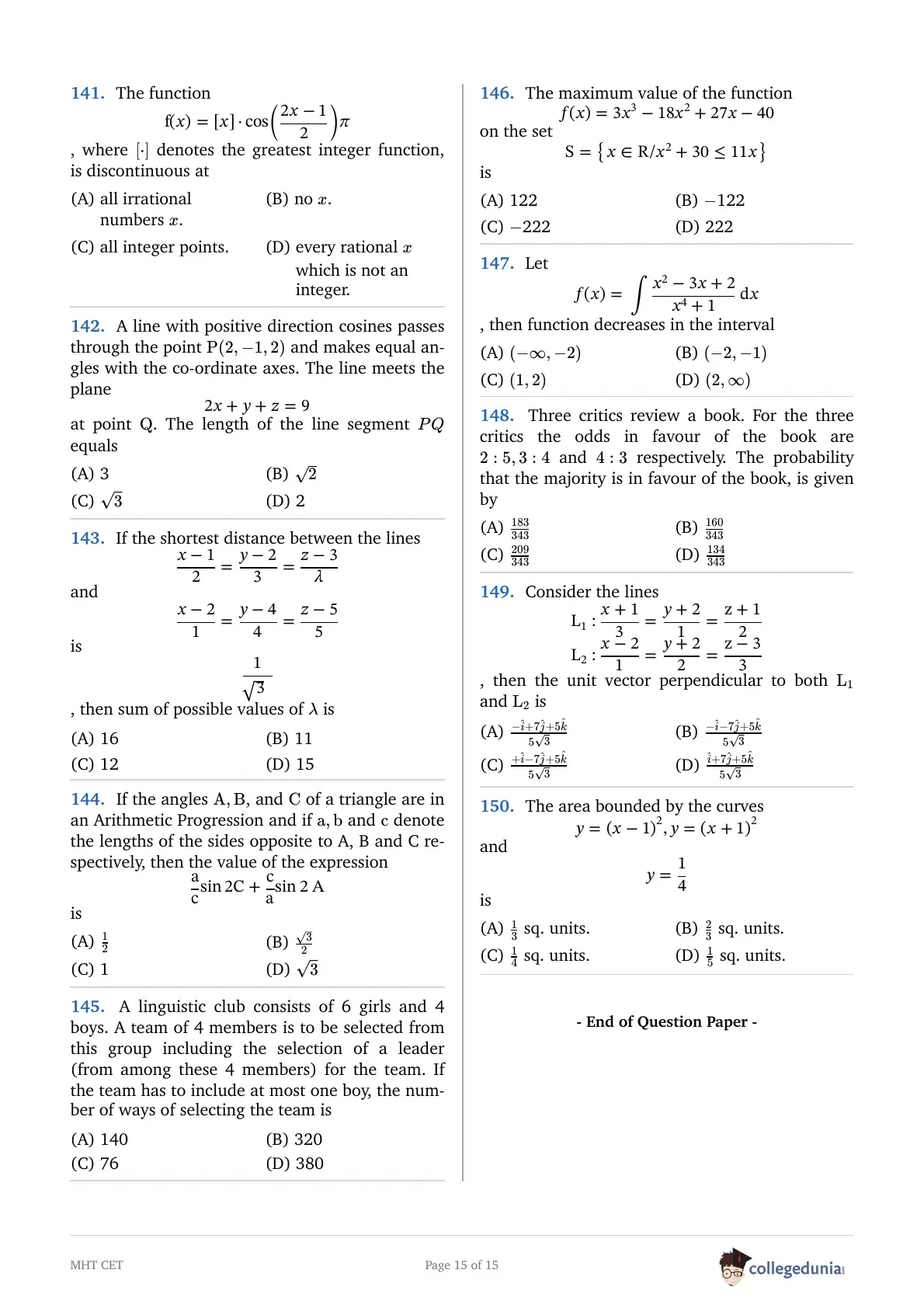
Question 142:

A line with positive direction cosines passes through the point \[\mathrm{P}(2,-1,2)\] and makes equal angles with the co-ordinate axes. The line meets the plane \[2 x+y+z=9\] at point \[\mathrm{Q}\]. The length of the line segment \[P Q\] equals

  • (A) 3
  • (B) \(\sqrt{2}\)
  • (C) \(\sqrt{3}\)
  • (D) 2

Question 143:

If the shortest distance between the lines \[\frac{x-1}{2}=\frac{y-2}{3}=\frac{z-3}{\lambda}\] and \[\frac{x-2}{1}=\frac{y-4}{4}=\frac{z-5}{5}\] is \[\frac{1}{\sqrt{3}}\], then sum of possible values of \[\lambda\] is

  • (A) 16
  • (B) 11
  • (C) 12
  • (D) 15

Question 144:

If the angles \[\mathrm{A}, \mathrm{B}\], and \[\mathrm{C}\] of a triangle are in an Arithmetic Progression and if \[\mathrm{a}, \mathrm{b}\] and \[\mathrm{c}\] denote the lengths of the sides opposite to A, B and C respectively, then the value of the expression \[\frac{\mathrm{a}}{\mathrm{c}} \sin 2 \mathrm{C}+\frac{\mathrm{c}}{\mathrm{a}} \sin 2 \mathrm{~A}\] is

  • (A) \(\frac{1}{2}\)
  • (B) \(\frac{\sqrt{3}}{2}\)
  • (C) 1
  • (D) \(\sqrt{3}\)

Question 145:

A linguistic club consists of 6 girls and 4 boys. A team of 4 members is to be selected from this group including the selection of a leader (from among these 4 members) for the team. If the team has to include at most one boy, the number of ways of selecting the team is

  • (A) 140
  • (B) 320
  • (C) 76
  • (D) 380

Question 146:

The maximum value of the function \[f(x)=3 x^3-18 x^2+27 x-40\] on the set \[\mathrm{S}=\left\{x \in \mathrm{R} / x^2+30 \leq 11 x\right\}\] is

  • (A) 122
  • (B) \(-\)122
  • (C) \(-\)222
  • (D) 222

Question 147:

Let \[f(x)=\int \frac{x^2-3 x+2}{x^4+1} \mathrm{~d} x\], then function decreases in the interval

  • (A) \((-\infty ,-2)\)
  • (B) \((-2,-1)\)
  • (C) \((1,2)\)
  • (D) \((2,\infty )\)

Question 148:

Three critics review a book. For the three critics the odds in favour of the book are \[2: 5, 3: 4\] and \[4: 3\] respectively. The probability that the majority is in favour of the book, is given by

  • (A) \(\frac{183}{343}\)
  • (B) \(\frac{160}{343}\)
  • (C) \(\frac{209}{343}\)
  • (D) \(\frac{134}{343}\)

Question 149:

Consider the lines \[\mathrm{L}_1: \frac{x+1}{3}=\frac{y+2}{1}=\frac{\mathrm{z}+1}{2}\]

\[\mathrm{L}_2: \frac{x-2}{1}=\frac{y+2}{2}=\frac{\mathrm{z}-3}{3}\], then the unit vector perpendicular to both \[\mathrm{L}_1\] and \[\mathrm{L}_2\] is

  • (A) \(\frac{-\hat{i}+7\hat{j}+5\hat{k}}{5\sqrt{3}}\)
  • (B) \(\frac{-\hat{i}-7\hat{j}+5\hat{k}}{5\sqrt{3}}\)
  • (C) \(\frac{+\hat{i}-7\hat{j}+5\hat{k}}{5\sqrt{3}}\)
  • (D) \(\frac{\hat{i}+7\hat{j}+5\hat{k}}{5\sqrt{3}}\)

Question 150:

The area bounded by the curves \[y=(x-1)^2, y=(x+1)^2\] and \[y=\frac{1}{4}\] is

  • (A) \(\frac{1}{3}\) sq. units.
  • (B) \(\frac{2}{3}\) sq. units.
  • (C) \(\frac{1}{4}\) sq. units.
  • (D) \(\frac{1}{5}\) sq. units.

MHT CET 2023 PCM Exam Pattern and Marking Scheme

Parameter Details
Conducting Body Maharashtra Common Entrance Test Cell (Maharashtra CET Cell)
Exam Mode Online (Computer-Based Test)
Duration 180 minutes (3 hours)
Groups / Subjects PCM (Physics, Chemistry, Mathematics) for Engineering
Total Questions

150

Total Marks 200
Question Type Multiple Choice Questions (MCQs)
Marks Distribution
  • Mathematics – 2 marks/question
  • Physics and Chemistry – 1 mark/question
Negative Marking No
Syllabus Weightage
  • Class 12 – 80%
  • Class 11 – 20%