




MHT CET 2024 April 22 Shift 2 PCB Question Paper is available for download here. Maharashtra State CET Cell conducted MHT CET 2024 PCB Exam on April 22 in Shift 2 from 2 PM to 5 PM in CBT mode.
The MHT CET 2024 PCB question paper includes the following:
- The MHT CET 2024 PCB Question Paper consists of 200 multiple-choice questions (MCQs) totalling 200 marks divided into 3 sections: Physics (50 questions), Chemistry (50 questions), and Biology (100 questions).
- All questions carry 1 mark each. There is no negative marking for incorrect answers.
MHT CET 2024 April 22 Shift 2 PCB Question Paper with Solution PDF
| CD PDF | CD PDF with Solutions |
|---|---|
| Download Collegedunia PDF 1.20 MB | - |
Also Check:
MHT CET 2024 April 22 Shift 2 PCB Questions with Solutions
Physics (Q1 - Q50)
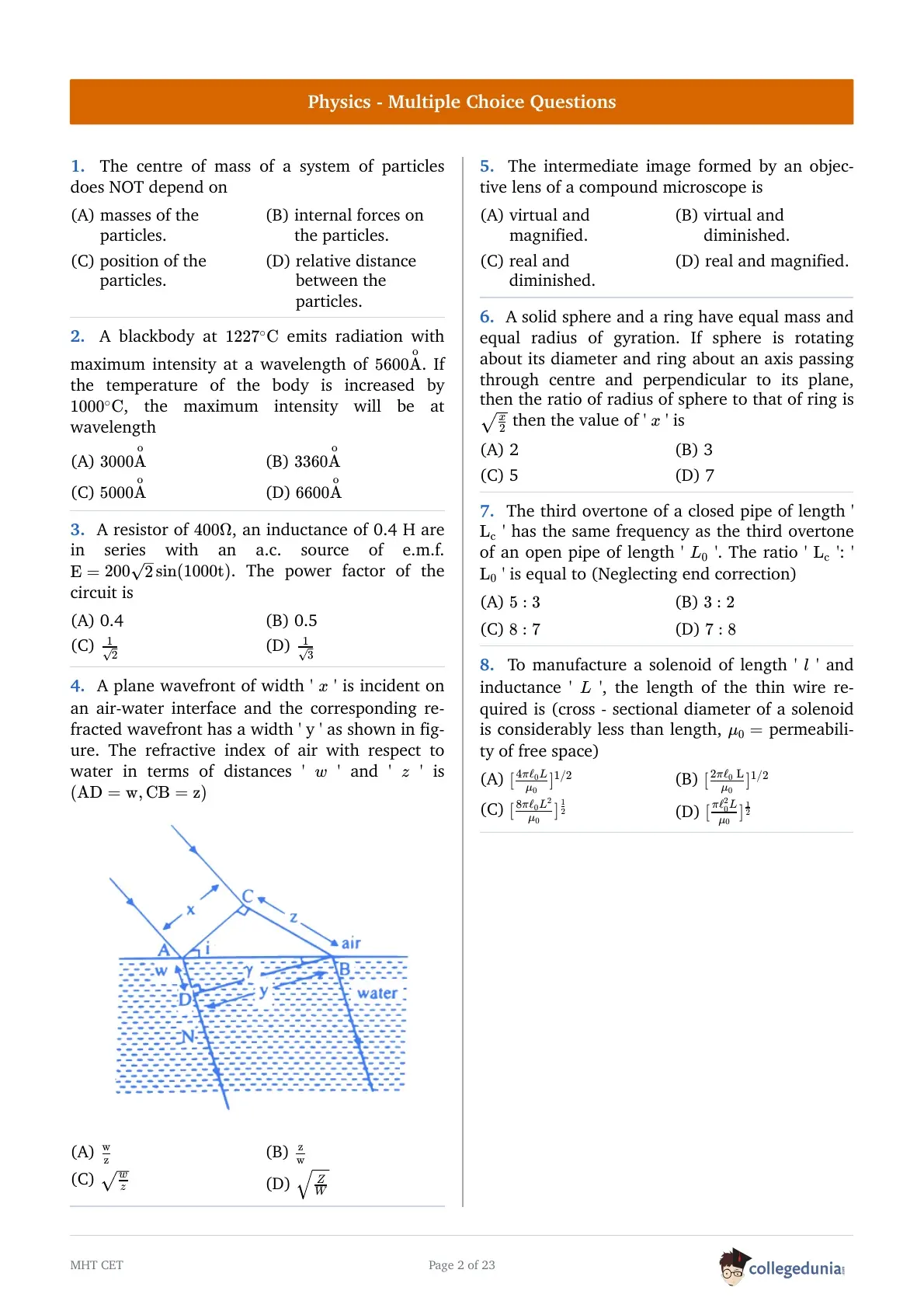
The centre of mass of a system of particles does NOT depend on
A blackbody at \( 1227^\circ\text{C} \) emits radiation with maximum intensity at a wavelength of \( 5600\,\text{\AA} \). If the temperature of the body is increased by \( 1000^\circ\text{C} \), the maximum intensity will be at wavelength
A resistor of \( 400\,\Omega \) and an inductance of \( 0.4\,\text{H} \) are in series with an a.c. source of e.m.f. \( E = 200\sqrt{2}\sin(1000t) \). The power factor of the circuit is
A plane wavefront of width ' \( x \) ' is incident on an air-water interface and the corresponding refracted wavefront has a width ' \( y \) ' as shown in figure. The refractive index of air with respect to water in terms of distances ' \( w \) ' and ' \( z \) ' is (AD = w, CB = z)

The intermediate image formed by an objective lens of a compound microscope is
A solid sphere and a ring have equal mass and equal radius of gyration. If sphere is rotating about its diameter and ring about an axis passing through centre and perpendicular to its plane, then the ratio of radius of sphere to that of ring is \( \sqrt{\frac{x}{2}} \) then the value of ' x ' is
The third overtone of a closed pipe of length ' \( L_c \) ' has the same frequency as the third overtone of an open pipe of length ' \( L_o \) '. The ratio ' \( L_c \) ' : ' \( L_o \) ' is equal to (Neglecting end correction)
To manufacture a solenoid of length ' \( l \) ' and inductance ' \( L \) ', the length of the thin wire required is (cross - sectional diameter of a solenoid is considerably less than length, \( \mu_0 = \) permeability of free space)
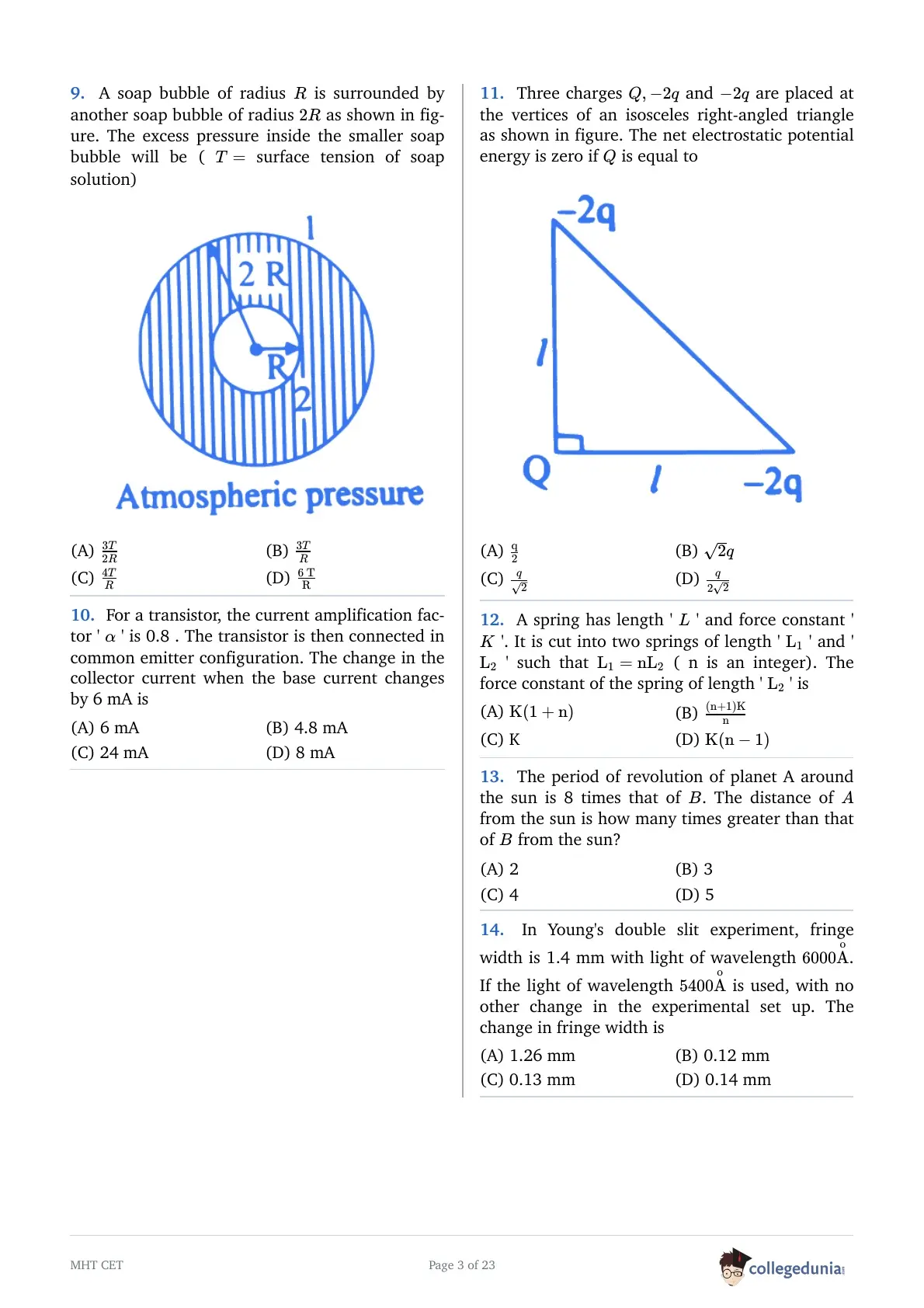
A soap bubble of radius \( R \) is surrounded by another soap bubble of radius \( 2R \) as shown in figure. The excess pressure inside the smaller soap bubble will be (\( T \) = surface tension of soap solution)

For a transistor, the current amplification factor \( \alpha \) is \( 0.8 \). The transistor is then connected in common emitter configuration. The change in the collector current when the base current changes by \( 6 \text{ mA} \) is
Three charges \( Q, -2q \) and \( -2q \) are placed at the vertices of an isosceles right-angled triangle as shown in figure. The net electrostatic potential energy is zero if \( Q \) is equal to

A spring has length ' \( L \) ' and force constant ' \( K \) '. It is cut into two springs of length ' \( L_1 \) ' and ' \( L_2 \) ' such that \( L_1 = nL_2 \) (n is an integer). The force constant of the spring of length ' \( L_2 \) ' is
The period of revolution of planet A around the sun is 8 times that of \( B \). The distance of \( A \) from the sun is how many times greater than that of \( B \) from the sun?
In Young's double slit experiment, fringe width is \( 1.4 \text{ mm} \) with light of wavelength \( 6000\,\text{\AA} \). If the light of wavelength \( 5400\,\text{\AA} \) is used, with no other change in the experimental set up. The change in fringe width is
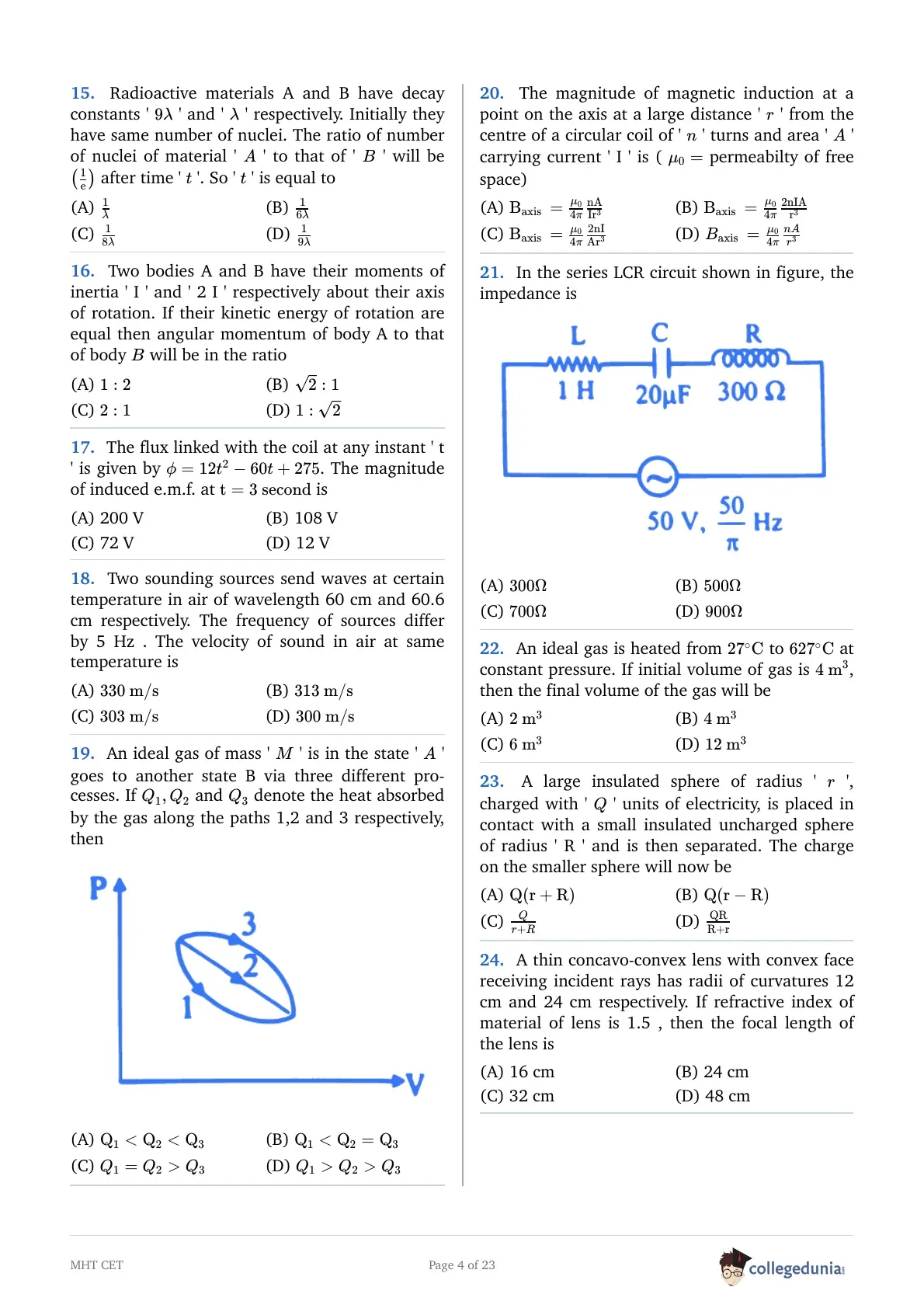
Radioactive materials A and B have decay constants ' \( 9\lambda \) ' and ' \( \lambda \) ' respectively. Initially they have same number of nuclei. The ratio of number of nuclei of material ' \( A \) ' to that of ' \( B \) ' will be \( \left( \frac{1}{e} \right) \) after time ' \( t \) '. So ' \( t \) ' is equal to
Two bodies A and B have their moments of inertia ' \( I \) ' and ' \( 2 I \) ' respectively about their axis of rotation. If their kinetic energy of rotation are equal then angular momentum of body A to that of body \( B \) will be in the ratio
The flux linked with the coil at any instant ' t ' is given by \( \phi = 12t^2 - 60t + 275 \). The magnitude of induced e.m.f. at \( t = 3 \text{ second} \) is
Two sounding sources send waves at certain temperature in air of wavelength \( 60 \text{ cm} \) and \( 60.6 \text{ cm} \) respectively. The frequency of sources differ by \( 5 \text{ Hz} \). The velocity of sound in air at same temperature is
An ideal gas of mass \( M \) in the state \( A \) goes to another state \( B \) via three different processes. If \( Q_1, Q_2 \) and \( Q_3 \) denote the heat absorbed by the gas along the paths 1, 2 and 3 respectively, then

The magnitude of magnetic induction at a point on the axis at a large distance ' \( r \) ' from the centre of a circular coil of ' \( n \) ' turns and area ' \( A \) ' carrying current ' I ' is (\( \mu_0 = \) permeability of free space)

An ideal gas is heated from \( 27^\circ\text{C} \) to \( 627^\circ\text{C} \) at constant pressure. If initial volume of gas is \( 4 \text{ m}^3 \), then the final volume of the gas will be
A large insulated sphere of radius ' r ', charged with ' Q ' units of electricity, is placed in contact with a small insulated uncharged sphere of radius ' R ' and is then separated. The charge on the smaller sphere will now be
A thin concavo-convex lens with convex face receiving incident rays has radii of curvatures \( 12 \text{ cm} \) and \( 24 \text{ cm} \) respectively. If refractive index of material of lens is \( 1.5 \), then the focal length of the lens is
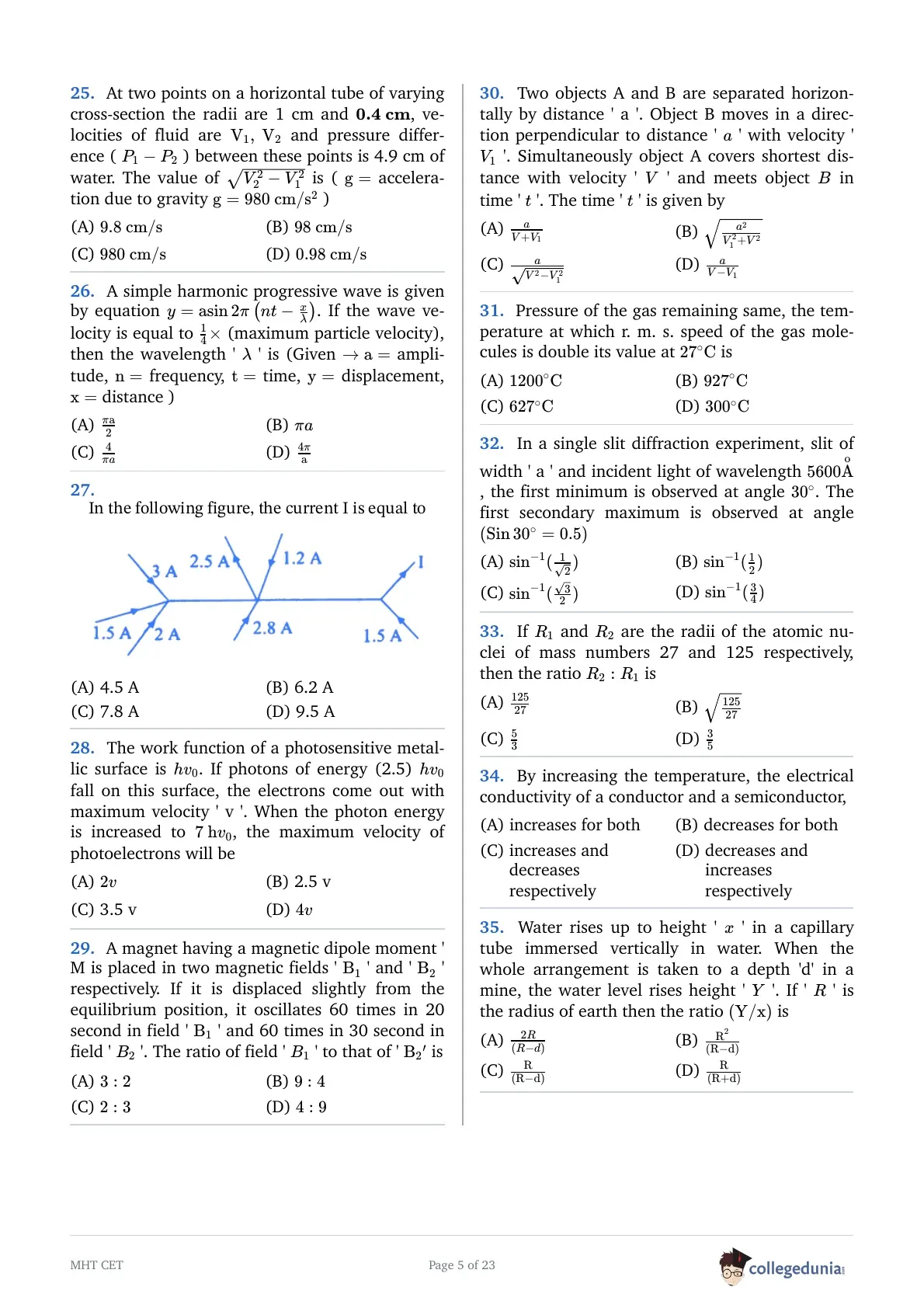
A simple harmonic progressive wave is given by equation \( y = a \sin 2\pi (nt - \frac{x}{\lambda}) \). If the wave velocity is equal to \( \frac{1}{4} \times \) (maximum particle velocity), then the wavelength ' \( \lambda \) ' is (Given \( a = \) amplitude, \( n = \) frequency, \( t = \) time, \( y = \) displacement, \( x = \) distance )

The work function of a photosensitive metallic surface is \(h v_0\). If photons of energy (2.5) \(h v_0\) fall on this surface, the electrons come out with maximum velocity ' v '. When the photon energy is increased to \(7 \mathrm{~h} v_0\), the maximum velocity of photoelectrons will be
A magnet having a magnetic dipole moment ' M is placed in two magnetic fields ' \( B_1 \) ' and ' \( B_2 \) ' respectively. If it is displaced slightly from the equilibrium position, it oscillates \(60\) times in \(20\) second in field ' \( B_1 \) ' and \(60\) times in \(30\) second in field ' \( B_2 \) '. The ratio of field ' \( B_1 \) ' to that of ' \( B_2 \) ' is
Two objects A and B are separated horizontally by distance ' a '. Object B moves in a direction perpendicular to distance ' a ' with velocity ' \( V_1 \) '. Simultaneously object A covers shortest distance with velocity ' V ' and meets object B in time ' t '. The time ' t ' is given by
Pressure of the gas remaining same, the temperature at which r.m.s. speed of the gas molecules is double its value at \( 27^\circ\text{C} \) is
In a single slit diffraction experiment, slit of width 'a' and incident light of wavelength \( 5600\,\text{\AA} \), the first minimum is observed at angle \( 30^\circ \). The first secondary maximum is observed at angle \( (\sin 30^\circ = 0.5) \)
If \( R_1 \) and \( R_2 \) are the radii of the atomic nuclei of mass numbers \(27\) and \(125\) respectively, then the ratio \( R_2 : R_1 \) is
By increasing the temperature, the electrical conductivity of a conductor and a semiconductor,
Water rises up to height ' x ' in a capillary tube immersed vertically in water. When the whole arrangement is taken to a depth 'd' in a mine, the water level rises height ' Y '. If ' R ' is the radius of earth then the ratio (Y x) is
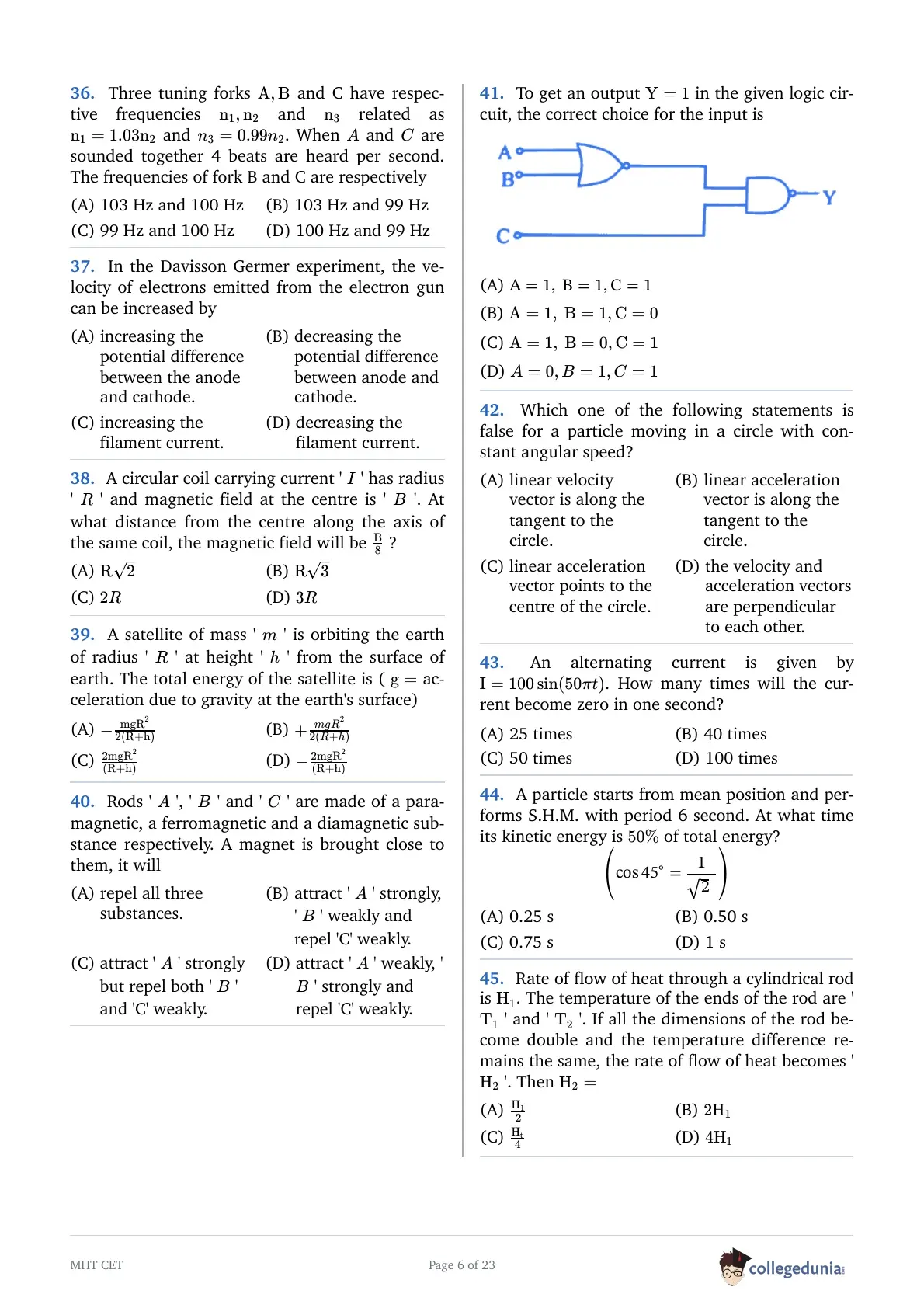
Three tuning forks A, B and C have respective frequencies \( n_1, n_2 \) and \( n_3 \) related as \( n_1 = 1.03n_2 \) and \( n_3 = 0.99n_2 \). When A and C are sounded together 4 beats are heard per second. The frequencies of fork B and C are respectively
In the Davisson Germer experiment, the velocity of electrons emitted from the electron gun can be increased by
A circular coil carrying current ' I ' has radius ' R ' and magnetic field at the centre is ' B '. At what distance from the centre along the axis of the same coil, the magnetic field will be \( \frac{B}{8} \) ?
A satellite of mass ' m ' is orbiting the earth of radius ' R ' at height ' h ' from the surface of earth. The total energy of the satellite is ( g = acceleration due to gravity at the earth's surface)
Rods 'A', 'B' and 'C' are made of a paramagnetic, a ferromagnetic and a diamagnetic substance respectively. A magnet is brought close to them, it will
To get an output Y = 1 in the given logic circuit, the correct choice for the input is
Which one of the following statements is false for a particle moving in a circle with constant angular speed?
An alternating current is given by \(I = 100 \sin(50\pi t)\). How many times will the current become zero in one second?
A particle starts from mean position and performs S.H.M. with period 6 second. At what time its kinetic energy is \(50\%\) of total energy? \( (\cos 45^\circ = \frac{1}{\sqrt{2}}) \)
Rate of flow of heat through a cylindrical rod is \( H_1 \). The temperature of the ends of the rod are ' \( T_1 \) ' and ' \( T_2 \) '. If all the dimensions of the rod become double and the temperature difference remains the same, the rate of flow of heat becomes ' \( H_2 \) '. Then \( H_2 = \)
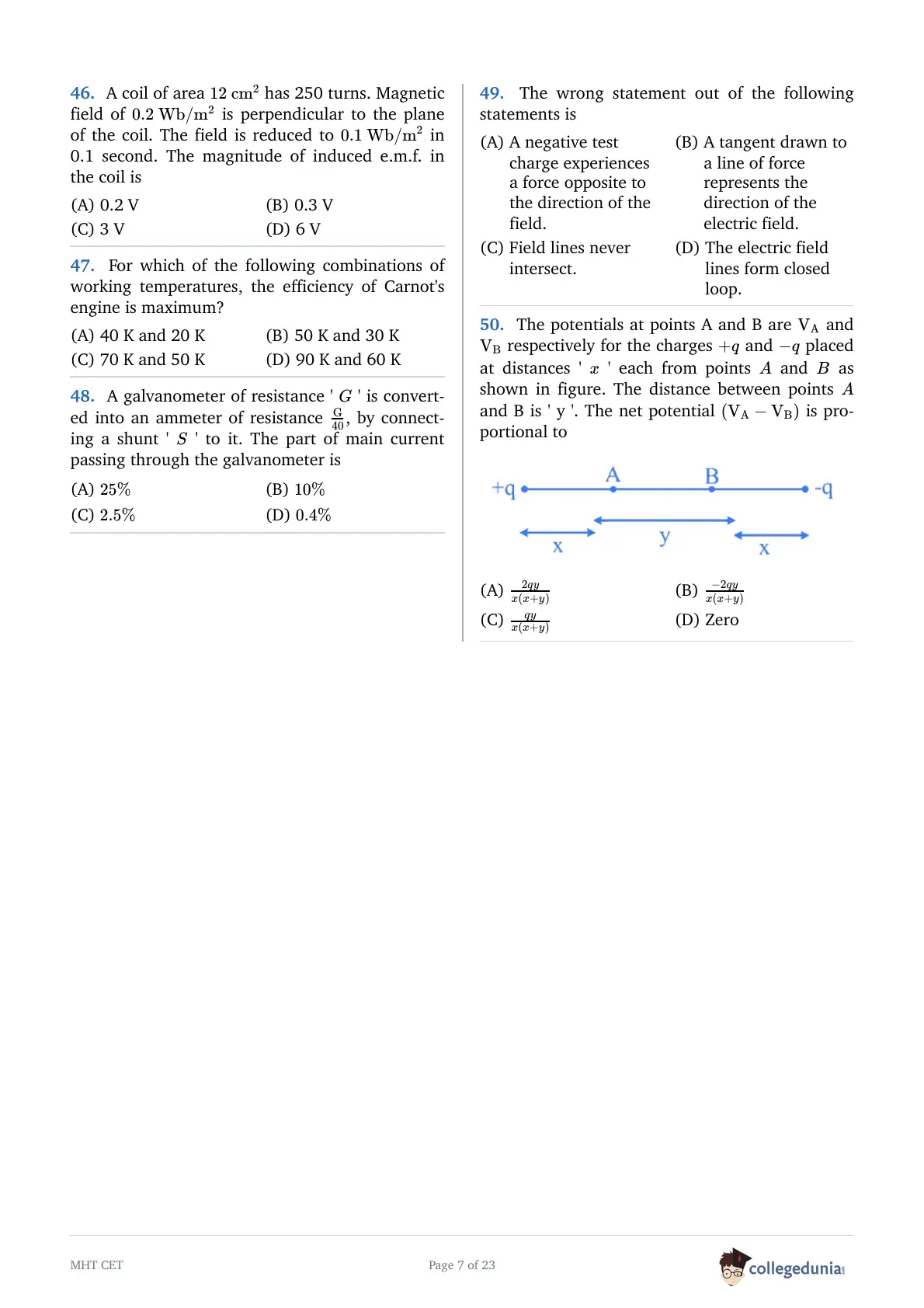
A coil of area \( 12 \text{ cm}^2 \) has \( 250 \) turns. Magnetic field of \( 0.2 \text{ Wb/m}^2 \) is perpendicular to the plane of the coil. The field is reduced to \( 0.1 \text{ Wb/m}^2 \) in \( 0.1 \text{ second} \). The magnitude of induced e.m.f. in the coil is
For which of the following combinations of working temperatures, the efficiency of Carnot's engine is maximum?
A galvanometer of resistance ' G ' is converted into an ammeter of resistance \( \frac{G}{40} \), by connecting a shunt ' S ' to it. The part of main current passing through the galvanometer is
The wrong statement out of the following statements is
The potentials at points A and B are \( V_A \) and \( V_B \) respectively for the charges \( +q \) and \( -q \) placed at distances ' x ' each from points A and B as shown in figure. The distance between points A and B is ' y '. The net potential (\( V_A - V_B \)) is proportional to
Chemistry (Q51 - Q100)
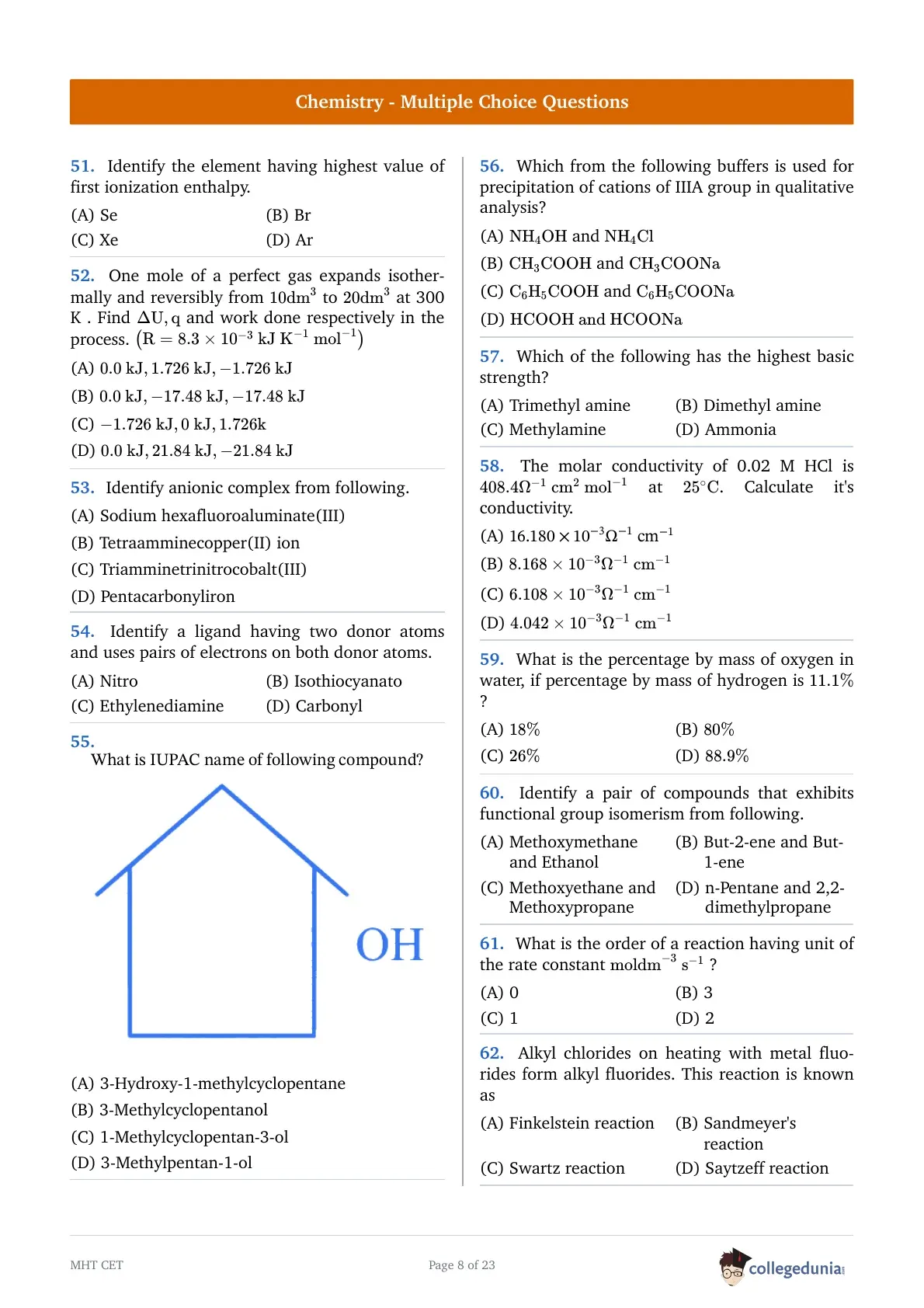
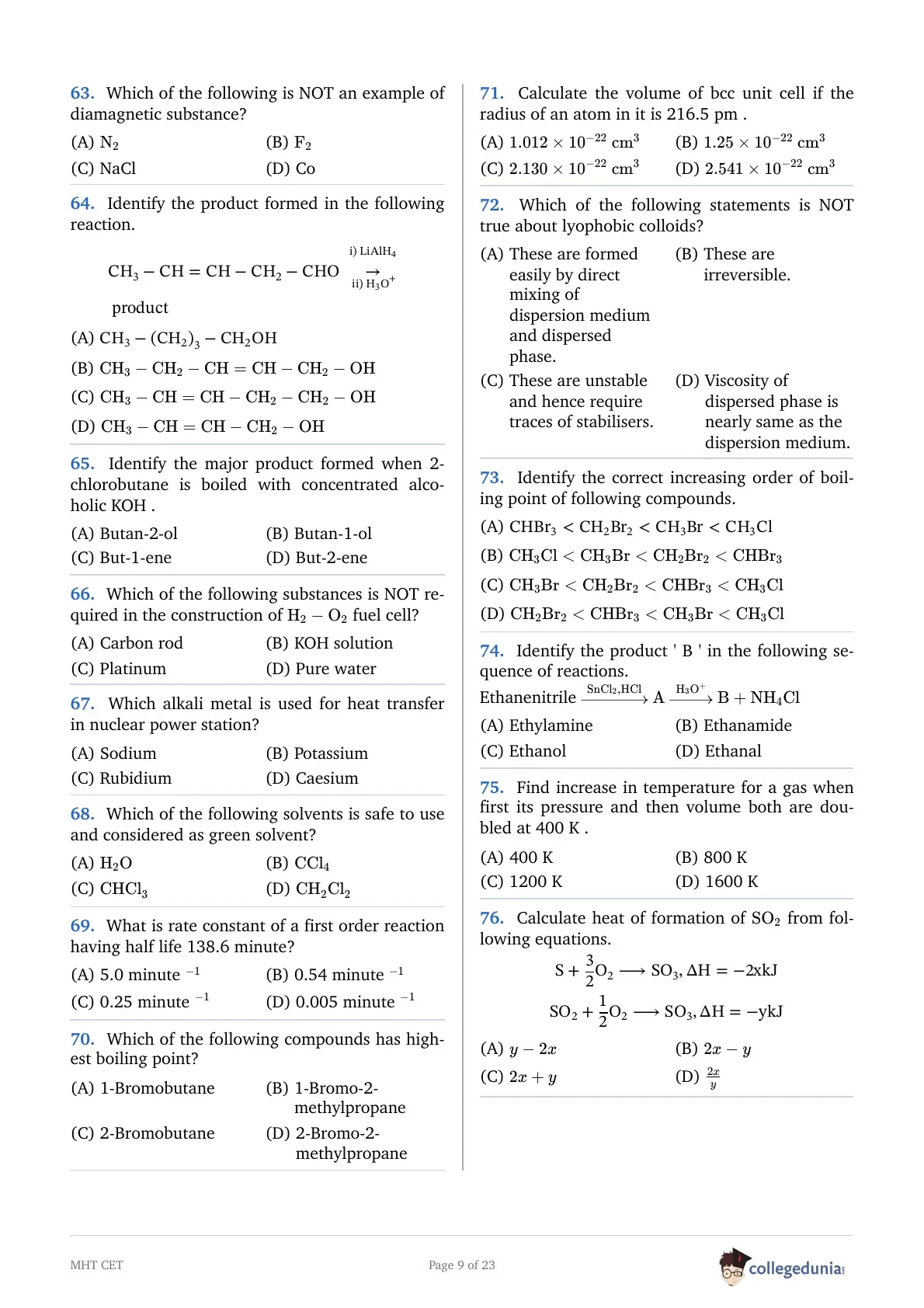
Identify the element having highest value of first ionization enthalpy.
One mole of a perfect gas expands isothermally and reversibly from \(10\text{dm}^3\) to \(20\text{dm}^3\) at \(300\text{ K}\) . Find \(\Delta \text{U}\), q and work done respectively in the process. \(\left( \text{R} = 8.3 \times 10^{-3} \text{ kJ K}^{-1} \text{ mol}^{-1} \right)\)
Identify anionic complex from following.
Identify a ligand having two donor atoms and uses pairs of electrons on both donor atoms.

Which from the following buffers is used for precipitation of cations of IIIA group in qualitative analysis?
Which of the following has the highest basic strength?
The molar conductivity of \(0.02 \text{ M HCl}\) is \(408.4 \Omega^{-1} \text{ cm}^2 \text{ mol}^{-1}\) at \(25^\circ\text{C}\). Calculate it's conductivity.
What is the percentage by mass of oxygen in water, if percentage by mass of hydrogen is \(11.1\%\) ?
Identify a pair of compounds that exhibits functional group isomerism from following.
What is the order of a reaction having unit of the rate constant \(\text{mol}\cdot\text{dm}^{-3} \text{s}^{-1}\) ?
Alkyl chlorides on heating with metal fluorides form alkyl fluorides. This reaction is known as
Identify the product formed in the following reaction.
\[ \text{CH}_3 - \text{CH} = \text{CH} - \text{CH}_2 - \text{CHO} \xrightarrow[ii) \text{ H}_3\text{O}^+]{i) \text{ LiAlH}_4} \text{product} \]
Identify the major product formed when 2-chlorobutane is boiled with concentrated alcoholic \(\text{KOH}\) .
Which of the following substances is NOT required in the construction of \(\text{H}_2 - \text{O}_2\) fuel cell?
Which alkali metal is used for heat transfer in nuclear power station?
Which of the following solvents is safe to use and considered as green solvent?
What is rate constant of a first order reaction having half life \(138.6 \text{ minute}\)?
Which of the following compounds has highest boiling point?
Calculate the volume of bcc unit cell if the radius of an atom in it is \(216.5 \text{ pm}\) .
Which of the following statements is NOT true about lyophobic colloids?
Identify the correct increasing order of boiling point of following compounds.
Identify the product ' B ' in the following sequence of reactions.
\[ \text{Ethanenitrile} \xrightarrow{\text{SnCl}_2, \text{HCl}} \text{A} \xrightarrow{\text{H}_3\text{O}^+} \text{B} + \text{NH}_4\text{Cl} \]
Find increase in temperature for a gas when first its pressure and then volume both are doubled at \(400 \text{ K}\) .
Calculate heat of formation of \(\mathrm{SO}_2\) from following equations.
\[ \begin{aligned} & \mathrm{S}+\frac{3}{2} \mathrm{O}_2 \longrightarrow \mathrm{SO}_3, \Delta \mathrm{H}=-2 \mathrm{xkJ} \\ & \mathrm{SO}_2+\frac{1}{2} \mathrm{O}_2 \longrightarrow \mathrm{SO}_3, \Delta \mathrm{H}=-\mathrm{ykJ} \end{aligned} \]
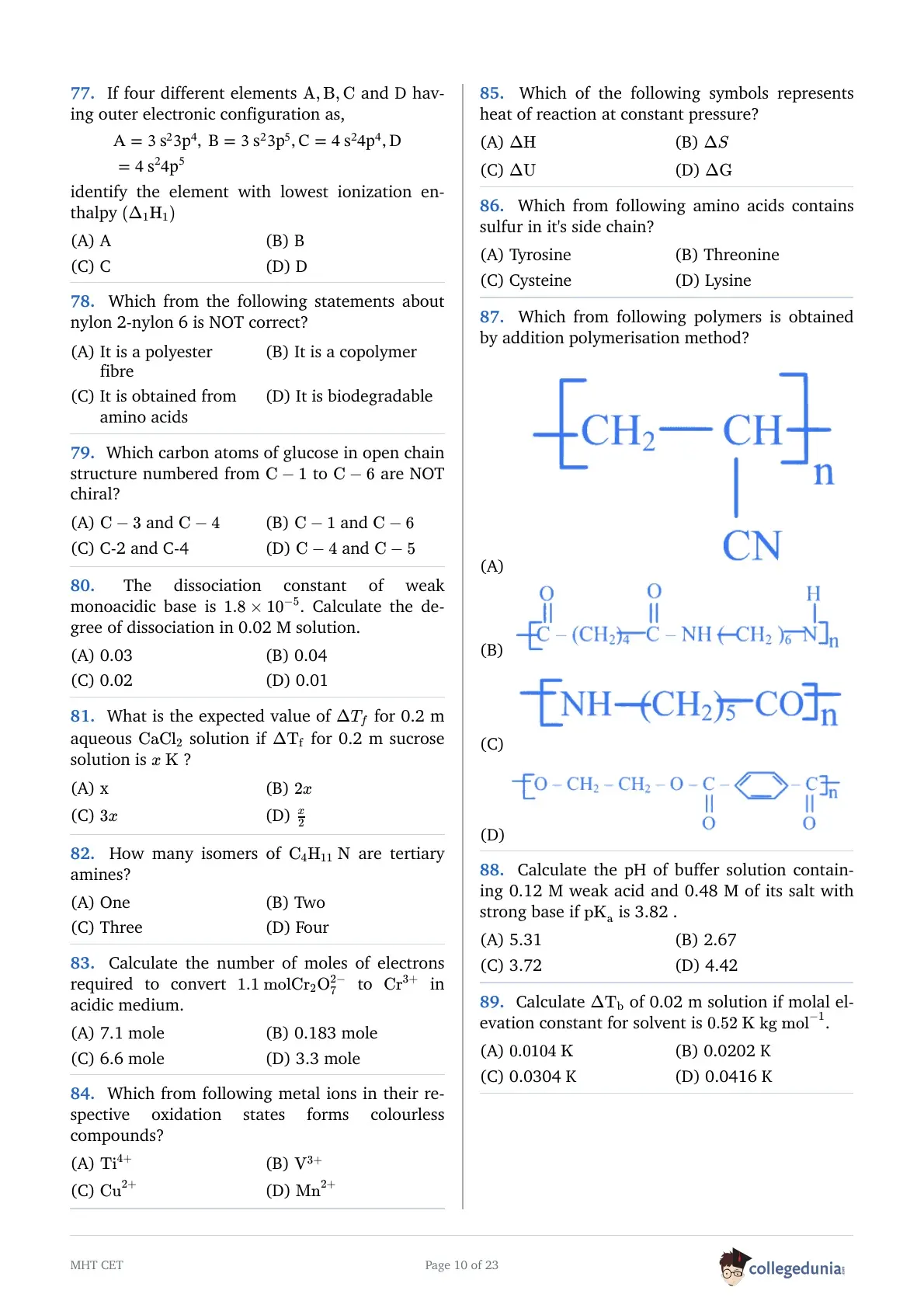
If four different elements A, B, C and D having outer electronic configuration as,
\(\text{A} = 3s^2 3p^4, \text{B} = 3s^2 3p^5, \text{C} = 4s^2 4p^4, \text{D} = 4s^2 4p^5\)
identify the element with lowest ionization enthalpy \((\Delta_i \text{H}_1)\)
Which from the following statements about nylon 2-nylon 6 is NOT correct?
Which carbon atoms of glucose in open chain structure numbered from \(\mathrm{C}-1\) to \(\mathrm{C}-6\) are NOT chiral?
The dissociation constant of weak monoacidic base is \(1.8 \times 10^{-5}\). Calculate the degree of dissociation in \(0.02 \text{ M}\) solution.
What is the expected value of \(\Delta \text{T}_f\) for \(0.2 \text{ m}\) aqueous \(\text{CaCl}_2\) solution if \(\Delta \text{T}_f\) for \(0.2 \text{ m}\) sucrose solution is \(x \text{ K}\) ?
How many isomers of \(\text{C}_4\text{H}_{11}\text{N}\) are tertiary amines?
Calculate the number of moles of electrons required to convert \(1.1 \text{ mol } \text{Cr}_2\text{O}_7^{2-}\) to \(\text{Cr}^{3+}\) in acidic medium.
Which from following metal ions in their respective oxidation states forms colourless compounds?
Which of the following symbols represents heat of reaction at constant pressure?
Which from following polymers is obtained by addition polymerisation method?
- (A)
![]()
- (B)
![]()
- (C)
![]()
- (D)
![]()


Calculate the pH of buffer solution containing \(0.12 \text{ M}\) weak acid and \(0.48 \text{ M}\) of its salt with strong base if \(pK_a\) is 3.82 .
Calculate \(\Delta \text{T}_b\) of \(0.02 \text{ m}\) solution if molal elevation constant for solvent is \(0.52 \text{ K kg mol}^{-1}\).
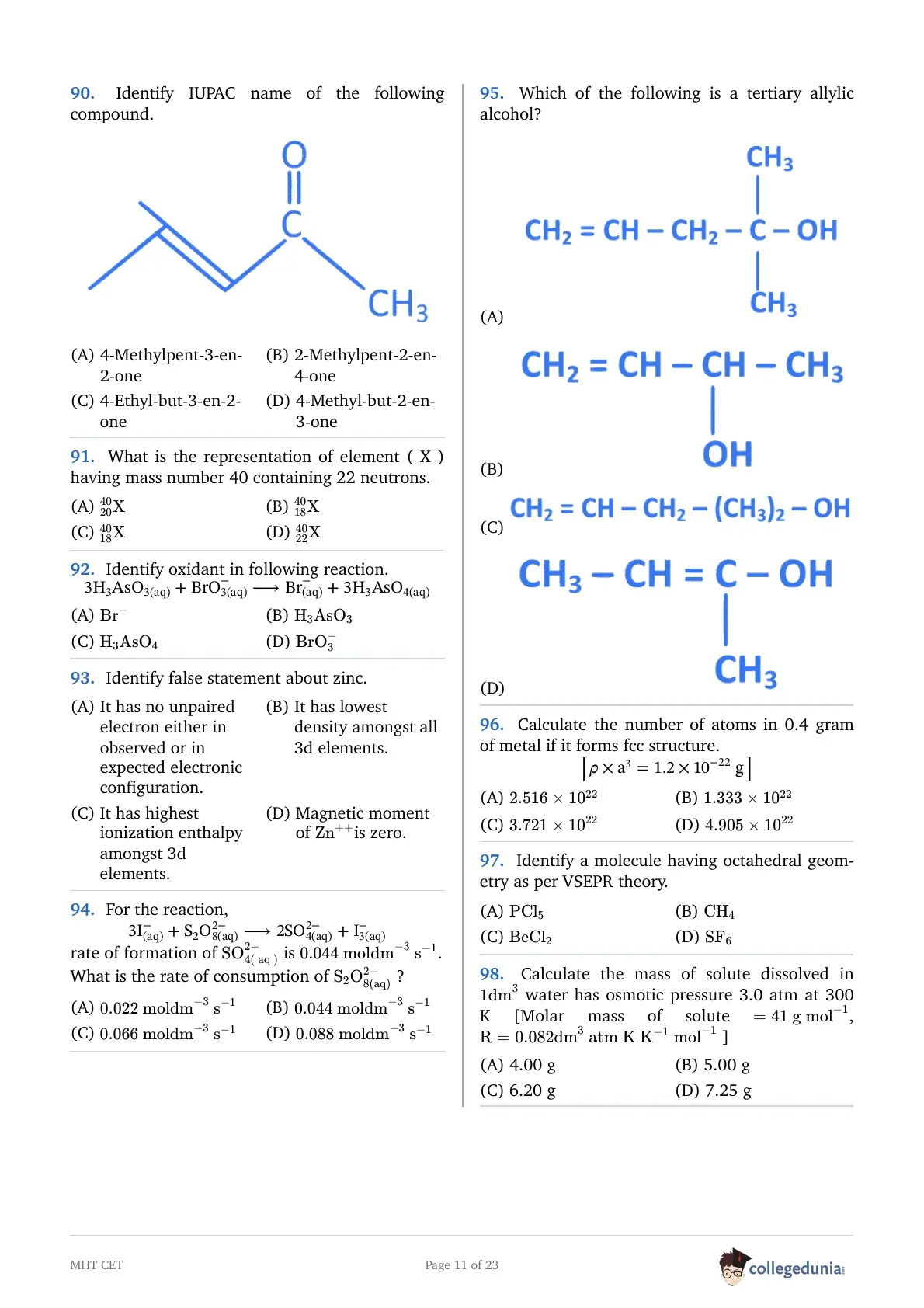
What is the representation of element ( X ) having mass number 40 containing 22 neutrons.
Identify oxidant in following reaction.
\[ 3\text{H}_3\text{AsO}_{3(aq)} + \text{BrO}^-_{3(aq)} \longrightarrow \text{Br}^-_{(aq)} + 3\text{H}_3\text{AsO}_{4(aq)} \]
Identify false statement about zinc.
For the reaction,
\( 3\,\text{I}^-_{(aq)} + \text{S}_2\text{O}_8^{2-}{}_{(aq)} \longrightarrow 2\,\text{SO}_4^{2-}{}_{(aq)} + \text{I}_3^-{}_{(aq)} \)
rate of formation of \( \text{SO}_4^{2-}{}_{(aq)} \) is \( 0.044\,\text{mol dm}^{-3}\,\text{s}^{-1} \).
What is the rate of consumption of \( \text{S}_2\text{O}_8^{2-}{}_{(aq)} \) ?
Which of the following is a tertiary allylic alcohol?
Calculate the number of atoms in 0.4 gram of metal if it forms fcc structure.
\([ \rho \times a^3 = 1.2 \times 10^{-22} \text{ g} ]\)
Identify a molecule having octahedral geometry as per VSEPR theory.
Calculate the mass of solute dissolved in \(1 \text{ dm}^3\) water has osmotic pressure \(3.0 \text{ atm}\) at \(300 \text{ K}\)
\([ \text{Molar mass of solute} = 41 \text{ g mol}^{-1}, \text{R} = 0.082 \text{ dm}^3 \text{ atm K}^{-1} \text{ mol}^{-1} ]\)
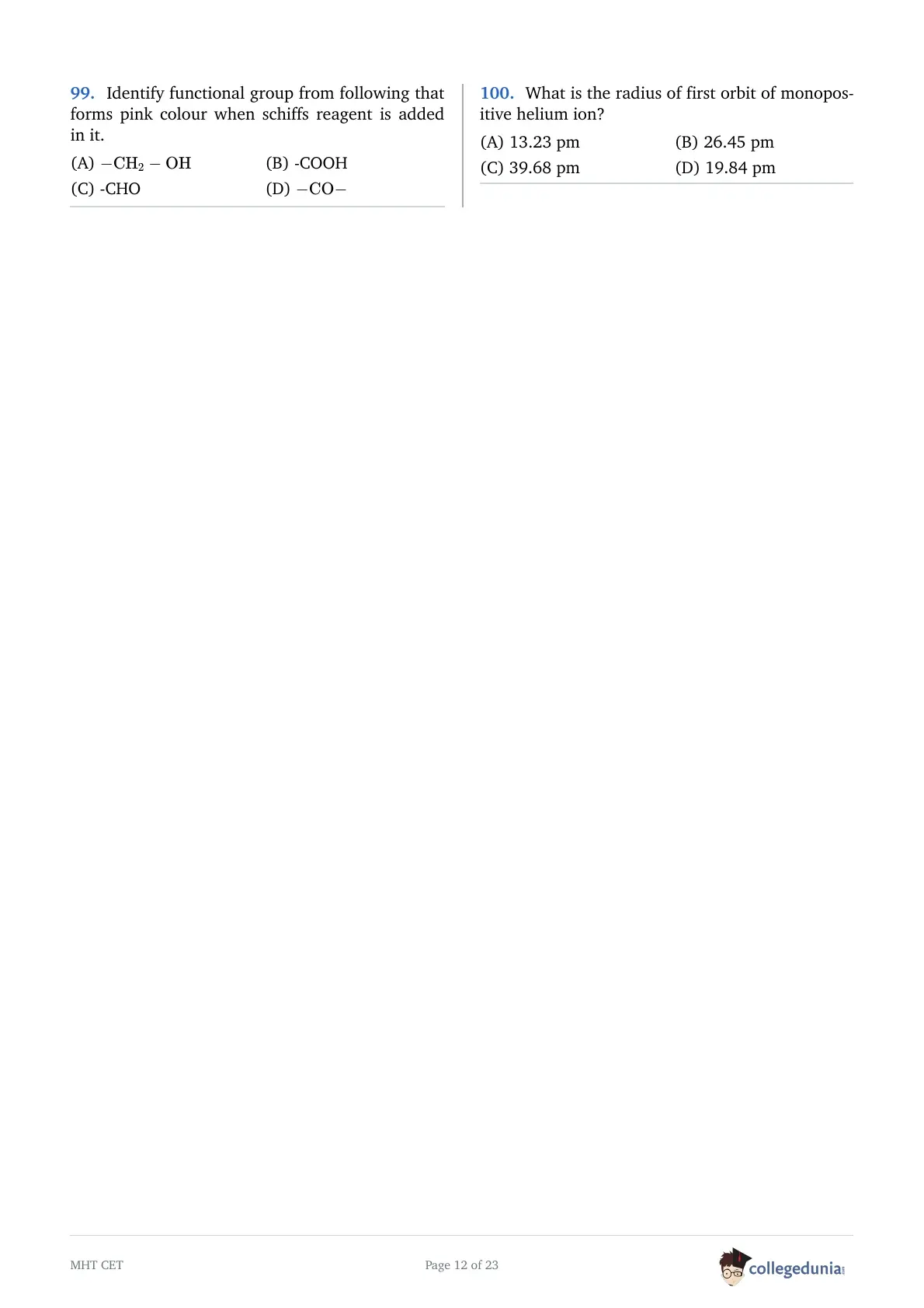
Identify functional group from following that forms pink colour when schiffs reagent is added in it.
What is the radius of first orbit of monopositive helium ion?
Biology (Q101 - Q200)
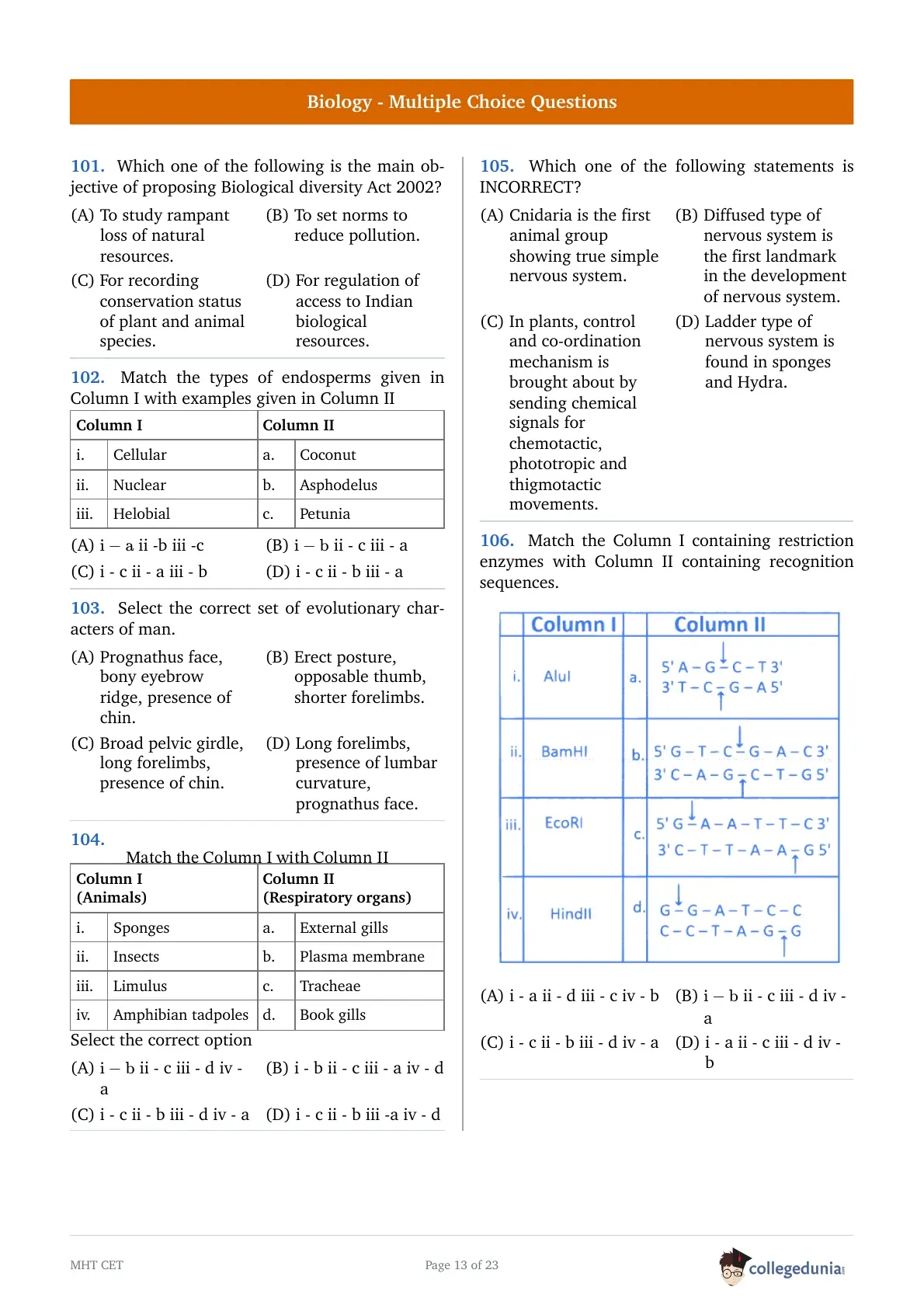
Which one of the following is the main objective of proposing Biological diversity Act 2002?
Match the types of endosperms given in Column I with examples given in Column II
{|c|c|c|c|}
Column I & & Column II &
i. & Cellular & a. & Coconut
ii. & Nuclear & b. & Asphodelus
iii. & Helobial & c. & Petunia
Select the correct set of evolutionary characters of man.
Match the Column I (Animals) with Column II (Respiratory organs)
{|c|l|c|l|}
Column I (Animals) & & Column II (Respiratory organs) &
i. & Sponges & a. & External gills
ii. & Insects & b. & Plasma membrane
iii. & Limulus & c. & Tracheae
iv. & Amphibian tadpoles & d. & Book gills
Select the correct option
Which one of the following statements is INCORRECT?
Match the Column I containing restriction enzymes with Column II containing recognition sequences.

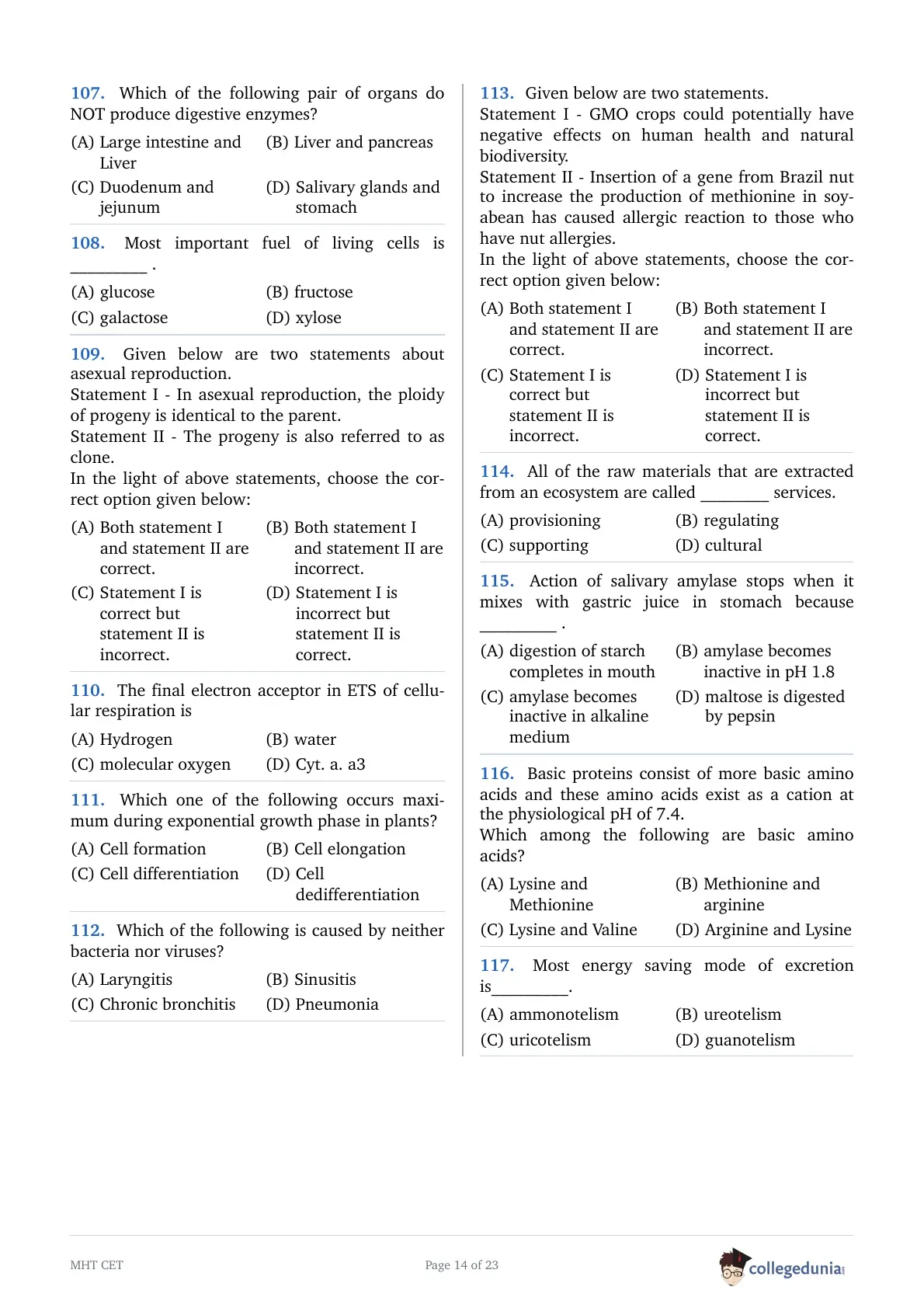
Which of the following pair of organs do NOT produce digestive enzymes?
Most important fuel of living cells is ________ .
Given below are two statements about asexual reproduction.
Statement I - In asexual reproduction, the ploidy of progeny is identical to the parent.
Statement II - The progeny is also referred to as clone.
In the light of above statements, choose the correct option given below:
The final electron acceptor in ETS of cellular respiration is
Which one of the following occurs maximum during exponential growth phase in plants?
Which of the following is caused by neither bacteria nor viruses?
Given below are two statements.
Statement I - GMO crops could potentially have negative effects on human health and natural biodiversity.
Statement II - Insertion of a gene from Brazil nut to increase the production of methionine in soyabean has caused allergic reaction to those who have nut allergies.
In the light of above statements, choose the correct option given below:
All of the raw materials that are extracted from an ecosystem are called ________ services.
Action of salivary amylase stops when it mixes with gastric juice in stomach because ________ .
Basic proteins consist of more basic amino acids and these amino acids exist as a cation at the physiological pH of 7.4.
Which among the following are basic amino acids?
Most energy saving mode of excretion is________.
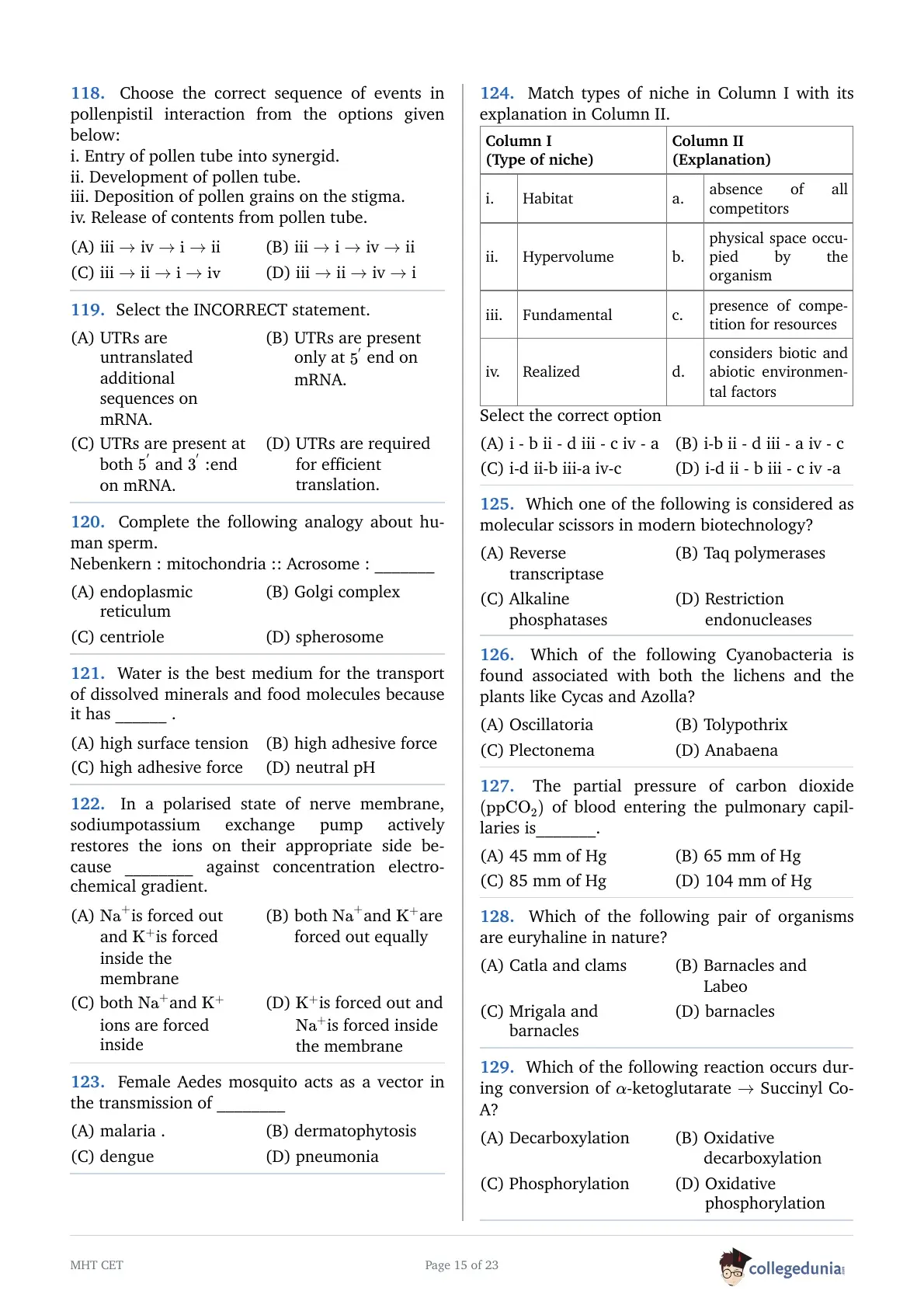
Choose the correct sequence of events in pollen-pistil interaction from the options given below:
i. Entry of pollen tube into synergid.
ii. Development of pollen tube.
iii. Deposition of pollen grains on the stigma.
iv. Release of contents from pollen tube.
Select the INCORRECT statement.
Complete the following analogy about human sperm.
Nebenkern : mitochondria :: Acrosome : ________
Water is the best medium for the transport of dissolved minerals and food molecules because it has ________ .
In a polarised state of nerve membrane, sodium-potassium exchange pump actively restores the ions on their appropriate side because ________ against concentration electrochemical gradient.
Female Aedes mosquito acts as a vector in the transmission of ________
Match types of niche in Column I with its explanation in Column II.
| Column I (Type of niche) | Column II (Explanation) | ||
|---|---|---|---|
| i. | Habitat | a. | absence of all competitors |
| ii. | Hypervolume | b. | physical space occupied by the organism |
| iii. | Fundamental | c. | presence of competition for resources |
| iv. | Realized | d. | considers biotic and abiotic environmental factors |
Which one of the following is considered as molecular scissors in modern biotechnology?
Which of the following Cyanobacteria is found associated with both the lichens and the plants like Cycas and Azolla?
The partial pressure of carbon dioxide (\(ppCO_2\)) of blood entering the pulmonary capillaries is ________ .
Which of the following pair of organisms are euryhaline in nature?
Which of the following reaction occurs during conversion of \(\alpha\)-ketoglutarate \(\rightarrow\) Succinyl Co-A?
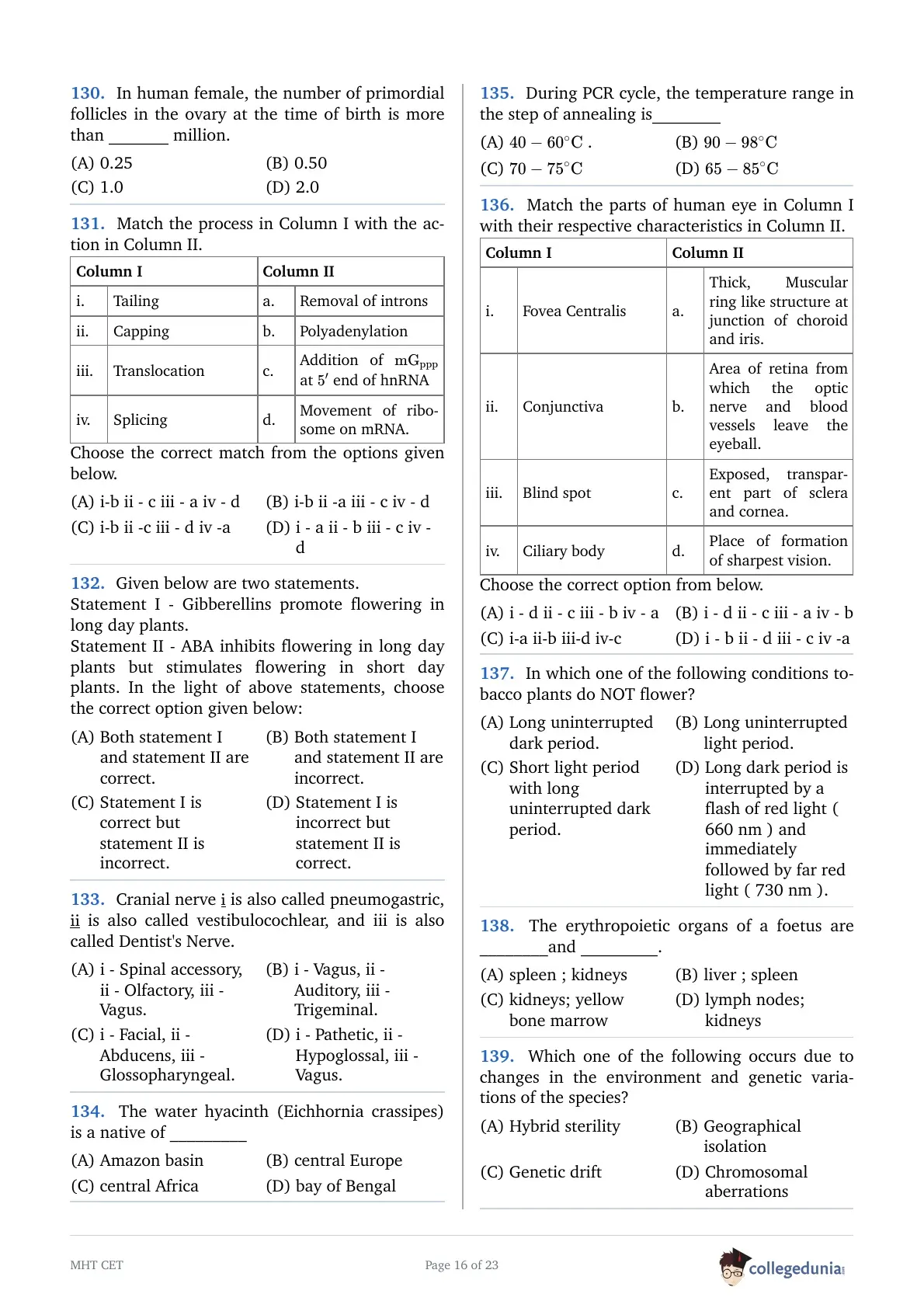
In human female, the number of primordial follicles in the ovary at the time of birth is more than ________ million.
Match the process in Column I with the action in Column II.
| Column I | Column II | ||
|---|---|---|---|
| i. | Tailing | a. | Removal of introns |
| ii. | Capping | b. | Polyadenylation |
| iii. | Translation | c. | Addition of mGppp at 5' end of hnRNA |
| iv. | Splicing | d. | Movement of ribosome on mRNA |
Given below are two statements.
Statement I - Gibberellins promote flowering in long day plants.
Statement II - ABA inhibits flowering in long day plants but stimulates flowering in short day plants.
In the light of above statements, choose the correct option given below:
Cranial nerve i is also called pneumogastric, ii is also called vestibulocochlear, and iii is also called Dentist's Nerve.
The water hyacinth (Eichhornia crassipes) is a native of ________
During PCR cycle, the temperature range in the step of annealing is________
Match the parts of human eye in Column I with their respective characteristics in Column II.
| Column I | Column II | ||
|---|---|---|---|
| i. | Fovea centralis | a. | Thick, muscular ring-like structure at junction of choroid and iris |
| ii. | Conjunctiva | b. | Area of retina from which optic nerve and blood vessels leave the eyeball |
| iii. | Blind spot | c. | Exposed, transparent part of sclera and cornea |
| iv. | Ciliary body | d. | Place of formation of sharpest vision |
In which one of the following conditions tobacco plants do NOT flower?
The erythropoietic organs of a foetus are ________ and ________.
Which one of the following occurs due to changes in the environment and genetic variations of the species?
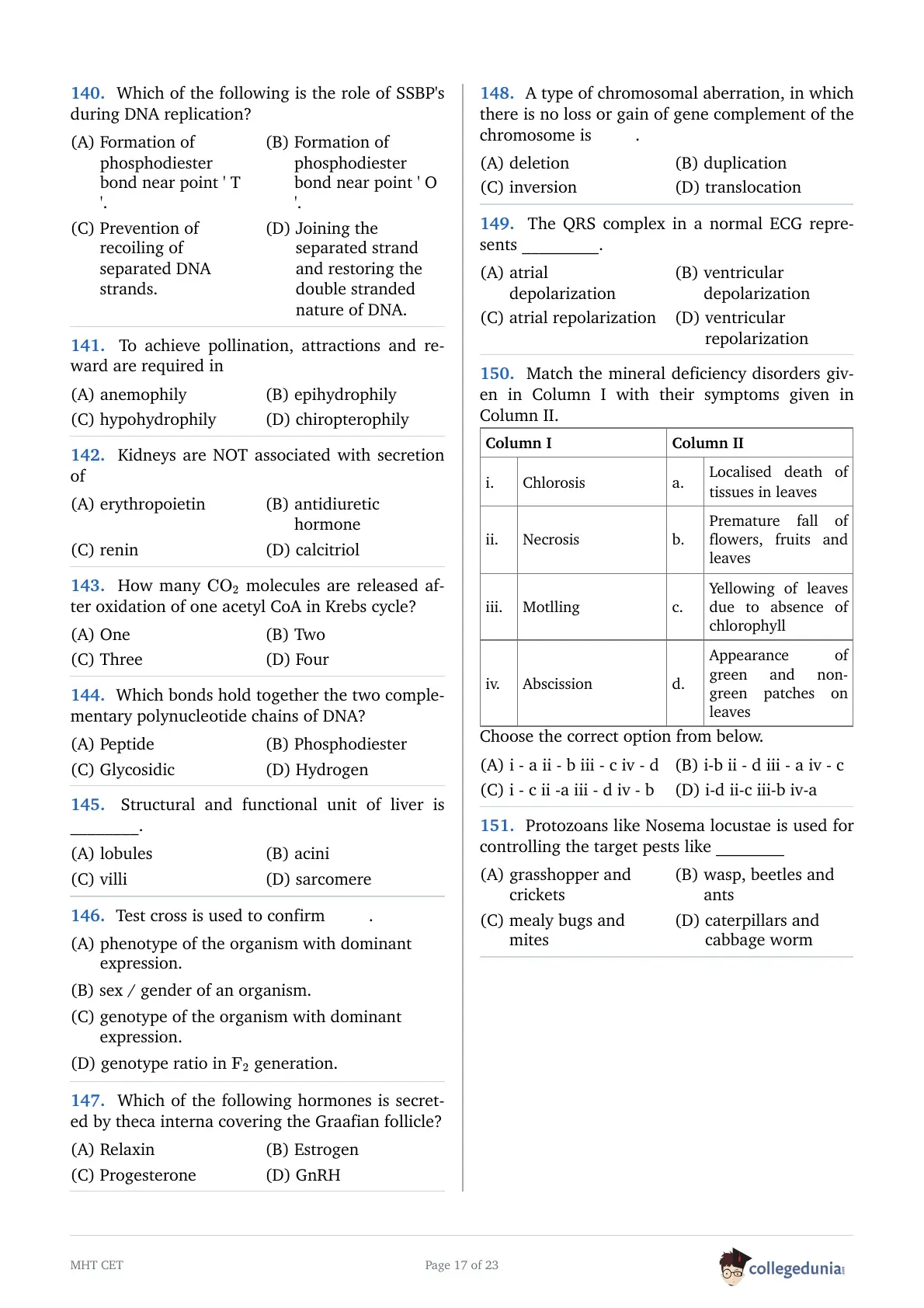
Which of the following is the role of SSBP's during DNA replication?
To achieve pollination, attractions and reward are required in
Kidneys are NOT associated with secretion of
How many \(CO_2\) molecules are released after oxidation of one acetyl CoA in Krebs cycle?
Which bonds hold together the two complementary polynucleotide chains of DNA?
Structural and functional unit of liver is ________.
Test cross is used to confirm ________ .
Which of the following hormones is secreted by theca interna covering the Graafian follicle?
A type of chromosomal aberration, in which there is no loss or gain of gene complement of the chromosome is ________ .
The QRS complex in a normal ECG represents ________.
Match the mineral deficiency disorders given in Column I with their symptoms given in Column II.
| Column I | Column II | ||
|---|---|---|---|
| i. | Chlorosis | a. | Localised death of tissues in leaves |
| ii. | Necrosis | b. | Premature fall of flowers, fruits and leaves |
| iii. | Mottling | c. | Yellowing of leaves due to absence of chlorophyll |
| iv. | Abscission | d. | Appearance of green and non-green patches on leaves |
Protozoans like Nosema locustae is used for controlling the target pests like _______
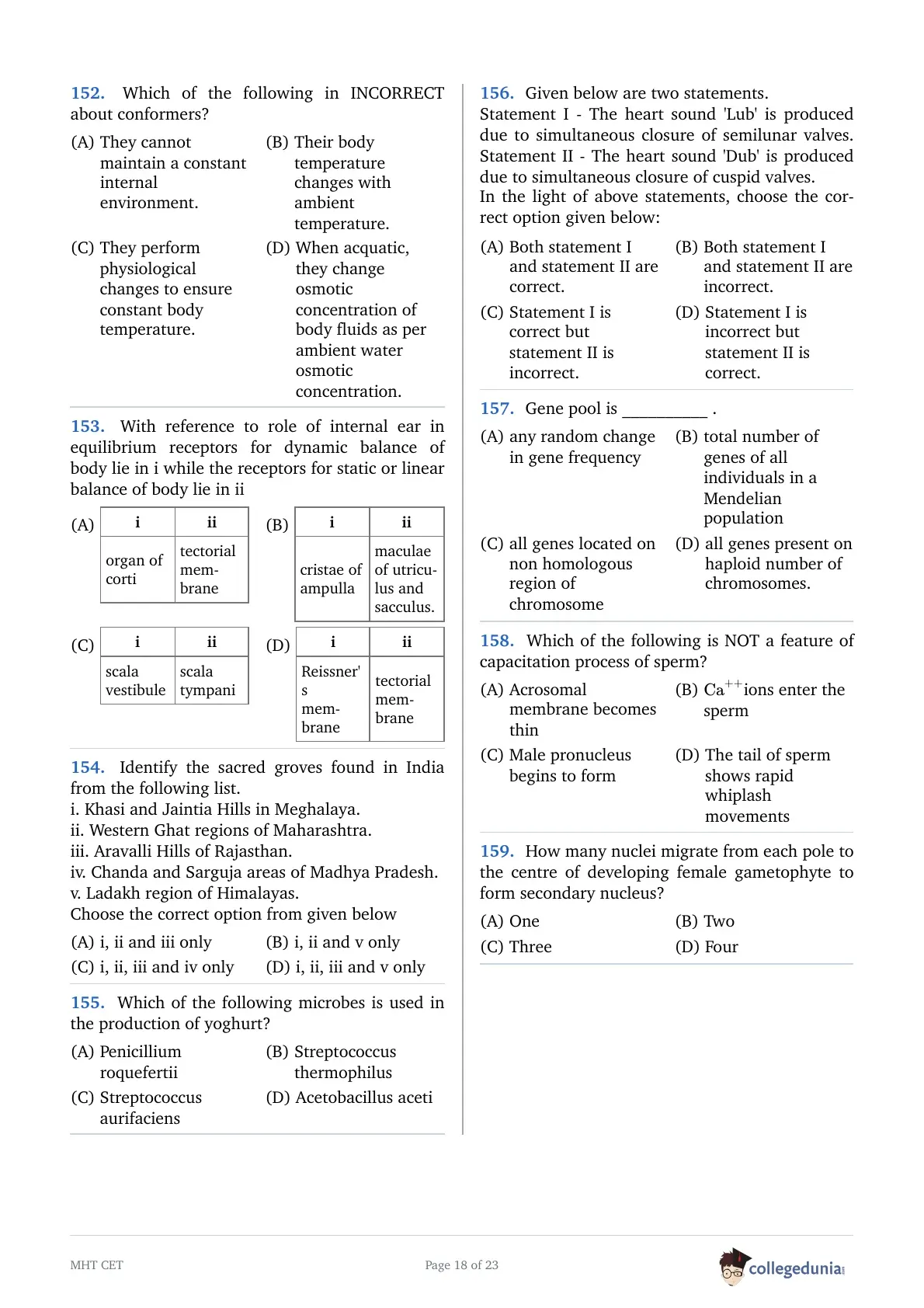
Which of the following in INCORRECT about conformers?
With reference to role of internal ear in equilibrium receptors for dynamic balance of body lie in i while the receptors for static or linear balance of body lie in ii
Identify the sacred groves found in India from the following list.
i. Khasi and Jaintia Hills in Meghalaya.
ii. Western Ghat regions of Maharashtra.
iii. Aravalli Hills of Rajasthan.
iv. Chanda and Sarguja areas of Madhya Pradesh.
v. Ladakh region of Himalayas.
Choose the correct option from given below
Which of the following microbes is used in the production of yoghurt?
Given below are two statements.
Statement I - The heart sound 'Lub' is produced due to simultaneous closure of semilunar valves.
Statement II - The heart sound 'Dub' is produced due to simultaneous closure of cuspid valves.
In the light of above statements, choose the correct option given below:
Gene pool is _______ .
Which of the following is NOT a feature of capacitation process of sperm?
How many nuclei migrate from each pole to the centre of developing female gametophyte to form secondary nucleus?
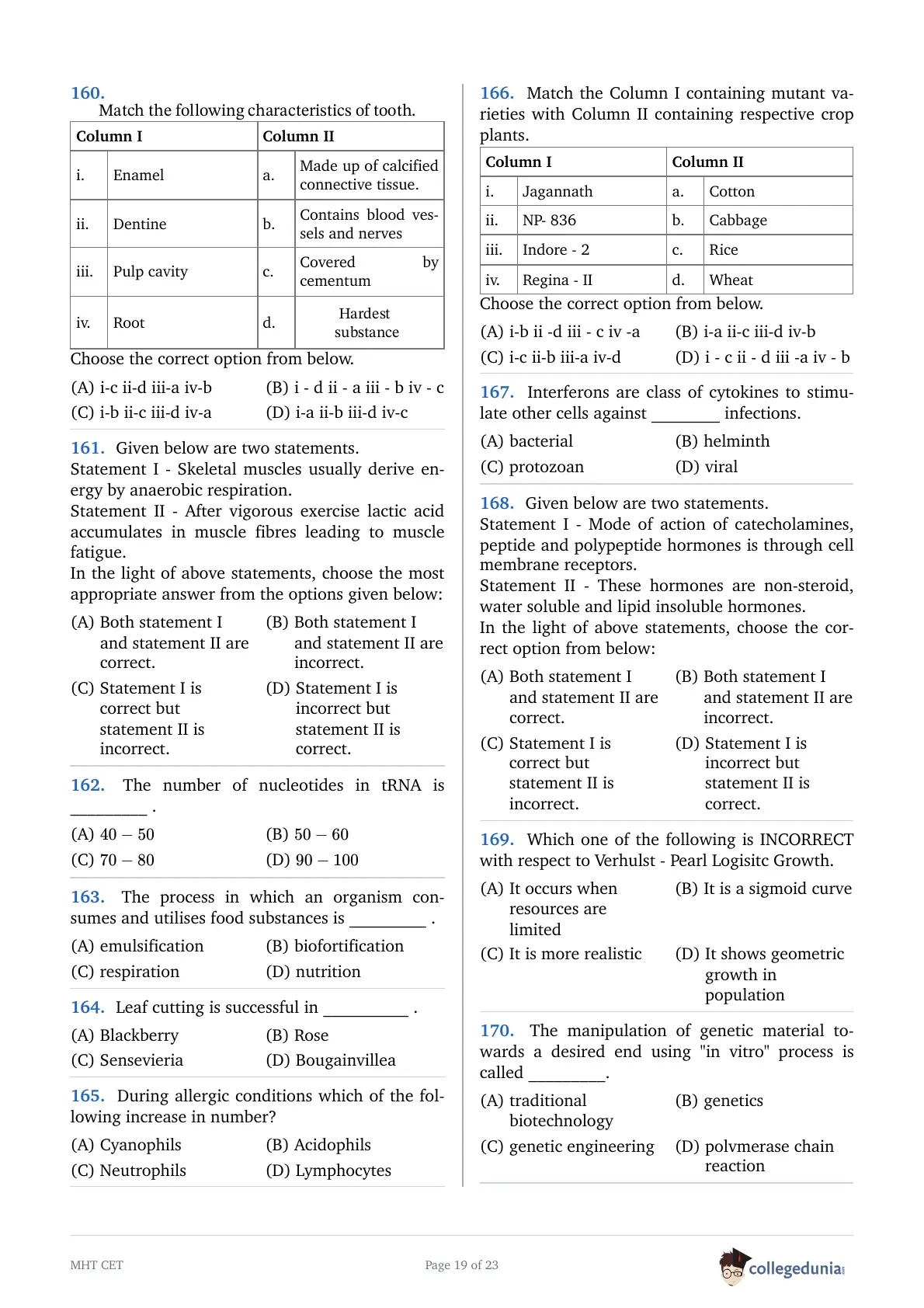
Match the following characteristics of tooth.
| Column I | Column II | ||
|---|---|---|---|
| i. | Enamel | a. | Made up of calcified connective tissue |
| ii. | Dentine | b. | Contains blood vessels and nerves |
| iii. | Pulp cavity | c. | Covered by cementum |
| iv. | Root | d. | Hardest substance |
Given below are two statements.
Statement I - Skeletal muscles usually derive energy by anaerobic respiration.
Statement II - After vigorous exercise lactic acid accumulates in muscle fibres leading to muscle fatigue.
In the light of above statements, choose the most appropriate answer from the options given below:
The number of nucleotides in tRNA is ________ .
The process in which an organism consumes and utilises food substances is ________ .
Leaf cutting is successful in ________ .
During allergic conditions which of the following increase in number?
Match the Column I containing mutant varieties with Column II containing respective crop plants.
| Column I | Column II | ||
|---|---|---|---|
| i. | Jagannath | a. | Cotton |
| ii. | NP-836 | b. | Cabbage |
| iii. | Indore-2 | c. | Rice |
| iv. | Regina-II | d. | Wheat |
Interferons are class of cytokines to stimulate other cells against _______ infections.
Given below are two statements.
Statement I - Mode of action of catecholamines, peptide and polypeptide hormones is through cell membrane receptors.
Statement II - These hormones are non-steroid, water soluble and lipid insoluble hormones.
In the light of above statements, choose the correct option from below:
Which one of the following is INCORRECT with respect to Verhulst - Pearl Logistic Growth.
The manipulation of genetic material towards a desired end using "in vitro" process is called ________ .
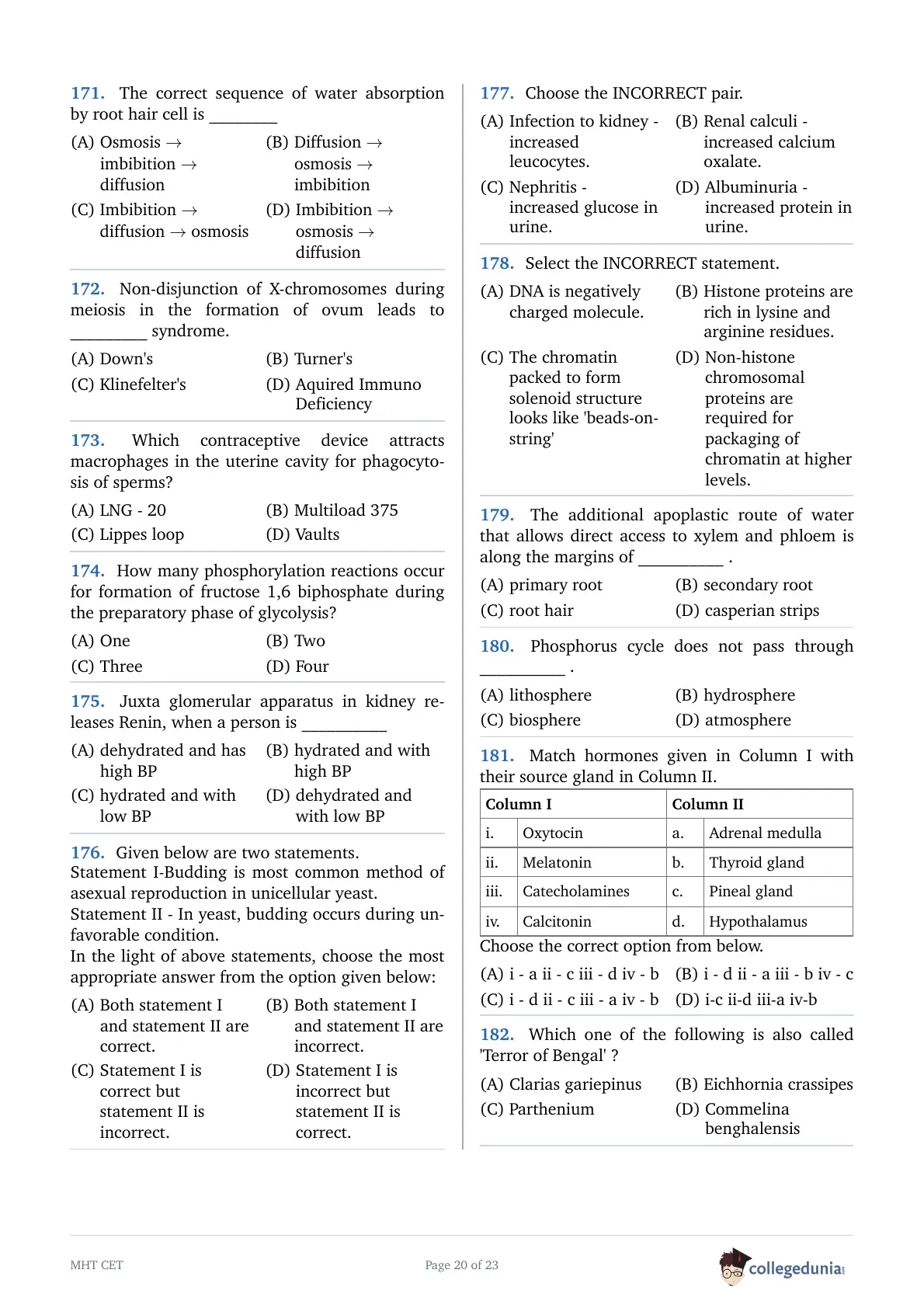
The correct sequence of water absorption by root hair cell is ________
Non-disjunction of X-chromosomes during meiosis in the formation of ovum leads to ________ syndrome.
Which contraceptive device attracts macrophages in the uterine cavity for phagocytosis of sperms?
How many phosphorylation reactions occur for formation of fructose 1,6 biphosphate during the preparatory phase of glycolysis?
Juxta glomerular apparatus in kidney releases Renin, when a person is ________
Given below are two statements.
Statement I-Budding is most common method of asexual reproduction in unicellular yeast.
Statement II - In yeast, budding occurs during unfavorable condition.
In the light of above statements, choose the most appropriate answer from the option given below:
Choose the INCORRECT pair.
Select the INCORRECT statement.
The additional apoplastic route of water that allows direct access to xylem and phloem is along the margins of ________ .
Phosphorus cycle does not pass through ________ .
Match hormones given in Column I with their source gland in Column II.
| Column I | Column II | ||
|---|---|---|---|
| i. | Oxytocin | a. | Adrenal medulla |
| ii. | Melatonin | b. | Thyroid gland |
| iii. | Catecholamines | c. | Pineal gland |
| iv. | Calcitonin | d. | Hypothalamus |
Which one of the following is also called 'Terror of Bengal' ?
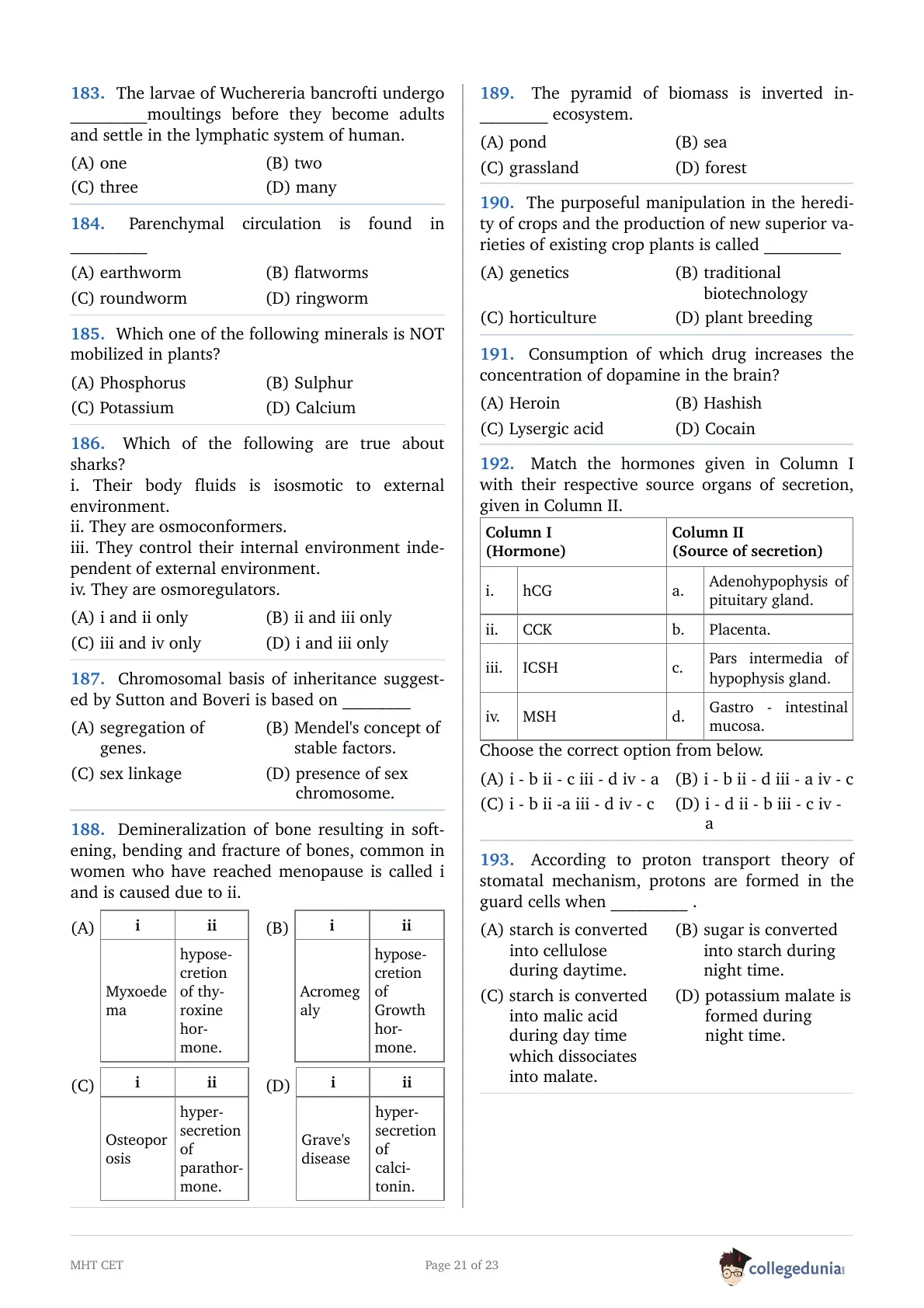
The larvae of Wuchereria bancrofti undergo ________ moultings before they become adults and settle in the lymphatic system of human.
Parenchymal circulation is found in ________
Which one of the following minerals is NOT mobilized in plants?
Which of the following are true about sharks?
i. Their body fluids is isosmotic to external environment.
ii. They are osmoconformers.
iii. They control their internal environment independent of external environment.
iv. They are osmoregulators.
Chromosomal basis of inheritance suggested by Sutton and Boveri is based on ________
Demineralization of bone resulting in softening, bending and fracture of bones, common in women who have reached menopause is called i and is caused due to ii.
The pyramid of biomass is inverted in________ ecosystem.
The purposeful manipulation in the heredity of crops and the production of new superior varieties of existing crop plants is called ________
Consumption of which drug increases the concentration of dopamine in the brain?
Match the hormones given in Column I with their respective source organs of secretion, given in Column II.
| Column I (Hormone) | Column II (Source of secretion) | ||
|---|---|---|---|
| i. | hCG | a. | Adenohypophysis of pituitary gland. |
| ii. | CCK | b. | Placenta. |
| iii. | ICSH | c. | Pars intermedia of hypophysis gland. |
| iv. | MSH | d. | Gastro - intestinal mucosa. |
According to proton transport theory of stomatal mechanism, protons are formed in the guard cells when ________ .
Which one of the following is the correct description of Streptococcus pneumoniae causing pneumonia?
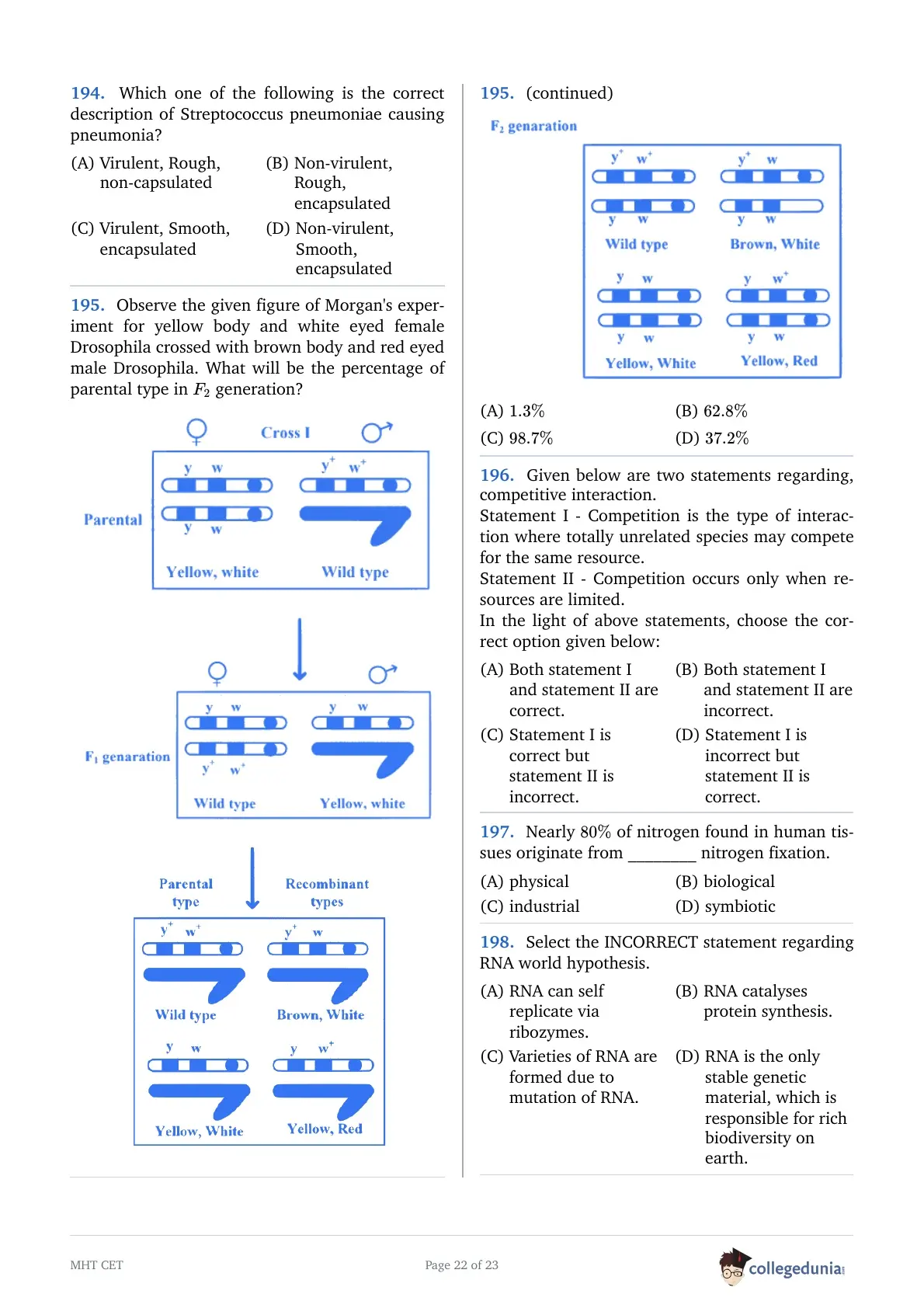
Observe the given figure of Morgan's experiment for yellow body and white eyed female Drosophila crossed with brown body and red eyed male Drosophila. What will be the percentage of parental type in \( F_{2} \) generation?
Given below are two statements regarding, competitive interaction.
Statement I - Competition is the type of interaction where totally unrelated species may compete for the same resource.
Statement II - Competition occurs only when resources are limited.
In the light of above statements, choose the correct option given below:
Nearly 80% of nitrogen found in human tissues originate from ________ nitrogen fixation.
Select the INCORRECT statement regarding RNA world hypothesis.
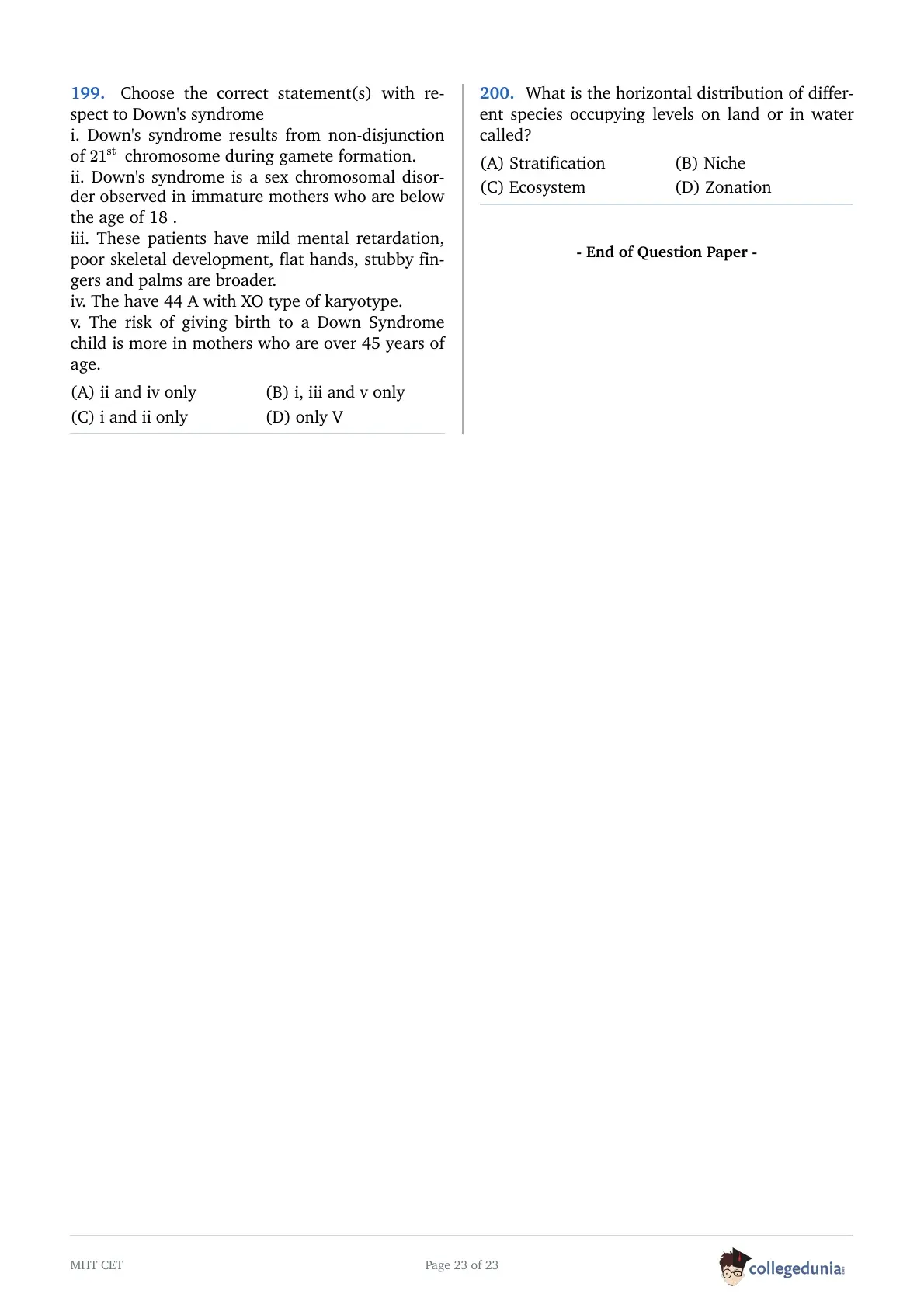
Choose the correct statement(s) with respect to Down's syndrome
i. Down's syndrome results from non-disjunction of \( 21^{st} \) chromosome during gamete formation.
ii. Down's syndrome is a sex chromosomal disorder observed in immature mothers who are below the age of 18 .
iii. These patients have mild mental retardation, poor skeletal development, flat hands, stubby fingers and palms are broader.
iv. The have 44 A with XO type of karyotype.
v. The risk of giving birth to a Down Syndrome child is more in mothers who are over 45 years of age.
What is the horizontal distribution of different species occupying levels on land or in water called?
MHT CET 2024 PCB Exam Pattern and Marking Scheme
| Parameter | Details |
|---|---|
| Conducting Body | Maharashtra Common Entrance Test Cell (Maharashtra CET Cell) |
| Exam Mode | Online (Computer-Based Test) |
| Duration | 180 minutes (3 hours) |
| Groups / Subjects | PCB (Physics, Chemistry, Biology) for Pharmacy and Agriculture |
| Total Questions |
200 |
| Total Marks | 200 |
| Question Type | Multiple Choice Questions (MCQs) |
| Marking Scheme | 1 mark for each correct answer |
| Negative Marking | No |
| Syllabus Weightage |
|



Comments