




MHT CET 2024 May 2 Shift 1 PCM Question Paper is available for download here. Maharashtra State CET Cell conducted MHT CET 2024 PCM Exam on May 2 in Shift 1 from 9 AM to 12 PM in CBT mode.
The MHT CET 2024 PCM question paper includes the following:
- The MHT CET 2024 PCM Question Paper consists of 150 multiple-choice questions (MCQs) totalling 200 marks divided into 3 sections: Physics, Chemistry, and Mathematics, with 50 questions in each subject.
- Physics and Chemistry questions carry 1 mark each while Mathematics questions carry 2 marks each.
- There is no negative marking for incorrect answers.
MHT CET 2024 May 2 Shift 1 PCM Question Paper with Solution PDF
| CD PDF | CD PDF with Solutions |
|---|---|
| Download Collegedunia PDF 0.88 MB | - |
Also Check:
MHT CET 2024 May 2 Shift 1 PCM Questions with Solutions
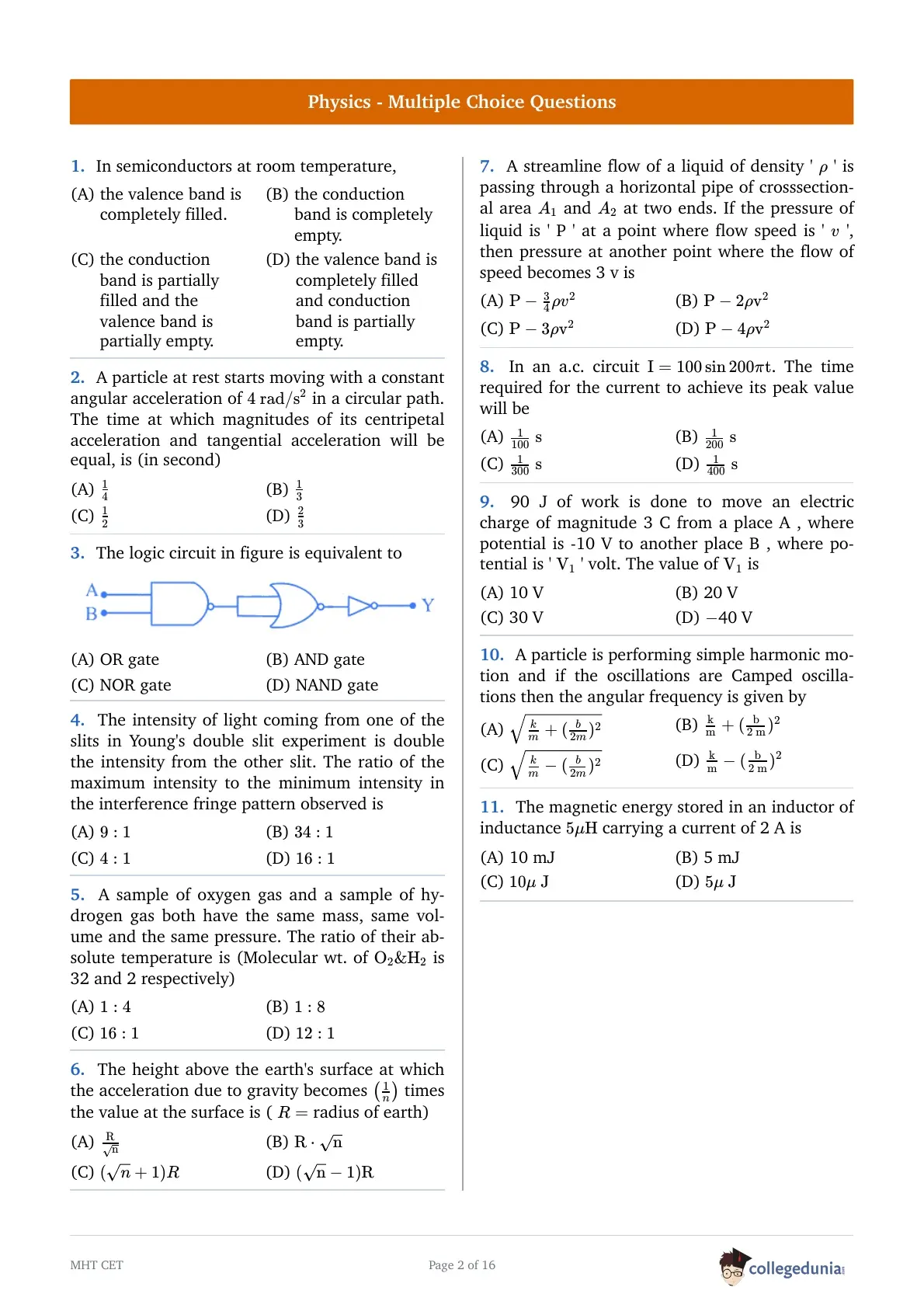
Physics (Q1 - Q50)
A particle at rest starts moving with a constant angular acceleration of \(4 \mathrm{~rad} / \mathrm{s}^2\) in a circular path. The time at which magnitudes of its centripetal acceleration and tangential acceleration will be equal, is (in second)

The intensity of light coming from one of the slits in Young's double slit experiment is double the intensity from the other slit. The ratio of the maximum intensity to the minimum intensity in the interference fringe pattern observed is
A sample of oxygen gas and a sample of hydrogen gas both have the same mass, same volume and the same pressure. The ratio of their absolute temperature is (Molecular wt. of \(\mathrm{O}_2 \& \mathrm{H}_2\) is 32 and 2 respectively)
The height above the earth's surface at which the acceleration due to gravity becomes \(\left(\frac{1}{n}\right)\) times the value at the surface is ( \(R=\) radius of earth)
A streamline flow of a liquid of density ' \(\rho\) ' is passing through a horizontal pipe of crosssectional area \(A_1\) and \(A_2\) at two ends. If the pressure of liquid is ' P ' at a point where flow speed is ' \(v\) ', then pressure at another point where the flow of speed becomes 3 v is
In an a.c. circuit \(\mathrm{I}=100 \sin 200 \pi \mathrm{t}\). The time required for the current to achieve its peak value will be
90 J of work is done to move an electric charge of magnitude 3 C from a place A , where potential is -10 V to another place B , where potential is ' \(\mathrm{V}_1\) ' volt. The value of \(\mathrm{V}_1\) is
A particle is performing simple harmonic motion and if the oscillations are Camped oscillations then the angular frequency is given by
The magnetic energy stored in an inductor of inductance \(5 \mu \mathrm{H}\) carrying a current of 2 A is
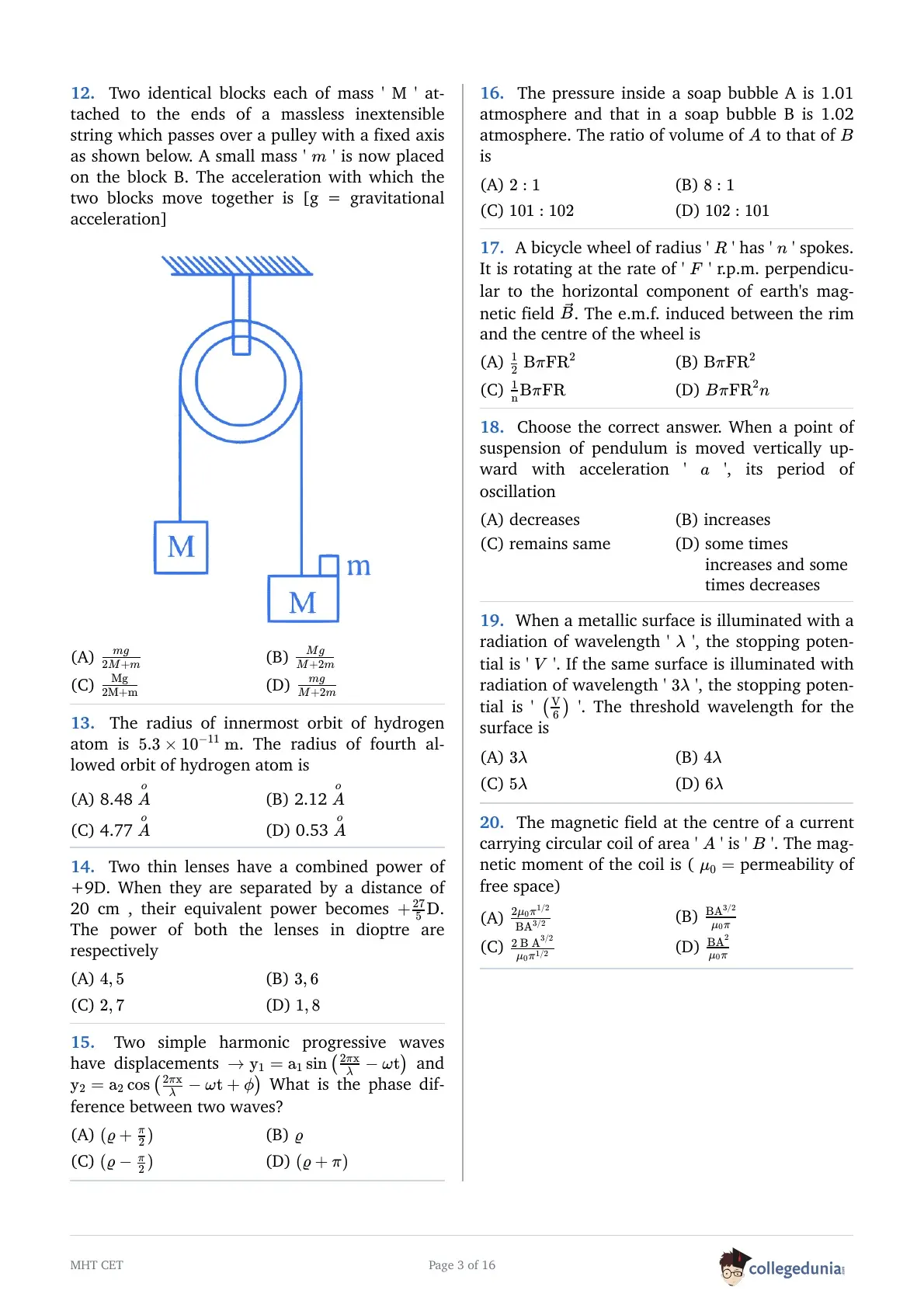
Two identical blocks each of mass ' M ' attached to the ends of a massless inextensible string which passes over a pulley with a fixed axis as shown below. A small mass ' \(m\) ' is now placed on the block B. The acceleration with which the two blocks move together is [g = gravitational acceleration]

The radius of innermost orbit of hydrogen atom is \(5.3 \times 10^{-11} \mathrm{~m}\). The radius of fourth allowed orbit of hydrogen atom is
Two thin lenses have a combined power of +9D. When they are separated by a distance of 20 cm , their equivalent power becomes \(+\frac{27}{5} \mathrm{D}\). The power of both the lenses in dioptre are respectively
Two simple harmonic progressive waves have displacements \(\rightarrow \mathrm{y}_1=\mathrm{a}_1 \sin \left(\frac{2 \pi \mathrm{x}}{\lambda}-\omega \mathrm{t}\right)\) and \(\mathrm{y}_2=\mathrm{a}_2 \cos \left(\frac{2 \pi \mathrm{x}}{\lambda}-\omega \mathrm{t}+\phi\right)\) What is the phase difference between two waves?
The pressure inside a soap bubble A is 1.01 atmosphere and that in a soap bubble B is 1.02 atmosphere. The ratio of volume of \(A\) to that of \(B\) is
Choose the correct answer. When a point of suspension of pendulum is moved vertically upward with acceleration ' \(a\) ', its period of oscillation
When a metallic surface is illuminated with a radiation of wavelength ' \(\lambda\) ', the stopping potential is ' \(V\) '. If the same surface is illuminated with radiation of wavelength ' \(3 \lambda\) ', the stopping potential is ' \(\left(\frac{\mathrm{V}}{6}\right)\) '. The threshold wavelength for the surface is
The magnetic field at the centre of a current carrying circular coil of area ' \(A\) ' is ' \(B\) '. The magnetic moment of the coil is ( \(\mu_0=\) permeability of free space)
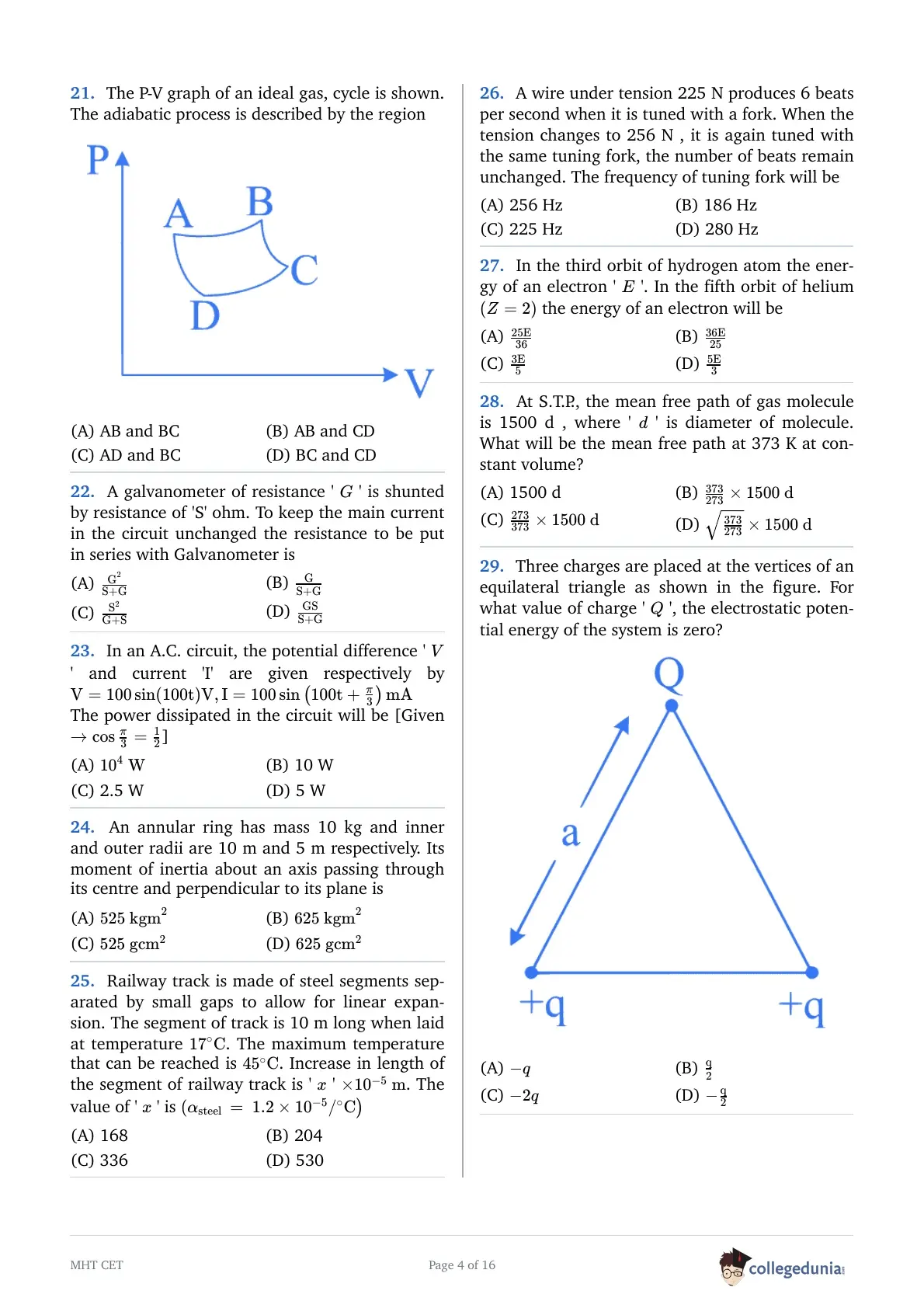
The P-V graph of an ideal gas, cycle is shown. The adiabatic process is described by the region

A galvanometer of resistance ' \(G\) ' is shunted by resistance of 'S' ohm. To keep the main current in the circuit unchanged the resistance to be put in series with Galvanometer is
In an A.C. circuit, the potential difference ' \(V\) ' and current 'I' are given respectively by \(\mathrm{V}=100 \sin (100 \mathrm{t}) \mathrm{V}, \mathrm{I}=100 \sin \left(100 \mathrm{t}+\frac{\pi}{3}\right) \mathrm{mA}\) The power dissipated in the circuit will be [Given \(\rightarrow \cos \frac{\pi}{3}=\frac{1}{2}\)]
An annular ring has mass 10 kg and inner and outer radii are 10 m and 5 m respectively. Its moment of inertia about an axis passing through its centre and perpendicular to its plane is
Railway track is made of steel segments separated by small gaps to allow for linear expansion. The segment of track is 10 m long when laid at temperature \(17^{\circ} \mathrm{C}\). The maximum temperature that can be reached is \(45^{\circ} \mathrm{C}\). Increase in length of the segment of railway track is ' \(x\) ' \(\times 10^{-5} \mathrm{~m}\). The value of ' \(x\) ' is \(\left(\alpha_{\text {steel }}=\right.\) \(\left.1.2 \times 10^{-5} /{ }^{\circ} \mathrm{C}\right)\)
A wire under tension 225 N produces 6 beats per second when it is tuned with a fork. When the tension changes to 256 N , it is again tuned with the same tuning fork, the number of beats remain unchanged. The frequency of tuning fork will be
In the third orbit of hydrogen atom the energy of an electron ' \(E\) '. In the fifth orbit of helium \((Z=2)\) the energy of an electron will be
Three charges are placed at the vertices of an equilateral triangle as shown in the figure. For what value of charge ' \(Q\) ', the electrostatic potential energy of the system is zero?

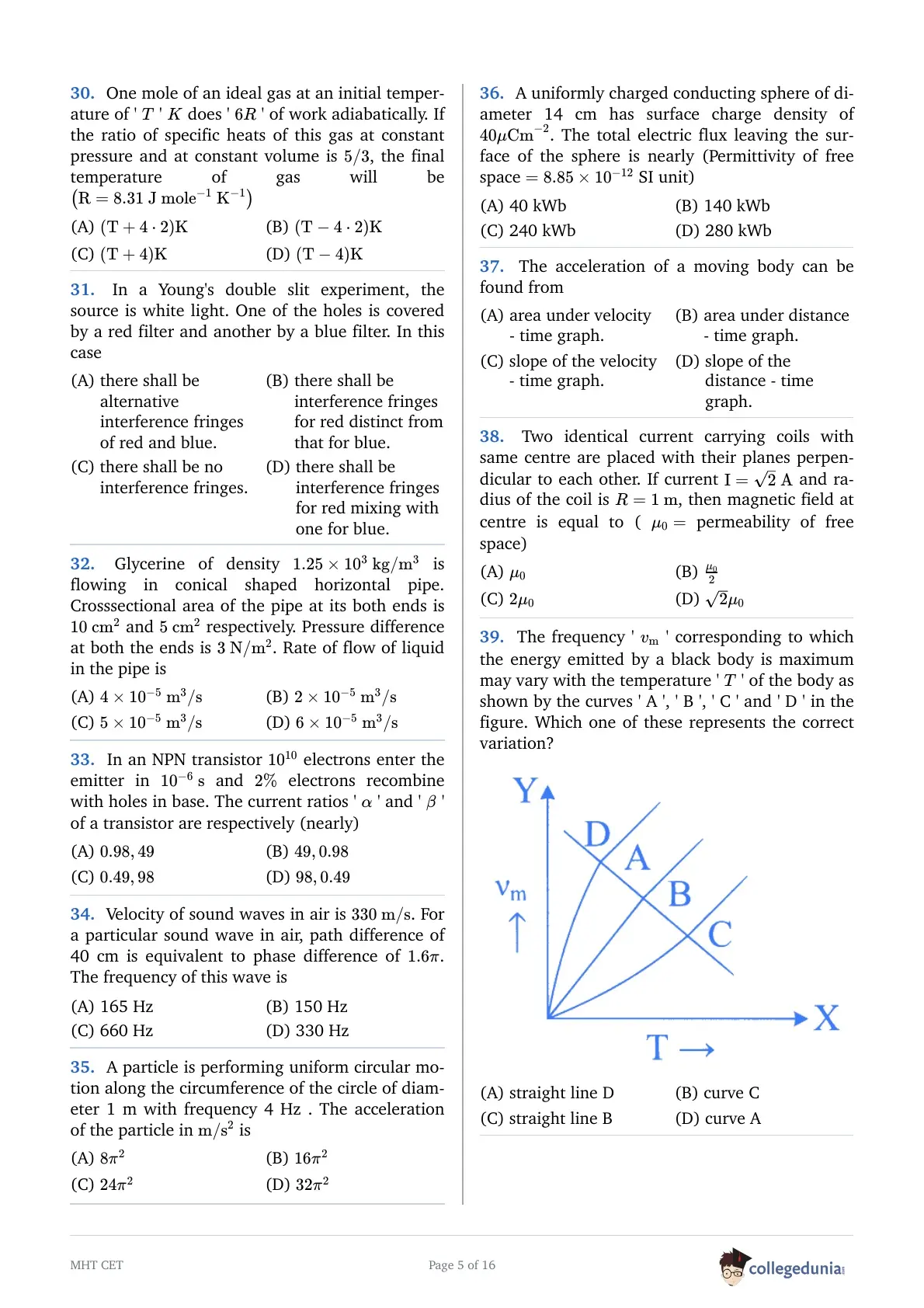
One mole of an ideal gas at an initial temperature of ' \(T\) ' \(K\) does ' \(6 R\) ' of work adiabatically. If the ratio of specific heats of this gas at constant pressure and at constant volume is \(5 / 3\), the final temperature of gas will be \(\left(\mathrm{R}=8.31 \mathrm{~J} \mathrm{~mole}^{-1} \mathrm{~K}^{-1}\right)\)
In a Young's double slit experiment, the source is white light. One of the holes is covered by a red filter and another by a blue filter. In this case
Glycerine of density \(1.25 \times 10^3 \mathrm{~kg} / \mathrm{m}^3\) is flowing in conical shaped horizontal pipe. Crosssectional area of the pipe at its both ends is \(10 \mathrm{~cm}^2\) and \(5 \mathrm{~cm}^2\) respectively. Pressure difference at both the ends is \(3 \mathrm{~N} / \mathrm{m}^2\). Rate of flow of liquid in the pipe is
In an NPN transistor \(10^{10}\) electrons enter the emitter in \(10^{-6} \mathrm{~s}\) and \(2 \%\) electrons recombine with holes in base. The current ratios ' \(\alpha\) ' and ' \(\beta\) ' of a transistor are respectively (nearly)
Velocity of sound waves in air is \(330 \mathrm{~m} / \mathrm{s}\). For a particular sound wave in air, path difference of 40 cm is equivalent to phase difference of \(1.6 \pi\). The frequency of this wave is
A particle is performing uniform circular motion along the circumference of the circle of diameter 1 m with frequency 4 Hz . The acceleration of the particle in \(\mathrm{m} / \mathrm{s}^2\) is
A uniformly charged conducting sphere of diameter 14 cm has surface charge density of \(40 \mu \mathrm{Cm}^{-2}\). The total electric flux leaving the surface of the sphere is nearly (Permittivity of free space \(=8.85 \times 10^{-12}\) SI unit)
Two identical current carrying coils with same centre are placed with their planes perpendicular to each other. If current \(\mathrm{I}=\sqrt{2} \mathrm{~A}\) and radius of the coil is \(R=1 \mathrm{~m}\), then magnetic field at centre is equal to ( \(\mu_0=\) permeability of free space)
The frequency ' \(v_{\mathrm{m}}\) ' corresponding to which the energy emitted by a black body is maximum may vary with the temperature ' \(T\) ' of the body as shown by the curves ' A ', ' B ', ' C ' and ' D ' in the figure. Which one of these represents the correct variation?

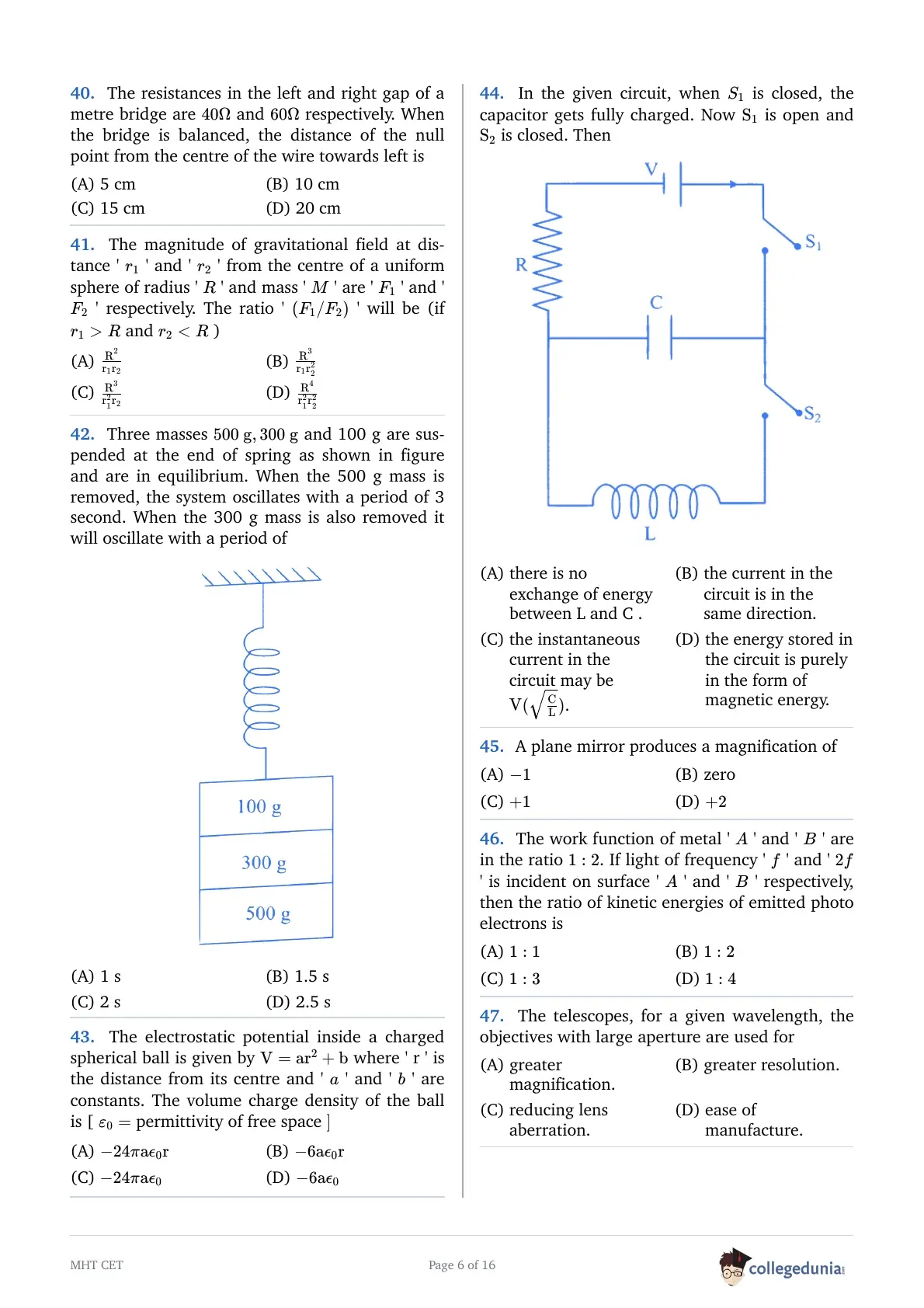
The resistances in the left and right gap of a metre bridge are \(40 \Omega\) and \(60 \Omega\) respectively. When the bridge is balanced, the distance of the null point from the centre of the wire towards left is
The magnitude of gravitational field at distance ' \(r_1\) ' and ' \(r_2\) ' from the centre of a uniform sphere of radius ' \(R\) ' and mass ' \(M\) ' are ' \(F_1\) ' and ' \(F_2\) ' respectively. The ratio ' \(\left(F_1 / F_2\right)\) ' will be (if \(r_1>R\) and \(r_2<R\) )
Three masses \(500 \mathrm{~g}, 300 \mathrm{~g}\) and 100 g are suspended at the end of spring as shown in figure and are in equilibrium. When the 500 g mass is removed, the system oscillates with a period of 3 second. When the 300 g mass is also removed it will oscillate with a period of

The electrostatic potential inside a charged spherical ball is given by \(\mathrm{V}=\mathrm{ar}^2+\mathrm{b}\) where ' r ' is the distance from its centre and ' \(a\) ' and ' \(b\) ' are constants. The volume charge density of the ball is [ \(\varepsilon_0=\) permittivity of free space \(]\)
In the given circuit, when \(S_1\) is closed, the capacitor gets fully charged. Now \(\mathrm{S}_1\) is open and \(\mathrm{S}_2\) is closed. Then

The work function of metal ' \(A\) ' and ' \(B\) ' are in the ratio \(1: 2\). If light of frequency ' \(f\) ' and ' \(2 f\) ' is incident on surface ' \(A\) ' and ' \(B\) ' respectively, then the ratio of kinetic energies of emitted photo electrons is
The telescopes, for a given wavelength, the objectives with large aperture are used for
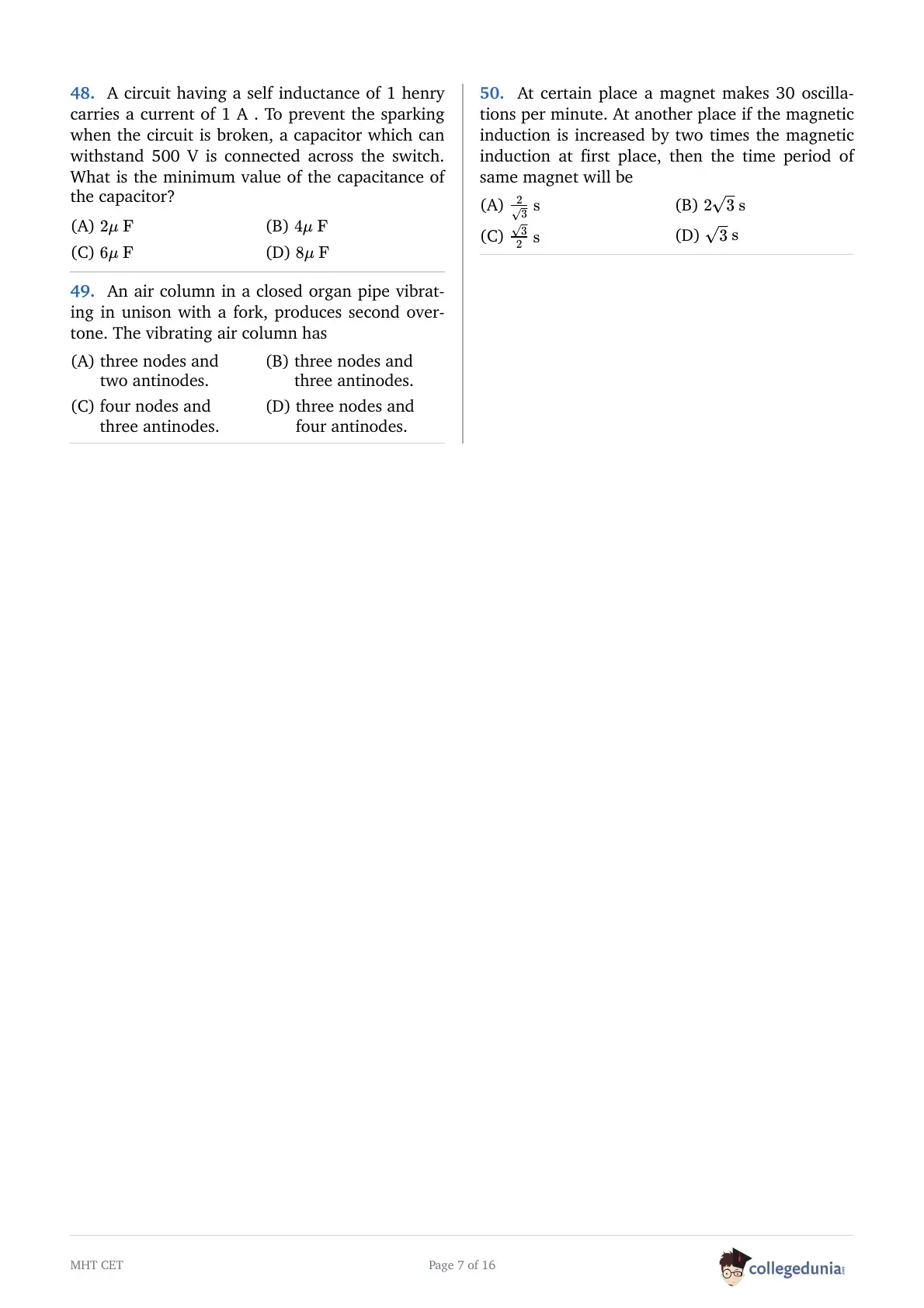
A circuit having a self inductance of 1 henry carries a current of 1 A . To prevent the sparking when the circuit is broken, a capacitor which can withstand 500 V is connected across the switch. What is the minimum value of the capacitance of the capacitor?
An air column in a closed organ pipe vibrating in unison with a fork, produces second overtone. The vibrating air column has
At certain place a magnet makes 30 oscillations per minute. At another place if the magnetic induction is increased by two times the magnetic induction at first place, then the time period of same magnet will be
Chemistry (Q51 - Q100)
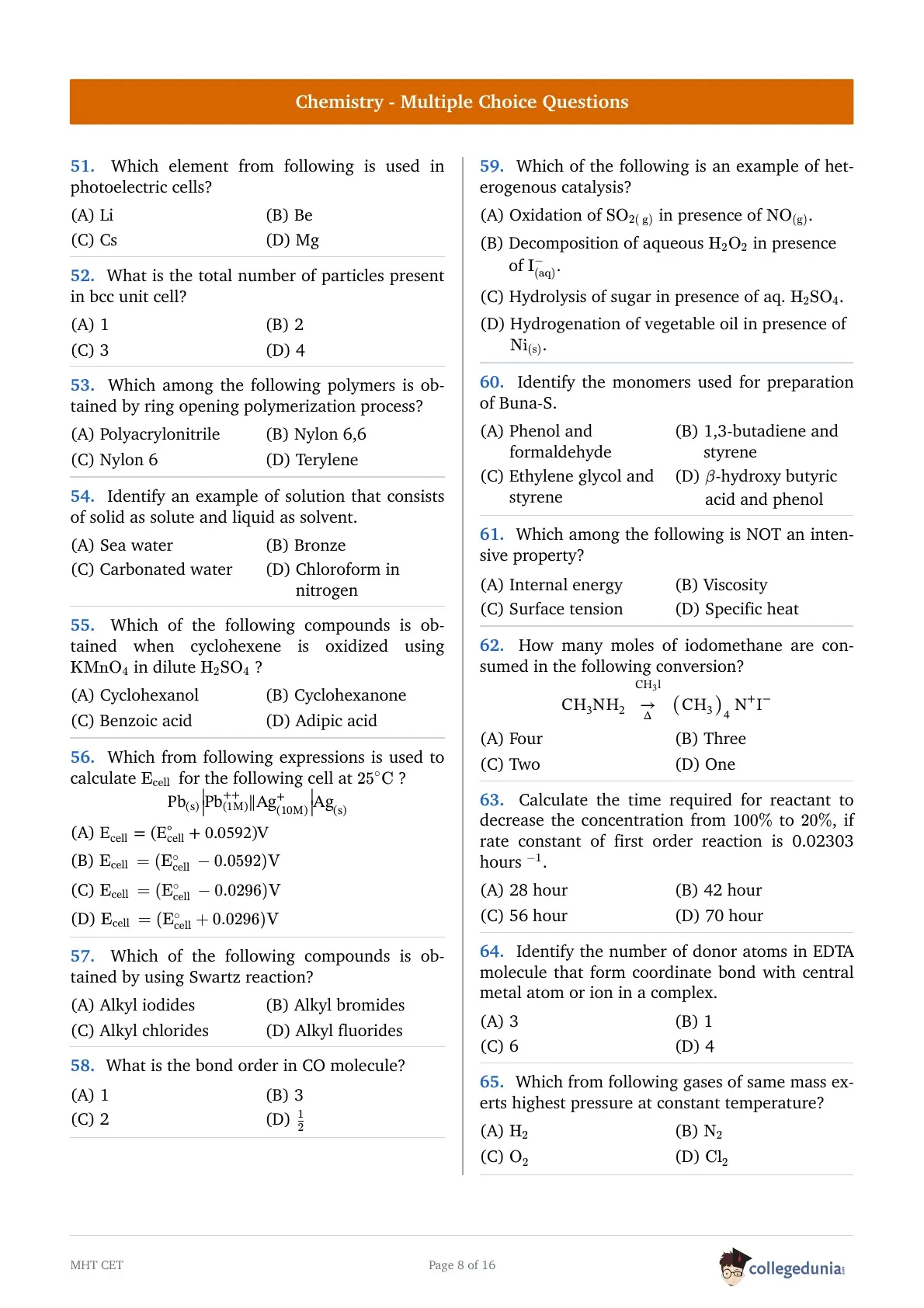
Which among the following polymers is obtained by ring opening polymerization process?
Identify an example of solution that consists of solid as solute and liquid as solvent.
Which of the following compounds is obtained when cyclohexene is oxidized using \(\mathrm{KMnO}_4\) in dilute \(\mathrm{H}_2 \mathrm{SO}_4\) ?
Which from following expressions is used to calculate \(\mathrm{E}_{\text {cell }}\) for the following cell at \(25^{\circ} \mathrm{C}\) ?
\[\mathrm{Pb}_{(\mathrm{s})}\left|\mathrm{Pb}_{(\mathrm{1M})}^{++} \| \mathrm{Ag}_{(\mathrm{10M})}^{+}\right| \mathrm{Ag}_{(\mathrm{s})}\]
Which of the following compounds is obtained by using Swartz reaction?
How many moles of iodomethane are consumed in the following conversion?
\(\text{CH}_3\text{NH}_2 \xrightarrow[\Delta]{\text{CH}_3\text{I}} (\text{CH}_3)_4\text{N}^+ \text{I}^-\)}
Calculate the time required for reactant to decrease the concentration from \(100 \%\) to \(20 \%\), if rate constant of first order reaction is 0.02303 hours \(^{-1}\).
Identify the number of donor atoms in EDTA molecule that form coordinate bond with central metal atom or ion in a complex.
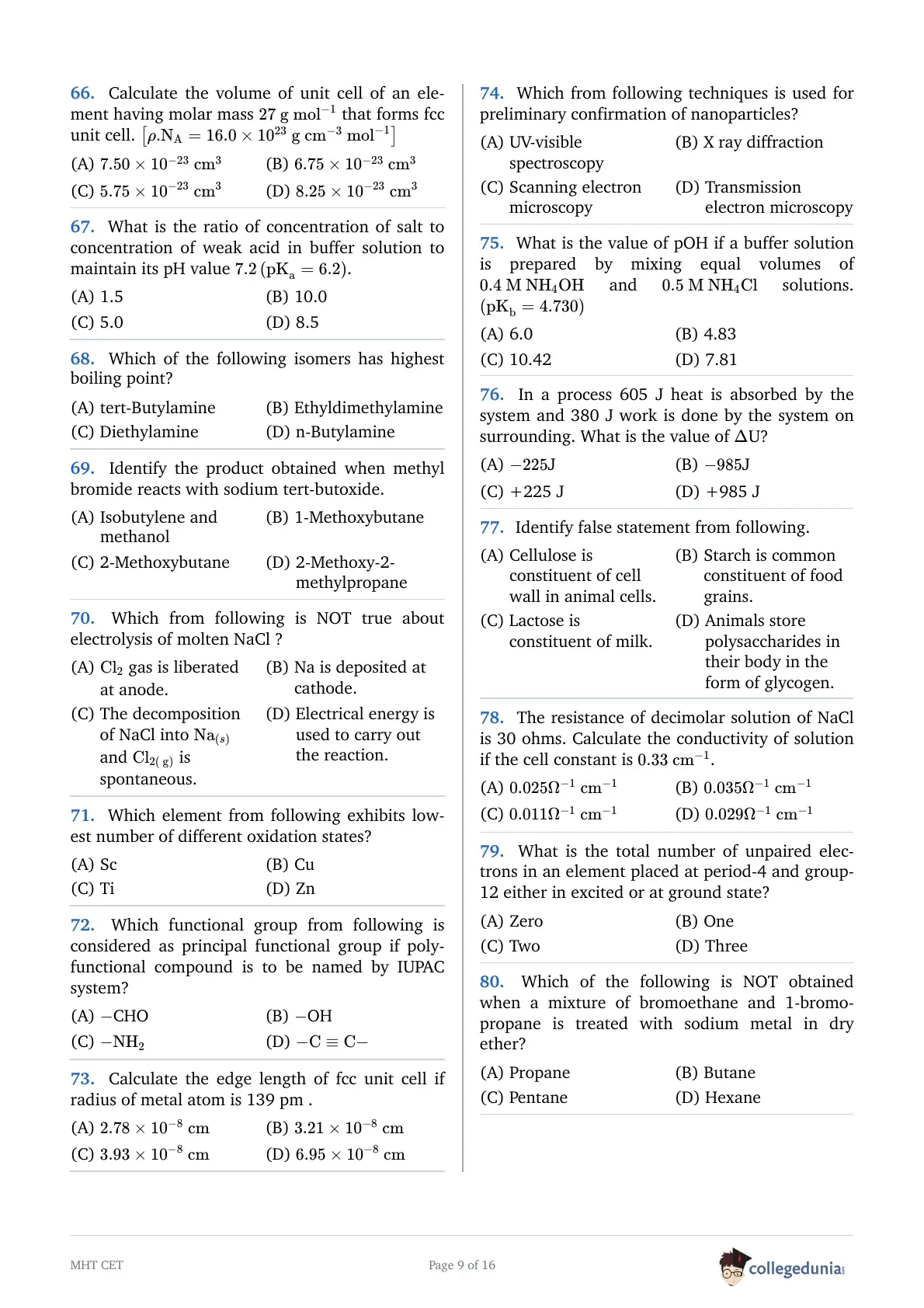
Calculate the volume of unit cell of an element having molar mass \(27 \mathrm{~g} \mathrm{~mol}^{-1}\) that forms fcc unit cell. \(\left[\rho . \mathrm{N}_{\mathrm{A}}=16.0 \times 10^{23} \mathrm{~g} \mathrm{~cm}^{-3} \mathrm{~mol}^{-1}\right]\)
What is the ratio of concentration of salt to concentration of weak acid in buffer solution to maintain its pH value \(7.2\left(\mathrm{pK}_{\mathrm{a}}=6.2\right)\).
Which of the following isomeric amines has the highest boiling point?
Identify the product obtained when methyl bromide reacts with sodium tert-butoxide.
Which functional group from following is considered as principal functional group if polyfunctional compound is to be named by IUPAC system?
Calculate the edge length of fcc unit cell if radius of metal atom is 139 pm .
Which from following techniques is used for preliminary confirmation of nanoparticles?
What is the value of pOH if a buffer solution is prepared by mixing equal volumes of \(0.4 \mathrm{~M} \mathrm{~NH}_4 \mathrm{OH}\) and \(0.5 \mathrm{~M} \mathrm{~NH}_4 \mathrm{Cl}\) solutions. \(\left(\mathrm{pK}_{\mathrm{b}}=4.730\right)\)
In a process 605 J heat is absorbed by the system and 380 J work is done by the system on surrounding. What is the value of \(\Delta\)U?
The resistance of decimolar solution of NaCl is 30 ohms. Calculate the conductivity of solution if the cell constant is \(0.33 \mathrm{~cm}^{-1}\).
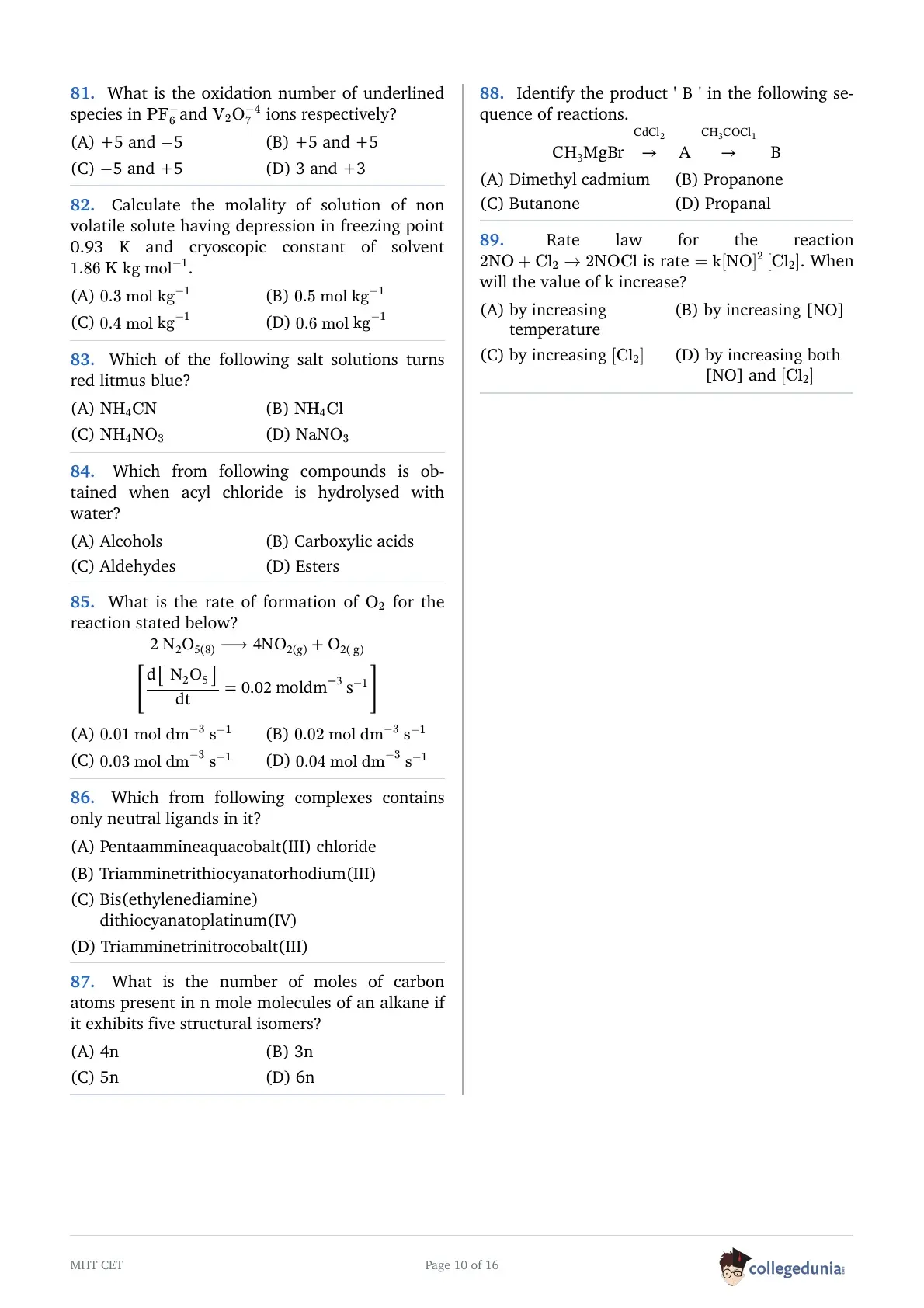
Which of the following is NOT obtained when a mixture of bromoethane and 1-bromopropane is treated with sodium metal in dry ether?
What is the oxidation number of underlined species in \(\mathrm{PF}_6^{-}\)and \(\mathrm{V}_2 \mathrm{O}_7^{-4}\) ions respectively?
Calculate the molality of solution of non volatile solute having depression in freezing point 0.93 K and cryoscopic constant of solvent \(1.86 \mathrm{~K} \mathrm{~kg} \mathrm{~mol}^{-1}\).
Which from following compounds is obtained when acyl chloride is hydrolysed with water?
What is the rate of formation of \(\mathrm{O}_2\) for the reaction stated below?
\[\begin{aligned} & 2 \mathrm{~N}_2 \mathrm{O}_{5(8)} \longrightarrow 4 \mathrm{NO}_{2(g)}+\mathrm{O}_{2(\mathrm{~g})} \\ & {\left[\frac{\mathrm{d}\left[\mathrm{~N}_2 \mathrm{O}_5\right]}{\mathrm{dt}}=0.02 \mathrm{~mol} \mathrm{dm}^{-3} \mathrm{~s}^{-1}\right]} \end{aligned}\]
What is the number of moles of carbon atoms present in n mole molecules of an alkane if it exhibits five structural isomers?
Identify the product ' B ' in the following sequence of reactions.
\[\mathrm{CH}_3 \mathrm{MgBr} \xrightarrow{\mathrm{CdCl}_2} \mathrm{~A} \xrightarrow{\mathrm{CH}_3 \mathrm{COCl}_1} \mathrm{~B}\]
Rate law for the reaction \(2 \mathrm{NO}+\mathrm{Cl}_2 \rightarrow 2 \mathrm{NOCl}\) is rate \(=\mathrm{k}[\mathrm{NO}]^2\left[\mathrm{Cl}_2\right]\). When will the value of k increase?


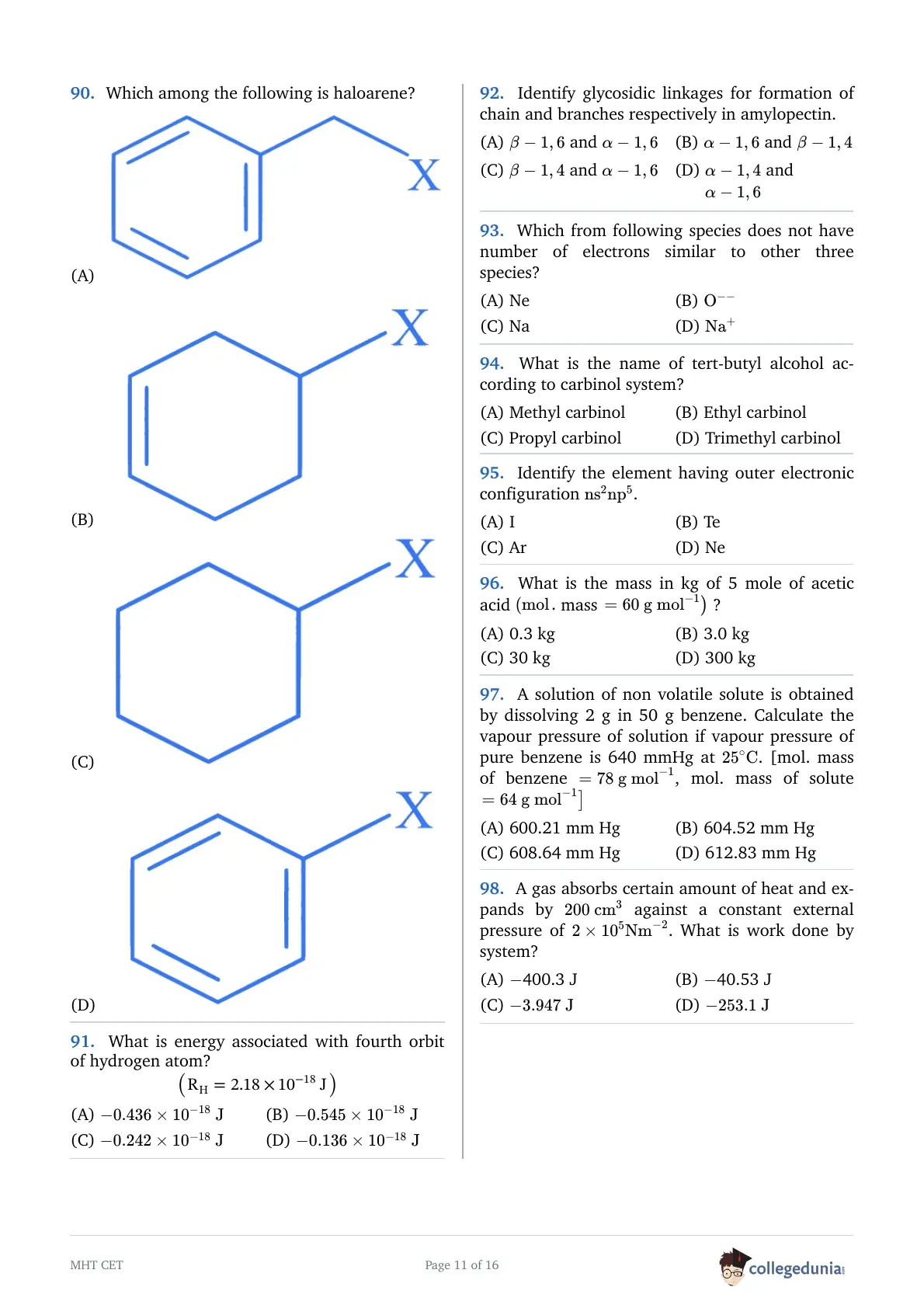
What is energy associated with fourth orbit of hydrogen atom?
\[\left(\mathrm{R}_{\mathrm{H}}=2.18 \times 10^{-18} \mathrm{~J}\right)\]
Identify glycosidic linkages for formation of chain and branches respectively in amylopectin.
Which from following species does not have number of electrons similar to other three species?
Identify the element having outer electronic configuration \(\mathrm{ns}^2 \mathrm{np}^5\).
What is the mass in kg of 5 mole of acetic acid \(\left(\mathrm{mol}\right.\). mass \(\left.=60 \mathrm{~g} \mathrm{~mol}^{-1}\right)\) ?
A solution of non volatile solute is obtained by dissolving 2 g in 50 g benzene. Calculate the vapour pressure of solution if vapour pressure of pure benzene is 640 mmHg at \(25^{\circ} \mathrm{C}\). [mol. mass of benzene \(=78 \mathrm{~g} \mathrm{~mol}^{-1}\), mol. mass of solute \(\left.=64 \mathrm{~g} \mathrm{~mol}^{-1}\right]\)
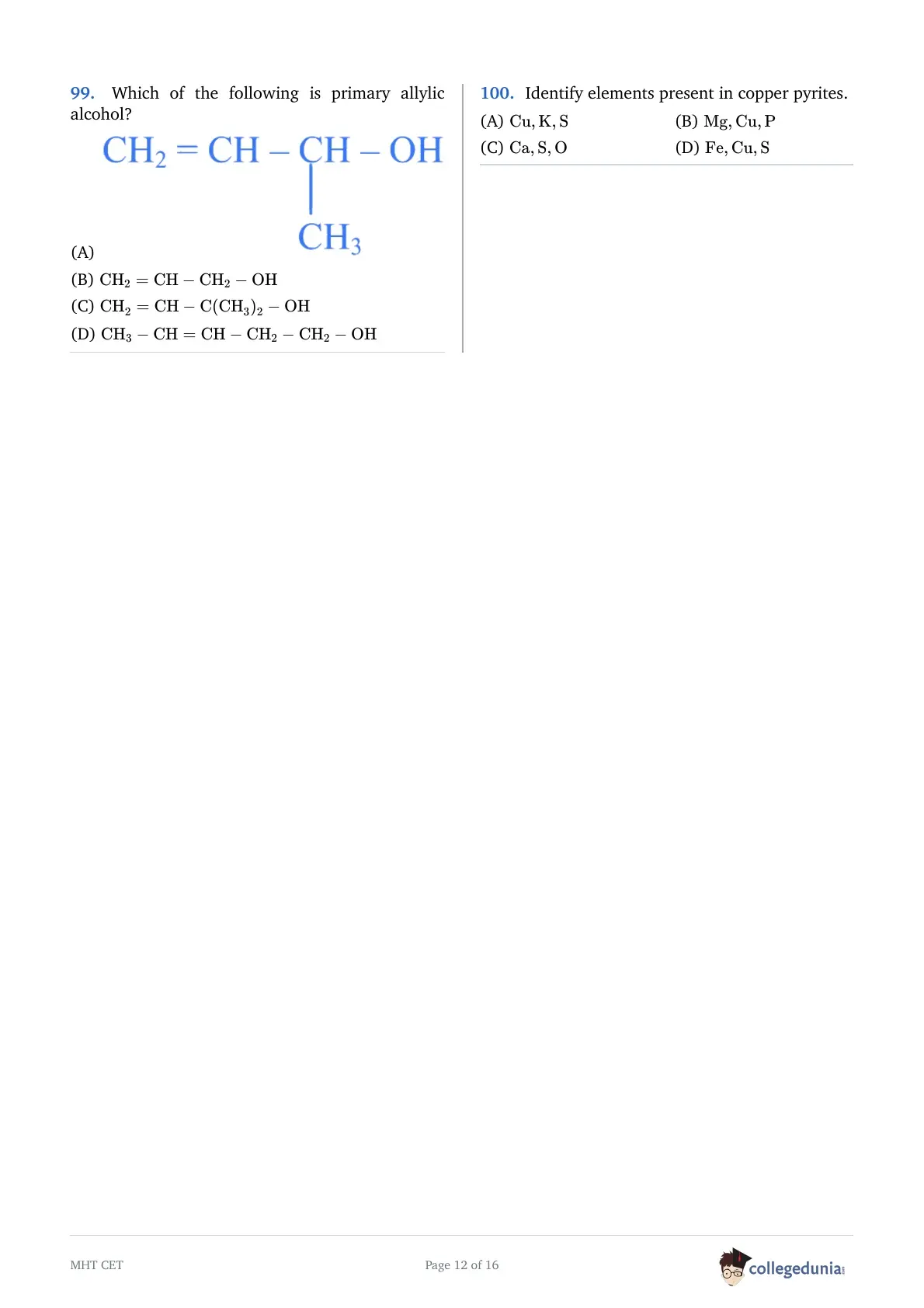
Which of the following is primary allylic alcohol?
- (A)
![]()
- (B) \(\mathrm{CH}_{2}=\mathrm{CH}-\mathrm{CH}_{2}-\mathrm{OH}\)
- (C) \(\mathrm{CH}_{2}=\mathrm{CH}-\mathrm{C}(\mathrm{CH}_{3})_{2}-\mathrm{OH}\)
- (D) \(\mathrm{CH}_{3}-\mathrm{CH}=\mathrm{CH}-\mathrm{CH}_{2}-\mathrm{CH}_{2}-\mathrm{OH}\)

Mathematics (Q101 - Q150)
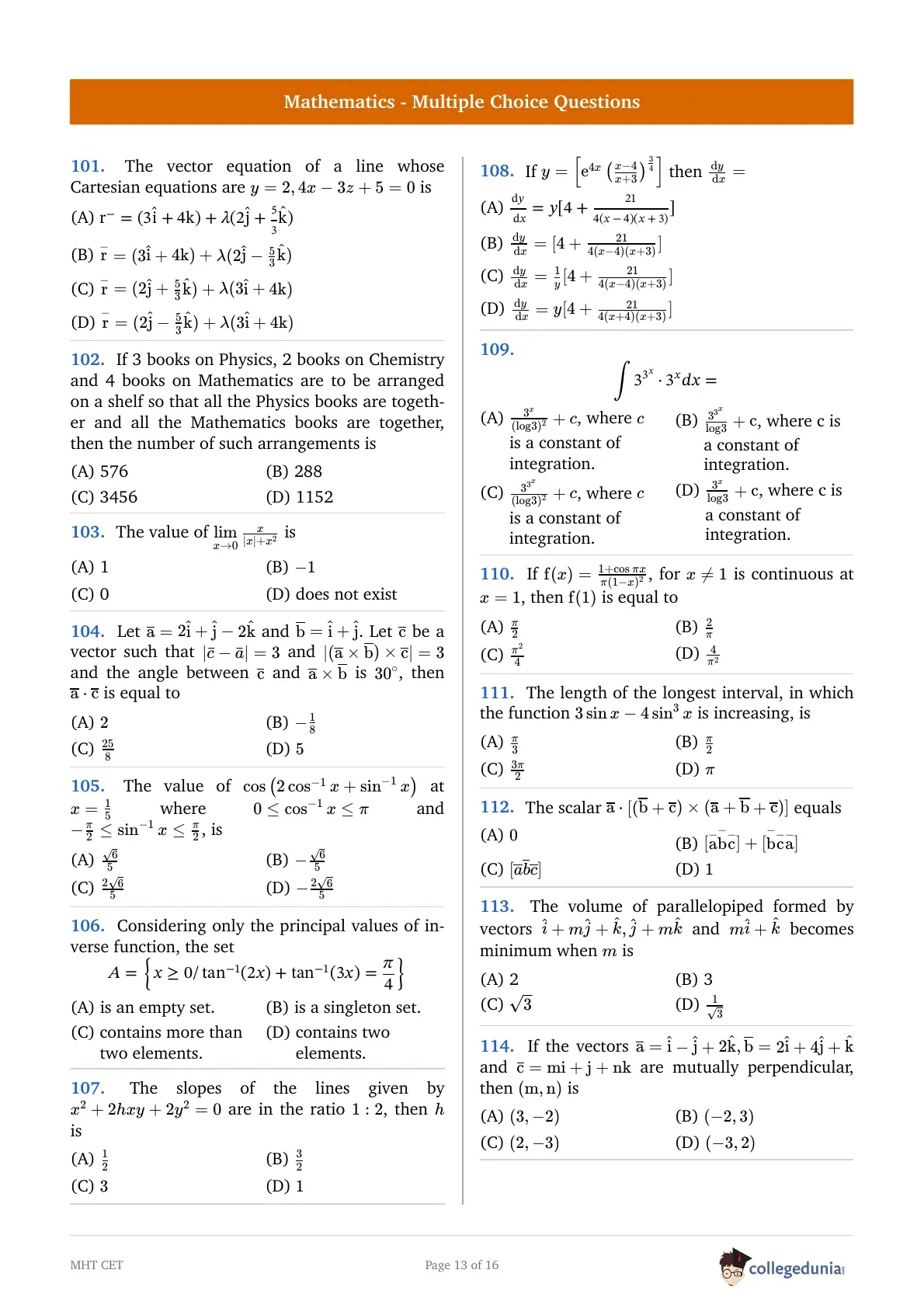
The vector equation of a line whose Cartesian equations are \(y=2,4 x-3 z+5=0\) is
If 3 books on Physics, 2 books on Chemistry and 4 books on Mathematics are to be arranged on a shelf so that all the Physics books are together and all the Mathematics books are together, then the number of such arrangements is
The value of \(\lim _\limits{x \rightarrow 0} \frac{x}{|x|+x^2}\) is
Let \(\overline{\mathrm{a}}=2 \hat{\mathrm{i}}+\hat{\mathrm{j}}-2 \hat{\mathrm{k}}\) and \(\overline{\mathrm{b}}=\hat{\mathrm{i}}+\hat{\mathrm{j}}\). Let \(\overline{\mathrm{c}}\) be a vector such that \(|\bar{c}-\bar{a}|=3\) and \(|(\overline{\mathrm{a}} \times \overline{\mathrm{b}}) \times \overline{\mathrm{c}}|=3\) and the angle between \(\overline{\mathrm{c}}\) and \(\overline{\mathrm{a}} \times \overline{\mathrm{b}}\) is \(30^{\circ}\), then \(\overline{\mathrm{a}} \cdot \overline{\mathrm{c}}\) is equal to
The value of \(\cos \left(2 \cos ^{-1} x+\sin ^{-1} x\right)\) at \(x=\frac{1}{5}\) where \(0 \leq \cos ^{-1} x \leq \pi\) and \(-\frac{\pi}{2} \leq \sin ^{-1} x \leq \frac{\pi}{2}\), is
Considering only the principal values of inverse function, the set
\[A=\left\{x \geq 0 / \tan ^{-1}(2 x)+\tan ^{-1}(3 x)=\frac{\pi}{4}\right\}\]
The slopes of the lines given by \(x^2+2 h x y+2 y^2=0\) are in the ratio \(1: 2\), then \(h\) is
If \(y=\left[\mathrm{e}^{4 x}\left(\frac{x-4}{x+3}\right)^{\frac{3}{4}}\right]\) then \(\frac{\mathrm{d} y}{\mathrm{~d} x}=\)
If \(\mathrm{f}(x)=\frac{1+\cos \pi x}{\pi(1-x)^2}\), for \(x \neq 1\) is continuous at \(x=1\), then \(\mathrm{f}(1)\) is equal to
The length of the longest interval, in which the function \(3 \sin x-4 \sin ^3 x\) is increasing, is
The scalar \(\overline{\mathrm{a}} \cdot[(\overline{\mathrm{b}}+\overline{\mathrm{c}}) \times(\overline{\mathrm{a}}+\overline{\mathrm{b}}+\overline{\mathrm{c}})]\) equals
The volume of parallelopiped formed by vectors \(\hat{i}+m \hat{j}+\hat{k}, \hat{j}+m \hat{k}\) and \(m \hat{i}+\hat{k}\) becomes minimum when \(m\) is
If the vectors \(\overline{\mathrm{a}}=\hat{\mathrm{i}}-\hat{\mathrm{j}}+2 \hat{\mathrm{k}}, \overline{\mathrm{b}}=2 \hat{\mathrm{i}}+4 \hat{\mathrm{j}}+\hat{\mathrm{k}}\) and \(\overline{\mathrm{c}}=\mathrm{mi}+\mathrm{j}+\mathrm{nk}\) are mutually perpendicular, then \((\mathrm{m}, \mathrm{n})\) is
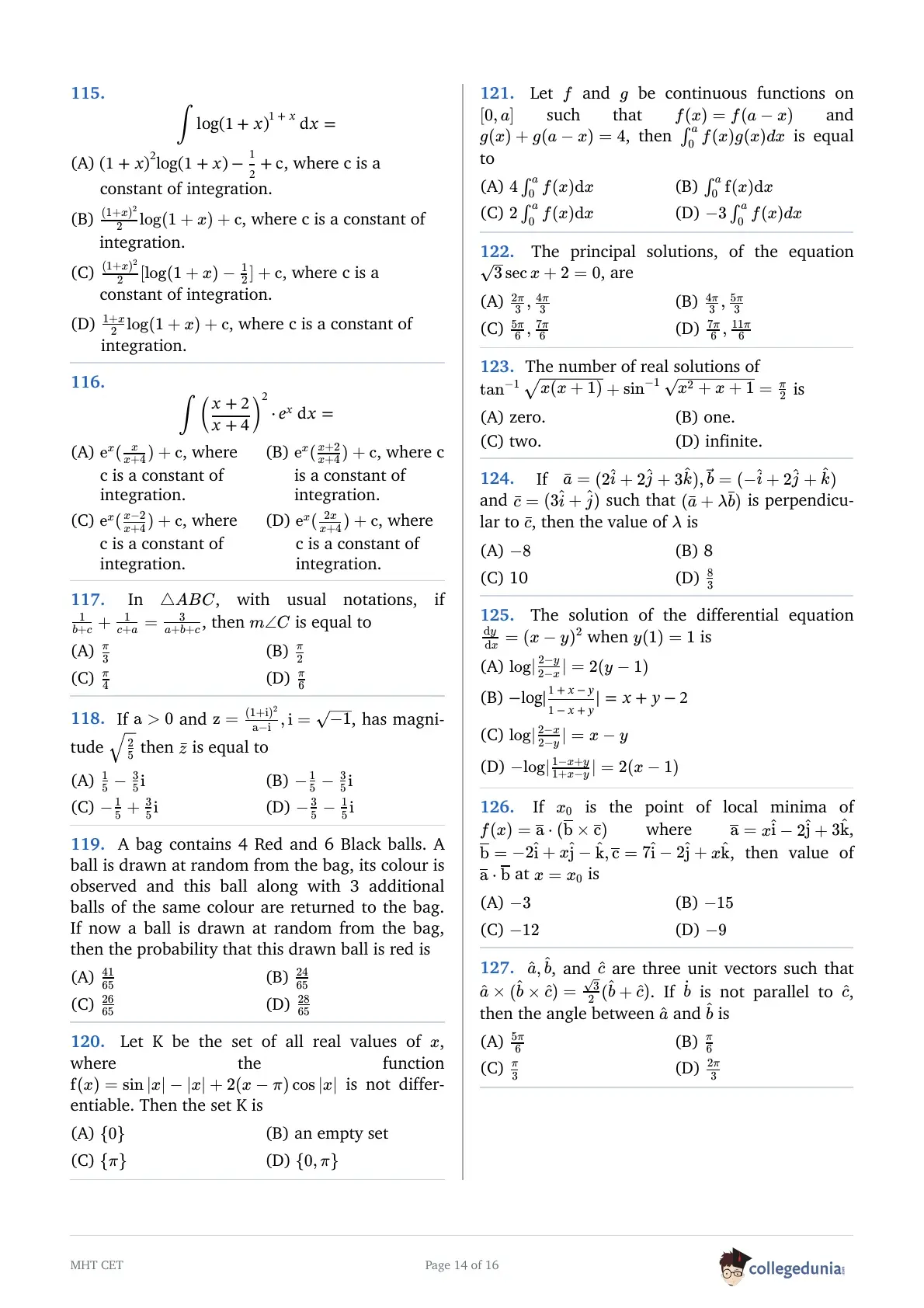
In \(\triangle A B C\), with usual notations, if \(\frac{1}{b+c}+\frac{1}{c+a}=\frac{3}{a+b+c}\), then \(m \angle C\) is equal to
If \(\mathrm{a}>0\) and \(\mathrm{z}=\frac{(1+\mathrm{i})^2}{\mathrm{a}-\mathrm{i}}, \mathrm{i}=\sqrt{-1}\), has magnitude \(\sqrt{\frac{2}{5}}\) then \(\bar{z}\) is equal to
A bag contains 4 Red and 6 Black balls. A ball is drawn at random from the bag, its colour is observed and this ball along with 3 additional balls of the same colour are returned to the bag. If now a ball is drawn at random from the bag, then the probability that this drawn ball is red is
Let K be the set of all real values of \(x\), where the function \(\mathrm{f}(x)=\sin |x|-|x|+2(x-\pi) \cos |x|\) is not differentiable. Then the set K is
Let \(f\) and \(g\) be continuous functions on \([0, a]\) such that \(f(x)=f(a-x)\) and \(g(x)+g(a-x)=4\), then \(\int_0^a f(x) g(x) d x\) is equal to
The principal solutions, of the equation \(\sqrt{3} \sec x+2=0\), are
The number of real solutions of
\(\tan ^{-1} \sqrt{x(x+1)}+\sin ^{-1} \sqrt{x^2+x+1}=\frac{\pi}{2}\) is
If \(\bar{a}=(2 \hat{i}+2 \hat{j}+3 \hat{k}), \vec{b}=(-\hat{i}+2 \hat{j}+\hat{k}) \quad\) and \(\bar{c}=(3 \hat{i}+\hat{j})\) such that \((\bar{a}+\lambda \bar{b})\) is perpendicular to \(\bar{c}\), then the value of \(\lambda\) is
The solution of the differential equation \(\frac{\mathrm{d} y}{\mathrm{~d} x}=(x-y)^2\) when \(y(1)=1\) is
If \(x_0\) is the point of local minima of \(f(x)=\overline{\mathrm{a}} \cdot(\overline{\mathrm{b}} \times \overline{\mathrm{c}})\) where \(\overline{\mathrm{a}}=x \hat{\mathrm{i}}-2 \hat{\mathrm{j}}+3 \hat{\mathrm{k}}\), \(\overline{\mathrm{b}}=-2 \hat{\mathrm{i}}+x \hat{\mathrm{j}}-\hat{\mathrm{k}}, \overline{\mathrm{c}}=7 \hat{\mathrm{i}}-2 \hat{\mathrm{j}}+x \hat{\mathrm{k}}\), then value of \(\overline{\mathrm{a}} \cdot \overline{\mathrm{b}}\) at \(x=x_0\) is
\(\hat{a}, \hat{b}\), and \(\hat{c}\) are three unit vectors such that \(\hat{a} \times(\hat{b} \times \hat{c})=\frac{\sqrt{3}}{2}(\hat{b}+\hat{c})\). If \(\dot{b}\) is not parallel to \(\hat{c}\), then the angle between \(\hat{a}\) and \(\hat{b}\) is
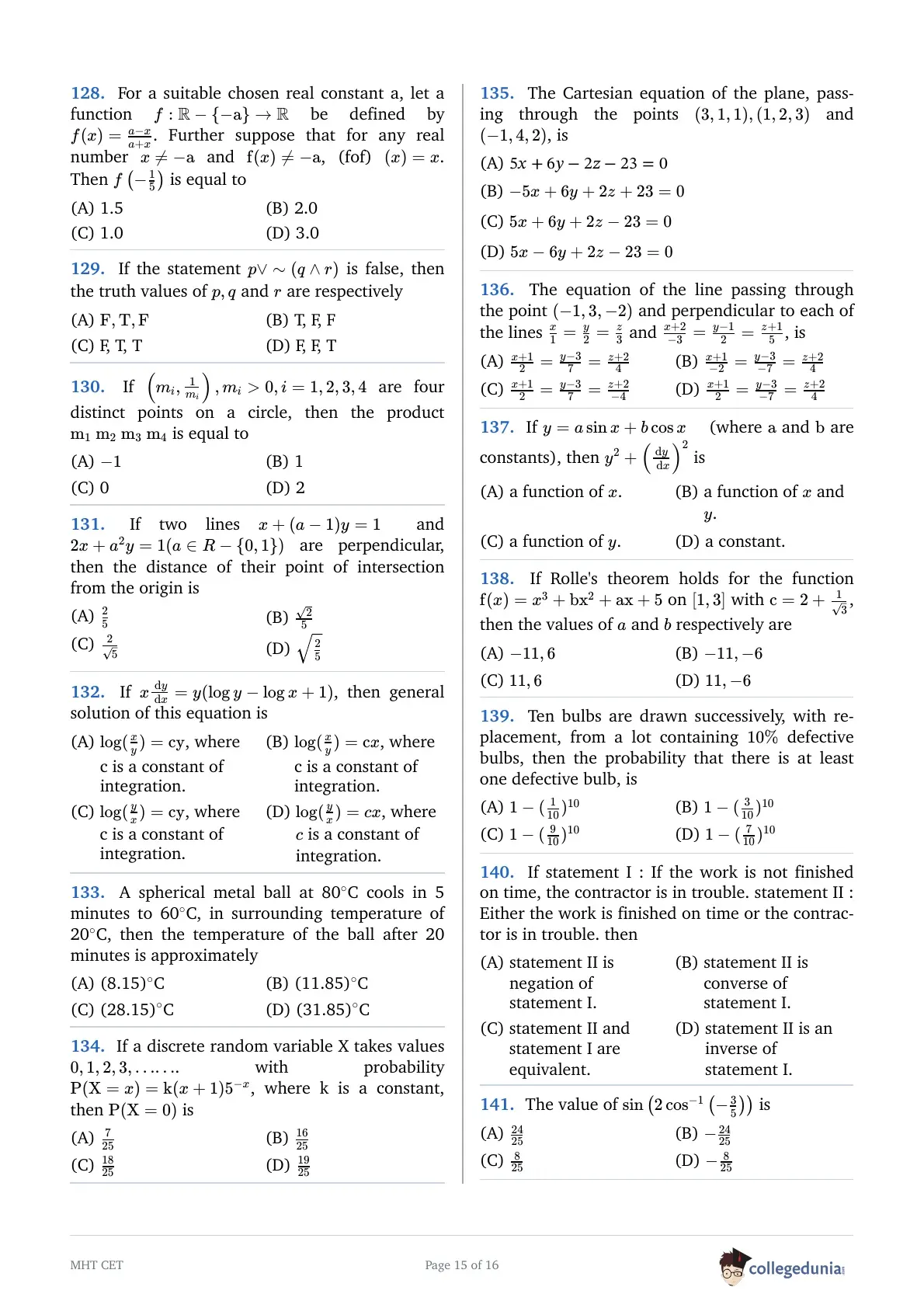
For a suitable chosen real constant a, let a function \(f: \mathbb{R}-\{-\mathrm{a}\} \rightarrow \mathbb{R}\) be defined by \(f(x)=\frac{a-x}{a+x}\). Further suppose that for any real number \(x \neq-\mathrm{a}\) and \(\mathrm{f}(x) \neq-\mathrm{a}\), (fof) \((x)=x\). Then \(f\left(-\frac{1}{5}\right)\) is equal to
If the statement \(p \vee \sim(q \wedge r)\) is false, then the truth values of \(p, q\) and \(r\) are respectively
If \(\left(m_i, \frac{1}{m_i}\right), m_i>0, i=1,2,3,4\) are four distinct points on a circle, then the product \(\mathrm{m}_1 \mathrm{~m}_2 \mathrm{~m}_3 \mathrm{~m}_4\) is equal to
If two lines \(x+(a-1) y=1 \quad\) and \(2 x+a^2 y=1(a \in R-\{0,1\})\) are perpendicular, then the distance of their point of intersection from the origin is
If \(x \frac{\mathrm{~d} y}{\mathrm{~d} x}=y(\log y-\log x+1)\), then general solution of this equation is
A spherical metal ball at 80\(^\circ\)C cools in 5 minutes to 60\(^\circ\)C, in surrounding temperature of 20\(^\circ\)C, then the temperature of the ball after 20 minutes is approximately
If a discrete random variable X takes values \(0,1,2,3, \ldots \ldots\). with probability \(\mathrm{P}(\mathrm{X}=x)=\mathrm{k}(x+1) 5^{-x}\), where k is a constant, then \(\mathrm{P}(\mathrm{X}=0)\) is
The Cartesian equation of the plane, passing through the points \((3,1,1),(1,2,3)\) and \((-1,4,2)\), is
The equation of the line passing through the point \((-1,3,-2)\) and perpendicular to each of the lines \(\frac{x}{1}=\frac{y}{2}=\frac{z}{3}\) and \(\frac{x+2}{-3}=\frac{y-1}{2}=\frac{z+1}{5}\), is
If \(y=a \sin x+b \cos x \quad\) (where \(\mathrm{a}\) and \(\mathrm{b}\) are constants), then \(y^2+\left(\frac{\mathrm{d} y}{\mathrm{~d} x}\right)^2\) is
If Rolle's theorem holds for the function \(\mathrm{f}(x)=x^3+\mathrm{bx}{ }^2+\mathrm{ax}+5\) on \([1,3]\) with \(\mathrm{c}=2+\frac{1}{\sqrt{3}}\), then the values of \(a\) and \(b\) respectively are
Ten bulbs are drawn successively, with replacement, from a lot containing \(10 \%\) defective bulbs, then the probability that there is at least one defective bulb, is
If statement I : If the work is not finished on time, the contractor is in trouble. statement II : Either the work is finished on time or the contractor is in trouble. then
The value of \(\sin \left(2 \cos ^{-1}\left(-\frac{3}{5}\right)\right)\) is
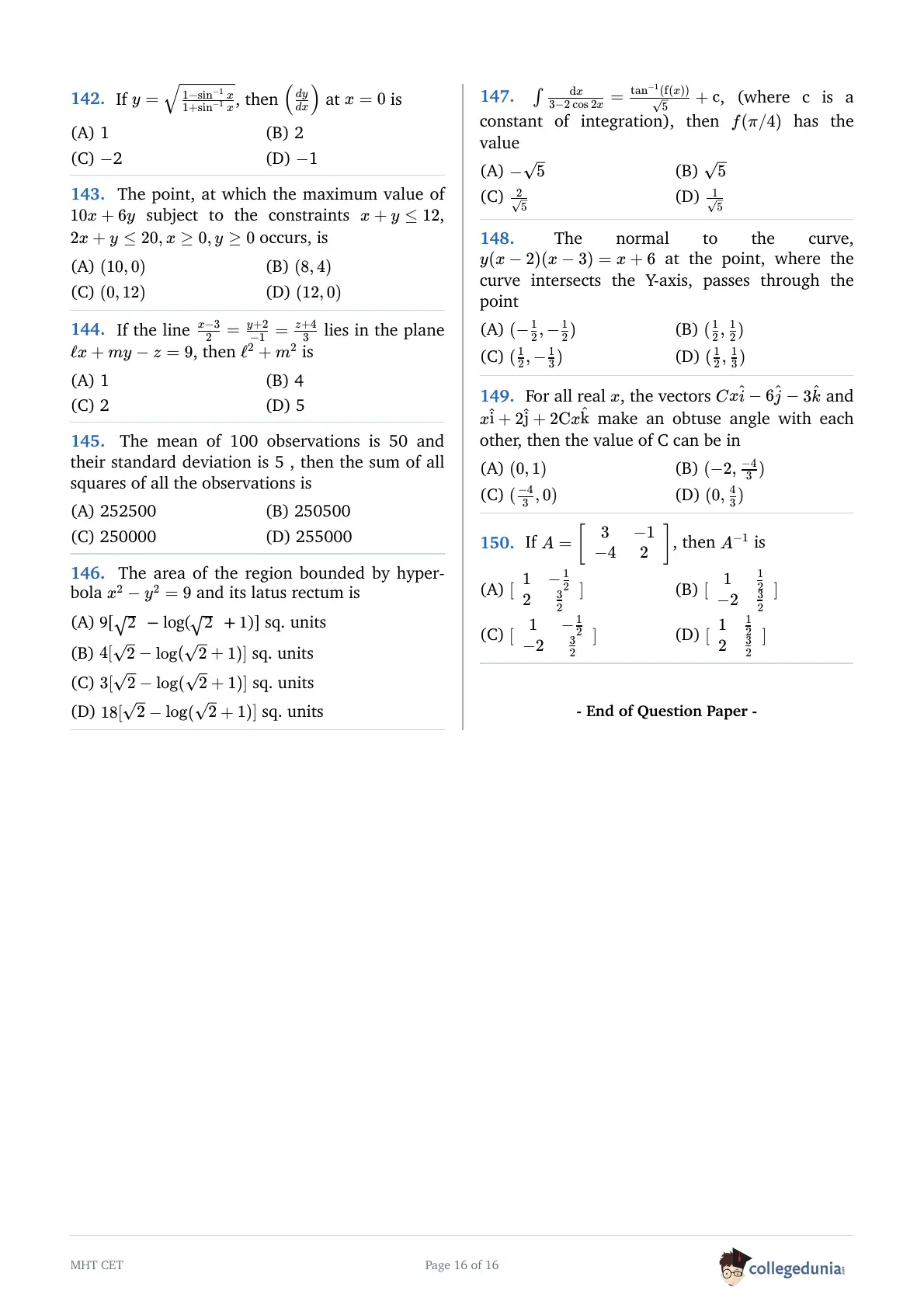
If \(y=\sqrt{\frac{1-\sin ^{-1} x}{1+\sin ^{-1} x}}\), then \(\left(\frac{d y}{d x}\right)\) at \(x=0\) is
The point, at which the maximum value of \(10 x+6 y\) subject to the constraints \(x+y \leq 12\), \(2 x+y \leq 20, x \geq 0, y \geq 0\) occurs, is
If the line \(\frac{x-3}{2}=\frac{y+2}{-1}=\frac{z+4}{3}\) lies in the plane \(\ell x+m y-z=9\), then \(\ell^2+m^2\) is
The mean of 100 observations is 50 and their standard deviation is 5 , then the sum of all squares of all the observations is
\(\int \frac{\mathrm{d} x}{3-2 \cos 2 x}=\frac{\tan ^{-1}(\mathrm{f}(x))}{\sqrt{5}}+\mathrm{c}\), (where c is a constant of integration), then \(f(\pi / 4)\) has the value
The normal to the curve, \(y(x-2)(x-3)=x+6\) at the point, where the curve intersects the Y-axis, passes through the point
For all real \(x\), the vectors \(C x \hat{i}-6 \hat{j}-3 \hat{k}\) and \(x \hat{\mathrm{i}}+2 \hat{\mathrm{j}}+2 \mathrm{C} x \hat{\mathrm{k}}\) make an obtuse angle with each other, then the value of C can be in
If \(A=\left[\begin{array}{cc}3 & -1 \\ -4 & 2\end{array}\right]\), then \(A^{-1}\) is
MHT CET 2024 PCM Exam Pattern and Marking Scheme
| Parameter | Details |
|---|---|
| Conducting Body | Maharashtra Common Entrance Test Cell (Maharashtra CET Cell) |
| Exam Mode | Online (Computer-Based Test) |
| Duration | 180 minutes (3 hours) |
| Groups / Subjects | PCM (Physics, Chemistry, Mathematics) for Engineering |
| Total Questions |
150 |
| Total Marks | 200 |
| Question Type | Multiple Choice Questions (MCQs) |
| Marks Distribution |
|
| Negative Marking | No |
| Syllabus Weightage |
|



Comments