




MHT CET 2024 May 2 Shift 2 PCM Question Paper is available for download here. Maharashtra State CET Cell conducted MHT CET 2024 PCM Exam on May 2 in Shift 2 from 2 PM to 5 PM in CBT mode.
The MHT CET 2024 PCM question paper includes the following:
- The MHT CET 2024 PCM Question Paper consists of 150 multiple-choice questions (MCQs) totalling 200 marks divided into 3 sections: Physics, Chemistry, and Mathematics, with 50 questions in each subject.
- Physics and Chemistry questions carry 1 mark each while Mathematics questions carry 2 marks each.
- There is no negative marking for incorrect answers.
MHT CET 2024 May 2 Shift 2 PCM Question Paper with Solution PDF
| CD PDF | CD PDF with Solutions |
|---|---|
| Download Collegedunia PDF 0.90 MB | - |
Also Check:
MHT CET 2024 May 2 Shift 2 PCM Questions with Solutions
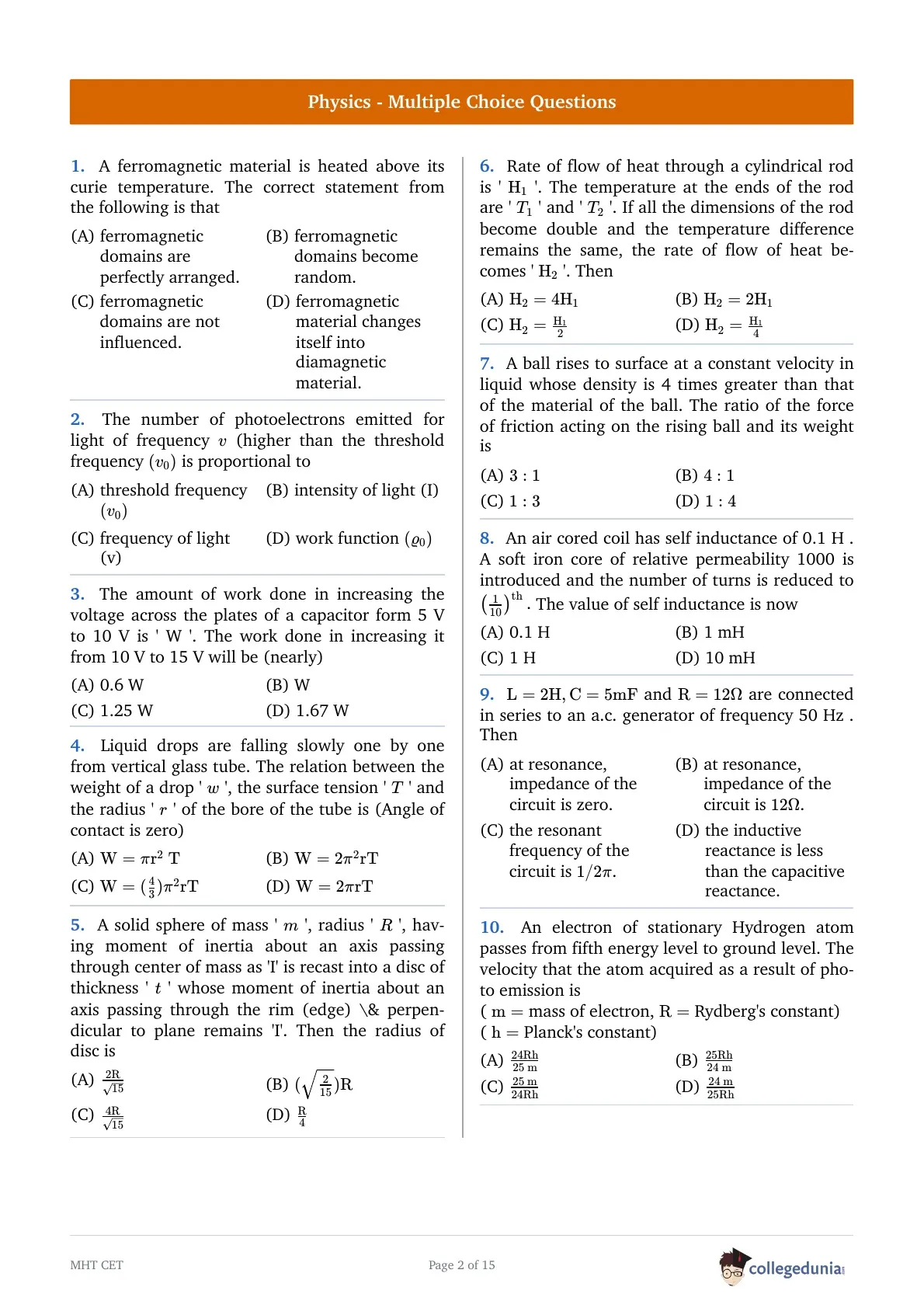
The number of photoelectrons emitted for light of frequency \(v\) (higher than the threshold frequency \(\left(v_0\right)\) is proportional to
The amount of work done in increasing the voltage across the plates of a capacitor form 5 V to 10 V is ' W '. The work done in increasing it from 10 V to 15 V will be (nearly)
Liquid drops are falling slowly one by one from vertical glass tube. The relation between the weight of a drop ' \(w\) ', the surface tension ' \(T\) ' and the radius ' \(r\) ' of the bore of the tube is (Angle of contact is zero)
A solid sphere of mass ' \(m\) ', radius ' \(R\) ', having moment of inertia about an axis passing through center of mass as 'I' is recast into a disc of thickness ' \(t\) ' whose moment of inertia about an axis passing through the rim (edge) \& perpendicular to plane remains 'I'. Then the radius of disc is
Rate of flow of heat through a cylindrical rod is \( H_1 \). The temperature of the ends of the rod are ' \( T_1 \) ' and ' \( T_2 \) '. If all the dimensions of the rod become double and the temperature difference remains the same, the rate of flow of heat becomes ' \( H_2 \) '. Then \( H_2 = \)
A ball rises to surface at a constant velocity in liquid whose density is 4 times greater than that of the material of the ball. The ratio of the force of friction acting on the rising ball and its weight is
An air cored coil has self inductance of 0.1 H . A soft iron core of relative permeability 1000 is introduced and the number of turns is reduced to \(\left(\frac{1}{10}\right)^{\text {th }}\). The value of self inductance is now
\(\mathrm{L}=2 \mathrm{H}, \mathrm{C}=5 \mathrm{mF}\) and \(\mathrm{R}=12 \Omega\) are connected in series to an a.c. generator of frequency 50 Hz . Then
An electron of stationary Hydrogen atom passes from fifth energy level to ground level. The velocity that the atom acquired as a result of photo emission is
( \(\mathrm{m}=\) mass of electron, \(\mathrm{R}=\) Rydberg's constant)
( \(\mathrm{h}=\) Planck's constant)
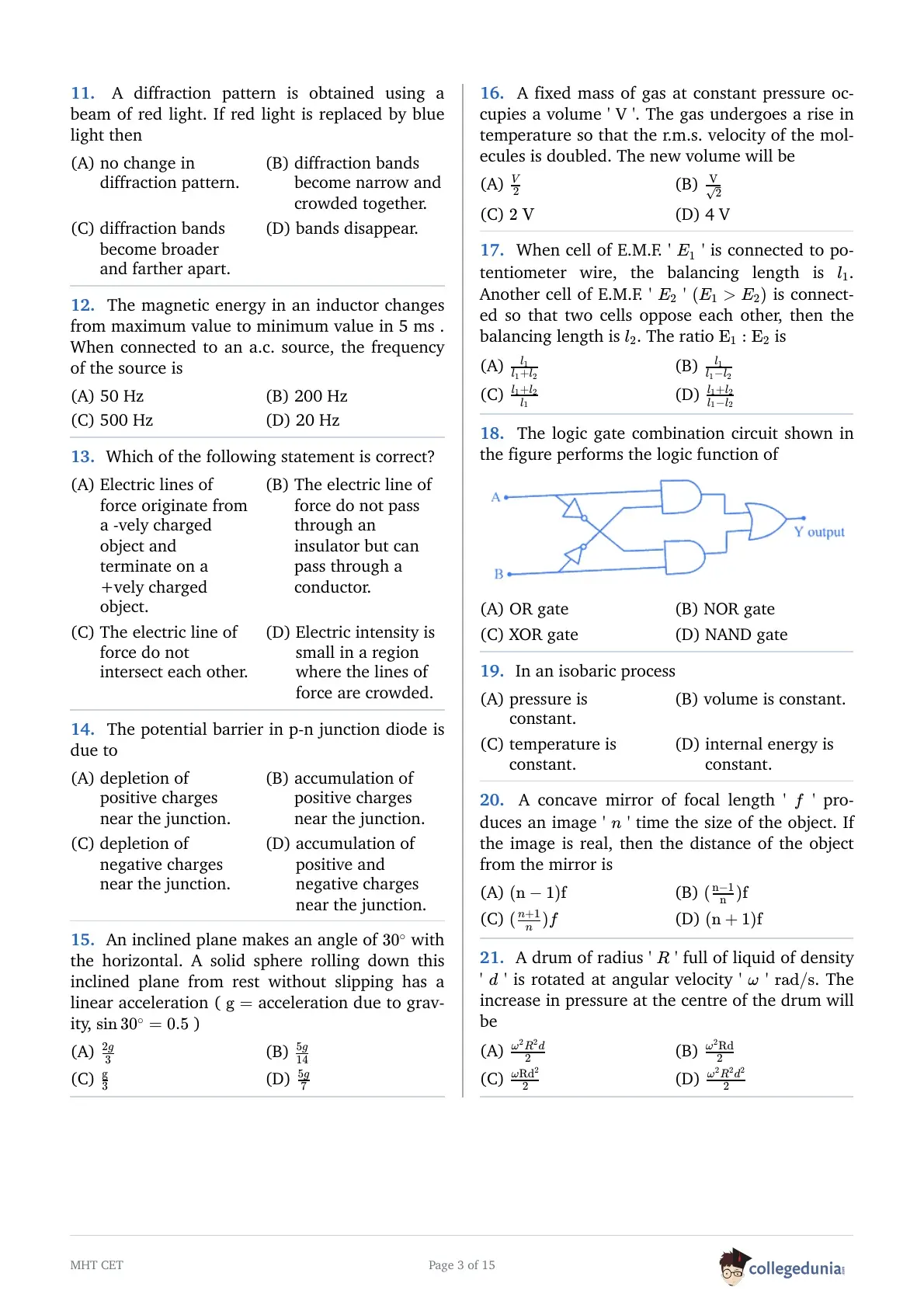
A diffraction pattern is obtained using a beam of red light. If red light is replaced by blue light then
The magnetic energy in an inductor changes from maximum value to minimum value in 5 ms . When connected to an a.c. source, the frequency of the source is
An inclined plane makes an angle of \(30^{\circ}\) with the horizontal. A solid sphere rolling down this inclined plane from rest without slipping has a linear acceleration ( \(\mathrm{g}=\) acceleration due to gravity, \(\sin 30^{\circ}=0.5\) )
A fixed mass of gas at constant pressure occupies a volume ' \(V\) '. The gas undergoes a rise in temperature so that the r.m.s. velocity of the molecule is doubled. The new volume will be
When cell of E.M.F. ' \(E_1\) ' is connected to potentiometer wire, the balancing length is \(l_1\). Another cell of E.M.F. ' \(E_2\) ' \(\left(E_1>E_2\right)\) is connected so that two cells oppose each other, then the balancing length is \(l_2\). The ratio \(\mathrm{E}_1: \mathrm{E}_2\) is
The logic gate combination circuit shown in the figure performs the logic function of

A concave mirror of focal length ' \(f\) ' produces an image ' \(n\) ' time the size of the object. If the image is real, then the distance of the object from the mirror is
A drum of radius ' \(R\) ' full of liquid of density ' \(d\) ' is rotated at angular velocity ' \(\omega\) ' \(\mathrm{rad} / \mathrm{s}\). The increase in pressure at the centre of the drum will be
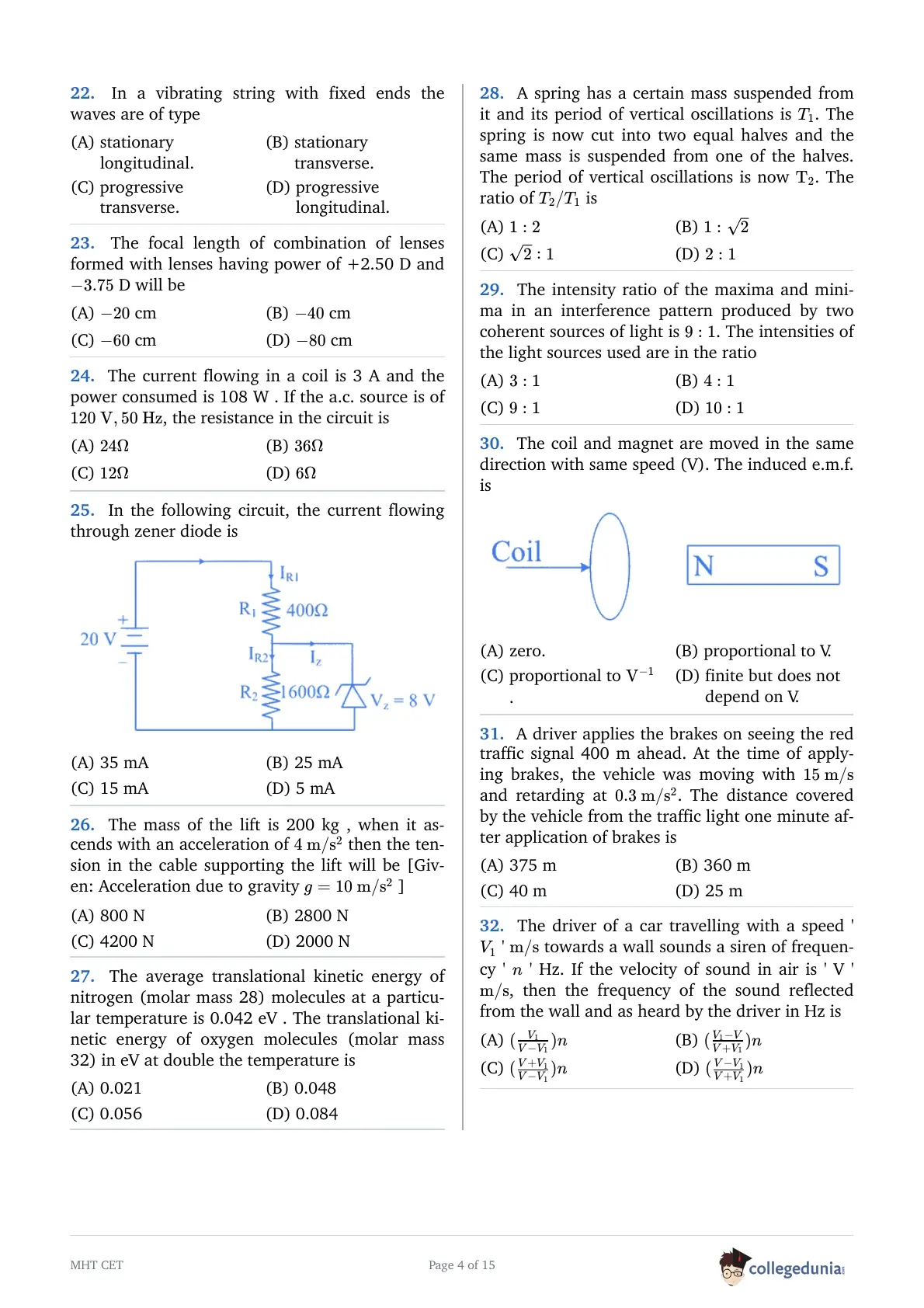
The focal length of combination of lenses formed with lenses having power of +2.50 D and \(-3.75\) D will be
The current flowing in a coil is 3 A and the power consumed is 108 W . If the a.c. source is of \(120 \mathrm{~V}, 50 \mathrm{~Hz}\), the resistance in the circuit is

The mass of the lift is 200 kg , when it ascends with an acceleration of \(4 \mathrm{~m} / \mathrm{s}^2\) then the tension in the cable supporting the lift will be [Given: Acceleration due to gravity \(g=10 \mathrm{~m} / \mathrm{s}^2\) ]
The average translational kinetic energy of nitrogen (molar mass 28) molecules at a particular temperature is 0.042 eV . The translational kinetic energy of oxygen molecules (molar mass 32) in eV at double the temperature is
A spring has a certain mass suspended from it and its period of vertical oscillations is \(T_1\). The spring is now cut into two equal halves and the same mass is suspended from one of the halves. The period of vertical oscillations is now \(\mathrm{T}_2\). The ratio of \(T_2 / T_1\) is
The intensity ratio of the maxima and minima in an interference pattern produced by two coherent sources of light is \(9: 1\). The intensities of the light sources used are in the ratio
The coil and magnet are moved in the same direction with same speed (V). The induced e.m.f. is

A driver applies the brakes on seeing the red traffic signal 400 m ahead. At the time of applying brakes, the vehicle was moving with \(15 \mathrm{~m} / \mathrm{s}\) and retarding at \(0.3 \mathrm{~m} / \mathrm{s}^2\). The distance covered by the vehicle from the traffic light one minute after application of brakes is
The driver of a car travelling with a speed ' \(V_1\) ' \(\mathrm{m} / \mathrm{s}\) towards a wall sounds a siren of frequency ' \(n\) ' Hz. If the velocity of sound in air is ' V ' \(\mathrm{m} / \mathrm{s}\), then the frequency of the sound reflected from the wall and as heard by the driver in Hz is
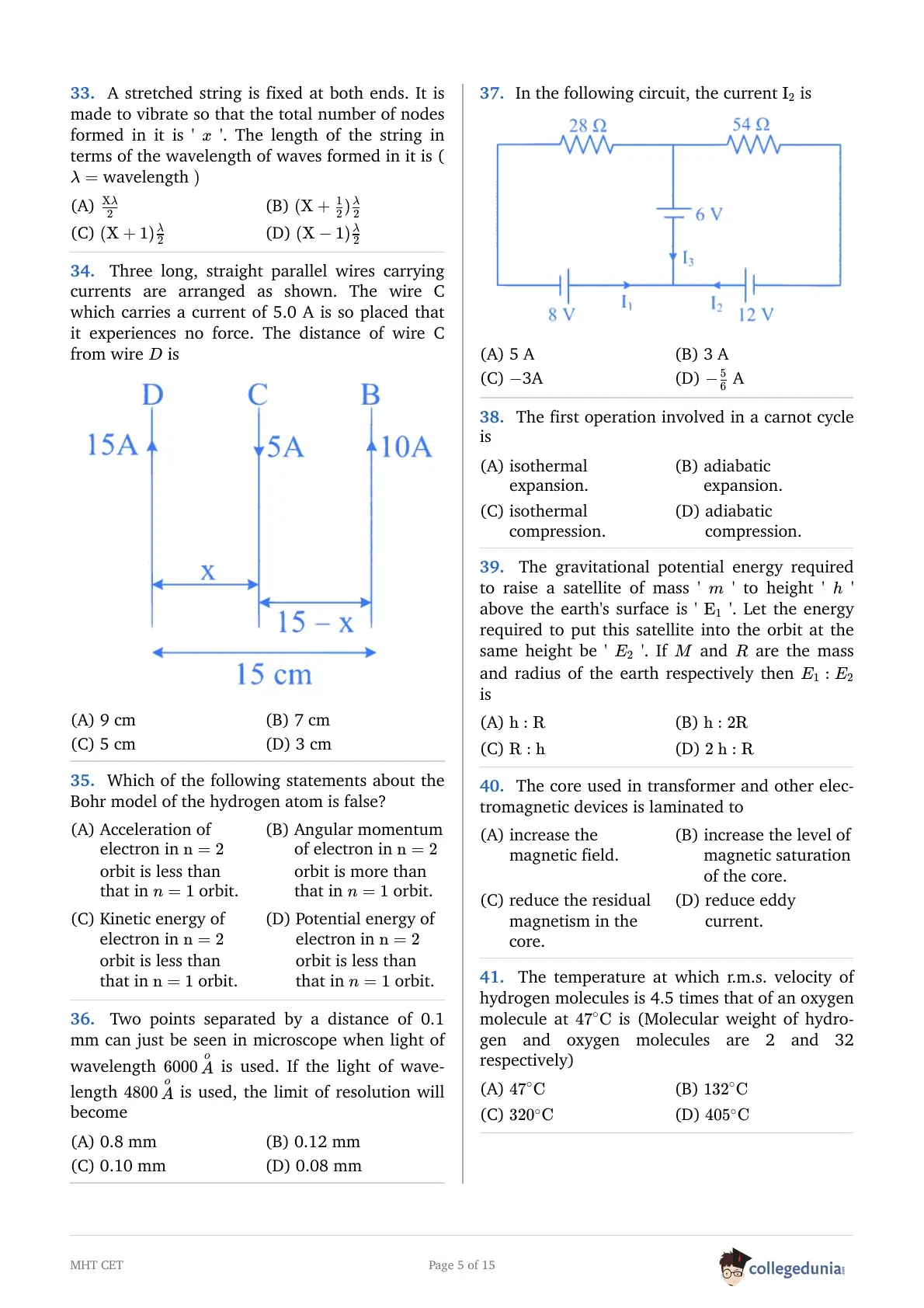
A stretched string is fixed at both ends. It is made to vibrate so that the total number of nodes formed in it is ' \(x\) '. The length of the string in terms of the wavelength of waves formed in it is ( \(\lambda=\) wavelength \()\)
Three long, straight parallel wires carrying currents are arranged as shown. The wire C which carries a current of 5.0 A is so placed that it experiences no force. The distance of wire C from wire \(D\) is

Which of the following statements about the Bohr model of the hydrogen atom is false?
Two points separated by a distance of 0.1 mm can just be seen in microscope when light of wavelength \(6000 \mathop A\limits^o \) is used. If the light of wavelength \(4800 \mathop A\limits^o \) is used, the limit of resolution will become
The core used in transformer and other electromagnetic devices is laminated to
The temperature at which r.m.s. velocity of hydrogen molecules is 4.5 times that of an oxygen molecule at \(47^{\circ} \mathrm{C}\) is (Molecular weight of hydrogen and oxygen molecules are 2 and 32 respectively)
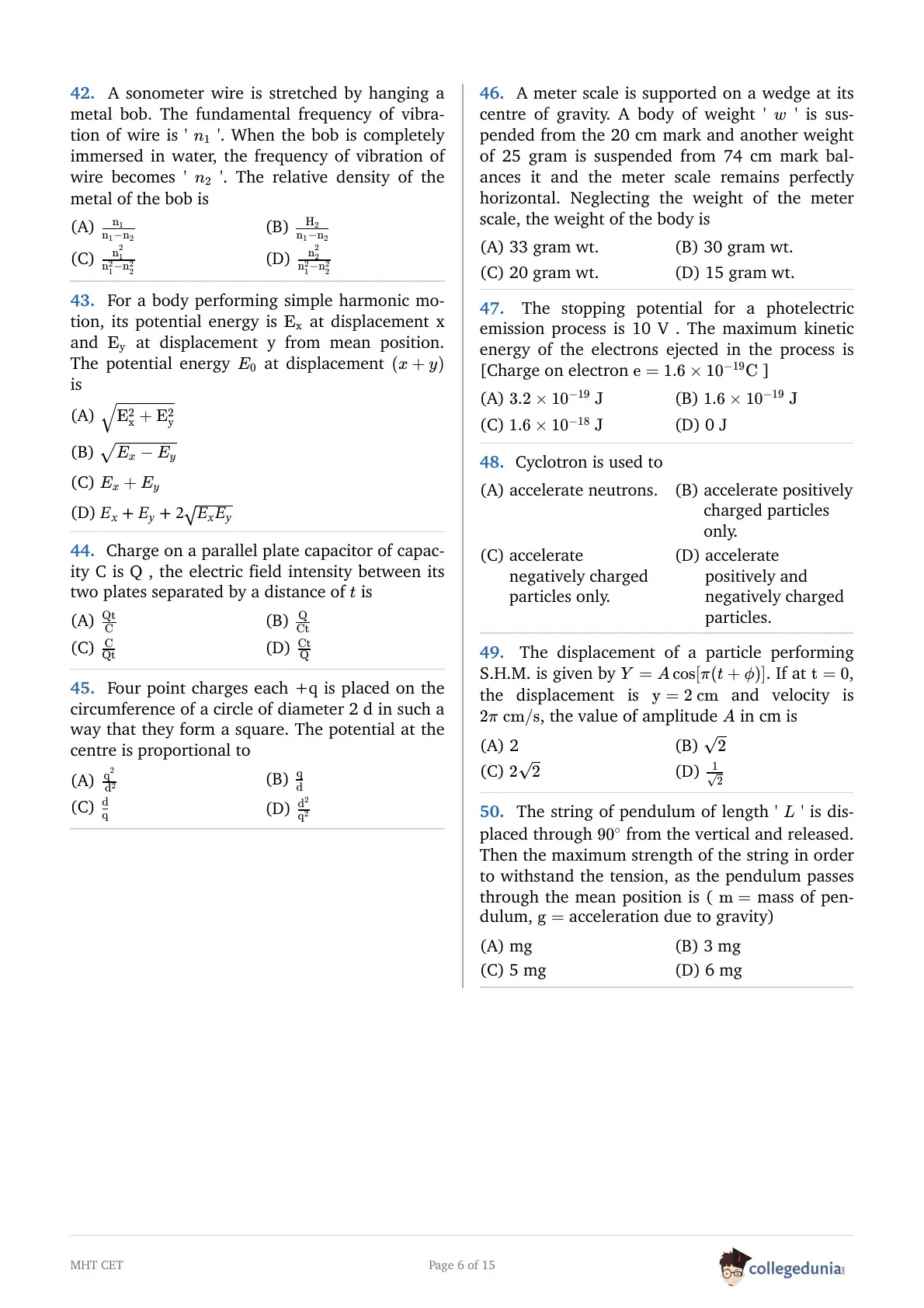
A sonometer wire is stretched by hanging a metal bob. The fundamental frequency of vibration of wire is ' \(n_1\) '. When the bob is completely immersed in water, the frequency of vibration of wire becomes ' \(n_2\) '. The relative density of the metal of the bob is
For a body performing simple harmonic motion, its potential energy is \(\mathrm{E}_{\mathrm{x}}\) at displacement x and \(\mathrm{E}_{\mathrm{y}}\) at displacement y from mean position. The potential energy \(E_0\) at displacement \((x+y)\) is
Charge on a parallel plate capacitor of capacity C is Q , the electric field intensity between its two plates separated by a distance of \(t\) is
Four point charges each +q is placed on the circumference of a circle of diameter 2 d in such a way that they form a square. The potential at the centre is proportional to
A meter scale is supported on a wedge at its centre of gravity. A body of weight ' \(w\) ' is suspended from the 20 cm mark and another weight of 25 gram is suspended from 74 cm mark balances it and the meter scale remains perfectly horizontal. Neglecting the weight of the meter scale, the weight of the body is
The stopping potential for a photelectric emission process is 10 V . The maximum kinetic energy of the electrons ejected in the process is [Charge on electron \(\mathrm{e}=1.6 \times 10^{-19} \mathrm{C}\) ]
The displacement of a particle performing S.H.M. is given by \(Y=A \cos [\pi(t+\phi)]\). If at \(\mathrm{t}=0\), the displacement is \(\mathrm{y}=2 \mathrm{~cm}\) and velocity is \(2 \pi \mathrm{~cm} / \mathrm{s}\), the value of amplitude \(A\) in cm is
The string of pendulum of length ' \(L\) ' is displaced through \(90^{\circ}\) from the vertical and released. Then the maximum strength of the string in order to withstand the tension, as the pendulum passes through the mean position is ( \(\mathrm{m}=\) mass of pendulum, \(\mathrm{g}=\) acceleration due to gravity)
Chemistry (Q51 - Q100)
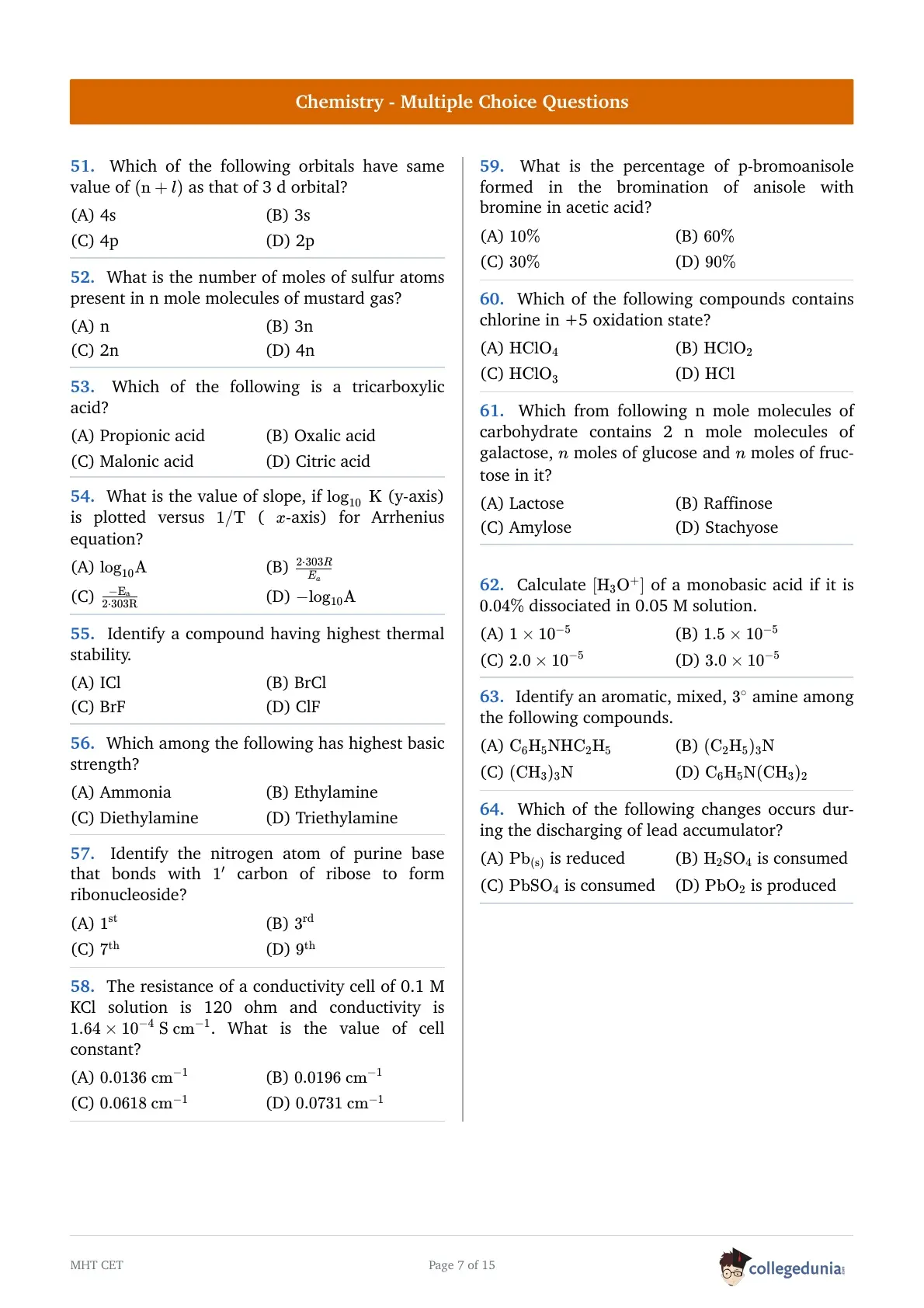
Which of the following orbitals have same value of \((\mathrm{n}+l)\) as that of 3 d orbital?
What is the number of moles of sulfur atoms present in n mole molecules of mustard gas?
What is the value of slope, if \(\log _{10} \mathrm{~K}\) (y-axis) is plotted versus \(1 / \mathrm{T}\) ( \(x\)-axis) for Arrhenius equation?
Identify the nitrogen atom of purine base that bonds with \(1^{\prime}\) carbon of ribose to form ribonucleoside?
The resistance of a conductivity cell of 0.1 M KCl solution is 120 ohm and conductivity is \(1.64 \times 10^{-4} \mathrm{~S} \mathrm{~cm}^{-1}\). What is the value of cell constant?
What is the percentage of p-bromoanisole formed in the bromination of anisole with bromine in acetic acid?
Which of the following compounds contains chlorine in +5 oxidation state?
Which from following n mole molecules of carbohydrate contains 2 n mole molecules of galactose, \(n\) moles of glucose and \(n\) moles of fructose in it?
Calculate \(\left[\mathrm{H}_3 \mathrm{O}^{+}\right]\) of a monobasic acid if it is \(0.04 \%\) dissociated in 0.05 M solution.
Identify an aromatic, mixed, \(3^{\circ}\) amine among the following compounds.
Which of the following changes occurs during the discharging of lead accumulator?
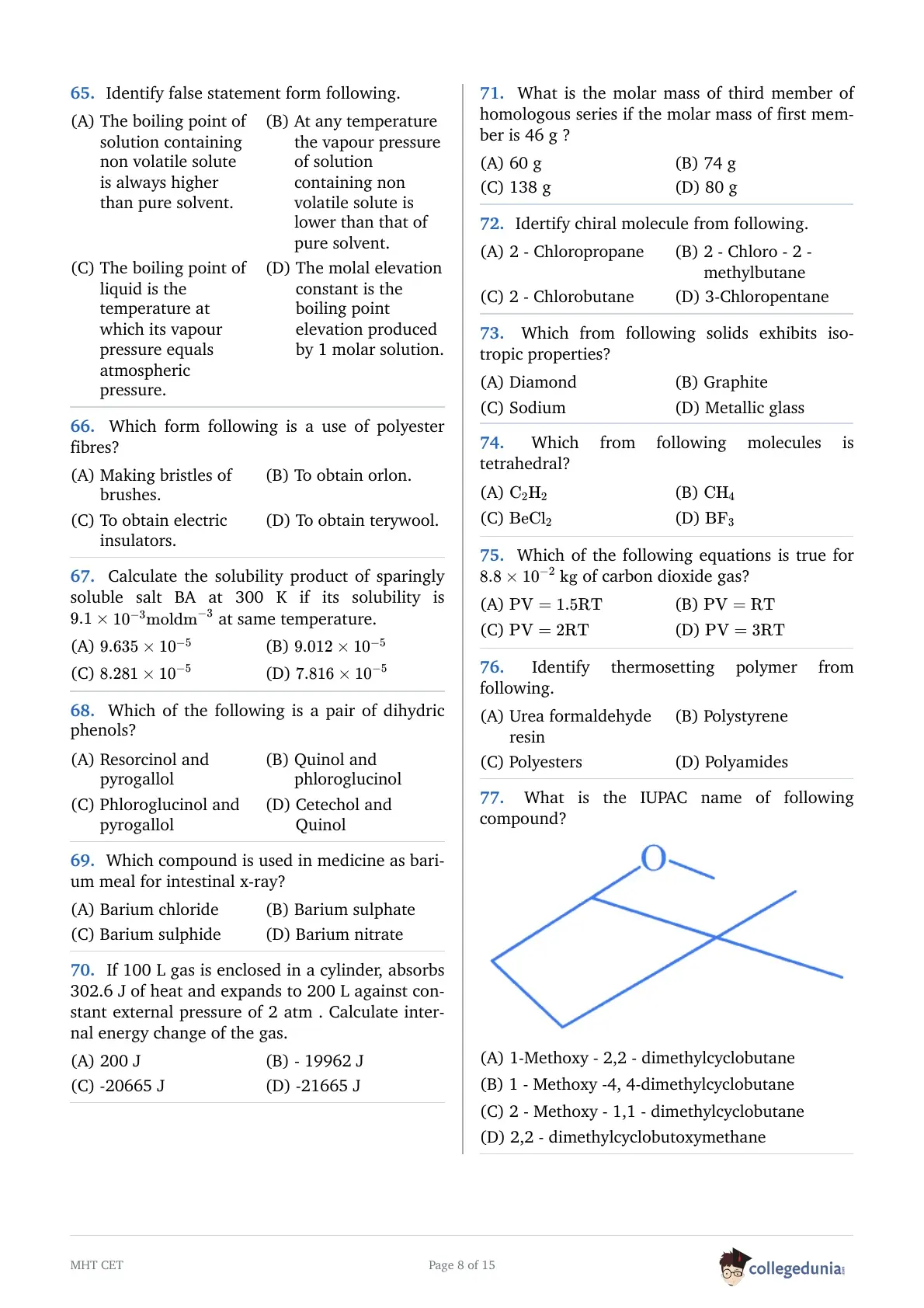
Calculate the solubility product of sparingly soluble salt BA at 300 K if its solubility is \(9.1 \times 10^{-3} \mathrm{moldm}^{-3}\) at same temperature.
Which compound is used in medicine as barium meal for intestinal x-ray?
If 100 L gas is enclosed in a cylinder, absorbs 302.6 J of heat and expands to 200 L against constant external pressure of 2 atm . Calculate internal energy change of the gas.
What is the molar mass of third member of homologous series if the molar mass of first member is 46 g ?
Which of the following equations is true for \(8.8 \times 10^{-2} \mathrm{~kg}\) of carbon dioxide gas?

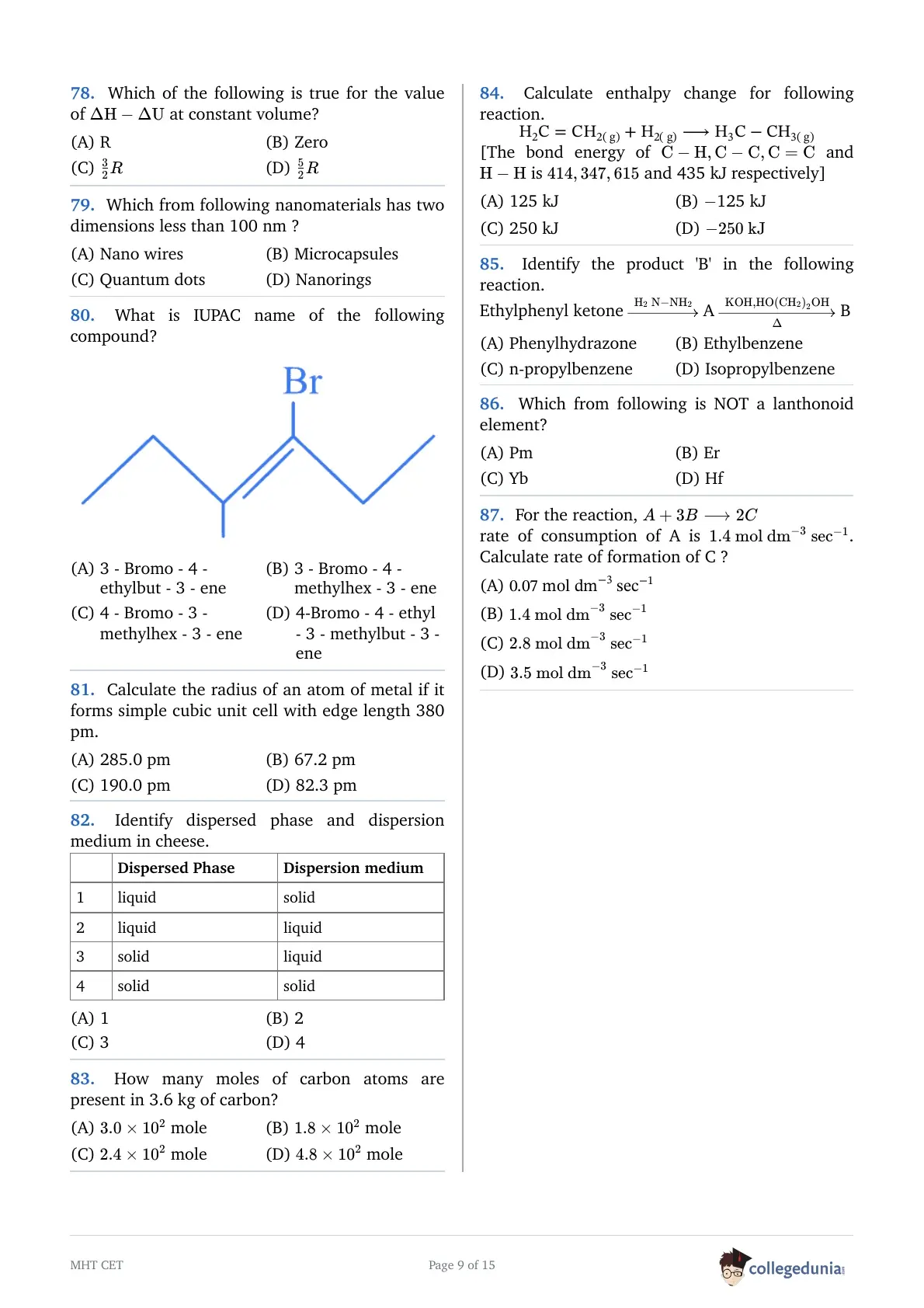
Which from following nanomaterials has two dimensions less than 100 nm ?

Calculate the radius of an atom of metal if it forms simple cubic unit cell with edge length 380 pm.
Identify dispersed phase and dispersion medium in cheese.
| Dispersed Phase | Dispersion medium | |
|---|---|---|
| 1 | liquid | solid |
| 2 | liquid | liquid |
| 3 | solid | liquid |
| 4 | solid | solid |
Calculate enthalpy change for following reaction.
\[\mathrm{H}_2 \mathrm{C}=\mathrm{CH}_{2(\mathrm{~g})}+\mathrm{H}_{2(\mathrm{~g})} \longrightarrow \mathrm{H}_3 \mathrm{C}-\mathrm{CH}_{3(\mathrm{~g})}\]
[The bond energy of \(\mathrm{C}-\mathrm{H}, \mathrm{C}-\mathrm{C}, \mathrm{C}=\mathrm{C}\) and \(\mathrm{H}-\mathrm{H}\) is \(414,347,615\) and 435 kJ respectively]
Identify the product 'B' in the following reaction.
Ethylphenyl ketone \(\xrightarrow{\mathrm{H}_2 \mathrm{~N}-\mathrm{NH}_2}\) A \(\xrightarrow[\Delta]{\mathrm{KOH}, \mathrm{HO}\left(\mathrm{CH}_2\right)_2 \mathrm{OH}}\) B
For the reaction, \(A+3 B \longrightarrow 2 C\)
rate of consumption of A is \(1.4 \mathrm{~mol} \mathrm{~dm}^{-3} \mathrm{~sec}^{-1}\). Calculate rate of formation of C ?
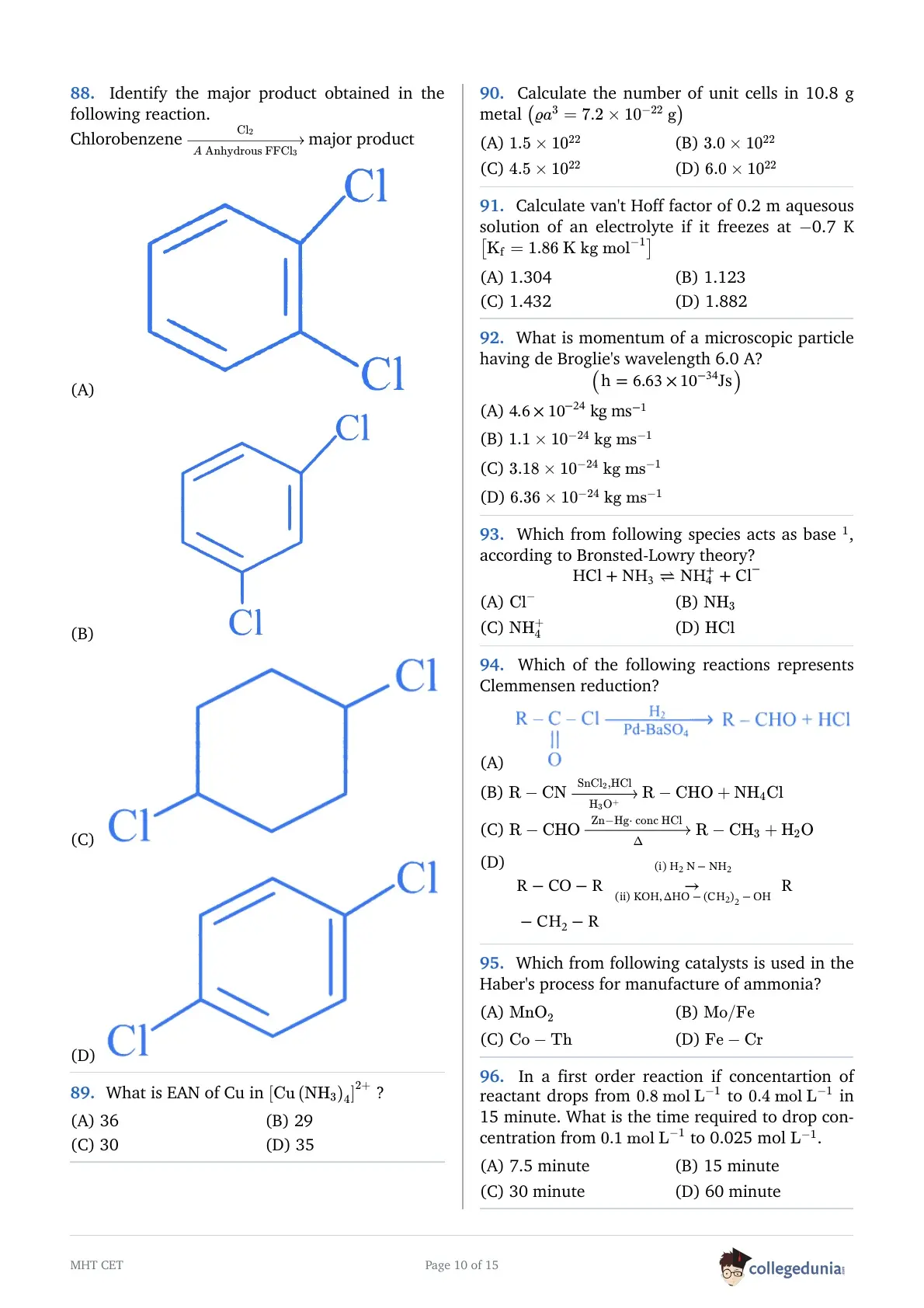
Identify the major product obtained in the following reaction.
Chlorobenzene \(\xrightarrow[A \text { Anhydrous } \mathrm{FFCl}_3]{\mathrm{Cl}_2}\) major product
- (A)
![]()
- (B)
![]()
- (C)
![]()
- (D)
![]()


What is EAN of Cu in \(\left[\mathrm{Cu}\left(\mathrm{NH}_3\right)_4\right]^{2+}\) ?
Calculate the number of unit cells in 10.8 g metal \(\left(\varrho a^3=7.2 \times 10^{-22} \mathrm{~g}\right)\)
Calculate van't Hoff factor of 0.2 m aquesous solution of an electrolyte if it freezes at \(-\)0.7 K \(\left[\mathrm{K}_{\mathrm{f}}=1.86 \mathrm{~K} \mathrm{~kg} \mathrm{~mol}^{-1}\right]\)
What is momentum of a microscopic particle having de Broglie's wavelength 6.0 A?
\[\left(\mathrm{h}=6.63 \times 10^{-34} \mathrm{Js}\right)\]
Which from following species acts as base \({ }^1\), according to Bronsted-Lowry theory?
\[\mathrm{HCl}+\mathrm{NH}_3 \text { \rightleftharpoons } \mathrm{NH}_4^{+}+\mathrm{Cl}^{-} \]
Which of the following reactions represents Clemmensen reduction?
- (A)
![]()
- (B) \(\mathrm{R}-\mathrm{CN}\xrightarrow[\mathrm{H}_{3}\mathrm{O}^{+}]{\mathrm{SnCl}_{2},\mathrm{HCl}}\mathrm{R}-\mathrm{CHO}+\mathrm{NH}_{4}\mathrm{Cl}\)
- (C) \(\mathrm{R}-\mathrm{CHO}\xrightarrow[\Delta]{\mathrm{Zn}-\mathrm{Hg}\cdot \text{ conc HCl }}\mathrm{R}-\mathrm{CH}_{3}+\mathrm{H}_{2}\mathrm{O}\)
- (D) \(\mathrm{R}-\mathrm{CO}-\mathrm{R}\xrightarrow[\text{ (ii) }\mathrm{KOH},\Delta \mathrm{HO}-(\mathrm{CH}_{2})_{2}-\mathrm{OH}]{\text{ (i) }\mathrm{H}_{2}\text{ }\mathrm{N}-\mathrm{NH}_{2}}\mathrm{R}-\mathrm{CH}_{2}-\mathrm{R}\)

Which from following catalysts is used in the Haber's process for manufacture of ammonia?
In a first order reaction if concentartion of reactant drops from \(0.8 \mathrm{~mol} \mathrm{~L}^{-1}\) to \(0.4 \mathrm{~mol} \mathrm{~L}^{-1}\) in 15 minute. What is the time required to drop concentration from \(0.1 \mathrm{~mol} \mathrm{~L}^{-1}\) to 0.025 mol \(\mathrm{L}^{-1}\).
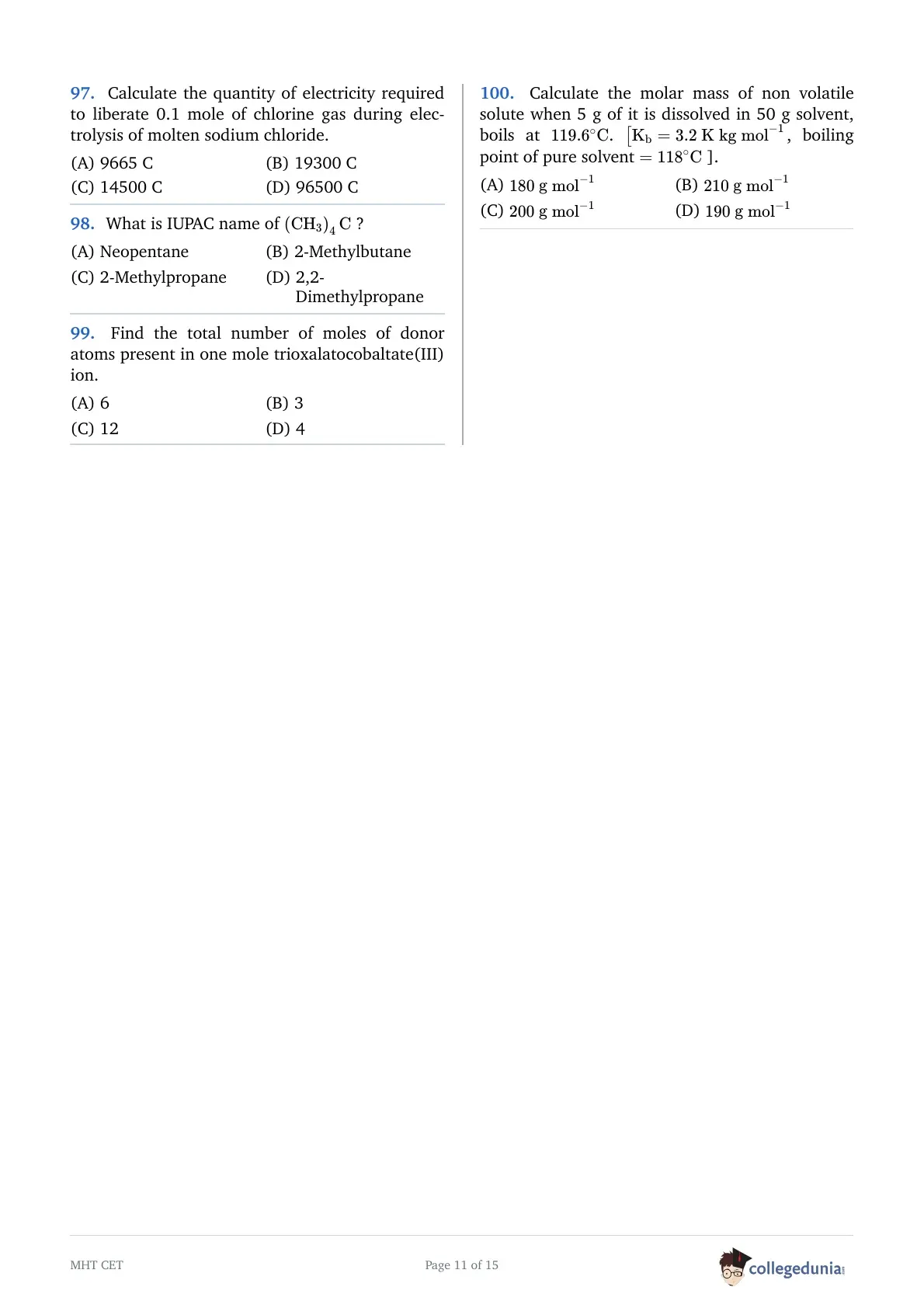
Calculate the quantity of electricity required to liberate 0.1 mole of chlorine gas during electrolysis of molten sodium chloride.
Find the total number of moles of donor atoms present in one mole trioxalatocobaltate(III) ion.
Calculate the molar mass of non volatile solute when 5 g of it is dissolved in 50 g solvent, boils at \(119.6^{\circ} \mathrm{C}\). \(\left[\mathrm{K}_{\mathrm{b}}=3.2 \mathrm{~K} \mathrm{~kg} \mathrm{~mol}^{-1}\right.\), boiling point of pure solvent \(=118^{\circ} \mathrm{C}\) ].
Mathematics (Q101 - Q150)
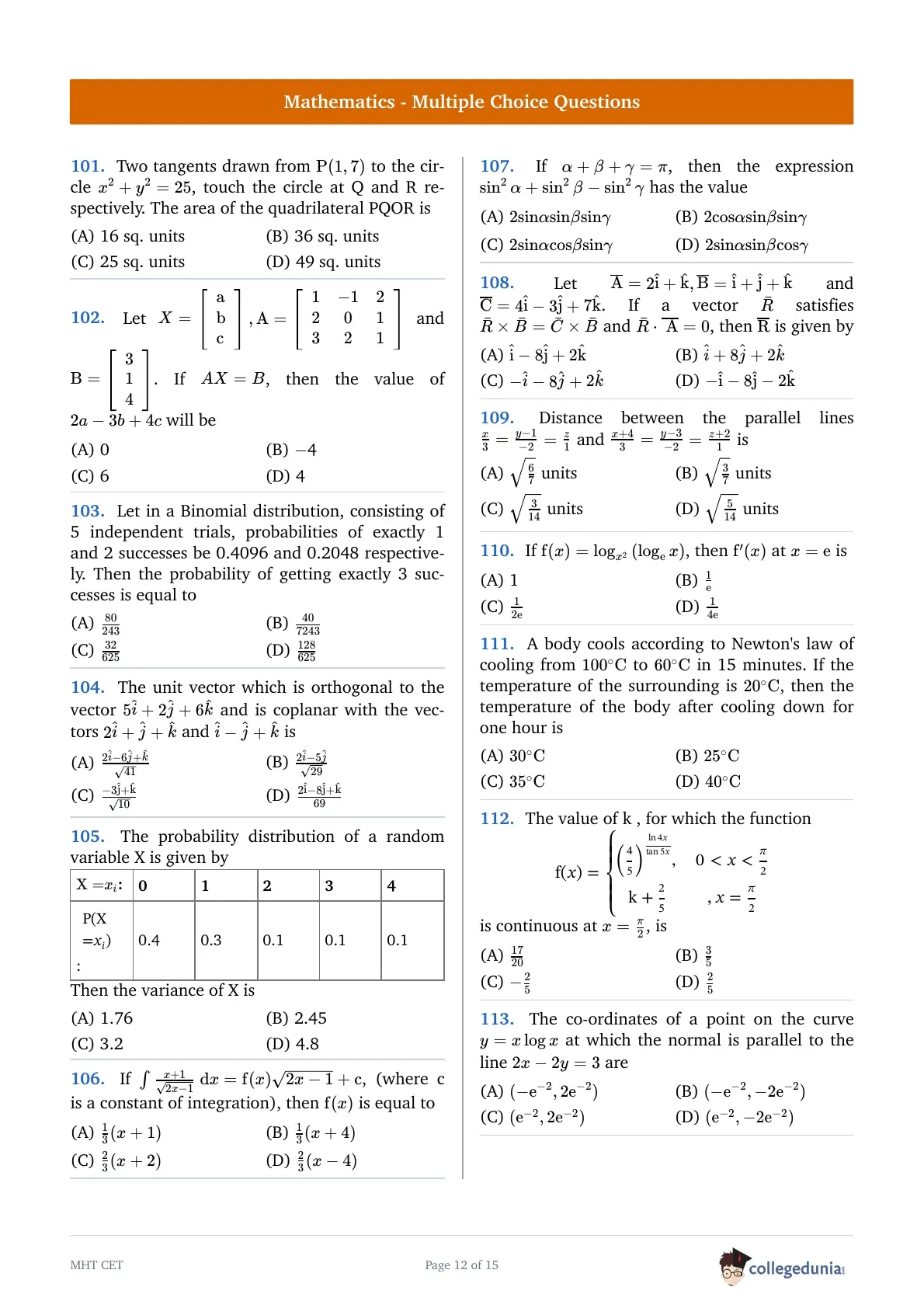
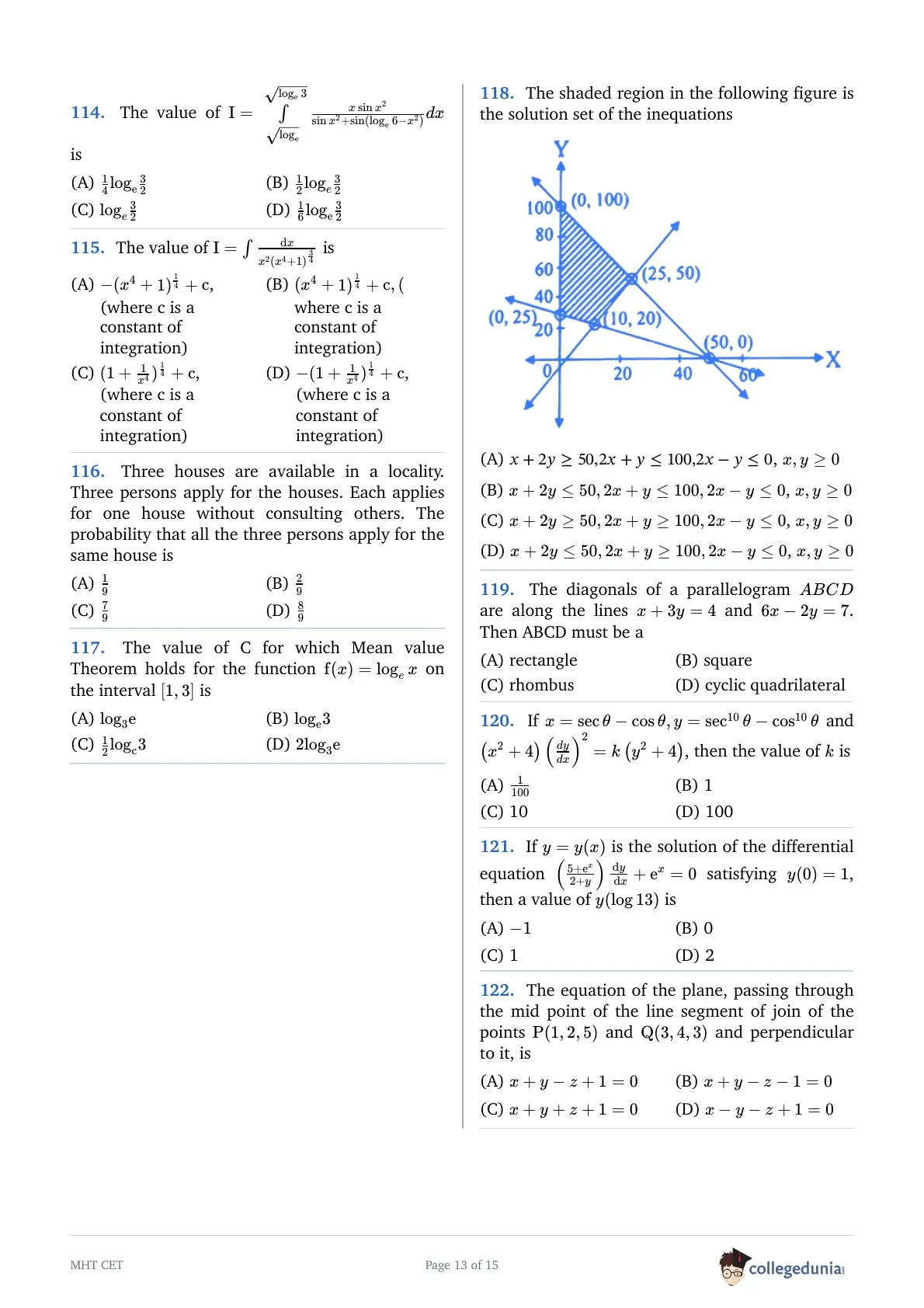
Two tangents drawn from \(\mathrm{P}(1,7)\) to the circle \(x^2+y^2=25\), touch the circle at Q and R respectively. The area of the quadrilateral PQOR is
Let \(X=\left[\begin{array}{l}\mathrm{a} \\ \mathrm{b} \\ \mathrm{c}\end{array}\right], \mathrm{A}=\left[\begin{array}{ccc}1 & -1 & 2 \\ 2 & 0 & 1 \\ 3 & 2 & 1\end{array}\right]\) and \(\mathrm{B}=\left[\begin{array}{l}3 \\ 1 \\ 4\end{array}\right]\). If \(A X=B\), then the value of \(2 a-3 b+4 c\) will be
Let in a Binomial distribution, consisting of 5 independent trials, probabilities of exactly 1 and 2 successes be 0.4096 and 0.2048 respectively. Then the probability of getting exactly 3 successes is equal to
The unit vector which is orthogonal to the vector \(5 \hat{i}+2 \hat{j}+6 \hat{k}\) and is coplanar with the vectors \(2 \hat{i}+\hat{j}+\hat{k}\) and \(\hat{i}-\hat{j}+\hat{k}\) is
The probability distribution of a random variable X is given by
| \(\mathrm{X=}x_i\): | 0 | 1 | 2 | 3 | 4 |
|---|---|---|---|---|---|
| \(\mathrm{P(X=}x_i)\) : | 0.4 | 0.3 | 0.1 | 0.1 | 0.1 |
If \(\int \frac{x+1}{\sqrt{2 x-1}} \mathrm{~d} x=\mathrm{f}(x) \sqrt{2 x-1}+\mathrm{c}\), (where c is a constant of integration), then \(\mathrm{f}(x)\) is equal to
If \(\alpha+\beta+\gamma=\pi\), then the expression \(\sin ^2 \alpha+\sin ^2 \beta-\sin ^2 \gamma\) has the value
Let \(\overline{\mathrm{A}}=2 \hat{\mathrm{i}}+\hat{\mathrm{k}}, \overline{\mathrm{B}}=\hat{\mathrm{i}}+\hat{\mathrm{j}}+\hat{\mathrm{k}}\) and \(\overline{\mathrm{C}}=4 \hat{\mathrm{i}}-3 \hat{\mathrm{j}}+7 \hat{\mathrm{k}}\). If a vector \(\bar{R}\) satisfies \(\bar{R} \times \bar{B}=\bar{C} \times \bar{B}\) and \(\bar{R} \cdot \overline{\mathrm{~A}}=0\), then \(\overline{\mathrm{R}}\) is given by
Distance between the parallel lines \(\frac{x}{3}=\frac{y-1}{-2}=\frac{z}{1}\) and \(\frac{x+4}{3}=\frac{y-3}{-2}=\frac{z+2}{1}\) is
If \(\mathrm{f}(x)=\log _{x^2}\left(\log _{\mathrm{e}} x\right)\), then \(\mathrm{f}^{\prime}(x)\) at \(x=\mathrm{e}\) is
A body cools according to Newton's law of cooling from \(100^{\circ} \mathrm{C}\) to \(60^{\circ} \mathrm{C}\) in 15 minutes. If the temperature of the surrounding is \(20^{\circ} \mathrm{C}\), then the temperature of the body after cooling down for one hour is
The value of k , for which the function
\[\mathrm{f}(x)= \begin{cases}\left(\frac{4}{5}\right)^{\frac{\ln 4 x}{\tan 5 x}}, & 0< x< \frac{\pi}{2} \\ \mathrm{k}+\frac{2}{5} & , x=\frac{\pi}{2}\end{cases}\]
is continuous at \(x=\frac{\pi}{2}\), is
The co-ordinates of a point on the curve \(y=x \log x\) at which the normal is parallel to the line \(2 x-2 y=3\) are
The value of \(\mathrm{I}=\int \frac{\mathrm{d} x}{x^2\left(x^4+1\right)^{\frac{3}{4}}}\) is
Three houses are available in a locality. Three persons apply for the houses. Each applies for one house without consulting others. The probability that all the three persons apply for the same house is
The value of C for which Mean value Theorem holds for the function \(\mathrm{f}(x)=\log _e x\) on the interval \([1,3]\) is
The shaded region in the following figure is the solution set of the inequations

The diagonals of a parallelogram \(A B C D\) are along the lines \(x+3 y=4\) and \(6 x-2 y=7\). Then ABCD must be a
If \(x=\sec \theta-\cos \theta, y=\sec ^{10} \theta-\cos ^{10} \theta\) and \(\left(x^2+4\right)\left(\frac{d y}{d x}\right)^2=k\left(y^2+4\right)\), then the value of \(k\) is
If \(y=y(x)\) is the solution of the differential equation \(\left(\frac{5+\mathrm{e}^x}{2+y}\right) \frac{\mathrm{d} y}{\mathrm{~d} x}+\mathrm{e}^x=0\) satisfying \(y(0)=1\), then a value of \(y(\log 13)\) is
The equation of the plane, passing through the mid point of the line segment of join of the points \(\mathrm{P}(1,2,5)\) and \(\mathrm{Q}(3,4,3)\) and perpendicular to it, is
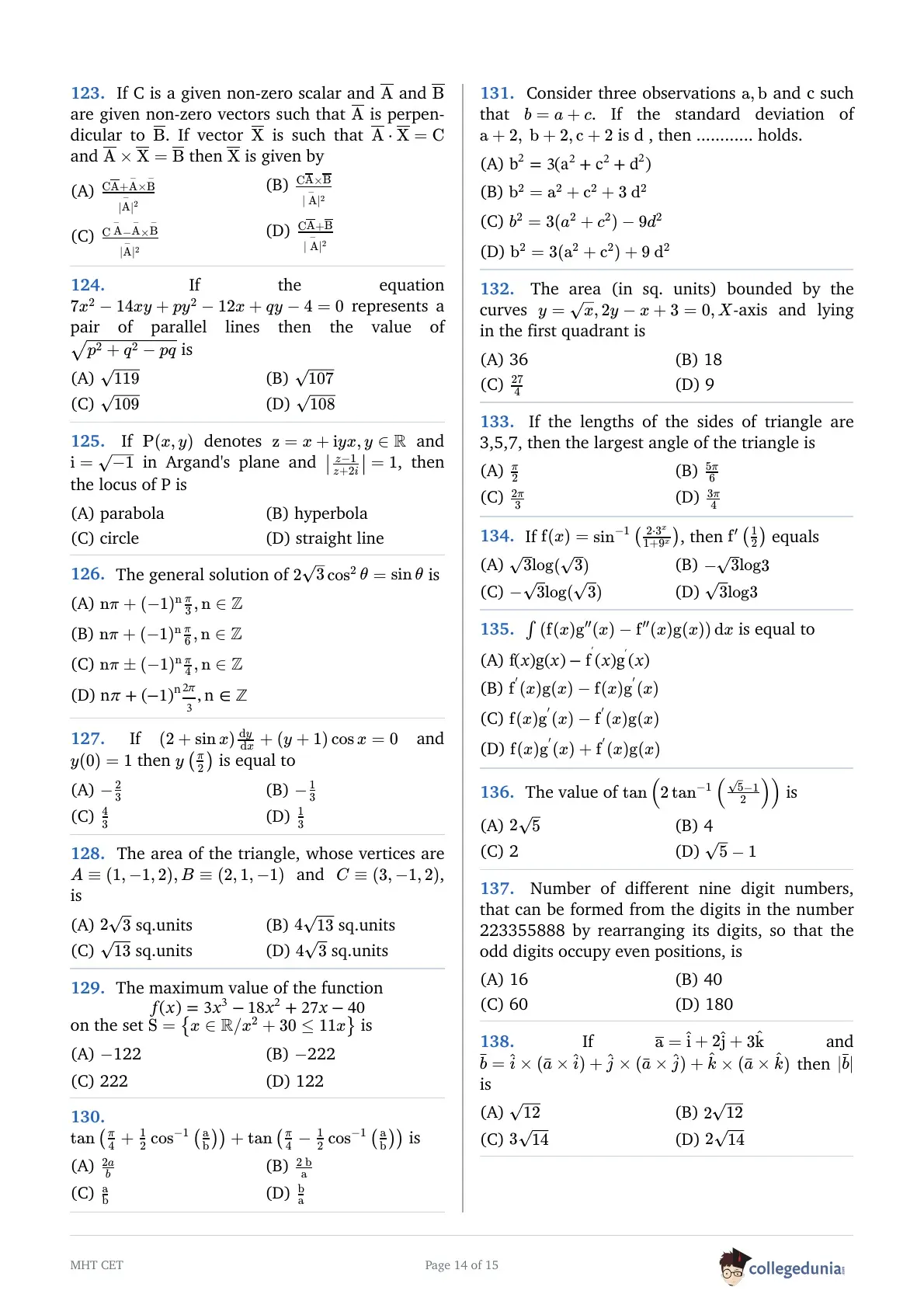
If C is a given non-zero scalar and \(\overline{\mathrm{A}}\) and \(\overline{\mathrm{B}}\) are given non-zero vectors such that \(\overline{\mathrm{A}}\) is perpendicular to \(\overline{\mathrm{B}}\). If vector \(\overline{\mathrm{X}}\) is such that \(\overline{\mathrm{A}} \cdot \overline{\mathrm{X}}=\mathrm{C}\) and \(\overline{\mathrm{A}} \times \overline{\mathrm{X}}=\overline{\mathrm{B}}\) then \(\overline{\mathrm{X}}\) is given by
If the equation \(7 x^2-14 x y+p y^2-12 x+q y-4=0\) represents a pair of parallel lines then the value of \(\sqrt{p^2+q^2-p q}\) is
If \(\mathrm{P}(x, y)\) denotes \(\mathrm{z}=x+\mathrm{i} y x, y \in \mathbb{R}\) and \(\mathrm{i}=\sqrt{-1}\) in Argand's plane and \(\left|\frac{z-1}{z+2 i}\right|=1\), then the locus of P is
The general solution of \(2 \sqrt{3} \cos ^2 \theta=\sin \theta\) is
If \((2+\sin x) \frac{\mathrm{d} y}{\mathrm{~d} x}+(y+1) \cos x=0\) and \(y(0)=1\) then \(y\left(\frac{\pi}{2}\right)\) is equal to
The area of the triangle, whose vertices are \(A \equiv(1,-1,2), B \equiv(2,1,-1)\) and \(C \equiv(3,-1,2)\), is
The maximum value of the function
\[f(x)=3 x^3-18 x^2+27 x-40\]
on the set \(\mathrm{S}=\left\{x \in \mathbb{R} / x^2+30 \leq 11 x\right\}\) is
\(\tan \left(\frac{\pi}{4}+\frac{1}{2} \cos ^{-1}\left(\frac{\mathrm{a}}{\mathrm{b}}\right)\right)+\tan \left(\frac{\pi}{4}-\frac{1}{2} \cos ^{-1}\left(\frac{\mathrm{a}}{\mathrm{b}}\right)\right)\) is
Consider three observations \(\mathrm{a}, \mathrm{b}\) and c such that \(b=a+c\). If the standard deviation of \(\mathrm{a}+2, \mathrm{~b}+2, \mathrm{c}+2\) is d , then ............ holds.
The area (in sq. units) bounded by the curves \(y=\sqrt{x}, 2 y-x+3=0, X\)-axis and lying in the first quadrant is
If the lengths of the sides of triangle are 3,5,7, then the largest angle of the triangle is
\(\int\left(\mathrm{f}(x) \mathrm{g}^{\prime \prime}(x)-\mathrm{f}^{\prime \prime}(x) \mathrm{g}(x)\right) \mathrm{d} x\) is equal to
The value of \(\tan \left(2 \tan ^{-1}\left(\frac{\sqrt{5}-1}{2}\right)\right)\) is
Number of different nine digit numbers, that can be formed from the digits in the number 223355888 by rearranging its digits, so that the odd digits occupy even positions, is
If \(\overline{\mathrm{a}}=\hat{\mathrm{i}}+2 \hat{\mathrm{j}}+3 \hat{\mathrm{k}}\) and \(\bar{b}=\hat{i} \times(\bar{a} \times \hat{i})+\hat{j} \times(\bar{a} \times \hat{j})+\hat{k} \times(\bar{a} \times \hat{k})\) then \(|\bar{b}|\) is
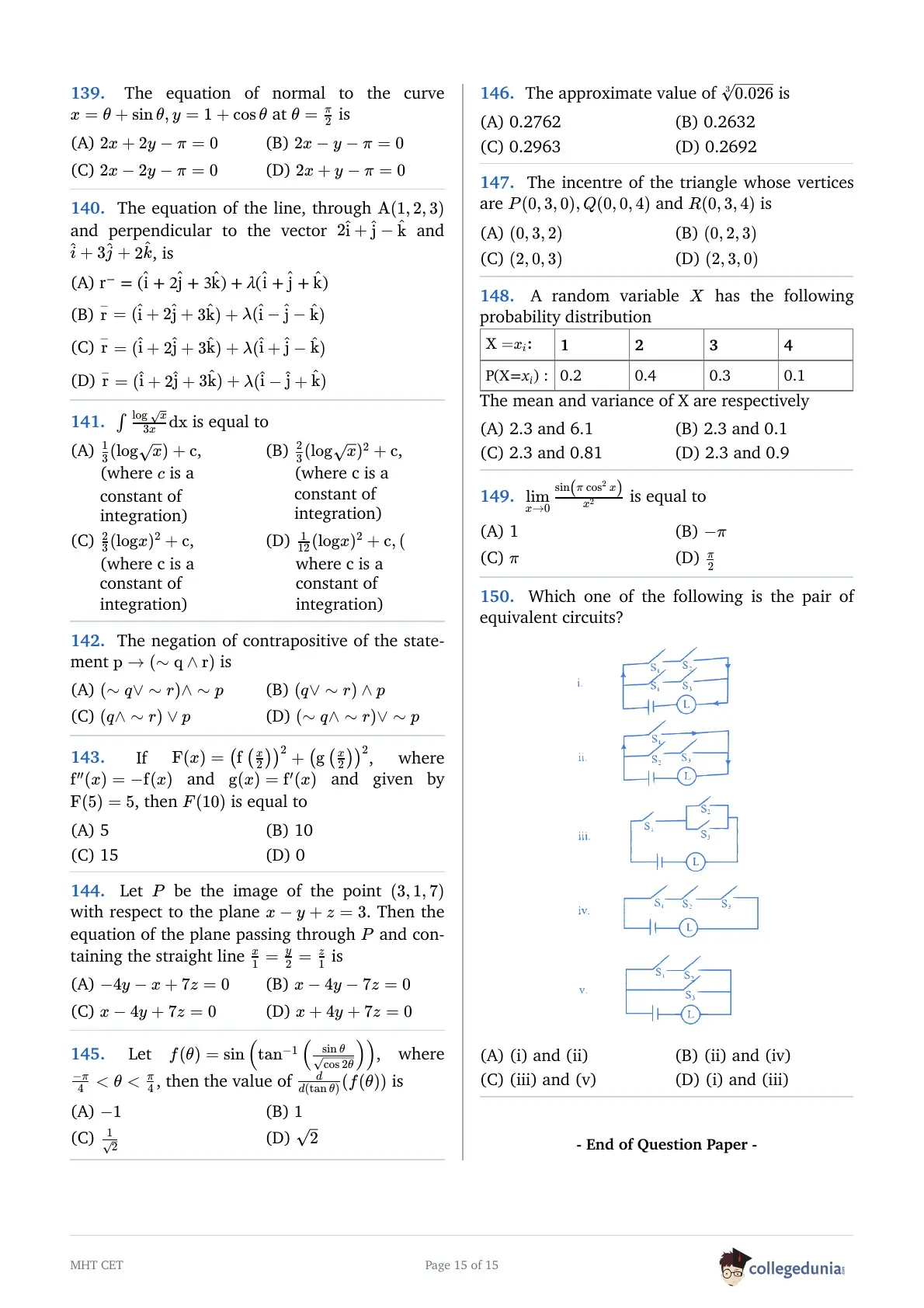
The equation of normal to the curve \(x=\theta+\sin \theta, y=1+\cos \theta\) at \(\theta=\frac{\pi}{2}\) is
The equation of the line, through \(\mathrm{A}(1,2,3)\) and perpendicular to the vector \(2 \hat{\mathrm{i}}+\hat{\mathrm{j}}-\hat{\mathrm{k}}\) and \(\hat{i}+3 \hat{j}+2 \hat{k}\), is
The negation of contrapositive of the statement \(\mathrm{p} \rightarrow(\sim \mathrm{q} \wedge \mathrm{r})\) is
If \(\mathrm{F}(x)=\left(\mathrm{f}\left(\frac{x}{2}\right)\right)^2+\left(\mathrm{g}\left(\frac{x}{2}\right)\right)^2\), where \(\mathrm{f}^{\prime \prime}(x)=-\mathrm{f}(x)\) and \(\mathrm{g}(x)=\mathrm{f}^{\prime}(x)\) and given by \(\mathrm{F}(5)=5\), then \(F(10)\) is equal to
Let \(P\) be the image of the point \((3,1,7)\) with respect to the plane \(x-y+z=3\). Then the equation of the plane passing through \(P\) and containing the straight line \(\frac{x}{1}=\frac{y}{2}=\frac{z}{1}\) is
Let \(f(\theta)=\sin \left(\tan ^{-1}\left(\frac{\sin \theta}{\sqrt{\cos 2 \theta}}\right)\right)\), where \(\frac{-\pi}{4}<\theta<\frac{\pi}{4}\), then the value of \(\frac{d}{d(\tan \theta)}(f(\theta))\) is
The incentre of the triangle whose vertices are \(P(0,3,0), Q(0,0,4)\) and \(R(0,3,4)\) is
\(\lim _\limits{x \rightarrow 0} \frac{\sin \left(\pi \cos ^2 x\right)}{x^2}\) is equal to

MHT CET 2024 PCM Exam Pattern and Marking Scheme
| Parameter | Details |
|---|---|
| Conducting Body | Maharashtra Common Entrance Test Cell (Maharashtra CET Cell) |
| Exam Mode | Online (Computer-Based Test) |
| Duration | 180 minutes (3 hours) |
| Groups / Subjects | PCM (Physics, Chemistry, Mathematics) for Engineering |
| Total Questions |
150 |
| Total Marks | 200 |
| Question Type | Multiple Choice Questions (MCQs) |
| Marks Distribution |
|
| Negative Marking | No |
| Syllabus Weightage |
|



Comments