




MHT CET 2024 May 3 Shift 1 PCM Question Paper is available for download here. Maharashtra State CET Cell conducted MHT CET 2024 PCM Exam on May 3 in Shift 1 from 9 AM to 12 PM in CBT mode.
The MHT CET 2024 PCM question paper includes the following:
- The MHT CET 2024 PCM Question Paper consists of 150 multiple-choice questions (MCQs) totalling 200 marks divided into 3 sections: Physics, Chemistry, and Mathematics, with 50 questions in each subject.
- Physics and Chemistry questions carry 1 mark each while Mathematics questions carry 2 marks each.
- There is no negative marking for incorrect answers.
MHT CET 2024 May 3 Shift 1 PCM Question Paper with Solution PDF
| CD PDF | CD PDF with Solutions |
|---|---|
| Download Collegedunia PDF 1.00 MB | - |
Also Check:
MHT CET 2024 May 3 Shift 1 PCM Questions with Solutions
Physics (Q1 - Q50)
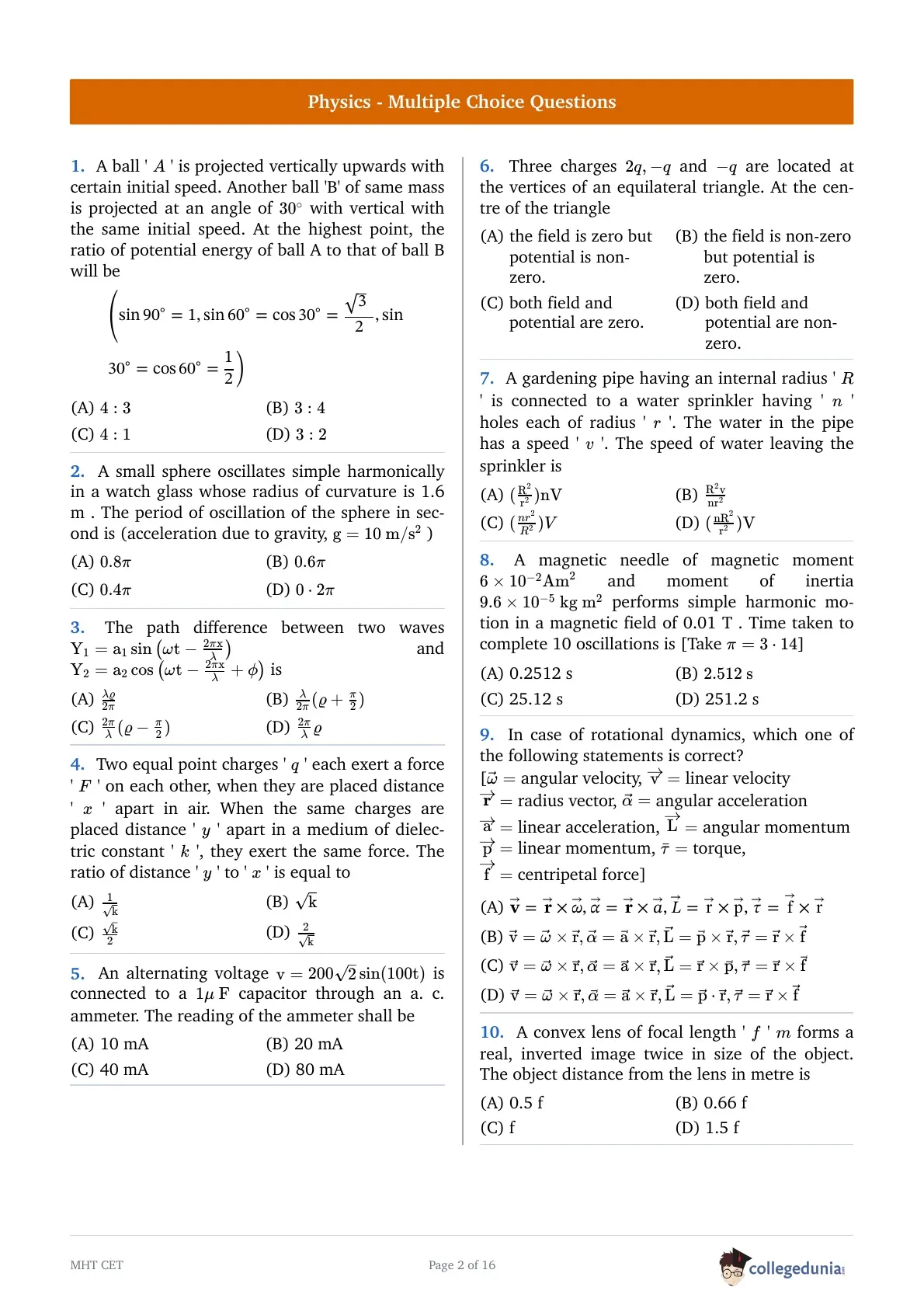
A ball ' \(A\) ' is projected vertically upwards with certain initial speed. Another ball 'B' of same mass is projected at an angle of \(30^{\circ}\) with vertical with the same initial speed. At the highest point, the ratio of potential energy of ball A to that of ball B will be
\[\left(\sin 90^{\circ}=1, \sin 60^{\circ}=\cos 30^{\circ}=\frac{\sqrt{3}}{2}, \sin 30^{\circ}=\cos 60^{\circ}=\frac{1}{2}\right)\]
A small sphere oscillates simple harmonically in a watch glass whose radius of curvature is 1.6 m . The period of oscillation of the sphere in second is (acceleration due to gravity, \(\mathrm{g}=10 \mathrm{~m} / \mathrm{s}^2\) )
The path difference between two waves \(\mathrm{Y}_1=\mathrm{a}_1 \sin \left(\omega \mathrm{t}-\frac{2 \pi \mathrm{x}}{\lambda}\right)\) and \(\mathrm{Y}_2=\mathrm{a}_2 \cos \left(\omega \mathrm{t}-\frac{2 \pi \mathrm{x}}{\lambda}+\phi\right)\) is
Two equal point charges ' \(q\) ' each exert a force ' \(F\) ' on each other, when they are placed distance ' \(x\) ' apart in air. When the same charges are placed distance ' \(y\) ' apart in a medium of dielectric constant ' \(k\) ', they exert the same force. The ratio of distance ' \(y\) ' to ' \(x\) ' is equal to
An alternating voltage \(\mathrm{v}=200 \sqrt{2} \sin (100 \mathrm{t})\) is connected to a \(1 \mu \mathrm{~F}\) capacitor through an a. c. ammeter. The reading of the ammeter shall be
Three charges \(2 q,-q\) and \(-q\) are located at the vertices of an equilateral triangle. At the centre of the triangle
A gardening pipe having an internal radius ' \(R\) ' is connected to a water sprinkler having ' \(n\) ' holes each of radius ' \(r\) '. The water in the pipe has a speed ' \(v\) '. The speed of water leaving the sprinkler is
A magnetic needle of magnetic moment \(6 \times 10^{-2} \mathrm{Am}^2\) and moment of inertia \(9.6 \times 10^{-5} \mathrm{~kg} \mathrm{~m}^2\) performs simple harmonic motion in a magnetic field of 0.01 T . Time taken to complete 10 oscillations is [Take \(\pi=3 \cdot 14\)]
In case of rotational dynamics, which one of the following statements is correct?
[\(\vec{\omega}=\) angular velocity, \(\overrightarrow{\mathrm{v}}=\) linear velocity
\(\overrightarrow{\mathbf{r}}=\) radius vector, \(\vec{\alpha}=\) angular acceleration
\(\overrightarrow{\mathrm{a}}=\) linear acceleration, \(\overrightarrow{\mathrm{L}}=\) angular momentum
\(\overrightarrow{\mathrm{p}}=\) linear momentum, \(\bar{\tau}=\) torque,
\(\overrightarrow{\mathrm{f}}=\) centripetal force]
A convex lens of focal length ' \(f\) ' \(m\) forms a real, inverted image twice in size of the object. The object distance from the lens in metre is
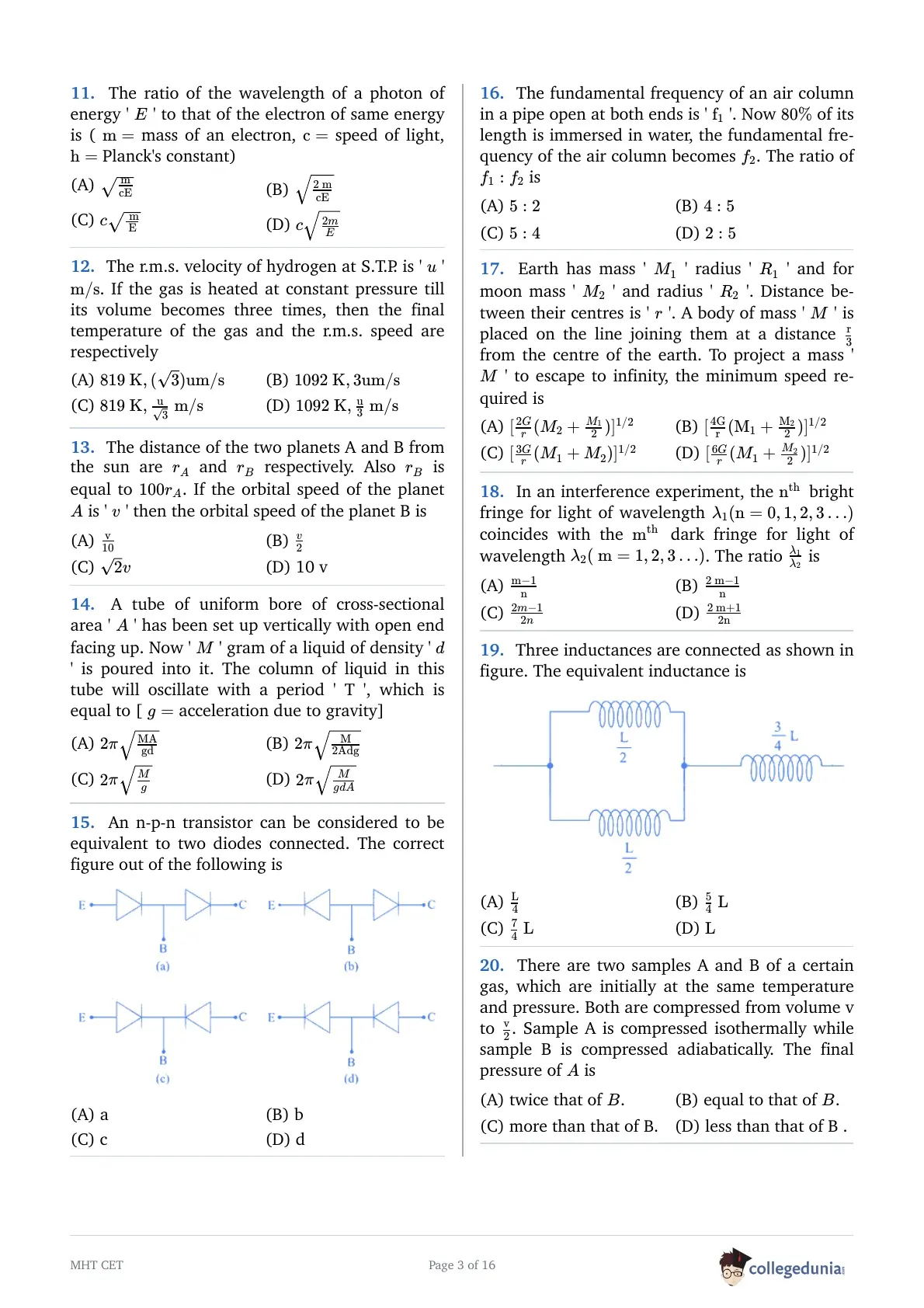
The ratio of the wavelength of a photon of energy ' \(E\) ' to that of the electron of same energy is ( \(\mathrm{m}=\) mass of an electron, \(\mathrm{c}=\) speed of light, \(\mathrm{h}=\) Planck's constant)
The r.m.s. velocity of hydrogen at S.T.P. is ' \(u\) ' \(\mathrm{m} / \mathrm{s}\). If the gas is heated at constant pressure till its volume becomes three times, then the final temperature of the gas and the r.m.s. speed are respectively
The distance of the two planets A and B from the sun are \(r_A\) and \(r_B\) respectively. Also \(r_B\) is equal to \(100 r_A\). If the orbital speed of the planet \(A\) is ' \(v\) ' then the orbital speed of the planet B is
An n-p-n transistor can be considered to be equivalent to two diodes connected. The correct figure out of the following is

The fundamental frequency of an air column in a pipe open at both ends is ' \(\mathrm{f}_1\) '. Now \(80 \%\) of its length is immersed in water, the fundamental frequency of the air column becomes \(f_2\). The ratio of \(f_1: f_2\) is
Earth has mass ' \(M_1\) ' radius ' \(R_1\) ' and for moon mass ' \(M_2\) ' and radius ' \(R_2\) '. Distance between their centres is ' \(r\) '. A body of mass ' \(M\) ' is placed on the line joining them at a distance \(\frac{\mathrm{r}}{3}\) from the centre of the earth. To project a mass ' \(M\) ' to escape to infinity, the minimum speed required is
In an interference experiment, the \(\mathrm{n}^{\text {th }}\) bright fringe for light of wavelength \(\lambda_1(\mathrm{n}=0,1,2,3 \ldots)\) coincides with the \(\mathrm{m}^{\text {th }}\) dark fringe for light of wavelength \(\lambda_2(\mathrm{~m}=1,2,3 \ldots)\). The ratio \(\frac{\lambda_1}{\lambda_2}\) is
Three inductances are connected as shown in figure. The equivalent inductance is

There are two samples A and B of a certain gas, which are initially at the same temperature and pressure. Both are compressed from volume v to \(\frac{\mathrm{v}}{2}\). Sample A is compressed isothermally while sample B is compressed adiabatically. The final pressure of \(A\) is
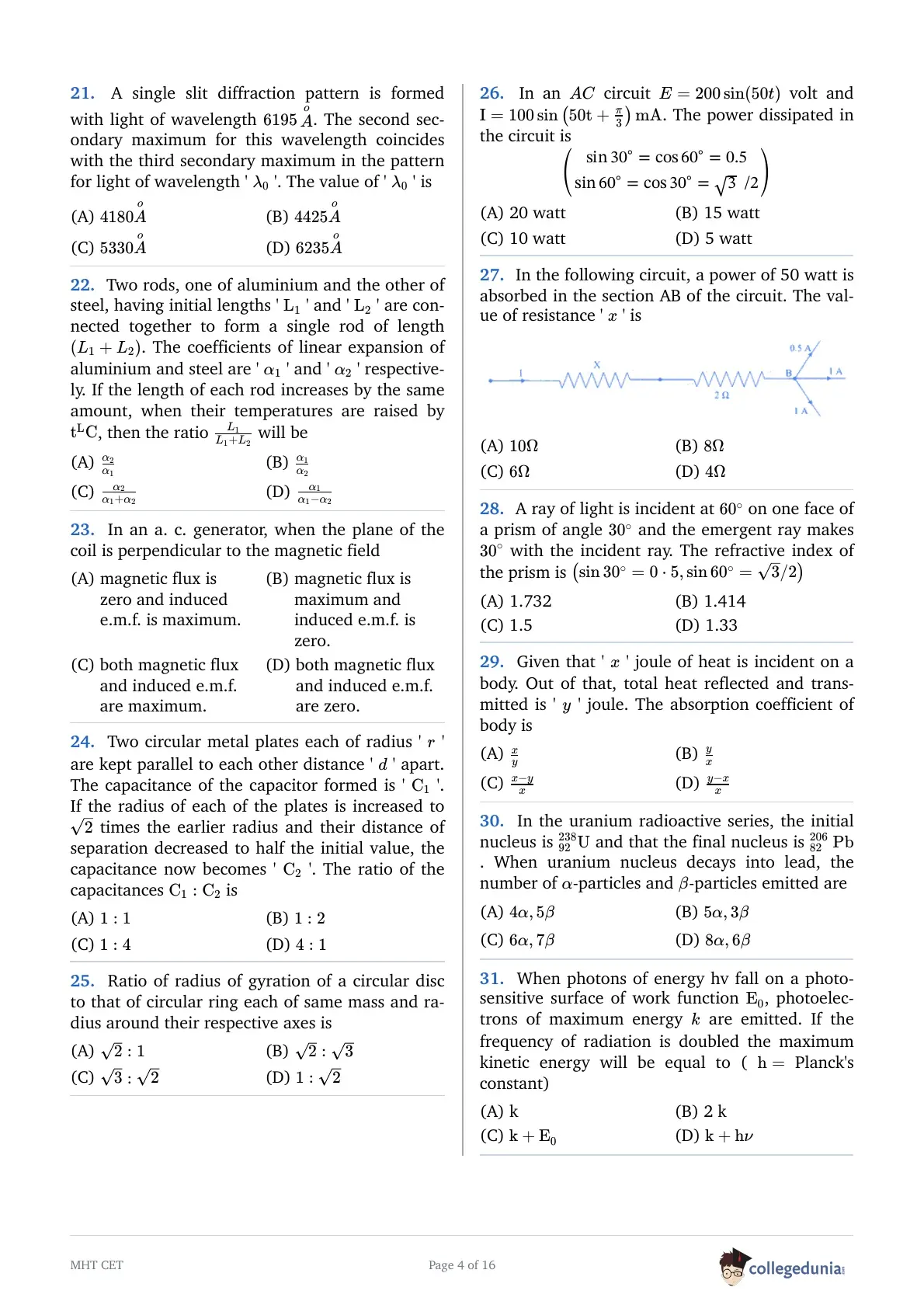
A single slit diffraction pattern is formed with light of wavelength \(6195 \mathop A\limits^o\). The second secondary maximum for this wavelength coincides with the third secondary maximum in the pattern for light of wavelength ' \(\lambda_0\) '. The value of ' \(\lambda_0\) ' is
Two rods, one of aluminium and the other of steel, having initial lengths ' \(\mathrm{L}_1\) ' and ' \(\mathrm{L}_2\) ' are connected together to form a single rod of length \(\left(L_1+L_2\right)\). The coefficients of linear expansion of aluminium and steel are ' \(\alpha_1\) ' and ' \(\alpha_2\) ' respectively. If the length of each rod increases by the same amount, when their temperatures are raised by \(\mathrm{t}^{\mathrm{L}} \mathrm{C}\), then the ratio \(\frac{L_1}{L_1+L_2}\) will be
In an a. c. generator, when the plane of the coil is perpendicular to the magnetic field
Two circular metal plates each of radius ' \(r\) ' are kept parallel to each other distance ' \(d\) ' apart. The capacitance of the capacitor formed is ' \(\mathrm{C}_1\) '. If the radius of each of the plates is increased to \(\sqrt{2}\) times the earlier radius and their distance of separation decreased to half the initial value, the capacitance now becomes ' \(\mathrm{C}_2\) '. The ratio of the capacitances \(\mathrm{C}_1: \mathrm{C}_2\) is
Ratio of radius of gyration of a circular disc to that of circular ring each of same mass and radius around their respective axes is
In an \(A C\) circuit \(E=200 \sin (50 t)\) volt and \(\mathrm{I}=100 \sin \left(50 \mathrm{t}+\frac{\pi}{3}\right) \mathrm{mA}\). The power dissipated in the circuit is
\[\binom{\sin 30^{\circ}=\cos 60^{\circ}=0.5}{\sin 60^{\circ}=\cos 30^{\circ}=\sqrt{3} / 2}\]
In the following circuit, a power of 50 watt is absorbed in the section AB of the circuit. The value of resistance ' \(x\) ' is

A ray of light is incident at \(60^{\circ}\) on one face of a prism of angle \(30^{\circ}\) and the emergent ray makes \(30^{\circ}\) with the incident ray. The refractive index of the prism is \(\left(\sin 30^{\circ}=0 \cdot 5, \sin 60^{\circ}=\sqrt{3} / 2\right)\)
Given that ' \(x\) ' joule of heat is incident on a body. Out of that, total heat reflected and transmitted is ' \(y\) ' joule. The absorption coefficient of body is
In the uranium radioactive series, the initial nucleus is \({ }_{92}^{238} \mathrm{U}\) and that the final nucleus is \({ }_{82}^{206} \mathrm{~Pb}\). When uranium nucleus decays into lead, the number of \(\alpha\)-particles and \(\beta\)-particles emitted are
When photons of energy hv fall on a photosensitive surface of work function \(\mathrm{E}_0\), photoelectrons of maximum energy \(k\) are emitted. If the frequency of radiation is doubled the maximum kinetic energy will be equal to ( \(\mathrm{h}=\) Planck's constant)
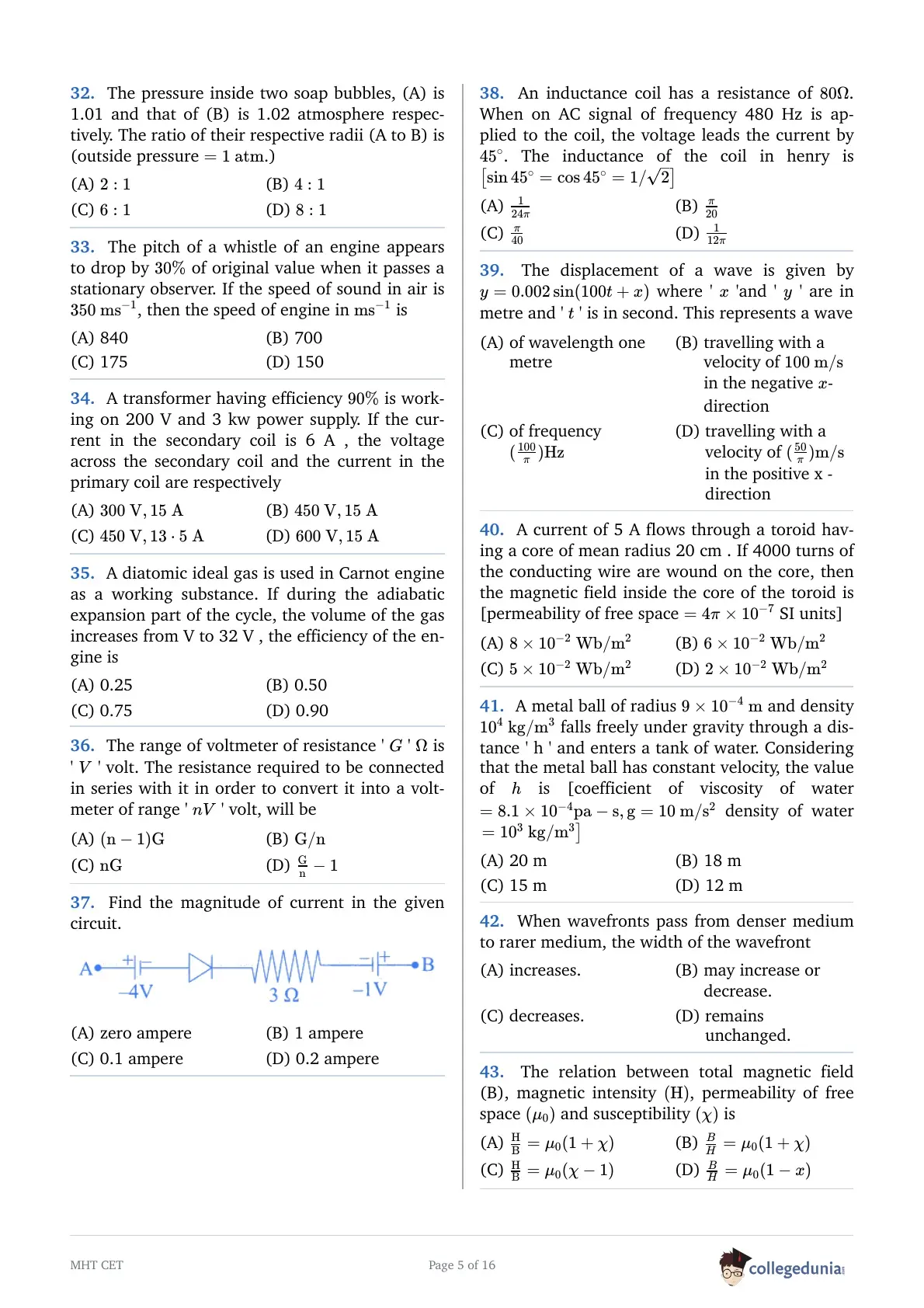
The pressure inside two soap bubbles, (A) is 1.01 and that of (B) is 1.02 atmosphere respectively. The ratio of their respective radii (A to B) is (outside pressure \(=1 \mathrm{~atm}\).)
The pitch of a whistle of an engine appears to drop by \(30 \%\) of original value when it passes a stationary observer. If the speed of sound in air is \(350 \mathrm{~ms}^{-1}\), then the speed of engine in \(\mathrm{ms}^{-1}\) is
A transformer having efficiency \(90 \%\) is working on 200 V and 3 kw power supply. If the current in the secondary coil is 6 A , the voltage across the secondary coil and the current in the primary coil are respectively
A diatomic ideal gas is used in Carnot engine as a working substance. If during the adiabatic expansion part of the cycle, the volume of the gas increases from V to 32 V , the efficiency of the engine is
The range of voltmeter of resistance ' \(G\) ' \(\Omega\) is ' \(V\) ' volt. The resistance required to be connected in series with it in order to convert it into a voltmeter of range ' \(n V\) ' volt, will be

An inductance coil has a resistance of \(80 \Omega\). When on AC signal of frequency 480 Hz is applied to the coil, the voltage leads the current by \(45^{\circ}\). The inductance of the coil in henry is \(\left[\sin 45^{\circ}=\cos 45^{\circ}=1 / \sqrt{2}\right]\)
The displacement of a wave is given by \(y=0.002 \sin (100 t+x)\) where ' \(x\) 'and ' \(y\) ' are in metre and ' \(t\) ' is in second. This represents a wave
A current of 5 A flows through a toroid having a core of mean radius 20 cm . If 4000 turns of the conducting wire are wound on the core, then the magnetic field inside the core of the toroid is [permeability of free space \(=4 \pi \times 10^{-7}\) SI units]
A metal ball of radius \(9 \times 10^{-4} \mathrm{~m}\) and density \(10^4 \mathrm{~kg} / \mathrm{m}^3\) falls freely under gravity through a distance ' h ' and enters a tank of water. Considering that the metal ball has constant velocity, the value of \(h\) is [coefficient of viscosity of water \(=8.1 \times 10^{-4} \mathrm{pa}-\mathrm{s}, \mathrm{g}=10 \mathrm{~m} / \mathrm{s}^2\) density of water \(\left.=10^3 \mathrm{~kg} / \mathrm{m}^3\right]\)
When wavefronts pass from denser medium to rarer medium, the width of the wavefront
The relation between total magnetic field (B), magnetic intensity \((\mathrm{H})\), permeability of free space \(\left(\mu_0\right)\) and susceptibility \((\chi)\) is
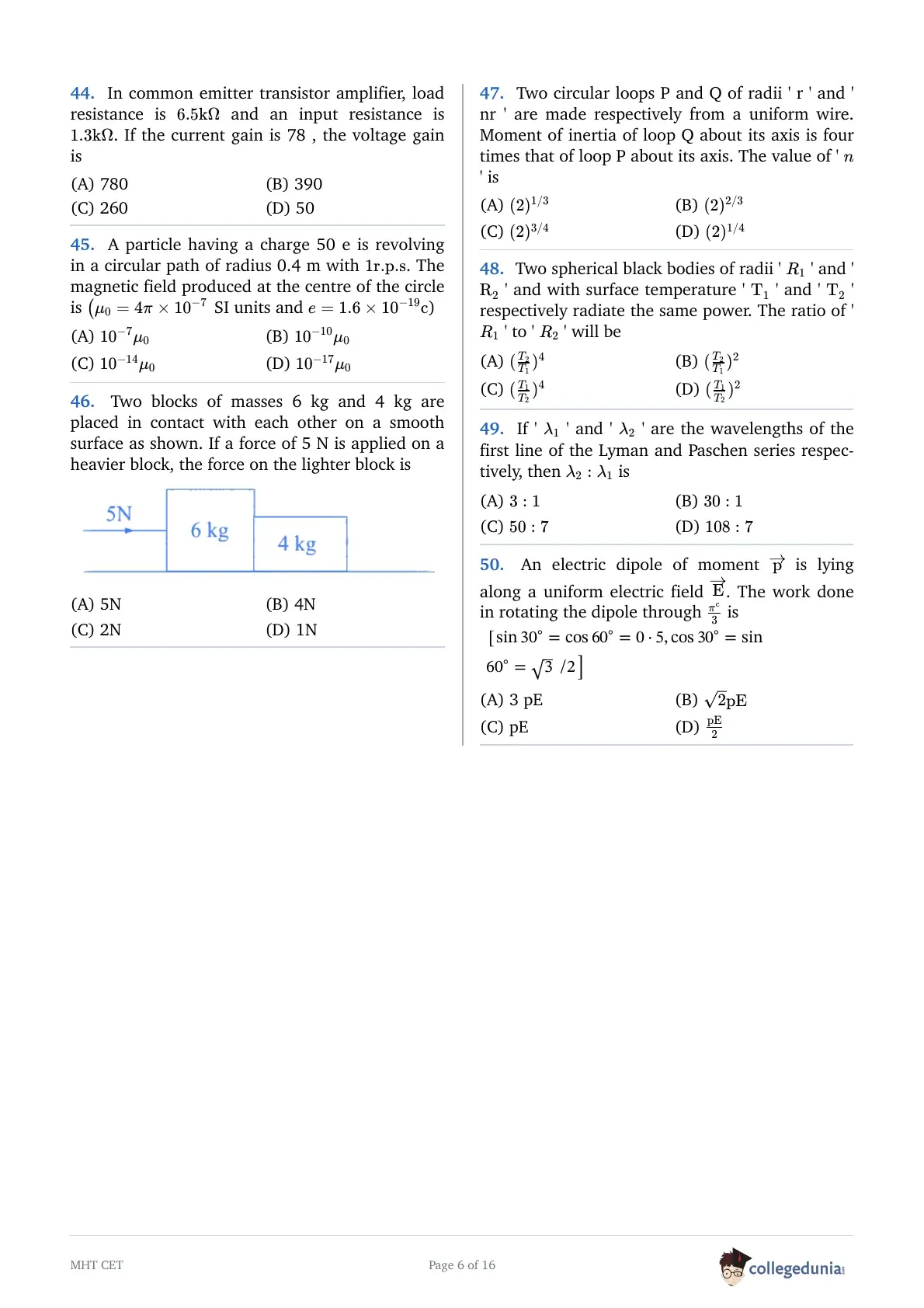
In common emitter transistor amplifier, load resistance is \(6.5 \mathrm{k} \Omega\) and an input resistance is \(1.3 \mathrm{k} \Omega\). If the current gain is 78 , the voltage gain is
A particle having a charge 50 e is revolving in a circular path of radius 0.4 m with \(1 \mathrm{r} . \mathrm{p} . \mathrm{s}\). The magnetic field produced at the centre of the circle is \(\left(\mu_0=4 \pi \times 10^{-7}\right.\) SI units and \(e=1.6 \times 10^{-19} \mathrm{c}\))
Two blocks of masses 6 kg and 4 kg are placed in contact with each other on a smooth surface as shown. If a force of 5 N is applied on a heavier block, the force on the lighter block is

Two circular loops P and Q of radii ' r ' and ' nr ' are made respectively from a uniform wire. Moment of inertia of loop Q about its axis is four times that of loop P about its axis. The value of ' \(n\) ' is
Two spherical black bodies of radii ' \(R_1\) ' and ' \(\mathrm{R}_2\) ' and with surface temperature ' \(\mathrm{T}_1\) ' and ' \(\mathrm{T}_2\) ' respectively radiate the same power. The ratio of ' \(R_1\) ' to ' \(R_2\) ' will be
If ' \(\lambda_1\) ' and ' \(\lambda_2\) ' are the wavelengths of the first line of the Lyman and Paschen series respectively, then \(\lambda_2: \lambda_1\) is
An electric dipole of moment \(\overrightarrow{\mathrm{p}}\) is lying along a uniform electric field \(\overrightarrow{\mathrm{E}}\). The work done in rotating the dipole through \(\frac{\pi^{\mathrm{c}}}{3}\) is \(\left[\sin 30^{\circ}=\cos 60^{\circ}=0 \cdot 5, \cos 30^{\circ}=\sin 60^{\circ}=\sqrt{3} / 2\right]\)
Chemistry (Q51 - Q100)
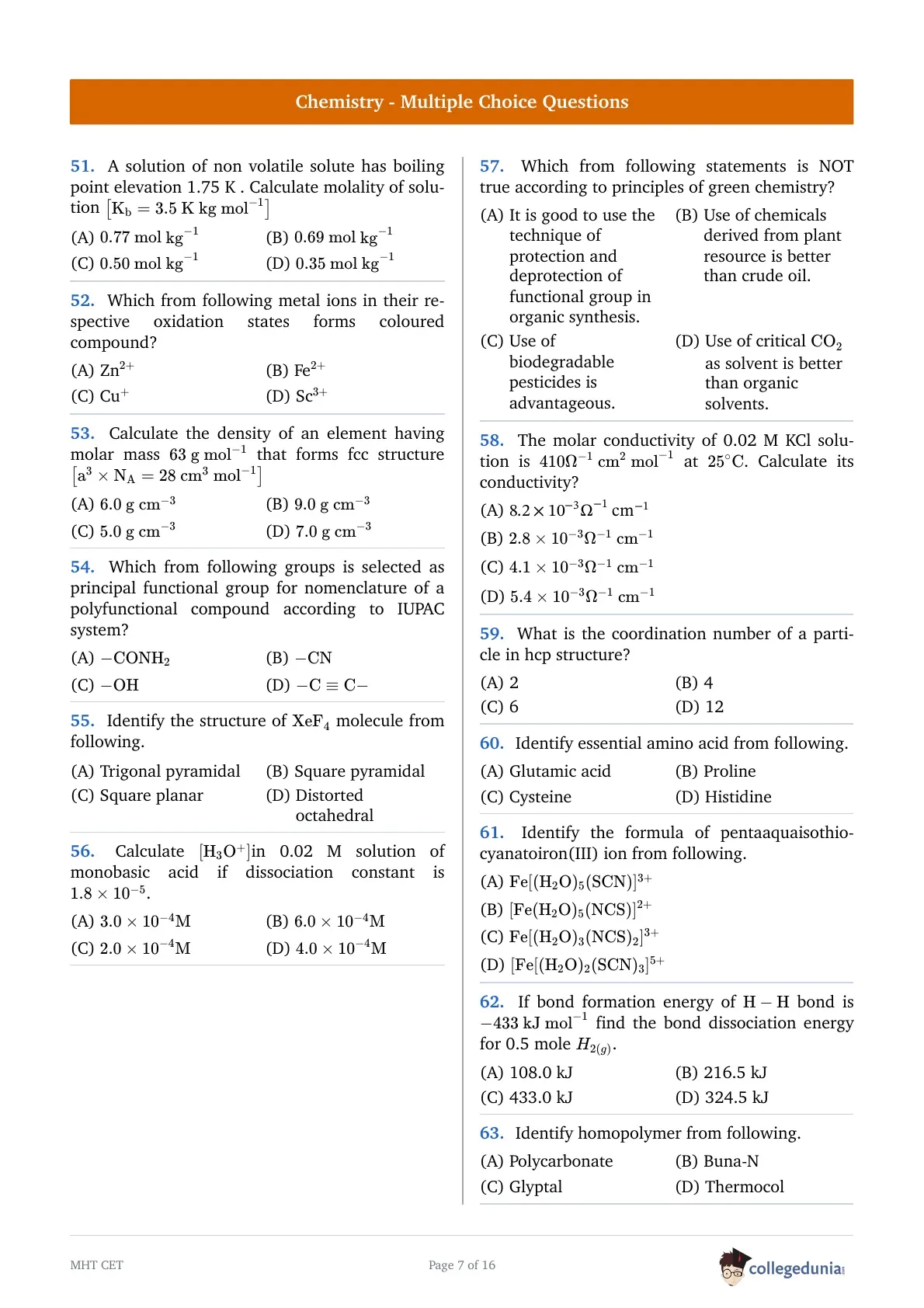
A solution of non volatile solute has boiling point elevation 1.75 K . Calculate molality of solution \(\left[\mathrm{K}_{\mathrm{b}}=3.5 \mathrm{~K} \mathrm{~kg} \mathrm{~mol}^{-1}\right]\)
Which from following metal ions in their respective oxidation states forms coloured compound?
Calculate the density of an element having molar mass \(63 \mathrm{~g} \mathrm{~mol}^{-1}\) that forms fcc structure \(\left[\mathrm{a}^3 \times \mathrm{N}_{\mathrm{A}}=28 \mathrm{~cm}^3 \mathrm{~mol}^{-1}\right]\)
Which from following groups is selected as principal functional group for nomenclature of a polyfunctional compound according to IUPAC system?
Identify the structure of \(\mathrm{XeF}_4\) molecule from following.
Calculate \(\left[\mathrm{H}_3 \mathrm{O}^{+}\right]\)in 0.02 M solution of monobasic acid if dissociation constant is \(1.8 \times 10^{-5}\).
Which from following statements is NOT true according to principles of green chemistry?
The molar conductivity of 0.02 M KCl solution is \(410 \Omega^{-1} \mathrm{~cm}^2 \mathrm{~mol}^{-1}\) at \(25^{\circ} \mathrm{C}\). Calculate its conductivity?
Identify the formula of pentaaquaisothiocyanatoiron(III) ion from following.
If bond formation energy of \(\mathrm{H}-\mathrm{H}\) bond is \(-433 \mathrm{~kJ} \mathrm{~mol}^{-1}\) find the bond dissociation energy for 0.5 mole \(H_{2(g)}\).
Which from following molecules has two lone pair of electrons in valence shell of its central atom?
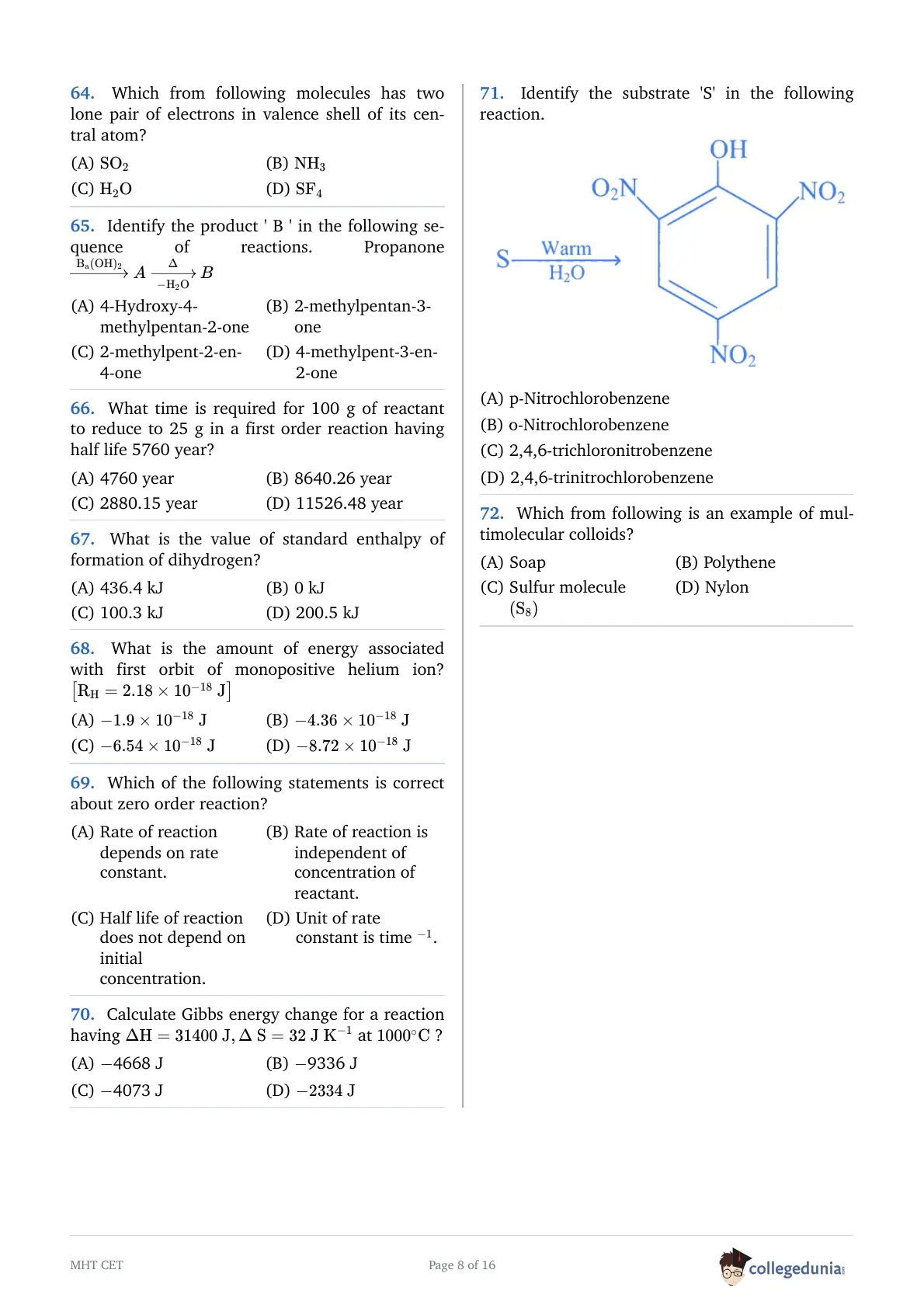
What time is required for 100 g of reactant to reduce to 25 g in a first order reaction having half life 5760 year?
What is the amount of energy associated with first orbit of monopositive helium ion? \(\left[\mathrm{R}_{\mathrm{H}}=2.18 \times 10^{-18} \mathrm{~J}\right]\)
Which of the following statements is correct about zero order reaction?
Calculate Gibbs energy change for a reaction having \(\Delta \mathrm{H}=31400 \mathrm{~J}, \Delta \mathrm{~S}=32 \mathrm{~J} \mathrm{~K}^{-1}\) at \(1000^{\circ} \mathrm{C}\) ?

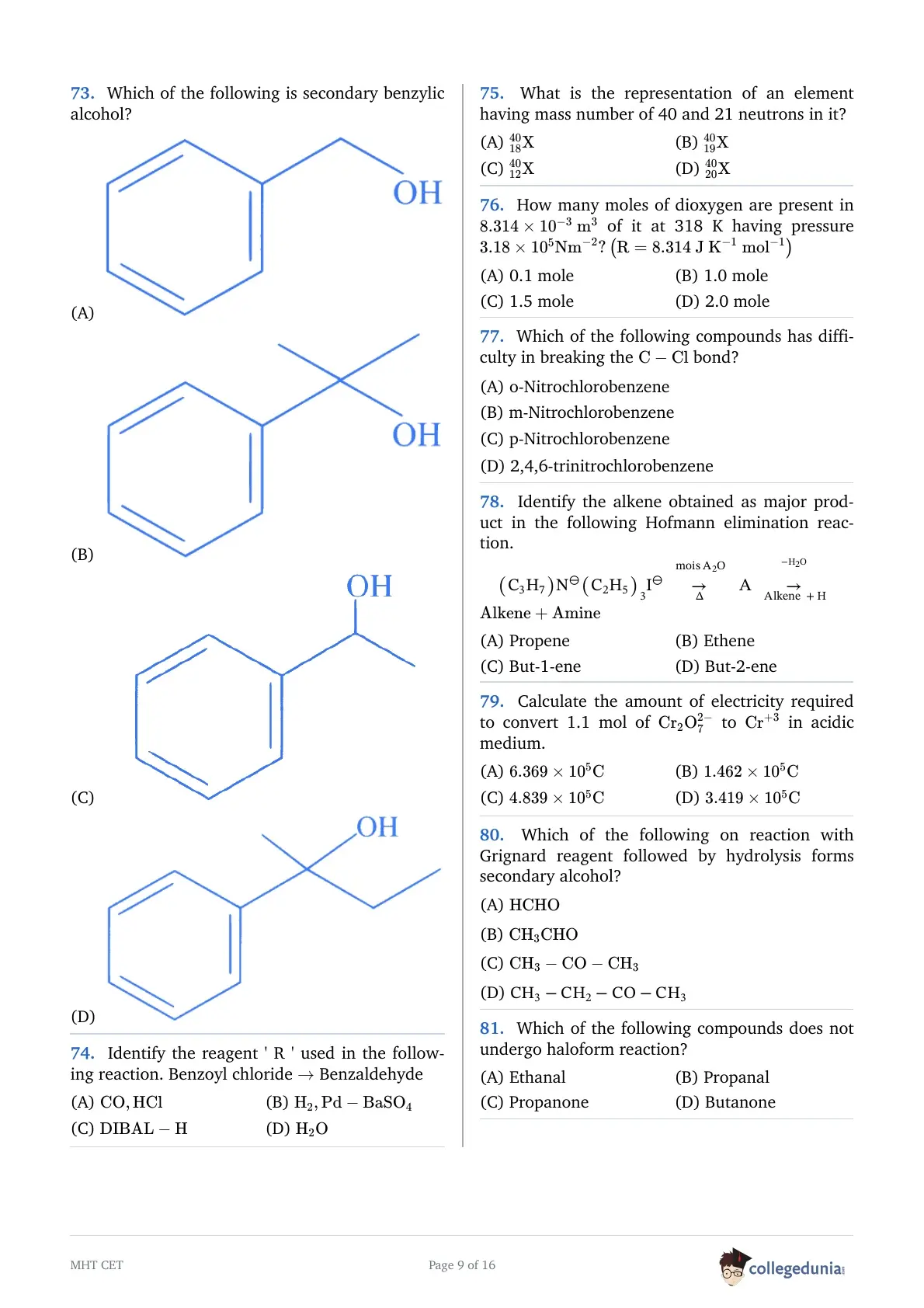
Which of the following is secondary benzylic alcohol?
- (A)
![]()
- (B)
![]()
- (C)
![]()
- (D)
![]()


Identify the reagent ' R ' used in the following reaction. Benzoyl chloride \[ \to \] Benzaldehyde
What is the representation of an element having mass number of 40 and 21 neutrons in it?
How many moles of dioxygen are present in \(8.314 \times 10^{-3} \mathrm{~m}^3\) of it at 318 K having pressure \(3.18 \times 10^5 \mathrm{Nm}^{-2} ?\left(\mathrm{R}=8.314 \mathrm{~J} \mathrm{~K}^{-1} \mathrm{~mol}^{-1}\right)\)
Which of the following compounds has difficulty in breaking the \(\mathrm{C}-\mathrm{Cl}\) bond?
Identify the alkene obtained as major product in the following Hofmann elimination reaction.
\[
\left(\mathrm{C}_3 \mathrm{H}_7\right) \mathrm{N}^{\ominus}\left(\mathrm{C}_2 \mathrm{H}_5\right)_3 \mathrm{I}^{\ominus} \xrightarrow[\Delta]{\text { mois } \mathrm{A}_2 \mathrm{O}} \mathrm{~A} \xrightarrow[\text { Alkene }+\mathrm{H}]{\stackrel{-\mathrm{H}_2 \mathrm{O}}{ }}
\] \(\mathrm{Alkene + Amine}\)
Calculate the amount of electricity required to convert 1.1 mol of \(\mathrm{Cr}_2 \mathrm{O}_7^{2-}\) to \(\mathrm{Cr}^{+3}\) in acidic medium.
Which of the following on reaction with Grignard reagent followed by hydrolysis forms secondary alcohol?
Which from the following statements is correct for aqueous solution of \(6 \mathrm{~g} \mathrm{~L}^{-1}\) urea and \(17 \cdot 12 \mathrm{~g} \mathrm{~L}^{-1}\) of sucrose?
[Molar mass of urea \(=60 \mathrm{~g} \mathrm{~mol}^{-1}\)
Molar mass of sucrose \(=342 \mathrm{~g} \mathrm{~mol}^{-1}\)]
Calculate the volume occupied by all atoms in bcc unit cell if the volume of unit cell is \(1.5 \times 10^{-22} \mathrm{~cm}^3\).
What is the number of electrons present in 3d orbital of Ti in +2 state?
Which of the following pair of compounds does not demonstrate the law of multiple proportion?
What is the coordination number of central metal ion in \(\left[\mathrm{Fe}\left(\mathrm{C}_2 \mathrm{O}_4\right)_3\right]^{3-}\) ?
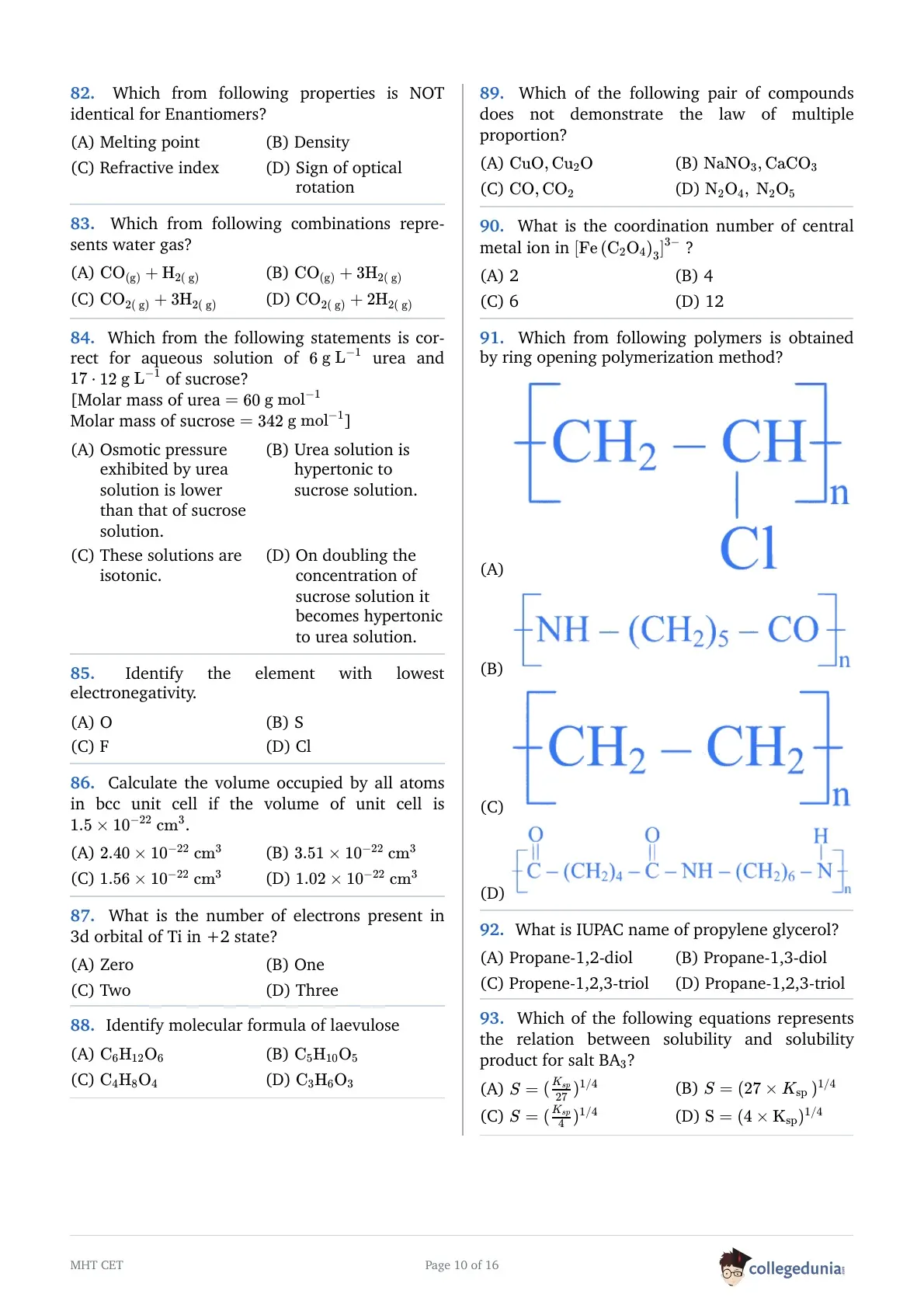
Which from following polymers is obtained by ring opening polymerization method?
- (A)
![]()
- (B)
![]()
- (C)
![]()
- (D)
![]()


Which of the following equations represents the relation between solubility and solubility product for salt BA\(_3\)?

For a reaction, \[2 \mathrm{~N}_2 \mathrm{O}_{5(\mathrm{~g})} \longrightarrow 4 \mathrm{NO}_{2(\mathrm{~g})}+\mathrm{O}_{2(\mathrm{~g})}\]
\(\mathrm{N}_2 \mathrm{O}_5\) disappears at a rate of \(0.06 \mathrm{~mol~dm}^{-3} \mathrm{~s}^{-1}\) What is rate of \(\mathrm{NO}_{2(\mathrm{~g})}\) formation?
Calculate the molar mass of nonvolatile solute when 1.5 g of it is dissolved in 90 g solvent decreases its freezing point by 0.25 K. \[\left[\mathrm{K}_{\mathrm{f}}=1.2 \mathrm{~K} \mathrm{~kg} \mathrm{~mol}^{-1}\right]\]
Which of the following does not have intermolecular hydrogen bonding?
Which of the following statements is NOT correct for \(\mathrm{H}_2-\mathrm{O}_2\) fuel cell?
Identify the element reduced in following reaction.
\[\mathrm{Cr}_2 \mathrm{O}_7^{2-}+14 \mathrm{H}^{+}+6 \mathrm{I}^{-} \longrightarrow 2 \mathrm{Cr}^{3+}+3 \mathrm{H}_2 \mathrm{O}+3 \mathrm{I}_2\]
Calculate the pH of buffer solution containing 0.027 M weak acid and 0.054 M of its salt with strong base if \(\mathrm{pK}_{\mathrm{a}}\) is 4.2.
Mathematics (Q101 - Q150)
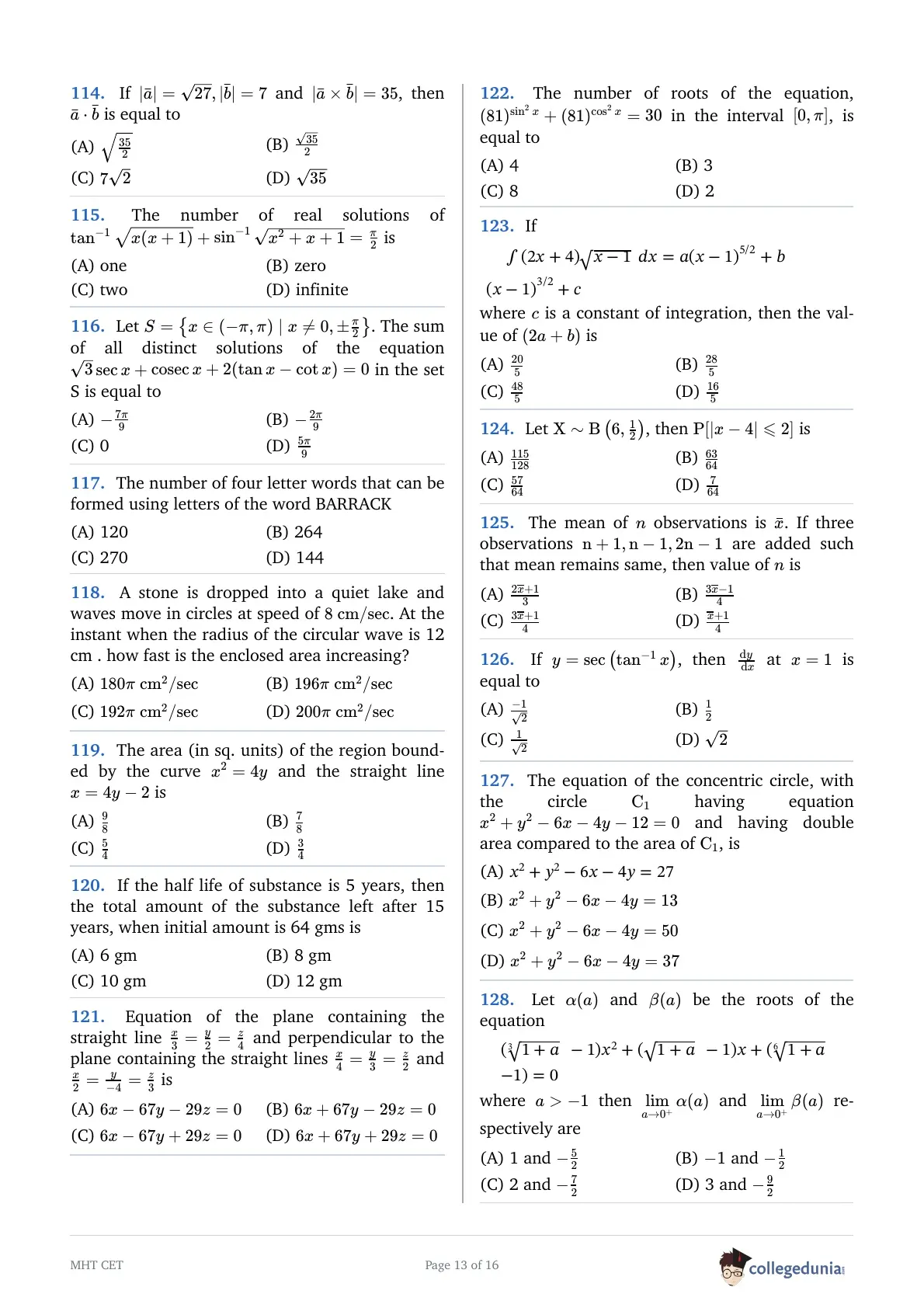
If \(\int \frac{\mathrm{d} x}{\cos ^3 x \sqrt{2 \sin 2 x}}=(\tan x)^A+C(\tan x)^B+K\), where K is a constant of integration, then the value of \(5(A+B+C)\) is equal to
Let \(\mathrm{f}(x)=\frac{1-\tan x}{4 x-\pi}, x \neq \frac{\pi}{4}, x \in\left[0, \frac{1}{2}\right], \quad \mathrm{f}(x)\) is continuous in \(\left[0, \frac{\pi}{2}\right]\), then \(\mathrm{f}\left(\frac{\pi}{4}\right)\) is
The number of possible distinct straight lines passing through \((2,3)\) and forming a triangle with co-ordinate axes whose area is 12 sq . units are,
The differential equation \(\left[\frac{1+\left(\frac{d y}{d x}\right)^2}{\left(\frac{d^2 y}{d x^2}\right)}\right]^{\frac{3}{2}}=\mathrm{kx}\) is of
A triangular park is enclosed on two sides by a fence and on the third side a straight river bank. The two sides having fence are of same length \(x\). The maximum area (in sq. units) enclosed by the park is
If \(\int_\limits0^{\frac{\pi}{3}} \frac{\tan \theta}{\sqrt{2 k \sec \theta}} d \theta=1-\frac{1}{\sqrt{2}},(k>0)\), then the value of \(k\) is
A random variable x has the following probability distribution. Then value of \(k\) is _________ and \(\mathrm{P}(3< x \leq 6)\) has the value
| \(\mathrm{X}=x\) | 0 | 1 | 2 | 3 | 4 | 5 | 6 | 7 | 8 |
|---|---|---|---|---|---|---|---|---|---|
| \(\mathrm{P}(x)\) | \(\mathrm{k}\) | \(\mathrm{2k}\) | \(\mathrm{3k}\) | \(\mathrm{4k}\) | \(\mathrm{4k}\) | \(\mathrm{3k}\) | \(\mathrm{2k}\) | \(\mathrm{k}\) | \(\mathrm{k}\) |
If \(y=\log \left[\mathrm{e}^{5 x}\left(\frac{3 x-4}{x+5}\right)^{\frac{4}{3}}\right]\), then \(\frac{\mathrm{d} y}{\mathrm{~d} x}\) is equal to
Let \(f\) be a twice differentiable function such that \(\mathrm{f}^{\prime \prime}(x)=-\mathrm{f}(x), \mathrm{f}^{\prime}(x)=\mathrm{g}(x)\) and \(\mathrm{h}(x)=[\mathrm{f}(x)]^2+[\mathrm{g}(x)]^2\). If \(\mathrm{h}(5)=1\), then \(\mathrm{h}(10)\) is __________.
The area (in sq. units) of the parallelogram whose diagonals are along the vectors \(8 \hat{\mathrm{i}}-6 \hat{\mathrm{j}}\) and \(3 \hat{i}+4 \hat{j}-12 \hat{k}\), is
The line L given by \(\frac{x}{5}+\frac{y}{b}=1\) passes through the point \((13,32)\). The line K is parallel to L and has the equation \(\frac{x}{c}+\frac{y}{3}=1\). Then the distance between \(L\) and \(K\) is
If \(|\bar{a}|=\sqrt{27},|\bar{b}|=7\) and \(|\bar{a} \times \bar{b}|=35\), then \(\bar{a} \cdot \bar{b}\) is equal to
The number of real solutions of \(\tan ^{-1} \sqrt{x(x+1)}+\sin ^{-1} \sqrt{x^2+x+1}=\frac{\pi}{2}\) is
Let \(S=\left\{x \in(-\pi, \pi) \mid x \neq 0, \pm \frac{\pi}{2}\right\}\). The sum of all distinct solutions of the equation \(\sqrt{3} \sec x+\operatorname{cosec} x+2(\tan x-\cot x)=0\) in the set S is equal to
The number of four-letter words that can be formed using the letters of the word "BARRACK" is:
A stone is dropped into a quiet lake and waves move in circles at speed of \(8 \mathrm{~cm} / \mathrm{sec}\). At the instant when the radius of the circular wave is 12 cm . how fast is the enclosed area increasing?
The area (in sq. units) of the region bounded by the curve \(x^2=4 y\) and the straight line \(x=4 y-2\) is
If the half life of substance is 5 years, then the total amount of the substance left after 15 years, when initial amount is 64 gms is
Equation of the plane containing the straight line \(\frac{x}{3}=\frac{y}{2}=\frac{z}{4}\) and perpendicular to the plane containing the straight lines \(\frac{x}{4}=\frac{y}{3}=\frac{z}{2}\) and \(\frac{x}{2}=\frac{y}{-4}=\frac{z}{3}\) is
The number of roots of the equation, \((81)^{\sin ^2 x}+(81)^{\cos ^2 x}=30\) in the interval \([0, \pi]\), is equal to
If \(\quad \int(2 x+4) \sqrt{x-1} d x=a(x-1)^{5 / 2}+b(x-1)^{3 / 2}+c\) where \(c\) is a constant of integration, then the value of \((2 a+b)\) is
Let \(\mathrm{X} \sim \mathrm{B}\left(6, \frac{1}{2}\right)\), then \(\mathrm{P}[|x-4| \leqslant 2]\) is
The mean of \(n\) observations is \(\bar{x}\). If three observations \(\mathrm{n}+1, \mathrm{n}-1,2 \mathrm{n}-1\) are added such that mean remains same, then value of \(n\) is
If \(y=\sec \left(\tan ^{-1} x\right)\), then \(\frac{\mathrm{d} y}{\mathrm{~d} x}\) at \(x=1\) is equal to
The equation of the concentric circle, with the circle \(\mathrm{C}_1\) having equation \(x^2+y^2-6 x-4 y-12=0\) and having double area compared to the area of \(\mathrm{C}_1\), is
Let \(\alpha(a)\) and \(\beta(a)\) be the roots of the equation \[(\sqrt[3]{1+a}-1) x^2+(\sqrt{1+a}-1) x+(\sqrt[6]{1+a}-1)=0\] where \(a>-1\) then \(\lim _\limits{a \rightarrow 0^{+}} \alpha(a)\) and \(\lim _\limits{a \rightarrow 0^{+}} \beta(a)\) respectively are
Let \(2 \sin ^2 x+3 \sin x-2>0\) and \(x^2-x-2<0\). (\(x\) is measured in radians). The \(x\) lies in the interval
If \(\mathrm{A} \equiv(1,-1,0), \mathrm{B} \equiv(0,1,-1)\) and \(\mathrm{C} \equiv(-1,0,1)\), then the unit vector \(\overline{\mathrm{d}}\) such that \(\overline{\mathrm{a}}\) and \(\overline{\mathrm{d}}\) are perpendiculars and \(\overline{\mathrm{b}}, \overline{\mathrm{c}}, \overline{\mathrm{d}}\) are coplanar is
A bullet is shot horizontally and its distance S cm at time t second is given by \(\mathrm{S}=1200 \mathrm{t}-15 \mathrm{t}^2\), then the distance covered by the bullet when it comes to the rest, is
If \(|z|=1\) and \(w=\frac{z-1}{z+1}\) (where \(\left.z \neq-1\right)\), then \(\operatorname{Re}(w)\) is
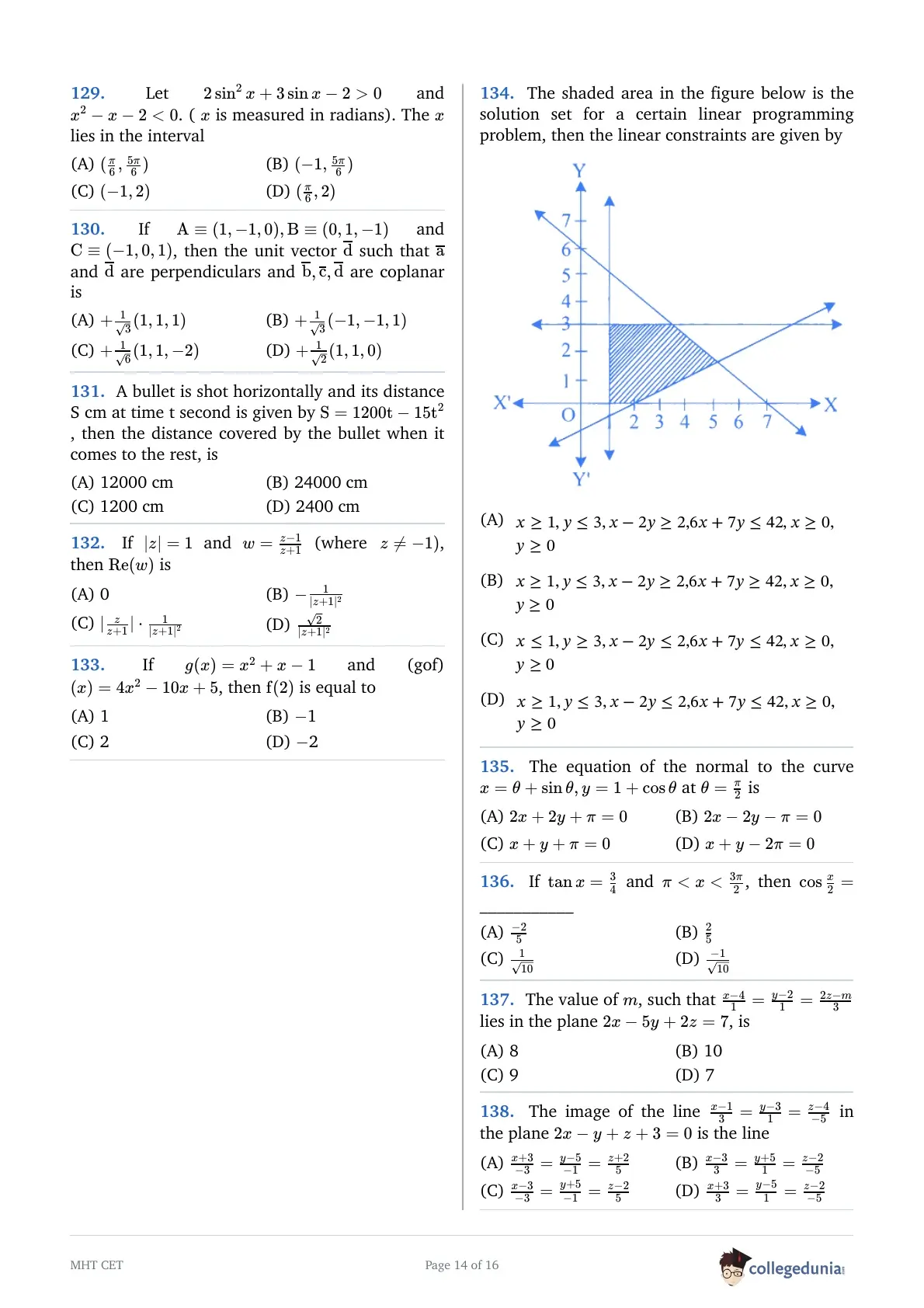
The shaded area in the figure below is the solution set for a certain linear programming problem, then the linear constraints are given by

The equation of the normal to the curve \(x=\theta+\sin \theta, y=1+\cos \theta\) at \(\theta=\frac{\pi}{2}\) is
If \(\tan x=\frac{3}{4}\) and \(\pi< x< \frac{3 \pi}{2}\), then \(\cos \frac{x}{2}=\) ___________
The value of \(m\), such that \(\frac{x-4}{1}=\frac{y-2}{1}=\frac{2 z-m}{3}\) lies in the plane \(2 x-5 y+2 z=7\), is
The image of the line \(\frac{x-1}{3}=\frac{y-3}{1}=\frac{z-4}{-5}\) in the plane \(2 x-y+z+3=0\) is the line
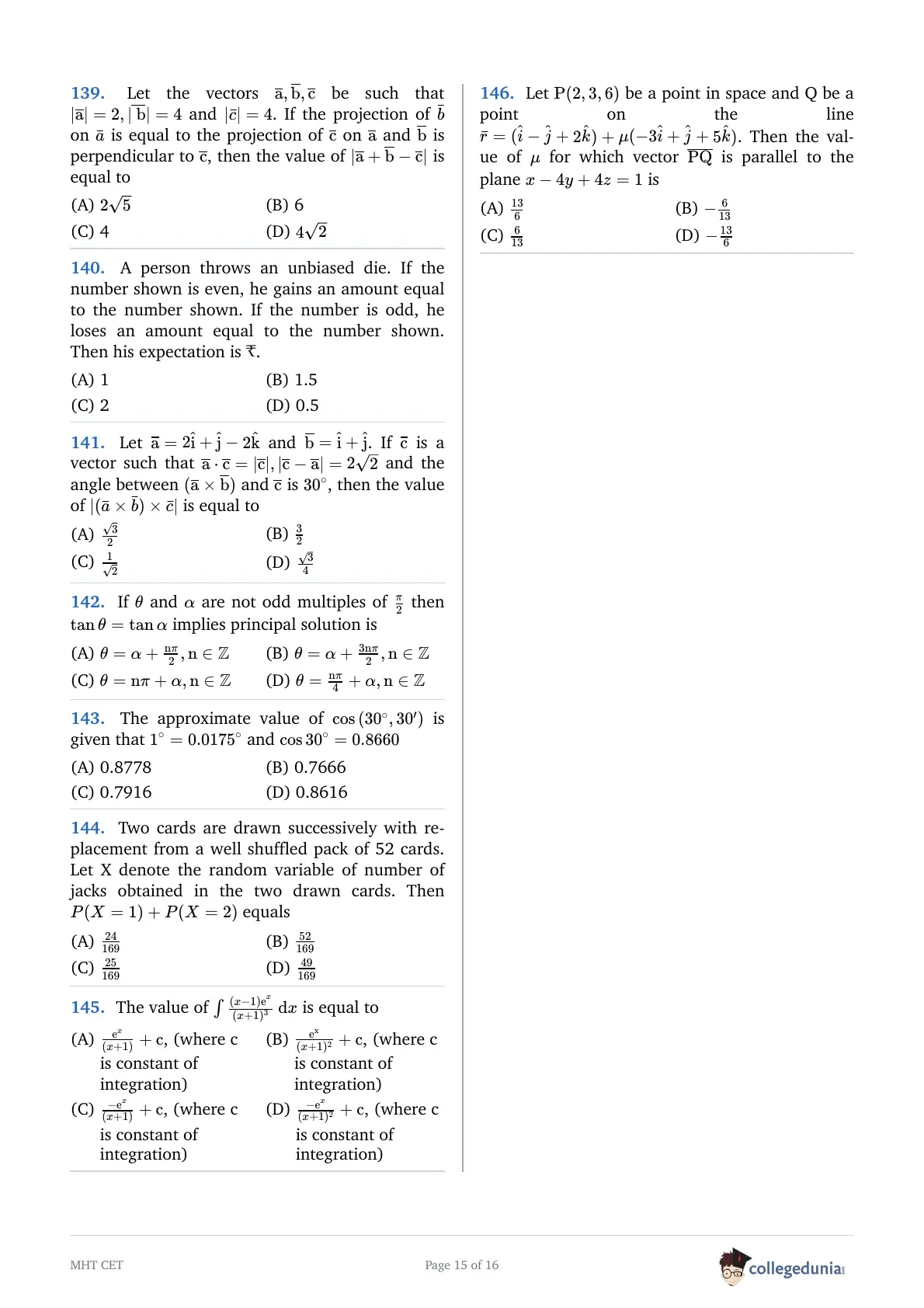
Let the vectors \(\overline{\mathrm{a}}, \overline{\mathrm{b}}, \overline{\mathrm{c}}\) be such that \(|\overline{\mathrm{a}}|=2,|\overline{\mathrm{~b}}|=4\) and \(|\bar{c}|=4\). If the projection of \(\bar{b}\) on \(\bar{a}\) is equal to the projection of \(\overline{\mathrm{c}}\) on \(\overline{\mathrm{a}}\) and \(\overline{\mathrm{b}}\) is perpendicular to \(\overline{\mathrm{c}}\), then the value of \(|\overline{\mathrm{a}}+\overline{\mathrm{b}}-\overline{\mathrm{c}}|\) is equal to
A person throws an unbiased die. If the number shown is even, he gains an amount equal to the number shown. If the number is odd, he loses an amount equal to the number shown. Then his expectation is ₹.
Let \(\overline{\mathrm{a}}=2 \hat{\mathrm{i}}+\hat{\mathrm{j}}-2 \hat{\mathrm{k}}\) and \(\overline{\mathrm{b}}=\hat{\mathrm{i}}+\hat{\mathrm{j}}\). If \(\overline{\mathrm{c}}\) is a vector such that \(\overline{\mathrm{a}} \cdot \overline{\mathrm{c}}=|\overline{\mathrm{c}}|,|\overline{\mathrm{c}}-\overline{\mathrm{a}}|=2 \sqrt{2}\) and the angle between \((\overline{\mathrm{a}} \times \overline{\mathrm{b}})\) and \(\overline{\mathrm{c}}\) is \(30^{\circ}\), then the value of \(|(\bar{a} \times \bar{b}) \times \bar{c}|\) is equal to
If \(\theta\) and \(\alpha\) are not odd multiples of \(\frac{\pi}{2}\) then \(\tan \theta=\tan \alpha\) implies principal solution is
The approximate value of \(\cos \left(30^{\circ}, 30^{\prime}\right)\) is given that \(1^{\circ}=0.0175^{\circ}\) and \(\cos 30^{\circ}=0.8660\)
Two cards are drawn successively with replacement from a well shuffled pack of 52 cards. Let X denote the random variable of number of jacks obtained in the two drawn cards. Then \(P(X=1)+P(X=2)\) equals
The value of \(\int \frac{(x-1) \mathrm{e}^x}{(x+1)^3} \mathrm{~d} x\) is equal to
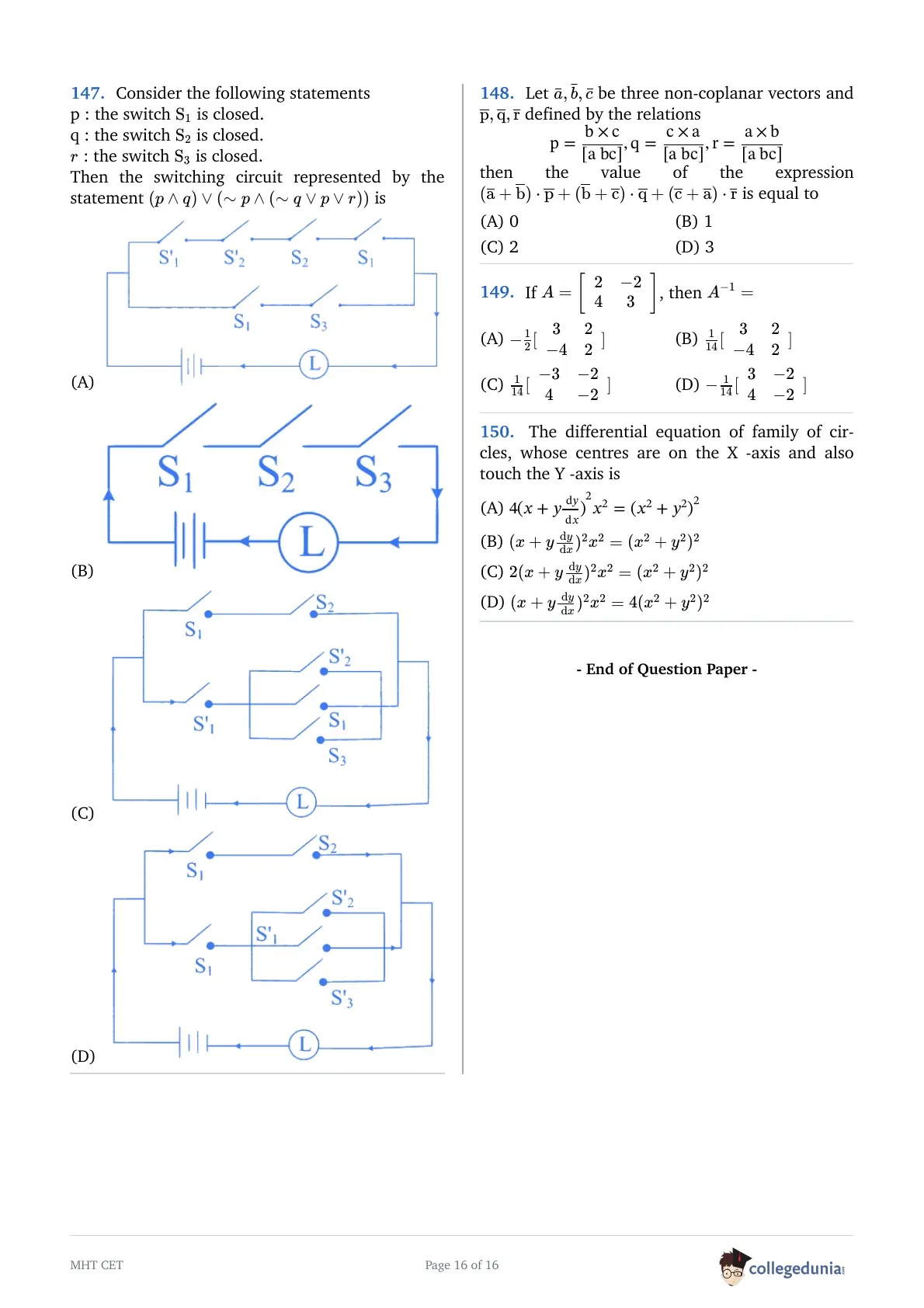
Consider the following statements
p : the switch \(\mathrm{S}_1\) is closed.
q : the switch \(\mathrm{S}_2\) is closed.
\(r\) : the switch \(\mathrm{S}_3\) is closed.
Then the switching circuit represented by the statement \((p \wedge q) \vee(\sim p \wedge(\sim q \vee p \vee r))\) is
- (A)
![]()
- (B)
![]()
- (C)
![]()
- (D)
![]()


Let \(\bar{a}, \bar{b}, \bar{c}\) be three non-coplanar vectors and \(\overline{\mathrm{p}}, \overline{\mathrm{q}}, \overline{\mathrm{r}}\) defined by the relations
\[\overline{\mathrm{p}}=\frac{\overline{\mathrm{b}} \times \overline{\mathrm{c}}}{[\overline{\mathrm{a}} \overline{\mathrm{~b}} \overline{\mathrm{c}}]}, \overline{\mathrm{q}}=\frac{\overline{\mathrm{c}} \times \overline{\mathrm{a}}}{[\overline{\mathrm{a}} \overline{\mathrm{~b}} \overline{\mathrm{c}}]}, \overline{\mathrm{r}}=\frac{\overline{\mathrm{a}} \times \overline{\mathrm{b}}}{[\overline{\mathrm{a}} \overline{\mathrm{~b}} \overline{\mathrm{c}}]}\]
then the value of the expression \((\overline{\mathrm{a}}+\overline{\mathrm{b}}) \cdot \overline{\mathrm{p}}+(\overline{\mathrm{b}}+\overline{\mathrm{c}}) \cdot \overline{\mathrm{q}}+(\overline{\mathrm{c}}+\overline{\mathrm{a}}) \cdot \overline{\mathrm{r}}\) is equal to
If \(A=\left[\begin{array}{cc}2 & -2 \\ 4 & 3\end{array}\right]\), then \(A^{-1}=\)
The differential equation of family of circles, whose centres are on the X -axis and also touch the Y -axis is
MHT CET 2024 PCM Exam Pattern and Marking Scheme
| Parameter | Details |
|---|---|
| Conducting Body | Maharashtra Common Entrance Test Cell (Maharashtra CET Cell) |
| Exam Mode | Online (Computer-Based Test) |
| Duration | 180 minutes (3 hours) |
| Groups / Subjects | PCM (Physics, Chemistry, Mathematics) for Engineering |
| Total Questions |
150 |
| Total Marks | 200 |
| Question Type | Multiple Choice Questions (MCQs) |
| Marks Distribution |
|
| Negative Marking | No |
| Syllabus Weightage |
|



Comments