




MHT CET 2024 May 4 Shift 1 PCM Question Paper is available for download here. Maharashtra State CET Cell conducted MHT CET 2024 PCM Exam on May 4 in Shift 1 from 9 AM to 12 PM in CBT mode.
The MHT CET 2024 PCM question paper includes the following:
- The MHT CET 2024 PCM Question Paper consists of 150 multiple-choice questions (MCQs) totalling 200 marks divided into 3 sections: Physics, Chemistry, and Mathematics, with 50 questions in each subject.
- Physics and Chemistry questions carry 1 mark each while Mathematics questions carry 2 marks each.
- There is no negative marking for incorrect answers.
MHT CET 2024 May 4 Shift 1 PCM Question Paper with Solution PDF
| CD PDF | CD PDF with Solutions |
|---|---|
| Download Collegedunia PDF 0.91 MB | - |
Also Check:
MHT CET 2024 May 4 Shift 1 PCM Questions with Solutions
Physics (Q1 - Q50)
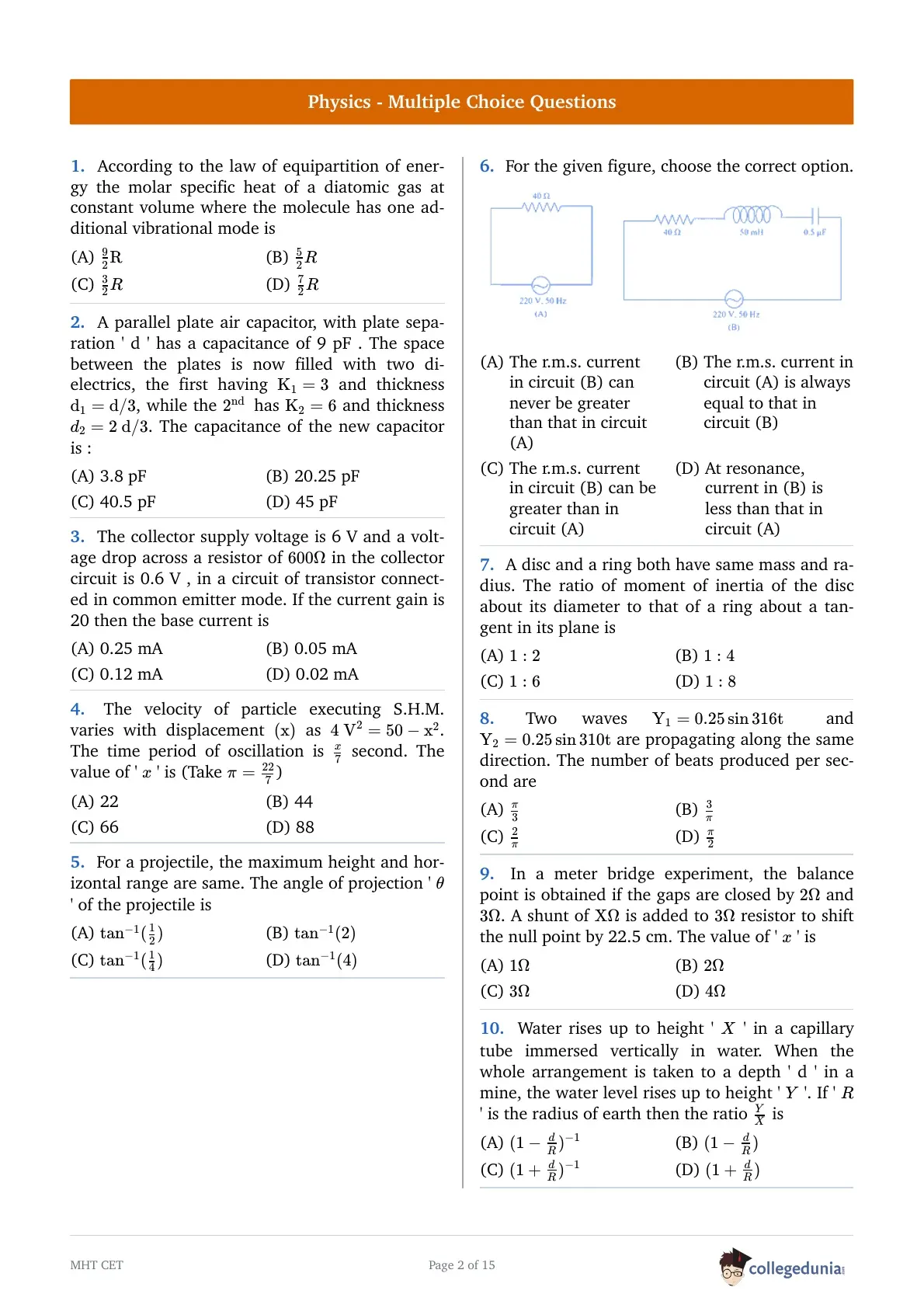
According to the law of equipartition of energy the molar specific heat of a diatomic gas at constant volume where the molecule has one additional vibrational mode is
A parallel plate air capacitor, with plate separation ' d ' has a capacitance of 9 pF . The space between the plates is now filled with two dielectrics, the first having \(\mathrm{K}_1=3\) and thickness \(\mathrm{d}_1=\mathrm{d} / 3\), while the \(2^{\text {nd }}\) has \(\mathrm{K}_2=6\) and thickness \(d_2=2 \mathrm{~d} / 3\). The capacitance of the new capacitor is :
The collector supply voltage is 6 V and a voltage drop across a resistor of \(600 \Omega\) in the collector circuit is 0.6 V , in a circuit of transistor connected in common emitter mode. If the current gain is 20 then the base current is
The velocity of particle executing S.H.M. varies with displacement \((\mathrm{x})\) as \(4 \mathrm{~V}^2=50-\mathrm{x}^2\). The time period of oscillation is \(\frac{x}{7}\) second. The value of ' \(x\) ' is (Take \(\pi=\frac{22}{7}\))
For a projectile, the maximum height and horizontal range are same. The angle of projection ' \(\theta\) ' of the projectile is

A disc and a ring both have same mass and radius. The ratio of moment of inertia of the disc about its diameter to that of a ring about a tangent in its plane is
Two waves \(\mathrm{Y}_1=0.25 \sin 316 \mathrm{t} \quad\) and \(\mathrm{Y}_2=0.25 \sin 310 \mathrm{t}\) are propagating along the same direction. The number of beats produced per second are
In a meter bridge experiment, the balance point is obtained if the gaps are closed by \(2 \Omega\) and \(3 \Omega\). A shunt of \(\mathrm{X} \Omega\) is added to \(3 \Omega\) resistor to shift the null point by 22.5 cm. The value of ' \(x\) ' is
Water rises up to height ' \(X\) ' in a capillary tube immersed vertically in water. When the whole arrangement is taken to a depth ' d ' in a mine, the water level rises up to height ' \(Y\) '. If ' \(R\) ' is the radius of earth then the ratio \(\frac{Y}{X}\) is
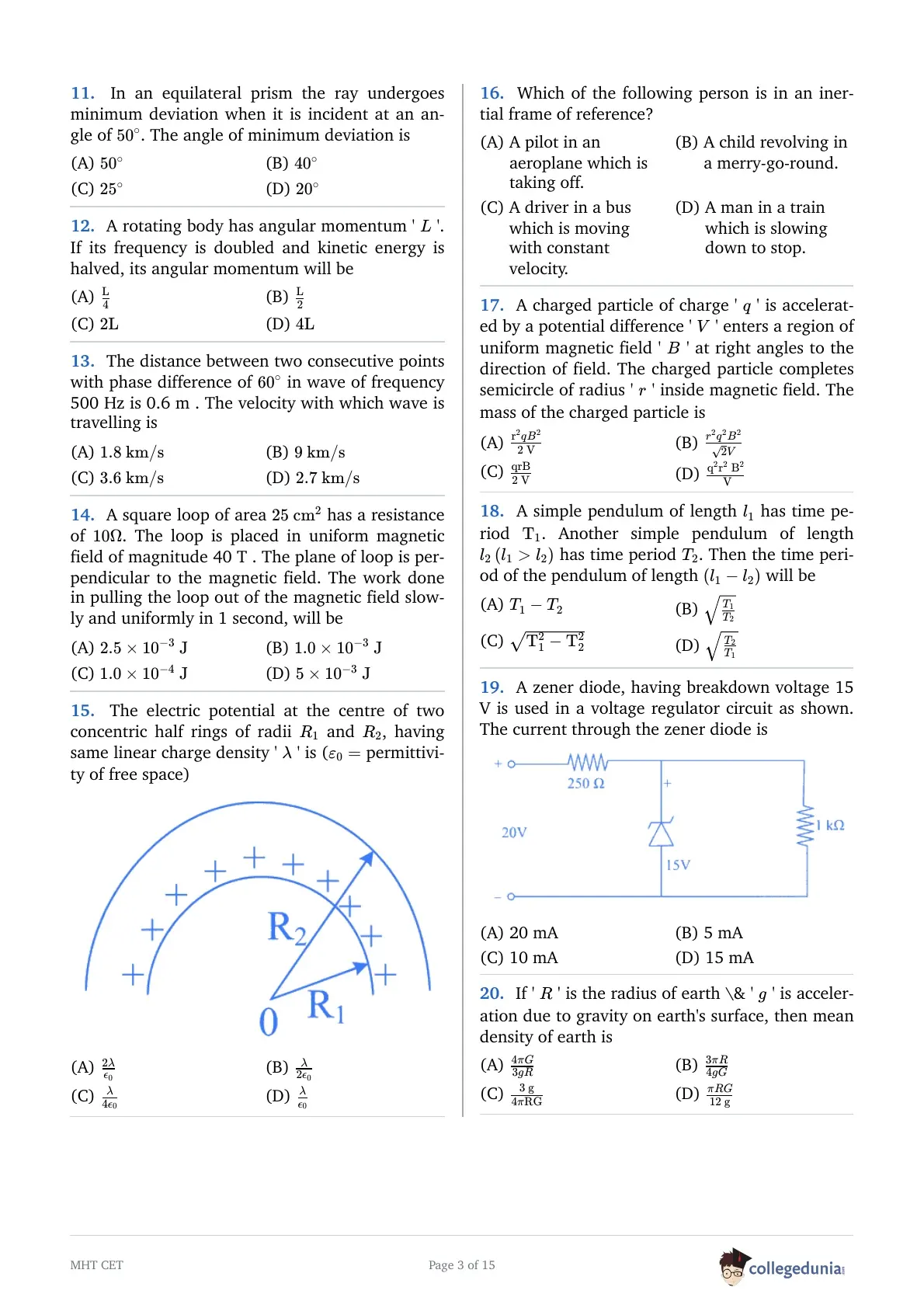
In an equilateral prism the ray undergoes minimum deviation when it is incident at an angle of \(50^{\circ}\). The angle of minimum deviation is
A rotating body has angular momentum ' \(L\) '. If its frequency is doubled and kinetic energy is halved, its angular momentum will be
The distance between two consecutive points with phase difference of \(60^{\circ}\) in wave of frequency 500 Hz is 0.6 m . The velocity with which wave is travelling is
A square loop of area \(25 \mathrm{~cm}^2\) has a resistance of \(10 \Omega\). The loop is placed in uniform magnetic field of magnitude 40 T . The plane of loop is perpendicular to the magnetic field. The work done in pulling the loop out of the magnetic field slowly and uniformly in 1 second, will be
The electric potential at the centre of two concentric half rings of radii \(R_1\) and \(R_2\), having same linear charge density ' \(\lambda\) ' is (\(\varepsilon_0=\) permittivity of free space)

A charged particle of charge ' \(q\) ' is accelerated by a potential difference ' \(V\) ' enters a region of uniform magnetic field ' \(B\) ' at right angles to the direction of field. The charged particle completes semicircle of radius ' \(r\) ' inside magnetic field. The mass of the charged particle is
A simple pendulum of length \(l_1\) has time period \(\mathrm{T}_1\). Another simple pendulum of length \(l_2\left(l_1>l_2\right)\) has time period \(T_2\). Then the time period of the pendulum of length \(\left(l_1-l_2\right)\) will be
A zener diode, having breakdown voltage 15 V is used in a voltage regulator circuit as shown. The current through the zener diode is

If ' \(R\) ' is the radius of earth \& ' \(g\) ' is acceleration due to gravity on earth's surface, then mean density of earth is
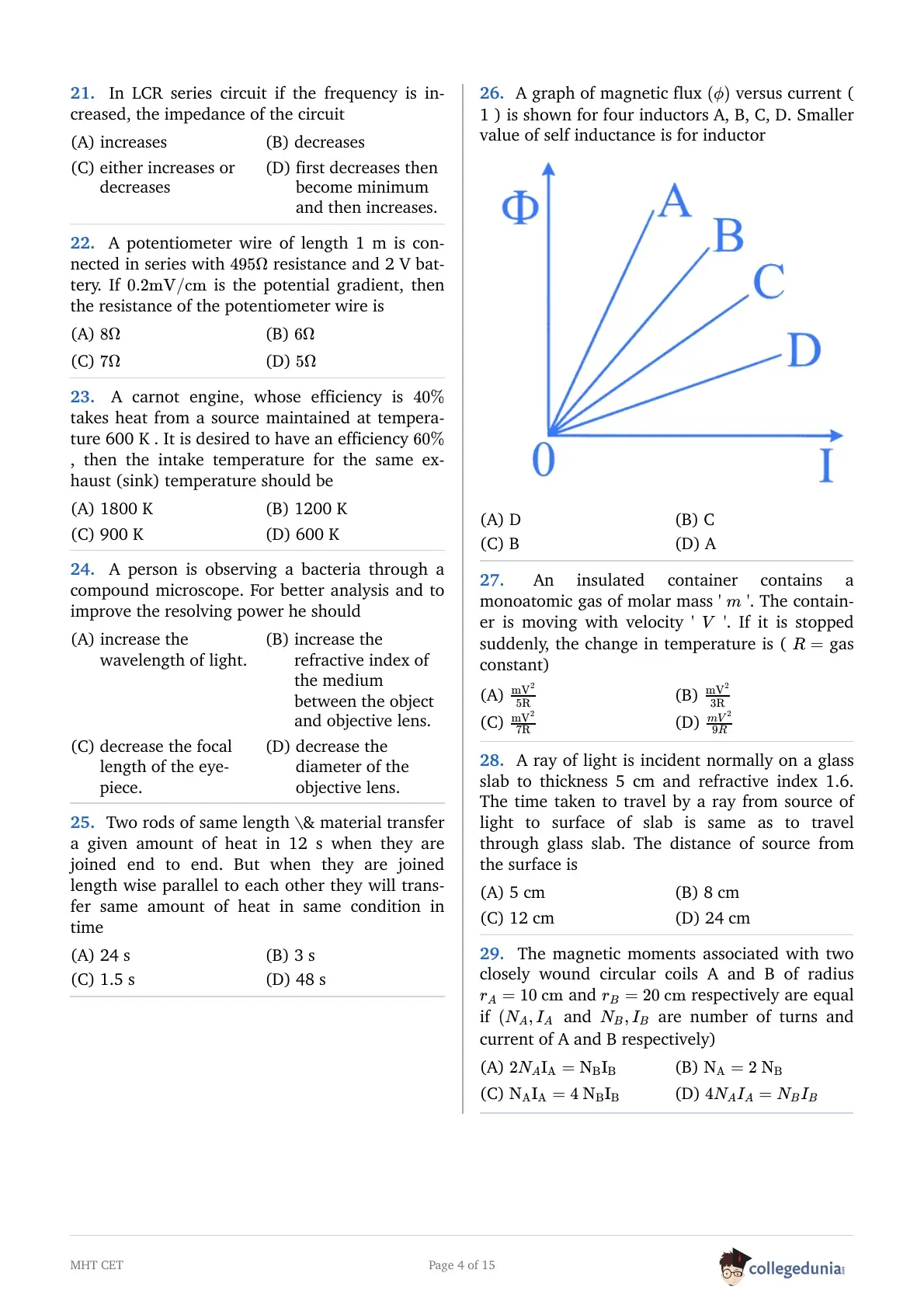
In LCR series circuit if the frequency is increased, the impedance of the circuit
A potentiometer wire of length 1 m is connected in series with \(495 \Omega\) resistance and 2 V battery. If \(0.2 \mathrm{mV} / \mathrm{cm}\) is the potential gradient, then the resistance of the potentiometer wire is
A carnot engine, whose efficiency is \(40 \%\) takes heat from a source maintained at temperature 600 K . It is desired to have an efficiency \(60 \%\), then the intake temperature for the same exhaust (sink) temperature should be
A person is observing a bacteria through a compound microscope. For better analysis and to improve the resolving power he should
Two rods of same length \& material transfer a given amount of heat in 12 s when they are joined end to end. But when they are joined length wise parallel to each other they will transfer same amount of heat in same condition in time
A graph of magnetic flux \((\phi)\) versus current ( 1 ) is shown for four inductors A, B, C, D. Smaller value of self inductance is for inductor

An insulated container contains a monoatomic gas of molar mass ' \(m\) '. The container is moving with velocity ' \(V\) '. If it is stopped suddenly, the change in temperature is ( \(R=\) gas constant)
A ray of light is incident normally on a glass slab to thickness 5 cm and refractive index 1.6. The time taken to travel by a ray from source of light to surface of slab is same as to travel through glass slab. The distance of source from the surface is
The magnetic moments associated with two closely wound circular coils A and B of radius \(r_A=10 \mathrm{~cm}\) and \(r_B=20 \mathrm{~cm}\) respectively are equal if \(\left(N_A, I_A\right.\) and \(N_B, I_B\) are number of turns and current of A and B respectively)
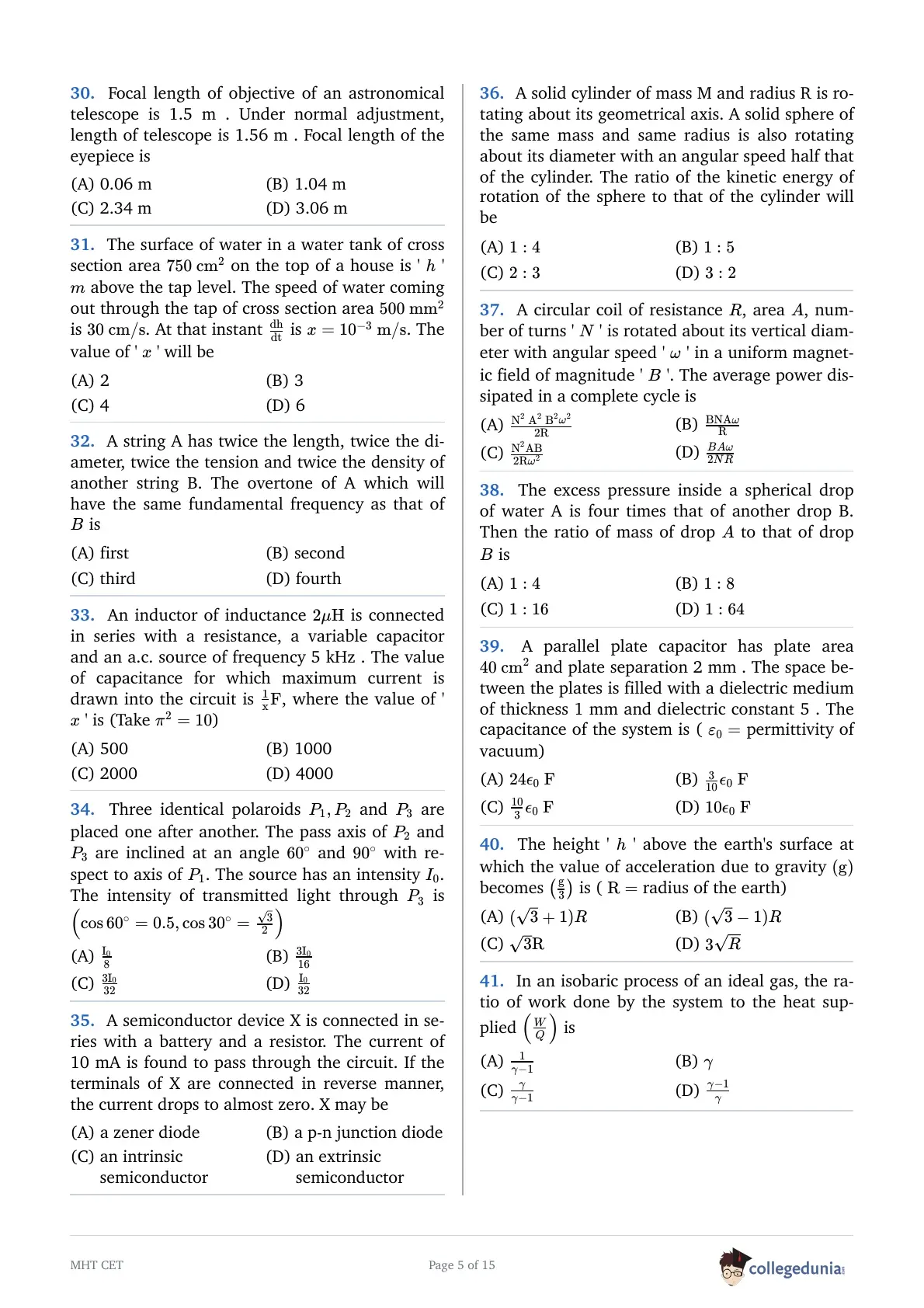
Focal length of objective of an astronomical telescope is 1.5 m . Under normal adjustment, length of telescope is 1.56 m . Focal length of the eyepiece is
The surface of water in a water tank of cross section area \(750 \mathrm{~cm}^2\) on the top of a house is ' \(h\) ' \(m\) above the tap level. The speed of water coming out through the tap of cross section area \(500 \mathrm{~mm}^2\) is \(30 \mathrm{~cm} / \mathrm{s}\). At that instant \(\frac{\mathrm{dh}}{\mathrm{dt}}\) is \(x=10^{-3} \mathrm{~m} / \mathrm{s}\). The value of ' \(x\) ' will be
A string A has twice the length, twice the diameter, twice the tension and twice the density of another string B. The overtone of A which will have the same fundamental frequency as that of \(B\) is
An inductor of inductance \(2 \mu \mathrm{H}\) is connected in series with a resistance, a variable capacitor and an a.c. source of frequency 5 kHz . The value of capacitance for which maximum current is drawn into the circuit is \(\frac{1}{\mathrm{x}} \mathrm{F}\), where the value of ' \(x\) ' is (Take \(\pi^2=10\))
Three identical polaroids \(P_1, P_2\) and \(P_3\) are placed one after another. The pass axis of \(P_2\) and \(P_3\) are inclined at an angle \(60^{\circ}\) and \(90^{\circ}\) with respect to axis of \(P_1\). The source has an intensity \(I_0\). The intensity of transmitted light through \(P_3\) is \(\left(\cos 60^{\circ}=0.5, \cos 30^{\circ}=\frac{\sqrt{3}}{2}\right)\)
A semiconductor device X is connected in series with a battery and a resistor. The current of 10 mA is found to pass through the circuit. If the terminals of X are connected in reverse manner, the current drops to almost zero. X may be
A solid cylinder of mass M and radius R is rotating about its geometrical axis. A solid sphere of the same mass and same radius is also rotating about its diameter with an angular speed half that of the cylinder. The ratio of the kinetic energy of rotation of the sphere to that of the cylinder will be
A circular coil of resistance \(R\), area \(A\), number of turns ' \(N\) ' is rotated about its vertical diameter with angular speed ' \(\omega\) ' in a uniform magnetic field of magnitude ' \(B\) '. The average power dissipated in a complete cycle is
The excess pressure inside a spherical drop of water A is four times that of another drop B. Then the ratio of mass of drop \(A\) to that of drop \(B\) is
A parallel plate capacitor has plate area \(40 \mathrm{~cm}^2\) and plate separation 2 mm . The space between the plates is filled with a dielectric medium of thickness 1 mm and dielectric constant 5 . The capacitance of the system is ( \(\varepsilon_0=\) permittivity of vacuum)
The height ' \(h\) ' above the earth's surface at which the value of acceleration due to gravity \((\mathrm{g})\) becomes \(\left(\frac{\mathrm{g}}{3}\right)\) is ( \(\mathrm{R}=\) radius of the earth)
In an isobaric process of an ideal gas, the ratio of work done by the system to the heat supplied \(\left(\frac{W}{Q}\right)\) is
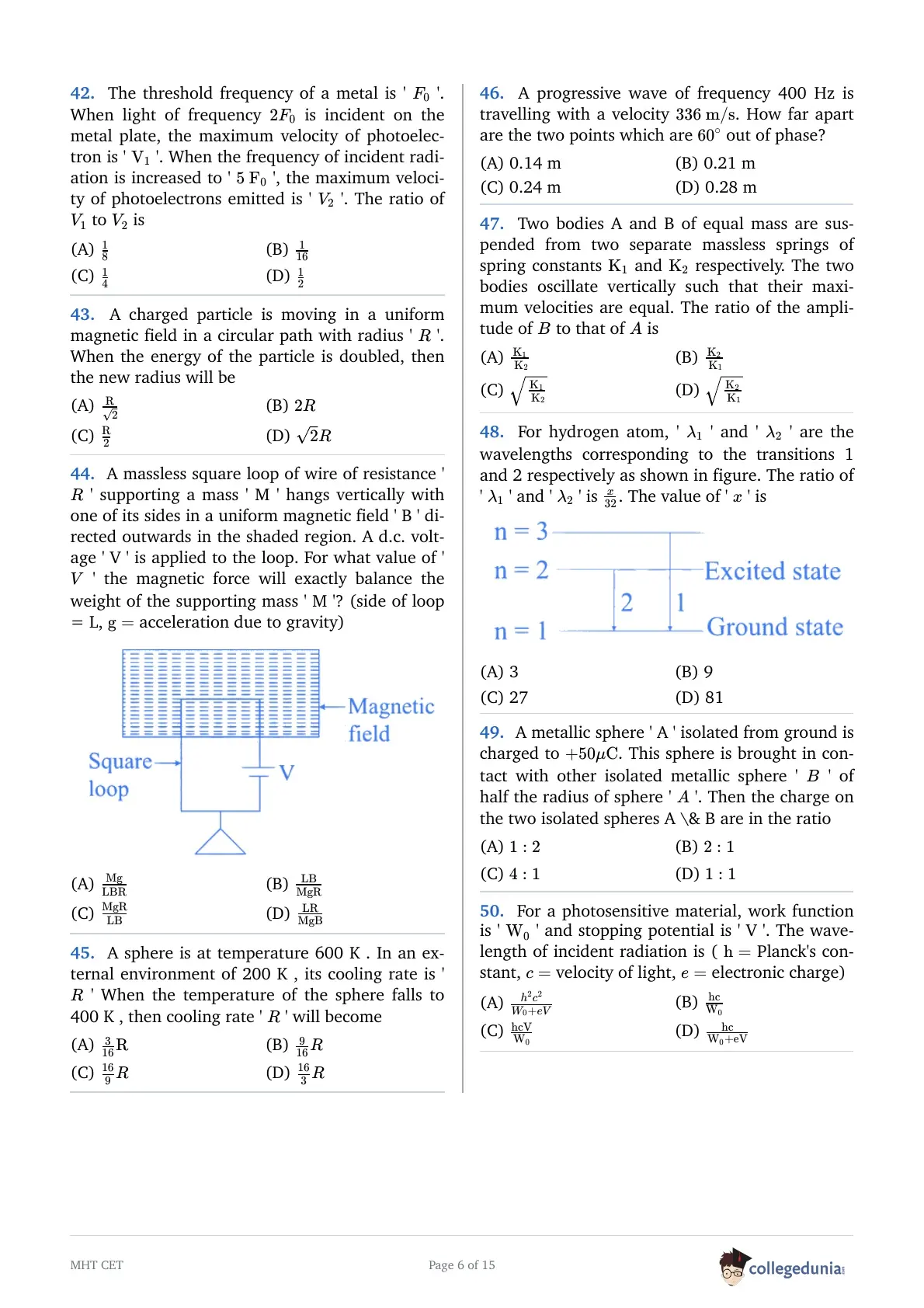
The threshold frequency of a metal is ' \(F_0\) '. When light of frequency \(2 F_0\) is incident on the metal plate, the maximum velocity of photoelectron is ' \(\mathrm{V}_1\) '. When the frequency of incident radiation is increased to ' \(5 \mathrm{~F}_0\) ', the maximum velocity of photoelectrons emitted is ' \(V_2\) '. The ratio of \(V_1\) to \(V_2\) is
A charged particle is moving in a uniform magnetic field in a circular path with radius ' \(R\) '. When the energy of the particle is doubled, then the new radius will be
A massless square loop of wire of resistance ' \(R\) ' supporting a mass ' M ' hangs vertically with one of its sides in a uniform magnetic field ' B ' directed outwards in the shaded region. A d.c. voltage ' V ' is applied to the loop. For what value of ' \(V\) ' the magnetic force will exactly balance the weight of the supporting mass ' M '? (side of loop = L, \(\mathrm{g}=\) acceleration due to gravity)

A sphere is at temperature 600 K . In an external environment of 200 K , its cooling rate is ' \(R\) ' When the temperature of the sphere falls to 400 K , then cooling rate ' \(R\) ' will become
A progressive wave of frequency 400 Hz is travelling with a velocity \(336 \mathrm{~m} / \mathrm{s}\). How far apart are the two points which are \(60^{\circ}\) out of phase?
Two bodies A and B of equal mass are suspended from two separate massless springs of spring constants \(\mathrm{K}_1\) and \(\mathrm{K}_2\) respectively. The two bodies oscillate vertically such that their maximum velocities are equal. The ratio of the amplitude of \(B\) to that of \(A\) is
For hydrogen atom, ' \(\lambda_1\) ' and ' \(\lambda_2\) ' are the wavelengths corresponding to the transitions 1 and 2 respectively as shown in figure. The ratio of ' \(\lambda_1\) ' and ' \(\lambda_2\) ' is \(\frac{x}{32}\). The value of ' \(x\) ' is

A metallic sphere ' A ' isolated from ground is charged to \(+50 \mu \mathrm{C}\). This sphere is brought in contact with other isolated metallic sphere ' \(B\) ' of half the radius of sphere ' \(A\) '. Then the charge on the two isolated spheres A \& B are in the ratio
For a photosensitive material, work function is ' \(\mathrm{W}_0\) ' and stopping potential is ' V '. The wavelength of incident radiation is ( \(\mathrm{h}=\) Planck's constant, \(c=\) velocity of light, \(e=\) electronic charge)
Chemistry (Q51 - Q100)
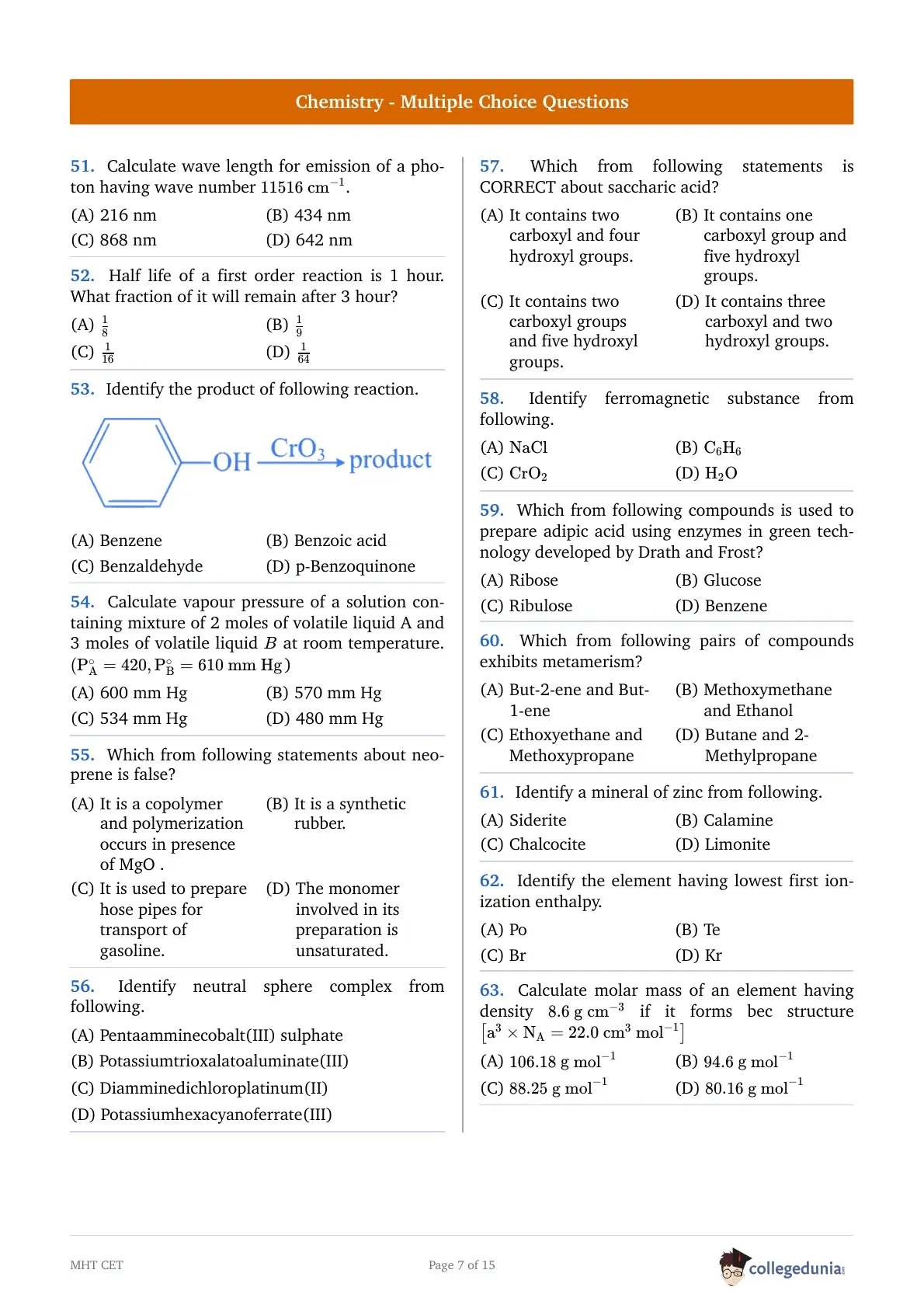
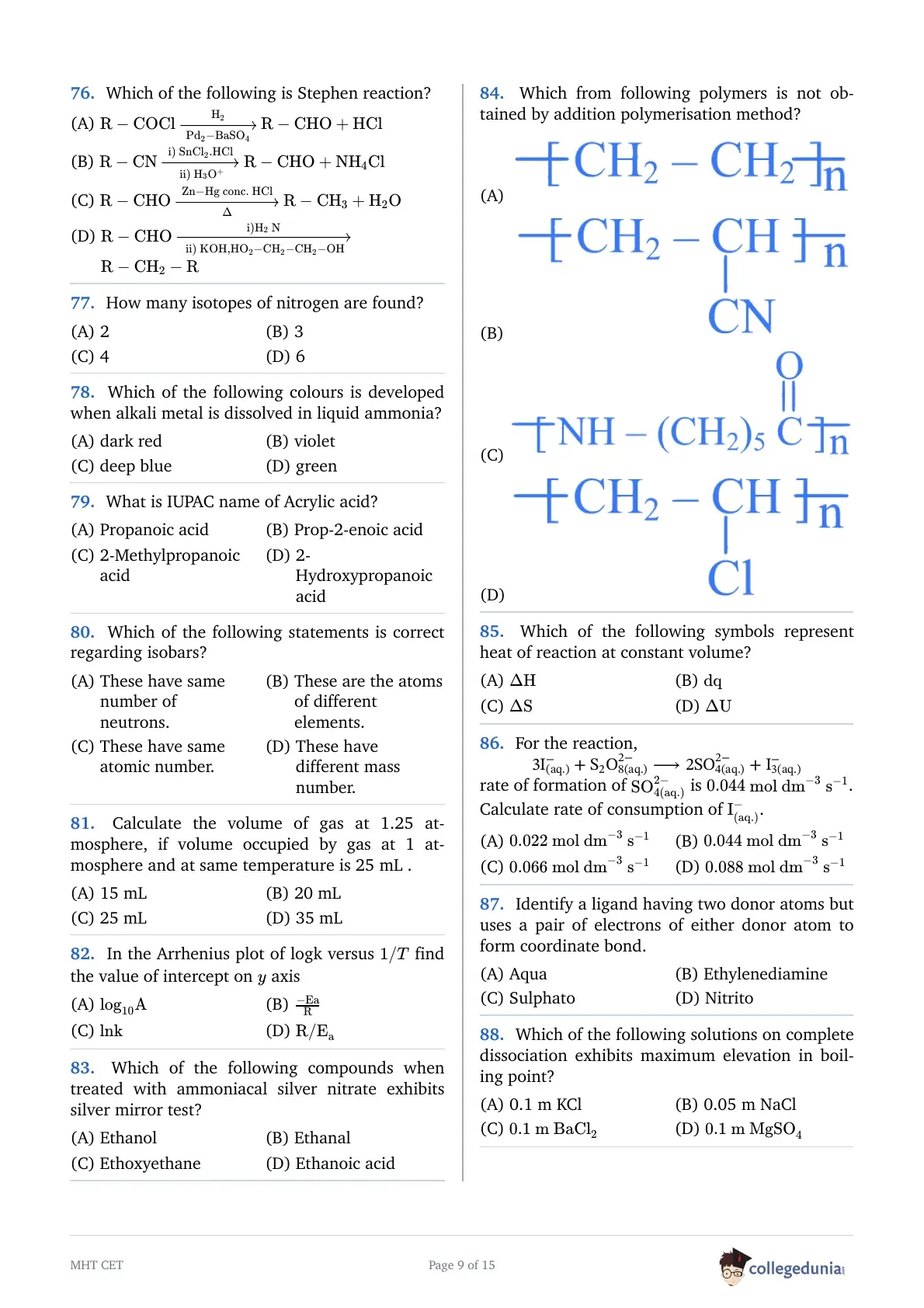
Calculate wave length for emission of a photon having wave number \(11516 \mathrm{~cm}^{-1}\).
Half life of a first order reaction is 1 hour. What fraction of it will remain after 3 hour?

Calculate vapour pressure of a solution containing mixture of 2 moles of volatile liquid A and 3 moles of volatile liquid \(B\) at room temperature. \(\left(\mathrm{P}_{\mathrm{A}}^{\circ}=420, \mathrm{P}_{\mathrm{B}}^{\circ}=610 \mathrm{~mm} \mathrm{~Hg}\right.\))
Which from following compounds is used to prepare adipic acid using enzymes in green technology developed by Drath and Frost?
Calculate molar mass of an element having density \(8.6 \mathrm{~g} \mathrm{~cm}^{-3}\) if it forms bec structure \(\left[\mathrm{a}^3 \times \mathrm{N}_{\mathrm{A}}=22.0 \mathrm{~cm}^3 \mathrm{~mol}^{-1}\right]\)
Which from following molecules does not have lone pair of electrons in valence shell of central atom?
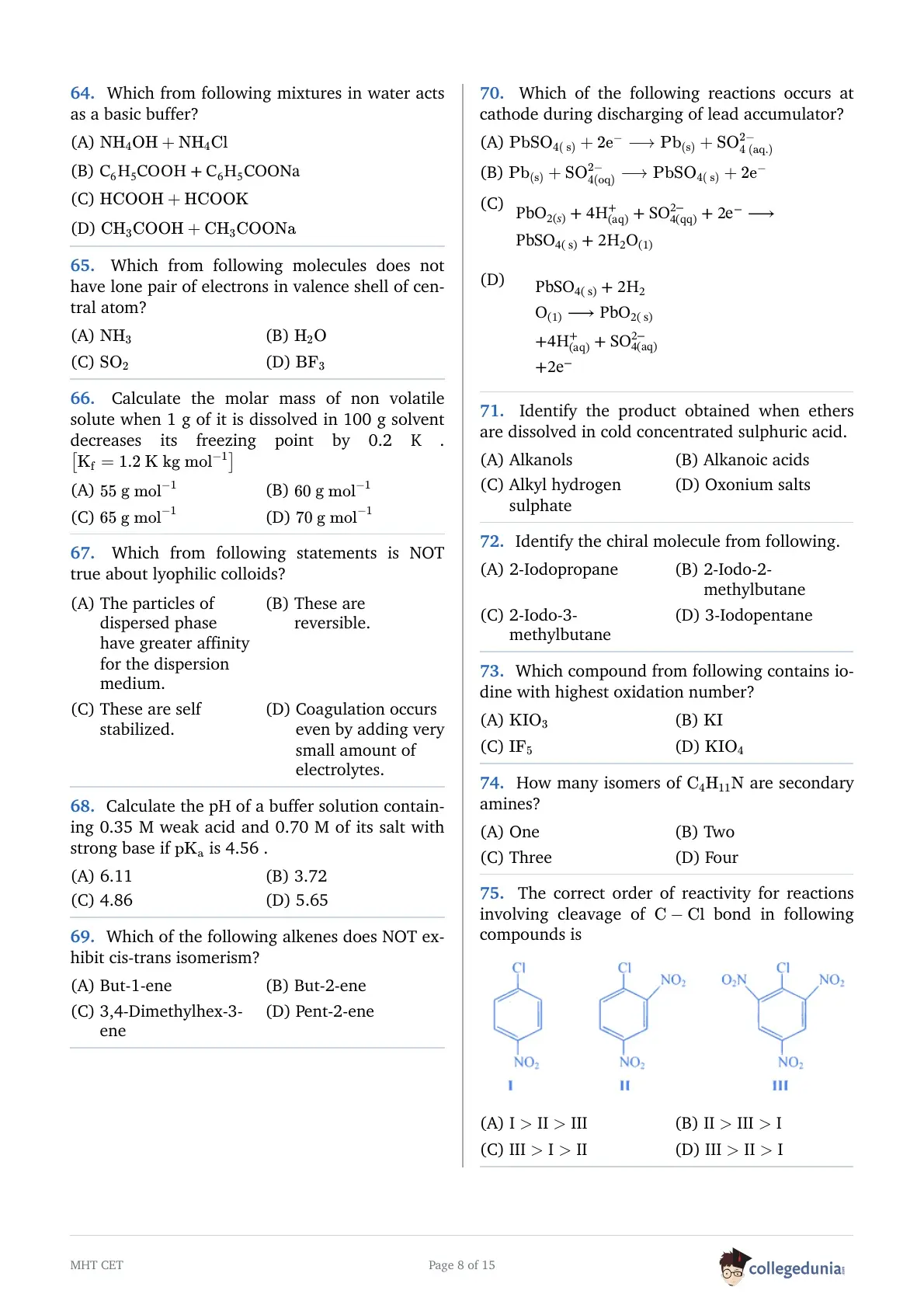
Calculate the molar mass of non volatile solute when 1 g of it is dissolved in 100 g solvent decreases its freezing point by 0.2 K . \(\left[\mathrm{K}_{\mathrm{f}}=1.2 \mathrm{~K} \mathrm{~kg} \mathrm{~mol}^{-1}\right]\)
Which from following statements is NOT true about lyophilic colloids?
Calculate the pH of a buffer solution containing 0.35 M weak acid and 0.70 M of its salt with strong base if \(\mathrm{pK}_{\mathrm{a}}\) is 4.56 .
Which of the following reactions occurs at cathode during discharging of lead accumulator?
Identify the product obtained when ethers are dissolved in cold concentrated sulphuric acid.
Which compound from following contains iodine with highest oxidation number?
The correct order of reactivity for reactions involving cleavage of \(\mathrm{C}-\mathrm{Cl}\) bond in following compounds is

Which of the following colours is developed when alkali metal is dissolved in liquid ammonia?
Calculate the volume of gas at 1.25 atmosphere, if volume occupied by gas at 1 atmosphere and at same temperature is 25 mL .
In the Arrhenius plot of logk versus \(1 / T\) find the value of intercept on \(y\) axis
Which of the following compounds when treated with ammoniacal silver nitrate exhibits silver mirror test?
Which from following polymers is not obtained by addition polymerisation method?
- (A)
![]()
- (B)
![]()
- (C)
![]()
- (D)
![]()


Which of the following symbols represent heat of reaction at constant volume?
For the reaction,
\[3 \mathrm{I}_{\mathrm{(aq.)}}^{-}+\mathrm{S}_2 \mathrm{O}_{8(\mathrm{aq.})}^{2-} \longrightarrow 2 \mathrm{SO}_{4(\mathrm{aq.})}^{2-}+\mathrm{I}_{3(\mathrm{aq.})}^{-}\]
rate of formation of \(\mathrm{SO}_{4(\mathrm{aq.})}^{2-}\) is \(0.044 \mathrm{~mol} \mathrm{~dm}^{-3} \mathrm{~s}^{-1}\).
Calculate rate of consumption of \(\mathrm{I}_{(\mathrm{aq.})}^{-}\).
Identify a ligand having two donor atoms but uses a pair of electrons of either donor atom to form coordinate bond.
Which of the following solutions on complete dissociation exhibits maximum elevation in boiling point?
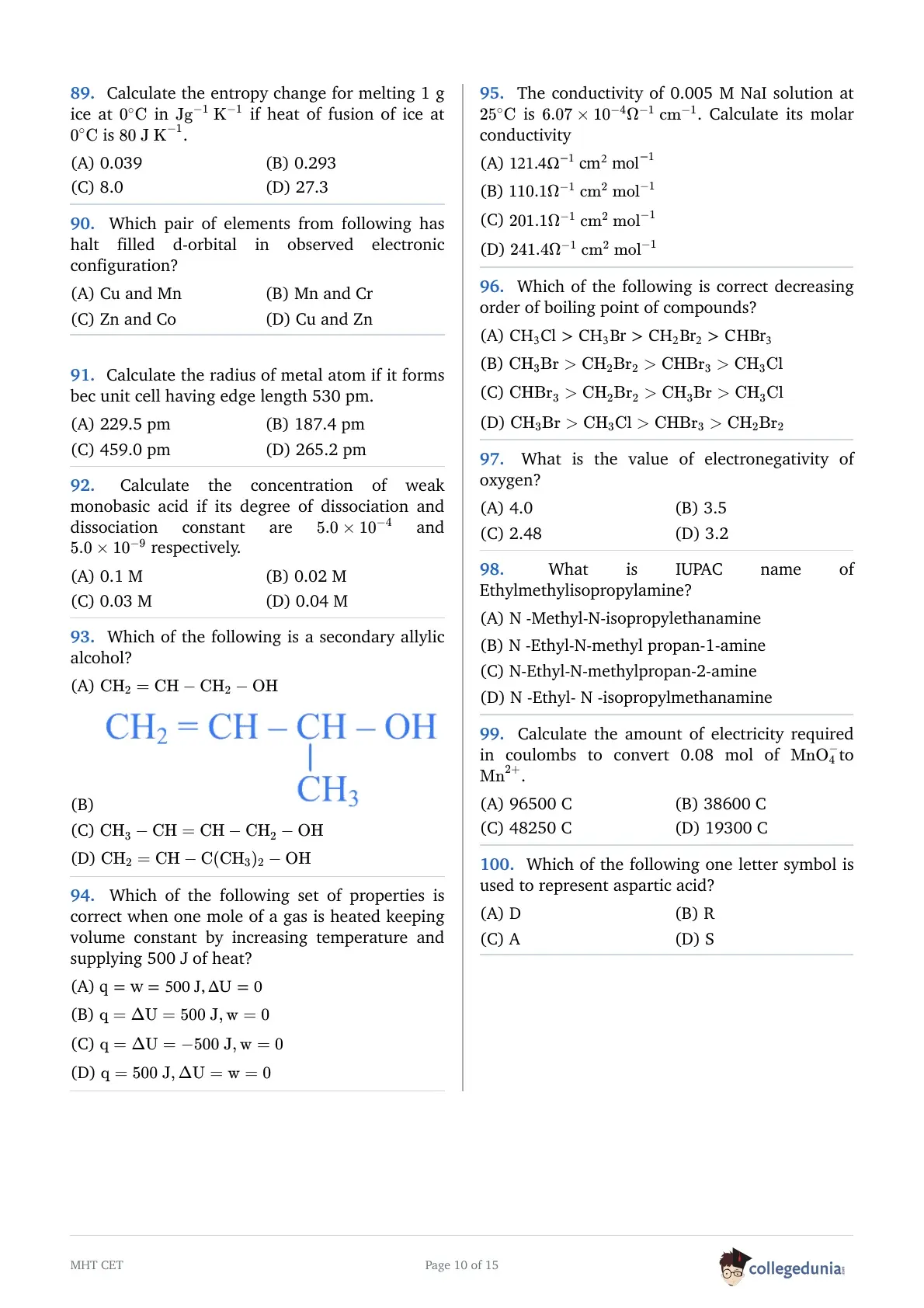
Calculate the entropy change for melting 1 g ice at \(0^{\circ} \mathrm{C}\) in \(\mathrm{Jg}^{-1} \mathrm{~K}^{-1}\) if heat of fusion of ice at \(0^{\circ} \mathrm{C}\) is \(80 \mathrm{~J} \mathrm{~K}^{-1}\).
Which pair of elements from following has halt filled d-orbital in observed electronic configuration?
Calculate the radius of metal atom if it forms bec unit cell having edge length 530 pm.
Calculate the concentration of weak monobasic acid if its degree of dissociation and dissociation constant are \(5.0 \times 10^{-4}\) and \(5.0 \times 10^{-9}\) respectively.
Which of the following is a secondary allylic alcohol?
- (A) \(\mathrm{CH}_{2}=\mathrm{CH}-\mathrm{CH}_{2}-\mathrm{OH}\)
- (B)
![]()
- (C) \(\mathrm{CH}_{3}-\mathrm{CH}=\mathrm{CH}-\mathrm{CH}_{2}-\mathrm{OH}\)
- (D) \(\mathrm{CH}_{2}=\mathrm{CH}-\mathrm{C}(\mathrm{CH}_{3})_{2}-\mathrm{OH}\)

Which of the following set of properties is correct when one mole of a gas is heated keeping volume constant by increasing temperature and supplying 500 J of heat?
The conductivity of 0.005 M NaI solution at \(25^{\circ} \mathrm{C}\) is \(6.07 \times 10^{-4} \Omega^{-1} \mathrm{~cm}^{-1}\). Calculate its molar conductivity
Which of the following is correct decreasing order of boiling point of compounds?
Calculate the amount of electricity required in coulombs to convert 0.08 mol of \(\mathrm{MnO}_4^{-}\)to \(\mathrm{Mn}^{2+}\).
Which of the following one letter symbol is used to represent aspartic acid?
Mathematics (Q101 - Q150)
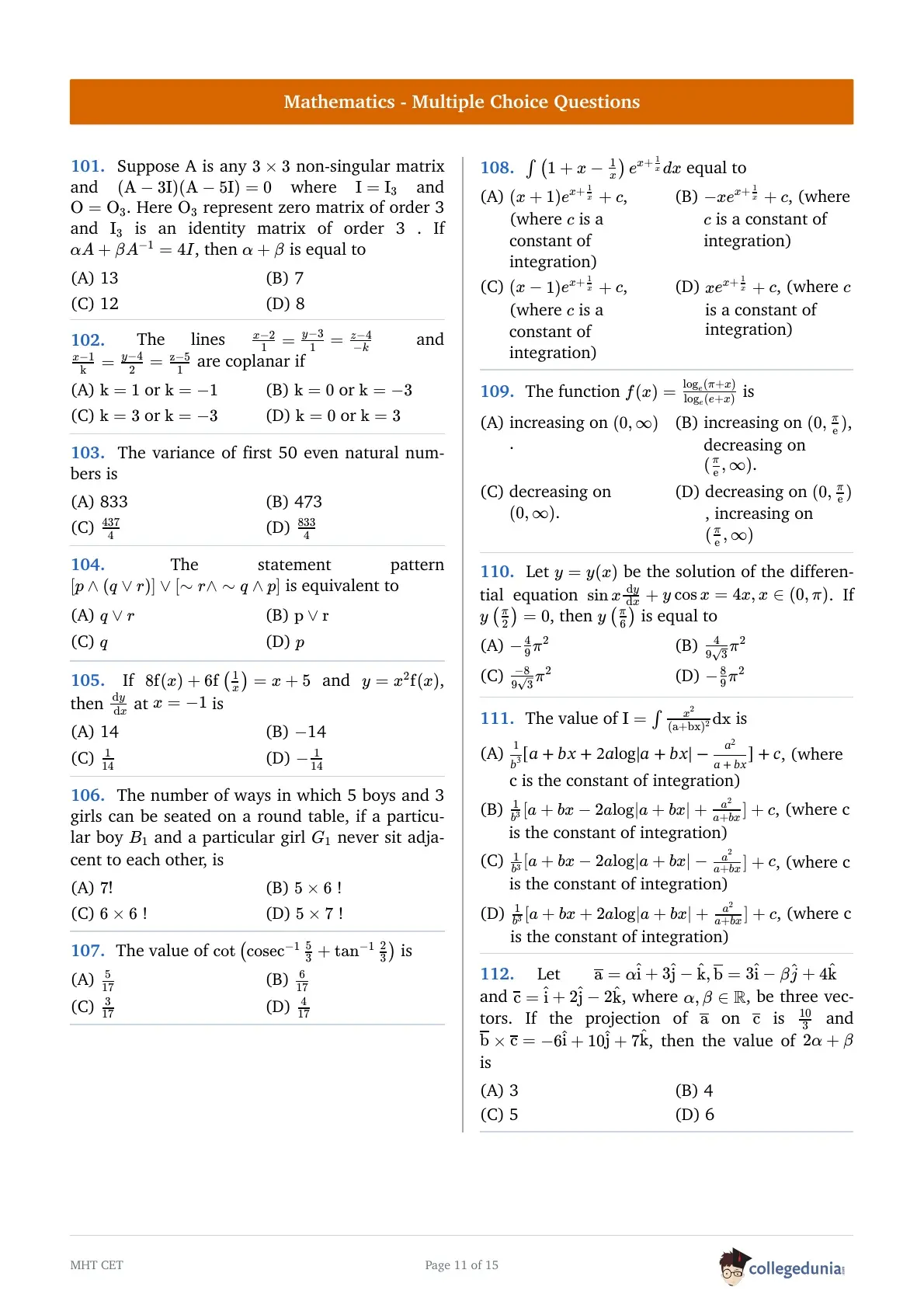
Suppose A is any \(3 \times 3\) non-singular matrix and \((\mathrm{A}-3 \mathrm{I})(\mathrm{A}-5 \mathrm{I})=0\) where \(\mathrm{I}=\mathrm{I}_3\) and \(\mathrm{O}=\mathrm{O}_3\). Here \(\mathrm{O}_3\) represent zero matrix of order 3 and \(\mathrm{I}_3\) is an identity matrix of order 3 . If \(\alpha A+\beta A^{-1}=4 I\), then \(\alpha+\beta\) is equal to
The lines \(\frac{x-2}{1}=\frac{y-3}{1}=\frac{z-4}{-k} \quad\) and \(\frac{x-1}{\mathrm{k}}=\frac{y-4}{2}=\frac{\mathrm{z}-5}{1}\) are coplanar if
The statement pattern \([p \wedge(q \vee r)] \vee[\sim r \wedge \sim q \wedge p]\) is equivalent to
If \(8 \mathrm{f}(x)+6 \mathrm{f}\left(\frac{1}{x}\right)=x+5\) and \(y=x^2 \mathrm{f}(x)\), then \(\frac{\mathrm{d} y}{\mathrm{~d} x}\) at \(x=-1\) is
The number of ways in which 5 boys and 3 girls can be seated on a round table, if a particular boy \(B_1\) and a particular girl \(G_1\) never sit adjacent to each other, is
The value of \(\cot \left(\operatorname{cosec}^{-1} \frac{5}{3}+\tan ^{-1} \frac{2}{3}\right)\) is
Let \(y=y(x)\) be the solution of the differential equation \(\sin x \frac{\mathrm{~d} y}{\mathrm{~d} x}+y \cos x=4 x, x \in(0, \pi)\). If \(y\left(\frac{\pi}{2}\right)=0\), then \(y\left(\frac{\pi}{6}\right)\) is equal to
The value of \(\mathrm{I}=\int \frac{x^2}{(\mathrm{a}+\mathrm{bx})^2} \mathrm{dx}\) is
Let \(\quad \overline{\mathrm{a}}=\alpha \hat{\mathrm{i}}+3 \hat{\mathrm{j}}-\hat{\mathrm{k}}, \overline{\mathrm{b}}=3 \hat{\mathrm{i}}-\beta \hat{j}+4 \hat{\mathrm{k}} \quad\) and \(\overline{\mathrm{c}}=\hat{\mathrm{i}}+2 \hat{\mathrm{j}}-2 \hat{\mathrm{k}}\), where \(\alpha, \beta \in \mathbb{R}\), be three vectors. If the projection of \(\overline{\mathrm{a}}\) on \(\overline{\mathrm{c}}\) is \(\frac{10}{3}\) and \(\overline{\mathrm{b}} \times \overline{\mathrm{c}}=-6 \hat{\mathrm{i}}+10 \hat{\mathrm{j}}+7 \hat{\mathrm{k}}\), then the value of \(2 \alpha+\beta\) is
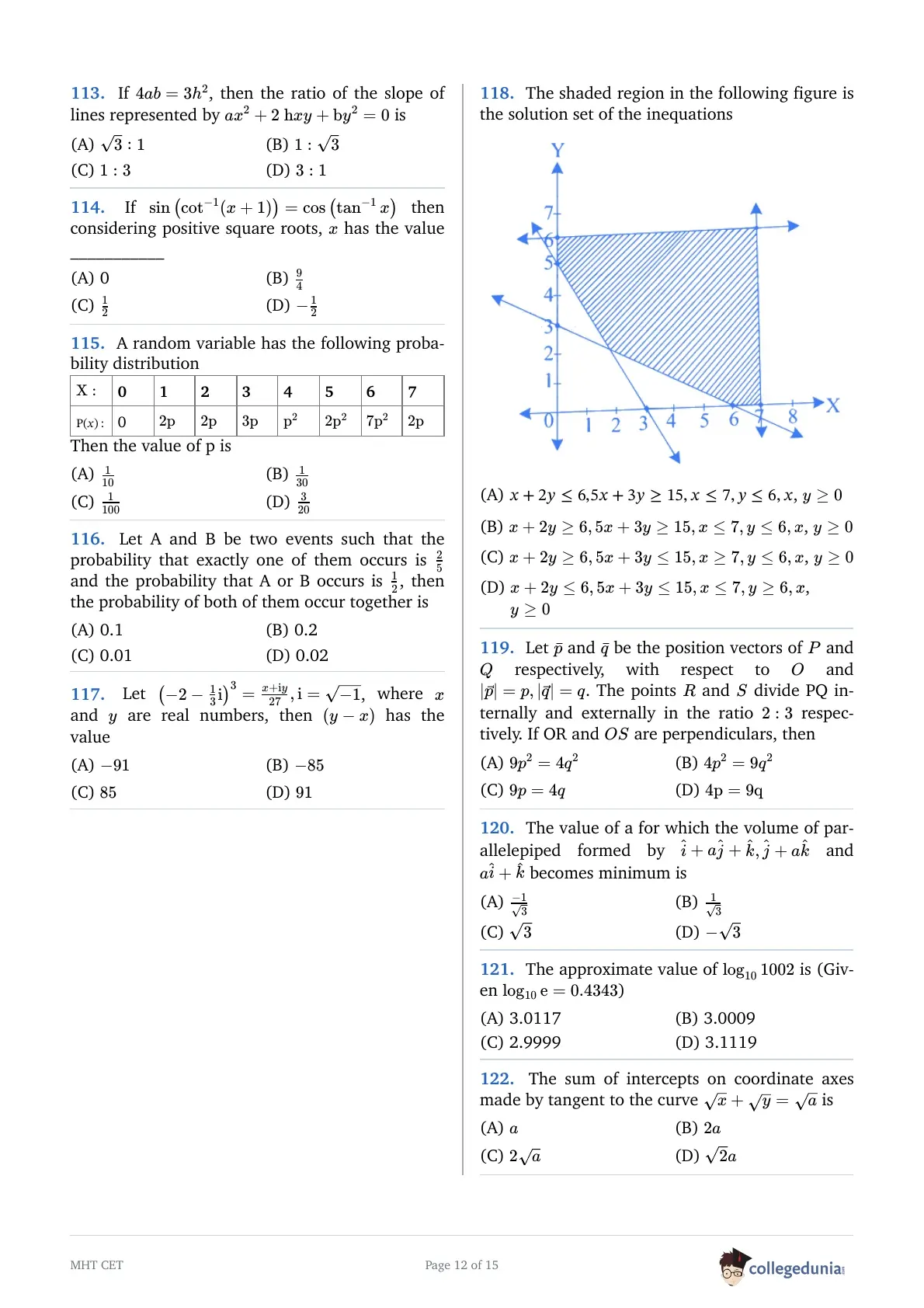
If \(\sin \left(\cot ^{-1}(x+1)\right)=\cos \left(\tan ^{-1} x\right)\) then considering positive square roots, \(x\) has the value ___________
A random variable has the following probability distribution
| \(\mathrm{X:}\) | 0 | 1 | 2 | 3 | 4 | 5 | 6 | 7 |
|---|---|---|---|---|---|---|---|---|
| \(\mathrm{P}(x):\) | 0 | \(\mathrm{2p}\) | \(\mathrm{2p}\) | \(\mathrm{3p}\) | \(\mathrm{p^2}\) | \(\mathrm{2p^2}\) | \(\mathrm{7p^2}\) | \(\mathrm{2p}\) |
Let A and B be two events such that the probability that exactly one of them occurs is \(\frac{2}{5}\) and the probability that A or B occurs is \(\frac{1}{2}\), then the probability of both of them occur together is
Let \(\left(-2-\frac{1}{3} \mathrm{i}\right)^3=\frac{x+\mathrm{i} y}{27}, \mathrm{i}=\sqrt{-1}\), where \(x\) and \(y\) are real numbers, then \((y-x)\) has the value
The shaded region in the following figure is the solution set of the inequations

Let \(\bar{p}\) and \(\bar{q}\) be the position vectors of \(P\) and \(Q\) respectively, with respect to \(O\) and \(|\vec{p}|=p,|\vec{q}|=q\). The points \(R\) and \(S\) divide PQ internally and externally in the ratio \(2: 3\) respectively. If OR and \(O S\) are perpendiculars, then
The value of a for which the volume of parallelepiped formed by \(\hat{i}+a \hat{j}+\hat{k}, \hat{j}+a \hat{k}\) and \(a \hat{i}+\hat{k}\) becomes minimum is
The approximate value of \(\log _{10} 1002\) is (Given \(\log _{10} \mathrm{e}=0.4343\))
The sum of intercepts on coordinate axes made by tangent to the curve \(\sqrt{x}+\sqrt{y}=\sqrt{a}\) is
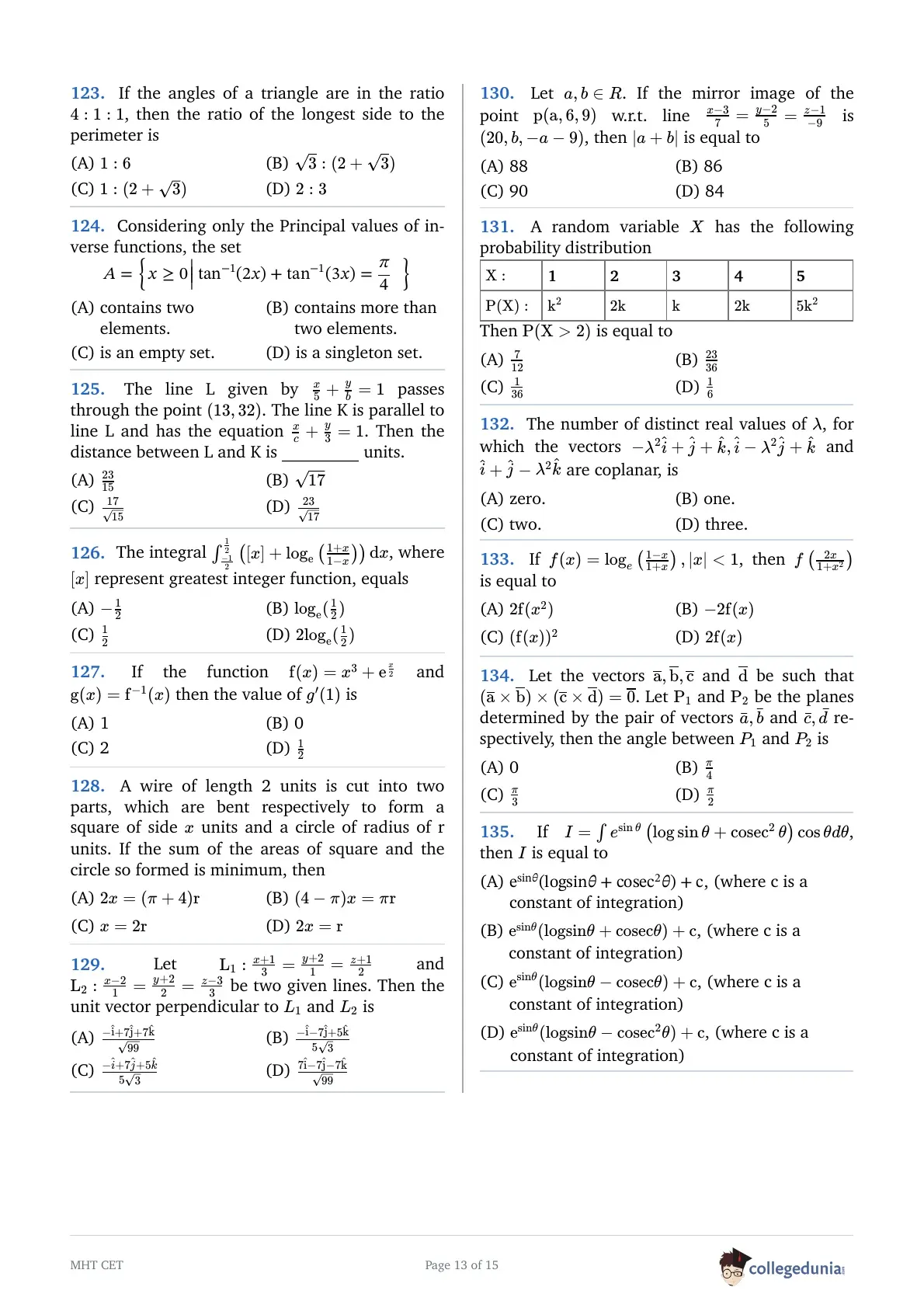
If the angles of a triangle are in the ratio \(4: 1: 1\), then the ratio of the longest side to the perimeter is
Considering only the Principal values of inverse functions, the set
\[A=\left\{x \geq 0 \left\lvert\, \tan ^{-1}(2 x)+\tan ^{-1}(3 x)=\frac{\pi}{4}\right.\right\}\]
The line L given by \(\frac{x}{5}+\frac{y}{b}=1\) passes through the point \((13,32)\). The line K is parallel to line L and has the equation \(\frac{x}{c}+\frac{y}{3}=1\). Then the distance between L and K is _________ units.
The integral \(\int_{\frac{-1}{2}}^{\frac{1}{2}}\left([x]+\log _{\mathrm{e}}\left(\frac{1+x}{1-x}\right)\right) \mathrm{d} x\), where \([x]\) represent greatest integer function, equals
If the function \(\mathrm{f}(x)=x^3+\mathrm{e}^{\frac{x}{2}}\) and \(\mathrm{g}(x)=\mathrm{f}^{-1}(x)\) then the value of \(g^{\prime}(1)\) is
A wire of length 2 units is cut into two parts, which are bent respectively to form a square of side \(x\) units and a circle of radius of r units. If the sum of the areas of square and the circle so formed is minimum, then
Let \(\mathrm{L}_1: \frac{x+1}{3}=\frac{y+2}{1}=\frac{z+1}{2}\) and \(\mathrm{L}_2: \frac{x-2}{1}=\frac{y+2}{2}=\frac{z-3}{3}\) be two given lines. Then the unit vector perpendicular to \(L_1\) and \(L_2\) is
Let \(a, b \in R\). If the mirror image of the point \(\mathrm{p}(\mathrm{a}, 6,9)\) w.r.t. line \(\frac{x-3}{7}=\frac{y-2}{5}=\frac{z-1}{-9}\) is \((20, b,-a-9)\), then \(|a+b|\) is equal to
A random variable \(X\) has the following probability distribution
| \(\mathrm{X:}\) | 1 | 2 | 3 | 4 | 5 |
|---|---|---|---|---|---|
| \(\mathrm{P(X):}\) | \(\mathrm{k^2}\) | \(\mathrm{2k}\) | \(\mathrm{k}\) | \(\mathrm{2k}\) | \(\mathrm{5k^2}\) |
The number of distinct real values of \(\lambda\), for which the vectors \(-\lambda^2 \hat{i}+\hat{j}+\hat{k}, \hat{i}-\lambda^2 \hat{j}+\hat{k}\) and \(\hat{i}+\hat{j}-\lambda^2 \hat{k}\) are coplanar, is
If \(f(x)=\log _e\left(\frac{1-x}{1+x}\right),|x|<1\), then \(f\left(\frac{2 x}{1+x^2}\right)\) is equal to
Let the vectors \(\overline{\mathrm{a}}, \overline{\mathrm{b}}, \overline{\mathrm{c}}\) and \(\overline{\mathrm{d}}\) be such that \((\overline{\mathrm{a}} \times \overline{\mathrm{b}}) \times(\overline{\mathrm{c}} \times \overline{\mathrm{d}})=\overline{0}\). Let \(\mathrm{P}_1\) and \(\mathrm{P}_2\) be the planes determined by the pair of vectors \(\bar{a}, \bar{b}\) and \(\bar{c}, \bar{d}\) respectively, then the angle between \(P_1\) and \(P_2\) is
If \(I=\int e^{\sin \theta}\left(\log \sin \theta+\operatorname{cosec}^2 \theta\right) \cos \theta d \theta\), then \(I\) is equal to
The equation of the circle which has its centre at the point \((3,4)\) and touches the line \(5 x+12 y-11=0\) is
A plane which is perpendicular to two planes \(2 x-2 y+z=0\) and \(x-y+2 z=4\), passes through \((1,-2,1)\). The distance of the plane from the point \((1,2,2)\) is
The value of the expression \(\sqrt{3} \operatorname{cosec} 20^{\circ}-\sec 20^{\circ}\) is equal to
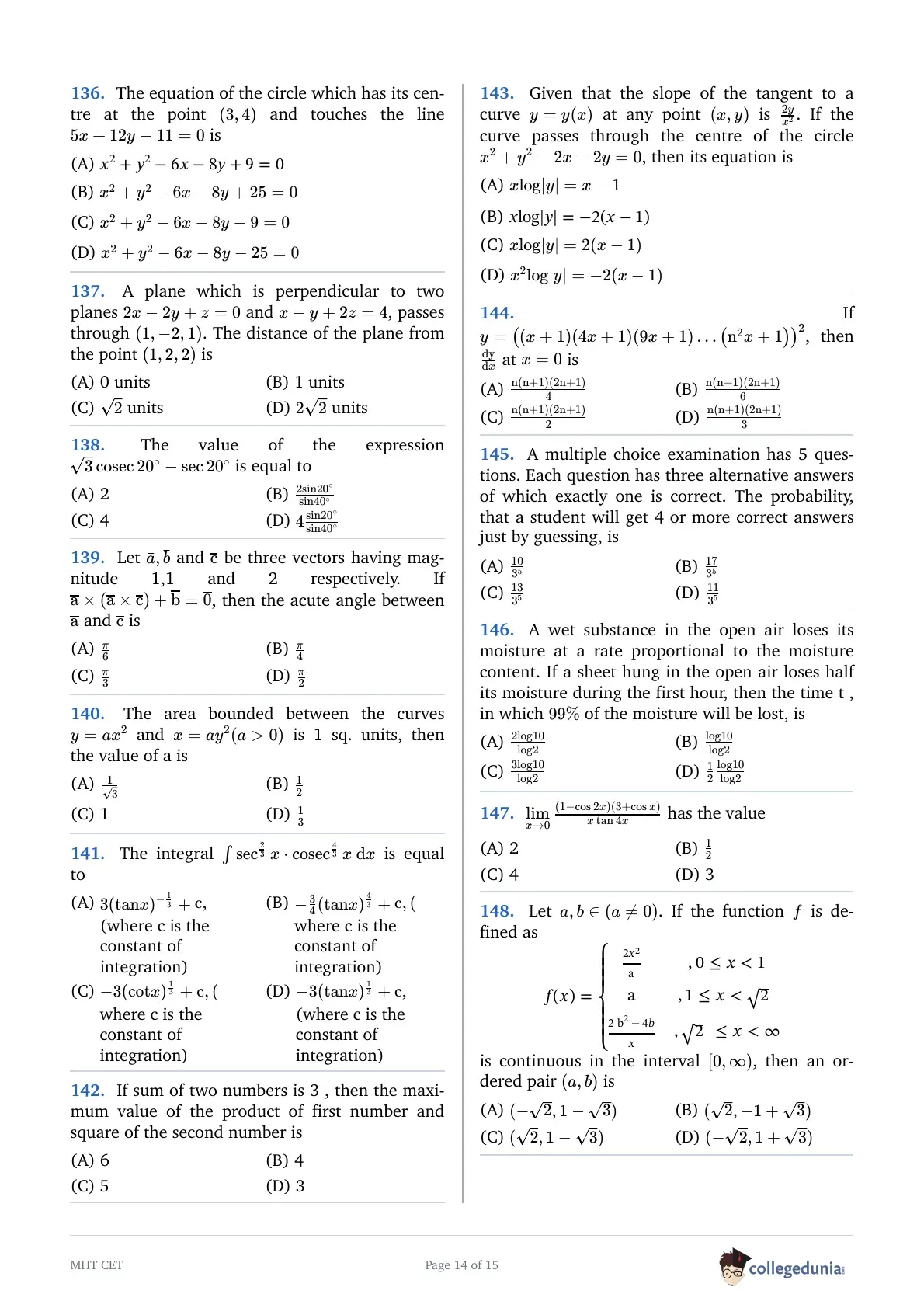
Let \(\bar{a}, \bar{b}\) and \(\overline{\mathrm{c}}\) be three vectors having magnitude 1,1 and 2 respectively. If \(\overline{\mathrm{a}} \times(\overline{\mathrm{a}} \times \overline{\mathrm{c}})+\overline{\mathrm{b}}=\overline{0}\), then the acute angle between \(\overline{\mathrm{a}}\) and \(\overline{\mathrm{c}}\) is
The area bounded between the curves \(y=a x^2\) and \(x=a y^2(a>0)\) is 1 sq. units, then the value of a is
If sum of two numbers is 3 , then the maximum value of the product of first number and square of the second number is
Given that the slope of the tangent to a curve \(y=y(x)\) at any point \((x, y)\) is \(\frac{2 y}{x^2}\). If the curve passes through the centre of the circle \(x^2+y^2-2 x-2 y=0\), then its equation is
If \(y=\left((x+1)(4 x+1)(9 x+1) \ldots\left(\mathrm{n}^2 x+1\right)\right)^2\), then \(\frac{\mathrm{dy}}{\mathrm{d} x}\) at \(x=0\) is
A multiple choice examination has 5 questions. Each question has three alternative answers of which exactly one is correct. The probability, that a student will get 4 or more correct answers just by guessing, is
A wet substance in the open air loses its moisture at a rate proportional to the moisture content. If a sheet hung in the open air loses half its moisture during the first hour, then the time t , in which \(99 \%\) of the moisture will be lost, is
\(\lim _\limits{x \rightarrow 0} \frac{(1-\cos 2 x)(3+\cos x)}{x \tan 4 x}\) has the value
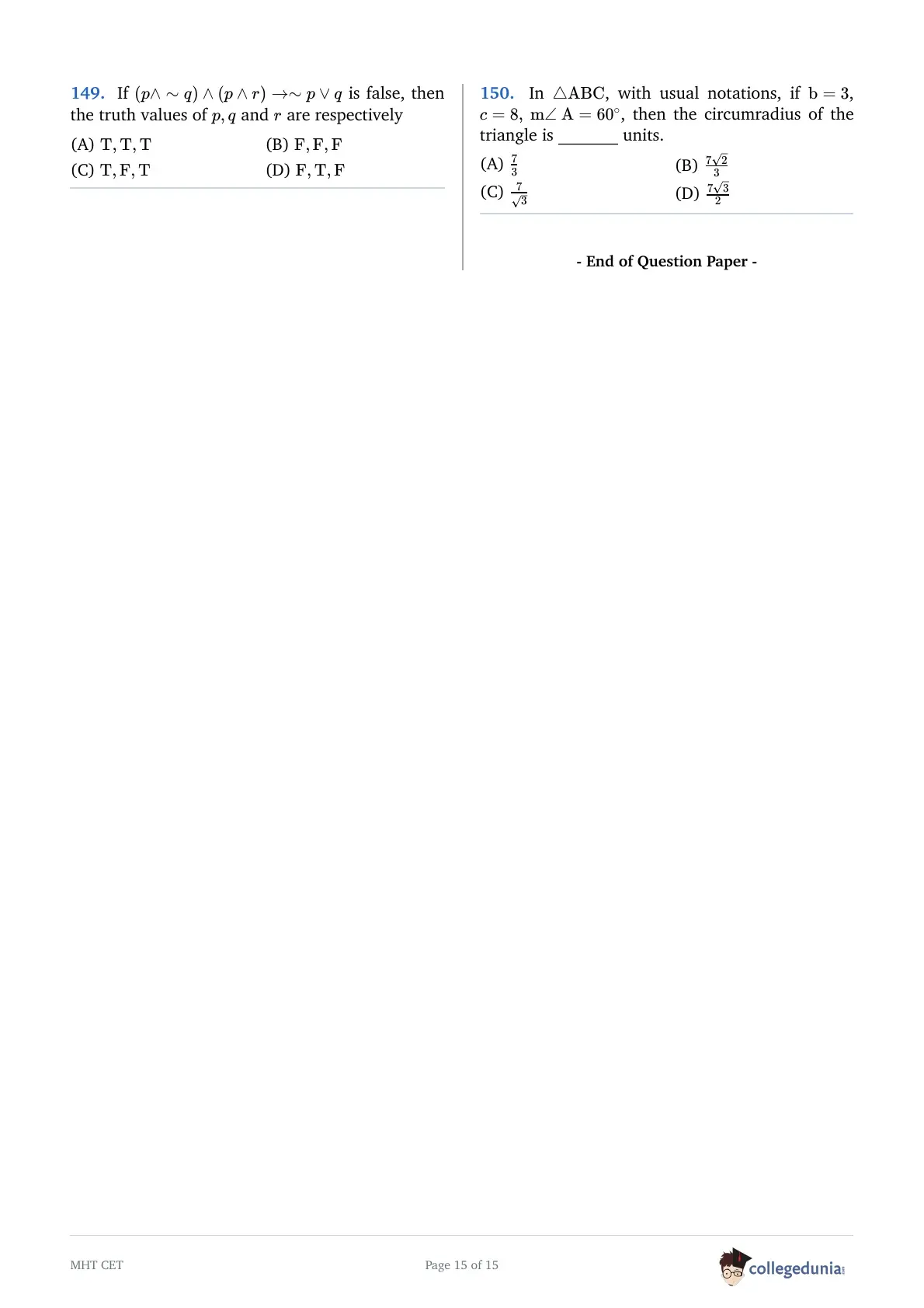
If \((p \wedge \sim q) \wedge(p \wedge r) \rightarrow \sim p \vee q\) is false, then the truth values of \(p, q\) and \(r\) are respectively
In \(\triangle \mathrm{ABC}\), with usual notations, if \(\mathrm{b}=3\), \(c=8, \mathrm{~m} \angle \mathrm{~A}=60^{\circ}\), then the circumradius of the triangle is _______ units.
MHT CET 2024 PCM Exam Pattern and Marking Scheme
| Parameter | Details |
|---|---|
| Conducting Body | Maharashtra Common Entrance Test Cell (Maharashtra CET Cell) |
| Exam Mode | Online (Computer-Based Test) |
| Duration | 180 minutes (3 hours) |
| Groups / Subjects | PCM (Physics, Chemistry, Mathematics) for Engineering |
| Total Questions |
150 |
| Total Marks | 200 |
| Question Type | Multiple Choice Questions (MCQs) |
| Marks Distribution |
|
| Negative Marking | No |
| Syllabus Weightage |
|



Comments